

Each semester, instructors of introductory American Government courses take up the challenge of providing civics education to new generations. In doing so, instructors strive to identify effective strategies for conveying information about government and the role of individuals in the political process, with the goal of equipping students to be informed and engaged citizens. One strategy is to make course material relatable to students. Although this approach has garnered attention from scholars of K–12 civics, textbook publishers, and popular-press authors, systematic evidence about the role of course relevance in college civics coursework is lacking. Our study fills this gap by testing the impact of a pedagogical technique aimed at increasing course relevance: namely, highlighting the roles and contributions of “regular people.”
Young people often feel that civics courses are “disconnected from their lives and political concerns” (Nelsen Reference Nelsen2023, 3). Focusing on the high school level, Nelsen (Reference Nelsen2023, 4) found that civics education is most impactful when it is “meaningfully embedded in local context and connected to the lives and experiences of students” (see also Haduong et al. Reference Haduong, Jeffries, Pao, Webb, Allen and Kidd2023; Levinson Reference Levinson2012). Using experimental evidence—some students were exposed to excerpts of narratives about marginalized groups taking collective political action—Nelsen (Reference Nelsen2023) demonstrated how making course content more relatable can decrease gaps in political engagement among racial groups. This reinforces the notion that, at its best, civics education can have a pronounced impact in preparing disadvantaged youth for active citizenship (Campbell Reference Campbell2019). However, even well-meaning instructors may struggle to deliver effective and engaging civics lessons, especially when they face the challenges of time constraints, large enrollments, and disinterested audiences that are common in introductory American Government courses.
Increasingly, publishers have attempted to make American politics textbooks more relevant to traditional college-aged students, providing a key tool for instructors. In their textbook, Geer et al. (Reference Geer, Herrera, Schiller and Segal2024) begin each chapter with vignettes about individuals that emphasized where they attended college and how their stories connected to lessons in the chapter. Similarly, each chapter of Lowi et al.’s (Reference Lowi, Shepsle, Ginsberg, Ansolabehere and Han2025) textbook features a case study of a person who has engaged with government.
This trend extends beyond textbooks. For example, Lewis’s (Reference Lewis2026) general-audience book profiles government workers who have made a major and often unseen impact on society. The book’s popularity suggests that narratives about relatable, ordinary individuals and their impact in public life may resonate with broad audiences.
Combined, these examples illustrate the efforts to make the subject of politics relevant to individuals. Aligned with these efforts, we explored how college instructors might make American Government courses more relevant to students by examining the efficacy of sharing the narratives of relatable people who have made an impact in politics.
An introductory American Government course is a promising setting for testing the effect of personal narratives on student learning. The course often is a general education requirement intended to serve as the capstone to a student’s civics education. As such, students are more likely to begin the course unaware of the relevance of politics to their life because they have not self-selected based on interest in the topic. If we were to find that narratives of relatable and politically active but low-salience individuals can foster students’ sense that politics is relevant and that they too can become involved, then we will have found evidence of an effective and scalable intervention that could broadly improve civics education.
Therefore, we asked: Does highlighting the roles and contributions of regular people help course material to feel more relevant to students? If so, does increased course relevance correspond to increases in other key civics learning outcomes, such as internal political efficacy (i.e., the feeling that one has the knowledge and skills to make a difference in the political process)?
We addressed these questions by surveying students enrolled in two in-person sections of Introduction to American Government taught by the same instructor at a large, public university. Otherwise similar, one section was presented profiles of ordinary people whose narratives tied into the weekly topics and whose backgrounds and experiences spoke to the political involvement of a broad array of subgroups within the US population; the other section was not. By isolating the impact of these regular people profiles, we found that the interventions increased the extent to which the course was perceived as personally relevant and that course relevance mediates student growth in internal political efficacy. In other words, increasing course relevance can boost internal political efficacy, a key civics education learning outcome.
Our analysis illuminates the role of course relevance in civics education and suggests a way to strengthen the effectiveness of required college civics coursework. We extended the literatures on K–12 civics and on course relevance from other disciplines to find an effective, flexible, and scalable approach for instructors at various types of institutions and across modalities. We demonstrated that deploying regular people interventions in college-level civics courses can boost students’ internal political efficacy, thereby equipping them to be active participants in democracy.
Our analysis illuminates the role of course relevance in civics education and suggests a way to strengthen the effectiveness of required college civics coursework.
We extended the literature on K–12 civics and on course relevance from other disciplines to find an effective, flexible, and scalable approach for instructors at various institutions and across modalities.
EXPECTATIONS
The development of the concept of course relevance and the techniques for enhancing it have been examined across disciplines. Making course content personally relevant means contextualizing it so that it is perceived as meaningful and connected to students’ lives (Gilbert Reference Gilbert2006).Footnote 1 This can be accomplished by reinforcing how the content helps students to find and understand their role in society, promote their own interests, and act responsibly as citizens (Stuckey et al. Reference Stuckey, Hofstein, Mamlok-Naaman and Eilks2013). Successfully making course material more relevant should promote a sense of ownership over learning (Gilbert Reference Gilbert2006). Studies of course relevance in the social sciences indicate that students who found the material more relevant were more motivated to study (Frymier and Shulman Reference Frymier and Shulman1995).
Furthermore, we also know that narratives are the preferred way most people make sense of the political world (Jones et al. Reference Jones, Smith-Walter, McBeth, Shanahan, Sabatier and Weible2023). Narratives help people to understand public problems and proposed solutions as well as the roles that individuals and groups play in politics (Jones et al. Reference Jones, Smith-Walter, McBeth, Shanahan, Sabatier and Weible2023; Patterson and Monroe Reference Patterson and Monroe1998). Narratives likely have a similar role in helping students to understand the relevance of politics to their life and the important role individuals can have in the political process.
Nelsen’s (Reference Nelsen2023) deep examination of high school civics courses confirmed that students often feel disconnected from course material (see also Junn Reference Junn2004). However, Nelsen (Reference Nelsen2023) found that this can be addressed by grounding course material in narratives about the agency and collective action of relatable individuals. Altering course content to explicitly emphasize narratives of people who lacked political power but took meaningful action can help a wide array of students to develop their personal civic identity (Haduong et al. Reference Haduong, Jeffries, Pao, Webb, Allen and Kidd2023) and feelings of political empowerment (Levinson Reference Levinson2012; Nelsen Reference Nelsen2023).
Following Nelsen (Reference Nelsen2023), we submit that three mechanisms might facilitate students finding narratives of the contributions of ordinary people relevant to them. While we do not attempt to distinguish which of these mechanisms may be operating via the treatment, they provide theoretical underpinning for our expectations. First, having role models—especially relatable ordinary individuals who may have faced a social disadvantage(s)—may illuminate a plausible path for political engagement (Bobo and Gilliam Reference Bobo and Gilliam1990). Second, exposure to these narratives may cultivate a positive sense of agency, thereby paving the way for increased internal political efficacy and participation (García-Bedolla Reference García-Bedolla2005). Third, learning about ordinary individuals who share one’s racial or ethnic background may activate a sense of linked fate or the belief that one’s “own self-interests are linked to the interests of the race” (Dawson Reference Dawson1994, 77). Connection to a broader identity-based group in turn may shape individuals’ self-perception and their role in politics.
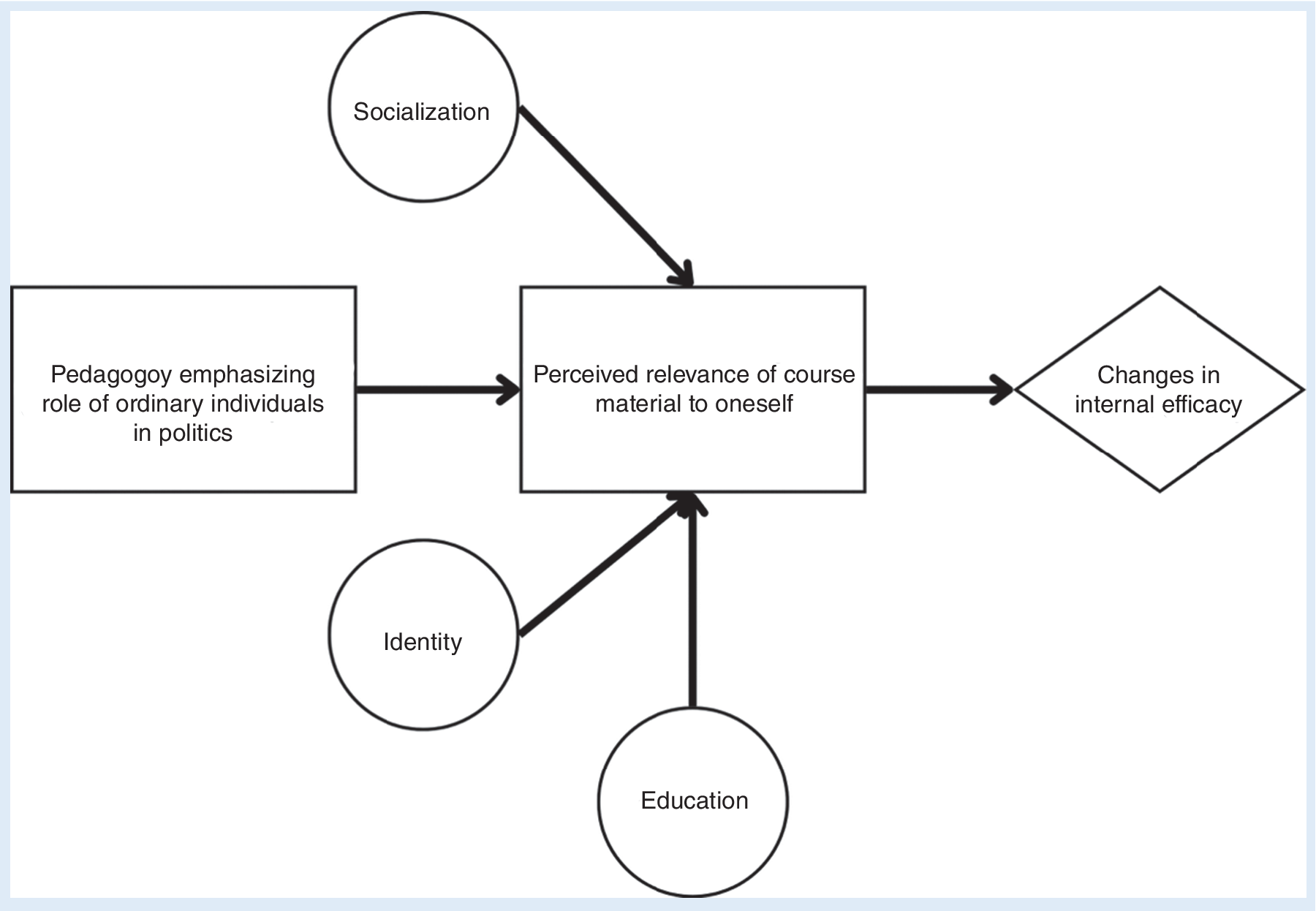
Applying these lessons to collegiate civics education, we present our theoretical expectations in the central pathway depicted by the rectangles and the diamond in figure 1. We anticipated a mediating relationship in which the pedagogical treatment facilitates growth in internal political efficacy by shaping students’ perceptions of course relevance. The narratives in the regular people profiles emphasize how ordinary individuals—those working behind the scenes in government or politics and/or in lower-profile positions coming from a variety of backgrounds—have been involved in politics and government. We expected that the instructional approach of emphasizing the role of regular people in the political process would provide a way for students to relate to and connect with course content, thereby increasing the extent to which they find it personally relevant.
Theoretical Framework

Figure 1 Long description
Starting at the left, a rectangle labeled Pedagogy emphasizing role of ordinary individuals in politics has a rightward arrow pointing to a central rectangle labeled Perceived relevance of course material to oneself. From this central rectangle, a rightward arrow leads to a diamond labeled Changes in internal efficacy. Above the central rectangle, a circle labeled Socialization connects downward with a diagonal arrow. Below the central rectangle, a circle labeled Identity connects upward with a diagonal arrow, and a circle labeled Education connects upward with a diagonal arrow to the Identity circle.
The mediational pathway approach also proposes that increased personal relevance should lead to greater gains in students’ internal political efficacy, which is widely accepted as a key civics education learning outcome (Beaumont Reference Beaumont2011). Moreover, it has been demonstrated that college civics courses have the capacity to boost internal political efficacy (Matthews and Hullinger Reference Matthews and Hullinger2018). Because the profiles focus on individuals’ relatability and the contributions that they have made and roles that they have played, we anticipated that exposure to the regular people treatment, through course relevance, would shape internal political efficacy—the feeling that one has the knowledge and skills to make a difference in the political process.Footnote 2 Therefore, we expected growth in internal political efficacy to be pronounced when students were exposed explicitly to lessons that contextualize key course topics with personal narratives of relatable people in government, politics, and advocacy.
It is important to note that factors such as students’ identity, socialization, and education also shape their views on the relevance of their civics coursework. These factors, which are not on the central pathway, are represented by circles in figure 1. Identities govern the affective reactions that people have toward stimuli (Baumeister and Leary Reference Baumeister and Leary1995) and help them to process what is and is not important (Huddy Reference Huddy2001). Identities, therefore, may shape students’ judgments about the relevance of the course material to their life. This is especially likely because part of the process of civics education involves exposing students to material that may have implications for their identity group(s)—regardless of whether they are in the treatment or the control group.
Socialization also matters because people can be primed from a young age to think certain ways about the world. A voluminous literature identifies parents’ crucial role in a child’s political socialization (Jennings, Stoker, and Bowers Reference Jennings, Stoker and Bowers2009). By the time individuals reach college, they already may have formed ideas—fostered by their parents—about politics and its relevancy to their life.
Finally, students’ educational background may shape the extent to which they connect with course material. Through the process of schooling, students gain interests in different subjects and career paths, demonstrate aptitude in learning new subjects, and sharpen cognitive and metacognitive skills.
RESEARCH DESIGN
We identified and profiled regular people whose narratives tied into major topics in American Government courses and whose background or personal experiences spoke to a broad array of subgroups in the US population (e.g., blue-collar workers, minority groups, women, and youth). For example, several of the profiled individuals were 30 years old or younger, 50% were women, 43% were racial or ethnic minorities, and the regular people featured included those with disabilities and an openly gay lobbyist. Several had state or regional connections to the location of the university at which the courses were being taught. The individuals selected were not well known to a general audience but instead tended to be ordinary citizens (e.g., teachers and firefighters) and/or those working behind the scenes in government or politics (e.g., staffers) or in lower-profile positions (e.g., a lower court judge and a state representative).
We tested the effectiveness of the regular people profiles by surveying two in-person sections of the American Government course taught the same way by the same instructor except that one section received the regular people treatment and the other section comprised the control group.Footnote 3 A profile was presented to the treatment section approximately once a week to introduce each major course topic. To facilitate the consistent application of this approach, we read from a script highlighting the profiled individuals and their connection to the current topic. A PowerPoint slide with a photograph of the person reinforced key aspects of the profile. When we designed this approach, we sought to include local context (Levinson Reference Levinson2012) and make connections to the daily life and experiences of students (Nelsen Reference Nelsen2023). We also considered the time constraints that instructors face as they prepare for class. Thus, the treatment was relatively weak; students learned about the regular person for about 5 minutes once a week at the beginning of a new lesson.
As much as possible, each profile included information about (1) the individual’s relatability; (2) their connection to a marginalized or historically underrepresented group; (3) how and why they became involved in politics, emphasizing any grassroots tactics or collective action used to make a difference (Nelsen Reference Nelsen2023); and (4) how they connected to the current course topic.
Relatability
In each narrative, we included details of the person’s life that might be relatable to our college-aged audience. Their youth, elements from their childhood, origins in lower-level jobs or volunteer opportunities, and an emerging passion for politics were common themes. Given our location, we also highlighted connections to Oklahoma or the region (Levinson Reference Levinson2012). For example:
Fleisher is the Gen Z founder of Wake Up to Politics, a newsletter with the tagline, “Helping you wade through the world of politics, five days a week.” He has gone from having one subscriber—his mom—to having…readers in all 50 states….After growing up in St. Louis, Fleisher…graduated from college…and has now expanded Wake Up to Politics to a full-time job….He recognizes that public trust in the media is historically low and that trust is particularly lacking among people his age—Gen Z. Fleisher wants “to provide a place where people of all political stripes could come to, not to be told how to think—but to understand how their government worked”.…Fleisher demonstrates that college-age individuals can play a positive role in American democracy.
Whenever possible, we traced people’s narratives back to their childhood to learn how their interest in politics may have been stoked, in the hope of kindling a similar interest among our student audience. For example, we noted how Richard Tisei, the chairperson of the Log Cabin Republicans, visited the Massachusetts State House when he was in high school, which cultivated his interest in politics despite coming from an apolitical family.
Connection to Underrepresented Groups
Most of the people we featured were members of underrepresented or marginalized groups and we highlighted this aspect of their background. For example:
Humetewa credits her parents for inspiring her to work in public service. Both of her parents attended Indian boarding schools and had fewer opportunities than others of their generation. Her father served in the US Navy and later worked for the Bureau of Indian Affairs….Her experiences accompanying her father on work trips across Arizona and to other Native American reservations informed her work as an attorney and as a judge. Having worked in both the tribal and US federal justice systems, Judge Humetewa has been leading an effort in Arizona to identify and increase ways the tribal and federal court systems can work together to facilitate justice.
We also selected individuals who worked on behalf of groups that are underrepresented in politics, even if they were not a member of an underrepresented group themselves. An example is Barry Maguire’s 1965 protest anthem, “Eve of Destruction,” which advocated for youth voting rights.
Behind the Scenes Political Involvement and/or Grassroots/Collective Action Approach
Rather than selecting high-profile insiders, we emphasized behind-the-scenes staffers, appointees, activists, organizers, and state and local candidates. These highly accomplished individuals highlight aspects of political involvement that are more accessible and relatable than being elected a governor, a legislator, or a president. For example, Clara Luper’s profile highlighted her grassroots organizing:
Luper and the youth council members, many of whom were local teens and young schoolchildren, thought about how they could demonstrate their discontent with racial segregation and hasten its end. Their first target was Katz’s drugstore, a chain of segregated supermarkets that had lunch counters….In August 1958, Luper and the youth decided to stage a “sit-in” at Katz’s. By walking into the store, ordering sodas, and refusing to leave until served, the Luper-led youth launched the nation’s sit-in movement—a full year and a half before better-known sit-ins in Greensboro, North Carolina….Just two days after the start of the sit-in, Katz desegregated its lunch counters in Oklahoma and two other states.
Connection to the Weekly Topic
Each person’s narrative was explicitly connected to material that students would encounter each week. For example, the profiles presented previously were used as introductions to media (Fleisher), interest groups (Tisei), courts (Humetewa), the Constitution (Maguire), and civil rights and liberties (Luper). Online appendix table A1 is a complete list of the people profiled and the topics they introduced.
KEY MEASURES AND BIVARIATE RESULTS
We administered a two-wave survey to students enrolled in the two sections of Introduction to American Government, both of which were taught by the same instructor at a large, public university in Fall 2024.Footnote 4 This course is required for all students seeking a bachelor’s degree at the university. It is an ideal venue for testing how instructors can foster student perceptions of course relevance because a large majority of students take the course only because it is required.
Students were invited to complete a Qualtrics-based survey via email and informed that they could earn extra credit for participating in the study. A total of 168 students completed both waves of the survey, yielding an overall response rate of 49.5% (Jansa and Ringsmuth Reference Jansa and Ringsmuth2026). As shown in online appendix table A2, the control and treatment groups had relatively minor differences across demographic factors. For example, a higher percentage of students identified as racial/ethnic minorities in the control group compared to the treatment group. In the following models, we controlled for demographic characteristics to account for the possibility that these differences, rather than the treatment, were driving the observed results.
We asked students to rate course relevance by indicating the extent to which they agreed with the statement, “The course was relevant to me personally,” on a 5-point scale ranging from “strongly disagree” (0) to “strongly agree” (4). This question was asked only in wave 2 so their answers could consider their full experience in the course.
The key independent variable in the course relevance model was whether the student’s section received the regular people treatment (1) or not (0). We expected that students who received the treatment highlighting the actions of a wide array of relatable and regular people to find the American Government course material more relevant, on average, than those who did not.
We also assessed the change or difference in a student’s internal political efficacy—that is, the feeling that they can make a difference in the political process because they have the knowledge and skills needed to do so—from wave 1 to wave 2. We captured internal political efficacy in each wave using five items: if students felt that (1) they have a good understanding of the issues; (2) they have a role to play in the political process; (3) they are comfortable contributing to political discussions; (4) they are well qualified to participate in politics; and (5) politics is too complicated to understand. Students indicated agreement on a 5-point scale ranging from “strongly disagree” to “strongly agree.” We created an additive index based largely on Beaumont’s (Reference Beaumont2011) measure for each waveFootnote 5 with a maximum score of 20 and rescale responses so that they ranged from low to high internal political efficacy. We then subtracted wave 1 from wave 2 to generate the change variable.
The profiles highlighted the political involvement—whether formal or informal—of individuals from ordinary backgrounds and those with connections to groups and subgroups that have been marginalized or historically underrepresented (e.g., blue-collar workers, minority groups, women, youth, and people with disabilities) and how their efforts made a difference in the political process. We expected that this theme would enhance students’ perceptions that course material about the workings of government and politics is relevant to them. This then should boost their internal political efficacy.
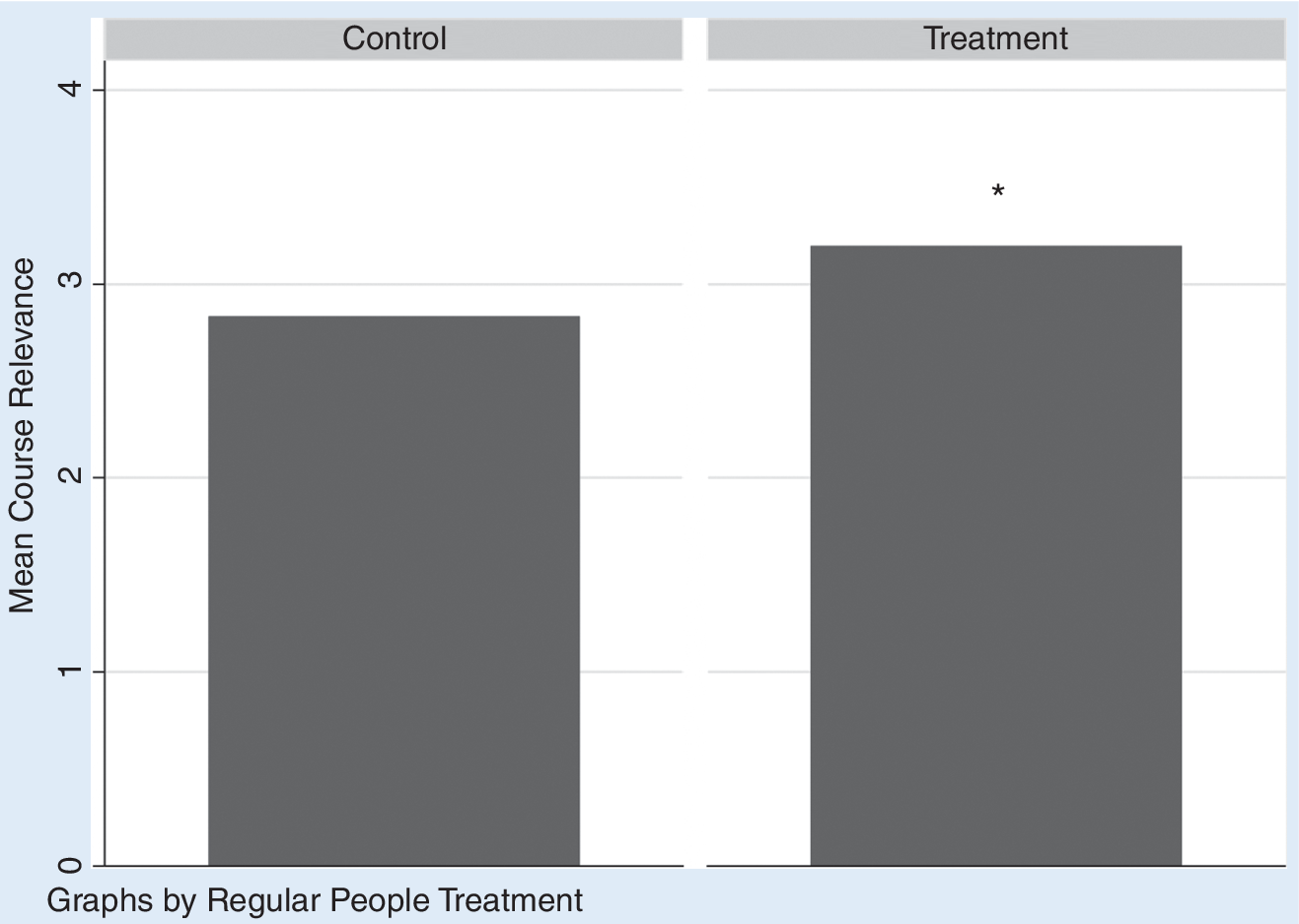
Figure 2 is a comparison of the average course relevance rating for the two sections at the end of the semester. As shown in the left panel of the figure, the mean for course relevance among students in the control group was 2.8 and the mean was 3.2 for students who received the regular people treatment. This was a statistically significant difference of 0.4 points—with 95% confidence that the difference is 0.3 or greater—compared to the control group based on a one-tailed t-test.Footnote 6 The difference of 0.4 points is equivalent to 10% of the course relevance scale. This provided preliminary evidence that the regular people treatment helped students to connect with course material, thereby increasing the extent to which they found it personally relevant.
Mean Course Relevance Rating in Control versus Treatment Groups
*=Difference in means p<0.05, one-tailed.

NON-RANDOM ASSIGNMENT AND CONTROLLING FOR OTHER FACTORS
However, the treatment was not randomly assigned; therefore, we controlled for additional factors (i.e., identity, socialization, and education) that were likely to shape students’ thoughts on the relevance of American Government course material and their subsequent growth in internal political efficacy. Previous research has documented how demographic characteristics (e.g., gender, race, and rural identity) have a role in views about and participation in politics, as well as how these characteristics impact civics education (Campbell and Niemi Reference Campbell and Niemi2016; Cramer Reference Cramer2016; Karpowitz and Mendelberg Reference Karpowitz and Mendelberg2014). To account for how identity can shape views about the course or students’ experiences in it, we asked about gender, racial/ethnic minority status, and rural identity.Footnote 7 Other scholars also have highlighted the important downstream consequences of students’ political socialization for their civics education (Neundorf, Niemi, and Smets Reference Neundorf, Niemi and Smets2016). We captured two aspects of their socialization experience: (1) whether they were from a college-educated household; and (2) the extent to which their parent(s) discussed politics when they were growing up. We also controlled for students’ educational background with variables that captured their class standing (e.g., sophomore), whether they were an arts and sciences major, and their GPA. These controls accounted for differences in the distribution of the individual-level characteristics between the treatment and the control groups. It is important to note that we also controlled for a student’s internal political efficacy at wave 1 in models of change in internal political efficacy to account for the fact that a student’s initial level of internal political efficacy may constrain or allow room for growth.
These control variables ensured that any differences detected between the control and treatment sections were driven by the treatment itself. Although students were not randomly assigned to the control or the treatment group, there is no theoretical reason to suspect systematic differences between the composition of the two sections in identity, socialization, and education. (Online appendix table A2 demonstrates that this is the case.)
MODELING STRATEGY AND RESULTS
Using the variables described previously, we estimated a series of ordinary least squares (OLS) regression models to test our theorized relationships. As illustrated in figure 1, we contend that the regular people pedagogical treatment should increase students’ perception that the course material is relevant to them, which in turn should yield greater growth in internal political efficacy, controlling for other factors. Thus, course relevance should mediate the positive relationship between the pedagogical treatment and the changes in internal political efficacy. We therefore set up the models as a mediation analysis wherein four relationships were estimated: the effect of the treatment on changes in internal political efficacy (model 1); the effect of the treatment on course relevance (model 2)Footnote 8; the effect of course relevance on changes in internal political efficacy (model 3); and the effect of the treatment and course relevance on changes in internal political efficacy (model 4). Given our directional expectations, we used one-tailed tests of statistical significance (Cho and Abe Reference Cho and Abe2013). (For context and transparency, see the equivalent two-tailed test results in footnotes to this article.) Because the models were structured to test only the hypothesized relationships, we interpreted effect sizes and significance levels only for the four primary relationships of interest (Hünermund and Louw Reference Hünermund and Louw2023; Keele, Stevenson, and Elwert Reference Keele, Stevenson and Elwert2020).
Table 1 presents results for the mediation analysis. Overall, the models indicate that the regular people treatment shaped changes in internal political efficacy but only through the mediator: course relevance. To summarize, we found evidence that linking course topics to narratives of ordinary people increased students’ belief that the American Government course was personally relevant, which in turn corresponds to greater gains in internal political efficacy.
…we found evidence that linking course topics to narratives of ordinary people increased students’ belief that the American Government course was personally relevant, which in turn corresponds to greater gains in internal political efficacy.
Mediation Analysis for Treatment, Relevance, and Change in Internal Political Efficacy

Table 1 Long description
The table contains four columns labeled Model 1 through Model 4. Model 1 and Model 3 use change in internal political efficacy as the dependent variable, Model 2 uses course relevance, and Model 4 again uses change in internal political efficacy. For Regular People Treatment, coefficients are 0.78 with standard error 0.44 in Model 1, 0.30 with 0.16 in Model 2, missing in Model 3, and 0.56 with 0.42 in Model 4. Course Relevance appears only in Models 3 and 4, with coefficients 0.85 and 0.80, both with standard error 0.20. Internal Political Efficacy Wave 1 has coefficients of negative 0.63 in Model 1, negative 0.65 in Models 3 and 4, all with standard error 0.06. For identity variables, Female has coefficients negative 0.86, negative 0.19, negative 0.75, negative 0.75 with standard errors 0.47, 0.17, 0.45, 0.45. Racial or Ethnic Minority has coefficients negative 0.77, negative 0.15, negative 0.71, negative 0.67 with standard errors 0.50, 0.18, 0.48, 0.48. Rural Identity has coefficients 0.03, 0.36, negative 0.25, negative 0.25 with standard errors 0.44, 0.16, 0.43, 0.43. Under Socialization, College-Educated Parent(s) has coefficients negative 0.12, negative 0.16, 0.05, 0.02 with standard errors 0.55, 0.20, 0.53, 0.53. Parent(s) Discussed Politics has coefficients 0.09, 0.10, 0.07, 0.03 with standard errors 0.22, 0.08, 0.21, 0.21. Under Education, Year in School has coefficients negative 0.56, negative 0.19, negative 0.39, negative 0.43 with standard errors 0.44, 0.16, 0.42, 0.42. Arts and Sciences Major has coefficients 0.51, 0.33, 0.26, 0.23 with standard errors 0.49, 0.18, 0.48, 0.48. GPA has coefficients negative 0.38, negative 0.14, negative 0.27, negative 0.27 with standard errors 0.32, 0.12, 0.31, 0.31. Constants are 12.62, 3.63, 10.07, 10.10 with standard errors 1.93, 0.66, 2.00, 1.99. N equals 163 for all models. Bayesian Information Criterion values are 831.94, 500.00, 820.66, and 823.85. Asterisks indicate statistical significance at p less than 0.05, one-tailed. All models estimated using O L S.
Notes: All models were estimated using OLS. Standard errors are in parentheses. *p<0.05, one-tailed.
Specifically, model 1 shows that students in the treatment section grew more in internal political efficacy, on average, than those in the control section, whereas model 2 shows that students in the treatment section found the course material more relevant, on average, than those in the control section. The treatment group was associated with a 0.8-point larger increase in internal political efficacy (p=0.038, one-tailed)Footnote 9 and a 0.3-point higher rating in course relevance (p=0.032, one-tailed)Footnote 10 than the control group.
Model 3, however, demonstrates that higher perceived relevance was associated with growth in internal political efficacy. Specifically, a one-category increase on the 5-point scale of a student’s perceived relevance corresponded to a 0.9-point increase in internal political efficacy (p<0.001 for both one- and two-tailed tests). From the minimum (i.e., “strongly disagree” that the course material was relevant) to the maximum (i.e., “strongly agree”), there was a difference in growth of 3.6 points, which is 18% of the total internal political efficacy scale.
In model 4, which includes both the regular people treatment indicator and students’ course relevance ratings as predictors, course relevance again emerged as a significant predictor of growth in internal political efficacy (i.e., p<0.001 for both one- and two-tailed tests). As in model 3, a one-category increase in a student’s perceived relevance corresponded to a 0.8-point increase in internal political efficacy. The relationship between course relevance and changes in internal political efficacy held when the treatment indicator also was included as a predictor. However, the treatment indicator was no longer statistically significant, signifying that its effect was mediated by course relevance. Indeed, based on the Bayesian Information Criterion statistic, model 3—which included only course relevance as a predictor variable—was the best-fitting model of changes in internal political efficacy.
DISCUSSION AND CONCLUSION
Instructors across disciplines face the challenge of making course material seem relevant to students. Political science courses are no exception. This challenge is acute in required general education courses, such as American Government, wherein students may feel disinterested and disconnected from the course material.
To address this barrier to student learning, we designed and tested a pedagogical approach featuring the involvement and contributions of regular people in key course topics. Comparing two sections of Introduction to American Government, we found that students who received regular people profiles rated the course as more personally relevant. Moreover, these same students were more likely to experience greater growth in internal political efficacy than those whose coursework was not contextualized with information about ordinary people’s involvement in politics and government.
Our findings suggest that instructors have the capacity to help students connect more with course material and that doing so can aid their growth in internal political efficacy. These results concur with other research that supports the broader theme that instructors have tools at their disposal to enhance learning and to equip students with the knowledge and confidence needed to be engaged participants in US democracy (Jansa, Ringsmuth, and Smith Reference Jansa, Ringsmuth and Smith2025).
Notably, the treatment—that is, brief weekly profiles of ordinary people—was relatively weak. Course content could be engineered further to connect with students in terms of avenues of both connection and frequency or the depth of the pedagogical tool. For example, an instructor might highlight other facets of relatability (e.g., tying material to individuals with a rural background) and also could deploy relatable content using active-learning techniques (e.g., in-class activities). We expect that a stronger treatment has the potential to further enhance students’ perceptions of course relevance and key learning outcomes, such as internal political efficacy.
Additionally, it is important to acknowledge the limitations of this study. First, while the results support the efficacy of the regular people pedagogical approach, additional data are required to assess its external validity and to rule out the possibility that the instructor inadvertently treated the two sections differently due to an awareness of the treatment. Future research potentially could mitigate these concerns by collecting data across multiple semesters and from other contexts, such as sections taught by different instructors at different institutions. Relatedly, this study could not fully isolate specific parts of the treatment that most effectively facilitated the differences detected between the two sections. A follow-up study could clarify this by testing variations on the formulation of the treatment. For example, a future study could deploy similar profiles in the control group but feature individuals who are unlike the students (e.g., older) rather than featuring relatable characteristics or background. Alternatively, a study could probe which facet(s) of relatability is most effective, for instance, by profiling people from the state or region for the treatment group and more geographically distant individuals for the control group. Additional data would provide insight into the role of student demographics in perceptions of course relevance and growth in internal political efficacy.
Despite these limitations, this study broadly addresses ongoing conversations about civics education. First, our findings suggest a way to strengthen the effectiveness of required civics coursework. When states or institutions enact civics education requirements, it generally is with the goal of preparing students to be engaged citizens. The results indicate that broadly deploying regular people interventions in college-level civics courses can boost students’ internal political efficacy, which is a key learning outcome and antecedent to political participation.
Second, our findings provide practical guidance for civics education instructors, including an accessible and flexible technique. Because the regular people approach is scalable for large classes and can be tailored to fit time constraints (e.g., shorter or longer), it offers a viable strategy for instructors at various institutions and across modalities.
Third, this study bridges research that assesses K–12 civics education with college-level civics courses. Much of the large-N civics education research (Campbell Reference Campbell2008; Pasek et al. Reference Pasek, Feldman, Romer and Jamieson2008), as well as resources and organizations that support this endeavor, focuses on K–12 students (e.g., iCivics and Generation Citizen). Our study builds on this foundation and demonstrates the usefulness of exploring the extent to which these findings and best practices also extend to college-level civics education.
SUPPLEMENTARY MATERIAL
To view supplementary material for this article, please visit http://doi.org/10.1017/S1049096526102194.
DATA AVAILABILITY STATEMENT
Research documentation and data that support the findings of this study are openly available at the PS: Political Science & Politics Harvard Dataverse at https://doi.org/10.7910/DVN/JVTXCF.
ACKNOWLEDGMENTS
An earlier version of this article was presented at the 2025 Annual Meeting of the Midwest Political Science Association. The authors thank the Introduction to American Government students who completed the survey; Diana Owen for her thoughtful feedback; and Tallie Tynes for research assistance.
CONFLICTS OF INTEREST
The authors declare that there are no ethical issues or conflicts of interest in this research.


 Open access

