





1. Introduction
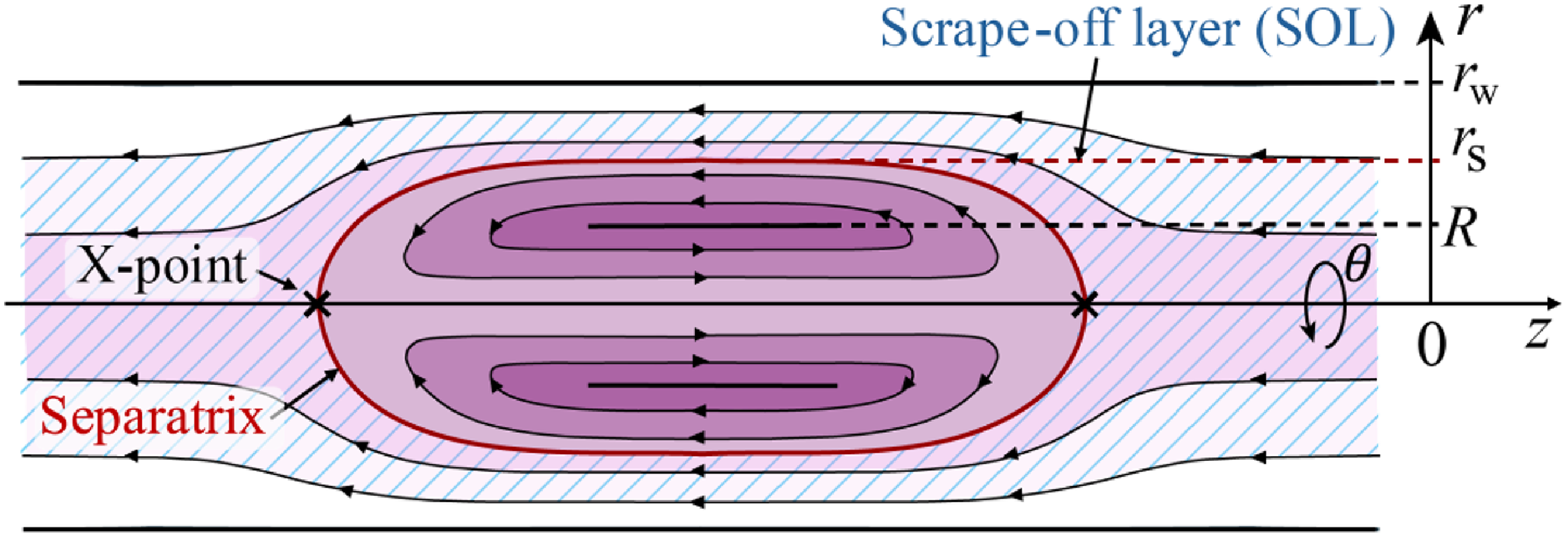
Field-reversed configurations (FRCs) are elongated and axisymmetric compact-toroid plasma structures comprising a closed-field core surrounded by an open-field periphery, as shown in figure 1. The periphery includes a scrape-off layer (SOL) adjacent to the core and jet-like structures extending from the ends, which provide a natural connection to remote solid surfaces. Fully kinetic analyses have indicated that particle end-loss through the SOL is sensitive to the mirror ratio and electrical biasing, which highlights the importance of the end region magnetic structure (Dettrick et al. Reference Dettrick2021; Gota et al. Reference Gota2024; Steinhauer & Nicks Reference Steinhauer and Nicks2025). End mirrors can influence the axial end-loss in the open-field edge/SOL (Dettrick et al. Reference Dettrick2021; Gota et al. Reference Gota2024; Steinhauer & Nicks Reference Steinhauer and Nicks2025). Previous edge experiments have shown that the particle end-loss time increases with the mirror ratio in a high-mirror-ratio regime (Ohtsuka, Okada, & Gota Reference Ohtsuka, Okada and Goto1999; Dettrick et al. Reference Dettrick2021; Gota et al. Reference Gota2024).
Schematic of a field-reversed configuration.

Figure 1. Long description
A diagram of a field-reversed configuration. The diagram shows an elongated and axisymmetric compact-toroid plasma structure. It comprises a closed-field core surrounded by an open-field periphery. The diagram includes several labeled regions: the scrape-off layer (SOL), the separatrix, and the X-point. The scrape-off layer (SOL) is the outer region, while the separatrix is a boundary that separates the closed-field core from the open-field periphery. The X-point is a specific point on the separatrix. Arrows indicate the direction of plasma flow within these regions. The diagram also includes axes labeled with r, r_w, r_s, R, theta, and z, which represent different spatial dimensions and positions within the plasma structure.
Because the confining magnetic field is primarily poloidal, FRCs can sustain a very high volume-averaged plasma pressure–magnetic pressure ratio ( $\beta$
). Owing to the simply connected topology of the core, FRCs are also linear systems that allow axial translation because no coils link through the plasma centre (Steinhauer, Roche & Steinhauer Reference Steinhauer, Roche and Steinhauer2020). However, this combination of a high
$\beta$
). Owing to the simply connected topology of the core, FRCs are also linear systems that allow axial translation because no coils link through the plasma centre (Steinhauer, Roche & Steinhauer Reference Steinhauer, Roche and Steinhauer2020). However, this combination of a high $\beta$
and simply connected structure accompanied by an open-field periphery makes it difficult to infer internal quantities such as the core size and trapped flux from external magnetic measurements alone. Therefore, equilibrium reconstruction methods that combine a plasma model with standard diagnostic data are important (Steinhauer et al. Reference Steinhauer, Roche and Steinhauer2020).
$\beta$
and simply connected structure accompanied by an open-field periphery makes it difficult to infer internal quantities such as the core size and trapped flux from external magnetic measurements alone. Therefore, equilibrium reconstruction methods that combine a plasma model with standard diagnostic data are important (Steinhauer et al. Reference Steinhauer, Roche and Steinhauer2020).
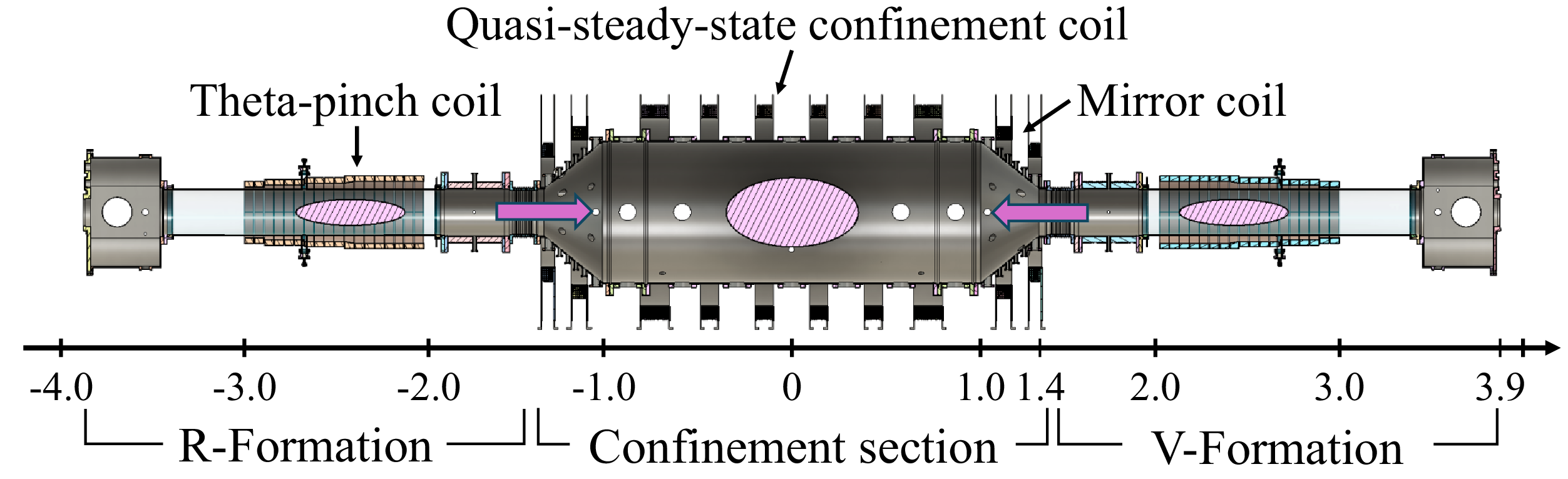
At Nihon University, FRCs are produced in the FRC amplification via translation–collisional merging (FAT-CM) device, which is illustrated in figure 2. In FAT-CM, two FRC-like plasmoids are independently formed by the field-reversed theta-pinch (FRTP) method and are translated towards a central confinement section. The plasmoids collide near the midplane with relative speeds of approximately 200–500 km s–1, and notable plasma heating as well as increases in trapped poloidal flux and excluded-flux have been observed during and after the collisional merging process (Asai et al. Reference Asai2019; Watanabe et al. Reference Watanabe, Asai, Takahashi, Kobayashi and Harashima2021). Experiments have indicated that, following the seemingly destructive violence of a super-Alfvénic collision, a quiescent FRC structure can emerge in a self-organised manner, which is accompanied by a marked increase in the excluded-flux compared with that in the two formation sections (Asai et al. Reference Asai2019).
Schematic view of FAT-CM.

The axial magnetic field profile, particularly the mirror magnetic field strength in the confinement section, is expected to influence both the translation dynamics and final merged FRC state. Internal magnetic probe (IMP) measurements in FAT-CM have shown that the confinement section requires a sufficient mirror magnetic field strength for two colliding FRCs to fully merge into a single FRC (Gota et al. Reference Gota2018). In related translation experiments, an FRC injected into a weaker and quasi-static magnetic field in the confinement section underwent super-Alfvénic acceleration, which was driven primarily by an axial magnetic pressure gradient acting on the slender plasmoids in the formation sections. The results of these experiments were qualitatively consistent with two-dimensional resistive magnetohydrodynamic (MHD) simulations (Kobayashi & Asai Reference Kobayashi and Asai2021). These observations indicate the need for a systematic evaluation on how the mirror magnetic field strength in the confinement section governs whether a closed magnetic flux FRC equilibrium can be realised after merging.
The quantitative interpretation of translated and merged FRCs has often relied on simplified assumptions and standard formulae based on limited magnetic measurements. For high- $\beta$
plasmas, however, the magnetic field structure can be strongly reshaped by the plasma pressure, and inferring the trapped flux and true core geometry calls for a reconstruction technique that remains robust even when simplified approximations fail (Steinhauer et al. Reference Steinhauer, Roche and Steinhauer2020). Therefore, for experimental systems with end mirrors and open-field peripheries, an analysis framework that retains essential two-dimensional geometry while maintaining computational efficiency is valuable for routine data interpretation.
$\beta$
plasmas, however, the magnetic field structure can be strongly reshaped by the plasma pressure, and inferring the trapped flux and true core geometry calls for a reconstruction technique that remains robust even when simplified approximations fail (Steinhauer et al. Reference Steinhauer, Roche and Steinhauer2020). Therefore, for experimental systems with end mirrors and open-field peripheries, an analysis framework that retains essential two-dimensional geometry while maintaining computational efficiency is valuable for routine data interpretation.
To address this need, Grushenka was developed as a fast tool for reconstructing fully two-dimensional (2-D) equilibria consistent with routine magnetic data (e.g. wall-mounted flux loops and magnetic probes) that uses a rotating fluid-based model augmented to capture several kinetic effects (Steinhauer et al. Reference Steinhauer, Roche and Steinhauer2020). Grushenka finds that the solution bifurcates, yielding either an FRC (i.e. closed magnetic flux) or a high- $\beta$
mirror (HBM) (i.e. no closed magnetic flux) depending on the experimental inputs. Further, it was shown that FRC equilibria exist only within a limited radius–length shape domain (Steinhauer et al. Reference Steinhauer, Roche and Steinhauer2020). Such capabilities make it suitable for assessing equilibrium consistency in collisional merging experiments where the external field profile is a key control factor.
$\beta$
mirror (HBM) (i.e. no closed magnetic flux) depending on the experimental inputs. Further, it was shown that FRC equilibria exist only within a limited radius–length shape domain (Steinhauer et al. Reference Steinhauer, Roche and Steinhauer2020). Such capabilities make it suitable for assessing equilibrium consistency in collisional merging experiments where the external field profile is a key control factor.
In this study, we applied Grushenka to the 2-D equilibrium analysis of collisional merging plasmas in FAT-CM and investigated how the mirror magnetic field strength in the confinement section affects the reconstructed equilibrium solutions. Because FAT-CM allows flexible control of the mirror magnetic field strength, which is a key input parameter for Grushenka, and provides internal diagnostics, it offers an appropriate platform for assessing the validity of the equilibrium reconstruction. We determined the mirror magnetic field conditions under which the reconstruction yields a closed magnetic flux FRC equilibrium and identified conditions where the solution instead transitions to a HBM equilibrium. We compared reconstructed equilibria with independent magnetic diagnostics and examined the implications for interpreting collisional merging FRC experiments. The remainder of this paper is organised as follows. Section 2 summarises the experimental set-up and dataset. Section 3 describes the reconstruction method and inputs. Section 4 presents the reconstructed equilibria and their dependence on the mirror magnetic field strength. Section 5 discusses the implications of the findings and their limitations, and § 6 concludes the paper.
2. Experimental set-up and dataset
FAT-CM is a linear facility with a total length of approximately 8 m and a coil diameter of approximately 1 m. The device comprises formation sections at each end and a central confinement section. Each formation section contains a quartz radius with an inner radius of 128 mm that is surrounded by a theta-pinch coil and produces an FRC-like plasmoid by the FRTP method. The two plasmoids are then translated towards the confinement section and collide near the midplane ( $z=0$
) before merging (Asai et al. Reference Asai2019; Watanabe et al. Reference Watanabe, Asai, Takahashi, Kobayashi and Harashima2021). The confinement section comprises a cylindrical flux conserver with an inner radius of approximately 0.39 m and external straight coils that generate an axial guide field. The ends of the flux conserver are conical and mirror coils are installed at both ends to provide axial compression.
$z=0$
) before merging (Asai et al. Reference Asai2019; Watanabe et al. Reference Watanabe, Asai, Takahashi, Kobayashi and Harashima2021). The confinement section comprises a cylindrical flux conserver with an inner radius of approximately 0.39 m and external straight coils that generate an axial guide field. The ends of the flux conserver are conical and mirror coils are installed at both ends to provide axial compression.
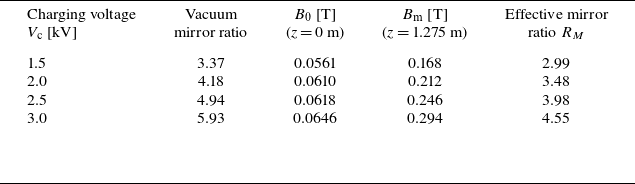
In the present experiments, the mirror magnetic field strength was scanned by varying the charging voltage V
c of the mirror coils between 1.5 and 3.0 kV. Charging voltages of 1.5, 2.0, 2.5 and 3.0 kV corresponded to vacuum mirror ratios of 3.37, 4.18, 4.94 and 5.93, respectively. We analysed the collisional merging discharges obtained under these four conditions. The reference time t = 0 was defined as the onset of the rapidly rising main theta-pinch field in the FRTP sequence. We focused on the quasi-stationary phase at $t = 57.5\, \unicode{x03BC} \text{s}$
, which was selected as a representative time slice for equilibrium analysis. Table 1 summarises the shot conditions and representative measured parameters at
$t = 57.5\, \unicode{x03BC} \text{s}$
, which was selected as a representative time slice for equilibrium analysis. Table 1 summarises the shot conditions and representative measured parameters at $t$
= 57.5 µs, which included the axial magnetic field at the midplane (
$t$
= 57.5 µs, which included the axial magnetic field at the midplane ( $B_{0}$
), the axial magnetic field at the far end (
$B_{0}$
), the axial magnetic field at the far end ( $B_{\mathrm{m}}$
) and the effective mirror ratio (
$B_{\mathrm{m}}$
) and the effective mirror ratio ( ${R}_{\mathrm{M}}$
).
${R}_{\mathrm{M}}$
).
Shot conditions and representative plasma parameters ( $t$
= 57.5 µs).
$t$
= 57.5 µs).

Note that the vacuum mirror ratio was evaluated under vacuum conditions (i.e. no plasma), while the effective mirror ratio ${R}_{\mathrm{M}}$
was evaluated during the plasma discharge. Here,
${R}_{\mathrm{M}}$
was evaluated during the plasma discharge. Here, ${R}_{\mathrm{M}}$
was defined as
${R}_{\mathrm{M}}$
was defined as ${R}_{\mathrm{M}}\equiv B_{\mathrm{m}}/B_{0}$
, where
${R}_{\mathrm{M}}\equiv B_{\mathrm{m}}/B_{0}$
, where $B_{0}\equiv B_{z}(z=0,t)$
is the axial magnetic field at the midplane and
$B_{0}\equiv B_{z}(z=0,t)$
is the axial magnetic field at the midplane and $B_{\mathrm{m}}\equiv B_{z}(z=Z_{\max },t)$
is the axial field in the mirror region at the same time. The mirror position (
$B_{\mathrm{m}}\equiv B_{z}(z=Z_{\max },t)$
is the axial field in the mirror region at the same time. The mirror position ( $Z_{\max }$
) corresponded to the end plane of the mirror region. Figure 3(a) shows the locations of measurement instruments used to collect data. Wall-mounted magnetic probes for collecting the axial magnetic field (
$Z_{\max }$
) corresponded to the end plane of the mirror region. Figure 3(a) shows the locations of measurement instruments used to collect data. Wall-mounted magnetic probes for collecting the axial magnetic field ( $B_{z}$
) were installed along the confinement section at z = −1.275, −1.185, −1.075, −0.90, −0.60, −0.30, 0, 0.30, 0.60, 0.90, 1.075, 1.185 and 1.275
$B_{z}$
) were installed along the confinement section at z = −1.275, −1.185, −1.075, −0.90, −0.60, −0.30, 0, 0.30, 0.60, 0.90, 1.075, 1.185 and 1.275 $\mathrm{m}$
. These measurements were used to characterise the vacuum magnetic field profile and provide key inputs for the equilibrium analysis. An IMP array was positioned at the midplane (z = 0) to provide three-component magnetic field measurements (
$\mathrm{m}$
. These measurements were used to characterise the vacuum magnetic field profile and provide key inputs for the equilibrium analysis. An IMP array was positioned at the midplane (z = 0) to provide three-component magnetic field measurements ( $B_{x},B_{y},B_{z}$
) at 12 radial locations from r = −0.08 to 0.36 m in 0.04 m increments. These data were used to examine the internal field structure (e.g. field reversal) and to identify the quasi-stationary phase used for analysis of the representative time slice. A heterodyne laser interferometer with three chords at r = 0, 0.12, and 0.20 m was used to obtain the line-integrated electron density, as shown in figure 3(b). The line-averaged electron density from each chord was used as an input for the reconstruction. The total (ion + electron) temperature (
$B_{x},B_{y},B_{z}$
) at 12 radial locations from r = −0.08 to 0.36 m in 0.04 m increments. These data were used to examine the internal field structure (e.g. field reversal) and to identify the quasi-stationary phase used for analysis of the representative time slice. A heterodyne laser interferometer with three chords at r = 0, 0.12, and 0.20 m was used to obtain the line-integrated electron density, as shown in figure 3(b). The line-averaged electron density from each chord was used as an input for the reconstruction. The total (ion + electron) temperature ( $T_{\mathrm{tot}}$
) was estimated by combining interferometer measurements of the electron density with the estimated thermal pressure from magnetic diagnostics using the formula
$T_{\mathrm{tot}}$
) was estimated by combining interferometer measurements of the electron density with the estimated thermal pressure from magnetic diagnostics using the formula $p=n{k}_{\mathrm{B}}T_{\mathrm{tot}}$
(assuming quasi-neutrality).
$p=n{k}_{\mathrm{B}}T_{\mathrm{tot}}$
(assuming quasi-neutrality).
Positions of measurement instruments in FAT-CM: (a) $x=0$
cross-section and (b) midplane (
$x=0$
cross-section and (b) midplane ( $z=0$
) cross-section.
$z=0$
) cross-section.

3. Analysis methods
3.1. Conventional quasi-1-D equilibrium analysis
Conventional quasi-one-dimensional (quasi-1-D) equilibrium analysis is based on the tendency of FRCs to be elongated in the axial direction. Accordingly, the plasma structure can be modelled as an infinitely long cylinder with a purely axial magnetic field. Under this assumption, the radial pressure is balanced by equating the external vacuum magnetic pressure to the total pressure (thermal plus magnetic) inside the FRC. Similarly, the axial forces are balanced by equating the contributions of magnetic tension, thermal pressure and magnetic pressure in a vacuum periphery to the magnetic pressure of the vacuum magnetic field at infinity. This simplified model ignores plasma pressure outside the separatrix and presumes the SOL to be thin relative to the radius of the plasma core.
A related limitation arises in the conventional excluded-flux method for estimating the FRC radius. With these assumptions, the wall flux in a vacuum ( $\mathrm{v}$
) is
$\mathrm{v}$
) is
 \begin{equation}\varPhi _{\mathrm{v}}={\Pi} {r_{\mathrm{w}}}^{2}B_{\mathrm{v}}\end{equation}
where $B_{\mathrm{v}}$
is the vacuum magnetic field (radially uniform) and
$B_{\mathrm{v}}$
is the vacuum magnetic field (radially uniform) and $r_{\mathrm{w}}$
is the wall radius. The wall flux in the presence of plasma (
$r_{\mathrm{w}}$
is the wall radius. The wall flux in the presence of plasma ( $p$
) is
$p$
) is
 \begin{equation}\phi _{\mathrm{p}}={\Pi} \big({r_{\mathrm{w}}}^{2}-{r_{{\Delta} {\phi} }}^{2}\big)B_{\mathrm{p}},\end{equation}
where $r_{{\Delta} {\phi} }$
is the excluded-flux radius and
$r_{{\Delta} {\phi} }$
is the excluded-flux radius and $B_{\mathrm{p}}$
is the magnetic field outside the separatrix (also radially uniform). If the wall flux is ‘frozen’, then
$B_{\mathrm{p}}$
is the magnetic field outside the separatrix (also radially uniform). If the wall flux is ‘frozen’, then $\phi _{\mathrm{v}}$
(vacuum shot) is identical to
$\phi _{\mathrm{v}}$
(vacuum shot) is identical to $\phi _{\mathrm{p}}$
(plasma shot). Then, the excluded-flux radius is given by
$\phi _{\mathrm{p}}$
(plasma shot). Then, the excluded-flux radius is given by
 \begin{equation}r_{{\Delta} {\phi} }=r_{\mathrm{w}}\sqrt{1-\frac{B_{\mathrm{v}}}{B_{\mathrm{p}}}}.\end{equation}
In this no-SOL model, the excluded-flux radius ( $r_{{\Delta} {\phi} }$
) is identical to the separatrix radius (
$r_{{\Delta} {\phi} }$
) is identical to the separatrix radius ( $r_{\mathrm{s}}$
). For this reason,
$r_{\mathrm{s}}$
). For this reason, $r_{{\Delta} {\phi} }$
is commonly used as a proxy for
$r_{{\Delta} {\phi} }$
is commonly used as a proxy for $r_{\mathrm{s}}$
. However, if an SOL with a finite thickness is considered, then
$r_{\mathrm{s}}$
. However, if an SOL with a finite thickness is considered, then $r_{\mathrm{s}}$
is less than
$r_{\mathrm{s}}$
is less than $r_{{\Delta} {\phi} }$
, which presumably depends on the relative thickness of the SOL. In addition, accounting for 2-D effects such as the field-line curvature and influence of a mirror magnetic field at the ends may lead to
$r_{{\Delta} {\phi} }$
, which presumably depends on the relative thickness of the SOL. In addition, accounting for 2-D effects such as the field-line curvature and influence of a mirror magnetic field at the ends may lead to $r_{\mathrm{s}}$
being substantially less than
$r_{\mathrm{s}}$
being substantially less than $r_{{\Delta} {\phi} }$
.
$r_{{\Delta} {\phi} }$
.
Computational domain of Grushenka.

3.2. Fully 2-D equilibrium analysis
We employed Grushenka to realise the fully 2-D equilibrium reconstruction of the flux variable $\psi (r,z)$
. In FAT-CM, the mirror magnetic field strength can be varied by adjusting the charging voltage of the mirror coils. Grushenka is well suited for analysing such configurations because it allows the magnetic field strength at the end of the computational domain, where the mirror coils are installed, to be specified explicitly. This model introduces the mirror magnetic field
$\psi (r,z)$
. In FAT-CM, the mirror magnetic field strength can be varied by adjusting the charging voltage of the mirror coils. Grushenka is well suited for analysing such configurations because it allows the magnetic field strength at the end of the computational domain, where the mirror coils are installed, to be specified explicitly. This model introduces the mirror magnetic field $B_{\mathrm{m}}$
at the end region and reconstructs the curvature of the external magnetic field, which allows the influence of the mirror magnetic field on the overall equilibrium to be considered. Another advantage of this approach is that intrusive IMPs are not required as direct inputs for the equilibrium reconstruction. Conventionally, equilibrium reconstruction depends on routine non-intrusive measurements at the device wall from which the excluded-flux size and external field profile are inferred. In the present study, however, we employed an IMP array to identify the quasi-stationary phase used for analysis of the representative time slice and to provide an independent validation of the reconstructed midplane magnetic field profile and equilibrium branch classification.
$B_{\mathrm{m}}$
at the end region and reconstructs the curvature of the external magnetic field, which allows the influence of the mirror magnetic field on the overall equilibrium to be considered. Another advantage of this approach is that intrusive IMPs are not required as direct inputs for the equilibrium reconstruction. Conventionally, equilibrium reconstruction depends on routine non-intrusive measurements at the device wall from which the excluded-flux size and external field profile are inferred. In the present study, however, we employed an IMP array to identify the quasi-stationary phase used for analysis of the representative time slice and to provide an independent validation of the reconstructed midplane magnetic field profile and equilibrium branch classification.
A key feature of Grushenka is that it admits two equilibrium branches in mirror magnetic field geometry: an FRC branch with a closed magnetic flux and an HBM branch with no closed magnetic flux. Under the given boundary conditions and input parameters, Grushenka can automatically determine to which branch the equilibrium converges. As shown in figure 4, the computational domain was defined in two dimensions: a central section with a fixed wall radius ( $r_{\mathrm{w}}$
) and conical end sections. We assumed midplane symmetry so that only one side of the midplane needed be addressed. Boundary conditions were imposed on the magnetic flux
$r_{\mathrm{w}}$
) and conical end sections. We assumed midplane symmetry so that only one side of the midplane needed be addressed. Boundary conditions were imposed on the magnetic flux $\psi (r,z)$
as follows (Steinhauer et al. Reference Steinhauer, Roche and Steinhauer2020).
$\psi (r,z)$
as follows (Steinhauer et al. Reference Steinhauer, Roche and Steinhauer2020).
-
1. A Dirichlet condition was imposed at the radial boundary by prescribing the wall flux ${\varPsi}(r_{\mathrm{w}}(z),z)=\varPsi _{\mathrm{w}}(z)$
.
${\varPsi}(r_{\mathrm{w}}(z),z)=\varPsi _{\mathrm{w}}(z)$
. -
2. We assumed that midplane (
$z=0$
) symmetry implies the Neumann condition
$\partial \varPsi /\partial z=0$
. -
3. At the end plane (
$z=Z_{\max }$
), a periodic condition
$\partial \varPsi /\partial z=0$
(Neumann) was imposed, which is a common artifice in equilibrium computations.



The two-dimensionality of the computational domain allowed us to consider both the finite length of the FRC as well as the effects of the mirror magnetic field.
The following expression was adopted for the wall flux: $\varPsi _{\mathrm{w}}(z)=B_{\mathrm{v}}(z){r}_{\mathrm{w}}^{2}(z)/2$
. The nominal vacuum field is expressed as follows (Steinhauer et al. Reference Steinhauer, Roche and Steinhauer2020):
$\varPsi _{\mathrm{w}}(z)=B_{\mathrm{v}}(z){r}_{\mathrm{w}}^{2}(z)/2$
. The nominal vacuum field is expressed as follows (Steinhauer et al. Reference Steinhauer, Roche and Steinhauer2020):
 \begin{equation}B_{\mathrm{v}}(z)=B_{0}+{\Delta} B_{\mathrm{m}}z^{2}/{Z}_{\max }^{2},\end{equation}
where the adjustable parameters are the base magnetic field strength at the midplane ( $B_{0}$
) and the increment of the mirror magnetic field strength (
$B_{0}$
) and the increment of the mirror magnetic field strength ( ${\Delta} B_{\mathrm{m}}$
) at the end.
${\Delta} B_{\mathrm{m}}$
) at the end.
Calculation flowchart of Grushenka.

The interior structure is governed by a combination of an extended fluid model for the current density $j_{\theta }(r,z)$
, which is linked to the magnetic flux (
$j_{\theta }(r,z)$
, which is linked to the magnetic flux ( $\psi$
) through Ampere’s law:
$\psi$
) through Ampere’s law:
 \begin{align}{\Delta}^{*}\psi & =-\mu_{0}rj_{\theta}\nonumber\\[5pt]{\Delta}^{{*}} & =r^{2} \boldsymbol{\nabla }\boldsymbol{\cdot }\left[\left(\frac{1}{r^{2}}\right)\boldsymbol{\nabla }\right]\!.\end{align}
A flexible current density profile was adopted:
 \begin{equation}j=rP'\left(\psi \right)\exp\! \left(\frac{{m}_{i}\varOmega ^{2}r^{2}}{2{k}_{\mathrm{B}}T_{\mathrm{tot}}}\right)\!,\end{equation}
where $P(\psi )$
is a surface function of
$P(\psi )$
is a surface function of $\psi$
and
$\psi$
and $P'(\psi )$
denotes the derivative with respect to
$P'(\psi )$
denotes the derivative with respect to $\psi$
. The exponential factor corresponds to the centrifugal effect:
$\psi$
. The exponential factor corresponds to the centrifugal effect: $\varOmega$
is the rotation frequency,
$\varOmega$
is the rotation frequency, ${m}_{i}$
is the ion mass,
${m}_{i}$
is the ion mass, ${k}_{\mathrm{B}}$
is Boltzmann’s constant and
${k}_{\mathrm{B}}$
is Boltzmann’s constant and $T_{\mathrm{tot}}$
is the total temperature (ion + electron). For simplicity, both
$T_{\mathrm{tot}}$
is the total temperature (ion + electron). For simplicity, both $\varOmega$
and
$\varOmega$
and $T_{\mathrm{tot}}$
were treated as constants. In the absence of rotation (
$T_{\mathrm{tot}}$
were treated as constants. In the absence of rotation ( $\varOmega =0$
), combining (3.5) and (3.6) results in the familiar Grad–Shafranov equation for static plasma equilibria. The pressure function has a two-branch form: one in the core (
$\varOmega =0$
), combining (3.5) and (3.6) results in the familiar Grad–Shafranov equation for static plasma equilibria. The pressure function has a two-branch form: one in the core ( $\psi \lt 0$
) and one in the SOL (
$\psi \lt 0$
) and one in the SOL ( $\psi \gt 0$
). Each is the composite of two rigid rotor-like elements (
$\psi \gt 0$
). Each is the composite of two rigid rotor-like elements ( $p=\mathrm{Ce}^{\alpha \psi }$
). Another kinetic effect related to a finite Larmor radius is to enforce continuous
$p=\mathrm{Ce}^{\alpha \psi }$
). Another kinetic effect related to a finite Larmor radius is to enforce continuous $p(\psi )$
,
$p(\psi )$
, $p'(\psi )$
and
$p'(\psi )$
and $p''(\psi )$
at the separatrix. This gives rise to a form for the current density with two free parameters. The solution algorithm is an iterative procedure that automatically adjusts the free parameters while converging to conformity with (3.5) and (3.6). Figure 5 shows a flowchart illustrating the iterative solution procedure. Among the key input parameters were the external magnetic field strength (i.e. the midplane magnetic field strength
$p''(\psi )$
at the separatrix. This gives rise to a form for the current density with two free parameters. The solution algorithm is an iterative procedure that automatically adjusts the free parameters while converging to conformity with (3.5) and (3.6). Figure 5 shows a flowchart illustrating the iterative solution procedure. Among the key input parameters were the external magnetic field strength (i.e. the midplane magnetic field strength $B_{0}$
and the mirror-coil increment
$B_{0}$
and the mirror-coil increment ${\Delta} B_{\mathrm{m}}$
) and the plasma size. The plasma size was characterised by the excluded-flux radius at the midplane (
${\Delta} B_{\mathrm{m}}$
) and the plasma size. The plasma size was characterised by the excluded-flux radius at the midplane ( $R_{{\phi} }$
) and by the axial distance over which the excluded-flux radius decreased to
$R_{{\phi} }$
) and by the axial distance over which the excluded-flux radius decreased to $2/3R_{{\phi} }$
, which was defined as the half-length (
$2/3R_{{\phi} }$
, which was defined as the half-length ( $Z_{{\phi} }$
). From these data, a fitting function for the external magnetic field strength was constructed and target parameters were corrected for the plasma size. Satisfying these target parameters together with the prescribed external magnetic field strength function obtained the magnetic flux function and associated correction terms that satisfied the
$Z_{{\phi} }$
). From these data, a fitting function for the external magnetic field strength was constructed and target parameters were corrected for the plasma size. Satisfying these target parameters together with the prescribed external magnetic field strength function obtained the magnetic flux function and associated correction terms that satisfied the $\theta$
component of Ampère’s law. From the resulting magnetic flux function, various physical quantities such as the density and energy were subsequently evaluated.
$\theta$
component of Ampère’s law. From the resulting magnetic flux function, various physical quantities such as the density and energy were subsequently evaluated.
4. Results
4.1. Representative reconstructions
Table 2 presents the geometry and boundary conditions for FAT-CM that were implemented in Grushenka. By varying the target excluded-flux dimensions $\{R_{\varPhi }, Z_{\varPhi }\}$
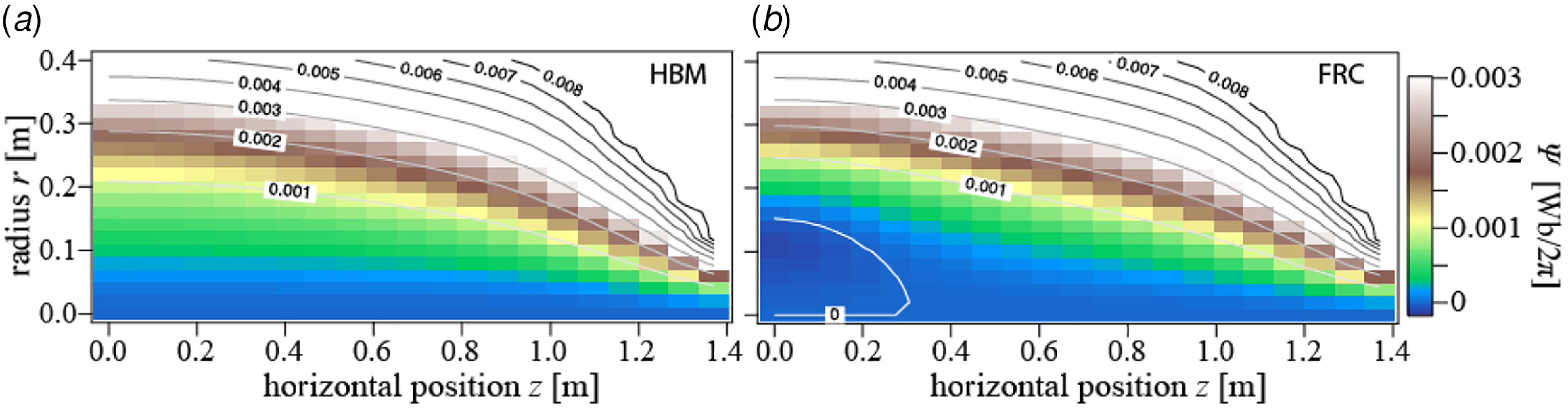
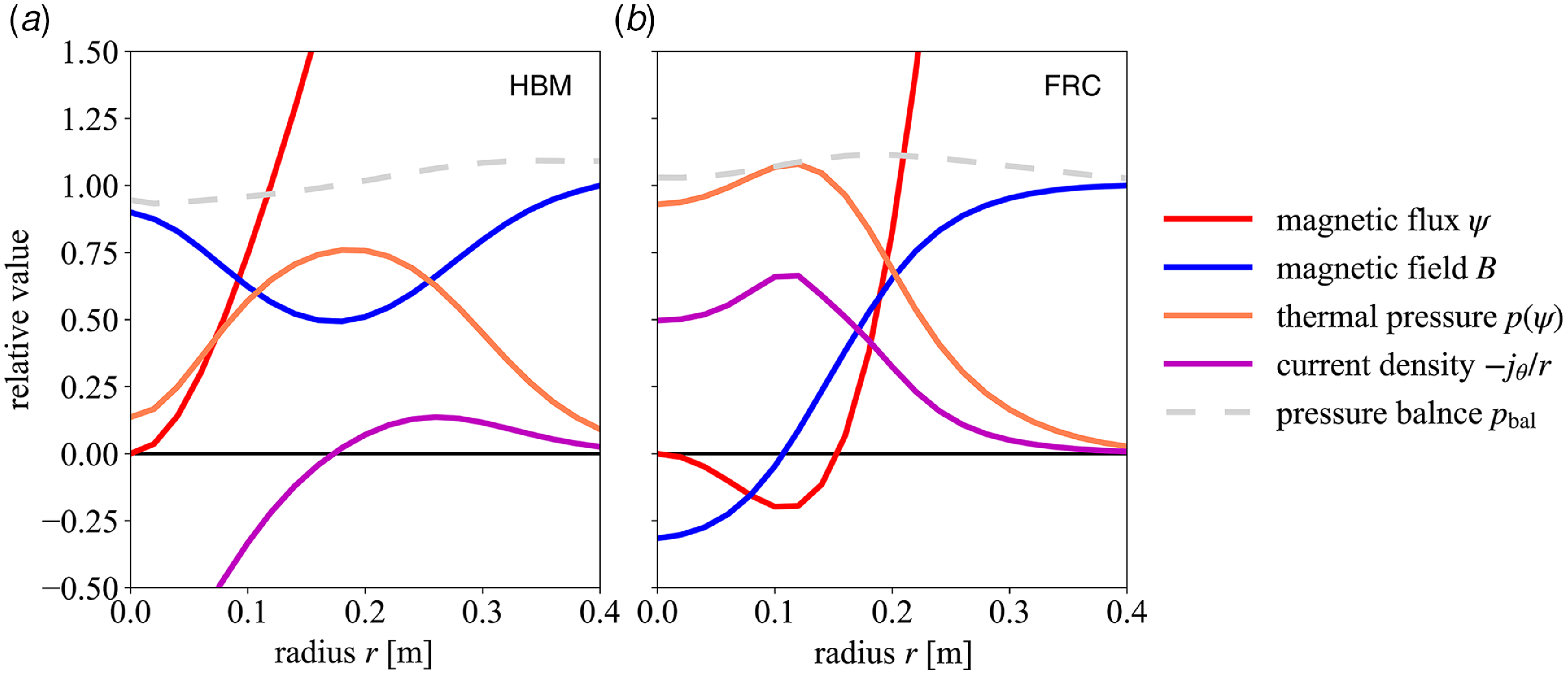
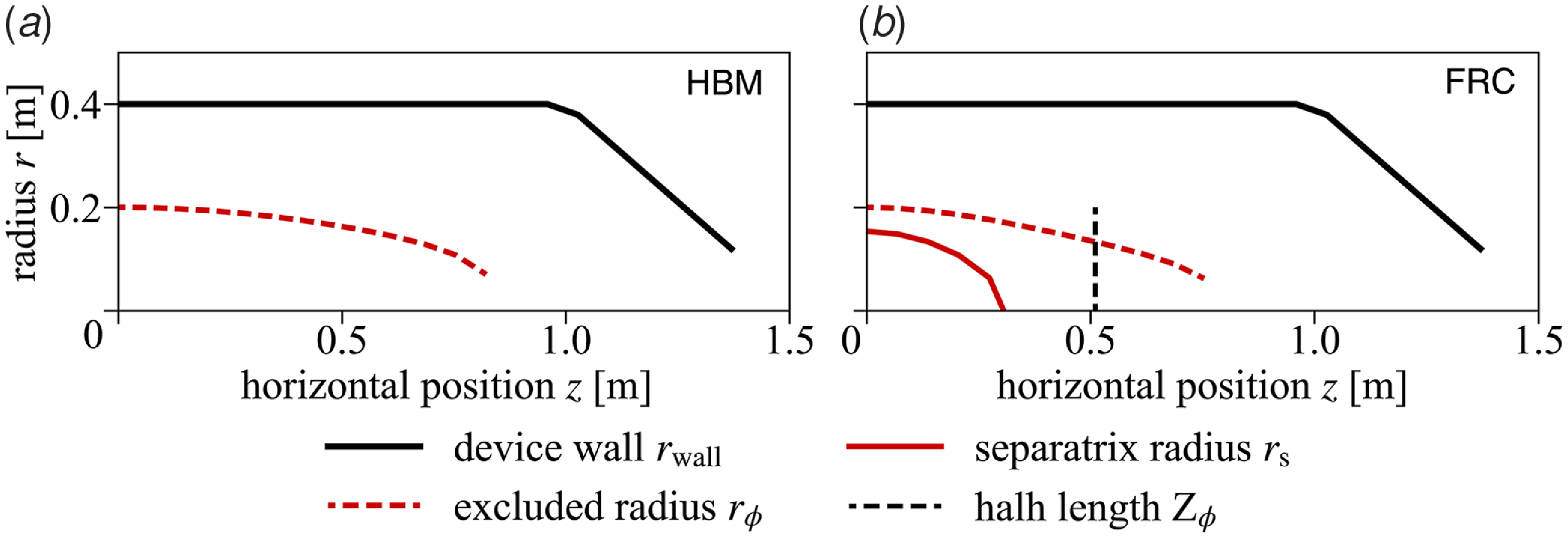
, two branches of equilibrium solutions were obtained. Figure 6(a) shows an HBM equilibrium solution comprising solely open magnetic field lines, while figure 6(b) shows an FRC equilibrium solution characterised by a closed magnetic flux. Figure 7 presents the radial distributions of the magnetic field at the midplane (
$\{R_{\varPhi }, Z_{\varPhi }\}$
, two branches of equilibrium solutions were obtained. Figure 6(a) shows an HBM equilibrium solution comprising solely open magnetic field lines, while figure 6(b) shows an FRC equilibrium solution characterised by a closed magnetic flux. Figure 7 presents the radial distributions of the magnetic field at the midplane ( $z=0$
) for each case. In the case of the FRC equilibrium solution, the sign of
$z=0$
) for each case. In the case of the FRC equilibrium solution, the sign of $B_{z}(r)$
clearly reversed. Figure 8 shows the excluded-flux radius (red dashed line), separatrix radius (red solid line) and half-length (black dashed line) within the computational domain. For the HBM equilibrium solution, no separatrix radius is shown because there was no closed magnetic flux.
$B_{z}(r)$
clearly reversed. Figure 8 shows the excluded-flux radius (red dashed line), separatrix radius (red solid line) and half-length (black dashed line) within the computational domain. For the HBM equilibrium solution, no separatrix radius is shown because there was no closed magnetic flux.
Observe that figure 7 also shows the pressure profiles for representative examples. Keep in mind that the pressure is at once removed ((3.5) and (3.6)) from the strictly magnetic results because it depends on the selection of a suitable pressure function family. In any case, care should be taken not to overinterpret this computed profile, e.g. by extracting quantitative details from it.
Geometry and boundary conditions for FAT-CM.

Contours of the magnetic fields calculated by Grushenka for the (a) HBM equilibrium solution and (b) FRC equilibrium solution.

4.2. Dependence on the mirror ratio
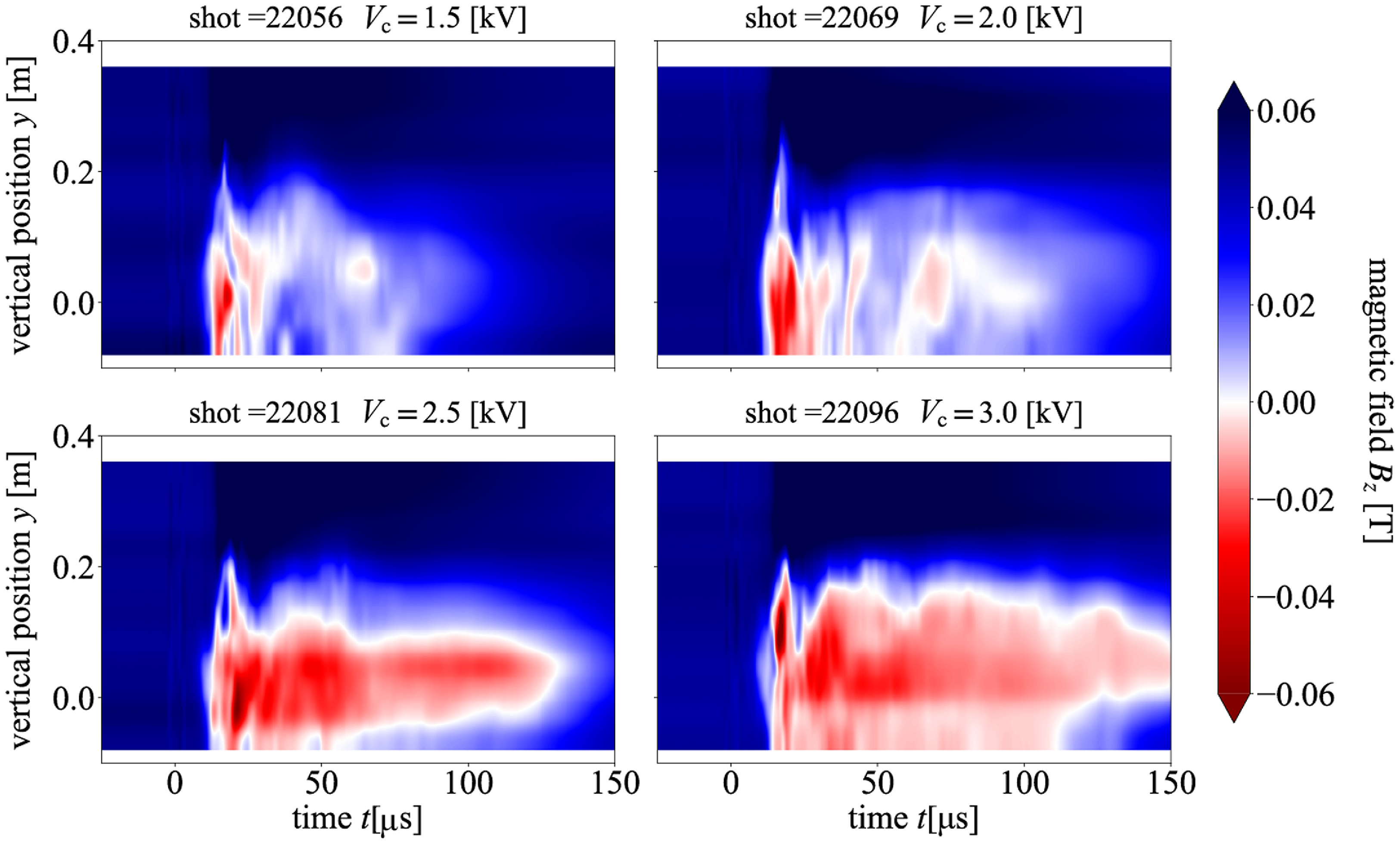
Previous experiments on FAT-CM indicated that the plasma did not relax to an FRC when the mirror magnetic field strength was reduced (Gota et al. Reference Gota2018). Therefore, FRC merging experiments were performed at charging voltages of 1.5, 2.0, 2.5 and 3.0 kV, which corresponded to vacuum mirror ratios of 3.37, 4.18, 4.94 and 5.93, respectively. Figure 9 shows the IMP measurements in individual shots, which served as an independent validation of the midplane field reversal behaviour reconstructed by Grushenka. For shots with a smaller effective mirror ratio, no clear sign reversal of $B_{z}(r)$
was observed, which indicated that the plasma state did not have a tendency to relax to an FRC equilibrium. In contrast, a clear sign reversal was observed for shots with a larger vacuum mirror ratio, which suggests relaxation towards an FRC equilibrium. The time at which the magnetic fluctuations relaxed (
$B_{z}(r)$
was observed, which indicated that the plasma state did not have a tendency to relax to an FRC equilibrium. In contrast, a clear sign reversal was observed for shots with a larger vacuum mirror ratio, which suggests relaxation towards an FRC equilibrium. The time at which the magnetic fluctuations relaxed ( $t$
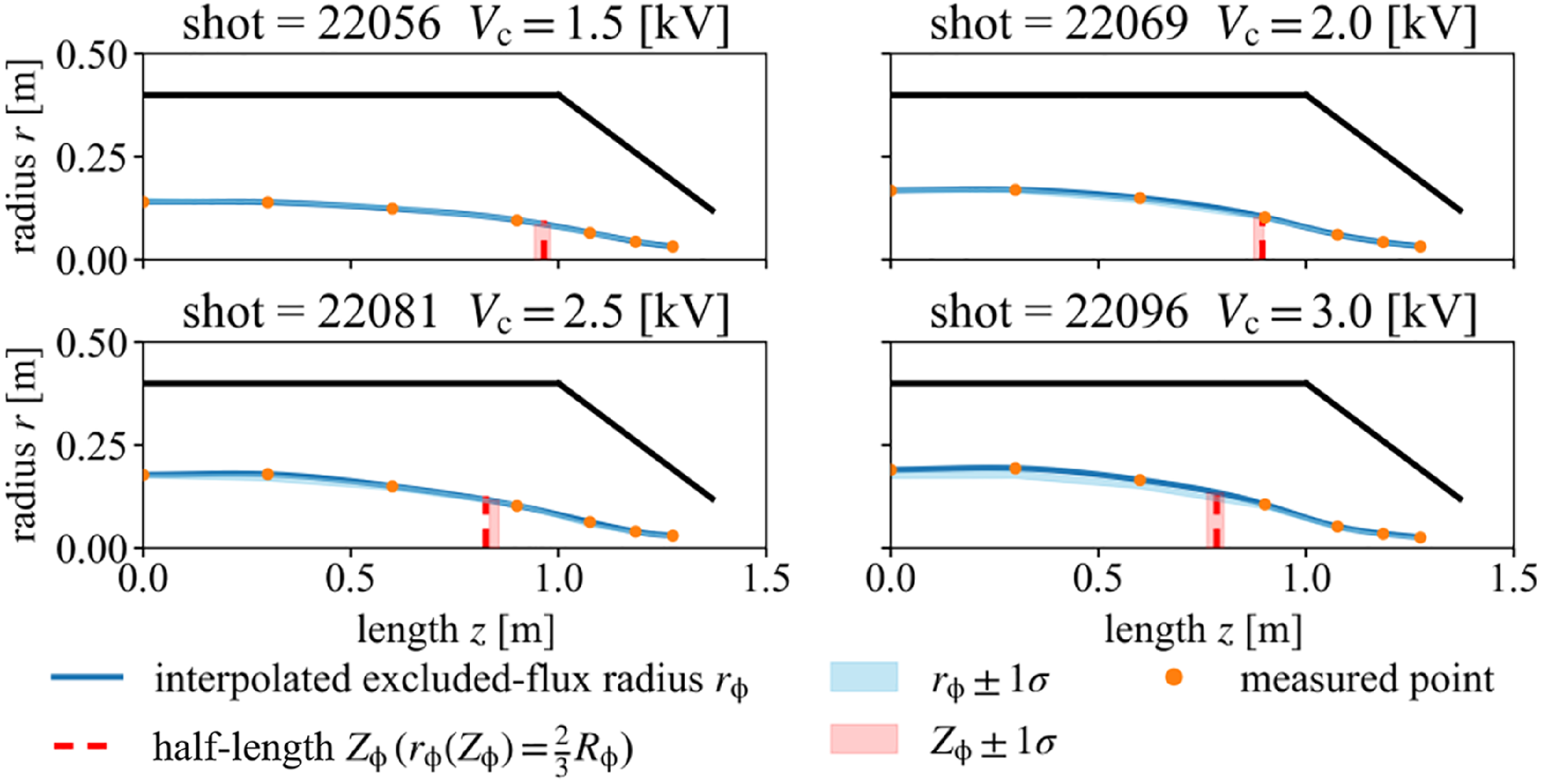
= 57.5 µs) was regarded as corresponding to a quasi-equilibrium state. Figure 10 presents the excluded-flux radius and half-length calculated from wall-mounted magnetic probe measurements (
$t$
= 57.5 µs) was regarded as corresponding to a quasi-equilibrium state. Figure 10 presents the excluded-flux radius and half-length calculated from wall-mounted magnetic probe measurements ( $t$
= 57.5 µs). As the effective mirror ratio increased, the plasma length decreased. A slight increase in the plasma radius was also observed, although the change was small. These trends are evident both in the shot-by-shot data and in the standard deviations evaluated for each condition.
$t$
= 57.5 µs). As the effective mirror ratio increased, the plasma length decreased. A slight increase in the plasma radius was also observed, although the change was small. These trends are evident both in the shot-by-shot data and in the standard deviations evaluated for each condition.
Radial distributions of the magnetic fields calculated by Grushenka for the (a) HBM equilibrium solution and (b) FRC equilibrium solution.

Plasma size parameters calculated by Grushenka for the (a) HBM equilibrium solution and (b) FRC equilibrium solution.

Time evolution of the magnetic field at the midplane measured by IMPs for a representative shot.

Excluded-flux radius and half-length determined from wall-mounted magnetic probe measurements. The solid line shows a representative shot and shaded regions denote ±1σ, where σ is the sample standard deviation.

To provide experimental evidence for the mirror-field dependence of the post-merging configuration, we quantify the plasma size using the excluded-flux radius $r_{{\Delta}\varPhi }$
at the midplane and the corresponding axial half-length
$r_{{\Delta}\varPhi }$
at the midplane and the corresponding axial half-length $Z_{{\Delta} \varPhi }$
obtained from the wall-mounted magnetic probes at
$Z_{{\Delta} \varPhi }$
obtained from the wall-mounted magnetic probes at $t = 57.5\, \unicode{x03BC} \mathrm{s}$
. In addition, the internal probe array at
$t = 57.5\, \unicode{x03BC} \mathrm{s}$
. In addition, the internal probe array at $z=0$
is used to extract the radial extent and strength of field reversal (e.g. the zero-crossing radius of
$z=0$
is used to extract the radial extent and strength of field reversal (e.g. the zero-crossing radius of $B_{z}(r)$
and the minimum value of
$B_{z}(r)$
and the minimum value of $B_{z}$
), which provides an independent indicator of the core ‘thickness’. These experimentally defined metrics collectively show that increasing mirror-field setting shifts the configuration towards larger radial extent and shorter axial extent.
$B_{z}$
), which provides an independent indicator of the core ‘thickness’. These experimentally defined metrics collectively show that increasing mirror-field setting shifts the configuration towards larger radial extent and shorter axial extent.
In the experiment, it was difficult to vary the mirror magnetic field strength continuously. Moreover, changing the mirror magnetic field strength affected other parameters such as the translation velocity. Therefore, we scanned the target plasma dimensions { $R_{{\phi} },Z_{{\phi} }\}$
and the mirror magnetic field increment (
$R_{{\phi} },Z_{{\phi} }\}$
and the mirror magnetic field increment ( ${\Delta} B_{\mathrm{m}}$
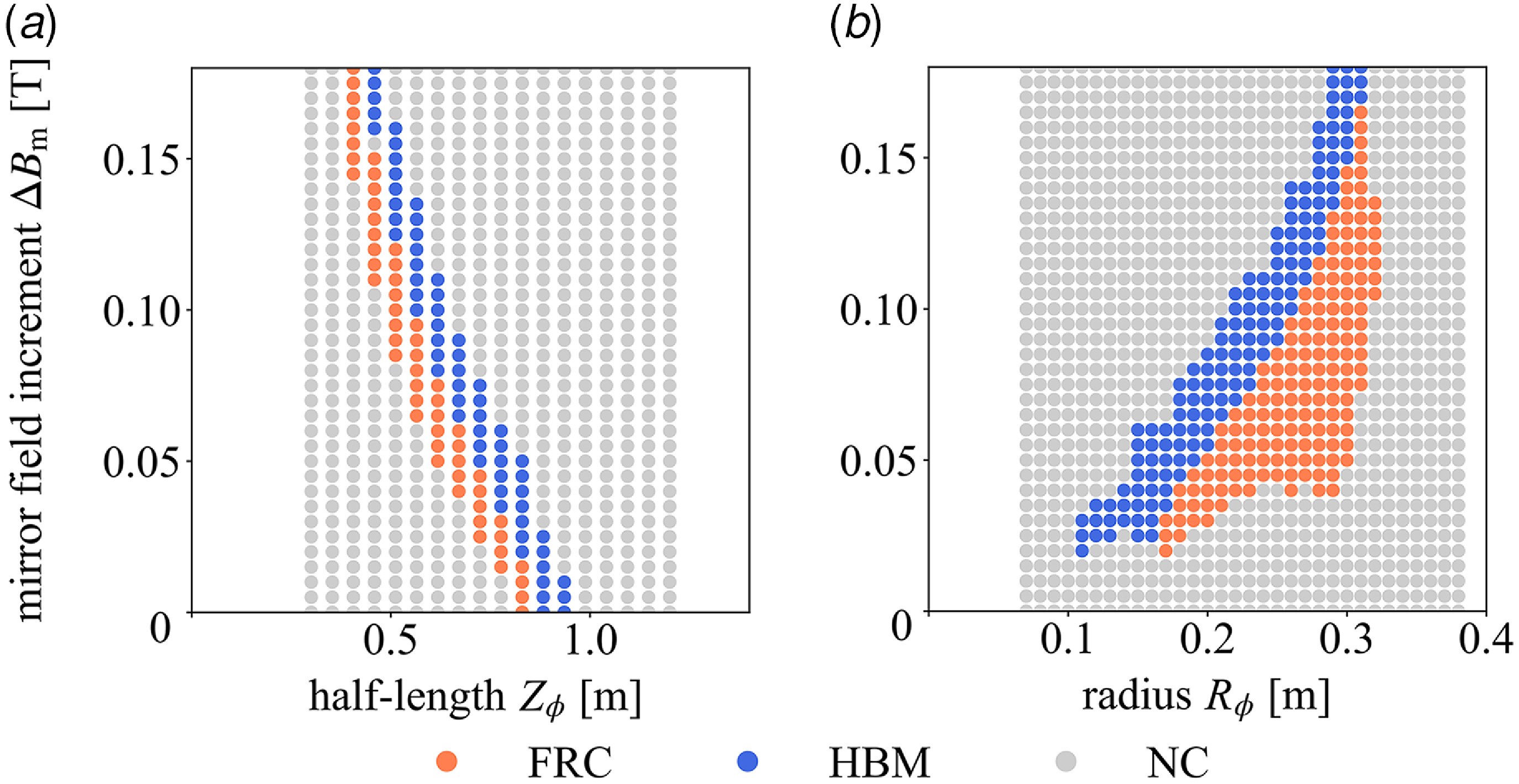
). The other input parameters were fixed to typical conditions for the FAT-CM device, which are listed in table 3. Figure 11 shows the results, which were categorised into three outcomes: relaxation to an FRC equilibrium, relaxation to an HBM equilibrium and no convergence (NC). Figure 11(a) shows the effects of the mirror magnetic field strength on the plasma half-length (
${\Delta} B_{\mathrm{m}}$
). The other input parameters were fixed to typical conditions for the FAT-CM device, which are listed in table 3. Figure 11 shows the results, which were categorised into three outcomes: relaxation to an FRC equilibrium, relaxation to an HBM equilibrium and no convergence (NC). Figure 11(a) shows the effects of the mirror magnetic field strength on the plasma half-length ( $Z_{\phi}$
) when the plasma radius
$Z_{\phi}$
) when the plasma radius $R_{{\phi} }$
was fixed at 0.2 m. As the mirror magnetic field strength increased, the plasma state tended to converge to a shorter FRC. In addition, the range of the mirror magnetic field strength over which an FRC was obtained increased as
$R_{{\phi} }$
was fixed at 0.2 m. As the mirror magnetic field strength increased, the plasma state tended to converge to a shorter FRC. In addition, the range of the mirror magnetic field strength over which an FRC was obtained increased as $Z_{{\phi} }$
decreased. These results suggest that FRC equilibrium is favoured for plasma states with a shorter axial length and that the formation of a shorter FRC requires a higher mirror magnetic field strength. Figure 11(b) shows the effects of the mirror magnetic field strength on
$Z_{{\phi} }$
decreased. These results suggest that FRC equilibrium is favoured for plasma states with a shorter axial length and that the formation of a shorter FRC requires a higher mirror magnetic field strength. Figure 11(b) shows the effects of the mirror magnetic field strength on $R_{{\phi} }$
when
$R_{{\phi} }$
when $Z_{{\phi} }$
was fixed at 0.7 m. As the mirror magnetic field strength increased, the plasma state tended to converge to an FRC with a larger
$Z_{{\phi} }$
was fixed at 0.7 m. As the mirror magnetic field strength increased, the plasma state tended to converge to an FRC with a larger $R_{{\phi} }$
. The range of mirror magnetic field strengths over which an FRC was obtained increased with
$R_{{\phi} }$
. The range of mirror magnetic field strengths over which an FRC was obtained increased with $R_{{\phi} }$
. These results indicate that FRC equilibrium is favoured for plasma states with a larger radius.
$R_{{\phi} }$
. These results indicate that FRC equilibrium is favoured for plasma states with a larger radius.
Typical plasma parameters for FAT-CM used as inputs for Grushenka.

Equilibrium solutions as functions of the mirror magnetic field strength: (a) plasma half-length and (b) plasma radius.

5. Discussion
In the present collisional merging experiments at FAT-CM, the mirror magnetic field strength was controlled by the charging voltage of the mirror coils (i.e. nominal vacuum mirror setting). To compare equilibrium solutions, we characterised each discharge at the analysis time by using the effective mirror ratio ( ${R}_{\mathrm{M}}$
), which was evaluated from the measured magnetic field profile. Experimentally, stronger mirror settings were associated with sign reversal of the midplane axial magnetic field
${R}_{\mathrm{M}}$
), which was evaluated from the measured magnetic field profile. Experimentally, stronger mirror settings were associated with sign reversal of the midplane axial magnetic field $B_{z}(r)$
, and with merged plasma states that were radially larger and axially shorter. For weaker mirror settings, no clear reversal of
$B_{z}(r)$
, and with merged plasma states that were radially larger and axially shorter. For weaker mirror settings, no clear reversal of $B_{\mathrm{z}}$
was observed. Nevertheless, the excluded-flux radius remained substantial at approximately half of the chamber radius, which indicates a strongly diamagnetic plasma even in the absence of a closed magnetic flux. In this regime, Grushenka tended to converge to HBM equilibria with no closed magnetic flux rather than to FRC equilibria with a closed magnetic flux (Steinhauer et al. Reference Steinhauer, Roche and Steinhauer2020). To interpret these trends, we performed a parametric study on Grushenka by using experiment-like inputs while scanning the target plasma dimensions
$B_{\mathrm{z}}$
was observed. Nevertheless, the excluded-flux radius remained substantial at approximately half of the chamber radius, which indicates a strongly diamagnetic plasma even in the absence of a closed magnetic flux. In this regime, Grushenka tended to converge to HBM equilibria with no closed magnetic flux rather than to FRC equilibria with a closed magnetic flux (Steinhauer et al. Reference Steinhauer, Roche and Steinhauer2020). To interpret these trends, we performed a parametric study on Grushenka by using experiment-like inputs while scanning the target plasma dimensions $\{R_{{\phi} },Z_{{\phi} }\}$
and the mirror magnetic field strength. The results showed that the region in
$\{R_{{\phi} },Z_{{\phi} }\}$
and the mirror magnetic field strength. The results showed that the region in $\{R_{{\phi} },Z_{{\phi} }\}$
space that converged to the FRC equilibrium branch depended strongly on the mirror magnetic field strength. A higher mirror magnetic field strength expanded the FRC equilibrium domain and favoured plasma states with shorter axial lengths. This behaviour is qualitatively consistent with the role of end mirrors in providing axial confinement and thereby reducing the internal axial force that must be supplied by core field-line tension (Steinhauer et al. Reference Steinhauer, Roche and Steinhauer2020). Conversely, when Grushenka converged to HBM equilibria, the magnetic flux remained open, and the plasma state typically occupied a more axially elongated region, which reflects the need to balance the imposed mirror magnetic field without the formation of a closed magnetic flux (Steinhauer et al. Reference Steinhauer, Roche and Steinhauer2020).
$\{R_{{\phi} },Z_{{\phi} }\}$
space that converged to the FRC equilibrium branch depended strongly on the mirror magnetic field strength. A higher mirror magnetic field strength expanded the FRC equilibrium domain and favoured plasma states with shorter axial lengths. This behaviour is qualitatively consistent with the role of end mirrors in providing axial confinement and thereby reducing the internal axial force that must be supplied by core field-line tension (Steinhauer et al. Reference Steinhauer, Roche and Steinhauer2020). Conversely, when Grushenka converged to HBM equilibria, the magnetic flux remained open, and the plasma state typically occupied a more axially elongated region, which reflects the need to balance the imposed mirror magnetic field without the formation of a closed magnetic flux (Steinhauer et al. Reference Steinhauer, Roche and Steinhauer2020).
Several caveats should be emphasised. First, FAT-CM produces plasma through a dynamic translation and collisional merging process. Therefore, shot-to-shot reproducibility can be limited, and changing the charging voltage of the mirror coils may also modify dynamic quantities such as translation velocity and collision energy. Such dynamic effects (e.g. super-Alfvénic acceleration driven by magnetic pressure gradients) cannot be captured by static equilibrium reconstruction methods (Kobayashi & Asai Reference Kobayashi and Asai2021). Second, the excluded-flux method provided a convenient estimate of the plasma size, but it can be affected by field curvature and physics in the open-field region. Therefore, the excluded-flux radii should be interpreted with caution, especially when the configuration is not clearly a closed magnetic flux (Tuszewski Reference Tuszewski1980). Finally, the bifurcation between FRC and HBM equilibrium branches can depend on parameters that were held fixed in the present scans (e.g. $T_{\mathrm{tot}}$
,
$T_{\mathrm{tot}}$
, $B_{0}$
, rotation) as well as on the trapped flux and heating history set by the merging dynamics (Gota et al. Reference Gota2018). Within these limitations, the present analysis using Grushenka reproduced the experimentally observed tendency that a higher mirror magnetic field strength is associated with FRC equilibrium solutions that have a larger plasma radius and shorter plasma length. This supports the use of Grushenka as a tool for rapidly estimating plasma states and exploring the operating windows for forming FRCs in FAT-CM while emphasising that equilibrium-based predictions should be complemented by dynamical analysis.
$B_{0}$
, rotation) as well as on the trapped flux and heating history set by the merging dynamics (Gota et al. Reference Gota2018). Within these limitations, the present analysis using Grushenka reproduced the experimentally observed tendency that a higher mirror magnetic field strength is associated with FRC equilibrium solutions that have a larger plasma radius and shorter plasma length. This supports the use of Grushenka as a tool for rapidly estimating plasma states and exploring the operating windows for forming FRCs in FAT-CM while emphasising that equilibrium-based predictions should be complemented by dynamical analysis.
6. Summary
Collisional merging experiments at FAT-CM showed that FRC formation depends on the applied mirror magnetic field strength. Conventional quasi-1-D equilibrium analysis does not account for the axial structure of the mirror magnetic field. Therefore, we applied Grushenka to reconstruct fully 2-D equilibria consistent with routine magnetic measurements (Steinhauer et al. Reference Steinhauer, Roche and Steinhauer2020). Experiments were performed at four charging voltages for the mirror coils. At higher charging voltages, a clear sign reversal of the midplane axial magnetic field strength $B_{z}(r)$
was observed, and the inferred plasma state shifted towards a larger radius extent and shorter axial length. The equilibria reconstructed by Grushenka reproduced these trends: equilibria with a shorter axial extent and larger radial extent were more likely to converge to the FRC branch. In addition, increasing the mirror magnetic field strength tended to produce equilibria that were axially shorter and radially larger. These results indicate that a higher mirror magnetic field strength more readily leads to convergence towards the FRC branch. These results support the use of Grushenka as a rapid tool to estimate the plasma state produced by FAT-CM and to explore the operating windows for FRC formation. Because the merging process is highly dynamic, these equilibrium-based estimates should be interpreted together with shot-to-shot variations and dynamical effects.
$B_{z}(r)$
was observed, and the inferred plasma state shifted towards a larger radius extent and shorter axial length. The equilibria reconstructed by Grushenka reproduced these trends: equilibria with a shorter axial extent and larger radial extent were more likely to converge to the FRC branch. In addition, increasing the mirror magnetic field strength tended to produce equilibria that were axially shorter and radially larger. These results indicate that a higher mirror magnetic field strength more readily leads to convergence towards the FRC branch. These results support the use of Grushenka as a rapid tool to estimate the plasma state produced by FAT-CM and to explore the operating windows for FRC formation. Because the merging process is highly dynamic, these equilibrium-based estimates should be interpreted together with shot-to-shot variations and dynamical effects.
Acknowledgements
The authors would like to express their sincere gratitude to the faculty members who supported the experiments and provided valuable discussions, as well as to their laboratory colleagues for their contributions and support.
Editor Cary Forest thanks the referees for their advice in evaluating this article.
Competing interests
The authors report no conflict of interest.
 t
t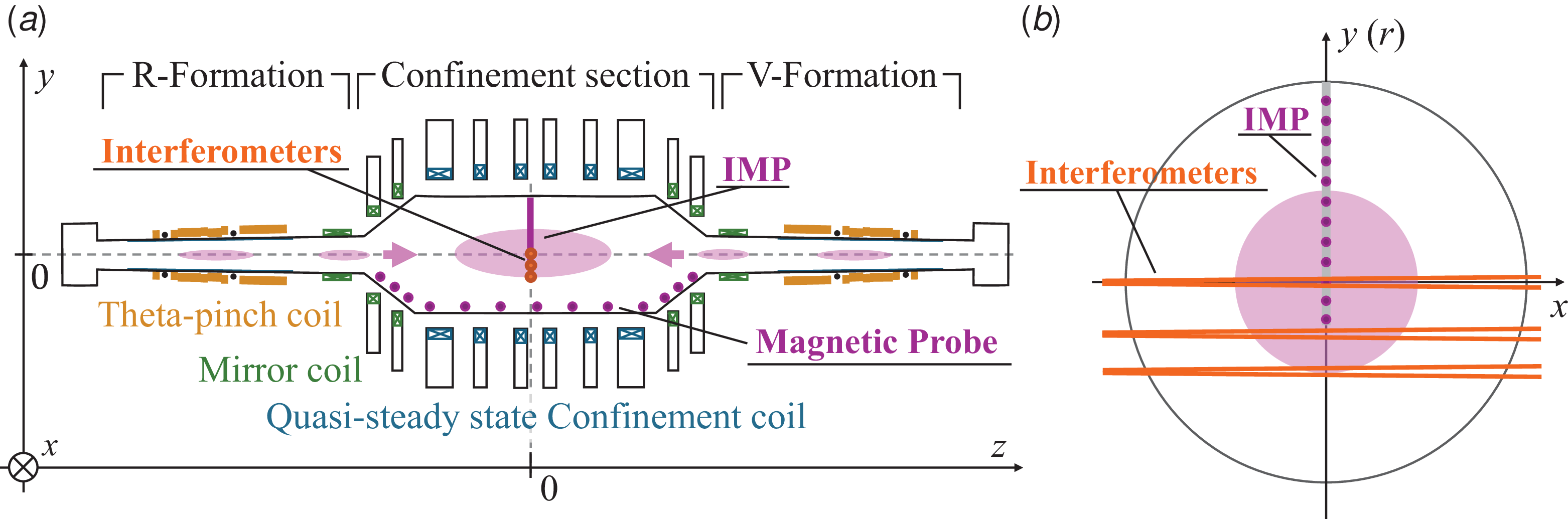
 x=0
x=0 z=0
z=0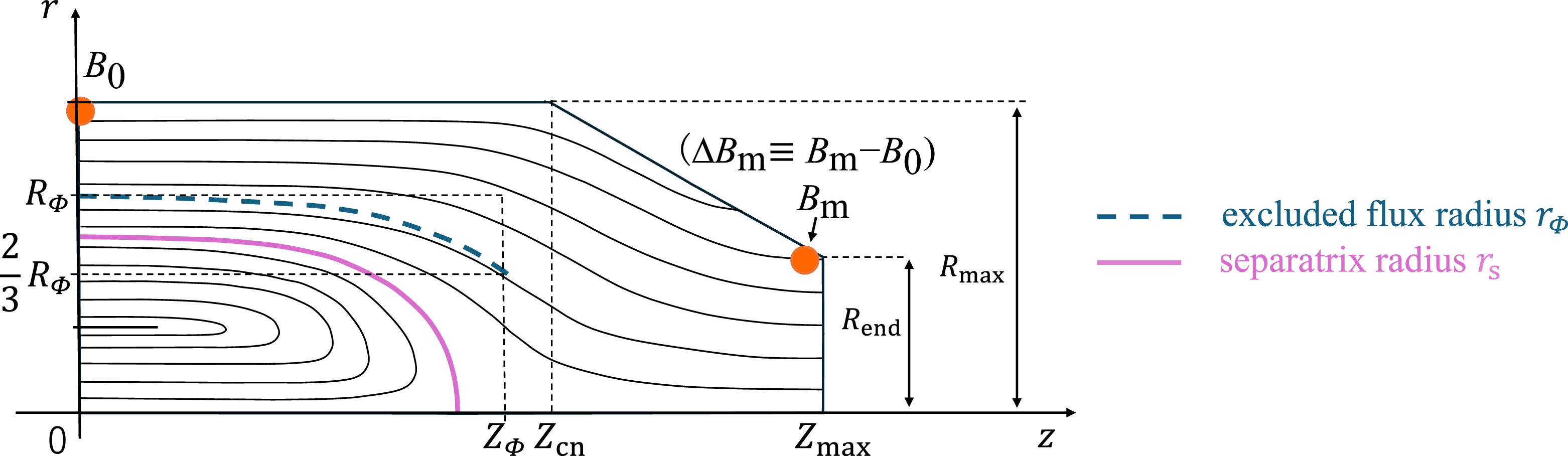




 Open access

