




Introduction
Among the many objects on display in the Frontier Gallery at Tullie House Museum in Carlisle, UK, is a second-century AD Romano-British copper-alloy jug (Figure 1). Its handle bears four vignettes, images that did not simply depict religious acts but which established precedents for their correct performance. The images on the upper part of the handle have become worn by the repeated handling of the cold metal, its materiality altered by the very acts depicted on it. These rituals likely included vows, prayers and sacrifices, during which the jug was used to dispense liquids specially acquired for the needs of each performance; offerings that provided varied sensory experiences through their viscosity, colour and smell as they flowed into an altar's flames. The jug, lighter after its contents had been successfully offered to a divine recipient, would then have been carefully cleaned and stored in preparation for the next ritual. The jug was likely the donation of a devotee (perhaps appearing anonymously in a vignette), whose generosity and piety might have been recognised long after their death. As an archaeological object, the jug can therefore tell us about more than vessel typology and artistic representations; it gives us access to a wealth of emotive, embodied and multisensory religious experiences. This article explores the degree to which museums currently engage with these experiences and the scholarly research that has recently developed around them. It then demonstrates how displays centred on lived religious experiences can be developed, contributing to a shift in the museum representation of Roman Britain, and of the classical world more broadly.
Second-century copper-alloy jug on display in the Frontier Gallery at Tullie House Museum, Carlisle (photographs by author).

Recent scholarship on ancient Mediterranean religion, particularly that advocating an approach focused on ‘lived ancient religion’, has foregrounded the social complexity of beliefs and practices, vibrant sensory experiences and individual agency in the creation, maintenance and transmission of religious knowledge (Gordon et al. Reference Gordon, Petridou and Rüpke2017; Rüpke Reference Rüpke2018; Albrecht et al. Reference Albrecht2018; Graham Reference Graham2020; Alvar Nuño et al. Reference Alvar Nuño, Alvar Ezquerra and Woolf2021; Häussler & King Reference Häussler and King2023). This work demonstrates that religious beliefs and practices are entwined within social, cultural and economic networks and, within these networks, material ‘things’ are not merely demonstrative of beliefs and practices but constitutive of them. At the same time, some scholars of Roman Britain have challenged deeply engrained narratives of ‘the Romans’ as an inherently superior civilising empire, arguing instead for a more complex picture of cultural and religious interactions (e.g. Revell Reference Revell2008: 110–49; Hingley Reference Hingley and Insoll2012). However, popular perceptions of Roman Britain have not kept pace with these scholarly developments (e.g. Hanscam Reference Hanscam2019; Hingley Reference Hingley2021a), and traditional perspectives about the ancient world remain influential within wider contemporary social and political discourse (Mac Sweeney et al. Reference Mac Sweeney2019; Bonacchi Reference Bonacchi2022). Museum displays on the Roman world and Britain's place within it may also not reflect the most recent scholarly research and hence may reinforce these popular perceptions. Museum visitors do not passively receive knowledge, but rather create meanings based in part on their prior knowledge and beliefs, influenced by a display's museography, interpretative narratives and situational atmospherics (Hooper-Greenhill Reference Hooper-Greenhill2000; Moser Reference Moser2010). Museum displays of religion in Roman Britain may therefore either validate or challenge visitors’ existing understandings but are never neutral.
This article considers displays of objects related to religion in Roman Britain at 23 museums of varying governance models and geographical locations (Figure 2). Analyses of permanent gallery layouts and their interpretation were conducted during 2019 and 2020, supported by interviews with curators and an online public survey (Lee Reference Lee2022). Drawing on recent archaeological, museological and religious scholarship, the article explores notions of ‘religion’ in ancient contexts, how ritual acts were emotionally and sensorially experienced, how religious knowledge was transmitted and maintained, and how religious communities and individuals operated within social, political and economic networks. These insights are used to review the 23 museum displays of religion in Roman Britain, before considering the potential opportunities for reconceptualising and redesigning such displays.
Map of surveyed museums (figure by author).

Integrating religion in displays of Roman Britain
To investigate how religion was integrated into Roman Britain displays across the 23 museums, each was analytically divided into a series of ‘display units’, defined as discrete interpretative groups encompassing a single narrative message, consisting of any combination of objects, labels, wall panels, replicas or interactives. Each display unit was then assigned to one of 17 general categories (Figure 3), with any specific reference to religion categorised as either a minor (level 1) or significant (level 2) element of the unit's narrative message. Although some individual units could be categorised in alternative ways, this method enables a general comparison of displays across museums of disparate size, governance and interpretative schemata. The results demonstrate that religion is as prominent in presentations of Roman Britain as the army, architecture and ‘daily life’, and galleries make use of significant material culture evidence (Figure 3). At most museums surveyed, the main religious narratives are, unsurprisingly, found in display units dedicated to ‘religion’. While allowing for a focused presentation of religion, however, this thematic separation risks presenting religious practice as a discrete aspect of life, reinforcing a modern religious and secular dichotomy. A notable exception to this trend relates to displays of health and wellbeing, especially at Corbridge and the Great North Museum, where the religious and magical aspects of healing are effectively integrated with the presentation of medical equipment, offering a valuable model for the integration of religion in other facets of life.
Graph showing subject matter contained in display units at the surveyed museums (figure by author).

Religious objects are commonly displayed in groups based upon the deities they depict or relate to, subtly reinforcing a restricted definition of religion as the worship of anthropomorphic divine beings. Objects therefore primarily become attestations of the existence of these deities as part of a universal polytheistic ‘catalogue of gods’, at the expense of a broader contextual understanding of how knowledge of these deities was transmitted and contested, and the myriad experiences inherent in communicating with them. Corinium Museum's display dedicated to Mercury (Figure 4) serves as an example. It features copper-alloy and pipeclay figurines of the deity and his attributes (cockerels and caducei or snake-entwined staffs), as well as cockerel leg bones and stone votive relief, altar and statuary fragments. These objects embody highly contextualised strategies for engaging with the deity. The cockerel bones may represent sacrificial offerings; the legs retained for special (votive) burial. The commissioning and installation of the relief and altar represent significant and lasting public proclamations of devotion by named worshippers, perhaps subsequently becoming cult foci in their own right. The statue fragments are likely temple cult imagery, perhaps perceived as the living embodiment of Mercury (Kiernan Reference Kiernan2020), whereas the smaller figurines might have been cult imagery at more intimate shrines, presented as less ostentatious offerings or carried as apotropaic devices. Despite this, museums often conflate the function of differently scaled anthropomorphic imagery. For example, at Canterbury Roman Museum, Kent, small figurines are positioned within temple models as proxies for life-sized statuary; while at Senhouse Museum in Maryport, Cumbria, an image of a copper-alloy statuette of Vulcan is used to complete a fragmentary stone relief (Figure 5). Both examples project an erroneous message that the statues/figurines served the same religious purpose.
Mercury display at Corinium, Cirencester (photograph by author).

Figurines at Canterbury Roman Museum (A) and Senhouse Museum, Maryport (B) (photographs by author).

The creation/acquisition, activation and deposition of these animals and objects therefore represent unique assemblages of situational religious needs, communicative strategies, specialist knowledge and engagement with various social and economic networks. These actions resulted in diverse embodied, sensory and emotive experiences, which may have differed depending on the ethnicity, social status, gender or other identities of those involved. Displays exploring such religious needs and lived experiences rather than focusing on presenting ‘catalogues’ of deities may therefore offer opportunities for more nuanced and emotive explorations of religious beliefs and acts.
The ability to explore the experiences offered by specific religious sites and communities can be restricted by historical collecting practices, which have often seen the aesthetics of objects prioritised over their depositional contexts. Assemblages, especially those originating in antiquarian collections, have also sometimes become split between different museums. Displays about the Housesteads Mithraeum on Hadrian's Wall, for example, are now at the Housesteads site museum, the Great North Museum and the Chesters Clayton Museum. Housesteads itself displays no finds but is the only museum with a reconstruction drawing, while the other two museums share the major sculptural pieces from the site. None offer a comprehensive understanding of the temple and its community and none reference the existence of the other displays to help the visitor understand the complete assemblage. The disruption of relationships between religious objects can also be caused by aesthetically focused display paradigms. Although museum displays are inherently artificial, retaining contextual connections between objects can enhance consideration of their experiential affordances. At the Great North Museum, for example, the original juxtapositions of the three focal altars from the Carrawburgh Mithraeum have been reconfigured. Their original organisation within the mithraeum was based on ritual functionality, a central altar with a focus (offering dish) flanked by two flat-topped mensae (tables; Figure 6A). In the gallery, however, this is rearranged to suit aesthetic sensibilities, moving the taller, figurative altar depicting Sol to the centre of the group (Figure 6B).
Altars from the Carrawburgh Mithraeum: A) during excavation (image by Richmond & Gibson Reference Richmond and Pearson Gibson1951: pl. XIb); B) on display in the Great North Museum, Newcastle upon Tyne (photograph by author).

Despite the significance of depositional context to archaeological interpretation, museums overwhelmingly focus on the use-life of religious objects rather than the acts and beliefs involved in their deposition into the ground. Where discussed, acts of deposition are often contextualised in economic terms, as the burial of valuables for safekeeping; discussion of structured or votive deposition almost entirely absent from displays. The British Museum, for example, describes assemblages from Hockwold, Barkway, Felmingham and Capheaton as ‘temple treasures’ or similar, a phrasing reminiscent of Christian concepts of ‘church plate’. The interpretation implies that their deposition reflected their religious or financial value in ‘life’ rather than being a ritually significant act in its own right. Object selections reinforce this through prioritising charismatic, aesthetically appealing finds over those reflecting the holistic compositions of assemblages. The British Museum's display of the Ashwell (Hertfordshire) votive assemblage, for example, focuses on the previously unattested deity Senuna (another entry in the ‘catalogue of gods’), the label suggesting the deposit was “perhaps for safekeeping”, buried with the intention of retrieval, rather than exploring the wider context of the finds within an area of long-established wetland ritual activity and processional movement (Jackson & Burleigh Reference Jackson and Burleigh2018).
Defining and expressing religious experiences in Roman Britain
Consideration of ancient ‘religious experiences’ is difficult to detach from contemporary monotheistic concepts of religiosity based upon internalised spiritual revelation (Sharf Reference Sharf2000; Taves Reference Taves2009; Patzelt Reference Patzelt and Gasparini2020). Embodied approaches to religion recognise the mutually affective connectivity between humans and their worlds. In his seminal study of the materiality of religion, David Morgan (Reference Morgan2010: 5) argued that when someone speaks of their belief in God:
…we must learn to hear his sighs, his gritted teeth, the murmur of nostalgia, the distance gaze of eyes searching the memory of folded hands, sore knees, and the lingering memory of the Eucharist liturgy. He says he believes, but what he really does is feel, smell, hear and see.
How do museums engage with such sensory and emotional experiences of ‘doing’ religion in Roman Britain? The ‘lived ancient religion’ approach conceptualises religion as a dynamic phenomenon, constantly adapting to situational needs and social landscapes (Albrecht et al. Reference Albrecht2018). Ritual performances inherently possess innovative potential; religious communities and their traditions are the outcome of myriad pragmatic agents possessing and transmitting specific and mutable religious knowledge. These ideas are generally not reflected in museum narratives, however. Ancient polytheism is often presented as undynamic, with religious change usually considered only at high levels, such as the adoption of Christianity. Religious acts are framed as something done rather than something experienced, perhaps reflecting the influence of traditional scholarship, which emphasised correct ritual performance (orthopraxy) over internalised piety (orthodoxy; Rives Reference Rives2019: 4).
Though many museums present religion as part of daily life in Roman Britain, this approach is rarely developed in any meaningful manner, such as examining how religious knowledge was acquired and how it could be wielded to enhance or threaten social or political status. Paradoxically, though ancient worshippers are often represented in displays—for example, as names inscribed on dedications—they do not feature as agentic, sentient individuals operating within social and religious communities. They are simultaneously part of the narrative yet absent from it, the explanation for the religious object's existence yet neither influential upon it nor influenced by it. Interpretations of the cult of Mithras at the surveyed museums, for example, frequently highlight ‘membership’ as a central theme, yet omit the social, emotional and physical implications of joining a dynamic religious community founded upon restricted knowledge. Intense experiences, such as initiations involving nudity, binding, sensory deprivation, exposure to fire and simulated death (Gordon Reference Gordon, Casadio and Johnston2009; Rubio Reference Rubio, Alvar Nuño, Alvar Ezquerra and Woolf2021), are not discussed in any displays.
Where sensory experiences of Romano-British religion are acknowledged in displays, these primarily concern light and sound, with taste, smell and touch almost entirely absent. Though many museums reference the use of light in rituals, light-emitting objects such as lamps are often presented as being either practical (illuminating a temple) or as potential votive offerings; the contextually specific use or restriction of light in creating influential sensory assemblages is not considered. The perforations in the Sol altar from the Carrawburgh Mithraeum (Great North Museum), for example (Figure 6), must originally have created an intense and specific ritual impact, yet neither this nor the surviving traces of pigment are discussed. Ritual sounds are treated in a similarly generic manner. Though some museums reference the role of sound in attracting deities or averting misfortune, these remain rather incidental and detached from specific ritual sensory experiences. The Bridgeness slab (RIB 2139), for example, features an evocative depiction of a sacrifice and is used by no fewer than five museums (the original sculpture at the National Museum of Scotland, casts at the Hunterian and Tullie House museums, and photographs at the Senhouse and Corinium museums); yet though it depicts a prominent aulos (reed pipe) player, only the Senhouse display draws attention to the musician's presence.
Among the museums discussed here, the display of the mithraeum beneath the Bloomberg building in central London offers visitors a uniquely immersive experience. The contextualising interpretation invites visitors to imagine a powerful and emotive scene: a dark temple, lit by lamps and torches and filled with smoke and incense, where a cramped crowd witnesses masked performers recounting the cult's narrative myths. The cult is portrayed as a sincere and idiosyncratic religious community. In the temple itself, however, the ritual experience, though memorably dramatic, is detached from any specific religious purpose. The lighting effects reconstruct absent architecture rather than exploring ritual uses of light, while the sounds of feasting, musical instruments and Latin speech are evocative but unspecific, even anachronistically including a Latin recitation of an excerpt of Kipling's poem ‘A Song to Mithras’.
Ritual movements and gestures are important facets of religious experience, whether explicit (e.g. pilgrimage, dance) or implicit (e.g. bending to make an offering, washing hands; Graham Reference Graham2020: 48–9). Museums rarely discuss pilgrimages or processions, though Bath is a prominent exception, visitors encountering a video and diorama of a procession supported by narratives that worshippers came from across the Roman world. Compared with other museums, it is easier to evoke religious movement around the extant structures at Bath and the Bloomberg Mithraeum, with modern visitor routes often directly replicating those of ancient worshippers. While visitors may be cognisant of this, the significance of crossing thresholds, such as the descent into the Mithraic cave or entry into the temple temenos (ritual enclosure) or sacred spring at Bath could be more effectively (and affectively) highlighted. More intimate movements are often reflected in museum displays, either depicted on ancient sculptural pieces or through modern reconstruction drawings, with many depicting acts of bowing, making offerings, kneeling, looking skyward or raising hands. However, explicit interpretations of these gestures are few.
Potential approaches for exploring religious experiences
Museums typically operate within tight financial circumstances that limit their ability to adapt to the latest theoretical developments in scholarly research. The analysis presented here is therefore not intended to judge museum displays as ‘wrong’ in any sense. Yet the material and sensory turns in museology challenge the primacy of the aesthetic gaze that has shaped displays (Classen & Howes Reference Classen, Howes, Edwards, Gosden and Phillips2006; Dudley Reference Dudley2012), and there is both a need and the opportunity for a reconsideration of how museums present Romano-British religion. The traditional museal focus on aesthetics and the description of objects reduces ‘religion’ to an archaeological category rather than an ancient numinous experience. Effective change, therefore, should be sought not only in design and interpretation but more fundamentally in relation to museum documentation. Greater consideration of what constitutes a ‘religious’ object and the retention of contextual relationships are essential to articulating broader concepts of ‘religious’ and ‘ritual’ activity. It is notable that none of the surveyed museums offer definitions for commonly employed terminology such as ‘religion’, ‘ritual’, ‘cults’ or ‘gods/goddesses’. Their use without contextualisation leads visitors to apply their own contemporary understandings of these culturally relative concepts to the ancient world.
More emotive and challenging interpretations might be created through greater consideration of the situational needs, actions and experiences of the original makers, users and depositors of the material culture displayed. This would represent a re-sacralisation of ancient religion; a tacit acknowledgement that its distinct material and sensorial assemblages were created by emotive and agentic religious actors existing within both real and imagined communities (Mol & Versluys Reference Mol, Versluys, Rüpke and Raja2015). The creation and deposition of curses represents one of the most intense religious experiences attested in Roman Britain (Gordon Reference Gordon2013; McKie Reference McKie2017) and offers a case study for exploring the potential for such experiential interpretative approaches. Cursing powerfully combined the multisensory, emotive and embodied processes of creating and depositing ritually specific materials with recourse to specialist religious knowledge. It was based on socially significant needs and a desire for tangible and dramatic outcomes, blurring traditional boundaries between religion and magic (Sanzo Reference Sanzo, Mastrocinque, Sanzo and Scapini2020). Despite this, museums displaying curses present them as being of primarily literary interest, their inscriptions highlighted as evidence of stolen items associated with bathing or agriculture. The folding or piercing of curses prior to deposition, where acknowledged in displays, are presented as an inconvenient barrier to translation rather than powerful acts conducted as part of transferring the curse to its divine recipient. Cursing to resolve social or legal injustices, and the emotion of wishing extreme harm on another, therefore offers unparalleled opportunities to engage visitors empathetically with the experiences of ancient individuals. Whether they possess active beliefs in the supernatural or not, it is valuable to ask visitors to consider whether they would feel able to create and deposit their own curses.
Traditional interpretation relies upon visitors’ preconceived notions of Roman Britain as a place of recognisable political, cultural and technological sophistication. The dominant aesthetic gaze of the museum reinforces these perceptions, prioritising descriptions of the artistic or technical quality of objects and the translation of inscriptions over contextualising their varying social functionality, deposition and experiential affordances. Interpretative narratives that creatively challenge engrained perspectives offer powerfully disruptive potential to make the religious landscape of Roman Britain feel more culturally alien, even unsettling. These might include communication with divine agents through structured deposits (sometimes including human remains) in varied and significant locations, or the use of magical amulets and formulae. Such considerations need not require longer or more complex interpretative texts and object labels; the creation of ontologically and emotively challenging interpretation centres upon not only what is said, but how it is said.
Creative interpretative methodologies might employ first-person dialogues or poetic responses to explore specific ritual acts from varied perspectives, such as religious officials, dedicators with specific needs, non-participatory (even dissenting) observers, and represent individuals of differing social, ethnic and gender identities. The emotive interpretative potential of poetry was demonstrated at the (now closed for relocation) Museum of London. As noted above, cursing is not generally presented as an emotive phenomenon, yet Jonathan Ladd's poem ‘Curses’, displayed in the Roman London Gallery, represented the most elegant expression of frustration and vengeful agency in any of the surveyed museums. The last stanza reads:
With primal glare, one you can't break,
Completes does he the curse he spat
All set to strike, gods as his snake
The venom in Vituperat
Allied to creative interpretation is a recognition that aesthetically driven ‘glass-case’ displays are insufficient for engagement with the multisensory and material realities of objects. Interactivity, broadly defined here to include any imaginative, emotive or multisensory activity, has an important role to play. Museum interactives (including object handling) have been long criticised for being overly child-orientated (Owen Reference Owen and Merriman1999; MacDonald Reference MacDonald and Pye2007: 108), and those at the museums surveyed here are indeed targeted at children, families and schools. Though these groups represent important visitor demographics for museums, greater interactivity can stimulate valuable new insights for visitors of all ages. For example, the ‘My Roman Pantheon’ interactive at the Clayton Museum (Figure 7) invites visitors to choose three deities to worship by using a wooden lamp carried around the gallery and held up against panels next to objects to select them (Petrelli et al. Reference Petrelli, Dulake, Marshall, Roberts, McIntosh and Savage2018). The lamp prompts consideration of the tactility of religious objects and the experience invites contemplation of the individual religious choices people in Roman Britain faced.
‘My Roman Pantheon’ interactive display at the Chesters Clayton Museum (photographs by author).

The imposition of modern religious language and concepts of religiosity onto the ancient world is problematic, yet the burgeoning scholarship of contemporary ‘material religion’ in museums is of interest for archaeological displays. Studies have, for example, explored the often-hidden religious interactions of visitors with objects (Berns Reference Berns, Buggeln, Paine and Plate2017). Ancient religion and its imagery retain active spiritual significance for some modern pagans (Tully Reference Tully2021), while other religious groups perceive the demise of such deities as supporting the veracity of their own faith (Paine Reference Paine and Paine2000: 166). These gallery experiences are generally overlooked, however, and archaeological-museum visitors are assumed to adopt a dispassionate academic interest in the objects on display. Actively recognising and facilitating religious experiences might offer a powerful new display paradigm; encouraging visitors who come face-to-face with ancient deities in museums to transcend a sense of awe at their age or artistry and consider ancient experiences of divine presence. Though we cannot know how ancient worshippers experienced their idols, we can be confident that they did not deploy a detached, art-historical museum gaze.
A desire for change?
As part of this research, interviews were conducted with curators at many of the surveyed museums, and an online survey created to gather wider opinions about religion in Roman Britain and museum displays (Lee Reference Lee2022). The curatorial interviews reveal an enthusiasm for new approaches, while recognising the physical and financial restrictions facing museums. The online survey had 172 respondents, mostly people working in museums, heritage and academia, who were asked how well they felt museums presented certain issues relating to religion (Lee Reference Lee2022: app. D). The issues perceived as most poorly represented were relevant to lived religious experiences: representations of individuals of varying identities; multisensory experiences; and the geographic and temporal variability of practices. One survey respondent elaborated that there is “little discussion of experience and interaction between the individual and wider religious/ritual, or the impact that such beliefs hold on the lives and actions of the individuals or groups”. Another commented that “generally, religion is not well described” because of “embarrassment by present-day historians/archaeologists who perhaps have little understanding of religion”. Another response recognised the potential for more reflexive presentations of Roman Britain:
The theme of religion and religious integration in Roman Britain has the potential to make Roman archaeology more personal and move museum visitors to consider and relate to the individual lived experience of people in the past. Hopefully this may also encourage them to consider similarities and differences between people in the past, themselves and those around them … Roman religion, a topic with many great artefacts and stories to illustrate it, has often been poorly served by museum displays. (Lee Reference Lee2022: 386)
Not all respondents were so desirous for change, however, with one objection based on the perceived ‘politicising’ of long-established narratives about Roman Britain: “It is not the job of a museum to make political or religious statements … It reduces public support for and trust in the institution.” (Lee Reference Lee2022: 387). Overall, the online survey revealed that museums are prominent and trusted places for engagements with Romano-British religion and offer valuable opportunities for discussion of contemporary social issues. However, recent religious scholarship exerted little impact upon respondents’ perceptions. The curatorial interviews demonstrated a broad appetite to explore new display methodologies, tempered by the practical constraints faced by the museum sector (Lee Reference Lee2022).
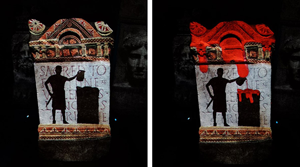
Since the completion of data collection in October 2020, there have been notable developments at some of the surveyed museums. The Great North Museum has introduced a series of eye-catching video projections onto some of its altars, recreating absent colours and highlighting aspects of their functionality (Figure 8A). An altar to Fortuna from Risingham (RIB 1210) features a silhouetted figure pouring a blood libation that trickles down the front of the altar (Figure 8B), evocatively connecting the depicted act with the original object and its messy ritual reality. A redisplay of Tullie House's Border Gallery also focuses on recontextualising altars through the installation of vinyl graphics (Figure 9). These confront the common disconnect between reconstruction drawings and original objects, the graphics incorporating the altars in active ritual acts, including the fire and smoke emitting from a focus. The interpretation's explanation that the gods received their offering through smelling the curling smoke highlights the emotive and sensory significance of a non-visual aspect of the ritual.
Altar projections at the Great North Museum: A) recreation of colours and aspects of their functionality; B) person pouring a blood libation on the altar (photographs by author).

Altar interpretation at Tullie House (photographs by author).

Conclusion
Despite reflexive recent scholarship into the historiography of Romano-British archaeology (e.g. Hingley Reference Hingley, Belvedere and Bergermann2021b), the presentation of the subject in museums remains under-studied. The research presented here represents a focused analysis of museum displays of religion in Roman Britain, considering the concept of lived religious experiences through a multidisciplinary study of complementary and evolving theoretical approaches to religion, material culture, museology and Roman archaeology.
It is not feasible to suggest that museums can or should attempt to reflect constantly shifting theoretical discourses. However, religion is a prominent aspect of the wider public understandings of Roman Britain and has been shown to be central to museum displays of that period. Current interpretative narratives generally perpetuate Romano-centric perspectives over more nuanced cultural interactions and promote the aesthetic elements of objects above their sensory and emotional affordances. Religion is a dynamic and culturally relative construct centred upon the actions of emotive, sentient agents operating within real and imagined communities. Ritual acts should accordingly be considered not as homogeneous and universal but contingent and situationally specific assemblages of people, places and things. Similarly, the religious landscape of Roman Britain should be more broadly defined to consider people's interactions with divine forces through varied communicative strategies in diverse contexts, rather than centred upon a universal, uncontested and classically dominated ‘catalogue of gods’. Terms such as ‘religion’, ‘ritual’ and ‘cults’ are neither universally applicable nor understood and require definition and contextualisation.
Museum displays are rarely static with changes, ranging from small in-case alterations to full-scale redevelopments, regularly undertaken. Such moments of revision, no matter how minor, offer potential opportunities to engage with the religious needs, experiences and actions of individuals and communities. These may not only better reflect ancient realities, but also crucially help to create displays that are more relatable and accessible for visitors. The use of creative language, multisensory interactivity, the active promotion of empathetic and emotive responses, and the introduction of broader and more nuanced concepts of religiosity can enhance engagement across all visitor demographics and benefit the wider participatory ambitions of the museum. Engaging with religious experiences in cognitively stimulating and creative ways need not require significant funding or increased quantities of interpretative text. Indeed, it is vital that new interpretative methodologies are not detached from the social and economic realities of museum work. In practice, greater collaboration between academics and museum professionals could generate mutually beneficial outputs, increasing the accessibility of new research and enhancing the educational role of museums. More proactive communication and loans between museums also offer the potential to share knowledge and resources, with the museums on Hadrian's Wall already making notable progress in this regard (Mills Reference Mills and Mills2021).
The creation of new display paradigms that challenge traditional preconceptions of religious acts, identities and experiences in Roman Britain is not merely of intrinsic interest. Such new paradigms offer benefits to the wider social and educational aims of museums and represent a powerful means of disrupting and deepening popular understanding of Roman Britain and its cultural landscapes.
Acknowledgements
This article is dedicated to the memory of my father, Robert Lee, in recognition of his endless love and support. I am grateful to my PhD supervisors for their guidance during the wider research upon which this article is based, and to the editors and anonymous reviewers whose constructive feedback has improved the quality and clarity of this manuscript.
Funding statement
This research received no specific grant from any funding agency or from commercial and not-for-profit sectors.


 Open access

