



Non-alcoholic fatty liver disease (NAFLD), the most common cause of chronic liver disease worldwide, affects one-third of the population(Reference Dietrich and Hellerbrand1). The prevalence of NAFLD among Chinese adults is up to 27 %, paralleled with the increase in both obesity and type 2 diabetes(Reference Fan2). NAFLD represents a wide spectrum of histopathological abnormalities ranging from simple steatosis to non-alcoholic steatohepatitis and, eventually, cirrhosis and hepatocellular carcinoma(Reference Manne, Handa and Kowdley3).
Flavonoids comprise the most common group of plant polyphenols and occur naturally in fruit, vegetables and beverages such as tea and wine. The major subclasses of flavonoids include flavones, flavan-3-ols, flavanones, flavanols, anthocyanins and isoflavones(Reference Ross and Kasum4). In the absence of effective medications, diet and exercise are important contributors to the management of NAFLD(Reference Fan and Cao5). The mainstream hypothesis of multiple hits proposes explanations of NAFLD pathology from several perspectives, among which insulin resistance, oxidative stress and inflammatory reactions play important roles(Reference Madan, Bhardwaj and Thareja6). Some dietary antioxidant compounds, such as flavonoids, are believed to decrease lipogenesis, lipid oxidation, peroxidation and inflammation, which represent a new attractive therapeutic approach for patients with hepatic steatosis(Reference Ferramosca, Di Giacomo and Zara7).
In vitro and animal studies have found that flavonoids prevent hepatosteatosis by reducing de novo lipogenesis, increasing fatty acid β-oxidation, improving insulin resistance and attenuating the release of inflammatory cytokines(Reference Rodriguez-Ramiro, Vauzour and Minihane8). Although a few studies have shown that a higher intake of flavonoids was associated with a lower risk/presence of the metabolic syndrome(Reference Sohrab, Ebrahimof and Hosseinpour-Niazi9) and insulin resistance(Reference Jennings, Welch and Spector10), scarce evidence was available regarding the association of dietary flavonoids and subclasses with NAFLD. The National Health and Nutrition Examination Survey (NHANES) (2005–2010) suggested an inverse association between flavonoid consumption and fatty liver indices in 17 685 US adults(Reference Mazidi, Katsiki and Banach11). Several trials showed that supplementation with high doses of flavonoids lowered the plasma γ-glutamyl transpeptidase and alanine aminotransferase (ALT) levels in thirty-seven Caucasians with borderline hepatitis(Reference Oki, Kano and Ishikawa12), improved plasma ALT, cytokeratin-18 M30 fragment and myeloperoxidase(Reference Zhang, Chen and Li13) or the liver-to-spleen computed tomography attenuation ratio(Reference Sakata, Nakamura and Torimura14) in NAFLD patients. To the best of our knowledge, no prospective human study has reported the relationship between dietary intake of flavonoids and subclasses and NAFLD. Considering the high doses of a single type of purified flavonoid used in randomised controlled trial, it remains uncertain whether the relatively lower-dose consumption of flavonoids (and their subclasses) in habitual diets is beneficially associated with the presence/risk of NAFLD or its progression in adults.
This prospective study aimed to examine the associations between dietary consumption of total flavonoids and their subclasses (flavonols, flavanones, flavones, flavan-3-ols, isoflavones and anthocyanins) and the progression of NAFLD in middle-aged and elderly Chinese adults.
Methods
Study population
The Guangzhou Nutrition and Health Study is a community-based prospective cohort study aimed at identifying determinants of common chronic diseases. Two batches of participants aged 40–80 years old were recruited from residents of Guangzhou between 2008 and 2010 (n 3169) and between 2012 and 2013 (n 879) through advertising, health lectures and referrals. They completed detailed questionnaire survey (including dietary survey), body examination and blood sample collection at baseline and followed-up(s) approximately every 3 years. Those with hospital-confirmed malignant tumours, heart disease, stroke, liver disease (e.g. cirrhosis, Wilson’s disease and haemosiderosis), renal failure and physical or mental disability were excluded. During 2011–2013, 2510 participants of the first batch and 879 participants of the second batch completed the ultrasonography NAFLD examination and at least one round of survey. Among them, 2945 subjects had the next ultrasonography NAFLD examination again between 2014 and 2017. Participants (n 251) who had missing data for key variables (NAFLD evaluation and/or dietary survey, n 187), viral hepatitis (n 29) and excessive alcohol (n 35) were further excluded. A total of 2694 participants with at least one round of dietary assessment (2008–2010, 2011–2013) and two rounds of ultrasound NAFLD evaluations (2011–2013, 2014–2017) were included in this prospective study (online Supplementary Fig. S1). Participants with the following conditions during the follow-ups were further excluded: (1) a history of serious chronic disease or diagnosed malignancy, (2) death, (3) excessive alcohol intake (>140 g/week for men and >70 g/week for women), (4) loss to follow-up and (5) hepatitis virus infection. Finally, 2694 follow-up participants were included.
The present study was conducted according to the guidelines laid down in the Declaration of Helsinki, and all procedures involving human subjects/patients were approved by the Ethics Committee of the School of Public Health of Sun Yat-sen University. Written informed consent was obtained from all the study participants.
Data collection
For all the participants, socio-demographics and anthropometrics were assessed both at baseline and again at the two follow-up visits (2008–2010, 2011–2013 and 2014–2017). Dietary assessments were conducted at baseline and at the first follow-up. The diagnosis of NAFLD was evaluated by ultrasonography at the first and second follow-ups.
Questionnaire interview and anthropometric measures
Trained interviewers collected information face-to-face for all three surveys, and the information included socio-demographic characteristics (e.g. age, sex, education, household income and other factors), habitual dietary intake, physical activity, lifestyle habits (e.g. consumption of alcohol, smoking) and history of chronic diseases and medication. Weight was measured while the subjects were minimally clothed and without shoes. Height was measured with the participant in a standing position without shoes. BMI was calculated as weight (kg) divided by the square of the height (m2).
Dietary assessment
A validated and reproducible quantitative FFQ including seventy-nine items was used to estimate the usual dietary intakes of the participants(Reference Liu, Dai and Xu15,Reference Zhang and Ho16) . The FFQ included eight categories: cereals (thirteen items), soya foods and other beans (eight items), vegetables (thirteen items), fruits (ten items), meats, fish and eggs (eighteen items), dairy products (eight items), edible fungus and nuts (two items) and drinks and soup (seven items). Additional three items were used to assess cooking oil consumption. The frequency of consumption was estimated on a five-level rating scale ranging from never to once per d. We used a standardised dietary atlas to show the serving size of each food. The intake of each food per d was transformed from the consumption frequency. Berries and chocolate were not included in the FFQ because the items were not often consumed by middle-aged and elderly people in China. The flavonoid contents were calculated based on the USDA database and the Hong Kong database of isoflavones(Reference Chan, Murphy and Ho17). We estimated intakes of the following six flavonoid subclasses: flavanones (hesperidin, naringenin), anthocyanins (cyanidin, delphinidin, malvidin, pelargonidin, petunidin and peonidin), flavan-3-ols ((+)-catechin, (+)-gallocatechin, (−) epicatechin, (−)-epigallocatechin, (−)-epicatechin 3-gallate and (−)-epigallocatechin 3-gallate), flavonols (quercetin, kaempferol, myricetin and isorhamnetin), flavones (luteolin, apigenin) and isoflavonones (daidzein, genistein and glycitein). Total flavonoid intake was estimated by summing the intake levels of the flavonoid subclasses. The average intake of total flavonoid and the flavonoid subclasses at baseline and the first visit was calculated as the dietary flavonoid intake in the present study. The percentage contribution of each food or food group to total flavonoid intake was calculated as the ratio of daily total flavonoid intake from each food to that of the average daily intake.
Abdominal ultrasonography and diagnosis of non-alcoholic fatty liver disease
Abdominal ultrasound examinations were conducted to evaluate the status of NAFLD with a Doppler sonography machine (Sonoscape SSI-5500) with a 3·5 MHz probe, and the experienced radiologists were blinded to the participants’ information. The NAFLD status and the degree of steatosis were evaluated according to Graif’s criteria(Reference Graif, Yanuka and Baraz18) (ranging from absent, mild or moderate to severe), as reported in our previous articles(Reference Chen, Liu and Zhou19). The change in fatty liver status was estimated by the difference between the two visits and was corrected for the severity of fatty liver status at the first visit(Reference Xiao, Chen and Zeng20). Participants were then classified into three groups: the improved, remained stable (no change in the degree of NAFLD) and progressed (worsening degree) groups. The between-operator reliability for the ultrasound evaluations was repeatedly assessed in 100 participants and showed very good reliability (κ = 0·875, total agreement = 93 %, P < 0·001). Validity was assessed in thirty-four participants with further computed tomography evaluations by researchers who were blinded to the ultrasound results, and good agreement was observed (κ = 0·691, total agreement = 85 %, P < 0·001).
Laboratory assays
Venous blood samples of the participants were drawn in the morning after a 10-h fast and were separated within 2–4 h and were then stored at –80°C until analysis. Colorimetric methods using a Hitachi 7600-010 automated analyser were used to measure fasting serum glucose. Fasting serum insulin was measured by an electrochemiluminescence immunoassay on a Roche Cobas 8000/e602® immunoanalyser using a kit (cat. no. 12017547 122). The homeostasis model assessment of insulin resistance was calculated using the following formula to evaluate insulin resistance: (plasma glucose (mg/dl) × plasma insulin (μU/ml))/405. Serum total cholesterol was measured by colorimetric methods using commercial kits (Biosino Biotechnology Company Ltd) with a Hitachi 7600-010 automated analyser (Hitachi).
Statistical analysis
The statistical power was calculated based on the Poisson regression with an α level of 0·05. The worsening rate of NAFLD was 18·8 % during the mean exposure time of 3 years. The relative risk between dietary flavonoids and worsening in NAFLD was 0·81 due to a one-unit change in the quintiles of flavonoids. Given these specifications, the sample of 2694 observations (18·8 % in progressed group) in the present study achieved 89·1 % power to detect the significant association.
Data are presented as means and standard deviations for continuous variables and as frequencies and percentages for categorical variables. The χ 2 test and ANOVA were used to analyse the differences between participant characteristics. Energy-adjusted intakes of each flavonoid and the total intake based on the residual method were used for further analyses. Robust Poisson regression was performed to estimate relative risks, and robust standard errors were used to estimate the 95 % CI(Reference Chen, Qian and Shi21) for NAFLD associated with quintile categories of flavanones, flavones, flavan-3-ols, flavonols, isoflavones, anthocyanidins and total flavonoids. In model 1, we adjusted for sex and age. In model 2, we further adjusted for household income (<4000, 4000–6000, >6000, yuan/month per person), smoking status (yes/no), alcohol drinking status (yes/no), tea drinking status (yes/no), physical activity (in MET h/d), dietary intake of energy (kJ/d), history of using statins (yes/no), BMI (kg/m2), dietary glycaemic index (units/d) and dietary intake of carbohydrates (g/d), protein (g/d), total fat (g/d), fibre (g/d), vitamin C (mg/d), PUFA (g/d) and SFA (g/d). ANCOVA was applied to compare the mean differences in flavonoids between the three groups of NAFLD progression. The Bonferroni’s test was used for multiple comparisons among NAFLD groups. BMI-stratified analyses and interaction analyses between flavonoids and BMI (<24, ≥24 kg/m2) were conducted in model 2(Reference Zeng, He and Dong22). Sensitivity analyses were conducted by removing the participants in the stable group and analysing the relationship between flavonoid intake and the degree of change in NAFLD. Restricted cubic splines were performed to evaluate the shape of the flavonoid–NAFLD relationship and to assess the dose–response relationship. The above statistical procedures were performed with SPSS 23.0 software (IBM Corporation) and STATA (version 11.1). Two-tailed P values less than 0·05 were considered significant in all statistical analyses.
We conducted path analysis to examine the relationship between dietary flavonoids and mediators (serum cholesterol, homeostasis model assessment of insulin resistance) and the changes in severity between the two evaluations of NAFLD, using SPSS AMOS version 24 (IBM Corporation). Standardised regression coefficients for each identified path were determined to obtain the estimates. The goodness-of-fit index and adjusted goodness-of-fit index were used to evaluate the fits of the models. All statistical tests were two-sided and were considered statistically significant when the P value was <0·05.
Results
Baseline characteristics of the study subjects
A total of 2694 participants (870 male and 1824 female) with a mean age of 58·4 years at baseline were involved in the 3-year prospective study. Participants were classified into the improved group (20·7 %), the stable group (60·4 %) and the progressed group (18·8 %) according to the degree of change in NAFLD in 3 years. The characteristics of the subjects in the three groups were shown in Table 1. Participants in the improved group tended to have a higher BMI (P < 0·001), older age (P = 0·003), higher homeostasis model assessment of insulin resistance index (P < 0·001), lower serum cholesterol (P = 0·039) and higher intake of dietary flavanones (P = 0·002) and isoflavones (P = 0·017).
Characteristics of the study participants* (Mean values and standard deviations; numbers and percentages)

* Continuous and categorical variables are described by means and standard deviations or numbers and percentages, and evaluated by ANOVA and χ 2 tests, respectively, to compare the categorical and continuous variables of the participants in the three groups.
† Smoker: ≥1 cigarette/d in the past year.
‡ Alcohol drinker: ≥1 cup/week in the past year.
§ Tea drinker: ≥1 cup/week in the past year.
|| Used statins in the past year.
¶ Physical activities, in metabolic equivalent (MET) h/d.
Major source of dietary flavonoids
Table 2 showed the food sources of flavonoids. We listed the top ten food groups contributing to total flavonoids and the top five food groups contributing to flavonoid subclasses. The total flavonoids were mainly obtained from citrus fruits/juice (24·19 %), soya foods (20·07 %), pome fruits (16·06 %), grapes (9·77 %) and bananas (7·89 %).
Major food sources of dietary flavonoids (Percentages)
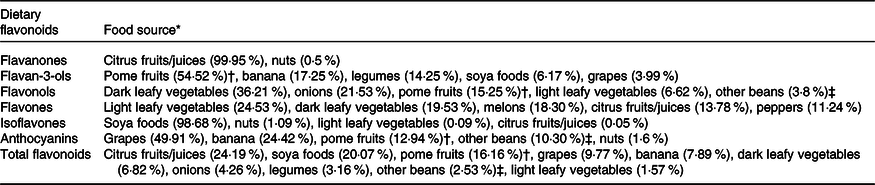
* Flavonoid subclass foods ranking in the top five are listed. Total flavonoid foods ranking in the top ten are listed.
† Pome fruits included apple, pear, peach, pineapple and plum.
‡ Other beans included mung beans, red beans, black beans, etc.
Comparisons of the mean levels of dietary flavonoid intake by the non-alcoholic fatty liver disease progression groups
ANCOVA analyses showed that participants with an improved (v. progressed) grade of NAFLD over 3 years had higher levels of dietary intake of total flavonoid, flavanones and anthocyanins in the fully adjusted model (model 2) (all P difference < 0·05) (Fig. 1 and online Supplementary Table S1). The mean intake of dietary flavonoids was 2·89–22·5 % higher for different flavonoids in the improved (v. progressed) participants.
Multivariable adjusted means with their standard errors of dietary flavonoids (mg/d) according to the change in the degree of non-alcoholic fatty liver disease. Means were adjusted for sex, age, BMI, household income, alcohol drinking status, smoking status, tea drinking status, physical activity, history of using statins, dietary glycaemic index, dietary intakes of energy, carbohydrate, protein, fat, SFA, PUFA, fibre and vitamin C. * P < 0·05, ** P < 0·01 and *** P < 0·001, compared with the improved group; † P < 0·05, compared with the stable group (Bonferroni’s test).  , Improved;
  , stable;
  , progressed.

Associations of dietary flavonoid intake with the risk of non-alcoholic fatty liver disease progression
The risks of NAFLD progression (v. improvement and stability) tended to be lower in participants with higher dietary intakes of individual and total flavonoids (Table 3). The relative risks and 95 % CI of NAFLD progression in quintile 5 (v. 1) of each flavonoid were 0·71 (95 % CI 0·54, 0·93) for total flavonoids (P trend = 0·012), 0·74 (95 % CI 0·57, 0·95) for flavanones (P trend = 0·014), 0·74 (95 % CI 0·56, 0·96) for flavan-3-ols (P trend = 0·023), 0·90 (0·68, 1·18) for flavonols (P trend = 0·433), 0·73 (95 % CI 0·56, 0·93) for flavones (P trend = 0·012), 0·79 (95 % CI 0·61, 1·02) for isoflavones (P trend = 0·067) and 0·74 (95 % CI 0·57, 0·96) for anthocyanins (P trend = 0·024) in model 2.
Associations of dietary flavonoids with risk of progressed non-alcoholic fatty liver disease status in the total population
(Relative risks (RR) and 95 % confidence intervals)

* P < 0·05, ** P < 0·01, *** P < 0·001.
† Model 1: adjusted for sex, age.
‡ Model 2: adjusted for sex, age, BMI, household income, alcohol drinking status, smoking status, tea drinking status, physical activities, history of using statins, dietary glycaemic index, dietary intakes of energy, carbohydrate, protein, fat, fibre, vitamin C, SFA and PUFA.
In the dose–response analysis with restricted cubic spline (Fig. 2), an L-shaped relationship between total flavonoids and the risk of NAFLD progression was observed (P non-linearity = 0·0134). Flavonoid intakes below approximately 140 mg/d were dose-dependently associated with an increased risk of NAFLD progression, but increased intakes of flavonoids beyond 140 mg/d were not associated with more decreased risk of NAFLD progression (Fig. 2). Similar L-shaped associations were observed for flavonols, flavones, isoflavones and anthocyanins, but linear trends were noted for flavanones and flavan-3-ols (online Supplementary Fig. S2).
Estimated non-linear trend between intake of total flavonoids and the risk of worsening in non-alcoholic fatty liver disease using restricted cubic splines. Solid and dashed lines represent the estimates of hazard ratios (HR) and 95 % CI. The dashed horizontal lines represent the reference line of null association (HR = 1). Knots were placed at the 10th, 50th and 90th percentiles of dietary flavonoids. A reference point was set at the median intake of flavonoids in quintile 1. Adjusted covariates: see Fig. 1.

Sub-group and sensitivity analyses
Among the BMI-stratified analyses, the beneficial associations of total flavonoids, flavanones, flavones and isoflavones were only significant in participants with BMI ≥ 24 kg/m2 (P interactions < 0·05) with the changes in NAFLD status (Fig. 1, online Supplementary Table S2), with the risk of NAFLD progression in quintile-based analyses, and non-linear dose–response analyses for the above-mentioned flavonoids (Table 4, Fig. 2, online Supplementary Fig. S3).
Associations of dietary flavonoids with risk of progressed non-alcoholic fatty liver disease status by BMI groups
(Relative risks (RR) and 95 % confidence intervals)

* P < 0·05, ** P < 0·01, *** P < 0·001.
† Model 1: adjusted for sex, age.
‡ Model 2: adjusted for sex, age, household income, alcohol drinking status, smoking status, tea drinking status, physical activities, history of using statins, dietary glycaemic index, dietary intakes of energy, carbohydrate, protein, fat, fibre, vitamin C, SFA and PUFA.
Sensitivity analysis showed that the beneficial association between dietary flavonoids (flavones, isoflavones and total flavonoids) and NAFLD tended to be more pronounced when comparing those who progressed with those who improved only in model 2 (Table 3).
Path analysis
Path analysis indicated that the beneficial association between total flavonoid and NAFLD progression risk might be mediated by decreased homeostasis model assessment of insulin resistance and serum cholesterol, which were positively associated with NAFLD progression risk (Fig. 3 and online Supplementary Table S3). The models showed good fit (goodness-of-fit index > 0·9 and adjusted goodness-of-fit index > 0·8).
The path models and results (standardised) of the effects of dietary flavonoids on homeostasis model assessment of insulin resistance (HOMA-IR) and serum cholesterol (CHO) and their effect on the degree of non-alcoholic fatty liver disease (NAFLD) at the first follow-up and the progression of NAFLD between the two visits. * P < 0·05, ** P < 0·01, *** P < 0·001.

Discussion
In this relatively large prospective study, beneficial associations were observed between dietary intake of individual and total flavonoids and the 3-year progression of NAFLD in middle-aged and elderly Chinese adults. Significant dose-dependent associations were observed between higher intakes of total flavonoid, flavanones, flavan-3-ols, flavones and anthocyanins, and lower risks of NAFLD progression (v. stability and improvement).
In the pathogenesis of NAFLD, sedentary lifestyle led to the dysfunction of adipocyte and the development of insulin resistance. Insulin resistance stimulated sterol regulatory element-binding protein-1 leading to fat accumulation within hepatocytes and increased pro-inflammatory cytokines and lipotoxicity. As a consequence, the mitochondrial dysfunction following oxidative stress and production of reactive oxygen species were activated leading to inflammation and fibrosis(Reference Buzzetti, Pinzani and Tsochatzis23). Based on the results of existing in vivo and in vitro experiments, flavonoids may protect against NAFLD by reducing lipid accumulation(Reference Zhu, Xiong and Liu24), acting as antioxidants(Reference Rafiei, Omidian and Bandy25), exerting anti-inflammatory effects(Reference Assini, Mulvihill and Sutherland26) and improving insulin resistance(Reference Sharma, Bharti and Ojha27). As the important role of NAFLD, insulin resistance was caused by high levels of NEFA released from adipose tissues and the intermediate metabolites of lipogenesis or lipolysis in the liver through phosphorylation and deactivation of serine/threonine residues of insulin receptor substrate-1 and insulin receptor substrate-2(Reference Akhlaghi28). In addition, inflammatory cytokines released from fat depots, such as TNF-α and IL-6, can interfere with insulin signalling through the phosphorylation of serine and dephosphorylation of tyrosine residues, thereby debilitating insulin receptor substrate-1 and causing insulin resistance(Reference Capurso and Capurso29). Flavonoids may up-regulate PPARγ gene expression or be agonists of PPARγ, then decrease TNF-α and IL-6 and increase adiponectin, phosphoenolpyruvate carboxykinase, fatty acid transport protein and insulin receptor substrate-2 to improve insulin resistance(Reference Van De Wier, Koek and Bast30). In addition, flavonoids up-regulated PPARα gene or protein expression; PPARα was highly expressed in the liver and regulates NEFA transport and stimulated enzymes involved in β-oxidation, limiting inflammation by inhibiting NF-κB and reducing C-reactive protein expression(Reference Van De Wier, Koek and Bast30). Flavonoids were reported to down-regulate sterol regulatory element-binding protein-1c protein and gene expression to reduce de novo lipogenesis. Moreover, flavonoids are known as effective scavengers, stimulating nuclear factor erythroid derived 2 to regulate the production of antioxidant enzymes(Reference Van De Wier, Koek and Bast30). In agreement with these previous studies, the present study showed that the beneficial association of dietary flavonoids with NAFLD progression risk might be mediated by lower levels of insulin resistance and serum cholesterol.
In recent years, epidemiological studies have examined the association between dietary flavonoids and cardiometabolic risk factors that were highly correlated with NAFLD. Existing observational studies have suggested that a higher intake of dietary flavonoids was associated with a lower prevalence of insulin resistance in British people(Reference Jennings, Welch and Spector10), a lower prevalence of the metabolic syndrome in Chinese adults(Reference Qu, Jia and Liu31) and lower levels of serum lipids in humans(Reference Cassidy, Rogers and Peterson32,Reference Oh, Kim and Vijayakumar33) . However, limited data were available for NAFLD. The 2007–2010 NHANES study found that participants in the highest (v. lowest) tertile of total flavonoid intake were associated with a lower prevalence of NAFLD estimated using a fatty liver index in 17 685 US adults (OR 0·81, 95 % CI 0·78, 0·86, P trend <0·001)(Reference Mazidi, Katsiki and Banach11). In a randomised controlled trial with seventy-four NAFLD patients, 12 weeks of supplementation with 320 mg anthocyanin reduced the biomarkers of NAFLD (plasma alanine aminotransferase, cytokeratin-18 M30 fragment and myeloperoxidase)(Reference Zhang, Chen and Li13). However, null or opposite effects/associations of dietary flavonoids were also noted. A recent meta-analysis including fifteen randomised clinical trials found that the flavan-3-ols component catechin and epigallocatechin gallate from tea reduced the levels of liver enzymes in participants with NAFLD but increased them in healthy subjects(Reference Mahmoodi, Hosseini and Kazemi34). Two randomised trials with supplementation (162 mg/d quercetin(Reference Brull, Burak and Stoffel-Wagner35) or 3 g/d anthocyanins(Reference Bar-Meir, Halpern and Gutman36)) did not significantly affect blood biomarkers of liver function in seventy overweight-to-obese subjects(Reference Brull, Burak and Stoffel-Wagner35), nor influence symptoms, laboratory tests and histological findings on liver biopsy in chronic active hepatitis patients(Reference Bar-Meir, Halpern and Gutman36). We found an inverse association of dietary intake of individual and total flavonoids with the risk of NAFLD progression in a general Chinese population based on habitual dietary intake. The findings from previous studies and the present study suggested that a higher intake of flavonoids might be beneficial for the prevention and management of cardiometabolic problems, including NAFLD. Moreover, our findings suggested that a higher intake of flavonoids in the habitual diet might be beneficial for the management of NAFLD, even at relatively low doses (approximately 140 mg/d or more).
Our findings showed a significant interaction of dietary flavonoids with BMI. The beneficial associations of flavonoids with the changes in NAFLD status and the risks of NAFLD progression were evident only in person with a BMI ≥ 24 kg/m2. NAFLD was much more prevalent in obese than in non-obese people, called as lean NAFLD. Lean NAFLD may be determined more likely by gene factors(Reference Wei, Leung and Loong37) than dietary or lifestyle factors. Therefore, overweight/obese participants may provide more potential for dietary factors (e.g. flavonoids) to exhibit their beneficial associations(Reference Aller, Laserna and Rojo38).
Among the analysis of six flavonoid subclasses, a potential protective association was found between five subclasses (flavanones, flavan-3-ols, flavones, isoflavones and anthocyanins) and NAFLD, but no association was found for flavonols. The differences in their chemical structure and bioavailability might explain why a null association was found for flavonols(Reference Cassidy and Minihane39). Flavonols consisted of quercetin (25·2 %), kaempferol (41·8 %), myricetin (1·41 %) and isorhamnetin (27·69 %) in the present study. In vitro structure–activity relationship studies have indicated that myricetin possessed the strongest effect as α-glucosidase inhibitor, in which it played a critical role in the digestion of carbohydrates into glucose for intestinal absorption, among flavonols, followed by quercetin, kaempferol and isorhamnetin. Compared with the other subtypes, flavones (apigenin and luteolin), anthocyanins (cyanidin) and flavan-3-ols (epigallocatechin gallate) showed better α-glucosidase-inhibition ability than flavonols (quercetin, kaempferol and isorhamnetin)(Reference Jia, Ma and Cheng40). The reactive oxygen species scavenging ability of flavonols (quercetin, kaempferol and isorhamnetin, myricetin) was lower than that of flavanones (naringenin), flavan-3-ols (epigallocatechin, epicatechin), flavones (luteolin)(Reference Yang, Wang and Guo41) and isoflavones (genistein)(Reference Lin, Zhang and Liao42). A prospective case–cohort study in eight European countries with 340 234 participants showed inverse associations between all individual flavan-3-ols and the flavonols myricetin with incident type 2 diabetes, but this association was not observed for other flavonols subtypes(Reference Zamora-Ros, Forouhi and Sharp43). However, myricetin was consumed in the smallest amount in the present study, which may contribute to the null association. Similar to the results of the present study, a null association of individual dietary flavonols (quercetin, kaempferol and isorhamnetin) with type 2 diabetes was also found in other observational studies(Reference Kataja-Tuomola, Kontto and Mannisto44,Reference Song, Manson and Buring45) .
The strengths of the present study included the prospective design. To the authors’ knowledge, this is the first prospective study that determined the association between dietary flavonoids and ultrasound-evaluated NAFLD. The average intakes of dietary flavonoids at baseline and at the 3-year visit were used to obtain stable intake information over a long-term period. We adjusted for a wide range of potential confounding factors and the results from the minimally and the maximumly adjusted models were largely similar with each other. The beneficial associations were consistently observed for the five subclasses (flavanones, flavan-3-ols, flavones, anthocyanins and isoflavones), which were found in different food sources. The internal consistent results between different models and among the subclasses of flavonoids suggested that the observed associations were unlikely to be due to chance, compounds coexisting in foods with flavonoids or other covariates.
Several limitations of our study deserve mention. First, our seventy-nine-item FFQ cannot capture all potential sources of flavonoids, and some anthocyanin-rich foods were integrated with other foods, which led to misclassification. For example, we did not include flavonoids in tea because it was difficult to estimate daily tea consumption relatively accurately. Moreover, flavonoid intake was calculated from a database developed using the USDA databases, and flavonoid content of foods could be different depending on the climate, growth factors, soil, harvesting conditions, storage and preparation conditions of plants leading to measurement error(Reference Tian, Laaksonen and Haikonen46,Reference Pinto and Santos47) . The different metabolism and bioavailability of dietary flavonoids in individuals might also attenuate the association. The precision and accuracy of the ultrasound method for NAFLD evaluation were relatively lower than those of liver biopsies, which are the ‘gold standard’ for the diagnosis of fatty liver. However, our previous study examined the precision and accuracy of NAFLD ultrasound evaluation with computed tomography evaluations, and the results revealed very good precision (κ = 0·875) and good validity (κ = 0·691, P < 0·001)(Reference Xiao, Chen and Zeng20). Compared with liver biopsy (the ‘gold standard’), acceptable sensitivity (84 %) and specificity (95 %) have been proven in the USA(Reference Browning, Szczepaniak and Dobbins48). Finally, although a prospective study is chronological, we could not exclude residual confounding to the extent a randomised controlled trial can.
In conclusion, we found a beneficial association between total flavonoids, flavanones, flavones, flavan-3-ols, isoflavones and anthocyanins and changes in NAFLD status. More evidence of the role of flavonoid intake in NAFLD is necessary.
Acknowledgements
We are grateful for the help of other staff, postgraduates and undergraduates involved in data collection in the present study.
The present study was jointly supported by the National Natural Science Foundation of China (no. 81773416, 81472965 and 81730090) and the 5010 Program for Clinical Researches (no. 2007032) by the Sun Yat-sen University, Guangzhou, China. The funders had no role in study design, data collection and analysis, decision to publish or preparation of the manuscript.
Y.-M. C. conceived and designed the research; Q.-W. Z. performed the statistical analysis and draft the paper; Q.-W. Z., Y.-Y. W., F. X., M. L., Y.-P. L. and C. W. conducted the research and Y.-M. C. revised the paper and had primary responsibility for final content. All authors read and approved the final manuscript.
The authors declare that there are no conflicts of interest.
Supplementary material
For supplementary materials referred to in this article, please visit https://doi.org/10.1017/S0007114520002846



