


In the early days of April 2020, protests broke out across the U.S. in response to the government-imposed lockdowns meant to curb the spread of a deadly disease. Encouraged by Republican elites and decried by Democratic elites, the protests brought together a variety of conservative factions. As the pandemic wore on, Americans continued to disagree about government policies in response to COVID-19, revealing just how deep the partisan divide runs. Affective partisan polarization in the party-in-the-electorate takes many forms, but through the coronavirus pandemic, it has raised new questions about the extent to which polarization persists. In particular, are Americans so polarized that hostility towards outpartisans persists through tragedy?
In this study, I leverage two original survey experiments fielded in the summer and fall of 2021 to test this question. I find evidence that partisans mostly blame victims who have died from COVID-19 when those victims held anti-vaccination views and are unvaccinated. I find some evidence of partisan animus whereby Democrats blame the victim for his own death simply when he is identified as a Republican. Further, Democrats and Republicans are less sympathetic towards the victim when the victim is an outpartisan, regardless of whether or not he was vaccinated. Surprisingly, results indicate that while some outgroup hostility persists, it is logical patterns of blame and sympathy based on vaccination status and anti-vaccination advocacy of the victim that characterizes partisans’ emotional responses to tragedy.
The paper first outlines how recent studies inform expectations of outpartisan hostility even when outpartisans are victims of a tragedy. Next, I develop a theory of persistent partisan hostility to explain why some tragedies provide avenues for such animosity to persevere and articulate expectations given this theory. After this, I explain the experimental design, which employs vignette survey experiments in August and October (pre-registered) 2021 studies. Finally, I analyze the results and close with concluding thoughts, limitations, and future directions.
Can tragedy unify a polarized public?
The American public is largely polarized, ideologically and affectively. While studies continue to parse out the contours of this partisan division, the fact remains that whether through elected officials (Layman and Carsey, Reference Layman and Carsey2002; Druckman, Peterson, and Slothuus, Reference Druckman, Peterson and Slothuus2013), the media (Levendusky, Reference Levendusky2013), party activists (Layman et al., Reference Layman, Carsey, Green, Herrera and Cooperman2010), or neighbors (Brown, Reference Brown2022), and whether by means of issue-based sorting (Fiorina, Abrams, and Pope, Reference Fiorina, Abrams and Pope2005) or social identity-based sorting (Mason and Wronski, Reference Mason and Wronski2018), the American public has become affectively polarized. In response, many scholars have turned their attention towards strategies to depolarize partisans, with mixed results.
Recent research indicates that rally effects are not just limited to terrorist attacks or other similar anthropogenic mass tragedies. Importantly, studies find that natural disasters trigger a rally effect among at least co-partisans (Heersink et al., Reference Heersink, Jenkins, Olson and Peterson2022); that natural disasters, terrorist attacks, and pandemics have similar effects because rally effects are more strongly connected to centralization of government (Lago and Blais, Reference Lago and Blais2023); but studies of the effects of COVID-19 in particular find an emotionally driven rally effect in the Netherlands and other countries (Schraff, Reference Schraff2021; Hegewald and Schraff, Reference Hegewald and Schraff2024) as well as in Sweden (Johansson, Hopmann, and Shehata, Reference Johansson, Hopmann and Shehata2021), though such effects are short-lived.
The theoretical basis of many attempts to depolarize the public, successful and unsuccessful, rely upon efforts to recategorize or alter social identity conceptualization to see similarities with the partisan outgroup (Levendusky, Reference Levendusky2018; Simas, Clifford, and Kirkland, Reference Simas, Clifford and Kirkland2019; Druckman et al., Reference Druckman, Gubitz, Levendusky and Lloyd2019) or to bracket differences in a way that allows partisans to conceptualize outpartisans as less distant and extreme (and less threatening) (Druckman et al., Reference Druckman, Klar, Krupnikov, Levendusky and Barry Ryan2022; Marsh, Reference Marsh2022a). But, there are exogenous factors that may influence such perceptions without the active intervention of political scientists and journalists: traumatic events.
Research has indicated that traumatic experiences or events influence political behaviors such as turnout and protest engagement (Williamson, Trump, and Einstein, Reference Williamson, Trump and Levine Einstein2018; Ojeda and Pacheco, Reference Ojeda and Pacheco2019; Marsh, Reference Marsh2023) as well as contact with government (Cohen et al., Reference Cohen, Gunderson, Jackson, Zachary, Clark, Glynn and Leo Owens2019).Footnote 1 Further, political scientists have for decades identified a “rally effect” in which some types of traumatic events, such as terrorist attacks and other threats to national security boost support for the president and cooperation among political elites across the partisan divide (Lee, Reference Lee1977; Norrander and Wilcox, Reference Norrander and Wilcox1993; Marcus and MacKuen, Reference Marcus and MacKuen1993). Beyond this, traumatic events that threaten the American public in some way, such as 9/11, trigger increased nationalism, patriotism, and national unity (Li and Brewer, Reference Li and Brewer2004). In short, traumatic events are psychologically challenging events, which oftentimes involve circumstances in which one feels a larger social group to which they belong is threatened. In particular, during some traumatic events, like 9/11, many perceive the event as threatening “America” and thus all those who identify as “American.” The traumatic event, therefore, at once 1) provides a foundation for recategorizing identity under the superordinate “American” identity, rather than subordinate identities, and 2) makes this superordinate identity more salient in the process of managing posttraumatic stress.
One foundation of perceiving a shared superordinate social group identity is that the social group shares some “essence” such as shared attributes or heritage among members of that group (Yzerbyt, Rocher, and Schadron, Reference Yzerbyt, Rocher, Schadron, Spears, Oakes, Ellemers and Alexander Haslam1997; Brewer, Hong, and Li, Reference Brewer, Hong, Li, Yzerbyt, Judd and Corneille2004). This is the foundation of the recategorization strategy used in a successful depolarizing effort in Levendusky (Reference Levendusky2018), by reminding partisans of what makes them “American.” A second foundation is when members are seen as part of a single group because of a common problem that creates a common purpose (Hamilton, Sherman, and Lickel, Reference Hamilton, Sherman, Lickel, Sedikides, Schopler and Insko1998; Brewer, Hong, and Li, Reference Brewer, Hong, Li, Yzerbyt, Judd and Corneille2004). Mass tragedies such as 9/11 or the spread of a deadly disease trigger this second type of superordinate-identity-recategorization, as these are both threats that unite “Americans” together to solve a common challenge. It is in this way that great tragedy can unite a polarized public: by providing them with a common purpose in the face of serious threats to their own and co-members’ lives. But, such unifying potential is vulnerable to forces that maintain a fragmented public.
A theory of persistent partisan hostility
To understand why American partisans continue to demonstrate high levels of negative outparty affect even through events which should unify them and enable them to overcome differences, I develop a theory of persistent partisan hostility. This theory contends that traumatic events that 1) reveal or exacerbate inequities between subordinate groups and/or 2) emphasize issue cleavages between parties negate the depolarizing effects traumatic events can have (providing a means for Americans to recategorize outpartisans within the “American” superordinate identity).
First, by “traumatic event,” I mean events that threaten serious violence or death to a subject or their close friends or family members (APA, 2013), and are likely to shatter individuals’ perceptions of how the world works (Janoff-Bulman, Reference Janoff-Bulman1992). I conceptualize traumatic events as largely being either anthropogenic or natural and as being accidental or intentional (Marsh, Reference Marsh2023). Further, mass tragedies are more likely to be politically relevant, meaning they are more likely to induce some political behavioral outcomes when they are events that require governmental response by law or precedent, are of a scale and severity that pressures a government to respond, or if policy demanders or elites make the event political (Marsh, Reference Marsh2022b, Reference Marsh2023). Further, it is political elites who make politically relevant traumatic events partisan such that the processes of polarization amplify responses to such events (Marsh, Reference Marsh2022b). Policy demanders typically polarize a traumatic event to achieve policy goals or concessions, leveraging the event as a focusing event that leads to policy gains, while political elites typically polarize for electoral gain, seeking to shirk or shift blame (Marsh Reference Marsh2022a, b).
Importantly, the processes of this theory are dependent largely on elite framing in that elites can utilize either of these principles to counter or at least decrease the depolarizing tendencies of traumatic events. That is, if policy demanders (party activists or the media) or party elites (elected officials) use the mass tragedy to identify existing social group inequities that align with partisan identity or to emphasize issue or value cleavages between the parties, the event will resist depolarizing forces and could even further polarize the mass public.
One case exemplifying how elites can successfully intervene to counter depolarizing tendencies of a mass tragedy is the COVID-19 pandemic. From very early on in the pandemic, party elites polarized the public on attitudes towards COVID-19 and towards policies meant to respond to the pandemic (Green et al., Reference Green, Edgerton, Naftel, Shoub and Cranmer2020; Box-Steffensmeier and Moses, Reference Box-Steffensmeier and Moses2021). Such messaging from party elites largely relied upon decades of messaging about trust in science, such that Republican elite efforts to sow distrust in science laid the groundwork for Republican mass distrust in scientific policy solutions in response to COVID-19, while trust in science characterized Democratic attitudes (Hegland et al., Reference Hegland, Zhang, Zichettella and Pasek2022). More proximate to the pandemic, then-President Trump’s messaging influenced Republican mass behavior, while scientific research did the same for Democrats in structuring polarized COVID-19 policy attitudes (Golos et al., Reference Golos, Hopkins, Bhanot and Buttenheim2022).
Elites emphasized existing cleavages between Democrats and Republicans regarding trust in science and trust in government that ultimately led to a conflict extension (Layman and Carsey, Reference Layman and Carsey2002) in which partisans were divided on almost every COVID-19 policy (Druckman et al., Reference Druckman, Klar, Krupnikov, Levendusky and Barry Ryan2021b; Rodriguez et al., Reference Rodriguez, Gadarian, Goodman and Pepinsky2022). Geography played an important factor in that areas already geographically polarized demonstrated polarized adherence to COVID-19 policies, especially mask wearing (Baxter-King et al., Reference Baxter-King, Brown, Enos and Vavreck2022). Geography may be important in the dynamics of how traumatic events impact behavior via identity primes through the politicization of the event (Marsh, Reference Marsh2023). Further, while partisan hostility shaped COVID-19 attitudes and behavior, this relationship was muted in geographic locations with more severe outbreaks of the disease (Druckman et al., Reference Druckman, Klar, Krupnikov, Levendusky and Barry Ryan2021a). This indicates that more severe trauma exposure increases the likelihood of a tragedy breaking the pattern of partisan animosity.
Finally, the polarization of partisans through the COVID-19 pandemic was characterized by important differences in trust in government and medical officials, and perceived risk (Kerr, Panagopoulos, and van der Linden, Reference Kerr, Panagopoulos and van der Linden2021). Trust and risk perception undergo important changes in posttraumatic stress and posttraumatic growth responses to mass tragedies (Marsh, Reference Marsh2023). Two other important psychological responses in the wake of traumatic events are blame attribution and sympathy. When such events occur, elites try to avoid blaming themselves, while often also blaming outparty elites (Boin, Hart’t, and McConnell, Reference Boin, Hart and McConnell2009). Such blaming is an expression of partisan polarization when the mass public accepts and attributes blame of mass tragedies on outpartisans absent other reasons. As such, blaming outpartisans and having less sympathy for them when they die is an indicator of partisan hostility.
Expectations
Given this theory of persistent partisan hostility, I expect that partisan animosity will persist through the COVID-19 pandemic along with the psychological responses of blame attribution and sympathy. Democratic and Republican respondents are more likely to blame outpartisans for their own death from COVID-19 ( ${H_{1a}}$
). The effects should be especially strong when the outpartisan is vocally anti-vaccination (
${H_{1a}}$
). The effects should be especially strong when the outpartisan is vocally anti-vaccination ( ${H_{1b}}$
). Importantly, effects should be strongest among Democrats given the partisan nature of the COVID-19 response and vaccine hesitancy among Republicans (
${H_{1b}}$
). Importantly, effects should be strongest among Democrats given the partisan nature of the COVID-19 response and vaccine hesitancy among Republicans ( ${H_{1c}}$
).
${H_{1c}}$
).
Further, I expect Democrats and Republicans will be less sympathetic towards outpartisans who have died from COVID-19 ( ${H_{2a}}$
). The effects should be especially strong when the outpartisan is vocally anti-vaccination (
${H_{2a}}$
). The effects should be especially strong when the outpartisan is vocally anti-vaccination ( ${H_{2b}}$
).
${H_{2b}}$
).
Empirical strategy
Experimental design
To test these hypotheses, I construct and pre-register a traditional survey experiment.Footnote 2 In this experiment, respondents read a short news story (see Figure 1) about a community leader who has died from complications related to a coronavirus infection. In August 2021, I fielded the survey experiment on a nationwide Lucid Theorem sample with quotas for age, gender, ethnicity, and region of 1,360 U.S. adults. I then replicated the study through a 1,000-individual sample on the 2021 Cooperative Election Study (CES) through YouGov, fielded in October 2021. YouGov uses stratified random sampling from its existing panel to approach national representativeness. The experiments were exactly the same in both studies. Henceforth, Study I refers to the Lucid Theorem study and Study II to the CES (YouGov) study.
Control condition.

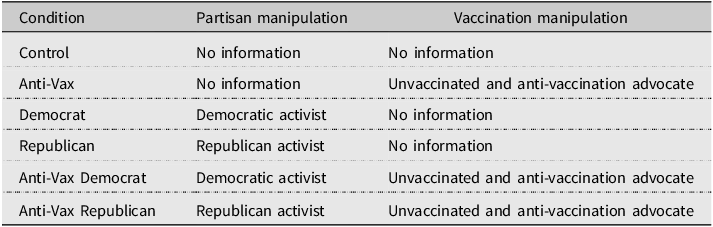
Respondents were randomly sorted into one of six experimental conditions outlined in Table 1.Footnote 3 The treatments combined all combinations of manipulating partisan information as well as information about the deceased man’s vaccination status and stance. As such, there are six conditions: 1) Control – no information about partisanship or vaccination status/stance, 2) Anti-Vax – the victim is given no partisan identity, but identified as an anti-vaccination advocate who is unvaccinated, 3) Democrat – identified as a Democrat with no information about vaccination status/stance, 4) Republican – same as condition 3, but Republican, 5) Anti-Vax Democrat – a combination of conditions 2 and 3, and 6) Anti-Vax Republican – a combination of conditions 2 and 4. These conditions allow me to test the effect of both partisan identity and vaccination stance in assessing my dependent variables of interest.Footnote 4 I model the effects separately for partisans and other relevant subgroups, but leverage alternative modeling strategies in the SI, section D. I pre-registered that I would also include difference-in-means tests as a main part of the analysis. I deviate from this part of the pre-registered analysis plan because regression analyses are more appropriate and easily interpretable to readers, and given reviewer suggestions. As such, I include the difference-in-means tests in the SI, section E.
Experimental design

I provide figures of the estimated effects of each treatment condition compared to the control in the SI, section D, but in the main text, I utilize regression models in partisan subgroups with an interaction between the two types of treatment: 1) victim partisanship (no partisanship information, Democratic activist, Republican activist) and 2) victim anti-vaccination stance (no information, anti-vaccination).
In a second set of analyses, I run the same model, but on different subsets of the data or with additional variables added as controls. In these specifications, I subset by respondent vaccination status as well as exposure to a close friend or family member dying from COVID-19 or a COVID-19-related illness. I also run specifications on the full sample with a number of control variables including: respondent vaccinated (1 if respondent has at least one dose of a two-dose vaccine, 0 otherwise), covid death (1 if a close friend or family member died of COVID-19 or related complications and 0 otherwise), covid concern (101-pt scale of how concerned the respondent is about the COVID-19 pandemic), and vaccine mandate (101-pt scale of how strongly they believe the government should require a vaccination for all who can medically receive the vaccine).
Dependent variables
In these studies, I am interested in identifying the persistence of partisan hostility through mass tragedies. Two particularly important psychological responses to traumatic events are sympathy and blame attribution. Given this, I use measures of blame attributed to the deceased man as well as sympathy for him to capture partisan hostility. This is because if the recategorization process initiated by a traumatic event occurs, individuals should be more sympathetic towards and less likely to blame a member of their ingroup; this ingroup being the new superordinate identity that overcomes subordinate partisan identities. But, if the event fails to trigger this recategorization process, or makes it worse, individuals will have less sympathy for and be more likely to blame outgroup members. I use 101-point slider scales of blame attributed to and sympathy for the deceased (rescaled 0-1). I include details on exact wording of variables, distributions, and sample summary statistics in the SI, section B.
Results
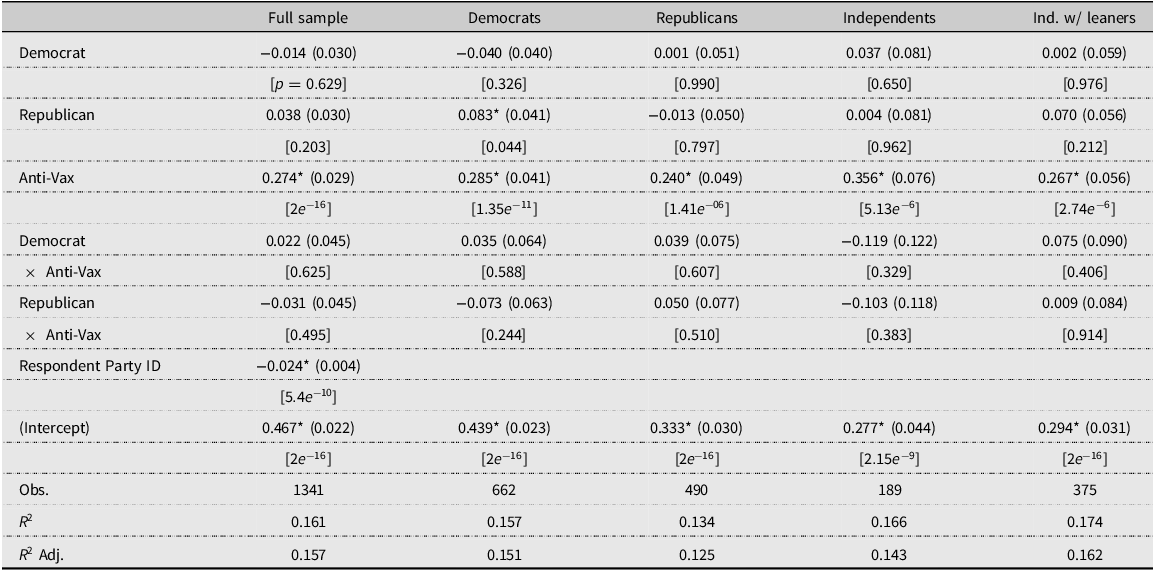
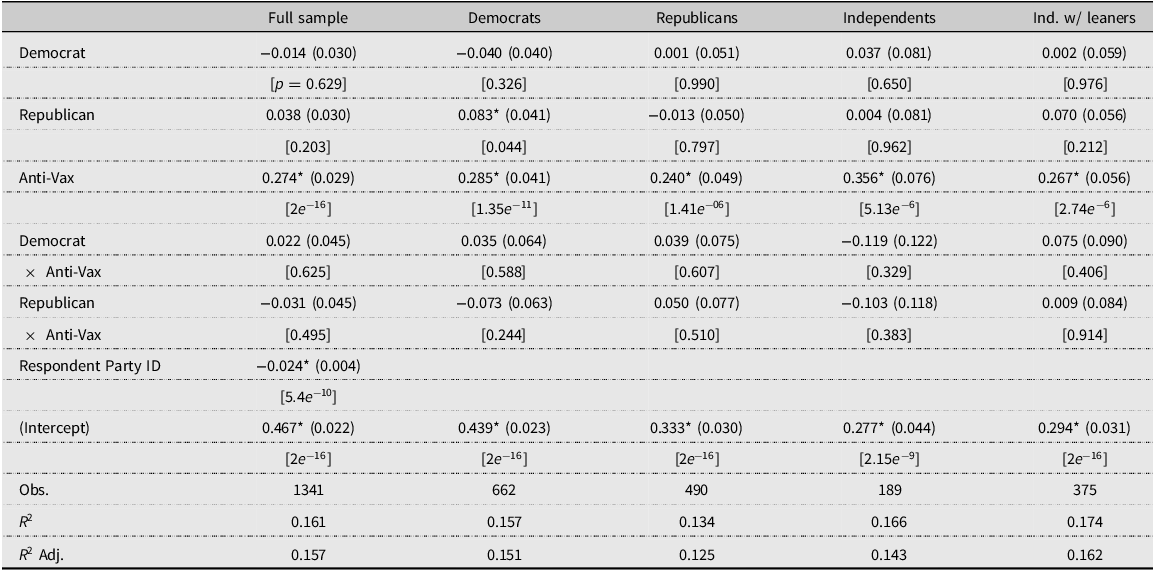
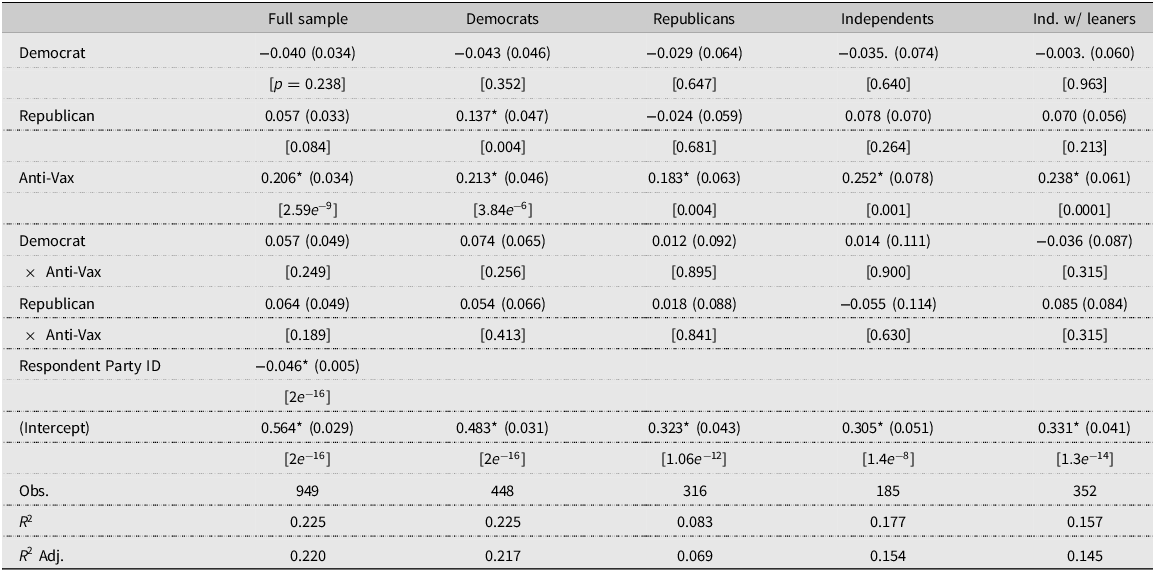
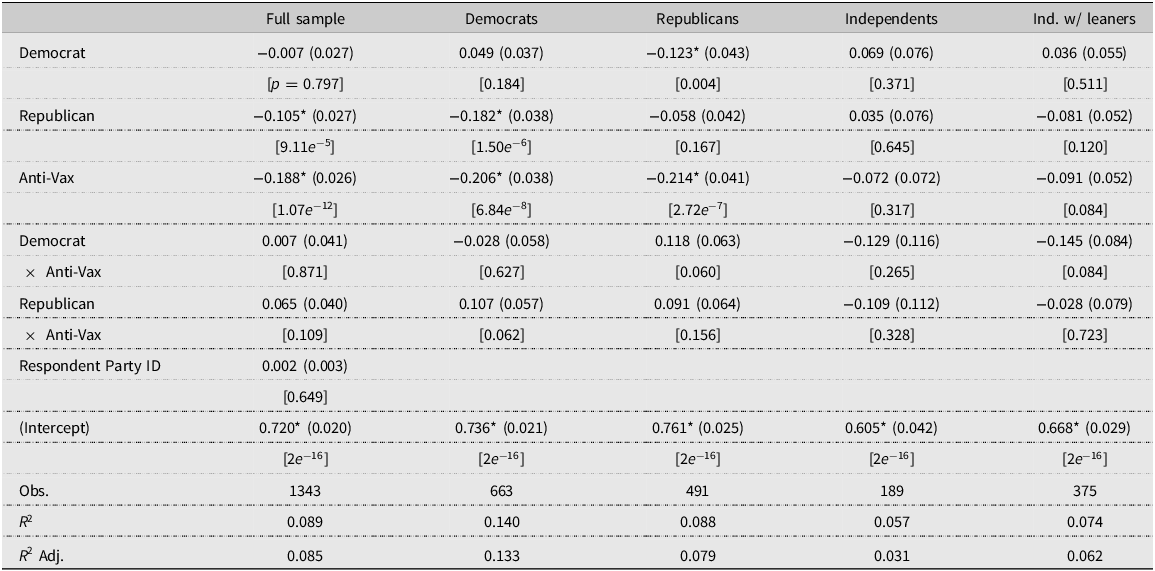
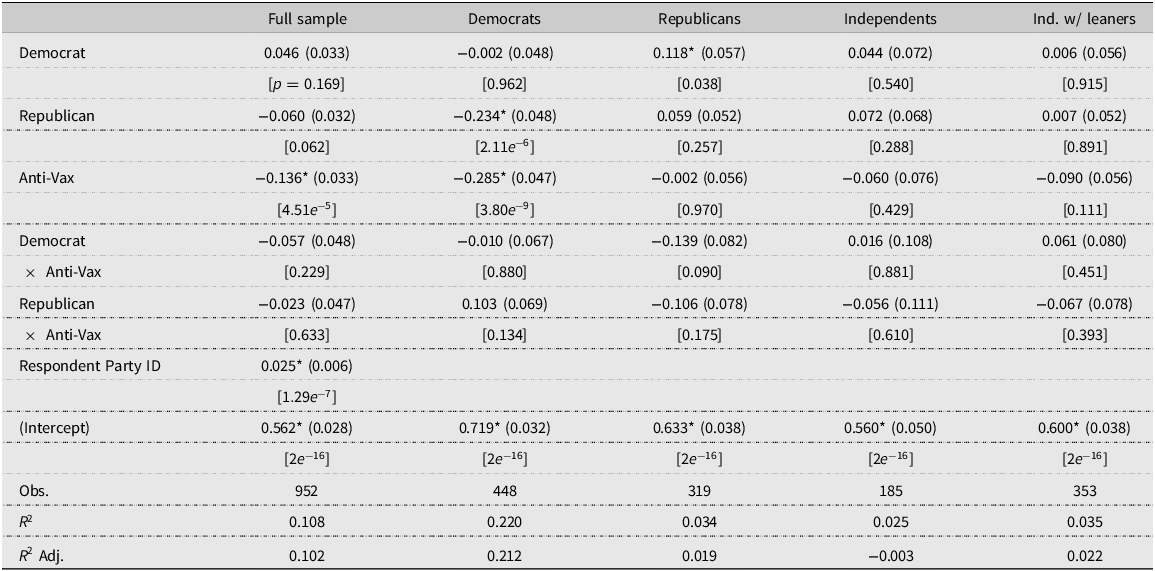
In Tables 2 and 3, I present the results for a regression model predicting the effect of victim partisanship and anti-vaccination stance on blame attribution in studies I and II, respectively. Tables 4 and 5 present the same results for predicting sympathy felt for the victim. Results in Tables 2 and 4 are derived from analyses the author did not pre-register, those in Tables 3 and 5 are from pre-registered analyses. Overall, the results indicate that respondents’ blame attribution and sympathy are mostly driven by the anti-vaccination treatment and less so by the partisanship of the deceased individual.
Effect of candidate partisanship and anti-vaccination stance on blame attribution, Study I. For all tables, standard errors are in parentheses next to the estimate and p-values are in square brackets under the estimated value
* p < 0.05.
Effect of candidate partisanship and anti-vaccination stance on blame attribution, Study II

* p < 0.05.
Effect of victim partisanship and anti-vaccination stance on sympathy, Study I

* p < 0.05.
Effect of victim partisanship and anti-vaccination stance on sympathy, Study II

* p < 0.05.
Across both studies, respondents are more likely to blame the deceased individual for his own death when the newspaper vignette expressed he was anti-vaccination. This was the case for all subgroups (Democrats with leaners, Republicans with leaners, Independents, and Independents with leaners) and the full sample, with estimated effects that were consistent across studies and across all models of both studies. Turning to patterns of sympathy felt for the deceased individual, the full sample, Democrats, and Republicans were less sympathetic when the individual was anti-vaccination in Study I, while this was only true for the full sample and Democrats in Study II. Further, Democrat-identifying respondents (with leaners) in both studies were more likely to blame the individual when he was a Republican, but the interaction of anti-vaccination and Republican was not significant for any subgroup or the full sample in either study. This indicates that for respondents, knowing the partisanship of the individual did not meaningfully change the effect of the anti-vaccination treatment on blame attribution and sympathy felt for the individual, and vice versa. Finally, Republican respondents are less sympathetic when a Democrat dies in Study I, but this does not replicate in Study II, where they were surprisingly more sympathetic.
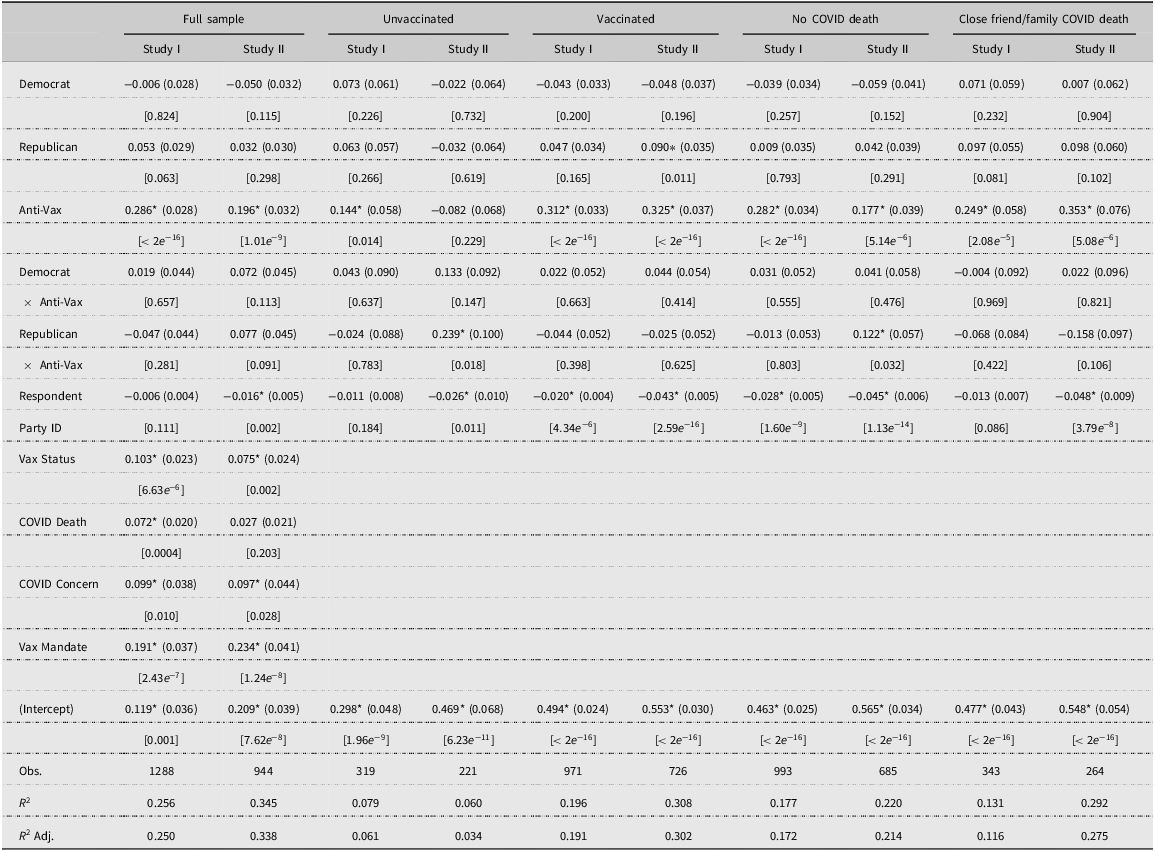
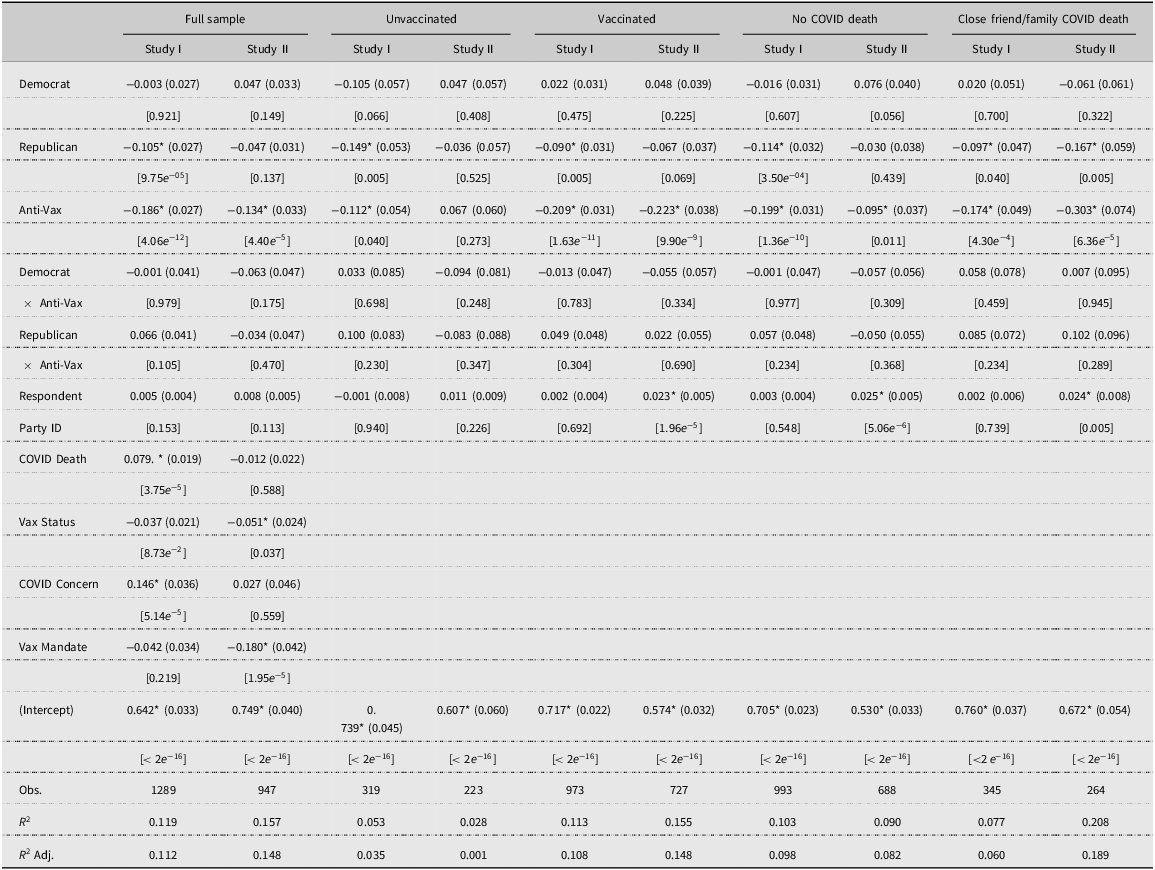
In Tables 6 and 7, I provide the results of the secondary analyses on subsets of respondents who are vaccinated and not vaccinated, and who have proximity to COVID-19 deaths, as well as full sample analysis with a number of additional control variables added.
Effect of victim partisanship and anti-vaccine stance on blame attribution, conditioned by respondent vaccination status and exposure to close friend or family member dying from COVID

Effect of victim partisanship and anti-vaccine stance on sympathy, conditioned by respondent vaccination status and exposure to close friend or family member dying from COVID

* p < 0.05.
The results in Table 6 demonstrate that the effect of the anti-vaccination information on blame attribution is consistent. Across both studies, all subgroups are more likely to blame the individual when he is anti-vaccination, except unvaccinated respondents in both studies. The interaction of the Republican and Anti-Vax treatments is significant and positive among unvaccinated respondents and among no COVID-death proximity respondents, both in Study II. This indicates that while these groups do not blame Republicans more, they are more likely to blame Republicans who are anti-vaccination. In Table 7, I provide results that indicate that respondents given the anti-vaccination treatment are less sympathetic in every subgroup, except unvaccinated respondents in both studies. Additionally, respondents in every subgroup and the full sample have less sympathy when he is a Republican in Study I, and those who have had a close friend or family member die from COVID in Study II. Again, the interaction between anti-vaccination treatment and either partisan treatment is not significant.
These findings demonstrate that respondents primarily blame or have less sympathy for the deceased individual when he is anti-vaccination, controlling for a host of factors and in full sample and subgroup analyses. Secondarily, the experiment reveals that partisanship does matter in that respondents (primarily, but not only, Democrat-identified respondents) are less sympathetic and more likely to blame the individual when he is a Republican, controlling for other factors. Though the findings suggest that partisanship matters less than expected, there is evidence that respondents’ patterns of blame attribution and, especially, sympathy are structured to some extent by outpartisan hostility.
Limitations
One important point to consider is that the treatment conditions seek to increase external validity, but in a way that may make it more difficult to identify the specific mechanism. The treatments identify the victim as a party activist and an anti-vaccination advocate. As such, it is not possible to distinguish the effects of partisanship from partisan activist and being unvaccinated or being anti-vaccination for oneself, compared to advocating for others to also not be vaccinated. Further, the treatments do not provide information about the behaviors of the victim, meaning respondents are imputing their own assumptions about masking, social distancing, and other behaviors.
In explaining the empirical design, I explain the reason for such choices, but it is important to note again the limitations such design choices impose. I have specified the models in such a way as to better contextualize this particular limitation. Namely, I have interacted with two treatment types, analyzed multiple subgroups separately, and included a number of control variables that should parse out some of the threats to identifying the effect of partisanship and anti-vaccination.
Another limitation is that I only test a single event, while my theory proposes to explain a broader range of types of traumatic events. Previous research indicates that there are rally events after natural events, such as a pandemic, but that there have been mixed results because the effect is conditioned by shared partisanship between elected officials and constituents (Heersink et al., Reference Heersink, Jenkins, Olson and Peterson2022). Further, after COVID-19, executives enjoyed an initial rally effect, but one which eroded in the long-term as the pandemic “normalized” (Johansson, Hopmann, and Shehata, Reference Johansson, Hopmann and Shehata2021). This is important because previous work often conceptualizes political responses to traumatic events in relation to rally effects and the incentives they provide for leaders.
9/11 provided a clear external enemy in a way that natural disasters (and pandemics) often do not. As policy demanders constrain elites, however, this dynamic is changing. Even still, there were limited efforts to blame external enemies for COVID-19 (though some actors, including then-Pres. Trump, did blame China explicitly). My theory of persistent partisan hostility implies that despite these differences, we have reason to believe that such patterns of outpartisan hostility and polarization will perpetuate as long as elites are able to polarize. I argue that one way they do this is by identifying existing social group inequalities that align with existing partisan identity and/or by emphasizing issue or value cleavages between the parties. In this study, I have tested this theory in the context of COVID-19, but future work should investigate how this theory does or does not travel to other natural events and to anthropogenic tragedies.
Conclusion
As mass affective partisan polarization extends into more corners of American life beyond the reach of politics, political scientists seek to explore the limits of this divergence. While scholars debate how this polarization relates to acceptance and promotion of political violence (Kalmoe and Mason, Reference Kalmoe and Mason2022; Westwood et al., Reference Westwood, Grimmer, Tyler and Nall2022), it is clear that Americans are divided. This study has sought to explore how this division extends beyond ordinary politics and into traumatic politics.
In the wake of mass tragedies, the psychological dynamics of reckoning with a worldview-shattering event through trauma responses can provide the opportunity for recategorization that overcomes partisan polarization. In this piece, I develop a theory of persistent partisan hostility, contending that when mass tragedies reveal existing inequalities or party cleavages, partisans resist these recategorization processes instead maintaining, or even increasing, outparty animosity through the event. Using two original survey experiments, I test this theory and find limited evidence that partisan hostility continues to structure blame of and sympathy towards victims of tragedy. I find much stronger evidence that voters are attentive to information beyond partisanship in that the patterns of blame attribution and sympathy are structured primarily by the vaccination status and stance of the deceased individual.
These findings suggest that partisan hostility persists through mass tragedies, but that partisans are attentive to information relevant to assigning blame and sympathy. In short, partisans are not mindlessly obedient to the pull of partisan animosity, but rather consider relevant information about the context that instructs their propensity to blame and express sympathy. This study, then, provides a mixed picture of the persistence of partisan hostility, even through mass tragedies. Future work should explore how elite framing impacts these dynamics as well as how such responses vary by type and severity of tragedy.
Supplementary material
To view supplementary material for this article, please visit https://doi.org/10.1017/XPS.2025.10019
Data availability
Funding was received from an internal research grant from the Rooney Center for the Study of American Democracy at the University of Notre Dame. The data, code, and any additional materials required to replicate all analyses in this article are available at the Journal of Experimental Political Science Dataverse within the Harvard Dataverse Network, at: doi: https://doi.org/10.7910/DVN/548AVK (Marsh, Reference Marsh2025).
Acknowledgments
The author is grateful to Geoffrey C. Layman, Jeffrey Harden, Christina Wolbrecht, David E. Campbell, Matthew E.K. Hall, Erin Rossiter, Levi G. Allen, James Kirk, Jonas Linde, Nolan Kavanaugh, Søren Damsbo-Svendsen, and the editors, reviewers, and editorial staff at the Journal of Experimental Political Science for their very helpful comments on previous versions of this manuscript. The author is also grateful to the Rooney Center for the Study of American Democracy at the University of Notre Dame for funding this research.
Competing interests
The author has no competing interests to declare.
Ethics statement
The University of Notre Dame’s Institutional Review Board determined the studies to be exempt under IRB protocols 21-07-6733 (study I) and 21-08-6759 (study II). The studies related to this publication adhere to APSA’s Principles and Guidance for Human Subjects Research https://connect.apsanet.org/hsr/principles-and-guidance/. Study I was part of an original survey fielded through the survey firm Lucid Theorem. While Study II was part of the author’s institution’s module on the 2021 Cooperative Election Study (CES), with the sample recruited by the survey firm YouGov. Both firms recruited the samples from their panel of respondents and compensated them accordingly. The respondents were aware that they were taking part in a research study and given a summary of the study in advance. The studies were both determined exempt by the author’s academic institution under IRB protocols 21-07-6733 (study I) and 21-08-6759 (study II). Study II was pre-registered at https://aspredicted.org/KJ7_1BN.
Respondents were first required to read an Informed Consent form and agree that they had read the entire informed consent. Respondents were informed that their participation was completely voluntary and that they were allowed to withdraw from the study at any time without any impact on their relationship with the academic institution. Respondents were also informed that they were able to abstain from answering any question. This informed consent document also informed respondents that there were no known risks or direct benefits of the study. Respondents were assured that no identifying information about them would be made public and any views they expressed would be kept completely confidential. Respondents were encouraged to print and save a copy of the informed consent for their records. A full copy of the informed consent is available by contacting the author.
The studies did not use deception in this experiment. Nor did the experiment/survey intervene in political processes. Respondents were given the PI/author’s and the IRB’s contact information for any concerns or questions. Respondents were compensated for their survey participation by Lucid Theorem and YouGov directly. The author does not know the exact form or amount of compensation, but was assured it was fair compensation. The survey in Study I used quotas of gender, ethnicity, region, and income, to mimic the U.S. population. Study II was a probabilistic sample meant to be representative of the U.S. population. No social group is disproportionately represented in either sample.



 Open access

