




Policy Significance Statement
Our research highlights the critical role of well-designed open research data (ORD) support services in fostering a cultural shift toward increased adoption of open science (OS) practices at academic institutions. By engaging stakeholders, we identified a strong preference for simple, user-friendly services and the need for professional data stewardship. Additionally, we identified key preferences and desires of stakeholders in six key ORD support areas. Finally, we recommend academic policymakers to promote ORD adoption by investing in accessible support services, embedding research data management (RDM) training in curricula, and establishing dedicated data stewards. These measures will promote transparency, collaboration, and the effective use of research data, aligning with broader OS goals.
1. Introduction
Over the past years, with the intensification of efforts to promote OS within the academic environment to strengthen, or even revitalize, innovation in scientific research (see Gold, Reference Gold2021; Beck et al., Reference Beck, LaFlamme, Bergenholtz, Bogers, Brasseur, Conradsen, Crowston, Di Marco, Effert and Filiou2023), the concept of ORD has been gaining traction at research institutions across the world (Lasthiotakis et al., Reference Lasthiotakis, Kretz and Sá2015; Zhang et al., Reference Zhang, Downs, Li, Wen and Li2021; Moradi and Abdi, Reference Moradi and Abdi2023). The intuitive idea that the open sharing of research data can benefit scientific progress is supported by successful examples of data reuse (e.g., Fu et al., Reference Fu, Li, Zhang, Wan, Zhang, Jiang and Liu2020; Gardinassi et al., Reference Gardinassi, Souza, Sales-Campos and Fonseca2020; Khan et al., Reference Khan, Thelwall and Kousha2021; Li et al., Reference Li, Koeppen, Holden, Neff, Cengher, Demers, Mould, Stanton and Hampton2021, Reference Li, Dennis, Hutch, Ding, Zhou, Li, Pillai, Ghotbaldini, Garcia and Broad2022). Furthermore, openly sharing data can dramatically increase the cost-effectiveness (Piwowar et al., Reference Piwowar, Vision and Whitlock2011) and transparency (Lyon, Reference Lyon2016; Mancini et al., Reference Mancini, Lardo, De Angelis, Lazazzara, Ricciardi and Za2020) of scientific research, and has been proven to have a citation advantage on research publications (Piwowar and Vision, Reference Piwowar and Vision2013; Kratz and Strasser, Reference Kratz and Strasser2015; Colavizza et al., Reference Colavizza, Hrynaszkiewicz, Staden, Whitaker and McGillivray2020; Ishita et al., Reference Ishita, Miyata, Kurata, Goh, Chen and Tuarob2023). Research institutions within and outside Europe have been active since at least a decade, to provide services aimed at supporting their staff in RDM and OS, particularly through their libraries (Tenopir et al., Reference Tenopir, Talja, Horstmann, Late, Hughes, Pollock, Schmidt, Baird, Sandusky and Allard2017; Liu and Liu, Reference Liu and Liu2023). In the Swiss context, the umbrella organization of higher education and research institutes (swissuniversities) has published its National ORD Strategy (swissuniversities.ch/en/topics/open-science/open-research-data/national-strategy) in 2021. One of the four pillars of this strategy is “to ensure a comprehensive and effective range of basic infrastructures and services that are made available to all researchers in Switzerland.”
While the benefits to science and society are evident, researchers often lack the incentive to invest effort in ORD (Nosek et al., Reference Nosek, Alter, Banks, Borsboom, Bowman, Breckler, Buck, Chambers, Chin and Christensen2015; Munafò et al., Reference Munafò, Nosek, Bishop, Button, Chambers, du Sert, Simonsohn, Wagenmakers, Ware and Ioannidis2017). This reluctance is understandably driven, in part, by concerns over time and budget constraints (Tenopir et al., Reference Tenopir, Rice, Allard, Baird, Borycz, Christian, Grant, Olendorf and Sandusky2020). To effectively motivate researchers, it is crucial to reduce barriers to ORD adoption, which interestingly are mostly perceived to be, rather than actually being, insurmountable (Borgerud and Borglund, Reference Borgerud and Borglund2020; Gomes et al., Reference Gomes, Pottier, Crystal-Ornelas, Hudgins, Foroughirad, Sánchez-Reyes, Turba, Martinez, Moreau and Bertram2022). Establishing an optimal ORD support system at academic institutions—one that is both well known and easily accessible—could therefore alleviate researchers’ hesitation, encouraging a more willing investment of time and resources.
Instead of providing researchers with excessive and potentially confusing resources, and optimal ORD support system should stimulate a cultural, or behavioral, change toward the widespread adoption of ORD principles and practices (Norris and O’Connor, Reference Norris and O’Connor2019). The design or improvement of an institution’s ORD support system should be hinged on the selection of services and practices that are most relevant for locally stimulating behavioral change (Norris and O’Connor, Reference Norris and O’Connor2019; Robson et al., Reference Robson, Baum, Beaudry, Beitner, Brohmer, Chin, Jasko, Kouros, Laukkonen and Moreau2021), as “one-size-fits-all” approaches were already demonstrated to be harming instead of benefiting researchers (Levin et al., Reference Levin, Leonelli, Weckowska, Castle and Dupré2016; Levin and Leonelli, Reference Levin and Leonelli2017). A more effective approach toward the identification of relevant services and practices for ORD-centered behavioral change is through stakeholder engagement, a widely used methodology in business and social research (Kujala et al., Reference Kujala, Sachs, Leinonen, Heikkinen and Laude2022). We define stakeholder engagement as the process of involving interested individuals, groups, or even organizations in a project or decision, with the aim to understand their perspectives and address their concerns and needs. This process is increasingly recognized as crucial for promoting collaboration between decision-makers and those affected by decisions due to its mutual benefits. While the decision-makers have the opportunity to capture a broad variety of knowledge, the stakeholders gain influence over the decisions, which consequently builds their trust, and are presented with the chance to learn from other stakeholders’ perspectives (Mathur et al., Reference Mathur, Price and Austin2008). Stakeholder engagement is also gaining more attention in scientific research and development due to its potential to create clear and demonstrable impacts on policy and practice (Huzzard, Reference Huzzard2021; Hollmann et al., Reference Hollmann, Regierer, Bechis, Tobin and D’Elia2022).
This article stems from the final work package of the AFFORD: A Framework for Avoiding Open Research Data Dump project (Center for Reproducible Science and The Interface Group, 2024), funded for the 2023–2024 period at the University of Zurich (UZH). In line with what was already applied at other institutions (Loureiro-Koechlin, Reference Loureiro-Koechlin2009; Sveinsdottir et al., Reference Sveinsdottir, Wessels, Smallwood, Linde, Kala, Tsoukala and Sondervan2014; Noorman et al., Reference Noorman, Wessels, Sveinsdottir, Wyatt, Rudinow, Schneider and Green2018; Araujo et al., Reference Araujo, Bornatici, Ochsner and Heers2024), the work we present focused on engaging ORD stakeholders from the UZH and the larger Swiss ORD community. First, we developed a strategy to engage with various ORD stakeholders and gather their input on ORD support services, based on their specific roles. We then studied how the stakeholders’ experience, expertise, and desires, input could guide the establishment of ORD support services as sustainable enablers for cultural change on ORD. Lastly, we generated a series of recommendations for improving services aimed at supporting researchers’ ORD activities that we generalized to be applicable to all academic institutions.
2. Methods
2.1. Stakeholder selection, categorization, and engagement
Stakeholders were identified and categorized based on their roles and positions regarding ORD support services. The primary target group, researchers, who are the end users of these support services, was classified as Users. Those responsible for delivering these services were grouped as Support Staff. Finally, the category Policymakers comprised individuals involved in ORD-related governance and university management. Collectively, the Support Staff and Policymakers stakeholders will be referred to as Experts.
To obtain effective insights, we employed two engagement methods tailored to each stakeholder group. First, we distributed a survey among researchers to understand the needs and preferences of Users for developing an optimal support services model. This approach facilitated wide-reaching engagement and allowed us to gather quantitative data on user preferences and service requirements. Second, we conducted semi-structured interviews with Experts (i.e., Support Staff and Policymakers) to obtain detailed qualitative insights into best practices, feasibility, and the strategic value of ORD support services.
2.2. Data collection and analysis
To maximize the quality and relevance of the data, we tailored our communication plan according to stakeholder roles. Interviews with policymakers and support staff focused on surveying in-depth knowledge on service provision and policy implementation, while the questionnaire for users allowed for broader input across diverse research needs and preferences.
2.2.1. Survey
A concise survey, consisting of six ranking questions, was designed to interrogate potential users of ORD support services at the UZH. Each question corresponded to one of the six previously defined ORD support service areas (Figure 1). In each question, survey participants were introduced to the four representative services corresponding to each ORD support service area (see Figure 1), and they were asked to rank them on a scale ranging from 1 to 4. Specifically, participants were asked to rank the representative services from the one they would most likely make use of (1) to the one they would least likely make use of (4). Additionally, the survey featured a single-choice question on the participants’ role within the University and an open-text field allowing participants to express their remarks or considerations on ORD practices. Screenshots of each survey web page can be found as Supplementary Figures S1–S8.
The service offering matrix used as the foundation for our investigation. Four representative services are proposed for each of the six ORD support service areas introduced on the left. For each area, the services are ordered along a continuum of “resource availability,” meaning that more guidance, support, or infrastructure is included in services toward the right of the figure.

The survey was hosted on the online Microsoft Forms (https://forms.office.com) platform, and it was distributed within the UZH through the mailing lists of the University Research Priority Programs (https://www.uzh.ch/en/researchinnovation/priorities/university.html) and the UZH Graduate Schools (https://www.uzh.ch/en/studies/programs/phd.html). This approach was chosen over one involving a bulk mailing list to target primarily researchers who would most likely be engaging with, or exposed to, ORD practices. It should be noted that due to privacy regulations the e-mail distribution was carried out by the contact persons for the University Research Priority Programs and Graduate Schools. Due to the restricted access to the corresponding mailing lists, we do not know the total number of e-mail addresses and therefore cannot calculate response rates for our survey. Detailed information on the analysis of survey responses can be found in Appendix A.1.
2.2.2. Interviews
Selected stakeholders (N = 20) were invited for semi-structured interviews lasting between 50 and 60 minutes. Of the 20 interviewees, 10 (“internal” stakeholders) belonged to the UZH and 10 (“external” stakeholders) belonged to universities, research institutes, and policy organizations across Switzerland. The interviews were conducted by the same two researchers and were composed of three parts:
-
1. Introduction, personal experience with ORD themes and practices of the interviewee (researcher 1).
-
2. “Workshop element” on designing an ideal ORD support model (researcher 2).
-
3. Open questions on barriers and enablers of the designed support model, and potential involvement of interviewee on development of the designed support model (researcher 1).
Detailed information on the recording, transcription, and analysis of interviews can be found in Appendix A.2. Interview transcripts were annotated according to ten categories (Supplementary Table S1) independently by two researchers, resulting in double screening of each transcript. The annotations were then processed per category by means of sentence embedding and clustering. Clustered annotations were inspected in search of common patterns, as well as unique statements.
The “Workshop” element of the interview required interviewees to select services on a paper or digital version of the service offering matrix (Figure 1). Interviewees were first asked to select per each ORD support service area all services they saw fit in an ideal ORD support model. They were then asked to only select the single service they saw as most relevant per each ORD support service area. Further information on the analysis of workshop results can be found in Appendix A.3.
3. Results
To provide targeted advice on ORD policy for the UZH, we engaged stakeholders through various approaches designed to reach distinct cohorts effectively. We begin by providing a definition and a categorization of ORD “support services” as used in our study. We then provide an overview of the results gathered from both the survey and the interviews we ran over the summer of 2024 (van de Wiel and Garassino, Reference van de Wiel and Garassino2025), followed by a unified presentation of findings organized by support service areas (Figure 1).
3.1. A practical definition of open research data support services
Most definitions around the topic of ORD relate to the “Findable, Accessible, Interoperable, Reusable” (FAIR) principles (Wilkinson et al., Reference Wilkinson, Dumontier, Aalbersberg, Appleton, Axton, Baak, Blomberg, Boiten, da Silva Santos and Bourne2016). A key component of the interoperability concept is the use of univocal, accessible, and broadly applicable definitions. In light of the lack of a universally recognized definition of “ORD support services,” we aimed at elaborating one. Policies from Science Europe (scienceeurope.org), the association of European funding organizations for scientific research, articulate the concept of RDM along six action areas: Organisational Engagement and Commitment, Policy Environment, Financial Aspects, Training, Technical Preparedness, and Communication and Awareness Raising (Boccali et al., Reference Boccali, Sølsnes, Thorley, Winkler-Nees and Timmermann2021). Additionally, these policies are centered on the idea that specific subjects should be given the responsibility for RDM (Science Europe, 2021). Intuitively, these subjects cannot be researchers, due to their increasingly high workload and a potentially scarce knowledge of the field (Zuiderwijk et al., Reference Zuiderwijk, Shinde and Jeng2020; Hostler, Reference Hostler2023).
For the scope of our research, we aimed at developing a practical definition of ORD support services. Based on the concepts illustrated above and a landscape analysis of ORD-aimed policies and services of Swiss academic institutions and research institutes, we defined ORD support services as the services offered by professional dedicated staff that belong to six service areas, defined as follows:
-
• Online information, grouping services aimed at making information on (FAIR) ORD practices available and accessible. An example service is the grouping of information in the main or in dedicated institutional pages. Other example services are an institutional ORD knowledge base, potentially including a collection of links and resources or organized as a collaborative, wiki-style website.
-
• Stewardship, for data management services offered to researchers by specialized staff. While the profile and tasks of Data Stewards can vary depending on the institution, here we consider Data Stewards to be employees acting as contact persons for questions about (FAIR) ORD practices spanning the entire data life cycle. Stewards can act as a bridge between researchers and other institutional research support services, or they can be more directly involved in research workflows (e.g., by consulting on improving the reproducibility of analyses) and data management (e.g., by helping with curating metadata and documentation).
-
• IT support, collecting services offered by academic institutions’ IT departments focusing specifically on supporting data management. For example, IT support can include the provision of data storage solutions to be used during the active phase of a project (including activities such as data backup and controlled access). The support may also extend to helping researchers efficiently manage their data, for example, by assisting with copying or moving large volumes of files, keeping track of changes, or indexing the files to facilitate navigation and findability of research outputs. General metadata production may also be supported as part of IT support.
-
• Data sharing, including services aimed at delivering information and/or infrastructure for sharing and publication of data. Support in data sharing can include guidelines and recommendations on generalist or specialized repositories, on repository-compliant metadata, and on data formatting, as well as help during the data submission process. Additionally, universities may offer proprietary data repositories and associated data curation services.
-
• Community, for services aimed at creating and maintaining communities to educate and engage researchers (potentially) interested in ORD practices. These support services can take various forms, such as providing a platform for the exchange and communication of ORD tools and tips, or organizing event-based interactions like seminars. Additionally, they can involve fostering direct contact between experienced ORD researchers or support staff and those with less experience, such as through mentoring networks. They may also include promoting interest groups that advocate for ORD-oriented policymaking.
-
• Training, encompassing services related to courses, at both undergraduate and graduate levels, as well as seminars, workshops, and other educational events designed to instruct students and researchers on ORD practices. Training support can come in various formats, such as structured courses integrated into academic curricula or standalone workshops focused on specific ORD tools and methodologies. Additionally, it may include interactive seminars that facilitate hands-on learning and discussions.
We then created a “service offering matrix” proposing four different services per service area, falling along a continuum of “resource availability” (Figure 1). Services representing a lower resource availability would offer less guidance, support, or infrastructure to researchers, but would be less onerous for the institution offering them. Definitions for each representative service can be found in Supplementary Table S2. The service offering matrix served as the key stakeholder engagement tool in both our survey and interviews.
3.2. Survey of UZH researchers highlights higher usage likelihood for low-resource services
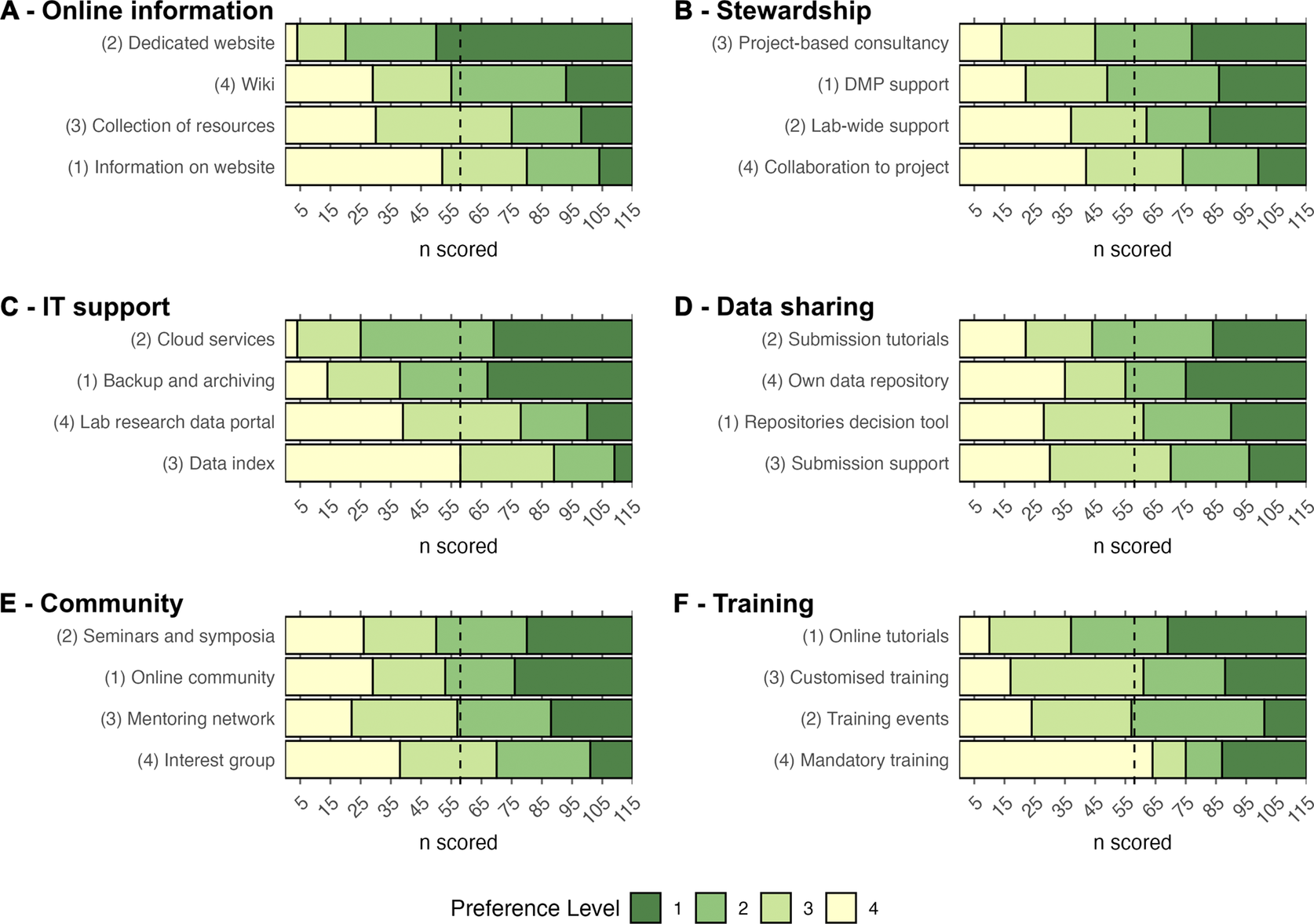
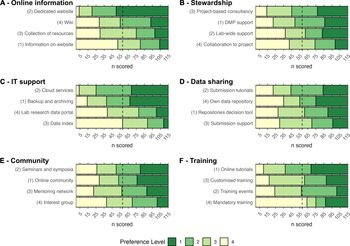
The survey interrogating UZH research personnel resulted in a total number of 116 responses, 71 (61.7%) and 44 (38.3%) of which coming from PhD candidates and academic staff, respectively. Stratifying the results of the survey showed similar patterns between the two groups, with a generally higher usage likelihood for services corresponding to lower resources’ availability levels across the six proposed service areas (Supplementary Figures S9–S11). The distribution of usage likelihood across survey responses and service areas appears fairly uniform, with the most preferred services generally ranked about equally as first or second choices overall. The only exception is the “Online information” services category, where more than half of respondents ranked one particular service as their top choice (Figure 2).
Overview of the service usage likelihood by the 116 survey respondents. Each plot represents one of the six surveyed areas. In each plot, services are numbered following their associated availability of resources (1 = lowest availability, 4 = highest availability, see Figure 1). The stacked bars and corresponding color scheme represent the number of survey respondents that ranked each service as their first, second, third, or last choice for usage (i.e., their preference level, with 1 being highest preference and 4 being lowest preference). The associated percentages can be found in Supplementary Table S3. The dotted lines represent 50% of survey respondents.
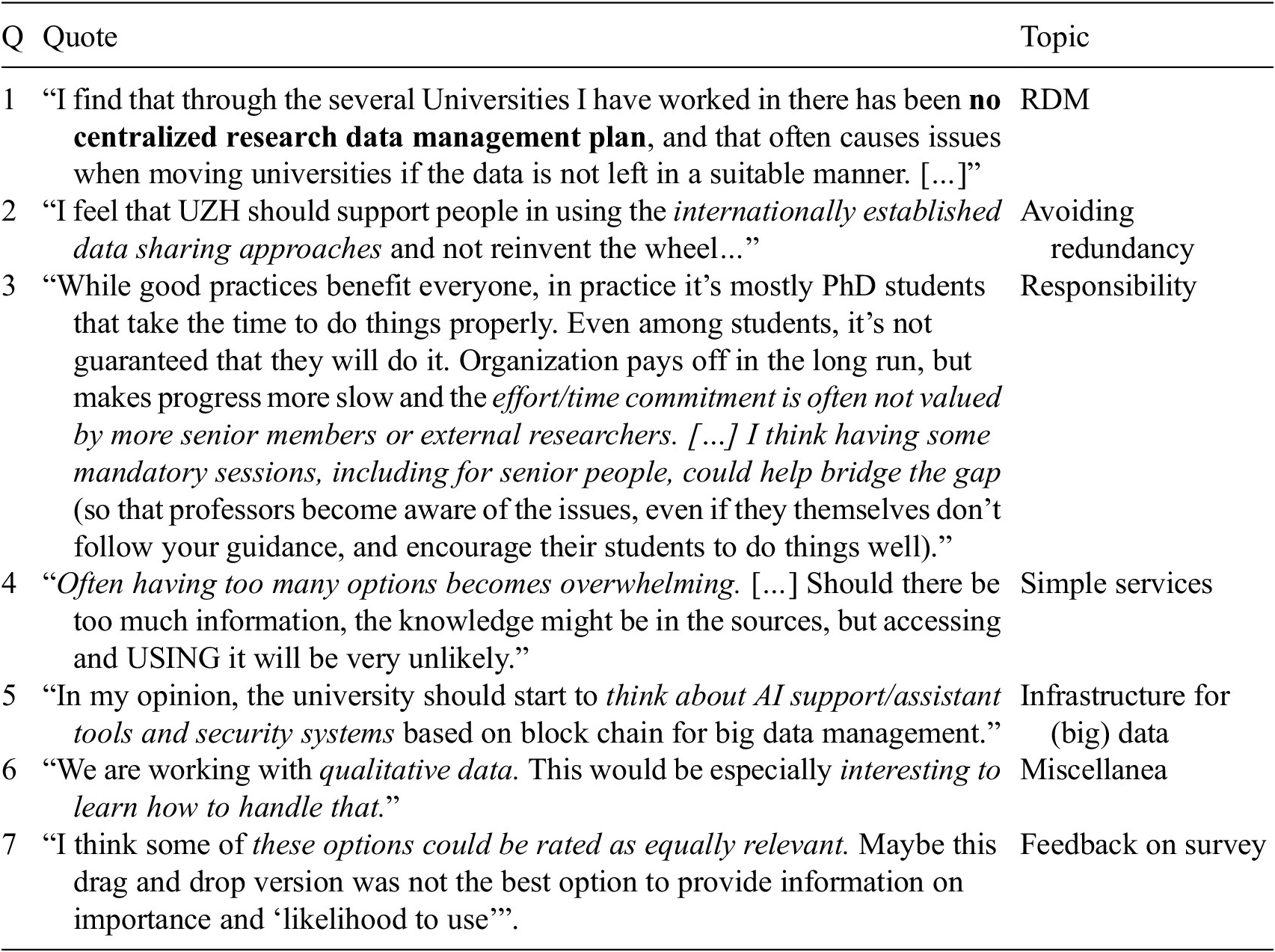
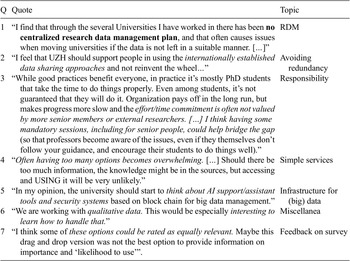
Twenty respondents left comments on the survey (Supplementary Table S4), which we subdivided into seven topics, of which five are content-related, one is about the method of the survey itself, and one contains miscellaneous statements. In the content-related comments, respondents emphasized several concerns about, as well as aspects for improving, ORD management. First, there was a strong consensus on the importance of integrating robust RDM practices, underscoring the need for standardized protocols and best practices to enhance data quality and accessibility (Table 1, Q1). Second, participants also highlighted the importance of avoiding redundancy by aligning with internationally recognized and inter-institutional data-sharing frameworks, which would streamline efforts and reduce duplication (Table 1, Q2). Third, regarding responsibility for ORD, respondents pointed out a gap in ownership, noting that due to time constraints or a lack of expertise, PhD students as well as more senior research staff are often not in a position to manage data effectively and could benefit from professional support (Table 1, Q3). Additionally, a clear call was made for systems that are easy to use and time efficient, with an emphasis on minimizing administrative burdens for researchers (Table 1, Q4). Finally, improvements to the infrastructure for handling (big) data were mentioned, with respondents suggesting that solutions relying on the most modern technologies are essential to address the challenges posed by the management of current datasets (Table 1, Q5). Additionally, two respondents expressed interest in learning more about the management of qualitative research data, and the handling of “abandoned” data, that is, the data non- or partially analyzed due to the conclusion of the corresponding research projects or a lack of funds or infrastructure (Table 1, Q6). Finally, three respondents commented on the chosen survey method, highlighting shortcomings of the ranking approach such as the lack of possibilities for more customized answers, or their desire to express equal relevance for multiple services (Table 1, Q7).
Selected quotes from the additional comments written by 20 survey participants
Note. The complete list of comments can be found in Table S3.
3.3. Interviews of ORD stakeholders reveal goals, barriers, and enablers of the transition toward ORD
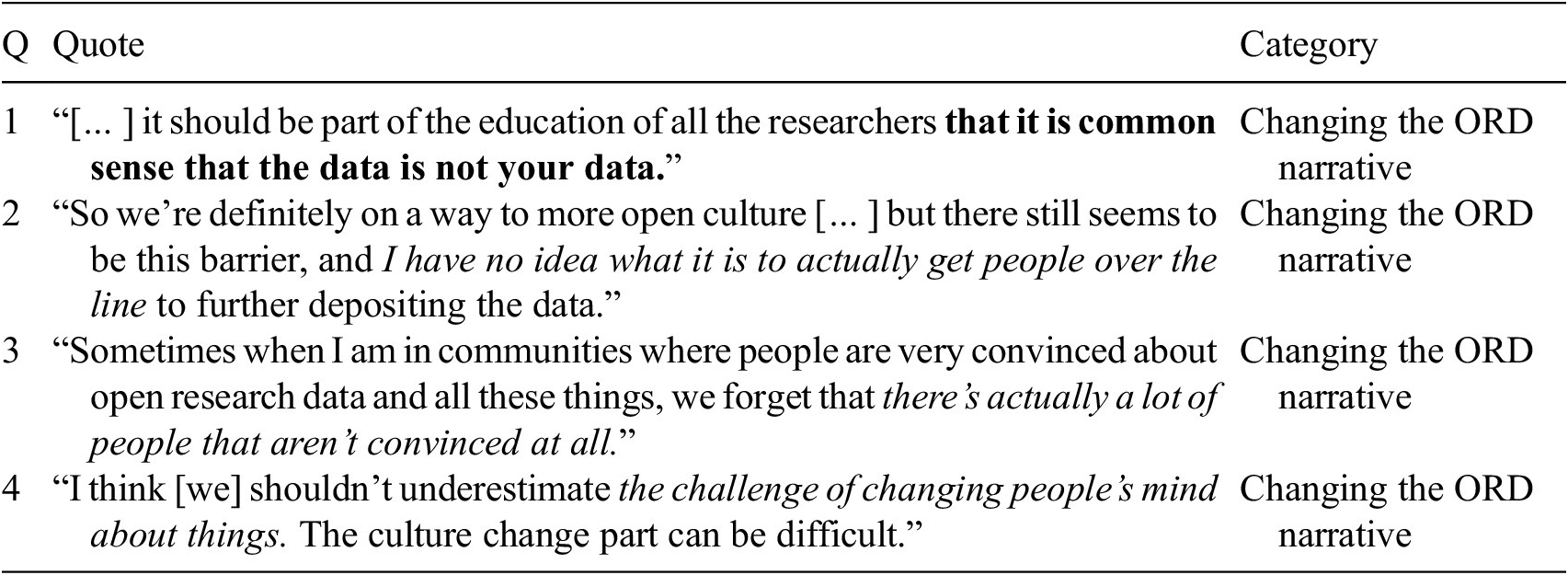
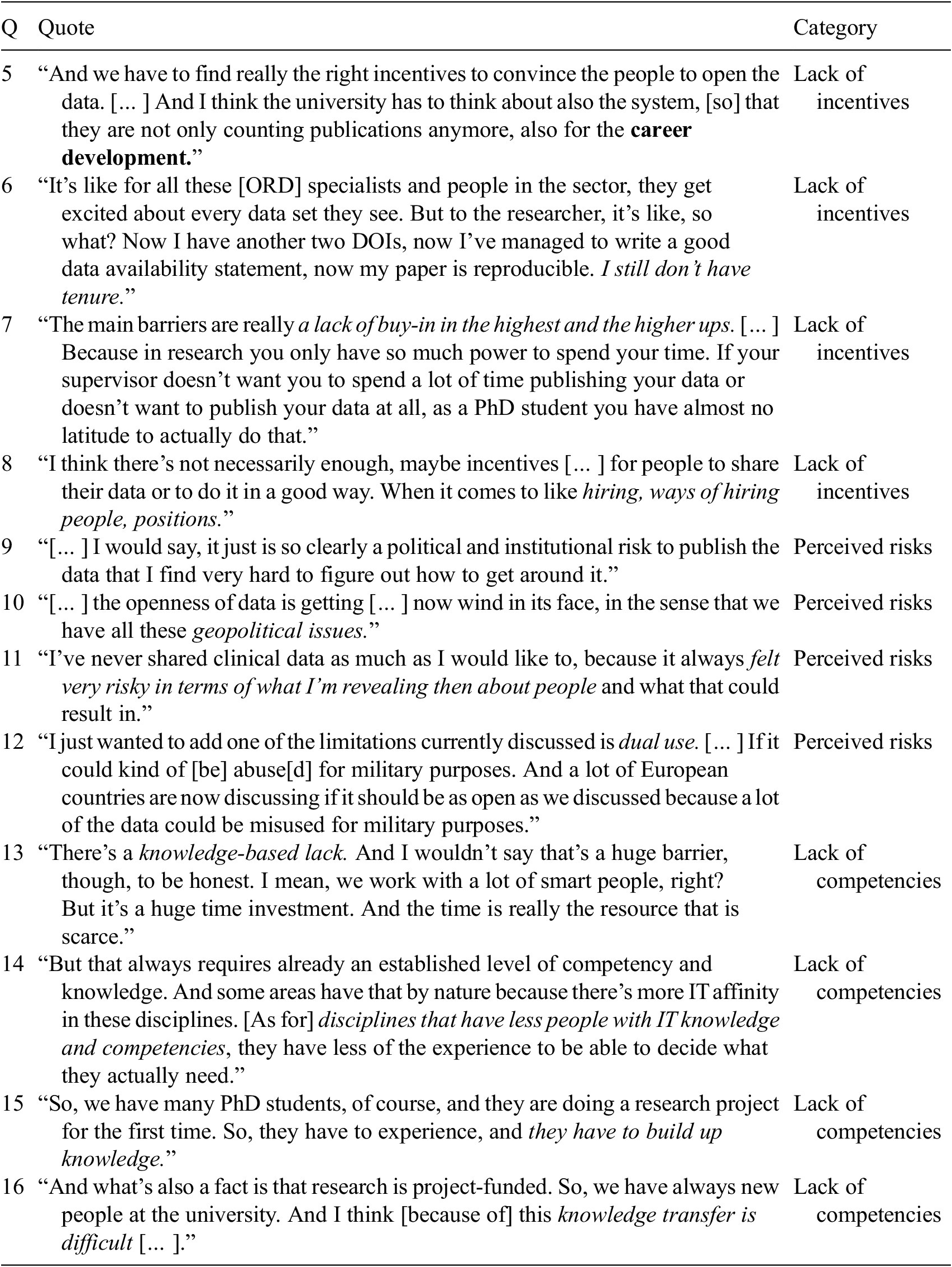
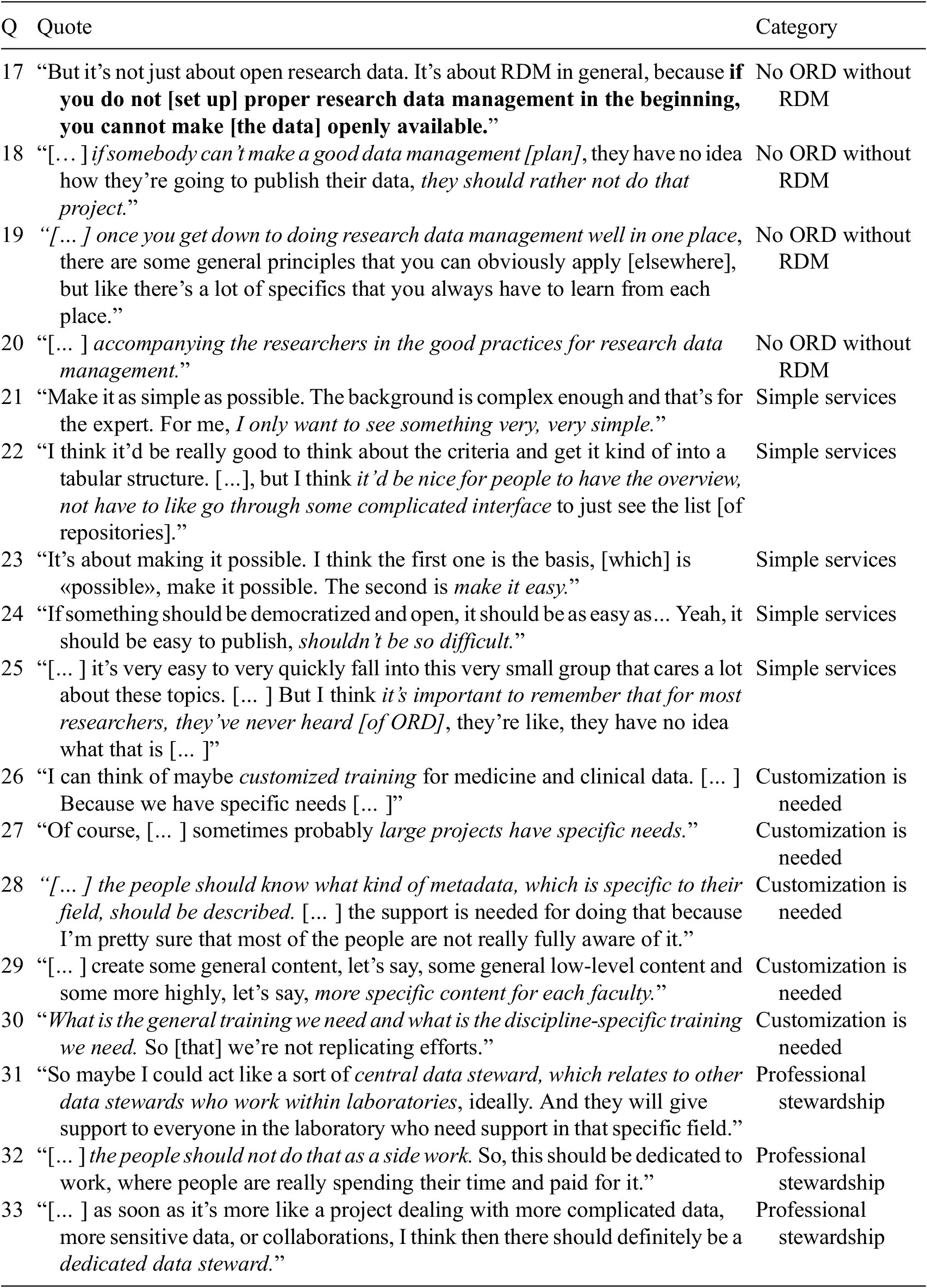
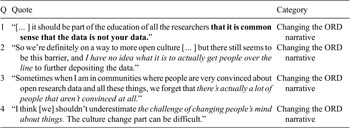
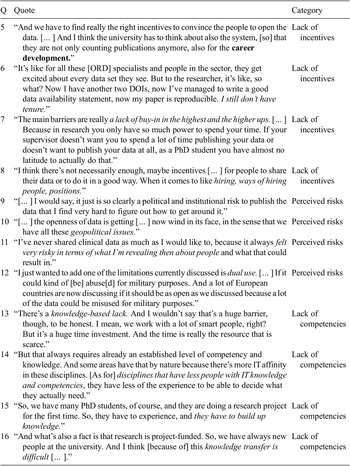
The analysis of the 20 annotated interview transcripts highlighted how stakeholders overall are motivating a main goal toward improving the adoption of ORD practices: changing the narrative and therefore culture on ORD (Table 2). The stakeholders further reported that cultural change on ORD is made difficult by a lack of incentives, perceived risks, and scarce competencies on ORD (Table 3). Additionally, stakeholders provided insight on how to promote cultural change by suggesting a stronger focus on RDM as the foundation for ORD, the creation and promotion of simple yet customizable support services, and a prominent role for professional data stewardship (Table 4). We will describe each of these goals, barriers, and recommendations in more detail in the following paragraphs.
Selected quotes from the 20 interviews conducted over the summer of 2024 regarding ORD goals
Note. The complete list of annotations these quotes were extracted from can be found in Supplementary Tables S5 and S14.
Selected quotes from the 20 interviews conducted over the summer of 2024 regarding ORD barriers
Note. The complete list of annotations these quotes were extracted from can be found in Supplementary Table S6.
Selected quotes from the 20 interviews conducted over the summer of 2024 regarding ORD enablers
Note. The complete list of annotations these quotes were extracted from can be found in Supplementary Table S7.
3.3.1. Goals: changing the ORD narrative
Experts emphasized that, while ORD has significant potential, it is currently underutilized and hindered by various barriers. They noted that ORD should not be treated as an isolated component of a research project but rather as an integral resource that benefits the research community and the public at large. Quotes from experts underscored the need for a cultural shift to prevent ORD from becoming a mere “data dump” (Table 2, Quote 1), advocating instead for practices that value data stewardship and recognize the long-term value of research data.
Although all experts work within fields related to ORD or support ORD initiatives, they agreed that ORD’s full potential remains untapped. While they generally support the direction toward enhanced data sharing and transparency, they expressed that a more prominent shift in attitudes and behaviors is necessary to maximize ORD’s benefits. The majority of interviewees highlighted that, although support services are crucial for a wide adoption of ORD practices, a broader cultural and structural change is equally essential. This includes viewing ORD as an essential component of research with a recognized public value (Table 2, Q1–2).
3.3.2. Barriers: lack of incentives toward ORD, perceived risks, and scarce competencies
Experts identified several barriers to ORD adoption, including commonly cited issues such as funding limitations and time constraints. In addition to these resource-based challenges, they pointed to further reasons why ORD has not yet become standard practice in the scientific community. A first significant barrier to ORD adoption reported by the interviewees was the absence of career benefits tied to ORD contributions. Unlike publications, ORD efforts do not currently contribute to the evaluation of tenure-track candidates, nor are they prioritized in hiring processes. This lack of recognition reduces motivation for researchers to invest their limited time in ORD activities. Additionally, ORD skills are not widely regarded as essential for academic roles, and researchers receive minimal encouragement from supervisors to allocate time and funding toward ORD (Table 3, Q5–8). The interviews further revealed that stakeholders perceive substantial risks related to ORD, particularly concerning political, societal, and privacy implications. Sensitive data, such as clinical information, present specific challenges that require specialized support services to address privacy and ethical considerations adequately. Concerns about the potential dual use of ORD data—where data might be repurposed for unintended applications—also emerged as a key issue, indicating a need for mitigation of these risks (Table 3, Q9–12).
Finally, experts stressed that effective ORD practices require more extensive competencies to avoid data misuse and prevent data from simply being stored without context or accessibility. The interviews highlighted disciplinary differences in technical skills and ORD knowledge depth, with some fields possessing more advanced data management expertise than others. To ensure that ORD practices are carried out effectively and securely, support for developing ORD-related skills is critical, enabling researchers to fully leverage data sharing without compromising on quality or security (Table 3, Q13–16).
3.3.3. Enablers: RDM as basis, simple services, customization, and data stewardship
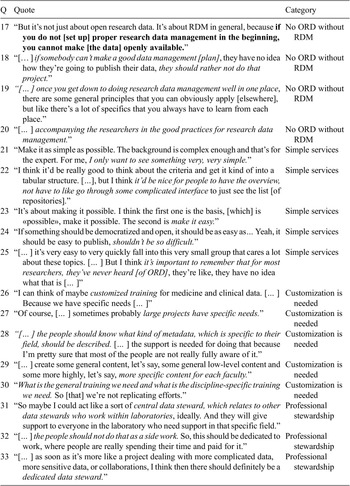
In addition to barriers, experts identified several key enablers that could promote data sharing while addressing the risk of data dumping, a primary focus of the AFFORD project. Experts emphasized that effective ORD practices are inherently dependent on robust RDM, viewing it as the essential foundation for any successful ORD initiative (Table 4, Q17–20).
A key attribute identified for ORD services was simplicity and ease of use. Experts stressed that accessible, straightforward services will enable researchers to adopt ORD principles and prevent discouragement (Table 4, Q21–25). While straightforward ORD services were seen as beneficial to a broad range of researchers, experts also highlighted the need for a degree of customization, especially for large-scale or complex projects. The interviews revealed disciplinary differences in data management skills and requirements, underscoring that customized support is necessary to address these variations (Table 4, Q26–30).
To address the general constraints of time and funding, experts proposed the integration of professional data stewards as the most sustainable approach to ORD support. Such stewards, funded by the university and allocated dedicated time for ORD support, could provide customized, project-specific assistance that relieves researchers of significant time and financial burdens. This stewardship model was viewed as a crucial enabler to bridge existing gaps, ensuring that ORD practices align with both institutional goals and individual project needs (Table 4, Q31–33).
3.4. Survey and interviews outline per-service area trends
Since both survey and interviews we employed to engage stakeholders revolved around the same topics and made use of the service offering matrix (Figure 1), we are able to compare the results we collected across the survey and interviews. In this section, we will adopt a service area perspective and present a comprehensive overview of the trends we could outline from our datasets.
3.4.1. Online information
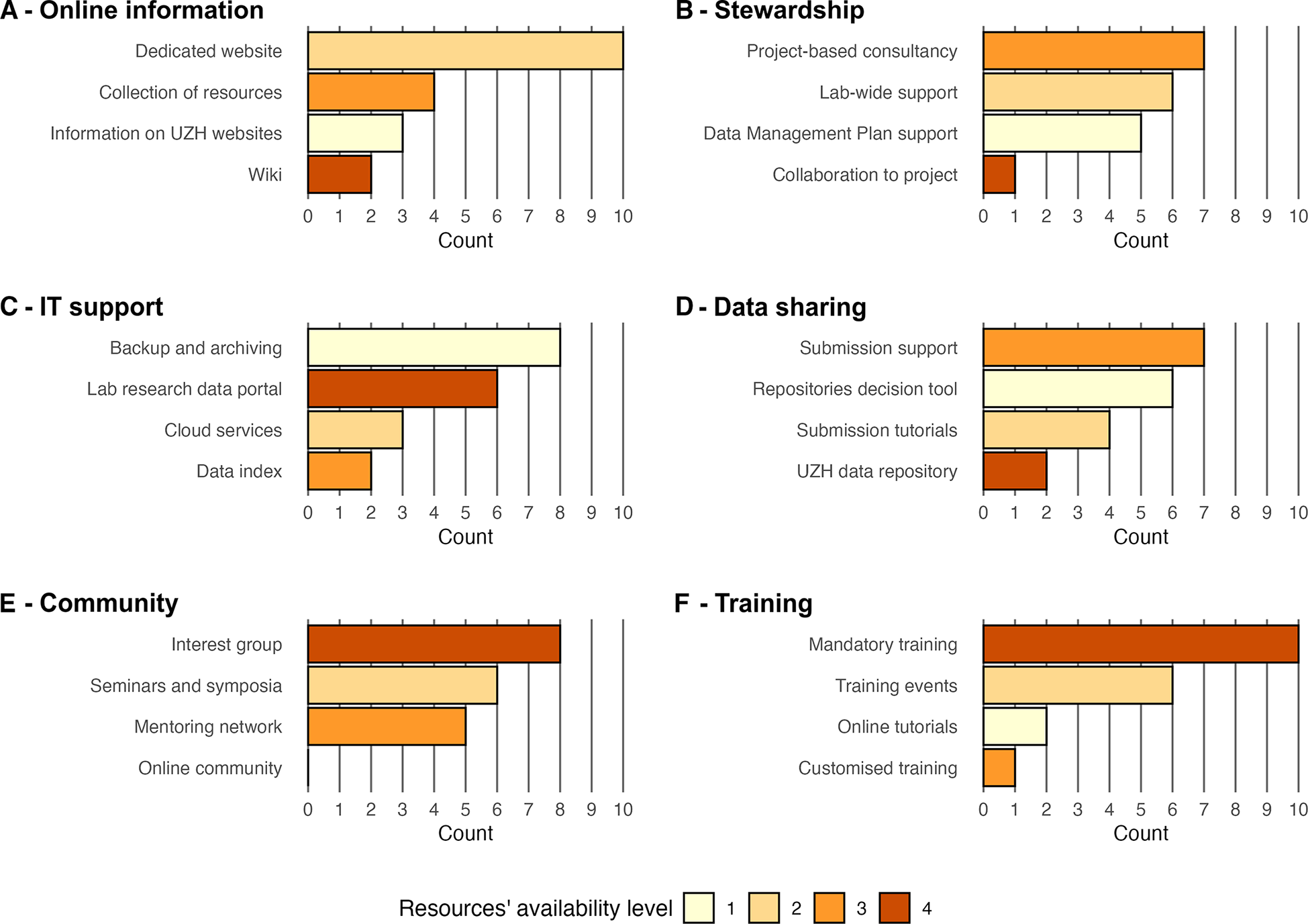
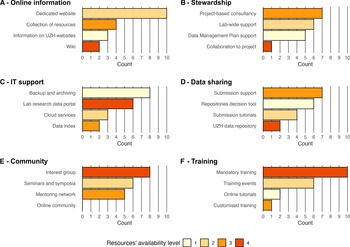
The survey results revealed a clear preference for a dedicated website as the primary service, with remarkably less interest in the use of other available services (Figure 2a). This finding was reinforced in the interviews, where participants consistently viewed the dedicated website as the optimal ORD-supporting service (Figures 3a and Supplementary Figure S12). Interviewees recognized the value of centralizing information resources on the dedicated website, with strong emphasis placed on ensuring the website’s findability through search engine indexing (Supplementary Table S8). Some participants also highlighted the potential of creating a nested collection of resources or a wiki within the website itself. However, concerns were raised regarding the sustainability of such resources, specifically around ongoing maintenance responsibilities. Additionally, interviewees suggested that the website could serve as a central contact hub, directing users to specialized services or departments for specific needs, such as legal support.
Overview of the preferences expressed by 19 interviewees when asked to design an ideal ORD support model featuring a single service per each service area. The color scheme represents the placement of each service along the resources’ availability continuum of the service offering matrix (Figure 1), with 1 being the lowest resource availability per service area and 4 being the highest.
3.4.2. Stewardship
Throughout our study, data stewardship emerged as a highly relevant enabler of ORD practices. Interviewed stakeholders particularly stressed the need for a professionalization of data stewards (Table 4, Q31–33) through dedicated, long-term funding. Survey responses and interview workshops emphasized the need for a “Project-based consultancy” service approach (Figures 2b and 3b), where professional data stewards provide tailored support for specific research projects, especially those involving complex data structures. While centralized services enhance efficiency and financial sustainability, faculty-based support that combines general guidance with domain-specific expertise was deemed essential. Such a hybrid model, ideally coordinated by a central entity like a university library, was suggested to balance financial efficiency with the need for localized, personalized mentoring.
Participants mentioned the importance of integrating data management throughout the research life cycle, addressing key elements like metadata, data management plans (DMPs), data sharing, and publication. Standardized templates and workflows were highlighted as critical tools to reduce redundancy and foster collaboration, enabling researchers to focus on project-specific concerns more effectively. While automation can assist with routine tasks, personalized guidance was deemed vital, particularly in fields with intricate data requirements. Hands-on training, peer learning, and clear communication were also deemed fundamental for establishing robust ORD management practices, ultimately empowering researchers to integrate effective stewardship into their workflows while maintaining ownership of their data management processes (Supplementary Table S9).
3.4.3. IT support
A high level of IT infrastructure is essential for effective (open) RDM, and our study highlighted an agreement on academic institutions having to take responsibilities in providing advanced IT services. The preferences on these services between researchers and stakeholders, however, diverged. Researchers prioritized “Cloud services” and “Backup and Archiving” as the top choices (Figure 2c). In contrast, stakeholders ranked “Backup and Archiving” highest but showed a strong preference for the resource-intensive solution “Laboratory research data portals,” ranking “Cloud services” lower (Figure 3c). Cloud solutions were widely recognized as essential for RDM, with secure identification protocols and user-friendly interfaces being crucial for enabling safe, cross-institutional collaboration. However, concerns about third-party providers led to calls for institutionally supported or public solutions. Stakeholders further stressed how these solutions should complement, not replace, backup, and archive infrastructure, which was deemed a prerequisite for data management.
Secure handling of sensitive data emerged as a key challenge. Generalist cloud platforms were deemed inadequate, prompting recommendations for high-security environments like data safe havens to protect information and build trust among funders, study participants, and the public while safeguarding researchers. Financial constraints, however, were reported to be a potential limitation to the development of such systems. Academic institutions were urged to invest in robust IT infrastructure, including backup, indexing, and publication solutions, to reduce reliance on commercial solutions. Stakeholders emphasized practical, sustainable investments to address immediate infrastructure needs, balancing technical advancements with financial viability. While innovations like machine-actionable data management plans hold promise, they were seen as secondary to foundational improvements (Supplementary Table S10).
3.4.4. Data sharing
Data sharing through publishing is crucial for enabling the reuse of data, which can drive new research, improve transparency, and enhance collaboration across disciplines. The availability of reliable data repositories is thus essential for ORD. However, hosting own data repositories by academic institutions did not emerge as the most preferred option in the survey (Figure 2d) and received the least preferences in the interviews (Figure 3d). Nevertheless, two reasons were mentioned in the interviews for potentially setting up a university-owned repository: if there are no field-specific repositories available or if the university wants to take a leading role in a particular scientific area, especially when dealing with sensitive or legally restricted data. Experts pointed out that peer-to-peer exchanges are often the best way to find repositories in many fields. On the other hand, in areas where such exchanges are lacking, a decision tool could be helpful.
Regarding submission preferences, researchers tend to prefer tutorials over direct support (Figure 2d), while experts place more value on the latter (Figure 3d). A role for data stewards in data submission and publishing support was emphasized during a number of interviews. Additionally, some experts highlighted the importance of clear data ownership in relation to data sharing. They denoted a need for top-down decisions and guidelines on this topic by academic institutions, centered on the idea that data gathered during research endeavors should be treated as a collective good (Supplementary Table S11).
3.4.5. Community
A community can play a crucial role in changing the culture around ORD; however, interviews indicated that the sustainability of the community is key to its success. Perceptions on how such a community can be arranged varied between survey respondents and interviewees, with the first indicating a preference toward services with lower involvement (Figure 2e), and specifically toward an online community. The interviewees, on the other hand, showed little interest in the online community, preferring services requiring more resources and involvement such as the interest group and mentoring network (Figure 3e). Sustainability concerns were raised by the interviewees, some of which reported examples in which community participants who were highly motivated gradually reduced involvement after solving own ORD issues and ultimately left the community initiatives, leading to a loss of effort and knowledge. Dedicated top-down initiatives can be relevant in providing momentum to community initiatives, but a mix of these with bottom-up events that lower barriers to participation could provide a more effective approach for engaging people at multiple levels (Supplementary Table S12).
3.4.6. Training
The overall results suggest that multiple methods are needed for training on ORD. A difference can be identified between users (as identified in the survey), who prefer online tutorials (Figure 2f), and experts, who favor mandatory training (Figure 3f and Supplementary Figure S12). Experts noted that researchers are used to setting their own pace and schedule for training. Mandatory training, at least at early-career stages, or even study curriculum-embedded training, is seen as an effective way to change (future) researchers’ incentives toward training, thus leading to higher engagement. Additionally, a combination of diverse training methods (see Figure 2f) is highlighted as the way to fulfill the need for both general and discipline-specific training, with experts pointing to a central role for data stewards in delivering customized training and to a need for a practical focus of the training. General and customized training should be balanced to avoid overlap and redundancy in the training offer. Additionally, stakeholders suggested that the general training should be founded on modular, reusable, and engaging content. Fundamental skills, such as good research practices (Schwab et al., Reference Schwab, Janiaud, Dayan, Amrhein, Panczak, Palagi, Hemkens, Ramon, Rothen and Senn2022), file naming conventions, data storage and management, metadata curation, and data publishing should form the baseline for early-career researchers’ training (Supplementary Table S13).
4. Discussion
In this study, we engaged a diverse set of stakeholders across the UZH and the Swiss ORD landscape to develop a community-backed set of recommendations aimed at improving ORD support services. This effort is founded on the idea that the implementation of appropriate services and practices is crucial for stimulating a cultural shift toward broader adoption of ORD practices across research communities (Norris and O’Connor, Reference Norris and O’Connor2019; Robson et al., Reference Robson, Baum, Beaudry, Beitner, Brohmer, Chin, Jasko, Kouros, Laukkonen and Moreau2021).
The landscape of initiatives on ORD principles and practices is vast and variegated. Most initiatives in this landscape, however, tend to focus on promoting ORD principles and practices through normative incentives. The most notable example of such initiatives is the Coalition for Advancing Research Assessment (CoARA, coara.eu), which aims to reform the way in which research is evaluated. The Coalition advocates for a more holistic approach to research assessment, emphasizing the importance of OS, transparency, and the recognition of various forms of research output and contributions beyond traditional academic publications (Arentoft et al., Reference Arentoft, Berghmans, Borrell-Damian, Bottaro, Faure, Gaillard, Glinos, Albacete, Morais, Morris, Schiltz and Stroobants2022). The CoARA goals are contextualized in the Swiss landscape by the Recognise ORD (recORD, forscenter.ch/projects/swissuniversities-record/) project, which is nearing completion. Both initiatives aim at incentivizing researchers to adopt ORD practices through an increased recognition of these practices in research evaluation, a need of which was highlighted as well by our interviews (see Table 3, Q5–8) and pre-existing research (Levin and Leonelli, Reference Levin and Leonelli2017; Stieglitz et al., Reference Stieglitz, Wilms, Mirbabaie, Hofeditz, Brenger, López and Rehwald2020; Zuiderwijk et al., Reference Zuiderwijk, Shinde and Jeng2020; Ballesteros-Rodríguez et al., Reference Ballesteros-Rodríguez, De Saá-Pérez, García-Carbonell, Martín-Alcázar and Sánchez-Gardey2022).
Complementary to the normative incentives-based approaches, in the AFFORD project we propose to use ORD support services as sustainable enablers for ORD adoption. Sustainability is defined as “the quality of being able to continue over a period of time” (Cambridge University Press, 2024). We hereby define “sustainable enablers” as the elements that will stimulate the adoption of ORD practices for a continued amount of time, possibly despite changing policies, practices, and perceptions on ORD. Therefore, our work was guided by the idea that the services clearly preferred by support staff and final users would function as the most sustainable ORD enablers. This prompted us to develop our service offering matrix (Figure 1) and feature it in both the survey targeting researchers and the interviews of ORD experts.
While some common patterns emerged across the two groups of stakeholders, differences could be identified as well. For the “Online information” and “Stewardship” support areas, both users and experts had a higher willingness of usage or involvement in the support offering of the same services, respectively (Figures 2a–b and 3a–b). While users indicated a strong willingness to use cloud services in the “IT support” area, experts preferred the involvement of the higher-resources research data portal (Figures 2c and 3c). However, both groups strongly stressed an interest in foundational backup and archiving services, highlighting a need for local data storage. For all the remaining service areas, that is, “Data sharing,” “Community,” and “Training,” the choices patterns fully diverged between the two groups of stakeholders. Notably, users indicated higher willingness to use on-demand services requiring them to invest less time for both the “Community” and “Training” areas, such as online communities and online tutorials (Figure 2e–f), while experts showed greater interest in adding time-intensive services such as interest groups and mentoring networks, or mandatory training, in their ideal service offering (Figure 3e–f). This divergence points at different priorities between our two groups of stakeholders, with users (i.e., researchers) being very wary of their time and experts recognizing the need for more intensive ORD-oriented activities. The difference in priorities must therefore be taken into account by academic policymakers when updating ORD regulations and service providers when introducing or updating ORD support services. Our findings show that involving both users and experts in the decision-making and implementation processes will be fundamental for the sustainability and ultimate success of ORD support strategies.
5. Recommendations
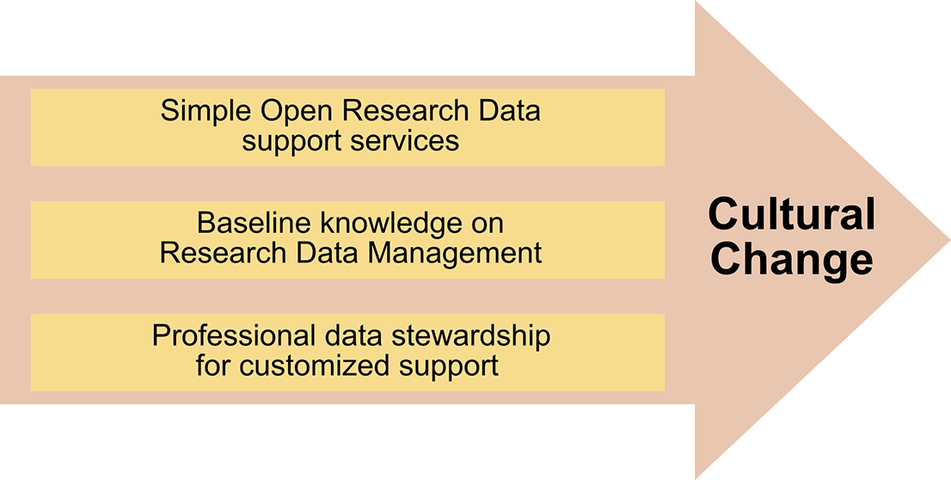
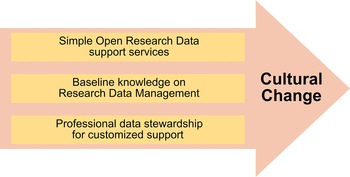
In this article, we presented our investigation on the use of ORD support services as sustainable enablers for a greater adoption of ORD principles and practices. In addition to offering practical recommendations for researchers and their institutions on cost-effective methods to achieve a reasonable degree of openness for their data (Fraga-González et al., Reference Fraga-González, van de Wiel, Garassino, Kuo, de Zélicourt, Kurtcuoglu, Held and Furrer2025), the AFFORD project (Center for Reproducible Science and The Interface Group, 2024) aimed to provide the UZH and other similarly committed academic institutions with recommendations for enhancing their support services. Taken together, findings derived from surveys and interviews point toward a model for strengthening ORD support services that focuses on three core elements: simplicity of services, a strong emphasis on RDM, and customization of the ORD service offering through the professionalization of data stewardship (Figure 4). In this final section, we elaborate on these core elements and provide recommendations to academic policymakers.
A graphical summary of the three recommendations for fostering cultural change around ORD resulting from our study.
5.1. Provide findable and user-friendly ORD support services
The landscape of ORD services is vast and fragmented, with a wide variety of platforms, tools, and services available to researchers. However, navigating this complexity can be difficult, particularly for those who may not have deep knowledge of data management systems. The lack of clear guidance on the most relevant and effective tools for specific research needs makes it hard for researchers to identify and access the appropriate services. This situation calls for the establishment of a more organized and user-friendly system for discovering and using these tools.
Recommendation: In order to address the need for simplicity and user-friendliness, academic institutions should first of all create a comprehensive inventory of all their existing ORD services and establish a way for staff to easily access and navigate it. This inventory could catalog the available tools, categorize them by their function (e.g., data repositories, data analysis tools, metadata standards), and include key information such as usability, accessibility features, and service sustainability. Together with providing researchers with a clearer understanding of the available support options, this inventory would allow the institutions in evaluating their service offering, identifying potential redundancies or support areas left uncovered and ultimately allowing for a more rational planning of services and allocation of resources.
5.2. Increase baseline knowledge and skillset for research data management
A wide variation of fundamental knowledge and skills required for effective RDM exists between researchers, due to research field, technical proficiency, previous education, time availability, and lack of support. The adoption of ORD practices might therefore be hindered, as researchers may not be inclined to adopt proper data management or not know how to integrate the increasingly complex ecosystem of data management tools into their work.
Recommendation: To foster ORD adoption, academic institutions should aim to build a baseline level of knowledge and skill in RDM among their students and faculty. This can be achieved by incorporating basic RDM training into undergraduate and graduate curricula, as well as offering workshops and resources to support faculty in developing their data management practices. A dedicated website or online portal could serve as a centralized resource, offering easy access to educational materials, guidelines, and tools that help researchers at all levels improve their data management skills.
5.3. Establish professional research data stewards for customized support needs
While a general knowledge baseline in RDM is essential, some researchers may require more customized support. This need is particularly critical for researchers handling large or complex datasets, or working in fields where specific data management strategies are necessary, such as fields dealing with sensitive data or (qualitative) data posing identification risks.
Recommendation: To meet this need, academic institutions should establish professional research data stewards—experts in data management who can provide customized support to faculty and researchers. These stewards should be funded and have dedicated time to work closely with researchers, offering advice on best practices for data organization, sharing, and preservation, as well as helping them navigate the range of available services. Additionally, academic institutions may consider establishing a hybrid structure for data stewardship that combines central, university-wide services with faculty-based, discipline-specific stewardship. This hybrid model would ensure that all researchers, regardless of their discipline or level of expertise, have access to both general support and tailored, domain-specific guidance.
Supplementary material
The supplementary material for this article can be found at http://doi.org/10.1017/dap.2026.10056.
Data availability statement
Supplementary Tables S1–S14, Supplementary Figures S1–S14, and other relevant data files (van de Wiel and Garassino, Reference van de Wiel and Garassino2025) are available on Zenodo with DOI 10.5281/zenodo.15745656. All scripts used for data analysis are available on Zenodo with DOI 10.5281/zenodo.15745500, as well as a Git repository at gitlab.uzh.ch/crsuzh/afford_stakeholder_assess.
Acknowledgments
We are very grateful to all the survey and interview participants who dedicated some of their time to this study. Furthermore, we thank the AFFORD project members Willy Kuo, Diane de Julien de Zélicourt, and Vartan Kurtcuoglu for the support, lively discussions, and proactive feedback on our work. We also would like to thank Simona Doneva for her guidance in sentence embedding and clustering analyses, as well as for the stimulating discussions on text mining.
Author contribution
Conceptualization: H.J. vd W., F.G., G.F.G., E.F., L.H.; Data curation: H.J. vd W., F.G., Z.L.; Investigation: H.J. vd W., F.G., Z.L.; Methodology: H.J. vd W., F.G.; Visualization: F.G.; Writing—original draft: H.J. vd W., F.G., E.F.; Writing—review and editing: H.J. vd W., F.G., G.F.G., E.F., L.H. All authors approved the final submitted draft. H.J. vd W. and F.G. contributed equally to this work.
Funding statement
This research was supported by grants from swissuniversities (2022-2024 Open Science I, Phase B, ORD AFFORD) and the Swiss National Science Foundation (Sinergia 213535).
Competing interests
None.
Ethical standard
The research meets all ethical guidelines, including adherence to the legal requirements of the study country.
A. Appendix. Supplementary Methods
A.1. Analysis of survey responses
All survey responses were exported as a spreadsheet from the Microsoft Forms (https://forms.office.com) platform. Analysis and visualization of the survey responses were conducted with a custom R script leveraging the tidyverse v2.0.0, RColorBrewer v1.1-3, and cowplot v1.1.3 packages.
A.2. Recording, transcription, and analysis of interviews
All interviews were recorded with a consumer-grade videoconferencing microphone (Jabra Speak 510 UC) and either Audacity v3.6.1 or Microsoft (MS) Teams v24180.210.3001.6635. MS Teams-recorded .m4a files were converted to single-channel .waw files with ffmpeg v7.0.1. Recordings were transcribed and diarized with a custom Python script leveraging the openai-whisper v20231117, pyannote.core v5.0.0, and pyannote-audio v3.3.1 modules. Diarized transcripts were manually anonymized by masking references to persons’ names, roles within institutions, affiliations, and any other potentially identifying information.
The anonymized transcripts were annotated according to ten categories (Supplementary Table S1) with Taguette v1.4.1-50-geed050b. All transcripts were annotated independently by two researchers, resulting in double screening of each transcript. All annotations were exported from Taguette and further processed with a Python v3.12.4 notebook (running in jupyterlab v4.2.3) leveraging packages matplotlib v3.9.1, numpy v1.26.4, pandas v2.2.2, scikit-learn v1.5.1, scipy v1.14.0, and sentence-transformers v3.3.0. Briefly, annotated sentences were embedded with the “all-mpnet-base-v2” pre-trained model (https://huggingface.co/sentence-transformers/all-mpnet-base-v2). The resulting embeddings were employed to calculate distance matrices with Ward’s method (Ward, Reference Ward1963). Distance matrices were then visualized as dendrograms (Supplementary Figure S13). The dendrograms were inspected to determine the optimal grouping of sentences into clusters. Hierarchical clustering with Ward’s method was then employed to assign sentences to clusters (Supplementary Figure S14). The clustered sentences were then processed with a second Python notebook that compared annotations made by the two independent annotators and identified similar annotations by leveraging, additionally to the above-mentioned packages, package thefuzz v0.22.1. Per-category (Supplementary Table S1) annotations were then inspected in search for the most representative ones, which are reported in this manuscript, and were manually summarized based on clustering results.
A.3. Analysis of interviews’ “workshop” responses
During the “workshop” component of interviews, interviewees were asked to note their service choices on printouts of the service offering matrix (Figure 1). The printouts were then digitized, and per-interview choices were manually transferred to a spreadsheet. The choices were further analyzed with a custom R script leveraging the tidyverse v2.0.0, RColorBrewer v1.1-3, and cowplot v1.1.3 packages.



 Open access


Comments
No Comments have been published for this article.