





Introduction
Recognizing others’ emotional states from their facial expressions is a crucial ability in social functioning. Individuals can derive a considerable amount of information through nonverbal facial cues conveying signals to others about thoughts, feelings, attitudes, and intentions (Ekman & Friesen, Reference Ekman and Friesen2003; Ekman, Reference Ekman1993). Indeed, facial emotion recognition (FER) is necessary for adapting one’s own social actions and feedbacks, with the aim of creating worthwhile social interactions (Fischer et al., Reference Fischer, Pauw, Manstead, Hess and Hareli2019). In this sense, understanding emotional manifestations is a prerequisite for responding appropriately to other people’s assumed internal state, whether it means offering help, or simply an acknowledgement, or even a disapproval (Van Kleef, Reference Van Kleef2009). However, youth with different developmental disorders, such as autism spectrum disorder (ASD) and specific learning disorders (SLD), might experience challenges when dealing with emotion recognition, with specific emotional and cognitive factors associated with such difficulties. By comparing FER and associated factors across various neurodevelopmental disorders, researchers can gain a better understanding of the specific challenges and strengths associated with each condition.
Specifically, evidence suggests that social difficulties experienced by autistic people might be partly due to a reduced social reciprocity, mainly conveyed by their weakness to detect other people’s emotional and mental expressions (Baron-Cohen et al., Reference Baron-Cohen, Golan and Ashwin2009; Chiu et al., Reference Chiu, Chen, Tsai, Li, Wu, Huang and Chen2022). Challenges in FER are consistently associated with autism spectrum disorder (ASD) (for a meta-analysis see Lozier et al., Reference Lozier, Vanmeter and Marsh2014), an early onset neurodevelopmental condition characterized by deficits in social communication and social interaction alongside stereotypic, repetitive, restricted behaviors and interests (American Psychiatric Association, 2013). However, the overall picture of FER in autism is inconsistent, and complicated by the substantial variability between the huge amount of studies in task features, and participants’ characteristics, which could count as potential moderating factors contributing to the mixed findings in the literature (for systematic reviews and meta-analyses, see Black et al., Reference Black, Chen, Iyer, Lipp, Bölte, Falkmer, Tan and Girdler2017; Harms et al., Reference Harms, Martin and Wallace2010; Leung et al., Reference Leung, Sin, Dawson, Ong, Zhao, Veić and Liu2022; Lozier et al., Reference Lozier, Vanmeter and Marsh2014; Uljarevic & Hamilton, Reference Uljarevic and Hamilton2013; Yeung, Reference Yeung2022). Some studies have identified a generalized face-emotion recognition deficit across all emotional facial expressions in autistic children (Lindner & Rosén, Reference Lindner and Rosén2006; Lozier et al., Reference Lozier, Vanmeter and Marsh2014; Rump et al., Reference Rump, Giovannelli, Minshew and Strauss2009), whereas others revealed a lower performance for one or a subset of expressions, highlighting emotion-specific challenges mainly for negative emotions, which have variously included anger, fear, disgust, sadness, and surprise (see for example, Ashwin et al., Reference Ashwin, Baron-Cohen, Wheelwright, O’Riordan and Bullmore2007; Economides et al., Reference Economides, Baiano, Zappullo, Conson, Kalli-Laouri, Laouris and Esposito2020; Humphreys et al., Reference Humphreys, Minshew, Leonard and Behrmann2007). Moreover, challenges with emotion recognition in ASD might also vary based on the type of measure (i.e., accuracy vs reaction times), task (i.e., verbal vs non-verbal), emotion complexity (i.e., basic vs complex emotions), processing (i.e., holistic vs featural), and stimuli (i.e., faces vs speech prosody) (for reviews and meta-analyses see, Leung et al., Reference Leung, Sin, Dawson, Ong, Zhao, Veić and Liu2022; Lievore et al., Reference Lievore, Crisci and Mammarella2023; Yeung, Reference Yeung2022). Overall, the large variability of findings on the topic denotes a literature gap which is incapable of establishing a clear framework; for this reason, it is essential to increase the evidence-based results on the study of FER in autism, by also embracing possible associated mechanisms.
While it appears that FER is an area of significant challenge for children with ASD, questions have arisen encompassing those with SLD. People with SLD show difficulties in reading, written expression, and/or mathematics, which have to be substantially and quantifiably below the levels expected for the individual’s chronological age and may affect academic achievement or daily functioning (American Psychiatric Association, 2013). Academic achievement has been discovered to be intimately linked to social adaptive functioning (Brigman et al., Reference Brigman, Webb and Campbell2007; Sung & Chang, Reference Sung and Chang2010). In particular, the model of social-emotional learning emphasizes that learning in school is a profoundly social process (Denham & Brown, Reference Denham and Brown2010). About that, longitudinal research confirmed that social skills are important predictors of future school and work success (Whiting & Robinson, Reference Whiting and Robinson2001). An extensive body of literature has linked social behavior to school achievement, highlighting how early adaptive social skills of children might provide the foundation for both positive attitudes toward learning and a constructive classroom atmosphere (Brigman et al., Reference Brigman, Webb and Campbell2007; Sung & Chang, Reference Sung and Chang2010).
Some authors have explored whether children with SLD might face challenges with recognizing others’ emotions. Despite the limited number of research in this area, most studies revealed that individuals with SLD were more inaccurate and slower in detecting facial emotions as compared to non-diagnosed participants (Albayrak et al., Reference Albayrak, Kadak, Gürbüz and Doğangün2022; Bloom & Heath, Reference Bloom and Heath2010; Ciray & Turan, Reference Ciray and Turan2022; Economides et al., Reference Economides, Baiano, Zappullo, Conson, Kalli-Laouri, Laouris and Esposito2020; Operto et al., Reference Operto, Pastorino, Stellato, Morcaldi, Vetri, Carotenuto, Viggiano and Coppola2020). Specific-emotion difficulties (e.g., for angry faces; Ciray & Turan, Reference Ciray and Turan2022) emerge as well as a generalized challenge, with the tendency to assign some emotional states to neutral expressions (Operto et al., Reference Operto, Pastorino, Stellato, Morcaldi, Vetri, Carotenuto, Viggiano and Coppola2020). Some authors concluded that problems with FER might be specifically related to high-level visual deficit (Economides et al., Reference Economides, Baiano, Zappullo, Conson, Kalli-Laouri, Laouris and Esposito2020); people with dyslexia, a subtype of SLD that impacts reading ability, matched faces more slowly, especially when the faces differed in viewpoint, and discriminated more poorly between similar faces (but not cars) (Gabay et al., Reference Gabay, Dundas, Plaut and Behrmann2017; Sigurdardottir et al., Reference Sigurdardottir, Ívarsson, Kristinsdóttir and Kristjánsson2015; Tarkiainen et al., Reference Tarkiainen, Helenius and Salmelin2003). However, research is still needed to disentangle the possible mechanisms that underlie challenges with others’ emotion detection from facial expressions in children with SLD.
Facial emotion recognition and social anxiety
When facing others’ emotions within social interactions, some people might feel inadequate or uncomfortable, resulting in tension or anxiety (Heimberg et al., Reference Heimberg, Hofmann, Liebowitz, Schneier, Smits, Stein, Hinton and Craske2014). From this point of view, anxiety is not necessarily negatively conceptualized, and under certain circumstances, may serve as useful for navigating social situations (McNeil & Randall, Reference McNeil, Randall, Hofmann and DiBartolo2014). Sometimes instead, anxiety might reach the disabling extremity of the continuum, preventing people to maintain close social relationships. This feeling is usually named social anxiety, which is characterized by cognitive, emotional, behavioral, and physiological symptoms before or during social or performance situations, concerning the fear to be exposed to possible scrutiny by others, to be negatively evaluated and a tendency for avoiding interactions (American Psychiatric Association, 2013; Lievore et al., Reference Lievore, Cardillo, Lanfranchi, Mammarella, Hodapp, Fidler and Lanfranchi2022). A recent social information processing model of childhood social anxiety development (Nikolić, Reference Nikolić2020), postulates cognitive biases when encoding social stimuli, such as facial emotional expressions. Feelings of rejection can derive from a facial expression perceived as hostile or when misinterpreted, and might consequently provoke anxiety in people for whom approval is meaningful (for a meta-analysis see O'Toole et al., Reference O’Toole, Hougaard and Mennin2013). Findings are inconsistent on the types of other people’s emotions that can trigger the development of social anxiety. Some do support the idea that effects are not emotion-specific (Bell et al., Reference Bell, Bourke, Colhoun, Carter, Frampton and Porter2011; Button et al., Reference Button, Lewis, Penton-Voak and Munafò2013; Silvia et al., Reference Silvia, Allan, Beauchamp, Maschauer and Workman2006), whereas others have proven that people with social anxiety recognize less accurately or are more sensitive to certain emotions (Battaglia et al., Reference Battaglia, Ogliari, Zanoni, Villa, Citterio, Binaghi, Fossati and Maffei2004; Richards et al., Reference Richards, French, Calder, Webb, Fox and Young2002; Simonian et al., Reference Simonian, Beidel, Turner, Berkes and Long2001; Tseng et al., Reference Tseng, Huang, Chen, Liang, Lin and Chen2017). In addition, an attentional bias toward threatening facial expressions has been proven in socially anxious children and adults (Bantin et al., Reference Bantin, Stevens, Gerlach and Hermann2016; Dudeney et al., Reference Dudeney, Sharpe and Hunt2015; Waters et al., Reference Waters, Mogg, Bradley and Pine2011). However, the relationship between face emotion recognition and social anxiety focusing on neurodevelopmental disorders has not been investigated yet.
The experience of negative emotions, such as fear or anxiety, within the social contexts is common in most children and adolescents diagnosed with different neurodevelopmental disorders, such as ASD and SLD (Harms et al., Reference Harms, Martin and Wallace2010; Lievore et al., Reference Lievore, Cardillo, Lanfranchi, Mammarella, Hodapp, Fidler and Lanfranchi2022; Rostami et al., Reference Rostami, Veisi, Jafarian Dehkordi and Alkasir2014; Terras et al., Reference Terras, Thompson and Minnis2009). Some researchers have proposed a bidirectional relationship between social challenges and social anxiety in ASD (Bellini, Reference Bellini2006; White et al., Reference White, Albano, Johnson, Kasari, Ollendick, Klin, Oswald and Scahill2010). The presence of social anxiety, together with previous negative social experiences, could prevent people from engaging in social situations, reducing the opportunity to practice social skills and to empower social efficacy. Therefore, autistic individuals might have increased social worries as a consequence of the self-awareness of their social problems (internal sources of threat, for example, making a self-identified mistake in social situations) and of rejections or negative judgment from others (external sources of threat) (Rosen & Lerner, Reference Rosen and Lerner2018; Spain et al., Reference Spain, Sin, Linder, McMahon and Happé2018). In this regard, for some autistic individuals, faces may not be perceived as emotionally interesting causing indifference toward social interactions (Ashwin et al., Reference Ashwin, Baron-Cohen, Wheelwright, O’Riordan and Bullmore2007), while for others, faces may be overstimulating, and possibly associated with higher levels of social anxiety (Kleinhans et al., Reference Kleinhans, Richards, Weaver, Johnson, Greenson, Dawson and Aylward2010). However, the relationship between the ability to recognize facial emotions and levels of social anxiety in children and adolescents with ASD has not been extensively investigated yet. The few studies on the topic revealed that social anxiety might be related to poorer FER in young adults and adolescents with ASD (Antezana et al., Reference Antezana, Valdespino, Wieckowski, Coffman, Carlton, Garcia, Gracanin, White and Richey2023), and to poorer fear recognition in autistic adults (Corden et al., Reference Corden, Chilvers and Skuse2008). Research on social attention in autism revealed that self-reported fears of negative evaluation predict greater gaze duration to social threat stimuli (White et al., Reference White, Maddox and Panneton2015), and that autonomic reactivity to eye gaze negatively correlates with face recognition performance in autistic children (Bal et al., Reference Bal, Harden, Lamb, Van Hecke, Denver and Porges2010; Joseph et al., Reference Joseph, Ehrman, Mcnally and Keehn2008). Other studies found no association between behavioral ratings of social anxiety and emotion recognition performance across 7–13 years old autistic children (Wong et al., Reference Wong, Beidel, Sarver and Sims2012) and adults (Spain et al., Reference Spain, Happé, Johnston, Campbell, Sin, Daly, Ecker, Anson, Chaplin, Glaser, Mendez, Lovell and Murphy2016).
In respect of children with SLD, social anxiety might be driven by specific challenges associated with their academic impairments. Children with SLD might face a unique set of socioemotional challenges as a result of their academic difficulties (Livingston et al., Reference Livingston, Siegel and Ribary2018). Specifically, to social anxiety, different studies have revealed a higher rate in children and adults with SLD compared to non-diagnosed (Carroll & Iles, Reference Carroll and Iles2006; Mammarella et al., Reference Mammarella, Ghisi, Bomba, Bottesi, Caviola, Broggi and Nacinovich2016; Rostami et al., Reference Rostami, Veisi, Jafarian Dehkordi and Alkasir2014; Terras et al., Reference Terras, Thompson and Minnis2009). Consequently, to school challenges and negative experiences, children with SLD might experience feelings of anxiety, shame, and inadequacy (Elgendi et al., Reference Elgendi, Stewart, MacKay and Deacon2021), and any negative feedback from school may affect their socioemotional functioning furthering internalizing problems (Donolato et al., Reference Donolato, Cardillo, Mammarella and Melby-Lervåg2022; Sahoo et al., Reference Sahoo, Biswas and Padhy2015; Thaler et al., Reference Thaler, Kazemi and Wood2010). Multiple experiences of these feelings can result in lowering self-esteem, social skills deficits with peers, causing loneliness and troubles finding friends or relationships, and resulting in higher levels of social anxiety (Kohli et al., Reference Kohli, Malhotra, Mohanty, Khehra and Kaur2005). Though, the association between social skills, such as FER, and social anxiety in children and adolescents with SLD, has not been systematically examined yet.
Facial emotion recognition and executive functions
Besides underpinning emotional mechanisms, there is accumulating evidence that social development and emotion knowledge, might be supported by higher-order cognitive skills, such as executive functions (EFs). EFs refer to an umbrella term that includes a set of top-down mental processes, crucial for controlling, monitoring and planning thoughts and behaviors, as well as problem-solving, self-controlling, considering alternatives and flexibly adjusting to new settings (Diamond, Reference Diamond2013; Miyake et al., Reference Miyake, Friedman, Emerson, Witzki, Howerter and Wager2000). According to Miyake et al. (Reference Miyake, Friedman, Emerson, Witzki, Howerter and Wager2000), the three core processes of EFs are inhibitory control (i.e., the ability to deliberately inhibit automatic responses when required), updating (i.e., the ability to update and monitor information in the working memory), and cognitive flexibility (i.e., set shifting, the ability to switch between mental sets to adjust to changed priorities). Altogether EFs help us to reach goal-directed behaviors, and are therefore essential for success in school and work situations, as well as everyday living. A widely cited biopsychosocial model (SOCIAL; Beauchamp & Anderson, Reference Beauchamp and Anderson2010) combines the biological underpinnings and socio-cognitive skills that underlie the social functioning (EFs, communication, socio-emotional skills), as well as the internal and external aspects that mediate these skills. A developing body of literature has indeed underlined the relation between EFs and social abilities (Denham et al., Reference Denham, Bassett, Way, Mincic, Zinsser and Graling2012; Moriguchi, Reference Moriguchi2014; Spikman et al., Reference Spikman, Boelen, Pijnenborg, Timmerman, van der Naalt and Fasotti2013). EFs might serve as basis for the development of emotional understanding, since attentional and inhibitory control may be required for children to correctly behave in social contexts, and practising with social skills (Carlson & Wang, Reference Carlson and Wang2007; Lecce et al., Reference Lecce, Bianco, Devine and Hughes2017). In particular, cognitive flexibility showed a consistent positive correlation with FER in various populations, given that the ability to handle with complex emotional scripts might be supported by EFs (David et al., Reference David, Soeiro-de-Souza, Moreno and Bio2014; Lee et al., Reference Lee, Lee, Kweon, Lee and Lee2009; Martins et al., Reference Martins, Osório, Veríssimo and Martins2016). Moreover, working memory might play a role in the recognition of other persons’ emotions, because of the need to process the emotional cue while temporarily holding it in mind (Neumann et al., Reference Neumann, Völker, Hajba and Seiler2021; Phillips et al., Reference Phillips, Channon, Tunstall, Hedenstrom and Lyons2008).
Impairments in executive functioning have been described in different neurodevelopmental disorders, including autism and SLD (Brosnan et al., Reference Brosnan, Demetre, Hamill, Robson, Shepherd and Cody2002; Hill, Reference Hill2004). In autism, the “executive dysfunction” theory has been put forward to try to describe autistic symptoms (Hill, Reference Hill2004; Hughes, Reference Hughes2001; Ozonoff, Reference Ozonoff, Schopler, Mesibov and Kunce1998). Impairments in EFs have been proposed as a cause of not only the rigid and repetitive interests and behaviors in ASD, but also of the primary challenges with reciprocal social interactions. However, there is a multitude of conflicting evidence on executive dysfunction in ASD, indicating the inconsistency of EF deficit across subdomains, thus supporting heterogeneity in EFs in this clinical population (Dajani et al., Reference Dajani, Llabre, Nebel, Mostofsky and Uddin2016). In this regard, sometimes autistic people display prominent challenges with EFs in everyday life, while amply performing on structured neuropsychological tests (Kenworthy et al., Reference Kenworthy, Yerys, Anthony and Wallace2008). The association between the ability to recognize others’ emotions and EFs has been quite investigated in children with ASD (Joseph & Tager–Flusberg, Reference Joseph and Tager-Flusberg2004; Sivaratnam et al., Reference Sivaratnam, Newman and Rinehart2018; Torske et al., Reference Torske, Nærland, Øie, Stenberg and Andreassen2018), postulating a link between the domains.
Concerning children with SLD, challenges with EFs have been proven in many studies, in particular vis-à-vis working memory (Meltzer, Reference Meltzer2011; Swanson & Sachse-Lee, Reference Swanson and Sachse-Lee2001). Due to the evident difficulties of children with SLD in working memory, research has focused at most on this area of EFs. Verbal working memory seems to be linked to reading competences (Schuchardt et al., Reference Schuchardt, Maehler and Hasselhorn2008), whereas visuospatial working memory to math achievement (Caviola et al., Reference Caviola, Colling, Mammarella and Szűcs2020; Giofrè et al., Reference Giofrè, Mammarella and Cornoldi2014; Mammarella et al., Reference Mammarella, Caviola, Giofrè and Szűcs2018). In a recent study, however, children with dyslexia were able to similarly perform an updating task to the control group (Artuso et al., Reference Artuso, Borgatti and Palladino2021). Regarding other EFs’ components, findings are inconsistent. Some supported the idea of an executive impairment when assessing set-shifting and response inhibition in SLD (Crisci et al., Reference Crisci, Caviola, Cardillo and Mammarella2021; Singh et al., Reference Singh, Arun and Bajaj2021; Szűcs et al., Reference Szűcs, Devine, Soltesz, Nobes and Gabriel2013), whereas others did not confirm it when assessing planning, sequencing, or inhibiting responses, reporting comparable outcomes to non-diagnosed participants (Brosnan et al., Reference Brosnan, Demetre, Hamill, Robson, Shepherd and Cody2002; Desoete & De Weerdt, Reference Desoete and De Weerdt2013). Contrary to ASD, the association between the ability to recognize others’ emotions and EFs has never been studied in children with SLD.
The present study
To the best of our knowledge, no previous studies investigated the abilities to recognize facial emotion expressions and associated internalizing (social anxiety) and cognitive (EFs) factors, by taking into account (and comparing) groups of children with and without ASD and SLD. By comparing FER and associated factors across various neurodevelopmental disorders, researchers can gain a better understanding of the specific challenges and strengths associated with each condition. In this regard, a great amount of studies has been conducted in the field of autism with huge variability across findings, but little attention has been given to the maladaptive effects of experiencing learning difficulties.
Thus, the first aim of the present study was to evaluate FER skills in children with different neurodevelopmental disorders (ASD, SLD) as compared to non-diagnosed (ND) participants, by also considering how different emotions are perceived. The second aim was to understand which emotional and cognitive mechanisms might be associated with FER abilities, and how these relationships might differ among groups (ASD, SDL, and ND). To do so, we investigated the role of social anxiety and executive functioning (inhibition, updating, and set-shifting) in predicting performance on an FER task.
Based on previous findings (Black et al., Reference Black, Chen, Iyer, Lipp, Bölte, Falkmer, Tan and Girdler2017; Bloom & Heath, Reference Bloom and Heath2010; Operto et al., Reference Operto, Pastorino, Stellato, Morcaldi, Vetri, Carotenuto, Viggiano and Coppola2020; Uljarevic & Hamilton, Reference Uljarevic and Hamilton2013), it is worth hypothesizing a worse general performance on the FER task in children with ASD and SLD, as compared to those without these conditions. As regards the recognition of single emotions, we expect that the clinical groups will find more difficulties in detecting negative facial expressions, such as fear and anger (Ashwin et al., Reference Ashwin, Baron-Cohen, Wheelwright, O’Riordan and Bullmore2007; Ciray & Turan, Reference Ciray and Turan2022; Humphreys et al., Reference Humphreys, Minshew, Leonard and Behrmann2007).
Concerning our second aim, we expect a statistically significant association between FER ability and the reported social anxiety in both clinical groups (ASD, SLD). In children with ASD, higher levels of social anxiety might be consistent with a poorer recognition of other people’s emotional expressions because of their widely recognized social challenges and discomfort within the social contexts (Antezana et al., Reference Antezana, Valdespino, Wieckowski, Coffman, Carlton, Garcia, Gracanin, White and Richey2023; Corden et al., Reference Corden, Chilvers and Skuse2008; Kleinhans et al., Reference Kleinhans, Richards, Weaver, Johnson, Greenson, Dawson and Aylward2010). Similarly, children and adolescents with SLD with higher levels of social anxiety might display worse FER ability, as a result of avoidance toward others’ emotions which they find difficulties to interpret (Bögels & Mansell, Reference Bögels and Mansell2004; Mansell et al., Reference Mansell, Clark, Ehlers and Chen1999). The fear of being negatively evaluated and diminished self-efficacy could play a role as well in the association between social anxiety and others’ emotion recognition (Livingston et al., Reference Livingston, Siegel and Ribary2018; Rostami et al., Reference Rostami, Veisi, Jafarian Dehkordi and Alkasir2014; Terras et al., Reference Terras, Thompson and Minnis2009). Nonetheless, the hypothesis on the link between social anxiety and FER in SLD is solely exploratory due to the lack of literature on the topic.
Moreover, we predict that EFs might support the performance on the FER task in all considered groups (Martins et al., Reference Martins, Osório, Veríssimo and Martins2016; Neumann et al., Reference Neumann, Völker, Hajba and Seiler2021; Phillips et al., Reference Phillips, Channon, Tunstall, Hedenstrom and Lyons2008; Sivaratnam et al., Reference Sivaratnam, Newman and Rinehart2018; Torske et al., Reference Torske, Nærland, Øie, Stenberg and Andreassen2018).
Method
Participants
The study involved 263 children and adolescents aged between 8 and 16 years old divided into three groups: 60 (52 M) with autism spectrum disorders (ASD), 63 (44 M) with SLD, and 140 (105 M) matched non-diagnosed (ND) peers. The three groups did not statistically differ in chronological age [F (2, 260) = 1.04, p = .35, Adj R 2 = .001; ASD = 12.05 (8.33), SLD = 12.53 (1.94), ND = 12.07 (2.06)], sex distribution [X 2 = .86, df = 2, p = .65], or total IQ [F (2, 260) = 1.14, p = .32, Adj R 2 = .002; ASD = 106.63 (15.68), SLD = 106.17 (10.47), ND = 108.66 (11.22)]. All children and adolescents were native Italian speakers, and none had any visual or hearing impairments.
The ND group comprised healthy children with typical development with no psychiatric, neurological, or neurodevelopmental disorders. They were engaged and examined individually at school. The clinical groups (ASD, SLD) were assessed at the child and adolescent psychiatric services, where they referred. All participants in the clinical groups had been previously diagnosed with ASD or SLD, according to the DSM-IV-TR or the DSM-5 (American Psychiatric Association, 2000, 2013) or ICD-10 (World Health Organization, 1992) criteria. Specifically, the SLD group was composed as follows: 44 % of the participants had major difficulties in mathematics, reading and/or writing, 35 % in reading, 13 % in writing, and 8 % in mathematics. To confirm their diagnosis, an experimenter, blind to the group membership of the participants, was responsible for testing all the children using specific clinical assessment materials. Diagnosis of ASD were confirmed using the Autism Diagnostic Interview – Revised (ADI-R; Rutter et al., Reference Rutter, Le Couteur and Lord2005). The groups statistically differed in all subscales of ADI-R (Reciprocal social interaction: F (2, 260) = 122.78; Language/communication: F (2, 260) = 87.81; Repetitive behaviors/interests: F (2, 260) = 73.94), with autistic participants having higher scores than those with SLD and ND (p s < .001). Diagnoses of SLD were also confirmed by implementing some age-appropriate subtests which evaluated reading and math competencies (AC-MT-3 6-14, Cornoldi et al., Reference Cornoldi, Mammarella and Caviola2020; DDE-2, Sartori et al., Reference Sartori, Job and Tressoldi2007; MT-Avanzate-3-Clinica, Cornoldi et al., Reference Cornoldi, Pra Baldi and Giofrè2017). In both reading (words - errors: F (2, 260) = 72.93, words - time F (2, 260) = 45.68; pseudo-words - errors: F (2, 260) = 39.82, pseudo-words – time F (2, 260) = 28.56) and math (mental calculation - accuracy: F (2, 260) = 23.67, mental calculation - time F (2, 260) = 13.34) subtests, the SLD group was more impaired than the ASD and ND groups (p s < .001).
Inclusion criterion for the current study was a standard score of 80 or more for total IQ as assessed by the Wechsler Intelligence Scales (WISC IV; Wechsler, Reference Wechsler2003). Participants who were taking medication, or with other known genetic conditions, a history of neurological diseases, comorbid psychopathologies, or certified physical and intellectual disabilities were excluded.
Materials
Facial emotion recognition
An ad hoc computerized task was created to assess FER abilities. It was developed by using the EU-Emotion Stimulus Set, which was created as part of the ASC-Inclusion project within the European Community’s Seventh Framework Programme (FP7/2007-2013; O’Reilly et al., Reference O’Reilly, Pigat, Fridenson, Berggren, Tal, Golan, Bölte, Baron-Cohen and Lundqvist2016).
Stimuli were static images of actors, taken from dynamic video clips with a neutral white background, that expressed a facial emotion. The frame for the static images was captured at the peak of the expressed emotion, so that the emotion appeared as close as possible to a real-life situation. A direct frontal view of each actor, featuring only their shoulders and head within the frame, was depicted. The participant was required to choose whether two actors expressed the same or different emotions by pressing distinct keys on the keyboard (“z” if “same emotion”, “m” if “different emotions”). There were no time restrictions to respond. The task comprised 144 trials divided into two blocks of 72 with a small break after the first 36 trials of each block. In half of the trials the two actors showed the same emotion (n = 72), in half different emotions (n = 72). The six basic emotions were assessed: happiness, surprise, sadness, fear, anger, and disgust. Each of the six emotions was the correct answer 12 times during the entire task. Actors were of different ethnicity and age range 10–70 years old (ten females and nine males). The trials were counterbalanced for actors’ age (adult–adult, child–child, and adult–child) and emotions’ intensity (high and low). Raw scores were calculated for total accuracy. In addition, correct responses for the single emotions (happiness, surprise, sadness, fear, anger, and disgust) were considered.
For the current sample, Cronbach’s α (total accuracy) = .83 (C.I. = .79–.86).
Social anxiety
The parent-report form of the Italian version (Paloscia et al., Reference Paloscia, Giangregorio, Guerini and Melchiori2017) of the Multidimensional Anxiety Scale for Children (MASC-2; March, Reference March2012) was administered to evaluate the presence of social anxiety symptoms. Specifically, the Social Anxiety subscale (composed by Humiliation/Rejection, and Performance Fears) was administered. This dimension includes 9 items rated on a 4-point scale from 0 (never) to 3 (often). Raw scores were converted into T scores by using normative data that considers the child’s age and sex.
Cronbach’s α (Social Anxiety scale) = .88.
Executive functions
The tripartite Miyake’s model of EFs (Miyake et al., Reference Miyake, Friedman, Emerson, Witzki, Howerter and Wager2000) was applied to assess executive functioning in our sample.
Inhibition
Inhibitory control was assessed with a computerized go/no-go task (adapted from Christ et al., Reference Christ, Holt, White and Green2007). The task included 120 trials, composed by two blocks (60 + 60) with a break between them. On each trial, one of four stimuli (blue, red, yellow, and green dots) was centrally displayed in a computer monitor. In the first block, children were asked to press the spacebar as quickly as possible when a blue dot appeared (target; go trials) and to give no response when a dot in any other color showed (non-target; no-go trials). In the second block, children were asked to press the spacebar as quickly as possible when a dot of any color except for blue appeared (target; go trials) and to deliver no response when a blue dot appeared (non-target; no-go trials). Performance on the go trials corresponds to a measure of attention, whereas errors on the no-go trials to a measure of inhibition. Within each block, stimuli were produced in a random order, and targets were presented on a minority of trials (25%). After an intertrial interval of 2.000 ms, a new trial was presented. At the beginning of the task, after giving the instructions, eight practise trials were presented, in which children were provided a feedback on the response (“correct”, “incorrect”, and “too slow” when the response was not given within 2.000 ms). Errors on the no-go trials (number of reactions to the non-target stimuli) were considered as a measure of inhibition.
Cronbach’s α (for both go and no-go trials) = .94.
Updating
This computerized task, adapted from Cardillo et al. (Reference Cardillo, Mammarella, Demurie, Giofrè and Roeyers2021), was used to assess the ability to visually and spatially update information into the working memory system. Participants were shown a 4 × 4 blank matrix on the computer screen. A total of eight sequences of various shapes (i.e., triangle, circle, star, square, rhombus, and pentagon) appeared in the matrix. Participants were asked to recall the last position of certain shapes shown on the screen. The number of shapes to recall ranges from 2 to 5, depending on the level’s difficulty. Sequences of 6, 8, 10, or 12 shapes were used, and there were two trials for each sequence length. Before starting the experiment, participants were presented with three practice trials. Accuracy was calculated as a proportion of items’ last positions correctly recalled out of the total positions to remember (Giofrè & Mammarella, Reference Giofrè and Mammarella2014).
Cronbach’s α = .80 (C.I. = .75–.83).
Set-shifting
A computerized version of the Wisconsin Card Sort Test (WCST; Heaton et al., Reference Heaton, Chelune, Talley, Kay and Curtiss1993) has been designed from the original edition. Each trial comprised four stimulus cards and a response card, and the participant’s goal was to correctly match the response card to one of the stimulus cards according to one of three grouping principles. After each trial, participants received feedback on the answer’s correctness. The stimulus cards appeared in a row at the top of the computer screen, and the response cards showed one at a time at the bottom of the screen. The four stimulus cards displayed the following symbols: (a) one red triangle, (b) two green stars, (c) three yellow crosses, and (d) four blue circles. There were two decks of 64 response cards, each containing from one to four identical symbols (triangles, stars, crosses, or circles) of a particular color (red, green, yellow, or blue). The first correct sorting principle was color, followed by form and then number. The participant had to correctly match the stimulus and the response cards 10 times consecutively within each criterion. The test finished when the participant was able to match the response cards following six criteria (twice each sorting principle), or when he/she used two identical decks of 64 response cards (128 cards total). The total number of perseverative errors, calculated as proportions to the number of administered trials, was used in the analysis. A perseverative error is defined as a failure to shift category after receiving negative feedback from the previous trial.
Generalizability coefficient = .60 (from .37 to .72) (Heaton et al., Reference Heaton, Chelune, Talley, Kay and Curtiss1993).
Procedure
The study was approved by the ethics review board of the Authors’ institution. After obtaining the written consent of children’s parents to their participation in the study, participants were tested individually in a quiet room at specialized centers (ASD, SLD) or at school (ND) during three sessions (a screening and two experimental phases) lasting approximately 40 minutes each. In the screening phase, the IQ was calculated and only participants who scored above 80 were included; reading and math competences were also evaluated in this initial phase. Meanwhile, parents were administered the ADI-R for child autistic symptoms. The first experimental phase included the FER test (first block), go-no go, and updating tasks. The second one comprised the FER task (second block) and the WCST. The tasks in the experimental sessions were presented in a counterbalanced order. At the same time, parents completed the MASC-2 for assessing the child social anxiety. The experimenter provided instructions on each task, letting the participant practice before starting the experiment. The computerized tasks (FER and EFs’ tasks) were created and administered using PsychoPy3 (Peirce et al., Reference Peirce, Gray, Simpson, MacAskill, Höchenberger, Sogo, Kastman and Lindeløv2019) and a laptop computer with a 15-inch LCD screen.
Statistical approach
First, a series of univariate ANOVAs were performed to estimate differences between the three groups in the measures of interest. Post hoc comparisons between groups were assessed through the Tukey’s correction test. Effect sizes were also computed, using both adjusted R-squared (Adj R 2), which represents the effect size of the comparisons between the three groups for the factors considered, and Cohen’s d, which instead expresses the effect size of the pairwise comparisons between the groups (for details see Supplementary results).
Second, a series of regression models were developed to assess the effect of the measured variables on the dependent variable. To do this, we created a full model with FER (total accuracy) as dependent variable, and group, social anxiety, inhibition, updating and set-shifting as predictors. Age of the child was included as a covariate. Starting from the full model, we built the various models by removing one variable at time, to evaluate the principal effects of the single predictors on the dependent variable. In addition, the interaction effects between each variable and the group were tested, starting from the full model we added one interaction effect at time. We compared each model with the full model, using the Akaike Information Criterion (AIC) and the Adj R 2. A lower AIC indicates a better model. The Adj R 2 represents the proportion of variance in the outcome variable which is explained by the predictor variables in the sample. The Adj R 2 is a modified version of R 2 that adjusts for the number of predictors in a regression model and allows for comparing models with a different number of predictors (Miles, Reference Miles2005). Cohen (Reference Cohen1988) has defined the effects as follows: a very weak effect < 0.02, a weak effect between 0.02 ≤ R 2 < 0.13, a moderate effect between 0.13 ≤ R 2 < 0.26, and a large effect ≥ 0.26, whereas a recent paper establishes that an R 2 of at least 0.10 is acceptable in social science empirical modeling (Ozili, Reference Ozili2023).
Data were analyzed using R version 1.3.1093 (R Core Team, 2022). The “lme4” package was used to run the regression models and the AIC (Bates et al., Reference Bates, Maechler, Bolker and Walker2015), and the “ggplot2” package to obtain the graphical effects (Wickham, Reference Wickham2016).
Results
Preliminary analyses
Tables 1 and 2 display descriptive statistics and statistical comparisons between the three groups in all considered measures. Effect sizes of the pairwise comparisons between the groups (Cohen’s d), are reported in Table S1 (Supplementary results).
Descriptive statistics and statistical comparisons by group for correct responses on the facial emotion recognition task, in children and adolescents with Autism spectrum disorders (ASD), specific learning disorders (SLD), and non-diagnosed (ND)

Descriptive statistics and statistical comparisons by group for social anxiety and executive functions (inhibition, updating, and set-shifting), in children and adolescents with Autism spectrum disorders (ASD), specific learning disorders (SLD), and non-diagnosed (ND)

Facial emotion recognition
Table 1 concerns to the performance in the FER task with respect to total accuracy, and single emotions (happiness, surprise, sadness, fear, anger, and disgust). The three groups statistically differed in the scores of all the considered variables in this test, with a worse performance for clinical groups as compared to ND. Both the ASD (Tukey’s p < .001, Cohen’s d = −.82) and SLD (Tukey’s p < .001, Cohen’s d = −.59) groups achieved an overall lower performance in recognizing emotions as compared to the ND group, F (2, 260) = 17.03, p < .001, Adj R 2 = .11. Specifically, the ASD group scored worse than the ND group in recognizing happiness (Tukey’s p = .04, Cohen’s d = −.38), surprise (Tukey’s p = .005, Cohen’s d = −.49), fear (Tukey’s p = .01, Cohen’s d = −.46), anger (Tukey’s p = .04, Cohen’s d = −.37), and disgust (Tukey’s p < .001, Cohen’s d = −.73). Instead, the SLD group obtained lower scores as compared to the ND group in detecting surprise (Tukey’s p = .008, Cohen’s d = −.49), sadness (Tukey’s p = .03, Cohen’s d = −.41), and disgust (Tukey’s p < .001, Cohen’s d = −.55).
Social anxiety
Concerning social anxiety (see Table 2), a statistically significant effect of the group emerged, F (2, 260) = 15.43, p < .001, Adj R 2 = .10. Parents of children and adolescents with ASD (Tukey’s p < .001, Cohen’s d = .63) and SLD (Tukey’s p < .001, Cohen’s d = .76) reported greater levels of social anxiety as compared to the ND group.
Executive functions
As regards the EFs’ tasks (see Table 2), the ASD group performed significantly worse than the ND (Tukey’s p < .001, Cohen’s d = −.61) and SLD (Tukey’s p = .03, Cohen’s d = −.41) groups in the updating task, F (2, 260) = 7.56, p < .001, Adj R 2 = .05.
No statistically significant differences between groups emerged as regard to the other measures.
Regression models
A series of linear regressions were tested in order to investigate the association between the FER and the hypothesized predictors (i.e., group, social anxiety, inhibition, updating, and set-shifting). Age of the child was included as a covariate. The interactive effect of group was also considered (see Table 3).
Results of the comparisons between regression models with facial emotion recognition (total accuracy) as dependent variable, and all the other measured variables and their interactions with group as predictors. Age of the child has been included as a covariate
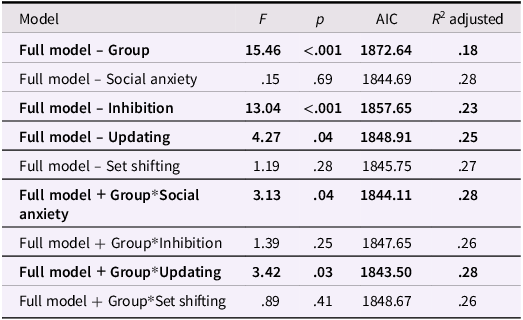
Note. AIC, Akaike Information Criterion. Full model = Age + Group + Social anxiety + Inhibition + Updating + Set-shifting. [AIC = 1846.53, R2 adjusted = .26].
A significant main effect of group was found (full model with group: AIC = 1846.53, R 2 adj = .26, model without group: AIC = 1872.64, R 2 adj = .18; F = 15.46, p < .001). The model coefficients showed that the ASD and SLD groups were less accurate than the ND group in the FER task (p s < .001).
The main effects of inhibition (full model with inhibition: AIC = 1846.53, R 2 adj = .26, model without inhibition: AIC = 1857.65, R 2 adj = .23; F = 13.04, p < .001) and updating (full model with updating: AIC = 1846.53, R 2 adj = .26, model without updating: AIC = 1848.91, R 2 adj = .25; F = 4.27, p = .04) were also significant. The model coefficients showed that participants who made more errors in the inhibition task (p = .001) and were more accurate and in the updating task (p < .001), had higher performance in the FER task. Differently, the effects of social anxiety and set-shifting were not statistically significant (p = .69 and p = .28 respectively).
As regards the interaction effects between measures and group, the analysis revealed two statistically significant interaction effects. The interaction between group and social anxiety was found to significantly predict the performance on the FER task (model with interaction: AIC = 1844.11, R 2 adj = .28, model without interaction: AIC = 1846.53, R 2 adj = .26; F = 3.13, p = .04). More specifically, as Figure 1 shows, higher levels of social anxiety are consistent with greater scores on the FER task in ASD group, whereas higher levels of social anxiety are related to lower scores on the FER task in SLD group, and no relation emerged for ND group.
Significant interaction effect of the group with social anxiety (T score), and facial emotion recognition (total accuracy) as a dependent variable. Error bands represent 95% confidence intervals.

Also the interaction between group and updating was found to be statistically significant (model with interaction: AIC = 1843.50, R 2 adj = .28, model without interaction: AIC = 1846.53, R 2 adj = .26; F = 3.42, p = .03). As Figure 2 shows, a better performance in the updating task is significantly associated to higher scores in the FER task only in the ASD group.
Significant interaction effect of the group with updating (% accuracy), and facial emotion recognition (total accuracy) as a dependent variable. Error bands represent 95% confidence intervals.

No other statistically significant main or interaction effects occurred.
Discussion
The present study sought to investigate the abilities to recognize facial emotion expressions in children and adolescents with and without ASD and SLD, by also considering how different emotions are identified. A second aim was to study how social anxiety and executive functioning (inhibition, updating, and set-shifting) might underlie the performance on a FER task in these three groups (ASD, SLD, and ND).
In line with previous data in literature (Black et al., Reference Black, Chen, Iyer, Lipp, Bölte, Falkmer, Tan and Girdler2017; Bloom & Heath, Reference Bloom and Heath2010; Operto et al., Reference Operto, Pastorino, Stellato, Morcaldi, Vetri, Carotenuto, Viggiano and Coppola2020; Uljarevic & Hamilton, Reference Uljarevic and Hamilton2013), our findings revealed that performance on the FER task was statistically worse in both clinical groups (ASD, SLD) as compared to the ND group. Recognizing other people’s emotions from facial expression represents a foundation for adaptive social functioning (Fischer et al., Reference Fischer, Pauw, Manstead, Hess and Hareli2019; Van Kleef, Reference Van Kleef2009), so youth with ASD and SLD might find challenging to navigate the social world because of their difficulties to interpret emotional dispositions, matched with requests, intentions, and feedbacks in dyadic social exchanges. However, differences between ASD and SLD emerged as regards the type of conveyed emotion. Autistic participants seem to experience difficulties in detecting all emotions included in our task (except for sadness) as compared to the ND group, giving support to the hypothesis of a generalized face-emotion recognition deficit in ASD (Leung et al., Reference Leung, Sin, Dawson, Ong, Zhao, Veić and Liu2022; Lindner & Rosén, Reference Lindner and Rosén2006; Lozier et al., Reference Lozier, Vanmeter and Marsh2014; Rump et al., Reference Rump, Giovannelli, Minshew and Strauss2009). It is worth noting that a lack of global expertise in basic social processes, like FER, may be associated to profound deficits in social reciprocity (Høyland et al., Reference Høyland, Nærland, Engstrøm, Lydersen and Andreassen2017; Trevisan & Birmingham, Reference Trevisan and Birmingham2016), particularly when individuals fail to recognize primary emotions (e.g., happiness). Interestingly, children and adolescents with SLD demonstrated an overall worse performance in the FER test, but more remarkably specific challenges with certain emotions (Ciray & Turan, Reference Ciray and Turan2022), not experiencing any problems with happiness, fear, and anger. Apart from happiness which is the first learnt (and more common) emotion, fear, and anger are adaptive emotions with a long evolutionary history, representing reactions to threatening stimuli (Marsh et al., Reference Marsh, Ambady and Kleck2005), thus it may be easier to recognize and interpret them. Instead, participants with SLD demonstrated problems with interpreting facial expressions such as those expressing disgust, surprise, and sadness. However, future studies should verify if such findings can be replicated because of the lack of literature on the recognition of specific emotions in SLD.
Facial emotion recognition and social anxiety
To further explore the ability of recognizing others’ emotions from their facial expressions, it is worth investigating whether internalizing symptoms might play a role. Our findings revealed that both parents of children and adolescents with ASD and SLD reported higher levels of social anxiety in their sons and daughters as compared to ND participants, consistent with data in literature (Bellini, Reference Bellini2006; Livingston et al., Reference Livingston, Siegel and Ribary2018; Terras et al., Reference Terras, Thompson and Minnis2009; White et al., Reference White, Albano, Johnson, Kasari, Ollendick, Klin, Oswald and Scahill2010). Therefore, youth with ASD and SLD might experience concerns and emotional activation when acting in front of other people, and this could prevent them from being involved in social situations (Rostami et al., Reference Rostami, Veisi, Jafarian Dehkordi and Alkasir2014; Spain et al., Reference Spain, Sin, Linder, McMahon and Happé2018). This might trigger a cascade effect which could lower the possibility of these children of practising with social skills and with interpreting others’ emotions and intentions to appropriately socially behave.
Indeed, what is noteworthy is the relationship between social anxiety and FER abilities depending on the group of membership. In fact, a statistically significant interaction emerged between social anxiety and group in predicting FER ability.
In contrast with our initial hypotheses, for children with ASD a better recognition of other people’s facial emotional expressions was consistent with higher levels of social anxiety reported by parents. Better FER skills might trigger social anxiety in autistic children and adolescents, because of the distress with social interactions, which may increase when they have more advanced sociocognitive abilities and are more aware of the social context, as revealed by research on socially anxious individuals (Hunter et al., Reference Hunter, Buckner and Schmidt2009; Nikolíc et al., Reference Nikolić, van der Storm, Colonnesi, Brummelman, Kan and Bögels2019; Tibi-Elhanany & Shamay-Tsoory, Reference Tibi-Elhanany and Shamay-Tsoory2011). Alternatively, autistic children with higher levels of social anxiety may have enhanced attentional resources toward external stimuli (Schultz & Heimberg, Reference Schultz and Heimberg2008), as a consequence of hypervigilance when executing a socially based test. Indeed, emotional faces might be perceived as threatening for people with ASD because of the awareness of their own social challenges (Brewer et al., Reference Brewer, Lucas, Georgopoulos and Young2022), causing a biased attentive processing (Koster et al., Reference Koster, Crombez, Verschuere and De Houwer2006). Higher attentional levels could have resulted in a better performance, because of the increased focus on the FER task: anxiety may not weaken the performance on a task when it enables the use of compensatory strategies (Eysenck et al., Reference Eysenck, Derakshan, Santos and Calvo2007). An interesting study conducted by Livingston et al. (Reference Livingston, Colvert and Happé2019) stated that autistic adolescents who show better outcome (e.g., good social skills) than others, are usually the ones with higher IQ and EFs but also higher levels of anxiety. In this sense, compensation may come at a cost, promoting exhaustion, and anxiety for trying to meet social demands.
In agreement with our initial hypotheses instead, a worse FER ability was associated with higher levels of social anxiety in children with SLD. One potential explanation for this result is that youth with SLD are more in need to receive social feedbacks, especially in school, as a consequence of their awareness of their academic difficulties, lower self-efficacy, and fear of being negatively evaluated (Carroll & Iles, Reference Carroll and Iles2006; Elgendi et al., Reference Elgendi, Stewart, MacKay and Deacon2021; Rostami et al., Reference Rostami, Veisi, Jafarian Dehkordi and Alkasir2014; Terras et al., Reference Terras, Thompson and Minnis2009). This necessity for feedbacks from others might negatively affect emotional regulation and boost social anxiety when other people’s emotions are not well understood. Moreover, higher levels of social anxiety, worries, and emotional activation in children with SLD might be consistent with avoidance and safety behaviors (Bögels & Mansell, Reference Bögels and Mansell2004; Mansell et al., Reference Mansell, Clark, Ehlers and Chen1999), which could have prevented them from accurately perform on the FER task.
Facial emotion recognition and executive functions
According to the literature, not only internalizing symptoms such as social anxiety but also cognitive processes are involved in the processing of others’ emotions. As regards the role of EFs, the main effect of inhibition emerges in predicting FER in the whole sample. The bidirectional relation between executive functioning and social abilities has been widely explored: EFs are required to correctly behave in social contexts, and practising with social skills may support the development of cognitive processes associated with behavioral regulation (Denham et al., Reference Denham, Bassett, Way, Mincic, Zinsser and Graling2012; Moriguchi, Reference Moriguchi2014; Spikman et al., Reference Spikman, Boelen, Pijnenborg, Timmerman, van der Naalt and Fasotti2013). In this sense, the ability to inhibit impulsive behaviors is significantly correlated with the capacity to detect others’ emotions, but also with the ability to perform a computerized task that requires to press the correct answer as quickly as possible (Martins et al., Reference Martins, Osório, Veríssimo and Martins2016; Neumann et al., Reference Neumann, Völker, Hajba and Seiler2021). Besides, a statistically significant interaction emerged between updating and group membership in predicting FER ability. Updating skills seem to be predictive of social abilities in autistic children and adolescents (Phillips et al., Reference Phillips, Channon, Tunstall, Hedenstrom and Lyons2008; Sivaratnam et al., Reference Sivaratnam, Newman and Rinehart2018; Torske et al., Reference Torske, Nærland, Øie, Stenberg and Andreassen2018). As a fact, higher order EFs may support social engagement, acting as an important compensatory mechanism (Johnson et al., Reference Johnson, Jones and Gliga2015; Livingston et al., Reference Livingston, Colvert and Happé2019). In line with these previous studies, our findings revealed that ASD-diagnosed children who exhibited the highest levels of updating skills performed at a level equivalent to non-diagnosed participants on the FER task. It appears as though this underlying executive function has a compensatory impact on social skills in individuals with autism.
Limitations and potential implications
Despite the novelty and significance of our findings, some limitations of the present study need to be considered. The first limitation might be intrinsic to the FER task, which is composed by static images of facial emotional expressions, and though previous research stated the reliability of this type of stimuli, also other tasks could be useful to study emotion recognition. For example, dynamic cues (e.g., morphing from neutral to angry) and videos of social interactions might be implemented to examine emotion recognition from an ecological point of view, which resembles more the real world (Cardillo et al., Reference Cardillo, Crisci, Seregni and Mammarella2023; Ekman & Friesen, Reference Ekman and Friesen2003). The absence of time constraints in the FER task may have allowed the use of compensatory strategies. For instance, autistic children without intellectual disability could potentially use their cognitive resources to effectively recognize the emotions of others (Harms et al., Reference Harms, Martin and Wallace2010; Leung et al., Reference Leung, Sin, Dawson, Ong, Zhao, Veić and Liu2022). Future studies should investigate this aspect, which may provide valuable insights into the strategies employed by children with different neurodevelopmental conditions in the recognition of emotions. Moreover, only the six basic emotions have been investigated (Ekman, Reference Ekman1993), thus it could be interesting to explore how children and adolescents diagnosed with ASD and SLD perceive and interpret more complex emotions, especially the “social” emotions (e.g., shame, guilt), which could be more related to the development of social anxiety and internalizing symptoms. Future research should further study the underlying mechanisms of social challenges in children with SLD and the association between academic competences, social learning, and executive functioning.
Potential implications of the present research should target clinical practise when handling social skills. From our findings, higher awareness of others’ emotions is consistent with higher social anxiety levels in ASD, thus it could be possible that children who do not dispose of social strategies could feel tension when they face social demands with the growing awareness of their own social difficulties. From this point of view, social motivation and social kills should be empowered to prevent negative feelings associated with emotional reciprocity. Instead, a key factor for preventing the rising of social problems in children with SLD might be enhancing self-efficacy and lowering worries concerning others’ negative judgment, allowing the possibility of practising social skills and interacting with peers. Lastly, executive functioning should also be addressed to support social learning in the case of ASD-diagnosed children and adolescents.
Overall, despite similar weaknesses in FER in ASD and SLD, different underlying mechanisms may lie behind such performances in these two different neurodevelopmental conditions. Understanding these differences can guide practitioners in designing individualized interventions, tailored to the specific challenges of the examined clinical profile. Our findings provide new insights into the relationship between FER, social anxiety, and executive functioning in children and adolescents with different neurodevelopmental disorders. Noteworthy, specific patterns distinctly emerged in children with ASD and SLD in the association between social anxiety and FER, whereas executive functioning seems to boost social skills in autism.
Supplementary material
The supplementary material for this article can be found at https://doi.org/10.1017/S0954579424000038.
Author contribution
All authors contributed to the study’s conception and design. RL conceptualized the study, RL and RC performed the literature search and data analysis, and RL drafted the work. All authors (RL, RC, and ICM) discussed versions of the draft. ICM supervised and critically revised the work and approved the final manuscript.
Funding statement
None.
Competing interests
None.


 Open access

