


Introduction
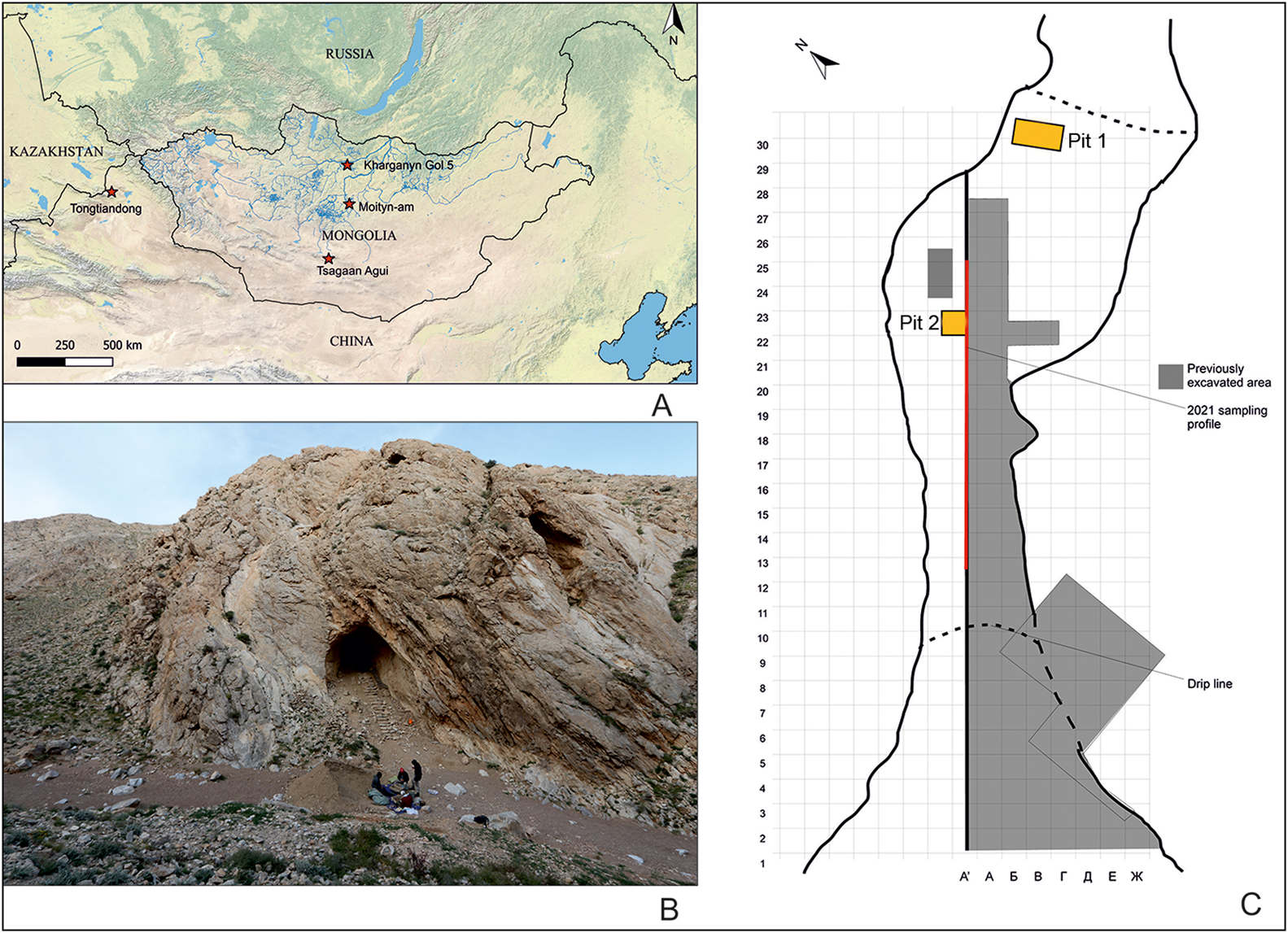
Tsagaan Agui Cave, located in the Gobi Altai Mountains of Bayankhongor Province in southern Mongolia (44°42´53.3″ N, 101°10´13.4″ E; Figure 1), was first investigated in 1987–1989 and subsequently excavated from 1995–2000 (Derevianko et al. Reference Derevianko2000а). Its Main Chamber includes 14 archaeological layers divisible into at least five discrete units: Late Upper Palaeolithic (Layer 2), Initial Upper Palaeolithic (Layer 3), Late Mousterian Middle Palaeolithic (Layers 4–5), Mousterian Middle Palaeolithic (Layers 6–11), and an industry in Layers 12 and 13 described as Acheulean-like (Derevianko et al. Reference Derevianko2000b). Nonetheless, the chronology of the cave's stratigraphy prior to c. 45 000 cal BP, its faunal composition, and the patterns of climatic changes, remained unclear. Middle and Upper Palaeolithic human migrations and dispersals throughout Central Asia are usually associated with mid-altitudes and relatively temperate steppe and forest-steppe environments (Izuho et al. Reference Izuho2019; Khatsenovich et al. Reference Khatsenovich2019; Kolobova et al. Reference Kolobova2020). For unknown reasons, however, Tsagaan Agui, situated in the extreme Gobi Desert environment, was occupied during the Middle Palaeolithic. Chert occurs as nodules in the thick limestone bedrock surrounding the cave, but its poor quality makes knapping difficult and yields rather unsophisticated end products (Derevianko et al. Reference Derevianko, Brantingham, Kuhn and Kerry2004). Excavations were resumed at Tsagaan Agui in 2021 to address these and other problems.
Map of sites mentioned in the text (A); overall (B) and plan (C) views of Tsagaan Agui Cave (A & B by D. Marchenko, C by A. Khatsenovich).
2021 field investigations
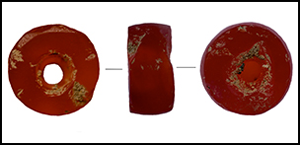
Two test pits were excavated in 2021. Pit 1 was located at the innermost extension of the Main Chamber and Pit 2 was located immediately adjacent to a sondage excavated in 2000. A sequence of three layers, differing from the rest of the cave profile, was uncovered in Pit 1. Two are of Holocene age, the products of erosional processes and the deposition of speleothems during wet periods, some of which have been modified and redeposited by human activity, including trampling by Buddhist pilgrims and tourists. The third comprises light, silty loam lying in contact with limestone bedrock and is probably Pleistocene but contains mixed archaeological materials. Here, as in Layer 1 in Pit 2, Bronze Age and medieval (c. 3300 BC–AD 1500) cultural material was recovered, including paste and carnelian beads, fragments of birch bark inscribed in Old Mongolian, a bronze spoon, and wood fragments (Figure 2). Pleistocene lithic artefacts and faunal remains were also recovered from Pit 1.
Finds from Pit 1: top) inscribed birch-bark fragments (side A: a01 (tr.) “evils,”, a02 (tr.) “put out by himself”; side B: b01 (tr.) “political gathering with legal rights to make decisions”); bottom) paste and carnelian beads (translations from Old Mongolian by Zh. Gerelbadrakh; figure by Ya. Tserendagva).

A 1m2 excavation pit (Pit 2) was dug in the northern part of the Main Chamber. The stratigraphic sequence of the cave, as identified in the 2000 sondage, includes 14 layers, 13 of which yielded archaeological material. Pit 2 was situated 0.5m from the 2000 sondage and was excavated down to Layer 6 (Figure 3). The main stratigraphic units are broadly comparable to those of the 2000 sondage. Layer 1 includes three Holocene horizons. Layer 2.1 is interpreted as reflecting a dry period during the Last Glacial Maximum (LGM) or pre-LGM, based upon evidence generated by previous excavations and then-experimental electron spin resonance (ESR) dates of 23 000±2000 BP and 25 000±2000 BP (Derevianko et al. Reference Derevianko, Brantingham, Kuhn and Kerry2004), respectively. This layer contains a flake industry with occasional blades and bladelets produced mostly on non-local raw materials (Figure 4: 1–2). Here, we found a modified rod-like fragment of serpentinite flaked from both ends (Figure 4: 4). The nearest known serpentinite outcrops occur some 40km to the south of the cave. The Layer 2.2 assemblage contains end-scrapers and a truncated-faceted piece (Figure 4: 3).
Stratigraphic profile of Pit 2 (figure by Ya. Tserendagva).

Lithic artefacts from Pit 2: 1) bidirectional blade, Layer 2.1; 2) asymmetric stemmed point, Layer 2.1; 3) truncated-faceted piece, Layer 2.2; 4) modified fragment of serpentinite, Layer 2.1; 5) truncated-faceted piece, Layer 3; 6) déjeté flake, Layer 3; 7) core, Layer 3; 8) denticulated-notched tool (perforator), Layer 4; 9) blade, Layer 4; 10) core management element, Layer 5 (figure by Ya. Tserendagva).

Layer 3 yielded a laminar industry and evidence of Levallois point production that was interpreted as Initial Upper Palaeolithic (Brantingham et al. Reference Brantingham, Krivoshapkin, Li and Tserendagva2001). In 2021, we recovered additional truncated-faceted pieces and unretouched déjeté flakes from this layer (Figure 4: 5–6). A small number of blades also occurred here, but no evidence of standardised Initial Upper Palaeolithic subprismatic, bidirectional, large blade production. This cannot be explained solely by poor quality local raw material, as Levallois points made on imported, high-quality stone were also found. The industry is based on flakes produced by orthogonal and flat, unidirectional knapping. We hypothesise that this assemblage is transitional from the Middle to Upper Palaeolithic and resembles the Terminal Middle Palaeolithic complex from Tongtiandong Cave in Xinjiang, dated to 42 000–44 000 BP (Yu et al. Reference Yu2018), the Terminal Middle Palaeolithic and Initial Upper Palaeolithic complexes of Kharganyn Gol 5, dated to 50 000–38 000 BP, and industries from Layers 4–6 at Moiltyn-am in northern and central Mongolia, respectively (Khatsenovich et al. Reference Khatsenovich2019). These industries include both bidirectional blades and Levallois points and flakes. At Tsagaan Agui, laminar production was accomplished by the Levallois convergent method for points before it became an independent technology. The tool kit indicates probable connections with western Central Asia and China. Specifically, truncated-faceted pieces—a chronologically transitional tool type found in three layers at Tsagaan Agui—are characteristic of the Middle and Upper Palaeolithic of Uzbekistan, Lebanon, and the Zagros and Caucasus regions (Krivoshapkin & Shalagina Reference Krivoshapkin and Shalagina2013).
Terminal Middle Palaeolithic Layer 4 also contained bidirectional blades and a denticulated-notched tool (Figure 4: 8–9). Middle Palaeolithic Layers 5 and 6 are represented by core-management elements (Figure 4: 10).
A small bone industry was identified in Layers 2.1–4, including several bone flakes (Figure 5). Two such flakes from Layer 3 exhibit secondary treatment; one is a perforator, while another has two drilled holes (Figure 5: 2–3). It is currently unknown whether this latter artefact was an item of personal ornamentation or a utilitarian object.
Bone industry from Pit 2021/2 (figure by Ya. Tserendagva).

Stratified traces of human and animal behaviour
We recorded stratigraphic disturbances in the lower part of Layer 2.1 and in Layer 2.2, consisting of darker sediments containing small, fragmented bones. Palaeontological and spatial analyses of screened sediments, including 62 cave hyaena (Crocuta spelaea) coprolites and 89 digestion-eroded bones, along with traces of denning behaviour, indicate episodic hyaena occupation of the cave (Figure 6).
Hyaena den in profile and combustion feature in Pit 2 (figure by D. Marchenko and A. Khatsenovich).

Layer 3 ranges from 10–30mm thick and can be traced across the longitudinal profile of the entire cave as a thin, charcoal-containing, clayey loam layer. Its thickness reaches 0.15m in Pit 2021/2. The top of this layer is a combustion feature yielding animal bones and lithics (Figure 4: 7). Radiocarbon dates generated on charcoal from this layer during the 1990s cluster around 33 000 BP (Derevianko et al. Reference Derevianko2000b). Charcoal fragments from the combustion feature excavated in 2021 all exceed several centimetres in maximum dimension. We conclude that the burnt wood consisted of rather large pieces, as opposed to the ashy remains of wildfires conveyed into the cave by various natural means (Figure 6).
Faunal remains
Mammalian fossils from Tsagaan Agui Cave reflect the rich faunal community of the Gobi Altai region in the Pleistocene and Early Holocene. Species from strata dated to MIS 3 (c. 60–27 kya), including cave hyaena, wild ass (Equus hemionus), camel (Camelus knoblochi), Mongolian gazelle or dzeren (Procapra guttorosa), argali (Ovis ammon) and Tibetan antelope or chiru (Pantholops hodgsonii), are typical members of the Central Asian faunal complex. Gregarious ungulates live in large groups requiring abundant grasslands, and the large body-mass of C. knoblochi presumes the availability of even richer food resources than the modern wild camel (Camelus ferus) requires. Based on this faunal community, we conclude that a dry steppe environment prevailed in the vicinity of the cave throughout much of the Pleistocene. The faunal complex remained unchanged in the Early Holocene, except for the extinction of C. spelaea and C. knoblochi.
Conclusions
Renewed excavations at Tsagaan Agui Cave have yielded evidence of the production of non-utilitarian objects, a bone industry, and human-animal interactions, such as cut-marks and hyaena gnawing on the same bones. Human occupation of this elevated locale (approximately 2000m asl) with only relatively poor lithic raw material available locally was challenging, but palaeoenvironmental conditions appear to have been milder than at present. Tsagaan Agui is the earliest known stratified Middle Palaeolithic site in Mongolia and greater arid eastern Asia. As such, the materials excavated comprise an essential element in decoding the human presence in the region during the Late Pleistocene.
Acknowledgements
We thank the Government of Mongolia and the administrations of Bayankhongor Province and Bayanlig County for their invaluable assistance in authorising and facilitating our work. Fieldwork was undertaken under Mongolian Government Permit 1-14.
Funding statement
Faunal and artefact analyses were supported by the Russian Science Foundation, Project 19-78-10112. Holocene material was studied within the framework of the Russian Foundation for Basic Research, Project 19-59-44010. Field investigations were undertaken with support from the Leakey Foundation and the Je Tsongkhapa Endowment for Central and Inner Asian Archaeology.



