





Practitioner Points
-
• Decentralization’s double-edged sword:
Web3 technologies, while promising distributed power, may unintentionally concentrate influence among a technically proficient and financially privileged elite. Practitioners should critically assess whether decentralization structures genuinely democratize access or merely shift power to new gatekeepers.
-
• Embracing hybrid policy models:
For Web3 to serve diverse communities, a balanced approach is needed—integrating decentralized governance with ethical, inclusive frameworks. Hybrid models combining local and global dynamics can help ensure that decentralized systems foster digital justice and equitable access.
-
• Evaluating inclusivity in network models:
Different Web3 paradigms (Network States, Network Sovereignties, Algorithmic Nations) offer varied levels of inclusivity. Practitioners should evaluate which model best aligns with organizational goals, considering trade-offs in accessibility, community cohesion, and potential for elite dominance.
Policy Significance Statement
While Web3 technologies promise to decentralize power, this article critically examines whether they genuinely democratize governance or instead concentrate influence among a new elite with technical expertise and digital access. Policymakers must assess how Web3 governance structures distribute power, considering both their potential for inclusion and the risks of exclusion. The article, after briefly presenting several cases from the Global North and Global South, engages with three post-Westphalian paradigms—Network States, Network Sovereignties, and Algorithmic Nations—while acknowledging the broader landscape of Web3 governance, including hybrid and federated models. Each paradigm presents distinct inclusivity challenges. Network States, driven by market-based governance, often exclude those lacking technical literacy or financial resources. Network Sovereignties emphasize collective management but still require digital proficiency, which may create unintended barriers. Algorithmic Nations, while promoting community-led governance, face risks of technological gatekeeping, limiting broader participation. Adopting hybrid policy frameworks can help address these challenges, ensuring decentralized governance promotes broader access, equity, and digital justice across diverse communities.
1. Introduction
The Westphalian system, established in the seventeenth century to define state sovereignty, has been the foundation of the modern international order (Agnew, Reference Agnew2005). However, the rise of decentralized Web3 technologies is fundamentally transforming global governance, challenging the traditional Westphalian model of nation–state sovereignty that has dominated since 1648 (Hui, Reference Hui2024; Hope and Ludlow, Reference Hope and Ludlow2025). As globalization and digital technologies blur the fixed boundaries of territorial authority, Web3 policy trends propose a radical reimagining of governance (Golumbia, Reference Golumbia2024). Driven by blockchain and decentralized systems, these trends advocate for individual sovereignty and oppose centralized state structures and data monopolies (Davidson and Rees-Mogg, Reference Davidson and Rees-Mogg1999; Nanni et al., Reference Nanni, Bizzaro and Napolitano2024). Rather than reinforcing conventional governance, Web3 technologies enable the emergence of new decentralized, transnational entities that empower communities to assert their own technopolitical sovereignty (Calzada, Reference Calzada2025a, Reference Calzada2025e).
Building on these technopolitical changes, it is essential to theorize how power circulates within decentralized systems that claim to challenge the Westphalian order. Polycentric governance theory (Ostrom, Reference Ostrom2010) provides a useful perspective, highlighting the existence of multiple overlapping centers of authority, which aligns with the dispersed nature of Web3 governance. However, decentralization does not equate to a lack of power asymmetries (Mathew, Reference Mathew2016). Drawing from Bourdieu’s concepts of symbolic capital and field theory (Bourdieu, Reference Bourdieu1984), we can see how early adopters and technical elites accumulate prestige and control in Web3 ecosystems, influencing norms and decision-making structures. Similarly, Castells’ network society thesis (Castells, Reference Castells1996) reveals how networked power configurations—both horizontal and hierarchical—emerge within digital infrastructures. These frameworks help clarify the paradox where decentralized technologies, while aiming to democratize governance, often reproduce or even exacerbate existing inequalities through elite capture, opaque technical architectures, and unequal access to digital capabilities.
Broadly speaking, these shifts echo the growing discourse around digital sovereignty, global challenges, and dynamic threats, as this journal’s Area 6 details, where policy actors reconsider the balance of power between states, corporations, and individuals in the digital realm (Hui, Reference Hui2024; Pohle and Santaniello, Reference Pohle and Santaniello2024). The governance and power structures emerging from Web3 are not only disruptive but also diverse in their implementation and societal, economic, and cultural implications, raising questions about their inclusivity and accessibility (Gray et al., Reference Gray, Hutchinson, Stilinovic and Tjahja2024). For instance, the rise of Decentralized Autonomous Organizations (DAOs) has created new governance models; yet many remain controlled by early adopters or large token holders, concentrating decision-making power rather than fully democratizing it (DuPont, Reference DuPont2023). Similarly, cryptocurrency-based financial inclusion initiatives, such as Bitcoin adoption in El Salvador, illustrate both the opportunities and risks of Web3 technologies—while aiming to provide financial services to the unbanked, these initiatives often favor those with digital literacy and access to stable Internet connections (Calzada and Eizaguirre, Reference Calzada and Eizaguirre2025).
As such, a deeper exploration of how Web3 technologies might affect social structures, economic inequalities, or cultural practices is necessary, though it goes beyond the focus of this article. Furthermore, global implications and regional differences in Web3 adoption would provide valuable context for further conceptual and empirical action research (Reason and Bradbury, Reference Reason and Bradbury2013). For example, while Estonia’s e-Residency and HanHemen e-diaspora programs, facilitated respectively by the Estonian and Basque governments, showcase the potential for digital governance beyond physical borders, the former program predominantly attracts entrepreneurs and investors rather than marginalized communities, and the latter program attempts to connect e-diaspora citizens (Calzada, Reference Calzada2023a, Reference Calzada2023b; Masso et al., Reference Masso, Kasapoglu, Calzada and Tammpuu2025). Similarly, in contrast to crypto-driven Network States (Srinivasan, Reference Srinivasan2022), federated networks like Mastodon and the Fediverse offer decentralized social media alternatives that emphasize community moderation over algorithmic control, presenting an alternative model of digital governance, though the penetration of such alternatives has encountered usability and scalability issues (Calzada, Reference Calzada2025c, Reference Calzada2025d).
The article is structured as follows: After this introduction, the next section scopes the article through action research methodology, defining it and focusing on Web3 cases, including eight from the Global North (Table 1), six from the Global South (Table 2), and the three main post-Westphalian global paradigms presented and compared. Next, the article establishes the research question. This is followed by a discussion of the current state of policy analysis for the three post-Westphalian Web3 paradigms, based on fieldwork action research conducted since August 2022. Table 3 is included to address the research question. The article concludes by comparing the three Web3 paradigms in relation to the research question and offering pathways for further global policy debates and implications regarding the role of Web3 technologies in reshaping governance and sovereignty, noting the nuances in the distribution and decentralization of technopolitical power. The article includes stakeholder-specific recommendations, a procedural roadmap, and a concise policy toolkit.
Summary of Web3 cases in the Global North

Summary of Web3 cases in the Global South
Responding the research question

2. Scoping through action research methodology
Action research is a participatory and critically reflective methodology aimed at generating actionable knowledge through iterative cycles of inquiry, observation, and intervention (Reason and Bradbury, Reference Reason and Bradbury2013). Particularly suited to rapidly evolving sociotechnical environments, it supports the coproduction of knowledge between researchers and stakeholders while maintaining a commitment to reflexivity and transformative social change. In this article, action research provides both a guiding framework and a methodological orientation for examining how decentralized Web3 technologies are reconfiguring global governance arrangements in practice and in imagination.
Analytically, the action research approach is combined with a theoretically integrated lens drawing on Ostrom’s theory of polycentric governance (Ostrom, Reference Ostrom2010), Bourdieu’s concepts of symbolic and technical capital (Bourdieu, Reference Bourdieu1984), and Castells’ analysis of networked power (Castells, Reference Castells1996). Together, these perspectives allow the article to examine not only where governance authority is formally distributed in Web3 systems, but also how power asymmetries emerge through infrastructural control, expertise, legitimacy, and participation rules—thereby foregrounding dynamics of elite capture within ostensibly decentralized arrangements.
Empirically, the article proceeds in three interrelated steps. First, it analyses prominent Global North–anchored cases—such as Ethereum, MakerDAO, and Polkadot—which illustrate (Table 1) how polycentric governance structures often coexist with concentrated control among developers, core contributors, and large token holders. These cases reveal how technical and symbolic capital accumulate within networked fields, shaping decision making despite formal decentralization.
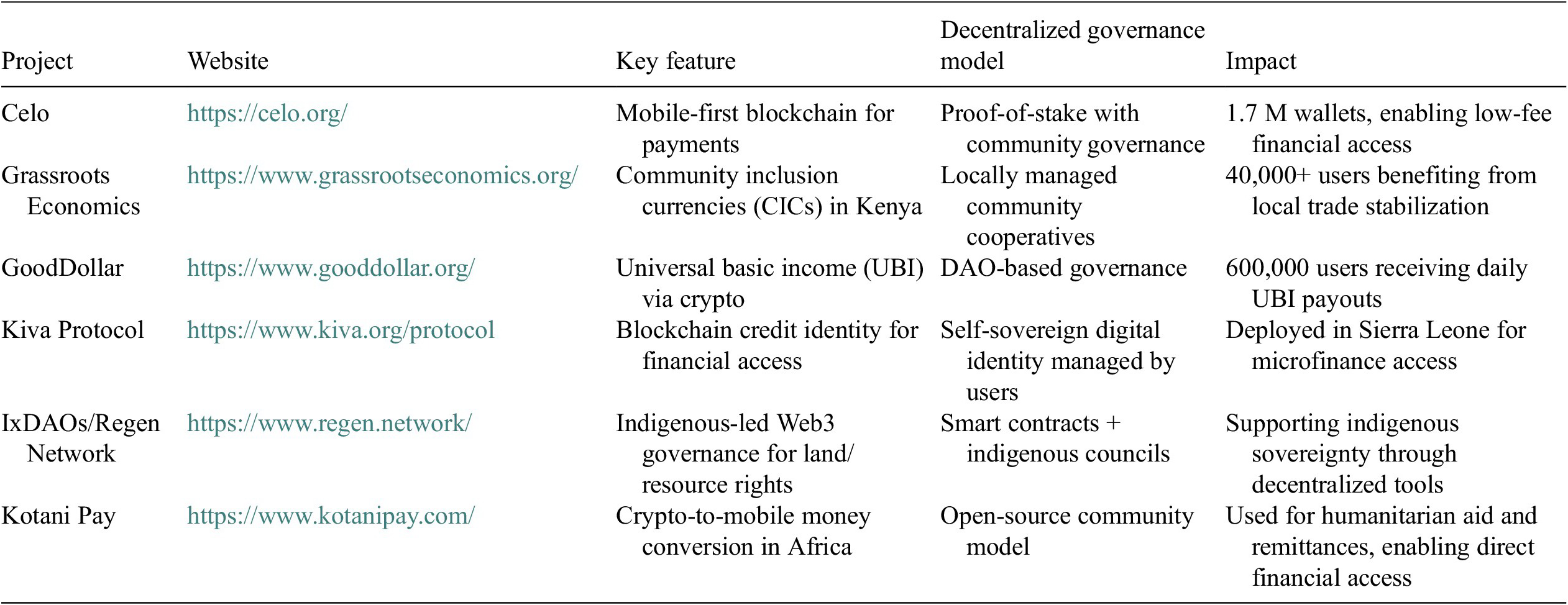
Second, the article introduces a set of smaller scale, experimental initiatives rooted in the Global South (Table 2), including Celo, Grassroots Economics, GoodDollar, Kiva Protocol, IxDAOs, and Kotani Pay. These cases offer counterpoints by exploring financial inclusion, community-led governance, and alternative infrastructural models. However, data limitations and institutional access constraints prevent full analytical parity with the Global North cases (Calzada and Eizaguirre, Reference Calzada and Eizaguirre2025; Calzada, Reference Calzada2025c), a limitation that is explicitly acknowledged.
Third—and most centrally—the article interrogates the governance imaginaries and normative logics underpinning three post-Westphalian paradigms of digital sovereignty: Network States, Network Sovereignties, and Algorithmic Nations. This step constitutes the primary theoretical contribution of the article, examining decentralization not only as a set of implemented governance mechanisms, but also as a sociopolitical project shaped by competing ideologies, infrastructures, and epistemic communities. Across these paradigms, the integrated Ostrom–Bourdieu–Castells framework is used to compare how decentralization redistributes authority, reconfigures legitimacy, and potentially reproduces elite power within networked governance systems.
The methodological framework follows a purposive case selection strategy grounded in four interrelated criteria: (i) relevance to emerging governance paradigms; (ii) geographic and socioeconomic diversity across Global North and Global South contexts; (iii) degree of decentralization and experimentation in governance design; and (iv) availability and quality of participatory, institutional, and governance-related data. These criteria were shaped by practical constraints, including data accessibility, language barriers, institutional proximity, and the temporal framing of the Web3 ecosystem (2022–2025). To address resulting asymmetries, the article distinguishes analytically between Global North (Table 1) and Global South (Table 2) cases.
The scope of the study is necessarily limited. Rather than providing exhaustive case analysis, the article focuses on three paradigms that are most extensively discussed within contemporary debates on global digital governance (Calzada, Reference Calzada2025b): Network States (Srinivasan, Reference Srinivasan2022), Network Sovereignties (De Filippi et al., Reference De Filippi, Reijers and Mannan2024), and Algorithmic Nations (Calzada, Reference Calzada2018). This comparative structure enables theoretical depth while recognizing the broader heterogeneity of the Web3 governance landscape.
Finally, the author’s positionality is explicitly acknowledged. Based in the Global North and embedded within Euro-American academic networks, the researcher’s access to data, analytical framing, and institutional vantage point inevitably shape the production of knowledge, particularly when engaging with initiatives emerging from the Global South. Rather than resolving these asymmetries, the reflexive approach adopted here seeks to surface them as methodological limitations and as prompts for more plural, inclusive, and collaborative governance research.
2.1. Scoping the Global North
This article, therefore, acknowledges the need to expand the scope to include other relevant paradigms, such as hybrid on-chain/off-chain governance systems, which attempt to balance transparency with institutional flexibility, as seen in projects like Optimism’s Retroactive Public Goods Funding. Actionable research, as this article attempts to formulate an action research framework through three paradigms, could be enhanced through typologies of power, including distributed and decentralized power axes.
While theoretical debates around Web3 governance continue to evolve, empirical insights are necessary to assess the extent to which decentralization is genuinely being achieved. Various case studies reveal how governance structures, token distribution, and user participation shape Web3 projects, often contradicting decentralization claims (Calzada, Reference Calzada2025c, Reference Calzada2025d).
One illustrative case is Ethereum’s governance model, where despite the presence of a decentralized ecosystem, decision making is often concentrated among core developers, validators, and large token holders. This pattern is evident in the Ethereum Improvement Proposal (EIP) process, where governance is driven by technically proficient actors, reinforcing a meritocratic but centralized dynamic. Similarly, in DAOs, governance participation is often limited to a small group of active contributors. For example, in the MakerDAO community, less than 10% of token holders engage in major governance decisions, revealing a gap between the ideals of decentralization and actual participation rates (Nabben and De Filippi, Reference Nabben and De Filippi2024).
A critical aspect of decentralization is token distribution, which heavily influences governance power. Studies on major DeFi (Decentralized Finance) projects such as Uniswap and Aave indicate that a small percentage of wallets hold the majority of governance tokens, leading to de facto oligarchic control rather than democratic decision making. A Uniswap governance report found that just five wallets controlled over 50% of voting power, undermining the principle of broad-based governance (Calzada, Reference Calzada, Certomá, Martelozzo and Iapaolo2024a).
Metrics on user participation in governance decisions further illustrate decentralization gaps. Analysis of Polkadot’s on-chain governance system shows that participation rates rarely exceed 2% of token holders, meaning decisions are disproportionately influenced by a minority of engaged stakeholders (Gray et al., Reference Gray, Hutchinson, Stilinovic and Tjahja2024). Additionally, federated networks like Mastodon and decentralized networks like BlueSky, while promoting a decentralized approach to social networking, struggle with governance fragmentation, scalability, and user retention, illustrating practical challenges in sustaining participatory governance models.
These empirical insights reinforce the necessity of assessing decentralization not just as a conceptual ideal but as a measurable reality. While Web3 technologies present promising models for governance innovation, current implementations reveal significant barriers to inclusive participation. Future research should expand on these empirical studies, systematically evaluating governance models across decentralized ecosystems to identify actionable policy recommendations for equitable Web3 governance.
Further empirical research also highlights regional disparities in Web3 governance.Estonia’s e-Residency program has attracted over 100,000 digital residents; yet a majority are entrepreneurs from Western economies, particularly from the United Kingdom, rather than disenfranchised or stateless individuals, challenging claims of digital sovereignty as a tool for inclusion (Pohle and Santaniello, Reference Pohle and Santaniello2024; Masso et al., Reference Masso, Kasapoglu, Calzada and Tammpuu2025).
2.2. Scoping the Global South
In Table 2, the article presents smaller Web3 projects by counterarguing successful examples of decentralized governance, particularly around financial inclusion in underserved communities including (i) Celo (mobile-first blockchain financial inclusion), (ii) Grassroots Economics (community inclusion currencies in Kenya), (iii) GoodDollar (Universal Basic Income via Web3), (iv) Kiva Protocol (Decentralized Credit History for Financial Access), (v) IxDAOs (Indigenous-Led Decentralized Organizations), and (vi) Kotani Pay (Bridging Crypto with Local Payment Systems in Africa). The article shows these case studies as potential further research highlighting ownership concentration, presenting metrics on user participation in governance decisions across platforms as potential routes for action research on empirical case studies (Calzada, Reference Calzada2025c).
2.3. The scope of the article: Examine three post-Westphalian global paradigms
Hence, within its specific scope—and regardless of the empirical asymmetries outlined in the previous sections on Global North and Global South cases, or the acknowledged constraints related to data access, regional imbalance, and institutional embeddedness—this article primarily seeks to engage with and critically interrogate three emergent paradigms of post-Westphalian global governance shaped by decentralized Web3 policy trends: (i) Network States (Srinivasan, Reference Srinivasan2022), (ii) Network Sovereignties (De Filippi et al., Reference De Filippi, Reijers and Mannan2024), and (iii) Algorithmic Nations (Calzada, Reference Calzada2018). These paradigms serve as conceptual anchors for exploring how digital technologies and blockchain infrastructures are not only reshaping governance practices but also reimagining the very idea of sovereignty, territoriality, and citizenship beyond the Westphalian order established in 1648. As detailed in ongoing research at the European University Institute’s Global Governance Programme—including the mapping of libertarian-decentralized Web3 experiments as nonterritorial political formations—these paradigms reflect broader shifts toward nonstate, nonterritorial modes of governance that challenge classical notions of jurisdiction and institutional authority (https://globalgovernanceprogramme.eui.eu/project/new-network-sovereignties-the-rise-of-non-territorial-states/libertarian-decentralised-web3-map-in-search-of-a-post-westphalian-territory/). By critically comparing these three paradigms, the article aims to contribute to an emerging scholarly and policy debate on the risks, potentials, and contradictions embedded in Web3-driven transformations of sovereignty. In doing so, it advances a conceptual analysis that transcends specific case disparities and provides a framework for future empirical and normative inquiry into digital governance.
While these paradigms propose alternatives to centralized governance, they also reveal the illusion of decentralization, where the promise of distributing power may instead elevate a new, libertarian, tech-savvy elite (Rauchfleisch and Jungherr, Reference Rauchfleisch and Jungherr2024; Schroeder, Reference Schroeder2024). By critically analyzing these trends, this article seeks to contribute to the debate on the evolving notions of sovereignty, governance, and citizenship in the digital age, emphasizing the need for inclusive and equitable policy frameworks in the Web3 era (Spelliscy et al., Reference Spelliscy, Hubbard, Schneider and Vance-Law2023). While decentralized technologies like blockchain and DAOs are heralded as the harbingers of digital democratization, there is a paradoxical risk that they may reinforce existing power structures or create new forms of centralization (Calzada, Reference Calzada2024b). The governance models of many decentralized systems often concentrate power among a small group of technically proficient actors, undermining the democratic ideals they purport to uphold (Mathew, Reference Mathew2016). Despite the promise of distributed, participatory governance, blockchain-based systems and DAOs frequently require technical expertise that is not widely accessible, thus creating new gatekeepers in the form of developers, validators, and major token holders (Nabben and De Filippi, Reference Nabben and De Filippi2024).
This tension is evident in the way blockchain and Web3 governance structures operate. Nabben (Reference Nabben2023) describes Web3 as “self-infrastructuring,” where communities design and govern their own digital infrastructure. However, the capacity to engage in this governance is often limited to those with specialized knowledge or the resources to acquire tokens, making the promise of inclusivity tenuous. Singh et al. (Reference Singh, Lu, Gupta, Chopra, Blanc, Klinghoffer, Tiwary and Raskar2024) further explore this in the context of Artificial Intelligence (AI) and decentralized systems (Cugurullo and Xu, Reference Cugurullo and Xu2024; Tucker, Reference Tucker2024; Visvizi et al., Reference Visvizi, Kozlowski, Calzada and Troisi2025), where decentralization often results in concentrating decision making among those with technical expertise. Similarly, Allen et al. (Reference Allen, Frankel, Lim, Siddarth, Simons and Weyl2023) examine the ethics of decentralized social technologies and argue that without careful design and accountability protocols (Alston and Cossar, Reference Alston and Cossar2024), these systems risk replicating the very hierarchies they seek to dismantle.
The potential for DAOs and blockchain governance systems to entrench power imbalances is further supported by ethnographic studies, such as Merk’s (Reference Merk2024) examination of trust-building in “trustless” spaces (De Filippi et al., Reference De Filippi, Mannan and Reijers2020). While DAOs claim to create trustless environments where transparency and rules are encoded into smart contracts, in practice, trust is often concentrated among the system’s developers and early adopters. This mirrors concerns about algorithmic governance raised by Ohlhaver et al. (Reference Ohlhaver, Weyl and Buterin2022), who note that decentralized societies may not inherently prevent power consolidation unless explicit mechanisms are designed to ensure equitable participation and accountability. Abdi (Reference Abdi2023) also highlights the territorialization of virtual communities, noting that Web3 governance often mirrors existing geopolitical structures, where digital capital and technical know-how define influence and access to decision-making processes (G’sell, Reference G’sell2024). This raises concerns about the role of digital elites in shaping the future of decentralized governance, particularly as these systems are presented as alternatives to traditional state-based power structures.
The research question driving this article—whether Web3 is distributing power or merely creating a new, tech-savvy elite—thus becomes increasingly pertinent (Galloway and Thacker, Reference Galloway and Thacker2007). While decentralized systems are designed to oppose centralization, the concentration of power among those with the necessary technical knowledge or financial resources undermines their democratizing potential (Bodó et al., Reference Bodó, Brekke and Hoepman2021). Mathew (Reference Mathew2016) argues that the myth of the decentralized internet fails to address the underlying social and economic inequalities that pervade these technologies, further complicating the narrative of decentralization as a force for empowerment even around AI (Horvitz and Mitchell, Reference Horvitz, Mitchell, Jamieson, Mazza and Kearney2024; Verhulst, Reference Verhulst2024).
As decentralized Web3 policy trends continue to evolve alongside the post-Westphalian shift, traditional notions of sovereignty and citizenship rooted in physical territories are being fundamentally reimagined (Calzada, Reference Calzada2025a). Decentralized systems, such as blockchain-driven platforms and DAOs, are seen as facilitating fluid, borderless forms of identity and community, particularly for digital nomads and e-diaspora networks (D’Andrea, Reference D’Andrea2006). These platforms enable individuals to maintain their cultural and social ties across borders while participating in global economic activities, effectively bypassing the constraints of nation–state sovereignty through peer-to-peer (P2P) interactions that emphasize data privacy (Calzada, Reference Calzada2023a, Reference Calzada2023b). In theory, e-diaspora platforms offer a compelling model for building digital nations without the need for physical borders or the formal recognition of statehood (Senor and Singer, Reference Senor and Singer2011).
However, this vision of decentralization is fraught with contradictions. While proponents like Balaji Srinivasan advocate for the creation of Network States—new political entities built on decentralized technology—the reality often masks deeper ideological agendas. Critics argue that Srinivasan’s vision is not about democratizing power but rather creating states accessible only to those with the economic means to participate, which risks reinforcing global inequalities (Srinivasan, Reference Srinivasan2022). Such a paradigm of governance aligns with libertarian ideals that prioritize individual sovereignty and market-driven governance, but overlooks the complexities of social, cultural, and territorial identities that have historically defined nationhood (Kukutai and Cormack, Reference Kukutai, Cormack, Walter, Kukutai, Carroll and Rodriguez-Lonebear2020; Walter et al., Reference Walter, Lovett, Maher, Williamson, Prehn, Bodkin-Andrews and Lee2021a; Golumbia, Reference Golumbia2024).
Although Network States and similar structures claim to bypass traditional nation–state models, they risk creating exclusive digital enclaves rather than fostering inclusive communities. The assumption that digital networks alone can constitute viable sovereign entities neglects the importance of shared cultural values and community-driven governance, which are essential for meaningful political participation and social cohesion (Calzada, Reference Calzada2018).
Network sovereignties, which take a more culturally rooted approach to decentralization, attempt to address this by integrating the technopolitical dimension into governance without fully detaching from the territorial or community-based aspects of sovereignty (De Filippi et al., Reference De Filippi, Reijers and Mannan2024). These models acknowledge that decentralization cannot be an abstract exercise removed from the lived experiences and histories of communities. However, even these approaches must grapple with the risk that decentralized technologies, by emphasizing individual sovereignty, may unintentionally consolidate power among technical elites, further distancing governance from the wider populace.
The illusion of decentralization is further compounded by the fact that these technologies—while promising autonomy and the dismantling of centralized state structures—often replicate the same power dynamics they claim to oppose (Data and Society, 2023). As Cooper (Reference Cooper2024) notes in his white paper “Decentralized Possibilities for Locally-Led Development,” the governance models of many blockchain systems and DAOs concentrate decision-making authority among a small group of technically proficient actors. This creates a paradox: while Web3 technologies claim to decentralize governance, they frequently consolidate power in the hands of those who have the technical expertise or capital to influence decision-making processes (Nabben and De Filippi, Reference Nabben and De Filippi2024).
The result is a tension between the utopian ideals of digital democratization and the practical realities of economic elitism and technocratic control (Golumbia, Reference Golumbia2024). As Allen et al. (Reference Allen, Frankel, Lim, Siddarth, Simons and Weyl2023) argue, decentralized social technologies often fail to deliver on their promises of inclusivity and equity, instead creating new forms of gatekeeping. Moreover, the reliance on P2P networks and token-based governance systems risks reinforcing inequalities, as those with greater access to resources or technological know-how dominate decision-making processes (Mathew, Reference Mathew2016). This exacerbates the divide between the empowered few and the marginalized many, contradicting the core principles of decentralization. Mathew argues that the notion of a fully decentralized internet is more of an ideological construct than a reality. Drawing on historical and technical analysis of internet infrastructure, specifically focusing on the Border Gateway Protocol (BGP), Mathew demonstrates that the Internet has always operated through a distributed system with centers of control rather than being truly decentralized. This perspective directly parallels the current discourse around Web3 technologies, which similarly claim to decentralize power but often result in new forms of concentration of authority.
In the context of this article, Mathew’s analysis supports the critical examination of the illusion of decentralization in Web3. Just as Mathew argues that the early Internet never achieved full decentralization, this article explores how decentralized Web3 systems, despite their promise of empowering individuals, risk replicating existing power structures or creating new elites who control these systems through technical expertise and resources. This reinforces the central argument of this article: while decentralized technologies promise to distribute power, in practice, they may perpetuate or even exacerbate existing inequalities, much like the internet’s governance mechanisms have evolved into distributed but still controlled systems.
This article, therefore, seeks to address the research question: Are we truly decentralizing power, or are we merely shifting it into the hands of a new elite under the guise of technological innovation? In doing so, it presents a comparative analysis of three key paradigms that reflect different paradigms to decentralization (Calzada, Reference Calzada2024c): (i) Network States, (ii) Network Sovereignties, and (iii) Algorithmic Nations. Each paradigm represents a distinct interpretation of how decentralization can redefine sovereignty in the digital age. Network States, with their crypto-libertarian ethos, create new political entities grounded in market-driven governance. In contrast, Network Sovereignties take a more cooperative approach, aiming to integrate cultural values and community-based governance into the digital sphere. Algorithmic Nations, meanwhile, propose a hybrid model that combines algorithmic governance with decentralized technologies to empower communities, such as indigenous groups, stateless groups, and nations and e-diasporas (Calzada, Reference Calzada2018).
Together, these paradigms reveal how decentralized technologies are not only redefining sovereignty, but also presenting new challenges and opportunities for inclusivity, equity, and global citizenship. By engaging with these emerging models, this article contributes to the broader debates surrounding the future of governance in an increasingly digital and interconnected world. The rise of Web3 technologies, while promising to decentralize power, must confront the realities of governance in order to avoid replicating the very inequalities they seek to overcome.
3. Research question: distributing power or creating a new tech-savvy elite?
The rise of decentralized Web3 technologies is often seen as a revolutionary step toward empowering individuals and communities by dismantling the centralized control traditionally held by governments and large corporations. Silicon valley’s (crypto-) libertarian ethos (Harris, Reference Harris2023; Cheney-Lippold, Reference Cheney-Lippold2024; Golumbia, Reference Golumbia2024), promoting individual sovereignty and minimal state interference, has significantly influenced the ideological foundation of these technologies (Barlow, Reference Barlow1996; Bratton, Reference Bratton2017; Bodó et al., Reference Bodó, Brekke and Hoepman2021; DuPont, Reference DuPont2023; Calzada, Reference Calzada, Certomá, Martelozzo and Iapaolo2024a). Embedded in this cyberlibertarian perspective is the belief that decentralization—via blockchain, cryptocurrencies, and DAOs—could disperse power from entrenched authorities and redistribute it across distributed networks (Verhulst, Reference Verhulst2024).
However, despite the utopian vision of democratizing governance, Web3 may be giving rise to a new form of concentrated power. John Perry Barlow’s A Declaration of the Independence of Cyberspace (Barlow, Reference Barlow1996) famously called for a digital frontier free from state control, emphasizing individual autonomy and self-regulation. While this vision has inspired many decentralization efforts in Web3, it overlooks the complexities of power distribution in practice (Bourdieu, Reference Bourdieu1984; Castells, Reference Castells1996; Ostrom, Reference Ostrom2010). Barlow’s ideals, though aligned with the promise of Web3, fail to account for the new gatekeepers—those with the technical know-how, resources, or early access to blockchain systems—who may wield disproportionate influence in this supposedly decentralized environment. This tension is central to the research question: Is Web3 genuinely redistributing power, or is it creating a new elite class defined by technical expertise?
A key element in this debate is the role of cryptography, framed by Timothy C. May in The Crypto Anarchist Manifesto (May, Reference May1992) as a tool for undermining state control and securing individual privacy. Cryptography enables transaction and interaction encryption, offering digital anonymity and protection from government surveillance. In theory, this technology should level the playing field, empowering users to engage freely in decentralized systems. However, as May’s vision has been realized through blockchain and Web3 technologies, cryptographic systems have often been controlled by a small group of actors who understand these systems and can exploit them for personal or economic gain. The promise of decentralization has, in many cases, been undermined by the concentration of influence among those with the technical capability to operate, develop, and maintain these systems.
Benjamin Bratton’s The Stack (Bratton, Reference Bratton2017) provides a critical framework for understanding the limitations of Web3’s decentralization efforts. Bratton conceptualizes modern society as a series of interconnected technological layers, where power and governance operate across multiple dimensions—from Earth and Cloud to Interface and User (Lehdonvirta, Reference Lehdonvirta2022). While decentralization theoretically disrupts hierarchical control, Bratton argues that new digital infrastructures, such as blockchain and DAOs, often reinforce centralized decision making within these layers, especially where technical expertise is concentrated. Thus, while Web3 claims to decentralize governance, the actual operation of these technologies may create new centers of control, typically governed by a technologically literate few. The recent Euro-Stack report by UCL also sheds light on this debate (Bria et al., Reference Bria, Timmers and Gernone2025).
The emerging governance structures within Web3, particularly DAOs, illustrate this paradox. Although DAOs claim to enable decentralized, community-driven governance, their effectiveness often depends on active participation from users with the technical skills to navigate complex systems. As Julia Black (Reference Black2002) notes, decentralized systems require reflexive regulation—governance models that can adapt to the complexities of modern digital societies. However, the technical barriers within blockchain-based systems often hinder broader participation, reinforcing the divide between the technically proficient and the majority of users. This disparity challenges the democratic ideals of Web3, as those with more access to technology and knowledge inevitably hold greater influence.
Pasquale and Cockfield’s (Reference Pasquale and Cockfield2018) concept of functional sovereignty further illuminates how decentralized technologies may inadvertently consolidate power. The authors suggest that power, once exclusive to nation-states, is increasingly exercised by digital platforms and other nonstate actors. In this context, Web3 may not represent genuine decentralization but rather a shift in who holds sovereignty. Blockchain developers, cryptocurrency investors, and platform architects may emerge as new sovereign entities, controlling critical infrastructures and decisions traditionally managed by governments. Rather than fostering inclusivity, these systems often concentrate power in the hands of those with the capital or technical capacity to shape decentralized networks.
Moreover, the economic structures underpinning Web3 technologies complicate the promise of decentralization. As Kevin Carson (Reference Carson2016) argues, decentralized economic systems driven by blockchain and cryptocurrencies often replicate the inequalities of traditional financial systems. Token-based governance models, for instance, frequently empower those who hold the most tokens, privileging wealth and capital over democratic participation. This creates a form of digital oligarchy, where the wealthy and technically proficient dominate decision-making processes, further exacerbating the divide between the empowered and the disenfranchised.
In conclusion, while the Web3 movement is driven by a compelling vision of decentralization and individual empowerment, it risks perpetuating new forms of elitism. The promise of redistributing power through decentralized technologies has, in practice, led to the concentration of influence among a small group of digital elites. This presents a critical challenge for the future of governance in an increasingly digital world: how can we ensure that decentralized systems fulfill their promise of inclusivity and equity, rather than replicating the very inequalities they seek to dismantle? Only by addressing these contradictions can Web3 truly offer a viable alternative to centralized power structures and contribute to a more equitable global governance framework.
4. Discussion: three post-Westphalian paradigms through fieldwork action research
This research, grounded in ongoing fieldwork action research since August 2022, from the Stanford DAO Workshops 2022 and 2023 (https://www.youtube.com/watch?v=mTT0tCix43E) held by the Decentralization Research Centre (DRC), provided critical insights into how Web3 technologies are reshaping traditional governance models. These findings inform the comparative analysis of Network States, Network Sovereignties, and Algorithmic Nations presented next. Guided by the following hypotheses, the study explores how the counter-reaction against data-opolies and the rejection of state structures, characterized by rent seeking and surveillance, might be fueling a global movement around Web3 decentralized technologies (Utrata, Reference Utrata2024).
In response to the enduring Westphalian mindset that continues to dominate debates around sovereignty (https://www.ehu.eus/en/web/gizarte-komunikazio-zientzien-fakultatea/-/subiranotasuna-k-aztergai-iv-kongresua), this article employs an action research methodology to explore the transformative potential of the P2P Web3 policy trends. Since August 2022, the author, as a Fulbright Scholar in California, has engaged in extensive fieldwork aimed at critically examining and participating in the development of decentralized technologies and their implications for global governance. The last iteration entitled 2025 Decentralized Tech Summit (https://thedrcenter.org/2025-decentralized-tech-summit/) took place in April 2025 in Washington DC by being held by the DRC and Liberty Project at the Georgetown University (https://www.projectliberty.io/news/how-can-data-cooperatives-help-build-a-fair-data-economy) and National Press Club on 1st and 2nd April, following April 2024 event held by the DRC.
This research was conducted through active participation in key initiatives such as the SOAM Residence program (https://soam.earth/), which centers on the concept of Network Sovereignties. This program has been instrumental in fostering collaborations with a diverse group of scholars and changemakers who are reimagining sovereignty beyond traditional state boundaries. Further fieldwork was carried out at the Research Workshop and Public Conference organized by the BlockchainGov ERC project (https://cordis.europa.eu/project/id/865856/results), led by Dr. Primavera De Filippi (https://scholar.google.fr/citations?user=hI461yIAAAAJ&hl=en), during the Edge Esmeralda event in Healdsburg, Sonoma County, California (https://www.edgeesmeralda.com/). This event, titled Exploring Coordi-Nations & Network Sovereignties, facilitated dynamic exchanges among entrepreneurs, activists, and scholars, establishing a vibrant Web3 ecosystem of nonstate stakeholders. These stakeholders advocate for the adoption of emerging decentralized technologies, including blockchain, DAOs, and data cooperatives, which are central to the ethos being studied (Calzada, Reference Calzada2023a).
The fieldwork also included collaborations with the Decentralization Research Centre (https://thedrcenter.org/fellows-and-team/igor-Author/), which connects with flagship projects such as Project Liberty (https://www.projectliberty.io/institute/) and MetaGov (https://metagov.org/). These engagements have allowed the author to gather rich, firsthand insights into the ways decentralized platforms are challenging and reshaping traditional nation–state structures. The findings from this ongoing fieldwork action research have been disseminated through various channels, including a paper presented at the Royal Geographic Society RGS-IBG Annual International Conference in London, focusing on “Digital Territories” under the Regional Futures ERC Regional Futures (https://www.regionalfutures.org/all-outputs/rgs-cfp2024). The latest iteration is the Data Cooperatives event on July 9, 2025 (https://plpopup0007.splashthat.com/) and Impact Evaluator Research Retreat 2025 event in Iceland on July–August 2025 by Ethereum Foundation (https://www.researchretreat.org/ierr-2025/).
The post-Westphalianism refers to the evolving global order where the sovereignty of nation–states is increasingly challenged by digital technologies, decentralized governance models, and transnational networks. Unlike the Westphalian model, which was predicated on clear territorial boundaries and centralized power, the post-Westphalian framework is fluid, borderless, and driven by the logic of data and algorithms. As a result of the fieldwork research, three post-Westphalian global paradigms can be distinguished (Calzada, Reference Calzada2024c). This section summarizes each paradigm as state-of-the-art Web3 policy analysis to consequently respond to the research question for each paradigm.
4.1. Network state (Srinivasan, Reference Srinivasan2022)
The Network State marks a shift from traditional nation–state governance by creating digitally native, decentralized communities that transcend national boundaries (Hui, Reference Hui2024). Utilizing blockchain and Web3 technologies, these communities establish their own governance structures, offering new forms of collective identity and sovereignty beyond the Westphalian framework. This paradigm challenges conventional notions of statehood, sovereignty, and governance.
Ideologically, the Network State is rooted in a crypto-libertarian worldview, emphasizing individual autonomy and market-driven governance (Golumbia, Reference Golumbia2024). It aligns with the libertarian concept of “sovereign individuals,” advocating for minimal state intervention and relying on market principles such as efficiency, scalability, and the financialization of social relationships (Singh, Reference Singh2019). This ideology fosters the creation of “startup societies,” where governance structures function like tech startups, prioritizing innovation, entrepreneurship, and lean governance models. In these societies, decisions are often influenced by financial contributions and tokenized interactions, reflecting broader Web3 policy trends.
Governance in the Network State operates through a hybrid model. Internally, legitimacy is consent based, with members formalizing participation through social smart contracts governed by cryptographic codes that ensure transparency and enforcement (Lessig, Reference Lessig1999). Decision making balances centralization among key figures, such as founders or engineers, with decentralized consensus from the community. Externally, the Network State seeks global legitimacy by adhering to traditional statehood criteria, navigating the complexities of the existing international legal order while challenging the boundaries of traditional state governance.
The Network State’s economic structure is highly transactional and market driven. Development emphasizes efficiency, scalability, and financial viability, akin to a startup. Cryptocurrencies facilitate economic activities, ensuring transparency and decentralization. However, this financialized approach risks deepening social inequalities by privileging those with financial resources and excluding those unable to engage in the tokenized economy. The reliance on market-driven governance may also lead to elite-driven communities that prioritize wealth over inclusivity.
Technologically, the Network State adopts a “technology-first” philosophy, relying on blockchain and decentralized systems for governance and social organization. This techno-solutionism presents technology as a remedy for societal issues, offering more efficient alternatives to state governance. However, heavy reliance on technology raises concerns about access and equity, potentially privileging those with technological literacy and access to digital infrastructure, thereby exacerbating the digital divide.
Territorially, the Network State does not conform to traditional geographic boundaries. Instead, it operates as a distributed network of landholdings and digital communities. Its relationship with traditional nation–states is dual: it seeks to comply with international law for legitimacy while exploiting legal gray areas to carve out autonomous spaces. This fluid approach to territory introduces challenges related to local impacts, such as gentrification and inequality (Morozov, Reference Morozov2022). For instance, a Network State founded on crypto-libertarian principles could exacerbate inequalities if access to governance is determined by financial contributions, potentially creating exclusive digital enclaves for wealthy participants while excluding those without sufficient resources.
While the Network State offers a transformative vision for decentralized governance, it also raises critical concerns about inclusivity and equity. Its focus on market-driven, technologically mediated governance risks creating exclusive, elite communities that reinforce existing inequalities. To adequately serve the needs of a global citizenry, the Network State must address these structural issues to ensure a more inclusive and equitable future.
These concerns are likely addressed by the other two (not mutually exclusive) paradigms. In summary, Network States prioritize individual sovereignty and market-driven governance, while Network Sovereignties emphasize collective, commons-based governance. Algorithmic Nations, in turn, focus on empowering minority communities through culturally rooted, data-driven governance.
4.2. Network sovereignties (De Filippi et al., Reference De Filippi, Reijers and Mannan2024)
Network Sovereignties represent a novel form of decentralized governance, where communities assert sovereignty through blockchain networks and other decentralized technologies. These communities establish fluid, transnational digital jurisdictions that challenge the centralized authority of traditional nation–states. Rooted in a commons-centric worldview, Network Sovereignties prioritize collective governance, shared resources, and collaboration, contrasting with the market-driven individualism of the Network State (Fritsch et al., Reference Fritsch, Emmett, Friedman, Kranjc, Manski, Zargham and Bauwens2021; De Filippi et al., Reference De Filippi, Reijers and Mannan2024).
Ideologically, Network Sovereignties emphasize commons-based governance, where resources are collectively managed by community members for the common good. This approach contrasts with privatized, profit-driven models, focusing on the stewardship of shared resources such as knowledge, digital infrastructure, and public goods (Ostrom, Reference Ostrom1990; Aligica and Tarko, Reference Aligica and Tarko2012). At the heart of this paradigm is the interdependence of individuals who collaborate for the community’s collective well-being. This ideology aligns with principles of collaborative governance, where decision making is inclusive, participatory, and driven by community values. Network Sovereignties critique both market radicalism and statism, advocating for decentralized governance structures that empower communities to self-govern while balancing local autonomy with ethical technology use.
In governance, Network Sovereignties emphasize inclusive, community-driven decision making. External legitimacy is not sought through traditional recognition by nation–states, but through ethical governance that minimizes negative externalities like environmental degradation or social inequality. Internal legitimacy relies on consensus and shared moral values rather than financial investment, as seen in Network States. This ensures that all community members have a voice, fostering a deeply participatory governance model. Power distribution is decentralized, following the principle of subsidiarity, where decisions are made as close as possible to those affected, with higher level governance intervening only when necessary.
The economic model of Network Sovereignties starkly contrasts with the market-driven, financialized economies of Network States. Development is commons-driven and mutualistic, focusing on cooperation and reciprocity rather than competition. Economic activities are designed to benefit the community, prioritizing sustainability and collective well-being over efficiency and profit. Unlike the cryptocurrency-based economies of Network States, Network Sovereignties often explore alternative, nonmonetary systems of value exchange emphasizing trust, collaboration, and shared values over purely financial transactions.
Technologically, Network Sovereignties leverage digital tools to enhance decentralized governance and manage commons more effectively. However, unlike the techno-solutionist approach of the Network State, Network Sovereignties adopt a responsible and ethical approach to technology, ensuring that innovation serves the public good and promotes equity. This techno-pragmatism focuses on practical applications that support community well-being and foster sustainable outcomes rather than using technology as a one-size-fits-all solution to societal challenges.
Territorially, Network Sovereignties are fluid and transnational, not bound by physical borders. Their focus is on land stewardship and meaningful engagement with local ecosystems and communities, allowing for flexibility and sustainability. These communities operate within traditional legal frameworks, but creatively leverage existing laws to establish autonomous spaces that align with their commons-based governance model.
Network Sovereignties balance their autonomy with strategic participation in global governance structures, leveraging their ethical governance practices to engage with international institutions and networks.
4.3. Algorithmic nations (Calzada, Reference Calzada2018; Calzada and Bustard, Reference Calzada and Bustard2022)
Algorithmic nations are new political entities formed by communities empowered by algorithms, data-driven technologies, and digital platforms (Amoore, Reference Amoore2016). These nations challenge traditional nation–state sovereignty by reconfiguring governance into transnational, decentralized models. Rooted in an emancipatory and transnational worldview, Algorithmic Nations aim to empower historically marginalized communities through responsible technology use, emphasizing cultural preservation, self-determination, and social justice (Jansen, Reference Jansen2008; Carroll et al., Reference Carroll, Rodriguez-Lonebear and Martinez2019; Ahmad, Reference Ahmad2022).
Central to this paradigm is the empowerment of diverse communities, including indigenous groups, e-diasporas, stateless nations, and digital nomads (Kannisto, Reference Kannisto2016; Walter et al., Reference Walter, Kukutai, Carroll and Rodriguez-Lonebear2021b; Cook, Reference Cook2022). Algorithmic Nations prioritize community well-being over economic gain, using technology to enhance culturally rooted self-determination. This governance model values cultural identity preservation and fosters transnational cooperation (internationalism), advancing shared goals like environmental sustainability, digital rights, and social justice. Ethical technology use is crucial, focusing on data privacy, transparency, and inclusivity (Stucke, Reference Stucke2022). This contrasts with techno-solutionism, where technology is viewed as a tool for promoting equity and community development, rather than a one-size-fits-all solution.
Governance in Algorithmic Nations is decentralized and participatory. Legitimacy is gained through community impact rather than formal recognition by traditional nation–states (Tucker and Piero de Bellis, Reference Tucker and Piero de Bellis2016). These nations promote digital rights, self-determination, and ethical technology use, supporting cultural sovereignty beyond conventional statehood. Internally, governance structures prioritize inclusivity, transparency, and community consent. Decision making reflects diverse cultural backgrounds and values, ensuring participatory and ethical governance that prioritizes collective well-being over financial considerations. Power is decentralized and mediated by algorithms, ensuring equitable and culturally sensitive decision making.
Membership in Algorithmic Nations is voluntary, based on shared cultural and ethical values. These values foster strong identities and belonging, with governance reflecting the historical and cultural narratives of communities. Technology enhances collective identity and cultural sovereignty, integrating heritage with digital platforms to create a unique sense of belonging. The transnational and emancipatory nature of these communities promotes collaboration across borders, challenging both centralized statism and market radicalism, while fostering networks of solidarity and mutual aid.
The economic model of Algorithmic Nations emphasizes endogenous growth and cooperativism, with development shaped by community needs rather than market forces. This contrasts with the efficiency-driven models of Network States. Algorithmic Nations prioritize mutual support, shared ownership, and sustainable resource management, with economic activities reflecting ethical standards rooted in community values. For example, data cooperatives allow communities to manage and exchange value in ways that align with their cultural and social priorities, rather than being solely profit-driven. Through data cooperatives and decentralized governance frameworks, Algorithmic Nations maintain cultural sovereignty, ensuring that community values guide decision making even as they engage with global digital networks.
Technologically, Algorithmic Nations adopt a techno-emancipatory approach, using digital platforms and algorithms to enhance self-determination and cultural preservation. Technology is employed to support social, cultural, and political goals, rather than as an end in itself. Decentralized frameworks enable transnational cooperation and community governance, emphasizing digital rights, self-organization, and the creation of data cooperatives. This approach resists hierarchical or market-driven models, promoting collaborative governance rooted in solidarity.
Algorithmic Nations are tied to specific territories, based on cultural and data sovereignty, unlike Network Sovereignties. Their governance models operate through city-regional frameworks, where community needs dictate governance rather than traditional borders (Calzada, Reference Calzada2015). They strategically interact with nation–state laws by advocating for governance rescaling through devolution, transferring power from centralized governments to local, community-controlled structures through data-driven processes (Calzada, Reference Calzada2022).
As these decentralized governance paradigms evolve, future research should explore how Network States, Network Sovereignties, and Algorithmic Nations can address issues of inclusivity, equity, and global cooperation. Policymakers must engage with these models to ensure that decentralized governance contributes to a more just and equitable global order.
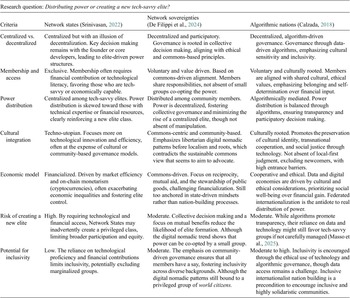
Consequently, Table 3 illustrates how each paradigm would respond to the research question posed in this article: Are we truly decentralizing power, or are we merely shifting it into the hands of a new elite under the guise of technological innovation?
Regarding Table 3, two main nuanced comments should be added:
The first comment acknowledges governance disparities in Network Sovereignties and Algorithmic Nations. As such, participation disparities and governance elite formations can emerge even within Network Sovereignties and Algorithmic Nations, despite their emphasis on cooperative or community-led governance. Participation in governance remains unequal, as those with greater digital literacy, social capital, or resources are more likely to engage in decision making. In large-scale decentralized communities, low voter engagement often results in governance being dominated by a self-selecting elite, similar to participation trends observed in DAOs. While Network Sovereignties and Algorithmic Nations advocate for inclusivity, in practice, governance mechanisms may still reflect power imbalances due to algorithmic biases, digital access disparities, and cultural gatekeeping.
The second comment clarifies the exclusivity of Network States and the nature of decentralization among elites. As such, a question remains open: whether Network States are inherently exclusive or whether decentralization can still exist within an elite group that is uniformly tech-savvy. While access to governance is exclusive, power structures within Network States may still be decentralized among the highly tech-literate elite. Rather than a strictly centralized hierarchy, governance in Network States often follows a distributed model within a narrow, self-selected community of individuals with specialized knowledge. This results in a form of “elite decentralization,” where participants may share governance rights, but barriers to entry (technical literacy, financial means, ideological alignment) still restrict broader participation.
5. Conclusions
This article critically examines whether Web3 decentralization genuinely redistributes power or merely creates a new elite of technologically literate and economically privileged individuals. Using a post-Westphalian lens and fieldwork-based action research, it analyzes three paradigms widely discussed in the scientific and policy communities regarding Global Digital Governance—Network States, Network Sovereignties, and Algorithmic Nations—against a comparative empirical landscape that includes initiatives from the Global North and South. The structure moves from a conceptual foundation rooted in critiques of the Westphalian model, through an empirical exploration of Web3 projects (Tables 1 and 2), toward an analytical response to the core research question using the three paradigms (Table 3). Drawing on insights from polycentric governance, symbolic capital, and algorithmic mediation, the article reveals how decentralization often reproduces structural inequalities under new forms. While each paradigm offers partial pathways toward inclusion, the analysis shows that the potential for democratization remains uneven and dependent on access to digital, financial, and epistemic infrastructures.
Network States create an illusion of decentralization, as decision making often remains with the founder or core developers. Centralized power structures persist, primarily benefiting those with technical expertise or financial resources. This market-driven framework risks forming a new elite among the tech-savvy and economically privileged, limiting broader participation. Inclusivity is low, as membership tends to be exclusive, requiring technological literacy or financial contributions, which often excludes marginalized groups. This techno-utopian focus on innovation frequently undermines cultural integration and community-based governance.
In contrast, Network Sovereignties emphasize a more distributed and participatory approach to governance, rooted in collective decision making aligned with ethical and commons-based principles. Power is shared among community members, reducing the risk of elite formation, though manipulation by small groups is still possible. While inclusivity is moderate, with governance aimed at accommodating diverse members, the trend toward digital nomadism often favors more mobile, tech-savvy citizens. Economically, this model is commons-driven, focusing on mutual aid and the stewardship of public goods, though its strong ties to the state present challenges in fully transitioning away from financialized models.
Algorithmic Nations offer a hybrid model where governance is mediated by algorithms, promoting transparency and inclusivity through data-driven decision making. Although algorithms help decentralize power, there remains a risk of favoring those with technological access and expertise, as data access becomes a significant barrier. Cultural integration is prioritized, fostering transnational cooperation and the preservation of cultural identity, but local-first tendencies can still lead to the exclusion of newcomers. The economic model emphasizes cooperative and ethical principles, ensuring social well-being over financial gain, though a careful balance must be maintained to avoid replicating traditional elite-driven power structures.
In response to the research question of whether Web3 technologies genuinely distribute power or merely shift it to a new tech-savvy elite, the answer is nuanced. Network States pose the greatest risk of consolidating power among a privileged few, exacerbating social inequalities through technological and financial barriers to participation. Network Sovereignties offer a more inclusive approach through decentralized governance but still face challenges related to scalability and inclusivity within a global context. Algorithmic Nations represent a local–global nexus alternative by empowering underrepresented communities within nations, with the potential for inclusivity mediated by algorithmic governance, yet they must manage risks associated with technological gatekeeping.
The evolving nature of Web3 technologies and the nascent state of these governance models present limitations in this study. Future research should focus on longitudinal case studies to assess the effectiveness of decentralized systems in reducing power imbalances and fostering true inclusivity. Additionally, more research is needed on how these decentralized systems interact with traditional nation–states and whether hybrid models can bridge the gap between emerging decentralized technologies and existing political institutions. Ultimately, the success of Web3 in decentralizing power will depend on its ability to design inclusive, socially responsible systems, ensuring that the benefits of decentralization are equitably distributed across all communities.
6. Policy implications and governance levers
The policy consequences of the analysis are clarified here without overstating prescriptive claims. Rather than advancing normative slogans, the article identifies where policy intervention matters most—specifically in governance design, accountability mechanisms, participation thresholds, and regulatory hybridity—and why these levers operate differently across Web3 paradigms. This approach preserves analytical rigor while remaining consistent with the scope of a conceptual–policy contribution.
Responding to the journal’s applied orientation, the final section translates the comparative analysis into concrete but flexible policy implications. First, it outlines stakeholder-specific areas of intervention. For regulators, the analysis highlights the importance of requiring publicly auditable smart-contract code, ensuring transparency in DAO and data-cooperative voting procedures, and mandating disclosure of token concentration levels where governance rights are tied to asset ownership. These measures address accountability gaps without assuming uniform regulatory models across paradigms. For developers, the article identifies governance-relevant design choices, including the use of antihoarding mechanisms in tokenomics (such as vesting schedules or limited governance transferability), the development of accessible participation interfaces, and the integration of algorithmic fairness and accountability checks during protocol design. For community leaders and intermediary actors, the findings underscore the relevance of locally embedded digital-literacy initiatives, coproduced with grassroots organizations, to reduce exclusion driven by technical complexity—particularly for indigenous communities, women, and e-diasporas.
Second, the article proposes a procedural roadmap for strengthening participatory governance across decentralized systems. Rather than prescribing a single model, it identifies governance mechanisms that can be selectively adopted depending on institutional context, including randomized or rotating delegation to broaden participation, quadratic voting to limit wealth-based influence, and participatory audit processes that allow communities to periodically assess inclusivity and legitimacy through transparent metrics and feedback loops. These mechanisms are especially relevant for DAOs, civic-tech initiatives, and federated Web3 infrastructures seeking to scale while maintaining democratic credibility.
Third, the article introduces a lightweight policy toolkit for monitoring decentralization outcomes. Inspired by initiatives such as the Ethereum Foundation’s Impact Evaluators program, the toolkit focuses on evaluative indicators rather than fixed standards. These include governance participation rates disaggregated by socioeconomic background, token-concentration indices, indicators of algorithmic decision bias, and the availability of multilingual or culturally sensitive governance interfaces. Used comparatively, these indicators enable policymakers, funders, and decentralized organisations to assess whether decentralization is functioning as a measurable governance practice rather than an aspirational narrative.
Data availability statement
[dataset] Calzada, Igor, 2025, “Fieldwork Dataset by Prof. Igor Calzada for Data & Policy Article’ Zenodo and SSRN at https://doi.org/10.5281/zenodo.15879958 and https://doi.org/10.2139/ssrn.5341665, reference numbers 15,879,958 and 5,341,665 respectively.
Author contribution
IC: conceptualization, methodology, data curation, data visualization, writing original draft, and writing final version.
Funding statement
This research was funded by (i) the European Commission, Horizon 2020, H2020-MSCA-COFUND-2020-101,034,228-WOLFRAM2: Ikerbasque Start Up Fund, 3021.23.EMAJ; (ii) UPV-EHU, Research Groups, IT 1541–22; (iii) Ayuda en Acción NGO, Innovation & Impact Unit, Research Contract: Scientific Direction and Strategic Advisory, Social Innovation Platforms in the Age of Artificial Intelligence (AI) (www.designingopportunities.org accessed on 1 July 2024) and AI for Social Innovation. Beyond the Noise of Algorithms and Datafication Summer School Scientific Direction, September 2–3, 2024, Donostia-St. Sebastian, Spain (https://www.uik.eus/en/activity/artificial-intelligence-social-innovation-ai4si accessed on 1 July 2024), PT10863; (iv) Presidency of the Basque Government, External Affairs General Secretary, Basque Communities Abroad Direction, Scientific Direction and Strategic Advisory e-Diaspora Platform HanHemen (www.hanhemen.eus/en accessed on 1 July 2024), PT10859; (v) European Commission, Horizon Europe, ENFIELD-European Lighthouse to Manifest Trustworthy and Green AI, HORIZON-CL4–2022-HUMAN-02-02-101,120,657, https://cordis.europa.eu/project/id/101120657. Invited Professor at BME, Budapest University of Technology and Economics (Hungary) (https://www.tmit.bme.hu/speechlab?language=en); (vi) Gipuzkoa Province Council, Etorkizuna Eraikiz 2024: AI’s Social Impact in the Historical Province of Gipuzkoa (AI4SI). 2024-LAB2–007-01. www.etorkizunaeraikiz.eus/en/ and https://www.uik.eus/eu/jarduera/adimen-artifiziala-gizarte-berrikuntzarako-ai4si; (vii) Warsaw School of Economics SGH (Poland) by RID LEAD, Regional Excellence Initiative Programme (https://rid.sgh.waw.pl/en/grants-0 and https://www.sgh.waw.pl/knop/en/conferences-and-seminars-organized-by-the-institute-of-enterprise and https://www.sgh.waw.pl/knop/en/conferences-and-seminars-organized-by-the-institute-of-enterprise; (viii) SOAM Residence Programme: Network Sovereignties (Germany) via BlockchainGov (www.soam.earth); (ix) Decentralization Research Centre (Canada) (www.thedrcenter.org/fellows-and-team/igor-calzada/); (x) The Learned Society of Wales (LSW) 524,205; (xi) Fulbright Scholar-In-Residence (S-I-R) Award 2022–23, PS00334379 by the U.S.–U.K. Fulbright Commission and IIE, U.S. Department of State at the California State University (https://fulbright.org.uk/people-search/igor-calzada/); (xii) the Economic and Social Research Council (ESRC) ES/S012435/1 “WISERD Civil Society: Changing Perspectives on Civic Stratification/Repair.” (xiii) Gipuzkoa Province Council, Human Rights & Democratic Culture: Gipuzkoa Algorithmic Territory: Socially Cohesive Digitally Sustainable? (i) Digital Inclusion, (ii) Anticipatory AI Governance, and (iii) EcoTechnoPolitics and Digital Inclusion & Generative AI International Summer School Scientific Direction, July 15–16, 2025, Donostia-St. Sebastian, Spain, PT10937, PT10984, and TR42875; and (xiv) Astera Institute, Cosmik Data Cooperatives for Open Science. Views and opinions expressed, however, are those of the author only and do not necessarily reflect those of these institutions. None of them can be held responsible for them.
Competing interests
The authors declare no potential conflicts of interest.
Biography
Igor Calzada is accredited Full Professor in Interdisciplinarity (ANECA) and in Social Sciences and Humanities (Unibasq) and holds R3 Established Researcher certificate. He is (i) a Principal Investigator/Research Fellow/Associate Professor at Ikerbasque (Basque Foundation for Science) and the University of the Basque Country, Faculty of Social Sciences; (ii) Principal Research Fellow/Reader at WISERD (Wales Institute of Social and Economic Research and Data) at Cardiff University; and (iii) Fulbright Scholar-in-Residence (SIR), California State University by U.S.–U.K. Fulbright Commission His research intersects digital, urban, and political transformations. He is the author of the books Emerging Digital Citizenship Regimes: Postpandemic Technopolitical Democracies (Emerald, 2022) and Smart City Citizenship (Elsevier, 2021) and Datafied Democracies & AI Economics Unplugged: Technopolitics in Smart Cities and Datafied Network States (Springer Nature, 2026). He is culminating a Routledge monograph (2024) on Benchmarking City-Regions. His work has been published in top academic journals such as Futures, Globalizations, Journal of Urban Affairs, Citizenship Studies, Journal of Urban Technology, Space and Polity, Regional Studies Regional Science, Regional Science Policy and Practice, Transforming Government: People, Process, and Policy, Sustainability, AI, Smart Cities, Social Sciences, Societies, Digital, Systems, and Innovation: The European Journal of Social Science Research. He has worked as a Senior Researcher at the University of Oxford, European Commission, United Nations, and Mondragon Co-operative Corporation, among other international institutions. www.igorcalzada.com/publications Google Scholar 5,979, h-index 35, i10-index 78.



 Open access


Comments
No Comments have been published for this article.