

Introduction
Gender equality is considered a key indicator of the development of representative democracy and an essential principle of ethical and legal systems. It reflects a commitment to inclusion and recognition of human diversity, where the values of humanity, tolerance and respect for the rights of every human being are central. This principle is inextricably linked to the more general notion of equality, encompassing both formal and factual aspects of legal and social justice. Insufficient attention to this problem leads to an imbalance in the perception and assessment of the social functions of men and women, which creates uncertainty in their legal and social status. This impedes the equal distribution of opportunities and resources across genders, slowing the pace of progress on human rights. Thus, the successful realization of equal rights and freedoms regardless of gender requires an active revision of established perceptions and the promotion of principles of social inclusion and justice.
In the Republic of Kazakhstan, the issues of ensuring equality of rights and freedoms between men and women continue to be relevant for legal regulation. The Constitution of the Republic of Kazakhstan (1995) consolidates key transformations concerning the equality of rights and freedoms of both sexes. Achieving equality is a priority in the regulation of social relations, especially in light of the increased protection of women’s rights in various areas, which encompasses the full range of rights and freedoms of both sexes. Full and equal participation of citizens regardless of gender is considered the basis of integration processes that contribute to the recognition of Kazakhstan as an equal member among developed states. At the same time, the issues of equality of rights and freedoms between men and women continue to be the subject of active discussions in Kazakhstan. The issues of constitutional–legal provision of equality of persons with different gender identities continue to be one of the key issues in the Republic of Kazakhstan. Although the principle of equal rights and opportunities for all gender groups is declared at the legislative level, the practical implementation of these norms faces certain difficulties. Specifically, mechanisms for integrating a gender perspective into political decision-making and the management of public affairs need to be further developed and implemented.
This includes not only the development of legislative frameworks but also the creation of effective institutional mechanisms aimed at implementing gender equality principles in national socio-economic and political development strategies.
The existing problems are related to the existence of double standards in the perception of equal rights, which negatively affect citizens’ participation in government and policy-making. Despite constitutional guarantees of equal rights for all gender groups, traditional stereotypes about the social and family roles of men and women continue to dominate public consciousness. These stereotypes perpetuate imbalances in the distribution of social resources and opportunities. The lack of integration of gender mainstreaming and the absence of serious scientific analyses of this issue mean that the policy of equal access to resources is still largely theoretical. In practice, this manifests itself in a lack of attention to gender inequality in labour relations, education, politics and social life. According to the United Nations (United Nations Development Programme 2024b), less than 40% of the population of Kazakhstan is aware of the significance of gender equality. The state’s attempts to address gender equality have not yet produced meaningful results. The principal reasons for this are the lack of fundamental research in the field of legal science and the limited demand for the existing scientific achievements in the practical activities of state bodies.
The issues of constitutional legal provision of equality of rights and freedoms between men and women in Kazakhstan continue to be the subject of active scientific research. Shaidullina (Reference Shaidullina2023) analysed the legislation of the Republic of Kazakhstan in the context of gender equality to assess its compliance with international standards and successful practices of other countries, as well as the possibilities of adapting these standards to the institutional structures of Kazakhstan. Sufieva (Reference Sufieva2023) investigated constitutional and legislative aspects of equality of rights and opportunities between men and women, focusing on the role of education as a key element of employment and occupation. Buribayev and Khamzina (Reference Buribayev and Khamzina2022) analysed the implementation of gender policy in a series of European countries that are considered leaders in this area. In these countries, gender equality is closely linked to the welfare-state model, which helped to identify specific features of this system. Rubio-Marin (Reference Rubio-Marin2020, Reference Rubio-Marin2022) focused on the exclusion of women from constitution-making in distinct jurisdictions. The study analysed the forms of women’s participation in the constitutional process, including their progressive involvement through civil society, although this participation is still insufficient. Mashtalir, Kapitan, and Shai (Reference Mashtalir, Kapitan and Shai2022), Neo (Reference Neo2022) and Ali and Buratai (Reference Ali and Buratai2019) explored the relevance of gender equality in the context of constitutional regulation. These studies demonstrated that the integration of care into constitutional regulation can lead to a rethinking of the focus of constitutional law, shifting the focus from traditional aspects such as social relations and the family to new directions.
Despite the attention of researchers to the topic in general, gender equality is still understudied in the field of constitutional law, even though the Constitution of Kazakhstan, for the first time, consolidated the equality of rights and freedoms of men and women in national legislation and created a basis for their effective protection.
The purpose of this study was to analyse the principle of gender equality in the context of its constitutional consolidation in Kazakhstan and other countries.
Materials and Methods
During the study, a comprehensive analysis of legal acts was performed, which helped to conduct a comprehensive assessment of the current state of the problem of gender equality and identify areas for its improvement. To provide a broad comparative context, the study included norms of various legal sources, both national and international legislation. Specifically, the study considered the norms of the Constitution of the Republic of Kazakhstan (1995), which establish the basic principles of equality of rights and freedoms for women and men at the constitutional level. Legislative acts from other countries were also analysed, including: the Constitution of the Czech Republic (1992); the Constitution of the Italian Republic (1947); the Federal Constitution of the Swiss Confederation (1999); the Federal Constitutional Law of Austria (1920); the Constitution of the Portuguese Republic (1976); the Constitution of the Republic of Lithuania (1992); the Law of the Republic of Kazakhstan No. 223-IV “On State Guarantees of Equal Rights and Equal Opportunities for Men and Women” (2009); the Law of the Republic of Kazakhstan No. 214-IV “On the Prevention of Domestic Violence” (2009); the Code of the Republic of Kazakhstan No. 518-IV “On Marriage (Matrimony) and Family” (2011); and the Decree of the President of the Republic of Kazakhstan No. 384 “On Approval of the Concept of Family and Gender Policy in the Republic of Kazakhstan until 2030” (2016).
To achieve objectivity and comprehensiveness of the analysis, this study uses a set of modern methodological tools covering both general and special theoretical and methodological tools of scientific cognition of social phenomena and processes.
A dialectical approach helped to further explore the nature of gender equality by defining the rights and freedoms granted to men and women. This method helped to identify the reasons for assigning specific rights to each gender, and to analyse the contradictions and evolution of gender relations in the legal context.
The formal-logical method facilitated a detailed examination of key concepts related to gender equality. This method allowed for the classification of legal norms regulating gender relations in both Kazakhstan and other countries, highlighting the features of each legal regime. The application of the system method provided a comprehensive picture of the dynamics of changes in the legal regulation of gender equality in Kazakhstan. This approach helped to identify patterns in the development of relevant legal norms and to assess existing barriers related to gender discrimination. The system-structural method was used to analyse the structure of constitutional and legislative guarantees supporting equal rights for men and women. It helped to establish the interaction between different regulations and assess their contribution to the maintenance and realization of the principle of gender equality in the legal system.
The comparative-legal method enabled a detailed analysis of the legal systems of different countries to investigate their experience in regulating gender equality. This method helped to identify effective mechanisms for eliminating gender imbalance and to consider the possibility of adapting them into the legislative system of Kazakhstan, considering the specific national features and legal traditions. The modelling method was used to develop possible scenarios and avenues for improving Kazakhstan’s legal and regulatory framework for gender equality. Using this method, hypothetical models of legal mechanisms aimed at eliminating gender discrimination were created. Recommendations were developed that consider successful international practices and involve the adaptation of the most effective solutions for the national legal system.
Results and Discussion
Legal Regulation of the Principle of Gender Equality in Europe
Freedom and equality, as fundamental values of democratic systems, play a key role in creating a just and stable social order. Their enjoyment is directly related to ensuring the rule of law, within the framework of which every individual, regardless of gender, should have equal opportunities to exercise their rights and freedoms. The scientific interpretation of these values, as well as the practical aspects of ensuring equality between women and men, regularly becomes the object of attention of researchers. Researchers investigate not only theoretical concepts of equality, but also mechanisms of its fulfilment through legislative acts and law enforcement practice, including protection against discrimination and creation of conditions for equal access to various public goods and resources.
Thus, according to the studies of Lambert and Scribner (Reference Lambert and Scribner2020, Reference Lambert and Scribner2021) and Mariani and Verge (Reference Mariani and Verge2023), the concept of equality in the legal sphere includes the idea of equal rights and duties for all citizens, as well as an equal level of social freedom. This understanding implies equality in the degree of responsibility, compensating for differences between actors. Formal legal equality excludes the granting of advantages or privileges to particular persons. This provision has its validity, since equality implies the absence of additional privileges for individuals in the exercise of their rights or the application of liability measures. An important aspect of this approach is also the granting of equal rights and obligations to be exercised and fulfilled accordingly.
Asli Bilgin (Reference Asli Bilgin2021), Carlsson (Reference Carlsson2020) and Sosa (Reference Sosa2021) emphasize the difference between “de facto equality” and “formal equality”. According to these researchers, legal norms ensure formal equality, while the actual exercise of subjects’ rights may be unequal. Regulations fix the possibility of obtaining and exercising certain rights, such as the right to education, healthcare and housing. In this context, the significance of the issue is not limited to the existence of rights; it is also important to ensure access to their exercise without discriminatory restrictions. Restricting access to rights to certain groups of people undermines those rights, which contributes to discrimination. Sprague, Heymann, and Raub (Reference Sprague, Heymann and Raub2022), Berevoescu and Ballington (Reference Berevoescu and Ballington2021) and Rummery (Reference Rummery2021) support the importance of protecting gender equality as a key public duty, emphasizing that the right to equality, based on natural rights conferred by birth, is regulated by the Constitution. The principle of equality, consolidated in constitutional acts, is an important, albeit insufficiently fulfilled, regulatory mechanism aimed at forming key interrelationships between the subjects of constitutional legal relations and determining the level of freedom, justice and equality in society. Gender equality is thus a critical element reflecting the level of development of a democratic society. Gender equality is a core element of the universal constitutional principle of equality, which excludes discrimination based on any ground, such as race, colour, religious belief, social status and other characteristics. Achieving full gender equality is important and remains at the centre of discussions on protecting human rights, upholding democratic values, promoting the rule of law, and ensuring economic growth and sustainable development.
In the Constitution of the Republic of Kazakhstan (1995), the principle of gender equality is prescribed as an integral part of the legal order. Under Article 14 of the Constitution of Kazakhstan, all citizens have equal rights before the law and the courts, and no one may be discriminated against on grounds of origin, social or official status, property status, sex, race, nationality, language, attitude towards religion, beliefs, place of residence or other circumstances. This constitutional norm establishes legal safeguards to protect against discrimination and to promote a just and inclusive society, where gender equality is considered a fundamental element of the rights and freedoms of every citizen. The Constitution serves as the primary guarantor of gender equality. This regulation indicates the country’s policy on the protection of maternity and equal rights of men and women. Horowitz and Igielnik (Reference Horowitz and Igielnik2020), Avolio and Del Caprio (Reference Avolio and Del Caprio2020) and Profiroiu and Nastaca (Reference Profiroiu and Nastaca2021) point out that the Constitution affirms the absolute equality of the sexes in all aspects of life. Since the proclamation of Kazakhstan’s independence, there has been an active introduction of anti-discrimination norms into legislation. The principle of non-discrimination is a fundamental element of a democratic society. The inclusion of relevant norms in the Constitution should be considered a logical development of state policy aimed at modernizing social relations. An essential step in this process was the establishment of legal standards immediately after independence, which provided clear guidelines for changing social structures.
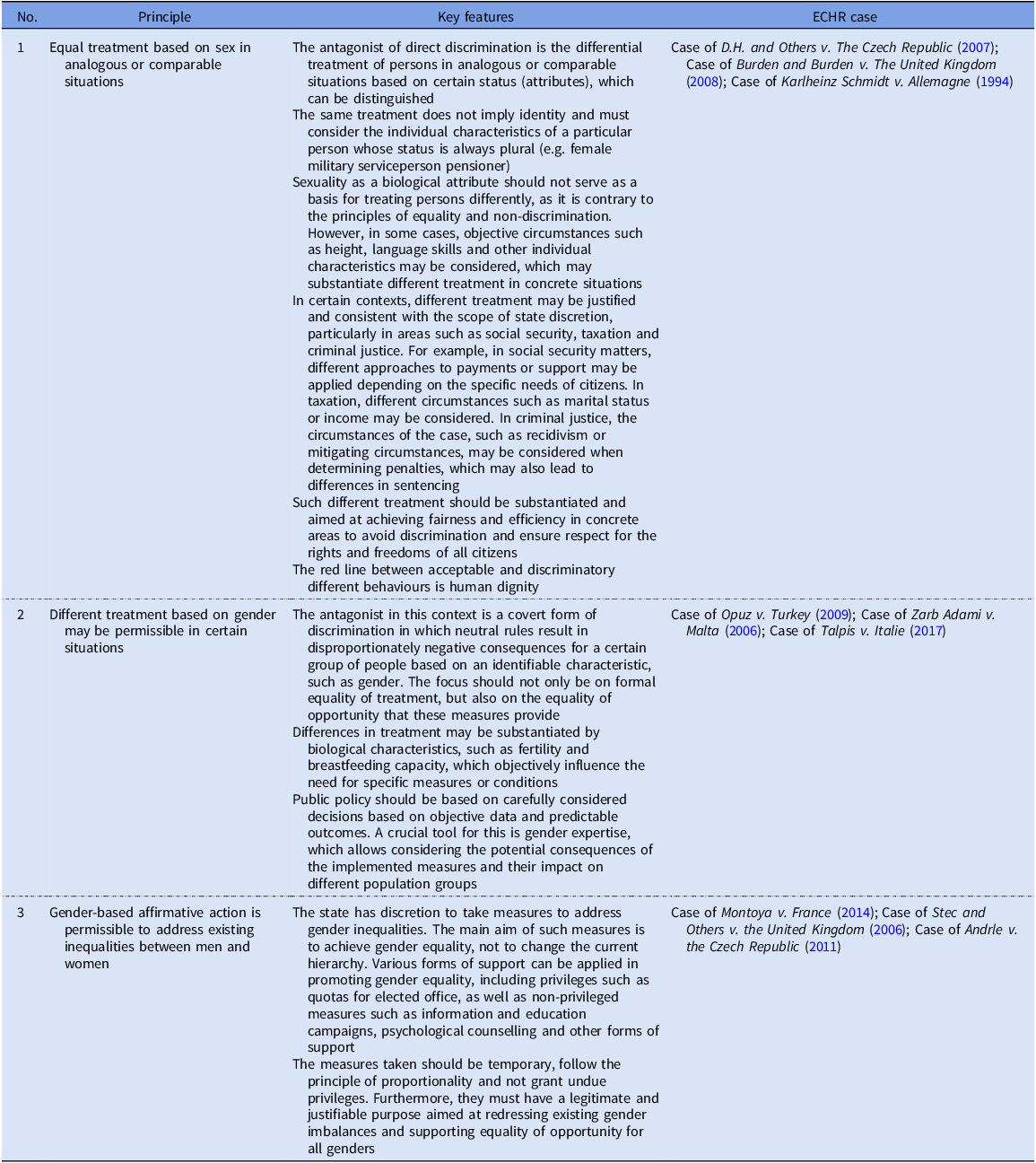
Still, the effective implementation of this principle requires not only statutory consolidation but also practical implementation in various spheres of public life, which implies the active development of political, social and economic mechanisms aimed at eliminating existing gender stereotypes and ensuring real equality of opportunity for all. This approach is an example of a formal understanding of the principle of gender equality, based on the practices of the European Court of Human Rights (Table 1).
Principles of gender equality, their main characteristics and examples from the European Court of Human Rights (ECHR) practices

Source: created by the authors.
National social protection systems in European countries are characterized by diversity in terms of public participation in organization and financing, methods of social budgeting and allocation, coverage of the population, and the quality and scope of services and benefits provided. A specific feature of the European Union is the implementation of equality policy, which is based on the principle of creating equal conditions for the self-fulfilment of the individual regardless of gender. The implementation of this policy requires respect for human rights, a legal framework to address emerging issues, the establishment of arbitration mechanisms, committees and councils to address sexual discrimination and the establishment of specialized departments or divisions within each ministry handling gender equality. An essential aspect is to conduct research on gender issues, establish a reliable statistical base and carry out gender expertise.
In the European Union countries, gender equality is achieved through the legal equalization of opportunities between men and women. The legal systems of these countries consider gender differences while ensuring equal social status for both sexes. A fundamental aspect of state policy is to actively combat gender stereotypes that shape and perpetuate inequalities in society. Gender stereotypes are preconceived notions and expectations about the roles and characteristics of men and women, which considerably affect social relations and legal systems. Gender relations, as a set of interactions between different genders, are subject to legal regulation and are a vital component of legal systems. They address aspects related to equality of opportunity, anti-discrimination measures and inclusion policies. Effective legal regulation of gender relations requires the development and implementation of norms and mechanisms aimed at eliminating discrimination and ensuring equal treatment of persons regardless of their gender. The practice of law enforcement and the development of legislation aimed at achieving gender equality occupy a prominent place in the countries of the European Union. Constitutions and regulations governing gender equality issues in European countries are of considerable interest for practical and scientific study in the context of Kazakhstan. Gender equality is a global challenge recognized by all states. However, approaches to the fulfilment of gender equality may differ substantially even at the constitutional level in the countries of the European Union.
Article 32 of the Charter of Fundamental Rights and Freedoms, which is part of the Constitution of the Czech Republic (1992), mandates special measures to protect the rights of women during pregnancy. Specifically, the Article guarantees increased attention to women’s labour rights by creating suitable conditions for them to work. Furthermore, the Article establishes equality of rights and freedoms for children, whether born in or out of wedlock. Article 29 focuses on the right of women to improved healthcare during employment. This right covers not only aspects of the employment relationship, but also additional health guarantees, reduced workloads, longer rest periods and increased social security. The consolidation of such norms in the Constitution ensures that they are unchanged and are protected from repeal or restriction through laws or regulations, thereby ensuring that women’s rights are protected, even in the case of attempts to change legislative guarantees.
The Constitution of the Italian Republic (1947), in Article 117, Part 6, prescribes that regional legislation shall remove obstacles to the achievement of full equality between men and women in the social, cultural and economic spheres, as well as promote the equal participation of men and women in elections to office. Considering regional differences in culture, economy, occupations and businesses, as well as climatic conditions, ensuring a uniform level of protection for gender equality at the state level can be challenging.
The Federal Constitution of the Swiss Confederation (1999) consolidates more comprehensive equality of rights and freedoms between men and women. Article 31 mandates equality in marriage and labour relations and establishes the obligation to bring a detainee before a judge immediately, regardless of gender. Article 145 prescribes the election of the Union Chancellor for a term of four years without regard to the gender of the candidate. The wording “woman or man” for all positions in state and local self-government bodies is aimed at eliminating potential misunderstandings and excluding restrictions on the rights of women or men to hold public office. This wording also eliminates the need for mandatory appointment of a member of the opposite sex to equal positions or a reduction in the tenure of such positions.
The Federal Constitutional Law of Austria (1920) emphasizes political equality between men and women by guaranteeing in Article 23a the right to vote for both sexes who have reached the age of 19 years on 1 January of the election year. The legislative establishment of equality of age for eligibility to be elected to a political party or parliament emphasizes the recognition of equal conditions of physical and psychological development for men and women. Such a constitutional consolidation facilitates better representation of the interests of different age and gender groups.
In the Constitution of the Portuguese Republic (1976), Article 9, Item “h” establishes the state’s duty to promote equality between men and women. Article 109 emphasizes the need for both sexes to take part in political life as a key element in strengthening democratic processes. Legislation is required to support equality in the exercise of political and civil rights, preventing gender discrimination in access to political office. Thus, ensuring the fulfilment of the principle of gender equality and the protection of the rights and freedoms of men and women must be guaranteed permanently, which contributes to sustainable development and the effective satisfaction of the needs of society.
In the Republic of Lithuania, Article 29 of the Constitution of the Republic of Lithuania (1992) mandates the process of shaping the social structure considering the gender concept. This Article prohibits any restriction of human rights or granting of privileges based on sex, race, nationality, language, origin, social status, religion, belief or opinion. Article 29 of the Constitution of Lithuania establishes the principle of universal equality, which serves as the basis for the creation of a just society. It guarantees that everyone enjoys equal rights and opportunities, regardless of the characteristics mentioned, which is a crucial step in integrating the gender concept into the country’s legal system. This norm is aimed at eliminating discrimination and creating conditions for the equal participation of all citizens in social and public life. It provides a framework for the development and implementation of public policies, programmes and measures that support equality and inclusion in different areas of society, including labour relations, education, healthcare and other areas of social life.
An analysis of national approaches to the promotion, advancement and protection of gender equality in the Nordic countries, which have considerable experience in equality and discrimination reduction, demonstrates that these states have achieved elevated standards of gender equality through comprehensive social security and equity policies. The adoption of gender equality principles by states and the enforcement of universal and individual rights promote a more balanced participation of men and women in political and democratic processes than in other communities. A comprehensive gender approach in these countries covers a wide range of aspects, including equal distribution of resources and income, adequate attention to the interests and needs of both sexes in the development of legislative initiatives and the establishment of institutional mechanisms to ensure gender equality. A key element in promoting and achieving gender equality is the unification of specialized legislation and the integration of a gender component into sectoral regulations. The basis of legislation governing gender equality in various countries is the prohibition of discrimination. Legislative and policy measures aimed at achieving gender equality are subject to regular review in line with changes in society and its needs.
The analysis of practices in European countries demonstrates that achieving gender equality effectively requires a comprehensive approach, including the introduction of a gender perspective into public ideology. This includes creating conditions for equal economic independence for both men and women, which requires structural changes in economic policy and legislation. Key aspects are the harmonization of private and professional life, which is achieved through the development and implementation of policies that support work–life balance, including flexible working hours and access to quality childcare. Equal participation in decision-making processes is a critical element requiring the removal of barriers to women’s and men’s participation at all levels of management and decision-making. This includes both political and corporate structures. Eliminating gender-based violence and eliminating stereotypes in public consciousness are essential goals that requires targeted education and prevention programmes. Overcoming negative stereotypes and perceptions of the roles of men and women in society is necessary to create an environment conducive to equality.
Furthermore, relevant initiatives should be promoted both domestically and internationally. Domestic measures include the development and implementation of national policies and programmes on gender equality, while at the international level, cooperation with international organizations and participation in global initiatives and agreements are required. This comprehensive approach contributes to creating the conditions for sustainable and effective achievement of gender equality, reflecting the best practices of European countries.
Problems of Consolidation and Fulfilment of Gender Equality in Kazakhstan
Assurance of gender equality in Kazakhstan is largely equivalent to ensuring equality of rights and freedoms between women and men. Minto and Parken (Reference Minto and Parken2020), Ün and Arıkan (Reference Ün and Arıkan2022) and Kochenov and Belavusau (Reference Kochenov and Belavusau2021) emphasize the key role of gender equality in the development of an integrated and developed society. It is argued that the extent to which women’s rights are protected is an indicator of the overall level of development of a society, and ignoring gender equality issues can negatively affect governance. However, this opinion may be questioned. The level of gender equality reflects the degree of implementation and application of the principle of equality among all people, which underlies the harmonious development of society. At the beginning of the twentieth century, women’s rights were limited, but, over time, the world community came to recognize the need for equal rights for all genders.
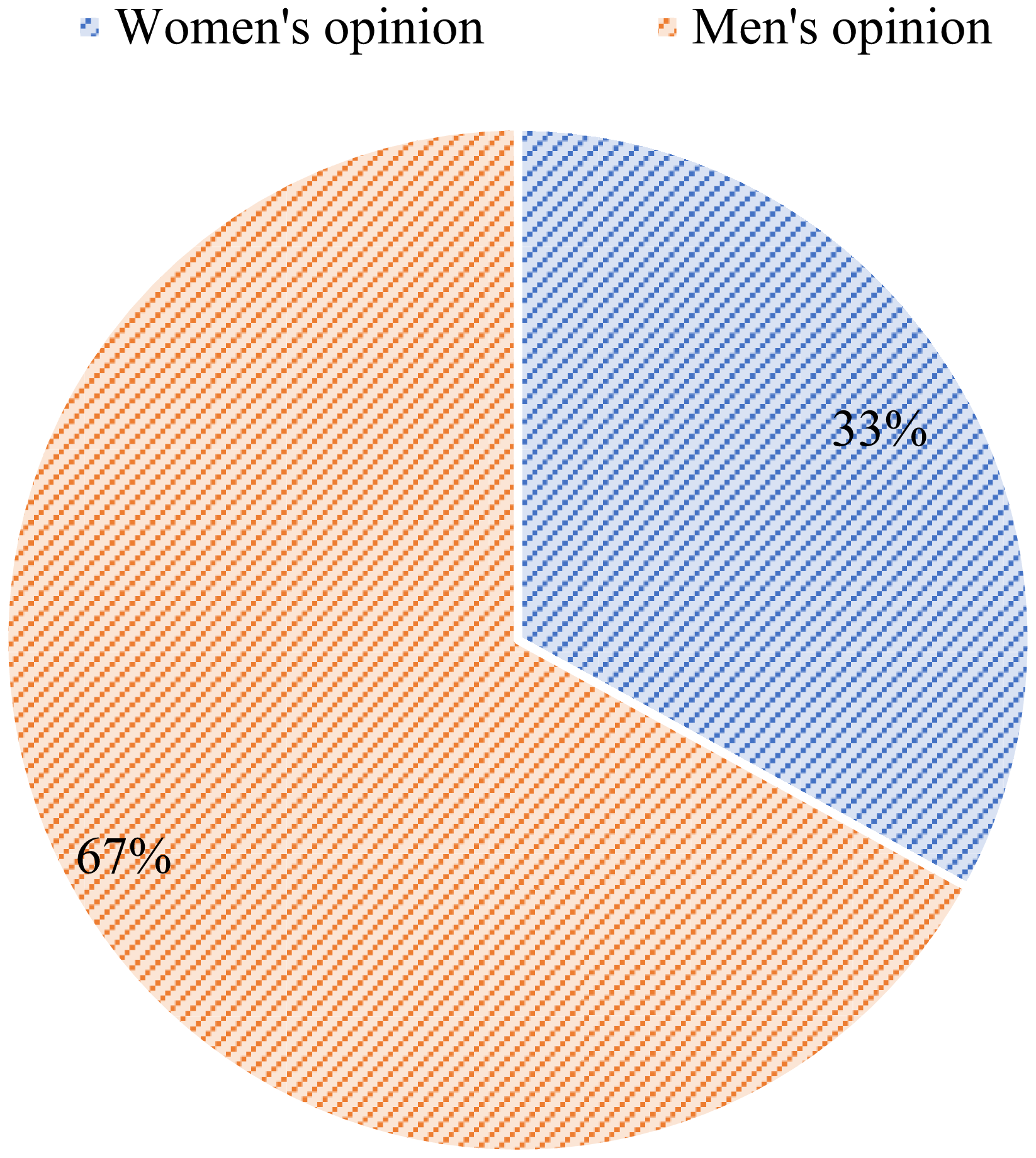
According to statistical data, the issue of ensuring equality of rights and freedoms for men and women in Kazakhstan remains a pressing concern. Research shows that more than half of the interviewed women and two-thirds of the interviewed men support the opinion that the main duty of a woman is to create comfort in the family, raise children, and ensure their health, which implies that there is no need for labour activity (Figure 1).
Perceptions of men and women in Kazakhstan behind United Nations data.
Source: created by the authors based on the United Nations Analytical Report “Public Perception of Gender Equality and Women’s Empowerment in Kazakhstan” (United Nations Development Programme 2024a).

Based on the data presented, there is a bias against gender roles in Kazakhstan. Traditionally, it has been assumed that women’s primary function is to provide family comfort and raise children, which limits their participation in the formal economy. This trend points to historical norms where women have held more passive positions in the economic sphere, limiting their access to economic resources and opportunities. Kashyap (Reference Kashyap2024), Lucherini (Reference Lucherini2024) and Faugoo (Reference Faugoo2024) demonstrate that providing special benefits to individuals based on gender or to meet the needs of certain groups should not be perceived as discrimination. Positive discrimination, particularly in favour of women, is considered a necessary tool to ensure adequate living conditions for them, accommodating their biological characteristics.
Therewith, Kazakhstan demonstrates a comprehensive system of regulation of gender equality issues, which is confirmed by the existence of legal norms aimed at ensuring equality of rights and freedoms for men and women. The Constitution of the Republic of Kazakhstan (1995) includes an explicit prohibition of gender discrimination. The country has adopted important regulations, such as the Law of the Republic of Kazakhstan No. 223-IV “On State Guarantees of Equal Rights and Equal Opportunities for Men and Women” (2009) and the Law of the Republic of Kazakhstan No. 214-IV “On the Prevention of Domestic Violence” (2009), which establish and maintain equal rights for men and women in various spheres of public life. The Law of the Republic of Kazakhstan No. 223-IV “On State Guarantees of Equal Rights and Equal Opportunities for Men and Women” (2009) consolidates the principle of gender equality in social, political and economic spheres. This law ensures equality of opportunity and rights for all genders, emphasizing the significance of non-discrimination in different areas of life. At the same time, the Code of the Republic of Kazakhstan No. 518-IV “On Marriage (Matrimony) and Family” (2011) mandates liability for coercion to terminate or maintain family relations, which may violate the right to liberty and security of person. This norm illustrates the principle of equality by applying liability to parties regardless of their gender, which emphasizes respect for the equal rights of men and women.
The problem of gender-based violence is a complex and multifaceted phenomenon that requires comprehensive consideration by both state and public structures. In this context, it is useful to consider the experience of Kazakhstan, where measures such as the Law of the Republic of Kazakhstan No. 214-IV “On the Prevention of Domestic Violence” (2009) have been introduced. This law aims to protect the rights and freedoms of citizens regardless of sex and to eliminate discrimination on various criteria, including sex. The Decree of the President of the Republic of Kazakhstan No. 384 “On Approval of the Concept of Family and Gender Policy in the Republic of Kazakhstan until 2030” (2016) emphasizes that achieving gender equality requires the development of gender awareness, which should influence the formation of social ties and relationships. This implies the establishment of a system of gender education covering all age groups, starting from early childhood.
The Constitution of the Republic of Kazakhstan (1995) is a fundamental regulation that guarantees equality of rights and freedoms for men and women. An analysis of constitutional provisions shows that they ensure gender equality in various spheres of public life. The Constitution serves as the basis for the development of all other legislation, making it the centrepiece of the country’s anti-discrimination policy, where equality of rights and freedoms is considered a key principle. Based on the above, the key features of the legislation of the Republic of Kazakhstan in the field of gender equality can be identified as follows:
-
1. Equality consolidation. The Constitution establishes equality of rights and freedoms for men and women, excluding discrimination based on sex.
-
2. Equal opportunity. Legislation ensures equal opportunities for all genders to protect their rights and interests.
-
3. Lack of discrimination and privileges. There are no restrictions or privileges based on gender in the legislation, emphasizing that discrimination and unwarranted privileges are unacceptable.
-
4. Equal conditions. Laws ensure equal conditions for the realization of rights and freedoms for both men and women, creating conditions for equitable access to all resources and opportunities.
-
5. Anti-discrimination. The legislation has an anti-discriminatory orientation, aimed at preventing and countering discrimination based on sex.
As stated earlier, the Constitution of the Republic of Kazakhstan (1995) establishes basic principles of equality aimed at preventing discrimination based on gender. In addition, the country’s various regulations introduce specific rules governing aspects of life where enhanced protection is required for persons of different genders. International legal standards play a significant role by prohibiting discrimination and providing guidance for improving national legislation and policy measures to ensure equality of rights and freedoms.
An analysis of the current state of gender equality protection in Kazakhstan reveals several key characteristics. First, the protection system is characterized by adaptability and a range of measures that vary according to the type of threats to rights and freedoms. This implies the development of specific strategies and approaches according to concrete circumstances, which is particularly important in the context of combatting domestic violence, where protection methods can be modified according to current needs and situations. The inclusion of elements such as the provision of psychological support is an example of adapting protection measures to different forms of violence and rights violations (Government of Kazakhstan 2022). Second, strategic planning and continuous improvement of protection measures also play a significant role. This involves regularly updating and adjusting approaches and instruments of protection in response to changes in the social and legal context, as well as to new challenges arising in the field of equality of rights and freedoms.
The integration of international initiatives and partnerships represents another prominent feature. Kazakhstan is actively involved in global efforts to promote gender equality. For example, in 2021, the Republic of Kazakhstan joined two Coalitions of Action of the Global Forum “Generation of Equality” (United Nations Women 2024). This engagement is linked to commitments to gender-based violence and economic justice. One of the notable results of these efforts was the abolition of the list of prohibited occupations for women, a step towards eliminating discrimination in the labour market.
Despite the considerable amount of research on equality of rights and opportunities between men and women, a series of theoretical categories still requires better clarification. Preti and Bella (Reference Preti, Bella, di Bella, Fachelli, López-Roldán and Suter2023) and Habimana (Reference Habimana2023) emphasize the need to consider equality of rights and freedoms between the sexes as a comprehensive system of statutory guarantees. This system should ensure equal rights and opportunities for both sexes in various aspects of life, including economic, political, social and cultural development. Furthermore, it is necessary to consider the activities of public authorities, which play a key role in realizing and supporting these rights. According to the findings of Lawless et al. (Reference Lawless, Cohen, Mangubhai, Kleiber and Morrison2021) and Knežević, Pavlović, and Bojičić (Reference Knežević, Pavlović and Bojičić2022), even with existing institutional measures, there is a question concerning the ability of state bodies to effectively influence policy processes and minimize their potentially negative impact on gender equality. Specifically, some public bodies responsible for protecting equality rights may not have sufficient powers to fulfil this task. Based on these studies, gender equality requires a systemic approach, encompassing not only legal norms but also practical measures aimed at redressing existing imbalances and supporting equality in everyday life. However, there is also a series of challenges, such as a lack of systematization and inconsistency in national legislation. These challenges highlight the need for better coordination and unification of legal norms on gender equality to ensure a more effective and targeted approach to the protection of rights and freedoms.
This context demonstrates that positive developments are taking place in the field of international initiatives and partnerships, facilitating the integration of modern and effective practices into national legislation. These changes are in line with current social demands and trends. Knowledge sharing and support from international partners play an important role in optimizing public policies on gender equality. Achieving a considerable level of gender equality requires a comprehensive approach involving all levels of government and various spheres of public life. Effective implementation of gender equality requires the development and implementation of a targeted programme that will include clear identification of priorities and strategies for integrating gender perspectives into all aspects of public administration and public activities. Only a comprehensive and systematic approach to the integration of gender equality at all levels of government and in various spheres of public life can ensure the effective achievement and maintenance of gender equality in the long term.
The practice of European countries points to the need to create a specialized coordination body for the effective organization of work and liaison between the structures involved in the implementation of gender equality policies. International organizations also recommend the establishment of such a mechanism. Specifically, the recommendations of the United Nations Development Programme highlight the need for substantial transformation of existing national systems for gender equality (United Nations Development Programme 2022). In confirmation of this approach, it is worth noting the proposal of the President of Kazakhstan in his video address at the Global Forum “Generation of Equality” (President of the Republic of Kazakhstan 2021). This forum proposed an initiative to create a regional educational platform to share experiences and best practices in the field of gender equality and violence prevention in Central Asia. This move underscores Kazakhstan’s sustained commitment to protecting women’s rights and security, as well as to empowering them regionally.
To implement effective measures to promote gender equality in the country, it is advisable to establish a specialized high-level body, such as a gender equality bureau, commission or secretariat. The main objective of this body should be to improve governance in the field of gender equality by introducing gender analysis, forecasting and lobbying in the development and implementation of state policies and programmes, as well as involving non-governmental organizations. Among the key tasks of these structures is also cooperation with the media to increase gender sensitivity and overcome gender stereotypes. The creation of a specialized body that works outside a narrow field of activity contributes to a deeper analysis and increased attention to gender equality issues. The need to develop a legal mechanism that would not only meet exacting standards of legal form and practical significance, but also contribute to the development of legal consciousness of citizens and the development of a gender worldview is becoming clear. In this context, it is necessary to consider key constitutional principles such as justice, freedom and equality, which play a significant role in shaping the legal consciousness of citizens. These principles serve as the foundation of the legal system, contributing to the correct understanding and application of the law. They help to prevent the distortion of legal categories and their inadequate application, thus ensuring the fair and impartial functioning of the legal system. The principles of justice, liberty and equality promote a legal environment in which the rights and duties of citizens are clearly defined, and any attempts to manipulate and violate legal norms can be effectively addressed.
Developing a human rights culture in society through the integration of gender equality principles into educational programmes and raising public awareness of these issues represent key elements of civil society. Gender equality education should consider the diversity of society, fostering values such as respect and tolerance for other people and cultures, and overcoming discrimination and prejudice. Educating citizens in this area contributes to an informed society, which strengthens democratic principles. An analysis of a vast body of legal research shows that achieving true equality between persons of different genders in various spheres of social life is one of the most complex and multifaceted social problems. This problem is still under-recognized and partly under-appreciated in current discourse. Gender research has played a key role in revising existing social theories, cultural norms, traditional stereotypes and biases related to perceptions of men’s and women’s roles.
These studies have expanded the scope of issues addressed and approaches used, offering a better insight into the nature of gender inequality and helping to develop new conceptual frameworks for analysing gender relations. As a result, the studies have contributed to a more comprehensive understanding of issues related to gender equality and provided a basis for the development of effective policies and regulations aimed at redressing existing imbalances and promoting equality in society.
Conclusions
Assurance of gender equality requires an understanding of its essence and relevant context. In the modern approach, gender equality refers to the guarantee of equal rights, freedoms and responsibilities for men and women, taking into account their social, physiological and psychological characteristics in social interactions. As the concept of gender equality can evolve and change, contemporary interpretations may vary. The solution to this problem must be coordinated with an adequate response of society and legislatures to the emerging changes. Changes in the concept of gender equality must be promptly reflected in national legislation and become the subject of research.
An analysis of the legal regulation of the equality of rights and freedoms of women and men in Kazakhstan shows that this issue is regulated at the level of the Constitution of the Republic of Kazakhstan (1995), as well as various national and international regulations. The system of ensuring equality of rights and freedoms in Kazakhstan is characterized by a systematic approach, including a set of regulations, and is part of a broader framework that guarantees the rights and freedoms of citizens. There has been a shift from traditional social roles to the establishment of equality between women and men in all aspects of life, which is actively supported and protected by the state. This equality includes the creation of equal conditions for the exercise of rights and freedoms, the elimination of discrimination based on sex and the provision of equal opportunities for the protection of rights and freedoms.
An analysis of the current state of equality of rights and freedoms of men and women in Kazakhstan confirms compliance with the established norms, since equality implies non-discrimination based on gender. An essential aspect of ensuring equality of rights and freedoms is the application of positive discrimination in favour of women, especially mothers. This positive discrimination is expressed through the provision of special biologically sensitive protection, which is considered justified and necessary to redress historical inequalities and ensure a fair distribution of opportunities. Achieving effective gender equality requires the comprehensive implementation of measures at all levels of government and in all spheres of public life. This implies the implementation of integrated programmes with clearly defined priorities and strategies for gender mainstreaming. In the long term, gender equality principles should be integrated into the day-to-day activities of public bodies.
Analysis of the practices of European countries demonstrates that effective coordination and interaction between different structures responsible for the implementation and development of gender equality policies are achieved through the establishment of specialized coordination bodies and commissions. The establishment and functioning of such coordination structures help not only to improve the effectiveness of the implementation of gender equality policies, but also to ensure greater understanding, commitment and compliance with equality principles at all levels of society and public administration.
The constitutionalization of the principle of gender equality may face limitations due to the cultural and historical specificities of each country that affect the interpretation and application of the principle, making it difficult to implement and enforce fully. Analysing the impact of political instability and changes in the political regime on the observance and development of constitutional norms on gender equality is a promising area of research.
Competing interests
The authors declare that there are no competing interests.
Yermek Abdrasulov is a Full Doctor and Professor at the Department of the Constitutional and Civil Law, L.N. Gumilyov Eurasian National University. His research interests include constitutional and civil law.
Ramazan Sarpekov is a PhD and Director at the Institute of Legislation and Legal Information of the Republic of Kazakhstan. His research interests include law and legislation.
Saltanat Tursynbekova is a Master and Head at the National Centre for Human Rights of the Republic of Kazakhstan, L.N. Gumilyov Eurasian National University. Her research interests include law, human rights and national studies.
Abai Rahmetulin is a Master and Doctoral Student at the School of Business, Law and Education, Kazakh–American Free University. His research interests include law and international studies.
Fryderyk Zoll is a Full Doctor and Professor at the Faculty of Law and Administration, Jagiellonian University. His research interests include law, management and administration.