




Knowing from the middle
Each day, I call my father, a Palestinian farmer in the West Bank. Our conversations are quiet, deliberate, ritualised and shaped by distance. I ask how he is, and inevitably, I ask about the Land.Footnote 1 My mother once told me that he loves to be asked about her – meaning the Land. Although he often has to wait for hours at military checkpoints, he makes every effort to visit the Land daily, not as a site of labour but as a beloved companion, an extension of the self and a living memory.
In light of those conversations, I have learned something political and philosophical. From a person whose hands have cultivated ancestral soil for decades, I inherited not only agony but an ethical imperative: one cannot speak of dignity and justice without speaking of Land. In Palestinian Arabic, Fellahin Footnote 2 say al-ard zayy al-ʿird (Land is like honour), expressing the inseparability of dignity and Land.
As a Palestinian activist-scholar living in exile in North America, I feel the weight of this question: how can one engage lofty theories of human rights while remaining silent about the very earth a father cannot freely touch? That question reopened a rupture I called epistemic agony in another academic work, which refers to the psychological, epistemological and political tension that arises when inherited concepts/knowledge fail to acknowledge harm to others, and this article builds on such entanglements (Sawafta, Reference Sawafta2025, p. 22).
Moving from the valleys of the West Bank, a region deeply affected by the broader colonial history of Palestine since 1948, to North Carolina’s Piedmont and then to the prairies of Canada, another settler-colonial context, this essay advances two claims. First, epistemic agony is a situated condition of relational knowing that emerges from the “in-betweenness”. Second, engaging with various Indigenous thought, such as grounded normativity (Coulthard, Reference Coulthard2014), Land as pedagogy (Simpson, Reference Simpson2014, Reference Simpson2017) and Land as living entity (Deloria, Reference Deloria1973), among others, this article invokes the case of Palestine and underscores Land-bodied rights as a counter-framework to mainstream human rights and justice frameworks. Land-bodied rights mean relational rights that consider Land and more-than-humans in general as kin, reframing human rights as ecological obligations.
In response to this special issue’s call, this article weaves specific autobiographical vignettes with theory to reexamine justice. My father’s gentle insistence that the self ma binfaʿ nfāslo ʿan al-ard (is inseparable from Land) serves as an embodied counter-argument to universalist notions of rights, which are “social constructs” and unnatural endowments (Müllerson, Reference Müllerson2018, p. 931).Footnote 3 His praxis of care – speaking to Land as kin – suggests that any discussion of justice must encompass stones, soils and plants as participants in dignity.
To deepen such reframing, alongside Indigenous scholarship, I draw on posthumanist and new materialist thinkers who contribute to unsettle the human–nature divide (Barad, Reference Barad2007; Bennett, Reference Bennett2010). Such perspectives, although important, need to be articulated not as “new” or “post” to Western thought on new materialism and posthumanism; rather, they engage concerns long articulated in Indigenous thought and its thousands of years of development (Rosiek et al., Reference Rosiek, Snyder and Pratt2019).
The article advances more urgent approaches to Land-based teaching by attending to practices of environmental and relational violence, including the cutting down of oranges, cacti, poppies and olive trees (see Abufarha, Reference Abufarha2008), the theft wildlife, dispossession, genocide, ecological damage and what Liboiron (Reference Liboiron2021, pp. 9–14) describes as a “damaged cosmography” (Brossoise, Reference Brossoise2025, p. 165). Through this lens, colonisation is understood not only as a violation of human rights, but as a violent reconfiguration of the coloniser’s relationship with Land, water, animals and ecosystems. Zionist colonialism in Palestine, for instance, emerged from this worldview, built on the myth of “a land without a people” (Masalha, Reference Masalha1997), which denied Arab Indigenous ways of knowing Land as living, relational and sacred. Against this, the stories that move through my lived relations gesture towards an ecological, rather than merely anthropocentric, understanding of justice.
This article unfolds in three movements. First, three narrative vignettes trace the pedagogical events that animate my inquiry – events in which affect, matter and discourse intra-act to compose agony, exile and Land as kin. Through these scenes, I “story from within” dislocation, speaking from exile rather than beyond it, embracing Gloria Anzaldúa’s (Reference Anzaldúa1987) borderlands as a space of generative pain and knowledge. Second, a section of theoretical synthesis – rethinking rights through rupture – bridges narrative with scholarly dialogue, exploring how moments of epistemic agony can crack open dominant frameworks, allowing more plural, earth notions of rights to emerge. Finally, Pedagogical diffractions consider how these storylines and concepts might transform education.
Land as kin: respecting the first mother
Indigenous thinkers have long articulated Land as an animate, knowing relation rather than inert property. Mohawk/Six Nations scholar Vanessa Watts (Reference Watts2013) describes Place-Thought as the inseparability of Land and thought. Watts (Reference Watts2013, p. 21) states: “land is alive and thinking and humans and non-humans derive agency through these thoughts”. These insights resist the reduction of Land to backdrop and instead highlight it as an agentive participant in learning and building solidarities in the case of “place-based solidarity” for Coulthard and Simpson (Reference Coulthard and Simpson2016; also see Coulthard, Reference Coulthard2025).
We know because we are of the world, not outside it, and that ethics, being and knowing (ethico-onto-epistemology) are inseparable in the entangled intra-relationalities of our universe (Barad, Reference Barad2007, p. 141). Jane Bennett (Reference Bennett2010, p. 11), similarly, points out that humans are “walking, talking minerals”, our bodies composed of the same elements as Land itself. Bennett’s perspective affirms that we are Earthlings, enmeshed in earthly materials and processes. Such perspectives remind me of my childhood that was filled with the fabulous works of Egyptian poet Fouad Haddad, particularly his poem “El-ard bttkallim Aarabi” (the Land speaks Arabic), which was sung by Egyptian composer Sayed Mekawy. In that poem, Haddad (Reference Haddad2006) expresses: “The earth speaks Arabic… Your origin is water and your origin is clay”.
Kinship is not a metaphor (Martin, Reference Martin2022). Haraway (Reference Haraway2016), by presenting The Camille Stories, emphasises that successful, resilient “worlding” requires embracing new, complex forms of relatedness. The most explicit form of new relatedness in The Camille Stories is the foundational act of making kin through biological and cultural integration, known as sympoiesis (“making-with”) (Haraway, Reference Haraway2016, p. 58).
Indigenous author Robin Wall Kimmerer (2013, p. 17) demonstrates that “[i]n the settler mind, land was property… But to our people, it was everything: identity, the connection to our ancestors, the home of our nonhuman kinfolk, our pharmacy, our library, the source of all that sustained us”. This non-anthropocentric understanding of Land is also present in Palestinian literature. Palestinian poet Mahmoud Darwish states, “The earth is my first mother”, in an interview conducted by Helit Yeshurun (Reference Yeshurun2012, p. 50). His verse portrays the Land as a generative maternal figure:
We have on this earth what makes life worth living…
the mother of all beginnings,
and the mother of all ends… (Saber, Reference Saber2024).
Palestinians’ attachment to Land is woven into their identities and stories, shaping who they are in ways that go beyond the material (Ayyash, Reference Ayyash2018). Such attachment is commemorated nationally through Yawm al-Ard (Land Day), marking collective resistance to Land dispossession since 1976. Yet this attachment is across generation and lived most fully in everyday practices.
My father walks the boundary of our Land at dusk, as he has done for decades. He bends to pluck a weed or press soil back into place. Such gestures might seem small, yet I know they are greetings to the Land, a quiet conversation. Are you well, my friend? I imagine him asking. Land answers through the scent of crushed wild thyme or the tremor of leaves in the evening wind.
My father approaches the farm not to impose his will, but to learn what the Land wants to offer each season. Interestingly, I witnessed our Land holding different plants each season, I used to ask my grandfather about it. He told me that some years, we leave a portion of the field fallow, saying the Land needs to rest. Other years, he experiments with planting a new crop (such as chickpeas) based on subtle hints – “the Land is asking for nitrogen”, he explained, as if the soil had spoken in his ear.
This entangled way of knowing resonates with Kimmerer’s (Reference Kimmerer2013) description of the earth a mother and teacher and with Leanne Betasamosake Simpson (Reference Simpson2014) insights that learning comes from being enveloped by Land. These perspectives gave me language for what I had known intuitively: when my father says, “Land uses us, not the other way around”, he is describing a relational ontology that mainstream Western categories obscure.
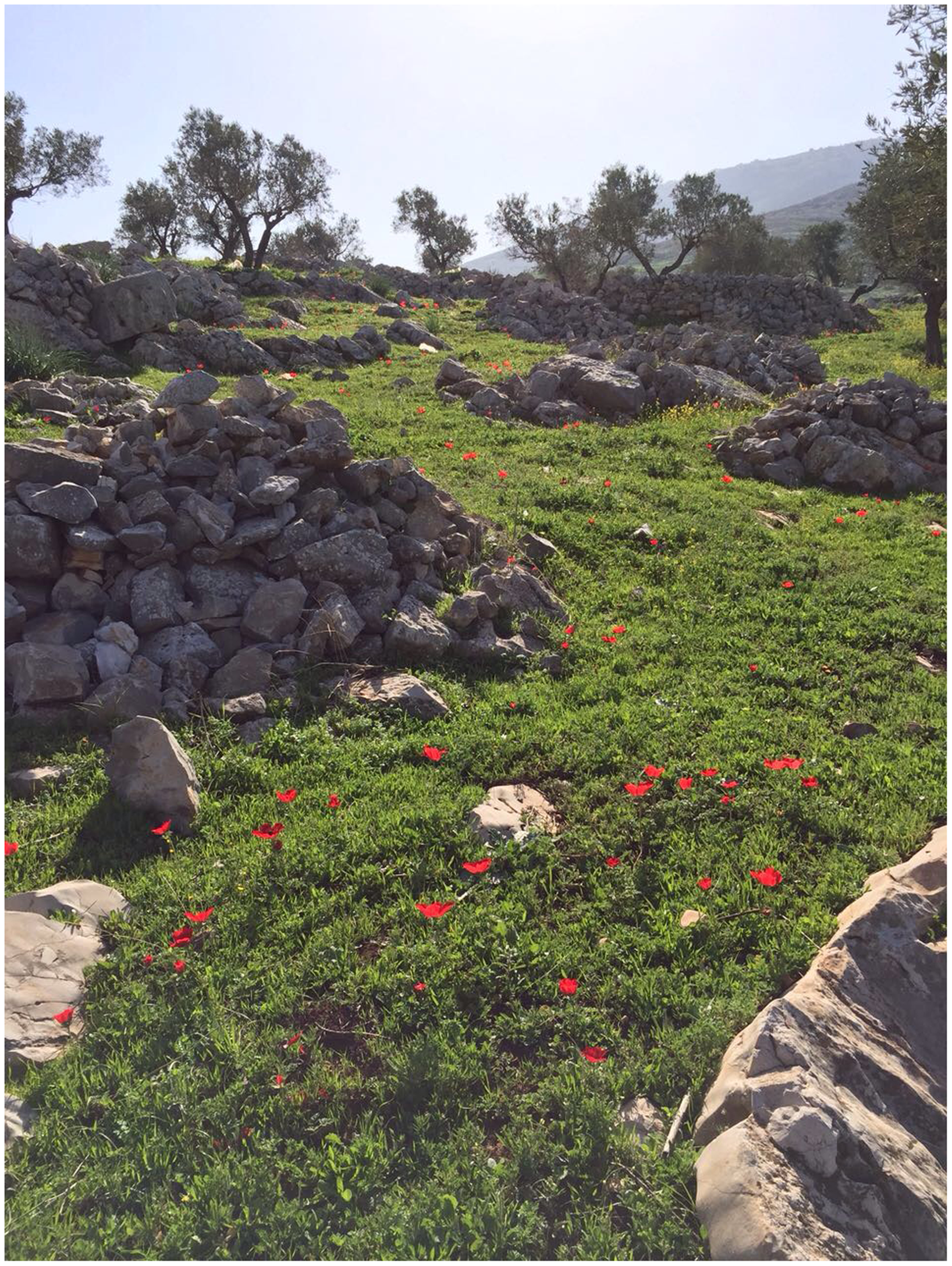
Land herself also resists (see Ayyash, Reference Ayyash2018). Our farm carries scars from war and bulldozers, yet life pushes back: a cactus tree called Em-Ahmed (أم أحمد, Mother of Ahmed) grows from al-sinsila (stone terrace, see Figure 1); desert shrubs reappear after water is diverted. My father adapts, planting drought-tolerant crops such as corn/maize, heeding the land’s own adjustments. Such resilience is the Land’s refusal to be silenced and empty.
Al-sinsila (stone terrace) in an olive grove. Fellahin traditionally use stone terraces to stabilise soil on steep slopes and retain moisture, sustaining olive trees and long-term cultivation. You can also see the poppy anemone. Photograph by the author, 24 February 2017, Tubas village, West Bank, Palestine.

Figure 1 Long description
The image features a stone terrace, known as Al-sinsila, situated within an olive grove. The terrace is constructed from large, irregularly shaped stones and is designed to stabilize the soil on a steep slope. This traditional method helps retain moisture, supporting the growth of olive trees and ensuring long-term cultivation. The terrace is covered with green grass, and scattered throughout are vibrant red poppy anemones. In the background, olive trees are visible, along with a rocky landscape and distant hills under a clear sky.
For me, seeing Land as kin transforms exile. Although far from Palestine, I find a sense of belonging by listening to the kisiskâciwani-sîpiy (“North Saskatchewan River”) and noting the calls of magpies in amiskwacîwâskahikan (“dmonton”). When my father asks, “and how is their Land?” I answer with stories of this Land (the Land now called Edmonton). To respect Land as the first mother is to accept a responsibility of care. Justice, then, is not only about human rights, but about protecting Land that sustains us and about saving our first mother, our dignity.
Al-manfā (exile): knowing from the borderlands
Why did you leave the horse alone?
To keep the house company, my son
Houses die when their inhabitants are gone…
In the poem “why did you leave the horse alone?” Darwish (as cited in Yee, Reference Yee2009) evokes al-manfā as a space where human agony extends to more-than-human worlds: the horse, the house and Land mourn together. His relational dissolves the boundary between sentient and material life, revealing a relational ontology where absence itself becomes animate.
When I first arrived in Edmonton, coming from Cherokee homelands in what is now the southeastern United States, I encountered another form of this relational vitality: the vast sky and the flow of the North Saskatchewan River seemed to carry histories of memory and endurance. What I want to make salient is that exile, or al-manfā, is not merely a human condition but a shared material resonance. In this affective geography, bodies, rivers and winds bear witness to both displacement and continuity. Entering al-manfā is arriving at what Anzaldúa (Reference Anzaldúa1987, p. 78) calls the “borderlands”, living not only a literal crossing of borders but also “a struggle of borders, an inner war” and an intrapersonal agony.
Al-manfā sharpened the awareness of rupture. I live without title to my own ancestral Land (Palestinians recognised stateless in many contexts) and without full belonging in my host Land – a condition of in-betweenness that is both precarious and illuminating. It is true that in-betweenness is painful, it is also true to claim that in-betweenness is a site of ethical and political power and to think in a dynamic way “across established categories, such as nature/culture” (Haraway, as cited in Braidotti, Reference Braidotti2006, p. 202). By dismantling traditional dualisms, in-betweenness could be, also, considered as a “more diverse approach to education for a sustainable future” (Malone, Reference Malone2016, p. 43). Riley (Reference Riley2023) eloquently demonstrated that in-betweenness (the ecotone or contact zone) hosts dynamic tensions between restrictive (potestas) and productive (potential) forces. This dwelling in the middle space, guided by agential realism, is essential for generating new socioecological possibilities and affirming difference (Riley, Reference Riley2023).
Translation became a daily entanglement: explaining to Palestinian friends that the Indigenous peoples around the globe, such as the Cherokee people, Dene, or Assyrians have endured a history not unlike Palestinians, or reminding Canadian colleagues that the Truth and Reconciliation Commission (TRC) is, in some respects, similar to the Oslo peace process that sustain/ed the coloniser domination. This capacity to see across sites and scales echoes what Weis and Fine (Reference Yeshurun2012, p. 174) term “critical bifocality”, defined as an epistemological approach that helps to have a more comprehensive understanding of social and educational issues by considering macro-level structures as well as micro-level lives within broad sociopolitical formations. Yet it is also exhausting to live that bifocality. On such days, I call my father, and his refrain – “Hold your ground” – returns me to the soil of home, both metaphor and literal reminder: ma tinsa (remember) the ground you come from and stand in that truth wherever you are.
Academia, despite its exclusions, also gave me language to name this borderland knowledge. Edward Said described exilic consciousness as “decentered, contrapuntal” (as cited in Spanos, Reference Spanos2012, p. 53). Living “in between” the colonised and the decolonised urges us to configure the multiple ontologies and that realities are enacted differently by different practices, echoing the divergent ontologies of Land: an abstract object and a relative with political meaning (Annemarie Mol, Reference Mol2021; Simpson, Reference Simpson2014, p. 17).
While living “in between”, it is essential to pay attention to critiques of how Euro-Western academia embraces “ontological turns” that echo Indigenous cosmologies while erasing their sources, in such contexts Zoe Todd (Reference Todd2014) for examples warns that “ontology is just another word for colonialism”.
Donna Haraway’s (Reference Haraway1988, p. 587) concept of situated knowledges emphasises that all knowledge is embodied and situated. For me, this situatedness is not a limitation but a wellspring: it ensures that I see Land as both ecosystem and home, as something never empty but saturated with memory and loss. Al-manfā, or Exile, then, is a source of insight, knowing the self and the other, forcing a recognition that knowledge, like belonging, is always bound to Land and history.
ʿadhāb (Agony): affective entanglements with Land
The term ʿadhāb represents the Arabic expression for agony. For the Palestinian people, ʿadhāb, transcends mere feeling or mourning or grief (Sawafta, Reference Sawafta2025); it is true to claim that it embodies a connection with more-than-human worlds especially considering the condition of exile (Cohen, Reference Cohen2021). For instance, in the 1948 Nakba – some scholars theorise it as genocide (Abdo, as cited in Abdo & Masalha, Reference Abdo, Masalha, Abdo and Masalha2018, p. 10) – ʿadhāb and grief became deeply inscribed in Palestinian cultural life following the mass displacement of Palestinians from their Land. This is not to suggest that the term ʿadhāb originated at this moment, but rather that it came to be consolidated as a shared, collective affect and condition shaping Palestinians identity thereafter. In her poem “A Poet in Time of War”, Palestinian Hind Joudah (2024) explores this profound expression of Agony/ʿadhāb in the context of Gaza genocide and leaving homes:
What does it mean to be a poet in times of war?
It means apologizing…
to the burnt trees
to the nestless birds
to the crushed homes…
I strongly feel such agony every time I wake before dawn, with racing heart and the sound of an olive tree being cut down – a tragedy all too familiar for Palestinian families. Though thousands of miles from our Land, I see it clearly in my dreams: silvery leaves trembling as Israeli bulldozer shears through the trunk. Agony crosses continents and oceans. Each morning, my father still rises to tend the Land, even when Israeli checkpoints or soldiers prevent harvesting or expansion. He rarely shares the losses with me, but once, after Israeli soldiers prevented him from going to his Land, which is only 20-minute drive from our house, he waited for five hours at the checkpoint. Afterward, he told me, “ʿadhāb ma feih bado ʿadhāb”, which means an agony beyond anything imaginable. Yet I inherit his agony. In Canada, I carry an ambient agony for the uprooted groves, the contaminated wells and the college friends I constantly lose in the olive fields after Israeli settlers attack them.
This agony is entangled with many lives, worlds and things. In Palestinian Arabic, Darwish once wrote: “If the olive trees knew the hands that planted them[,] [t]heir oil would become tears” (Ghanayem, Reference Ghanayem2023). As a child, I wondered how soil or trees could agonise, but I later understood this as our way of naming the inseparable bond between people and Land. When Fellahin are killed or displaced by Israeli forces or settlers, Land herself aches. This is the structural and most direct violence of occupation: the daily losses since the 1948 Nakba, the uprooted trees and diverted water, the walls that sever hillsides (see Dahnoun, Reference Dahnoun2023). Palestinian literature refers to less direct form of violence as silent displacement or silent annexation (Colonization and Wall Resistance Commission, 2024; Hamdan, Reference Hamdan2020), a process rooted in colonial practices that sever relationships between people and the broader ecological system for two purposes: to colonise the Land and to displace people.
My father often describes one such practice: Israeli settlers releasing deer into Palestinian cornfields to destroy the corps, while imposing fines exceeding $10,000 on any Palestinian who accidentally kills a deer while protecting the Land (also see Land Research Center, 2025). These tactics accumulate not only agony but also deepen the rupture or divide between humans and animals on the one hand and between Land and animals on the other hand. Settlers transform, even for a single moment, the Land-based conflict from one between Indigenous people and settlers into a conflict between Fellahin and deer.
Building on Simpson’s (Reference Simpson2017) understanding of grief, I suggest that agony is not only sorrow but also resistance (Sawafta, Reference Sawafta2025). My father’s persistence – walking the Land, caring for trees he cannot freely talk to or touch – is agony-work as protest. It enacts love and memory against erasure. Deborah Bird Rose (Reference Rose1996, p. 7) notes that Indigenous Australians “worry about Country” as they would for kin. I recognise my father in this: when an olive tree is wounded, he feels it in his own body.
Naming agony became a necessary act for me as well. Thinkers such as Haraway urge us to “stay with the trouble” by committing to living in a “thick presents to keep the story going for those who come after” (Haraway, Reference Haraway2016, p. 125) and rejecting the idea of being vanished between “awful or edenic pasts and apocalyptic or salvific futures” (Haraway, Reference Haraway2016, p. 1).
Shannon Speed (Reference Speed, Speed and Stephen2021, p. 26) speaks of “grief and an Indigenous feminist’s rage” in contexts of injustice. Their work shows that sorrow can foster solidarity. Inspired by Kimmerer’s idea of re-story-ation – restoring severed connections through story (as cited in Pech-Cárdenas, Reference Pech-Cárdenas2023) – I began writing my own narratives of loss such as the story of a village road cut Israeli soldiers by using earthen barriers. Each story carries an argument: this Land matters, these bonds matter. Naming agony can orient us towards protecting what remains and healing what has been harmed.
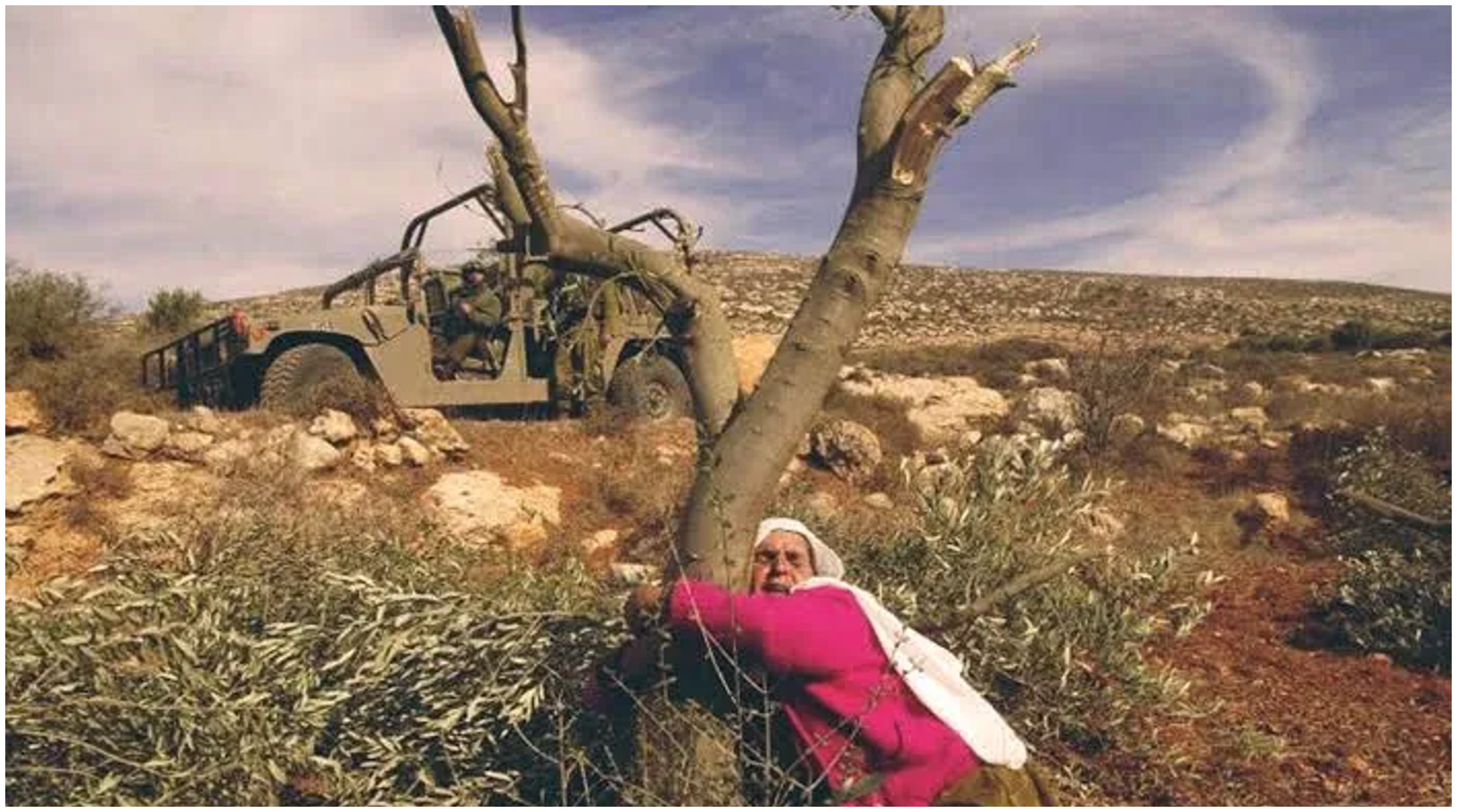
Stories of agony are embodied with everyone and with everything. The following Figure 2 from 2005 shows Hajja Mahfouza Shtayyeh after Israeli settlers cut down her olive trees in the West Bank. Hajja Mahfouza says in an interview with Al Jazeera, “[w]hen I saw the olive tree destroyed by the settlers, I hugged it as if I were hugging one of my sons who had fallen as a martyr” (Al-Najjar, Reference Al-Najjar2007). Since then, this Picture has become an iconic one for Palestinian agony and its entanglements with Land and Trees. In another similar incident, Izzat Abu Latifa, olive farmer from the West Bank, said that “When I saw them cutting down the trees I felt as if my heart was being uprooted from between my lungs” (Brownsell, Reference Brownsell2011). Additionally, in 2003, Al Jazeera documented a testimony for several farmers saying that “our olive oil this year is mixed with blood” (Amayreh, Reference Amayreh2003). This uprooting of olive trees is a colonial policy occurring daily (see Al Jazeera, Reference Jazeera2025).
Hajja Mahfouza embracing an olive tree – a gesture where human and more-than-human ʿadhāb/Agony entwine in shared endurance. Source: (Al-Najjar, 2007).

Figure 2 Long description
In a dry, rocky landscape, a woman dressed in a pink sweater and a white headscarf tightly embraces an olive tree. The tree stands amidst sparse vegetation and scattered rocks. In the background, a military vehicle is partially obscured by the tree and other natural elements. The scene conveys a sense of shared endurance between the woman and the tree, set against a backdrop of rugged terrain and a hint of human conflict.
Reconfiguring rights through rupture
This section is an invitation to envision rights and justice that involves humans and more-than-humans together by highlighting the ruptures exposed through story, where stories serve as a methodology of knowing (Smith, Reference Smith2021). Such rupture comes with the acute awareness of living between irreconcilable worldviews and epistemic agony (Sawafta, Reference Sawafta2025). This agony is a generative space for emphasising Barad’s (Reference Barad2007) ethico-onto- epistemology (where ethics, being and knowing are entangled), including learning from the ground up (quite literally, from the ground or with the Land) (see Choudry & Kapoor, Reference Choudry and Kapoor2010).
Modern human rights discourse, as inherited from Enlightenment liberalism and codified in documents like the Universal Declaration of Human Rights and the International Human Rights Law, is built on certain anthropocentric premises (Gómez Sánchez, Reference Gómez Sánchez2020). It posits a universal human subject vested with inherent rights, abstracted from Land, culture and more-than-human relations (see Gilbert, Reference Gilbert2013). Yet, as many critics have noted, it carried the imprint of its Eurocentrism (Gómez Sánchez, Reference Gómez Sánchez2020). How to accept such universality of human rights where same rights fall apart during the genocide in Gaza (see Krever et al., Reference Krever2024). A genocide that targets everything: humans, Land, animals, water and plants.
Given the exclusion of colonised peoples whose lifeways did not fit liberal individualism, animals and ecosystems deemed rightless, even women and subaltern groups who were only gradually recognised, decolonial scholars such as Gómez Sánchez (Reference Gómez Sánchez2020) underscores the importance of debunking human rights universalism.
Anti-universalists challenge “arrogant, neo-imperial arguments of universality”, based on the geopolitical reality that those who defined and enforced the epistemology of “human” rights were the colonial and imperial powers themselves (see Donnelly, Reference Donnelly2006, p. 22). Frantz Fanon (Reference Fanon1965) and other anticolonial thinkers critiqued this hypocrisy: the same civilisation that authored rights also brutalised colonised nations. Thus, a rupture lay at the heart of human rights – a tension between its lofty ideals and its exclusions and complicities.
My personal disconnect with mainstream rights theory began when I attempted to articulate the harm I felt at my father’s inability to connect with the Land and was further intensified by the genocide in Gaza in 2023. Mainstream human rights language could frame this as a violation of property rights or freedom of movement, but those terms felt insufficient. What about the Land’s rights? What about the violation of our kinship, Palestinian relational liberation that is built on the “right of return” to the Land as kin.
The dominant discourse had no space for the idea that Land could be wronged. Rights were/are reserved for humans, while Land was/is treated as an object – at best an object of human rights, such as the right to property (see Gilbert, Reference Gilbert2013) – but not as a subject in its own regard. As this question continued to unfold through its relations, the more it seemed that human rights, as traditionally conceived, is problematic as much as the mainstream Western epistemology. Riley (Reference Riley2023, p. 41) points out that the system of Western thought “is built on dualistic and hierarchical thinking” that separates “the knower from the known also renders the object as objective…”. Regarding human rights, they did not only fail to protect humans, they consistently fail to prevent ecological or biological harm, for example, Cohen (Reference Cohen2021, pp. 362–363) showed how the conditions of diaspora in the case of Palestine “are intertwined with the condition of ecological degradation because human exile is symbiotic with plant and animal exiles”. Legal scholar Anna Grear points out that:
[T]he dominant conception of the rights-bearer as an autonomous and rational subject has produced forms of closure in rights discourse, paying particular attention to the way in which the central case universal rightsbearer is an abstract entity: either ‘man’ (in the French Declaration) or the ‘human being’ in the UDHR (Grear, Reference Grear2010, p. 137).
Posthumanist/new materialist theorists provide tools to break open this paradigm. Posthumanism questions the centrality of the autonomous human subject, emphasising how humans are entangled with more-than-human agencies and worlds (Birke, Reference Birke2012; Frost, Reference Frost2011; Barad, Reference Barad2007, p. 232). Karen Barad’s concept of intra-action suggests that entities (like human and more-than-human) do not pre-exist their relationships; rather, they emerge through relational interactions (Barad, Reference Barad2007, p. 33). If we take this seriously, then rights, too, could be seen not as pre-existing entitlements held by isolated individuals, but as emergent properties of relationships.
What would it mean to say that a right to clean water, for instance, is not simply a human claim upon water, but a mutual enactment of care between water and people? The Māori legal innovations in New Zealand, where Whanganui River has been granted legal personhood in 2017 (New Zealand Legislation, 2017; also see Evans, Reference Evans2024), hint at this possibility – rights being reframed as flowing from reciprocal relations of guardianship rather than unilateral human dominance.
Applying Barad’s (Reference Barad2007) ethico-onto-epistemology to rights: the way we know rights (for example through stories) shapes the way we be in relation to others, which is an ethical matter. Thus, if we know rights only as abstract rules protecting individuals, we become ethical subjects mostly concerned with our own abstract autonomy for some. But if we reconceptualise rights as relational (for example, the right of a river to flow, which in turn implicates our responsibility to let it flow), we become ethical subjects enmeshed in networks of accountability that include more-than-human worlds. In short, posthumanist thinking urges a shift from human rights to earthly rights. This is not an invitation to diminish human dignity, but to situate it within the dignity of all participants in an ecosystem.
New materialism complements this by foregrounding the agency of matter and the illusory nature of the nature/culture divide. Bennett’s (Reference Bennett2010) idea of vibrant matter invites us to see matter (whether bodies, trees, or tools) as active forces with trajectories and influences. Bennett highlights human life as a form of organised matter not fundamentally separate from the soil or metals in our cells. If we extend this view to justice and rights, one could argue that rights need to account for the vitality of the more-than-humans. What if we recognised the Land’s right to rest, or the soil rights to retain specific minerals? Such formulations are beginning to appear in movements around the rights of nature.
Bennett’s work, however, offers a caution: simply granting human-style rights to more-than-humans might not be enough if we do not also transform our philosophical understanding of agency and responsibility. In Bennett’s view, because humans and more-than-humans co-create each other, ethics becomes a matter of navigating entanglements rather than respecting independent others. “Responsibility and accountability for the lively relationalities of becoming of which we are a part” is how Barad (Reference Barad2007, p. 393) phrases the ethical call.
These theoretical shifts align profoundly with decolonial imperatives. Decolonial scholars like Tuck and Yang (Reference Tuck and Yang2012) have aimed to remind readers “what is unsettling about decolonization” (p. 3). As they argue, settler colonialism transforms Land “into property and human relationships to land are restricted to the relationship of the owner to his property” (Tuck & Yang, Reference Tuck and Yang2012, p. 5). In their manifesto “Decolonization is not a metaphor”, Tuck and Yang (Reference Tuck and Yang2012) emphasise that decolonisation specifically means “repatriation of Indigenous land and life” (p. 1). This is a political demand, but it is also an epistemic one: it asks us to think differently about Land and thus about rights. If Land is not an exploitable resource but a relative, then the rights of that relative must be upheld just as seriously as the rights of any human family member. My grandfather used to say that when we passed a Land that did not yield good crops or trees, it was because of ihmāl (neglect by humans).
By threading posthuman/new materialist ideas with Indigenous and decolonial thought, we see justice as an ecology of relationships. That is, justice is not a set of abstract principles, but rather the quality of relationships among all participants in a given context, including both human and more-than-human entities. In an ecology, balance and reciprocity are key; too much domination or extraction by one part harms the whole. Reciprocity moves beyond a transactional view of nature to one of interconnectedness, mutual responsibility and sustained partnership, recognising the value and agency of all components of the natural world (Ojeda et al., Reference Ojeda, Salomon, Rowe and Ban2022). Thus, a rights framework informed by ecology would prioritise balance and mutual thriving over unilateral claims. This resonates with what some philosophers, such as Thomas Berry (as cited in Tolan, Reference Tolan2011), call “earth jurisprudence” which holds that the Earth community as a whole is the subject of moral concern.
However, I want to push further by including the lived reality of rupture as part of how we know justice. The agony point – where the system fails to address harm – are exactly where new formulations must emerge. Returning to my father’s story that that I opened this article, the agony point was the realisation that my father’s dignity and the Land’s well-being were inseparable, yet human rights discourse siloed them. That rupture led me to engage with frameworks where Land is not only a matter liberation or colonisation, but also dignity (see Abusalem, Reference Abusalem, Hilal, Bedir, Ramsgaard Thomsen and Tamke2023).
Land-bodied rights describe the idea that rights that are conceived as emanating from specific Lands and the human/ more-than-human communities associated with those Lands, rather than from an abstract concept of humanity and civilisation. Land-bodied rights invert the usual hierarchy by making Land primary and people derivative, or by focusing on the “reciprocal human-nature relations” (as opposed to human-centred rights that treat land as derivative) (see Diver et al., Reference Diver, Vaughan and Baker-Medard2024, p. 1). This concept draws inspiration from Indigenous legal principles – such as the Māori notion that people belong to Land rather than Land belonging to people – and from feminist new materialist critiques of human exceptionalism (Gómez Sánchez, Reference Gómez Sánchez2020; Mol, Reference Mol2021; Birke, Reference Birke2012; Subramaniam et al., Reference Subramaniam and Felt2016). It is a theoretical construct in progress, but, based on various mentioned resources in this article, it helps me frame what a decolonial posthuman rights might look like: contextual, plural, rooted in the living relationships of each place/Land.
Critically, rethinking rights through rupture also means embracing partial and plural perspectives. There may not be a single grand theory of posthuman justice that suits all contexts. Indeed, trying to impose one would repeat the universalising tendencies we seek to overcome. Instead, the process of reading diffractively, or diffractive analysis, as Barad (Reference Barad2007; also see Geerts & Van Der Tuin, Reference Geerts and Van Der Tuin2016) points out, allows different perspectives (Indigenous Land concepts, diasporic entanglements, non-Western philosophies, scientific insights, Palestinian Sumud) to interact and create new patterns of understanding, without one silencing the others. This is also important to heal from epistemic agony.
For instance, the highlighted relational stories diffracted through Watts’ Place-Thought concept offered a new angle for me: if Land thinks through us, there is, then, ethical ramifications for rights (we then owe Land a hearing in our decision-making). Such co-articulation when it is put in conversation with Zoe Todd’s critique produces another insight: theories of more-than-human justice must explicitly acknowledge their debts to Indigenous thought or risk continuing the colonial pattern of appropriation. Each rupture – be it personal dislocation or intellectual contradiction – is thus a site of potential innovation if we approach it with what Aimee Cesaire (Reference Cesaire2000) presents, a dialectics of rupture from enlightenment thought and connection to nature, identities and culture.
Finally, rethinking rights must contend with the question of whose knowledge counts. As this special issue’s call notes, pursuing social and ecological justice requires rejecting claims of epistemological certainty about whose knowledge is important. In other words, Eurocentric framework, as “a constructed knowledge system created in Europe to establish its invidious universality and superiority of European thought” (Henderson, Reference Henderson2021, p. 94), need to yield space to other intellectual traditions such as Indigenous. This means uplifting subjugated knowledges – oral histories, spiritual epistemologies, stories, archives, Land-based teachings – as theory in their own right.
Storytelling is one such mode of theory. It carries truths that may not fit into academic jargon but speak to moral worlding (Smith, Reference Smith2021). When my father agonises with Land and says that dividing self from soil is a wound, he is theorising a critique of Cartesian dualism and liberal individualism in plain and honest words. For the purpose of this article, that is to weave stories from Land with theories and academic discourse while preserving their essence and keeping their soul. I find support in scholars who validate storytelling as method: for instance, Cree scholar Dwayne Donald’s (Reference Donald2021) work on curricular storytelling, or educational research by Tuck et al. (Reference Tuck, McKenzie and McCoy2014) on “land education” that integrates community narratives with analysis. They argue that stories are not just illustrations but forms of knowledge production that can unsettle dominant paradigms. Thus, rethinking rights through rupture is not just about the actors or networks (Land, more-than-humans, etc.), but also about the method of telling the agony and healing from it: how we arrive at decolonial knowledge and how we depart from a dominant framework. If we arrive through story, through activism, through Land’s input, the resulting visions of justice will be fundamentally different from one arrived at solely through abstract philosophy.
As this analysis comes together, it is crucial to posit that epistemic, philosophical/ontological, emotional, ethical, political and social rupture is not merely experienced but enacted through relational entanglements – invitations to re-envision the architecture of rights. By attuning to the fracture points where inherited concepts break down, we can piece together a more holistic framework. In this framework, rights are not about isolated individuals versus nation–state power (the classic model), but about ensuring healthy relationships in the web of life. Justice, then, becomes a practice of continually negotiating these relationships and healing them where they have been broken. It becomes, as Blackfoot scholar Leroy Little Bear (Reference Bear and Battiste2007) might say, a process rather than an endpoint – a process of renewing balanced reciprocity.
Pedagogical diffractions: Justice involves humans and more-than-humans together
If justice is an ecology of relationships (Celermajer et al., Reference Celermajer, Schlosberg, Rickards, Stewart-Harawira, Thaler and Tschakert2020), education must connect with Land as teacher and storytelling as method. Standing at this conceptual crossroads, I ask: How can these insights be applied in the practice of contemporary education, particularly more-than-human education?
As I mentioned earlier, my childhood was filled with the fabulous works of Egyptian poet Fouad Haddad. Since then, this song has honoured the Palestinian national liberation movement, Land was important for creating new pathways and education in schools. Each time I listen to it, I am reminded of water, soil and our relationship to them.
It is through story that abstract ideas became personally meaningful to me. The guest editors of this issue write of storytelling as a method that can “speak to the heart of social consciousness” and reveal moral and political phenomena that more formal discourse may evade. Telling the story of my father and our Land to my classmates did more to convey the injustice of colonial Land relations than any report or statistic I could have cited. Stories activate empathy, solidarity and situated understanding. Additionally, they allow listeners to enter a perspective, to feel the stakes.
If we envision a more-than-human education that truly fosters social and ecological justice, it must make room for the kinds of stories and relationships I have described. This means decentring the textbook notion of the more-than-human as an objective system “out there” and instead, as many Indigenous scholars mentioned, highlighting Land as teachers in themselves. Practical approaches such as body Land, or the “ontological relationships between people and territory” (Altamirano-Jiménez, Reference Altamirano-Jiménez2020, p. 322) and Land-based pedagogy (Simpson, Reference Simpson2014). Following Indigenous linking of Land, people and place, Quinton et al. (Reference Quinton, Ward, Ahearn and Carapeto2020, p. 170) highlight resonance-based walkography, or “the concept of resonance”, that considered as an active, embodied engagement to make the specific location the primary site of inquiry. Such pedagogy might involve learning from local Indigenous knowledge keepers, engaging in caretaking activities on the Land and critically examining one’s own relationship to Land. Stories, such as the ones I provided earlier in this article, are small steps towards learning entanglements that cultivate kinship ethics with human and more-than-human others.
By using storytelling, everyone becomes both student and teacher by bringing their piece of the truth. This echoes a key point made by education scholars Nxumalo and Pacini-Ketchabaw (Reference Nxumalo and Pacini-Ketchabaw2017), who argue for common world pedagogies where educators and children learn with, rather than just about, more-than-human worlds. Nxumalo and Pacini-Ketchabaw suggest practices like storytelling with place, multispecies inquiry and paying attention to Indigenous narratives of Land as ways to challenge colonial anthropocentrism in early childhood education.
Storytelling and Land ethics also transform the role of the educator. Rather than the expert imparting knowledge, the teacher becomes a facilitator, a storyteller among storytellers and sometimes an apprentice to the Land. I experienced such practices during open, outdoor classes with middle and high school students in Palestine during the spring semester, as well as during university field trips and academic discussions held in open landscapes, where the beauty of poppy anemones surrounded us.
One might ask, how does this connect to justice? The answer, as I suggest, lies in the kinds of citizens or community members education seeks to nurture. More-than-human education saturated with stories of Land and kinship is likely to produce people who feel deeply accountable to Land and community (both human and ecological). When you have heard the story of an olive tree field from an elder or shared your own story of grief for a river, you are less likely to accept that olive tree being clear-cut or that river being poisoned without objection. The moral stakes become personal.
Moreover, storytelling can highlight connections between injustice and ecological harm, fostering an integrated vision of justice. For example, telling the story of a displaced Indigenous community fighting a pipeline through their territory immediately frames it as both a more-than-human and justice issue – you cannot separate the two. Thus, students come to see such struggles not as isolated incidents, but as part of a pattern of colonial Land relations and racialised exploitation of humans and more-than-humans. This integrated awareness is crucial if we want the next generation to work towards intersecting justice goals rather than siloed activism.
Importantly, a Land storytelling pedagogy also offers healing. The state of the world can induce despair, especially in young people inheriting climate crises and entrenched inequities. By re-grounding them in stories of resilience, of ancestral teachings, of Land that continues to give life, we provide not false hope but what educator Joanna Macy and Chris Johnstone (Reference Macy and Johnstone2012) call “active hope” – the energy to engage in healing the world, sustained by connection rather than optimism.
One challenge I have encountered is institutional constraints. Standard curricula are packed with content, standardised testing and classic theory, leaving little room for open-ended storytelling or Land-based exploration. Here, I draw inspiration from insurgent educators and scholars who find creative ways to overcome these constraints. For instance, Qwo-Li Driskill’s (Reference Driskill2005) work incorporates storytelling and performance to teach about Land and colonisation in ways that standard lessons cannot. Or consider Max Liboiron’s practice in their science laboratory: they open each lab meeting with a reading from Indigenous authors or a moment of diffraction on Land, integrating social accountability into scientific practice (see Raman, Reference Raman2023). These examples show that even within colonial institutions, one can carve out de- and anti-colonial spaces. It requires a bit of bravery and a conviction that these approaches are not a frill but ways of knowing to the educational mission of our time, which I would argue is learning to live well together on a damaged planet.
To conclude this diffraction, I return to the notion of the power of stories for justice. Stories have the power to travel across boundaries; my father’s story, through my telling, has now reached readers and listeners far from our little village in the West Bank. In being told, it gathers new layers – connecting with the stories of an activist in North America, resonating with an Australian Indigenous quote about Country, cited alongside theorists like Barad or Bennett in the pages of a journal. In this way, storytelling becomes an act of world-building and justice-teaching outside of the ivory tower.
Following the special issue’s call mentioning “assemblages and worldings”, my hope is that the assemblage formed here – of Palestinian exile narrative, posthuman philosophy, Indigenous wisdom and educational praxis – offers one such worlding: a vision of more-than-human education and justice grounded in relational story. If we can story our way into new relations with each other and the earth, then we can also materialise those relations in action. The transformations start in the envisioning, but they do not end there. As I finish writing, I envision taking this article, this “story” and planting it like a seed. Not in soil, but in the bodies, minds and hearts of those who read, feel, or hear it. In time, with care, perhaps it will grow into something real, such as a changed lesson plan, a community project, a policy advocacy platform, a ceremony of remembrance. Stories are like seeds: unpredictable in their germination, yet holding immense potential for renewal.
Acknowledgements
I recognise that the ideas in this work are not mine alone, but emerge from a web of relationships – family, friends, mentors, scholars and Lands that have taught me. I spent precious time near the North Saskatchewan River in Edmonton. I spoke to the river every time I was nostalgic. I thank Land where I was born, my small, beautiful village Tubas and Land that currently sustains me in Treaty 6 territory, for their guidance and patience. I thank my father, who continues to ask after Land and, in doing so, teaches me to ask after the self. Moreover, to the reader, thank you for listening to these stories; may they inspire you to listen more closely to your own Land and the stories it holds.
The initial draft of this paper was submitted to the POL S 514 PhD seminar in Winter 2024 under the instruction of Professor Didier Zúñiga at the University of Alberta. Moreover, the same idea was presented as a poster titled “Human Rights Advocacy in the Era of War: The Case of Gaza” at International Week, February 5–10, 2024, at the University of Alberta. I sincerely thank my supervisor, Professor Yasmeen Abu-Laban.
I thank the two anonymous reviewers for their careful and constructive comments. I also sincerely thank Dr Kathryn Morog and Dr Izzeddin Hawamda for inviting me to this special issue.
AI tools (ChatGPT) were used only for transliteration assistance (e.g., rendering Arabic terms such as al-ard zayy al-ʿird in Latin script). All conceptual, analytical, and interpretive work is my own.
Financial support
This research received no specific grant from any funding agency, commercial or not-for-profit sectors.
Ethical standards
Nothing to note.
Author Biography
Eleyan Sawafta is a Palestinian Ph.D. student and Graduate Research Assistant at the Department of Political Science at the University of Alberta. His academic journey began in Palestine, where his early formation in engineering and environmental studies was shaped by life under occupation and concerns for land, climate and survival. He later earned master’s degrees in political planning and peace and conflict studies in Palestine and the United States. Now based in Canada, he contributes as Highly Qualified Personnel to research on immigration and technology, carrying Palestine with him as both origin and horizon. (sawafta@ualberta.ca)

 Open access

