




INTRODUCTION
Criminal law is essentially processual: there is no evidence without the effort of counsels and judges to question witnesses and defendants, and there is no judgment without the practical work accomplished by judges or jurors in assessing that evidence and producing a decision. Typically, this involves connecting textual materials produced at different stages of the proceedings (Heffer, Rock, & Conley Reference Heffer, Rock and Conley2013; Komter Reference Komter2019). Critical scholars have demonstrated how the resulting text trajectories are inflected by power interests, as statements given as testimony are imbued with new meanings in subsequent recontextualizations at later trial stages (Matoesian Reference Matoesian2001; Trinch Reference Trinch2003; Eades Reference Eades2012; Ehrlich Reference Ehrlich2012). Hence, criminal trials represent a prime site where ‘texts cross and weave together different and changing contexts, achieving (or not) a range of social purposes, to the advantage of some actors and to the detriment of others’ (Tusting Reference Tusting2017:554). In this article, we examine the role of such ‘textual traveling’ (Heffer et al. Reference Heffer, Rock and Conley2013) in the production and assessment of evidence about local forms of spirit belief in the trial of the Ugandan rebel commander Dominic Ongwen before the International Criminal Court (ICC). There are reasons to assume that the effects of such travelling may be all the more manifest at an international tribunal like the ICC. ICC trials have been characterized as a form of ‘distant justice’ (Clark Reference Clark2018), and the meaning-making spaces across which ICC trial discourse circulates are separated not only by geographical and demographic but also by sociocultural and institutional remoteness, particularly when dealing with culturally sensitive evidence of the type discussed here.
The ICC is a relatively novel institution. Established as a permanent international court with headquarters in The Hague, the Netherlands, it became operative in 2002 and prosecutes individuals charged with genocide, war crimes, crimes against humanity, and the crime of aggression. Dominic Ongwen is a former brigade commander in the Ugandan rebel movement Lord's Resistance Army (LRA), who was on 4 February 2021 found guilty on sixty-one counts of war crimes and crimes against humanity and on 6 May 2021 sentenced to twenty-five years imprisonment (confirmed on appeals on 16 December 2022). These included attacks and atrocities against the civilian population, gender-based crimes including forced marriage and sexual slavery, and the conscription and use of child soldiers, all committed between July 2002 and December 2005 among the Acholi population in Northern Uganda, in the context of the armed conflict between the Ugandan government and the LRA rebel movement. Ongwen had been captured on 16 January 2015, and four days later he was transferred to ICC custody. The trial itself started on 6 December 2016. Over the course of 234 hearings, the Prosecutor, Ongwen's defense, and the victim representatives called in total 179 witnesses and experts.Footnote 1 This article only deals with a small portion of the vast amount of trial data generated in this way: the evidence presented by the defense regarding the alleged supernatural powers of LRA leader Joseph Kony, produced during the direct examination of its own witnesses and the cross-examination of the witnesses called by the prosecution.
Despite the defense's insistence on the relevance of local spirit beliefs, and despite the 6,000 kilometres distance that separates the ICC trial site in The Hague from the conflict theatre in Northern Uganda, we must also keep in mind that ‘distance’ is a gradient concept. There is ample linguistic-anthropological and sociolinguistic literature on what might be called ‘cultural’ differences in how professional and lay actors in domestic trials perceive legal proceedings (Conley & O'Barr Reference Conley and O'Barr1990; Trinch Reference Trinch2003; Heffer et al. Reference Heffer, Rock and Conley2013), and domestic judges too occasionally must pass judgment over perpetrators whose cultural background is radically different from their own. International criminal trials, however, derive much of their specificity from the fact that culture and other contextual considerations often play a far more comprehensive role in determining individual criminal responsibility.
This centrality of context extends in multiple directions. Other scholars have pointed out that in international criminal justice, criminal truth is always closely intertwined with historical truth (see, for example, Wilson Reference Wilson2011), which poses some unique challenges. For example, commenting on the difficulties of trying war crimes in the former Yugoslavia, Koskenniemi notes that
in the context of a domestic criminal trial, … there is normally little doubt about how to understand the relevant acts in their historical context. The only problem is ‘did the accused do it’? … In transitional periods, however, the debate about past normality takes on a contested, political aspect. How to deal with the routine spying by citizens of one another, shooting at those wishing to escape, or systematic liquidation of political opponents? How to judge the actions of individuals living and working in a ‘criminal’ normality …? (Reference Koskenniemi2011:179–80)
It is due to this entwining of the criminal and the historical record that the ICC, but also the Yugoslavia and the Rwanda Tribunals, may be considered ‘transitional justice mechanisms’ (Teitel Reference Teitel2003; Murphy Reference Murphy2017). Similar to truth commissions and local justice initiatives, they enable societies recovering from mass atrocities to achieve closure by establishing an authoritative historical record and ‘giving a voice to the victims’ (but see Kendall & Nouwen Reference Kendall and Nouwen2013). However, narrative authority at international courts is not exclusively located in judgments but is distributed across actors and trial stages (Sander Reference Sander2018), and consequently this entwining of law and history also opens possibilities for introducing alternative, often more explicitly political narratives. Hence, Ongwen's attorneys invoked several disruptive strategies to overturn the Prosecution narrative of a bloodthirsty African warlord made to bow to the rule of law (Branch Reference Branch2017; Hassellind Reference Hassellind2021). Their client had himself been conscripted as a child soldier at a very young age, which fundamentally destabilizes the victim-perpetrator dichotomy on which the international criminal law framework is founded (see also Minkova Reference Minkova2021). The defense also provided evidence about the interests of the military and the government in allowing the war to drag on, and highlighted violence committed by government troops and the forced relocation of Acholi villagers in refugee camps, thus suggesting selectiveness on the part of the Prosecution.Footnote 2
More important for our purposes, the Ongwen case also brought out the centrality of local cultural circumstances in examining questions of criminal liability and the intertwining of legal truth and ‘anthropological’ narratives. To prove that their client had committed the alleged crimes under duress, and could therefore not be held criminally liable, the defense submitted extensive evidence about the role that spirit beliefs played in the LRA rebel movement. Ongwen's attorneys particularly emphasized the predictive powers attributed to LRA leader Joseph Kony, who acted as a medium for the various spirits that had allegedly joined the rebel ranks. LRA fighters believed that these spirits secretly provided Kony with information allowing him to pre-emptively detect treason and defection, which installed a reign of terror that made it impossible for fighters to escape, even for a high-ranking commander like Ongwen. Once this spirit-based duress defense had been raised, the ICC Judges were legally required to consider the defense evidence on spirituality in the Judgment and make a statement on what the rebels ‘actually believed’.
Here too, the rise in complexity is striking. The way this evidence about the rebels’ spirit beliefs is produced and evaluated illustrates that at the ICC, the task of assessing the cultural background of the perpetrators extends far beyond what is commonly understood as a ‘cultural defense’ (Foblets & Renteln Reference Foblets and Renteln2009) in domestic criminal trials. Domestic cultural defenses typically involve a relatively simple assessment of whether presumably ‘cultural’ elements may have had an impact on the behavior of deviant individuals considered outsiders of the mainstream culture with which the legal system is associated (D'hondt Reference D'hondt2010). In the Ongwen trial, however, assessing whether the defendant acted under duress required an in-depth assessment of the whole cultural environment in which the perpetrators operated and an inquiry into the local circumstances under which deviant conduct could eventually become a new form of normality.Footnote 3 Moreover, these determinations concerning the cultural environment had to be made despite the fact that the legal instruments available offered only limited guidance as to their relevance. As Kelsall noted regarding the Special Court for Sierra Leone (a partially international, ‘hybrid’ criminal tribunal): ‘how to credibly assess the responsibility of military actors who have as a significant source of their authority, imputed supernatural powers?’ (Reference Kelsall2009:145). The Ongwen trial was slightly different, in that it was a subordinate brigade commander subject to supernatural discipline who stood trial rather than a commander-in-chief endowed with supernatural authority. Yet, the problem facing the Judges remained largely identical: how to take into account the defense claim that their client acted under the spell of a spirit, when the Rome Statute (RS), the international treaty that established the ICC's jurisdiction and its substantive and procedural law, and the other available legal instruments do not contain any provisions on issues like supernatural surveillance or spirit participation in warfare?
In the Ongwen trial, the ICC Judges wrestled their way out of this conundrum by positing a strict binary of believing/not-believing, according to which those in command of the LRA skillfully exploited the naivety of newly arrived recruits and abducted child soldiers. This article draws on the rich sociolinguistic and linguistic-anthropological scholarship on text trajectories in the legal process to trace the discursive processes by which this binary theory of believing was established. The transformation of evidence across trial stages is an important part of this, and hence we examine below how the Trial Chamber's assessment (and eventual dismissal) of the defense evidence about spirit beliefs was grounded in specific patterns of re- and decontextualization (Bauman & Briggs Reference Bauman and Briggs1990) that selectively erased the interactional environment in which the testimony was produced and made witness statements consistent with the Chamber's own theory of the LRA as belief-environment. This, however, is only a part of the story, and our analysis reveals that the defense counsels who elicited the evidence were at least partially complicit in the production of this binary. Hence, the seeds of this binary approach to LRA spirituality were planted in the questioning practices of the defense (and on at least one occasion also of the Presiding Judge).Footnote 4 For this reason, our account of the text trajectory begins with the ‘entextualization’ (Bauman & Briggs Reference Bauman and Briggs1990:73) of the evidence during testimony-taking, that is, the interactional process of ‘encoding … human experience and the cultural marking of this representation as a text which … acquires a life of its own and can be taken up and recontextualized in other settings’ (Maybin Reference Maybin2017:416). In the final part, we point out the implications of these continuities between en- and recontextualization for our understanding of text trajectories and textual traveling, arguing that they redirect attention to the shared ‘grammar’ on which the legal language game is founded.
The trial transcripts on which this analysis is based can be found on the ICC website and are available for research purposes. To navigate the massive amount of trial data related to this four-year trial, we adopted a twofold strategy. First, we examined the testimony of witnesses called by the defense to give testimony on spirit beliefs in the LRA. In addition, we examined those transcripts that were referenced in the segment of the Judgment dealing with these beliefs in the context of the duress argument, so as to also cover (at least partially) those occasions where the issue was addressed in the defense's cross-examinations of ex-LRA members called by the prosecution. As examples of ‘public transcripts’ (Park & Bucholtz Reference Park and Bucholtz2009) that are endogenous to the legal process, these hearing transcripts reflect the ‘logocentric’ bias characteristic of the ICC and many other legal institutions: the transcripts are verbatim renditions of ‘all the words’ spoken in the courtroom, but embodied production features (gestures, pauses, etc.) are systematically erased and evidence in Acholi or other Ugandan languages is rendered in the ICC's working languages English and French. As such, they epitomize a narrower understanding of entextualization (the translation of speech into written text, cf. Maybin Reference Maybin2017:416), which here occurs in tandem with the interactional encoding of lived experience and partially obscures our view of that process (see D'hondt Reference D'hondt2021 for a full account). Original video footage, however, is not available. The removal of embodied speech features from the transcripts also mirrors the real-life downplaying of such features caused by the ICC's simultaneous conference interpreting. In this sense, the logocentrism of the transcripts captures the lifelessness that characterizes much testimony-taking in the ICC courtroom, where counsel and witnesses are expected to observe a five-second pause before responding to what the other speaker said.
SPIRIT BELIEFS IN THE LRA AND IN THE COURTROOM
The LRA emerged in the late 1980s and is often described as at once a political-military insurgency and a religious movement aimed at spiritual renaissance (see, for example, the contributions in Allen & Vlassenroot Reference Allen and Vlassenroot2010). Strongly resembling an earlier politico-military spirit cult led by the medium Alice Auma in 1986–1987, of which the LRA is alternately depicted as a competitor or the successor, Kony's movement drew on existing Acholi practices of spirit possession and ritual purification (including the acceptance of non-clan-based, ‘foreign’ spirits that had made their appearance in early colonial times), but was also innovative in that it was built around possession by a ‘holy spirit’ of Christian origins, on a mission to eradicate witchcraft and restore social order among the Acholi (Behrend Reference Behrend1999). The appearance of these ‘holy spirits’ is indicative of the modern character of movements like that of Alice Auma and the LRA (Behrend Reference Behrend1999:38) and reflects the tensions Northern Ugandan society was going through at the time, as successive dictatorships and prolonged civil war had dismantled Acholi civil society and politically marginalized the northern provinces, which concurrently faced the impossible task of reintegrating fleeing ex-army soldiers after Yoweri Museveni's National Resistance Movement had taken control of the government in the South (Behrend Reference Behrend1999:126; see also Branch Reference Branch, Allen and Vlassenroot2010). The role of spirituality in the LRA appears to have gradually declined from the middle of the nineties onwards, as the movement was forced to seek refuge in Sudan and began to receive military assistance and training from the Khartoum government (Titeca Reference Titeca, Allen and Vlassenroot2010:72). But at least in its earlier stages, leadership was attributed to a multiplicity of spirits, under the command of the ‘holy spirit’ Lakwena and speaking through the mouth of Joseph Kony, who had allegedly established the many rules and commandments that LRA members had to observe, directed military operations, and were in charge of intelligence gathering (Titeca Reference Titeca, Allen and Vlassenroot2010). By the time the case went to trial, the role of these spirits had been amply documented in the academic literature. Both parties drew upon the expertise of social and political scientists in building their case, and some of the authors cited here were also called to testify in court.
Based on testimony on the role of spirit beliefs in the LRA, Ongwen's counsel raised two ‘affirmative’ defenses, which, if successful, would have fully exonerated Ongwen from criminal liability (Nistor Reference Nistor2022). First, they argued that the traumatic experiences and spiritual indoctrination their client suffered from an early age had resulted in a state of mental illness and prevented him from controlling his own conduct (‘mental incapacity’, RS Article 31(1)(a)). Second, they emphasized that these spirit beliefs contributed significantly to maintaining discipline in the LRA ranks, and that their client was convinced that he too risked severe punishment if he resisted Kony's orders or tried to escape. Hence, Ongwen had committed the alleged crimes under ‘a threat of imminent death or of continuing or imminent serious bodily harm’, the primary requirement for ‘duress’ under RS Article 31(1)(d).Footnote 5 As Nistor (Reference Nistor2022) points out, both the mental incapacity and the duress defense invoked local spirit beliefs to demonstrate that the defendant's agency was restricted up to a point that criminal liability is effaced. In the case of incapacity, however, these beliefs and the practices associated with it allegedly resulted in a state that would also be considered pathological in Ongwen's own cultural environment. For duress, the associated sense of supernatural discipline is supposedly representative of the defendant's cultural milieu (see also D'hondt Reference D'hondt2010). This article is primarily concerned with the latter, examining how the court processes evidence by which such ‘alternative normality’ is projected in the courtroom.
To demonstrate the ubiquity of spirit belief, Ongwen's defense called several former LRA fighters and abductees (testifying as fact witnesses), and one expert witness, an anthropologist-political scientist with a long record of fieldwork in Northern Uganda and multiple publications on LRA fighters’ cosmological beliefs. In the Judgment, however, the Chamber discarded this expert testimony as ‘of very limited value’, on the grounds that he had refused to ‘question the statements made to him about the spiritual influence on LRA fighters and did not consider it to be his role to make a judgment about the truthfulness or falsity of the statements’.Footnote 6 Having thus precluded a social-scientific evaluation of the impact spirit beliefs had on LRA fighters,Footnote 7 the Chamber assessed the validity of the duress defense exclusively on the basis of these fighters’ testimonies about ‘what they believed’. Indirectly, our article therefore also contributes to the ongoing debate about the friction between legal and anthropological epistemologies regarding cultural evidence (Good Reference Good2007; Wilson Reference Wilson2016), by documenting a case in which the court itself takes on the role of ‘anthropological knowledge-machine’.
DURESS CAUGHT IN A TEXT TRAJECTORY
Our account of the production and assessment of spirit evidence is thus based on how counsels and Judges handled belief-statements by fact witnesses called by the defense. For obvious reasons, this discursive negotiation of the relevance of spirit beliefs cannot be understood apart from the legal framework within which the trial actors operate: both the questions that the counsel put to ex-LRA members and the selections that the Judges made from the massive amount of available testimonies (and their recontextualization of the latter in the Judgment) were ‘filtered’ by the trial actors’ orientation to, and interpretation of, the category of duress established in RS Article 31(1)(d). Peculiar to this case is that the defense attempted to expand this notion of duress beyond its established interpretation of immediate physical threat, by introducing a collective subjective element: the fear and awe that the spirits and Kony's supernatural powers instilled among LRA fighters. In the Judgment, the Trial Chamber did not reject this innovative interpretation per se but ruled that the defense had failed to provide sufficient evidence that such a ‘shared belief’ indeed existed among LRA rebels.Footnote 8
Hence, the Ongwen trial at once illustrates the structuring power of legal doctrine regarding what can be argued in court and the ‘open texture’ of legal rules (Hart Reference Hart1961). Applying ‘rules’ to ‘facts’ is a bi-directional process and represents ‘an unavoidably creative practice that constitutes the meanings that it purports to find’ (Sander Reference Sander2018:304; see also D'hondt, Dupret, & Bens Reference D'hondt, Dupret and Bens2021; D'hondt, Pérez-León-Acevedo, & Barrett Reference D'hondt, Pérez-León-Acevedo and Barrett2022). This article makes this open-texturedness empirically tangible, by examining how the defense evidence in support of duress based on spirit beliefs is discursively produced and assessed. For this, we draw both on CA-style analysis of courtroom talk and on linguistic-anthropological and sociolinguistic notions of textual traveling and legal text trajectories. The analysis of the recontextualization of ex-LRA members’ belief-statements in the Judgment shows how the Chamber's orientations to the category of duress are fused with a binary conception of how belief operates. This is consistent with earlier accounts of how testimony transforms and acquires new meanings as it ‘moves up’ in the legal process and is reinserted in meaning-making spaces to which the witnesses have no access (cf. Blommaert Reference Blommaert2005:62). This process is in turn facilitated by language ideologies that emphasize ‘referential transparency’ (Haviland Reference Haviland2003) and the ‘self-contained’ or ‘fixed’ nature of written text (Mertz Reference Mertz2007:46), hence obfuscating the power dynamics behind these recontextualizations and the establishment of the belief-binary.
Texts that are supposed to travel along institutionally defined trajectories also have forward-looking qualities, and testimony is a prime example of discourse produced specifically with an eye on its later reuse in judicial proceedings (Komter Reference Komter2019). Our analysis of the trajectory of spirit evidence in the Ongwen trial therefore starts already at the entextualization stage, examining the unscripted exchanges where defense counsels and ex-LRA members jointly ‘co-author’ (Cotterill Reference Cotterill and Cotterill2002) incipient narratives of how Kony controlled LRA ranks through spirit possession. We do so not only to identify possible tensions and discrepancies between the defense's and the Chamber's interpretations of the witnesses’ utterances (which are indeed likely to occur), but also to demonstrate that the process of legal interpretation and of fleshing out legal categories and requirements is already operative at this initial stage, while trial actors are reworking lived experience into presumable stable ‘text’ that can buttress their argument.
THE ENTEXTUALIZATION OF SPIRIT POSSESSION: CLAIMING VS. EXHIBITING BELIEF
To substantiate the collective duress argument, the defense called several ex-LRA fighters to testify on the widespread and systematic nature of spirit beliefs in the movement (between September 2018 and March 2020). Before that, the defense also raised the issue of spirit possession while cross-examining ex-LRA fighters called by the Prosecution (from January 2016 to April 2018). Here, we analyze how this evidence of spirit belief is elicited and ‘entextualized’ (or interactionally shaped as quotable text). Below, the defense counsel cross-examines one of the prosecution witnesses, P-0231, a former fighter who had served under Ongwen and knew him personally. After asking how new LRA recruits were socialized and how this prevented them from escaping, the counsel turns to the religious aspect of the movement and raises the issue of spirit possession.
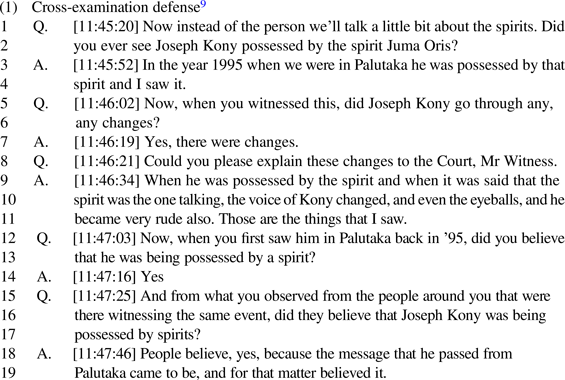
The defense counsel's line of questioning gradually culminates in the elicitation of an explicit belief-statement (lines 12–14), starting in lines 1–2 with the yes/no interrogative about whether the witness “did … ever see Joseph Kony possessed by the spirit Juma Oris” (once a high-ranking colonel and Minister of Foreign Affairs under the Idi Amin dictatorship, now allegedly the spiritual commander of the LRA's military operations). In line 3, rather than responding with a straight yes or no, the witness provides precise temporal (“In the year 1995”) and spatial (“we were in Palutaka”) references to an occasion where he observed the LRA leader being possessed by the spirit in question, followed by an explicit confirmation of first-hand access to the event (“and I saw it”). Both the specificity of the spatiotemporal references and the fact that they precede the witness's explication of his mode of access (‘There was X and I saw it’ rather than ‘I saw X’) enhance the facticity of his description. The counsel continues with two questions that perpetuate this ‘empiricist’ orientation and elicit further clarification of ‘what exactly’ the witness saw, that is, the physical, vocal, and behavioral changes Kony underwent, before finally embarking on the elicitation of an explicit belief-statement in lines 12–13.
Extract (1) thus exemplifies a collaboratively accomplished, delicately patterned alternation of two distinct modes of providing evidence about one's beliefs, only one of which is ‘legally adequate’ (Ferraz de Almeida & Drew Reference Ferraz de Almeida and Drew2020). The initial, ‘empiricist’ account of the changes in Kony's conduct prior to line 12 suggest that P-0231 assumes that these changes indeed constitute credible evidence of spirit possession, which betrays a form of belief. Based on Sacks’ (Reference Sacks1992:252) distinction between ‘exhibiting’ and ‘claiming’ (see also Drew Reference Drew, Drew and Heritage1992; Ferraz de Almeida Reference Ferraz de Almeida2022; D'hondt, Pérez-León-Acevedo, Ferraz de Almeida, & Barrett Reference D'hondt, Pérez-León-Acevedo, de Almeida and Barrett2022a), it can be argued that the witness is here exhibiting his belief in Kony's spiritual powers. From line 12 onwards, however, this exhibition of belief is treated as insufficient by the defense counsel, who uses it as a steppingstone for requesting a confirmation, first, about the witness's individual belief that Kony was possessed (lines 12–13) and, next, about the collective beliefs of his fellow LRA members (lines 15–17). Here, the witness is summoned to formulate an explicit claim affirming his belief in spirit possession, despite having ‘exhibited’ that position in his previous answers. Below we see that only these explicit belief-claims are quoted in the Judgment, suggesting that confirmation is required for belief-testimony to acquire legal significance. The agenda-based character of the counsel's elicitation of these explicit belief-claims is conveyed by the ‘and’-preface in line 15, which indicates a connection between subsequent inquiries (Heritage & Sorjonen Reference Heritage and Sorjonen1994).
This ‘empiricist’ orientation also permeates the accounts that witnesses occasionally produce in response to the counsel's elicitation of a belief-claim. In the next two extracts, taken from the direct examination of two former LRA fighters called by the defense, the counsel asks the witnesses to explicitly confirm their belief after first producing an exhibition. In both cases, their explicit confirmation is immediately followed by an account for their beliefs.
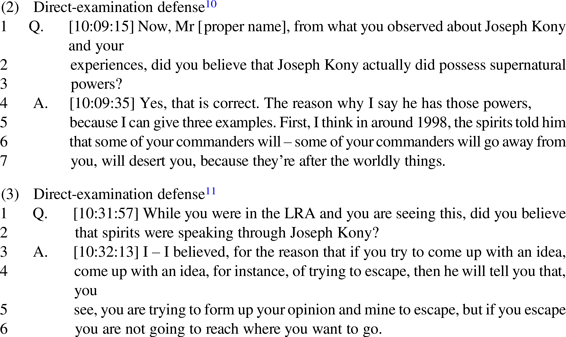
Accounts are typically used to explain untoward or deviant behaviours (Buttny Reference Buttny1993; Antaki Reference Antaki1994) and to ‘forestall negative conclusions which might otherwise be drawn’ (Heritage Reference Heritage and Antaki1988:140). That witnesses volunteer accounts for their beliefs thus indicates that they anticipate how this ‘non-Western’ form of spirituality will be received at the other side of the witness stand. In doing so, these ex-LRA fighters are actively reaching out to the Court, and the following statement by Behrend (Reference Behrend1999:10), on a written text prepared for her by a former officer in the LRA's precursor movement led by Alice Auma, is equally applicable here.
Anthropologists are not the only ones confronted with the problem of translation; the same is true for those who try to produce a text [in this case, testimony] that crosses cultural boundaries. … The distance of events that texts for Europeans required for him permitted him to recognize the ‘exoticism’ of the Holy Spirit Movement and its history. But perhaps it was also the influence of the mass media that led him to defend his own text as non-fiction.
The agency that witnesses demonstrate in addressing their international audience, and the mediated nature of their testimony, demonstrate the partiality of analyzing their testimony in terms of Sacks’ contrast pair ‘claiming’ vs. ‘exhibiting’. For a defense counsel seeking to establish the widespread nature of spirit beliefs in the LRA, their accounts of what they saw may represent ‘exhibitions’ of belief that can be used as a steppingstone for eliciting explicit belief-claims. For the ex-fighters, however, at least for those like in extracts (2) and (3) who have ‘kept their faith’, these accounts also serve to empirically substantiate their belief that Kony had supernatural powers and to underscore the veracity of their testimony.
Regardless of whose perspective we adopt here, the salience of the distinction itself appears beyond doubt. Occasionally these two modes of giving evidence can even become the object of a discursive struggle, as in extract (4) below from the cross-examination of prosecution witness P-0205. In the twenty-five minutes that preceded, this former LRA recruit, who had successfully managed to escape, gave a detailed description of the various spirits in the LRA pantheon. However, confronted with the counsel's elicitation in lines 2–3, he first rejects confirming his belief in Kony's powers (by pointing out its incompatibility with his escape, lines 4–5), before formulating an explicit claim of disbelief (lines 5–6).
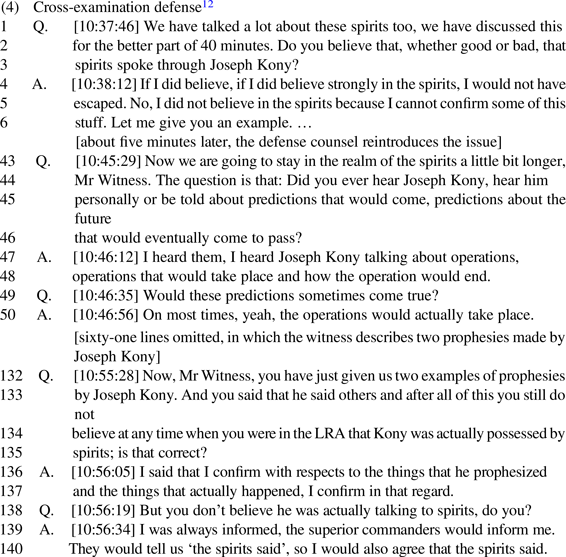
First, the defense counsel successfully elicits an account from the witness that ‘exhibits’ belief in Kony's supernatural powers, as in Acholi culture it is the ability to predict the future that authenticates the spirit medium's status (Behrend Reference Behrend1999). Once the witness has completed the account, the counsel proceeds by pointing out the discrepancy between these exhibitions of belief and the witness's earlier explicit statement of disbelief (lines 132–135). The witness responds (in lines 136–137) with a partial acknowledgment that he realized Kony possessed predictive powers (but which may also anticipate further disagreement; Pomerantz Reference Pomerantz, Atkinson and Heritage1984), after which the counsel reiterates the discrepancy (line 138). The incident indicates how eliciting explicit belief-claims is central to the defense counsel's efforts, with revealing the discrepancy with earlier exhibitions as an alternative option if the witness refuses to come forward with such an explicit claim.
A final observation concerns the relationship between these exhibitions and the temporal organization of believing/disbelieving. In the first extract, the witness's belief-claim was unambiguously formulated in the past tense. However, the ‘empiricist’ nature of the witness's preceding report of Kony's possession (i.e. the fact that he considers certain observable changes in Kony's conduct/appearance to be ‘evidence’ of possession, an empiricism that he apparently still endorses before the Court) simultaneously suggested a continuity of belief, from the reported event (Palutaka, 1995) up to the reporting event (testimony-taking). In the fragment below, a continuation of the cross-examination by the defense counsel in extract (1), this ambiguity is picked up by the Presiding Judge, who, directly after the witness's explicit belief-claim, intervenes with a question that explicitly raises the duration of belief as a matter of concern.
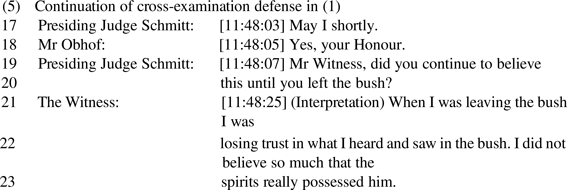
This temporal organization of believing/disbelieving in turn becomes the subject of debate. The Presiding Judge's intervention suggests only a vague correlation between ceasing to believe and ‘leaving the bush’, without specifying any concrete temporal reference points and leaving open issues of cause and effect. The witness's response retains this vagueness, indicated by successive uses of the past progressive (“when I was leaving the bush I was losing trust”, lines 21–22) suggesting simultaneity rather than consecutiveness. However, when the floor is returned to the defense counsel, the latter invites the witness to situate his loss of belief in a more precise timeframe.
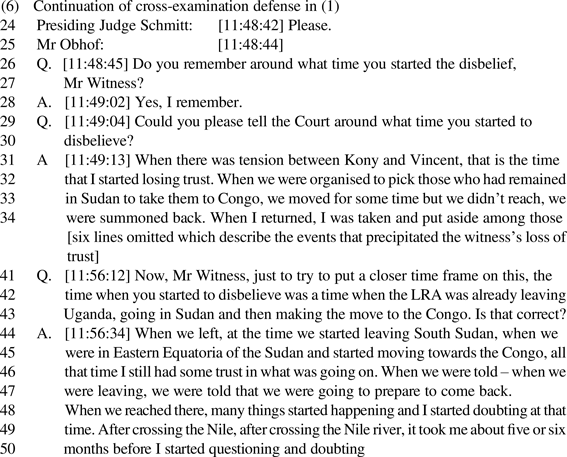
Unlike the Presiding Judge, the defense counsel refuses to treat the temporality issue as resolved. In his answer, the witness describes in detail the circumstances under which he started disbelieving, providing a biographical account that also refers to political rifts within the LRA and power struggles between the LRA commanders Joseph Kony and Vincent Otti. The witness's use of the phrase “losing trust” (line 32) also hints at alienation from the political project embodied by the LRA, suggesting that his loss of belief was not purely a ‘transcendental’ or ‘internal cognitive’ phenomenon. In the next sequence (starting in line 41), this biographical account of his loss of belief is further situated within a broader, explicitly historical frame of events, referring to the time when the LRA was withdrawing to Eastern Congo. Such entanglements of explicit belief-claims and orientations to temporality are recurrent throughout the corpus and will be important in our discussion of how the defense evidence on spirituality in the LRA is recontextualized in the Trial Judgment.
RECONTEXTUALIZING SPIRIT BELIEF: THE ASSESSMENT OF CULTURAL EVIDENCE
Let us now examine how this evidence about spirit belief, co-authored by defense counsels and witnesses (and occasionally also the Presiding Judge) in testimony-taking, is recontextualized by the Trial Chamber in its assessment of that evidence. The following extract from the Judgment is essential in this respect. In the extract, the Judges acknowledge the ubiquity of spirit beliefs and the reverence for Kony's supernatural powers among LRA members. However, they brush aside the defense argument that this would excuse Ongwen from criminal liability, arguing that the available evidence suggests a recurrent ‘pattern’ whereby belief in the supernatural declined the longer a recruit stayed with the LRA.
(7) Trial JudgmentFootnote 13
Whereas there is evidence that some persons did believe in the spiritual powers of Joseph Kony,7047 the Chamber observes that there is consistent evidence that for many persons who stayed in the LRA longer their belief followed a pattern: it was stronger in the young, new and impressionable abductees and then subsided and disappeared in those who stayed in the LRA longer.
This trajectory was explained very clearly by P-0231, who stated that when he first saw Joseph Kony in 1995, he believed Joseph Kony was possessed by a spirit.7048 However, the witness explained that when he was leaving the bush he was losing trust in what he heard and saw in the bush, and that he ‘did not believe so much that the spirits really possessed [Joseph Kony]’.7049 P-0231 also stated:
In regards to the spirits, when I had just arrived in the bush, when I was still young, I believed so much that the spirits were the ones that were protecting us against anything.
Later on, when I grew up and I became aware, I started realising that it was not that thing that was protecting me. I started believing that my own survival skill made me to survive from whatever was happening in the bush. That was according to me. I started realising that whatever Kony says, that this and that should be done, he first mentions so that you will follow what he wants. I realised later that because I was still young, it was what Kony used to brainwash you so that you can believe.
When I matured up, I became aware and knowledgeable in many of the things that were happening. I realised that even if I'm not told, I'm supposed to protect myself because I am already exposed to danger. No one can ensure I am safe. I should ensure that I safeguard myself so that I don't die.705
This extended quote is followed by eleven more paragraphs containing often equally extended quotes from other ex-LRA members (at the rate of one witness per paragraph), to illustrate and confirm the existence of the alleged ‘pattern’. Testimony by those who believed in Kony's spiritual powers is by comparison treated far more superficially, in a footnote (7047) listing a limited number of references to explicit belief-claims in the transcripts (cf. supra).
The Judgment does not explicitly state a reason or cause why these spirit beliefs would have subsided or disappeared over time, thus suggesting that the pattern was the result of a uniform and inevitable process of ‘staying longer’ in the LRA. This is confirmed by the lengthy quote of witness P-0231, in which this former LRA recruit describes his gradual loss of confidence in the LRA's practices of magical protection as a process of ‘becoming aware/knowledgeable’ that directly correlated to ‘growing up’ and ‘maturing’. By recontextualizing P-0231's testimony, about realizing that survival was primarily a matter of self-preservation, as an instance of this pattern, the Judgment bestows P-0231's account with a self-explanatory character: because it instantiates the pattern, it may be considered a recurrent phenomenon. This recontextualization also sets the stage for the remainder of the evidence: framing P-0231's individual experience (about one single belief-aspect, magical charms) as an ‘illustration’ turns the quoted fragment into a template for interpreting subsequent testimony excerpts, allowing ‘the pattern’ to emerge through repetition.
The effects of recontextualization are also present in the preceding summary of P-0231's testimony, which contains two short quotes (one direct, one indirect). The footnotes to the summary refer to the following passages in the hearing transcripts (which we discussed earlier in excerpts (1) and (5)).
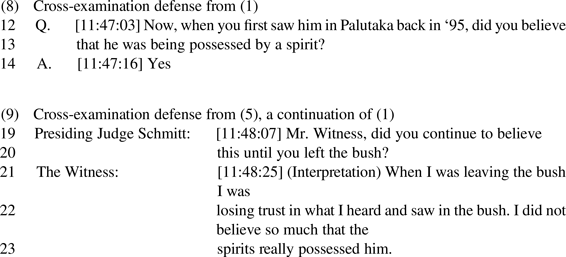
The Chamber's paraphrase of P-0231's testimony is not referencing a single monological statement delivered in a continuous stretch of talk, as an isolated reading of the Judgment might suggest. Instead, the pattern is constructed out of two separate question-answer pairs: (i) an affirmative response to the counsel's presuppositional question about whether the witness believed in Kony's spiritual power “in Palutaka back in ‘95” (note that the indirect quote attributed to the witness was actually produced by the counsel), and (ii) an account of the witness's growing scepticism of Kony's powers as he left the bush, in response to an intervention by the Presiding Judge. By describing these discursive actions by the witness as ‘stating’ and ‘explaining’, rather than, for example, confirming information presented by the defense counsel, the Judgment ignores the collaborative nature of storytelling and testimony-taking (Trinch Reference Trinch2003), and conceals the involvement of the counsel and Presiding Judge in eliciting and co-authoring the evidence. Moreover, referring to such very short extracts also removes the broader canvas against which trial actors negotiate the meanings of such statements. Recall that the question in lines 19–23 was asked by the Presiding Judge, and resulted in a verbal duel with the cross-examining defense counsel that revolved precisely around the temporal organization of believing/disbelieving: while the Presiding Judge was interested in finding out how the loss of faith was connected to the witness's decision to leave the bush (which is consistent with the concept of a recurrent pattern), the defense counsel elicited a ‘biographical’ account that anchored the emergence of disbelief in historical time and suggested disappointment about political rifts that had emerged in the LRA. The latter part of the exchange, however, has disappeared in the Chamber's reading of the evidence.
This erasure of the broader discursive canvas and context of production is a recurrent feature of the recontextualizations of the additional testimonies, in the paragraphs after the P-0231 template. Here as well, the mutually constitutive relationship between the excerpts from witness statements and the recurrent pattern which they allegedly instantiate—an instance of what Garfinkel (Reference Garfinkel1967) would refer to as the ‘documentary method of interpretation’—takes precedence over the discursive struggle over meaning in the hearings during which that testimony was elicited. This is most outspoken in paragraph 2650, in which the Judgment cites witness P-0205 as saying that “if I did believe strongly in the spirits, I would not have escaped”. In taking this explicit statement of disbelief at face value, the Chamber omits that it formed part of an extended cross-examination sequence in which the defense counsel successfully elicited an ‘exhibition’ of spirit belief from the witness (see extract (4)).
The structuring power emanating from such recontextualizations as ‘exemplifying’ the pattern is best illustrated by paragraph 2647, which immediately follows the template provided by the first excerpt.
(10) Trial Judgment
Very similarly to P-0231 [cf. extracts (1) and (7)], also P-0379 testified:
That's what we are told. We are told, we are told about these things. But later on I, I became wiser and I decided that the use of things like the holy spirit is done to brainwash the younger children so that they do not escape. But at the time when it happened to me I believed it and I thought I had to comply and obey. But then when I realised that there were some people who were able to escape and not be apprehended, then I started doubting it because I knew that, that the holy spirit that they were talking about wasn't actually effective.
Turning to the hearing transcript, we see that this statement was made under cross-examination and immediately modified by the defense counsel. First, he asks the witness to confirm that he was abducted at age fourteen and that he escaped after only eight months. Next, he asks whether children abducted at a younger age were also able to resist spiritual indoctrination and tried to escape as well. In this way, the counsel subtly recasts the witness's account as not applicable to their client, who was much younger when he was caught and stayed with the rebels much longer, enough for indoctrination to be successful.
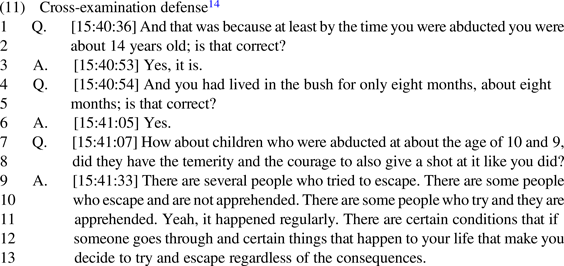
Taking into account the full context, the quoted witness statement could equally well have been invoked to support a rebuttal of the pattern. The fact that also younger people came to understand that the spirits had no power, and that they did so quite quickly (like the witness), could easily be recruited to paint a murkier, more complex picture, in which some people might believe but others might not, thus transcending the simple binary ‘believer/child soldier’ vs. ‘skeptic/adult fighter’.
Extracts like (7) and (10) also illustrate that the ‘believer/child soldier’ vs. ‘skeptic/adult fighter’ binary in turn evokes another dichotomy, that between ‘real victim’ of one's culture and ‘manipulative agent’ (Cooke Reference Cooke2017:30). The latter is deeply rooted in the legal liberalist assumptions underlying the ICC (for a critique, see Clarke Reference Clarke2009), and together these two binaries paint a picture of Ongwen and the other LRA commanders as skilled manipulators who ruthlessly exploited the naivety of the child soldiers they abducted. A full critique of these binaries is beyond the scope of this article, but it can easily be argued that they leave little room for the many shades of gray that characterize survival (and in the case of a victim-perpetrator like Ongwen, also the fact of being raised) in a rebel militia in a context of protracted civil war. As Branch (Reference Branch2017:40) comments,
In situations like the war in Uganda, in which longstanding violence has been deeply incorporated into societies, in which people must live under and try to make meaningful lives within local and global structures of violent constraint, consent is never absolute, and agency is always entangled and qualified. So a belief in mind reading or in the rightness of a cause is not something that is either permanently on or off. Ongwen, it seems, believed uncertainly in Kony's mind-reading powers. He had been indoctrinated and was under duress, but he also had access to other moral worlds and came to his own decisions. He laughed and he tried to flee. The question of individual criminal liability, potentially problematic in any criminal trial, becomes so extreme in some of the ICC's Africa interventions as to throw the very foundation of the law into doubt.
Elsewhere we argued that these binaries set an extremely high standard for successfully raising a duress defense (D'hondt, Pérez-León-Acevedo, Ferraz de Almeida, & Barrett Reference D'hondt, Pérez-León-Acevedo, de Almeida and Barrett2022b). The question is also whether the deterministic and essentialist view of culture projected by these binaries leaves sufficient room for the expression of local perspectives on the conflict, which is from a transitional justice perspective deeply problematic and casts doubt over the Court's potential as a mechanism for achieving closure in cases involving culturally sensitive issues.
CONCLUDING REMARKS
The analysis has shown how this binary take on the LRA as a belief-environment emerged through the Trial Chamber's recontextualization of a range of selected fragments as part of an emerging ‘pattern’. Assembling this pattern depended on the work of the Judges to transform testimonies into ‘a ‘polished’ version that occults the action that led to its production’ (Dupret, Colemans, & Travers Reference Dupret, Colemans, Travers, Dupret, Colemans and Travers2021:3), which once again shows that ‘knowledge about prior and current contexts is only ever partially shared in professional encounters and recontextualization is not equally transparent to all participants’ (Maybin Reference Maybin2017:421). Yet, the defense was at least partially complicit in the construction of this binary. In their questioning, Ongwen's counsels indeed expressed a greater concern with contextualizing and historicizing the temporal organization of (dis)believing, but the seeds of the belief-binary were already planted in the practice of eliciting explicit belief-claims. The intrinsically binary nature of the defense's questioning comes out most clearly in extract (4), in which the counsel tried to counter a negative belief-claim by eliciting a positive ‘exhibition’ of belief. In the majority of cases, however, this binary strategy was not aimed at undermining the credibility of the witness, even if that witness had been summoned by the Prosecution. Instead, it sought to produce evidence of spirit belief that is legally adequate and could be used later in the trial.
The fact that binarism was also part of the defense strategy for exonerating Ongwen has major ramifications. It suggests that, even though the dice eventually rolled in an unfavorable direction (and the Chamber rejected that Ongwen acted under duress), the trial actors nevertheless agreed over ‘the rules of the game’. In the end, the Chamber imposed a different temporal organization on ‘authentic’ spirit belief and contrasted it with ‘pretending’ and acting like a cultural impostor, but the binary conception of believing as a zero-sum game was endorsed by all actors. The doctrinal grid of RS Article 31(1)(d) may have established the framework for debating duress, but that debate was grounded in a consensus on subjecthood and associated notions of believing, agency, and culture that are deeply rooted in legal liberalism (Cooke Reference Cooke2017; see also Clarke Reference Clarke2009).
Ultimately, this once more illustrates the analytical potential of concepts such as text trajectory and textual traveling. If anything, our account illustrated that their potential extends beyond demonstrating how witnesses lose control over their utterances at later trial stages. The outcome of discursive struggles like the one documented here may be unpredictable and the movement of text and discourse across trial stages may not necessarily be unidirectional (a dimension not explored here, as we did not consider recontextualizations in subsequent hearings and/or closing briefs), but an intertextual analysis of textual traveling may reveal deeper commonalities. Legal scholars have argued that (international) legal discourse must be understood as a ‘language game’ that enables the articulation of conflicting positions (but without providing any intrinsic grounds for preferring one over the other; Koskenniemi Reference Koskenniemi2011; see also Jayyusi Reference Jayyusi, Dupret, Lynch and Berard2015). By emphasizing the continuities between en- and recontextualization, we opened a window onto the underlying ‘grammar’ on which this language game is founded.


 Open access

