

Introduction
Since the beginning of the 2000s, behavioural insights (BI) have gradually been applied in the design of policy programmes all over the world (Afif et al., Reference Afif, Islan, Calvo-Gonzalez and Dalton2019; Naru, Reference Naru2024; European Commission: Joint Research Centre et al., Reference Dupoux, Gaudeul, Baggio, Bruns, Ciriolo, Krawczyk, Kuehnhanss and Nohlen2025). BI has been defined in a variety of ways, for example, as ‘knowledge obtained from practical efforts to gain accurate and evidence-based understanding of how people behave and make decisions’ (UN Innovation Network, 2021: 2), ‘lessons derived from the behavioural and social sciences, including decision-making, psychology, cognitive science, neuroscience, organisational and group behaviour’ (OECD, 2017: 3) and ‘empirical evidence from the behavioural sciences, which study human behaviour in an attempt to identify the factors that affect our behaviour’ (European Commission, 2021). Although behavioural science knowledge has increasingly been applied in public administration during the last decades (OECD, 2017; Sanders et al., Reference Sanders, Snijders and Hallsworth2018; Ewert, Reference Ewert2020; Baggio et al., Reference Baggio, Ciriolo, Marandola and van Bavel2021), limited scientific research exists on the experiences of BI use, particularly outside the health context. Thus, studying the experiences of seasoned BI experts would benefit agents in various countries to direct BI promotion across different contexts.
To fully make use of the behavioural science approach in political decision-making, it is beneficial to integrate it throughout all phases of policy planning and implementation (Gopalan and Pirog, Reference Gopalan and Pirog2017; Afif et al., Reference Afif, Islan, Calvo-Gonzalez and Dalton2019; European Commission: Joint Research Centre et al., Reference Dupoux, Gaudeul, Baggio, Bruns, Ciriolo, Krawczyk, Kuehnhanss and Nohlen2025). Such integration requires an understanding of the challenges that experts working in public administration in different countries have faced and the solutions they have found. In European policymaking, the initial aim of using BI was to gain a better understanding of consumer behaviour, for example, in legislation to prevent purchases based on misleading information (Baggio et al., Reference Baggio, Ciriolo, Marandola and van Bavel2021). While contemporary approaches are frequently restricted to choice architecture and nudges (Ewert, Reference Ewert2020; De Ridder et al., Reference De Ridder, Feitsma, Hoven, Kroese, Schillemans, Verweij, Venema, Vugts and Vet2024), most actors currently see BI as a broad range of actions based on behavioural science that extends beyond nudging (Einfeld, Reference Einfeld2019; Ball, Reference Ball2022; Hallsworth, Reference Hallsworth2023). BI can be combined with traditional interventions like regulations, incentives and information requirements to enhance policy tools. It can also serve as an input to the entire policymaking process (Olejniczak et al., Reference Olejniczak, Śliwowski and Leeuw2020). It is acknowledged that BI does not guarantee a specific outcome and sometimes even indicates that no intervention or a conventional approach will give the best result (European Commission: Joint Research Centre et al., Reference Troussard, Sousa Lourenço, Rafael Almeida and Ciriolo2016).
Many factors impede or facilitate the use of research evidence in policymaking (van de Goor et al., Reference van de Goor, Hämäläinen, Syed, Juel Lau, Sandu, Spitters, Eklund Karlsson, Dulf, Valente, Castellani and Aro2017; Lecouturier et al., Reference Lecouturier, Vlaev, Chadwick, Chater, Kelly, Goffe, Meyer, Tang, Antonopoulou, Graham and Sniehotta2023) and public health policy (Liverani et al., Reference Liverani, Hawkins and Parkhurst2013). For example, lack of funding and varied political priorities can be key limitations for behavioural science projects, whereas strategic leadership, global networks, behavioural diagnostics and a solid evidence base can be seen as the key facilitators (Manning et al., Reference Manning, Dalton, Afif, Vakos and Naru2020). Examples of other key factors for the successful use of BI in policy include ensuring administrative and political support, an appropriate mix of key skills in BI teams (Halpern and Sanders, Reference Halpern and Sanders2016), sustained relationships with practitioners, and conducting both rapid small-scale trials and bigger, long-term projects (Ball et al., Reference Ball, Hiscox and Oliver2017). Previously identified impeding or facilitating factors also include criteria for project selection (Jones et al., Reference Jones, Head and Ferguson2021), participatory approaches and co-design when developing interventions (Byrne-Davis et al., Reference Byrne-Davis, Turner, Amatya, Ashton, Bull, Chater, Lewis, Shorter, Whittaker and Hart2022), building a shared understanding of the policy arena and priorities, and developing strong relationships with policymakers (Lecouturier et al., Reference Lecouturier, Vlaev, Chadwick, Chater, Kelly, Goffe, Meyer, Tang, Antonopoulou, Graham and Sniehotta2023).
In addition to facets listed above, it has been pointed out that ‘the work of BI units is also limited by the lack of understanding among public sector agencies about the nature of behavioural science knowledge and the discipline required to use scientific methods for establishing reliable evidence’ (Jones et al., Reference Jones, Head and Ferguson2021: 447). Underlying assumptions may impede use of BI in public policymaking. As the mainstream discourse in behavioural policymaking has historically focused on choice architecture, it may have created expectations of simple principles and tools that can be directly applied in solving complex problems. Such discourse includes the assumption that applying BI to policy is equally simple: that it is rationalist, instrumental and apolitical (for contrasting views of these assumptions, see, e.g., Feitsma, Reference Feitsma2018, Reference Feitsma2020; Whitehead et al., Reference Whitehead, Jones and Pykett2020). Real-world barriers, such as limited time and resources inhibit policy makers’ ability to integrate BI into policy practice. To make policies more BI-based, BI experts may need to be understood as knowledge brokers who translate BI to the ‘language of policymaking’ (Feitsma, Reference Feitsma2019).
Contextual understanding of BI in public administration is important (Fox and Sitkin, Reference Fox and Sitkin2015; Mukhtarov, Reference Mukhtarov2024). It has been noted that in promoting BI in public administration, the policy context should be better acknowledged and accommodated (Meyer, Reference Meyer2010). For example, applying BI has been critiqued for failing to understand the nature of policy procedures (Feitsma, Reference Feitsma2019). Most literature on the use of research evidence seems to lack a more nuanced perspective that applies theories and concepts from political science (Liverani et al., Reference Liverani, Hawkins and Parkhurst2013; Verboom and Baumann, Reference Verboom and Baumann2020).
With an even wider new wave of interdisciplinary perspectives in the field (see, e.g., Feitsma and Whitehead, Reference Feitsma and Whitehead2022; Schmidt et al., Reference Schmidt, Chen and Paz Soldan2022), complexity-informed approaches have been called to complement conventional applied behavioural science (Skivington et al., Reference Skivington, Matthews, Simpson, Craig, Baird, Blazeby, Boyd, Craig, French, McIntosh, Petticrew, Rycroft-Malone, White and Moore2021; Heino, Reference Heino2025; Stenger and Schmidt, Reference Stenger and Schmidt2025). One such approach, the Cynefin framework, addresses contextual understanding by distinguishing between ‘ordered’ and ‘complex’ decision-making domains (Snowden and Boone, Reference Snowden and Boone2007; European Commission: Joint Research Centre et al, Reference Rancati and Snowden2021; Snowden, Reference Snowden2026). In the ordered domain, solutions are either clear to everyone or – while complicated – discoverable through expert analysis, often amenable to standardised, large-scale solutions. Outside the ordered domain, the main context faced by behavioural public policy is called complex. Complex decision-making contexts are characterised by non-linearities, emergent properties and context-dependence. A similar distinction, between ‘complex’ and ‘large scale’ aspects of complex systems, is made by mathematical theories of complexity (Bar-Yam, Reference Bar-Yam and Kiel2002; Siegenfeld and Bar-Yam, Reference Siegenfeld and Bar-Yam2020).
For example, most parts of organising logistics for a mass vaccination event would fall into the ordered decision-making domain that permits solutions mostly based on a priori expert analysis. This is because experts can design the flow of people undergoing the process, and the process is the same for everyone (Siegenfeld and Bar-Yam, Reference Siegenfeld and Bar-Yam2020). In contrast, complex contexts – such as many aspects of countering vaccine hesitancy – require probing the system with parallel small-scale interventions, applying contextual adaptation and participatory approaches. This is because the inherent uncertainty of novel and idiosyncratic issues requires a different level of responsiveness. The distinction resonates with emerging discussions in behavioural public policy: for example, Hallsworth (Reference Hallsworth2023) notes that while we need to ‘see the system’, not everything is complex.
This study aimed to explore the challenges that seasoned international BI experts, working in public administration or as consultants for public servants and policy actors, experience and solutions that they have identified. We were particularly interested in experiences related to educating, cooperating with and advising public servants about the use of behavioural knowledge in their work, the scope of our interviews being framed as ‘introducing the use of behavioural insights to governments’.
Our research questions, regarding experiences of behavioural science experts working in public sector in different countries, were:
1. What kind of challenges have they faced, when they have been striving to promote use of BI?
2. What solutions have they identified or developed to such challenges?
In what follows, we will describe the methodology before moving on to our findings.
Methods
Study design and setting
We conducted semi-structured individual interviews with international experts working in behavioural advisory roles with the government or international BI units to explore their views and experiences of BI advisory work and training. The study plan was reviewed by the Ethics Committee of the Tampere Region (Statement 86/2022).
Data collection
The participants were recruited personally by email using convenience sampling. We sent an invitation to BI experts working both in the public sector and elsewhere (e.g., at universities) in various countries. More specifically, the research team and a collaborator first used their networks and contacted potential participants working at international BI units. Furthermore, the research team used Internet search to identify more experts with extensive expertise in educating, cooperating with and/or advising public servants.
Of the 21 invited experts, 57% agreed to participate. Six invitees did not answer the invitation, and three refused due to lack of time to participate. In total, 12 BI experts (6 men and 6 women) from national or regional BI units, international NGOs and universities took part in the study. Participants were based in Europe (n = 7), Australia (n = 2), North America (n = 1) and internationally operating organisations (n = 2). They had applied BI in a total of 39 countries situated in Europe, the Middle East, North Africa, Southern Africa, Central Asia, Southern Asia, the Far East, Australia, North America and South America. While some participants had worked in several countries, most of them had experience from one country only.
A semi-structured interview guide (including questions about misconceptions, barriers and facilitators, success stories and lessons learned; see Supplementary File 2) was developed, tested and modified. Interview data were collected during the summer of 2022 via Microsoft Teams by trained research assistants. During recruitment, participants received the oral and written information that their responses would be used for research purposes, voluntariness of the interview and possibility to withdraw at any time. All participants consented to participate before answering the interview questions. The interviews, which lasted for 48 min on average (range 39–57 min), were recorded. Recordings were transcribed by an external service provider, and transcripts were pseudonymised. The entire text corpus consisted of 75,797 words in total (range 4,467–8,101 words, mean 6,316 words).
Analysis procedure
Transcripts were analysed during autumn 2022 using inductive content analysis (e.g., Elo and Kyngäs, Reference Elo and Kyngäs2008; Tuomi and Sarajärvi, Reference Tuomi and Sarajärvi2018) with an essentialist approach, which means that the research interest is to report ‘experiences, meanings, and the reality of participants’ (Braun and Clarke, Reference Braun and Clarke2006, p. 81).
The main focus of our analysis was to identify challenges and solutions to implementing BI in policymaking. Challenges were identified by focusing on responses given to questions about problems and barriers, most usual misunderstandings and examples of unsuccessful BI advisory or training. Solutions were identified by focusing on responses to questions about facilitators, examples of successful BI advisory and training, learnings and what the participant would do differently in the future.
We analysed one whole answer to a question at a time and limited our attention to explicit content. First, the responses were condensed, grouped and categorised inductively. For example, if the answer to a question concerning problems and barriers included description of learning, this extract was coded as learning and vice versa. In this process, the responses to one question at a time were read, and relevant paragraphs extracted. From these paragraphs, keywords were identified, and a categorisation was created based on the keywords. Lists of challenges and solutions could hence be formulated based on the positive or negative nature of an extract. Next, the transcripts were re-read to see whether any challenges or solutions had been left unidentified. Final categories and subcategories were determined by comparing the extracts and looking for similarities and differences. Lastly, we checked which solutions and which challenges were present in each interview and whether we could identify links between them. In the main, analysis was carried out by K.K., with thorough discussions about tentative categories in team meetings among the analyst, N.H., S.P. and M.T.J.H.
Categories were distinguished from subcategories based on level of abstraction, with main categories representing broader themes and subcategories capturing specific manifestations. While the coding process was predominantly inductive, we acknowledge that the research questions’ focus on challenges and solutions provided initial sensitising concepts. An example of analysis unit is as follows:
Q: … what kind of things have been the helpful factors or facilitators in introducing the use of behavioural insights to governments?
P1: If you show good evidence, (–), you know, strong evidence regarding the impact of the intervention, it is quite easy to implement the policy or, yeah, that is. Or get support for any experiment. But you really need to show evidence, which is clear regarding the potential of the intervention that you are proposing. Yeah, I will say that, now. And the association with academia. If you, as a bureaucrat are alone doing this, it’s gonna be harder. But if you create good links with academia, with professors with a good background doing behaviour interventions and experiments, the route, the path is gonna be easier, yeah.
Because the number of renowned experts in this field is limited, and we were able to reach a significant percentage of the target group, we focused on those broad overarching themes in which saturation was reached. However, BI is not a uniform construct (Ball and Feitsma, Reference Ball and Feitsma2020), and in more particular sub-areas, such as specific cultural insights by participants with background in for example, anthropology, saturation was likely not reached, and we cannot make claims of more niche categories.
Positionality
Our research team positions itself within a complexity-informed understanding of behavioural insights that extends beyond traditional nudge-based choice architecture. This research emerged from a practical question: understanding challenges in training and advising civil servants to inform development of a training programme in complexity and BI for public servants. Most of the authors are behavioural scientists with backgrounds in complex systems sciences, behaviour change science and public health, with considerable experience in advising policymakers rather than first-hand policymaking experience. This may have shaped what we attended to regarding institutional barriers. We are sympathetic to the ‘behavioural and cultural insights’ view that goes beyond nudges (Copenhagen: WHO Regional Office for Europe, 2024), and the ‘s-frame’ view that goes beyond individual focus (Chater and Loewenstein, Reference Chater and Loewenstein2022; Connolly et al., Reference Connolly, Loewenstein and Chater2025). In addition, our commitment to developing a training intervention for public servants created focus on addressable challenges while potentially creating blind spots regarding structural barriers.
Before moving on to the results, we would like to emphasise that the views here represent those of the interviewees, whose expertise lies in BI and not necessarily policymaking – the domain of public servants. Hence, they represent only a partial view of the public administration’s realities.
Results
Our participants largely approached BI from the perspective of both behavioural and social sciences applied to policy. Their understanding of BI consisted of features such as having a scientific basis, pertaining to knowledge and understanding of human behaviour and being methodologically grounded in evidence. Participants differed in their perspectives to an extent. Some approached BI primarily through a behavioural economics lens, emphasising heuristics, biases and choice architecture, often with a strong orientation toward testing discrete interventions using experimental methods such as RCTs. Others approached BI from a more design-oriented perspective, emphasising user-centred and co-design methods, iterative prototyping and attention to the broader service and system contexts in which behaviour takes place. Most participants drew on elements of both to some degree. For more details, see Supplementary Table 1 of Puukko et al. (Reference Puukko, Heino, Kostamo, Saurio, Sniehotta and Hankonen2024). They all had trained and/or advised public servants, and shared facilitators and barriers in the endeavour.
For the first research question, we categorised the identified challenges into three main categories, and for the second research question, we identified potential solutions that were categorisable into four main categories. The solutions illustrate what actions BI teams can take to tackle those problems and barriers. We present challenges first, then move on to solutions.
Challenges identified in expert interviews
Identified challenges were categorised in three main groups: (1) quality of behavioural knowledge among key actors, (2) resources of BI units and public servants and (3) the public policy setting. These categories were interconnected and overlapping, described with extracts in Table 1.
Results: content analysis of experienced challenges
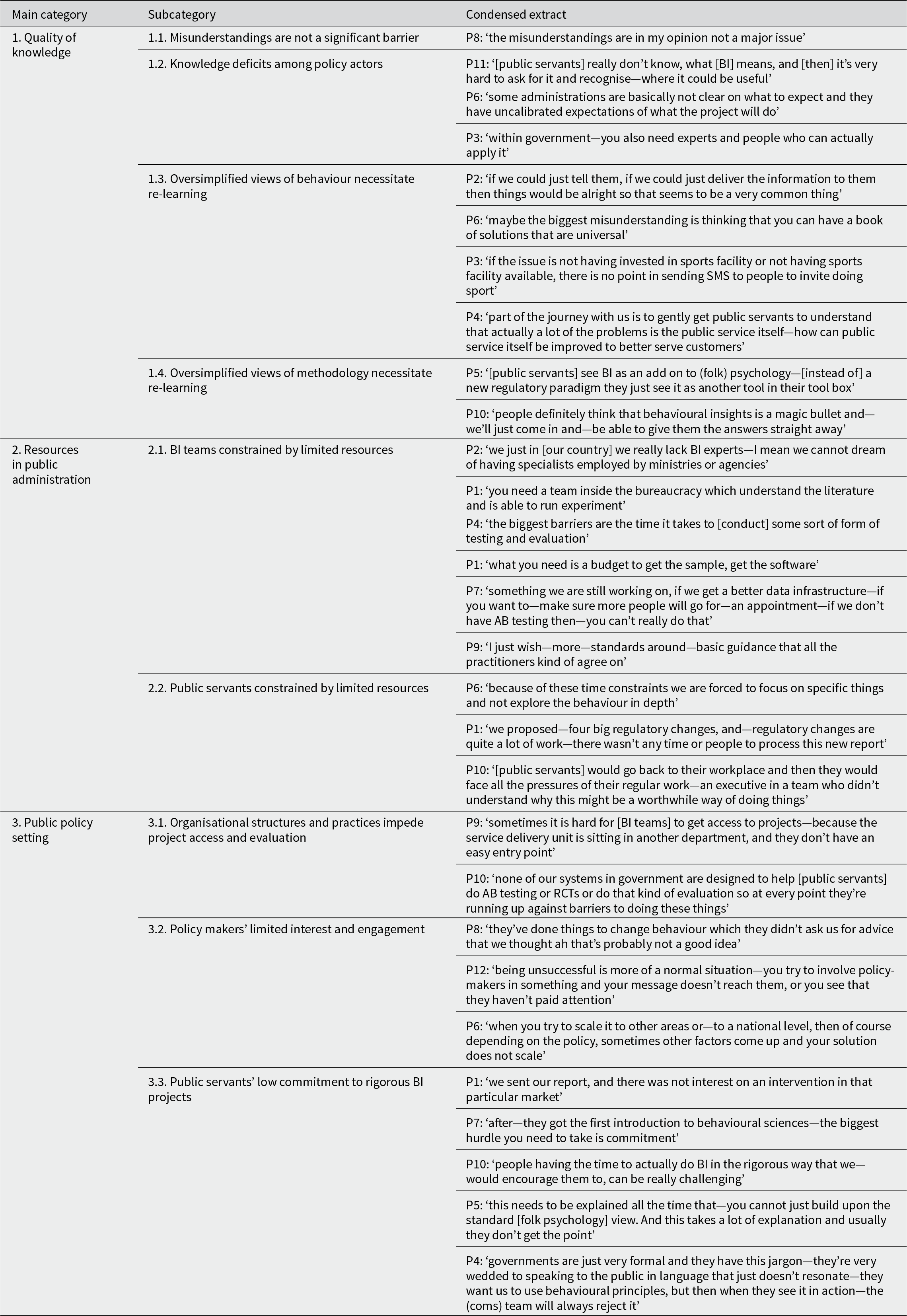
Table 1 Long description
The table summarises interview extracts about challenges in applying behavioural insights in public administration, organised into three main categories with subcategories. Under quality of knowledge, participants report that misunderstandings may be minor for some, but many describe knowledge deficits among policy actors and oversimplified beliefs about behaviour and methods, including treating behavioural insights as a magic bullet or a universal solution book. Several extracts stress the need to re-learn, such as recognising structural causes of problems and matching interventions to real constraints rather than defaulting to messaging. Under resources, both behavioural insights teams and public servants cite limited time, staffing, budgets, data infrastructure, and agreed standards, which restrict experimentation and evaluation such as A B testing and randomised trials. Under the public policy setting, organisational silos and systems impede access to projects and evaluation, while limited policymaker engagement and low commitment reduce uptake and follow-through on rigorous work. Across categories, a recurring pattern is that capacity and incentives in government settings constrain evidence-based testing even when interest exists. The entries are qualitative excerpts, so they indicate themes and perceived barriers rather than frequencies or effect sizes.
Challenge category 1: quality of behavioural knowledge
The category of knowledge was composed of conflicting interpretations of BI between public servants and BI experts during training and advisory settings. A couple of interviewees stated that differing understandings ‘are not a major issue’ (P8). Still, the most salient issue was seen to relate to (limited) awareness and understanding of BI. Many participants noted that public organisations may frequently lack such knowledge, and when they do, it can be challenging to proceed with BI projects or advisory work if that knowledge conflicts with the view the expert has. First of all, without being aware of BI, there may be no demand for BI advisory at all:
P11: ‘I think the most obvious barrier is maybe that people really don’t know, what it means, and if you don’t know, what it means, it’s very hard to ask for it, and recognise maybe the problems or themes where it could be useful, and on the other hand, where it’s not maybe the first choice, so, sort of making that distinction is hard, when you don’t have the basic knowledge about it.’
On the other hand, if ‘BI is perceived as a solution for everything’ (P3) – also for issues that are not behavioural by nature – BI projects may not achieve the goals that the partner has set. As described by another participant, it is possible that partial previous exposure to BI ideas may create unrealistic expectations that BI experts cannot meet:
P6: ‘[–] their initial understanding of what behavioural insights are and what is the promise of the project. Like basically some, it could happen that some administrations are basically not clear on what to expect and they have [–] uncalibrated expectations of what the project will do.’
Even with sufficient understanding of BI, it can be hard to make the transfer from the insight into what it means to public policy. Some participants explained this difficulty as having to adopt ‘a new regulatory paradigm’ (P5): a different way of doing things than the one that public administration is accustomed to. Hence, being able to apply BI in practice necessitates not only correct information but time and practice, as illustrated in the following extract:
P10: ‘[–] it can be really uncomfortable for people. It’s a different way of thinking about problems and it doesn’t always align with how they’re used to thinking about what their goals are or how they are used to thinking about approaching problems so giving people the space and the reflection and, yeah, the time to sit in it and kind of sit in these new ways of doing things. I think also that it just takes, using all these frameworks just takes practice and it takes applying them to different problems and you can learn them so well theoretically and then when you try to apply them you can completely miss the boat.’
Participants’ accounts indicate that knowledge needs to be understood not only as individual capability but as collective or organisational capability as well. We illustrate this aspect more later when discussing resources.
Most accounts in this category reflected how the interviewees considered public servants to have simplified views or misunderstandings about human behaviour or BI methodology, necessitating re-learning in these areas. Simplifications could be seen in the use of information delivery as most common tool in behaviour change. Misunderstandings, on the other hand, were related to BI theory, methods and scientific rigour.
Interviewees considered that there might be a demand for simplistic solutions to complex problems. Hence, the diversity of factors that affect human behaviour can sometimes be left without due attention, although this is understandable considering the policy context in which public servants work. One participant described that awareness-raising campaigns are easily seen as the best solution to most of the problems, and the context of delivery can be forgotten. On the other hand, official information letters, for example, can be written in bureaucratic language, and it seems that more attention should be paid to the understandability of official messages.
Another point that was highlighted in interview data was that there might be expectations for ready-made answers that can be implemented at once – instead of exploring the problem in-depth – or that there might be an assumption that just a thoughtful design of policy actions will guarantee their effectiveness. This was illustrated by one participant as follows:
P3: [–] for example, you can reuse a protocol, or you can do a similar exercise, but because there are aspect related to social norms, way in which people behave in a certain context, is very important to experiment. So, one misunderstanding is that oh yes, if the SMS work in country x, I should do the same thing for country y. Not necessarily. You have to test. See where it works and then apply, scale it up. And the other related misunderstanding is that well, if it is so easy to do an SMS, I can quickly do it and just send SMS to everybody. [–] The behavioural insights is that actually that SMS has to be designed in a way that we can actually absorb that information and make the best use of it.’
Even if the message is well designed, it needs to be tested to see whether it is effective. Using policies from other countries without testing them in one’s own country may not lead to expected results. This can be interpreted to highlight both the context dependence of BI, and how this context dependence may be surprising to public servants who may assume BI to provide simple, straight-forward solutions.
Furthermore, if behavioural science is perceived as an unethical or manipulative way to design policy, it may risk the use of BI in the first place. One participant described the issue in this way:
P3: “[–] ethical consideration in terms of deciding what is good or bad for the people. In fact, these are decision that government takes almost every day, any policy, try to affect the behaviour of individuals. Whether they use behavioural instruments to improve their effectiveness, or they don’t. Government make decisions on the importance of saving for retirement. They make decision on staying safe while driving. [–] I think the change is that with behavioural you try to understand what are our cognitive barriers to actually take up some of these policies that government put in place in any case.”
Here, the misunderstanding is related to believing that ethical issues would be related to policies based on BI, but not to other kinds of political decision-making. In fact, as the participant notes, ethical aspects need to be considered every time when policies aim to influence citizen behaviour.
Challenge category 2: resources of BI units and public servants
Turning to the second category: The category of resources consisted of material resources, such as personnel, time, data, finances and support. Being a fairly straight-forward category aligning with previous research (e.g., Feitsma, Reference Feitsma2019) and the participants provided little additional elaboration, we opt to not describe it in detail here, but refer the reader to Table 1.
Challenge category 3: the public policy setting
The third category concerns the institutional context. The category of public policy setting comprised problems related to access, involvement of experts, hectic time frames of policy making, as well as expectations regarding rigour and implementation. These relate to organisational structures and practices or interests, beliefs and habits of public servants and/or policy actors. In this category, the most salient challenges we identified were tensions related to adhering to rigorous implementation of policies based on BI. To achieve the best solutions, the interviewees argued it would be optimal to first define the behavioural problem, conduct testing and evaluation and then scale up the results appropriately. Nevertheless, some participants noted that rigorous – from the expert’s perspective, that is – application of BI can be quite demanding for public servants. One reason for this may be the hectic nature of policymaking, as described in the following:
P3: ‘OK, so, I will say first is probably the culture of evidence, which I think is a broader issue which goes beyond behavioural insights. Governments, very often they have to act very quickly, so you don’t have always the luxury of experimenting, collecting the best data, doing evaluation. But it’s important to keep in mind that it’s important to do it. [–] But sometimes the lack, or the weak evidence culture or data culture can be a challenge for applying behavioural insight, which is quintessentially experimental using data et cetera.’
However, as this participant stresses, there is more to be solved than just time constraints. Moreover, established ways of thinking may make change efforts harder. Another participant illustrates that there is a great need for explaining that there is more to science-based BI than ‘traditional naïve psychology or folk psychology’ (P5). For BI-based policies to have impact, it is important to ensure that successful practices are implemented after experimentation. Many participants reported challenges related to this. An example is staff turnover:
P7: ‘[–] when you want to work more evidence based so you also have your experiments, your RCTs, and you have results from these RCTs and then you found that this type of intervention works better, you also ideally want to scale up this intervention and make sure it stays in place. And what I’ve noticed in the past is that, well, people they change, drop jobs quite frequently, so, [–] before you know the way the intervention will be implemented and scaled up in the future is quite different from the one we tested out, and we all know that small details matter, so, I’m not so sure about the impact anymore.’
In addition, organisational structures and practices may prevent application of BI. Such problems were attributed to for example, physical location, systems that do not enable experimentation, randomised controlled trials or evaluation or processes that ‘lack traction to existing policymaking’ (P12). One participant cited issues arising from the conception that BI is ‘just another tool in [the public servant’s] toolbox’ (P5), whereas it actually necessitates different kinds of practice than the standard procedure. Another participant stated that current practice of providing short briefs for policymakers does not provide enough basis for discussion, thus limiting understanding of BI:
P8: ‘If we look at the advising for policy, most of the time we were asked to put things in writing and so we always wrote a letter and that went also to parliament but for the real discussion about what policies to do, we had to provide one or two PowerPoint slides. That was it. And I’ve noticed that [–] when you’re not at the table yourself to explain those slides and explain their relevance when the policy makers are having their discussions about the pros and cons of different policy choices, then I think written materials are probably [–] not adequate. So, [–] the main barrier was that we were often not at the table to explain it when the policy makers were having discussions.’
Experts’ potential solutions to identified challenges
Participants also described factors that are helpful. These potential solutions were grouped into four categories: (1) building capacity across the public sector, (2) improving project management, (3) improving communication and (4) making strategic choices. Supplementary Table 1 presents the categories with extracts, and Supplementary Table 2 outlines examples of solutions that were linked with experienced challenges in participants’ accounts. All four categories include actions of BI teams, that is, what the teams themselves can do to solve various problems and barriers. In the following, however, we continue focusing on knowledge and present in more detail those solutions that were illustrated as facilitating increased knowledge among public servants.
Solution category 1: building capacity across public sector
In our study, the category of capability building consisted of building peer networks, partnering with experts, organising training and offering various ways to facilitate public servants’ daily work, such as providing timely support, toolkits and partner programmes. Some participants described the benefits of organising training for public servants. One of them noted that even if time constraints may limit possibility to attend trainings among key actors, trainings can be used as a basis for increasing BI knowledge in public administration:
P12: ‘I would say trainings are kind of like an easy way to get to get started, and to get maybe excited. But, unfortunately, usually it’s lower-level people who have time to participate in the trainings. Or people who are kind of like outside of the core decision-makers, who have time to attend. But with trainings you can kind of like start building capabilities.’
Beyond formal training, P4 described peer-network arrangements as part of capacity building: ‘we’ve run quite a lot of community practice [–] bringing lots of people from across the sector together to [–] use BI in their organizations [–] but also kind of like a peer support network’.
The point is that training should not only be used to increase the level of knowledge and understanding but also to generate interest and awareness among public servants, which may make it easier for them to recognise those issues where using BI could be helpful. In the following, one participant illustrates the multiple benefits of training:
P5: ‘So the kind of the most successful approach to introducing behavioural insights is basically to train some people working in the relevant places in the public sector. And then developing a relation to them. Kind of very often a personal relation to them where they get interested in working with behavioural insights. And then return to you on a repeat basis. When they spot a problem that they see could be an object for behavioural insights project, and where they also see that there might be the freedom to work with this approach.’
In addition to generic training efforts, it can be beneficial to ensure that there is some training in connection with BI projects. The next section elaborates more on training targeted at project partners.
Solution category 2: improving project management
The second category concerned project management. This category was associated with paying attention to project design, training project partners, building and nurturing partnerships, practising risk management and demonstrating results. Some participants highlighted how spending time to ensure better understanding among project partners can facilitate successful completion of projects. For example, training project partners may help to implement rigour:
P6: ‘I think what I would do differently is perhaps take the time to, before starting a project with a given partner, take more time to train them.. Maybe take, I don’t know, a one-week or something in that order.. session to introduce them to the concept of behavioural insights and to explain to them why it’s important to do randomised controlled trials and basically address the complexity before starting the project, because I think that the more these administrations have a clear idea of the body of knowledge, the more it’s easy to design with them solutions that are realistic to implement.’
This participant highlights the possibility of tackling conflicting expectations, with pre-training that helps calibrate the views of experts and partners. Specific training is not the only way to increase understanding of BI. Interaction as part of a project that for example, encourages public servants to consider the customer’s point of view, can also challenge old assumptions and beliefs. Mere participation in a project may also result in unintended positive consequences – as illustrated by one participant:
P9: ‘[–] we’ve had some interventions that didn’t have any significant results, but the units were able to see, the problems they had with administrative data. [–] so for me this is kind of the added value of behavioural science and the surprises because they end up discovering, you know, out of the hundred things that are not optimal, in the service delivery or the way they run the units, they identify the three four things that if they’re able to address, they’re gonna be able to improve service delivery or have better data or better way to track, you know, the results or how effective their programmes are. So, this has been for me like an added benefit of behavioural science, [–] helping governments see how they can improve further their processes and systems.’
The quote reflects the importance of observing the process, where novel development opportunities may arise unexpectedly, not merely focusing on pre-planned outcomes. The BI expert can perhaps also build relationships by acting as a mirror that reflects and elucidates the systems policy experts are embedded in. During training, advisory and guidance of projects, the way experts communicate BI insights can make a difference in how recipients understand the issue. We present this aspect in more detail in the following section.
Solution category 3: improving communication
The third category concerned communication and was related to two aspects. First, managing public relations and taking advantage of opportunities seemed to be important in creating awareness of BI in general. Second, focusing on the problem, being concrete and convincing, providing examples and estimating consequences was stressed as beneficial in advisory work. Some participants emphasised that it is necessary to adopt a more concrete way of communicating, for example, to have real impact on policy:
P3: ‘[–] to be extremely concrete and practical, on the advice we give and government receive. Because ultimately [–] the purpose is not to produce a paper but is to make policy. And I think on this one has to be extremely practical and concrete on what governments can do and what use they can make of the advice which is given. [–] I think again probably going back also to the advisory work I think is being extremely concrete, [–] what does it mean for the policymakers, so how can I translate this result into a policy [–]’
Experts with scientific background are used to publishing their results in journals and conferences where communication requires compliance with specific conventions. However, the public administration is a different kind of audience and is most interested in practical implications concerning the problems at hand. One way to come closer to public policy context in practice could be to look at a specific problem in detail and point out how certain choices may trigger unwanted behaviour. One participant illustrated this with the example of crafting information letters, which could be understood with basic education only.
Participants stated that the importance of adapting one’s actions to the needs of public servants is not limited to communication but should also be considered when designing BI trainings. Next, we turn more closely to the aspects of training that participants themselves highlighted.
Solution category 4: making strategic choices
The fourth category concerned strategic choices, and included choosing from various types of projects, different partners, compositions of the BI team and suite of services and trainings offered by the team. Such choices were deemed to enable successful outcomes, whereas less optimal choices could make one’s own work even more challenging. Some participants mentioned that paying attention to design of trainings could contribute to better understanding and ability to apply BI among public servants, as described below. One such choice concerned matching engagement to the situation:
P10: ‘is this a situation where they need a BI member in their team who can be embedding BI across a whole range of different things or is this a situation where they can come to us with a particular project or policy and we can help them redesign it or is it a really self-motivated team who just need some resources and they’ll run with it and kind of go on the journey themselves’
Another strategic choice concerned the design of trainings, as described below:
P11: ‘I think it’s important to see sort of the larger context, where it happens. It’s not only the training, but it’s also the situation in general, how people relate to their work, if they are in control of their own sort of job and the projects that they have been given. And because we have done a lot of discussion, it’s important to sort of give them space to share and to develop the ideas, [–] the major learning would be probably that you need to give space, and you need to have more time, and then you sort of start to approach the real issues and then you can sort of also train the skills. Because people have time to sort of get into the subject more, and not only just in a theoretical way to listen about what could be done in an ideal world, but also to really consider that what could be done in my day-to-day work.
The participant emphasises that learning the approach takes plenty of time and reflection and learning the skills to use it in one’s daily work takes even more. In another extract, they describe how beneficial it is to use some real-world problems as basis of discussions and even practice BI application together to solve these problems:
P11: ‘I think what we learned from our last training, which was based also on conversations and sort of co-creation in the problems or the cases that the participants wanted to introduce, we found that it was very fruitful to sort of let them explore the cases and giving them the tools and maybe some suggestions how they could sort of implement behavioural insights in their own work. So, I think it’s more of a process that you need to work with [–] combining knowledge and discussion and sort of common problem-solving. [–] that it’s not only the knowledge but also that you try to implement and use it yourself and not only just listen to some expert.’
Another point that needs consideration is the complexity of behavioural issues and how to approach that complexity in BI training. How to determine what is key content, and how to ensure that this content will be correctly understood during a limited amount of time? One of the participants was left pondering whether the best way to proceed would be to apply BI also when designing training, for example, planning content according to needs and capabilities of the target group:
P9: ‘Maybe I would simplify how we are kind of delivering the behavioural science advisory as well as the training. [–] like the five things you want them to take away and actually apply it, versus trying to show them, you know, how they can think behaviourally which will take a longer time for them to know how to apply it. But [–] especially when we designed our training, we could have applied behavioural science on the design of our training and think more about where the people are, what is gonna be the most valuable for them, and what are the kind of the learning goal objectives we want them to take versus [–] how to introduce the whole topic to them, so I think our training could have been little bit more simplified, and have different levels depending on where people are.’
The participant highlights the importance of determining the content of the training by thinking of it as a set of limited learning objectives: specific knowledge or skills that the participant should possess after the training is completed. Importantly, the content may not be universal but vary, for example, depending on participants’ background and current knowledge about BI.
Discussion
This study explored the experiences of BI experts advancing the use of behavioural science in public policy, with a specific focus on training and advising public servants. Analysis identified three challenge categories encompassing knowledge deficits and oversimplified views among policy actors, resource constraints affecting both BI teams and public servants, and structural barriers within the policy setting, including limited access, engagement and commitment to ‘rigorous’ implementation. Many of these challenges align with previous literature (e.g., Ingold and Monaghan, Reference Ingold and Monaghan2016; Ball and Head, Reference Ball and Head2021; Jones et al., Reference Jones, Head and Ferguson2021; Fels, Reference Fels2022). Participants also described four solution categories: (1) building capacity across the public sector through training and peer networks, (2) improving project management via for example, partnerships and co-design, (3) enhancing communication through, for example, concrete examples and ongoing dialogue and (4) making strategic choices about projects, partners and services provided.
The distinction between ordered and complex decision-making contexts (see Introduction) illustrates patterns in these findings, and we brought it as a sensitising framework to our interpretative analysis. Ordered aspects of problems – where causal relationships are either clear to everyone or complicated but discoverable through expert analysis – permit repeatable solutions (Snowden and Boone, Reference Snowden and Boone2007; see also discussion of ‘large-scale’ solutions in Siegenfeld and Bar-Yam, Reference Siegenfeld and Bar-Yam2020). Many of the challenges participants described fit this context well. For example, several participants described how public servants assumed copying an intervention from somewhere else, or designing it thoughtfully, was sufficient to cause success – while experts insist they need to be tested (see, e.g., P3 and the SMS intervention case). The interviewees here described public servants seeing the interventions in clear order (‘known knowns’ with single linear cause-effect relationships), while experts seemed to report they actually belonged to complicated order (‘unknown knowns’ with multiple linear cause-effect relationships).
A trickier situation arises with complex decision-making contexts (‘unknown unknowns’ with multiple non-linear cause-effect relationships). Such sub-problems carry structural features – heterogeneity among the actors and conditions involved, instability over time, causal pathways that are not knowable in advance – that mean large-scale interventions, however efficient under homogeneity and stability, cannot track the contextual variation and temporal change to which they would need to respond (Siegenfeld and Bar-Yam, Reference Siegenfeld and Bar-Yam2020). P10 described the stage: applying BI ‘can be really uncomfortable for people’, being a different way of thinking, which does not always align with how they are used to thinking. This is unlikely to be alleviated by BI brochures or self-paced video courses, requiring a shift to engaging public servants in facilitated, collaborative sense-making and parallel safe-to-fail experiments (Snowden and Boone, Reference Snowden and Boone2007; Snowden, Reference Snowden, Mosier and Fischer2011).
Many solutions described by participants consistently emphasised the relational and participatory elements, which are critical when probing complex contexts, while wasteful in ordered ones. P5 articulated that ‘the most successful approach’ involves training coupled with ‘developing a relation’, where public servants can spot problems which BI can influence, and repeatedly return to discuss these with the experts. In this sense, problem identification itself requires local knowledge that emerges through sustained collaboration. Similarly, P11 emphasised that effective learning requires ‘space to share and to develop the ideas’ to consider what could be done differently.
P9’s account acts as a seminal illustration of how complex systems are navigated: interventions might not achieve significant results, but the process can unexpectedly reveal addressable problems, for example, administrative data. Likewise, ‘discussion space’ in a BI training has the potential to stimulate emergent benefits, which would not be captured in narrow outcome assessments – highlighting the need for process evaluation (Moore et al., Reference Moore, Audrey, Barker, Bond, Bonell, Hardeman, Moore, O’Cathain, Tinati, Wight and Baird2015) in evaluating such trainings. More generally, when BI experts act as facilitators rather than solution-providers, they might enable policy actors to identify contextually relevant improvements that emerge through collaborative sense-making (Snowden, Reference Snowden, Mosier and Fischer2011) rather than top-down prescription. We should note, though, that all solutions work in particular contexts, and in ordered contexts you may just need ‘extremely concrete and practical’ advice, as noted by P3.
A practical tension runs through our findings. The resource constraints participants described may create pressure toward ‘efficient’, large-scale approaches which may fail in the complex domain (Snowden and Boone, Reference Snowden and Boone2007; Siegenfeld and Bar-Yam, Reference Siegenfeld and Bar-Yam2020). Yet the challenges they identified often call for time-intensive, participatory work. P6’s recommendation for week-long partner training before project commencement might be seen to exemplify this tension (see also Jansen and Hoeijmakers, Reference Jansen and Hoeijmakers2013; Haynes et al., Reference Haynes, Rowbotham, Redman, Brennan, Williamson and Moore2018; McManus et al., Reference McManus, Constable, Bunten and Chadborn2018). One solution lies in strategic differentiation of contexts: P10 explicitly described triaging whether situations need a BI member in their team, project-specific consultation, or merely resources for teams to ‘go on the journey themselves.’ This diagnostic capacity – matching approach to problem type – can be central to effective practice.
Another solution involves building infrastructure that reduces costs over time. While partnering with universities was also mentioned – aligning with Western (Reference Western2019) – P4 mentioned cross-silo ‘community practice’, where people are brought together to use BI in their organisations, forming a peer support network. These exploratory investments may create ongoing capacity that reduces dependence on BI teams, or lowers cost by changing their role into a more facilitative one. Such an approach to BI promotion would align well with the agentic narrative that has been called to guide applied behavioural science (Dold, Reference Dold2024).
These findings connect to Hallsworth’s (Reference Hallsworth2023) observation that we need to acknowledge complexity, but not all policy contexts function in this domain. Our analysis suggests the statement, while accurate, understates its implications: a major challenge underlying failures to scale interventions (Hallsworth, Reference Hallsworth2023) may lie in developing practical capacity to diagnose problem types and calibrate approaches, in order to only attempt large-scale knowledge transfer when and where it is appropriate – the ordered domain. The convergence between Hallsworth’s insight, complexity-informed decision-making studies (Snowden and Boone, Reference Snowden and Boone2007) and foundational research in complex systems science (Bar-Yam, Reference Bar-Yam and Kiel2002; Siegenfeld and Bar-Yam, Reference Siegenfeld and Bar-Yam2020) suggests that behavioural public policy more generally would benefit from explicit engagement with this literature, enriching existing calls to understand contexts better (Fox and Sitkin, Reference Fox and Sitkin2015; Skivington et al., Reference Skivington, Matthews, Simpson, Craig, Baird, Blazeby, Boyd, Craig, French, McIntosh, Petticrew, Rycroft-Malone, White and Moore2021; Dewies et al., Reference Dewies, Denktaş, Giel, Noordzij and Merkelbach2022).
Limitations and strengths
This study has several limitations. Convenience sampling may have excluded perspectives from experts with different experiences or from underrepresented regions. In addition, our participants’ expertise lies in behavioural science rather than policymaking, meaning their accounts represent partial perspectives on the science–policy interface. Public servants might characterise the same interactions differently. Challenges attributed to public administration may also partly reflect misalignment between behavioural science practices and legitimate constraints in the public policy context. Findings reflect expert perspectives and were not triangulated with documentary sources or policymaker accounts.
As for strengths, the theoretical framework applied is founded on transdisciplinary principles that apply to a wide variety of contexts (Siegenfeld and Bar-Yam, Reference Siegenfeld and Bar-Yam2020). Our focus on views of renowned experts in the BI sphere on advising and training public servants, particularly beyond the more explored health context (e.g., Lecouturier et al., Reference Lecouturier, Vlaev, Chadwick, Chater, Kelly, Goffe, Meyer, Tang, Antonopoulou, Graham and Sniehotta2023), also adds value to the literature published thus far.
Conclusions
We can understand advancing behavioural science in policy as requiring distinction between genuinely complex challenges – where participatory approaches and radical contextual adaptation prove essential – from ordered ones, where validated solutions may scale more readily. Training and advisory practices could be designed with this distinction in mind, investing in participatory approaches and relationship-building where complexity demands it, while enabling efficient knowledge transfer where it is appropriate.
Future research should investigate how BI practitioners can make this distinction in practice, and how public servants receive it (see Puukko et al., Reference Puukko, Heino, Kostamo, Saurio, Sniehotta and Hankonen2024). This agenda has the potential to respond to calls for behavioural public policy to accommodate the modern, dynamically shifting, heterogeneous contexts, where interventions increasingly take place (Gantayat et al., Reference Gantayat, Ashok, Manchi, Pierce-Messick, Porwal and Gangaramany2024).
Supplementary material
The supplementary material for this article can be found at https://doi.org/10.1017/bpp.2026.10044.
Acknowledgements
The authors wish to thank the study participants for their time, and Marike Andreas for helpful comments and discussions during the revision phase of the manuscript.
Funding statement
This study was funded by the Research Council of Finland [grant number 346702].
Competing interests
K.K. and S.P. declare that they have no conflicts of interest. F.S. has received research grants from NIHR. N.H. has received research grants from the Research Council of Finland and the Finnish Cultural Foundation. N.H. has research grants under review that aim to further investigate usefulness and effectiveness of behavioural and complexity insights training interventions in the public sector. N.H. has served on the advisory board of the Finnish Prime Minister’s Office behavioural science group (no financial compensation) and the National Institute for Health and Welfare COVID-related advisory group (no financial compensation). M.T.J.H. has been employed by the Finnish Behavioural Policy Team (FINBEPOL) at the Finnish Prime Minister’s Office, and has been compensated for delivering practical consultation, training, and education related to behaviour change in complex social systems by municipal, national and global organisations.


 Open access

