


Introduction
The swamp deer Rucervus duvaucelii or barasingha is an obligate swampy grassland-dwelling large cervid endemic to India and Nepal (Qureshi et al., Reference Qureshi, Sawarkar, Rahmani, Mathur, Sankar and Goyal2004). Historically swamp deer were widely distributed throughout the Indo-Gangetic plains and the lowlands flanking the southern Himalayas from Pakistan to Bangladesh and through to India (Schaller, Reference Schaller1967; Groves, Reference Groves1982; Sankaran, Reference Sankaran1989). With a current global population size of < 5,000 (Qureshi et al., Reference Qureshi, Sawarkar, Rahmani, Mathur, Sankar and Goyal2004; Tewari & Rawat, Reference Tewari and Rawat2013a) and a declining trend across its range (Duckworth et al., Reference Duckworth, Kumar, Pokheral, Baral and Timmins2015), the swamp deer is restricted to isolated pockets in north, north-east and central India and south-west Nepal (Qureshi et al., Reference Qureshi, Sawarkar, Rahmani, Mathur, Sankar and Goyal2004). The species is categorized as Vulnerable on the IUCN Red List (Duckworth et al., Reference Duckworth, Kumar, Pokheral, Baral and Timmins2015) and is listed in Appendix I of CITES and Schedule I (highest level of protection) of the Wildlife Protection Act of India (1972). There are three subspecies of swamp deer. The northern subspecies Rucervus duvaucelii duvaucelii occurs in the north Indian states of Uttar Pradesh and Uttarakhand and in Nepal. The hard ground barasingha Rucervus duvaucelii branderi (Pocock, Reference Pocock1943; Ellerman & Morrison-Scott, Reference Ellerman and Morrison-Scott1951) occurs in a single population in central India, and the eastern subspecies Rucervus duvaucelii ranjitsinhi occurs in the state of Assam (Groves, Reference Groves1982; Qureshi et al., Reference Qureshi, Sawarkar, Rahmani, Mathur, Sankar and Goyal2004). All swamp deer populations in India have declined in the last century because of increased anthropogenic pressure and changing land use practices (Qureshi et al., Reference Qureshi, Sawarkar, Rahmani, Mathur, Sankar and Goyal2004). The long-term viability of the remaining populations is under threat from habitat loss and degradation, leading to isolated populations, disturbance from livestock grazing and poaching (Qureshi et al., Reference Qureshi, Sawarkar, Rahmani, Mathur, Sankar and Goyal2004).
Rucervus duvaucelii duvaucelii is the most abundant of the subspecies, comprising c. 80% of the global population (Qureshi et al., Reference Qureshi, Sawarkar and Mathur1995, Reference Qureshi, Sawarkar, Rahmani, Mathur, Sankar and Goyal2004). This subspecies occurs in small, fragmented populations across the states of Uttar Pradesh (Hastinapur Wildlife Sanctuary, Bijnor Forest Division, Pilibhit Tiger Reserve, Kishanpur Wildlife Sanctuary, Dudhwa National Park and Katerniaghat Wildlife Sanctuary) and Uttarakhand (Jhilmil Jheel Conservation Reserve) (Qureshi et al., Reference Qureshi, Sawarkar, Rahmani, Mathur, Sankar and Goyal2004). It was thought to be extinct in the state of Uttarakhand, but was rediscovered in 2005 at Jhilmil Jheel Conservation Reserve (Sinha & Chandola, Reference Sinha and Chandola2006), followed by reports of another small population in the Banganga wetland region, Uttarakhand (Tewari & Rawat, Reference Tewari and Rawat2013a). The nearest known swamp deer habitat to these populations is c. 53 km downstream, in the area of Bijnor barrage in Hastinapur Wildlife Sanctuary, Uttar Pradesh (Khan & Khan, Reference Khan and Khan1999; Duckworth et al., Reference Duckworth, Kumar, Pokheral, Baral and Timmins2015). The area between these habitats is unprotected.
The ecology of R. duvaucelii duvaucelii, specifically habitat use, feeding habits, diet, herd size and threats, is well studied in and around Pilibhit Tiger Reserve, Kishanpur Wildlife Sanctuary, Dudhwa National Park and Katerniaghat Wildlife Sanctuary of Uttar Pradesh (Qureshi et al., Reference Qureshi, Sawarkar and Mathur1995, Reference Qureshi, Sawarkar, Rahmani, Mathur, Sankar and Goyal2004). These populations are also well protected inside the tiger reserves. However, populations in the upper Gangetic plains are less studied, except for those in the Jhilmil Jheel Conservation Reserve (Tewari & Rawat, Reference Tewari and Rawat2013a–Reference Tewari and Rawate). The last swamp deer status report, based on a survey conducted along the Ganges river in 1995, found no conclusive evidence of its presence between Jhilmil Jheel Conservation Reserve and Hastinapur Wildlife Sanctuary (Qureshi et al., Reference Qureshi, Sawarkar, Rahmani, Mathur, Sankar and Goyal2004), despite anecdotal reports from local communities of swamp deer sightings in some wetland patches. Several smaller patches of swamp habitat are present between these two areas, but information on swamp deer status outside Jhilmil Jheel Conservation Reserve is poor. Swamp deer regularly congregate in the Reserve during summer and then migrate with the onset of monsoon. Anecdotal reports suggest they move towards the Ganges, through heavily modified landscapes. Given the paucity of information on the current distribution of the swamp deer in the upper Gangetic plains it is critical to evaluate the subspecies’ status in this region to support its conservation.
In this study we assessed the current status of R. duvaucelii duvaucelii along both banks of the upper Ganges and its tributaries. We surveyed the entire stretch of the Ganges from Jhilmil Jheel Conservation Reserve to the Bijnor barrage area of Hastinapur Wildlife Sanctuary and adjoining areas, including some tributaries, searching for evidence of occurrence, assessing potential habitats and their status, and documenting threats faced by the species.
Study area
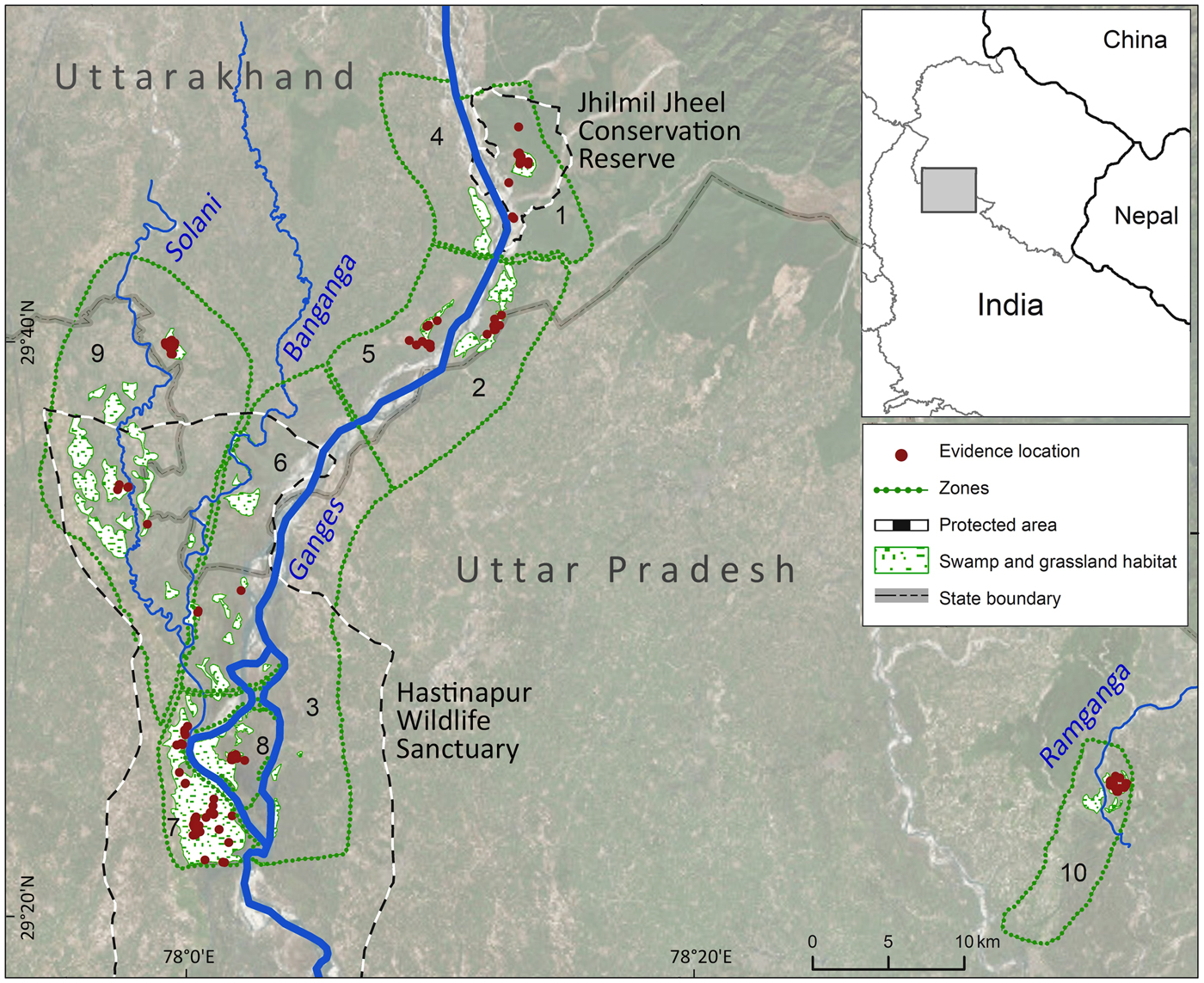
Swamp deer prefer wetlands (also called swamps or tals locally) and flooded grasslands (Tewari & Rawat, Reference Tewari and Rawat2013a). The study area includes the swampy grasslands along a stretch of the upper Ganges and adjoining areas. We surveyed both the west and east banks along the Ganges between the Jhilmil Jheel Conservation Reserve (38 km2) and the Bijnor barrage area of the Hastinapur Wildlife Sanctuary (2,073 km2), and grasslands along three tributaries of the Ganges: Solani and Banganga rivers on the west, and Ramganga river on the east bank (Fig. 1). The study area covers 1,061 km2, excluding the banks of Ramganga, where we surveyed an additional 63 km2 area. The main vegetation in the grassland patches comprises Typha sp., Phragmites sp. and Saccharum sp. Larger animals in the study area include swamp deer, hog deer Axis porcinus, spotted deer Axis axis, nilgai Boselaphus tragocamelus, smooth-coated otter Lutrogale perspicillata, fishing cat Prionailurus viverrinus and wetland birds such as sarus crane Antigone antigone, black-necked stork Ephippiorhynchus asiaticus, lesser adjutant Leptoptilos javanicus, Pallas's fish eagle Haliaeetus leucoryphus and bar-headed goose Anser indicus.
The swamp deer survey area between the Jhilmil Jheel Conservation Reserve and the Bijnor barrage area of Hastinapur Wildlife Sanctuary in the upper Gangetic plains, north India. The map shows the survey zones, swamp and grassland habitats and locations of direct (sightings of live animals and carcasses) and indirect (antler, hoofmark and genetically identified faecal pellet) swamp deer evidence.
Methods
Surveys
Because the last survey between Jhilmil Jheel Conservation Reserve and Hastinapur Wildlife Sanctuary found no conclusive evidence of swamp deer presence (Qureshi et al., Reference Qureshi, Sawarkar, Rahmani, Mathur, Sankar and Goyal2004) and there is no information available on the current status of potential swamp deer habitat, we first gathered information from local communities living close to the Ganges. These communities consist mainly of villagers, cattle herders, farmers, boatmen (who provide transport services with small boats) and fishermen. We collected information about swamp deer presence and their preferred habitat from 42 people (11 villagers, 16 cattle herders, 8 farmers, 3 boatmen and 4 fishermen), using a semi-structured questionnaire survey. The interviews typically took 10–20 minutes, and the following information was collected: (1) the interviewee's residential status and (2) occupation, (3) general mammalian diversity in their area, (4) location of swamps or grasslands in the area, if any, (5) information on swamp deer presence and specific characteristics used for identification, (6) approximate time and day of any swamp deer sightings, (7) presence of antlers in the area, (8) willingness to locate the antlers, if any had been seen in the area, (9) conflict caused by swamp deer crop use in the area and (10) any hunting or poaching incidences known from the area. We also used Google Earth (Google, 2015) images to identify grassland patches to corroborate with the information on swamp deer habitat provided by the local residents.
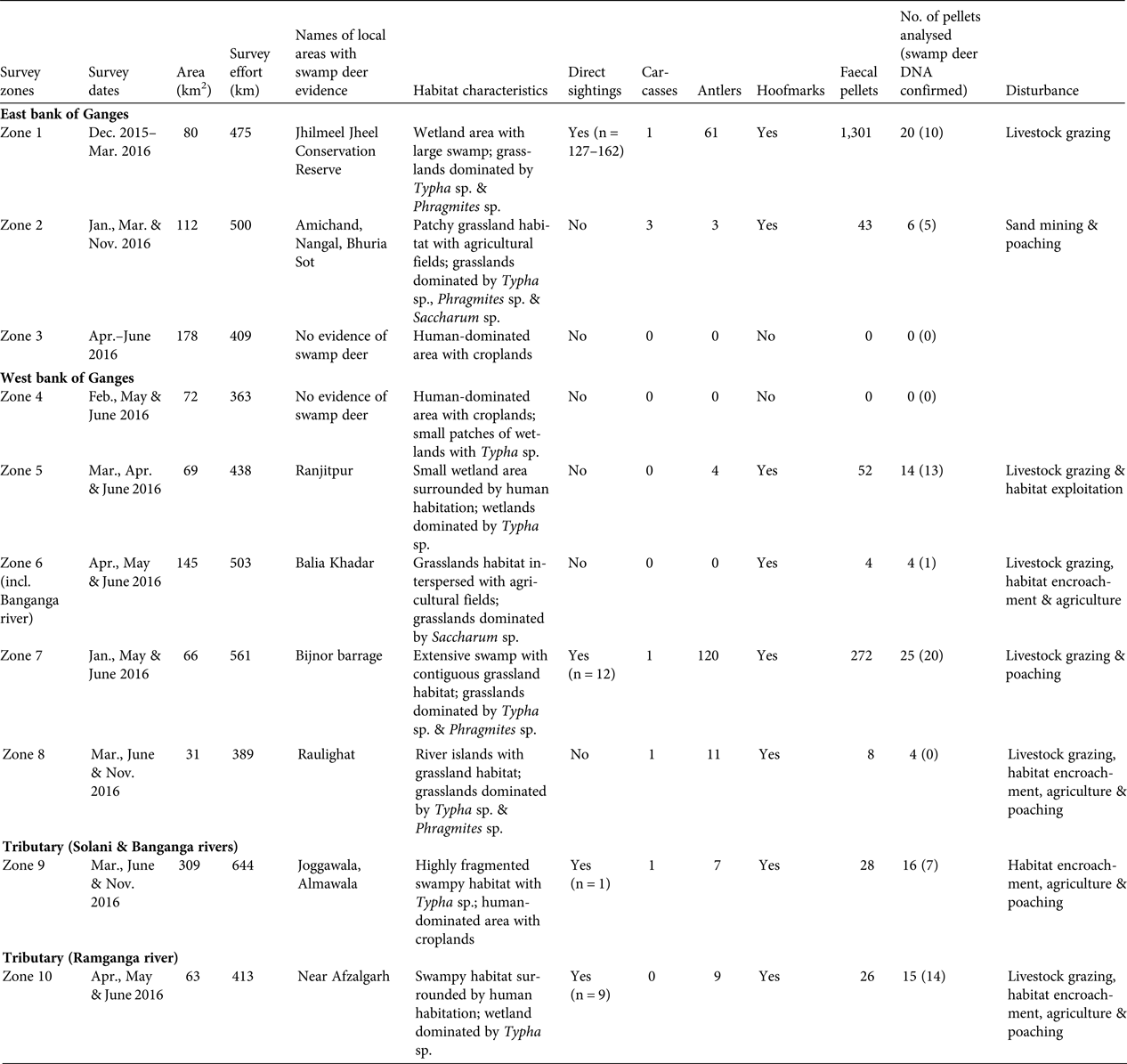
This information revealed that most of the grassland areas are restricted to 2–3 km on both sides of the Ganges and its tributaries, and are extremely fragmented along both banks of the 53 km stretch between Jhilmil Jheel Conservation Reserve and Hastinapur Wildlife Sanctuary. Subsequently, we conducted a focused survey covering up to 5 km on both banks of the Ganges and its tributaries in this area. We divided the study area into 10 survey zones (Fig. 1) based on presence of grasslands, tributaries, road network, croplands and human habitations and surveyed each zone extensively for evidence of swamp deer presence. Surveys were conducted on foot, by road vehicle or boat, depending on the habitat characteristics, during December 2015–November 2016, excluding the monsoon season of July–October 2016. The total survey effort was c. 4,692 km (Table 1). Each zone was surveyed three times over 15–18 days from 6.00 to 18.00, with occasional night surveys.
Details of swamp deer Rucervus duvaucelii duvaucelii surveys in the upper Gangetic plains (Fig. 1) during December 2015–November 2016, with area, survey effort, habitat characteristics, direct and indirect evidence of swamp deer presence, and evidence of disturbance.
The east bank of the Ganges was divided into three survey zones: Zone 1 comprising Jhilmil Jheel Conservation Reserve, a swampy grassland and surrounding areas in Uttarakhand; Zone 2 comprising an area of grassland 15 km downstream and stretching to a distance of 26 km from the Reserve, in Uttarakhand and Uttar Pradesh; Zone 3 extending further south to the Bijnor barrage area of Hastinapur Wildlife Sanctuary in Uttar Pradesh.
The west bank of the Ganges was divided into five survey zones: Zone 4 comprising the area opposite Jhilmil Jheel Conservation Reserve in Uttarakhand, a mostly human-dominated landscape interspersed with a small number of grassland and wetland patches; Zone 5 covering a wetland south of Zone 4, adjacent to the Ganges in Uttarakhand; Zone 6 covering human-dominated areas, partly within the boundary of Hastinapur Wildlife Sanctuary, across Uttarakhand and Uttar Pradesh; Zone 7 including the Bijnor barrage area of Hastinapur Wildlife Sanctuary and adjoining regions in Uttar Pradesh; Zone 8 containing a number of river islands close to Zone 7 within Hastinapur Wildlife Sanctuary in Uttar Pradesh.
In addition, we surveyed the grasslands along three tributaries of the Ganges: the Solani and Banganga on the west bank and the Ramganga on the east bank. Zone 9 comprised swampy grasslands along the Solani, located c. 10 km from the Ganges, partly within Hastinapur Wildlife sanctuary and covering parts of Uttarakhand and Uttar Pradesh. The grasslands along the Banganga were covered by Zones 6 and 9. Zone 10 included the swampy areas on both banks of the Ramganga near the town of Afzalgarh. This survey was motivated by a local newspaper report of swamp deer poaching in that region. Following interviews with the local communities, we conducted surveys for swamp deer habitats and presence in this area.
The protection status varies between survey zones: Zone 1 covers Jhilmil Jheel Conservation Reserve, and Zones 7 and 8 in Uttar Pradesh lie entirely within Hastinapur Wildlife Sanctuary. But Zones 3, 6 and 9 are only partially within the boundary of the Sanctuary, and Zones 2, 4, 5 and 10 are entirely unprotected.
During the survey, we considered direct sightings of live animals, presence of carcasses, and swamp deer signs such as antlers, hoof marks and dung as evidence of swamp deer presence. Direct sightings and carcasses were considered the best evidence of presence, followed by antlers, hoof marks and faecal pellets. Swamp deer antlers are distinct from those of other cervid species occurring in the area. An adult swamp deer antler usually has five or six tines and branches in a dichotomous manner in the upper half of the beam, whereas sambar, spotted deer and hog deer antlers are typically three-tined. Swamp deer hoof marks can also be identified by their distinctive splayed pattern, an adaptation to living in swampy habitats. Swamp deer faecal pellets are generally larger than those of other sympatric cervids (hog deer) or domestic animals (sheep or goats) occurring in this area, but pellets were not considered as conclusive evidence on their own. Swamp deer were considered to be present when at least two of the three indirect signs (antlers, hoof marks or faecal pellets) were found in an area.
During our surveys we recorded GPS coordinates of all locations with evidence of swamp deer presence, and collected dung pellets, antlers and tissue samples from carcasses from all surveyed areas. We also collected information on any disturbance and evidence of poaching. Presence of undisturbed grassland patches of Typha sp., Phragmites sp. and Saccharum sp. was considered an indicator of potential swamp deer habitat, whereas presence of livestock and humans in grassland was considered a sign of disturbance. Information about poaching came either from local residents or was gathered from direct evidence (e.g. skinned hides).
Identification using faecal DNA
Although swamp deer pellets are larger than those of other grassland cervids (hog deer) and domestic ungulates (sheep, goat), and distinct from those of bovids (nilgai) found in this region, species cannot always be identified with certainty based on pellet morphology alone. Pellets collected from marshy areas can usually be assigned to swamp deer because these areas are inaccessible to other species. However, because swamp deer co-occur with other ungulates in many areas, we used DNA-based species identification to confirm the species’ presence. We randomly selected 104 pellets from surveyed zones and extracted DNA by swabbing the outer layer of each pellet (Ball et al., Reference Ball, Pither, Manseay, Clark, Peterson, Kingston and Wilson2007). We amplified a 374 bp fragment of herbivore specific mitochondrial cytochrome b gene following published protocols (Gupta et al., Reference Gupta, Kumar and Hussain2014). The PCR products were visualized in 2% agarose gel, cleaned with Exonuclease (Thermo Scientific, Waltham, USA) and Shrimp Alkaline Phosphatase (Amresco, Solon, USA) mixture and then sequenced using forward primers in an ABI 3500XL bioanalyzer (Applied Biosystems, Waltham, USA). Sequences were aligned using MEGA v6.0 (Tamura et al., Reference Tamura, Stecher, Peterson, Filipski and Kumar2013) and visually examined for missense or frame-shift mutations. The aligned sequences were then matched against the Genbank database for species confirmation.
Results
Surveys
We found evidence of swamp deer presence in all Zones except 3 and 4. We had sightings in Zones 1, 7, 9 and 10 and found carcasses in Zones 1, 2, 7, 8 and 9 (Table 1). We collected a large number of antlers and faecal pellets and recorded signs of hoof marks across all surveyed areas (Table 1). The results confirm the presence of swamp deer along both banks of the Ganges and all three of its tributaries surveyed, and included a previously unreported population c. 58 km from Jhilmil Jheel Conservation Reserve, near the town of Afzalgarh by the Ramganga river (Zone 10).
Faecal DNA
Genbank matching analyses of the sequences generated from successfully amplified samples revealed that 70 of the 104 pellet samples belonged to swamp deer (Table 1). A small number of sequences were identified as sambar (n = 1), spotted deer (n = 6), hog deer (n = 1) and nilgai (n = 2). The Genbank accession numbers for species-specific sequences of all identified species are MF143831–MF143910. Twenty-four samples did not amplify during PCR, possibly because of degraded DNA quality.
Habitat status and disturbance
We found the highest number of swamp deer and patches of suitable habitat in the Jhilmil Jheel Conservation Reserve (Zone 1). However, our survey showed signs of anthropogenic pressures in the form of livestock grazing in Jhilmil Jheel Conservation Reserve and Hastinapur Wildlife Sanctuary, and habitat conversion within the Sanctuary. Protection in the form of regular patrolling, grassland management and control of livestock grazing in swamp deer habitat is limited in most of Zones 3, 6, 8 and 9 within Hastinapur Wildlife Sanctuary. In the remaining unprotected survey zones the main threats are poaching, retaliatory killings related to crop depredation, and other forms of anthropogenic disturbances. For example, the grassland patches in Zone 2 on the east bank of the Ganges are disturbed by heavy vehicles used for sand mining. In Zone 3 all small grassland patches have been converted to croplands, so there is now no suitable habitat for swamp deer in this area. Along the west bank of the Ganges, Zone 4 has minimal grassland habitats remaining for swamp deer. Our interviews with local communities revealed historical presence of swamp deer in this area but our surveys did not find evidence of swamp deer. In Zone 6 we found little evidence of swamp deer presence. Local communities reported occasional sighting of swamp deer on the bank of the Banganga river, which is supported by presence of hoof marks and faecal pellets (Table 1). In Zones 5 and 8 local communities reported incidences of swamp deer poaching and crop-use related retaliatory killings by farmers. The grassland and wetland patches along the Solani river (Zone 9) are fragmented and surrounded by human habitation, and the status of swamp deer connectivity with other areas cannot be ascertained. The survey along the Ramganga river (Zone 10) revealed occasional poaching and potentially poor connectivity with other swamp deer populations.
Discussion
Our survey covering the range of the northern swamp deer subspecies R. duvaucelii duvaucelii in the upper Gangetic plains revealed its presence in several areas along the Ganges from the Jhilmil Jheel Conservation Reserve (Uttarakhand) to the Bijnor barrage area of Hastinapur Wildlife Sanctuary (Uttar Pradesh). We also found signs of swamp deer presence along the Solani and Banganga rivers and a previously unreported population near Afzalgarh, Uttar Pradesh, along the Ramganga river. The presence of this subspecies was confirmed through direct sightings, presence of carcasses, antlers, hoof marks and genetically identified faecal pellets. We found evidence of swamp deer in eight of the 10 surveyed zones (Table 1) where local communities suggested their presence, indicating that swamp deer are present in larger areas than previously reported for this region (Qureshi et al., Reference Qureshi, Sawarkar, Rahmani, Mathur, Sankar and Goyal2004). Swamp deer may also occur downstream of Bijnor barrage and along other tributaries of the Ganges, and future surveys are required in these areas.
Our results reveal a patchy distribution of this subspecies in small areas across the states of Uttar Pradesh and Uttarakhand. Although we did not attempt to estimate population size, our surveys suggest the population in this region is relatively small. However, it is difficult to ascertain whether individuals in different survey zones are part of a meta-population, and information on swamp deer movement and gene flow rate in this landscape is not available. Seasonal movements of swamp deer from Jhilmil Jheel Conservation Reserve indicate their ability to move to other areas. Such seasonal and flood-driven movement patterns have been observed in central Indian and northern swamp deer populations (Martin & Gopal, Reference Martin, Gopal, Johnsingh and Manjrekar2015). Future studies, including tracking individuals with radio collars and analysing genetic data from antlers, pellets and tissue could provide additional information.
Although our survey revealed previously unknown habitats with swamp deer presence in the upper Gangetic plains, the habitat areas outside Jhilmil Jheel Conservation Reserve and parts of Hastinapur Wildlife sanctuary receive limited protection. Because all of these areas have potentially small, seasonally fluctuating numbers of swamp deer, survival of the subspecies will depend on its management as a meta-population with stable demographic and genetic parameters. Swamp deer in this region are threatened by habitat loss following conversion of wetlands to agricultural fields, livestock grazing and occasional poaching. The anthropogenic pressure on these grassland habitats is high because they are among the most fertile areas in northern India. Increased habitat conservation, anti-poaching activities and public awareness campaigns are needed to improve the status of these fragmented habitats and increase populations of this enigmatic species in this landscape. Conservation and management of R. duvaucelii duvaucelii as an umbrella species in unprotected areas would aid the conservation of swamp habitats in the upper Gangetic plains, but success will depend on the involvement of local communities. Directed efforts from government-initiated large-scale programmes such as the National Mission for Clean Ganga on reviving and protecting the swampy grassland patches along the Ganges could benefit swamp deer recovery. These swampy grasslands and wetlands are also home to other threatened species, and conservation and management is necessary to protect these critical habitats for all threatened fauna in this landscape.
Acknowledgements
We thank the Forest Departments of Uttarakhand and Uttar Pradesh for providing permits to carry out the research, Forest Department officials and local community members for their assistance, the Director and Dean of the Wildlife Institute of India for logistical support, Tista Ghosh, Suvankar Biswas, Supriya Bhatt, Imam, Ranju, Bhura, Annu and Ammi for help in the field, Debanjan Sarkar, Arun Kumar and Abhilash Patil for GIS support, two anonymous reviewers for their critiques and Julia Hochbach for her help in improving the text and figure. This research was funded by Uttarakhand Forest Department, Government of Uttarakhand. SP was supported by a Department of Science and Technology INSPIRE Research Fellowship (Award no. IF150680) and SM was supported by a Department of Science and Technology INSPIRE Faculty Award (Award no. IFA12-LSBM-47).
Author contributions
Conception of the study: SM and BP. Field survey design: BP, SM and SP. Data collection: all authors. Writing: SM, SP and BP. Final edits: all authors.
Conflicts of interest
None.
Ethical standards
All required permissions for our surveys and biological sample collection were provided by the Forest Departments of Uttarakhand (Letter no. 978/6–32/56) and Uttar Pradesh (Letter no. 2233/23–2–12 G).



