



Older adults living alone are vulnerable to malnutrition, especially when co-morbid loneliness and social isolation are experienced( Reference de Castro 1 – Reference Wylie, Copeman and Kirk 4 ). Malnutrition in later life is associated with undesirable outcomes such as poor quality of life( Reference Vetta, Ronzoni and Taglieri 5 ), impaired immune function( Reference Chandra and Kumary 6 ), increased risk of higher post-operative complications, mortality, and duration and cost of hospitalisation( Reference Correia and Waitzberg 7 ). Living alone is thought to cause malnutrition because of its association with dining alone, as eating with others (and particularly with friends) is associated with increased energy intake( Reference Brindal, Wilson and Mohr 8 , Reference de Castro and Stroebele 9 ), a phenomenon known as the social facilitation effect.
The social facilitation effect can be used to manipulate energy intake among older adults. Dining with others improves food intake specifically among older adults who live alone( Reference Locher, Robinson and Roth 10 ). Companionship can mitigate the impact of age-related appetite loss on energy intake too( Reference McIntosh, Shifflett and Picou 11 ).
The presence of others may improve social cognitive factors related to diet as well. Social cognitive theory states that individuals guide their own behaviour as informed through interactions with others( Reference Bandura 12 ). Social cognitive theory provides a framework in which individual factors can be targeted with the aim of altering behavioural outcomes. According to this theory, we learn best through watching the actions of others, and watching others can improve our confidence in our own abilities. This confidence is referred to by Bandura as ‘self-efficacy’, and has been studied in relation to nutritional health behaviours in the past( Reference Anderson, Winett and Wojcik 13 , Reference Hendy, Nelson and Greco 14 ). Social cognitive theory predicts that when self-efficacy is high, the individual is most likely to engage in a given health behaviour. Self-efficacy can be improved by providing opportunities for social modelling and vicarious learning (i.e. learning by observing others), combined with provision of educational information( Reference Archuleta, VanLeeuwen and Halderson 15 – Reference Wunderlich, Bai and Piemonte 17 ).
Involving peers in intervention delivery is advised, as social modelling is more likely to occur when one is observing a peer engage in a behaviour, which facilitates improvement of self-efficacy( Reference Buman, Giacobbi and Dzierzewski 18 ). Peer volunteers have been shown to enhance the gains associated with a physical activity intervention among older adults( Reference Buman, Giacobbi and Dzierzewski 18 ) as well as those associated with nutrition interventions( Reference Perez-Escamilla, Hrorni-Fiedler and Vega-Lopez 19 ).
Although nutrition education interventions have used peers in the past to improve nutritional behaviours, little research to date has considered the utility of peers in a more informal setting, such as in an informal mealtime intervention. Mealtime interventions typically constitute a shared mealtime, and have been used effectively for institutionalised older adults in long-term residential care and hospitals to improve energy intake( Reference Abbott, Whear and Thompson-Coon 20 – Reference Nijs, de Graaf and Siebelink 25 ). Mealtime interventions are often utilised for individuals with dementia, as dementia onset often brings with it the experience of difficulties at mealtimes( Reference Aselage and Amella 26 , Reference Charras and Fremontier 27 ), and as such these interventions are often concerned with feeding support and staff interactions. However, little is known about the utility of more informal mealtime interventions in improving outcomes for community-dwelling older adults. Mealtimes as a research topic are becoming prioritised in the literature( Reference Leslie 28 ), as they represent the provision of nutrition and social support, as well as occupational activity when the individual is involved in meal preparation as well( Reference Bundgaard 22 ). Although many older adults report that they prefer to graze than to sit down for full meals, particularly after life transitions such as children leaving the family home, retirement or widowhood( Reference Donkin, Johnson and Lilley 29 , Reference Winter Falk, Bisogni and Sobal 30 ), regular meal preparation is associated with improved nutrition and lower risk of mortality( Reference Chen, Lee and Chang 31 , Reference Hughes, Bennett and Hetherington 32 ), and can stimulate appetite and interest in food( Reference Bundgaard 22 ), thus representing a modifiable factor for improving nutrition.
The present study investigated a mealtime intervention focusing on the improvement of self-efficacy, food enjoyment and energy intake among older adults living alone at risk of social isolation. The research question addresses the impact of this 90-min, once weekly, 8-week intervention programme on these outcomes, compared with individuals in a control condition. A peer volunteer visited the individuals in the treatment condition once weekly to prepare and share a meal with them, aiming to improve their self-efficacy, food enjoyment and energy intake. As we were interested in potential future applications to subsets of the older population, we wanted to investigate outcomes in relation to the conditions of the intervention, as well as sex and extent of social connectedness, as this would tell us whether our intervention is more likely to improve outcomes among males, females, those who are socially isolated and those who are socially connected.
Hypothesis 1: The intervention will lead to an improvement in self-efficacy relative to the control group.
Hypothesis 2: The intervention will lead to an improvement in food enjoyment relative to the control group.
Hypothesis 3: The intervention will lead to an improvement in energy intake relative to the control group.
Methods
Participants
Participants were invited to the study through advertisements in the national media, leaflet drops, via allied health professionals, day centres and parish newsletters. An a priori sample size calculation was not used in this study, and instead sample size was based on feasibility. Initially, 181 participants expressed their interest in the study. Inclusion criteria were as follows:
-
∙ Aged over 60 years
-
∙ Living alone
-
∙ Self-reported risk of social isolationFootnote 1 .
Participants were screened for the following exclusion criteria:
-
∙ No history of stroke, epilepsy, schizophrenia, bipolar affective disorder and recurrent psychotic depression
-
∙ No cognitive impairment as defined using the telephone cognitive screen (‘TcogS’)( Reference Newkirk, Kim and Thompson 33 ) (see Table 1)
-
∙ No history of alcohol or drug abuse reported within the past 5 years
-
∙ No use of anticonvulsants/ antipsychotic medications
-
∙ No significant hearing difficulties that are not resolved using hearing aids
-
∙ No history of illness causing permanent decrease in memory or other cognitive functions
-
∙ No bloodborne, airborne or contact-borne infectious diseases that would threaten the well-being of the peer volunteer.
Baseline demographic and clinical characteristicsFootnote * (Means and standard deviations when data are continuous, and numbers and proportions when data are categorical)
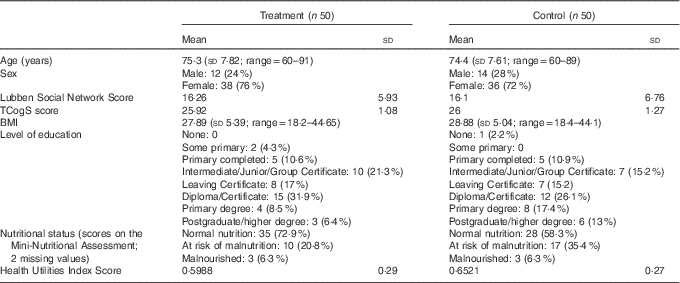
TCogS, telephone cognitive screening.
* Scores on the TCogS are equivalent to scores on the commonly used Mini Mental State Examination (MMSE) screen (Folstein et al.(52)).
Reference values for TCogS: values of 20 or below indicate cognitive impairment, as they reflect scores of 22 and below of the in-person MMSE, which is a validated cut-off in the Irish population( Reference Cullen, Fahy and Cunningham 34 ). Reference values for BMI: values of <18·5 kg/m2 indicate underweight; 18·6–24·9 kg/m2 indicate normal weight, 25·0–29·9 kg/m2 indicate overweight and 30+ kg/m2 indicates obesity. Reference values for Lubben Social Network Scale: scores of <12 indicate social isolation. Reference values for Mini-Nutritional Assessment: scores of 12–14 are considered normal nutritional status; 8–11 indicate risk of malnutrition; and 0–7 indicate malnutrition. Reference values for Health Utilities Index: no disability corresponds to an overall score of 1·00; scores for states with mild disability fall in the 0·89–0·99 range; states with moderate disability fall in the 0·70–0·88 range; and states with severe disability have scores<0·70. Differences of 0·03 or more are regarded as clinically important.
Of the 181 participants, 100 adults met all criteria and as such were recruited to the study. The study was conducted according to the guidelines laid down in the Declaration of Helsinki, and all procedures involving human participants were approved by the Trinity College Department of Psychology Ethics Committee. Written informed consent was obtained from all participants.
Volunteers
A group of fifty peer volunteers, aged over 55 years and free of cognitive impairment (screened using the TcogS)( Reference Newkirk, Kim and Thompson 33 ) were recruited from local social groups, via the national media, and from parish and research newsletters. The volunteers underwent a day of training with the research team, as well as vetting by the local police, before being matched to participants in the intervention condition for sex and convenience of their home location. The training covered information about intervention fidelity, nutritional education (covering the food pyramid, portion size guidelines, tips for healthy eating, tips for maintenance of bone health, bowel health, blood health), culinary skills and interpersonal skills for performing the intervention. The content of nutritional education was developed with permission from the Healthy Food Made Easy initiative (http://healthyfoodforall.com/initiatives/healthy-food-made-easy-3/), and the content was included in the guidebook as well (available for download at http://www.tcd.ie/Neuroscience/neil/research/relate.php). The content of the intervention was not highly structured, but fidelity was supported by regular contact with the volunteers and provision of intervention manuals for all participants and volunteers involved in the study. All volunteers also gave their informed consent to participate in the study.
Design and procedure
A parallel, randomised controlled trial design was used to evaluate the effectiveness of the complex mealtime intervention. The complete study protocol is described elsewhere( Reference Cullen, Fahy and Cunningham 35 ) (registration at clinicaltrials.gov; NCT02007551). Once participants were registered to the study, they were contacted by two separate teams working on the research project: one team (assessment) arranged a baseline assessment with the participant, and the other team (administration) indicated to the participant whether they had been randomised to a treatment or control condition (this randomisation was performed using a minimisation procedure( Reference McHugh, Lee and Aspell 36 )). Participants were asked by the administration team to refrain from telling the assessment team what condition they had been randomised to. Participants then received a written letter reminding them of this request. Assessments with participants were performed by interview at baseline and at 8-week (immediately after intervention completion), 12-week and 26-weeks follow-up points by assessors who were blinded to the condition of the participants. The assessors were research assistants with Masters degree in Clinical Psychology and had undergone training with a qualified Clinical Nutritionist in order to deliver the dietary recall component of the assessment. Assessments were performed in the home of the participant or in the research institute, according to the participant’s preference.
Measures
Baseline measures
A number of measures were evaluated at baseline to characterise the sample (see Table 1). All measures except the TcogS were taken by the assessor during interview. Scores from the TcogS( Reference Newkirk, Kim and Thompson 33 ) were collected during the telephone screen component of the recruitment process and as such are all above a criterion cut-off level, and are included in Table 1 for illustrative purposes. Age, education level and sex were evaluated by self-report. Social connectedness/social isolation was evaluated using the Lubben Social Network Scale Short Form( Reference Altman and Bland 37 ). This scale has six items pertaining to family and friends and has been shown to have acceptable reliability and validity( Reference Altman and Bland 37 ). Scores range from 0 to 30 with higher scores indicating increased connectedness, and a cut-off score of <12 has been suggested to indicate that an individual is socially isolated. Nutritional status was evaluated using the Nestle Mini-Nutritional Assessment short form, which has six questions and scores between 0 and 30, with scores >24 indicating better nutrition, scores between 17 and 23·5 indicating risk of malnutrition and scores of less than 17 indicating the presence of malnutrition( Reference Lubben and Gironda 38 ); it has high reliability and validity( Reference Guigoz, Vellas and Garry 39 ). Finally, health status was evaluated using the Health Utilities Index( Reference Guigoz 40 ), which is an interview-led forty-item questionnaire evaluating health-related disabilities. It has scores as a ratio between 0 and 1, with scores of 1 indicating no disability, scores of 0·89 to 0·99 indicating mild disability, scores of 0·7 to 0·88 indicating moderate disability and scores of <0·7 indicating severe disability.
Outcome measures
Outcome measures were self-efficacy, food enjoyment and energy intake.
The first outcome measure was self-efficacy, measured using the General Self-Efficacy Scale( Reference Horsman, Furlong and Feeny 41 ). This scale contains ten questions about self-efficacy and gives the participant a score between 10 and 40; this scale has previously been shown to have high reliability (Cronbach’s α=0·76–0·9) and validity( Reference Horsman, Furlong and Feeny 41 ).
The second outcome measure was food enjoyment (measured using the Food Enjoyment Scale( Reference Schwarzer, Jerusalem and Weinman 42 )). This six-item scale has been shown to have acceptable reliability for a short scale (Cronbach’s α=0·66( Reference Vailas and Nitzke 43 )). Originally, the scale was described such that higher scores indicate less food enjoyment, as all items were negatively worded; however, in line with a strategy taken previously( Reference Gollub and Weddle 44 ), we reverse-coded the scale so that higher scores indicated higher levels of food enjoyment (maximum score of 30), and lower scores indicated lower levels of food enjoyment (minimum score of 6).
The final outcome measure was energy intake, assessed in kilojoules (kilocalories) using two 24-h dietary recalls per assessment, whereby participants are asked to recall in detail everything they ate and drank in the previous 24-h period. These 24-h periods were at least 1 d apart and in the same week. Assessors used a structured dietary recall to collect this information, including probing questions to ensure maximum accuracy. The assessors then used Nutritics software (www.nutritics.com) to convert recalls into kilocaloric values. Nutritics uses the UK Composition of Foods Integrated Dataset (McCance and Widdowson, 6th ed.) and the Irish Food Compositions Database (University College Cork). Once two recalls were collected, the assessor calculated an average value across both recalls, in order to more accurately represent the average energy intake of the participant at each time point.
Intervention and control conditions
Participants in the intervention condition (n 50) were assigned a peer volunteer and introduced by a research assistant at the beginning of the 8-week programme. Each week thereafter, the participant–volunteer dyad chose a meal to prepare together, and the volunteer gathered the ingredients (as paid for by the research team with a budget of eight euro per meal) and brought them to the participant. The participant and volunteer together prepared and shared the meal. The dyads were furnished with a guidebook including nutritional and culinary information and tips as well as recipes designed to be quick and cost-effective. This guidebook was adapted, with permission, from the 101 Square Meals publication, which was developed by the Money Advice and Budgeting Service national organisation in conjunction with ‘safefood EU’ (www.safefood.eu), in line with the national Healthy Ireland initiative, a national framework aimed at improving health and well-being of Irish citizens. Meals were chosen from this publication if they were suitable for cooking for one and were low in cost. (The publication is available for download at https://www.mabs.ie/publications/educational/.) Each weekly session lasted for 90 min and took place in the home of the participant. Dyads were instructed to share the cookery work equally, and this instruction was emphasised both during volunteer training and to the study participants. As the intervention was based on social cognitive theory, volunteers were instructed to create opportunities for vicarious learning (the participant watching the volunteer cook), social support for cooking and nutritional behaviours, opportunities to master new skills by having the participant engage in cooking with the volunteer and facilitation of goal setting if the participant wished. Participants in the control condition (n 50) received the guidebook containing recipes as well as nutritional and culinary information and advice, but no visitor. Manuals on the other hand detailed the guidelines for intervention fidelity and were given to everyone involved in the treatment group.
Data analysis
Growth curve models were used to examine the role of treatment condition in the trajectory of outcomes across the four data collection points, with time modelled as a random effect and with both linear and quadratic terms accounted for (depending on which trend fit the data). Growth curve modelling, or multilevel modelling, allows time to be modelled explicitly, such that the researcher can learn whether individual trajectories are linear or otherwise, as well as allowing for the modelling of inter-individual variability. Growth curve models are additionally advantageous over more traditional linear models such as ANOVA because of their adaptability to normal and non-normal data, ability to handle violations of the independence assumption, ability to handle missingness and capability to use categorical or continuous predictors. Growth curve models can also inform us about the rate of change over time. In our study, outcomes of interest were self-efficacy, food enjoyment and energy intake, whereas condition (treatment, control) was the main fixed effect of interest. To investigate whether our intervention differentially impacted subsamples of our study, Social Connectedness/Social Isolation (based on categories arising from a cut-off score of 12 in the Lubben Social Network Scale( Reference Lubben and Gironda 37 )) and sex were also of interest as predictors of outcome, and two- and three-way interactions between the three fixed effects were also investigated. Time was allowed to vary as a random effect in the models if slope variation was found to be significant. Following the principle of intention-to-treat, effects are reported for the entire sample. A randomisation check (comparing baseline characteristics and all dependent variables in the treatment and control groups using t tests, with treatment/control as the independent variable, and all listed characteristics in Table 1 as well as self-efficacy, food enjoyment and energy intake) was conducted to screen for possible bias in assignment, but no differences were found (all P>0·05). For the growth curve analyses, corrections for multiple comparisons were made using the Sims–Hochberg method( Reference Hochberg 45 ).
Results
Sample characteristics
Baseline characteristics of the sample are reported in Table 1. Of the 100 participants, sixty-two were female, and 23 % met criteria for social isolation (based on categories arising from a cut-off score of 12 in the Lubben Social Network Scale( Reference Altman and Bland 37 )).
Compliance and attrition
Compliance was evaluated as number of visits received by participants, although this truly reflects compliance on behalf of both the volunteer and the participant. Reasons for missed visits included holidays, illness, emergencies and family obligations. The median number of visits received per participant in the treatment condition was 7 of a possible 8 (mean=5·56).
Outcomes
Results for growth curve models pertaining to primary outcome measures are detailed in Table 2.
Multilevel modelling results for primary outcome measures
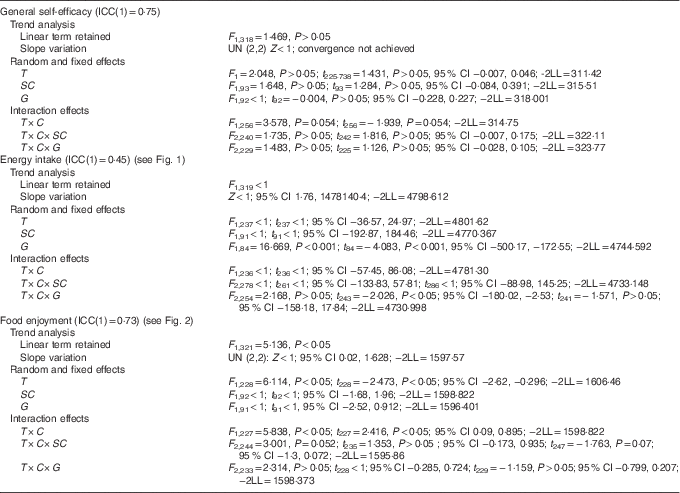
ICC, intraclass correlation coefficient; UN (2,2), variance of the random components of the participation effect; T, time; C, condition; SC, social connectedness; G, sex.
A borderline significant effect of condition over time was found for general self-efficacy as an outcome (F 1,256=3·578, P=−0·054; t 256=−1·939, P=0·054; −2LL =314·75; see Table 2) such that individuals in the treatment group improved their self-efficacy more so than those in the control group over time.Values of self-efficacy increased from 3·08 to 3·22 in the treatment group between baseline and post-intervention evaluation, and similarly increased from 3·26 to 3·38 in the control group during the same time.
Finally, an interaction between time and condition was found for food enjoyment as an outcome (F 1,227=5·838, P<0·05; t 227=2·416, P<0·05; 95 % CI 0·09, 0·895; see Fig. 1) such that those in the treatment group improved their food enjoyment over all four time points more so than those in the control group (see Fig. 1). Scores of food enjoyment improved from 25·15 to 25·65 in the treatment group between baseline and post-intervention assessment, and scores in the control group improved from 26·15 to 27·84 over the same time period (scores in the control group then reversed over time).
Interaction between time and condition with food enjoyment as outcome. This interaction indicates that food enjoyment improved more so over time among individuals who received the intervention relative to those who did not.  , Control group;
  , treatment group.

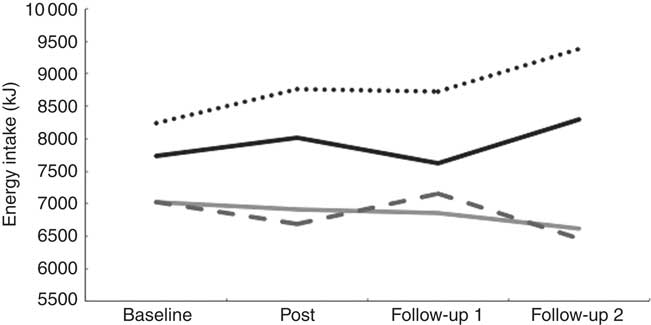
At baseline, average energy intake of participants in the treatment condition was 7376 kJ (1763 kcal) (7740 kJ (1850 kcal) for men and 7017 kJ (1677 kcal) for women) and after intervention it was 7347 kJ (1756 kcal) (8008 kJ (1914 kcal) for men and 6686 kJ (1598 kcal) for women). For energy intake, the interaction between time, condition and sex was significant (F 2,254=2·168, P<0·05; t 243=−2·026, P<0·05; 95 % CI −180·02, −2·53; t 241=−1·571, P>0·05; 95 % CI −158·18, 17·84; −2LL=4730·998). This interaction is plotted below (see Fig. 2). Males in the control and treatment conditions improved their energy intake, whereas only females in the treatment condition improved their intake (although this effect reversed over time). Of all the effects described in this study, only the finding of the difference in food enjoyment remained significant following correction for multiple comparisons.
Interaction between time, condition and sex, with average energy intake as outcome. This interaction indicates that the intervention may improve energy intake among females relative to females who did not receive the intervention but that among males in both groups energy intake improved.  , Control males;
  , control females; , treatment males;
  , treatment females.
Discussion
This study evaluated an intervention designed to improve self-efficacy, food enjoyment and energy intake in older adults living alone. The intervention led to a non-significant trend towards improvement in self-efficacy in those in the treatment condition. Second, individuals in the control group improved more so than those in the treatment group in food enjoyment between baseline and after intervention. However, although individuals in the treatment group continued to improve their levels of food enjoyment at the follow-up point, at this point food enjoyment decreased among participants in the control group. All males engaged in the study increased their energy intake over time, whereas females in the treatment group but not in the control group showed decreases in energy intake (except for females in the treatment group who increased their intake at follow-up). It is important to note that increases in energy intake may represent an improvement in some individuals and a disimprovement in others.
Results are mixed, and it is difficult to conclusively determine the success of the intervention. The intervention appears to be associated with improvements in food enjoyment and in some individuals’ energy intake. Overall, we only partially support our hypotheses, which suggested that the intervention would lead to improvements in social cognitive factors and energy intake in older adults.
For some outcomes, following corrections for multiple comparisons, there was no difference between the control group and the treatment group. It has previously been found that both treatment and control groups improve in social support interventions because of the interactive and social nature of the research, as well as interactions with researchers potentially constituting an intervention of sorts( Reference Berkman, Blumenthal and Burg 46 ). As all participants had interactions with assessors a minimum of ten times during their tenure with the project, this explanation likely holds for the current findings. Furthermore, the control group received the guidebook, which may have itself constituted a successful intervention. As both groups received this information, it is unlikely that the information constituted a more significant intervention for the control group unless they attended more to this information than those in the treatment group. We interviewed individuals in the control and treatment groups following the study to explore this possibility and it did not appear to be the case that those individuals in the control group attended to the guidebook more so than those in the intervention group. Future research comparing three groups – one control group receiving no intervention, one guidebook-only group and one group receiving the full social cognitive intervention – would be more informative about the specific effective components of such an intervention.
Our interviews also allowed us to ask whether participants felt that they got along with their volunteer matches, as this would likely affect the success of the intervention. Most participants reported that they felt they got along well with their volunteers, and acknowledged that they had been made aware of the opportunity for re-matching at the study outset.
Social cognitive theory has successfully been applied to nutritional health behaviours and cooking skills in previous studies, and social cognitive determinants are related to good nutritional outcomes( Reference Anderson, Winett and Wojcik 13 , Reference Hendy, Nelson and Greco 14 , Reference Condrasky, Williams and Catalano 47 – Reference Liquori, Koch and Ruth Contento 49 ). Largely, the results corroborate previous findings in the literature. We found that self-efficacy marginally trended towards improvement with the provision of opportunities for social modelling and vicarious learning in combination with education, as delivered by peers, as was previously found( Reference Archuleta, VanLeeuwen and Halderson 15 – Reference Buman, Giacobbi and Dzierzewski 18 ). We found improvements in energy intake for men but not for women, which partially aligns with previous findings that mealtime interventions in institutions can improve energy intake( Reference Abbott, Whear and Thompson-Coon 20 – Reference Nijs, de Graaf and Siebelink 25 ). We also found that the mealtime intervention led to an improvement in food enjoyment, which is in accordance with previous findings that interventions focusing on meal preparation can stimulate interest in food( Reference Bundgaard 22 ). The effect of the treatment on food enjoyment appeared to continue after the completion of the visits, which may suggest that the visits stimulated interest in food for the participants, leading to improved food enjoyment. The participants in the control group experienced an initial increase in food enjoyment, followed by decreases at follow-up, which might suggest that, although their initial involvement in and initiation to the study may have been sufficient to stimulate interest in food, it did not provide a long-lasting effect. Future studies are required to further explore the effectiveness of visits in providing long-lasting effects on food enjoyment.
The present study had methodological limitations. After corrections for multiple comparisons were made, only one of the findings remained significant (related to food enjoyment). This may be related to the fact that the study was underpowered, because the sample size was based on a feasibility principle rather than an a priori power calculation. Insufficient sample size is a common problem in health psychology intervention research( Reference O’Carroll 50 ), and results should as such be interpreted with caution. Participants were recruited to the study if they self-reported a risk of social isolation. Originally, the study protocol featured an inclusion criterion of being identified as socially isolated using the Lubben Social Network Scale( Reference Altman and Bland 37 ). However, it proved extremely difficult to recruit sufficient number of participants who scored as isolated on this scale, because, as was found in a nationally representative cohort, only 6 % of the older Irish population are classifiable as socially isolated( Reference Timonen, Kamiya and Maty 51 ), and this small proportion of socially isolated individuals in the population was reflected in attempts to recruit. As such inclusion criteria were relaxed to facilitate timely delivery of the project. In investigating the subset of the treatment group who were socially isolated, then, it appears that further studies focusing exclusively on socially isolated individuals (perhaps in areas with larger populations than that in which the current study was conducted) would find more conclusive evidence of the effectiveness (or otherwise) of the intervention being evaluated. The study results are best evaluated, in our opinion, as a suggestion that interventions may be beneficial for individuals who are at risk of becoming isolated. They also indicate that further evalaution of this intervention with a more definitively vulnerable population, such as individuals with psychosocial or otherwise functional limitations, is merited, in order to explore whether the mechanisms considered in this study have a role in protecting the well-being of these vulnerable individuals.
Participants in the current study were not representative of the overall older population, and thus generalisability of findings is limited to those living alone and who were willing to have a visitor to their home once weekly for 8 weeks. Furthermore, it is possible that the offer of a cost-free meal once a week for 8 weeks skewed interest in the study to those who were potentially more economically deprived than average. It is also a possibility that the intensity of the intervention was not sufficient; perhaps two or three visits per week would have yielded more conclusive results in the current study. We also did not evaluate nutritional knowledge in either the participants or the volunteers before the intervention – it is possible that minimising differences between treatment and control groups for this knowledge may have provided a more fair comparison between groups. This is advised for future similar interventions.
Results of the current trial could inform the design of future interventions. We acknowledge the need for future interventions to define study participants using more rigorous and objective methods than a self-report of social isolation risk, in order to deliver the intervention to those who are most in need and most likely to benefit from inclusion. Future interventions would benefit from considering the interaction between sex and impact of intervention, and potentially design separate interventions for males and females, as in the cohort we studied these individuals faced different challenges with regard to food and social isolation.
Our results have implications for further research and policy. We identify a gap in the current services offered to older adults, which are typically nutritional but not social, and we suggest that combining support for these two areas would be of importance for many older adults living alone. Older adults face challenges in both nutrition and social isolation, and targeting both areas simultaneously could represent an effective and cost-effective means to improve the health status of older adults.
Acknowledgements
The authors thanks Professor Cathal Walsh for his input on the data analysis plan and to all participants and volunteers involved in the study, as well as to the many individuals who helped the research team with recruitment.
This research was supported by the Home Instead Senior Care company under grant no. 201122 held at Trinity College Dublin. Vouchers for food purchase were donated free of charge by Dunnes Stores, Dublin.
J. E. M. P. designed the intervention and trial, managed recruitment and volunteer training, ran the study, performed data analysis and wrote the manuscript. O. L. helped with recruitment management, volunteer management, data management and assisted with the preparation of the manuscript, approving it for final submission. N. A. managed the nutritional component of the intervention, performed data collection and assisted with the preparation of the manuscript, approving it for final submission. M. L., E. M. and L. C. performed data collection, assisted with the preparation of the manuscript and approved it for final submission. B. L. and S. B. conceptualised the project, acquired funding for its execution and oversaw the project; they were also involved in manuscript preparation, approving the manuscript for final submission.
The authors declare that there are no conflicts of interest.



