





Highlights
-
• Learners can recognize words in continuous English speech before receiving instruction.
-
• Word recognition in continuous speech improves with phonological awareness skills.
-
• In our task, form similarity with the L1 does not aid word recognition in young pre-EFL learners.
-
• Pre-activating L1 forms does not increase cognate facilitation in our task.
-
• Differences may be due to metalinguistic awareness or the role of meaning in the task.
When using language, bilingualsFootnote 1 activate linguistic representations from both of their languages. Such co-activation has been found across the lifespan (Bobb et al., Reference Bobb, Von Holzen, Mayor, Mani and Carreiras2020; Von Holzen & Mani, Reference Von Holzen and Mani2012), in both the auditory and orthographic modalities (see Bailey et al., Reference Bailey, Lockary and Higby2023). Many studies on language co-activation examine the recognition and production of cognate words, that is, words that overlap in form (orthographic and/or phonological) and meaning between a bilingual’s two languages (e.g., English milk – German Milch /mɪlk/ – /mɪlx/). For example, word recognition and production have often been found to be faster for cognate words than for non-cognate words that do not overlap in form between a bilingual’s two languages. This phenomenon, known as the cognate facilitation effect, has been observed across different populations, including adult (e.g., Costa et al., Reference Costa, Caramazza and Sebastián-Gallés2000; Libben & Titone, Reference Libben and Titone2009) and child second-language (L2) learners (Bosma & Nota, Reference Bosma and Nota2020; Brenders et al., Reference Brenders, van Hell and Dijkstra2011; Gastmann & Poarch, Reference Gastmann and Poarch2022; Koutamanis et al., Reference Koutamanis, Kootstra, Dijkstra and Unsworth2024a; Poarch & van Hell, Reference Poarch and van Hell2012; Von Holzen et al., Reference Von Holzen, Fennell and Mani2019), in a variety of production and comprehension tasks in both spoken and written modalities (see Bailey et al., Reference Bailey, Lockary and Higby2023 for an overview on adults).
However, comparatively little is known about the role that such overlap with the L1 may play in the early stages of acquisition in contexts of instructed foreign-language learning. The current study investigates how form overlap influences early foreign-language (FL) processing in typical FL learning contexts. For example, instruction in English as an FL (EFL) begins in the third grade in many states in Germany, making young learners aged 8–11 years the predominant FL learner population. German and English share many cognate words (Friel & Kennison, Reference Friel and Kennison2001; Schepens et al., Reference Schepens, Dijkstra and Grootjen2012), and the two languages are in general phonologically similar (Floccia et al., Reference Floccia, Sambrook, Delle Luche, Kwok, Goslin, White and Plunkett2018). To this end, we focus on German first and second graders, a population of young learners before instruction in EFL has begun (pre-EFL learners). We ask whether the detection or segmentation of cognate words from the incoming speech signal is facilitated by their overlap in form and meaning with German, the societal majority language of the participants, even before EFL instruction has begun.
Two sets of evidence suggest that form overlap could already be facilitative in early FL acquisition. The first set of evidence comes from young learners’ vocabulary acquisition once EFL instruction has begun. Tribushinina et al. (Reference Tribushinina, Niemann and Meuwissen2023a) taught cognate awareness to Dutch EFL learners, highlighting the form- and meaning-overlap of these cross-linguistic word pairs. Learners’ recognition of cognate words in English improved both for cognate words taught during the intervention, and also generalized to new cognate words. This suggests that when their attention is explicitly drawn to form- and meaning-similarity between their L1 and FL, the development of a cognate strategy in word learning can be beneficial for lexical acquisition. Other studies have found a similar cognate advantage in both word learning (Mulder et al., Reference Mulder, Van De Ven, Segers and Verhoeven2019) and word recognition (Tribushinina et al., Reference Tribushinina, Dubinkina-Elgart and Mak2023b; Tribushinina & Mackaaij, Reference Tribushinina and Mackaaij2023) in young EFL learners, even in the absence of explicitly taught cognate awareness. These findings suggest that cognate words may ease vocabulary acquisition at the early stages of EFL acquisition, that is, when learners have had some experience with and reached initial understanding of the FL.
The second set of evidence comes from online speech processing in child and adult learners who have no prior experience in the foreign language. In a series of studies, Von Holzen and colleagues used the intermodal preferential looking procedure (Golinkoff et al., Reference Golinkoff, Hirsh-Pasek, Cauley and Gordon1987, Reference Golinkoff, Ma, Song and Hirsh-Pasek2013) to study 2- to 6-year-old children’s word recognition in a language to which they had not been previously systematically exposed, studying both English monolingual children’s recognition of German words (Von Holzen & Newman, Reference Von Holzen and Newman2025) as well as German monolingual children’s recognition of English words (Von Holzen et al., Reference Von Holzen, Fennell and Mani2019). In both studies, children first viewed two images in silence, and then one of the images was labeled in a sentence produced in the new language, such as “In front of you, where is the SHOE?” or “Where is the SHOE in front of you?,” while the two images remained on the screen (e.g., Von Holzen & Newman, Reference Von Holzen and Newman2025). Despite having no experience with this language, children showed recognition of cognate words in the new language, which improved with increasing similarity in their phonological forms (e.g., Von Holzen & Newman, Reference Von Holzen and Newman2025). These findings show that, when tasked with extracting meaning from foreign-language speech strings, children activate their native language as their only resource to complete the task.
Research with adults suggests that learners may also activate L1 words in a form-based task. Shoemaker and Rast (Reference Shoemaker and Rast2013) presented L1 French listeners with a word recognition task, where they first heard a Polish sentence, followed by an isolated Polish word. Participants had to decide whether the isolated word had been present in the utterance or not. Despite having no previous exposure to Polish, Shoemaker and Rast (Reference Shoemaker and Rast2013) found that in comparison to non-cognate words, cognate words (overlapping in form and meaning with French: professeur-professor “professor” versus médecin-lekarz “doctor;” see Carroll, Reference Carroll, Braunmüller, Gabriel and Hänel-Faulhaber2012, Reference Carroll2014 for similar evidence with L1 English learners of German) were better recognized in continuous Polish utterances. This task differed from the task used by Von Holzen et al. (Reference Von Holzen, Fennell and Mani2019), Von Holzen and Newman (Reference Von Holzen and Newman2025), which requires participants to associate an auditory form with an image. In contrast, the task used by Shoemaker and Rast (Reference Shoemaker and Rast2013) allows for the study of form-similarity effects in isolation. Building on this study’s design, we investigate whether pre-EFL learners similarly rely on form similarity of German words in a form-based task in a novel or little-known language. We test whether pre-EFL learners implicitly activate form-based lexical representations in their native language when exposed to a novel language.
We are particularly interested in the contribution of individual differences within a younger learner population and in how they rely on crosslinguistic form-overlap in the segmentation of continuous speech. Amongst these differences, cognitive variables, such as working memory and phonological short-term memory, have been found to generally support FL learning in adults (e.g., Martin & Ellis, Reference Martin and Ellis2012). As these abilities are likely to influence initial FL acquisition generally, we control for their variability in our analyses. Phonological awareness skills have been found to support early L2 acquisition (Hu, Reference Hu2014), but also to specifically modulate German pre-EFL learners’ ability to extract words from continuous English speech (Von Holzen et al., Reference Von Holzen, Wulfert, Schnieders and Hopp2025). Von Holzen and colleagues argued that learners may first approach the speech signal holistically and break it into chunks of information. Those participants with higher phonological awareness skills were then generally better able to hold and manipulate those chunks of information in memory and successfully compare them when subsequently encountered. Finally, young pre-EFL learners are still acquiring their L1(s) (Foster-Cohen, Reference Foster-Cohen2014) which has been found to influence their approach to FL segmentation (Von Holzen et al., Reference Von Holzen, Wulfert, Schnieders and Hopp2025) but may also specifically influence cognate effects. Previous studies with EFL learners have found that their recognition of cognate words is modulated by their language background, with bilingual learners showing smaller cognate effects in word recognition (Tribushinina & Mackaaij, Reference Tribushinina and Mackaaij2023). The authors speculate that this is not due to their status as bilingual learners per se, but instead that their L2 vocabulary, and therefore potential for overlap with cognate words in English, is smaller (but see Koşluku-Sankar et al., Reference Koşkulu-Sancar, Stolvoort, Oppeneer, De Graaff, Paradis and Tribushinina2025 for evidence of a general non-cognate learning advantage in bilingual kindergartners). In the present study, we test the specific influence of German productive vocabulary size on the role of form-overlap in initial speech segmentation, as well as the general influence of phonological awareness on this segmentation, while controlling for individual variability in learners’ cognitive abilities. By measuring individual differences in cognitive maturity and (meta-)linguistic knowledge, we aim to better understand how child learners approach the application of form-overlap in initial speech segmentation. On the one hand, younger learners may rely more on similarities to the majority language, German, as a parsimonious approach to initial foreign language processing with limited cognitive and linguistic resources. On the other hand, younger learners may rely less on these similarities because of their limited metalinguistic resources, which may be a prerequisite for exploiting form-based correspondences across languages.
German form overlap may not only facilitate segmentation of the English words themselves, but it may also facilitate the segmentation of other, adjacent words. If segmentation of cognate words in continuous speech is facilitated, the listener can gather information about the cognate word’s boundary at both its onset and offset. As a result, words adjacent to cognate words may also be more easily recognized, once a cognate has been excised from the speech stream. Indeed, in infant word segmentation, the presence of a familiar word can facilitate the segmentation of an adjacent, unfamiliar word (Bortfeld et al., Reference Bortfeld, Morgan, Golinkoff and Rathbun2005). Previously learned words can also facilitate segmentation in adult learners. In a between-group study, Cunillera and colleagues (Cunillera et al., Reference Cunillera, Càmara, Laine and Rodríguez-Fornells2010; see also Cunillera et al., Reference Cunillera, Laine and Rodríguez-Fornells2016) either first taught adult participants a pair of labels in an artificial language by presenting them with picture–pseudoword pairs (e.g., “senige” paired with an image of an apple) or did not expose participants to any words. Afterward, all participants listened to a speech stream produced in the artificial language and were then given a two-alternative-forced-choice task, which consisted of the pseudowords present in the speech stream. Participants who had been taught the pair of labels before listening to the speech stream performed significantly better than those participants who were not taught the labels – crucially also on those pseudowords which appeared in the speech stream consistently adjacent to those words they had been taught. This difference suggests word familiarity aids in the use of more bottom-up statistical cues to segment and recognize words. When applying this logic to early bilingual contexts, cognate words may, therefore, not only themselves benefit in foreign speech segmentation, but – because they have been more easily identified – they may also facilitate segmentation of adjacent words by signaling the onset of a word boundary. Planned research questions and hypotheses, as well as measurements and analyses, were pre-registered on OSF (Experiment 1: https://doi.org/10.17605/OSF.IO/DSG57; Experiment 2: https://doi.org/10.17605/osf.io/2j9zw). The present article was written with embedded analysis scripts in R (R Core Team, 2018) using the papaja package (Aust & Barth, Reference Aust and Barth2018) in R Markdown (Allaire et al., Reference Allaire, Xie, McPherson, Luraschi, Ushey, Atkins, Wickham, Cheng and Chang2018). The stimuli and programs to run the study, the de-identified data and the R files to produce this manuscript are available on Open Science Framework (https://osf.io/zkp2w/?view_only=8db7376fde17428ebeb14082ccc64163).
1. Experiment 1
In a word recognition task, following the procedure used by Shoemaker and Rast (Reference Shoemaker and Rast2013), German first and second graders first listened to a sentence in English (e.g., “I broke all milk brinchFootnote 2 on the counter”), followed by a probe word presented in isolation that was either present in the sentence (e.g., target “milk”) or not (e.g., lure “smoke”). Participants then decided whether the probe word had been present in the sentence. We examined the resulting word acceptance scores to address the following research questions:
-
• RQ1: Can pre-EFL learners recognize words in continuous foreign-language speech?
-
• RQ2: Is word recognition modulated by phonological awareness skills?
-
• RQ3: Does form similarity of target words with German improve recognition of English words in continuous English speech?
-
• RQ4: Is the recognition of cognate words modulated by participants’ German (majority language) productive vocabulary?
-
• RQ5: Can the form similarity of cognate words also facilitate the recognition of adjacent words?
-
• RQ6: Is the recognition of cognate-adjacent words modulated by participants’ majority language productive vocabulary?
The first two research questions aim to replicate the findings in Von Holzen et al. (Reference Von Holzen, Wulfert, Schnieders and Hopp2025) in a different segmentation task. We expect that, if participants are able to segment words when confronted with continuous English speech, then their word acceptance scores will be higher for probe words that occurred in the sentence, labelled target words, than those that did not, labelled lure words (H1), and that this difference will increase with increasing phonological awareness skills (H2). For RQ3, we predict that, if form similarity to words in the majority language improves segmentation of these words in an FL, word acceptance scores should be higher for cognate compared to non-cognate target words, but they should not differ for cognate and non-cognate lure words (H3). For RQ4, we predict that participants with greater majority language productive vocabularies will show greater word acceptance scores for cognate compared with non-cognate target words (H4). For RQ5, we predict that items that appeared next to a cognate word in the utterance (e.g., target-adjacent “brinch” in “I broke all milk brinch on the counter”) will have higher word acceptance scores than items that appeared next to a non-cognate word (H5). As for RQ6, we also expect that participants with greater majority language productive vocabularies will show greater word acceptance scores for items that were adjacent to cognate words compared with those that were adjacent to non-cognate words (H6).
1.1. Methods
1.1.1. Participants
The final sample comprised a total of 112 students (M age = 7.51; SD = 0.74, range = 6–8.75), recruited from first- (n = 49; 30 females, 19 males) and second-grade (n = 63; 36 females, 27 males) classrooms from four local schools in a mid-sized city in Germany. This sample size exceeded the pre-registered sample size of 96 to meet the required power of 80% and to test for the hypothesized role of individual differences.Footnote 3 All caregivers provided informed consent and filled out a questionnaire reporting the general health of the child (vision, hearing, diagnoses), their language background (adapted from the LEAP-Q, Marian et al., Reference Marian, Blumenfeld and Kaushanskaya2007; full questionnaire is included in the Supplementary Materials of Von Holzen et al., Reference Von Holzen, Wulfert, Schnieders and Hopp2025), and their socioeconomic status (SES, KiGGS Welle 2, Lampert et al., Reference Lampert, Hoebel, Kuntz, Müters and Kroll2018). All participants included in the final sample had normal or corrected-to-normal hearing and vision, as well as no diagnoses that impacted cognitive function or language development. No participant in the final sample had been systematically exposed to English, either at school or at home. A total of 29 children indicated that they spoke a language in addition to German and were also able to complete additional tasks in this minority language (semantic fluency, Delis et al. (Reference Delis, Kaplan and Kramer2001); LITMUS-CLT production task, Rinker & Gagarina, Reference Rinker and Gagarina2017; see below). As a result, we consider them bilingual and the remaining 83 participants monolingual. Bilingual participants reported speaking Arabic (n = 7), Russian (n = 5), Turkish (n = 4), Bulgarian (n = 2), Mandarin Chinese (n = 2), Polish (n = 2), Italian (n = 1), Catalan (n = 1), French (n = 1), Portuguese (n = 1), Serbian (n = 1), Spanish (n = 1) or Urdu (n = 1) in addition to German. The participant group was skewed toward having a high socioeconomic status according to the KiGGS Welle 2 (Lampert et al., Reference Lampert, Hoebel, Kuntz, Müters and Kroll2018): 44 high SES, 58 middle SES, 7 low SES and 3 that did not complete that section of the questionnaire. The local state school authorities approved the recruitment and testing of children in schools, and the ethics committee of the Linguistic Society of Germany approved the study (#2020-07-200812). Participants were given a certificate of participation and small toys (e.g., pencil, eraser and books) as a reward.
An additional 24 participants were tested but not included in the final analysis because they did not complete the testing sessions (n = 3), did not contribute at least 10 trials to each condition (see below; n = 1), their caregivers did not return the questionnaire (n = 7), their hearing was not corrected to normal (n = 3), they were diagnosed with ADHD (n = 2) or a developmental language disorder (n = 1), their caregivers reported suspicion but no official diagnosis of autism (n = 1), they had only started learning German recently (n = 1), their caregiver reported in a language background questionnaire that they were passively exposed to English more than 10% of the time (n = 4), or they reported speaking English and successfully completed a production task in English (n = 1).
The sample reported here was identical to that of Von Holzen et al. (Reference Von Holzen, Wulfert, Schnieders and Hopp2025), with the exception of the one participant who did not contribute at least 10 trials to each condition. Participants completed the same additional tasks as those reported in Von Holzen et al. (Reference Von Holzen, Wulfert, Schnieders and Hopp2025), but the segmentation task and its stimuli were different. A summary of participants’ age, language background and scores in the additional tasks separated by school grade (first or second graders) and language status (monolingual or bilingual) can be found in Supplementary Information A.
1.1.2. Segmentation task
In order to identify (non-)cognate nouns familiar to the participants, 6472 English–German translation equivalent pairs were retrieved from “Mr. Honey’s Beginner’s Dictionary (German-English)” (Honig, Reference Honig2002). For each pair, the corresponding phonological transcriptions and syllable counts in English and German were extracted from the CELEX Wordforms database (Baayen et al., Reference Baayen, Piepenbrock and Gulikers1995). To identify cognate and non-cognate word stimuli, the phonological transcriptions used in the CELEX database (CLX) were transliterated into IPA symbols, and the noun pairs were analyzed with the ALINE algorithm (Kondrak, Reference Kondrak2000, Reference Kondrak2001) using the alineR package (Downey et al., Reference Downey, Sun and Norquest2017). This produced a so-called ALINE score, which weighs the saliency of differences between segment pairs in terms of distinctive features using the measurements of Ladefoged (Reference Ladefoged1995). From 5532 German–English noun pairs that had corresponding entries in the CELEX database, 320 pairs were chosen to serve as probe words. Half of those pairs (80 monosyllabic and 80 bisyllabic with a trochaic syllable structure) with low ALINE scores were chosen to serve as cognate words (M = 0.17, SD = 0.06, range: 0.01–0.29; e.g., rat-Ratte /ræt/ – /ratə/).Footnote 4 The other half (80 monosyllabic and 80 bisyllabic) were chosen to serve as non-cognate words, as indicated by their high ALINE scores (M = 0.64, SD = 0.08, range: 0.46–0.89; e.g., pet – Haustier /pɛt/ – /haʊ̯sˌtiːɐ̯/). To ensure that cognate and non-cognate words had similar phonological neighborhood sizes, we next used the stringdist R package (van der Loo, Reference van der Loo2014) to calculate the pairwise string distance between the 320 probe words and each item in the German CELEX database (Baayen et al., Reference Baayen, Piepenbrock and Gulikers1995). String distances of 1, indicating the addition, deletion or substitution of one segment, were considered phonological neighbors. Cognate probe words (M = 3.64, SD = 6.77, range: 0–46) and non-cognate probe words (M = 2.77, SD = 7.15, range: 0–54) did not differ in the number of their German neighbors (t(317.03) = 1.12, p = .265). An additional 160 non-cognate English words were selected, and a vowel or a consonant was exchanged or a consonant was added to the onset to create pseudowords that were phonotactically legal in English (e.g., brinch). These pseudowords served as the target-adjacent items. Using pseudowords ensured that we could more easily control which phones appeared at boundaries and ensure that there was a phonotactically clear boundary between the probe word and the pseudoword.
Each cognate word was paired with a non-cognate word, matched on the number of syllables. Care was taken to ensure that the pairs ended in the same phoneme or a closed syllable. A pseudoword was then assigned to this pair, again matched on syllable number, to create a set of cognate words, non-cognate words and pseudowords. From each set, two word pairs were created by combining the pseudoword with either the cognate word (e.g., milk brinch) or the non-cognate word (e.g., smoke brinch). For each pair, German phonotactics would indicate a clear word boundary between the two words in each pair. Each pair was inserted into an otherwise identical declarative sentence frame either in the subject or the object position (e.g., cognate sentence: I broke all milk brinch on the counter; non-cognate sentence: I broke all smoke brinch on the counter) and preceded and followed by unstressed syllables, as realized via a determiner, an auxiliary or a monosyllabic pronoun. Sentence length was 9.91 syllables on average (SD = 0.74, range: 9–12). A list of all the sets, including IPA transcriptions for the cognate and non-cognate words, can be found in Supplementary Information B. A list of the sentences can be found in Supplementary Information C.
A female, L1 speaker of American English with a Midwestern accent recorded all sentences as well as each cognate, non-cognate and pseudoword in isolation and was instructed to use a friendly register. Recordings were post-processed in Praat (Boersma & Weenink, Reference Boersma and Weenink2016) to achieve noise reduction, segmentation into individual wave files and intensity normalization to 70 dB.
Each participant listened to 160 trials, each consisting of a combination of one sentence followed by a probe word, with a mean interstimulus interval of 499.48 ms (SD = 28.83 ms). For cognate word sentences (n = 80), the probe word was either the cognate word heard in the sentence (cognate target, 20 trials), the pseudoword directly following the cognate word heard in the sentence (target-adjacent, 20 trials), a cognate word not heard in the sentence (cognate lure, 20 trials) or a non-cognate word not heard in the sentence (non-cognate lure, 20 trials). For non-cognate word sentences (n = 80), the probe word was either the non-cognate word heard in the sentence (non-cognate target, 20 trials), the pseudoword directly following the non-cognate word heard in the sentence (target-adjacent, 20 trials), a cognate word not heard in the sentence (cognate lure, 20 trials) or a non-cognate word not heard in the sentence (non-cognate lure, 20 trials). For each sentence-probe word combination, half of the trials (10 trials) contained monosyllabic words and the other half contained bisyllabic words. Eight lists were created that counterbalanced the type of sentence (cognate, non-cognate), probe word type (cognate, non-cognate, target-adjacent) and presence/absence in the sentence (Target, Lure). The assignment of targets and lures to sentences is given in Supplementary Information C.
1.1.3. Onset-rhyme task
We measured phonological awareness using modified versions of both the phoneme manipulation and onset-rhyme tasks used by Bialystok et al. (Reference Bialystok, Majumder and Martin2003). To reduce the number of factors and analyses, we pre-registered an approach to choosing one of the tasks as our measure of phonological awareness. As described in Von Holzen et al. (Reference Von Holzen, Wulfert, Schnieders and Hopp2025), we opted to use the onset-rhyme task as our measure of phonological awareness, as these scores were normally distributed and better captured the variation within our population. In the onset-rhyme task, participants heard triplets of German-based pseudowords recorded by a male L1 German speaker, with two of the items overlapping either in the rhyme (e.g., [zɛt] and [vɛt] in the set of [mɛl] – [zɛt] – [vɛt]) or the onset (e.g., [kɛlp] and [kɔlx] in the set of [ʃɪlk] – [kɛlp] – [kɔlx]) and the third item not sharing this overlap. Participants had to indicate orally which pseudoword of the three did not match the other two.Footnote 5
1.1.4. German semantic fluency task
We used a modified version of the semantic fluency task used in the “InstDelis-Kaplan Executive Function” (D-KEF, Delis et al., Reference Delis, Kaplan and Kramer2001) to capture participants’ German vocabulary skills. Participants were instructed to produce as many items as possible that they could think of in 1 minute on the topic of “plants,” and then the topic of “clothing.” Our predictor variable of German vocabulary skill was created by summing the total number of correct category members, as well as parts of category members (e.g., “Ast” “branch” for the category “plants”), excluding repetitions of the same item, across the two categories for each participant.
1.1.5. Control variables
Participants also completed additional tasks examining non-verbal intelligence (Raven’s Progressive Matrices 2 – Clinical Edition; Raven, Reference Raven2019), phonological short-term memory (crosslinguistic nonword repetition task; Chiat, Reference Chiat, Armon-Lotem, de Jong and Meir2015; Polišenská & Kapalková, Reference Polišenská and Kapalková2014) and working memory (digit span task, “Hamburg-Wechsler-Intelligenztest für Kinder,” HAWIK IV; Petermann & Petermann, Reference Petermann and Petermann2008) to control for potential variation in cognitive skills that may impact their segmentation abilities.
To gain a better sense of participants’ linguistic skills in German and English, we used standardized tasks to measure their vocabulary in these languages. We used the LITMUS Crosslinguistic Lexical Task (CLT, Rinker & Gagarina, Reference Rinker and Gagarina2017) for the production of German nouns to measure German (majority language) productive vocabulary and the LITMUS-CLT (Haman et al., Reference Haman, Miller, Wodniecka, Koegler and Łuniewska2017) for the comprehension of English nouns to measure English receptive vocabulary. In the English receptive vocabulary task, 13 of the items were similar in phonological form to their German translation equivalents (ball, stool, nest, penguin, glass, motorcycle, watermelon, carrot, cow, star, balloon, tiger and apple) and may be recognizable to German children even without English knowledge (Von Holzen et al., Reference Von Holzen, Fennell and Mani2019). The remaining 19 words should not be recognizable based on knowledge of the German form alone. To ensure that our sample was without any pre-existing English knowledge, our pre-registered exclusion criteria specified that participants who performed better than chance (25%) on these 19 items should be excluded from the analysis. This would have removed over half of our sample (n = 74). Following the approach of Von Holzen et al. (Reference Von Holzen, Wulfert, Schnieders and Hopp2025), we explore whether participants’ English comprehension LITMUS-CLT scores modulate their recognition of cognate words (Supplementary Information E) instead of excluding these participants.
1.2. Procedure
The procedure was identical to Von Holzen et al. (Reference Von Holzen, Wulfert, Schnieders and Hopp2025). Participants were tested individually either in a quiet classroom during their school’s after-school program (two separate sessions) or accompanied by a caregiver and tested in a quiet room at the university (one single session with a break after the tasks of the first session). All tasks were administered using Open Sesame (Mathôt et al., Reference Mathôt, Schreij and Theeuwes2012), with the exception of Raven’s Progressive Matrices 2, which used a test booklet. Participants used an Xbox controller to indicate via button press whether probe words were present or absent from the preceding utterance in the segmentation task. Experimental stimuli were presented visually on a laptop (HP 250 G6 or Lenovo E51–80) and auditorily via child-appropriate headphones (JBL JR310). The participants were told that the experimenters were from the local university and had discovered an alien. The tasks were introduced as helping the researchers to decipher what the alien was saying. The segmentation task of the current study began in the first session, followed by Raven’s Progressive Matrices 2, the forward and backward digit span tasks and the German production LITMUS-CLT. In the second session, another segmentation task (reported in Von Holzen et al., Reference Von Holzen, Wulfert, Schnieders and Hopp2025) was followed by the crosslinguistic nonword repetition task, the phoneme manipulation and onset-rhyme tasks, the German semantic fluency task and the English comprehension LITMUS-CLT. If participants indicated that they spoke an additional language, they were asked to complete the production LITMUS-CLT and semantic fluency tasks in that language immediately after completing them in German.
1.3. Analysis
The tasks where participants had to indicate their answer orally (i.e., German production LITMUS-CLT, crosslinguistic nonword repetition task, the phoneme manipulation and onset-rhyme tasks and German semantic fluency task) were transcribed, checked and scored (for details, see Von Holzen et al., Reference Von Holzen, Wulfert, Schnieders and Hopp2025). Data pre-processing and statistical analyses were conducted using R version 4.2.2 (R Core Team, 2018). Participants’ responses in the segmentation task were used to calculate word acceptance scores, our dependent variable, which reflects the likelihood that participants accepted a particular probe word as occurring in the previously heard sentence (1) or not (0). Generalized linear mixed effects models were used to model the binary variable word acceptance using the lme4 and lmerTest packages (Bates et al., Reference Bates, Maechler, Bolker and Walker2015; Kuznetsova et al., Reference Kuznetsova, Brockhoff and Christensen2017). The maximum random effects structure was determined using the “order” function from the buildmer package (Voeten, Reference Voeten2023; see also Barr et al., Reference Barr, Levy, Scheepers and Tily2014) to produce the best-fitting model. The emmeans package (Lenth, Reference Lenth2019) was used to report estimated marginal means for significant effects and interactions and to test post hoc comparisons.
In addition to word acceptance scores, we also analyzed participants’ d’ scores to capture their sensitivity to the presence of items in the sentence (Hautus et al., Reference Hautus, Macmillan and Creelman2021). These pre-registered analyses can be found in the Supplementary Information D. We choose to report only analyses of word acceptance scores in this manuscript because they allow us to account for variability across items, whereas d’ scores are aggregated across items.
1.3.1. General segmentation ability and the role of phonological awareness
The first set of preregistered analyses investigated general FL segmentation ability (RQ1) and whether this was influenced by individual variation in phonological awareness (RQ2). A model was built including an interaction between the predictive fixed effect of word status (target/target adjacent, lure; deviation coding scheme: 0.5, −0.5) and the phonological awareness score (continuous, onset-rhyme task). Additional control fixed effects, mean-centered, were entered as main effects: German semantic fluency score, summed digit-span score, Raven’s Progressive Matrices 2 score and crosslinguistic nonword repetition task score. The maximum random effects structure was initially set with slopes for segmentation task trial number (1–160) and word status (target/target-adjacent, lure) on the participant and item (sentence) intercepts respectively.
1.3.2. The role of similarity to the German form in FL segmentation and the influence of the majority language productive vocabulary
The second set of preregistered analyses investigated the role of word similarity to the German form in FL segmentation in two separate models. The first focused on recognition of the target word (RQ3) and whether this recognition was influenced by individual variation in the majority language productive vocabulary (RQ4). We compared word acceptance responses in the interaction between target items and lures (word status; 0.5, −.05), word type (cognate, non-cognate; 0.5, −0.5) and the German semantic fluency score (continuous). Model specification was otherwise the same as the previous model, with an additional random slope of word type.
A second model focused on recognition of cognate- and non-cognate-adjacent pseudowords (RQ5) as well as the influence of majority language productive vocabulary size (RQ6). This was identical to the previous model, but instead of the effect of word status comparing target and lure items, it compared target-adjacent items and lures (0.5, −0.5).
To rule out that cognate effects in word acceptance hold irrespective of whether probe words had been present in the preceding utterance, we also tested for word type in the lures only. This analysis focused on responses to lure words and the model included an interaction between word type (cognate, non-cognate; 0.5, −0.5) and utterance type (sentence contains a cognate, non-cognate; 0.5, −0.5). Model specification was otherwise the same as the previous model, except that the random slope of word status was replaced with random slopes for utterance type.
1.4. Results
Only significant main effects or interactions (p < .05) with the predictor variables are interpreted. The full model output, including the random effects structure, is given in the respective Supplementary Information F table.
1.4.1. General segmentation ability and the role of phonological awareness
Figure 1 plots word acceptance scores for target/target-adjacent items and lures, and the relationship with onset-rhyme task scores.
Overall results from Experiment 1 examining children’s general segmentation ability for both (A) word acceptance for target/target-adjacent and lure items, as well as (B) the relationship between word acceptance for target/target-adjacent and lure items and children’s onset-rhyme scores, where the red line at 50% indicates the chance level. Individual points represent participants’ average scores in response to target/target-adjacent or lure items.

For RQs 1 and 2, the best-fitting model had random intercepts for subjects and items, with random slopes of word status for both. The main effect of word status was significant (b = −1.47, SE = 0.11, z = −12.85, p < .001), but the main effect of onset-rhyme score was not (b = −0.01, SE = 0.03, z = −0.31, p = 0.76). Critically, the interaction between word status and onset-rhyme score was significant (b = −0.07, SE = 0.03, z = −2.69, p < .01). Word acceptance was greater for target and target-adjacent items (EMM = −0.16, SE = 0.11) compared to lure words (EMM = −1.63, SE = 0.15). As the onset-rhyme score increased, the difference in word acceptance between target/target-adjacent items and lures increased. See Supplementary Information F1 for full model details.
1.4.2. The role of similarity to the German form in FL segmentation and the influence of the majority language productive vocabulary
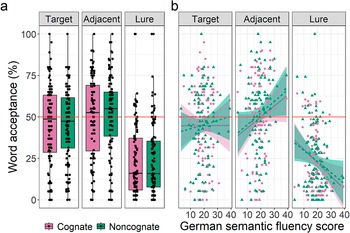
Figure 2 plots word acceptance scores for cognate and non-cognate targets, target-adjacent and lure words, as well as the relationship with German semantic fluency scores.
The relationship between word type (cognate, non-cognate) and word status (target, target-adjacent, lure items) on children’s word acceptance scores in Experiment 1 (A) overall and (B) in relation to children’s German semantic fluency scores. The red line at 50% indicates the chance level. Individual points represent participants’ average scores to target or lure items.

For RQs 3 and 4, which focus on the target word, the best-fitting model had random intercepts for subjects and items and a random slope of word status for subjects and for word status and word type for items. The main effect of word status was significant (b = 1.33, SE = 0.11, z = 12.08, p < .001), as was the interaction between word status and German semantic fluency score (b = 0.05, SE = 0.02, z = 2.74, p < .01). Word acceptance scores for target items (EMM = −0.29, SE = 0.11) were greater than those of lure items (EMM = −1.63, SE = 0.14). As German semantic fluency scores increased, the difference in word acceptance between targets and lures increased. Critically, neither the main effect of word type nor any of the interactions with word type were significant. See Supplementary Information F2 for full model details. Given the significant effects of phonological awareness on word acceptance, we ran exploratory analyses to assess whether the effect of word type interacts with onset-rhyme score (Supplementary Information, Table E5). The interaction was not significant (p > .7). Similarly, other participant-level differences in working memory, language background or English vocabulary knowledge did not interact with word type, either (Supplementary Tables E3–E6), nor were word acceptance scores significantly different from chance (Supplementary Table E8). Supplementary Information E also contains additional exploratory analyses investigating the influence of the item-level factors ALINE score and target/lure word length (Supplementary Tables E1–E2).
For RQs 5 and 6, which focused on the target-adjacent word, the best-fitting model had random intercepts for subjects and items and a random slope of word status for subjects and for word status and word type for items. The main effect of word status was significant (b = 1.62, SE = 0.13, z = 12.43, p < .001), as was the interaction between word status and German semantic fluency score (b = 0.08, SE = 0.02, z = 3.79, p < .001). Word acceptance scores for target-adjacent items (EMM = −0.01, SE = 0.12) were greater than those of lure items (EMM = −1.63, SE = 0.14). As German semantic fluency scores increased, the difference in word acceptance between target-adjacent and lure items increased. Critically, neither the main effect of word type nor any of the interactions with word type were significant. See Supplementary Information F3 for full model details.
As we found no evidence for cognate effects in target or target-adjacent words, we did not run the analysis to control for effects of general German form similarity in lures.
1.5. Discussion
We found that, in general, pre-EFL students are able to recognize words from continuous speech in an FL before instruction has begun, and that this ability increases with increasing phonological awareness skills. This replicates the results found by Von Holzen et al. (Reference Von Holzen, Wulfert, Schnieders and Hopp2025) and extends them to a different segmentation task. However, there was no effect of form similarity with German in the recognition of target items or items adjacent to those target items. Exploratory analyses for interactions with participant-level differences showed that effects of form similarity did not emerge once individual differences were considered, either. These results suggest that, unlike ab initio adult learners in a highly comparable task (Shoemaker & Rast, Reference Shoemaker and Rast2013), young pre-EFL learners do not appear to benefit from the presence of cognate words while recognizing words in a foreign language.
Such a null finding for young learners can have various, potentially interacting sources. For instance, their German word knowledge may overall not be as entrenched as adults’ word knowledge, or their cognitive capacities may limit the recall of form overlap in a complex, memory-heavy task. In addition, we argue that, critically, the task may not have been restricted enough to detect effects of form overlap on the target or target-adjacent items. Since these items were embedded in complex utterances, listeners may not only have activated the German forms for cognate words embedded in the utterances, but also representations for other German words, which then competed for selection. For example, the cognate target item “men” has many phonological neighbors beyond its German translation equivalent “Männer” (/mɛn/ – /’mɛnɐ/) in German (e.g., Mensch “human,” Mann “man,” mein “mine,” wenn “when/if,” denn “because;” Marian et al., Reference Marian, Bartolotti, Chabal and Shook2012), which may have been subsequently activated and competed for recognition while participants were listening to sentences in the current study. This would also be the case for the matched non-cognate word item “tin” (Dose, /tɪn/ – /’doːzə/), which also shares many phonological neighbors with German (e.g., Tisch “table,” Tipp “tip,” Ton “sound,” in “in,” hin “there”). What is more, these words were embedded in otherwise identical utterances (e.g., You lighten each men/tin lale in the hallway), which contained words that share further phonological neighbors with German words (e.g., lighten: Leiden “suffering,” leite “to guide (first pers. singular);” hallway: hohl “hollow;” in: in “in”). As a result, even if the German word form for the cognate words was activated while participants listened to sentences in Experiment 1, the forms of other similar-sounding German words may also have been activated and then competed for recognition, effectively neutralizing any specific facilitatory effect of the targeted cognate word. In Experiment 2, we modified the paradigm used in Experiment 1 to examine whether facilitatory effects of cognates appear when the German form of the target items is more relevant and strongly activated.
2. Experiment 2
In Experiment 2, we ask whether pre-activating the German representation of the target words under investigation increases German form overlap effects. For each trial, before participants listened to the sentence, they viewed two images. One of the images depicted an object corresponding to the target label (e.g., a stick of butter) in the subsequently presented sentence (e.g., “You pushed some butter mustom to the exit”), while the other image depicted a picture of the label of the matched non-cognate or cognate word (e.g., a mirror). Evidence suggests that upon viewing an object, the linguistic representations for that object will be activated (Mani & Plunkett, Reference Mani and Plunkett2010; Meyer et al., Reference Meyer, Belke, Telling and Humphreys2007; Von Holzen & Mani, Reference Von Holzen and Mani2014). For sentences with cognate words embedded, this means that the overlapping German form will be pre-activated before the sentence is heard, which may enhance the resting activation of the target items in the subsequent processing of the utterance. Specifically, the German form overlap of cognate words may aid in their detection and recognition. For sentences with non-cognate words embedded, the German form will also be pre-activated (e.g., “Spiegel”), but – since there is no or only little form overlap – it should not facilitate detection of the non-cognate word in the subsequent sentence (e.g., “You pushed some mirror mustom to the exit”). Through these modifications, we aimed to accomplish three things. First, the pre-activation of the German word form, which should facilitate recognition for cognate target words when they are present in the subsequent utterance. Second, participants were also instructed that the alien producing the utterance was talking about the images, thereby increasing the relevance of these pre-activated German word forms. Finally, these modifications should also reduce the cognitive resources required by participants to complete the word recognition task, as they can now narrow down their search for the target word when encountering the speech signal instead of excising it from the memory of the entire utterance afterward.
In Experiment 2, we again pose the same research questions as in Experiment 1. In a cross-experiment comparison, we additionally address RQ7:
-
• RQ7: Does the pre-activation of the German form-representations facilitate their detection, as well as the detection of adjacent words, in an FL?
If participants implicitly activate their German representations upon viewing the picture pairs at the beginning of trials in Experiment 2, then their acceptance of cognate target words should be higher than in Experiment 1 (H7). At the same time, acceptance of non-cognate target words should be similar in both cases, as the pre-activated German representation will not share form similarity with the English form and therefore not facilitate its subsequent recognition.
2.1. Methods
2.1.1. Participants
The final sample comprised a total of 53Footnote 6 students (M age = 7.24; SD = 0.53, range = 6.42–8.50), recruited from first- (n = 39; 23 females, 16 males) and second-grade (n = 14; 10 females, 4 males) classrooms from three of the four same local schools as Experiment 1. None of the participants had taken part in Experiment 1. All caregivers provided informed consent and filled out the same background questionnaire as in Experiment 1. All participants included in the final sample had normal or corrected-to-normal hearing and vision, as well as no diagnoses that impacted cognitive function or language development. No participant in the final sample had been systematically exposed to English, either at school or at home. A total of 20 children were bilingual, and the remaining 33 participants were monolingual. Bilingual participants reported speaking Russian (n = 5), Arabic (n = 3), Turkish (n = 3), Mandarin Chinese (n = 2), Spanish (n = 2), Finnish (n = 1), French (n = 1), Italian (n = 1), Romanian (n = 1) or Swahili (n = 1) in addition to German. As in Experiment 1, the final sample of children was skewed toward having a high socioeconomic status according to the KiGGS Welle 2 (Lampert et al., Reference Lampert, Hoebel, Kuntz, Müters and Kroll2018): 21 high SES, 25 middle SES, 2 low SES and 5 that did not complete that section of the questionnaire.
An additional eight participants were tested but not included in the final analysis because they did not complete the testing sessions (n = 1), their caregivers did not return the questionnaire (n = 1), their hearing was not corrected to normal (n = 1), they were diagnosed with ADHD (n = 1), they had only started learning German recently (n = 2) or their caregiver reported in the language background questionnaire that they were passively exposed to English more than 10% of the time (n = 2).
Table 1 gives information about participants’ age, language background and scores in the additional tasks separated by school grade (first or second graders) and language status (monolingual or bilingual). Bilingual participants had significantly lower German passive exposure percentages and a higher age of German acquisition than monolingual participants. No other comparisons were significant (a summary of t-tests comparing bilingual and monolingual participants’ scores in the additional tasks can be found in Supplementary Information G).
Participants’ age, language background and scores in the additional tasks in Experiment 2, including means and standard deviations (in parentheses) and ranges of values

Note: Columns are divided for participants in the first and second grade as well as for monolingual and bilingual participants. We break down the participants by grade due to the different distribution of grades between monolingual and bilingual participants.
2.1.2. Segmentation task
A subset of 80 cognate-non-cognate word pairs (49 monosyllabic and 31 bisyllabic) was selected from Experiment 1. This subset was primarily chosen for the imageability of the cognate word in the pair (e.g., bed – Bett, /bɛd/ – /bɛt/ as opposed to act – Akt, /ækt/ – /akt/). For each pair, a representative cartoon image was selected using the website StoryboardThat.com. Images were placed on a white background and resized to be 493 by 445 pixels. To make sure that the images activate the desired German label upon viewing by the children tested in our experiment (e.g., Mani & Plunkett, Reference Mani and Plunkett2010; Meyer et al., Reference Meyer, Belke, Telling and Humphreys2007; Von Holzen & Mani, Reference Von Holzen and Mani2014), we asked two German children attending a local primary school who did not participate in Experiment 2 to give the German label for each cognate image in the final set. Each child gave the desired label or a semantically related concept for at least 70% of the images, and across the two children, the desired label or a close semantic neighbor was given at least once for each image. We did not expect segmentation of the English non-cognate word to be facilitated by its form-dissimilar German translation equivalent, and therefore images for the non-cognate words were chosen to represent the word, but we did not control for the non-cognate word label as being the exclusive label for the image (e.g., a pile of clothes for the item laundry – Wäsche, /lɔːndɹi/ – /vɛʃə/).
Each participant completed the segmentation task over two sessions, listening in each session to 80 trials in which each trial consisted of a combination of a pair of images, followed by one sentence, and then followed by a probe word. Half of the sentences heard by each participant contained a cognate word, while the other half contained a non-cognate word. Otherwise, the counterbalancing was similar between the two sessions. For cognate-word sentences, the probe word was either the cognate word or cognate-adjacent word heard in the sentence (cognate target/adjacent, 20 trials), a cognate word not heard in the sentence (cognate lure, 10 trials) or a non-cognate word not heard in the sentence (non-cognate lure, 10 trials). Likewise for the non-cognate words. Mono- and bisyllabic words were never combined in one trial, so that 49 trials contained monosyllabic words and the other 31 trials contained bisyllabic words. Eight lists were created, which counterbalanced for the type of sentence (cognate, non-cognate), probe word type (cognate, non-cognate) and presence/absence in the sentence (target/adjacent, lure).
2.1.3. Additional tasks
In addition to the segmentation task, participants also completed the German semantic fluency task, the onset-rhyme task, the forward and backward digit span tasks and the English comprehension LITMUS-CLT, as described in Experiment 1.
2.1.4. Procedure
The procedure was identical to Experiment 1. The only exception was that for the segmentation task in Experiment 2, participants first viewed two images for 3000 ms. The images then disappeared and the trial proceeded as before, with the presentation of a sentence followed by a probe word. Participants were told that the alien producing the utterance was talking about the images.
The testing procedure was similar to that of Experiment 1. Participants first completed the segmentation task with cognate- and non-cognate-adjacent items, followed by the German semantic fluency task and onset-rhyme task. The segmentation task with cognate and non-cognate target items began the second session (between 0 and 61 days after the first session, M = 6.88 days; children tested at the university completed both sessions on the same day), followed by the forward and backward digit span tasks and the English comprehension LITMUS-CLT.
2.1.5. Analysis
The approach to analysis was identical to that in Experiment 1 for the investigated research questions.Footnote 7 We additionally included an analysis comparing the results of participants in Experiments 1 and 2 to evaluate whether the pre-activation of the German form representations of cognate words facilitates their detection and recognition, as well as that of adjacent words, in an FL (RQ7). This analysis focused on participants’ responses to target and target-adjacent words in Experiments 1 and 2 and the model included an interaction between the predictive, fixed effects of word status (target, target-adjacent words; 0.5, −0.5), word type (cognate, non-cognate; 0.5, −0.5) and experiment (Experiment 2, Experiment 1: 0.5, −0.5). The maximum random effects structure was initially set with slopes for segmentation task trial number (80) and word type (cognate, non-cognate) on the participant and item (sentence) intercepts.
2.2. Results
Only significant main effects or interactions (p < .05) with the predictor variables are interpreted. The full model output, including the random effects structure and analyses including participants’ scores in the additional tasks, is given in the respective Supplementary Information J table.
2.2.1. General segmentation ability and the role of phonological awareness
Figure 3 plots word acceptance scores for target/target-adjacent and lure words, and the relationship with onset-rhyme task scores.
Overall results from Experiment 2 examining children’s general segmentation ability for both (A) word acceptance for target and lure items, as well as (B) the relationship between word acceptance for target and lure items and children’s onset-rhyme scores, where the red line at 50% indicates the chance level. Individual points represent participants’ average scores in response to target or lure items.

For RQs 1 and 2, the best-fitting model had random intercepts for subjects and items, with random slopes of word status for both. The main effects of word status (b = 1.54, SE = 0.16, z = 9.35, p < .001) and onset-rhyme score (b = −0.07, SE = 0.04, z = −2.00, p = 0.05) as well as the interaction between word status and onset-rhyme score were significant (b = 0.16, SE = 0.05, z = 3.23, p < .01). Word acceptance was greater for target (EMM = 0.28, SE = 0.09) compared with lure words (EMM = −1.26, SE = 0.16), and overall word acceptance scores decreased with increasing onset-rhyme score. Critically, as the onset-rhyme score increased, the difference in word acceptance between target and lure words increased. See Supplementary Information J1 for full model details.
2.2.2. The role of German L1 form-similarity in foreign-language segmentation
Figure 4 plots word acceptance scores for cognate and non-cognate target, target-adjacent and lure words.
The relationship between word type (cognate, non-cognate) and word status (target, target-adjacent, lure items) on children’s word acceptance scores in Experiment 2. The red line at 50% indicates the chance level. Individual points represent participants’ average scores to target, target-adjacent or lure items.

For RQ 3, which focuses on target words, the best-fitting model had random intercepts for subjects and items and a random slope of word status and trial number for subjects and for word type for items. The main effect of word status was significant (b = 1.35, SE = 0.19, z = 7.09, p < .001). Word acceptance scores for target items (EMM = 0.09, SE = 0.13) were greater than those of lure items (EMM = −1.26, SE = 0.17). Critically, neither the main effect of word type nor any of the interactions with word type were significant. See Supplementary Information J2 for full model details. Exploratory analyses with participant-level differences in German productive vocabulary, phonological awareness, working memory, language background and English vocabulary did not return any significant interactions with word type (Supplementary Tables I3–I8), nor were target word acceptance scores significantly different from chance (Supplementary Table I10). Supplementary Information I also contains additional exploratory analyses investigating the influence of the item-level factors ALINE score and target/lure word length (Supplementary Tables I1–I2).
For RQ 4, which focuses on target-adjacent words, the best-fitting model had random intercepts for subjects and items and a random slope of word status and word type for subjects and word status for items. The main effect of word status was significant (b = 1.8, SE = 0.2, z = 8.72, p < .001), as was the interaction between word status and word type (b = −0.25, SE = 0.13, z = −1.93, p = 0.05). Word acceptance scores for target-adjacent items (EMM = 0.5, SE = 0.12) were greater than those of lure items (EMM = −1.26, SE = 0.17). Word acceptance scores for lure items were greater when they were cognate (EMM = −1.17, SE = 0.17) as opposed to non-cognate words (EMM = −1.34, SE = 0.19; Estimate = 0.17, SE = 0.09, z = 1.94, p = 0.05), whereas there was no difference in responses for cognate-adjacent (EMM = 0.46, SE = 0.13) and non-cognate-adjacent target items (EMM = 0.54, SE = 0.14; Estimate = −0.09, SE = 0.1, z = −0.84, p = 0.39). Critically, the difference between target-adjacent and lure words was significant for both cognate(-adjacent) (Estimate = 1.63, SE = 0.21, z = 7.73, p < .001) and non-cognate(-adjacent) (Estimate = 1.88, SE = 0.21, z = 8.86, p < .001) items. See Supplementary Information J3 for full model details. As we again found no evidence for cognate effects, we did not run the control analysis of general German form-similarity in lures.
2.2.3. The role of pre-activation of the German L1 form-representations of cognate words
To address potential task differences between Experiments 1 and 2, Figure 5 plots word acceptance scores for cognate and non-cognate target and target-adjacent words in Experiments 1 and 2.
The relationship between word type (cognate, non-cognate) and word status (target, target-adjacent) on children’s word acceptance scores in Experiments 1 and 2. The red line at 50% indicates the chance level. Individual points represent participants’ average scores to target or target-adjacent items.

For RQ 7, the best-fitting model had random intercepts for subjects and items and a random slope of word status and word type for subjects and word status for items. The main effects of word status (b = −0.31, SE = 0.09, z = −3.39, p < .001) and experiment were significant (b = 0.48, SE = 0.10, z = 4.61, p < .001), but neither the main effect of word type nor any interactions between the main factors were significant. Word acceptance was greater for target-adjacent words (EMM = 0.23, SE = 0.09) compared with target words (EMM = −0.13, SE = 0.09). Word acceptance responses were greater in Experiment 2 (EMM = 0.27, SE = 0.11) compared with Experiment 1 (EMM = −0.17, SE = 0.09). See Supplementary Information J4 for full model details.
2.3. Discussion
The pattern of results for Experiment 2 was similar to that of Experiment 1. Pre-EFL students are able to recognize words from continuous speech in an FL before instruction has begun, and this ability increases with increasing phonological awareness skills. This replicates the pattern of results found by Von Holzen et al. (Reference Von Holzen, Wulfert, Schnieders and Hopp2025) and those found in Experiment 1. In Experiment 2, overall word acceptance scores for items present in the sentences (e.g., target and target-adjacent items) were higher than in Experiment 1, which suggests that the addition of images may alleviate task demands or make the task more engaging for the participants. However, we again found no evidence that form similarity with German influences the recognition of target or target-adjacent items. Participant- or item-level differences did not affect the effects of form similarity with German. The addition of images, designed to increase the likelihood that the German form for the cognate word is accessed and can facilitate detection in the utterance, did not impact the role of German form similarity in word recognition.
3. General discussion
In two experiments, this study investigated pre-EFL learners’ recognition of words in continuous English speech. Despite having no previous EFL classroom instruction, participants successfully recognized words, and this increased with increasing phonological awareness skills, replicating and extending previous evidence to a new task (Von Holzen et al., Reference Von Holzen, Wulfert, Schnieders and Hopp2025). We take this as further evidence that, at the onset of FL acquisition, learners with stronger phonological awareness may be better able to compare and align phonological information across multiple encounters. Drawing on such resources in phonological awareness may therefore generally facilitate speech segmentation and FL learning before any specific knowledge of the language is acquired.
Despite our predictions, we found no evidence that form similarity with German, the majority language, would aid word recognition. Specifically, cognate targets or words adjacent to these cognate target words, were not better recognized than non-cognate(-adjacent) words. In Experiment 2, we modified our task and presented images of the target and matched non-cognate or cognate word before participants listened to the utterances. The goal was to pre-activate the German form of the target and increase the relevance of the cognate word for participants as they listened to the utterance, thereby reducing the cognitive resources required to complete the task. Despite these modifications, pre-EFL learners did not seem to benefit from German form overlap when recognizing words in continuous speech. Further, the role of German form overlap was not modulated by participants’ German productive vocabulary skills, which suggests that the lack of effects does not stem from differences in participants’ German vocabulary that may modulate the extent of lexical overlap in their lexicons (e.g., Tribushinina & Mackaaij, Reference Tribushinina and Mackaaij2023). Although we took care to choose cognate and non-cognate word stimuli that would likely be known to 6- to 8-year-old German-learning children, we were unable to control for individual participants’ knowledge of these words. If a particular participant did not know a cognate word in German, then it is unlikely that recognition of its English translation equivalent could be facilitated. Future studies may consider measuring participants’ knowledge of target items in German. As with German skills, no other participant- or item-level differences modulated effects of German form overlap in exploratory analyses either.
Previous evidence of improved recognition of targets that overlap in form with the L1 in non-experienced learners comes from adult learners (Shoemaker & Rast, Reference Shoemaker and Rast2013) as well as 2- to 6-year-old child learners (Von Holzen et al., Reference Von Holzen, Fennell and Mani2019; Von Holzen & Newman, Reference Von Holzen and Newman2025). We attribute the difference in the present results to two key factors: metalinguistic knowledge and the role of meaning in the task. Regarding metalinguistic knowledge, the study of Shoemaker and Rast (Reference Shoemaker and Rast2013) was part of the VILLA project (“Varieties of Initial Learners in Language Acquisition;” Dimroth et al., Reference Dimroth, Rast, Starren and Watorek2013), where participants were recruited to take part in an intense, 10-day Polish language course. Although Shoemaker and Rast (Reference Shoemaker and Rast2013) found that L1 French form overlap improved word recognition in Polish even before this instruction had begun, the participants were aware that they were going to learn Polish and had also previously learned two FLs. In our study, participants had not yet learned an FL and were instructed that they would listen to an alien language. As a result, they may have assumed that German knowledge would be less relevant for the task. This difference in metalinguistic knowledge of language learning may have led participants to approach the task differently.
However, previous studies with children found an influence of L1 form overlap in the absence of prior FL learning experience and related metalinguistic awareness (Von Holzen et al., Reference Von Holzen, Fennell and Mani2019; Von Holzen & Newman, Reference Von Holzen and Newman2025). Critically, we argue that these previous studies included a meaning-based dimension in their design. In the intermodal preferential looking paradigm employed by Von Holzen et al. (Reference Von Holzen, Fennell and Mani2019, Reference Von Holzen, Wulfert, Schnieders and Hopp2025), participants must fixate on an image depicting the target word that they just heard. In other words, participants must link or associate the form with its concept or meaning to complete the task. Most evidence for the cognate facilitation effect in bilinguals, especially younger participants, indeed comes from tasks that capture meaning or require its activation. Next to visual-world or intermodal preferential looking paradigms (Brenders et al., Reference Brenders, van Hell and Dijkstra2011; Gastmann & Poarch, Reference Gastmann and Poarch2022; Von Holzen et al., Reference Von Holzen, Fennell and Mani2019), cognate facilitation effects are also found in tasks such as picture naming (Koutamanis et al., Reference Koutamanis, Kootstra, Dijkstra and Unsworth2024a, Reference Koutamanis, Kootstra, Dijkstra and Unsworth2024b; Poarch & Van Hell, Reference Poarch and van Hell2012), lexical decision (Koutamanis et al., Reference Koutamanis, Kootstra, Dijkstra and Unsworth2024a, Reference Koutamanis, Kootstra, Dijkstra and Unsworth2024b), translation matching (Duñabeitia et al., Reference Duñabeitia, Ivaz and Casaponsa2016) and reading (Bosma & Nota, Reference Bosma and Nota2020; Schröter & Schroeder, Reference Schröter and Schroeder2016). In contrast, our tasks did not include any meaning components and relied solely on form overlap between English cognate words and their German translation equivalents. In the absence of meaning-based components, young FL learners may not be susceptible to word form overlap in the same way as adult FL learners (e.g., Shoemaker & Rast, Reference Shoemaker and Rast2013). Indeed, as they age, learners improve in their ability to guess the meaning of cognate words (Vanhove & Berthele, Reference Vanhove and Berthele2015), which suggests that they apply meaning components to cognate words more than younger learners. In an exclusively form-based task such as ours, young novice FL learners instead are more likely to focus on matching form between the utterance and the probe word.
Models proposed to account for bilingual co-activation highlight the importance of overlap in both form and meaning between a bilingual’s two languages. Both the Bilingual Interactive Activation + model (BIA+; Dijkstra & van Heuven, Reference Dijkstra and van Heuven2002) and the Bilingual Language Network for Comprehension of Speech (BLINCS; Shook and Marian, 2012) assume that activation spreads between corresponding form and meaning representations. For example, in word recognition studies with bilingual children, accuracy is more impacted by the combined overlap between form and meaning in cognate words than when there is only overlap in meaning with translation equivalents (e.g., Gastmann & Poarch, Reference Gastmann and Poarch2022) or in form (e.g., Brenders et al., Reference Brenders, van Hell and Dijkstra2011). Indeed, meaning differences impact the direction of form overlap effects, which can be seen in the processing of “false friends,” or interlingual homophones or homographs, which share form but not meaning across languages (e.g., English gift – German Gift “poison”). The recognition of false friends often results in inhibition effects (e.g., Brenders et al., Reference Brenders, van Hell and Dijkstra2011; Dijkstra et al., Reference Dijkstra, Van Jaarsveld and Brinke1998; Schulpen et al., Reference Schulpen, Dijkstra, Schriefers and Hasper2003), which have been suggested to result from competition between the contrasting L1 and L2 meanings.
Metalinguistic awareness and the activation of meaning may also interact with one another in cross-linguistic interaction. For example, at low levels of metalinguistic awareness, tasks that require participants to activate meaning to a greater extent than that of the current study may be more likely to find cognate effects (e.g., Von Holzen et al., Reference Von Holzen, Fennell and Mani2019; Von Holzen & Newman, Reference Von Holzen and Newman2025). As metalinguistic awareness increases, however, learners may be more likely to bring dimensions of meaning to the task, even if it does not include a meaning-based component, since they are experienced learners who foreground the communicative purposes of language use (e.g., Shoemaker & Rast, Reference Shoemaker and Rast2013). To tease apart the role of these two factors, specific participant groups can be targeted in future studies. For example, comparing groups that either do or do not have foreign language learning experience will allow for a test of the role of metalinguistic awareness. Likewise, comparing performance on experimental tasks that vary in their activation of meaning will also be needed. To study the latter, participant groups should have no or little proficiency in the language being tested, which makes pre-EFL or other ab initio learners with and without prior foreign language learning experience especially suited to serve as populations in which these two points and their interactions can be studied.
Our results suggest that the spreading of activation between corresponding form and meaning representations in the L1 and L2 may require a (task-based) context in which the meaning component of the L1 representation is activated, or an existing L2 representation with an associated meaning component, or a combination of both. For the young pre-EFL learners in our study, form overlap alone may not have been sufficient for an FL word form to activate its corresponding German representation, including its meaning, which, in turn, enables facilitation effects to surface. In a future study, instead of asking participants whether the probe word was in the utterance, one could present a pair of two images and ask which one the alien was talking about. This may highlight for participants that the speech signal contains meaningful units for them.
In all, the study showed that, even before receiving classroom instruction in English, pre-EFL learners are able to recognize individual words in continuous English speech. This is supported by their own phonological awareness skills, but not by form overlap with German, the majority language. As a result, we suggest that both form- and meaning-based components need to be considered when studying cognate effects, especially in young and beginning learners without prior language learning experience. Studying how these components interact can lead us to better understand how cross-linguistic co-activation develops across FL learning.
Supplementary material
The supplementary material for this article can be found at http://doi.org/10.1017/S1366728926101187.
Acknowledgements
The authors would like to thank Amelie Schatull, Naomi Kailasam, Jacob-Johann Hinrichs, Lisa Kümmel and Lareen Rochow for their valuable assistance in testing participants and data processing.
Data availability statement
The data, analysis scripts and RMarkdown file used in this study to create this manuscript are available on the Open Science Framework (https://osf.io/zkp2w/?view_only=8db7376fde17428ebeb14082ccc64163). The research reported here was funded by a German Research Foundation grant (project number: 465308402) awarded to Katie Von Holzen and Holger Hopp.
Competing interests
The author(s) declare none.



 Open access

