





Introduction
The first year of university is a developmentally significant transition that involves new relationships, routines, and increased independence (Barton & Kirtley, Reference Barton and Kirtley2012; Joo et al., Reference Joo, Durband and Grable2008). Changes during this period can constitute significant stressors (Abouserie, Reference Abouserie1994; Bouteyre et al., Reference Bouteyre, Maurel and Bernaud2007; Lu, Reference Lu1994), which are risk factors for increased anxiety (Andrews & Wilding, Reference Andrews and Wilding2004). Indeed, on average, first-year students tend to report greater anxiety than more senior students (Bassols et al., Reference Bassols, Okabayashi, Silva, Carneiro, Feijó, Guimarães, Cortes, Rohde and Eizirik2014; Moutinho et al., Reference Moutinho, Maddalena, Roland, Lucchetti, Tibiriçá, Ezequiel and Lucchetti2017). However, not all first-year students experience heightened symptoms of anxiety, despite exposure to stressors (Andrews & Wilding, Reference Andrews and Wilding2004; Cheung et al., Reference Cheung, Tam, Tsang, Zhang and Lit2020; Crocker et al., Reference Crocker, Canevello, Breines and Flynn2010). Thus, there is a need to examine factors that may explain why some individuals are more likely to experience anxiety following stressor exposure than others. One potential factor is experiences of parenting, as prior research has suggested that positive early received parenting can buffer against the negative effects of later stressor exposure on health (Kenny & Donaldson, Reference Kenny and Donaldson1991; Nijhof & Engels, Reference Nijhof and Engels2007; Pinquart & Kauser, Reference Pinquart and Kauser2018; Wintre & Yaffe, Reference Wintre and Yaffe2000).
Parenting practices have a lasting impact on emotional, cognitive, and social development (Clayborne et al., Reference Clayborne, Kingsbury, Sampasa-Kinyaga, Sikora, Lalande and Colman2021; Gee, Reference Gee2016; Hoskins, Reference Hoskins2014) and can alter the trajectories of internalizing symptoms (Hammen et al., Reference Hammen, Brennan and Shih2004; Yap et al., Reference Yap, Pilkington, Ryan and Jorm2014, Reference Yap, Morgan, Cairns, Jorm, Hetrick and Merry2016). Parental care and control, two distinct dimensions of parenting, appear to be particularly important in determining physical and psychological outcomes (Kazarian et al., Reference Kazarian, Baker and Helmes1987; Mackinnon et al., Reference Mackinnon, Henderson and Duncan-Jones1989; Parker et al., Reference Parker, Tupling and Brown1979; Parker, Reference Parker1990; Power, Reference Power2013). Parental care refers to providing warmth and affection and being responsive to a child to ensure their survival and health (Balshine, Reference Balshine, Royle, Smiseth and Kölliker2012; LeVine, Reference LeVine1988; Power, Reference Power2013). A high level of parental care has been associated with reduced anxiety in youth (Butterfield et al., Reference Butterfield, Silk, Lee, Siegle, Dahl, Forbes, Ryan, Hooley and Ladouceur2021; McLeod et al., Reference McLeod, Wood and Weisz2007; Quach et al., Reference Quach, Epstein, Riley, Falconier and Fang2015; Warren & Simmens, Reference Warren and Simmens2005), and even in young adults (Clayborne et al., Reference Clayborne, Kingsbury, Sampasa-Kinyaga, Sikora, Lalande and Colman2021; Giakoumaki et al., Reference Giakoumaki, Roussos, Zouraraki, Spanoudakis, Mavrikaki, Tsapakis and Bitsios2013; Smout et al., Reference Smout, Lazarus and Hudson2020). Parental control, in contrast, refers to behavioral control, such as establishing rules to modulate a child’s behavior, and/or psychological control which refers to guiding a child’s thoughts and emotions (Ballash et al., Reference Ballash, Leyfer, Buckley and Woodruff-Borden2006; Barber, Reference Barber1996; Grolnick & Pomerantz, Reference Grolnick and Pomerantz2009). Unlike care, both over- and under-control have been associated with adverse outcomes (Borelli et al., Reference Borelli, Margolin and Rasmussen2014, Reference Borelli, Shai, Smiley, Boparai, Goldstein, Rasmussen and Granger2019; González-Cámara et al., Reference González-Cámara, Osorio and Reparaz2019; Harris-McKoy, Reference Harris-McKoy2016). Appropriate levels of control change across development, such that fewer restrictions are typically expected across time (Ballash et al., Reference Ballash, Leyfer, Buckley and Woodruff-Borden2006). Excessive levels of parental control, or overprotection, can include practices like guilt, coercion, and micromanagement, and these parental behaviors have been associated with more anxiety symptoms across the lifespan (Beesdo et al., Reference Beesdo, Pine, Lieb and Wittchen2010; Drake & Ginsburg, Reference Drake and Ginsburg2012; Lieb et al., Reference Lieb, Wittchen, Höfler, Fuetsch, Stein and Merikangas2000; Mathijs et al., Reference Mathijs, Mouton, Zimmermann and Van Petegem2023; Rork & Morris, Reference Rork and Morris2009; Vigdal & Brønnick, Reference Vigdal and Brønnick2022).
In addition to direct associations with anxiety, some research suggests that care and overprotection can buffer against or exacerbate the effects of stress exposure, respectively, to decrease or increase anxiety in children and adolescents (Evans et al., Reference Evans, Kim, Ting, Tesher and Shannis2007; Grant et al., Reference Grant, Compas, Thurm, McMahon, Gipson, Campbell, Krochock and Westerholm2006). Indeed, some evidence suggests that from infancy to adolescence, the physical presence of a caring parent results in decreased stress reactivity, as measured by cortisol levels or neural activity, after laboratory-induced stressors (2015b; Brown et al., Reference Brown, Schlueter, Hurwich-Reiss, Dmitrieva, Miles and Watamura2020; Conner et al., Reference Conner, Siegle, McFarland, Silk, Ladouceur, Dahl, Coan and Ryan2012; Doom et al., Reference Doom, Hostinar, VanZomeren-Dohm and Gunnar2015, Hostinar et al., Reference Hostinar, Johnson and Gunnar2015a; Parenteau et al., Reference Parenteau, Alen, Deer, Nissen, Luck and Hostinar2020). The physical presence of a parent is also not always necessary, as people who report having a relationship with a caring and responsive parent have been shown to be less reactive to laboratory stressors (Engel & Gunnar, Reference Engel, Gunnar, Clow and Smyth2020; Gunnar, Reference Gunnar2017; Hackman et al., Reference Hackman, Betancourt, Brodsky, Kobrin, Hurt and Farah2013; Wade et al., Reference Wade, Sheridan, Zeanah, Fox, Nelson and McLaughlin2020).
Similar buffering effects of parental care against real-world stressors have also been found among children and adolescents, such that individuals show reduced neurological and physiological stress reactivity (Cohodes et al., Reference Cohodes, Kitt, Baskin-Sommers and Gee2021a; Engel & Gunnar, Reference Engel, Gunnar, Clow and Smyth2020; Hibel et al., Reference Hibel, Granger, Blair and Cox2011; Kahhalé et al., Reference Kahhalé, Barry and Hanson2023) and decreased anxiety symptoms following stressors (Affrunti et al., Reference Affrunti, Geronimi and Woodruff-Borden2014; Boullion et al., Reference Boullion, Linde-Krieger, Doan and Yates2023; Cohodes et al., Reference Cohodes, McCauley and Gee2021b; Costa et al., Reference Costa, Weems and Pina2009; Sharma et al., Reference Sharma, Mustanski, Dick, Bolland and Kertes2019) if they have experienced higher levels of parental care. Taken together, this literature suggests that, from childhood to adolescence, caring parenting buffers against the adverse effects of varied forms of stress exposure – from laboratory (Engel & Gunnar, Reference Engel, Gunnar, Clow and Smyth2020; Gunnar, Reference Gunnar2017; Hackman et al., Reference Hackman, Betancourt, Brodsky, Kobrin, Hurt and Farah2013; Wade et al., Reference Wade, Sheridan, Zeanah, Fox, Nelson and McLaughlin2020) to the real-world (Cohodes et al., Reference Cohodes, Kitt, Baskin-Sommers and Gee2021a; Engel & Gunnar, Reference Engel, Gunnar, Clow and Smyth2020; Hibel et al., Reference Hibel, Granger, Blair and Cox2011; Kahhalé et al., Reference Kahhalé, Barry and Hanson2023).
In contrast, greater parental overprotection has been associated with more anxiety symptoms and increased physiological reactivity during and after lab stressors (Borelli et al., Reference Borelli, Smiley, Rasmussen and Gómez2016, Reference Borelli, Burkhart, Rasmussen, Smiley and Hellemann2018, Reference Borelli, Shai, Smiley, Boparai, Goldstein, Rasmussen and Granger2019; Thirlwall & Creswell, Reference Thirlwall and Creswell2010; de Wilde & Rapee, Reference de Wilde and Rapee2008), as well as a stronger cortisol response and more anxiety symptoms in children and adolescents in response to real-world stressors (Affrunti et al., Reference Affrunti, Geronimi and Woodruff-Borden2014; Costa et al., Reference Costa, Weems and Pina2009; Fox et al., Reference Fox, Ryan, Martin Burch and Halpern2022; Leung, Reference Leung2021; Taylor et al., Reference Taylor, Spinrad, VanSchyndel, Eisenberg, Huynh, Sulik and Granger2013). Although research into the modulating effects of parental control on stress reactivity is more limited, existing findings suggest that, across childhood and adolescence, parental overcontrol also moderates reactivity to both laboratory and real-world stressors.
In adulthood, however, evidence for persistent stress-buffering or stress-exacerbating effects of parenting received is more mixed. Beginning in adolescence, parental stress-buffering effects appear to decrease (Burton et al., Reference Burton, Stice and Seeley2004; Hostinar et al., Reference Hostinar, Johnson and Gunnar2015b; Jeong et al., Reference Jeong, Pitchik and Fink2021), potentially due to decreased dependence on the parents (Doom et al., Reference Doom, Hostinar, VanZomeren-Dohm and Gunnar2015, Reference Doom, Doyle and Gunnar2017; Gee et al., Reference Gee, Gabard-Durnam, Telzer, Humphreys, Goff, Shapiro, Flannery, Lumian, Fareri, Caldera and Tottenham2014; van Rooij et al., Reference van Rooij, Cross, Stevens, Vance, Kim, Bradley, Tottenham and Jovanovic2017). Although some studies have found support for the buffering effects of experiences of parenting in adulthood, across both laboratory (Coan et al., Reference Coan, Beckes and Allen2013; Goger et al., Reference Goger, Rozenman and Gonzalez2020) and real-world stressors (Brody et al., Reference Brody, Gray, Yu, Barton, Beach, Galván, MacKillop, Windle, Chen, Miller and Sweet2017; Farrell et al., Reference Farrell, Simpson, Carlson, Englund and Sung2017; Hiester et al., Reference Hiester, Nordstrom and Swenson2009; Jeong et al., Reference Jeong, Pitchik and Fink2021; Larose & Boivin, Reference Larose and Boivin1998; Lucas-Thompson, Reference Lucas-Thompson2014; Spokas & Heimberg, Reference Spokas and Heimberg2009; Sun et al., Reference Sun, Bell, Feng and Avery2000), other researchers have not found these associations (Cummings-Robeau et al., Reference Cummings-Robeau, Lopez and Rice2009; Engert et al., Reference Engert, Efanov, Dedovic, Duchesne, Dagher and Pruessner2010; Farber et al., Reference Farber, Kim, Knodt and Hariri2019; Mattanah et al., Reference Mattanah, Lopez and Govern2011; Van Bronkhorst et al., Reference Van Bronkhorst, Abraham, Dambreville, Ramos-Olazagasti, Wall, Saunders, Monk, Alegría, Canino, Bird and Duarte2024), suggesting the need for further study.
An additional limitation of the stress-buffering literature in adult samples is the way in which life stress is measured or manipulated. Studies have often relied on well-controlled but artificial laboratory-based stressors (Coan et al., Reference Coan, Beckes and Allen2013; Eisenberger et al., Reference Eisenberger, Taylor, Gable, Hilmert and Lieberman2007; Goger et al., Reference Goger, Rozenman and Gonzalez2020), the results of which may not generalize to real-world experiences of stressor exposure. Those studies that have examined real-world stressors (e.g., transition to university; low-income status) have often not explicitly measured the number and severity of different experiences associated with these exposures (Brody et al., Reference Brody, Gray, Yu, Barton, Beach, Galván, MacKillop, Windle, Chen, Miller and Sweet2017; Cummings-Robeau et al., Reference Cummings-Robeau, Lopez and Rice2009; Larose & Boivin, Reference Larose and Boivin1998; Spokas & Heimberg, Reference Spokas and Heimberg2009; Sun et al., Reference Sun, Bell, Feng and Avery2000). Other studies have relied on measures of perceived stress rather than measures of actual stressor exposure (Hiester et al., Reference Hiester, Nordstrom and Swenson2009; Mattanah et al., Reference Mattanah, Lopez and Govern2011; Rodriguez et al., Reference Rodriguez, Flores, London, Bingham Mira, Myers, Arroyo and Rangel2019).
Although subjective experience of stress is an important consideration, it is closely associated with and may be confounded with symptoms (Shields et al., Reference Shields, Fassett-Carman, Gray, Gonzales, Snyder and Slavich2023). Subjective reports of stress, especially captured retrospectively, are influenced by current mood and recollections that can bias reporting (Monroe, Reference Monroe2008; Slavich, Reference Slavich2016). This complicates interpretations of the association between perceived stress and symptomology (Epel et al., Reference Epel, Crosswell, Mayer, Prather, Slavich, Puterman and Mendes2018; Espejo et al., Reference Espejo, Ferriter, Hazel, Keenan-Miller, Hoffman and Hammen2011). Indeed, measures that separate whether a stressor occurred and how an individual experienced the stressor might be more suitable for examining how the adverse effects of stressor exposure may be buffered by parenting. Finally, studies of stress-buffering or exacerbation effects in adults often collapse across diverse sources of social support, including parents, but also support from partners, peers, and even children (Cummings-Robeau et al., Reference Cummings-Robeau, Lopez and Rice2009; Eisenberger et al., Reference Eisenberger, Taylor, Gable, Hilmert and Lieberman2007; Rodriguez et al., Reference Rodriguez, Flores, London, Bingham Mira, Myers, Arroyo and Rangel2019; Wolfe et al., Reference Wolfe, Narayan, Fox and Doom2023), making it difficult to identify specific effects of parenting. Therefore, the extent to which experiences of good parental practices may continue to buffer the effects of stressor exposure into early adulthood is unclear.
In sum, although evidence suggests that parental care and overprotection may play a role in stress responsivity in childhood and adolescence, whether these associations persist into young adulthood requires further study, particularly during key transitional periods in adulthood which are associated with increases in anxiety (Kahn et al., Reference Kahn, Kasky-Hernández, Ambrose and French2017). We addressed this gap here by investigating interactions between parental behaviors and recent life stressor exposure as they relate to symptoms of anxiety at entry to university. Based on the literature summarized above, we hypothesized that higher levels of stressor exposure would be associated with more anxiety symptoms during the transition to college, but that this association would be moderated by parenting experiences. Specifically, we hypothesized that parental overprotection would exacerbate the negative effects of recent stressor exposure on anxiety levels during the transition to college and that parental care would buffer against these negative effects.
Method
Participants
Participants were 240 undergraduate students (M age = 18.2, SD = 1.18) who were recruited in the first two months of the fall semester of their first year of undergraduate studies, from 2016 to 2019. In the sample, 75.0% were female, 24.2% were male, and 0.8% preferred not to answer or selected other. Regarding race and ethnicity, 51.7% self-identified their background as White, 32.9% as Asian or Asian Canadian, 2.9% as of Middle Eastern or North African descent, 1.2% as Black, 10.0% indicated they were of another non-specified or multiple racial/ethnic groups, and 1.3% preferred not to answer. Out of the 174 individuals who reported their family income, the median was in the CAD $150,000 to CAD $199,000 range (of a full sample range from less than CAD $10,000 to greater than CAD $250,000).
These participants completed a battery of electroencephalographic (EEG) tasks as a part of a larger longitudinal study. Results from these EEG tasks and different subsamples have been reported elsewhere (e.g., Banica et al., Reference Banica, Sandre, Shields, Slavich and Weinberg2020, Reference Banica, Sandre, Shields, Slavich and Weinberg2021; Dell’Acqua et al., Reference Dell’Acqua, Allison, Yun and Weinberg2024; Ethridge & Weinberg, Reference Ethridge and Weinberg2018; Freeman, Carpentier, et al., Reference Freeman, Carpentier and Weinberg2023; Freeman, Panier, et al., Reference Freeman, Panier, Schaffer and Weinberg2023; Panier et al., Reference Panier, Park, Kreitewolf and Weinberg2024; Pegg et al., Reference Pegg, Ethridge, Shields, Slavich, Weinberg and Kujawa2019; Renault et al., Reference Renault, Freeman, Banica, Sandre, Ethridge, Park and Weinberg2023; Sandre et al., Reference Sandre, Bagot and Weinberg2019; Weinberg et al., Reference Weinberg, Ethridge, Pegg, Freeman, Kujawa and Dirks2021). All participants provided informed, written consent, and received their choice of course credit or monetary compensation of CAD $25 for their time. All procedures were pre-approved by the McGill University Research Ethics Board. The deidentified data, syntax, and task code for the analyses reported here can be found here: https://osf.io/4tgau.
Measures
Stressor exposure
Participants completed the Stress and Adversity Inventory for Adults (Adult STRAIN; Slavich & Shields, Reference Slavich and Shields2018) to assess lifetime stressor exposure, and the additional Transition to College (TTC) module to assess the recent stressors related to the transition to university. The STRAIN has been shown to predict anxiety (and other psychopathology) symptoms (Banica et al., Reference Banica, Sandre, Shields, Slavich and Weinberg2020; Parra et al., Reference Parra, Spahr, Goldbach, Bray, Kipke and Slavich2023), has strong test-retest reliability, and is not strongly influenced by social desirability or personality characteristics (Slavich & Shields, Reference Slavich and Shields2018; Sturmbauer et al., Reference Sturmbauer, Shields, Hetzel, Rohleder and Slavich2019). Further, stressor exposure summary scores on this measure have been shown to predict mental health complaints in university students (Toussaint et al., Reference Toussaint, Shields, Dorn and Slavich2016). In the TTC module, participants responded to 14 core questions regarding different domains of stressors, such as life-threatening situations, personal loss, and housing stressors that they could have encountered at the start of university up to the date of the interview. If they endorsed having been exposed to that stressor, the STRAIN system used branching logic to ask follow-up questions regarding the severity, frequency, timing, and duration of the stressor. For this analysis, we focused on stressor count from the TTC module, calculated as the sum of all recent stressor frequencies participants faced. By using the cumulative count of stressors during the transition to university, we differentiated the frequency of stressors from participants’ subjective responses to those stressors, which could be more strongly confounded with anxiety symptoms, our main outcome of interest.
Anxiety symptoms
Participants completed the Inventory of Depression and Anxiety Symptoms (IDAS-II; Watson et al., Reference Watson, O’Hara, Naragon-Gainey, Koffel, Chmielewski, Kotov, Stasik and Ruggero2012) through a Qualtrics survey. The IDAS-II is a 99 item self-report measure of 18 symptom dimensions of depression and anxiety. Item scores range from 1 to 5, with higher scores indicating more symptoms over the past two weeks. The IDAS-II scales have shown good convergent and discriminant validity with other self-report measures in a university student population (Watson et al., Reference Watson, O’Hara, Chmielewski, McDade-Montez, Koffel, Naragon and Stuart2008).
In the present study, we used a composite measure of 42 items from the eight anxiety subscales of the IDAS-II (e.g., Banica et al., Reference Banica, Sandre, Shields, Slavich and Weinberg2020). This composite score represents the total sum of panic (8 items; range: 8–40), social anxiety (6 items; range: 5–30), claustrophobia (5 items; range: 5–25), traumatic intrusions (4 items; range: 4–20), traumatic avoidance (4 items; range: 4–20), checking (3 items; range: 3–15), ordering (5 items; range: 5–25), and cleaning (7 items; range: 7–35) subscales (range for the composite scale: 42–210; α = 0.94). The IDAS-II was administered during the participants’ first two months of school. From this questionnaire, 0.17% of the data was missing. To determine whether our data were missing completely at random (MCAR), we conducted Little’s MCAR Test on all self-reported items. This is a maximum likelihood chi-square statistic that tests whether significant differences exist between the means of different missing-value patterns. Little’s MCAR Test was not statistically significant (χ 2(2449) = 2524.85, p = .091), indicating that we failed to reject the null hypothesis and that our data meet the assumption of MCAR. All missing values were imputed with the overall mean value of the question item (Çokluk & Kayri, Reference Çokluk and Kayri2011; Kalton & Kasprzyk, Reference Kalton and Kasprzyk1986).
Parenting behaviors
To measure parenting behaviors, participants completed the Parental Bonding Instrument (PBI; Parker et al., Reference Parker, Tupling and Brown1979). The PBI consists of 25 self-reported items designed to retrospectively measure maternal and paternal parenting behavior in an individual’s first 16 years of life. The PBI captures two dimensions of parenting – care and overprotection (Mackinnon et al., Reference Mackinnon, Henderson and Duncan-Jones1989; Parker et al., Reference Parker, Tupling and Brown1979). Each item was rated on a 4-point Likert scale from 0 (very unlike) to 3 (very like), with higher scores indicating more care (i.e., more parental warmth) or overprotection (i.e., more controlling and authoritarian behaviors). Prior research has shown that the PBI possesses high internal consistency and test-retest reliability (Wilhelm et al., Reference Wilhelm, Niven, Parker and Hadzi-Pavlovic2005) and, importantly, is not influenced by the current mood state of the respondent (Gotlib et al., Reference Gotlib, Mount, Cordy and Whiffen1988; Parker, Reference Parker1981). All 240 participants completed the PBI about maternal behaviors, but seven participants did not provide sufficient ratings for paternal behaviors (i.e., missing data on more than 20% of items). In total, 0.40% of the PBI data were missing and imputed with the overall mean value of the question item. Maternal and paternal care was summed across all care items and then averaged into a single parental care score for each participant, and the same was done for overprotection. For the seven participants who did not have any paternal care and overprotection ratings, scores were based only on their maternal ratings. The final care subscale consisted of 12 items (α = 0.93), and the overprotection subscale consisted of 13 items (α = 0.88).
Data analysis
All statistical analyses were conducted in RStudio (R version 4.3.3). Pearson’s correlations were conducted to examine bivariate associations between parenting, stressor count, and anxiety symptoms. Next, a linear regression was run where parental overprotection, care, and their interactions with stressor exposure were entered as predictor variables, and anxiety symptoms as the outcome variable. By including both parenting variables in the same model, along with the interaction terms, we aimed to determine the unique contributions of each parenting dimension in moderating the relationship between stressor exposure and anxiety. Sensitivity analyses conducted in G*Power indicated that our sample of 240 participants provided sufficient power (80%) to detect small-to-medium effect sizes (f 2 > .05, or β values of 0.20 to 0.25) in the regression model. Additional regression analyses incorporating the General Depression subscale from the IDAS-II and lifetime stressor count from the STRAIN were conducted as part of sensitivity analyses. Details and results of these sensitivity analyses can be found in the supplement (Tables S1 to S6).
Results
Pearson correlations (Table 1) showed that parental care and overprotection were correlated with anxiety symptoms, such that less care and higher overprotection were associated with more anxiety symptoms. Participants who reported experiencing more stressors during the transition to university also reported more anxiety symptoms.
Pearson r correlations for parental care and overprotection, transition to college stressor count, and anxiety symptoms

Note. *p < .05; **p < .01.
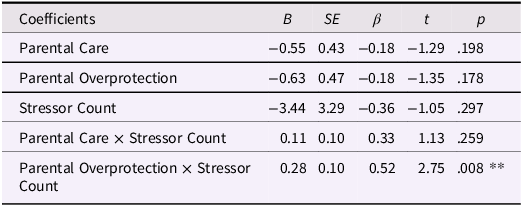
The results of the regression model (presented in Table 2) revealed a significant interaction (Figure 1A) between overprotection and stressor exposure, such that a higher stressor count was associated with more anxiety symptoms, but this effect was strongest for those reporting higher levels of parental overprotection. For those reporting lower levels of overprotection, this association was less strong. Johnson-Neyman analyses (Figure 1B) showed that this interaction was significant when overprotection values were outside the interval [−23.34, 7.19] (Figure 1b). While the Johnson-Neyman interval includes negative values, it does not correspond to real data points in our sample (range [0.5, 29.5]). The significant association between stressor exposure and symptoms of anxiety only applies to individuals in our sample with moderate-to-high levels of overprotection. Simple slopes analyses showed that the slope of stressor count on anxiety was significant and positive at mean (11.89) and high (+1 SD) overprotection (17.99), but not at low (−1 SD) levels of overprotection (5.79). Care did not significantly moderate the association with stressor exposure.
Effects of parenting, stressor count, and their interaction on anxiety symptoms
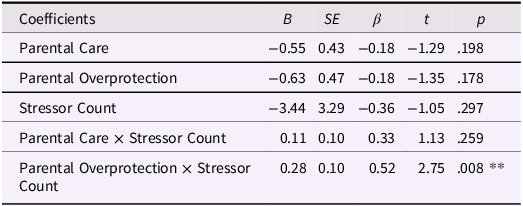
Note. *p < .05; **p < .01. In this model, 14.5% of the variance in anxiety symptoms was explained by the predictors, Adjusted R 2 = .13, F (5, 234) = 7.94, p < .001.
(a) Partial plots for stressor count and parental overprotection, divided into±1 standard deviation from the mean, predicting anxiety symptoms from the IDAS-II. Larger values represent more overprotective behaviors. Scatter points are jittered for visualization. (b) Johnson-Neyman intervals showing the values of parental overprotection that yielded a significant interaction with stressor count to predict anxiety. (c) Partial plots for stressor count and parental care, divided into±1 standard deviation from the mean, predicting anxiety symptoms from the IDAS-II. Note that this interaction is non-significant. (d) Johnson-Neyman intervals showing the values of parental care that yielded a significant interaction with stressor count to predict anxiety.

Discussion
The present study investigated the buffering and exacerbating effects of parental care and overprotection on life stressors experienced during the university transition. Because not all students will develop anxiety during this transition (Andrews & Wilding, Reference Andrews and Wilding2004; Cheung et al., Reference Cheung, Tam, Tsang, Zhang and Lit2020; Crocker et al., Reference Crocker, Canevello, Breines and Flynn2010), it is important to identify those individuals who will be most susceptible to stress exposure. A better understanding of the associations between parenting and stress susceptibility can potentially contribute to targeted interventions in earlier stages of development (Brody et al., Reference Brody, Gray, Yu, Barton, Beach, Galván, MacKillop, Windle, Chen, Miller and Sweet2017; Jeong et al., Reference Jeong, Pitchik and Fink2021). Consistent with our hypothesis, parental overprotection interacted with recent stressor exposure, such that individuals with higher levels of overprotection and more frequent stressor exposure also reported more anxiety symptoms during the transition to college. These results are consistent with prior research in adults demonstrating that greater parental overprotection and stressors are cross-sectionally associated with greater anxiety symptoms (Eberly Lewis et al., Reference Eberly Lewis, Slater, McGinley and Rote2024; Goger et al., Reference Goger, Rozenman and Gonzalez2020; Ono et al., Reference Ono, Takaesu, Nakai, Ichiki, Masuya, Kusumi and Inoue2017).
Contrary to our hypotheses and some prior research (Engert et al., Reference Engert, Efanov, Dedovic, Duchesne, Dagher and Pruessner2010; Sameshima et al., Reference Sameshima, Shimura, Ono, Masuya, Ichiki, Nakajima, Odagiri, Inoue and Inoue2020), we did not find that higher levels of parental care buffered against transition to university stressors to predict fewer anxiety symptoms. Although unexpected, these results are consistent with studies showing parental overprotection or overinvolvement explaining more variance in childhood anxiety compared to care or other parental variables (McLeod et al., Reference McLeod, Wood and Weisz2007; Rork & Morris, Reference Rork and Morris2009), suggesting that the negative effects of overprotection may outweigh the potential positive effects of care even in young adults.
Furthermore, although the present research documents an interaction between proximal stress exposure and parenting experiences (albeit measured retrospectively) as they relate to anxiety in emerging adulthood, additional research is needed to identify the mechanisms underlying this effect. One potential mechanism of the enduring effect of parenting is attachment styles (Yirmiya et al., Reference Yirmiya, Motsan, Zagoory-Sharon and Feldman2020). Overprotective parenting tends to lead to insecure attachment (Bowlby, Reference Bowlby1977; Körük et al., Reference Körük, Öztürk and Kara2016; Otani et al., Reference Otani, Suzuki, Matsumoto, Shibuya, Sadahiro and Enokido2013), which research suggests remains stable throughout adulthood (Chris Fraley, Reference Chris Fraley2002; Waters et al., Reference Waters, Hamilton and Weinfield2000). This can color adult social interactions and contribute to increased anxiety during the transition to university (Parade et al., Reference Parade, Leerkes and Blankson2010; Yu et al., Reference Yu, Liu, Song, Fan and Zhang2020) where many new social connections are made. Another proposed mechanism of overprotective parenting is poorer learned emotion regulation and coping skills (Nijhof & Engels, Reference Nijhof and Engels2007; Wolfradt et al., Reference Wolfradt, Hempel and Miles2003), which can last into adulthood (Bahtiyar & Gençöz, Reference Bahtiyar and Gençöz2023; Manzeske & Stright, Reference Manzeske and Stright2009; Spada et al., Reference Spada, Caselli, Manfredi, Rebecchi, Rovetto, Ruggiero, Nikčević and Sassaroli2012; Yao et al., Reference Yao, Chen and Gu2022), resulting in greater distress in response to stressors (McLafferty et al., Reference McLafferty, Armour, Bunting, Ennis, Lapsley, Murray and O’Neill2019; Segrin et al., Reference Segrin, Woszidlo, Givertz and Montgomery2013). Future studies might examine these constructs as potential mechanisms of the observed effects to better understand the ways in which parenting might relate to individual differences in stress susceptibility across development.
Limitations
This study has several limitations. First, we did not collect information about parental anxiety. Given that overprotective parenting can be associated with parents’ own anxiety (Clarke et al., Reference Clarke, Cooper and Creswell2013; Ginsburg et al., Reference Ginsburg, Grover and Ialongo2005; Jones et al., Reference Jones, Hall and Kiel2021), and that anxiety disorders and symptoms are subject to substantial genetic contributions (Barrett et al., Reference Barrett, Rapee, Dadds and Ryan1996; Hettema et al., Reference Hettema, Neale and Kendler2001; Meier & Deckert, Reference Meier and Deckert2019), it could be the case that observed effects of parenting simply reflect a greater genetic vulnerability to anxiety. However, we would note that there is previous evidence for independent effects of parenting, such that, even controlling for parental anxiety, overprotective parenting or behavior is still associated with offspring anxiety symptoms (Edwards et al., Reference Edwards, Rapee and Kennedy2010; Hudson & Rapee, Reference Hudson and Rapee2001; Moore et al., Reference Moore, Whaley and Sigman2004). It will be critical for future studies to also consider the potential role of parental anxiety in influencing the associations observed here. Additionally, anxiety during early life stages and parenting styles also have a bi-directional association, such that parents tend to be more overcontrolling with anxious children (Drake & Ginsburg, Reference Drake and Ginsburg2012; Gouze et al., Reference Gouze, Hopkins, Bryant and Lavigne2016; Hale et al., Reference Hale, Klimstra, Branje, Wijsbroek and Meeus2013), which may result in more anxiety in adulthood. Dynamic and longitudinal study designs that can more convincingly isolate genetic and environmental sources of influence will be useful in understanding the mechanisms of this effect. Second, we do not have reports of participants’ anxiety symptoms before the transition to university. Anxiety symptoms prior to university can set the stage for enduring symptoms later in life and are often a better predictor of future anxiety than parenting or stress exposure (Hovenkamp-Hermelink et al., Reference Hovenkamp-Hermelink, Jeronimus, Myroniuk, Riese and Schoevers2021). Future research should consider examining if parenting styles can predict longitudinal changes in symptoms before and after stressors.
Third, the use of a retrospective self-report measure of received parenting that assesses a wide age range (0 to 16) does not account for changes in parenting over the course of development. For instance, some levels of parental control can be appropriate at younger developmental stages but are interpreted as overprotection at later developmental stages (Ballash et al., Reference Ballash, Leyfer, Buckley and Woodruff-Borden2006). It might be difficult for participants to adequately average parenting styles across years of development. That said, despite the inherent limitations of retrospective reports, the PBI has shown considerable reliability and stability over time (Murphy et al., Reference Murphy, Wickramaratne and Weissman2010; Wilhelm et al., Reference Wilhelm, Niven, Parker and Hadzi-Pavlovic2005; Wilhelm & Parker, Reference Wilhelm and Parker1990). In addition to the PBI, future studies should also consider incorporating parent-rated scales of parenting, objective measures of parenting behaviors (e.g., observational methods), as well as whether the parenting behaviors were developmentally appropriate. The cross-sectional nature of the analyses also means that we are unable to determine whether the documented interaction between experiences of parental overprotection and stressor exposure plays a causal role in predicting changes in anxiety symptoms and reverse causality is also possible. Longitudinal research would be better positioned to address this limitation and should collect intensive longitudinal data, when possible (Moriarity & Slavich, Reference Moriarity and Slavich2023).
Finally, our analyses focused on stressor count as a measure of stressor exposure frequency, without considering the context, severity, duration, or characteristics of each stressor exposure. We did not have any a priori reasons to examine different types of stressors during this transition period, but acknowledge that not all types of stressors or their durations exert equivalent effects on internalizing symptoms (Epel et al., Reference Epel, Crosswell, Mayer, Prather, Slavich, Puterman and Mendes2018; McLoughlin et al., Reference McLoughlin, Fletcher, Slavich, Arnold and Moore2021). Future research should thus examine different stressor characteristics, such as social versus non-social stressors, in a larger sample with sufficient power.
Conclusion
In conclusion, the present findings indicate that higher levels of parental overprotective behaviors and more stressor exposure during the transition to university, combined, are associated with more anxiety symptoms during this developmentally important period. These results thereby advance our understanding of the enduring associations between parenting behaviors and vulnerability to subsequent stressors and associated psychological outcomes into early adulthood. These findings not only support the identification of those individuals who may be most vulnerable to experiencing anxiety during major life transitions, but also point toward meaningful directions for future research into underlying mechanisms. Namely, longitudinal studies further exploring these processes could support the optimal promotion of impactful, positive change in the parent-offspring relationship with an eye toward improved individual outcomes over development.
Supplementary material
The supplementary material for this article can be found at https://doi.org/10.1017/S095457942510028X.
Acknowledgments
A.W. was supported by funds granted by the Canada Research Chair in Clinical Neuroscience and CIHR (grant number: 427055). G.M.S. was supported by grant #OPR21101 from the California Governor’s Office of Planning and Research/California Initiative to Advance Precision Medicine, and by contract #21-10317 from the California Department of Health Care Services, which supports the UCLA-UCSF ACEs Aware Family Resilience Network and is strategically guided by the Office of the California Surgeon General. The findings and conclusions in this article are those of the authors and do not necessarily represent the views or opinions of these organizations, which had no role in designing or planning this study; in collecting, analyzing, or interpreting the data; in writing the article; or in deciding to submit this article for publication.
Data availability
Deidentified data, syntax, and task code can be found here: https://osf.io/4tgau.
Competing of interests
The authors declare no conflicts of interest with respect to this work.



 Open access

