

The rise of Christian nationalism is one of the great threats to American democracy in the modern era.Footnote 1 The reaction of conservative Christians to their declining numbers was not to reach out and compromise to build broader coalitions but to build elaborate notions of threat from Democrats, the Left, the non-religious, Marxists, and others to persecute Christians. Seeking the goal of dominion over the United States has led Christian nationalists to support anti-immigrant policies including separating children from their families (Al-Kire et al. Reference Al-Kire, Pasek, Tsang, Leman and Rowatt2022), employing the harsh use of force by police (Perry, Whitehead, and Davis Reference Perry, Whitehead and Davis2019), stripping voting rights from American citizens (Perry, Whitehead, and Grubbs Reference Perry, Whitehead and Grubbs2022), ending or preventing equal LGBT rights (Whitehead and Perry Reference Whitehead and Perry2015), and, generally, applying different legal standards and unequal applications of rights to outgroups (Broeren and Djupe Reference Broeren and Djupe2024; Davis, Perry, and Grubbs Reference Davis2023; Djupe, Lewis, and Sokhey Reference Djupe, Lewis and Sokhey2023).
Obviously, these developments have not gone unremarked upon, and organizations and individuals have arisen to try and raise a force against Christian nationalism (e.g., Tyler Reference Tyler2024). Most notably, some Christians have begun to articulate a vision of Christianity and a set of values that stand directly in opposition to Christian nationalism. In addition to their theological concerns, these Christian elites have also criticized Christian nationalism for its relationship to anti-Black and anti-immigrant sentiment, its curtailment of religious liberties for religious minorities, and its association with support for authoritarian politics. Christians Against Christian Nationalism, a leading Christian voice against the worldview, produced a statement that reads, “As Christians, we must speak in one voice condemning Christian nationalism as a distortion of the gospel of Jesus and a threat to American democracy” (Christians Against Christian Nationalism 2019). Over 35,000 people have signed the statement by the time of this writing. Christians Against Christian Nationalism has also developed a series of curricular materials aimed not only at explaining the dangers of the exclusionary worldview but also at rooting values of civic pluralism within the Christian tradition as the antidote to Christian nationalist tendencies (Baptist Joint Committee 2019).
A series of thoughtful books has come out in the past several years seeking to document the degree of threat that Christian nationalism poses to democracy (Copulsky Reference Copulsky2024) and the church (Alberta Reference Alberta2023). In their view, Christian nationalism is not a true expression of Christianity and results from a fundamental substitution of the nation as the object of worship—Christian nationalism is idolatry (Campbell Reference Campbell2024) that leads us “to betray our loyalty to Jesus and the gospel” (Whitehead Reference Whitehead2023: 15). Each, in their own way, offers ways to counter it, whether through belief change, conversations with friends and family, or advocacy work at all levels of government (Tyler Reference Tyler2024). All of them see the work involved to challenge Christian nationalism as an authentic expression of faith: “Our love of our neighbors naturally should include a commitment to protect their rights of citizenship and equal belonging regardless of which religion they practice” (Tyler Reference Tyler2024: 52-53). Whitehead, likewise, argues, “The gospel can and does empower us to enter more deeply into our neighbor’s needs, serving them out of gratitude to God” (emphasis in the original—2023: 13–14).
If we could distill a set of anti-Christian nationalist beliefs and values from this nascent literature, it would involve more than just a rejection of Christian nationalism with nothing to replace it. They offer, instead, a grounded set of principles that run counter to the blinkered set of priorities Christian nationalists offer. Rather than seek to treat outgroups as second-class citizens, they prioritize an embrace of religious pluralism—religious freedom means nothing if it’s not for everyone (Tyler Reference Tyler2024). These advocates wish to sever the notion that God favors particular nations and that, in particular, God has not favored the United States. And they clearly wish believers to serve their neighbor as themselves, approaching others not with fear but with love, grace, and humility (Campbell Reference Campbell2024).
In this paper, we seek to document whether a worldview that stands affirmatively opposed to exclusive Christian nationalism exists in the American populace, to identify its correlates (including its relationship with Christian nationalism), and to explore how it might compete with Christian nationalism to shape a core democratic value—political tolerance. Political tolerance goes beyond prejudice to offer the same extent of rights and liberties that they themselves enjoy to groups they dislike.
We label this worldview anti-Christian nationalism (ACN), and it taps into values of religious pluralism and inclusivism. However, despite ACN’s advocates intending it to be antithetical, and perhaps an antidote, to Christian nationalism, we find that ACN is already widely subscribed to and that it is positively correlated with Christian nationalism. In subsequent analyses, we find that while ACN has the potential to increase political tolerance, it appears to be unable to overcome the potency of Christian nationalism when in a threat-rich environment.
Religion and Political Tolerance
For as long as social scientists have measured these concepts, religion has been connected with intolerance. Stouffer (Reference Stouffer1955) first documented that church attendance was negatively correlated with the full extension of rights to controversial groups. And that basic finding has not changed much ever since. What has changed is the diversity of measures of religion that have been found to be correlated positively with intolerance (for a review, see Djupe Reference Djupe2015). That effort might be summarized under four explanations, starting with the composition of religious groups. First, given the strong relationship of education with tolerance (e.g., Golebiowska Reference Golebiowska1995), at one time, a rather strong case could be made that the demographic differences between religious groups, especially in levels of education, accounted for their varying tolerance levels (Reimer and Park Reference Reimer and Park2001; Roof and McKinney Reference Roof and McKinney1987; Wilcox and Jelen Reference Wilcox and Jelen1990). Those differences in educational attainment have narrowed over time, but, even so, religious links to tolerance persist when demographics have been accounted for (Burdette, Ellison, and Hill Reference Burdette, Ellison and Hill2005; Gibson Reference Gibson, Wolfe and Katznelson2010; but see Eisenstein Reference Eisenstein2008).
Second, the composition of religious groups might matter in another way—in the reduced degree of exposure to difference that religious involvement might entail (e.g., Smidt and Penning Reference Smidt and Penning1982), which otherwise plays a strong role in reducing prejudice (e.g., Pettigrew and Tropp Reference Pettigrew and Tropp2006; but see Djupe, Neiheisel, Sokhey, and Lewis Reference Djupe, Neiheisel, Sokhey and Lewis2025) and boosting tolerance (Mutz Reference Mutz2006). At the same time, congregations vary considerably in the amount of disagreement and diversity among their memberships (Djupe and Gilbert Reference Djupe and Gilbert2009), and religious traditions do not differ substantially in the amount of disagreement and political discussion in the social networks of identifiers (Djupe and Calfano Reference Djupe and Calfano2012a; Ladam et al. Reference Ladam, Shapiro, Sokhey, Djupe, Rozell and Jelen2019). Moreover, church involvement is strongly linked to diverse types of civic involvement (Son and Wilson Reference Son and Wilson2021; Verba, Schlozman, and Brady Reference Verba, Schlozman and Brady1995; Yeung Reference Yeung2017), suggesting that religious involvement may lead to diverse interactions even if the religious group itself is homogeneous (Parsell and Stambe Reference Parsell and Stambe2024; Polson Reference Polson2018). Together, these relationships highlight the complex nature of the intersection of “religious cloistering” and political tolerance.
Third, it is clear from the literature that religious beliefs help open up or close off people to the extension of equal status to others in democratic societies. With roots in the study of authoritarianism (Adorno et al. Reference Adorno1950), the conceptualization of dogmatism was a pursuit of a generalized concept of cognitive closure. The dogmatic hold their views tightly and exclusively, delegitimizing the views of others to the point where their citizenship is in question (Sullivan et al. Reference Sullivan, Piereson and Marcus1982). Religion and politics researchers have often used a measure of biblical literalism to proxy for dogmatism, which has been linked to intolerance in national samples (Jelen and Wilcox Reference Jelen and Wilcox1991; Tuntiya Reference Tuntiya2005; Wilcox and Jelen Reference Wilcox and Jelen1990) and over time (Reimer and Park Reference Reimer and Park2001). Literalism is a synonym for fundamentalism in Christianity, which has also been linked to intolerance (Ellison and Musick Reference Ellison and Musick1993). Tuntiya (Reference Tuntiya2005) finds that intolerance is not the result of a fundamentalist identity but the substantive cognitive closure of literalism doing the work. There are perhaps better measures of dogmatism in religion and politics work—Jelen and Wilcox (Reference Jelen and Wilcox1991) find a link between intolerance and commitment to clear rights and wrongs. Relatedly, Owen, Wald, and Hill (Reference Owen, Wald and Hill1991) reject authoritarianism in a religious context as a personality measure and instead pitch “authority-mindedness,” which can shift with religious teachings. Finally, Eisentein (Reference Eisenstein2008) sees a link of religiosity to a less secure personality, of which dogmatism is a part (see also Eisenstein and Clark Reference Eisenstein and Clark2014).
Fourth, how views are held may be important, but what those views entail should be paramount. One of the potential bright spots in this literature for religion is the role of values concerning the openness of the congregation to difference. Thought to be the foundation of the religious economy (Stark and Finke Reference Stark and Finke2000), the relative weight placed on inclusion versus exclusion defines how congregations are organized and relate to the outside world. Inclusive values indicate a receptiveness to diversity even if that means the congregation drifts in new directions, while exclusive values indicate a reticence to embrace diversity particularly because of the potential to stray from the one true path.
These values have consistent political implications across policy domains, and the effects have been documented in a variety of ways. Djupe and Calfano have connected inclusive values to more (and exclusive values to less) cooperative foreign policy (Reference Djupe and Calfano2013a) and expansive immigration policy (Reference Djupe and Calfano2013b). Naturally, the basic logic has also been extended to political tolerance and threat, for which the height of group boundaries is particularly salient. Generally, more inclusive value commitment is linked to perceiving less threat from a least-liked group and greater expressions of tolerance toward them (Djupe and Calfano Reference Djupe and Calfano2013c; Schaffer, Sokhey, and Djupe Reference Schaffer, Sokhey, Djupe and Djupe2015). But these values are not settled—exposure to these values by randomly priming them in a survey experiment also shaped threat, which affected levels of tolerance. In that case, only exclusive values had an effect, which the authors suggested is because inclusive values are chronically accessible and hence less susceptible to priming effects (Djupe and Calfano Reference Djupe and Calfano2013c). In another study, Djupe and Calfano (Reference Djupe, Calfano and Djupe2015) find that having a clergy person who espouses more exclusive values drives up intolerance using a matched clergy-congregant sample from Springfield, Missouri.
Given the ability to randomly prime inclusive and exclusive values, it may not come as a surprise that these two value dimensions are positively related. Some of that is due to including the non-religious in a sample, who would be expected to reject values about congregational action. But the items are positively correlated among the religious too.Footnote 2 The takeaway is that these values are simultaneously present for many believers and either one can be activated by events or elites as the experimental work suggests.
A Start to Anti-Christian Nationalism
There are multiple avenues of thinking about creating an ACN worldview. It is more than just rejecting the components of Christian nationalism—ACN defines Christianity as decoupled from American identity and inclusive of diverse others.
This is to say that, in contrast with the concept of inclusive and exclusive values applied to the congregation, identifying value statements that would apply at the national level might also be operative. We see evidence for this in the inverse through the expression of Christian nationalism. Viewing the goals of the nation as of, by, and for Christians, Christian nationalism has been linked to all sorts of conservative causes that reify boundaries between groups and redistribute resources to the ingroup and away from outgroups (e.g., Whitehead and Perry Reference Whitehead and Perry2020). For many, this orientation is synonymous with the interests of the racial group. For example, Christian nationalists prefer “racially pure” families (Perry and Whitehead Reference Perry and Whitehead2015) and the funneling of government funding toward programs like border and crime spending (Davis Reference Davis2019), which sustain social hierarchies. Indeed, the very encroachment of outgroups on the “rightful” place and power of Christians propels attachment to a Christian nationalist worldview (Al-Kire et al. Reference Al-Kire, Pasek, Tsang and Rowatt2021; Walker and Haider-Markel Reference Walker and Haider-Markel2024a).
Our strategy is to conceptualize ACN as not just a rejection of Christian nationalism, which would be captured by disagreement with the Christian nationalism survey questions, but as an embrace of opposing principles. In other words, simply rejecting Christian nationalism does not imply an embrace of ACN, and vice versa. If Christian nationalism is the pursuit of Christian dominion over the United States, then ACN may involve the idea that there is no dominant group that should be favored. If Christian nationalism involves special consideration for Christians, then ACN is expressing care for the diversity of people in the United States and beyond. If Christian nationalism involves the idea of special rights and protections for Christians, then ACN embraces universal religious freedoms because any group can be or become a minority, and minority status should not affect their rights and liberties. From these pairings, we hope it is clear that Christian nationalism is a particularistic worldview, while ACN is appropriately a pluralistic one. Because ACN may have multiple components, of which ours is just one, we suggest that an appropriate alternate label could be support for religious pluralism.
In the same way that inclusion and exclusion seem like polar opposites, but in fact are not, our inquiry in this paper concerns explicitly inclusive national and individual commandments that also seem at odds with exclusive notions inherent in Christian nationalism. However, we also suspect that, empirically, ACN and Christian nationalism are not polar opposites, where the embrace of one entails the necessary rejection of the other. Individuals will often hold a mix of considerations related to a topic (Zaller Reference Zaller1992). Like all faith systems, Christianity contains both messages of inclusion of outgroup members (e.g., the Good Samaritan) and exclusion of outgroup members, as discussed above. In fact, it is easy to imagine people agreeing with both dimensions, reflecting elements of the American creed in which everyone is welcome, as well as the credo that the United States was formed by Christians implementing the Bible’s commandments to form the Constitution (Gorski and Perry Reference Gorski and Perry2022; Walker and Haider-Markel Reference Walker and Haider-Markel2024b). That is, just like the positive relationship between inclusive and exclusive religious values found in previous work, we anticipate that Christians will simultaneously hold both Christian nationalist and anti-Christian nationalist attitudes (H1).
However, holding seemingly conflicting views about the role of Christianity in the country does not mean that considerations are entirely random. Instead, religion itself can house multiple schemas, which are cognitive structures that organize knowledge hierarchically by domain (Conover and Feldman Reference Conover and Feldman1984). Streib, Hood, and Klein (Reference Streib, Hood and Klein2010), for example, identify three schemas within religion: truth of text and teachings; fairness, tolerance, and rational choice; and xenosophia (deep knowledge of the other). Because Christian nationalism and ACN are organized around different principles—religious hierarchy and boundaries vs. religious pluralism—we anticipate that Christian nationalism and ACN items will form distinct factors (H2). These distinct factors should produce different effects. As mentioned previously, Christian nationalism assumes that Christians occupy a privileged status in the country, resulting in preferences for stronger group boundaries and higher prejudice against outgroups. ACN, alternatively, articulates a view that sees all religious groups as better off when they are treated equally by the government. Because the factors have different orientations toward the positions of outgroups, Christian nationalism will be linked to decreased tolerance, and ACN will be linked to increased tolerance (H3).
If these two concepts can be held conjointly, then the next task is to consider whether and how they interact. Because Christian nationalism is associated with strong social boundaries, we anticipate that it will be strongly linked with perceptions of outgroup threat, particularly the threat posed by an individual’s least-liked group. And because negativity bias has such a strong influence, with negative events and interactions able to overwhelm positive ones (Baumeister et al. Reference Baumeister, Bratslavsky, Finkenauer and Vohs2001; Rozin and Royzman Reference Rozin and Royzman2001), we think it likely that any pro-tolerance effects of ACN will be overwhelmed by the anti-tolerance effects of Christian nationalism linked to the threat of persecution.
We find support for these dynamics from another corner—research on competing values. Even if values do not seem to change much over time (Jennings and Niemi Reference Kent and Niemi1968), especially among sophisticated citizens (Jacoby Reference Jacoby2006), their specific application can shift dramatically depending on the context. For instance, Zaller (Reference Zaller1992) argues that value application hinges on the information available, which is akin to priming, which Katz and Haas (Reference Katz and Hass1988) find can elevate certain values. Group connections, like partisanship, may also place limits on what values can be applied (Goren Reference Goren2005). Of course, one of the most impactful shifts in the information environment is the introduction of threat (e.g., Huddy et al. Reference Huddy, Feldman, Taber and Lahav2005) and it is an old and sustained finding in the tolerance literature that the threat felt from a group has the most powerful effect in shifting people away from applications of equal rights (e.g., Sullivan et al. Reference Sullivan, Piereson and Marcus1982; Gibson Reference Gibson2006). As a result, we anticipate that Christian nationalism will mitigate the pro-tolerance effects of ACN (H4) because Christian nationalism will be uniquely associated with outgroup threat and Christian persecution beliefs (H5).
Data and Measurement
The data were gathered in a survey of 1,500 American Christian adults conducted in the last week of January 2024 through the panel provider Cint. We included three attention check questions, and the interview was ended for those who failed any of them. Those who sped through the survey (taking less than 6 minutes to complete what is reasonably a 15-minute survey) were dropped and replaced. The Census Bureau does not offer population percentages for religious groups, so we composed weights for race, education, age, gender, and Catholic and evangelical identifiers using the distribution of these variables among self-identified Christians in the weighted 2022 Cooperative Election Study. The weighted dataset hits those benchmarks (see Appendix Table A1 for a comparison of the weighted and unweighted variables of interest).
Tolerance is measured using the least-liked group approach (Sullivan et al. Reference Sullivan, Piereson and Marcus1982). The survey first asked respondents to identify their least-liked group from the following options: Biden supporters, Trump supporters, immigrants, atheists, Christian fundamentalists, socialists, environmental activists, pro-Palestinian protestors, or pro-Israel protestors. Then they were asked whether someone from their least-liked group should be banned from making speeches in the respondent’s community, allowed to teach in public schools, banned from running for public office, be subject to phone tapping by the government, allowed to hold public rallies in the respondent’s community, and that books written by the least-liked group be banned from public libraries. Cronbach’s alpha for these six items is 0.57.Footnote 3
The survey measured threat in two separate ways. Respondents were asked if their least-liked group is threatening the American way of life, is a threat to other people’s freedom, and whether the threat posed by the group justifies violence to try to stop them. Cronbach’s alpha for these three items is 0.75. Second, we inquire about the threat environment for Christians by assessing their agreement with these four items: Christians will lose their religious freedom if Democrats control the federal government; a Democratic president is likely to ban the Bible; a Democratic president will force you to pay for abortions; and a Democratic president will take your guns (Cronbach’s alpha = 0.88). We will refer to this second measure as Christian persecution beliefs (see Djupe, Lewis, and Sokhey Reference Djupe, Lewis and Sokhey2023).
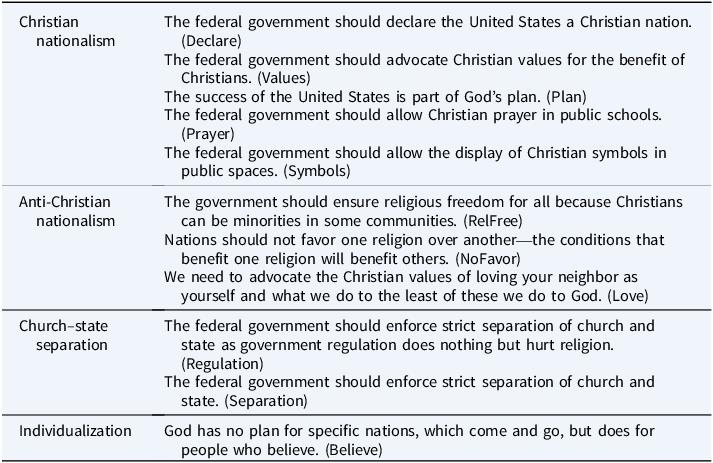
To assess attitudes about the role of religion, namely, Christianity, in politics and policy, we asked participants to respond to 11 items on a 5-point response scale to assess their attitudes about the intersection of religion and government. We began with the Whitehead and Perry (Reference Whitehead and Perry2020) Christian nationalism items, with a few alterations proposed by Djupe, Lewis, and Sokhey (Reference Djupe, Lewis and Sokhey2023). That is, we added “for the benefit of Christians” to the values question to make explicit that Christian nationalism elevates the preferences of Christians over those of other Americans. We added “Christian” to the items referencing prayer and religious symbols to again clarify the special status of Christianity (Davis Reference Davis2023; Smith and Adler Reference Smith and Adler2022). Then we presented five items that reflect counterpoints raised by Christian opponents of Christian nationalism. Table 1 presents the wording of our items.
Christian nationalism and anti-Christian nationalism item wording

We control for respondents’ religious (religious service attendance and evangelical identity), political (party identification), and demographic (gender, race, education, age) characteristics, as well as their least-liked group selection. Summary statistics (Table A1), question wording and coding, and full model results can be found in the Appendix.
Findings
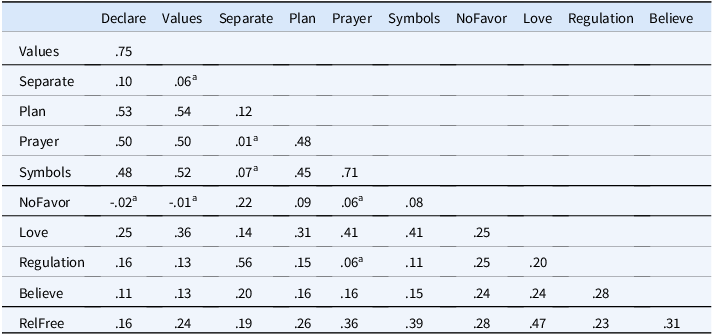
First, we anticipated that respondents would hold a mix of attitudes about how religion should be related to politics (H1). We find strong evidence to support this hypothesis (see Table 2). Almost all of the variables are positively correlated with a high degree of certainty even if the coefficients tend to be weak. This includes variables that, on their face, appear contradictory. Respondents who affirm that the United States should be declared a Christian nation also affirm that government regulation hurts religion (r=.16). Respondents who assert that the federal government should affirm Christian values also assert that the government should assert religious freedom for all (r=.24). And we even see that respondents who say governments shouldn’t favor one religion over another lean toward favor of Christian symbols in public spaces (r=.08) and Christian prayer in public schools (r=.06). In other words, Christian respondents often hold complex, perhaps contradictory positions about the scope of Christianity in government—Christian nationalism and ACN are not well-structured worldviews in opposition to each other.
Correlation matrix of Christian nationalist and proposed anti-Christian nationalist worldview components

Source: January 2024 survey.
a All Pearson correlation coefficients are significant at conventional levels (p<.05) except these.
While it is true that these variables are almost entirely positively and significantly correlated, a close examination of Table 2 reveals that these correlations are not all the same. Some are much stronger than others, and these variations are fairly predictable. The Declare and Values variables often used in a Christian nationalism battery are the most strongly related (r=0.75), as we’d expect based on previous work (Davis Reference Davis2023). But the correlation between valuing separation of church and state (Separation) and valuing Christian symbols in public spaces (Symbols) is much weaker (r=0.07). This leads us to suspect that there may be some underlying structure to how these items covary.
To explore this covariance, we conducted an exploratory factor analysis with varimax rotation (to emphasize intra-factor correlations). Four factors emerged as the most efficient solution with sufficiently small residuals (see Table 3 for results).Footnote 4 These four factors also point to theoretically distinct concepts. The first is the core Christian nationalism measure (Whitehead and Perry Reference Whitehead and Perry2020), minus the Separation item.Footnote 5 The second is an ACN perspective that endorses religious pluralism. The third focuses on the constitutional issue of separation of church and state, and the fourth centers on individualization (i.e., faith is a personal issue, not a collective one). We combined the items with factor loadings greater than .6 to create four index variables: Christian nationalism (alpha=0.86), anti-Christian nationalism (alpha=0.6), separation of church and state (alpha=0.71), and individualization (see Table 1 for the specific items assigned to each factor). The emergence of multiple factors provides support for H2.
Factor loadings of Christian nationalism and ACN items

It is important to note that our indices are positively correlated with each other (see Table 4). Even the separation of church and state is positively correlated with Christian nationalism. A positive link between support for religious pluralism (ACN) and individualization could be expected. But, if people hold logically consistent ideas, then we would expect that the belief that Christianity should dominate the political system i.e., Christian nationalism should be negatively correlated with support for religious pluralism and beliefs that religion is an individual act detached from nations. Not so here.Footnote 6
Correlation matrix between four religious and public life concepts

Source: January 2024 survey.
Note: All coefficients are significant at p<.01.
Do these orientations have distinct effects on tolerance, as we predicted in H3? We estimated a model with a number of covariates including Christian nationalism and ACN (full results are available in Appendix Table A2). Focusing on the variables of interest, we find that there are strong relationships between the two primary indices and tolerance in the expected directions (see Figure 1). Christian nationalism is associated with lower tolerance of least-liked groups (b=−0.33, p<0.01), which is consistent with other literature that points to Christian nationalism’s link to strong group boundaries (e.g., Djupe, Lewis, and Sokhey Reference Djupe, Lewis and Sokhey2023; Gorski and Perry Reference Gorski and Perry2022). Surprisingly, support for the separation of church and state is also associated with depressed tolerance (b=−0.11, p<0.01). But ACN is linked to greater tolerance, even of the groups people like least (b=0.24, p<0.01).Footnote 7 Individualization does not have a statistically significant relationship (b=−0.00; b=0.46). Our tolerance variable ranges from 0 to 1, so these estimated effects are quite large.
Coefficient plot of religious worldview relationships with political tolerance.
Source: January 2024 survey. See Table A2 for the full model results.

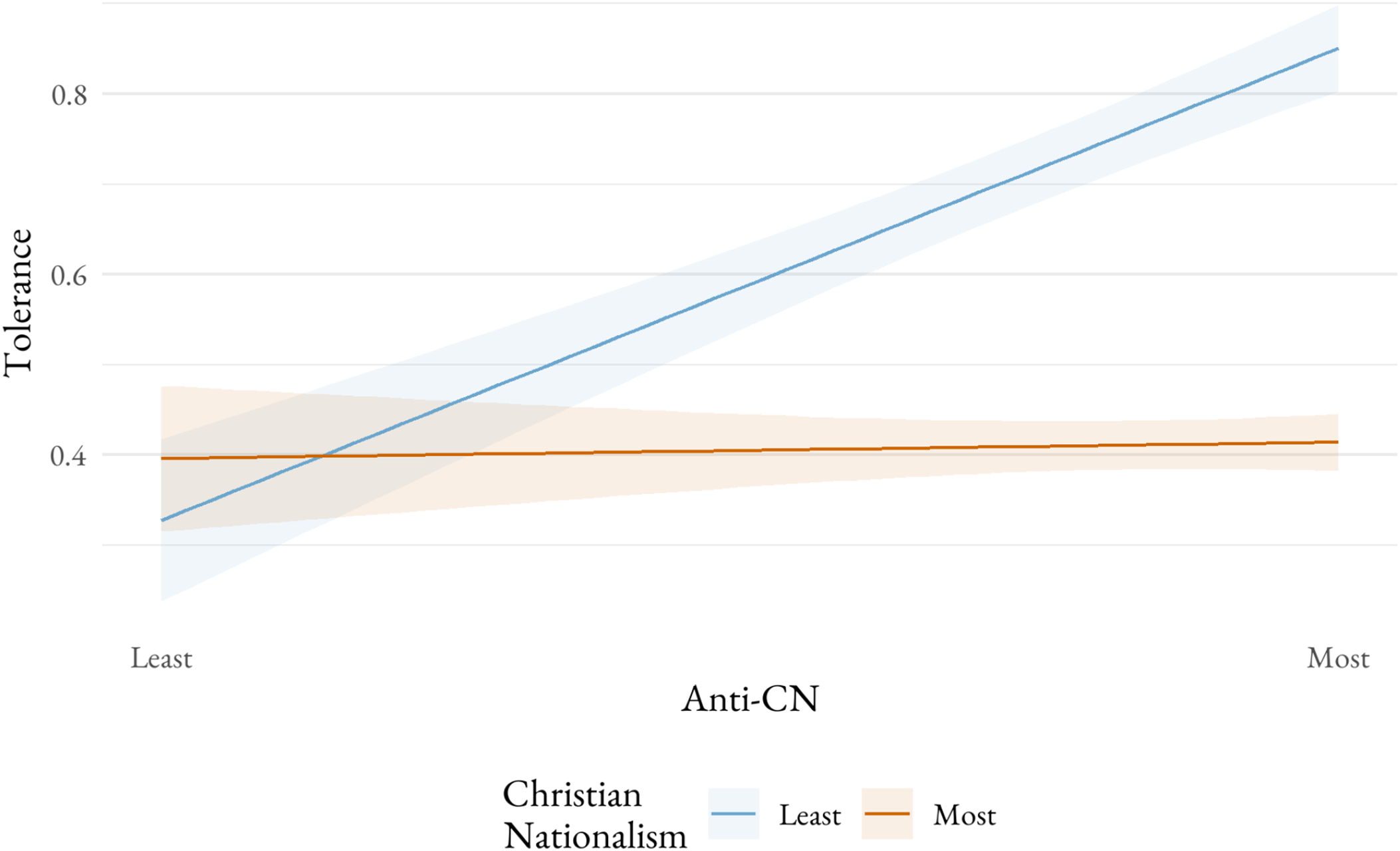
But, as described above, Christian nationalism and ACN are often held in conjunction, and it would be misleading to treat them as independent.Footnote 8 While the linear model described above provides evidence that Christian nationalism and ACN are distinct, it is not allowed (by model assumptions) to demonstrate how they may be operating conjointly. We therefore ran a model interacting Christian nationalism and ACN, and our results are depicted in Figure 2. ACN continues to have a positive relationship with tolerance (b=0.52, p<0.01) when Christian nationalism is zero, but Christian nationalism is no longer significant (b=0.07, p=0.50) when ACN is zero. This suggests that the interactive effect of the two is quite strong (b=−0.51, p<0.01). When Christian nationalism support is low, individuals with strong ACN attitudes are quite tolerant of their least-liked group. But Christian nationalism has a strong relationship, depressing the effect of ACN on tolerance. For strong Christian nationalism supporters, ACN tenets about religious freedom and love of neighbor no longer matter—the group boundaries entrenched by Christian nationalism hold down tolerance regardless of their ACN beliefs.
Christian nationalism erases the link of ACN to tolerance.
Source: January 2024 survey. See Table A3 for the full model results.

Why would Christian nationalism have such a strong relationship, weakening the positive effect of ACN on tolerance? We suspect that the answer lies in the distinctive levels of threat that Christian nationalists tend to hold (see Djupe Reference Djupe and Rudolph2022; Djupe, Lewis, and Sokhey Reference Djupe, Lewis and Sokhey2023). Models of threat that assess the influence of Christian nationalism and ACN separately indicate that ACN has no relationship with the perceived threat of their least-liked groups, though it is linked to less prospective Christian persecution (not shown). Christian nationalism, on the other hand, is strongly linked to greater scores on both measures of threat.
In this case, too, Christian nationalism and ACN interact to shape threat levels and tell a story consonant with the previous results. That is, in the presence of strong Christian nationalism, ACN is actually linked to higher scores on both measures of threat (see Figure 3). Only when respondents reject Christian nationalism is stronger ACN linked to lower levels of threat. This helps to confirm that the rejection of Christian nationalism is not synonymous with ACN—it takes the rejection of CN and the embrace of ACN to shape threat outlooks. But it also provides strong evidence that ACN is a much weaker presence and force in most American Christian worldviews.
ACN is linked to higher threat perception in the context of higher Christian nationalism.
Source: January 2024 survey. See Table A4 for the full model results.

Conclusion
Christianity is a complex theological system, with a set of scriptures written over 1,500 years by dozens of authors. Moreover, it has evolved in myriad ways for 2,000 years in diverse social settings. As a consequence, it’s no wonder that Christianity is multivocal and that its complexity filters into the pews today. Christians receive a host of messages about how the tenets of their faith should inform their treatment of others and their understanding of their own position in a larger society. Some of these messages emphasize love of others, especially the stranger. Some, though, describe exclusive divine favor of the ingroup and present outgroups as threats.
Our study suggests that both of these messages are held by Christians and that they have their expected effects on political tolerance. Christian nationalism (the exclusive set of messages) decreases tolerance of the least-liked groups, while ACN increases tolerance. But, consistent with existing literature on negativity bias, it’s Christian nationalism that rules the day. With its attendant deep sense of threat, Christian nationalism erases the pro-social effects of ACN when they are jointly present.
These findings present several implications. First, we provide evidence that Zaller’s (Reference Zaller1992) conceptualization of mixed considerations can be applied to the domain of religion (see also Bloom and Arikan Reference Bloom and Arikan2012; Djupe and Calfano Reference Djupe and Calfano2013a,b,c). Instead of finding a structured, parsed belief system, Christians have a mix of complex and sometimes contradictory considerations about Christianity as both tolerant and as reinforcing social boundaries.
Second, and most importantly, it is not the case that Christian nationalism crowds out all pluralist ideas about religion. Christians tend to agree with the ACN and other items we presented to them. This also means that if the elites’ goal is to amplify the pro-social impacts of religion, instilling values of religious pluralism is insufficient. Instead, efforts to combat Christian nationalism need to counter notions of religious threat head-on. Or the elite construction and promotion of threats need to simply abate.
The problem is that the communication of threat is baked into conservative Christian worldviews as a sense of embattlement (Smith Reference Smith1998) and that those seeking to mobilize them know this and exploit it (see also Al-Kire et al. Reference Al-Kire, Pasek, Tsang and Rowatt2021; Djupe Reference Djupe and Rudolph2022; Walker and Haider-Markel Reference Walker and Haider-Markel2024a). Trump’s first campaign honed in on Christian insecurity in the wake of the Obergefell decision legalizing same-sex marriage and pledged to be their fighter (see, e.g., Djupe, Neiheisel, Walker, and Sokhey Reference Djupe, Neiheisel, Walker, Sokhey and Haynes2025). His language-tapping threat grew more extensive and more religious, so that in the run-up to the 2020 elections, he claimed that Joe Biden would, “Take away your guns, destroy your Second Amendment. No religion, no anything, hurt the Bible, hurt God” (BBC, 2020). And by the time he was facing indictments, he claimed he was taking the persecution for Christians as if he were Christ-like (McCammon Reference McCammon2024). In the final moments of the 2024 elections, he told conservative Christians that, as the New York Times put it, “only he could protect Christian voters, darkly warning religious communities that they would come under legal, cultural, political and global assault if he lost in November” (Gold Reference Gold2024).
While the overwhelmingly strong influence of Christian nationalism may be discouraging, we do find a silver lining. The mix of considerations present suggests that framing matters. By applying ACN considerations to current issues, elites may be able to exert influence under certain circumstances. We recommend that future projects investigate the effects of Christian nationalist vs. ACN frames on tolerance, paying special attention to whether the type of elite (religious, political), the type of issue, and the presence of threat affect the strength of the frame.
Replication of this project with a sample of the general population could also reveal the extent to which this support for religious pluralism measure transcends religious group identities and whether these relationships hold more broadly. And while we did not do so here, we would also suggest further investigation of whether the types of outgroups matter, which is another way to index threat. Finally, our findings suggest that additional focus should be paid to the role of threat itself (Djupe Reference Djupe and Rudolph2022)—what, exactly, are people high in Christian nationalism concerned about, how is that threat communicated to them, and what messages might promote feelings of psychological safety?
Supplementary Material
To view supplementary material for this article, please visit https://doi.org/10.1017/S1755048326100285.
Funding statement
Funding for this project was provided by a Jack Shand Grant from the Society for the Scientific Study of Religion (SSSR) given to Paul Djupe, Jacob Neiheisel, and Andrew Lewis. The SSSR bears no responsibility for the findings or interpretations contained herein.
Replication data will be made available on Dataverse: https://doi.org/10.7910/DVN/HXHVS1.
Competing interests
The authors have none to declare.





 Open access

