


Introduction
Dicamba-resistant soybean cultivars have recently been commercialized, and adoption of this genetically engineered trait has been widespread throughout soybean-growing regions of the United States. Along with the commercial introduction of these cultivars, there have been many reports of soybean fields without the dicamba-resistance trait showing synthetic auxin herbicide symptoms. Extension personnel from soybean-producing states have estimated that more than 1.4 million hectares of soybean were damaged in 2017 (Bradley Reference Bradley2017), which represents approximately 4% of the 35 million hectares of soybean planted in 2017 (USDA-NASS 2017).
Synthetic auxin herbicide injury on soybean is very distinctive, and dicamba rates as low as 0.03 g ha−1 can cause visible injury symptoms (Solomon and Bradley Reference Solomon and Bradley2014). Many studies have been conducted to quantify the relationship between dicamba dose and soybean response. Egan et al. (Reference Egan, Barlow and Mortensen2014) previously conducted a meta-analysis of published research to better quantify the response of soybean and cotton (Gossypium hirsutum L.) to 2,4-D and dicamba. Meta-analyses can be valuable, as they allow a more robust estimation of the potential yield impacts due to herbicide exposure than could be produced by any single study. Since Egan and colleagues’ meta-analysis, additional studies have been published reporting the effects of dicamba on soybean yield. These new studies provide additional exposure timings and dicamba doses compared with the studies analyzed by Egan et al. (Reference Egan, Barlow and Mortensen2014). Therefore, the purpose of this report is to update the meta-analysis by Egan et al. (Reference Egan, Barlow and Mortensen2014) and to add potentially useful information regarding the relationship of visible injury symptoms to soybean yield loss based on the new data that have been published in the last several years.
The objectives of this meta-analysis were to (1) estimate the no observable effects dose (NOED) for dicamba on susceptible soybean; (2) evaluate available evidence for hormesis, or increased soybean yield in response to low doses of dicamba; (3) estimate the dose of dicamba likely to cause measurable soybean yield loss under field conditions; and (4) quantify the relationship between visible injury symptoms and soybean yield loss.
Materials and Methods
To find relevant studies for inclusion in this meta-analysis, all studies cited in the Egan et al. (Reference Egan, Barlow and Mortensen2014) meta-analysis were located. Additionally, the Web of Science and AGRICOLA databases were searched using the terms “dicamba” and “soybean” for papers published since 2012. All resulting papers (N=70) were then screened for the following inclusion criteria: (1) the study reported soybean yield data in response to dicamba treatment from a replicated field study; (2) the study included a zero-dose (nontreated control); and (3) the study included at least three dicamba doses greater than zero. Eleven studies met all three criteria for inclusion in the meta-analysis, five of which were not included in the original Egan et al. (Reference Egan, Barlow and Mortensen2014) meta-analysis (Table 1).
Information about studies included in the meta-analysis.

a Study was included in the Egan et al. (Reference Egan, Barlow and Mortensen2014) meta-analysis.
b Study was not included in the Egan et al. (Reference Egan, Barlow and Mortensen2014) meta-analysis.
Means from each dose–response series for each study were extracted from the published papers and converted to percentage of control (zero-dose) values where necessary. Transforming yield data to percent of control is not ideal for individual studies, as information about the original response is lost by converting to percent of control; however, some studies included in the analysis presented data only in this format, so it was decided to treat all data similarly. Transformation of means to relative response is a common approach in meta-analyses. Response variables included soybean injury at 14 d after dicamba exposure and soybean yield at maturity. Height data were also collected, but due to variable times of measurement in the original studies (ranging from 2 wk after treatment to maturity), analysis of height data is only presented as Supplementary Information (Supplementary Figures S1 and S2). For each dose–response series, the soybean growth stage as reported in the original study was recorded. For analysis, the growth stages were grouped into the following categories: early vegetative (V1 to V3), late vegetative, prebloom (V4 to V7), flowering (R1 to R2), and pod fill (R3 to R4). If the growth stage reported in the study was a range (such as V3 to V4), then it was included in the group corresponding to the most advanced growth stage reported.
A two-parameter log-logistic model (Equation 1) was used to quantify soybean response to dicamba dose for each study (Price et al. Reference Price, Shafii and Seefeldt2017; Seefeldt et al. Reference Seefeldt, Jensen and Fuerst1995), where y is the response variable, x is the dicamba dose, e is the dicamba dose causing 50% yield loss, and b is a parameter describing the slope at e. Equation 1 was used to quantify soybean yield and injury as a function of dicamba dose, as well as to quantify soybean yield as a function of soybean injury at 14 d after dicamba exposure. For each study, a separate regression was fit to each growth stage category. If a study contained multiple dose–response series for a growth stage category, the data from those series were combined to fit a single curve for the analysis. Lack-of-fit tests and model Akaike information criterion (AIC) values were compared to determine whether the slope parameter could be held constant among studies within each growth stage.
 $$y{\equals}100\,/\,\left( {1{\plus}\exp \left( {b\left( {\log \left( x \right){\minus}\log \left( e \right)} \right)} \right)} \right)$$
To determine the strength of evidence to support anecdotal reports of increased soybean yield in response to low-dose dicamba exposure, a hormesis model (Equation 2) was fit to data from all studies (N=3) in which reported yield values for any dicamba dose were greater than 102% of the control (Auch and Arnold Reference Auch and Arnold1978; Robinson et al. Reference Robinson, Simpson and Johnson2013; Weidenhamer et al. Reference Weidenhamer, Triplett and Sobotka1989). The hormesis model (Cedergreen et al. Reference Cedergreen, Ritz and Streibig2005) is of the same form as Equation 1, but with the addition of two parameters: f describes the magnitude of the increase in soybean yield (y) at low dicamba doses (x), and a describes the steepness of the increase, with possible values ranging from 0 to 1. When f=0, indicating no hormesis, then Equation 2 simplifies to Equation 1. For model fitting, a was fixed at values of either 0.5, 0.7, or 0.9, and the model with the lowest AIC was chosen to compare with the non-hormesis model. A t-test was used to compare each hormesis parameter (f) to 0, where a significant test suggests that hormesis was present. In addition, the three-parameter model and the hormesis model were compared using a lack-of-fit test, where a significant lack-of-fit test suggests the hormesis model provides a better fit to the data. If the f parameter t-test and lack-of-fit tests were both nonsignificant (at alpha=10% level), this suggests that the evidence for hormesis was not strong enough to support the claim of increased soybean yield at low doses. Conversely, if hormesis were present, it was expected that at least one test would be statistically significant.
 $$y{\equals}{{100{\plus}f{\rm {\,\asterisk\,}exp}({\minus}1\,/\,(x^{a} ))} \over {1{\plus}{\rm exp}(b({\rm log}(x){\minus}{\rm log}(e)))}}$$
The dicamba dose required to cause 5% soybean yield loss (YL5) or 5% visible injury (VI5) and the 95% confidence intervals (CI) were estimated for each growth stage from each study using the ED() function from the ‘drc’ package. The level of visible injury associated with a 5% soybean yield loss (I5) was also estimated using the same method.
After analyzing each study individually, data from all studies were pooled for analysis using a nonlinear mixed-effects model (Nielsen et al. Reference Nielsen, Ritz and Streibig2004). Equation 1 was re-paramaterized for the pooled analysis by adding a constant (K) to the equation as suggested by Schabenberger et al. (Reference Schabenberger, Tharp, Kells and Penner1999):
 $$y{\equals}K{\rm {\,\asterisk\,}}100\,/\,(K{\plus}{\rm exp}(b({\rm log}(x){\minus}{\rm log}(e)))$$
The constant K was calculated by taking the percentage response of interest (pct) and dividing it by 100 − pct, so that K=pct/(100 − pct). The pct of interest was either 5% or 95%, depending on whether the response was increasing or decreasing, respectively, so that K was equal to either 19 (95% of the control response for decreasing response variables) or 0.0526 (5% of the control response for increasing response variables). In this way, fixed-effects estimates and 95% CI values could be obtained for YL5, VI5, and I5 values from the pooled data, because addition of K to the model changes the interpretation of the e parameter in Equation 3 to be a direct estimate of the 5% difference from the control level. Random-effects terms for the b and e parameters were included to account for variation in the parameters associated with each individual study (Price et al. Reference Price, Shafii and Seefeldt2017). All analyses were done using R v. 3.4.4 (R Core Team 2018). Nonlinear regression for individual studies was done using the ‘drc’ package v. 3.0-4 (Ritz et al. Reference Ritz, Baty, Streibig and Gerhard2015), and nonlinear mixed-effects models for pooled data were conducted using the ‘nlme’ package v. 3.1-137 (Pinheiro et al. Reference Pinheiro, Bates, DebRoy and Sarkar2018).
Results and Discussion
Dicamba Effects on Visible Soybean Injury
Some injury was observed at all nonzero doses in all studies (Table 2). Robinson et al. (Reference Robinson, Simpson and Johnson2013) observed the lowest visible injury (<5%) at the 0.06 g ha−1 dose of dicamba. Three other studies applied dicamba rates less than 1 g ha−1; Johnson et al. (Reference Johnson, Fisher, Jordan and Edmisten2012) observed >25% injury at 0.6 g ha−1, Solomon and Bradley (Reference Solomon and Bradley2014) observed at least 10% injury at 0.028 g ha−1, and Weidenhamer et al. Reference Weidenhamer, Triplett and Sobotka1989 applied a dose of 0.04 g ha−1 but did not report visible injury. Because visible injury was reported at the lowest dicamba dose in each study in which injury was evaluated, a NOED value cannot be estimated from the existing published literature.
Visible injury from lowest dose in each study that reported visible injury.

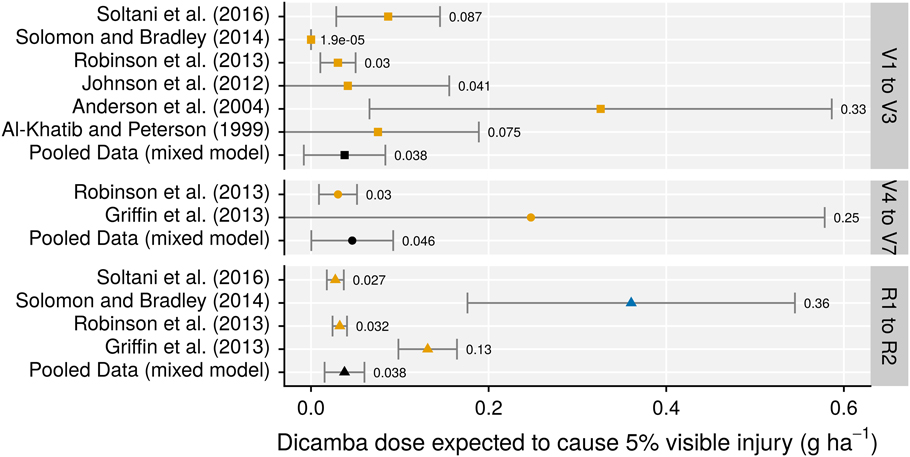
Estimating a field NOED value is important, as it could help determine the amount of off-target movement of dicamba required to cause symptoms in susceptible soybean fields. A NOED value could be combined with information on volatility and other mechanisms of off-target dicamba movement to better characterize the potential for visible soybean injury and yield loss under field conditions. Because a NOED could not be estimated from the published literature, the dicamba dose expected to cause 5% visible injury (VI5) was estimated for each study and each growth stage. For all except one study (Solomon and Bradley Reference Solomon and Bradley2014), the estimated VI5 was less than the lowest dose used in the study (Figure 1; Supplementary Figure S3), and therefore, these estimates should be viewed with caution. However, when data were pooled across studies, VI5 estimates for all growth stages were similar (0.038 to 0.046 g ha−1), suggesting the NOED may be in a range slightly less than the pooled estimate VI5 values. Future field research should include doses of less than 0.038 g ha−1 to better characterize effects of low dicamba doses on soybean.
Estimated dose of dicamba causing 5% visible soybean injury (VI5) as influenced by growth stage at exposure. Bars represent 95% confidence intervals around the estimates. Blue points represent VI5 estimates that were greater than the lowest dose used in the study; orange points represent VI5 estimates that were less than the lowest dose used in the study; black points represent VI5 estimates when data from all studies were pooled for analysis.
Dicamba Effects on Soybean Yield
Hormesis
Three studies, Auch and Arnold (Reference Auch and Arnold1978), Robinson et al. (Reference Robinson, Simpson and Johnson2013), and Weidenhamer et al. (Reference Weidenhamer, Triplett and Sobotka1989), reported soybean yield greater than 102% of the nontreated control treatment, suggesting a hormesis response was possible. All three studies were analyzed to quantify the strength of evidence of a hormesis response (Supplemental Figures S4–S6). For all three studies, the hormesis parameter f was not statistically significantly different from 0 (P>0.14). Additionally, for two of the three studies, the non-hormesis model resulted in a better model fit, as judged by AIC and lack-of-fit tests (Auch and Arnold Reference Auch and Arnold1978; Weidenhamer et al. Reference Weidenhamer, Triplett and Sobotka1989). For the Robinson et al. (Reference Robinson, Simpson and Johnson2013) data, the hormesis parameter improved model fit as judged by AIC and a significant lack-of-fit test; however, for this data set, the hormesis parameter was negative for two of three growth stages, again suggesting no evidence of hormesis. Based on the currently published information, there is insufficient evidence to support any increased soybean yield at low doses of dicamba. To determine whether hormesis exists at doses that cause visible soybean response, future studies should include dicamba applications at much lower doses, including doses less than the (still unquantified) NOED.
Yield Reduction
Eight studies characterized soybean yield response to dicamba at the V1 to V3 stage, compared with five studies at the V4 to V7 stage, seven studies at the R1 to R2 stage, and one study at the R3 to R4 stage. Soybean yield was modeled with a parallel-slopes model for the V1 to V3 stage, but with non–parallel slopes models for the V4 to V7 and R1 to R2 growth stages (Supplementary Figure S7). YL5 values were calculated for each study for each growth stage, and these values represent an estimate of the dicamba dose at which measurable yield loss is likely to be observed (Figure 2). An observed yield reduction of less than 5% is likely to be economically important to a soybean grower; however, estimating yield losses of less than 5% would increase the uncertainty of the estimates (Price et al. Reference Price, Shafii and Seefeldt2017), and therefore, a 5% level of yield loss was chosen for this analysis.
Estimated dose of dicamba causing 5% soybean yield loss (YL5) as influenced by growth stage at exposure. Bars represent 95% confidence intervals around the estimates. Blue points represent YL5 estimates that were greater than the lowest dose used in the study; orange points represent YL5 estimates that were less than the lowest dose used in the study; black points represent YL5 estimates when data from all studies were pooled for analysis.
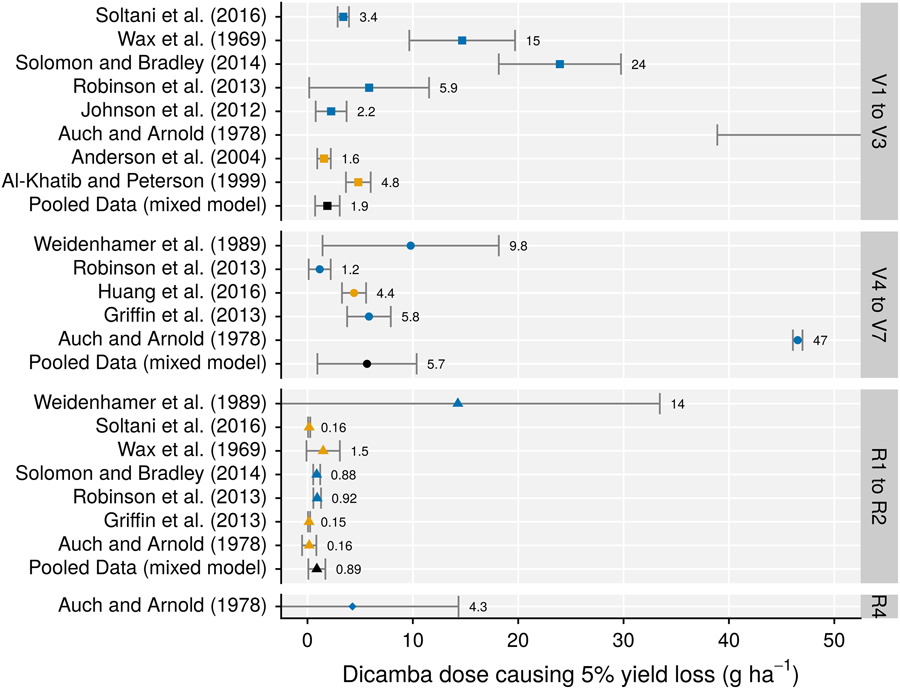
Soybean yield response to dicamba was variable across studies when exposed during the vegetative stages, with YL5 values ranging from 1.6 to 97 g ha−1 at the V1 to V3 stage, and from 1.2 to 47 g ha−1 at the V4 to V7 stage. YL5 estimates for pooled data across studies were 1.9 and 5.7 g ha−1 for early and late vegetative stages, respectively. Auch and Arnold (Reference Auch and Arnold1978) represented a notable outlier with respect to soybean yield loss in response to dicamba exposure at the vegetative stages, with YL5 estimates approximately 10 times greater than other studies. This may be due to only three nonzero doses used in the study, the fewest of any study in this meta-analysis (along with Anderson et al. Reference Anderson, Clay, Wrage and Mathees2004).
These results confirm many expert opinions that yield impacts of dicamba exposure are difficult to predict when soybean is exposed during the vegetative stage. There are many factors that contribute to plant response to stress, including precipitation, fertility, and temperature, all of which can impact eventual yield. Optimal conditions for soybean growth are likely to mitigate yield loss in response to dicamba exposure at the vegetative stages; however, unfavorable conditions are likely to exacerbate yield loss due to dicamba. The environmental factors most important in determining soybean yield loss following dicamba exposure have not been fully characterized, and this is a potential area for future research.
Soybean in the flowering stage (R1 to R2) was consistently more sensitive to dicamba exposure compared with exposure during the vegetative stages (Figure 2). When exposed at the R1 to R2 stage, YL5 values ranged from 0.15 to 14 g ha−1 with a pooled data YL5 estimate of 0.89. Based on pooled data YL5 values, soybean is two to six times more sensitive to dicamba when exposed at the flowering stage than when exposed at the vegetative stage of growth. Soybean yield loss estimates were also more consistent across studies when exposed at the flowering stage, possibly suggesting there is less potential for soybean recovery if exposure to dicamba occurs at this stage.
Relationship between Visible Injury and Yield
When diagnosing dicamba injury from off-target movement events, it is nearly impossible to estimate the dose received by the injured soybean plants, especially if the off-target event is a result of volatilization and the source is unknown. The direct relationship between dicamba dose and soybean yield is, therefore, of limited value to practitioners assessing off-target complaints. However, it is common for weed scientists to quantify the severity of visible injury in these fields, and the relationship between observed injury symptoms and soybean yield loss could be of value. Several previous papers have used dose–response techniques to estimate crop yield loss as a function of visible injury observed during the vegetative stage (Egan et al. Reference Egan, Barlow and Mortensen2014; Kniss and Lyon Reference Kniss and Lyon2011). This approach allows estimating yield loss as a function of the severity of injury symptoms, even if the herbicide dose is unknown.
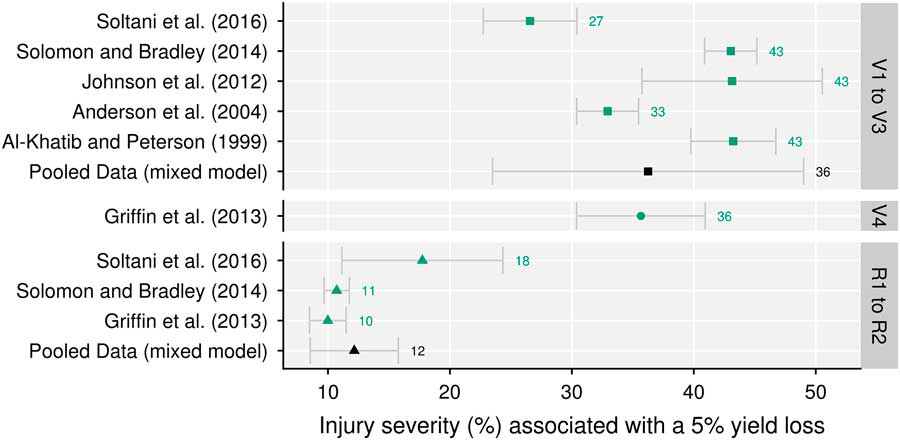
The I5 values (percent injury 14 d after exposure associated with a 5% yield loss) showed a pattern similar to YL5 with respect to soybean growth stage (Figure 3). The amount of injury associated with 5% yield loss was lower when soybean was exposed at the R1 to R2 stage compared with vegetative stages. I5 values ranged from 27% to 43% when soybean was exposed during the vegetative stages (pooled data I5=36%, 95% CI=23 to 50), suggesting that visible injury less than 23% is unlikely to result in severe soybean yield loss if exposure occurs before the V4 stage. However, when soybean was exposed at flowering, observed injury symptoms as low as 10% were associated with a 5% soybean yield loss (pooled data I5=12%, 95% CI=8 to 16).
Visible soybean injury severity 14 d after exposure associated with a 5% soybean yield loss (I5) as influenced by growth stage at exposure. Bars represent 95% confidence intervals around the estimates.
As previously described by Egan et al. (Reference Egan, Barlow and Mortensen2014), meta-analyses can be a powerful tool to summarize similar data from diverse environments and different study designs. This analysis differs from that of Egan and coworkers in that random effects were included when pooling data to account for variation in parameters associated with each study. Although this approach is unlikely to dramatically change the results of the point estimates (e.g., YL5), this mixed-model approach should provide a more accurate estimate of standard errors associated with those estimates, as well as the confidence intervals that are based on those standard errors.
The I5 estimates from this analysis are potentially useful to practitioners attempting to estimate yield loss in the field after an off-target movement event with unknown dose. However, the primary limitation for this use is that all of the data summarized here were a result of a single exposure of dicamba at a known time. For single, known exposure events such as sprayer tank contamination, data from this meta-analysis should be directly applicable to field conditions. However, off-target movement events are not always so well-defined, and an exact exposure time may be difficult or impossible to estimate based solely on in-field symptom progression. Off-target events due to volatilization or secondary fine particle drift may occur multiple times and expose susceptible soybean fields for a longer duration at each event. It is currently unknown whether the relationship between injury symptoms and yield are similar between single versus multiple exposures that result in similar levels of visible injury. It is possible that a concentration/exposure time model, similar to what is recommended for aquatic risk assessment (Reinert et al. Reference Reinert, Giddings and Judd2002), may provide a more reliable estimate for these repeated-exposure scenarios.
Supplementary materials
To view supplementary material for this article, please visit https://doi.org/10.1017/wet.2018.74
Acknowledgments
This research received no specific grant from any funding agency or the commercial or not-for-profit sectors. Funding has been previously provided to the University of Wyoming in support of ARK’s research and education program—through unrestricted gifts, research contracts, or grants—from the following organizations who have economic interests directly related to dicamba-resistant soybean: BASF, Bayer CropScience, DuPont, and Monsanto. None of the funding from these organizations related to the preparation of this manuscript, and no funding agency was consulted regarding this manuscript. Special thanks to Bill Price, University of Idaho, for helpful discussions about the combined data analysis.


 Open access

