


Roadside vegetation management is an arduous endeavor that requires a balance between providing safe travel routes and preserving road system infrastructure in an environmentally responsible manner (NCHRP 2005). Specific to motorist safety, one concern is vision impairment caused by excessive vegetation growth on road medians and shoulders. To mitigate vision impairment, roadsides are routinely mowed per local or state recommendations to provide clear definition of travel ways and adjacent areas (Ferrell et al. Reference Ferrell, Unruh and Kruse2009; Minnesota Department of Transportation 2008; Zartman et al. Reference Zartman, McKenney, Wester, Sosebee and Borrelli2013). Mowing recommendations take into consideration many management considerations; however, they largely relate to a maximum acceptable vegetation height, or intervention height, to avoid impairing motorist sightlines (Zartman et al. Reference Zartman, McKenney, Wester, Sosebee and Borrelli2013). Maximum acceptable vegetation height typically varies from 15 to 45 cm, and is costly to maintain (Louisiana Department of Transportation 2000; Ohio Turnpike Commission 2003; Zartman et al. Reference Zartman, McKenney, Wester, Sosebee and Borrelli2013). A 2005 report summarizing roadside vegetation management practices in 21 US states found mowing expenses incurred by managing bodies varies widely, ranging from US$50.93 ha−1 (Kentucky) to US$462.53 ha−1 (Florida) for fine turfgrass areas (NCHRP 2005). From 2012 to 2015, North Carolina roadside mowing costs totaled US$23,941,022 yr−1 (DC Smith, personal communication). While low-growing vegetation is typically established on roadside medians and shoulders for numerous reasons, including reduced mowing requirements, weed infestations can necessitate additional management inputs to maintain adequate motorist vision sightlines (Zartman et al. Reference Zartman, McKenney, Wester, Sosebee and Borrelli2013).
Native to South America, vaseygrass (Paspalum urvillei Steud.) is an invasive, perennial C4-grass that grows throughout the southeastern United States and in California (USDA 2015). Vaseygrass commonly infests pastures, roadsides, and other grass systems, and predominately spreads via seed (Ansong et al. Reference Ansong, Pickering and Arthur2015; Bryson et al. Reference Bryson, DeFelice and Evans2009; USDA 2015). Due to its high tolerance of poorly drained soils, vaseygrass is well suited to grow in roadside areas that are not routinely mowed, such as ditches and low-lying guardrails (Newman et al. Reference Newman, Sollenberger, Fox and Chambliss2003; personal observation). Vaseygrass has an upright growth habit, reaches 2 m in height, and can require increased vegetation management efforts to mitigate impairment of motorist sightlines (Bryson et al. Reference Bryson, DeFelice and Evans2009; KC Clemmer, personal communication).
Published research to date pertaining to vaseygrass control is limited. Sanders et al. (Reference Sanders, Strahan and Gentry2001) reported that imazapic (67 g ai ha−1) applied in May provided >90% vaseygrass control. Vaseygrass control with other herbicides has received limited attention in the scientific literature. Cultural practices, including grass canopy height management and nitrogen inputs, affect vaseygrass growth (Newman et al. Reference Newman, Sollenberger, Fox and Chambliss2003; Newman and Sollenberger Reference Newman and Sollenberger2005). Newman et al. (Reference Newman, Sollenberger, Fox and Chambliss2003) reported that vaseygrass cover decreased 9% over 2 yr when maintained at 20 cm, while it increased 4% when maintained at 40 cm. Newman and Sollenberger (Reference Newman and Sollenberger2005) reported that vaseygrass cover decreased 15% when continuously grazed by cattle, but decreased 3% when rotationally grazed. Additionally, coupling fertilizer inputs (50 kilograms nitrogen per hectare) with grazing at 15 cm reduced vaseygrass cover 16% compared to grazing at 30 cm (Newman and Sollenberger Reference Newman and Sollenberger2005). While fertilizing roadside vegetation is not feasible in most scenarios, herbicide applications and mowing are common control strategies that, if appropriately coordinated, may enhance vaseygrass control programs. The objectives of this research were to determine if vaseygrass control with various herbicides at fall and spring timings is affected by mowing and mowing timing.
Materials and Methods
Research Overview
The presented research includes two field experiments, with the latter building off of the former. Experiment one evaluated the effect of various herbicide treatments and application timings in plots routinely mowed or not mowed throughout the trial period. Based on results from run one of experiment one, which suggested that vaseygrass control was enhanced by fall herbicide applications and mowing, experiment two was initiated. Experiment two evaluated the same herbicide treatments as did experiment one, but used only fall herbicide applications and investigated the effect of mowing prior to herbicide application on vaseygrass control.
Experiment One
Field research was conducted from 2012 to 2014 on a roadside in Duplin County, North Carolina (34°55'07.66''N, 78°01'13.03''W) to evaluate the effect of mowing and herbicide application timing on vaseygrass control. Soil texture was a loamy fine sand, and the managed turfgrass was centipedegrass [Eremochloa ophiuroides (Munro) Hack.]. Herbicides selected for this research (Table 1) are currently registered for use on roadsides for POST control of various dicot and monocot weeds (Anonymous 2011a, 2011b, 2011c, 2013, 2015); however, excluding imazapic and metsulfuron+nicosulfuron, current labeling does not mention vaseygrass. Based on previous, unpublished research, it was decided to include clethodim, foramsulfuron+halosulfuron+thiencarbazone, and sulfosulfuron in the experiments. Herbicide application timings included fall-only and fall-plus-spring in run one, as well as an additional spring-only timing in run two. Fall applications were made on October 16, 2012 and October 1, 2013 in runs one and two, respectively, while spring applications were made on June 17, 2013 and June 18, 2014 in runs one and two, respectively. Average vaseygrass cover at fall herbicide application was 43%.
Herbicides included in vaseygrass control research.

a All herbicide applications included a nonionic surfactant at 0.25% v/v.
Prior to herbicide application in the fall, the entire trial area was mowed (10 cm height of cut, debris removed) 6 wk before treatment (WBT), at which time mowing ceased in nonmowed plots. Routinely mowed plots were cut to 10 cm throughout the trial period, from 6 WBT to 52 wk after fall treatment (WAFT), when average vegetation height in non-treated plots reached a 30-cm maximum allowance. Although arbitrarily set, the 30-cm maximum vegetation height allowance used in this research is also used in practice by numerous state departments of transportation, including Minnesota and Missouri (Minnesota Department of Transportation 2008; Missouri Department of Transportation 2003). Including the 6 WBT cut, this totaled three fall mowing events in both experimental runs, and four (run one) and five (run two) spring-to-fall mowing events the following growing season.
Herbicides were applied to plots measuring 1.8 by 3 m with a CO2-pressurized boom with four 11002 AIXR VS flat fan nozzles (TeeJet®, Spraying Systems Co., Wheaton, IL) calibrated to deliver 187 L ha−1 at 179 kPa. All treatments included a nonionic surfactant: alkyl aryl polyoxylkane ethers, alkanolamides, dimethyl siloxane, or free fatty acids (Induce®, Helena Chemical Co., Collierville, TN), at 0.25% v/v.
Three replications of a factorial treatment arrangement evaluating mowing (routinely mowed or nonmowed), herbicide treatments (five herbicides), and application timings (fall-only or fall-plus-spring in runs one and two; spring-only in run two) were evaluated in a strip plot randomized complete block design. The whole plot factor was mowing, while subplots were combinations of herbicides (Table 1) and application timings. Mowed and nonmowed non-treated controls were included for comparison.
Experiment Two
Field research was conducted from 2013 to 2015 on a roadside in Craven County, North Carolina (35°07'46.45''N, 77°08'33.38''W) to evaluate the effect of pre–herbicide application mowing interval on vaseygrass control. Soil texture was a silt loam, and the managed turfgrass was bahiagrass (Paspalum notatum Flueggé). Similarities between experiments one and two include mowing equipment, height of cut, and debris removal, as well as evaluated herbicides and nonionic surfactant inclusion.
The entire trial area was mowed 8 WBT and allowed to regrow for 2 wk before the pre–herbicide application interval mowing commenced. Intervals evaluated included mowing 6, 4, 3, 2, 1, or 0 WBT. Herbicides were applied 1 h after mowing at 0 WBT. Average vaseygrass cover at herbicide application was 58%, 52%, 45%, 35%, 28%, and 27% following mowing 6, 4, 3, 2, 1, and 0 WBT, respectively, while average height was 62, 45, 34, 25, 17, and 11 cm. Following herbicide application, plots were not mowed for the remainder of the growing season, and were only mowed one time the following season after the 40 wk after treatment (WAT) data collection.
Herbicide applications were made on September 18, 2013 and September 19, 2014 in runs one and two, respectively. Herbicides were applied to plots measuring 1.2 by 2.4 m with a CO2-propelled boom with three 8002 XR VS flat fan nozzles (TeeJet®, Spraying Systems Co., Wheaton, IL) calibrated to deliver 187 L ha−1 at 179 kPa. The aforementioned treatments were evaluated in unique research areas in each experimental run.
Three replications of a factorial treatment arrangement evaluating mowing interval (6, 4, 3, 2, 1, or 0 WBT) and herbicide treatment (five herbicides) were evaluated in a strip plot randomized complete block design. The whole plot factor was mowing interval, with herbicide treatment subplots. Non-treated controls were included for comparison.
Data Collection
In experiment one, vaseygrass cover was estimated visually on a 0% (no cover) to 100% (complete cover) scale at 2, 4, 8, 40, 46, and 52 WAFT. Data collection in experiment two also included visual cover estimations; however, data collection times varied due to earlier fall and no spring herbicide application timings. Additionally, the averages of three vaseygrass foliage height (cm) measurements and seedhead counts (seedheads m−2) were recorded. Data collection occurred at 4 and 8 WAT until dormancy onset, and the following summer at 40, 46, and 52 WAT.
Statistical Analysis
Statistical analysis was conducted by ANOVA (P<0.05) using MIXED procedures in SAS® version 9.2 (SAS Institute, Inc., Cary, NC). Fixed effects were herbicide treatments (both experiments), mowing (experiment one), pre–herbicide application mowing interval (experiment two), and season of herbicide application (experiment one), while experimental run and replicate were considered random as described by Carmer et al. (Reference Carmer, Nyquist and Walker1989). Main effects and their interactions are presented accordingly, with precedent given to significant interactions of increasing magnitude (Steel et al. Reference Steel, Torrie and Dickey1997) and means were separated according to Fisher’s protected LSD (P=0.05).
Results and Discussion
Experiment One
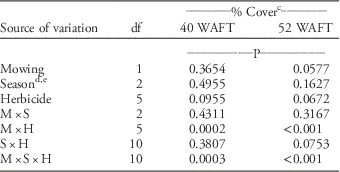
Analysis of variance revealed a significant interaction between herbicide, application timing, and mowing regimen at 40 WAFT in experiment one (Table 2). Across application timings, herbicide activity varied most notably with clethodim and imazapic in routinely mowed plots. Fall-only clethodim applied to routinely mowed vaseygrass (10% cover) decreased vaseygrass 19% compared to spring-only application (29% cover; Table 3). The opposite trend was observed for imazapic, with cover decreasing 22% with spring-only application (9% cover) compared to fall-only application (31% cover). Benefits of fall-plus-spring applications varied across herbicides. Spring-applied clethodim in routinely mowed plots did not improve vaseygrass control, as no differences were detected between fall-only (10% cover) and fall-plus-spring (8% cover) timings, and both decreased cover more than spring-only application did (29% cover); however, spring-only treatments were not repeated in space or time. Fall-plus-spring imazapic application to nonmowed vaseygrass decreased cover (16% cover) compared to spring-only application (31% cover); however, cover in routinely mowed plots that received fall-plus-spring or spring-only imazapic applications did not differ (9% and 7% cover, respectively). In nonmowed plots, fall-plus-spring metsulfuron+nicosulfuron application only improved vaseygrass cover reduction (26% cover) compared to fall-only application (48% cover). Excluding herbicide inputs, routine mowing reduced vaseygrass cover 17% to 20% compared to that of non-treated checks at 40 WAFT.
Experiment one ANOVA for vaseygrass cover, with P values, for main effects and interactions.Footnote a , Footnote b
a Abbreviations: M, mowing; S, season; H, herbicide; df, degrees of freedom; WAFT, weeks after fall treatment.
b Two experimental runs conducted on a roadside in Duplin County, NC.
c Cover visually estimated on a 0% (no cover) to 100% (complete cover) scale.
d Fall applications October 16, 2012 and October 1, 2013; spring applications June 17, 2013 and June 18, 2014.
e Spring-only application evaluated only in run two.
Herbicide-by-application timing-by-mowing regimen interaction on vaseygrass cover 40 weeks after fall treatment.Footnote a , Footnote b

a Abbreviations: FOR, foramsulfuron; HAL, halosulfuron; THI, thiencarbazone; MET, metsulfuron; NIC, nicosulfuron.
b Two experimental runs conducted on a roadside in Duplin County, NC.
c Fall applications October 16, 2012 and October 1, 2013; spring applications June 17, 2013 and June 18, 2014.
d Spring-only application evaluated only in run two.
e All herbicide applications included a nonionic surfactant at 0.25% v/v.
f Cover visually estimated on a 0% (no cover) to 100% (complete cover) scale.
Similarly, ANOVA revealed a significant interaction between herbicide, application timing, and mowing regimen 52 WAFT (Table 2). With single applications, clethodim provided maximum vaseygrass cover reduction compared to other herbicides when applied fall-only in routinely mowed (7% cover) and nonmowed (16% cover) plots (Table 4). Vaseygrass cover when treated with any other herbicide treatment in the fall was not different from that in routinely mowed plots. In nonmowed plots, vaseygrass cover was variable and control was unacceptably low (<60% cover reduction), except for those plots treated with clethodim. Timing of clethodim application affected vaseygrass cover, with greater cover following spring-only applications to routinely mowed (20% cover) and nonmowed (40% cover) plots compared to fall-only routinely mowed (7% cover) and nonmowed (16% cover) plots. Spring-only imazapic and metsulfuron+nicosulfuron application decreased cover relative to the non-treated plots, most notably when applied in conjunction with routine mowing (11% to 14% cover). Additionally, fall-plus-spring imazapic and metsulfuron+nicosulfuron decreased vaseygrass cover to ≤7%. Although metsulfuron+nicosulfuron did not provide acceptable vaseygrass control at 40 WAFT, fall-plus-spring and spring-only application provided equal or greater vaseygrass cover reductions than clethodim and imazapic at 52 WAFT across mowing regimens. This may have been due to an inadequate period of time between the spring herbicide applications and data collection at 40 WAFT (approximately 4 wk after spring treatment). Routine mowing affected vaseygrass cover at 52 WAFT. Excluding fall-only clethodim and fall-plus-spring metsulfuron+nicosulfuron, all herbicide and timing combinations decreased vaseygrass cover more in routinely mowed plots than in nonmowed plots. Additionally, mowing was required to reduce vaseygrass cover to <10% in treated plots. Lastly, routine mowing reduced vaseygrass cover 25% to 33% in non-treated plots, suggesting that mowing may have utility as a stand-alone cultural practice.
Herbicide-by-application timing-by-mowing regimen interaction on vaseygrass cover 52 weeks after fall treatment.Footnote a , Footnote b

a Abbreviations: FOR, foramsulfuron; HAL, halosulfuron; THI, thiencarbazone; MET, metsulfuron; NIC, nicosulfuron.
b Two experimental runs conducted on a roadside in Duplin County, NC.
c Fall applications October 16, 2012 and October 1, 2013; spring applications June 17, 2013 and June 18, 2014.
d Spring-only application evaluated only in run two.
e All herbicide applications included a nonionic surfactant at 0.25% v/v.
f Cover visually estimated on a 0% (no cover) to 100% (complete cover) scale.
Results from this experiment generally agree with previous research pertaining to the relationship between herbicide application timing, plant growth stage, and season. Johnson and Norsworthy (Reference Johnson and Norsworthy2014) reported that 4 wk following nicosulfuron (35 g ai ha−1) application, johnsongrass [Sorghum halepense (L.) Pers.] was 72% controlled when applications were made at 15-cm plant heights, but were 17% controlled when applications were made at 60-cm plant heights. Ruffner and Barnes (Reference Ruffner and Barnes2010) reported that spring-applied imazapic (210 g ai ha−1) reduced tall fescue [Lolium arundinaceum (Schreb.) S.J. Darbyshire] cover more than spring-applied clethodim did (230 g ai ha−1). Reducing vaseygrass cover to less than 10% with metsulfuron+nicosulfuron required fall and spring application, which is consistent with current herbicide label verbiage, which states that two applications may be required for acceptable control (Anonymous 2015). Additionally, Israel et al. (Reference Israel, Rhodes, Via and Muller2012) reported that two applications of metsulfuron+nicosulfuron were required to acceptably control the warm-season, perennial grass knotroot foxtail [Setaria parviflora (Poir.) Kerguélen]. Within the confines of this experiment, an explanation of the varying results from clethodim fall and spring applications cannot be determined. Although all herbicides did not behave similarly, vaseygrass may have been more susceptible to clethodim in the fall as the weed approached dormancy. Previous research has shown that dallisgrass (Paspalum dilatatum Poir.) response to select herbicides varies by season (Anonymous 2013; Caponio and Quarín Reference Caponio and Quarín1990). Brosnan et al. (Reference Brosnan, Breeden, Elmore and Zidek2010) reported 80% to 88% dallisgrass control 55 d after treatment following fluazifop application (105 g ai ha−1) in April; however, control decreased to less than 24% when fluazifop was applied in May or June. Elmore et al. (Reference Elmore, Brosnan, Mueller, Horvath, Kopsell and Breeden2013) also reported superior dallisgrass control at 365 d after treatment from fluazifop application (105 g ha−1) in April (79% to 83% control) compared to May or June (33% to 66% control). Additionally, the authors reported 88% to 93% control when application was delayed to September, which parallels findings regarding fall clethodim application for vaseygrass control in the research presented here.
Results from this experiment also generally agree with previous research pertaining to mowing effects on the establishment of select invasive plants. Derr (Reference Derr2008) reported that mowing every 2, 4, or 8 wk controlled common reed [Phragmites australis (Cav.) Trin. ex Steud.] 93%, 81%, and 69%, respectively, while Aigner and Woerly (Reference Aigner and Woerly2011) reported 48% barb goatgrass (Aegilops triuncialis L.) control as a result of mowing. Previous research has shown that decreasing canopy height adversely affects vaseygrass spread. Newman et al. (Reference Newman, Sollenberger, Fox and Chambliss2003) reported that vaseygrass cover decreased 9% over 2 yr when maintained at 20 cm, while it increased 4% when maintained at 40 cm. Parr and Way (Reference Parr and Way1988) concluded that roadside mowing affects plant competition by reducing vigor of taller-growing species through altering growth habits and root-to-shoot ratios, coupled with increasing light penetration at the soil surface which aids prostrate species growth.
Experiment Two
At 4 WAT in experiment two, ANOVA revealed a significant interaction between the effects of herbicide and pre–herbicide application mowing interval on vaseygrass seedhead counts, and a main effect of herbicide on vaseygrass height (Table 5). Across 6, 3, and 2 wk pre–herbicide application mowing intervals, clethodim and imazapic reduced vaseygrass seedhead production and height at 4 WAT, while treatment with metsulfuron+nicosulfuron had results similar to those of the non-treated plots (Table 6). In general, differences in seedhead counts between the herbicide-treated plots and the non-treated plots decreased as mowing interval decreased. This is likely due to herbicidal activity (as seen when comparing clethodim and imazapic with metsulfuron+nicosulfuron at 6, 4, 3, and 2 WBT), coupled with varying time for growth between mowing and data collection at 4 WAT for the various mowing intervals. More specifically, plots mowed 6 WBT grew for a 10-wk period between cutting and data collection at 4 WAT, while plots mowed 0 WBT only had 4 wk to grow before the data collection at 4 WAT. Within clethodim and imazapic treatments, mowing interval did not affect seedhead production, with counts ranging from 1 to 8 m−2.
Experiment two analysis of variance for vaseygrass seedheads, height, and cover with P values for main effects and interactions.Footnote a , Footnote b , Footnote c

a Abbreviations: MI, mowing interval; H, herbicide; df, degrees of freedom; WAT, week after treatment.
b Two experimental runs conducted on a roadside in Craven County, NC.
c Height and seedhead counts were averaged over three recordings per plot.
d Cover visually estimated on a 0% (no cover) to 100% (complete cover) scale.
e Applications September 18, 2013 and September 19, 2014.
Herbicide-by-pre–herbicide application mowing interval interaction on vaseygrass seedhead counts and the main effect of herbicide on vaseygrass height, 4 weeks after treatment.Footnote a − Footnote c

a Abbreviations: FOR, foramsulfuron; HAL, halosulfuron; THI, thiencarbazone; MET, metsulfuron; NIC, nicosulfuron.
b Two experimental runs conducted on a roadside in Craven County, NC.
c Applications September 18, 2013 and September 19, 2014.
d All herbicide applications included a nonionic surfactant at 0.25% v/v.
e Height and seedhead counts were averaged over three recordings per plot.
f Data pooled over PRE-herbicide application mowing interval.
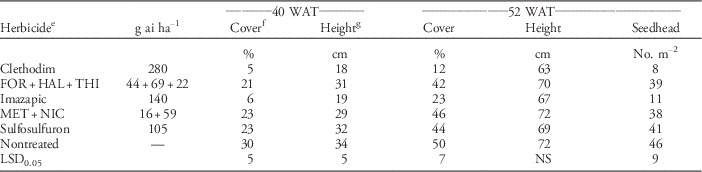
Across data collected 40 and 52 WAT, ANOVA revealed a significant main effect of herbicide, while pre–herbicide application mowing interval did not affect vaseygrass growth as measured by visual cover, height (excluding 40 WAT), and seedhead count (Table 5). At 40 WAT, clethodim, imazapic, and metsulfuron+nicosulfuron reduced vaseygrass cover and height compared to the non-treated plots (Table 7). Of these herbicides, clethodim and imazapic reduced cover by 24% to 25% and reduced height by 15 to 16 cm compared to the non-treated plots, while metsulfuron+nicosulfuron only reduced cover by 7% and height by 5 cm. These results suggest that clethodim and imazapic may reduce roadside mowing requirements within a season. Vaseygrass seedhead production had not uniformly resumed at 40 WAT. Following data collection at 40 WAT, research areas were mowed and allowed to regrow for a 12-wk period.
Main effect of herbicide on vaseygrass cover, height, and seedhead counts 40 and 52 weeks after treatment.Footnote a – Footnote d
a Abbreviations: WAT, weeks after treatment; FOR, foramsulfuron; HAL, halosulfuron; THI, thiencarbazone; MET, metsulfuron; NIC, nicosulfuron; NS, nonsignificant.
b Two experimental runs conducted on a roadside in Craven County, NC.
c Applications September 18, 2013 and September 19, 2014.
d Data pooled over pre–herbicide application mowing interval.
e All herbicide applications included a nonionic surfactant at 0.25% v/v.
f Cover visually estimated on a 0% (no cover) to 100% (complete cover) scale.
g Height and seedhead counts were averaged over three recordings per plot.
ANOVA revealed a significant main effect of herbicide on vaseygrass cover and seedhead counts 52 WAT, while vaseygrass height did not differ between herbicide treatments (Table 5). At 52 WAT, plots receiving metsulfuron+nicosulfuron treatment did not have significantly different vaseygrass cover (46% cover) or seedhead counts (38 seedheads m−2) than the non-treated control plots (50% cover, 46 seedheads m−2) (Table 7). Plots treated with imazapic and, most notably, clethodim, had decreased vaseygrass cover and seedhead counts compared to the non-treated plots, with 23% and 12% cover and 11 and 8 seedheads m−2, respectively. Surviving vaseygrass in clethodim and imazapic plots did not show any herbicide symptoms at 52 WAT, and seedhead reductions aligned with cover reductions. Furthermore, no differences in vaseygrass height were detected across herbicide treatments at this time point, which suggests that the control practices evaluated in this research would require multiple growing seasons to completely eradicate vaseygrass.
Overall, pre–herbicide application mowing interval did not affect herbicide activity on vaseygrass; however, this was likely due in part to generally poor control from foramsulfuron+halosulfuron+thiencarbazone and sulfosulfuron. Additionally, spring imazapic and metsulfuron+nicosulfuron application, which decreased vaseygrass cover in experiment one, were not included. Lastly, plots were not routinely mowed in experiment two, which may have improved imazapic and metsulfuron+nicosulfuron activity on vaseygrass. To focus on the effect of pre–herbicide application mowing interval on clethodim, the most efficacious fall-applied herbicide evaluated, data were analyzed separately for each herbicide. At 40 WAT, mowing vaseygrass 1 or 2 WBT with clethodim resulted in 1 to 2% cover, which generally outperformed mowing 0 (6%) or from 3 to 6 WBT (3 to 11%) (Table 8). The same trend was observed at 52 WAT: vaseygrass that was mowed 1 to 2 weeks before clethodim treatment (4 to 6% cover) resulted in superior control compared to mowing 0, 3, 4, or 6 weeks before clethodim treatment (13%, 14%, 13%, and 23%, respectively). Although there was only a 10% difference in vaseygrass cover at 52 WAT when mowing occurred 2 or 3 WBCT, cover reduction relative to respective nontreated (47% cover for both 2 and 3 WBCT) increased 21% from mowing 2 WBCT compared to 3, suggesting the shorter period of time between mowing and treatment enhanced clethodim efficacy. These results agree with current clethodim label recommendations, which suggest allowing for perennial grass vegetation regrowth to 30 cm (excluding johnsongrass) following mowing to promote foliar clethodim uptake (Anonymous 2011a).
Clethodim application-by-pre–herbicide application mowing interval interaction on vaseygrass cover 40 and 52 weeks after treatment.Footnote a – Footnote d

a Abbreviations: WAT, weeks after treatment.
b Two experimental runs conducted on a roadside in Craven County, NC.
c Applications September 18, 2013 and September 19, 2014.
d Clethodim applied at 280 g ai ha−1+nonionic surfactant at 0.25% v/v.
e Cover visually estimated on a 0 (no cover) to 100% (complete cover) scale.
Results from this research indicate that vaseygrass eradication from North Carolina roadsides may require management inputs over multiple growing seasons. Overall, routine mowing had a pronounced effect on reducing vaseygrass cover as a stand-alone cultural practice, and in most cases improved herbicide efficacy. While mowing decreased vaseygrass cover 55% at 52 WAT, in practice mowing is difficult in many areas with vaseygrass infestations due to issues associated with equipment operation in poorly drained soils. Under these circumstances, herbicide inputs can serve as a viable vaseygrass management input; however, efficacy varies based on herbicide and application timing. Optimal herbicide efficacy was obtained when clethodim was applied in the fall, and when imazapic and metsulfuron+nicosulfuron were applied in the spring. Additionally, metsulfuron+nicosulfuron applied in fall and spring to nonmowed vaseygrass reduced cover 80% at 52 WAT, while clethodim and imazapic required mowing to achieve comparable cover reductions. Herbicides can be used alternately based on application timing to optimize vaseygrass control, and this practice will also serve as an herbicide resistance prevention measure due to the varying modes of action between clethodim (inhibition of acetyl coenzyme A carboxylase) and imazapic/metsulfuron+nicosulfuron (inhibition of acetolactate synthase) (Shaner Reference Shaner2014). Through 2015, there were 47 and 157 plant species worldwide with reported resistance to acetyl coenzyme A carboxylase and acetolactate synthase inhibitors, respectively (Heap Reference Heap2015).
Vaseygrass primarily encroaches bahiagrass and/or centipedegrass on roadsides in North Carolina, and it should be noted that the herbicides that were found to provide acceptable control also pose tolerance concerns to the aforementioned species. Ferrell et al. (Reference Ferrell, Murphy, Vencill and Guerke2003) reported that clethodim application (280 g ha−1) resulted in 26% to 50% centipedegrass injury from 2 to 6 WAT in one experimental run; however, less than 12% injury was observed the following year. Centipedegrass is tolerant to imazapic and metsulfuron at the evaluated application rates; however, research to date is inconclusive on metsulfuron+nicosulfuron (Anonymous 2011c, 2016). Bahiagrass is sensitive to clethodim and imazapic at the evaluated application rates, while reports of metsulfuron sensitivity are inconclusive (Alabama Extension 2016; Anonymous 2011c; Bunnell et al. Reference Bunnell, Baker, McCarty, Hall and Colvin2003). Bunnell et al. (Reference Bunnell, Baker, McCarty, Hall and Colvin2003) reported that the metsulfuron application rate required to reduce bahiagrass growth 50% 6 WAT was 9.5 g ha−1 in one experimental run; however, 40.2 g ha−1 was required the following year. Ultimately, rights-of-way managers should be cognizant of potential injury to desirable turfgrass species following herbicide application for vaseygrass control, which may reduce the competitive ability of desired species and create more conducive conditions for vaseygrass and other weed species to encroach.
When routine mowing operations are part of a vegetation management plan, timing this cultural practice with an herbicide application may improve vaseygrass control. This was observed following clethodim application, and maximum cover reductions were consistent with current label recommendations regarding perennial grass height at application. However, mowing interval did not affect vaseygrass cover following imazapic and metsulfuron+nicosulfuron treatments. This pattern should be further investigated to confirm that this was not due to application at a suboptimal fall timing. Future research should evaluate treatment regimens including clethodim and imazapic or metsulfuron+nicosulfuron at fall and spring timings, respectively, and PRE herbicides for vaseygrass seed bank reduction.
Acknowledgements
This research was funded by, and conducted in collaboration with, the North Carolina Department of Transportation Roadside Environmental Unit. The authors wish to thank all individuals, notably Kevin Clemmer, Greg Rayburn, and Derek Smith, who assisted with research site selection and subsequent management inputs to preserve areas.



