


Introduction
Gibbons (Family Hylobatidae) are small apes that live in the tropical and subtropical forests of south-east Asia. There are 19 recognized extant species in four genera (Chivers, Reference Chivers, Mittermeier, Rylands and Wilson2013), of which six species, in three genera, occur in China: Nomascus concolor, N. nasutus, N. hainanus, N. leucogenys, Hylobates lar and Hoolock hoolock (Geissmann, Reference Geissmann2007). The Hainan gibbon is the most threatened species of gibbon (Zhou et al., Reference Zhou, Wei, Li, Zhang, Wang and Pan2005); it occurs only in a 16 km2 area of Bawangling National Nature Reserve (Liu et al., Reference Liu, Zhang, Jiang and Southwick1989; Zhou et al., Reference Zhou, Wei, Li, Zhang, Wang and Pan2005). The social structure of the Hainan gibbon is polygynous, with one adult male pairing with two adult females (Liu et al., Reference Liu, Zhang, Jiang and Southwick1989). The gibbons reach sexual maturity at 6–8 years of age, and generally females give birth every 2 years (Zhou et al., Reference Zhou, Wei, Li, Chan and Wang2008), unlike females of other gibbon species, which give birth every 3–4 years (Leighton, Reference Leighton, Smuts, Cheney, Seyfarth, Wrangham and Struhsaker1987).
In the 1980s Hainan gibbons were distributed in four groups comprising a total of 20 individuals (Liu et al., Reference Liu, Zhang, Jiang and Southwick1989). Previous studies of this endemic species have been limited to ecology, singing behaviour and the vegetation structure of the gibbon's habitat (Liu et al., Reference Liu, Zhang, Jiang and Southwick1989; Zhou et al., Reference Zhou, Wei, Li, Zhang, Wang and Pan2005, Reference Zhou, Wei, Li, Chan and Wang2008; Deng et al., Reference Deng, Zhou and Yang2014). To document the population of the Hainan gibbon, we have studied the species since 2002. Here we report the changes in the population and family structure over this time, based on a combination of field investigations and interviews.
Study area
Bawangling National Nature Reserve (c. 300 km2; Fig. 1), at the junction of Changjiang and Baisha counties in Hainan, is one of the island province's last remaining tropical primary forests, spanning an altitudinal range of 650–1,560 m. The mean temperature is 21.3 °C, and annual precipitation is 1,657 mm. The forest is tropical montane evergreen (Yu et al., Reference Yu, Zang and Jiang2001).
The distribution of the Hainan gibbon Nomascus hainanus in Bawangling National Nature Reserve, Hainan, China.

Methods
We began fieldwork in July 2002, when we spent 20 days per month observing and recording gibbon behaviour. During July 2002–August 2006 our total observation time was 1,580 hours. During January 2007–September 2012 we conducted 4,126 hours of fieldwork, in January–March and July–September each year. Our most recent field investigation began in January 2013 and was completed in April 2014, with 1,780 hours of observation.
To obtain local knowledge of the Hainan gibbon, we interviewed residents of Bawangling National Nature Reserve and the surrounding areas, hunters among ethnic minorities, and workers at conservation stations, during August–December 2002. In total we interviewed 16 hunters, 56 local residents and 21 reserve workers. Interview questions included whether they had seen gibbons, whether they had heard them sing, whether they were aware of the gibbons’ presence in other ways, whether they hunted gibbons, when and where they saw gibbons and if so how many were there and what were their characteristics.
All species of gibbons have loud, complex, stable structured songs (Marshall & Marshall, Reference Marshall and Marshall1976; Geissmann, Reference Geissmann2002). Hainan gibbons start singing within 20 minutes before or after sunrise, and the sound travels up to 2 km (Deng et al., Reference Deng, Zhou and Yang2014). Our field survey was based on a method of counting these calls (Liu et al., Reference Liu, Zhang, Jiang and Southwick1989; Brockelman & Ali, Reference Brockelman and Ali1987; Brockelman & Srikosamatara, Reference Brockelman and Srikosamatara1993; Zhou et al., Reference Zhou, Wei, Li, Zhang, Wang and Pan2005; Deng et al., Reference Deng, Zhou and Yang2014). We monitored gibbons from before sunrise at one location, and we used the same location for at least 6 consecutive days. We located Hainan gibbons based on sound, and followed them to confirm their location and the number of individuals in the group. We remained at each survey location for at least 5 consecutive days, and extended the time of investigation when necessary (Haimoff et al., Reference Haimoff, Yang, He and Chen1986). We were able to estimate the date of birth of infant gibbons based on their distinctive golden fur, which gradually turns black after 1 month. Staff at the Reserve have been carrying out patrols for 20 days each month since June 2005, and they record each birth, and photograph all newborns. We determined sex by observing external genitalia with binoculars, and also by the change in pelage colour from black to golden in females prior to maturity. The genitals of young gibbons (1−3 years old) were observed using a telescope. However, the sexing of young gibbons can be problematic because female Nomascus gibbons have a pendulous clitoris that may be mistaken for a penis (Pocock, Reference Pocock1927). Given that the reported sex ratio of young is biased towards males, we suspect that some pre-adult females may have been incorrectly reported as males.
Results
Historical population changes in Hainan gibbons
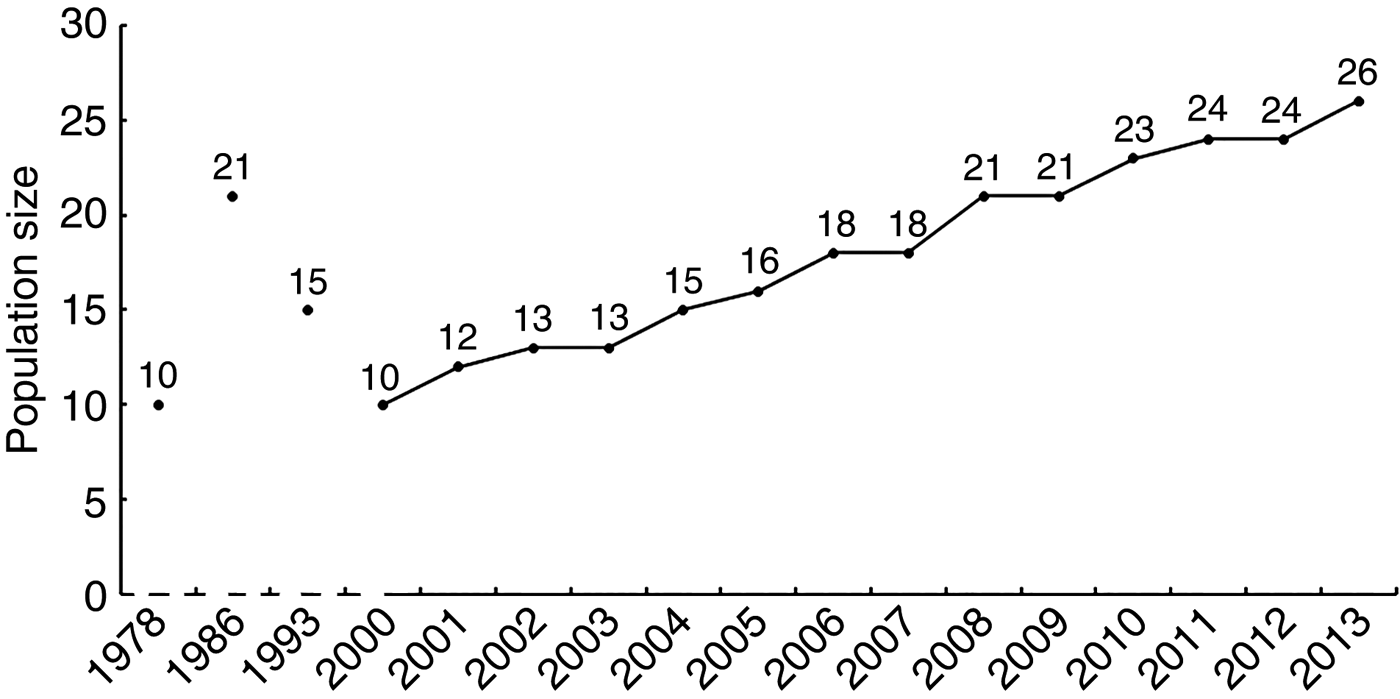
Hainan gibbons were widely distributed in Hainan province until the 1960s but by the early 1990s they were distributed only in Bawangling National Nature Reserve. The other subpopulations were extirpated during a period of logging and hunting during 1960–1980. In 1963 there were c. 150–200 individuals at three sites in the Reserve: Yajiadaling, Qichadaling and Futouling (Liu Zhenhe, pers. comm.). The current population increased from a total of 10 individuals in 2–3 groups in 1978 to 21 individuals in four groups in 1988 (Liu et al., Reference Liu, Zhang, Jiang and Southwick1989). The male : female ratio of young was 9 : 2 during 1982–1989. The population decreased to 15 in 1993 as a result of hunting (Zhang, Reference Zhang1992; Zhang & Sheeran, Reference Zhang and Sheeran1994).
Surveys conducted in 2002 showed there were only 13 individuals remaining: six in group A (including two infants), five in group B (including one infant), and two solitary individuals. The rate of population recovery has increased progressively since then (Fig. 2). The population increased to 15 with the birth of two infants during 2003–2004. Three more infants were born during 2005–2006, and three more in 2011, increasing the population to 21.
The population of the Hainan gibbon in Bawangling National Nature Reserve (Fig. 1) from 1978 to 2013. The 1978 and 1986 data are from Liu et al. (Reference Liu, Zhang, Jiang and Southwick1989), the 1993 data are from Zhang & Sheeran (Reference Zhang and Sheeran1994), the data for 2000−2001 are from Wu et al. (Reference Wu, Wang, Claro, Ding, Souris and Wang2004), and the data for 2002−2013 are from our observations.
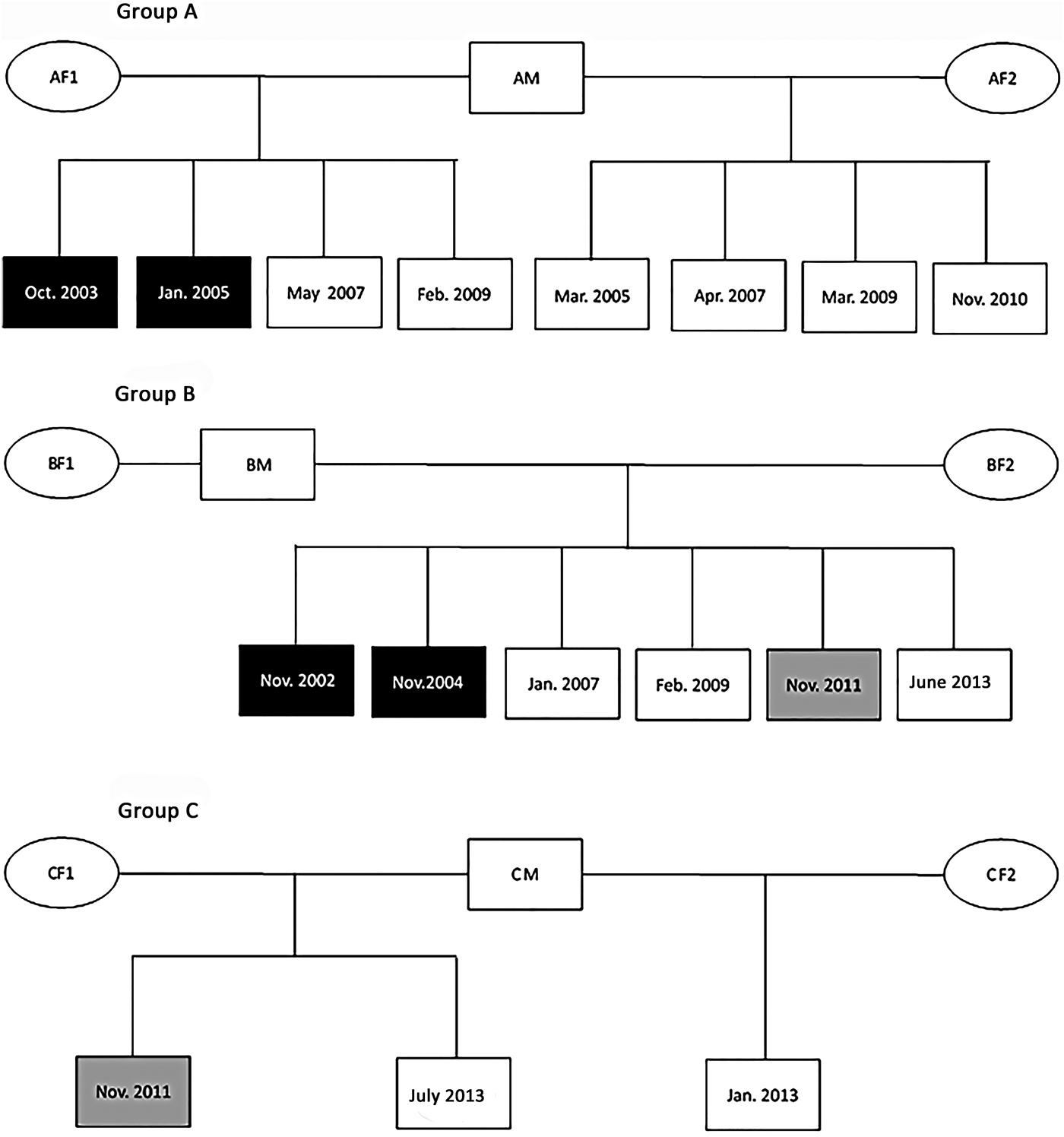
A new family group formed in the summer of 2011; one of the adult females had been born in group B in 1986 (Liu et al., Reference Liu, Zhang, Jiang and Southwick1989) and the other was one of the solitary individuals recorded in 2002. Two infants were born to these females, one in January and one in July 2013, increasing the family to five. Three more infants were born in 2013. In total, 17 gibbons were born in the 12-year period 2002–2013, but two of those born in 2011 in groups B and C died in 2012 (Fig. 3). The birth records for the three groups of Hainan gibbons during 2002–2013 are in Table 1.
Family tree of the three extant groups (A, B and C) of Hainan gibbons in Bawangling National Nature Reserve (Fig. 1), with month and year of birth. White boxes indicate individuals that have remained in the group, black boxes indicate individuals that have left their natal group and are living alone, and grey boxes indicate individuals that died in 2012; F, females; M, males.
Birth records for the three remaining groups of Hainan gibbons Nomascus hainanus during 2002–2013.

* Died c. 2 months after birth.
Interview results
The persistence of the Hainan gibbon in the Reserve is threatened by hunting, and the many Li and Miao villages in the area are a cause for concern. A Miao hunter reported killing a male and two females in 1986 (Liu Zhenhe, pers. comm.), thus eliminating a whole group; another group was destroyed by the same hunter in 1989 (Zhang & Sheeran, Reference Zhang and Sheeran1994). These killings resulted in a significant decrease in the population. The hunter was sentenced to 8 years in prison in 1986 (Bawangling Nature Reserve Administration).
Current population
In October 2013 there were three groups of Hainan gibbons and six solitary individuals in the Reserve, a total of 26 individuals. Their distribution is shown in Fig. 1. Group A comprised nine individuals: one adult male, two adult females, two pre-adult females, two juveniles and two infants. Group B comprised six individuals: one adult male, two adult females, two juveniles and one infant. Group C comprised five individuals: one adult male, two adult females and two infants. All solitary gibbons live in areas adjacent to the family groups.
Discussion
Hunting, human interference and habitat degradation are the main factors hindering the recovery of the Hainan gibbon. Populations have partially recovered, increasing steadily between the 1970s and the 1990s, although there was a decline after 1986 as a result of local hunting (Fig. 2; Zhang, Reference Zhang1992; Zhang & Sheeran, Reference Zhang and Sheeran1994). Since 2002 hunting in the Reserve has been controlled by regular patrols but the lowland areas and parts of the highland forests have been deforested, and highway development has caused habitat fragmentation and degradation (Zang et al., Reference Zang, An, Tao, Jiang and Wang2004).
Forested areas on Hainan Island declined from 157,927 km2 in 1991 to 107,597 km2 in 2001, a 32% reduction, with a higher rate of deforestation at altitudes < 800 m (Zhang et al., Reference Zhang, FelloWes, Jiang, Wang, Chan, Ren and Zhu2010). At present, the Hainan gibbon is distributed primarily in tropical mountainous evergreen forest at 650–1,280 m. The Reserve was established in 1976 but logging continued until 1994; by 1999 only 4% of the primary forest (c. 12 km2) remained (records from Hainan Provincial Government). The original vegetation has been gradually replaced by secondary forests consisting mainly of pine or fir trees. A low-quality environment with fewer Ficus species is the main factor restricting the recovery of the gibbon population.
The social structure of the Hainan gibbon also restricts population growth. Gibbon species usually exhibit monogamy (Leighton, Reference Leighton, Smuts, Cheney, Seyfarth, Wrangham and Struhsaker1987) but N. concolor jingdongensis has a polygynous social structure, with one adult male and two adult females (Fan et al., Reference Fan, Jiang, Liu and Luo2006). Nomascus hainanus has the same social structure and does not change mates even after losing reproductive capacity. The female F1 in Group B, with an estimated age of 19 in 1989, had two birth records during 1979−1986 (Liu et al., Reference Liu, Zhang, Jiang and Southwick1989) but did not reproduce after 2002. No adult females moved in or out of the family. The social structure of the group will be threatened if adult males or females are killed. Only one new family group was formed in the 9 years during 2002–2011. The process of forming a new family is slow, limiting population growth. The small population is also threatened by genetic drift.
Two adult females in group A did not breed during 2011–2013, and they may therefore have passed their breeding age. Of the 17 gibbons born during 2002–2013 15 survived, and at least 11 of these were male. The sex ratio is not known accurately, and the sex of all individuals should be reassessed as they transition to maturity. We will be conducting further research on whether the sex ratio of the next generation affects the recovery of the species. Efforts should focus on in situ conservation as there is no record of a population of this species in captivity, and restoration of the gibbon's lowland habitat should be a priority.
Acknowledgements
This study was supported by a 2011 grant from the National Natural Science Fund to the project The nutrition and ecological strategy of Hainan gibbons (No. 31170365). This research was conducted with the help of student Yun Liu and the staff of the Bawangling National Nature Reserve. We thank them for their support.
Biographical sketches
Deng Huaiqing is studying the behavioural ecology and conservation of the Hainan gibbon and Françoisi langur. Zhang Mingxia's research is focused on monitoring and protection of wild animals. Zhou Jiang conducts research on primates and conservation in China.



