





Highlights
-
• Using an FL promotes more agreement with egoistic lies than using an NL.
-
• Using an FL leads to comparable agreement with altruistic lies than using an NL.
-
• SCRs reveal cognition and affect may interactively act on the FLe on egoistic lies.
-
• SCRs reveal the mechanisms of the FLe on egoistic cannot apply to altruistic lies.
-
• The FLe is more stable in negative scenarios.
1. Introduction
Emerging evidence shows that individuals tend to systematically think and respond differently when using a foreign language (FL) compared to using a native language (NL), which is dubbed “the foreign language effect (FLe)” (Costa et al., Reference Costa, Corey, Hayakawa, Aparici, Vives and Keysar2019; Hayakawa et al., Reference Hayakawa, Tannenbaum, Costa, Corey and Keysar2017; Keysar et al., Reference Keysar, Hayakawa and An2012). To date, a growing body of literature has extended the FLe into various scenarios, such as risk-aversion (e.g., Keysar et al., Reference Keysar, Hayakawa and An2012), moral dilemmas (e.g., Peressotti et al., Reference Peressotti, Lorenzoni and Miozzo2023; Yavuz et al., Reference Yavuz, Küntay and Brouwer2023), causal inference (e.g., Díaz-Lago & Matute, Reference Díaz-Lago and Matute2019; Gao et al., Reference Gao, Zika, Rogers and Thierry2015; Hadjichristidis et al., Reference Hadjichristidis, Geipel and Surian2019) and self-assessment (e.g., Ivaz et al., Reference Ivaz, Costa and Duñabeitia2016, Reference Ivaz, Griffin and Duñabeitia2019; Zhang et al., Reference Zhang, Lan, Li, Gao, Hu and Gao2023). The present study attempted to investigate the FLe on the perception of egoistic lies and altruistic lies to further explore the manifestations of FLe in different affective scenarios.
It is proposed that according to the dual process theory, the FLe emerges as a result of reduced reliance on the affect system and/or heightened engagement in the deliberation system that is cognitively controlled (Evans, Reference Evans2003; Evans & Stanovich, Reference Evans and Stanovich2013). The decreased reliance on the affect-driven system is associated with attenuated affective responses observed in an FL, aligning with the “reduced emotion hypothesis” (Dewaele, Reference Dewaele2008; Harris Reference Harris2004; Pavlenko, Reference Pavlenko2012). The enhanced engagement in the cognitively controlled system is attributed to the increased cognitive effort required to process an FL, aligning with the “increased deliberation hypothesis” (Costa et al., Reference Costa, Corey, Hayakawa, Aparici, Vives and Keysar2019). Concerning moral judgments, deontological judgments grounded in intrinsic beliefs about moral norms are usually driven by the affect system (Yavuz et al., Reference Yavuz, Küntay and Brouwer2023). Utilitarian judgments are found to be driven by the deliberation system as utilitarian choices would diminish under the conditions of cognitive depletion (Greene et al., Reference Greene, Morelli, Lowenberg, Nystrom and Cohen2008; Hayakawa et al., Reference Hayakawa, Tannenbaum, Costa, Corey and Keysar2017). That means more or less deontological or utilitarian judgments vary with the relative weight of the engagement of affect system and deliberation system within the process of the moral judgments. Hence, decision-making in an FL is prone to be decreased affective involvement and heightened cognitive engagement (Caldwell-Harris & Ayçiçeği-Dinn, Reference Caldwell-Harris and Ayçiçeği-Dinn2021), contributing to more utilitarian choices in moral judgments.
However, this line of research is still facing some challenges. It should be noticed that affect is a continuum ranging from negative to positive. However, the majority of prior literature on the FLe has primarily focused on harm-related scenarios (such as risk-aversion and moral dilemmas) that elicit negative affect, as evidenced by recent meta-analyses (Circi et al., Reference Circi, Gatti, Russo and Vecchi2021). At the lexical level, substantial research has highlighted asymmetric emotionality effects along the valence dimension (Ferré et al., Reference Ferré, Sánchez-Casas and Fraga2013, Reference Ferré, Anglada-Tort and Guasch2018). To be specific, the notion that the automatic activation of emotion is stronger in response to negative words compared to positive words is described as negativity bias (Holleman et al., Reference Holleman, Kamoen and Struiksma2021), and positivity bias is in the opposite direction. The emotional polarity effect has also been identified in cross-language studies (e.g., Jończyk et al., Reference Jończyk, Boutonnet, Musiał, Hoemann and Thierry2016). Therefore, to establish a robust argument regarding the impact of an FL on decision- making, it is crucial to consider the polarity of affect when studying the FLe. In addition, as to moral behavior, prosocial as well as antisocial behavior are two central types of moral decision-making (Mitkidis et al., Reference Mitkidis, Lindeløv, Elbaek, Porubanova, Grzymala-Moszczynska and Ariely2022), which also prompts a necessity to investigate the FLe in different moral scenarios. Several studies actually have attempted to study the FLe in positive scenarios, but failed to reach consistent results and underlying mechanisms are still not clear. For example, Hadjichristidis et al. (Reference Hadjichristidis, Geipel and Surian2019) found that using an FL suppressed common superstitious beliefs in both bad-luck scenarios and good-luck scenarios, in line with Caldwell-Harris and Ayçiçeği-Dinn (Reference Caldwell-Harris and Ayçiçeği-Dinn2021), in which compared to using an NL, using an FL-reduced affective response and led to more agreement with selfish statements and less agreement with ethical statements. But Braida et al. (Reference Braida, Rodríguez-Ferreiro and Hernández2023) found a reverse FLe that participants rated positive motivational quotes more profound in the FL than in the NL. Therefore, the present study employs parallel scenarios involving egoistic lies and altruistic lies to provide a more complete view of how the FLe manifests itself in different affective scenarios.
Lies can be regarded as a distinctive form of affective language (Caldwell-Harris & Ayçiçeği-Dinn, Reference Caldwell-Harris and Ayçiçeği-Dinn2009). To be convincing, the lie-teller must convey an emotion that matches the social context. Generally, lies that aim to mislead the recipient and conceal transgressions for personal benefit are identified as egoistic lies or harmful lies (Abe et al., Reference Abe, Fujii, Ito, Ueno, Koseki, Hashimoto, Hayashi, Mugikura, Takahashi and Mori2014). These lies often evoke feelings of guilt in the speaker and anger in the listener. However, lies are not a homogeneous concept as not all types of lies inherently trigger negative feelings (Abe et al., Reference Abe, Fujii, Ito, Ueno, Koseki, Hashimoto, Hayashi, Mugikura, Takahashi and Mori2014). Altruistic lies, for instance, are motivated by the intention to benefit others (e.g., Yin et al., Reference Yin, Zhong, Guo and Li2021). Zanette et al. (Reference Zanette, Gao, Brunet, Bartlett and Lee2016) proposed that the basic expressions of affect that distinguished egoistic lies from altruistic lies were joy and contempt. Children, for example, reported that they experienced more joy in association with altruistic lies than with egoistic lies (Zanette et al., Reference Zanette, Gao, Brunet, Bartlett and Lee2016). Consequently, altruistic lies are more acceptable both socially and morally (e.g., Cui et al., Reference Cui, Wu, Wu, Wang, Jiao and Luo2018; Hayashi et al., Reference Hayashi, Abe, Fujii, Ito, Ueno, Koseki, Mugikura, Takahashi and Mori2014). Especially in Chinese culture, individuals are encouraged to demonstrate humility regarding their good deeds, such as helping those in need. When questioned, Chinese people are often encouraged to act as unsung heroes and to avoid revealing the truth about their own good deeds. An earlier study made by Fu et al. (Reference Fu, Lee, Cameron and Xu2001) found that a substantial proportion of Chinese adults categorized untruthful statements made to conceal one’s own good deeds not to be lies. Therefore, egoistic lies and altruistic lies are thought to be distributed at the negative and positive poles of affect, unacceptable and acceptable poles of morality, respectively. In the second language field, converging evidence from behavioral, psychophysiological, and neuroimaging studies indicates that using an FL is less affectively arousing compared to using an NL (Dewaele, Reference Dewaele2008). Suchotzki and Gamer (Reference Suchotzki and Gamer2018) observed diminished skin conductance responses (SCRs) in the FL compared to the NL and reduced behavioral and autonomic differences between lying and truth-telling in the FL. The results suggested that lying in an FL causes less affective arousal, making lying in the FL easier than in the NL, which leads to that using an FL would promote more lies, in line with the FLe on other moral issues that using an FL would contribute to more utilitarian choices. In addition, given the emotional polarity effect of language processing, the FLe on egoistic lies and altruistic lies may have different manifestations. Gai and Puntoni (Reference Gai and Puntoni2021) in a series of experiments found that using an FL increased selfish lying and reduced prosocial lying. This observation indicated that the FLe differs in positive and negative scenarios.
Lying is also a cognitively more demanding task. Lying has been conceptualized as being more taxing to cognitive resources because an individual has to engage in self-control that would activate the cognitively controlled system to resist the temptation of cheating to gain a higher utility (Mitkidis et al., Reference Mitkidis, Lindeløv, Elbaek, Porubanova, Grzymala-Moszczynska and Ariely2022). Caldwell-Harris and Ayçiçeği-Dinn (Reference Caldwell-Harris and Ayçiçeği-Dinn2009) proposed “double stressors.” That means when using an FL to lie, individuals would experience cognitive stress by speaking an FL and by lying, making lying in an FL more difficult. Caldwell-Harris and Ayçiçeği-Dinn (Reference Caldwell-Harris and Ayçiçeği-Dinn2009, Experiment 2) conducted the first experiment to explore lie-telling based on speech materials in an FL context. In this experiment, participants read false and true statements aloud either in their NL or FL while SCRs were recorded. There were two main results observed. First, false statements aroused stronger SCRs than true ones. Second, statements in the FL aroused stronger SCRs than in the NL. These results supported the “double stressor” account as the presence of two cumulative factors (i.e., lie-telling task and second language processing) led to increased cognitive stress. Recently, McDonald et al. (Reference McDonald, Mormer and Kaushanskaya2020) also found that a combination of producing deceptive speech and using an FL exerted double cognitive loads on the speaker. Moreover, Bereby-Meyer et al. (Reference Bereby-Meyer, Hayakawa, Shalvi, Corey, Costa and Keysar2020) and Yang et al. (Reference Yang, Li and Li2021) observed that the proportion of lying was significantly lower in the FL than in the NL. These results implied lying in an FL tends to be more difficult than in an NL. These findings appear to deviate from the notion that increased cognitive engagement leads to a greater tendency toward utilitarian decision-making in moral judgments. This discrepancy may arise from the interaction of two cognitive factors within the deliberation system. One is cognitive fluency. The utilization of an FL entails some cognitive demands and may disrupt cognitive fluency, thereby fostering heightened vigilance in individuals’ responses. In other words, using an FL would prompt the processes sustained by the deliberation system. According to the dual process, the activation of the deliberation system would contribute to more utilitarian choices in a moral dilemma. The other relevant factor is cognitive load. Contrary to cognitive fluency, excessive cognitive load (e.g., double stressor by telling lies and processing an FL) taxed the deliberation system, impeding the deliberation system to monitor the intuitive responses driven by the affect system. Consequently, a higher cognitive load facilitates an inclination toward intuitive responses in decision-making processes (Costa et al. Reference Costa, Foucart, Arnon, Aparici and Apesteguia2014). In conventional moral dilemmas, bilinguals usually encounter “single stressor” of using an FL. However, telling lies in an FL exerts “double stressor.” Excessive cognitive load makes individuals rely on intuitive responses, thereby the proportion of lying was significantly lower in the FL than in the NL. Therefore, the present study would employ lies’ perception task instead of telling a lie to lower the difficulty of the task to investigate whether there was a FLe on lies, that is, using an FL promotes more agreement for lies.
Besides, decontextualized methods of the FLe have been questioned because of related findings drawing from unrealism scenarios that lack ecological validity (Braida et al., Reference Braida, Rodríguez-Ferreiro and Hernández2023; Schein, Reference Schein2020), such as the trolley and the footbridge dilemma. The realism of scenarios might further influence moral judgments by changing bilinguals’ perceived psychological distance. According to the construal level theory (Trope & Liberman, Reference Trope and Liberman2010), moral transgressors are evaluated more harshly when people imagine the transgressions from a distant psychological distance as opposed to a near one (Agerström & Björklund, Reference Agerström and Björklund2013). So, lies are an optimal linguistic material to study the FLe in a more real scenario.
We also aimed to study physical arousal of lies’ perception by its link to responses from the autonomic nervous system. In addition to providing an objective method to measure affective arousal, the response of the automatic system also provides some information about decisions. Bechara et al. (Reference Bechara, Tranel, Damasio and Damasio1996) proposed the somatic marker hypothesis that decisions about actions with potentially positive or negative outcomes are frequently guided by physical signals that warn us whether the decision is safe or risky. Skin conductance serves as a reliable method to monitor the autonomic system’s response. The mechanism is to monitor transient changes in skin electrical resistance, indicative of the activity of sweat glands regulated by the sympathetic nervous system (Dawson et al., Reference Dawson, Schell, Filion, Cacioppo, Tassinary and Berntson2007). SCR reflects a transient increase in skin conductance level related to a specific stimulus. It conveys information about physiological arousal mainly elicited by emotion and efforts (Dawson et al., Reference Dawson, Schell, Filion, Cacioppo, Tassinary and Berntson2007). When people use an FL, SCRs can reflect reduced affective arousal for tasks with low cognitive effort. For example, Harris (Reference Harris2004) found that emotional expressions (i.e., reprimands) presented in the NL elicited larger SCRs than comparable expressions in the FL when participants listened to emotional words or phrases. Or SCRs can reflect increased arousal for cognitive efforts, such as using an FL, which could obscure the affect elicited by scenarios. Caldwell-Harris and Ayçiçeği-Dinn (Reference Caldwell-Harris and Ayçiçeği-Dinn2009) observed that using an FL elicited stronger SCRs compared to using an NL in a lie-telling task. Caldwell-Harris and Ayçiçeği-Dinn (Reference Caldwell-Harris and Ayçiçeği-Dinn2021) first employed SCRs to study the FLe on ethical and selfish statements and found that SCRs were overall larger in the FL than in the NL, suggesting that the FLe resulted from high cognitive effort which obscured emotional signal elicited by the ethical and selfish statements. Overall, SCRs provided a reliable method to explore the mechanism underlying the FLe.
In sum, the extant literature enlightens us that the FLe remains underexplored in different affective scenarios, which strengthens the possibility that the currently identified mechanisms of the FLe may be confined to negative scenarios. Furthermore, we utilize electrophysiological methods to provide more robust evidence about underlying mechanisms of the FLe. Therefore, the present study will extend the previous work by monitoring physiological arousal and manipulating the affective valence of scenarios via egoistic lies and altruistic lies presented to Chinese–English bilinguals. As the affective valence and moral attribute contained in the egoistic lies and altruistic lies are in line with the selfish statements and ethical statements, respectively, in the study by Caldwell-Harris and Ayçiçeği-Dinn (Reference Caldwell-Harris and Ayçiçeği-Dinn2021), we expected that participants would rate more agreement with egoistic lies and less agreement with altruistic lies in the FL than those in the NL following the findings of Caldwell-Harris and Ayçiçeği-Dinn (Reference Caldwell-Harris and Ayçiçeği-Dinn2021). Besides, we expected that egoistic lies and altruistic lies would elicit smaller SCRs in the FL compared to the NL in the lie’s perception task, as Caldwell-Harris and Ayçiçeği-Dinn (Reference Caldwell-Harris and Ayçiçeği-Dinn2021) have identified two patterns in the FL context. The first is that exposure to emotional words/phrases during auditory and visual stimuli results in diminished SCRs. And the second is that engaging in communication in an FL would result in heightened SCRs. We also hypothesize that the distinctions in SCRs between egoistic lies and altruistic lies, as well as between lies and the truth, would be less strong in the FL compared to the NL.
2. Methods
2.1. Participants
The target sample size was determined using G*Power with a medium effect size of 0.25 and a power of 0.95 at α level of 0.05. Results indicated a minimum sample size of 44. Finally, 100 participants were recruited. Each participant was asked to answer demographic questions about their gender, age, residence, and NLs. All participants (65.5% females and 34.5% males; age range = 18–32, mean = 21.03, SD = 3.22) reported normal or corrected-to-normal vision, and they were right-handed and free from psychiatric disorders, and they gave written informed agreement following the Declaration of Helsinki.
All the participants were native speakers of Chinese who were born in China and acquired English in an instructional setting. Fifty of the participants were randomly assigned to the native group and 50 to the foreign group. Participants were asked to self-assess their FL and NL proficiency (including listening, speaking, reading, and writing) on a 7-point Likert-type scale (1 = very poor, 7 = excellent). Independent sample t-tests showed that proficiency ratings of the FL and NL in the native group were comparable to those in the foreign group (all ts < 1.48, all ps > .142, see Table 1). In addition, paired-sample t-tests indicated that the proficiency ratings were significantly higher in their NL than in their FL (all ts > 13.45, all ps < .001, see Table 1). English proficiency was also assessed using the LexTALE (Lemhöfer & Broersma, Reference Lemhöfer and Broersma2012), and their mean score was 71.427 (SD = 10.20), indicating intermediate-level English proficiency.
Participant’s characteristics in the native and foreign language groups (means and standard deviations)

We also investigated participants’ Machiavellianism and prosocial behaviors because the results of different studies imply that lie processing can be modulated by personality traits. Individuals scoring higher on Machiavellianism are regarded as good liars. Lie-telling seems to be cognitively less strenuous for them (Wissing & Reinhard, Reference Wissing and Reinhard2019). We adopted the questionnaire of MachIV created by Christie and Geis (Reference Christie and Geis1970). Independent sample t-tests indicated that the MachIV ratings did not show any differences between the native group and foreign group (t = 1.32, p = .19, see Table 1). Concerning prosocial behavior, the self-report altruism scale developed by Philippe Rushton et al. (Reference Philippe Rushton, Chrisjohn and Cynthia Fekken1981) was utilized to measure participants’ prosocial behaviors in daily life. Independent sample t-tests indicated that the prosocial ratings did not show any differences between the native group and the foreign group (t = −0.35, p = .72, see Table 1).
2.2. Design and materials
The experiment used a 2 (Language: Chinese vs. English) × 3 (Type: egoistic lies vs. altruistic lies vs. truth) mixed design. Three experimental lists were created via Latin square design to ensure one participant never saw the altruistic and corresponding egoistic and literal scenarios in an experiment.
Twenty-one sets of experimental materials were prepared, all of which described common, but fictitious events that could occur in real-life situations (see Table 2). Each set of experimental materials encompasses three versions, indicating three distinct communicative intentions of the speaker: altruistic lies (a deceitful intention benefiting others but incurring a cost for the speaker), egoistic lies (a deceitful intention benefiting the speaker but causing harm to others), or literal (an honest response). Each material included two parts: the background information and the answer. The background information includes an introduction of scenarios in which the events of the story would unfold and a question raised by a protagonist in the scenario who was presented in the form of the second person, which allows participants to have an immersive experience in the scenario. That could reinforce the emotional content of the stimuli since self-related events would have a stronger affective resonance as compared to other-related events, which would enhance potential cross-language differences (Ivaz et al., Reference Ivaz, Costa and Duñabeitia2016). The other part is the corresponding response given by another one protagonist. The answer can be either a lie or an honest response. To maintain a balance between the number of the truth and lies, seven control materials were included, wherein the protagonists gave true responses. To ensure linguistic accuracy, the experimental materials were translated into English by a proficient translator and subsequently validated independently by two college students fluent in both Chinese and English.
Examples in each experimental condition

To validate the distinction between altruistic and egoistic lies, we recruited two separate groups of 16 subjects who did not participate in the formal experiment to rate the valence of the items which refers to whether the item harms or benefits the listener on a 7-point scale (−3 = harm, 3 = help), and to rate affective valence of the items which range from positive to negative on a 7-point scale (−3 = negative, 3 = positive). There was a significant difference in the mean ratings of valence of lies and valence of affect among the three types of scenarios, with altruistic lies (valence of the items: mean = 1.88, SD = 0.56; affective valence of items: mean = 1.90, SD = 0.57) is higher than the truth (valence of the items: mean = 0.37, SD = 0.50; affective valence of items: mean = 0.36, SD = 0.44), and the truth is higher than egoistic lies (valence of the items: mean = −2.27, SD = 0.54; affective valence of items: mean = −2.25, SD = 0.55) (ps < .001). Besides, the altruistic (arousal: mean = 4.71, SD = 0.46) and egoistic lies (arousal: mean = 4.95, SD = 0.56) were matched for affective arousal (p = .14), and the arousal of both lies was higher than the truth (arousal: mean = 4.12, SD = 0.52) (ps < .001), as rated by another separate group of 16 subjects who used a 7-point scale for each criterion (1 = clam, 7 = arousal).
2.3. Procedure
Participants were tested individually in a laboratory room, with Chinese as the background language, consistent with the setting of the study in China. The instructions of the experiment are as follows:
Please read each story carefully. Each story consists of two parts. The first part provides background information, such as characters and events. Notably, one of these characters will be referred to as “you,” and you should immerse yourself in their perspective. At the end of the introduction, there will be a question associated with the story posed by “you” or other characters in this story. In the second part, there was another one character responding to the question. When you see a question mark (?), please provide a rating from 1 (1 = strongly disagree) to 5 (5 = strongly agree) to indicate how strongly you disagree or agree with the behavior of the character or the response given by the character who answered the question of introduction part.
The procedure was administered using E-prime 3.0 software (Psychology Software Tools, Pittsburgh, PA). Each trial started with a fixation of a random duration between 500 and 800 ms. Then, the background information of the story was presented for 45 s on the screen, followed by the target sentence displayed on the screen for 15 s. Finally, a question mark (?) appeared, participants could make their ratings within 5 s. Before the formal experiment, a practice session with three trials was arranged for participants to familiarize themselves with the experimental procedure.
2.4. Electrodermal monitoring
Electrodermal activity was acquired simultaneously using the Biopac MP160 hardware system (Biopac Systems, Inc.). Electrodermal activity was recorded by a pair of Ag-AgCl electrodes which were specifically designed for finger attachment. The response transducers were filled with an isotonic electrolyte gel and positioned on the volar surfaces of the middle phalanges of the index and middle fingers of participants’ non-dominant hands followed by Tumanova and Backes (Reference Tumanova and Backes2019). Two electrodes were connected to a Biopac GSR100C skin conductance amplifier. The electrodermal activity (expressed in microSiemens, μS) was sampled at 2 kHz with the gain set at 10 μS/V and a low-pass filter at 1 Hz and subsequently down sampled for the analysis. The time window was set from 1 to 4 s for specific SCR latency following the recommendations of Boucsein et al. (Reference Boucsein2012). Specific SCRs were identified by using AcqKnowledge’s automatic SCR program, which identified any fluctuation of 0.1 μS or greater. Furthermore, a 10-s buffer period was implemented between trials to reduce the potential carryover impact of the EDA signal from the preceding trial.
2.5. Data analysis
We constructed linear mixed-effect regression models using the lme4 package (Bates et al., Reference Bates, Machler, Bolker and Walker2015) in R (R Development Core Team, 2020), which allowed us to simultaneously model the variance associated with each subject and each item. The analyses were done separately for the ratings and SCRs.
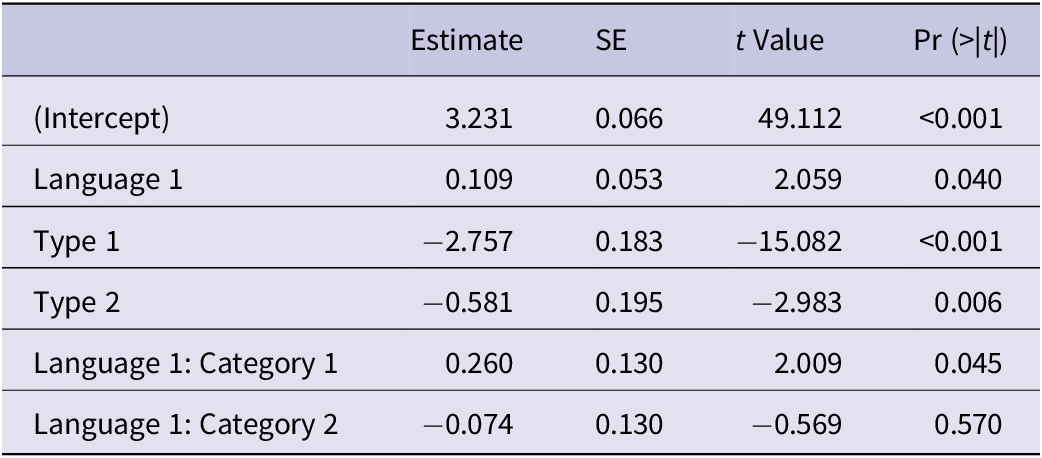
For the rating data, the dependent variable was agreement ratings, and the independent variable was types of the statements and language groups. We used sum coding for predictor variables to enable the interpretation of their main effects and interactions. The two levels of the predictor variable (language group: Chinese vs. English) were coded as −0.5 and 0.5. Sum contrasts were also used for the three levels of the predictor variable (type: egoistic lies vs. altruistic lies vs. the truth), where altruistic lies were compared to truth (truth = −1/3, altruistic lies = 2/3, egoistic lies = −1/3), and egoistic lies to truth (truth = −1/3, altruistic lies = −1/3, egoistic lies = 2/3). The final model included the fixed effects with the interaction of language and type, and the random effect structure with random intercepts for participants and items, and type as by-participant and by-item random slope. Moreover, post hoc analyses were conducted for all significant interactions by the emmeans function to obtain the simple effects.
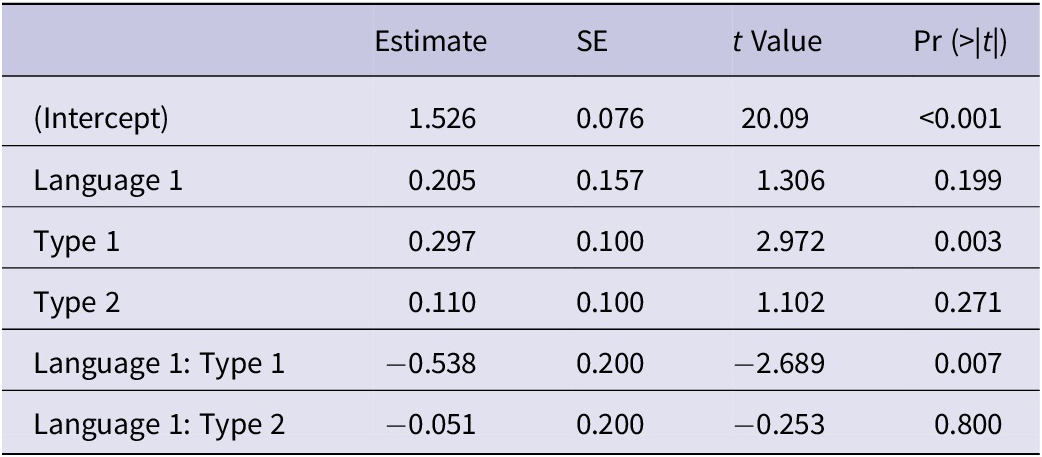
All SCRs data were collected, cleaned, and analyzed in Biopac’s AcqKnowledge 5.0 software provided by Biopac Systems, which transforms skin conductance level data to provide an SCR through a high pass digital filter set at 0.05 Hz (Romano et al., Reference Romano, Gandola, Bottini and Maravita2014). Before entering the liner mixed-effect regression model, six participants in the NL group and eight participants in the FL group were excluded because of excessive artifacts or failing to elicit SCRs. Besides, 113 cases were removed when the participants made any large body movements, sneezed, coughed, laughed, or if any environmental disturbances led to anomalous physiological patterns, which were confirmed using discreetly recorded videos of participants taken throughout the task. Those trials were deleted from the analysis (7.3% of trials). Hence, when the model was constructed, for the SCR data, the dependent variable was the amplitude of SCR, and the independent variable was the type of the statements and language group. The two levels of the predictor variable (language group: Chinese vs. English) were coded as −0.5 and 0.5. The three levels of the predictor variable (type: egoistic lies vs. altruistic lies vs. the truth) were coded where altruistic lies were compared to truth (truth = −1/3, altruistic lies = 2/3, egoistic lies = −1/3) and egoistic lies to truth (truth = −1/3, altruistic lies = −1/3, egoistic lies = 2/3). The final model included the fixed effects with the interaction of language and type, and the random effect structure with random intercepts for participants and items, and language as by-participant random slope. A post hoc analysis was also conducted to obtain the simple effects.
3. Result
3.1. Behavioral results
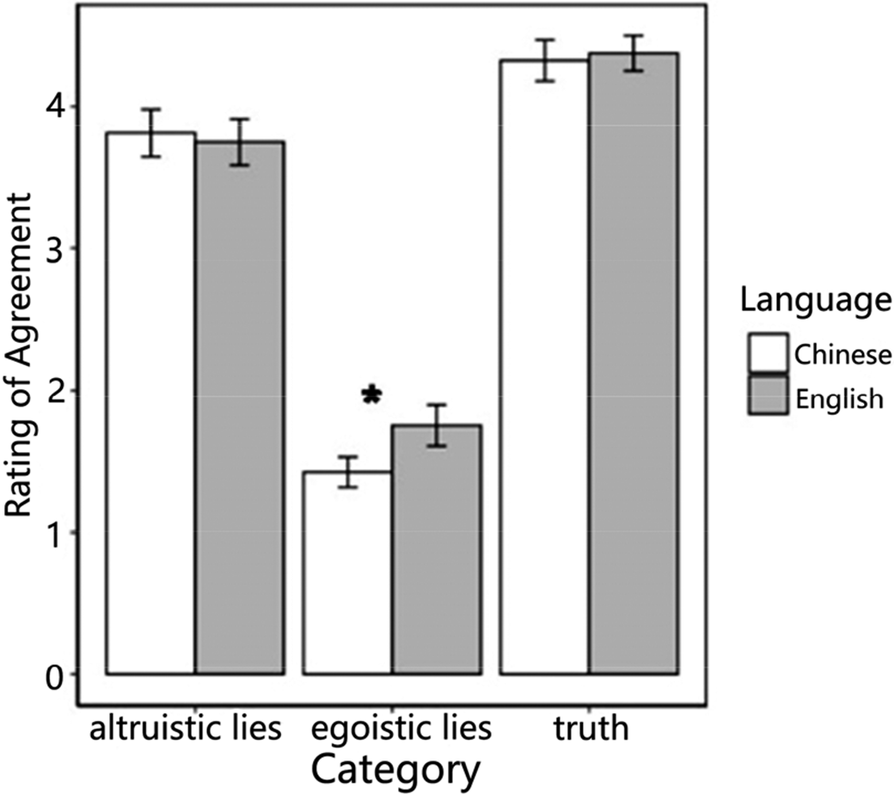
The results of mixed-model fitted to the rating of agreement were in Table 3. The two-way interaction was significant between statement type and language group (χ2 (2) = 7.01, p = .012). Post hoc analyses showed that agreement with the egoistic lie was higher in FL than in NL (β = −.307, SE = 0.091, t = −3.375, p < .001), whereas agreement with the altruistic lie (β = .027, SE = 0.093, t = 0.286, p = .775) and the truth (β = −.047, SE = 0.092, t = −0.513, p = .608) did not show any differences between languages (as shown in Figure 1).
Summary of the mixed-model fitted to the rating of agreement

Histogram showing the distribution of the agreement ratings by participants in the FL group and the NL group.

3.2. Electrophysiological results
The results of mixed-model fitted to the SCRs were in Table 4. There was not a main effect of language (χ2 (1) = 1.72, p = .190), but there was a main effect of type (χ2 (2) = 9.01, p = .011). Importantly, there was a significant two-way interaction between the statement type and language group (χ2 (2) = 8.72, p = .013). Post hoc analyses showed that the true statements in the FL elicited larger SCRs compared to that in NL (β = −.401, SE = 0.194, t = −0.067, p = .042), whereas no significant language effect was found neither in egoistic lies nor altruistic lies (egoistic lies: β = .137, SE = 0.196, t = 0.698, p = .487; altruistic lies: β = −.350, SE = 0.196, t = −1.784, p = .078) (see Figue 2(a)). Follow-up analyses in the other direction revealed that in NL, smaller SCRs for altruistic lies compared to egoistic lies (β = −.430, SE = 0.140, t = −3.82, p = .002), smaller SCRs for the truth compared to egoistic lies (β = .566, SE = 0.138, t = 4.096, p < .001), and similar SCRs for the true statement compared to the altruistic lies (β = .136, SE = 0.137, t = 0.987, p = .324), whereas no significant language effect was found among the three types of statement in the FL(truth vs. altruistic lie: β = .085, SE = 0.146, t = 0.583, p = .560; truth vs. egoistic lies: β = .028, SE = 0.145, t = 0.197, p = .844; altruistic lie vs. egoistic lie: β = .057, SE = 0.146, t = 0.387, p = .699) (as shown in Figure 2(b)).
Summary of the mixed-model fitted to the SCRs

(a) SCRs’ differences in scenarios between the foreign group and native group; (b) SCRs’ differences in language groups among altruistic lies, egoistic lies, and the truth.

4. Discussion
This study aimed to extend our current knowledge on whether the FLe influenced individuals’ judgments in positive and negative scenarios and whether the FLe in these scenarios shared underlying mechanisms. To this end, we investigated the FLe on the perception of egoistic lies and altruistic lies, and we collected behavioral and electrophysiological evidence to provide plausible explanations for the observations. According to Caldwell-Harris and Ayçiçeği-Dinn (Reference Caldwell-Harris and Ayçiçeği-Dinn2021), we expected that participants would express more agreement with egoistic lies and less agreement with altruistic lies in the FL than those in the NL. The results revealed that the FLe was observed and found to be modulated by the affective valence of scenarios. However, our predictions were only partially confirmed. To be specific, when reading and evaluating in an FL, participants showed increased agreement with egoistic lies, aligning with our expectations. Importantly, the use of the FL had no impact on the evaluation of truth with neutral affect, suggesting that the observed effect was genuine and not a result of misunderstanding. However, participants rated a comparable level of agreement with altruistic lies between languages, inconsistent with our initial expectations. Moreover, the pattern of SCRs was in line with our expectation that the difference between egoistic lies and altruistic lies was significant in the NL but not in the FL. We also observed that SCRs were stronger for the truth in the FL compared to that in the NL, while SCRs elicited by altruistic lies and egoistic lies were strong but less sensitive to experimental conditions.
4.1. The FLe on egoistic lies’ perception
The pattern of SCRs revealed three possible explanations (i.e., increased access to deliberative thinking, reduced affective thinking, obscuring of affective arousal due to cognitive load) for the FLe in negative scenarios with more agreement for egoistic lies in the FL compared to that in the NL. First, SCRs elicited by the truth differed by languages with higher SCRs in the FL than in the NL, suggesting additional cognitive load resulted from processing the FL. Previous studies have found that using an FL encourages participants to make more utilitarian choices. One possibility is that increased cognitive load enhanced engagement of the deliberation system, prompting more utilitarian judgments (e.g., Caldwell-Harris & Ayçiçeği-Dinn, Reference Caldwell-Harris and Ayçiçeği-Dinn2021; Costa et al., Reference Costa, Corey, Hayakawa, Aparici, Vives and Keysar2019). According to this account, more agreement ratings of egoistic lies in the FL manifested in the present study were contributed to increased access to deliberative thinking. In addition, SCRs in the NL clearly distinguished egoistic lies and the truth while in the FL they did not, inconsistent with Caldwell-Harris and Ayçiçeği-Dinn (Reference Caldwell-Harris and Ayçiçeği-Dinn2009) who observed higher SCRs for lying compared to truth-telling in both languages. This discrepancy suggested that participants in our study only faced “single stressor” stemming from using an FL, as opposed to the “double stressor” involving cognitive load associated with both telling a lie and using an FL in Caldwell-Harris and Ayçiçeği-Dinn (Reference Caldwell-Harris and Ayçiçeği-Dinn2009). That meant lies’ perception task employed in this study avoided excessive cognitive load taxing deliberation system, which led to an inclination toward intuitive responses in decision-making processes (Costa et al. Reference Costa, Foucart, Arnon, Aparici and Apesteguia2014), thereby avoiding contributing to a reverse FLe on lies like studies of Bereby-Meyer et al. (Reference Bereby-Meyer, Hayakawa, Shalvi, Corey, Costa and Keysar2020) and Yang et al. (Reference Yang, Li and Li2021) who observed that the proportion of lying was significantly lower in the FL than in the NL.
Second, the higher agreement for egoistic lies in the FL could be attributed to reduced access to affective thinking. The pattern of SCRs for the truth indicated that using the FL required additional cognitive resources and imposed a higher processing load on the bilinguals, which could have resulted in stronger SCRs when using the FL. However, the fact was that SCRs elicited by lies did not exhibit language differences, suggesting that using an FL-reduced affective response. SCRs elicited by lies were consistent with Suchotzki and Gamer (Reference Suchotzki and Gamer2018, experiment 3) where SCR results revealed no main effect of language in a lie-telling task. A possible explanation was the antagonistic effects of affective distance and cognitive load on lies’ perception in the FL. More specifically, reduced SCRs by affective attenuation canceled out increased SCRs by the increased cognitive load in the FL. It was noteworthy that this possibility found support in behavioral evidence, such as subjective reports of participants showing weaker feelings for lies in the FL than in the NL in the study by Caldwell-Harris and Ayçiçeği-Dinn (Reference Caldwell-Harris and Ayçiçeği-Dinn2009) and smaller response time differences between lying and truth-telling in the FL than in the NL in the study by Suchotzki and Gamer (Reference Suchotzki and Gamer2018). These findings implied that using an FL elicited reduced affective response. Such reduced affective response promoted activation of the cognitively controlled system that led to utilitarian choices. The according manifestation in this study was increased agreement of egoistic lies in the FL. Some research, actually, has provided more direct SCRs evidence that reduced affective resonance led to lying easier. For example, Kreyßig and Krautz (Reference Kreyßig and Krautz2019) found that using an NL elicited higher SCRs than using an FL across all conditions both in a lie-telling task and a lie-perception task, aligning with the vast research literature concerning affective differences between NL and FL. That supporting affective attenuation led to reduced physiological arousal in the FL context, and therefore lying in FL tended to be easier.
Third, that high cognitive load engendered by processing an FL dampened or obscured affective signals of the scenarios may result in more agreement with egoistic lies in the FL. SCRs were substantially higher during reading the egoistic lies compared to reading the altruistic lies in the NL, in line with the study of Caldwell-Harris and Ayçiçeği-Dinn (Reference Caldwell-Harris and Ayçiçeği-Dinn2021) where selfish statements elicited stronger SCRs than that of ethical statements in NL. This finding supported the somatic marker hypothesis. To be specific, altruistic lies functioned as a type of safety signal that elicited relatively weaker SCRs, while egoistic lies functioned as a risky signal that elicited stronger SCRs. Such a result was also in line with the negativity bias. The concept of “bad is stronger than good” suggests that individuals tend to perceive and respond more strongly to negative events compared to positive ones (Baumeister et al., Reference Baumeister, Bratslavsky, Finkenauer and Vohs2001). Supporting this notion, a recent meta-analysis conducted by Joseph et al. (Reference Joseph, Chan, Heintzelman, Tay, Diener and Scotney2020) found that experimentally manipulated negative content elicited mood changes that were nearly twice as strong as those elicited by positive content. However, in the FL, we found that there were no significant differences in SCRs between egoistic lies and altruistic lies. Similarly, Caldwell-Harris and Ayçiçeği-Dinn (Reference Caldwell-Harris and Ayçiçeği-Dinn2021) found that using the FL reduced the difference in SCRs between selfish and ethical statements compared to using the NL. According to Caldwell-Harris and Ayçiçeği-Dinn (Reference Caldwell-Harris and Ayçiçeği-Dinn2009), the increased cognitive load associated with processing an FL led to heightened physiological arousal, thereby obscuring the distinct affective arousal elicited by egoistic lies and altruistic lies. That explained why SCRs in the FL would be more insensitive to affective information than SCRs in the NL (Naranowicz et al. Reference Naranowicz, Jankowiak and Behnke2022). The reduced saliency of physiological signals elicited by affect resulted in the absence of somatic markers which typically guide individuals’ access to normative responses, resulting in more agreement with egoistic lies in the FL compared to that in the NL. In addition, the distribution of agreement ratings of egoistic lies in the FL did not seem to correlate with the SCRs of egoistic lies, which was against the somatic marker hypothesis. Participants judged more agreement with egoistic lies in the FL than in the NL, yet egoistic lies elicited similar SCRs across languages. It should be pointed out that the results of ratings of egoistic lies actually revealed different factors contributing to elevated SCRs. SCRs elicited by egoistic lies in the NL may reflect the affect associated with lying to a large extent, but SCRs for egoistic lies in the FL may reflect the cognitive load of using a less fluent language. According to dual process theory, moral decisions may vary depending on the relative weight of the affective and deliberative systems’ involvement within the process of the moral judgments (Costa et al., Reference Costa, Foucart, Arnon, Aparici and Apesteguia2014). That was why bilinguals gave higher ratings of egoistic lies in the FL than in the FL, yet experienced similar physical arousal between languages.
Overall, the pattern of egoistic lies’ SCRs revealed that the FLe on egoistic lies can result from the increased cognitive load leading to the activation of the deliberation system, affective attenuation leading to less access to the affect system, and affective obscuring caused by the cognitive effort of processing an FL. The three mechanisms dependently or collectively contributed to more agreement for egoistic lies in the FL compared to that in the NL. We agreed with the opinion proposed by Caldwell-Harris and Ayçiçeği-Dinn (Reference Caldwell-Harris and Ayçiçeği-Dinn2021) that there was no necessity to identify a single mechanism to explain the FLe, at least in negative scenarios. The aforementioned mechanisms were well-documented facets of human information processing, and their manifestation varies depending on the demands of the information being processed, while also being influenced by individual cognitive styles (Pennycook et al., Reference Pennycook, Fugelsang and Koehler2015).
4.2. The FLe on altruistic lies’ perception
The nonsignificant difference in agreement ratings for altruistic lies across languages was hardly accommodated by the three mechanisms for the FLe on egoistic lies, raising doubts about their capacity to explain the general nature of the FLe. While it was true that bilinguals experienced reduced affective response and increased cognitive load when perceiving altruistic lies in the FL, as evidenced by the analysis of the results of SCRs, they did not have a significant impact on the evaluation of altruistic lies. A hypothesis about the underlying mechanism of the FLe in positive scenarios was the increased psychological distance. In a recent study, Braida et al. (Reference Braida, Rodríguez-Ferreiro and Hernández2023) observed a reverse FLe that bilinguals rated motivational quotes as more profound in the FL than in the NL when they investigated whether the FLe extended to the way people perceived motivational quotes. The researchers tentatively applied the psychological distance hypothesis to explain the reverse FLe, which shed light on how the FLe operated in positive scenarios. The psychological distance hypothesis allows people to mentally detach themselves from other people, objects, events, or time (Trope & Liberman, Reference Trope and Liberman2003) and to take a broader perspective on a situation or evaluate it with an eye to long-term goals (Trope & Liberman, Reference Trope and Liberman2003, Reference Trope and Liberman2010). In other words, psychological distance contributes to a high construal level that leads people to adopt a more rational mindset during decision-making (Aguilar et al., Reference Aguilar, Brussino and Fernández-Dols2013). This means that compared to using an NL, using an FL leads to greater consideration of the value associated with an action and less concern with the detail of the action. Braida et al. (Reference Braida, Rodríguez-Ferreiro and Hernández2023) hypothesized that bilingual individuals used abstract representations of motivational quotes in the FL, which directed their attention toward the value conveyed by motivational quotes rather than how to carry out the behavior consistency with the value. As Shin and Kim (Reference Shin and Kim2017) pointed out, the nature of the psychological distance hypothesis is that when people make a decision, using an FL drives people to separate from themselves and make them concentrate on maximizing the overall good. Therefore, it seems that the psychological distance may serve as an explanation for the absence of the FLe on altruistic lies, manifesting that participants in the current study paid more attention to the value of altruistic lies that they were willing to help others though they lied. However, the psychological distance hypothesis appeared to have limitations in explaining the FLe on altruistic lies because using the FL did not play a substantial role in promoting agreement with altruistic lies, unlike using the FL contributed to more profoundness of motivational quotes by Braida et al. (Reference Braida, Rodríguez-Ferreiro and Hernández2023). In the latest study, Yavuz et al. (Reference Yavuz, Küntay and Brouwer2023) directly investigated psychological distance on moral judgments in some negative scenarios, and they did find psychological distance affected moral judgment, but it did not interact with languages. Hence, future studies should further explore whether psychological distance serves as a potential mechanism prompting the FLe in different affective scenarios.
We also considered another alternative explanation for the absence of the FLe on altruistic lies that valence-specificity of cross-language emotionality effects. From the perspective of affective language processing, negative words showed language-affect interactions more than positive words. Therefore, using the FL-reduced affect elicited by egoistic lies to a larger extent compared to that of altruistic lies, which might contribute to more agreement with egoistic lies that elicited negative affect in the FL, and no differences in altruistic lies that evoked positive affect between languages. The results were in line with Gao et al. (Reference Gao, Luo and Gou2020) who found the unpleasantness of criticism was reduced in the FL as compared to in the NL, whereas affective ratings for praise were not modulated by the languages. Wu and Thierry (Reference Wu and Thierry2012) proposed a hypothetical mechanism of repression. That means using an FL activates automatic process which suppresses access to negative emotional content. This proposition was further validated by Jończyk et al. (Reference Jończyk, Boutonnet, Musiał, Hoemann and Thierry2016) who demonstrated that using a FL would suppress negative content in the early phases of processing in affectively realistic sentence contexts. The results of SCRs in this study also strengthened this possibility as SCRs for egoistic lies were larger than altruistic lies in the NL, while there were no differences in SCRs between lies in the FL. That suggested that negative affect elicited by egoistic lies may be suppressed more strongly than positive affect by altruistic lies. Therefore, participants experienced more reduced negative affect compared to reduced positive affect in the FL, leading to more agreement for egoistic lies and a comparable level of agreement for altruistic lies in the FL.
Therefore, we proposed that the FLe was more stable and more obvious in negative scenarios. However, it’s important to note that Caldwell-Harris and Ayçiçeği-Dinn (Reference Caldwell-Harris and Ayçiçeği-Dinn2021) observed the FLe on evaluating ethical behaviors with reduced agreement ratings in the FL, which mismatched with the agreement ratings for altruistic lies in the present study. Although both scenarios were perceived as positive and acceptable socially and morally, there were some differences that might cause the discrepancy. One is the affective intensity of the scenarios. Kyriakou and Mavrou (Reference Kyriakou and Mavrou2023) suggested that the FLe may be limited to scenarios involving strong affect. In Caldwell-Harris and Ayçiçeği-Dinn (Reference Caldwell-Harris and Ayçiçeği-Dinn2021), the ethical behaviors involved significant personal sacrifices. While in the present study, altruistic lies were designed to involve less significant personal sacrifices to make the scenarios more reflective of everyday situations. As a result, the altruistic lies in this study elicited relatively weaker affective responses compared to the ethical behaviors in the study by Caldwell-Harris and Ayçiçeği-Dinn (Reference Caldwell-Harris and Ayçiçeği-Dinn2021), leading to the absence of the FLe on altruistic lies. Another possibility was the difference in narrative perspective. Hu and Navarrete (Reference Hu and Navarrete2024) investigated the FLe on black lies and white lies. They found that when lies were presented in third-person narratives, black lies were judged less harshly, and white lies were judged less acceptable in the FL, which was in line with Caldwell-Harris and Ayçiçeği-Dinn (Reference Caldwell-Harris and Ayçiçeği-Dinn2021). However, when the scenarios shifted from third-person to first-person narratives, the intention to tell black lies still remained higher in the FL compared to in the NL, while the intention to tell white lies was not so apparent between languages, in line with the present study. Hu and Navarrete (Reference Hu and Navarrete2024) proposed that descriptive norms (narrated by third-person perspective) are more external and impersonal, making them more susceptible to contextual changes such as language. In contrast, subjective norms (narrated by first-person perspective) are more robust because they are internalized and personal. Consequently, it could be inferred that the discrepancy between the study by Caldwell-Harris and Ayçiçeği-Dinn (Reference Caldwell-Harris and Ayçiçeği-Dinn2021) and the present study may stem from different narrative perspectives. Certainly, it cannot be ignored that Braida et al. (Reference Braida, Rodríguez-Ferreiro and Hernández2023) observed a reverse FLe when participants rated motivational quotes. Except for longer physiological distance in the FL contributing to the reverse FLe, Ayçiçeği-Dinn et al. (Reference Ayçiçeği-Dinn, Şişman-Bal and Caldwell-Harris2018) gave another explanation for the reverse FLe when they found jokes are funnier in the FL. That is added effort of using an FL leading to a feeling of achievement when the meaning is obtained. Although existing research offers various explanations for the impact of FL on positive situations, the instability of the FLe on positive scenarios is evident. Therefore, it is necessary to further explore how the FLe impacts positive situations. Moreover, the inconsistency of the FLe on positive behavior further supported our proposition that the FLe was more stable and obvious in negative scenarios.
4.3. Limitations and future direction
Several limitations of the current study should be acknowledged and addressed in future studies. First, the proportion of males and females in the present study was unbalanced. Gender may have a direct impact on the FLe. In a recent study, Purpuri et al. (Reference Purpuri, Vasta, Filippi, Wei and Mulatti2023) investigated the FLe on tolerance of ambiguity (ToA) and found that female bilinguals showed more tolerance of ToA compared to males, suggesting female participants experienced more FLe. However, Gargalianou et al. (Reference Gargalianou, Urbig and Van Witteloostuijn2017) observed no differences between male and female participants in their responses to social dilemmas presented in NL, while in FL, female participants exhibited a higher level of cooperative behavior compared to male counterparts, suggesting that female participants experienced less FLe. Hence, gender should be further explored in more detail. Second, participants in the study were not explicitly investigated on whether they had experienced the events that occurred in the scenarios. Although personality traits have been investigated before the experiment, previous studies have shown that individuals’ moral concerns may vary depending on their prior similar experiences (Carpendale & Krebs, Reference Carpendale and Krebs1995). Especially in a more realistic scenario studying the FLe, the subjective experience of the person with the particular event may influence their judgments (Yavuz et al., Reference Yavuz, Küntay and Brouwer2023). Thirdly, the research methods for studying the FLe need to be improved. Previous studies mainly adopted self-reported measures to examine affective impacts on the FLe where participants were allowed to freely express affective labels and are required to be aware of their affective states. Although we have used SCRs as the psychological indicator to study the FLe following Caldwell-Harris and Ayçiçeği-Dinn (Reference Caldwell-Harris and Ayçiçeği-Dinn2021) to monitor affective response objectively, it still hardly provides a robust explanation for the absence of FLe in scenarios with positive affective valence. Therefore, an important direction for future work is to employ neuroimaging technology to explore the neural mechanism of the FLe, and therefore figure out boundary conditions of this phenomenon and utilize the FLe to improve judgment in a realistic scenario.
5. Conclusion
We investigated the FLe on the perception of egoistic lies and altruistic lies to expand the current knowledge on the FLe in different affective scenarios. The results revealed a significant FLe on the egoistic lies, but not on the altruistic lies. The observed pattern of SCRs suggested that increased access to deliberative thinking, reduced access to affective thinking, and the obscuring of affective arousal due to cognitive load may dependently or interactively contribute to the FLe on egoistic lies. However, these mechanisms cannot accommodate altruistic lies. The results implied the FLe is more stable and obvious in negative contexts. Overall, our study contributed to the growing body of literature on the FLe and provided a more complete picture of how language influences judgments in different scenarios. It underscores the need for further exploration and understanding of how language influences our cognitive processes and decision outcomes.
Data availability statement
The datasets generated during the current study are available from the corresponding author on reasonable request.
Acknowledgments
We would like to thank Professor Caldwell-Harris for her invaluable suggestions in collecting and analyzing SCRs for this study. This work was supported by the National Social Science Fund of China [grant 23AYY019].
Competing interest
The authors declare no conflict of interest.




 Open access

