





1 Introduction
In high-power laser facilities, such as the National Ignition Facility (NIF), Laser Megajoule (LMJ) and Shenguang-III (SG-III) for inertial confinement fusion (ICF)[ Reference Betti and Hurricane1], the long-distance propagation of high-power laser pulses in air inevitably induces stimulated rotational Raman scattering (SRRS), which gives rise to substantial energy loss and severe beam quality degradation, thereby critically challenging fusion ignition[ Reference Zhu, Lin, Lu, Wang, Wang, Liang and Ba2, Reference Bates, Follett, Shaw, Obenschain, Myatt, Weaver, Wolford, Kehne, Myers and Kessler3]. In order to enhance the reliability and stability of high-power laser drivers in ICF and achieve successful ignition, it is essential to conduct in-depth research on the SRRS effect and its mitigation. Consequently, extensive studies have been conducted to mitigate SRRS in high-power laser systems[ Reference Skeldon and Bahr4, Reference Lin, Kessler, Armstrong and Lawrence5].
Lin et al. [ Reference Lin, Kessler and Lawrence6] established a four-dimensional transient SRRS model and derived the empirical threshold criterion gIL = 25, where g is the Raman gain coefficient, I is the peak intensity and L is the propagation distance. Their work revealed that SRRS significantly degrades beam quality during long-distance propagation, which may prevent the successful realization of ICF ignition. A widely adopted mitigation method involves filling the beam path with an inert gas such as argon[ Reference Fan, Huang, Wang, Zhang, Li and Sun7], which exhibits narrower Raman linewidth and lower gain compared to air. However, argon is costly and requires high-pressure containment, leading to elevated operational and maintenance expenses. Alternatively, employing broadband laser sources can disrupt the phase-matching condition for SRRS and suppress Stokes generation[ Reference Kehne, Weaver, Lehmberg, Wolford and Obenschain8]; yet, this approach severely compromises third-harmonic conversion efficiency, limiting the overall energy output capacity of ICF drivers.
Recently, a kind of advanced optical filter – volume Bragg gratings (VBGs) recorded in photo-thermo-refractive (PTR) glass – has attracted extreme attention[ Reference Zhang, Feng, Xiong, Zou and Yuan9] due to their exceptional spectral and angular selectivity (AS), high diffraction efficiency (DE) and superior laser-induced damage threshold. Consequently, VBGs have been successfully applied in spatial filtering[ Reference Zhang, Yuan, Feng, Gao, Xiong and Zou10], spectral stabilization[ Reference Liu, Liu, Li, Xiao, Xia, Gao, Li and Zheng11], pulse compression[ Reference Glebov, Smirnov, Rotari, Cohanoschi, Glebova, Smolski and Lumeau12] and beam combining[ Reference Zhou, Liang, Li, Zhao, Wang and Jing13, Reference Drachenberg, Divliansky, Smirnov, Venus and Glebov14]. Building upon the distinctive advantages of VBGs, we propose an approach for the cut-off of SRRS effects in high-power laser pulses via transmission-type VBGs to mitigate SRRS in ICF facilities. Specifically, the narrowband filtering capability of VBGs may be designed to selectively suppress the dominant Stokes wavelengths in SRRS, while maintaining high transmission efficiency and further combining the spatial filtering capability of VBGs to improve the beam quality of the laser.
2 Parameter selection of volume Bragg gratings
The long-distance propagation of large-aperture, high-power laser pulses in air involves the interaction of linear diffraction and the nonlinear effects of SRRS. Not only the pulse intensity but also its near-field modulation, wavefront distortion, temporal profile and phase modulation (in the case of broadband pulses) influence the process[ Reference Peñano, Sprangle, Hafizi, Ting, Gordon and Kapetanakos15]. The SRRS effect during the long-distance propagation of high-power laser pulses in air leads to the generation of Stokes light, causing a sharp degradation in the near-field beam quality[ Reference Liu, Lin, Lu and Zeng16]. This directly affects the beam’s far-field distribution and focusing characteristics. Calculations indicate that the intensity of the Stokes light is related to the intensity-path-length product of the pulse in air, and the threshold for SRRS depends on factors such as intensity, laser pulse width and the spatial aperture of the beam. According to the coupled-wave equations of SRRS, the generation of SRRS arises from the mutual coupling between the pump light and the Stokes light[ Reference Divliansky17, Reference Kogelnik18]. If the Stokes light can be directly filtered out before the laser pulse reaches the SRRS threshold, the coupling balance between these two fields can be disrupted. Although this does not completely prevent subsequent SRRS or the continued generation of Stokes light, the allowed propagation distance of the pump light is significantly increased, and the high-frequency ‘modulations’ in the light beam induced by the SRRS effect are substantially reduced.
From Fourier optics, any beam with an arbitrary intensity distribution can be decomposed into an infinite superposition of monochromatic plane waves propagating in different directions, where the complex amplitude distribution of the beam is related to its spatial frequency distribution via a Fourier transform. Due to the excellent AS of VBGs, the medium- and high-frequency spatial components of the beam, which deviate significantly from the Bragg condition, cannot be efficiently diffracted by the VBG[ Reference Wu, Yuan, Zhang, Feng, Zou and Zhang19]. Consequently, these components are effectively filtered out in the diffracted beam, forming the basic principle of near-field filtering using VBGs.
Meanwhile, the VBG inherently possesses spectral selectivity (SS)[ Reference Damzen, Matsumoto, Crofts and Green20]. During long-distance propagation of high-power laser pulses in air, Stokes components with a new ‘wavelength’ are generated along the same propagation direction as the pump light. In practical applications, the structural parameters of the VBG can be designed so that its spectral bandwidth is smaller than, or much smaller than, the wavelength separation between the pump light and Stokes light. Under this condition, the pump light satisfies the Bragg condition and is efficiently diffracted, whereas the Stokes light deviates from the Bragg condition and is filtered out. This enables effective spatial separation between the pump light and Stokes light, thereby breaking the coupling balance and raising the SRRS threshold, achieving partial suppression of the SRRS effect. Furthermore, due to the near-field filtering capability of the VBG, the high-frequency modulations within the pump beam are also directly removed during separation, effectively improving the beam quality of the pump light.
The diffraction characteristics of a VBG include AS, SS and peak DE. These diffraction properties are primarily determined by three grating parameters: the grating period, grating thickness and refractive index modulation[ Reference Divliansky17]. The three parameters are mutually coupled and jointly influence the diffraction characteristics. Therefore, determining suitable grating parameters that can effectively suppress the SRRS effect during long-distance propagation in air is a critical step in VBG parameter design.
According to coupled-wave theory, the Bragg selectivity of a transmission-type VBG can be expressed as follows[ Reference Kogelnik18]:
 $$\begin{align}\kern0.1em \eta =\frac{\sin^2{\left({\nu}^2+{\xi}^2\right)}^{1/2}}{1+{\xi}^2/{\nu}^2},\end{align}$$
where
 $$\begin{align}\nu &=\frac{\pi {n}_1d}{\lambda \sqrt{C_{\mathrm{R}}{C}_{\mathrm{S}}}}, \end{align}$$
 $$\begin{align}\kern0.1em \xi &=\frac{\varDelta \theta Kd\sin \left(\phi -{\theta}_0\right)}{2{C}_{\mathrm{S}}}=-\frac{\Delta \lambda {K}^2d}{8\pi {nC}_{\mathrm{S}}},\end{align}$$
where K = 2π/Λ, Λ is the grating period, d represents the grating thickness, n 1 refers to the refractive index modulation amplitude, ϕ is the tilt angle of the grating vector, n is the refractive index of the VBG, θ 0 denotes the angle of incidence, λ is the wavelength and C R and C S are coupling coefficients, respectively.
The half-width at first zero point (HWFZ) for the Bragg selectivity of a transmission-type VBG can be derived by letting ξ 2 + ν 2 = π 2 in Equation (1), and the AS and SS (half-width) of the grating can be respectively expressed as follows:
 $$\begin{align}\kern0.1em \Delta {\theta}_{\mathrm{HWFZ}}=\frac{n\cos {\theta}_0}{\sqrt{1-{n}^2{\sin}^2{\theta}_0}}\cdot \frac{\Lambda {C}_{\mathrm{S}}}{d\sin \left(\phi -{\theta}_0\right)}\sqrt{1-\frac{n_1^2{d}^2}{\lambda^2{C}_{\mathrm{R}}{C}_{\mathrm{S}}}},\end{align}$$
 $$\begin{align}\kern0.1em \Delta {\lambda}_{\mathrm{HWFZ}}=\frac{2n{\Lambda}^2{C}_{\mathrm{S}}}{d}\sqrt{1-\frac{n_1^2{d}^2}{\lambda^2{C}_{\mathrm{R}}{C}_{\mathrm{S}}}}.\end{align}$$
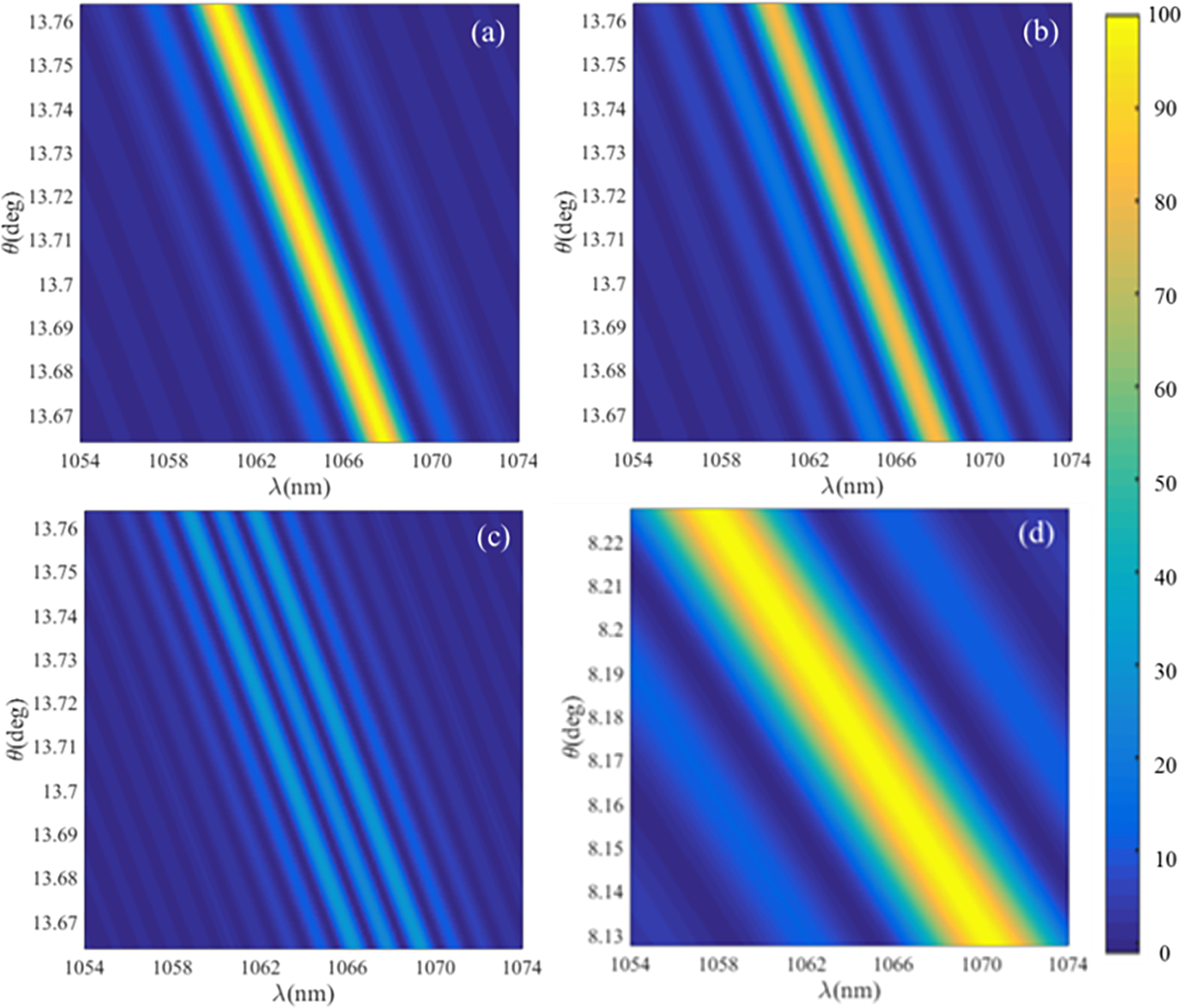
Figure 1 shows the Bragg selectivity of a lossless transmission-type VBG for different grating periods, grating thicknesses and refractive index modulations. It can be seen from Figure 1 that, as the grating period increases, the widening of the fringe patterns indicates that the Bragg selectivity of the grating increases with the grating period. The change in the angle between the fringe patterns and the coordinate axes reveals that the AS and SS vary at different rates as the grating period increases. Meanwhile, the central brightness of each fringe pattern remains essentially unchanged, indicating that the peak DE of the grating and the diffraction efficiencies of the side lobes are largely independent of the grating period.
Bragg selectivity of transmission-type volume Bragg gratings: (a) grating period Λ = 1.5 μm, refractive index modulation amplitude n 1 = 175 ppm (parts per million), grating thickness d = 3 mm; (b) Λ = 1.5 μm, n 1 = 225 ppm, d = 3 mm; (c) Λ = 1.5 μm, n 1 = 175 ppm, d = 5 mm; (d) Λ = 2.5 μm, n 1 = 175 ppm, d = 3 mm.

Figure 1 further implies that, with increasing grating thickness and the refractive index modulation, the inclination of the fringe patterns does not change, indicating that the effects of both the grating thickness and the refractive index modulation on AS and SS increase at the same rate. However, the central brightness of the fringe patterns decreases continuously, indicating that the DE of the grating varies periodically with the thickness and the refractive index modulation. In addition, increasing the grating thickness and the refractive index modulation leads to a synchronous enhancement of the grating’s Bragg selectivity.
The diffraction model of the VBG can be used to match the required diffraction characteristics for effectively suppressing the SRRS effect during long-distance propagation in air. For example, when the target ASs are x 1 = 1.0, 1.5 and 2.0 mrad, the corresponding design requirements are as follows:
 $$\begin{align}\Delta {\theta}^{\prime }=\frac{n\cos {\theta}_0}{\sqrt{1-{n}^2{\sin}^2{\theta}_0}}\cdot \frac{\Lambda {C}_{\mathrm{S}}}{d\sin \left(\phi -{\theta}_0\right)}\sqrt{1-\frac{n_1^2{d}^2}{\lambda^2{C}_{\mathrm{R}}{C}_{\mathrm{S}}}}\le {x}_1 .\end{align}$$
Then, in order to filter out the Stokes light, the SS (half-width) of the grating is required to be smaller than the wavelength separation between the pump light and the Stokes light. For a 1053 nm pulsed laser, this requires that the SS half-width be less than or equal to x 2 = 8 nm, which means
 $$\begin{align}\Delta {\lambda}^{\prime}=\frac{2n{\Lambda}^2{C}_{\mathrm{S}}}{d}\sqrt{1-\frac{n_1^2{d}^2}{\lambda^2{C}_{\mathrm{R}}{C}_{\mathrm{S}}}}\ge {x}_2.\end{align}$$
According to the requirement that higher DE is preferable, the grating thickness and refractive index modulation must satisfy appropriate matching conditions.
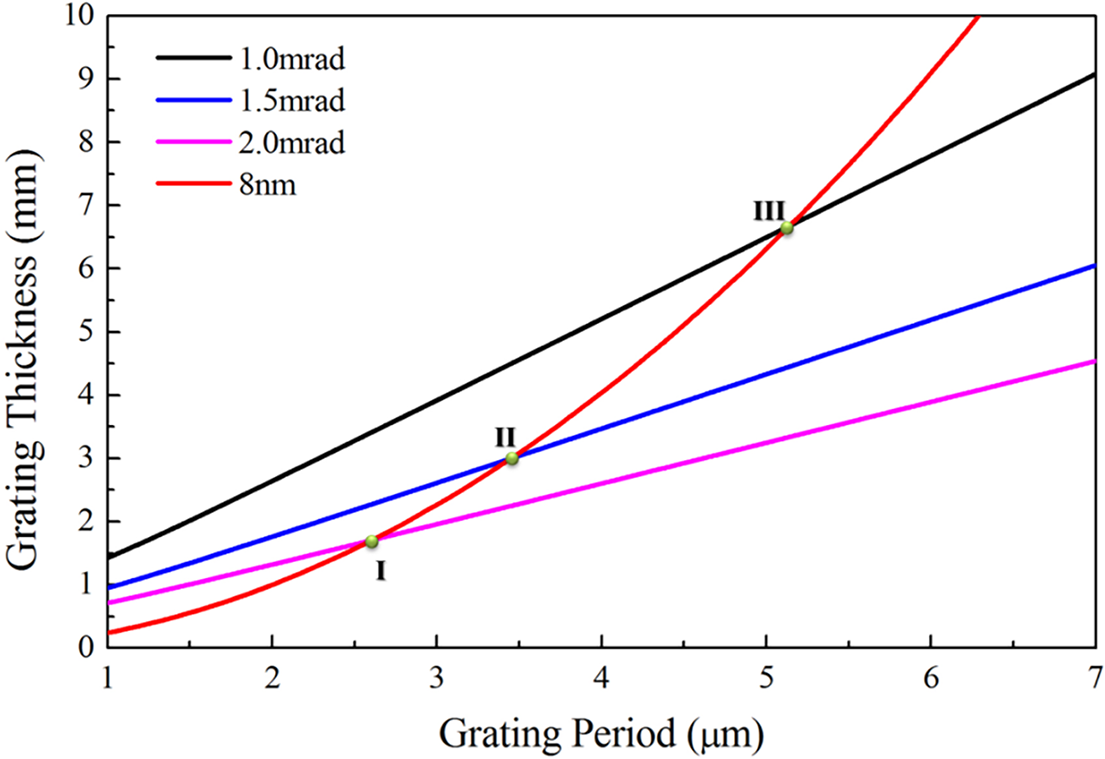
Based on the above conditions, VBGs with identical SS but different AS were designed. By simultaneously solving the two sets of inequality formulas (Equations (6) and (7)), the feasible parameter ranges for the grating period and grating thickness that satisfy the diffraction requirements can be directly obtained, as shown in Figure 2. In the figure, the black, blue and pink curves are approximately straight lines representing the AS constraints of the grating, corresponding to x 1 = 1.0, 1.5 and 2.0 mrad in Equation (6), respectively. The red curve is approximately parabolic, representing the SS constraint of the grating, corresponding to x 2 = 8.0 nm in Equation (7). The AS and SS curves intersect at three points, and these three intersection points represent the grating structural parameters corresponding to the critical diffraction characteristics, as listed in Table 1.
Relationship between the grating period and thickness satisfying the diffraction characteristics.

Structural parameters of the volume Bragg grating (VBG).

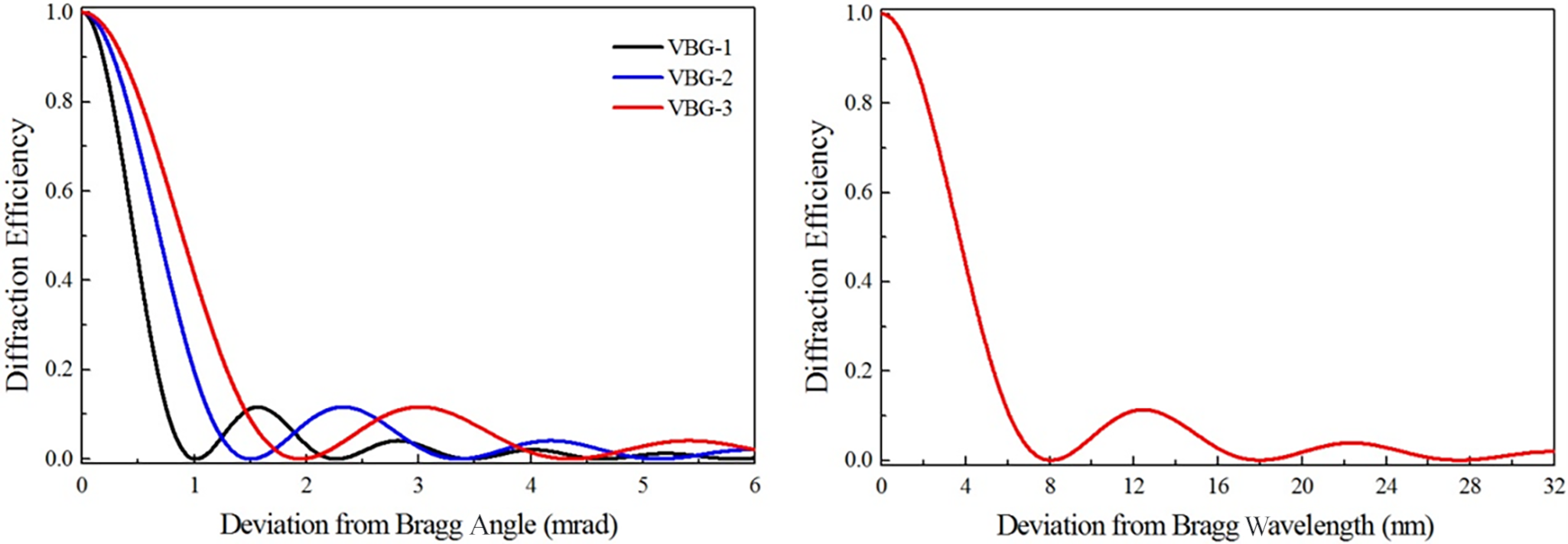
The corresponding Bragg conditions of the gratings are shown in Figure 3. The first null half-widths of the AS are 1.0, 1.5 and 2.0 mrad, respectively, while the three gratings share the same SS, with the first null half-width equal to 8 nm.
Bragg selectivity corresponding to the critical grating parameters – angular selectivity (left) and spectral selectivity (right).

In practical applications, the stability of the VBG under realistic high-power operating conditions is crucial, especially for the thermal stability and damage threshold of the VBG. Regarding thermal stability, the VBGs used in this work are fabricated in PRT glass, which exhibits excellent thermal stability and a very low thermal expansion coefficient. According to our previous work[ Reference Zhang, Feng, Xiong, Zou and Yuan21], by appropriately controlling the crystallization temperature during fabrication, the variation of the grating period induced by thermal expansion can be effectively controlled. For instance, even when the grating temperature increases by approximately 20°C, the resulting reduction in DE remains below 1%. Therefore, the thermal effects have a negligible impact on the diffraction performance of the VBGs and do not compromise their effectiveness in suppressing the SRRS effect. On the other hand, the surface damage threshold of VBGs recorded in PTR glass in high peak power pulse laser operation has been measured at 11 and 40 J/cm2 for 1 and 8 ns pulses, respectively, at the wavelength of 1054 nm[ Reference Efimov, Glebov, Papernov and Schmid22, Reference Jain, Drachenberg, Andrusyak, Venus, Smirnov and Glebov23]. According to our experimental data, the damage threshold of the VBG is measured to be larger than 30 J/cm2 for a 1064 nm laser with the pulse width of 10 ns.
3 Cut-off of stimulated rotational Raman scattering growth via volume Bragg gratings
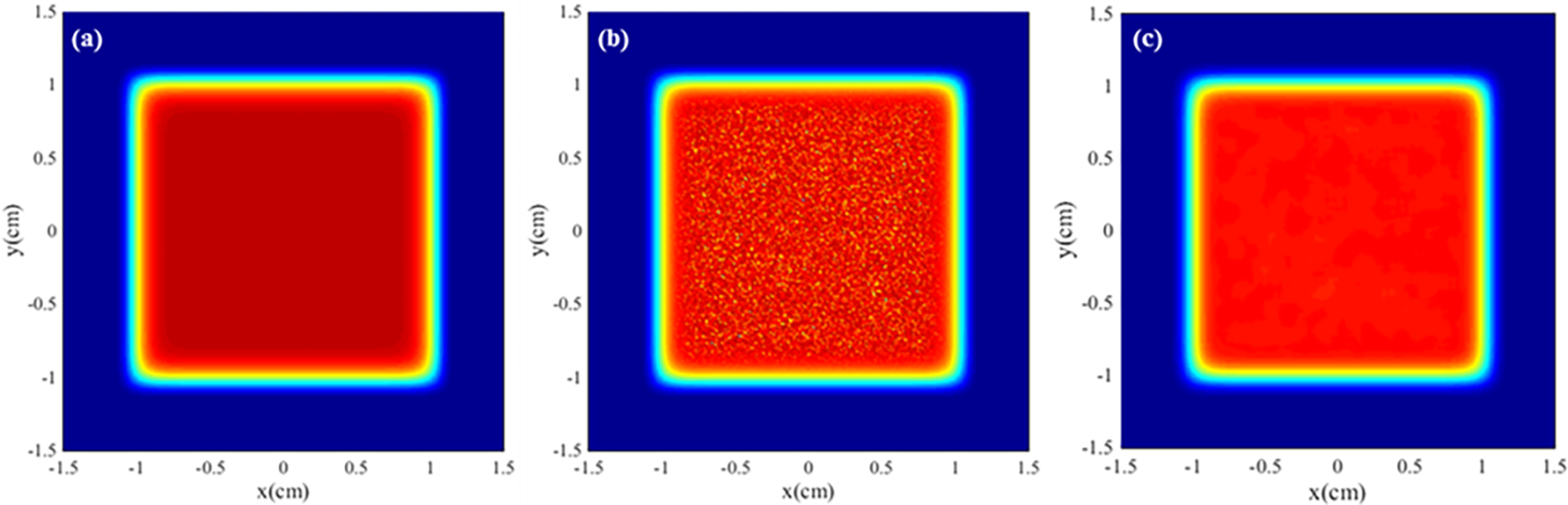
Hereafter, the cut-off of SRRS using the designed VBGs was analyzed. Taking VBG-I from Table 1 as an example, we calculated and analyzed the effect of using the VBG to cut-off SRRS for the initial super-Gaussian beam after 45 m of air propagation, as given in Figure 4. In the simulations, the initial laser pulse has a wavelength of 1053 nm, while the first-order Stokes wavelength can be approximately considered as 1061 nm, corresponding to a spectral shift of about 8 nm[ Reference Meyers24]. For the convenience of calculation without losing generality, the initial beam is assumed to be a square super-Gaussian beam with an aperture of 20 mm × 20 mm and a beam order of 16th order, with an average power density of 3.75 GW/cm2 and a pulse width of 3 ns. Although the incident laser beam is assumed to be a square super-Gaussian beam, diffraction effects are taken into account in the analysis. Any asymmetry or modulation in the incident beam may degrade the performance of VBGs but does not alter the underlying SRRS suppression mechanism. In addition, as can be seen from Table 1, the VBGs designed in this work for suppressing SRRS during long-distance laser propagation have grating periods that are significantly larger than the wavelength of the incident laser. According to grating diffraction theory, under such conditions the polarization-dependent effects of the grating are generally weak enough that can be neglected to a good approximation.
Intensity distributions: (a) initial beam (M = 1.00); (b) pump beam after 45 m propagation with modulation (M = 1.081); (c) diffracted beam through VBG-I (M = 1.012).

In the simulations, to achieve an optimal balance between computational cost and simulation accuracy, it is essential to understand how microscopic scales in each dimension influence the macroscopic beam characteristics. Considering that the near-field profiles of high-power 1ω or 3ω driver pulses typically exhibit millimeter- to centimeter-scale modulations, the spatial sampling intervals δx and δy in the transverse (x, y) dimensions are set to the sub-millimeter level. Given that the rotational relaxation time of N2 molecules at ambient conditions is approximately 133 ps, the temporal sampling interval δt is chosen to be of the order of 10 ps. The longitudinal sampling interval δz, which governs the description of Stokes wave growth, is primarily determined by the growth rate along the propagation direction and thus depends on the pump intensity, pulse width and related parameters. For nanosecond pulses with pump intensities of several GW/cm2, a sampling interval of δz ≈ 10 cm is sufficient to maintain the required accuracy. Therefore, by appropriately selecting microscopic sampling scales in all four dimensions of the model, a practical balance between computational efficiency and numerical fidelity can be achieved.
As shown in Figure 4, due to the excellent AS of the grating, the high-frequency modulations present in the pump light after long-distance propagation of 45 m are effectively filtered out by diffraction through VBG-I. After filtering by VBG-I, the near-field modulation, which is defined as $M=\frac{I_{\mathrm{max}}}{I_{\mathrm{avg}}}$
, of the pump light decreases from 1.081 to 1.012, indicating a significant improvement in the near-field beam quality of the pump light.
$M=\frac{I_{\mathrm{max}}}{I_{\mathrm{avg}}}$
, of the pump light decreases from 1.081 to 1.012, indicating a significant improvement in the near-field beam quality of the pump light.
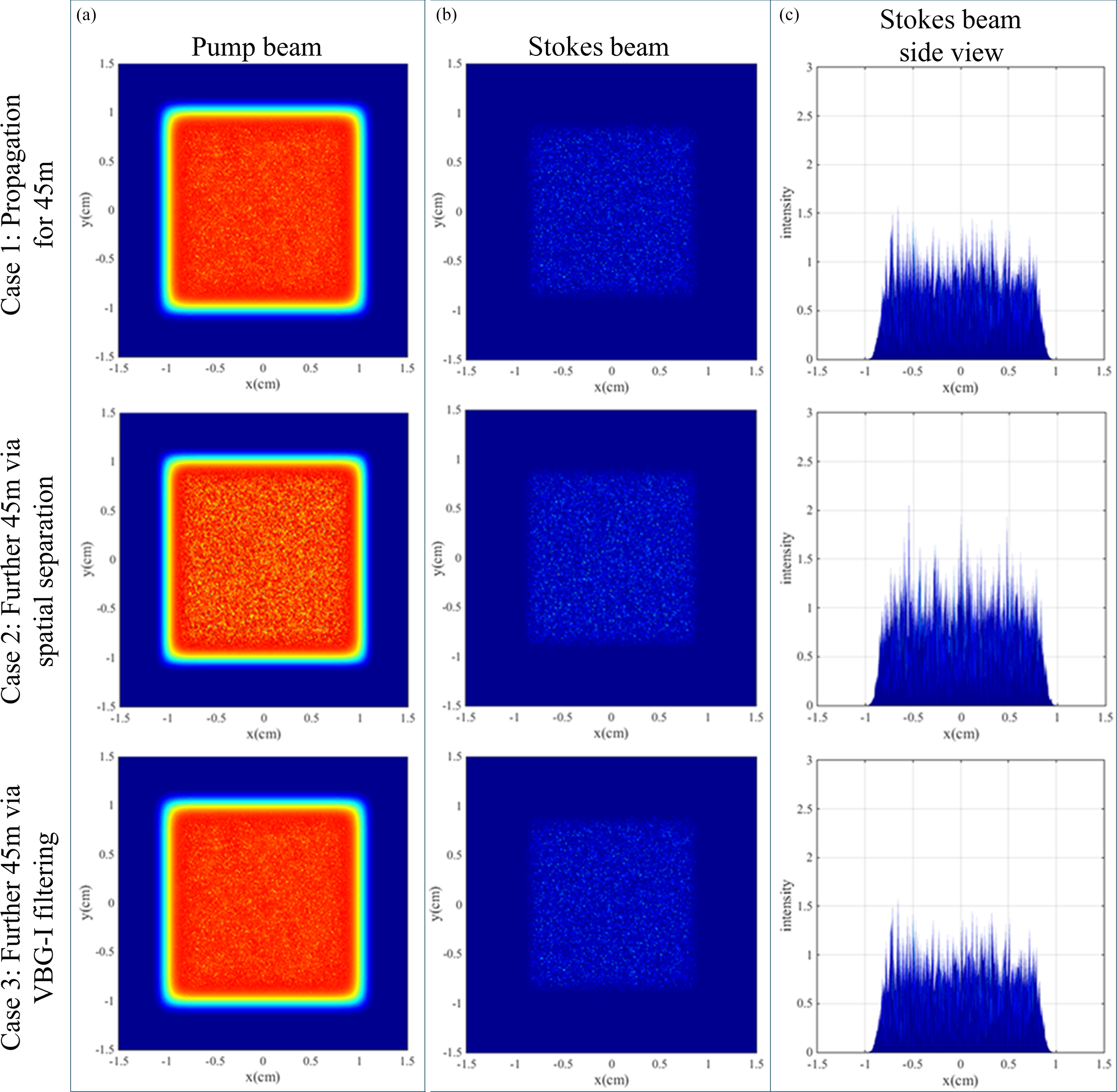
Further, using the pump intensity distribution in Figure 4(c) as the initial condition for an additional 45 m of propagation, the resulting pump and Stokes light intensity distributions are compiled in Figure 5.
Intensity distributions include (a) the pump beam (M = 1.00), (b) the Stokes beam (M = 1.081) and (c) the side view of the Stokes beam. Case 1: the SRRS field distributions of the light fields after propagation in air for 45 m. Case 2: the SRRS field distributions after spatial separation of the Stokes light and further 45 m propagation of the pump pulse (M = 1.178). Case 3: the SRRS field distributions after a further 45 m propagation of the pump beam following VBG-I filtering and separation (M = 1.073).

It can be seen from Figure 5 that the flat-top region of the square beam is severely modulated, and the Stokes light intensity increases significantly after 45 m of propagation in air. The near-field modulation of the 1053 nm pump light rises from the initial 1.000 to 1.081. By using a narrowband reflector or other means to spatially separate the 1053 nm pump light and the 1061 nm Stokes light after 45 m of propagation, and using the resulting 1053 nm pump light as the initial beam for a further 45 m propagation, the near-field modulation depth of the pump light obviously increases from 1.081 to 1.178. This is so because high-frequency modulations still exist in the flat-top region of the initial beam, and the SRRS effect further degrades the beam quality of the pump light. Fortunately, by replacing the narrowband reflector with VBG-I, the SRRS effect is significantly reduced. The near-field modulation depth of the pump light decreases from 1.178 to 1.073, indicating an improvement in the beam quality of the pump light.
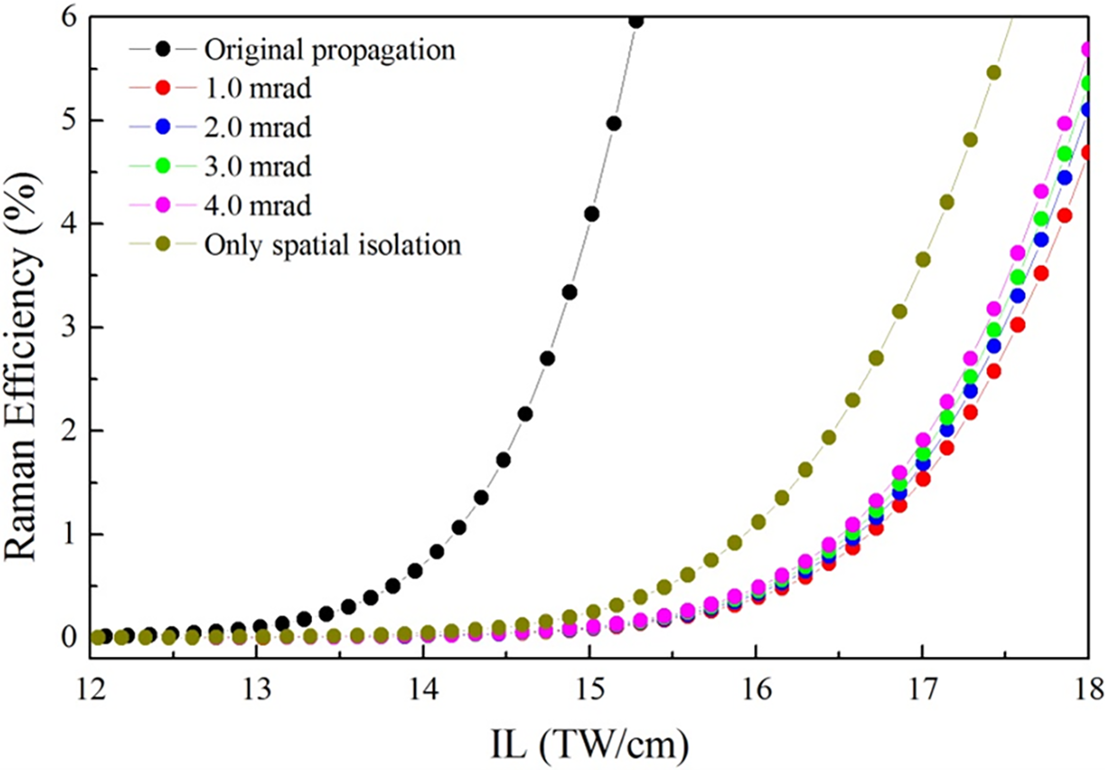
To compare the performance of VBGs with different angular selectivities and only spatial isolation by narrowband filters, Figure 6 further shows the variation of Raman efficiency defined as the ratio of the Stokes energy to the pump energy during propagation after filtering by VBGs with different angular selectivities, as well as after spatial separation using only narrowband filters.
Variation of Raman efficiency with intensity–distance product for different SRRS suppression methods.

Figure 6 implies that the Raman efficiencies after diffraction filtering by the VBG and by methods such as narrowband filters are both lower than that in the free-propagation case, corresponding to a higher SRRS threshold. Moreover, the SRRS threshold after VBG filtering is higher than that achieved using only narrowband filters. This indicates that the Bragg selectivity of the VBG not only enables spatial separation of the pump and Stokes light but also effectively suppresses the SRRS effect to a certain extent, thereby extending the propagation distance of the pump light and increasing the SRRS threshold while maintaining beam quality to a certain extent.
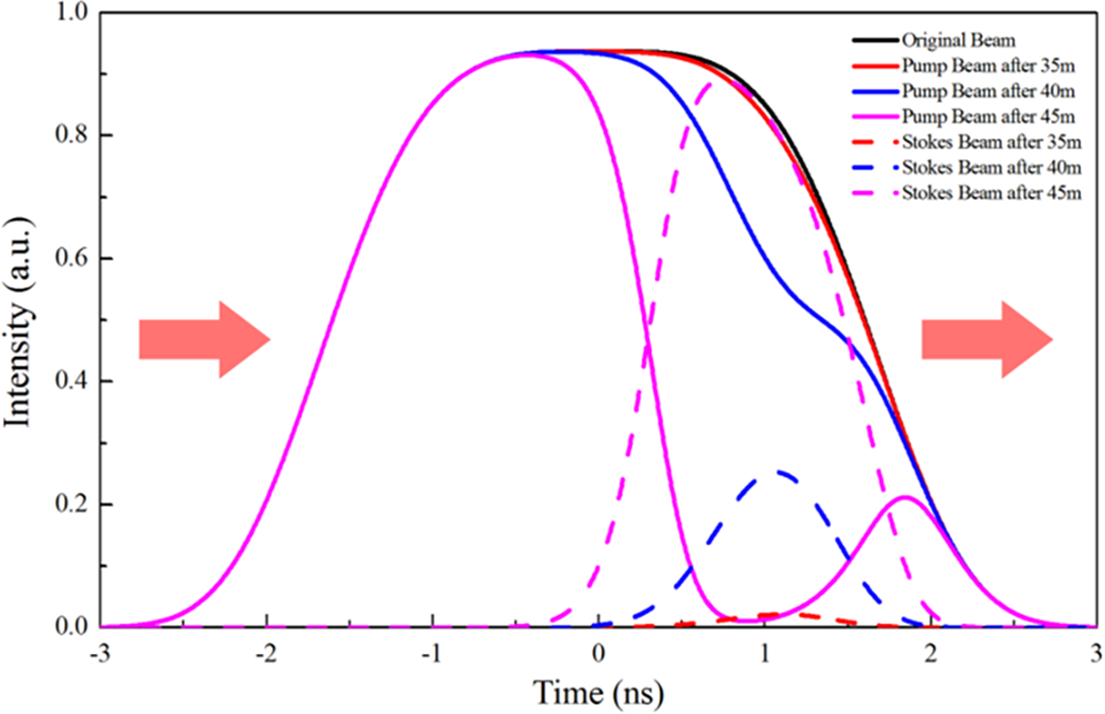
Figure 7 illustrates the evolution of temporal profiles of the pump and the Stokes waves during the SRRS process. The initial beam is a nanosecond-scale laser pulse whose temporal profile is an intensity-normalized eighth-order super-Gaussian flat-top function with a pulse width of 3 ns. The positive and negative axes correspond to the leading and trailing edges of the pulse, respectively. After propagating 35 m, the leading edge of the pump pulse exhibits a slight ‘collapse’, and a weak Stokes component, which is generated by the SRRS process, appears at the same time. As the propagation distance increases, energy coupling between the pump and Stokes waves becomes progressively stronger. Consequently, the collapse of the pump pulse’s leading edge becomes more pronounced, while both the temporal width and peak intensity of the Stokes pulse continue to grow.
Temporal profiles of the pump and Stokes waves at different propagation distances. The black solid line represents the original beam, the colored solid lines are the pump beams after different distances and the colored dashed lines correspond to the Stokes beams after different distances.

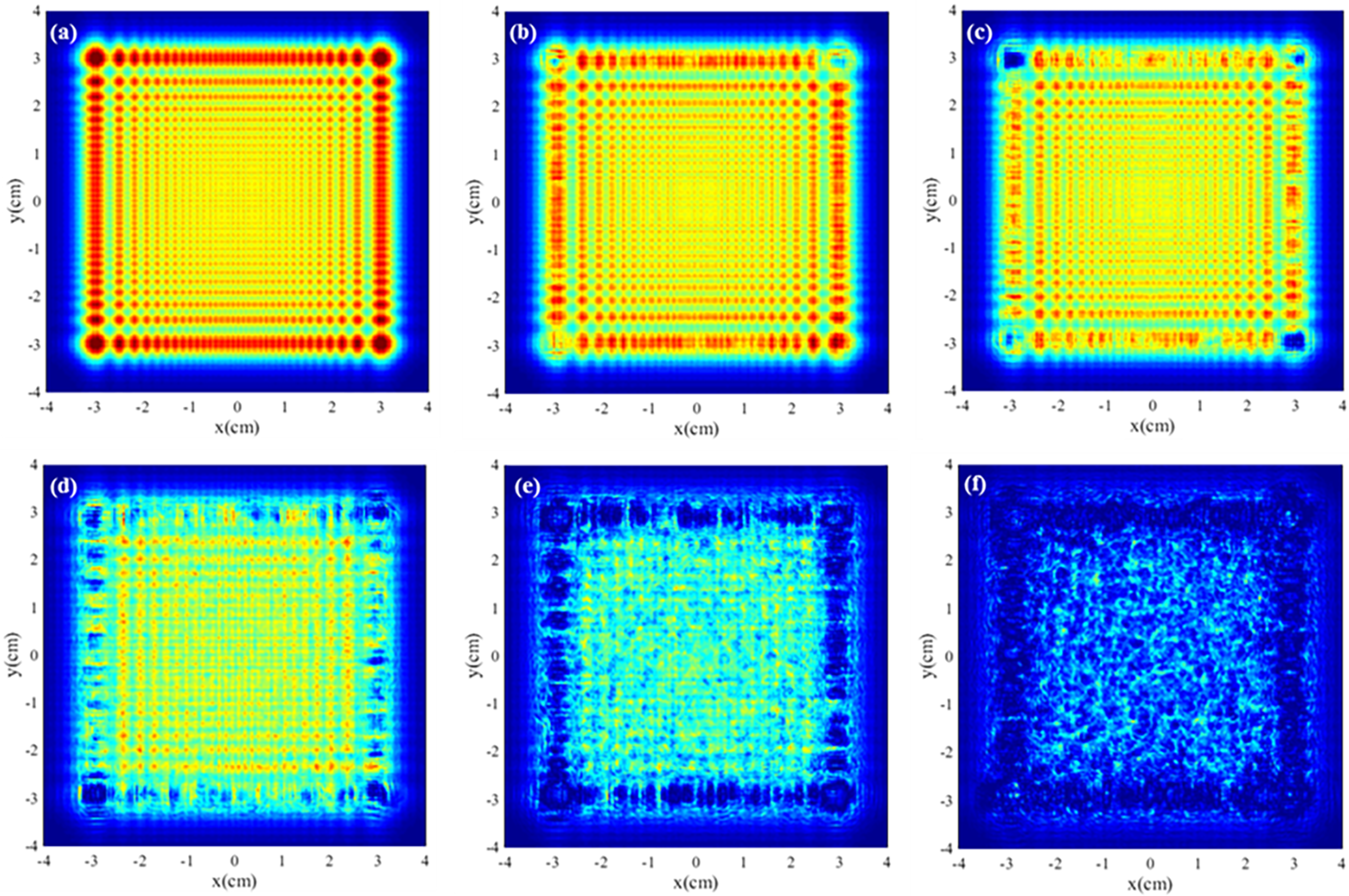
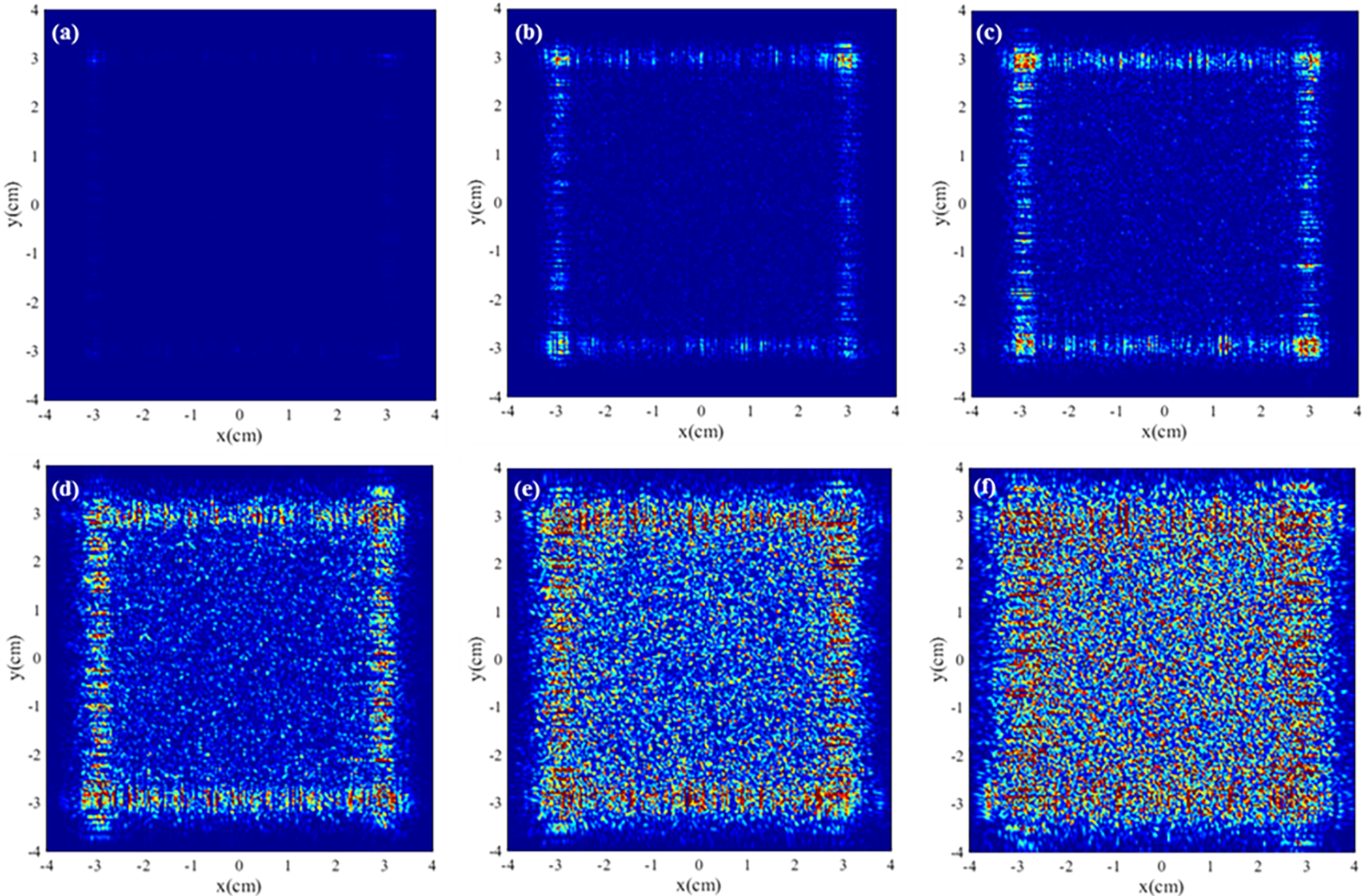
To further highlight the impact of diffraction effects, the beam was increased to a 100 mm × 100 mm, 100th-order super-Gaussian square beam, with an average power density of 3.75 GW/cm2 and a pulse duration of 3 ns. The SRRS effects induced by propagation over different distances in air were simulated, and the resulting pump and Stokes light intensity distributions are shown in Figures 8 and 9, respectively.
Pump beam intensity distributions at different propagation distances: (a) 35 m; (b) 40 m; (c) 42.5 m; (d) 45 m; (e) 47.5 m; (f) 50 m.

Stokes beam intensity distribution at different propagation distances: (a) 35 m; (b) 40 m; (c) 42.5 m; (d) 45 m; (e) 47.5 m; (f) 50 m.

It can be shown from Figures 8 and 9 that, due to the diffraction effect of the beam, the intensity distribution of the pump light exhibits pronounced diffraction fringes. The spatial amplitude modulation period corresponding to these fringes varies at different positions within the beam: the modulation period is smaller near the beam center and larger near the edges. As the propagation distance in air increases, the beam quality of the spot is severely degraded.
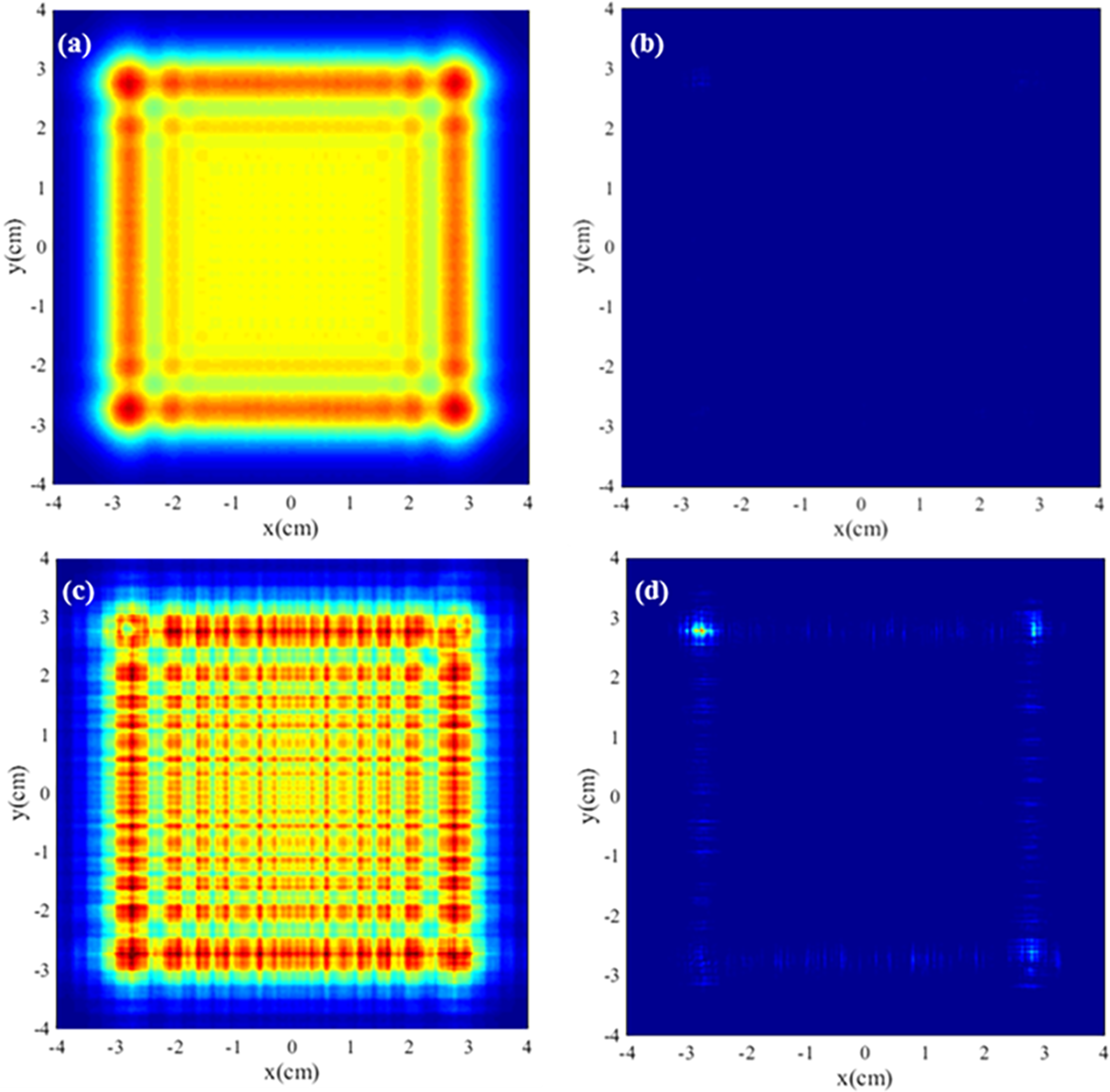
As illustrated in Figure 6, VBGs can not only achieve spatial separation of different spectral components but also enhance the SRRS threshold of the beam to some extent. Since the SRRS effect generates high-frequency components with small spatial periods in the intensity distribution of the beam, variations in the AS of the grating have little influence on increasing the SRRS threshold. Here, we only discuss SRRS suppression using a VBG with an angular half-width of 0.4 mrad. Figure 10 compares the intensity distributions of the pump and Stokes light after an additional 40 m of propagation under suppression conditions using either the VBG or a narrowband filter at 40 m.
(a) Pump beam after VBG filtering and subsequent 40 m propagation. (b) Stokes beam after VBG filtering and subsequent 40 m propagation. (c) Pump beam after the narrowband filter and subsequent 40 m propagation. (d) Stokes beam after the narrowband filter and subsequent 40 m propagation.

As shown in Figure 10, after diffraction by the VBG, the pump and Stokes beams are spatially separated. Due to the AS of the grating, part of the mid- to high-frequency spatial components of the pump beam are effectively filtered out. Moreover, after VBG filtering and a further 40 m of propagation, the near-field beam quality of the pump light is significantly better than that achieved using only a narrowband filter for separation, and the corresponding Stokes intensity is also notably lower than that obtained with the narrowband filter alone.
It is worth pointing out that VBGs inherently combine the functions of both narrowband spectral filtering and spatial filtering. Owing to the SS and AS of the VBG, the Stokes light is efficiently filtered out while the high-spatial-frequency modulation components of the pump beam are simultaneously suppressed. Since the near-field modulation of the beam is reduced and lowered, it is also effective for the far-field modulation performance[ Reference Zhang, Yuan, Feng, Gao, Xiong and Zou25].
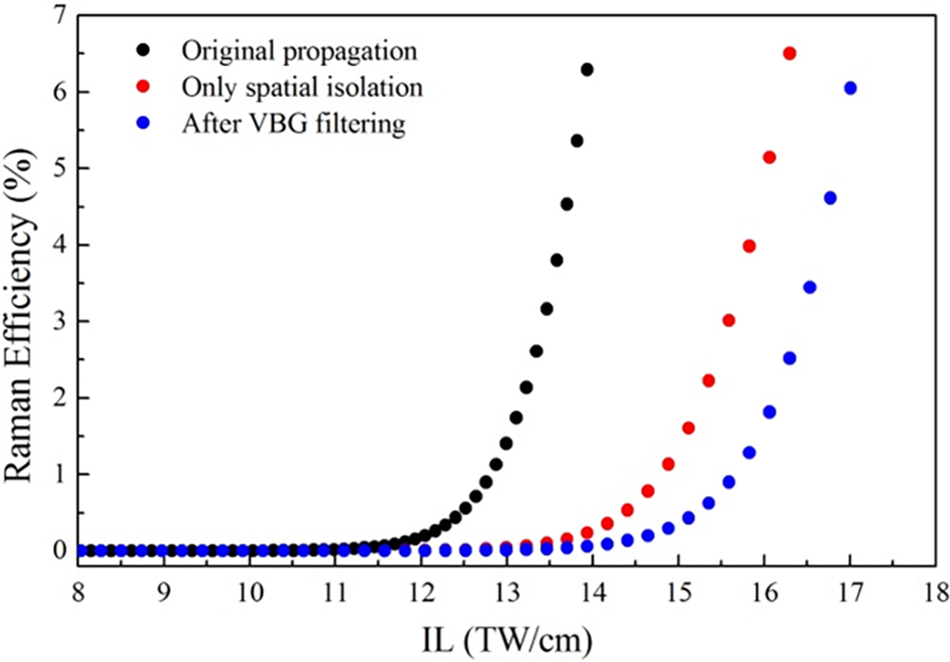
Figure 11 further compares the effects of different SRRS suppression methods on Raman efficiency. It can be seen that using a VBG not only achieves spatial separation of the pump and Stokes beams but also effectively suppresses the SRRS effect to a certain extent. This allows the pump beam to propagate over much longer distances while maintaining beam quality.
Raman efficiency versus intensity–distance product for different SRRS suppression methods.

It should be emphasized that our proposed method exploits the SS and AS of the VBG to suppress SRRS in high-power laser systems and efficiently separate pump and Stokes light beams while enhancing beam quality by filtering the high-spatial-frequency components from the pump beam.
With regard to the conventional inert-gas filling schemes, although they can effectively mitigate SRRS, they are associated with high operational costs and stringent system requirements. If necessary, the proposed VBG-based method can also be implemented in conjunction with inert-gas filling to further enhance SRRS suppression performance.
Regarding the narrowband spectral filters and spatial filtering techniques, the two approaches play fundamentally different roles in SRRS suppression. A narrowband spectral filter directly blocks the frequency-shifted Stokes radiation, whereas a spatial filter mainly suppresses the mid- and high-spatial-frequency components of the pump beam and, by itself, provides limited effectiveness in suppressing SRRS. By contrast, the VBG-based approach proposed in this work inherently combines the functions of both narrowband spectral filtering and spatial filtering, and can efficiently filter out the Stokes light while improving the beam quality of the pump beam simultaneously. The main difference between the VBG and spatial filter lies in their fundamental principles in mitigating SRRS. Spatial filtering suppresses SRRS indirectly by lowering intensity modulation and reducing localized intense spots, whereas the VBG enables direct spectral filtering of the Stokes light and spatial filtering of the pump beam, all within a single, robust optical element. This provides a fundamentally more compact, stable and power-scalable solution for high-power laser systems.
4 Conclusion
In this study, using the SRRS propagation model, the temporal and spatial characteristics of high-power laser pulse generation and growth of SRRS during long-distance propagation in air were calculated and analyzed, clarifying the growth mechanism of SRRS in the course of long-distance propagation of high-power laser pulses. Meanwhile, by combining the SRRS propagation model with the VBG diffraction model, the suppression characteristics of the SRRS effect in long-distance propagation of high-power laser pulses by using a novel near-field filter based on the VBG were investigated in detail. The effects of different suppression methods on extending the pump beam propagation distance and increasing the SRRS threshold were also discussed. The results indicate that the near-field filter based on VBGs, owing to its excellent AS and SS, can effectively separate the pump and Stokes beams in the near-field while simultaneously improving the beam quality of the laser pulse. These findings provide a new technical foundation for SRRS control in high-power laser facilities.


 Open access

