





I
Over the course of the nineteenth century, reporters became fixtures in the galleries of all courts in which they served as overseers of the principles of open justice and mediators of news for the wider public.Footnote 1 Historians rely heavily on courtroom reporting and the resulting newspaper articles as primary sources, but the ‘flow of information’, how complete it might be, or why a particular case might become news rarely forms the basis of historical inquiry.Footnote 2 Investigating what constitutes newsworthiness in any context is challenging but it is even more so in countries like Ireland where large sections of pertinent court and newspaper records are missing. This article adopts a case study approach to examine the extent to which digitized newspapers can act as a surrogate archive for missing Dublin city coroner’s court records; in so doing, it seeks to make broad interventions in the domains of medico-legal, social, and digital history.
Irish coroners’ courts operated like their English and Welsh counterparts, as courts of record, whose purpose it was to establish the identity of the deceased and provide a verdict as to cause of death in sudden and suspicious cases.Footnote 3 Court records were supposed to be transferred after twenty years to the Public Records Office of Ireland located in the Four Courts complex, which was destroyed at the outset of the Civil War in June 1922. While large swathes of Dublin city coronial court records suffered extensive damage then and many were lost in the years since, the register books have a full survival rate and are held at the National Archives of Ireland (NAI).Footnote 4 Essentially, they act as an index to a corresponding set of numbered ‘original inquest papers’ but for 1911, the case study year used here, only seven of the 193 corresponding papers are extant. Unfortunately, no reporters’ notebooks or memoranda between reporters and editors are known to have survived, which leaves little choice but to turn to digitized newspapers to ascertain patterns in reporting. Here, I take up the challenge of reconciling archival absence with court reporting and in some respects, this work capitalizes on Vicky Holmes’s efforts to reconstitute the lost records of the Ipswich coroner from newspapers. With the advantage of an index to guide keyword searches, the aim is to push the boundaries of what we can know about which coroners' cases became news, and how editors used headlines to heighten levels of public attention around certain causes of death over others.Footnote 5
Coronial court inquiries were intense medio-legal environments for the uninitiated, and they could be especially traumatic for the families and wider communities of their subjects, but by the turn of the twentieth century the process itself was professional, fine-tuned, and formulaic.Footnote 6 A coroner presided over the inquiry where a jury of between twelve and twenty-three men listened to the presentation of a doctor’s report determining cause of death, as well as civilian and police witness testimony surrounding the circumstances. After consideration and deliberation, the jury provided an agreed verdict, which was usually a verbatim confirmation of the medical cause of death. If cases involved anything controversial, they were likely to be accompanied by a jury rider, which Mark Coen and Niamh Howlin define simply as ‘statements that accompany verdicts’.Footnote 7 Verdicts could be rendered open by using inconclusive wording like ‘and we have no evidence to show’, which was commonly used to explain the circumstances surrounding suicide and other suspicious deaths where the perpetrator was unidentified. Taken together or apart, verdicts and riders constituted ready-made headlines that met the content demands of the highly competitive newspaper market in early twentieth-century Ireland.Footnote 8 Morning and evening editions brought news from the coroners’ courts into the public sphere, and, although they had no legal standing, riders often had a bearing on public sentiment towards cases brought to criminal trial.Footnote 9
Newspaper reporters attended, annotated, and were a silent presence who acted as intermediaries scurrying between the coroners’ courts and their editors; in Dublin, it was a short distance from the morgue on Amiens Street to Middle Abbey Street, where some of the main Irish newspapers were located.Footnote 10 As details of morning inquests could make their way into the evening editions, we know they operated within tight timeframes but their content was ready made and conducted in such haste that they were often error ridden. Editorial decision-making processes involved the calculus of risk and libel, which, as this research shows, can be mapped along social class and gendered lines. Censorship and libel laws kept Irish newspaper proprietors and editors in check, and technically they could be prosecuted if they published prejudicial matter from the coroner’s court, but it rarely occurred.Footnote 11 Newspapers, then as now, were highly politicized and the British authorities reserved powers of prosecution to contain Irish nationalist rhetoric; as such, reporting from the coroners and the adversarial courts was relatively safe.Footnote 12 Cases concerning matters of greater public interest naturally found traction in the broadsheets of the following day and could form the basis of a front page headline leading to continued coverage in the middle pages.
With high mortality rates in all age cohorts and dire levels of poverty, sudden and potentially suspicious deaths were a daily occurrence, and the Dublin city coroner’s court sat several times a week. As most deaths were so mundane and ordinary, coroners' cases only became newsworthy if they were particularly gruesome or on slow news days. In stark contrast with modern journalistic standards, but similar to Gemma Richardson’s findings in historical Canadian newspapers, this research found extended and often graphic coverage of suicide and murder-suicide reporting.Footnote 13 Pamela Shoemaker and Timothy Vos argue that ‘gatekeeping’ forms the bedrock of journalistic practice to assist with the distillation of facts into news. Therefore, it is crucial for historians to consider editorial decision-making processes and the fact that newspapers are a highly curated information stream with limitations to their capacity to serve as surrogate archives.Footnote 14 Three fully digitized newspapers were used in this study, The Irish Times (1859–), The Freeman’s Journal (1764–1924), and The Evening Herald (1891–). The latter two were nationalist in political persuasion, and The Irish Times positioned itself as the voice of ‘southern Unionism’, and all three published daily weekday editions.Footnote 15
Further to the rote nature of news compilation, historians need to be cognizant of problems inherent to past digitization methods: whether newspapers were scanned afresh from originals or if old microfilm was used to generate PDFs will have an impact on image quality (see Figure 1). Other important considerations are what version of Optical Character Recognition (OCR) software was available at the time of scanning, if there were difficulties with font recognition, and what, if anything, was indexed to improve querying. In addition, the physical placement of relevant articles can be amplified in the digitized sources, for example, the use of capital letters in headlines or shading at the edges of the page that can emphasize or obscure text and dictate whether it will be recognized. Writing in 2013, Bob Nicholson warned about the absence of researchers in key decision-making processes in the digitization industry, which in turn has given rise to a problematic hardwiring of problems from a user perspective.Footnote 16
Front page of The Evening Herald, 7 July 1911.

Figure 1 Long description
The front page of The Evening Herald dated 7 July 1911 displays four framed portraits. The top two portraits are labeled 'His Majesty King George V' and 'Her Majesty Queen Mary,' with the latter's face obscured. Below, two more portraits are labeled 'His Excellency the Lord Lieutenant' and 'Her Excellency the Countess of Aberdeen,' with the former's face obscured. Above the portraits, the text 'Cead Mile Failte' is visible. To the left, an illustration shows a woman in a dress pointing towards a distant landscape. At the bottom, a caption reads 'First State Visit to Ireland of His Majesty King George V—July 8, 1911.'.
Mass digitization has increased access and facilitated enormous research activity on past newspapers over recent decades but, with few exceptions, historians have been passive recipients of the digital turn. This passivity has come at several costs, primarily, that advances in conceptual and methodological frameworks of analysis have not kept pace with technology, and there has been a collective neglect to problematize how paywalled digital platforms have reshaped praxis for historians. Given conservation and preservation mandates and poor paper quality, it is taken for granted that in the global north, most newspapers have been taken out of the handling environment through digitization. Yet, we can only infer this because citation methods do not provide precise archival-grade references to access the physical newspaper in its original form, or to distinguish between what Tessa Hauswedell et al. term ‘retro-digitized surrogates’ or ‘analogue’ original sources.Footnote 17
Access to such platforms is another major issue: despite being a legal deposit library in receipt of daily copies, the National Library of Ireland (NLI) has been a passenger in the digital turn, and it is now a subscriber to British Library efforts and other commercial platforms rather than a content producer. Unlike Australia and New Zealand, where respective national libraries took a lead role in digitization, Irish historical newspaper platforms are completely privatized and paywalled.Footnote 18 From the late 1980s, the NLI conducted the Newsplan Project in co-operation with the British Library and library representatives in Northern Ireland, to take stock of physical newspaper holdings, what was microfilmed to date and collection gaps. This co-ordinated approach ensured a reduction in work programme duplication, and several titles were identified for microfilming as part of space saving and conservation exercises that took ‘at risk’ materials out of the handling environment.Footnote 19 With the sheer volume of holdings at the British Library’s newspaper archive at Colindale London – some ‘52,000 separate newspaper, journal, and periodical titles’ – well-intentioned pilot digitization projects quickly gave way to expediency, representative samples, and a succession of private enterprise (currently Findmypast) partnerships that have rendered mixed results.Footnote 20 Ruth Ahnert et al. describe their difficulties in working with industry partners and digital copyright, a situation that may deteriorate at the whim of commercial practices and pricing.Footnote 21
Against this backdrop, a few commercial entities, for example, the Irish Newspaper Archive (INA), secured early market share.Footnote 22 Until relatively recently, Ireland was low in British Library priorities, so the INA, used here to access The Evening Herald and The Freeman’s Journal, has been an inestimable boon to researchers but it is paywalled and until October 2025 the platform itself relied on old technology. Genealogical companies like Ancestry.com have also engaged in ‘aggressive digitization’ to plug the enormous gaps in the Irish historical record and its ‘library edition’ is available in some universities.Footnote 23 The second platform used here, The Irish Times by ProQuest, is by far more responsive to keyword searches, as the rest of this case study will show.
As well as reiterating the widely accepted cautions about application programming interfaces (API) and search engine limitations, which Ian Milligan has cogently described, this article calls for further discussion on how access to, and use of, digital newspapers can alter methodologies and historical research findings.Footnote 24 Here, I describe the ways in which I modified my methods to work with two different digital platforms, and why apart from the register, the spatial and temporal parameters provided by the case study approach proved to be necessary guardrails.
To foreground discussion of the digital platform capabilities in a case study context, section II provides an outline of the medico-legal positioning of the coroner’s court in Dublin, as well as the ownership, legal standing, and political persuasion of the newspapers. This heeds the advice of Katherine Bode, who used digitized Australian newspaper collections in her study of literary serials at the turn of the twentieth century, and argued that ‘understanding the collection’s relationship to the historical context it appears to represent is essential’.Footnote 25 Section III provides further details about the manuscript sources, the parameters of the case study, and a flavour of how technologies used to underpin digital newspaper platforms can have consequences for superficial research findings. It exemplifies why close reading techniques must be employed if digital newspapers are used in surrogate record capacities. Section IV discusses deaths by suicide because they emerged as a dominant topic in contemporary newspapers. The concluding section V provides a summary of findings.
II
The Dublin city coroner’s court provides a very useful case study in the context of digitized newspapers as it inadvertently solved two issues for newspapers: it could be relied upon for regular interesting content and its professional gravitas essentially provided an indemnity against potential legal problems. Professional requirements of legal or medical qualifications for coroners were first laid out in 1876 for Dublin city, where the coronerships were traditionally held by medical men. The coroner’s court maintained a register comprising a high level record (of number, name, address, cause of death, date and location of inquest, and verdict) for all cases. This article focuses on those records created under the coronership of Dr Louis A. Byrne from 1900, when he began his work, and 1927, when the Irish Free State introduced an amended Coroners Act. That act consolidated the previous acts of 1876, which concerned the County of the City of Dublin only, and that of 1881, which encompassed every other county with respect to legal or medical qualifications for coroners.Footnote 26 Among the changes enacted post-partition in 1922 were that all twenty-six counties were brought under the same legislation and, to offset the difficulties associated with empanelling a jury of twelve to twenty-three men, numbers were reduced to between six and twelve. To address the problems that the overlap between coronial and criminal courts had caused over previous decades, the act stipulated that cases involving allegations of manslaughter, infanticide, or murder should be adjourned until after the criminal proceedings had concluded.Footnote 27 With respect to homicide, until 1927, medical evidence was usually first presented in the coroner’s court; it informed the verdict that regularly identified the perpetrator and how the victim died. In turn, these details were reported in newspapers, even if it stood to influence future legal action taken by the state.
Doctors were registered and legal professionals were identifiable in professional membership directories, but we know little about court reporters as bylines (the signing of articles) were not the journalistic convention of the time. Most Irish newspapers did not keep their personnel records, such was the cost of conserving the vast nature of the daily published outputs. What we can tell about them is that the reporters were considered professionals who straddled the upper echelons of the working and lower-middle classes. According to the 1911 census aggregate report, ninety men and nineteen women were returned in Leinster as ‘author, editor, journalist’ under the general taxonomy of ‘Class I (Professional) 5. Literary and Scientific Persons’.Footnote 28 It is unfortunate that these occupations are grouped but the ‘reporter, shorthand writer’ category was dominated by seventy-four women as compared to seven men aged between fifteen and forty-four years.Footnote 29 This does not mean that they were all employed by newspapers, historically a male-dominated industry, but it gives a rough indication of gendered lines. A search on the transcribed household 1911 census returns for Dublin shows that twenty-three women were returned as journalists, further investigation shows that two entries were incorrect, and three were journalist and another occupation (private secretary manager, needlework, and actress).Footnote 30 Men occupied the industry’s management positions and, until such a time that articles were signed, editors were responsible for the veracity of content.
Prompted in part by advances in technology, in the early twentieth century the newspaper industry underwent enormous change. It facilitated the emergence of what is now recognized as tabloid journalism, which at that time had less to do with physical size and more to do with its popular content, and short and sharp pieces with varying degrees of integrity. British tabloids and the American predecessor ‘penny press’, was as Henrik Örnebring and Anna Maria Jönsson argue, ‘an alternative public sphere’ that spoke to a different constituency to the elite consumer profile of old fashioned broadsheets like The Irish Times containing long-form articles and more political content.Footnote 31 Their emergence in Britain owes much to the efforts of the Dublin-born Alfred Harmsworth (1865–1922), later Lord Northcliffe, whose media empire included The Daily Mail (1896) and The Daily Mirror (1903). So-called ‘new journalism’ was what Philip March defines as a ‘commercially astute and technologically advanced press’ that used ‘sensationalism and the personal’ to its advantage.Footnote 32 With keen pricing, mixed content ranging from popular culture, gossip, sports, advertising, and personal announcements, tabloids appealed to a younger demographic with less disposable income.Footnote 33 Readerships dictated the gatekeeping standards, processes, and conventions, and the marked differences between old and new journalism generally correlated with social class.
In Ireland, newspapers were inherently political. When it was revealed that the Irish Parliamentary Party (IPP) leader Charles Stewart Parnell (1846–91) was named in Captain William O’Shea’s petition for divorce from his wife Katherine ‘Kitty’ in 1889, the scandal caused a party spilt that was never reconciled.Footnote 34 Both The Irish Daily Independent and The Evening Herald were established in 1891 to counteract the anti-Parnellite rhetoric particularly in The Freeman’s Journal.Footnote 35 First published shortly after Parnell’s death on 19 December 1891, The Evening Herald declared its politics on the front page: ‘The Herald has come to fight. The former newspaper organs of Nationalism having turned and acquiesced in the betrayal of Ireland, there is room and also necessity for us.' In taking a firm Parnellite stance, the first edition took aim at prominent IPP members and promised content of the highest local and international news.Footnote 36 Factional politics continued to dominate content, which caused the newspapers’ insolvency in 1900, and they were bought by businessman, tram and rail tycoon, William Martin Murphy (1845–1919). Following the business model pioneered by Lord Northcliffe and significant investment in faster printing presses, Murphy conducted a complete overhaul of his Independent Newspaper (established 1904) group, and took the bold move of reducing the price of The Irish Independent to a halfpenny in 1905.Footnote 37 The risk reaped substantial rewards and according to estimates cited by Patrick Maume, the once failing Irish Independent had a circulation of 30,000 in 1910 that grew to 100,000 during the First World War.Footnote 38 Similarly, Padraig Yeates found that The Evening Herald’s readership of 19,500 in 1913 sustained its viability.Footnote 39 In 1910, The Irish Times had a circulation of 33,000, and despite its reduced historically Protestant readership in the twenty-six counties, sales in Independent Ireland remained steady at 34,500 in 1922 and 36,500 in 1926, as Mark O’Brien notes.Footnote 40 With a limited consumer population, The Freeman’s Journal fell victim to the success of Murphy’s Independent Newspapers and the company folded in 1924.
Readership constituencies determined how newspaper editors arbitrated content, and while all three newspapers relied heavily on sales in the Dublin metropolitan area, The Freeman’s Journal had a strong regional presence. Paid advertising content was honed to appeal to the respective bases, and it received priority with respect to newspaper layout, which at an operational level left very little room for manoeuvre in a time-limited context, and for evening editions even shorter timeframes applied. Although the courts formed a consistent source of content, it was secondary to other major local and global events. For example, as Figure 1 shows, The Evening Herald reserved the front page for a pictorial Céad Míle Fáilte (one hundred, thousand welcomes) for King George V, his wife Queen Mary, and their royal entourage on their first official visit to Dublin. That use of space had a domino effect; page 2 carried a mixture of stock market, some British court content, and adverts; page 3 was filled with sports’ reporting; page 4 was primarily adverts; page 5 contained domestic and foreign news including the American heatwave that had claimed over 100 lives in one day; ‘The Domain of Women’ a regular feature ‘by Patricia’ occupied two columns on page 7 alongside sporting fixtures and adverts. Classified adverts, including low-paid domestic roles, filled most of the two last pages of the eight-page edition. And the largely blank ‘Latest News’ section normally reserved for page 1 was reassigned to the back page. There was no space that day to relay the tragic circumstances of John Phelan’s workplace accident, which under normal circumstances would have been of great interest in the era of growing momentum for workers’ rights and fair compensation. Page 3 prioritized twelve lines of breaking news to convey the ‘MOTOR CAR FATALITY IN THE CITY – A Boy’s Death’. The article reported the fatal road collision that occurred at 4pm, immediately prior to print, where an unknown boy ‘about ten’ received ‘shocking injuries about the head’. Reflecting the secondary content status of the coroner’s court, it was not placed in the ‘Latest News’ column, but the arresting headline and the use of all capitals amid the cluttered page would have drawn the eye of concerned citizens who could not help but notice the changing contours of road use in the city. The increased volume of cars was part of an ongoing and lively debate. In March 1911, Dublin Corporation made an application to the Local Government Board to have the speed limit for motorcars set at 10 miles per hour in the city, and reaction to it prompted an inquiry which rumbled through the newspapers from April until July.Footnote 41 Personal pedestrian responsibility was pitted against the deep-pockets of various automobile associations and it was eventually resolved by the Local Government Board that the charge of reckless driving could be levied under existing legislation irrespective of the speed, which remained ambiguous for cars.Footnote 42
Moral leanings and perceptions of respectability naturally captured editorial attention and tales of caution and violence were particularly popular. In many respects, court reports worthy of publication were self-selecting, but other social factors were at play. So it followed that on slow news days the space allocated to court reporting expanded, on busy days it contracted and other criteria were taken into consideration. For example, one major case might receive more attention in favour of truncated accounts of less exciting ‘copy’; these conventions varied in accordance with the competing news of the day. Syndicated coronial court content from other countries was used in preference to mundane local stories of last resort, for example the death of ‘anarchists’ in a fire in London was front page news over several days in January 1911.Footnote 43 When deaths involved foul play of any description, they became a source of great public interest that in turn served further functions of determining public support for the punishment of responsible parties.
III
Editorial decision-making in 1911 dictates the extent to which we can use digitized newspapers as surrogate records, and accessing such sources on digital platforms will introduce further constraints necessitating methodological shifts. This section provides an overview of the manuscript sources and the selection criteria adopted in this case study before describing some of the digital platform challenges.
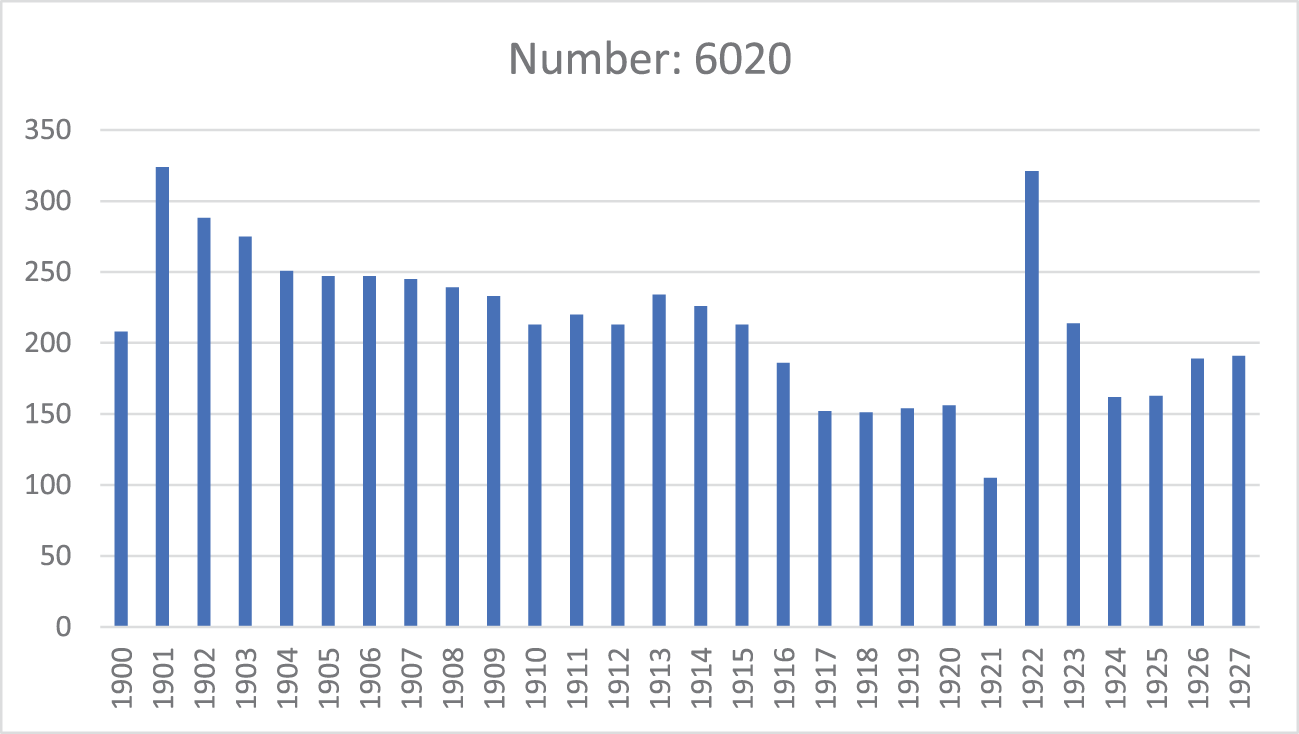
The coroner’s registers held at the NAI were used to identify a sample year; they comprise an index of all cases coming before the court from 1900 to 1927.Footnote 44 As the dispersion in Figure 2 shows, it was a very busy court and the records provide an important lens to broader social and political contexts. The dip in 1921 corresponds to the imposition of martial law by British crown forces where ‘military inquiries in lieu of inquests’ replaced civil proceedings in Dublin from 25 November 1920 until 8 August 1921, and the increase in 1922 reflects bloodshed in the city during the Civil War.Footnote 45
Total number of registered inquests, 1900–27.

Figure 2 Long description
The bar graph displays annual data from 1900 to 1927, with the total number indicated as 6020. The x-axis represents the years from 1900 to 1927, while the y-axis shows the values ranging from 0 to 350. The graph highlights a peak in 1901, reaching above 300 and another significant peak in 1922. There is a noticeable dip in 1921, where the value drops below 100. The values generally range between 150 and 250 for most years, with fluctuations visible throughout the period.
In 1911, a census year, 220 cases were entered into the coroner’s register; for reasons unexplained, they were renumbered and reduced to 193, 128 were male, 60 female, and 5 were infants whose gender was unspecified (in every other year the numbering is precise).Footnote 46 The morgue registers, also held at the NAI, were used to provide further personal information such as age.Footnote 47 This case study adopted an empirical approach by entering each coroner’s register entry for 1911 into a Microsoft Excel database and manually dividing the 193 verdicts into cases that would have been considered mundane (sudden but with a clear medical reason of natural cause) and possibly suspicious (unexpected and unnatural). Using these criteria, ninety-nine were categorized as mundane cases; they included most of the sixty-five deaths of children aged thirteen and under.
Such was the poor state of health in the city that the public was inured to the high infant mortality rate, but twenty-two of the forty-four cases of infants (aged under twelve months) may have piqued public interest as they were of ‘unknown’ children.Footnote 48 This means that their mothers had not been identified at the time of the inquest, which points to potential criminality associated with concealment of pregnancy and child murder. Infant bodies were often deliberately placed in public places to be discoverable, so the ‘poor rate’ would afford a decent burial. For example, a decomposed male infant body found in the garden of a house at 22 Harcourt Street on 31 August had a note attached: ‘A poor widow unable to bury her darling pet who died from convulsions 12 yesterday. Oblige to ask burial for charity sake and God bless you.’ The verdict was that it ‘died from insufficient or improper food causing diarrhoea to which the child succumbed’, but the infant’s sixteen-year-old mother, Mary Alice Brett, and its thirty-eight-year-old grandmother, Mary Margaret Brett, were later identified and brought first before the police courts and then the Dublin City Sessions in October 1911 on a manslaughter charge. From census and civil registration searches, it seems that neither were widows, Alice was discharged and her mother was ‘put back’ to serve three months at Mountjoy Prison according to the prison register.Footnote 49
The verdict in twelve of the unknown cases was ‘want of proper attention at birth’, six were ‘stillborn’, there was one case of ‘premature birth’, and another of ‘pneumonia accelerated by insufficient or improper food’ and ‘diarrhoea’ (Brett case), none of which would have been regarded as unusual at the time. Only one case was deeply suspicious, where the verdict in the case of a male infant found in the Phoenix Park on 2 November also identified a murder weapon as follows: ‘died from heart failure complicated by pneumonia and the handkerchief it had around its neck accelerated its death’. But it seems that nobody was immediately apprehended for the apparent crime.Footnote 50 Newspaper editors, in Ireland and elsewhere in the anglophone world, were more apt to place these infant deaths in the mundane category unless they progressed to the criminal courts.Footnote 51
For such reasons, only one infant death is included in the ninety-four suspicious cases investigated here, that of Kathleen McIntyre who was ‘murdered by mother’ in April 1911. ‘While temporarily insane’, Catherine McIntyre slit her daughter’s throat with a razor using such force that the head was almost severed from the body.Footnote 52 Despite the widespread use and abuse of the colloquially named ‘Dangerous Lunatic Act’ of 1838, which permitted two non-medically qualified witnesses to commit individuals to asylums on account of unusual behaviour, some of the reported coroners' cases concerned serious mental health problems being managed within households.Footnote 53 Unique to Ireland, historians of psychiatry have shown how the act was abused and caused a shift in admission patterns, but it may also have had the adverse effect of suppressing the management of serious mental health problems into domestic settings. Unmanageable cases often came before the coroner’s court as either suicide or homicide, and sometimes both, as the next section will show. The inquest papers are extant for McIntyre’s case and it contains the Dublin Metropolitan Police report, which described how her daughters were doing their best to manage a terrible situation while their father (categorized as a traveller and manager in the census) attended to business in County Offaly. Pollie (reported in newspapers as Dolly) ‘aged about 10’ testified that she had hidden the razor from her mother earlier that morning. When thirteen-year-old May heard her sister Gracie call out that there was blood everywhere, she ran upstairs, disarmed her mother, and ran with the weapon and the body of her almost lifeless sibling next door to Mrs Anne Nolan. Clearly Catherine McIntyre, who according to the census was a thirty-five-year-old mother of seven children aged from thirteen down to two months, had been suffering from a serious mental health breakdown since Kathleen’s premature birth.Footnote 54 She told May ‘This baby has drove me mad’ and her young daughters knew to keep watch. Mrs Nolan did her best but the infant expired within a short timeframe.Footnote 55
Despite the very clear criminal elements, The Evening Herald published a graphic account of the coronial inquiry on the front page. It provided more information about Mrs McIntyre’s fragile mental health than the inquest papers, and how she told her husband that she ‘could not go on’ and had threatened to ‘run out to the canal’ the day before. In efforts to manage the problem, Mary Francis (May) had been ‘kept from school’ to look after her mother and her aunt called around every day. We are informed that May sobbed her way through her testimony.Footnote 56 The Freeman’s Journal concluded its front page account of ‘THE PAINFUL CITY TRAGEDY’ with a direct quote from the coroner ‘I may add that I have known Mr McIntyre for a number of years. I know him to be a very respectable man, and I feel very deeply for him in his trouble.’Footnote 57 The verdict was ‘murdered by mother who cut her throat with a razor while temporarily insane’; the registered cause of death provided an abridged version.Footnote 58 None of the three newspapers (reported under McIntyre/M’Intyre/McIntire making it harder to track) mentioned murder in their reports.
The criteria of mundane and suspicious in child and adult cases is affirmed by newspaper coverage across all three newspapers, and a cursory digital search affords the opportunity to detect trends in the space between shorthand and headline. In this study, only three infant deaths were found in The Irish Times, all of which were named, and four each in the other two newspapers, of which two were of unknown children in both instances. Cases that progressed to newspaper articles were topical: sixteen cases involved modes of transport (cars, trains, trams, bicycles, and horses). There is some overlap in cause and place, for example, of the ten cases that involved fire and burns, all but one occurred in domestic spaces. The outlier was a highly unusual case of a tram passenger, Elizabeth Johnson, whose clothes accidentally caught fire in transit.Footnote 59 The court was careful not to cast aspersions of negligence on the tram company, which always had legal representation at inquests to manage its reputation and compensation claims. The verdict was that she died of ‘shock following accidental burns in tram car 98’.Footnote 60 As it was highly unusual, Johnson’s case received extended newspaper attention, and it was readily returned in a keyword search of The Irish Times and The Freeman’s Journal.
Like many other researchers, I have developed manual skills to work around the problems associated with keyword searches, algorithmic bias, and poor OCR function on the INA platform, which has a less powerful search engine capacity and less functionality than The Irish Times fuelled by ProQuest.Footnote 61 The latter claims to have almost 100 per cent accuracy with respect to articles, which it defines as forty lines or more.Footnote 62 INA responds better to targeted ‘attribute’ search criteria, particularly if it is limited by timeframe and by newspaper title. I used a combination of searches for each suspicious case. In the gestation of this article, the INA platform was overhauled and significantly improved. In early 2025, a simple search of the INA using ‘coroner Dublin’ for the timeframe 1 January 1900 to 31 December 1927 yielded 25,428 results when all of the newspapers in that dataset were queried; it yielded 1,250 results from The Evening Herald when filtered by title. The revised search engine yielded 52,497 in December 2025, the inflation was in response to ‘Dublin’; similarly The Evening Herald hits increased to 3,450. A search of the same keywords from 1900 to 1927 in The Irish Times yielded a total of 4,276 returns, in the sample year; 161 entries were returned, 90 were in the daily, and 71 were in weekly editions, and a further 8 were editorials (the more sophisticated platform allows for results to be downloaded to Excel). Following manual sorting, it was found that only 50 pertained to the Dublin city coroner’s court, 23 of which were duplications of content, leaving 27 cases. To adjust for the distortion of ‘Dublin’ on INA, when a simple search of ‘Coroner’ was used in The Evening Herald in the date range of 1911, 87 articles were returned, once they were manually sorted by place; 24 articles about cases named in the register remained. ‘Coroner’ returned 240 results and 310 article/hits in The Freeman’s Journal and 80 were relevant. Problems with keyword searches on INA seem to be rooted in poor OCR: commercial, common, colonel, coronation, and corona were confused with coroner.Footnote 63 Condy’s Fluid, a mouth rinse, used the words ‘Coroner’s Inquests’ to legitimize its claims to efficacy, but the detection of this common advertisement was irregular. For example, the page 2 entry on Friday, 1 December 1911, was not returned, which may have to do with its positioning and the shading at the edges of pages; it should be added that The Evening Herald is visually more crowded than the other two newspapers.Footnote 64 Sometimes, Dr Byrne was mentioned by name, in other instances presumed knowledge was at play – as a public figure, he was often referred to as the Dublin coroner. By contrast, county coroners with less name recognition were named in full, like South Dublin Coroner William A. Rafferty and North Dublin Coroner Christopher Friery, both of whom were legally qualified.Footnote 65 When Dr Byrne attended a funeral of the great and good of Dublin city, he was often listed, along with his title, as among the mourners.Footnote 66 He was regularly called to give evidence in criminal cases; for example, in the alleged case of the poisoning of Francis McArdle on 28 January published as M’Ardle in The Freeman’s Journal in the February reporting and in his capacity as surgeon at Jervis Street Hospital in a civil suit for injury and damages following a fire in June 1911.Footnote 67 This typesetting convention of M’ for Mc was also used in The Irish Times, which reported John McLean as M’lean, following the template for names like O’Brien.Footnote 68 To reconcile the limits to search functionalities, further individual searches were conducted for all suspicious cases using the full name of the deceased. It improved detection and found that The Irish Times carried 41 articles, The Evening Herald 31, and The Freeman’s Journal 57 for all 193 cases. These results show a clear bias towards suspicious cases (Table 1).
Results of various searches

Table 1 Long description
The table compares search results from three newspapers: The Irish Times, The Evening Herald, and The Freeman’s Journal, based on different criteria. For 'Coroner Dublin', The Freeman’s Journal had significantly more results, totaling 80, while The Irish Times and The Evening Herald had 27 and 24 respectively. In the 'Name search all 193' category, The Irish Times and The Freeman’s Journal both had 57 results, whereas The Evening Herald had 31. For 'Suspicious cases/name', The Freeman’s Journal again led with 46 results, followed by The Irish Times with 41 and The Evening Herald with 31. The Freeman’s Journal consistently shows higher search results across all criteria, indicating a broader coverage or more comprehensive archives.
Source: 1911 editions of The Irish Times, The Evening Herald and The Freeman’s Journal.
Scholars of the history of journalism and computer science have warned about the problems associated with segmentation (a step in the workflow process of text recognition), which requires straight lines and the rectification of orientation, and the limitations of OCR software should be well noted too. Elina Late and Sanna Kumpulainen cite studies with wide disparities in OCR accuracy at word level of between 50 and 70 per cent, but improved figures of between 71 and 98 per cent for ‘character level’.Footnote 69 Equally, Richard A. Hawkins warns that with German-language newspapers ‘Gothic typescript probably only has a success rate of 50% or less.'Footnote 70 Shading in images, depth of field in image capture, varying typography, and obsolete fonts are among the factors that wreak havoc for word and character recognition, even before we consider search engine capacity. Following the case study selection, keyword searches were used on the respective platforms to produce a body of PDFs (the only output option), which were individually downloaded, and uploaded to Adobe ABBYY to see if it could produce a machine readable document; the same articles were converted to PNGs to facilitate upload to Transkribus to test its ability in the same regard. In brief, the results were terrible for the former, and while ABBYY could read most of the text the outputs were unintelligible. Maëlle Le Roux’s comprehensive work on representations of nationalism in The Capuchin Annual periodical, which used similar historical fonts, yielded the same results.Footnote 71 She found that the effort involved in manually correcting the outputs from machine reading tools exceeded the time involved in full manual transcription from the outset.
To fortify efforts of article detection, close reading methods were employed using the browse function and page by page analysis on the day of the case for The Evening Herald and the following day for the other dailies. This caused the problems of factual errors and spelling variation between the register and the newspapers to emerge: Richard Lacey to Lacy (see Table 2), Ellen Smith (in the register), who died following a fatal fall at the Pim’s factory, was reported as Smyth in The Freeman’s Journal meaning that she was not returned under a name search.Footnote 72 Anne Rock was reported as Jane Rock in The Weekly Irish Times, and on the same page, William Connor was reported as W. Connor.Footnote 73 Hubert Murphy as per his coroner’s register entry, was corrected in reporting to Herbert.Footnote 74 To adjust for these idiosyncrasies, I used variations in the nominal searches by dropping or initializing first names.
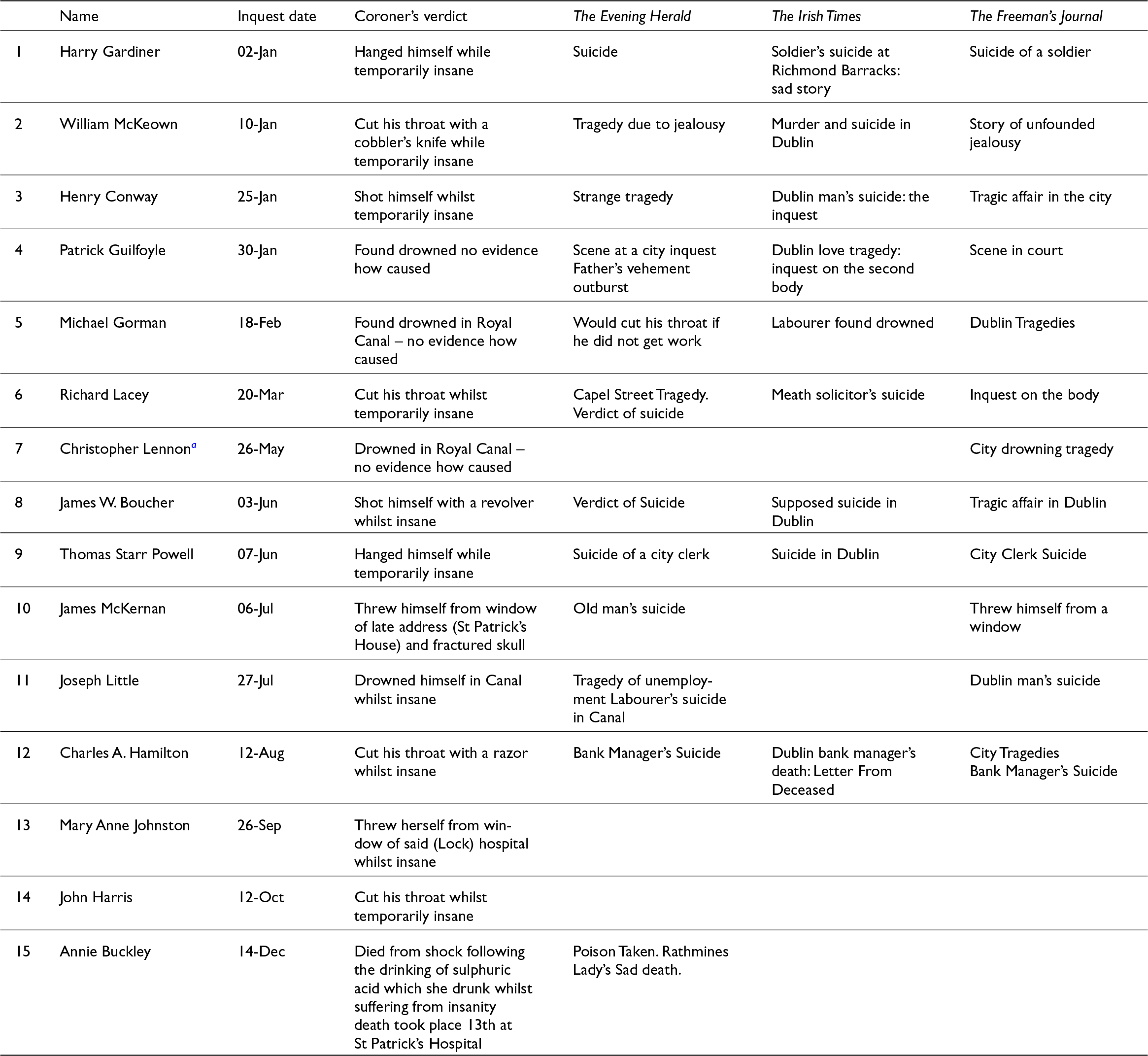
Suicide and suspected suicide cases reported in 1911

Table 2 Long description
This table documents suicide and suspected suicide cases reported in Dublin, Ireland, during 1911. It lists the name of the deceased, the inquest date, the coroner's verdict, and mentions of the case in three newspapers: The Evening Herald, The Irish Times, and The Freeman's Journal. A common coroner's verdict was 'temporarily insane'. Several cases involved drowning or cutting the throat. Newspaper coverage varied, with some cases receiving attention in all three papers, while others were only mentioned in one or two.
a When asked if he was going home after a night out at the theatre with his sister Mary, Connie Farrell and John Fox. After the ladies left, Fox asked if he was going home; he said ‘he was not, and that he would go there no more’, Freeman’s Journal, 26 May 1911.
Sources: NAI/2004/75, vol. 2, and The Evening Herald on date of inquest, and following day for the daily The Irish Times and The Freeman’s Journal.
IV
When we take search returns at face value, we run the risk of only detecting extremely violent deaths, graphic details of which were routinely featured without censure. For example, a search of the three newspapers in 1911 using suicide as a keyword returned 128 articles in The Freeman’s Journal and 74 in The Evening Herald. These returns included syndicated content from British newspapers and a Reuter’s article about St Petersburg where it reported that twenty-seven cases of suicide or attempted suicide occurred over the Christmas holidays. There was a follow-up report from St Petersburg in April describing another spate of twenty-four cases of suicide or attempted suicide, fifteen from poisoning, as ‘a craze’ among young adults aged under twenty-five from the ‘artisan and working classes’, and a further eleven cases in July were reported as a ‘suicide epidemic’.Footnote 75 In this case study, the coroner’s court identified fifteen definite suicide cases concerning thirteen men and two women, twelve of which were deemed to have happened ‘whilst of unsound mind’. A further six had the hallmarks of suicide by drowning, which returned open verdicts like ‘asphyxia the result of immersion in the Royal Canal and we have no evidence as to how the deceased got in the water’ (see Table 2). By 1911, this terminology was euphemistic and the cases included here had other witness testimony of prior erratic behaviour, evidence of heartbreak, financial woes, or direct statements of suicidal intent. Seasonal patterns also emerged in the case study; half of the sixteen cases that came before the Dublin city coroner in January 1911 involved criminality: there were four suicide verdicts (while temporarily insane), two deaths arising from a murder-suicide, another potential murder-suicide, and three suspected suicides.
In a cognate study of suicide in Austrian newspapers, Manina Mestas and Florian Arendt state that the privacy of letters was protected by a statute, a right that extended to the dead as well as the living, but that was not a legal impediment for Irish or British newspapers.Footnote 76 After receiving a letter from his parents about the death of ‘poor Florrie’ in West Bromwich, Harry Gardiner hanged himself at Richmond Barracks. A letter discovered at the scene was published in full in The Evening Herald; he apparently had a child with Florrie, and his mother wrote: ‘You will be surprised to know that the child is alive – a lovely little thing. I would have it myself, but they say they will not part with it for money.' The official verdict was ‘hanged himself while temporarily insane’, but the headline of the extended article ran as follows: ‘SOLDIER’S SUICIDE – Tragedy in a Dublin Barracks – STRANGE LETTER READ, Coroner thinks it unhinged his mind’.Footnote 77
Eight days later, a gruesome case of murder-suicide was reported on the front page of The Evening Herald and it received extended coverage on page 2. The jury found that Elizabeth McKeown, who had survived several episodes of domestic violence and prior attempts on her life, was ‘murdered by her husband who cut her throat while temporarily insane’. Peter Hughes, her brother, testified that former soldier, William McKeown (M’Keon in The Freeman’s Journal, M’Keown in The Evening Herald) had become obsessively jealous of his wife over the previous six weeks, and a police officer stated he had been served a summons for threatening Margaret and Joseph Plunkett who sheltered Elizabeth when her husband threw her out. William McKeown’s paranoia was triggered when his wife stayed with Mrs Plunkett, as he believed they were conspiring to ‘put him in a lunatic asylum’ (exercising rights under the Dangerous Lunatics Act). Against the advice of her brother and the Plunketts, she returned home to her husband who struck her on the head rendering her unconscious and proceeded to slit her throat before turning the ‘cobbler’s knife’ on himself.Footnote 78 Domestic trouble of another kind was held as the reason for Henry Conway’s suicide, which made front page news of The Evening Herald in January 1911. The verdict stated ‘Shot himself whilst temporarily insane’. Despite the fact that he clearly had financial problems, indicated by the pawning of bedclothes, the newspaper put a different slant on things by blaming his second wife:
‘I AM AFRAID OF THAT WOMAN’
Strange Tragedy in Dublin
‘DOMESTIC TROUBLE’
Inquest on Man who Was Found Shot
VERDICT OF CORONER’S JURY.Footnote 79
The Freeman’s Journal reported Conway’s case as ‘tragic’ on page 7 with ‘circumstances pointing to suicide’, but page 10 provided coverage of his acrimonious marriage.Footnote 80
Another suspected case of murder-suicide arose in late January. It involved Ellen ‘Nellie’ Wade, a twenty-two-year-old forewoman at Jacob’s Biscuit Factory, and Patrick Guilfoyle, who were reported as missing persons on 7 January in The Irish Times. The couple had gone for a walk on the evening of 27 December 1910 and were not seen alive afterwards. Her body was found floating in the Royal Canal on 26 January 1911.Footnote 81 His ‘much decomposed’ body was discovered three days later. Guilfoyle’s father deposed that he was ‘sober and correct’ and ‘attended to his religious duties’, but this steady character profile was contested by other witnesses both at his and Nellie Wade’s inquest. At the latter, Mr McPartland, her brother-in-law, stated that Guilfoyle had stolen his razor on the night they both disappeared, and his disturbed state of mind was discussed. After spending three months at the Mercer’s Hospital for an ‘internal complaint’, which was not operated on, he complained that he was charged 7 shillings a week for an extended stay that he could not afford and amounted to no medical intervention. Witnesses surmised that he was depressed about the debt.Footnote 82 Guilfoyle’s sister deposed that he remained in bed all Christmas Day and ‘said that if the doctors did not do something for him he would do away with himself’. Mr Wade argued that testimony given at his daughter’s inquest should be entered in the Guilfoyle case. Personal items produced in evidence at the coroner’s court centred discussion around the razor and religious articles found on his person. Perhaps given the immediate aftermath of the gruesome McKeown case, Guilfoyle’s father took umbrage and stated that while he was depressed his son was not suicidal or deranged: ‘This man wants to stigmatise my son as some kind of a human butcher. I say it is outrageous.’ The newspaper coverage would not have been so protracted were it not for the ‘scene’ created by his father in the coroner’s court. Although murder-suicide was deliberated, Dr Byrne dissuaded the jury from conjecture about the ‘respectable couple’ citing a lack of evidence and ‘no marks of violence in the body’; instead, to spare the Guilfoyle family further grief, stigma, and reputational damage, he said it was more than likely that they fell into the canal in the dark, as it was unprotected.Footnote 83 Two open verdicts were returned.
With this close reading approach, editorial deference to social class surfaced as a possible reason for exclusion of coronial court mention, which as I have argued elsewhere primarily concerned Dublin’s poorest citizens.Footnote 84 Perhaps the potential revenue capture through personal notices, which at that time were only taken out by the wealthy and aspiring upwardly mobile, influenced decisions to omit the fact that Dr Joseph Horan’s death was investigated at the coroner’s court.Footnote 85 His cause of death from ‘Morphia administered hypodermically by misadventure’ would in normal terms be considered highly suspect, but it cannot be classified as a suicide without further evidence of intent. The Weekly Irish Times did report it as a coroner’s case but clarified that the morphia used to ‘relieve suffering’ caused his sudden death at the North Star Hotel.Footnote 86 Dr Byrne, who was listed in attendance at the funeral, was his colleague at Jervis Street Hospital, and that may have dictated how content was mediated in the court. Similarly, a report about Assistant Inspector-General of the Royal Irish Constabulary Henry Annesley Rogers’s death was carried by The Irish Times, but it did not mention how he was subject to coroner’s inquiry.Footnote 87 The Freeman’s Journal did mention the coroner’s court but under a fuller version of his surname Coxwell-Rogers.Footnote 88 The mundane case of Michael Kennedy’s death, the ‘result of an accident, was published as a personal notice in The Freeman’s Journal on 14 October.Footnote 89 John Shortall’s death was marked by an expression of condolence by his Gaelic League club which submitted an Irish Catholic condolence prayer ‘go n-deanaidh Dia trocaire ar a anam’ (may God have mercy on his soul).Footnote 90
Using the combination of search methods described, a clearer pattern emerged: of all the suspicious cases, homicides and deaths by suicide or suspected suicide (see Table 2) had more representation. It focused attention on them, which revealed more about editorial decision-making, subtle nuances between old and new journalistic practices, and how representations may have been governed by libel consciousness. For example, John Coleman’s death was primarily reported as a murder charge against his assailant Hugh Courtenay in The Freeman’s Journal but The Evening Herald mentioned that an inquest would be held.Footnote 91
Apart from the fifteen cases of suicide in Table 2, there were six further suspicious drowning cases which was a common suicide method. Distinction is drawn between these unusual cases and others where there was clear evidence of accidental drowning while at work, or the typical pattern of fatalities from young boys swimming during the summer months. Servant girl Kate Byrne’s death bore hallmarks of self-harm: she was discovered kneeling in four feet of water; reference was made to her steady moral character and her regular visits to St Peter’s church.Footnote 92 Delia Rice was found in the canal in mysterious circumstances on 4 November: the thirty-five-year-old married woman was reported missing by her husband on 21 October.Footnote 93 These cases are unusual because the women were fully dressed, and recreational swimming was both gendered and socially stratified: girls and women did not use the city’s waterways for such purposes, and the well to do had access to swimming clubs. Three cases of men ‘found drowned’ in the canals were suspicious too but they were not reported as there was scant information about their lives.Footnote 94 John Joseph East’s open verdict of ‘Found drowned in River Liffey – no evidence who caused’ was reported in The Evening Herald and, with an air of suspicion, as ‘The Liffey Mystery’ in The Freeman’s Journal.Footnote 95
Cases of suicide, which was a felony under Irish law, found their legal conclusion at the coroner’s court and there are striking differences in how they were reported.Footnote 96 Verdicts and riders used codified language ‘and we have no evidence to prove’ and ‘while temporarily insane’ in a show of respect for the memory of the deceased and compassion for grieving families by virtue of an open rider and an explanation for the tragedy. Newspaper reports rarely deviated from verdict and rider’ terminology, except in suspected suicide cases and Table 2 shows some discernible language shifts. Pathos was evoked in all the reported female cases and the open verdicts were retained, contrasting sharply with male cases ‘while insane’ being fully translated to suicide by the newspapers. This is contrary to Kelly McGuire’s assessment of eighteenth-century English fiction that endeavoured to recast suicide as a feminine trait. In Ireland, the gendered handling of suicide cases was linked to morality, social class, and respectability.Footnote 97 Mary Anne Johnston’s death (Table 2) at the Westmoreland Lock Hospital, which dealt with venereal disease, was not reported. Arguably, it was a combination of the location and cause of death that shielded her and other fatalities located there from exposure. Two other syphilitic deaths came before the coroner that year, one was of an infant (congenital) and the other an adult male whose cause of death was gangrene of the genitals, the publication of the latter verdict would been unacceptable to contemporary moral standards. Libel consciousness caused a prompt ‘correction’ in the already overstretched royal edition (see Figure 1) of The Evening Herald for its hasty reporting and misidentification of Saint Patrick’s Hospital instead of Saint Patrick’s Home as the location for James McKernan’s death, ‘we regret extremely the inadvertence as a result of which a false impression was conveyed’.Footnote 98 The Freeman’s Journal called it Saint Patrick’s House, Kilmainham, which although an error did not prompt apology or retraction. Saint Patrick’s Hospital (established in 1757, following a bequest by Jonathan Swift) was a private mental health facility that served not just Dublin’s but Ireland’s wealthy elites.Footnote 99 While the dead cannot be defamed under Irish law, powerful institutions can, and there was a notable fall off in coroner’s court reporting in The Evening Herald that year. Once the threat of libel became more distant, coverage resumed, and Annie Buckley’s consumption of poison at her sister-in-law’s house in Rathmines, while on day release from Saint Patrick’s Hospital, was featured as a ‘sad death’.Footnote 100 The coverage in December 1911 was careful to include details of precisely where and when the poison was consumed, to clarify that there was no dereliction of duty on the part of Saint Patrick’s Hospital.
V
Existing studies that rely on newspapers as surrogate archives for Irish court records quietly elide the limitations of digitized newspapers, which is why this article has focused on how information from the courts comes into the public sphere and argued that it is an important consideration for historical inquiry. It posits that scholars need to think more critically about why one case might progress to a headline over another, and the absence of those that were mundane. Newspapers could rely on the coroners' courts for content but, as this research shows, publication was influenced by two factors. Firstly, if an inquest involved criminality it was more likely to be deemed newsworthy and receive column inches. Secondly, cases, both mundane and suspicious, became content on slack news days. Newsworthiness was determined by editors who in turn responded to readership tastes, and it was a formulaic selection process that was conditioned by libel law and its enforcement.
Historical newspapers are unquestionably a very valuable primary source but despite the advances in software engineering and the advantages afforded by greater levels of accessibility, we are working with materials originally created as ephemera and the quality of images arising from them are low. This research used three newspapers over the course of a year to ascertain the extent to which they could act as a surrogate source for missing records, and even with the register of names as a significant advantage it had very mixed results. Several methods were adopted to match the register to the newspapers but for the most part it relied on high levels of close reading, manual intervention, educated guesswork, and knowledge of the rote typesetting processes employed by newspapers. Often, cases were inaccurately reported and in abridged formats, which served to reduce the accuracy between the registers and the digitized newspapers. In general, The Freeman’s Journal published more suspicious coroner’s court cases than The Irish Times or The Evening Herald. This finding is counter-intuitive as the latter two had much firmer readership footholds in the Dublin market than The Freeman’s Journal, but perhaps it reveals a regional appetite for stories of the macabre and dangerous metropole. New journalism facilitated fresh forms of voyeurism at a safe distance, where, as Seth Koven found in his study of the London slums, the upwardly mobile could marvel at the lives of the less fortunate classes, but Irish editors proceeded with caution, and the calculus of risk was always at play, except in cases of suicide.Footnote 101
Reporting from the Dublin coroner’s court was rote, crude, and vivid, and levels of sensitivity were governed by the social class of the deceased and the reputation of surviving family members. ‘Moral contagion’ or the ‘Werther effect’ of copycat behaviours owing to newspaper reporting on suicide was not a moral burden felt by the Irish newspaper industry, and in the early twentieth century sales mattered more than social responsibility.Footnote 102 The risk of libel was a more important factor, and it seems that threat of litigation because of the inaccurate location of the McKernan case clipped the wings of The Evening Herald in 1911. Editorial caution is something that must be taken into consideration, as it is replicated and indeed amplified in digital case studies such as this, and can have a distorting legacy impact. Reliance on digitized newspapers alone, as this case study shows, can prejudice overall findings and reduce the coroner’s court to one that only investigated violent and potentially criminal cases. A much higher representation of suspicious cases will emerge from newspapers as mundane causes of death were simply too commonplace to merit publication. For such reasons, I conclude that newspapers can only be regarded as a partial proxy for missing or destroyed court records.
Acknowledgements
I am very grateful to Dr Rachel Murphy and Dr Audrey Galvin for their generous feedback.
Competing interests
The author declares none.



 Open access

