

Introduction
Classics pedagogy has long prioritised the textual: philology, literary criticism, and historiography dominate the learning environment. Material culture is central to the field but often studied indirectly – through slides, illustrations, or readings. Within UK higher education, and particularly in the study of Classics, material engagement remains constrained by broader issues of marginalisation (Hunt, Reference Hunt2024). Despite the visual and tactile richness of the ancient world, the curriculum typically privileges text over object, theory over experience. As Laurillard (Reference Laurillard2002) has argued, the conditions for effective learning are mediated largely by the institutional and pedagogical context in which teaching occurs. When those contexts render objects invisible or inaccessible, students’ understanding of the ancient world remains partial.
Today, students studying on Classics, Classical Archaeology, and Ancient History programmes throughout the world enjoy unparalleled access to an exceptional range of modules focused on ancient art and material culture. These include papers such as Greek Art and Archaeology which covers the classical period, Hellenistic Art and Archaeology, Greek Vases, Greek Sculpture, Roman Architecture, and Art under the Roman Empire, among many others, taught through a blend of set-piece lectures and small-group tutorials. The curriculum has matured, and instruction not only supports visual literacy and stylistic analysis but also introduces students to key monuments and archaeological contexts. However, while the modern curriculum is rich in content and breadth, it is often mediated through digital reproductions or secondary descriptions, opportunities for sustained, hands-on engagement with ancient materials remain surprisingly rare. In particular, decorative stones and marbles – though frequently discussed in courses on Roman art and architecture – are seldom studied through direct material comparison. The marble workshop was designed to tackle this issue by offering a multisensory and object-based counterpart to conventional classroom teaching. In this sense, the session complemented rather than duplicated existing provision: it offered a depth of engagement with a specific category of material that is often referenced but rarely encountered in a practical setting.
The aim of this article is, therefore, fourfold: to document and reflect on the design and delivery of that workshop; to highlight student reactions and learning gains; to position this work within broader trends in object-based and experiential learning; and to demonstrate its value as a model for enhancing teaching within Classics departments, particularly where material culture plays a key but under-utilised role.
Context and pedagogical framework
This research was prompted by the observation that, despite the increasing emphasis on material culture in Classical curricula, relatively few opportunities exist for students to learn how to look at materials in a direct, hands-on way. This is somewhat in contrast to students on archaeology degrees for whom initiatives such as the London Archaeological Archive and Research Centre offer hands-on experiences. In preparing students for museum placements, excavation work, or graduate study, there is a clear need to develop what might be called ‘material literacy’: the ability to observe, compare, hypothesise and interpret artefacts not merely from images or descriptions but through physical interaction. The focus of the study was an experimental marble identification workshop, designed to be small-scale, replicable, and low-cost, using existing resources that had been underexploited in a teaching context.
The Corsi Collection comprises close to a thousand polished stone samples assembled in Rome during the early nineteenth century by Faustino Corsi, a Roman magistrate and pioneering marble scholar. Unlike earlier cabinets of curiosities, Corsi’s collection was systematic and scientific in character; specimens were cut to a consistent and unusually generous size, enabling clear observation of colour, texture, and veining, and they were classified by geological criteria rather than aesthetic ones. Corsi sought to document not only the antique marbles used by the Romans but also contemporary stones still quarried in Italy and abroad, providing multiple examples from known sources to illustrate quarry variation. His accompanying catalogue cross-referenced ancient literary sources with the terminology of modern stoneworkers, creating a vital bridge between classical scholarship and mineralogical science. The collection was acquired for Oxford in 1827 and remains a uniquely useful resource for identifying ancient decorative stones by visual means (Cooke & Price, Reference Cooke, Price, Herrmann, Herz and Newman2002).
As a pedagogical response to the opportunity offered by this collection, the application of object-based learning (OBL) techniques in which physical artefacts are used as tools for deep learning, seemed opportune (Cobley, Reference Cobley2022). Rooted in constructivist pedagogy, OBL emphasises multisensory engagement, contextual interpretation, and the building of personal connections with material evidence (Thogersen et al., Reference Thogersen, Simpson, Hammond, Janiszewski and Guerry2018). Studies in higher education have shown that OBL can significantly improve content retention, foster analytical thinking, and increase student motivation (Murphy & Rose, Reference Murphy and Rose2019). A particularly valuable model, as outlined by Hannan et al. (Reference Hannan, Duhs, Chatterjee, Boys, Boddington, Boys and Speight2016), emphasises three interdependent elements that shape OBL’s impact: the qualities of the object itself; the context of its presentation; and the attributes the learner brings. The theoretical framework underpinning the workshop derives primarily from that work as well as the conversational model developed by Diana Laurillard (Reference Laurillard2002) which sees such interactive teaching opportunities as the Corsi Collection presents as ‘conversational spaces’ where students’ interpretations are shaped and reshaped through interaction with materials, peers, and facilitator, framing learning as an iterative dialogue between teacher and student, mediated by the learning environment – including objects. The multisensory nature of this sort of work enables students to test their assumptions, propose hypotheses, and receive immediate feedback, both from the object and from discussion with one-another. In Laurillard’s terms, this corresponds to a ‘productive’ form of media – one that prompts the learner to construct knowledge through doing (Brown, Reference Brown, Boys, Boddington, Boys and Speight2016; Laurillard, Reference Laurillard2002). In the same vein, objects are seen as not merely illustrative but generative, capable of eliciting personal responses, stimulating inquiry, and anchoring abstract concepts in concrete form (Hannan et al., Reference Hannan, Duhs, Chatterjee, Boys, Boddington, Boys and Speight2016).
The design and delivery of this response was deeply informed by the author’s earlier experience as part of a HEFCE-funded team at UCL Museums, who sought to embed object-based learning within the higher education curriculum as a vehicle for interdisciplinarity. Working across eighteen research collections – including the Institute of Archaeology, the Petrie Museum, and the Grant Museum of Zoology – the author was influenced by colleagues such as Helen Chatterjee and others who were developing teaching practices grounded in material engagement. These formative experiences established a lasting commitment to OBL and shaped the workshop’s emphasis on multi-sensory interaction, cross-disciplinary thinking, and reflective learning. UCL’s institutional commitment to this pedagogy may be seen as part of the vanguard of UK higher education practice, recognising that ‘objects can be viewed from many different perspectives to reveal multiple, and sometimes contested, meanings’ (Kador et al., Reference Kador, Hannan, Nyhan, Terras, Chatterjee, Carnall, Davies and Pachler2018, 159). The breadth of UCL’s initiatives reflects a genuine equivalence between research-based teaching and curriculum development, with innovative applications across the collections – from Art to Zoology. Of particular note is the: ‘increasing amount of evidence for the broader health and well-being benefits of engaging with objects, especially through touch’ (Kador et al., Reference Kador, Hannan, Nyhan, Terras, Chatterjee, Carnall, Davies and Pachler2018, 161; Chatterjee & Noble, Reference Chatterjee and Noble2016). In the wake of the COVID-19 pandemic, the mental health consequences of which continue to be felt among a so-called ‘lost generation’, this seemed an idea whose time had come. The Oxford workshop was thus born of these UCL inspirations, reframed in light of new pedagogical needs and local institutional opportunity.
The Corsi Collection, with its tactile richness, variety, and historical specificity, therefore provided an exemplary object-base. The curated teaching context – a structured yet exploratory session within a museum setting – offering a supportive environment (Boddington et al., Reference Boddington, Boys and Speight2016), and the learners, bringing disciplinary knowledge and a readiness to experiment, made the session dynamic and dialogic. This framework helps explain why Classics, with its rich corpus of surviving artefacts, is ideally placed to benefit from OBL. Yet, in many universities students often engage with ancient material culture at a remove. The marble identification workshop sought to address this by giving students direct, sustained access to real samples of ancient decorative stone, encouraging them to think like archaeologists, art historians, and geologists, wherein unfamiliar objects, just as Hannan et al. (Reference Hannan, Duhs, Chatterjee, Boys, Boddington, Boys and Speight2016) argue, prompt observation, enquiry, and hypothesis testing.
Though the primary focus of this article is the marble workshop itself, it is important to situate this within a broader institutional lineage. Oxford’s Cast Gallery, long a site of object-based teaching through plaster reproductions, provides a relevant historical precedent. While differing in material and pedagogical emphasis, it represents an earlier phase in the integration of physical objects into Classics teaching – a point returned to in the discussion below.
Method
The session took place in a museum study room at the Oxford University Museum of Natural History. Approximately twenty samples were made available for handling, including notable ancient types such as giallo antico, pavonazzetto, portasanta, and serpentino, and the students were tasked beforehand with specific reading work including material on the background of the collection; they were also encouraged to think about how material qua material fitted in with their existing studies on the ancient world. The students who took part were undergraduates at various stages of the degree programme, with mixed disciplinary backgrounds, each taking different academic papers. For some, the workshop was an introduction to the practical study of materials; for others, it reinforced or extended concepts introduced in lectures on Roman sculpture or architecture. Most had not previously encountered the Corsi Collection, and few had been asked to study ancient marbles in a direct and comparative way.
The session was designed to be exploratory rather than didactic, though just as with recent gamification initiatives (Moser & Thomas, Reference Moser and Thomas2024; Oulitskaia, Reference Oulitskaia2024), a narrative structure was employed to enhance knowledge retention and motivation. Its goals were not only cognitive (to improve factual knowledge about types of marble) but also affective (to foster confidence, curiosity, and a sense of discovery) and practical (to give students the experience of formulating and testing visual hypotheses). The role of the teacher was therefore not to lecture but to mediate, to model observation, and to ask guiding questions. OBL offers a particularly powerful means to do this, as it situates abstract ideas within tangible contexts. Students were encouraged to discuss visual features such as veining, colour, grain size, and inclusions, and to attempt identifications based on appearance alone before consulting comparative reference materials.
The workshop began with a deliberately revelatory moment. On entering the teaching space, students were clustered around a table with a single object hidden under a green baize cloth, with a daylight-balanced anglepoise lamp targeted on it. Their fingers twitched in anticipation whilst they were given an introductory briefing on the collection and the role of marble. Then they were given the moment of release as they were allowed to remove the cloth, and with an audible howl of delight came face-to-face with the first sample – a stunning piece of lapis lazuli (see Figure 1). The brilliant blue colour of this fabled stone, with flecks of creamy sodalite and a seam of golden pyrite, entranced them. This was probably the best sample in the collection, and gave the opportunity to think about how we view these materials; how we might assign value to their qualities; what parts of the ancient world valued them (and perhaps just as interestingly, what parts did not value them). This led to a discussion of the origins of the stone in Badakhshan province in north-east Afghanistan and what we might deduce about trade, Empire, and colonialism.
A student handling a specimen of lapis lazuli from the Corsi Collection during the marble identification workshop at the Oxford University Museum of Natural History.

This led nicely to the second sample – a piece of purple imperial porphyry from the Eastern Desert. Handling this specimen enabled students to appreciate not only its distinctive deep purple colour and hardness – qualities that contributed to its elite status in antiquity – but also the logistical and political implications of its use, given that it could be quarried only from a single remote source in Egypt under imperial control. Through this tactile encounter, they gained insights into Roman concepts of power, exclusivity, and resource management.
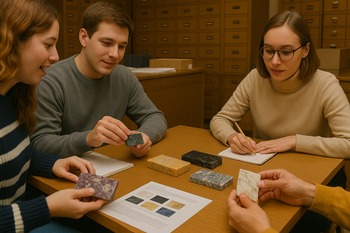
The session then progressed in a similar vein through multiple coloured and white marbles being examined during informal group discussions being facilitated by the instructor (see Figure 2). Printed sheets with provenance, typology, and visual comparisons of known Roman marbles such as giallo antico, verde antico, and portasanta were also circulated, as well as providing illustrations of the source quarries and examples of statuary and architecture that utilised these materials – tying, for example, the statue of Ganymede from Sperlonga, studied in the Art under the Roman Empire Paper, with a sample of the Phrygian pavonazzetto that it is made from, underscoring the deliberate aesthetic and symbolic choices made by Roman artists and patrons. This connection encouraged students to evaluate the relationship between material substance and artistic meaning while exploring how geological characteristics affect the visual effects and storytelling potential of ancient artworks. Their responses were enthusiastic, and feedback was reflective, indicating that touching artefactual material was an unusual privilege for them, and that, prior to this workshop, their experience of Roman architecture and Greek art was limited to photographs they found in textbooks and lectures. The ability to study authentic materials led students to wonder about the factors that influenced colour selection and material sourcing, and the amount of work required.
Working in small groups, they compared specimens, noted diagnostic features such as colour and veining, and discussed their potential significance in Classical art and architecture.

Results
According to Laurillard (Reference Laurillard2002) learning technologies along with physical materials need to be integrated into supportive educational settings. The workshop demonstrated how to embed object engagement by linking it to specific learning objectives and organised reflection activities. The session followed a specific structure which started with independent stone observation followed by group discussions about colour, texture and origin. Students finished the session by sharing their observations and received handouts for annotation which combined personal reflection with peer learning, and asked at the end of the session how their observations had evolved, through both their own reflection and peer learning. The results of this experimental workshop were both encouraging and profound. In both formal feedback and follow-up discussions, students identified the workshop as one of the most memorable parts of their term. Several reflected that it had changed how they approached visual material more generally; instead of treating sculpture and architecture as static images, they began to ask new questions about material sourcing, craft, and embodied experience. This shift aligns closely with Laurillard’s emphasis on iterative, practice-based learning, in which learners refine their conceptual understanding through engagement and feedback. For example, as students re-evaluated marble types across the session, they revised their identifications in response to peer discussion and facilitator feedback. This cycle of testing and refinement of ideas illustrates the kind of iterative learning that Laurillard frames as central to conceptual development, and which is to some extent, a facet of the Oxford tutorial system. The facilitator noted that the student experience of comparing similar-looking marbles taught them to slow down and really look carefully at the object, cultivating a precision of observation that later translated into better essay work and more confident handling of visual sources in tutorials.
However, the delivery of the workshop was not without its challenges. The session was constrained by time and had to balance introductory explanation with hands-on exploration, limiting opportunities for extended comparison or deeper contextual discussion. Differentiation was also a challenge, as the participants were drawn from different degree programmes – including Archaeology, Classical Archaeology and Ancient History, and History of Art – and were at varying stages of their academic progression, from first-year undergraduates to finalists. This heterogeneity brought valuable variety in perspective, enriching the discussion, but also created disparities in prior knowledge and confidence levels. It demanded careful facilitation to ensure that less experienced students were not overshadowed, and that disciplinary differences were bridged rather than reinforced. Some students, for example, found the geological terminology initially unfamiliar, requiring additional scaffolding to bridge disciplinary gaps. Managing informal group discussions in a non-traditional space also demanded flexibility in facilitation style. These challenges highlighted the importance of pre-session preparation, clearly structured tasks, and follow-up opportunities to consolidate learning. Future iterations might benefit from multiple sessions or integration with formal assessments to embed the gains more fully into the academic programme.
Nevertheless, the session fostered significant gains in interdisciplinary thinking. Students drew on concepts from geology, geography, and art history in an integrated way, reflecting the real-world analytical challenges faced by archaeologists and curators. This type of lateral learning – where students move fluidly between domains – is one of the most powerful affordances of object-based education, as highlighted by Hannan et al. (Reference Hannan, Duhs, Chatterjee, Boys, Boddington, Boys and Speight2016). What began as an aesthetic exercise became an interpretive one, helping students to make connections between quarry sites, imperial logistics, visual symbolism, and sculptural form. Facilitating this shift required careful mediation: students’ initial reactions were often grounded in affective or sensory impressions – responses to colour, polish, or ‘beauty’ – rather than analytical interpretation. Rather than dismissing these aesthetic reactions, the facilitator treated them as valid entry points, prompting students to articulate what they found striking and to hypothesise why such qualities may have mattered in antiquity. This approach modelled a central skill in Classics pedagogy: moving from ‘I liked it’ to ‘I think it means…’ to ‘I can use this to understand…’. By encouraging comparison, contextual inference, and reference to architectural or sculptural applications, the session actively bridged affective engagement and interpretive reasoning.
This dynamic is familiar in Classics teaching, particularly in relation to visual and literary material, where students often begin with subjective responses before developing critical arguments. In the marble workshop, students who initially described a stone as ‘pretty’ or ‘impressive’ were invited to explore what those reactions revealed – about the stone’s rarity, optical properties, or symbolic associations – and to connect their impressions with Roman practices of selection and display. Through this process, they came to see aesthetic judgments not as superficial, but as potential clues to ancient values and decision-making. The facilitator’s role was to reframe instinctive reactions as hypotheses to be tested and contextualised, thus transforming surface-level preferences into tools for deeper interpretation.
Crucially, the workshop also supported affective outcomes. Students spoke of a sense of ‘ownership’ over their learning, and described how the opportunity to handle real materials made them feel more directly connected to the ancient world. One participant commented that ‘for the first time, I felt like I was doing what a real archaeologist does’ (student feedback, anonymised, 2024). This kind of motivation and identification with disciplinary practices is often difficult to achieve in conventional lectures or seminars, but is well documented in studies of OBL. This motivation was evident in students’ behaviour during and after the session. Some lingered over samples beyond the allotted time, returned at the end to re-examine favourites, and expressed strong interest in repeating the experience. One student later remarked that in Greek Sculpture lectures, they now felt ‘better equipped to think like a classical archaeologist’ (student feedback, anonymised, 2024), while another noted the difference it made to ‘see and touch what’s normally just a footnote in a slide’ (student feedback, anonymised, 2024). Such observations point to a shift from passive reception to active, self-directed inquiry – a hallmark of engaged learning in experiential pedagogy. By allowing students to enact roles – observer, analyst, interpreter – the session offered a participatory model of classical education that complemented more traditional modes of instruction.
Discussion
Material encounters: the cast gallery as a precedent
The marble workshop did not, however, emerge in a pedagogical vacuum. It was conceived in relation to existing object-based teaching practices, most notably those centred around the Ashmolean Museum’s Cast Gallery, first established in the 19th century as a teaching collection. Housing over 900 plaster casts of Greek and Roman sculpture, it was designed to enable students to study classical art through direct visual encounter. At a time when access to original antiquities was rare, the cast collection functioned as an essential pedagogical tool, offering a structured, object-based means to examine form, proportion, and stylistic development.
This made Oxford, and the similar collection at Cambridge, part of a wider European trend, when classical casts became de rigueur in university Classics departments as reference and teaching tools (Payne, Reference Payne2019). Plaster reproductions allowed students to study the form and style of Greek and Roman statues first-hand at a time when travel to see originals was rare and photography was still in its infancy. These collections had even earlier precursors – plaster casts had been used as artistic teaching aids since the 17th century – but the 1884 initiative firmly embedded object-based study into the Oxford Classics curriculum. By 1960–61 the Ashmolean gave the casts a dedicated gallery space, reflecting their ongoing role in pedagogy. Notably, the gallery’s design was overseen by Bernard Ashmole, then Professor of Classical Archaeology, to maximize its instructional value. In short, the Cast Gallery’s raison d’être was educational: it provided tangible surrogates of ancient art for students to observe, discuss, and learn from in an object-based learning environment avant la lettre.
From its inception, the Cast Gallery was intended to enable object-based learning (OBL) within Classics and art history. Rather than relying solely on texts or two-dimensional illustrations, students could engage directly with three-dimensional replicas of famed antiquities. This hands-on, observational approach aligns with what museum educators recognize as the unique power of objects to convey ideas. Long before OBL was theorized, plaster casts functioned as a student-centred teaching tool – a way for learners to construct knowledge by examining physical representations of ancient material culture. As pedagogical theory has caught up, there is now strong evidence that such active, experiential learning methods deepen understanding. Over recent decades, education has shifted from ‘chalk and talk’ lecturing toward active learning and multi-sensory engagement, vindicating the 19th-century intuition that object study can enrich the learning experience (Hannan et al., Reference Hannan, Duhs, Chatterjee, Boys, Boddington, Boys and Speight2016).
However, today this enrichment is not as evident as might be hoped, and the future of cast galleries more broadly does seem to be uncertain, general visitor numbers are low, and though graduate tutors utilise the resource, their more established colleagues are less prone to do so, indeed Mary Beard’s positioning on the Cambridge collection is revealing:
The casts now have no educational function – not at least in the sense that A. B. Cook would have meant it. They are no ‘laboratory’ for any Classicist; rarely (let’s be honest) looked at; never studied. They are sustained by their own myth; by the contact they offer with that past world when sepia-tinted professors wheeled them onto the lecture room stage in Little St Mary’s Lane, when students measured and drew. They are sustained by our myth that they were once ‘education’; that they were not always white elephants; that they are senior citizens of the Faculty, honourably retired after long and loyal service. (Beard, Reference Beard1994, 22–23)
The value of plaster casts began to decline as they were increasingly viewed as mere ‘mechanical’ reproductions rather than valuable artistic objects. This perception emerged in the late 19th and early 20th centuries, where casts were seen as lacking the individual touch and aesthetic qualities of original sculptures, which diminished their status in the art world. The cast collection of the Royal Academy Schools had, by the early 2000s become little more than wall decoration, and the UCL collection appears to have vanished entirely, sometime in the 1990s.
The very limitations of plaster – as a uniform, synthetic material – means that it lacks the material authenticity of the stone originals, and authenticity matters in a broader sense (Murphy & Rose, Reference Murphy and Rose2019). However faithful the reproduction, students remain conscious that the cast is a copy – as one tutorial student put it: ‘no Roman ever actually laid eyes or hands on that plaster copy’. Handling an actual fragment of ancient stone or pot, by contrast, provides a tangible link to the ancient world – a real piece of the past. This can create a powerful emotional and cognitive connection. It engages multisensory learning: the feel, heft, and even smell (yes, dolomitic marble from Thassos does actually smell) become part of the educational experience, activating more neural pathways and reinforcing memory. Students find that working with authentic material inspires a kind of curiosity and excitement that is hard to achieve through slides or replicas alone. Indeed, object handling can prompt deep and thoughtful questioning and more personal investment in learning. In this way, the marble workshop exemplifies how tactile interaction with authentic materials enriches learning in ways that complement visual study of form.
Whereas casts teach about sculptural form and iconography, marble samples reveal the material decisions, textures, and sensory properties that contribute to the meaning and reception of ancient objects. Engaging with both resources enables students to develop a richer, more integrated understanding of ancient art and architecture – one grounded not just in visuality, but in touch, weight, and substance. Participants have Corsi’s specimens ‘on the table in front of us’ and are able to examine and touch the major stone types used in antiquity, learning to recognize and identify them both in the field and in their studies. This tactile engagement provides an extra dimension to their studies for students of ancient art. The sensory dimension afforded by real samples is something plaster cast cannot replicate. Casts are uniform in material – a white gypsum that, while adept at reproducing the shape and surface details of a sculpture, tells us nothing about the weight, texture, or colour of the original object. By contrast, when a student picks up a block of purple imperial porphyry or feels the cool polish of fine-grained Pentelic marble, or howls with delight at their first sight of lapis lazuli, they gain an immediate appreciation of the material properties – the density, the translucence, the veining – that ancient sculptors and patrons deliberately chose and that contribute to an artefact’s meaning. Such tactile knowledge is crucial in understanding ancient material culture. For instance, a plaster cast of a Roman bust might convey the portrait features, but only a real marble sample can convey why a luminescent Greek island marble like lychnites was prized for cult statues, or how the speckled pattern of Spartan green porphyry might catch the eye in a floor or wall veneer. The marble workshop thus addresses a blind spot of the Cast Gallery: it reconnects the study of ancient art to the substances from which that art was made.
Towards a holistic approach: integrating casts and marbles
Rather than seeing plaster casts and marble samples as competing approaches, it is most productive to use them in tandem. Each resource offers distinct pedagogical benefits, and together they can give students a more holistic understanding of ancient artefacts. In practical teaching design, an instructor, whether at Oxford, or elsewhere, might first use a Cast Gallery to introduce students to the artistic and stylistic aspects of classical sculpture – the pose of the Discobolus, the drapery of the Peplos Kore, the expressive face of a Hellenistic portrait – encouraging close observation and discussion. In the Cast Gallery’s open layout, students can walk around statues and observe them from multiple angles, experiencing something of the imposing scale and presence these works have in person. The instructor can prompt students to consider questions of style, iconography, and context using the casts as visual aids. Then, in a subsequent session, students might participate in the marble workshop to literally get a feel for the materials that those sculptures and monuments were made of. This two-part approach mirrors the dual nature of classical art itself – it is at once form and material. By engaging with both, students appreciate not only how an object looks but what it is made of and why that matters – why did Trajan choose pavonazzetto to depict the Dacian prisoners? Why did the famous crocodile at the Villa Adriana use cipollino? And what about the Ny Carlsberg Glyptotek’s lovely statue of a hippo in blood-red rosso antico? When combined, these resources foster a deeper understanding of ancient production and experience. A student who has studied the Parthenon frieze via plaster casts, for example, will recognize its carving style and iconography; if that same student has also handled a slab of Pentelic marble, with its faint golden shimmer, they can better imagine the original gleam of the Parthenon columns against the red, blue, and purple painted frieze. Similarly, a student who admired the sheer size of a cast of the Farnese Hercules can more fully grasp the technical feat of carving it once they’ve felt how hard and heavy a block of marble is. The Cast Galleries, wherever they might be, and workshops in marble identification thus reinforce each other.
Participants, therefore, come away not only able to analyse art visually, but also to identify stone types and consider how the choice of material relates to trade, value, or function in the ancient world. This integrated understanding is precisely the goal of an object-based pedagogy in Classics – to engage students with ancient material culture in 3D and multi-sensory ways, bridging the gap between textbook abstractions and the physical realities of the past (Pollalis et al., Reference Pollalis, Minor, Westendorf, Fahnbulleh, Virgilio, Kun and Shaer2018). Crucially, using both casts and authentic materials can prompt students to reflect on the differences between original and copy: Idealplastik and the importance of context. Why does it matter that a statue of Augustus was carved in glowing white Luna marble, or that a statue of Hadrian was made of crimson porphyry from Egypt? How does seeing a modern plaster duplicate differ from encountering the genuine artefact (or a piece of it) with all its centuries of history? Such discussions can lead to sophisticated insights about authenticity, museum ethics, and the sensory dimensions of worship and viewing in antiquity. They also highlight for students the interdisciplinary nature of Classics – where art history, archaeology, and even geology intersect. In sum, pairing the study of casts with hands-on marble workshops exemplifies a best-practice approach to OBL: leveraging the strengths of different object-centred resources to create a richer, more engaging learning experience.
To unlock the full potential of object-based learning within Classics, a more integrated pedagogical strategy is therefore required – one that views casts and marbles not as isolated interventions but as interdependent components in a broader, multisensory curriculum. Casts, with their emphasis on form and visual analysis, and the material study, with a focus on substance, materiality, and origin, offer different perspectives on the same ancient objects. When taught in tandem, they present students with the tools to investigate the complex interplay between aesthetics, material choices, and cultural significance in antiquity.
Such integration does not merely serve content delivery – it reshapes student perceptions. One student, reflecting on both sessions, remarked: ‘Until I handled the marble, I thought of statues only in terms of what they depict. Now I also think about what they are’. This shift in perspective exemplifies the pedagogical power of material engagement to disrupt passive reception and foster critical reflection. Furthermore, integrating these approaches reinforces interdisciplinary thinking.
Geological knowledge becomes relevant to art history; tactile sensation enriches stylistic analysis; empirical observation sharpens theoretical interpretation.
Students leave not only with a richer understanding of Classical art, but also with transferable analytical skills, including enhanced visual discrimination (e.g. identifying mineral inclusions or grain sizes), hypothesis generation (e.g. proposing provenance based on observable traits), and contextual synthesis – drawing connections between quarry geography, material symbolism, and artistic intent. These skills translate readily into curatorial work, archaeological documentation, and interdisciplinary analysis, making OBL a particularly fertile ground for Classics pedagogy. This holistic strategy is not merely additive. It reflects the actual conditions of ancient production and experience, where the choice of material was inseparable from artistic intent. The Roman viewer saw not only the form of an object but also its substance – and understood both as meaningful. Our teaching, too, should reflect that unity.
Conclusions
The approach described above is grounded in the principles of object-based learning, a pedagogy that helps develop transferable skills like communication and teamwork, and allows peer learning as students notice different aspects of the object. Unlike traditional classroom sessions that rely on passive reception of textual or visual content, OBL fosters active interrogation. While lectures convey conceptual frameworks efficiently, hands-on encounters allow students to test and internalise those concepts through embodied experience. The two approaches, when integrated, offer complementary routes to understanding. In these ways, OBL stimulates interest in acquiring and applying knowledge to other contexts both in and out of the classroom. A student who has physically engaged with classical objects is more likely to draw comparisons with other material evidence or modern experiences, thereby deepening their overall learning. For Classics instructors designing curricula, the implications are clear and encouraging. Incorporating object-based learning can significantly enrich the study of antiquity. Practical steps might include scheduling regular classes in a museum gallery, arranging handling sessions with university collections, or even using 3D-printed replicas when originals are not available. The key is to move beyond sole reliance on slides and lectures, and give students direct encounters with the concrete realities of ancient life. Such encounters can be profoundly motivating. They convey to students that Classics is not just about reading ancient texts or viewing static images – it is also about interacting with the physical legacy of the past. Museum educators have long known that an authentic object on a table can ignite curiosity in ways that a PowerPoint slide may not. Now, with a growing body of research and positive case studies, university faculty are increasingly embracing OBL as a powerful pedagogy for higher education. Classics departments are particularly well-positioned to benefit, given the rich material culture of the Greco-Roman world and the often readily available collections of antiquities, casts, or archaeological materials on campus.
In conclusion, using cast and material in a non-hierarchical, unprejudiced manner, demonstrates how object-based learning can be leveraged in Classics teaching to connect students with ancient material culture on multiple levels. The historical origins of cast galleries remind us that object-centred teaching is not new – it has deep roots in the discipline’s pedagogical traditions. Today, renewed focus on active and experiential learning has reinvigorated these practices, backed by educational theory that validates learning with objects as a high-impact practice. Whether through the awe of walking among towering plaster gods in the fabled basement of the Ashmolean, or the thrill of handling a two-thousand-year-old piece of marble, students are engaging with the ancient world in ways that are vivid, sensory, and memorable. Such experiences not only impart specific knowledge about art and archaeology but also cultivate skills in observation, analysis, and critical thinking that will serve students far beyond their Classics classes, just as Friedlaender found that medical students’ observational skills could be improved through the visual analysis of art-works (Friedlaender, Reference Friedlaender, Boys, Boddington, Boys and Speight2016). Perhaps most importantly, object-based approaches inspire a sense of wonder and personal connection – a reminder that studying Classics is, at its heart, an encounter with the tangible remnants of human history. By thoughtfully integrating resources like the cast galleries and the marble collection into our teaching designs, we can give students the best of both worlds: the visual and contextual insight gained from replicas, and the tactile, material understanding gained from authentic objects. This combined approach exemplifies a rich, research-informed pedagogy for the next generation of Classics teaching.
Acknowledgements
I am very grateful to Duncan Murdock, Collections Manager of Earth Collections at the Oxford University Museum of Natural History, for his generous support of this project and for facilitating access to the Corsi Collection. His knowledge of the collection, enthusiasm for teaching with objects, and willingness to accommodate experimental pedagogical use were central to the success of the workshop described here. I also wish to thank the Oxford University Museum of Natural History itself for sustaining a collection whose pedagogical potential continues to reward imaginative engagement. My thanks are likewise due to the students of Magdalen College and Exeter College who took part in the workshop. They approached the material with curiosity, attentiveness, and intellectual generosity, and their willingness to look closely, ask questions, and reflect critically on unfamiliar materials shaped both the atmosphere and the outcomes of the session. Their responses confirmed the value of object-based learning not merely as a teaching technique, but as a shared act of discovery. This article is dedicated to the memory of Amanda Claridge (1949–2022). It was Amanda who first taught me how to recognise coloured marbles in the field – not as abstract categories, but as lived materials with histories, textures, and personalities of their own. I remember with particular fondness the long, hot days spent learning marble under open skies, sustained by conversation, stone, improbably good wild rocket salads, and the occasional G&T. Those early lessons shaped not only how I look at ancient materials, but how I think about teaching them. This piece stands as a small tribute to her generosity as a scholar, teacher, and companion in the field.
Author contributions
The author was solely responsible for the conception, research, writing, and revision of this article.
Financial support
No funding was received for this project. The Society for the Promotion of Roman Studies expressed an interest in making the workshop available online, and offered funds to support this, but the author has not yet been able to action their kind support.
Competing interests
The author declares no potential conflicts of interest with respect to the research, authorship, and/or publication of this article.
Ethics standards
This study involved the observation of teaching practices and the collection of anonymised feedback from undergraduate students. All participants were informed of the nature of the study and provided their voluntary, anonymised feedback with the understanding that it would be used for pedagogical research purposes. No further ethical issues were identified.


 Open access

