


Introduction
Women often experience gender discrimination and bias in various situations, such as the hiring process (Coffman et al., Reference Coffman, Exley and Niederle2021), wage levels (Mulligan and Rubinstein, Reference Mulligan and Rubinstein2008; Flabbi, Reference Flabbi2010; Card et al., Reference Card, Cardoso and Kline2016; Biasi and Sarsons, Reference Biasi and Sarsons2022), promotion (Babcock et al., Reference Babcock, Recalde, Vesterlund and Weingart2017; Régner et al., Reference Régner, Thinus-Blanc, Netter, Schmader and Huguet2019), work-environment (Antecol et al., Reference Antecol, Barcus and Cobb-Clark2009), educational attainment (Carlana, Reference Carlana2019; Brenøe and Zölitz, Reference Brenøe and Zölitz2020) and bargaining outcomes (Ayres and Siegelman, Reference Ayres and Siegelman1995; Dittrich et al., Reference Dittrich, Knabe and Leipold2014; Ge et al., Reference Ge, Knittel, MacKenzie and Zoepf2016; Hernandez-Arenaz and Iriberri, Reference Hernandez-Arenaz and Iriberri2018). A large body of literature has shown that gender inequality also exists in evaluating women's abilities and statements; women are underestimated in their abilities, even when they have the same abilities as men (Boring, Reference Boring2017; Huang et al., Reference Huang, Gates, Sinatra and Barabási2020; Ayalew et al., Reference Ayalew, Manian and Sheth2021). These studies suggest that women's abilities and opinions may be devalued by gender, not by their content.
The undervaluation of women's abilities and opinions can be attributed, in part, to prevailing social norms that are unfavorable to women. Social norms are customary or ideal forms of behavior that individuals in a group try to conform to, influencing human behavior through the willingness to punish those who breach them (Elster, Reference Elster1989; Fehr and Gächter, Reference Fehr and Gächter2000; Benabou and Tirole, Reference Benabou and Tirole2011; Burke and Young, Reference Burke, Young, Benhabib, Bisin and Jackson2011; Krupka and Weber, Reference Krupka and Weber2013; Buckholtz, Reference Buckholtz2015; Adriani and Sonderegger, Reference Adriani and Sonderegger2018). Specifically, in patriarchal cultures, such as many in Asia, Africa and the Middle East, male-preferential norms may act to discourage women from asserting themselves publicly.
This study had two main objectives. First, I empirically investigated whether tolerance for opinions decreases when expressed by women through online randomized experiments in Japan, a country with a strong patriarchal culture. In this experiment, I presented 10 anonymous statements to the participants and asked them to evaluate the agreement score for each statement. At that time, I disclosed the gender of the statement poster to randomly selected participants. Since the disclosure of gender and the type of gender were determined randomly, in the absence of gender bias, the agreement score was expected to be similar regardless of the poster's gender.
The second objective of this study was to examine how a normative gender-egalitarian message (hereafter, ‘normative message’) can mitigate gender inequality in tolerance for women's opinions. This normative message aims to raise awareness that male-preferential norms are often misperceived and to encourage individuals to judge women's opinions based on their content rather than the gender of the speaker. This study tested the effectiveness of the normative message in reducing gender inequality by analyzing changes in agreement scores for women's opinions.
This study contributes to the literature on gender bias in women's abilities. Previous empirical literature reported that women's abilities are underestimated because of their gender (Hoisl and Mariani, Reference Hoisl and Mariani2017). For example, Azmat and Ferrer (Reference Azmat and Ferrer2017) reported that female lawyers earn less than half as much as male lawyers from new clients, even after controlling for individual characteristics. Similar gender bias has been observed in academia (Hechtman et al., Reference Hechtman, Moore, Schulkey, Miklos, Calcagno and Aragon2018; Bosquet et al., Reference Bosquet, Combes and García-Peñalosa2019; Huang et al., Reference Huang, Gates, Sinatra and Barabási2020; Ersoy and Pate, Reference Ersoy and Pate2023). For example, Knobloch-Westerwick et al. (Reference Knobloch-Westerwick, Glynn and Huge2013) found that the scientific quality of female scientists was underestimated, especially in male-dominated fields. Ginther and Kahn (Reference Ginther and Kahn2021) reported that female economists were 15% less likely to be promoted to associate professor, even after controlling for academic achievements, such as cumulative publications, citations and grants. However, it remains unclear whether, in general, people change their tolerance for women's opinions.
In addition, this study contributes to the literature on gender inequality and role of normative message. Previous literature discussed how the provision of normative message mitigates gender inequality (Boring and Philippe, Reference Boring and Philippe2021). For example, Okuyama (Reference Okuyama2021) found that normative messages delivered through a radio program increased women's political participation during the Allied Occupation of Japan. In addition, Bursztyn et al. (Reference Bursztyn, González and Yanagizawa-Drott2020) demonstrated that correcting misperceptions of social norms stimulated female labor participation in Saudi Arabia. However, to the best of my knowledge, none of the studies have investigated whether normative message efficiently reduce gender inequality in tolerance for women's opinions, particularly in settings with strong patriarchal norms that are unfavorable to women.
In this regard, Japan provides an ideal setting to examine the effectiveness of correcting misperceptions about male-preferential norms through normative messages. In general, Japan is a male-dominated country with a low awareness of gender equality (Lee, Reference Lee2019; Ogasawara and Komura, Reference Ogasawara and Komura2021). In fact, Japan ranks 125th out of 146 countries in the Global Gender Gap Report 2021, which is the second lowest among OECD countries (World Economic Forum, 2023). Despite this, there is a strong demand to mitigate gender inequality in Japan. For example, a 2019 public opinion survey revealed that over 90% of respondents believed that the government should implement policies to promote gender equality (Cabinet Office, 2019). By providing a normative message emphasizing the societal demand for gender equality, this study aimed to address and correct misperception about male-preferential norms, thereby assessing their impact on the tolerance of women's opinions.
Hypotheses
In this section, I developed hypotheses regarding tolerance for women's opinions and the expected impact of providing the normative message. As discussed, women are often undervalued because of their gender, even when they have abilities similar to men (Boring, Reference Boring2017; Hechtman et al., Reference Hechtman, Moore, Schulkey, Miklos, Calcagno and Aragon2018; Bosquet et al., Reference Bosquet, Combes and García-Peñalosa2019; Mengel et al., Reference Mengel, Sauermann and Zölitz2019; Huang et al., Reference Huang, Gates, Sinatra and Barabási2020; Ayalew et al., Reference Ayalew, Manian and Sheth2021; Ersoy and Pate, Reference Ersoy and Pate2023). This undervaluation is likely influenced by social norms that are unfavorable to women, which may lead to the devaluation of their abilities and opinions.
Although many studies have indicated that norm enforcement helps to sustain cooperation in society (Fehr and Gächter, Reference Fehr and Gächter2000; Gürerk et al., Reference Gürerk, Irlenbusch and Rockenbach2006), social norms can also exacerbate gender disparities (Gneezy et al., Reference Gneezy, Leonard and List2009; Field et al., Reference Field, Jayachandran and Pande2010; Alesina et al., Reference Alesina, Giuliano and Nunn2013; Bertrand et al., Reference Bertrand, Kamenica and Pan2015; Jayachandran, Reference Jayachandran2015, Reference Jayachandran2021). Specifically, when social norms dictate behaviors and ideologies that disadvantage women, such as prescribing how they should act, look, think and feel, they perpetuate gender inequalities (Cislaghi and Heise, Reference Cislaghi and Heise2020). Consequently, even individuals who personally hold egalitarian views may conform to unequal norms under societal pressures.
This dynamic is particularly pronounced in patriarchal cultures like Japan, where norms favoring men over women are deeply entrenched (Hamada, Reference Hamada2024). In such contexts, behaviors perceived as assertive or challenging to male opinions, especially when exhibited by women, are socially stigmatized (Seguino, Reference Seguino2000; Jayachandran, Reference Jayachandran2015; Lecoutere et al., Reference Lecoutere, d'Exelle and Van Campenhout2015). As a result, women's opinions and ideas may receive less acceptance, regardless of their quality. This argument leads to the first hypothesis:
Hypothesis 1. Tolerance for women's opinions is lower compared with the same opinions of men.
In contrast, previous literature suggests that providing general normative messages can lead to various prosocial behaviors (Dimant et al., Reference Dimant, Van Kleef and Shalvi2020; Takahashi, Reference Takahashi2021a, Reference Takahashi2021b; Takahashi and Tanaka, Reference Takahashi and Tanaka2021; Bhattacharya and Dugar, Reference Bhattacharya and Dugar2022). Moreover, some studies demonstrate that normative messages specifically addressing gender equality can stimulate gender-egalitarian behavior (Boring and Philippe, Reference Boring and Philippe2021; Okuyama, Reference Okuyama2021).
One reason the provision of normative messages promotes gender-egalitarian behavior is by correcting misperceptions through these messages. In societies with unequal gender norms, individuals may support gender equality but misperceive societal norms due to prevailing stereotypes or biases. In such cases, transmitting normative messages endorsing gender-egalitarian behavior can correct these misperceptions and promote attitudes aligned with gender equality (Cislaghi and Heise, Reference Cislaghi and Heise2020). If gender inequality exists in the tolerance for opinions due to such misperceived norms, providing the normative message could mitigate this inequality. Accordingly, I propose the following hypothesis:
Hypothesis 2. The provision of a normative gender-egalitarian message mitigates gender inequality in the tolerance for women's opinions.
Experimental design and data collection
To test the above hypotheses, I conducted two online randomized experiments in Japan. The first experiment was conducted on August 3 and 4, 2021, targeting 1,600 individuals through the online survey platform ‘iResearch’.Footnote 1 I conducted a second survey a month later (between September 3 and 7) to construct panel data. Although I invited 1,000 participants from the first survey, only 774 participated in the second survey (attrition rate was 22.6%). For each survey, participants received a participation allowance of 35 yen (approximately US$0.35), which is the standard price fixed by the survey company. The participants took an average of 6 min to complete the two tasks: (1) a demographic questionnaire survey and (2) evaluation of an anonymous statement.Footnote 2
Evaluation of anonymous statements
The main objective of this study was to identify whether people changed their attitudes toward statements depending on the gender of the statement poster. For this purpose, I asked the participants to evaluate their preferences for anonymous statements at the end of the survey.
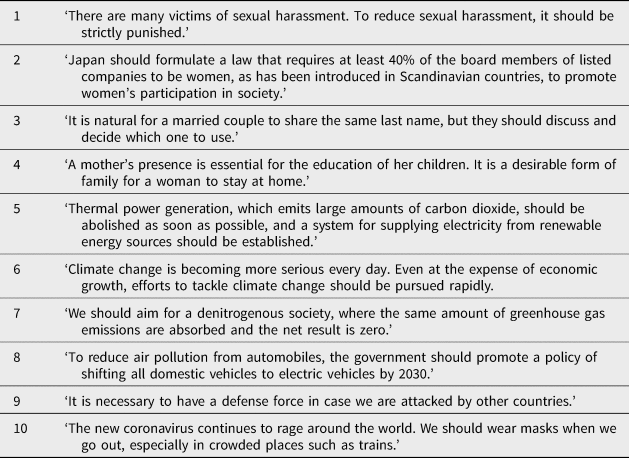
Specifically, the participants were informed that 10 statements would be presented on the screen one at a time, and all statements were made by anonymous individuals. Table 1 shows the 10 statements used in the first and second surveys. Statements 1 through 4 in Table 1 are related to gender equity (hereafter, ‘gender-sensitive statements’). The first three statements focus on gender equity issues, which are of significant social concern in Japan. If male-preferential social norms or conservative beliefs are entrenched, people may strongly resist accepting these statements when made by women. In contrast, the fourth statement, which posits that women should stay home to raise their children, was included as a male-preferential opinion.
Ten statements presented during the first and second surveys

Table 1 Long description
The table is intended to list ten survey statements used in two survey rounds. However, no table entries, statement text, or results are provided here. Because the data are missing, it is not possible to summarize key points, compare the two surveys, or describe any trends. If you share the statement list and any associated counts, ratings, or percentages for each survey, I can write accurate WCAG-compliant.
Note: The same statements were used consistently in the first and second surveys. The order of the statements presented to the participants was randomized.
Statements 5 through 8 pertain to environmental issues. Given the pervasive gender assumption that women are innately compassionate toward protecting the environment (Lau et al., Reference Lau, Kleiber, Lawless and Cohen2021), it is possible that pro-environmental statements made by women may be more readily accepted without strong opposition. The last two statements were included as neutral statements that are not considered to be particularly affected by gender.
To avoid ordering effects, the order of the statements presented to the participants was randomized. Then, the participants were asked to rate how much they agreed or disagreed with each statement based on a 7-point scale (hereafter, ‘agreement score’), ranging from ‘Strongly disagree’ to ‘Strongly agree’. For the analysis, I set a response of neither agree nor disagree as zero, while ‘Strongly disagree’ and ‘Strongly agree’ answers were scored −3 and 3, respectively.Footnote 3
Random interventions
To empirically test the hypotheses, I implemented two types of interventions. The first intervention involved disclosing the gender of the statement posters (gender disclosure treatment). I indicated whether the posters were anonymous women or anonymous men when presenting each statement, while participants without the gender disclosure treatment saw ‘anonymous person’. The gender disclosed to participants was randomly selected; in the gender disclosure treatment, 50.3% of statements were presented as women's opinions.
In the second intervention, I provided a normative message related to gender equality in Japan to randomly selected participants before the evaluation of statement agreement (normative message treatment). Specifically, participants were presented with the following message:
The following is a summary of the results of a public opinion survey conducted by the Cabinet Office in 2019.
According to the survey, more than 70% of the respondents feel that men are more privileged in society and that gender inequality persists.
Furthermore, more than 90% of respondents require the government to implement policies to promote gender equality.
By providing the normative message, I expected to correct the misperception of male-preferential norms. It is important to note that the message did not explicitly indicate the potential influence of gender inequality on the tolerance for women's opinions. Instead, the normative message suggested that it is socially desirable to mitigate gender-unequal behavior.
It is important to note that the gender disclosure treatment is considered deceptive because the gender of the poster is randomly assigned. This deception could be avoided by using actual written statements in the experiment. However, using actual statements might blur the distinction between whether differences in tolerance result from the speaker's gender or from differences in the statement's wording, as the wording may not align perfectly. Hence, to effectively test the hypotheses of this study, I opted for deception in the second intervention. This approach allows me to eliminate the influence of wording discrepancies and clearly discern gender inequality in tolerance. To mitigate the potential negative effects of deception, participants received debriefing information at the end of the survey (refer to Supplementary Appendix A). Furthermore, the experiment was conducted with approval from the Institutional Review Board.
Overview of the experimental design
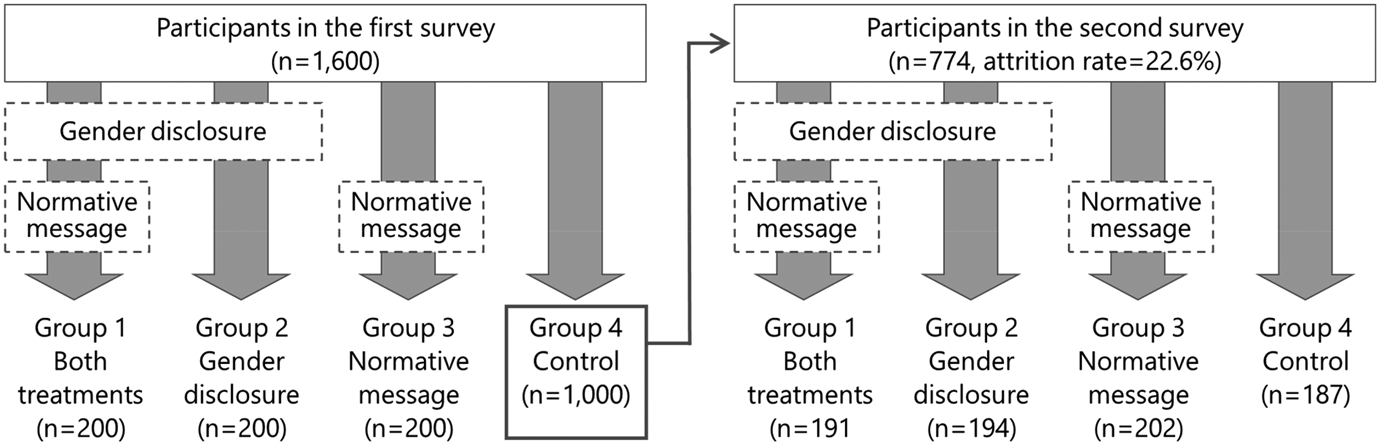
Figure 1 shows an overview of the experimental design of this study. In the first survey, 1,600 participants were randomly assigned to one of the four groups. A total of 600 out of 1,600 participants received one or two interventions (groups 1–3 in Figure 1). It is important to note that for groups 1 and 3, which received the normative message treatment, the normative message was presented before participants were asked to evaluate their agreement with the 10 statements. The remaining 1,000 participants did not receive any intervention and served as the control group.
Experimental design overview. Notes: The two interventions (i.e., the disclosure of poster's gender and the provision of normative message) are illustrated in dash box. Numbers in parentheses indicate the number of observations.

Figure 1 Long description
Part icipants in the first survey total 1,600, divided into four groups. Group 1 (n=200) receives both gender disclosure and a normative message. Group 2 (n=200) receives only gender disclosure. Group 3 (n=200) receives only a normative message. Group 4 (n=1,000) is the control group. In the second survey, with an attrition rate of 22.6 percent, there are 774 participants. Group 1 has 191 participants, Group 2 has 194, Group 3 has 202 and Group 4 has 187. The interventions remain the same as in the first survey.
Since the control group participants in the first survey were not exposed to the interventions, they were exclusively invited to participate in the second survey to assess how the treatments influenced changes in agreement scores. A total of 774 individuals participated in the second survey, resulting in an attrition rate of 22.6%. This attrition rate is moderate compared with the average attrition rate of approximately 15% reported for field experiments (Ghanem et al., Reference Ghanem, Hirshleifer and Ortiz-Beccera2023). For the second survey, participants were again randomly assigned to one of four groups and were asked to rate their agreement with the same set of 10 statements presented in the initial survey.
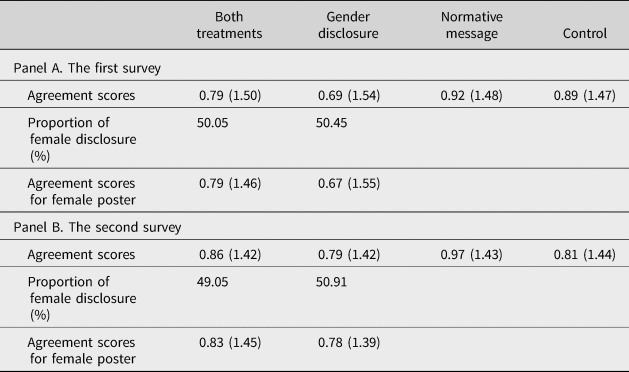
The participants' demographic characteristics and the balance between the groups are reported in Supplementary Appendix B. Scheffe's multiple comparison test confirmed that there were no statistical differences in the average demographic characteristics between the four groups. Table 2 reports the average agreement scores of the groups for the first and second surveys. The total averages of agreement score were 0.85 and 0.86 in the first and second surveys, respectively. In both surveys, the average agreement score was relatively smaller for the groups with the gender disclosure treatment (i.e., both treatments and gender disclosure groups). While Table 2 presents the mean scores for the 10 statements at the individual level, the estimations use the agreement score for each statement as the dependent variable.
Average agreement scores at the individual level by the groups

Table 2 Long description
The table is intended to report average agreement scores for individuals, broken out by participant group. Each group’s mean agreement score is paired with a standard deviation shown in parentheses to indicate how much responses vary within that group. The table also distinguishes groups by whether the poster’s gender was disclosed, with gender information available only for participants in the combined-treatments group and the gender-disclosure group. Because the numeric entries and group labels are not included in the provided data, specific group averages, differences between groups, and any trends cannot be described. Interpret any comparisons as dependent on the missing values and the groups actually listed in the table.
Note. Standard deviations are in parentheses. The gender of the poster is disclosed only for the participants in the both treatments group and gender disclosure group.
Methodology
To identify how the agreement level was affected by the gender of the poster, this study employed both cross-sectional and panel data analyses. First, I started with a prefecture-level fixed effects regression model using observations from the first survey (cross-sectional analysis), as follows:

where Scoreij is the agreement scale ranging from −3 to 3 for statement j for individual i. Femaleij and Maleij are the dummy variables representing the gender disclosure treatment of individual i for statement j (hereafter, ‘female disclosure dummy’ and ‘male disclosure dummy,’ respectively). More precisely, Femaleij takes a value of 1 if the gender of the poster of statement j is disclosed as female, while Maleij takes a value of 1 if the gender of statement j is disclosed as male to individual i. Normi is a dummy variable that takes a value of 1 if individual i receives the normative message. In Equation (1), I include two interaction terms between each gender disclosure dummy and the normative message dummy, shown as Femaleij × Normi and Maleij × Normi. Statej denotes a set of dummy variables for each statement. Xi indicates a set of observable demographic characteristics of individual i (see Supplementary Appendix Table B1). ρi is the prefecture-specific fixed effect for individual i, which reduces the unobserved time-invariant differences between prefectures. Standard errors are clustered at the treatment level to account for autocorrelations in the error term ɛij.
Next, I conducted an individual fixed effects model using panel data:

where t is the time of the survey round. υi and τt represent individual-specific fixed effects and time dummy. Note that Equation (2) excludes time-invariant variables.
In addition to Equations (1) and (2), I performed the regression by excluding the gender-sensitive statements (statements 1 through 4 in Table 1). The potential concern with including gender-sensitive statements is that the results, particularly for the gender disclosure treatment, could be affected by social desirability bias, male backlash or other confounding effects when participants encounter gender-sensitive statements. In addition, I excluded each statement from the observation and performed the estimation, which results are provided in Supplementary Appendix C.
Hypothesis 1 is tested by examining whether the agreement score is decreased when the gender of the poster was disclosed as female compared with when the poster's gender is disclosed as male. In Equations (1) and (2), the non-disclosure of the statement poster's gender is set as the baseline category. Therefore, β 1 in Equations (1) and (2) represents the difference in agreement scores when the poster's gender is disclosed as female compared with when it is not disclosed. Since the exact same statements were presented to all participants in both surveys, if the agreement scores were determined solely by the content of the statements, the scores should be similar regardless of the disclosed gender (i.e., β 1 = β 2). However, if unfavorable social norms reduce tolerance for women's opinions, the coefficient for the female disclosure dummy is expected to be lower than that for the male disclosure dummy (β 1 < β 2).
Meanwhile, as proposed in Hypothesis 2, providing the normative message may mitigate the influence of social norms and improve tolerance for women's opinions. The general impact of normative message is captured in β 3, while the study focuses on its specific impact on the agreement score for women's statements, indicated by the interaction term between the female disclosure dummy and the normative message dummy (β 4). A positive β 4 would suggest that the normative message helps correct the misperception of norms.
If the normative message treatment successfully offsets the underestimation of women's opinions, there should be no significant gender difference in the agreement scores. This is expressed as β 1 + β 4 = β 2 + β 5, meaning that the negative effect of disclosing a female poster's gender (β 1) combined with the positive effect of the normative message (β 4) should equal the effect of disclosing a male poster's gender (β 2) combined with the normative message (β 5). In other words, the normative message should neutralize the gender bias, resulting in no difference in agreement scores between genders.
Results
Results of the benchmark estimations
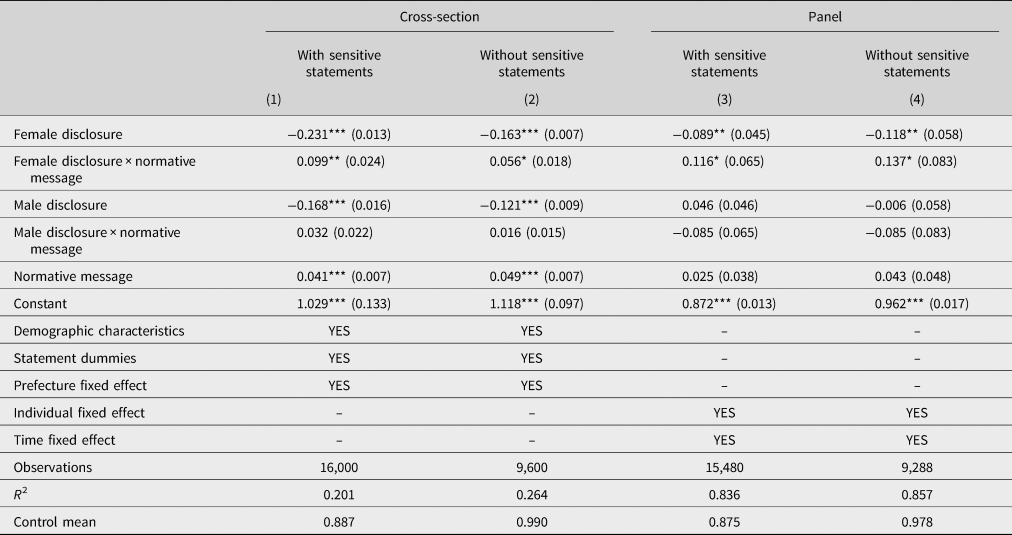
The estimation results are presented in Table 3.Footnote 4 First, the results of the cross-sectional analysis with the gender-sensitive statements indicated that the female gender disclosure dummy negatively affected the agreement score (column 1). The coefficient indicates that participants decreased the agreement score for women's opinions by 0.23 compared with when the gender of the statement poster was not disclosed, even though the exact same statements were presented. Given that the average agreement score in the first survey was 0.89, this coefficient represents approximately a 26% reduction in the agreement score due to female disclosure.
Effect of the gender disclosure and normative message on agreement score
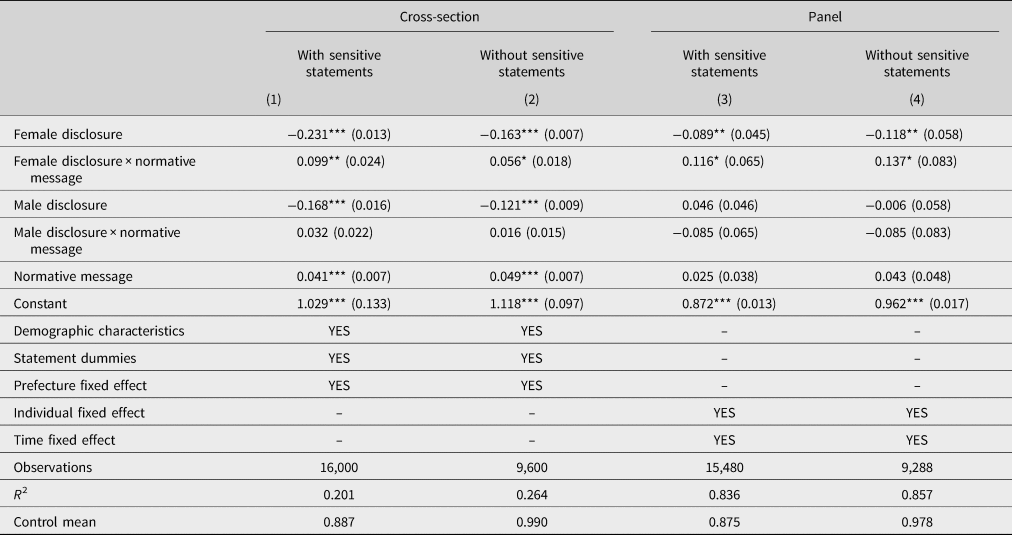
Table 3 Long description
The table is intended to report how agreement scores change with gender disclosure, a normative message treatment, and their interaction. It appears to include indicators for disclosing a female poster, disclosing a male poster, receiving a normative message, and the combined effect of female disclosure with the normative message. However, no coefficient values, standard errors, sample sizes, or model columns were provided, so the direction, size, and statistical significance of any effects cannot be summarized. If you share the table’s numbers, an accessible summary can describe which treatments increase or decrease agreement, whether the interaction strengthens or weakens the normative message effect, and which results are statistically reliable. Any interpretation should note that uncertainty is conveyed via clustered standard errors at the group level and that significance is indicated by star markers.
Note: The female disclosure variable represents the gender disclosure dummy for women. Female disclosure × normative message is the interaction term between female disclosure and the normative message dummy. The male disclosure variable is a dummy variable indicating the disclosure of the statement poster's gender as male. The normative message variable denotes whether an individual receives the normative message treatment. Standard errors are clustered at the group level in parentheses; ***, ** and * indicate statistical significance at the 1, 5 and 10% levels, respectively.
Similarly, the male disclosure dummy also had a negative and significant impact on the agreement score, reducing it by approximately 19%. These results indicate that, on average, agreement scores decrease when the poster's gender is disclosed, regardless of gender. However, testing the coefficients of the two variables revealed that the coefficient for the female disclosure dummy was significantly lower than that for the male disclosure dummy (p < 0.01).
Additionally, even after controlling for the general effect of the normative message treatment, I observed a significantly positive effect of the interaction term between the female gender disclosure dummy and the normative message dummy. In contrast, the coefficient of the interaction term with the male disclosure dummy was positive but not significant. To test whether the normative message fully offsets the underestimation of women's opinions, I compared the combined effects of the gender disclosure dummies and their interaction terms with the normative message. The test did not reveal a significant difference (p = 0.57), suggesting that the normative message treatment neutralizes the negative effect of female gender disclosure.
Furthermore, I performed the regression excluding the gender-sensitive statements, and the results are presented in column 2 of Table 3. While there were concerns about potential estimation bias from including gender-sensitive statements, the findings showed that the coefficients were slightly smaller but did not change significantly. Similar to the results in column 1, there were significant differences between the female and male gender disclosure dummies (p < 0.01). However, when the effects of the interaction terms were combined, no significant difference was found (p = 0.75). These findings suggest that including gender-sensitive statements does not introduce major biases.
Columns 3 and 4 of Table 3 present the results of the panel data analysis with and without gender-sensitive statements, respectively. Consistent with the cross-sectional results, the coefficient for female gender disclosure indicates that participants reduced the agreement score by 0.089 (approximately a 16% reduction) when they were aware that the poster was female. A similar finding was observed in the results excluding the gender-sensitive statements, with a reduction of 0.118 (equivalent to 12%).
In contrast, unlike the cross-sectional results, the coefficients for the male disclosure dummy were smaller and became insignificant for both the estimates with and without gender-sensitive statements. However, when testing for differences between female and male disclosure, combined with their interaction terms, there was consistently no significant difference (p = 0.35).
Attrition
While the attrition rate of 22.6% in the second survey is not excessively high, I cannot rule out the possibility that it may have influenced the results of the panel data analysis. Specifically, if participants with certain characteristics were more likely to participate in the second survey, systematic differences between the first and second control groups could arise, potentially leading to over- or underestimation of the panel data analysis results. To address this concern, I conducted a t-test to examine differences in the average agreement score and demographic characteristics between the control group in the first survey (1,000 participants) and the control group in the second survey (184 participants).
The results of the t-test are reported in Supplementary Appendix Table C2. The average agreement score for the control group in the first survey was 0.89, compared with 0.81 for the control group in the second survey. This difference was not statistically significant, indicating that individuals who scored particularly high or low in the first survey did not disproportionately continue to the second survey. Similarly, there were no significant differences between the groups in the eight demographic characteristics used in the estimation. These findings suggest that attrition is unlikely to have caused estimation bias into the panel data analysis results.
Heterogeneity
This section presents the results of two types of heterogeneity analyses. The first analysis examines heterogeneity based on the gender gap at the prefectural level. Regions with larger gender gaps may exhibit stronger male-dominated social norms, potentially leading to a greater undervaluation of women's opinions. In this study, I used the gender composition of prefectural assembly parliament posts as a proxy for the gender gap in each prefecture. In Japan, there are significant regional differences in the gender composition of prefectural assembly posts, ranging from 31% in areas with the highest gender composition to as low as 5% in areas with the lowest composition. For the estimation, observations were divided into two groups based on the median gender composition (16%). Subsequently, panel data analysis was conducted separately for prefectures with large and small gender gaps.
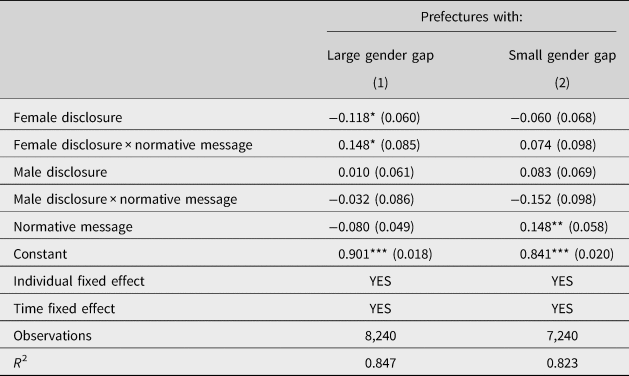
The results are presented in Table 4, with columns 1 and 2 showing the results for prefectures with large and small gender gaps, respectively. In prefectures with large gender gaps, the coefficient for the female disclosure variable is negative and significant, while the interaction term with the normative message is positive and significant. In contrast, no significant effects were found for the male disclosure variable. These findings are largely consistent with the benchmark results.
Panel data analysis for prefectures with large and small gender gaps

Table 4 Long description
The table is intended to report panel data regression results for Japanese prefectures, comparing groups with larger versus smaller gender gaps in prefectural assembly seats. No table entries, variable names, coefficients, standard errors, sample sizes, or model specifications were provided, so key findings and comparisons cannot be described. Without the numeric results, it is not possible to identify which predictors are statistically significant or whether effects differ between the large-gap and small-gap groups. If you share the full table content, including column headers and all rows, I can produce WCAG-compliant that summarizes the main effects, differences across groups, and any noted significance levels.
Note: The term ‘gender gap’ refers to the gender gap in prefectural assembly parliament posts; ***, ** and * indicate statistical significance at the 1, 5 and 10% levels, respectively.
In prefectures with smaller gender gaps, as shown in column 2, the signs of the female disclosure variable and its interaction term were the same, but the coefficients were small and insignificant. This insignificance might be attributed to the reduced prevalence of social norms unfavorable to women in regions with smaller gender gaps. Additionally, I found that the normative message had a significantly positive effect, unlike the benchmark results. These findings imply that the provision of the normative message effectively improves tolerance for women's opinions only in regions with large gender gaps, whereas in areas with small disparities, such intervention increases tolerance in general, regardless of gender.
The second heterogeneity analysis examines whether the effects of the normative message treatment vary by participant demographic characteristics. Specifically, I investigate how concern for gender issues influences the effect of normative message provision. Participants who have pre-existing concerns about gender issues may respond more strongly to the normative message, which could primarily explain the positively significant results observed in the benchmark analysis.
To test for this heterogeneity, I used two demographic variables: the high gender concern dummy and the female dummy, both of which are included in X in Equation (1). The high gender concern dummy takes a value of 1 if the participant strongly agrees that gender inequality needs to be addressed, while the female dummy takes a value of 1 if the participant is female. In the estimation, I included interaction terms between each of these two demographic variables and the interaction terms in Equation (1).
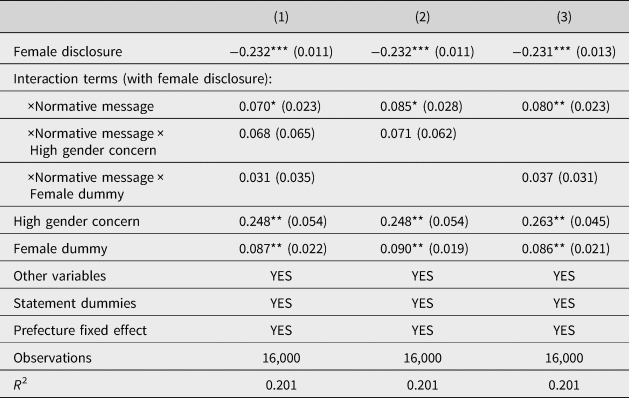
The results including the interaction terms with each of the two demographic variables are presented in column 1 of Table 5, while columns 2 and 3 indicate the results with the interaction terms with either demographic variable.Footnote 5 Although the coefficients of the interaction terms with each demographic variable were positive (0.068 and 0.031), they were not statistically significant. In contrast, the interaction term between female gender disclosure and normative message remained significant and positive. These findings suggest that the main results of this study are not driven by participants' pre-existing concerns about gender issues.
Results by participant demographic characteristics and normative message treatment

Table 5 Long description
The table is intended to report regression interaction results linking a normative message treatment with participant demographics, focusing on how effects differ for women. It includes interaction terms between the normative message indicator and a female indicator, plus three-way interactions that add demographic characteristics such as high prior concern about gender issues. Standard errors are reported in parentheses and are clustered at the group level, and some estimates may be flagged as statistically significant at the one percent level. However, the table data itself is missing, so the direction, size, and significance of any effects cannot be described. Provide the coefficients and standard errors for each row and column to generate accurate, WCAG-compliant with key comparisons and trends.
Note: This table shows the results of the interaction terms between the female gender dummy and the other variables. The variable ‘×Normative message’ is the interaction term between the female gender dummy and normative message dummy, while the other two variables (‘×Normative message × High gender concern’ and ‘×Normative message × Female dummy’) are the interaction terms of three variables, including each of the demographic variables. High gender concern is a dummy variable representing a high level of interest in gender issues before the experiment. Female dummy is a dummy variable indicating the gender of the respondent. Standard errors are clustered at the group level in parentheses; ** indicates statistical significance at the 1% level.
Discussion
The results of both cross-sectional and panel data analyses showed that tolerance significantly decreased when the poster's gender was disclosed as female. This finding is consistent with previous studies indicating that women's abilities are often underestimated (Boring, Reference Boring2017; Hechtman et al., Reference Hechtman, Moore, Schulkey, Miklos, Calcagno and Aragon2018; Bosquet et al., Reference Bosquet, Combes and García-Peñalosa2019; Mengel et al., Reference Mengel, Sauermann and Zölitz2019; Huang et al., Reference Huang, Gates, Sinatra and Barabási2020; Ayalew et al., Reference Ayalew, Manian and Sheth2021; Ersoy and Pate, Reference Ersoy and Pate2023). These findings clearly demonstrate that people undervalue women's opinions based on gender rather than content. Hence, based on these findings, Hypothesis 1 is supported.
Furthermore, the heterogeneity analysis revealed that the underestimation of women's opinions was most pronounced in regions with larger gender gaps. Although this study cannot definitively identify the precise mechanisms driving this phenomenon, the findings strongly suggest that social norms unfavorable to women could be a contributing factor to this undervaluation. These results underscore the significant role that unfavorable social norms play in perpetuating gender inequality.
In contrast, the provision of the normative message significantly increased the agreement score for women's opinions. The test results showed that providing the normative message offset the negative effect of disclosing the female gender, resulting in agreement scores that were no longer significantly different from those for men's opinions. Therefore, the findings also confirm Hypothesis 2.
In addition, a notable observation from the study is that gender disclosure (whether female or male) leads to a more substantial reduction in agreement scores compared with non-disclosure. This phenomenon could imply that a situation where people are not conscious of gender might lead to more unbiased evaluations. This notion aligns with the findings from blind audition studies, such as those by Goldin and Rouse (Reference Goldin and Rouse2000), which demonstrated reduced gender bias when anonymity was maintained. In the context of this study, it appears that disclosing gender – regardless of whether it is male or female – introduces a bias that lowers the perceived value of the statement.
This observation could be understood through the lens of implicit bias, which refers to unconscious attitudes or stereotypes that affect our understanding, actions and decisions (Greenwald and Banaji, Reference Greenwald and Banaji1995). The reduction in agreement scores upon gender disclosure could be a manifestation of such implicit biases, where awareness of gender activates subconscious stereotypes and prejudices held by individual participants, leading to biased evaluations. This interpretation aligns with the differences observed between the cross-sectional and panel data results. The inclusion of individual fixed effects in the panel data analysis, which yielded a significant negative effect only for female disclosure, indicates that unobserved individual factors, such as personal biases and experiences, significantly influence sensitivity to gender disclosure.
Overall, these findings suggest that implicit biases could be more pronounced when gender is disclosed, whether female or male, influencing the evaluation process. This is consistent with research indicating that merely increasing the number of women in leadership positions does not necessarily promote gender equality (Bagues and Esteve-Volart, Reference Bagues and Esteve-Volart2010; Bagues et al., Reference Bagues, Sylos-Labini and Zinovyeva2017). Therefore, in addition to providing normative messages to mitigate gender inequality, these findings also underscore the importance of maintaining anonymity in assessment and decision-making processes to mitigate such biases.
Conclusion
By conducting randomized online experiments with 1,600 individuals in Japan, this study reported empirical evidence on gender inequality in tolerance for women's opinions. In our experiment, although the exact same statements were presented to all participants, the results of both cross-sectional and panel data analyses indicated that people reduced the agreement score when the gender of the statement poster was disclosed as female. These results suggest that people are likely to be less tolerant of women's opinions. However, the negative impact of female gender disclosure was neutralized when participants were provided with the normative gender-egalitarian message.
These findings have policy implications for mitigating gender inequality. First, it is important to recognize that there is a risk of underestimating women's opinions, even unconsciously. I believe that the participants did not intendedly reduce the agreement score for women's opinions in order to oppress them. In fact, approximately 60% of participants reported that they have a strong or relatively strong concern on gender inequality issue. However, this study found a statistical difference in the score between female and male disclosure, suggesting that people may unintendedly decline women's opinions based on gender, not by its quality. This point is practically important because in a society where women's opinions are disregarded, their views will not be reflected in policy, which may reproduce a male-dominated society (Chattopadhyay and Duflo, Reference Chattopadhyay and Duflo2004).
Second, it is essential to disseminate the messages of normative gender egalitarianism. As the results of this study suggested, if undervaluation of women's opinions is generated by social norms unfavorable to women, correcting such misperceptions of norms is of paramount importance. In fact, efforts to disseminate information on gender equality have been undertaken for a long time (Beach and Hanlon, Reference Beach and Hanlon2019; Lau et al., Reference Lau, Kleiber, Lawless and Cohen2021; Okuyama, Reference Okuyama2021). Likewise, this study suggests that people may refrain from making gender inequality when they correct their perception of gender norms through normative messages, even in a patriarchal, male-dominated country like Japan.
Third, to prevent bias in the evaluation process, the non-disclosure of gender is crucial. The findings of this study reveal that the mere act of disclosing gender – whether male or female – introduces a bias that reduces the perceived value of the statement. While it may not be feasible to implement gender non-disclosure in all areas, this study suggests that maintaining gender anonymity in evaluation processes can contribute to more equitable evaluations for both men and women. This recommendation aligns with the broader literature on implicit bias, which emphasizes the benefits of anonymity in reducing gender-based biases in various evaluative contexts (Goldin and Rouse, Reference Goldin and Rouse2000). Therefore, policy measures that promote or enable gender non-disclosure in assessments could be a significant step toward achieving gender equality.
Finally, I discuss the limitations of this study. The primary limitation is that it is not clear how individuals perceived the normative message treatment, so the actual mechanisms by which message provision improved the agreement scores were not clearly identified. Furthermore, the generalizability of the findings is limited. The study was conducted within the specific cultural context of Japan, which may have unique social norms and gender biases. While the findings may have some applicability to other patriarchal cultural countries, the extent to which they apply to other cultural or societal contexts remains uncertain. Future research should focus on how social norms and the provision of normative messages influence behavior toward women in diverse cultural settings.
Supplementary material
To view supplementary material for this article, please visit https://doi.org/10.1017/bpp.2024.41.
Acknowledgments
This paper was supported by JSPS KAKENHI Grant-in-Aid for Scientific Research (B) Number 19H01492. The author would like to thank Kahori Ishibashi for her help with data collection.
Conflict of interest
The author declares that there is no competing financial interests or personal relationships that could have influenced the work reported in this paper.
Ethical approval
All participants provided informed consent, and the study design was approved by the institutional review board of Waseda University (Application Number: 2021-111).


 Open access

