

The United States is an outlier when it comes to the minimum wage, a social welfare policy that provides a safety net for millions of low-wage workers. Whereas most countries increase their minimum wages on a regular basis, the US government has only approved raising the federal minimum wage two times in the last 30 years (Desilver Reference Desilver2021). Despite strong voter support for higher minimum wages, it has been stuck at $7.25/hour since 2009 (Rose Reference Rose2020; Simonovits, Guess, and Nagler Reference Simonovits, Guess and Nagler2019). This marks the longest period of time without a minimum-wage increase not only in US history but also in the OECD (Grimshaw and Johnson Reference Grimshaw, Johnson, Arnholtz and Refslund2024, 192).Footnote 1 As a result of this inaction, the federal minimum wage has fallen from 36% to 32% of the median wage and from 29% to 22% of the average wage of full-time workers between 2000 and 2019, the lowest measures in the OECD (Dingeldey, Schulten, and Grimshaw Reference Dingeldey, Schulten, Grimshaw, Dingeldey, Grimshaw and Schulten2021, 12).Footnote 2
Existing scholarship on the politics of the minimum wage in the United States has attributed federal inaction to declining union density (Bartels Reference Bartels2016; Levin-Waldman Reference Levin-Waldman1998), the power of wealthy interests (Witko et al. Reference Witko, Morgan, Kelly and Enns2021), and increased polarization and partisanship (Bartels Reference Bartels2016; Poole and Rosenthal Reference Poole, Rosenthal, Alesina and Carliner1991; Rose Reference Rose2020). Although we agree that these factors are important, other countries that share these characteristics have experienced more robust growth in the minimum wage. Take Hungary, for example. Much like the United States, union density has plummeted, and the ascendant Right has produced similar patterns of polarization. Yet, whereas the US president has only signed legislation raising the minimum wage twice since 1990—in 1996 and in 2007—Hungary’s executive has approved increases 33 times. The United States also trails behind liberal market economies (LMEs) such as the United Kingdom, which has raised its national minimum wage every year since its inception in 1999 (Francis-Devine Reference Francis-Devine2025). This difference has important consequences for workers. Between 1990 and 2024, the real value of the federal minimum wage declined by 18% in the United States, whereas in Hungary and the United Kingdom, its real value rose by 178% and 72%, respectively.Footnote 3
Through a comparative analysis of the politics of the minimum wage in Hungary, the United Kingdom, and the United States, we argue that institutions are a key overlooked factor that explains US exceptionalism. Although some comparative studies of the minimum wage have highlighted the importance of institutions, they focus solely on the degree of governmental control over minimum-wage setting (Kozák and Picot Reference Kozák and Picot2025). However, there are important institutional differences among countries in which the government has this authority that have implications for the politics of the minimum wage. The US system of minimum-wage setting, in which the legislative branch must initiate bills to raise the minimum wage, agree to them, and then secure presidential approval, is highly unusual. In most countries, the executive branch has the authority to raise minimum wages without legislative approval (Desilver Reference Desilver2021). This institutional difference produces both fewer veto points and a distinctive political logic. When executives have the authority to raise the minimum wage, they cannot easily duck responsibility for wage stagnation; they can also manipulate the minimum wage for maximal effect during election season. The results, we argue, are more frequent and more generous increases to the minimum wage.
The Political Consequences of Minimum-Wage–Setting Institutions
Minimum wage systems differ widely around the world (Dingeldey, Schulten, and Grimshaw Reference Dingeldey, Schulten, Grimshaw, Dingeldey, Grimshaw and Schulten2021; International Labour Conference 2014). In the most complex systems, minimum wages are set regionally and by sector or occupation, giving rise to dozens of different minimum wages. At the other end of the spectrum are countries that set a single national minimum wage. Between these two poles are a dizzying array of institutional arrangements. Amid this variation, however, is one key similarity: in most countries, the executive branch can determine the national minimum wage without involving the legislative branch of government.Footnote 4 Most commonly, tripartite committees comprising unions, employers, and government appointees chosen by the executive make recommendations to the executive branch. In most cases these recommendations are merely advisory, which gives the executive branch enormous discretion in setting the minimum wage. Countries in which national legislatures participate directly in minimum-wage setting are a distinct minority—only 17 countries worldwide according to Desilver (Reference Desilver2021).Footnote 5 The United States belongs to this small group of countries. How might these institutional differences help explain the United States’ outlier status?
In nations in which legislatures must approve minimum wage increases, there are two political logics at work that diminish the likelihood of policy change. The first is that there are more veto points. When the executive sets the minimum wage without needing legislative approval, there are typically no veto points. By contrast, in systems in which legislatures must approve minimum-wage hikes, multiple veto points usually exist. In presidential systems, the legislature is a veto point, and in bicameral systems, each chamber is a veto point. In parliamentary systems, coalition governments must secure the support of multiple parties, each of which could potentially block a hike in the minimum wage. As the number of veto points increases, policy change is less likely (Tsebelis Reference Tsebelis1995).
As historical institutionalist scholars have noted, political systems with many veto points are vulnerable to policy drift. The US minimum wage is a frequent example used to illustrate the point that the failure to update a policy alters its intended effect, in this case, providing America’s poorest workers a decent minimum living standard (Béland, Rocco, and Waddan Reference Béland, Rocco and Waddan2016; Galvin and Hacker Reference Galvin and Hacker2020; Hacker Reference Hacker2004; Hacker and Pierson Reference Hacker and Pierson2014; Hacker, Pierson, and Thelen Reference Hacker, Pierson, Thelen, Mahoney and Thelen2015). Political institutions that widely disperse power also provide more opportunities for organized interests to block action and therefore favor actors that benefit from the status quo (Hacker et al. Reference Hacker, Hertel-Fernandez, Pierson and Thelen2022). Thus, political systems with many veto points are not neutral: they favor some organized interests over others.
These political institutions interact with minimum-wage–setting institutions to shape the terrain on which battles over increases to the minimum wage are fought. In the United States, business interests need only defend the status quo, because raising the minimum wage requires legislative action and they have many opportunities to block legislation. For example, a bill can be killed quietly in committee, filibustered in the Senate, or defeated in either chamber of Congress.
But why do executives choose to side with workers and raise the minimum wage? We argue that executives with the authority to raise the minimum wage without legislative approval face strong electoral incentives to approve increases. In political business-cycle fashion, generous raises put money in voters’ pockets as they go to the polls. Research shows that executives are especially likely to increase minimum wages around election time, and this electoral effect holds across ideological differences among executives and in both competitive autocracies and democracies (Caraway, Ford, and Nguyen Reference Caraway, Ford and Nguyen2019; Caraway and Öker Reference Caraway and Öker2022). Even executives who might be ideologically predisposed against raising the minimum wage, and who have closer links to business than to labor-based interest groups, face political consequences if they are too stingy. Whereas executives in countries in which legislatures must approve minimum-wage increases can duck responsibility for not raising it, voters in countries where the executive makes the call know exactly who to blame for stagnant wages.
Scholarship on the US federal minimum wage has rarely highlighted the importance of this peculiar set of minimum-wage–setting institutions in large part because these institutions have remained constant over time: Congress has set the minimum wage since 1949.Footnote 6 Therefore, social scientists have directed their attention to new factors that have emerged since then. One obvious development is increased partisanship and polarization since the 1970s, which has made the minimum wage a more divisive policy than it used to be (Bartels Reference Bartels2016; Rose Reference Rose2020). Although Democrats have historically and until the present been stronger proponents of a higher minimum wage, moderate Republicans from states with higher unionization rates had frequently joined Democrats to pass increases to the minimum wage (Gitterman Reference Gitterman, Béland, Howard and Morgan2014). As Republicans became more conservative and as partisanship became more polarized, however, Republicans increasingly “utilized the complexities of the legislative process to block or moderate policy changes” on the minimum wage (Bartels Reference Bartels2016, 201; see Gitterman Reference Gitterman, Béland, Howard and Morgan2014). Scholars have also argued that the declining power of labor unions has contributed to the infrequency of minimum-wage increases (Bartels Reference Bartels2016). As union membership falls—with a corresponding drop in the number of votes that unions might influence—politicians may not respond as vigorously to their demands.
All these factors certainly play an important role in explaining inaction on the minimum wage. We, however, find the work of scholars who emphasize the status quo bias of American political institutions more persuasive. Miller (Reference Miller2023), for example, argues that the United States’ “veto exceptionalism” not only produces policy gridlock but also does so in a way that systematically advantages powerful groups. Drawing on the work of comparativists, Miller shows that the United States has an exceptionally high number of veto points and aligns with scholars who argue that the status quo bias of US political institutions is exacerbated—not caused—by polarization (Hacker Reference Hacker2004; McCarty Reference McCarty, Pierson and Skocpol2007). Even without polarization and weak unions, then, minimum-wage increases would happen less frequently in the United States than in countries where executives have the authority to raise them. Yet these scholars have not mapped out the distinctive logics at play in different minimum-wage–setting institutions.
Similarly, the limited comparative work on the politics of the minimum wage has not focused on how variations in institutions shape the politics of minimum-wage setting (Aghion, Algan, and Cahuc Reference Aghion, Algan and Cahuc2011; Kim and Wu Reference Kim and Wu2023; Koçer and Visser Reference Koçer and Visser2009; Wilson Reference Wilson2017; Wong Reference Wong2023). An important exception is Kozák and Picot (Reference Kozák and Picot2025), who present evidence that parties on the Left deliver higher minimum-wage increases when the government has full control over minimum-wage setting. In their coding scheme, which draws on Visser’s (Reference Visser2019) 9-point ordinal variable for government control over setting the minimum-wage level, all countries in which the government controls minimum-wage setting are grouped together. In other words, because the US government has the authority to raise the minimum wage, its political institutions are effectively treated as identical to those in which the executive can raise the minimum wage without involving the legislature.
Case Selection
To demonstrate how institutions shape the politics of the minimum wage, we conduct controlled comparisons of the United States, Hungary, and the United Kingdom. Our research design does not aim for strict experimental control or follow a “most similar systems” approach that assumes nearly identical structural characteristics (Mill Reference Mill, Bird and Ladyman2013) — an objective that can seldom be met in the real world. Scholars of comparative politics often select cases for comparison based on their similarity on theoretically relevant factors and their dissimilarity on a new and potentially important explanatory variable (Skocpol and Somers Reference Skocpol and Somers1980; Slater and Ziblatt Reference Slater and Ziblatt2013). In this case, Hungary and the United Kingdom differ from the United States in that the executive can unilaterally authorize increases to the minimum wage, but they also share similarities with the United States on other theoretically relevant variables.
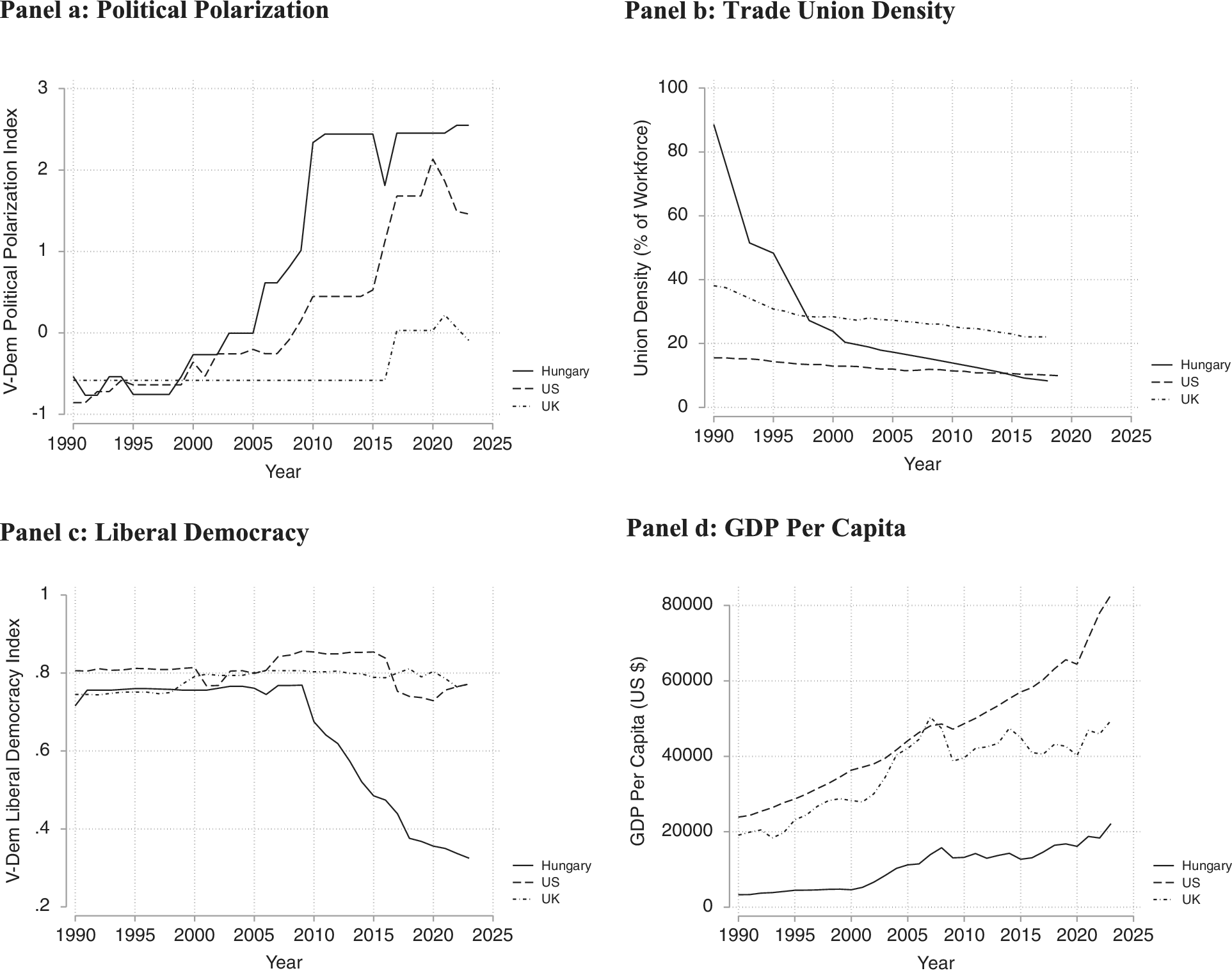
Our comparison of Hungary and the United States accounts for two key factors that Americanist scholars identify as causally important: union power and partisan polarization. As shown in figure 1 (panel a), polarization levels are closely aligned and have followed similar trends in Hungary and the United States. Although Hungary had a much higher union density rate in the early 1990s, it has since declined sharply, resulting in similar levels in both countries today (figure 1, panel b). However, Hungary also has some important differences with the United States. It is a small, post-communist, Eastern European country with a vastly different political history and political culture, and it is far less affluent than the United States.
Political Polarization, Liberal Democracy, Unionization Rate, and GDP Per Capita in Hungary, the United Kingdom and the United States (1990-2023)
Source: OECD/AIAS ICTWSS (2023) and World Bank (2025a).
Note: The V-Dem Political Polarization Index (v2cacamps) measures the extent to which a society is divided into antagonistic political camps. It ranges from 0 to 4. The V-Dem Liberal Democracy Index (v2x_libdem) measures a country’s adherence to democratic principles, combining individual country scores on the protection of individual liberties, rule of law, and judicial/legislative constraints on the executive. It ranges from 0 to 1.

Figure 1 Long description
Panel a at top left plots V-Dem Political Polarization Index on the y-axis from minus 1 to 3 and year on the x-axis from 1990 to 2025. Hungary shows a sharp rise after 2010, peaking near 3 by 2023. US rises steadily after 2000, peaking near 2. UK remains lower, peaking below 1. Panel b at top right shows union density as percent of workforce on the y-axis from 0 to 100. Hungary starts above 80 percent in 1990, dropping steeply to below 10 percent by 2023. US and UK start lower and decline more gradually, with US below 10 percent and UK near 20 percent by 2023. Panel c at bottom left plots V-Dem Liberal Democracy Index from 0 to 1. Hungary declines sharply after 2010 from about 0.8 to below 0.4 by 2023. US and UK remain high, fluctuating around 0.8 to 0.9. Panel d at bottom right shows G D P per capita in US dollars from 0 to 80,000. US rises steeply, reaching about 80,000 by 2023. UK rises moderately to about 50,000. Hungary remains much lower, below 20,000 throughout. Legends in each panel distinguish Hungary (solid line), US (dashed), and UK (dotted).
To allay these concerns, we also compare the United States to the United Kingdom. Although polarization in the United Kingdom remains low, it is increasing (figure 1, panel a), and the unionization rate, which is relatively low, has also declined (figure 1, panel b). Both countries are also long-established Western democracies with LMEs (Hall and Soskice Reference Hall and Soskice2001). Adding the comparison to the United Kingdom also helps address concerns about the potential effects of differences in national wealth levels (figure 1, panel d).
This comparative approach allows us to isolate our key variable—wage-setting institutions—while controlling for alternative explanations (Slater and Ziblatt Reference Slater and Ziblatt2013). Because Hungary and the United Kingdom, which have similar wage-setting institutions, have both adopted far more generous minimum-wage policies than the United States yet all three countries share other characteristics that scholars have identified as theoretically salient, we hope to convince readers that institutions are an important part of the explanation for the different outcomes. This comparison therefore adopts a theory-building logic whose objective is to illustrate and evaluate a theory’s explanatory power, rather than to explicitly test it (George and Bennett Reference George and Bennett2005; Skocpol and Somers Reference Skocpol and Somers1980).
Before proceeding to the case studies, we should also address some common objections to this comparative framework. One objection is that Hungary and the United States are not comparable because Hungary is less democratic than the United States. Although Hungary has experienced autocratization in recent years, before 2010 the United States and Hungary had nearly identical scores on the V-Dem Liberal Democracy Index (Coppedge et al. Reference Coppedge, Gerring, Knutsen and Lindberg2021; see figure 1, panel c). Hungarian governments raised minimum wages regularly before and after 2010, so autocratization is not a convincing explanation for the greater frequency of wage adjustments in Hungary. Another objection is that lower polarization in the United Kingdom creates greater demand for minimum-wage adjustments and makes increases more likely. Although polarization is less pronounced (figure 1, panel a), it has increased since 2017, yet governments have continued to adjust the minimum wage annually. Finally, some may think that these three countries should not be compared because the United States has a federal system of government and the others are unitary states. Yet federalist systems are not characterized by high levels of stagnation in the national minimum wage. Of the 11 federal countries with national statutory minimum wages in place from 2000 to 2020,Footnote 7 the average real increase was 192% and the median was 52%.Footnote 8 With one exception, Nigeria, the legislature played no role in minimum-wage–setting, and tellingly, the real value of the minimum wage there fell by 47%. Other countries with a federal system also raised the minimum wage far more frequently than the United States: an average of 12 times (the median is 15 times) as opposed to just twice in the United States.Footnote 9 In the next section we show in greater detail how US wage-setting institutions are the most powerful explanation for its outlier status.
The United States
The United States’ peculiar system of minimum-wage setting, which gives Congress statutory authority over the federal minimum wage, creates an institutional obstacle course unlike any other country in the world. Legislators who support raising the minimum wage must build a bipartisan coalition and clear three veto points—the House, the Senate, and the president— to win passage (Gitterman Reference Gitterman, Béland, Howard and Morgan2014). Super-majoritarian institutions, procedural rules, and the need to reconcile legislation between chambers before sending a bill to the president create additional roadblocks and opportunities to derail legislation. In the House, for example, the majority party can refuse to hold hearings, leaving minimum-wage bills to languish in committee. In the Senate, minority parties have more power than in the House because limiting debate and amendments from the floor normally requires unanimous consent, which the majority leader must negotiate with both parties. Minority parties can therefore usually move to attach amendments to bills from the floor, which opens avenues for supporters of the minimum wage to force it onto the agenda. The need to win 60 votes to overcome a filibuster, however, means that bills that do not have bipartisan support are unlikely to become law.Footnote 10 By preventing the minimum wage from coming to a vote, which its opponents are keen to do given its popularity, legislators who oppose it often do not even have to vote against it (Witko et al. Reference Witko, Morgan, Kelly and Enns2021). Should both chambers settle on a bill, a presidential veto, which requires a two-thirds majority to override, or the mere threat of one, erects an additional roadblock to change. American political institutions allow for a diffusion of responsibility that is nearly impossible in settings where wage setting is centralized in the executive.
This institutional setting confers systematic advantages to organized interests that oppose the minimum wage. In the United States as elsewhere, employers are the primary interest group opposing minimum-wage increases, and labor organizations are the main force supporting higher minimum wages. In Congress, employers join forces with the GOP (Republicans), which is ideologically predisposed against raising the minimum wage, whereas unions are more tightly aligned with Democrats. The political maneuvering around the minimum wage therefore typically involves a coalition of labor-based interest groups, Democrats, and some moderate Republicans confronting a coalition of employers and the GOP. The business community has greater resources for lobbying than other interest groups, and it deploys them to derail legislation that it opposes (Baumgartner et al. Reference Baumgartner, Berry, Hojnacki, Kimball and Leech2009). Because minimum-wage bills must clear many hurdles to secure passage, opponents have numerous opportunities to prevent the bill from landing on the president’s desk. Labor organizations and their allies, by contrast, have fewer resources than business and must navigate an institutional and procedural gauntlet for the bill to become law.
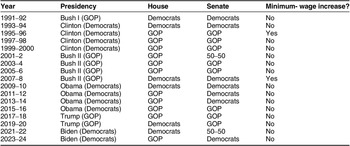
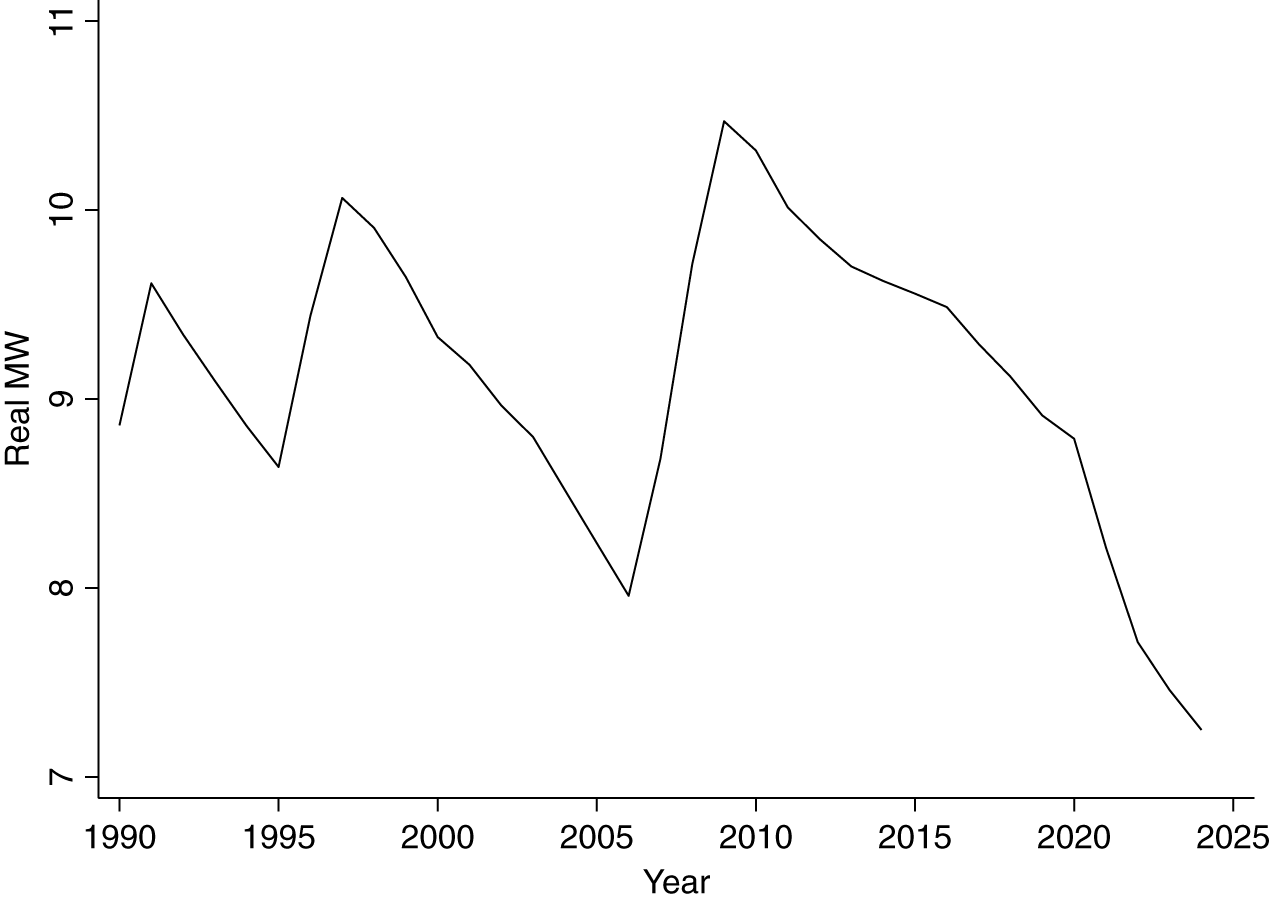
The consequences of these political institutions and vesting Congress with authority over the minimum wage are apparent in table 1 and figure 2. The president has only signed minimum-wage bills into law two times since 1991; as a result, its real value has fallen by almost 20%. The first increase took place in 1996 when Democrats held the presidency and the GOP controlled both chambers, and the second was in 2007 when the GOP held the presidency and Democrats had majorities in both chambers. A good place to begin our analysis, then, is with these successful efforts to raise the minimum wage. After that, the analysis proceeds to failed efforts, focusing first on Republican administrations (Bush (I and II) and Trump) and then on Democratic administrations (Clinton, Obama, and Biden).
Party in Control of the Presidency, the House, and the Senate (2001–24)

Table 1 Long description
Beginning at the top row, the table lists years from 1991–92 through 2023–24. For each period, columns show the president’s name and party, House control, Senate control, and whether a minimum-wage increase occurred. In 1991–92, Bush I (G O P) was president, House and Senate were Democratic, no increase. In 1993–94, Clinton (Democrats), Democratic House and Senate, no increase. In 1995–96, Clinton (Democrats), G O P House and Senate, minimum-wage increase occurred. In 1997–98 and 1999–2000, Clinton (Democrats), G O P House and Senate, no increase. In 2001–2, Bush II (G O P), G O P House, Senate split 50–50, no increase. In 2003–4 and 2005–6, Bush II (G O P), G O P House and Senate, no increase. In 2007–8, Bush II (G O P), Democratic House and Senate, minimum-wage increase occurred. In 2009–10, Obama (Democrats), Democratic House and Senate, no increase. From 2011–14, Obama (Democrats), G O P House, Democratic Senate, no increase. In 2015–16, Obama (Democrats), G O P House and Senate, no increase. In 2017–18, Trump (G O P), G O P House and Senate, no increase. In 2019–20, Trump (G O P), Democratic House, G O P Senate, no increase. In 2021–22, Biden, Democratic House, Senate split 50–50, no increase. In 2023–24, Biden (Democrats), G O P House, Democratic Senate, no increase. Minimum-wage increases occurred only in 1995–96 and 2007–8, both during divided government.
Real Value of the U.S. Federal Minimum Wage in 2024 Dollars
Source: U.S. Department of Labor (2025) and World Bank (2025b).
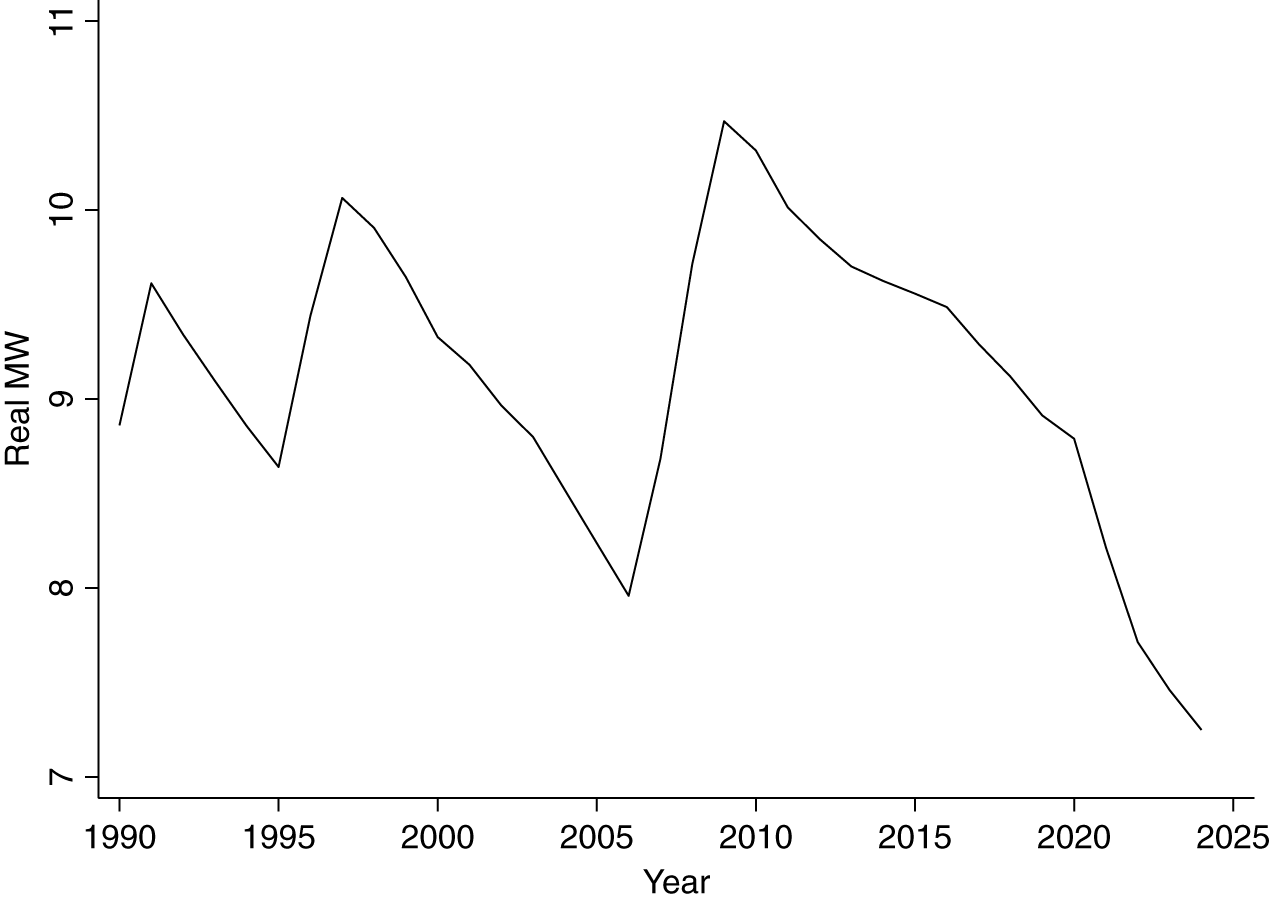
Figure 2 Long description
The horizontal axis is labeled Year, spanning from 1990 to 2025 in increments of five years. The vertical axis is labeled Real M W, ranging from 7 to 11. The line starts near 9 in 1990, rises above 9 by 1995, dips below 9 by 2000, then climbs to a peak above 11 around 2010. After 2010, the line trends downward, falling below 8 by 2025. The overall pattern shows fluctuations in the 1990s and early 2000s, a peak in the late 2000s, and a steady decline after 2010.
The 1996 increase under President Clinton is notable because it was the first time that a minimum-wage increase was signed into law when Republicans controlled at least one chamber of Congress (Gitterman Reference Gitterman, Béland, Howard and Morgan2014, 382). The driving force behind this successful episode was a group of two dozen House Republicans, largely from northeastern states with strong union bases, who worked with Democrats to bring a bill to the floor. Unwilling to vote against a popular issue with voters in an election year, 93 Republicans joined Democrats to pass a bill that combined tax breaks for small businesses with a 90-cent increase in the minimum wage over two years (Weisman Reference Weisman1996a; Reference Weisman1996b; Reference Weisman1996c).
In the Senate, minimum-wage legislation faced a higher hurdle because there was not a contingent of moderate Republicans who supported a minimum-wage hike. To overcome resistance from GOP leadership, Democrats exploited Senate procedures to add minimum-wage amendments to almost every bill on the floor and filibustered bills when that failed (Weisman and Rubin Reference Weisman and Rubin1996). With an election on the horizon and nothing much to show for legislatively, Majority Leader Lott broke the gridlock by bringing a relatively clean minimum-wage bill to the floor that included some tax relief for small businesses, and it passed 74–24 (Cassata Reference Cassata1996; Weisman Reference Weisman1996b). The two chambers hammered out their differences in conference and President Clinton signed the bill when it reached his desk (Rubin Reference Rubin1996a; Reference Rubin1996b).
In the next successful effort to raise the minimum wage in 2007, Democrats held majorities in both the House and the Senate, and the GOP controlled the presidency. With a majority in the House, Democrats quickly delivered on their campaign promise to raise the minimum wage in their first 100 hours, passing a standalone increase, 315–116, with the support of 82 Republicans (Sandler Reference Sandler2007). In the Senate, however, Democrats held fewer than 60 seats and needed to entice some Republicans to join them. GOP Senators demanded tax breaks for small businesses in exchange for their support (Rubin Reference Rubin2007). Over the next three months, House and Senate leaders negotiated over the tax relief component of the bill and reached an agreement in late April (Sandler Reference Sandler2007). The legislation stalled, however, after some Republicans in both chambers criticized the bill. To avoid a presidential veto, Democrats attached the minimum-wage increase to an emergency spending bill for the war in Iraq, a White House priority. After both chambers passed the bill (348–73 in the House, 80–14 in the Senate), President Bush signed it, and the minimum wage rose to $7.25/hour over three years (2007–9; Sandler Reference Sandler2008).
Both cases illustrate the obstacle course that bills must traverse to become law. Both were also cases of divided government in which one party controlled both chambers of Congress and the other party held the presidency. However, these institutional and partisan configurations occurred four other times (Bush I (1991–92), Clinton (1997–98 and 1999–2000), and Obama (2015–16), but no minimum-wage increases were enacted. Neither episode of a minimum-wage bill becoming law, surprisingly, occurred during a period of unified Democratic government. To illustrate how minimum-wage legislation can be easily derailed no matter the partisan configuration in Congress and the presidency, we now analyze the many failed attempts under GOP and Democratic administrations.
Given that Republicans are less supportive of the minimum wage than Democrats, it is unsurprising that no increases to the minimum wage occurred during periods of unified GOP government. In the House, Republican leaders used committee control to prevent minimum-wage bills from reaching the floor (CQ Weekly 2004; West Reference West2017). In the Senate, the GOP fended off efforts by Democrats to tag minimum-wage amendments onto bills important to Republicans with cloture motions, points of order, and unanimous consent agreements; by withdrawing the legislation; or by defeating amendments when they came to a vote (CQ Weekly 2004; Sandler Reference Sandler2006; Swindell Reference Swindell2006; Wayne Reference Wayne2004). When a group of Republican senators tried to attach minimum-wage amendments to other legislation (twice in 2005), these efforts also failed (Swindell Reference Swindell2006).
One effort in 2006, however, nearly succeeded. With a midterm election on the horizon, Democrats in the House, by agreeing to an estate tax reduction, secured sufficient support from moderate Republicans to win committee adoption of a minimum-wage amendment to the fiscal 2007 spending bill for the Departments of Labor, Health and Human Services, and Education. The bill narrowly passed in the House, only to be blocked in the Senate by a filibuster by Minority Leader Reid, who objected to the estate tax provision (Sandler Reference Sandler2006; Wayne Reference Wayne2006).
The odds of a bill reaching the desk of a Republican president improved when Democrats controlled one or both chambers. Under Bush I (1991–92), no action was taken in Congress on the minimum wage even though Democrats controlled both chambers. The president had just signed a bill raising the minimum wage in 1989, and increases took place in 1990 and 1991, making action less urgent. Democrats in the House introduced two bills, but both were referred to committee. Democrats also controlled the House during the last two years of Trump’s first term (2019–20). After taking back the House in the 2018 midterms, Democrats passed a bill to raise the minimum wage to $15/hour (231–199, with three Republicans supporting it). But Republicans controlled the Senate, and Majority Leader McConnell refused to take up the “Raise the Wage Act” (Bose Reference Bose2019), which was referred to committee.Footnote 11
Under Democratic presidents, similar dynamics in the House and the Senate were in play that kept minimum-wage legislation off the president’s desk. A critical period to analyze is the first two years of Clinton’s (1993–94) and Obama’s (2009–10) first terms, when Democrats controlled both chambers of Congress, but no minimum-wage legislation was signed into law. House Democrats introduced three different minimum-wage bills in 1993 and 1994, but they never made it out of committee, because Clinton feared that pressing on the minimum wage would jeopardize other legislative priorities (Greenhouse Reference Greenhouse1993). Under Obama, other issues, most notably the Affordable Care Act, trumped the minimum wage during the first two years of his first term (Bartels Reference Bartels2016). In addition, the last increment of the increase enacted in 2007 occurred in 2009, the first year of President Obama’s first term, and the economic turmoil in the wake of the 2008 financial crisis made congressional Democrats reluctant to press for a minimum-wage hike.
Democratic presidents often faced GOP control in both chambers. Although this configuration boded poorly for winning passage of a minimum-wage bill in Congress, as analyzed earlier, Clinton signed a minimum wage into law in 1996 when Republicans held majorities in both chambers. In Clinton’s second term, Republicans also controlled both chambers. Democrats in the House and the Senate introduced minimum-wage bills in 1998, but Republican leaders referred them to committee. Moderate Republicans who voted for the 1996 bill were not yet ready to support another increase (Nitschke Reference Nitschke1998).
During the last two years of Clinton’s presidency, Democrats in both chambers and even some Republicans introduced minimum-wage bills. Most never made it to the floor for a vote, but with a big election on the horizon, both the House and the Senate passed bills to increase the minimum wage in 2000 (Nitschke Reference Nitschke1999). President Clinton, however, wanted a clean bill that was not loaded down with tax breaks and insisted that the wage hike be implemented over two (not three) years. Unable to iron out differences between the House and Senate bills in conference and facing a looming presidential veto, the GOP leadership in the Senate let the bill die during the lame-duck session (CQ Weekly 2000). Efforts to raise the minimum wage to $15 during Obama’s last two years in office met similar fates. After Republicans took the Senate in the 2014 midterms, they controlled both chambers. Democrats introduced four different bills to raise the minimum wage in 2015 (Fandos Reference Fandos2015), but none made it to the floor for a vote.
The batting average for minimum-wage bills did not improve when Democrats held both the presidency and a majority in one chamber of Congress. Obama faced a GOP House and a Democratic Senate from 2011–14. Democrats introduced minimum-wage bills in both chambers in 2011–12, but having lost their majority in the House and falling short of the 60 votes needed in the Senate, the bills languished in committee. After Obama’s reelection in 2012, Democrats in the House and the Senate revived their minimum-wage bills, but they made no headway. The GOP easily defeated a motion by House Democrats to tag a minimum-wage increase onto a job training bill (Ota Reference Ota2014), and in the Senate, the Democrats could not overcome a Republican filibuster (Peters Reference Peters2014).
President Biden, who supported raising the minimum wage (Yglesias Reference Yglesias2020), also faced steep odds, with a 50–50 split in the Senate during his first two years and a GOP-controlled House in his last two years in office. In January 2021, Democratic lawmakers put forward a $15/hour bill in the Senate and tried to circumvent the filibuster through budget reconciliation by attaching a minimum-wage increase to the coronavirus relief bill (CQ Magazine 2021; Luhby and Krieg Reference Luhby and Krieg2021). Reconciliation would have allowed a simple majority in the Senate to pass the bill, but the Senate parliamentarian blocked this maneuver (Cochrane and Edmondson Reference Cochrane and Edmondson2021).Footnote 12 House Democrats introduced three different bills to raise the minimum wage in 2023–24, but they never made it to the floor. In the Senate, two bills, one by Democrats that would have raised the minimum wage to $15/hour and another by five GOP senators that would have raised it to $11/hour, met a similar fate.Footnote 13
After the bruising defeat of minimum-wage legislation in the Senate in 2021, Senator Elizabeth Warren observed, “If we would get rid of the filibuster, then we wouldn’t have to keep trying to force the camel through an eye of a needle…. Instead, we would do what the majority of Americans want us to do, and in this case that’s raise the minimum wage” (Cochrane Reference Cochrane2021). Warren was certainly correct that in this instance a minimum-wage increase—perhaps not to $15/hour—would have passed the Senate without the filibuster. But as illustrated earlier, multiple veto points make raising the minimum wage a difficult proposition, and the filibuster was not the cause of every failure. As Miller (Reference Miller2023, 1610) observed, “Overcoming veto exceptionalism requires an alignment of the stars that seems as mystical as it is opportunistic. Even when public pressure is high, it takes only one weak link for the moment to be lost.”
Thinking through several counterfactuals illustrates how things might have turned out differently if the president could have raised the minimum wage without congressional approval. Clinton would have endorsed a minimum-wage increase in 2000, and Obama would have also likely raised it in 2012, just before his reelection bid. Biden would have also raised the minimum wage (likely not in 2021 but just before his aborted reelection bid). In these three cases, Democratic presidents who wanted to raise the minimum wage confronted a GOP-controlled House that would have blocked an increase, even without a filibuster in place in the Senate where Democrats held the majority. Facing a tight race in 2020, there was even a fair chance that Trump would have been unable to resist the temptation to raise the minimum wage to increase his chances of victory in key battleground states.
The pivotal role that institutions play is evident if we compare the United States to other countries in the 1970s and 1980s, when polarization was less acute in the United States than it is today. Between 1970 and 1989, the US government agreed to raise the minimum wage three times, resulting in seven increases (in 1974, 1975, 1976, 1978, 1979, 1980, and 1981).Footnote 14 As scholars of the minimum wage in the United States have argued, increases happened more regularly when polarization was at lower levels. However, the United States still raised the minimum wage far less frequently than other OECD countries with national statutory minimum wages in which the executive had authority to raise the minimum wage. Between 1970 and 1989, France raised its minimum wage every year, and New Zealand increased it in 16 of 20 years (ACIL Economics and Policy Pty Ltd 1994; Institut des Politiques Publiques 2025). After their transitions to democracy in 1974 and 1975, respectively, Portugal and Spain raised the minimum wage annually until 1989.Footnote 15
But we do not need to rely solely on hypotheticals and counterfactuals to imagine how different institutions could have produced dramatically different results. We can look to Hungary and the United Kingdom, which both bear important similarities to the United States but place authority over the minimum wage in the executive.
Hungary and the United Kingdom
Hungary and the United Kingdom are striking contrasts to the United States. Both countries’ governments have raised the minimum wage almost every year, regardless of their political stripe, and these annual increases have resulted in a substantial rise in the real value of the minimum wage. Why have governments in these two countries been such consistent supporters of raising the minimum wage? We argue that the institutional setting in which the executive has the power to raise the minimum wage without legislative approval reduces barriers to policy change and creates a political logic that entices governments to support increases to the minimum wage.
Minimum-wage–setting institutions in Hungary and the United Kingdom differ sharply from those in the United States. Whereas raising the US federal minimum wage requires Congress to initiate action and for numerous institutional obstacles to be cleared, in Hungary and the United Kingdom the executive can do it with the stroke of a pen, without authorization from parliament. In both countries, the process begins when specialized bodies make minimum-wage recommendations to the government—in Hungary, a tripartite committee (the Reconciliation Council [OÉT] or the Permanent Consultation Forum [VKF], depending on the year) and in the United Kingdom, the Low Pay Commission, comprising representatives from unions, employers, and academia. These bodies forward recommendations to the government annually, but the government is not obligated to accept them. Thus, although there is more scope for technocrats to participate in wage setting than in the United States, the politicians in the executive branch are the ones who make the final determination.Footnote 16 Once a decision is reached, the Hungarian government simply issues a decree. In the United Kingdom, the Secretary of State for Business and Trade announces amendments to the National Minimum Wage Regulations. Unlike the United States, there are no veto points or super-majoritarian hurdles that must be overcome to raise the minimum wage.
But the formal rules of the minimum-wage–setting process on their own do not explain why executives and ruling parties in the United Kingdom and Hungary, regardless of their political orientation, use this power to deliver substantial wage gains to low-paid workers. As in the United States, labor unions in both countries have closer ties with left-leaning parties (Avdagic Reference Avdagic2005; Draca, Green, and Homroy Reference Draca, Green and Homroy2023; Johnston and Pattie Reference Johnston and Pattie2007; Trif and Szabó Reference Trif and Szabó2023) and conservative parties have closer ties with the business community (Csik, Gulyás, and Kampis Reference Csik, Gulyás and Kampis2015; Stark and Vedres Reference Stark and Vedres2012; Wilks-Heeg and Hopkin Reference Wilks-Heeg and Hopkin2025). However, unlike the United States, the executive has the authority to raise the minimum wage. This centralized executive control over the minimum wage means that employers cannot exploit multiple veto points to block increases, which creates a more level playing field than in the United States.
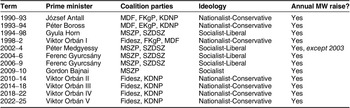
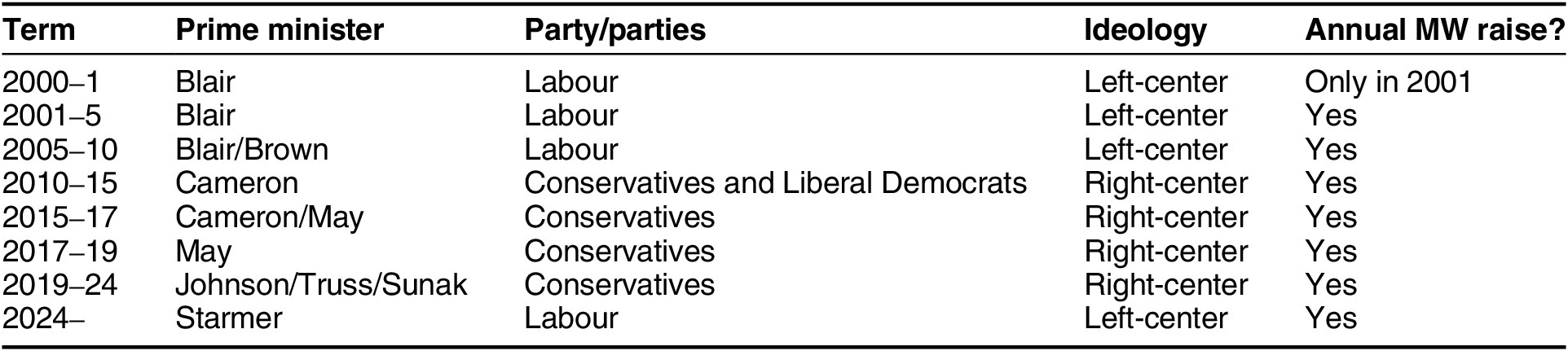
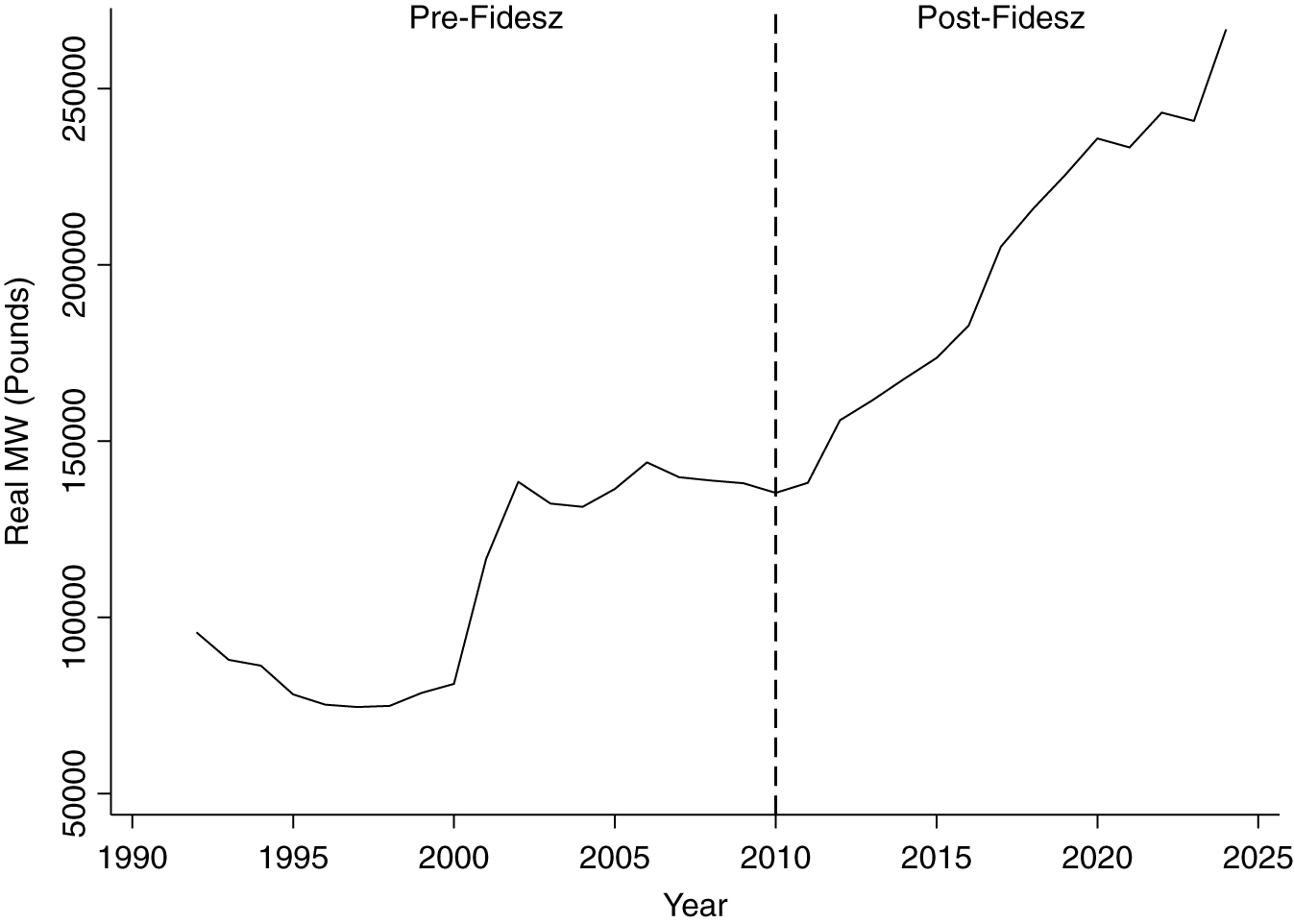
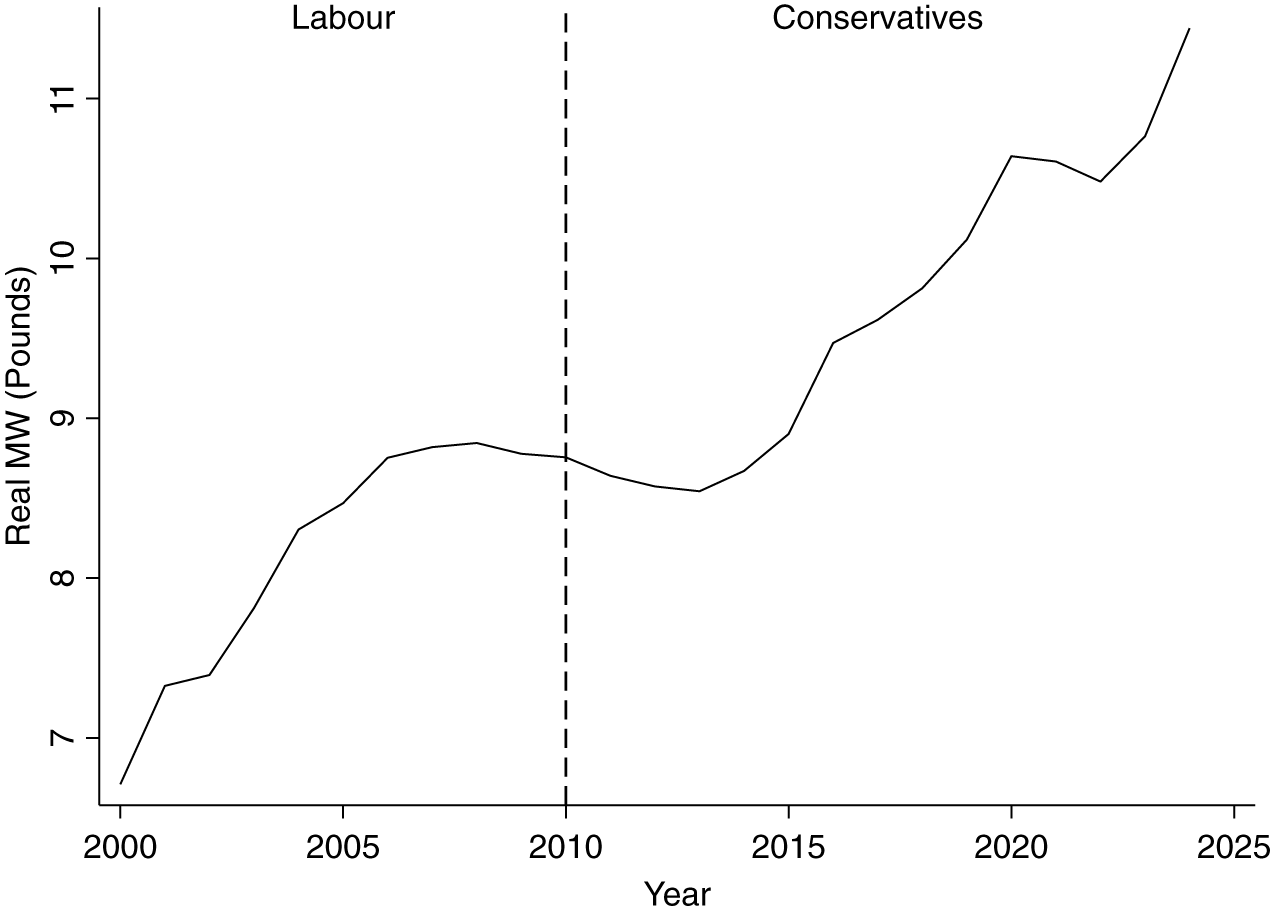
At the same time, executive authority over minimum-wage setting means that it is impossible to diffuse responsibility for failing to raise it. In the United States, there are many ways for minimum-wage bills to fail, and legislation can often be defeated quietly. But in Hungary and the United Kingdom, executives cannot sidestep responsibility for stagnant or declining wages. Because authority is vested with them, voters know whom to blame if the real value of their paycheck declines. In parliamentary systems such as Hungary and the United Kingdom, moreover, executive inaction on the minimum wage affects the fate not only of the prime minister but also of the entire party that they represent. Fear of punishment at the polls, combined with the hope of winning votes by delivering substantial raises during election season, creates strong incentives for politicians, regardless of ideology, to support minimum-wage increases. Both conservative and left-leaning governments have raised the minimum wage almost every year (see tables 2 and 3), and these regular pay hikes have added significantly to its real value (see figures 3 and 4).
Prime Ministers, Coalitions, Ideology, and Minimum-Wage Increases in Hungary (1990-Present)
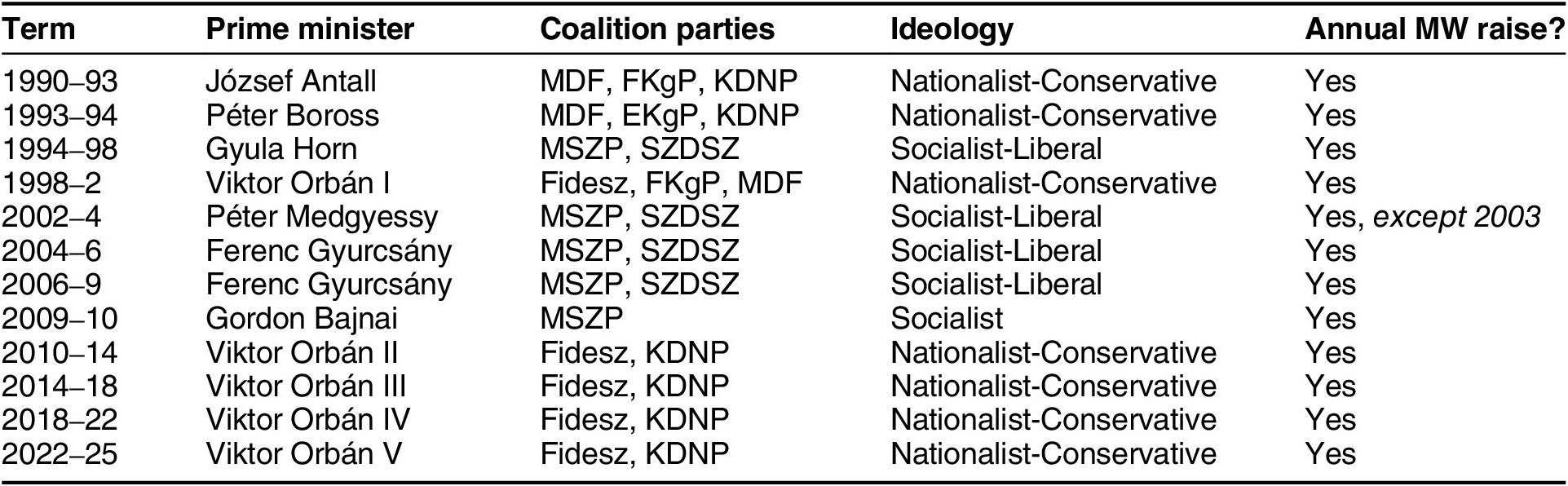
Table 2 Long description
Beginning at the top row, the table shows the term 1990–93 with József Antall as prime minister, coalition parties M D F, F K g P, K D N P, ideology Nationalist-Conservative, annual minimum wage raise Yes. The next row is 1993–94, Péter Boross, M D F, E K g P, K D N P, Nationalist-Conservative, Yes. 1994–98, Gyula Horn, M S Z P, S Z D S Z, Socialist-Liberal, Yes. 1998–2, Viktor Orbán I, Fidesz, F K g P, M D F, Nationalist-Conservative, Yes. 2002–4, Péter Medgyessy, M S Z P, S Z D S Z, Socialist-Liberal, Yes except 2003. 2004–6, Ferenc Gyurcsány, M S Z P, S Z D S Z, Socialist-Liberal, Yes. 2006–9, Ferenc Gyurcsány, M S Z P, S Z D S Z, Socialist-Liberal, Yes. 2009–10, Gordon Bajnai, M S Z P, Socialist, Yes. 2010–14, Viktor Orbán II, Fidesz, K D N P, Nationalist-Conservative, Yes. 2014–18, Viktor Orbán III, Fidesz, K D N P, Nationalist-Conservative, Yes. 2018–22, Viktor Orbán IV, Fidesz, K D N P, Nationalist-Conservative, Yes. 2022–, Viktor Orbán V, Fidesz, K D N P, Nationalist-Conservative, Yes. The annual minimum wage raise column is consistently Yes except for 2003 under Medgyessy. Coalition parties alternate between M S Z P, S Z D S Z for Socialist-Liberal governments and Fidesz, K D N P for Nationalist-Conservative governments, with Viktor Orbán serving multiple consecutive terms.
Prime Ministers, Party, Ideology, and Minimum Wage Increases in the United Kingdom (2000–24)
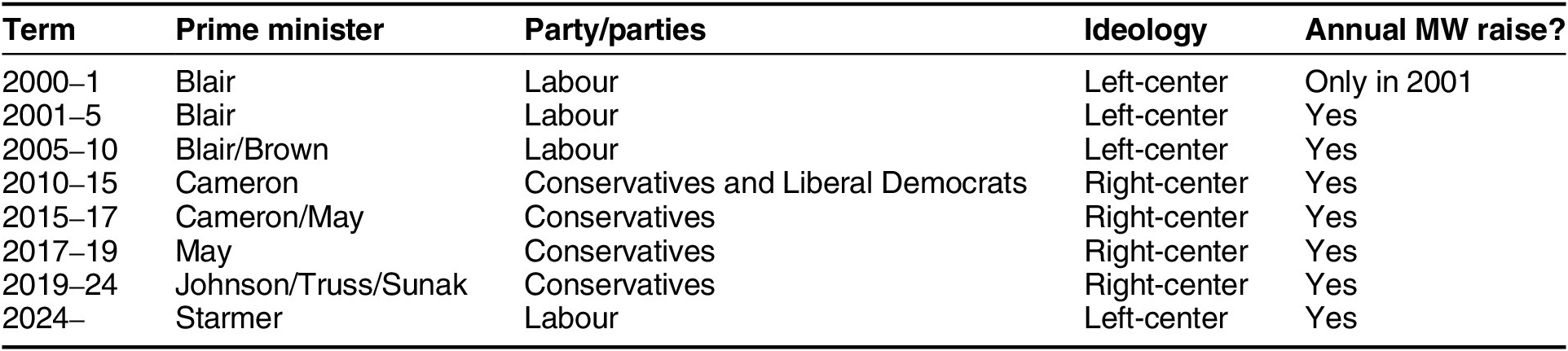
Table 3 Long description
From the top row, the table begins with term 2000–1, prime minister Blair, Labour party, left-center ideology, minimum wage raised only in 2001. Next, 2001–5, Blair, Labour, left-center, annual raise yes. Third, 2005–10, Blair/Brown, Labour, left-center, annual raise yes. Fourth, 2010–15, Cameron, Conservatives and Liberal Democrats, right-center, annual raise yes. Fifth, 2015–17, Cameron/May, Conservatives, right-center, annual raise yes. Sixth, 2017–19, May, Conservatives, right-center, annual raise yes. Seventh, 2019–24, Johnson/Truss/Sunak, Conservatives, right-center, annual raise yes. Last, 2024–, Starmer, Labour, left-center, annual raise yes. Each row details the prime minister(s), party, ideology, and whether minimum wage was raised annually.
Real Value of the Hungarian National Minimum Wage in 2024 ForintsFootnote 22
Source: ILOSTAT (2024) and World Bank (2025b).

Figure 3 Long description
The x-axis is labeled Year, ranging from 1990 to 2025 in increments of five years. The y-axis is labeled Real M W, ranging from 50000 to 250000. The graph is divided by a vertical dashed line at 2010, with Pre-Fidesz labeled above the left section and Post-Fidesz above the right. From 1990 to about 2000, the real minimum wage declines and then rises sharply around 2000, stabilizing until 2010. After 2010, the line shows a steep and continuous increase, peaking near 2024. The trend highlights a significant rise in real minimum wage during the Post-Fidesz period.
Real Value of the U.K. National Minimum Wage in 2024 Pounds
Source: Brewer et al. (2019), Low Pay Commission (2024), and World Bank (2025b).

Figure 4 Long description
The x-axis spans years 2000 to 2025, and the y-axis is labeled Real M W, ranging from 7 to 11. The graph is divided by a vertical dashed line at 2010, with ‘Labour’ above the left section and ‘Conservatives’ above the right. From 2000 to 2008, the line rises from just above 7 to nearly 9. Between 2008 and 2010, the value plateaus around 9. After 2010, under Conservatives, the line dips slightly, then rises steadily from about 2014, reaching above 11 by 2025. The most rapid increase occurs after 2020.
Political scientists would not be surprised that left-leaning governments, which usually have strong ties to trade unions, consistently support minimum-wage increases. It is more surprising, however, that conservatives have also embraced the minimum wage. In fact, as illustrated in figures 3 and 4, although both leftist and rightist governments have consistently endorsed minimum-wage increases, their real value rose even more dramatically when conservative parties were in charge. As in the United States, conservative parties in both countries have packaged minimum-wage increases with compensatory measures to appease their business allies. Fidesz, for example, paired significant wage hikes with reductions in employer social security contributions (Naczyk and Eihmanis Reference Naczyk and Eihmanis2023), and when the Conservatives began to support the minimum wage after years of opposition in 2015, they paired an increase with a cut in the corporation tax, a deal the party framed as a uniquely Conservative “compact” (Financial Times, 2015). Next, we demonstrate that similar political logics drove politicians to raise the minimum wage regardless of their party’s ideology in both Hungary and the United Kingdom.
In Hungary, the last communist government introduced the minimum wage in 1989 (Kertesi and Köllõ Reference Kertesi and Köllõ2003). Although the real value of the minimum wage did not change significantly in the first decade of its existence, frequent adjustments helped maintain minimum living standards during the difficult transition from a controlled to a free-market economy. Painful economic reforms weakened the welfare state and resulted in increased poverty and unemployment (Baxandall Reference Baxandall, Goldberg and Rosenthal2002; Ferge and Tausz Reference Ferge and Tausz2002; Phillips et al. Reference Phillips, Henderson, Andor and Hulme2006). The minimum wage was also a reference point for many social welfare programs, and if its value declined, these programs would fail to provide a sufficient social safety net (Vanhuysse Reference Vanhuysse2003). Both left and right governments approved modest nominal increases during this decade that prevented a substantial erosion in the real value of the minimum wage.
Governments of all political persuasions continued to support annual increases in the 2000s, but the real value of the minimum wage only began to rise dramatically when the Fidesz-led government implemented a record-setting 43.6% wage hike in 2001, followed by an 18.8% increase just months before the 2002 elections (Kertesi and Köllõ Reference Kertesi and Köllõ2003). Fidesz hoped that generous raises would translate into votes from minimum-wage earners, whose numbers had exploded from just 5% to 19% of the workforce (Naczyk and Eihmanis Reference Naczyk and Eihmanis2023). Voters removed Fidesz from office anyway, and after the large hikes in the previous two years, the newly elected left-leaning government opted not to raise the minimum wage in 2003—the first time this ever happened.
The failure to approve even a small raise provided ammunition to the Fidesz-led opposition, which accused the government of welfare retrenchment (Tóth and Neumann Reference Tóth and Neumann2004). Annual increases resumed, although they were more modest in scale than under Fidesz. In real terms, the value of the minimum wage was relatively flat through 2010 due largely to the severe economic crisis and conditionalities in the IMF’s 2008 rescue package, which called for minimum-wage restraint (Connolly and Traynor Reference Connolly and Traynor2008). The only real increases that occurred between 2003 and 2010 coincided with the lead-up to the 2006 elections. The Fidesz-led opposition attacked the government for cuts to social welfare programs, and the government softened the blow by increasing the minimum wage by 3.8% and 5.5% in real terms in 2005 and 2006 (Naczyk and Eihmanis Reference Naczyk and Eihmanis2023).
Before 2010, both left and right governments in Hungary held office for substantial periods of time, but since then the Fidesz party has ruled in coalition with the Christian Democratic People’s Party (KDNP). The minimum wage played a central role in the model of Fidesz’s leader, Viktor Orbán, for a “work-based society,” which aimed to replace the Western-style welfare state with a system that rewarded work and reduced dependence on state-sponsored welfare programs (Szikra Reference Szikra2014; Vidra Reference Vidra2018). As Orbán consolidated his party’s power and weakened democratic institutions (Buzogány Reference Buzogány2017; Csehi Reference Csehi2019; Haggard and Kaufman Reference Haggard and Kaufman2021; Vegetti Reference Vegetti2019), Fidesz has exercised a relatively free hand in realizing this vision. Orbán’s work-based society programs required higher wages if Fidesz was to retain working-class support and prevent the opposition from attacking the government on bread-and-butter issues: this resulted in regular real increases to the minimum wage, and especially large raises in the run-up to elections (Naczyk and Eihmanis Reference Naczyk and Eihmanis2023). Between 2010 and 2024, the real value of the minimum wage soared by 97%.
Similar dynamics were in play in the United Kingdom, which was a relatively late adopter of a national statutory minimum wage.Footnote 17 The Conservative Party had opposed the introduction of the national statutory minimum wage when it was enacted in 1997 during the first Blair ministry (Weishaupt Reference Weishaupt, Ebbinghaus and Naumann2018). Set at 3.6 pounds in 1999, the Labour government was initially reluctant to authorize annual increases to the minimum wage, and for two years its real value sank. But with an election looming in 2001 and mounting concern about low turnout in the urban heartlands, the government announced an inflation-busting 11% increase three months before the election (Atkinson and Elliot Reference Atkinson and Elliot2001). After a landslide victory, the Labour government continued to support rises in the minimum wage that exceeded inflation until the financial crisis hit in 2008. Although the government signed off on the annual wage hikes recommended by the Low Pay Commission, the real value of the minimum wage began to decline, a pattern that continued after Conservatives took the reins of government.
Yet, by the time that Conservatives reclaimed power in 2010, influential party figures had already begun to back away from their opposition to the minimum wage. Party leader David Cameron stated as early as 2005 that the Tories did not want to turn back the clock to 1997. In 2008 Boris Johnson, the mayor of London, became “the conservative face of the Living Wage campaign” by honoring his pre-election pledge to set a new Living Wage for London’s public-sector employees (Weishaupt Reference Weishaupt, Ebbinghaus and Naumann2018, 63). Conservatives also began to see a link between low wages and the rising cost of tax credits (Mabbett Reference Mabbett2023).
Raising the minimum wage thus became part of the Conservative Party’s vision of reducing pressure on the public purse by making work pay. The first Cameron ministry was nevertheless slow to reverse course and only endorsed modest minimum-wage increases during its first years in office. Conservatives abandoned this policy of wage restraint in the run-up to the 2015 election. Aware of the crushing impact of the economic crisis on working-class voters, the party endorsed large increases in the minimum wage that would restore its value to pre-financial crisis levels (Watt and Wintour Reference Watt and Wintour2014; Weishaupt Reference Weishaupt, Ebbinghaus and Naumann2018). Labour followed suit with its own, similarly generous proposal (Wintour Reference Wintour2014). After winning the election, Chancellor Osborne rebranded the national minimum wage as the national living wage and declared, “Let me be clear: Britain deserves a pay rise, and Britain is getting a pay rise” (Elliott and Wintour Reference Elliott and Wintour2015).
Subsequent Conservative governments delivered on this promise. In the shadow of frequent general elections (in 2017 and 2019), Conservatives stuck to their pledge to make work pay by delivering sizable real increases for the next five years. On the eve of the COVID pandemic, they promised to lift the minimum wage to two-thirds of median earnings, a level higher than any other European Union or G7 country (Partington and Butler Reference Partington and Butler2021). Despite the difficult economic situation during the pandemic, the Tory government continued to approve modest increases that prevented a significant erosion in the real value of the minimum wage, and once the pandemic ended, both Conservative and Labour governments have endorsed substantial real increases.
This change of heart by the Conservative Party is evident in its manifestos as well. It is no surprise that the Labour Party committed to raising the minimum wage in every party manifesto between 2001 and 2019. However, that the party of Margaret Thatcher has committed to raise the minimum wage in every election since 2015 is a 180-degree turn for the Tories. A policy that was once highly partisan is now embraced by both the Left and the Right. This contrasts sharply with the United States, where the minimum wage divides the parties. Between 1992 and 2020, the Republican Party’s manifestos never committed to raise the minimum wage, while the Democratic Party pledged to do so before every election except 2004 and 2008.Footnote 18 This weaker commitment to the minimum wage supports our contention about the importance of institutions in explaining the United States’ outlier status.
The Hungarian and United Kingdom cases powerfully illustrate how institutions shape minimum-wage policy outcomes. The concentration of wage-setting authority in the executive branch has enabled executives in both countries to authorize consistent minimum-wage increases, even amid the rise of the Right, increasing partisan polarization, and weakened labor unions. In contrast to the United States, where legislative gridlock and multiple veto points hinder minimum-wage hikes, institutional frameworks in Hungary and the United Kingdom allow the government to act unilaterally. Unable to duck responsibility for falling real wages, governments of all political stripes have not only defended the real value of the minimum wage but have also authorized significant real increases in its value. Governments were likely to be especially generous during election season, when they could offer low-wage workers a raise as a carrot to draw them to the polls and to punch the ballot for the governing party. The consequences of these different institutions are also clear. Where low-wage workers in Hungary and the United Kingdom have experienced a substantial improvement in minimum pay, those in the United States have not.
End-runs around Federal Inaction in the United States
Although US national political institutions have been a roadblock to delivering better pay to workers, federalism provides interest groups with other pathways to raise wages. Advocates of higher minimum wages have responded to federal inaction by acting at the state level (Rose Reference Rose2020). As at the federal level, legislatures have the authority to initiate bills to raise minimum wages in most states, and multiple veto points give business an advantage. Pro-minimum-wage groups usually must win majorities in both legislative chambers and secure the governor’s signature, and many—but not all—state legislative chambers have provisions similar to the US Senate filibuster that require supermajorities to end debate and vote on a question (Curry and Oldham Reference Curry and Oldham2025). This institutional setting has also impeded efforts to pass increases to the minimum wage at the state level.
Despite these obstacles, minimum-wage advocates have faced better odds at passing legislation at the state level than the federal level. When Democrats have controlled both legislative chambers, they have enacted increases to the minimum wage and have even inserted indexing provisions that assure that it keeps up with inflation in some cases.Footnote 19 In red states, labor organizations have depended on ballot initiatives to take minimum-wage increases directly to voters.Footnote 20 Much of this action around minimum wages at the local level was spurred by the Fight for $15 movement, which educated the wider public about the need to raise the minimum wage to $15/hour. As more states and localities adopted higher minimum wages, scholars also exploited this variation to demonstrate that higher minimum wages did not produce disemployment effects (Minchin Reference Minchin2022). Thirty states and the District of Colombia now have minimum wages that exceed the federal minimum wage (Rose Reference Rose2020), and more workers earn these higher minimum wages than the $7.25/hour federal minimum wage (Hickey Reference Hickey2025).
These state-level measures have improved minimum wages for many workers in the United States. However, these gains may be fragile. In Missouri, for example, voters passed a ballot initiative that raised the minimum wage and included an indexing provision, but Republican legislators stripped the indexing provision from the law. Consequently, the value of the minimum wage will erode, and proponents of the minimum wage will have to start from scratch to raise it again. Legislatures in some states (e.g., Arkansas, Florida, Oklahoma), are also taking steps to make it more difficult for citizens to qualify questions for ballots and have raised the approval thresholds needed for passage (Hickey Reference Hickey2025; Lopez Reference Lopez2025). Legislatures in red states have also increasingly enacted preemption laws that restrict the ability of blue cities to increase the local minimum wage (Goodman and Hatch Reference Goodman and Hatch2023).
American labor advocates have also begun to explore alternatives to the statutory minimum wage such as industry standards boards for setting minimum workplace standards, including wages. These tripartite boards make recommendations to state authorities to set standards in a particular industry, rather than throughout the economy. Currently at least six states have created such bodies for fast food (California), nursing homes (Michigan and Minnesota), home care (Colorado and Nevada), and farm work (New York; Center for American Progress 2024). Although these boards have delivered gains for some workers, it is no accident that they are all in blue or purple states. Thus, even though state-level initiatives have helped mitigate the effects of federal inaction on the minimum wage, they are a poor substitute for a federal statutory minimum wage that would address wage stagnation for all. The United States’ peculiar institutional setting has produced a patchwork minimum-wage landscape that has delivered substantial gains for workers in some states while denying them to workers in others.
Conclusion
The comparative analysis of the United States, Hungary, and the United Kingdom underscores the critical role that institutional frameworks play in shaping minimum-wage policies. Although the legislative hurdles complicating policy making on other issues have been well analyzed, our study offers a fresh perspective by highlighting how these same legislative processes have also impeded minimum-wage increases in the United States. By placing the United States within a comparative framework alongside Hungary and the United Kingdom, we emphasize how its institutional design has contributed significantly to its persistent wage stagnation. This comparison reveals that the challenges in the United States are not merely a result of political stalemates but are deeply embedded in the structure of its wage-setting institutions. Vesting the authority to raise the minimum wage with Congress means that any increase to the minimum wage must clear both multiple veto points and numerous procedural hurdles. This institutional setting magnifies the effects of partisan polarization and declining union power, creating further barriers to wage increases.
By contrast, when the executive has the authority to raise wages without legislative approval, institutional differences can lead to vastly different policy outcomes, even under similar political conditions. In both Hungary and the United Kingdom, centralized executive control has facilitated frequent and politically motivated wage hikes. This finding challenges the notion that the obstacles to raising the minimum wage in the United States are mostly due to political divisions. Instead, it highlights how the United States’ unique institutional setup exacerbates these challenges, resulting in prolonged wage stagnation despite strong public support for increases. Our analysis suggests that if the United States were to consider institutional reforms that allow for more centralized decision making in wage policy, it might achieve more timely and substantial wage adjustments. Ultimately, our study provides new insight on the long-standing issue of wage stagnation in the United States, underscoring the importance of institutional design in understanding and addressing these challenges.
Our argument and analysis resonate with the existing literature on welfare state development that shows that high-veto systems have historically influenced both welfare state expansion and retrenchment (Huber and Stephens Reference Huber and Stephens2001; Immergut Reference Immergut1992; Maioni Reference Maioni1998). Yet, scholars of welfare states, despite the minimum wage being one of the most common social welfare policies in the world and one that disproportionately benefits low-wage workers (who tend to be women and ethnic minorities), have not paid much attention to how minimum wages fit into welfare states. As Bonoli (Reference Bonoli2003) argues, minimum wages are “predistributive” in that they reduce the incidence of low wages before government redistribution occurs (Cantillon, Parolin, and Collado Reference Cantillon, Parolin and Collado2020; Mabbett Reference Mabbett2016). The direct costs of raising the minimum wage in the private sector are paid by employers, not the government, and their effects are not captured well by common metrics such as government spending.
Unlike other social welfare policies, however, statutory minimum wages also impinge directly on wage setting through collective bargaining institutions. Historically, unions in countries with high collective bargaining coverage have therefore opposed statutory minimum wages to protect their bargaining autonomy (Furåker Reference Furåker2020; Marx and Starke Reference Marx and Starke2017; Meyer Reference Meyer2016; Nijhuis Reference Nijhuis2013; Soskice and Carlin Reference Soskice and Carlin2009). Today, most western democracies that do not have minimum wages are coordinated market economies (CMEs), such as Denmark, Finland, Norway, and Sweden, and unions negotiate directly with employers to set minimum pay in different sectors of the economy.Footnote 21 LMEs, by contrast, were early adopters of statutory minimum wages, and their comparatively low collective bargaining coverage and use of means-tested benefits have made the minimum wage a central pillar of welfare states. Conservatives may support bringing minimum wages closer to a living wage precisely because doing so can reduce government spending on means-tested benefits (Waltman Reference Waltman2008; Wilson Reference Wilson2017). Ironically, the higher prioritization of market forces in LMEs has also made their welfare states more dependent on state intervention in wage setting.
Finally, this study contributes to debates around left governments and minimum-wage politics. Although most scholars argue that leftist parties champion higher minimum wages as part of their commitment to workers’ rights (Cova Reference Cova2023; Durocher Reference Durocher2024; Feierherd et al. Reference Feierherd, Larroulet, Long and Lustig2023; Grimshaw, Bosch, and Rubery Reference Grimshaw, Bosch and Rubery2014), others contend that the Left’s impact is conditional (Kozák and Picot Reference Kozák and Picot2025; Rueda Reference Rueda2008). Rueda (Reference Rueda2008) shows that left parties only raise minimum wages where corporatism is weak. In their analysis of minimum wage levels, Kozák and Picot (Reference Kozák and Picot2025) counter that wage-setting institutions, not corporatism, matter, finding clearer partisan effects when governments control level setting. As our case studies reveal, however, even conservative governments have been strong supporters of the minimum wage when the executive holds the authority to raise them unilaterally. And even left governments may have difficulty raising the minimum wage if the executive does not have authority to do so.
Acknowledgments
We would like to thank Liz Suhay, Adam Dean, and participants in the American Political Science Association Comparative Labor Workshop (2025) and the American Political Science Association annual meeting (2024) for their helpful comments.

 Open access

