





Abbreviations: ASB, artificially sweetened beverages; DNBC, Danish National Birth Cohort; GW, gestational week; LGA, large for gestational age; SES, socio-economic status; SSB, sugar-sweetened beverages.
The rate of obesity has increased dramatically throughout the last decades(Reference Gulliford and Shibuya1), posing a threat to public health due to the increased burden of associated comorbidities(Reference Powell-Wiley, Poirier and Burke2,Reference Maggio and Pi-Sunyer3) . To avoid excessive weight gain, many people try to lower energy intake, for example, by substituting caloric sweeteners with artificial sweeteners. True artificial sweeteners are synthetic sweetening agents used in a wide range of ‘sugar-free’ (diet) food products and beverages(Reference Ng, Slining and Popkin4–Reference Chattopadhyay, Raychaudhuri and Chakraborty6). However, recent research suggests that artificial sweetener intake is associated with obesity(Reference Sylvetsky, Jin and Clark7,Reference Pearlman, Obert and Casey8) , and the WHO now advises against the use of non-nutritive sweeteners (including both artificial sweeteners and natural sweeteners such as steviol glycosides) for weight loss purposes(9). Some studies have shown impairment in insulin tolerance in aspartame-exposed rats independently of body fat composition(Reference Palmnäs, Cowan and Bomhof10) and increased glucose intolerance in both mice and humans exposed to artificial sweeteners, partly mediated by changes in the gut microbiome(Reference Suez, Cohen and Valdés-Mas11,Reference Suez, Korem and Zeevi12) .
Childhood obesity is associated with an increased risk of metabolic and cardiovascular disease in adulthood(Reference Weihrauch-Blüher, Schwarz and Klusmann13,Reference Robertson, Schaufelberger and Lindgren14) . Several parental and early-life factors have been linked to childhood obesity risk, including duration of breastfeeding(Reference Qiao, Dai and Zhang15), smoking in pregnancy(Reference Rayfield and Plugge16), parental socio-economic status (SES)(Reference Sares-Jäske, Grönqvist and Mäki17), maternal pre-pregnancy BMI(Reference Voerman, Santos and Patro Golab18) and gestational weight gain(Reference Voerman, Santos and Patro Golab18). Obesity rates among children and adolescents are high globally(Reference Di Cesare, Sorić and Bovet19), but intervention strategies to limit weight gain in youth differ in effectiveness(Reference Smith, Fu and Kobayashi20), underscoring the need for primary prevention strategies.
Although the WHO does not recommend artificial sweetener consumption for weight management, pregnant women with obesity or diabetes are recommended to substitute sugar-sweetened beverages (SSB) with artificially sweetened beverages (ASB) to reduce weight gain during pregnancy in some countries(21). However, ASB consumption in pregnancy has previously been associated with overweight in infancy, early childhood and mid-childhood(Reference Plows, Aris and Rifas-Shiman22–Reference Azad, Sharma and de Souza24). Yet, there is conflicting evidence in the field(Reference Li, Wang and Zhang25), as others have found no association(Reference Gillman, Rifas-Shiman and Fernandez-Barres26).
Several hypotheses have been proposed to explain the association between ASB consumption and overweight in childhood, including metabolic programming, influence on sweet taste preference and influence on the human microbiome and microbiome-dependent glycaemic response(Reference Suez, Cohen and Valdés-Mas11,Reference von Poser Toigo, Huffell and Mota27,Reference Sylvetsky, Conway and Malhotra28) . It has been demonstrated that artificial sweeteners can cross the placenta into the fetal circulation, highlighting the possibility of prenatal exposure(Reference Halasa, Sylvetsky and Conway29,Reference Leth-Møller, Duvald and Stampe30) . However, the underlying mechanism for the association has not yet been established(Reference Archibald, Dolinsky and Azad31). Moreover, postnatal exposure to artificial sweeteners through breast milk has been established(Reference Stampe, Leth-Møller and Greibe32,Reference Sylvetsky, Gardner and Bauman33) .
To expand the knowledge on the safety of ASB consumption during pregnancy regarding offspring obesity, we aimed to examine the association between ASB and SSB consumption during pregnancy and offspring overweight from birth to 18 years of age. Additionally, we aimed to evaluate this association with SSB consumption and compare the two groups.
Methods
Study design and data collection
In this nationwide cohort study, we utilised data from the Danish National Birth Cohort (DNBC),(Reference Olsen, Melbye and Olsen34) which prospectively enrolled 101 042 pregnant women from 1996 to 2002 to investigate health across generations. The women were followed throughout pregnancy and after birth. Data on the offspring were collected from birth until 18 years of age. The last data were collected in 2022.
The pregnant women were enrolled at their first antenatal visit with their general practitioner(Reference Olsen, Melbye and Olsen34). Pregnant women were asked to participate if they spoke Danish and if they wished to carry their child to term, regardless of ethnic and cultural background. The women who agreed to participate were asked to participate in four interviewer-assisted phone interviews: two during pregnancy scheduled in gestational week (GW) 12 and GW 30 and two after pregnancy when the offspring was approximately 6 and 18 months old. In GW 25, the women completed an FFQ(Reference Olsen, Mikkelsen and Knudsen35). The FFQ has been validated for different variables, but not in totality(Reference Mikkelsen, Olsen and Rasmussen36–Reference Madsen, Bjerregaard and Furtado38). Information on birth outcomes was extracted from the Danish Medical Birth Register. Written questionnaires were distributed to the families at ages 7 years (2005–2010) and 11 years (2010–2014) and to the offspring at ages 14 years (2013–2017) and 18 years (2016–2022). The timeline for the data collection is visualised in online Supplementary eFig. S1.
Population
We included all singleton pregnancies that resulted in a live birth in GW 34 + 0 or later (Fig. 1). We included women who completed the FFQ with information on the consumption of ASB or SSB. We excluded women with diabetes, including those with pre-existing diabetes, newly detected manifest diabetes and gestational diabetes. Information on the diagnosis of diabetes was obtained from the Danish National Patient Register and based on ICD-8 (1977–1993) and ICD-10 codes (1994 onward). We excluded offspring with missing data on weight and length/height at each age of follow-up, but the offspring could be included in analyses for subsequent ages.
Flow chart for the inclusion process. DNBC, Danish National Birth Cohort; GW, gestational week; ASB, artificially sweetened beverages; SSB, sugar-sweetened beverages.

Variables and data sources
Exposure
The exposures were defined as maternal consumption of ASB and SSB during pregnancy. In the FFQ completed in GW 25, the pregnant women were asked: ‘How many glasses/cups of the following beverages have you drunk within the last month?’ One glass/cup was defined as 250 ml. The mothers were asked to indicate the number of glasses consumed of sugar-sweetened and artificially sweetened (diet) carbonated and non-carbonated beverages. They could choose a number per month (none, 1, 2–3), per week (1–2, 3–4, 5–6) or per d (1, 2–3, 4–5, 6–7, 8 or more).
The consumption of ASB was calculated by adding the frequency of artificially sweetened carbonated and non-carbonated beverages. Similar calculations were made for SSB. Frequency of consumption of ASB and SSB was grouped into four exposure groups: never consumption, less than 1 beverage (250 ml) per week, 1–6 beverages per week and 1 or more beverages per d.
Outcome
The primary outcome was large for gestational age (LGA) birthweight and overweight at 5 and 12 months and 7, 11, 14 and 18 years. Length and weight measurements of the offspring in infancy (5 and 12 months) were done by the general practitioner at the 5- and 12-month health visits. The mothers reported these measurements during the last phone interview when the offspring was 18 months old. The measurements throughout childhood and adolescence were done by the parents or the offspring themselves and provided in the written questionnaires at ages 7, 11, 14 and 18 years. To avoid outliers, we excluded values of more than 5 sd from the mean, in either direction (n 489).
The offspring were defined as LGA if their birth weight was above 2 sd with the study population as internal reference material. Postnatal outcomes were based on offspring BMI reported at ages 5 and 12 months and 7, 11, 14 and 18 years. The cut-off value for overweight was BMI + 1·30 sd for boys and BMI + 1·19 sd for girls(Reference Cole, Bellizzi and Flegal39). BMI z-scores were calculated by estimating mean (with sd) BMI dependent on age and sex using linear regression. We then estimated z-scores by subtracting the mean predicted BMI from the individual measured BMI and dividing it by the sd.
Covariates
Several covariates, all potential determinants of childhood obesity, were included in the analyses to control potential confounding and minimise bias (online Supplementary eFig. S2). Maternal age was retrieved from the Danish Civil Registration System(Reference Pedersen40). Maternal pre-pregnancy BMI and physical activity in early pregnancy were provided in the first phone interview (GW 12). The women were asked whether they did any physical activity during pregnancy (yes/no). Gestational weight gain (kg) was provided by the mothers in the third interview. If the women confirmed smoking during pregnancy in any of the first three phone interviews, they were counted as having smoked during pregnancy (yes/no).
The maternal healthy eating index (points/80) was calculated from the FFQ(Reference Bjerregaard, Halldorsson and Tetens41). The diet was rated using a score of 0–80, with 80 being the healthiest. It should be noted that SSB is included in the healthy eating index. The amount of each food item consumed was calculated by multiplying the frequency of consumption, as reported in the FFQ, with standard portion sizes. Total energy intake was then estimated by multiplying the amount consumed with the energy content of food as reported in the food composition tables(Reference Olsen, Mikkelsen and Knudsen35). Paternal BMI was reported in the 4th interview. Duration of breastfeeding was reported in the two postpartum phone interviews. Two variables were created: one describing breastfeeding for more or less than 4 months used for the analysis at 5 months and one describing breastfeeding for more or less than 6 months used for the 12-month and subsequent analyses. The mother’s occupational status defined her SES. If unavailable, the father’s occupational status was used instead. Socio-economic status was grouped into categories: unskilled, other work or receives public benefits; working class, craftsmen, short education or under education; and leaders or long/medium-long education. The criteria for the categorisation are described in further detail elsewhere(Reference Bech, Nohr and Vaeth42).
Statistical analysis
For baseline characteristics, the mean (sd) was calculated for continuous variables and frequencies (%) for categorical variables. The associations between ASB or SSB consumption in pregnancy and offspring overweight were assessed using multiple logistic regression using ‘no consumption’ as a reference. To limit potential confounding, we adjusted for pre-pregnancy BMI, maternal age, maternal healthy eating index, physical activity in early pregnancy, smoking in pregnancy, combined SES, paternal BMI and breastfeeding duration. To evaluate associations between ASB consumption during pregnancy and birthweight and BMI z-scores as continuous measures, we used multiple linear regression to estimate the mean difference and 95 % CI. All analyses were performed as complete case analyses.
A few sub-analyses were performed: one analysis exchanged the maternal healthy eating index with total energy intake, and another analysis included additional adjustment for gestational weight gain. In addition, we designed an isoenergetic substitution model including the same covariates as the main analysis, with total energy intake replacing healthy eating index and with mutual adjustment of the exposures, where ASB was adjusted for SSB and SSB was adjusted for ASB. All analyses were performed as complete case analyses.
All data analysis was performed using R for Windows (version 4.3.1 (2023) (R Foundation for Statistical Computing).
Results
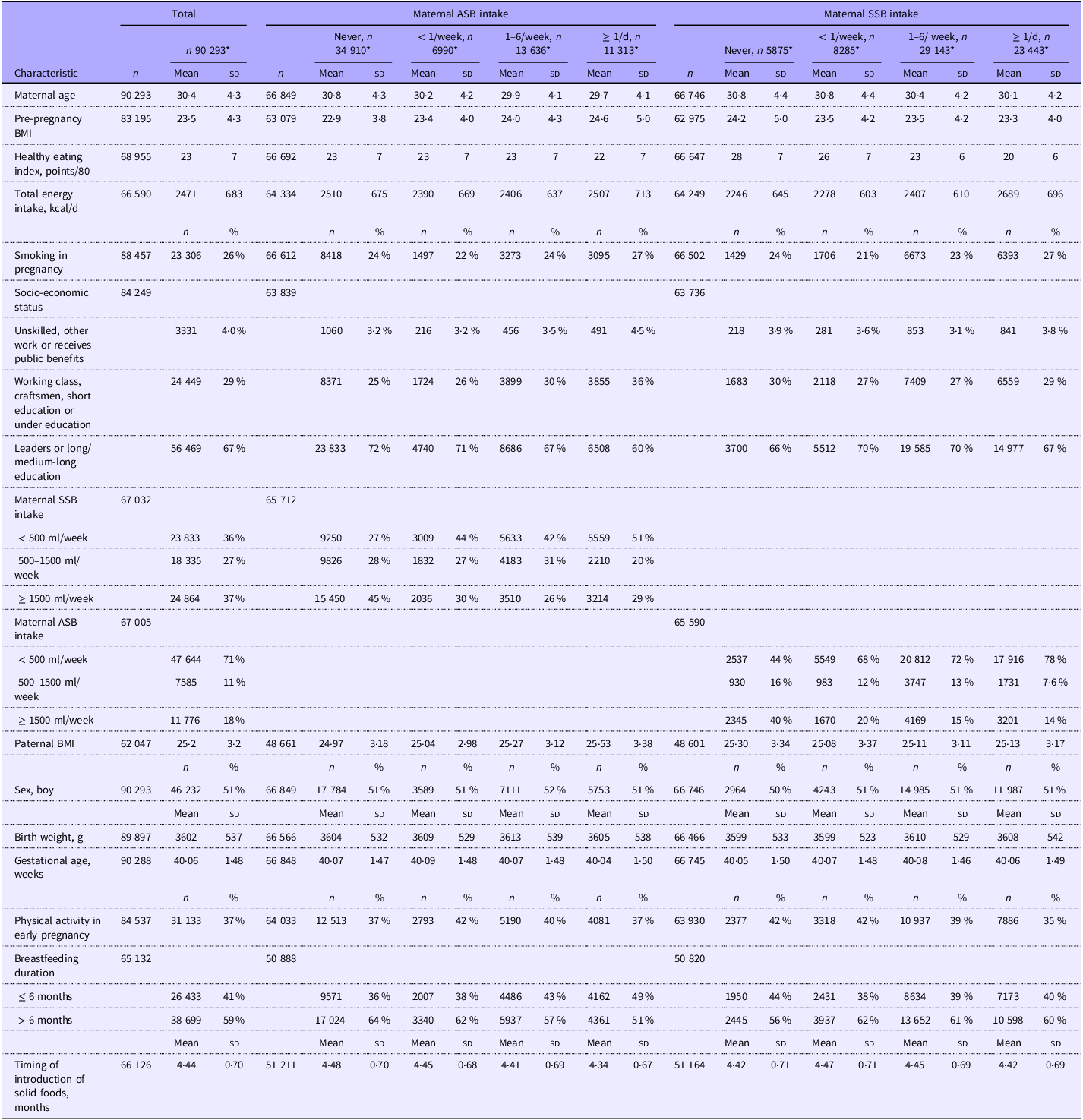
A total of 101 042 pregnancies were enrolled in the DNBC. Of these, 90 060 children born to 83 833 women were eligible to participate in the study; 66 668 women had information on ASB from the FFQ, and 66 568 women had information on SSB from the FFQ (Fig. 1). Pregnant women consuming ≥ 1 ASB/d were younger, had higher BMI, more often smoked and had a lower SES compared with pregnant women with no ASB consumption (Table 1). There was no difference in healthy eating index, offspring sex, birth weight or gestational age at birth. Physical activity in early pregnancy was highest in the < 1 ASB/week group. Women with high ASB intake tended to have a shorter breastfeeding duration compared with the never group.
Characteristics for all live born, singleton offspring born after gestational week 34 to mothers without diabetes in the Danish National Birth Cohort (Mean values and standard deviations; numbers and percentages)

ASB, artificially sweetened beverages; SSB, sugar-sweetened beverages.
* Mean (sd); n (%).
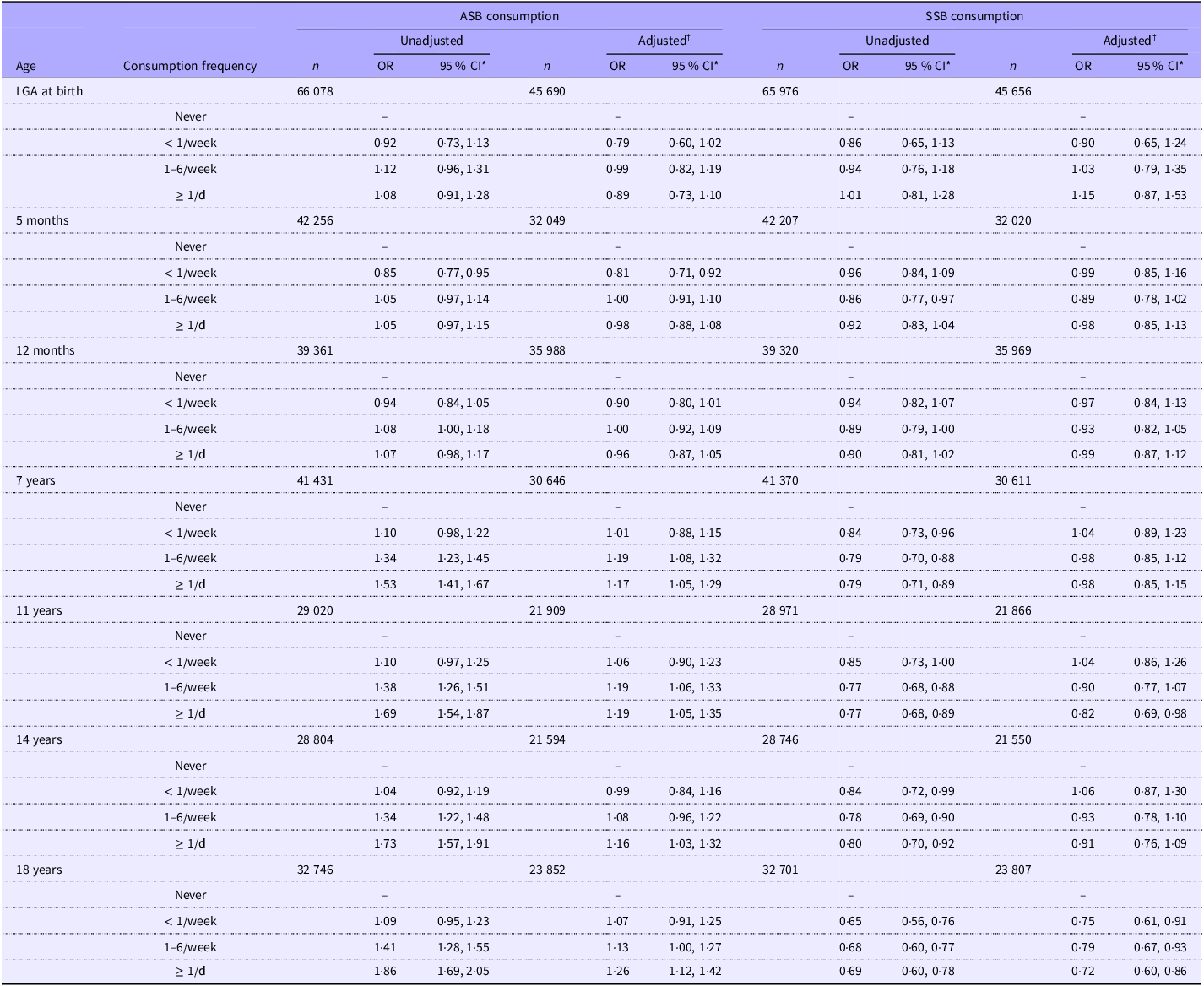
The associations between maternal ASB or SSB consumption and childhood overweight and LGA at birth are shown in Table 2 and Fig. 2. At birth and in infancy (5 and 12 months), we found no association between daily ASB consumption and LGA or overweight after adjustment. At 7, 11 and 18 years, we found higher odds of overweight in offspring whose mothers consumed 1–6 ASB/week or ≥ 1 ASB/d compared with no consumption. The associations attenuated but remained after adjustment (18 years in the ≥ 1 ASB/d group: adjusted OR 1·26 (95 % CI 1·12, 1·42)). At 14 years, we found higher odds for overweight in the ≥ 1 ASB/d group compared with never consumption, but not in the 1–6 ASB/week group. Daily maternal SSB consumption in pregnancy entailed lower odds for overweight at 11 years and 18 years compared with no consumption in both crude and adjusted analyses.
Gestational age birth weight or overweight at different ages dependent on maternal beverage consumption during pregnancy (Odds ratios and 95 % confidence intervals)
ASB, artificially sweetened beverages; SSB, sugar-sweetened beverages; LGA, large for gestational age.
* OR (CI). †Adjusted for maternal pre-pregnancy BMI, healthy eating index, age, smoking during pregnancy, physical activity in early pregnancy, duration of breastfeeding (except at birth), socio-economic status and paternal BMI.
Forest plots summarising adjusted odds ratios for large for gestational weight birth weight or overweight depending on maternal artificially sweetened beverage consumption and age. The adjustment model included maternal pre-pregnancy BMI, healthy eating index, age, smoking during pregnancy, physical activity in early pregnancy, duration of breastfeeding (except at birth), socio-economic status and paternal BMI.

Evaluating the difference in z-score at birth or BMI z-score dependent on maternal beverage consumption is shown; regarding ASB, the largest difference in BMI z-score was seen among the 18-year-olds whose mothers consumed ≥ 1 ASB/d compared with no consumption (BMI z-score 0·07 (95 % CI 0·03, 0·10)) (online Supplementary eTable S1). For SSB, the largest difference in BMI z-score was seen among the 18-year-olds whose mothers consumed ≥ 1 SSB/d compared with no consumption (BMI z-score −0·12 (95 % CI − 0·16, −0·07)) (online Supplementary eTable S1).
While we did not adjust for gestational weight gain in the primary analysis, doing so minimally attenuated the associations, and the associations persisted at ages 7, 11 and 18 years (online Supplementary eTable S3 and eTable S4). Similar results were seen when adjusting for total energy intake, where minimal changes were seen for ASB (online Supplementary eTable S5) and SSB; however, for SSB, the attenuation was more profound (online Supplementary eTable S6). When performing a substitution analysis substituting SSB with ASB and vice versa (see online Supplementary eTables S5 and S6), moderate attenuations were seen for SSB.
Discussion
Our results indicate that daily ASB consumption compared with no ASB consumption during pregnancy is associated with a higher risk of overweight during childhood and adolescence, but not at birth or in infancy. We found a higher risk of being overweight at 7, 11 and 18 years among offspring whose mothers consumed 1–6 ASB/week or ≥ 1 ASB/d during pregnancy. Additionally, we found that consumption of ≥ 1 SSB/d during pregnancy was associated with a lower risk of overweight in the offspring at ages 11 and 18 years compared with no consumption. These results remained after adjustments for known risk factors for childhood obesity and overweight as well as in substitution models. Previous studies have found a higher risk of overweight during infancy in children exposed to the largest amounts of artificial sweeteners(Reference Plows, Aris and Rifas-Shiman22,Reference Azad, Sharma and de Souza24) . The incongruence with our results could be due to different populations and adjustment models. Notably, the observed effect sizes for these associations were modest, and reservations should be kept before basing clinical advice on these results.
We adjusted for a variety of covariates that are potential determinants of childhood obesity. We sought to account for lifestyle variables by adjusting for overall diet quality (healthy eating index), smoking in pregnancy, physical activity, duration of breastfeeding and SES. However, acknowledging that it is an inherent challenge to capture lifestyle factors in an observational study, residual confounding may persist. Our study focused on prenatal and early-life factors, and future investigations may benefit from considering ASB consumption during childhood and adolescence as a potential risk factor. Gestational weight gain was not included in the primary analysis, as we considered it a potential mediator of the association between ASB and childhood overweight, as a previous study showed an association between ASB consumption in pregnancy and higher gestational weight gain(Reference Renault, Carlsen and Nørgaard43).
Additionally, we found that daily consumption of SSB was associated with a trend towards a lower overweight risk in the offspring. Since the main difference between ASB and SSB is the sweetening agent, these findings may indicate that artificial sweeteners, rather than other components of the beverage, account for the association found for ASB. Still, differences between those choosing ASB over SSB remain; hence, residual confounding cannot be excluded. Additionally, we found a trend towards a decreased risk of overweight among children whose mothers reported daily consumption of SSB, seemingly suggesting a protective effect on childhood overweight. It should be noted, as shown in Table 1, that the group reporting daily consumption of ASB and the group reporting daily consumption of SSB differed on several baseline values, which could affect the results. For instance, women who reported daily consumption of SSB tended to have a higher SES, had a lower pre-pregnancy BMI and tended to breastfeed for a longer time compared with women who reported daily consumption of ASB. This indicates that the reference groups are differently composed, which could potentially introduce bias. This should be considered when interpreting results.
When comparing low-calorie beverages and calorie-dense beverages, it is likely to observe confounding due to differences in energy consumption. Indeed, as portrayed in Table 1, total energy intake in kcal was higher in the daily SSB-consumption group than in the daily ASB-consumption group. In a sub-analysis adjusting for total energy intake (kcal) instead of healthy eating index, the results for ASB were minimally attenuated, while for SSB, some regression towards the null was observed (online Supplementary eTable S5 and eTable S6). To further investigate if the substitution of ASB or SSB with other drinks would affect the results, we constructed an isocaloric substitution model. In this model, replacing ASB with SSB was associated with lower weight gain, which is consistent with findings from unadjusted analyses that consumption of ASB is associated with a higher risk of overweight.
The observed association between maternal ASB consumption and offspring overweight manifested in mid-childhood, while we saw no discernible correlation during infancy. There is a substantial time gap between the measurements at 12 months and 7 years, along with a large difference in overweight risk. Keeping in mind that rapid weight gain from 2 to 6 years of age increases the risk of manifest obesity(Reference Geserick, Vogel and Gausche44), longitudinal analyses are called for to fully comprehend the development of overweight in this age period concerning ASB consumption. In infancy, we saw a limited influence of ASB on overweight risk, which could indicate that changes appear when the offspring start choosing their own food to a larger extent. Furthermore, we found the highest OR for overweight among 18-year-olds exposed to ≥ 1 ASB/d during pregnancy. One possibility could be that dietary habits and lifestyle behaviour become increasingly independent of parental behaviours with increasing age(Reference McKeown and Nelson45), while height has mostly stabilised at age 18(Reference de Oliveira, Araújo and Ramos46,Reference Tinggaard, Aksglaede and Sørensen47) .
We found increasing BMI Z-score with increasing consumption of ASB, suggestive of a dose-dependent association between artificial sweetener consumption and risk for overweight in the offspring. One ASB or SSB was defined as 250 ml, corresponding to one regular glass of, for example, artificially sweetened soda. Danish Health Authorities recommend that adults consume no more than 500 ml of soda or non-carbonated sweetened beverages weekly(48). According to our data, this recommendation was followed by 36 % of the women regarding SSB and 71 % of the women regarding ASB (Table 1). Our results highlight the importance of limiting consumption of SSB and ASB, and the low adherence to recommendations is concerning.
As previously described, some artificial sweeteners are transferred to the child via breast milk, enabling postnatal exposure. When the women report consuming artificial sweeteners during pregnancy, we speculate that these patterns continue postpartum, meaning that the children are further exposed to artificial sweeteners in infancy. Early exposure to artificial sweeteners showed contradictory evidence on metabolic effects in a systematic review(Reference Reid, Chauhan and Rabbani49); however, no reports on infant artificial sweetener exposure were included. If the children, who were exposed to artificial sweeteners in utero continue exposure postnatally, this could account for some of the associations observed in our results. Studies on the consequences of infant exposure to artificial sweeteners are warranted to investigate this possible association.
Despite the robust sample size and extended follow-up, limitations inherent in observational studies, such as self-reported data and recall bias, remain in this study. Limitations include the reliance on self-reported beverage consumption, which holds uncertainty and makes it impossible to investigate specific artificial sweeteners. Furthermore, the questionnaire did not include other sources of artificial sweeteners, including tabletop sweeteners. Additionally, there have been substantial changes in artificial sweetener usage patterns since the data collection (1996–2003), with an increase in consumption(Reference Sylvetsky, Figueroa and Rother50), which could impact the generalisability of our findings today. There is evidence of some selection bias in the DNBC, and despite inclusive inclusion criteria, some segments of the population may be underrepresented(Reference Jacobsen, Nohr and Frydenberg51).
Adjusting for a variety of confounders eliminated many potential participants from this study. Thus, the adjusted results are based on fewer participants than those available for the unadjusted analyses, resulting in less precise adjusted estimates. An influence by confounding factors cannot be discounted despite adjustment due to the uncontrolled environment intrinsic in observational studies. Characteristics for the participants at each follow-up are shown in online Supplementary eTable S2. When interpreting the results, it is important to consider that due to the extensive sample size, even minor associations may achieve statistical significance. Thus, the clinical implications of these associations may be modest.
Presently, women with diabetes and/or overweight are recommended to substitute SSB with artificially sweetened alternatives during pregnancy(21). While this may be motivated by goals of limiting gestational weight gain(Reference Rasmussen, Catalano and Yaktine52,Reference Johansson, Bodnar and Stephansson53) , this study suggests adverse long-term effects, as there is an observed tendency towards an increased risk of overweight in the offspring if these recommendations are met. We excluded women with diabetes in this analysis, but existing evidence shows an increased OR of overweight among children born to women who had gestational diabetes and were exposed to artificial sweeteners during pregnancy(Reference Zhu, Olsen and Mendola23).
In conclusion, we found in adjusted analyses that daily consumption of ASB during pregnancy increased the odds of overweight in mid-childhood and adolescence, but not in infancy. Furthermore, we found a trend suggesting that daily consumption of SSB during pregnancy was associated with a decreased risk of overweight in adolescence. Longitudinal evidence for the offspring at ages 2–6 years is warranted to better understand the association.
Acknowledgements
The work presented in this article is supported by the Novo Nordisk Foundation (grant NNF21SA0069371), A.P. Møller og Hustru Chastine Mc-Kinney Møllers Fond til almene Formaal (grant L-2022-00216) and Kong Christian den Tiendes Fond (grant 51/2023). The Novo Nordisk Foundation, A.P. Møller og Hustru Chastine Mc-Kinney Møllers Fond til almene Formaal and Kong Christian den Tiendes Fond had no role in the design, analysis or writing of this article.
The DNBC was established with a significant grant from the Danish National Research Foundation. Additional support was obtained from the Danish Regional Committees, the Pharmacy Foundation, the Egmont Foundation, the March of Dimes Birth Defects Foundation, the Health Foundation and other minor grants. The DNBC Biobank has been supported by the Novo Nordisk Foundation and the Lundbeck Foundation.
Follow-up of mothers and children have been supported by the Danish Medical Research Council (SSVF 0646, 271-08-0839/06-066023, O602-01042B, 0602-02738B), the Lundbeck Foundation (195/04, R100-A9193), the Innovation Fund Denmark (0603-00294B, 09-067124), the Nordea Foundation (02-2013-2014), Aarhus Ideas (AU R9-A959-13-S804), University of Copenhagen Strategic Grant (IFSV 2012) and the Danish Council for Independent Research (DFF – 4183-00594 and DFF – 4183-00152).
March of Dimes Birth Defects Foundation (6-FY-96-0240, 6-FY97-0553, 6-FY97-0521, 6-FY00-407), the European Union (QLK1-2000-00083), the Danish Medical Research Foundation (9601842 and 22-03-0536), the Health Foundation (11/263-96) and the Heart Foundation (96-2-4-83-22450) supported the collection, development and elaboration of the dietary data.
E. M. G.: Conceptualisation, methodology, validation, formal analysis, writing – original draft, writing – review and editing, visualisation, project administration, funding acquisition. B. H. B.: Conceptualisation, methodology, writing – review and editing, supervision. S. S.: Conceptualisation, methodology, writing – original draft, writing – review and editing, supervision. T. I. H.: Methodology, resources, writing – review and editing. A. A. B.: Methodology, resources, writing – review and editing. S. F. O.: Methodology, resources, writing – review and editing. P. G. O.: Conceptualisation, methodology, writing – review and editing, supervision, project administration, funding acquisition. M. L-M.: Conceptualisation, methodology, validation, formal analysis, writing – review and editing, supervision, project administration.
The authors declare no conflicts of interest.
Supplementary material
For supplementary material/s referred to in this article, please visit https://doi.org/10.1017/S0007114525000455.



 Open access

