





A healthy and nutritious diet has long been recognised as an important component of protecting population health(Reference Stafford1). Neufeld et al. define a healthy diet as ‘health-promoting and disease-preventing. It provides adequacy, without excess, of nutrients and health-promoting substances from nutritious foods and avoids the consumption of health-harming substances’ (Reference Neufeld, Hendriks, Hugas, von Braun, Afsana, Fresco and Hassan2). Food-based dietary guidelines (FBDGs) outline the composition of a healthy diet by grouping foods based on nutritional and health-promoting characteristics(Reference Herforth, Arimond and Álvarez-Sánchez3). However, there is evidence that compliance with recommendations in FBDGs is low, and Leme et al. found almost 40 % of people living in low- and high-income countries do not adhere to FBDGs with many exceeding intakes of discretionary high fat, sugar and salt (HFSS) foods(Reference Leme, Hou and Fisberg4).
The over consumption of HFSS foods increases the risk of overweight, obesity and diet-related noncommunicable diseases (NCDs), including cardiovascular disease (CVD), type 2 diabetes, and some cancers(Reference Herforth, Arimond and Álvarez-Sánchez3,Reference Nettleton, Brouwer and Geleijnse5–Reference Wang, Afshin and Yakoob7) . A review of the global burden of diet-related disease identified diets high in salt, trans fats, and sugar-sweetened beverages and low in wholegrains and fresh fruit and vegetables as major risk factors for the development of diet-related NCDs(Reference Afshin, Sur and Fay8). Diet-related NCDs are one of the leading causes of death in Europe and this is also true for Ireland where it is estimated 9,000 deaths per year are a result of CVD(Reference Afshin, Sur and Fay8,9) . It is estimated that dietary improvement could prevent one in five deaths globally and a quarter of European deaths from NCDs(Reference Afshin, Sur and Fay8,Reference Gressier, Swinburn and Frost10) . With many countries globally, including Ireland, experiencing an ageing population, the prevention of diet-related NCDs and their associated risk factors, such as overweight and obesity, is of priority(Reference Milte and McNaughton11,Reference Schoufour, Voortman and Franco12) . Reducing NCD risk, can enable people to live healthily for longer, increasing quality-adjusted life years(Reference Afshin, Sur and Fay8). Improvements in diet quality through increasing intakes of fresh fruit, vegetables and wholegrains whilst reducing consumption of HFSS foods, is an effective strategy to reduce population-wide NCD risk and promote healthy aging throughout the life course(Reference Afshin, Sur and Fay8). The aim of this review was to investigate the healthfulness of the supermarket food environment and its relationship with food choice, purchase and diet-related health outcomes.
Determinants of diet-related health outcomes
The determining factors of diet-related health outcomes are varied and complex, resulting from reciprocal relationships which influence food choice, dietary intake, and subsequent health outcomes. Given this complexity, various models have been developed to describe and explain the determining factors of excess weight accumulation and/or development of diet-related NCDs(Reference Bennett, Hall and Hu13).
The Socio-Ecological Model (SEM) proposes that individual-level outcomes (such as over consumption of foods/nutrients, as described above) are affected by factors beyond the individual, including social, environmental, cultural and economic conditions(Reference Bronfenbrenner14). Davison and Birch considered the context of food intake and energy balance, outlining a contextual model, focusing on child weight status, using ecological systems theory, outlined in Fig.1 (Reference Davison and Birch15). This model describes the micro-level factors including individual child characteristics and child risk factors, the meso-level factors including parenting styles and family characteristics, and the macro-level factors including community, demographic and societal characteristics contributing to child weight status, leading to childhood obesity(Reference Davison and Birch15). A review of the contribution of each layer within the SEM to the accumulation of excess weight in childhood, found that meso and macro-level determinants such as parental demographic and neighbourhood characteristics made the most substantial contribution to predicting childhood weight accumulation in a population in New Jersey, United States of America (USA)(Reference Ohri-Vachaspati, DeLia and DeWeese16).
Childhood overweight: a contextual model and recommendations for future research. Davison & Birch, Obesity Reviews, 2: 159-171 2001. Copyright © 2001 by Wiley Publications. Reprinted by permission of Wiley Publications(Reference Davison and Birch15).

The importance of meso and macro-level factors in excess weight accumulation is also recognised in the Foresight Obesity Map (Reference Butland, Jebb and Kopelman17). The Obesity Map (Fig.2) was one of the first times the complex nature of factors underlying and driving obesity was explained as a system-wide issue(Reference Steele, Mialon and Browne18). This map is based on systems thinking, which includes well-established approaches in other disciplines, complemented by innovative methods to guide how to consider the bigger picture related to the topic of obesity(19). Systems thinking is based on the idea that real-world phenomena exist within systems of contextually specific dynamic actors and factors. For example, in nutritional sciences, a person’s nutritional status is determined by a wide range of factors, e.g. genetics, food security, disease status and potential for absorption/increase requirements, food preferences, food environment and lifestyle factors(Reference Allender, Brown and Bolton20). Together, these determinants and factors make up a complex system. In the Foresight Obesity Map, the reciprocal relationships between societal influences, individual psychology, individual activity, activity environment, biology, food product and food consumption are described(Reference Butland, Jebb and Kopelman17).
Foresight Obesity Systems Map. Figure sourced from Tackling Obesities: Future Choices Report (2007). Reprinted with permission of Foresight, Government Office for Science(Reference Butland, Jebb and Kopelman17). Contains public sector information licenced under the Open Government License v3·0 (www.nationalarchives.gov.uk/doc/opengovernment-licence/version/3/).

Both the SEM and Foresight Obesity Map demonstrate how factors, beyond the individual, play an important role in the development of overweight, obesity and diet-related NCDs in the population. Both also show how our living environment, including the food environment, are an important determinant in food choice, consumption and the development of overweight, obesity and diet-related NCDs(Reference Brug21,Reference Hruby and Hu22) .
The food environment
Evidence supports a relationship between the availability and prominence of food in the food environment, food choice and health outcomes(Reference Story, Kaphingst and Robinson-O’Brien23,Reference Pineda, Stockton and Scholes24) . Swinburn et al. define the food environment as ‘the collective physical, economic, policy, and sociocultural surroundings, opportunities, and conditions that affect people’s food and beverage choices and nutritional status’(Reference Swinburn, Sacks and Vandevijvere25). A health-enabling food environment has been described as one where the goods, beverages and meals which support dietary intakes in line with population FBDGs are available, affordable and accessible to all(Reference Swinburn, Kraak and Rutter26). However, today it is well documented that across the Western world our food environments are now considered ‘obesogenic’ meaning energy-dense and nutrient-poor foods are readily available whilst the environment is amenable to a sedentary lifestyle(Reference Lake and Townshend27–Reference Cooksey-Stowers, Schwartz and Brownell29).
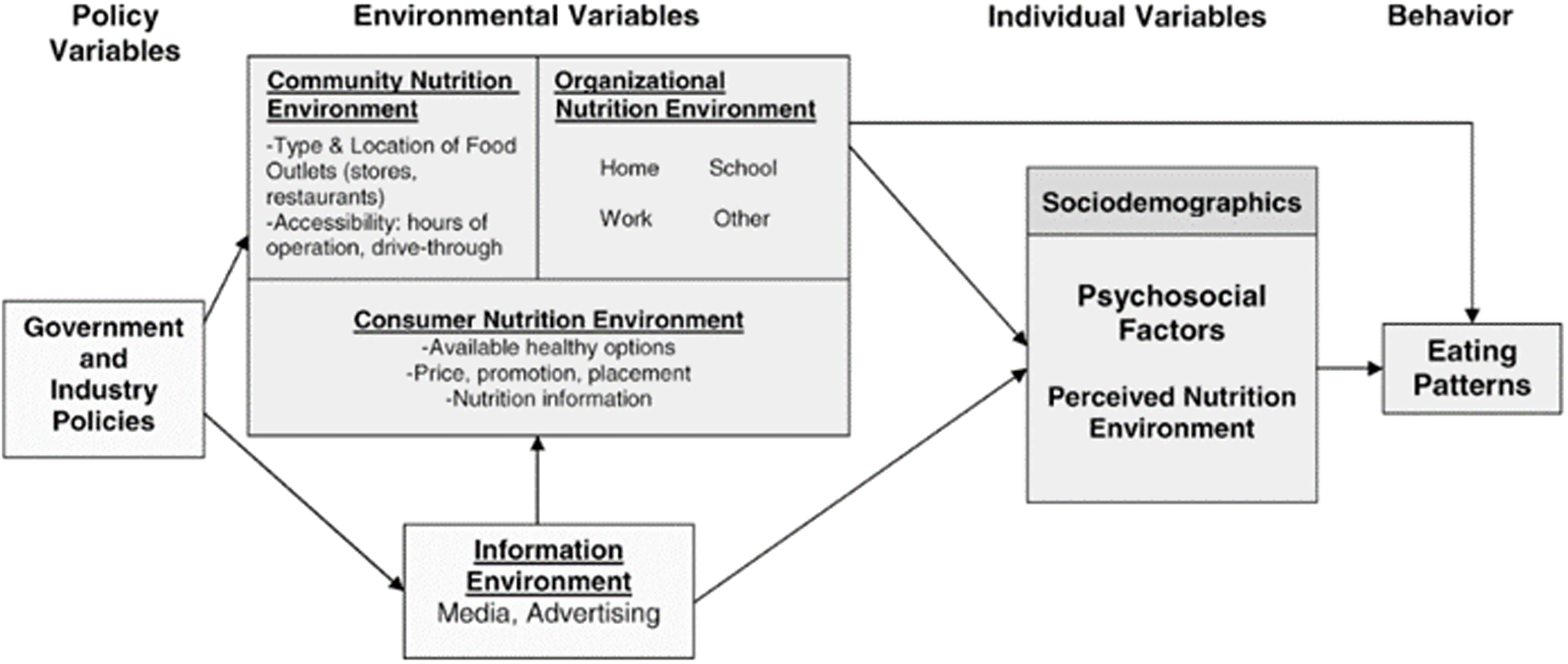
Several frameworks have been developed to describe the relationship between the food environment, food choice and eating behaviours(Reference Glanz, Sallis and Saelens30–Reference Tufford, Diou and Lucassen33). Glanz et al., described the community nutrition environment using the sem to outline the relationship between policy variables, environmental variables, individual variables, and behaviour and how they interact to determine eating patterns(Reference Glanz, Sallis and Saelens30). In this framework, shown in Fig.3, within the environmental variables, Glanz et al. describe the community food environment, referring to outlet type, location and availability; the consumer food environment, referring to in-store factors; and finally, the organisational food environment, referring to different settings where people spend significant amounts of time, such as work, school and care environments(Reference Glanz, Sallis and Saelens30). Since the development of this model, much of the empirical food environment research has investigated these domains(Reference Engler-Stringer, Le and Gerrard34,Reference Glanz, Fultz and Sallis35) .
Model of community nutrition environments; Glanz et al. Am J Health Promot. 2005 May-Jun;19(5):330-3. Copyright © 2005 by Sage Publications. Reprinted by Permission of Sage Publications (Reference Glanz, Sallis and Saelens30).

In a review by Herforth and Ahmed, the bidirectional relationship between food environments and dietary intakes is described, with dietary intakes aligning with the foods available in the individuals food environment, rather than in line with FBDGs(Reference Herforth and Ahmed31). The authors outline how the availability of foods in the food environment precedes consumption, concluding that ‘food cannot be consumed if it is not available at all’(Reference Herforth and Ahmed31). This conclusion is supported by research across the world, examples of which are described here(Reference Chen and Yang36–Reference Kelly, Callaghan and Molcho38). In the USA, Chen and Yang, using social media, examined the food environment experienced by individuals and how it affects food choice, concluding higher availability of fresh produce in the neighbourhood food environment was associated with increased likelihood of purchasing fresh and healthy foods(Reference Chen and Yang36). In Kenya, Chege et al. found that the diets of urban poor consumers could be improved by increasing the availability of fresh and healthy foods in traditional retail outlets such as mom-and-pop shops and informal restaurants(Reference Chege, Wanyama and Lundy37). In Ireland, Kelly et al. found that high fast food outlet density around post-primary schools was associated with decreased odds of post-primary school-aged children consuming fruit (OR 0·79, 95 % CI 0·62, 0·99)and vegetable (OR 0·73, 95 % CI 0·60, 0·88) and increased odds of consuming soft drinks (OR 1·79, 95 % CI 1·30, 2·47) and chips (OR 1·82, 95 % CI 1·17, 2·83) daily(Reference Kelly, Callaghan and Molcho38). Furthermore, in a systematic review examining the impact of the consumer and neighbourhood food environment on dietary intake and obesity-related outcomes, Atanasova et al. found the availability of and distance to unhealthy food outlets was associated with increased likelihood of fast–food consumption and higher Body Mass Index (BMI) in children across all socio-economic groups and in some adult population groups(Reference Atanasova, Kusuma and Pineda39). In addition, the availability of and distance to healthy food outlets was associated with improved children’s dietary intake and BMI(Reference Atanasova, Kusuma and Pineda39). In their systematic review and meta-analysis, Pineda et al. confirmed this finding, concluding fast-food outlet proximity was positively and significantly associated with obesity(Reference Pineda, Stockton and Scholes24). However, despite this growing evidence, many food environments in high-income countries are not health enabling, meaning they do not align with FBDGs(Reference Lake28).
Supermarkets in the retail food environment
Whilst the food environment encompasses all access to food, the retail food environment (RFE) is specifically defined as ‘the environment where all food and beverages are purchased by consumers, including food service operations such as restaurants’ (Reference Winkler, Zenk and Baquero40). The RFE comprises of many different types of outlets such as restaurants, cafés, takeaways, street food vendors, pubs, convenience stores, grocery stores and supermarkets, and influences the population’s food choices and dietary health outcomes(Reference Winkler, Zenk and Baquero40–Reference Shaw, Ntani and Baird42). In most high-income countries, there is a dependence on the built food environment, where many retail outlets are located, and natural and cultivated food environments play a minimal role in access to foods, meaning populations are dependent on the RFE to access some if not all of their food(Reference Downs, Ahmed and Fanzo43). Globally, supermarkets are a significant actor in the RFE, with an increasing amount of food purchased from supermarkets(Reference Pulker, Trapp and Scott44,Reference Hawkes45) . Over the past three decades, the changing landscape of the RFE, such as a shift away from local supermarkets to larger grocery supermarkets and discount supermarkets, many with both a physical and online presence, as well as an increase in the availability and consumption of foods out of home (e.g. takeaways, cafes and restaurants) has changed food availability and eating habits(Reference Winkler, Zenk and Baquero40). Evidence shows that different types of food outlets effect diet-related health outcomes in different ways. Pineda et al. found that RFE with high density of supermarkets had an inverse relationship with weight gain, whereas RFE with high density of fast-food outlets had a positive relationship with obesity(Reference Pineda, Stockton and Scholes24). There is growing evidence that supermarkets influence dietary behaviours and because of this, they are increasingly becoming a focus of health-promoting interventions(Reference Story, Kaphingst and Robinson-O’Brien23,Reference Glanz, Bader and Iyer41) . Indeed supermarkets have been identified as food environments with the potential to significantly influence consumer food choices and related health outcomes(Reference Brimblecombe, McMahon and Ferguson46).
Supermarkets, the community food environment, diet quality and diet-related health outcomes
The community food environment describes the availability of food outlets in a person’s surroundings(Reference Lake, Burgoine and Greenhalgh47). Food outlet location can be measured using Geographical Information Systems (GIS), which allows the visualisation of food outlet locations and the analysis of food outlet density and proximity using travel times to residential settings, schools and workplaces(Reference Charreire, Casey and Salze48). Community food environments can be considered health-enabling or health-disabling; the latter is often called ‘food swamps’ or ‘food deserts’(Reference Lake28,Reference Needham, Strugnell and Allender49) . Food swamps refer to areas with a high density of fast-food outlets serving energy-dense and nutrient-poor foods(Reference Needham, Strugnell and Allender49) and the tendency for fast-food outlets to be clustered in particular locations, even more so in areas of higher deprivation(Reference Lake28). Food deserts on the other hand refer to areas with limited access to food outlets offering fresh foods, such as supermarkets and greengrocers(Reference Cooksey-Stowers, Schwartz and Brownell29,Reference Vaughan, Cohen and Ghosh-Dastidar50) . Food deserts have been identified in the United Kingdom (UK) and USA, but not to the same extent across Europe(Reference Needham, Strugnell and Allender49,Reference Dubowitz, Ghosh-Dastidar and Cohen51,Reference Macdonald, Ellaway and Macintyre52) . There is limited evidence on food swamps and deserts in the Irish context.
As previously discussed, supermarkets have been identified as an important source of healthy food in the built food environment(Reference Pineda, Stockton and Scholes24). Increased availability of supermarkets has been associated with improved diet quality in some areas but decreased diet quality in others, with some concluding the relationship between supermarket density and proximity and diet-related health outcomes is cultural and dependant on the country or regional context(Reference Recchia, Perignon and Rollet53).
Much of the scientific evidence around supermarket availability and diet-related health outcomes is from high-income countries. Overall, it would appear that increasing supermarket density and/or proximity has a positive effect on diet quality and is associated with reduced population obesity prevalence(Reference Laraia, Siega-Riz and Kaufman54–Reference Athens, Duncan and Elbel57). Laraia et al. found that pregnant women in the USA living more than four miles away from a supermarket were twice as likely to fall into the lowest diet quality score quartile, than pregnant women living within two miles of a supermarket(Reference Laraia, Siega-Riz and Kaufman54). In addition, residents within 0·5 miles or less from a new supermarket, opened in the USA under an initiative to improve access to healthful food, had increased availability and consumption of healthy food following the opening of the supermarket(Reference Rogus, Athens and Cantor55). Lamichhane et al. found youths living with diabetes in the USA had improved diet quality following increased availability and accessibility to supermarkets(Reference Lamichhane, Mayer-Davis and Puett56). Increased supermarket proximity has also been shown to be associated with reduced frequency of fast-food consumption(Reference Athens, Duncan and Elbel57). The evidence on the relationship between supermarket proximity and obesity prevalence or high BMI is growing. Improved access to a supermarket has been found to be significantly associated with a decrease in BMI and lower population obesity prevalence(Reference Pineda, Stockton and Scholes24,Reference Powell, Auld and Chaloupka58,Reference Fiechtner, Kleinman and Melly59) . However, some evidence from the USA is less positive, Elbel et al. found children aged 3–10 years living in close proximity to a new supermarket, specifically opened to tackle a food desert in New York, had no difference in the availability of healthy or unhealthy foods at home, or in children’s dietary intake as a result of the supermarket opening(Reference Elbel, Moran and Dixon60). Furthermore, the clustering of fast-food outlets around supermarkets has been observed, which could diminish the effectiveness of supermarkets in increasing the purchase and consumption of healthy food options(Reference Lamichhane, Warren and Puett61).
Research outside of the USA is less conclusive(Reference Stevenson, Brazeau and Dasgupta62–Reference Skidmore, Welch and van Sluijs64). In Canada, Stevenson et al. found no relationship between the availability of supermarkets and diet quality(Reference Stevenson, Brazeau and Dasgupta62). In England, an inconsistent and complex relationship between supermarket availability and diet quality was found in children aged 9–10 years of age. In this cohort, density of supermarkets was associated with an increase in vegetable intake, but also an increase in the consumption of unhealthy foods(Reference Skidmore, Welch and van Sluijs64). In Glasgow, Scotland, the introduction of a supermarket to improve diet and health in a low socio-economic community was associated with no effect on diet quality(Reference Cummins, Petticrew and Higgins63). In contrast, in Ireland an investigation into the relationship between availability of supermarkets and diet quality by Layte et al. found a significant difference in diet quality mediated by the distance to the closest supermarket and by socio-economic status (SES) groups (using a household measure of SES)(Reference Layte, Harrington and Sexton65).
Whilst proximity and density of supermarkets appears to be an important variable for diet quality and diet-related health outcomes, the effect of supermarket density and proximity is mediated by the healthfulness of the in-store supermarket environment, known as the consumer food environment(Reference Pineda, Stockton and Scholes24).
Supermarkets, the consumer food environment and food purchase
Within outlet food availability has been described as the consumer food environment where the marketing mix: price, promotion, product, and placement, alongside food accessibility, convenience, and desirability, are variables influencing consumer food choice(Reference Glanz, Sallis and Saelens30,Reference Turner, Aggarwal and Walls32) . Studies investigating the in-store availability of unhealthy foods in supermarkets have found supermarkets have a high availability of unhealthy or discretionary foods. In Victoria, Australia, 63·2 %–72·7 % of shelf space was allocated to discretionary (unhealthy) foods, depending on the retailer(Reference Schultz, Cameron and Grigsby-Duffy66). A nationwide study in New Zealand found that for every one metre (100 cm) of shelf space there was 58 cm of shelf space allocted to unhealthy food(Reference Vandevijvere, Waterlander and Molloy67). In Flanders, Belgium, for every one metre (100 cm) of shelf space, 64 cm was allocated to unhealthy foods(Reference Vandevijvere, Van Dam and Inaç68). A study examining the availability of healthy and unhealthy foods in supermarkets in Dublin, Ireland found that for every one metre (100 cm) of shelf space measured 68 cm was allocated to unhealthy food(Reference O’Mahony, Collins and Doyle69). This study also found high prominence areas in supermarkets (locations highly visible to consumers such as check-outs and end of aisle) mostly contained unhealthy foods(Reference O’Mahony, Collins and Doyle69). These findings indicate that the current in-store supermarket food environment does not support consumers to make food choices in line with FBDGs recommendations. Given the high proportion of supermarket shelf space allocated to unhealthy foods, as well as the high visibility of this shelf space, there have been a number of studies examining interventions to improve the availability and prominence of healthy foods with the aim of increasing healthy food purchases and decreasing unhealthy food purchases.
Food purchase data is proposed as a reliable proxy indicator for food consumption in the adult population(Reference Vepsäläinen, Nevalainen and Kinnunen70). Healthy in-store interventions, which aim to create health-enabling consumer retail environments utilise merchandising strategies targeting product, price, placement, and promotion to incentivise the purchase of healthy foods and disincentive the purchase of unhealthy foods(Reference Brimblecombe, McMahon and De Silva71,Reference Cameron, Charlton and Ngan72) . Food pricing is a strategy used to increase sales and can be in the form of discounts, bulk buying offers or promotions(73). Adam and Jensen concluded that price promotions positively influenced the purchase of healthy food, and the effect was more significant the larger the price discount(Reference Adam and Jensen74). Studies examining the effect of price promotion interventions on fresh fruit and vegetables found that discounts had a progressive and sustained impact in increasing the purchase of fresh fruit and vegetables(Reference Geliebter, Ang and Bernales-Korins75–Reference Waterlander, de Boer and Schuit77). Product placement is another strategy used by retailers to promote the purchase of healthy foods(Reference Rose, Hutchinson and Bodor78). Evidence suggests placing foods in more prominent locations increases product sales(Reference Adam and Jensen74). A study investigating the placement of healthier food items at the point of sale increased their purchase(Reference Sigurdsson, Larsen and Gunnarsson79). A third merchandising strategy to increase healthy food product sales is promotion, such as signage, shelf tags, floor stickers and special island displays. Promotions have been found to be an effective way to increase sales of healthy foods in New Zealand(Reference Rosin, Young and Jiang80) and in Australia, shelf tags highlighting foods of lower nutrient quality effectively reduced their sale(Reference Cameron, Brown and Orellana81). In fact, a combination of merchandising approaches is likely to be most effective in increasing the purchase of healthy foods, rather than any one approach alone. A randomised control trial investigating the effect of restricting unhealthy food promotion on food and beverage sales concluded restricted merchandising of unhealthy food alongside increased merchandising of healthy food can achieve public health gains(Reference Brimblecombe, McMahon and Ferguson46). A systematic review by Adam and Jensen reported that n 36 of n 42 studies examining the effect of an in-store health-promoting intervention found a positive effect on the purchase of healthy foods(Reference Adam and Jensen74). This review concluded that interventions combining merchandising techniques to improve the purchase of healthy foods are likely to be most effective, including interventions that combine price, information, and easy access to and availability of healthy food(Reference Adam and Jensen74). Shaw et al. reached a similar conclusion, finding that in-store interventions which reduce the availability and prominence of unhealthy foods and increased the availability and prominence of healthy foods were associated with improved dietary health outcomes(Reference Shaw, Ntani and Baird42).
It is important to acknowledge that grocery retailers and supermarkets are businesses who are motivated by economic outcomes. Therefore, any intervention to improve the healthfulness of the supermarket food environment should also consider the feasibility and sustainability of healthy food retail strategies from the business outcome standpoint. In a review by, Blake et al. n 107 studies were considered to identify types of business outcomes that have been reported in healthy food retail strategy evaluations(Reference Blake, Backholer and Lancsar82). The review found commercial viability and retailer and customer perceptions were frequently measured as part of healthy food retail strategy evaluation. They concluded in most cases that retailer and customer perceptions, as well as product and promotional strategies were generally favourable(Reference Blake, Backholer and Lancsar82). In a more recent review investigating the evidence on factors influencing the implementation, sustainability and scalability of healthy food retail interventions, Gupta et al. concluded that few studies reported on intervention sustainability and scalability and this should be considered in future studies(Reference Gupta, Alston and Needham83).
Disparities in the healthfulness of the supermarket community and consumer food environment
In many high-income settings, obesity and diet-related NCD prevalence follow a social gradient, meaning overweight and obesity are more prevalent in lower socio-economic groups(Reference Cronin, Hurley and Buckley84,Reference Marmot and Bell85) . To address this health disparity, preventative policies targeting overweight, obesity and diet-related NCDs should be defined and implemented to ensure those with the greatest need benefit the most(Reference Marmot, Boyce and Goldblatt86). Evidence suggests that unhealthy food environments also follow a social gradient in many contexts, meaning areas of higher deprivation have less access to healthy food outlets, including supermarkets(Reference Cooksey-Stowers, Schwartz and Brownell29). For example, in Australia, New Zealand and Belgium areas of higher deprivation had fewer supermarkets(Reference Schultz, Cameron and Grigsby-Duffy66–Reference Vandevijvere, Van Dam and Inaç68). In the UK, using person-centred SES metrics, those with a higher education lived significantly closer to supermarkets than those with a lower education(Reference Maguire, Burgoine and Penney87). Similarly in Ireland, distance to the nearest food store and diet quality was mediated by SES, with people of lower SES living further away from supermarkets and having lower diet quality(Reference Layte, Harrington and Sexton65). Evidence also suggests that the in-store food environment in supermarkets located in areas of high deprivation has significantly more unhealthy foods in some contexts such as Australia, New Zealand, and Belgium(Reference Schultz, Cameron and Grigsby-Duffy66–Reference Vandevijvere, Van Dam and Inaç68). This means lower SES groups face a double burden in access to healthy food options, due to less access to supermarkets and less healthy foods available in supermarkets that are accessible. Given the important role supermarkets play in access to healthy foods, this situation could exacerbate disparities in diet-related health outcomes and requires policy action.
There is less evidence on the food environment, including the RFE, in low- and middle-income countries (LMIC)(Reference Turner, Kalamatianou and Drewnowski88). Turner et al., completed a systematic scoping review to investigate the relationship between the food environment, food choice and diet-related health outcomes in LMIC, concluding there were no published articles from low income countries and evidence regarding associations between the food environment and nutrition and health outcomes was inconclusive(Reference Turner, Kalamatianou and Drewnowski88).
Improving the healthfulness of the supermarket food environment: policy options and opportunities
A variety of evidence-based policies can be used to improve the healthfulness of the supermarket food environment. Macro-level intervention is required as targeting individual behaviours to prevent obesity and food-related ill health will not have the desired impact without addressing the context in which these behaviours are practised(Reference Story, Kaphingst and Robinson-O’Brien23). A Storey et al. concluded that to reduce food-related ill health and obesity, public health interventions are required that address environmental context and conditions in which people make health determining decisions(Reference Story, Kaphingst and Robinson-O’Brien23). Macro-level structural policies, which change the food environment to one which is health enabling are expected to have the highest and most equitable impact on overweight and obesity prevention(Reference Backholer, Beauchamp and Ball89).
As previously outlined, in the USA and Scotland, policies were introduced to increase the availability of supermarkets in food deserts, which had limited impact on improving healthy food purchase in some locations(Reference Elbel, Moran and Dixon60,Reference Cummins, Petticrew and Higgins63) and positive impacts in others(Reference Rogus, Athens and Cantor55). The evidence also suggests that the availability of healthy food outlets does not buffer the effect of fast-food outlet proximity and higher BMI(Reference van Erpecum, van Zon and Bültmann90). Potentially the inverse could be true; where higher density and proximity of fast-food outlets could limit the impact of providing healthy food outlets, such as supermarkets, in food deserts; and this requires further investigation. Therefore, consideration should be given to the wider foodscape, and not policies which focus on increasing the availability of healthy food outlets, such as supermarkets, alone.
Both voluntary and mandatory policies have been implemented to create more health-enabling consumer food environments in supermarkets. In the creation of health enabling in-store food environments in supermarkets, co-design and co-creation approaches have been used to develop, implement, and evaluate interventions(Reference Vargas, Whelan and Brimblecombe91,Reference Middel, Schuitmaker-Warnaar and Mackenbach92) . In designing and implementing these interventions, researchers describe some interventions as being more acceptable and easier to pursue, such as promotions on healthy and fresh foods, which lay the foundations for the design and implementation of interventions that can lead to more substantive change, such as price increases for HFSS foods(Reference Middel, Schuitmaker-Warnaar and Mackenbach92). Co-design of healthy in-store interventions with retailers, which augment merchandising strategies to make healthier food choices the easy choice, has led to interventions which have increased purchases of healthy foods(Reference Brimblecombe, McMahon and Ferguson46,Reference Cameron, Brown and Orellana81,Reference Middel, Schuitmaker-Warnaar and Mackenbach92,Reference Vogel, Crozier and Penn-Newman93) . The Food (Promotion and Placement) (England) Regulation 2021, is an example of mandatory restriction on the placement and promotion of unhealthy foods in the grocery RFE in England(94). This legislation restricts the placement of HFSS foods in high-prominence locations in eligible grocery store outlets. Early investigations into the effectiveness of these mandatory measures highlight they are a good first step but require stronger enforcement and resourcing(Reference Muir, Dhuria and Roe95). The effectiveness of this intervention in reducing purchases of unhealthy foods will be of interest to many, following full evaluation of the measure.
Although not as widely covered in the scientific literature on the healthfulness of the supermarket food environment, retailers play an important role in the nutrient composition of commonly purchased and consumed prepacked foods. Private label, or own brand, food products make up a considerable part of prepacked food market share in Europe, where in 2014 between 17 % and 44·5 % of food product market share was private label(Reference Pulker, Trapp and Scott44,Reference Olbrich, Hundt and Jansen96) . Working with retailers in both the provision of and composition of these foods, is an opportunity to improve the healthfulness of the consumer RFE and make the healthier choice the easier choice(Reference Pulker, Trapp and Scott44). Food reformulation has been shown to be an effective strategy to reduce nutrients of public health concern, such as salt, in prepacked foods and consumer diets(Reference Gressier, Swinburn and Frost10). To reduce nutrients of public health concern in the food supply, food retailers have a responsibility to reduce the salt, sugar, and saturated fat in their private-label prepacked foods through food reformulation(97,98) . To address this, voluntary and mandatory reformulation policies have been established in many countries(97–101). The reduction of salt by voluntary reformulation has led to reductions in prepacked foods(Reference He, Brown and Tan102). For example, a review of published literature found evidence of a consistent reduction in the sugar and salt content of breakfast cereals sold in the RFE(Reference O’Mahony, O’Donovan and Collins103). Despite this progress some researchers have proposed that reformulation under voluntary policies has not gone far or fast enough and additional efforts, such as mandatory legislation, is needed(Reference Song, Tan and Wang104).
Monitoring the healthfulness of the retail food environment
Measurement of the healthfulness of the RFE needs to consider several aspects, such as the availability, visibility and the nutrient composition of HFSS foods. To inform the development of contextually sensitive policies to improve the healthfulness of the supermarket food environment and to accurately measure their outcomes and impact, effective monitoring and evaluation strategies are required(Reference Swinburn, Vandevijvere and Kraak105). The International Network for Food and Obesity/Non-communicable Diseases Research, Monitoring and Action Support (INFORMAS) has established a monitoring framework for the food environment(Reference Swinburn, Vandevijvere and Kraak105). This framework outlines modules and protocols for monitoring the food environment, including the RFE and is an important source of standardised measures and tools to inform national food environment monitoring systems(Reference Swinburn, Vandevijvere and Kraak105).
A combination of approaches is used to measure different aspects of the food environment. Internationally, the community food environment has been measured using GIS mapping which is critical for monitoring food outlet density by area-level deprivation and rurality(Reference Clelland and Deprivation106). However, Wilkins et al. concluded that methods and reporting of GIS methods applied to the food environment are inconsistent and incomplete and proposed a reporting checklist, Geo-FERN, to support comprehensive measurement and reporting of the RFE(Reference Wilkins, Morris and Radley107). GIS mapping of the food environment will continue to play an important role in understanding the relationship between food outlet density, proximity, area-level deprivation and diet-related health outcomes.
The healthfulness of the consumer food environment is determined using methodological approaches that measure merchandising strategies based on the marketing mix, including product, price, placement, and promotion(Reference Brimblecombe, McMahon and Ferguson46,Reference van Waterschoot and van den Bulte108) . Several standardised approaches for measuring the healthfulness of the consumer food environment have been developed(Reference Brimblecombe, Jaenke and McMahon109). A review by Brimblecombe et al. found n 47 tools have been applied to measure the healthiness of the consumer food environment(Reference Brimblecombe, Jaenke and McMahon109). Tools that have been developed and applied in numerous settings to measure the healthiness of the in-store food environment include the Nutrition Environment Measures Survey (NEMS) and the INFORMAS Food Availability in Supermarkets tool(Reference Glanz, Fultz and Sallis35,Reference Ni Mhurchu, Vandevijvere and Waterlander110) . Glanz et al. concluded that n 123 studies had used a modified version of the NEMS tool, meaning it has played a pivotal role in the development and increase of research on the food environment(Reference Glanz, Fultz and Sallis35). The INFORMAS Food Availability in Supermarkets tool has been implemented in Australia, New Zealand, Argentina, Burkina Faso, Belgium, and Ireland(Reference Schultz, Cameron and Grigsby-Duffy66–Reference Vandevijvere, Van Dam and Inaç68,Reference O’Mahony, Collins and Doyle111,Reference Elorriaga, Moyano and López112) . More recently, Store Scout has been developed to rapidly measure the healthiness of the in-store food environment using an mHeatlh application(Reference Brimblecombe, Jaenke and McMahon109,Reference McMahon, Jaenke and Brimblecombe113) .
Changes in the composition of prepacked foods are measured using food label and composition information(Reference Neal, Sacks and Swinburn114). This means many data points (e.g. food product identifying information, description, nutrition composition, product weight and ingredients) for a large volume of prepacked foods are required to accurately monitor the evolution of the nutrient composition and ingredient content of the prepacked food supply over time(Reference Neal, Sacks and Swinburn114). Given the voluminous nature of data required to continually monitor the composition of the prepacked food supply, several countries have piloted or established data repositories(Reference Pravst, Hribar and Žmitek115–Reference O’Mahony, Pravst and Hribar118). These repositories are known as branded food databases, which serve as valuable resources for scientific research, healthcare, public health monitoring, policy development, education, food innovation and others(Reference Pravst, Hribar and Žmitek115,Reference Ahmed, Schermel and Lee116) . Branded food databases are compiled and maintained by different stakeholders in different countries; for example, foodDB was established and is maintained by a research group at Oxford University, the Deutch Branded Food Database, LEDA, is hosted and maintained by the Deutch Institute of Public Health and the Slovenia branded food database, CLAS, is hosted and maintained by their national nutrition institute(Reference Pravst, Hribar and Žmitek115,Reference Westenbrink, van der Vossen-Wijmenga and Toxopeus117,Reference Harrington, Adhikari and Rayner119) .
Branded food databases are only of value for policy development, monitoring and evaluation, if they are based on accurate and up-to-date nutrition declaration information(Reference Albuquerque, Nunes and Oliveira120). The European Commission guidelines on nutrition labelling tolerances sets out a tolerance for the acceptable variation in the declared and actual nutrient content of prepacked foods(121). The range of what is allowable for legal labelling purposes, depends on the type of food, whether a claim is made on the food and the type and amount of the nutrient in the food(121). The empirical evidence on the accuracy of nutrition declarations made on food labels varies with studies in Portugal and Italy finding 27 % and 35 % of products sampled were outside of the labelling tolerances, respectively(Reference Albuquerque, Nunes and Oliveira120,Reference Bragolusi, Tata and Massaro122) . In contrast, studies in Slovenia and Spain found high rates of declared sugar conformance with labelling tolerances, of 100 % and 98·4 % respectively(Reference Hafner, Lavriša and Hribar123,Reference Yusta-Boyo, Bermejo and García-Solano124) . Given the variability in the accuracy of nutrition declarations on food labels, food composition monitoring using food labels may not always be a reliable source of information and confirmatory laboratory analysis of nutrient content should be undertaken(Reference Neal, Sacks and Swinburn114). To reflect the potential for inaccuracies of nutrition declarations on food labels, guidance by research consortiums on methodologies to monitor the prepacked food supply recognise the role for laboratory analysis to determine the nutrient composition of foods(Reference Neal, Sacks and Swinburn114,Reference Dunford, Webster and Metzler125) .
Commercial datasets which measure food product volume share can be used to complement, or sometimes instead of, the approaches described for measuring and monitoring the consumer food environment, and the nutrient composition of the prepacked food supply(Reference Bandy, Adhikari and Jebb126). In their systematic review, Bandy et al. found n 68 studies which used sales or purchase data from four commercial data providers (Euromonitor, GfK, Kantar and Nielsen) to measure and evaluate interventions to improve nutrient quality of foods, food purchasing including socio-demographic variations in purchasing(Reference Bandy, Adhikari and Jebb126).
Future perspectives
The supermarket food environment is extending into the digital space with the growth of online grocery stores and home delivery(127,Reference Khandpur, Zatz and Bleich128) . This evolution presents new considerations which will need to be captured in tools and frameworks for monitoring and evaluating the healthfulness of the supermarket food environment(Reference Maganja, Miller and Trieu129). A review by Maganja et al. found only one tool for determining the healthfulness of the online supermarket environment and concluded additional validated tools are needed to measure the new opportunities online grocery stores can use to influence consumers(Reference Maganja, Miller and Trieu129). The advancement in online grocery stores provides an opportunity to more efficiently collect food product information from retailer websites, which is already underway in some branded food databases such as FLIP in Canada and foodDB in the UK(Reference Ahmed, Schermel and Lee116,Reference Harrington, Adhikari and Rayner119) . The potential for the use of online data to support food composition monitoring should continue to be explored.
With the introduction of regulation to limit the placement and promotion of HFSS foods in high-prominence areas of supermarkets in England, the consumer food environment is adapting(94,Reference Muir, Dhuria and Roe95) . However, the impact of this regulation is yet to be evaluated. If this regulatory measure is effective in reducing the sales of HFSS foods and stimulating food product reformulation, similar strategies could be considered elsewhere. How retailers (and the food industry) respond to rules limiting the placement and promotion of foods, may require adaptations to the consumer food environment monitoring tools.
In high-income countries, overweight, obesity and diet-related NCDs follow a social gradient(Reference Moore Heslin, O’Donnell and Kehoe130–Reference Abarca-Gómez, Abdeen and Hamid132). At the same time, lower socio-economic groups have less access to supermarkets in many contexts(Reference Layte, Harrington and Sexton65), and where they are accessible the consumer food environment is less healthy(Reference Schultz, Cameron and Grigsby-Duffy66,Reference Vandevijvere, Waterlander and Molloy67) . For healthy supermarket interventions to contribute to addressing this health disparity, policies addressing the healthfulness of the supermarket food environment will need to ensure the disparity in access to healthier food options is addressed. This can be done by prioritising areas of high deprivation for intervention first and evaluating the effectiveness of interventions across different socio-economic groups.
Finally, improving the sustainability of our food supply is a key component of addressing the climate crisis(Reference Willett, Rockström and Loken133). Consumption has been described as an important pillar of sustainable food systems(Reference Jarmul, Dangour and Green134,Reference Hallström, Carlsson-Kanyama and Börjesson135) . The supermarket food environment could play an important role in directing consumer food choice towards both healthy and sustainable foods(Reference Story, Kaphingst and Robinson-O’Brien23). Currently, there are few tools which examine the availability of HFSS foods and food sustainability in tandem(Reference Baker, Burd and Figueroa136). Baker et al. reported only n 2 of n 58 studies investigating the availability of healthy foods also considered sustainability(Reference Baker, Burd and Figueroa136) and concluded there is a need to develop consumer nutrition environment measures that assess nutrient-dense food availability and food sustainability to inform improving consumer food environments for human and planetary health(Reference Baker, Burd and Figueroa136). Tools and frameworks developed to determine the healthfulness of the consumer food environment should consider food sustainability alongside healthiness(Reference Baker, Burd and Figueroa136).
Conclusion
The food environment mediates consumer food choices and thus plays an important role in diet quality and related health outcomes(Reference Pineda, Stockton and Scholes24). Across high-income countries, the majority of populations are reliant on the built food environment to access food(Reference Downs, Ahmed and Fanzo43). In the Western world the built food environment has been described as obesogenic, meaning it does not support people to make food choices in line with FBDGs recommendations, whilst also being favourable to a sedentary lifestyle(Reference Lake28). Supermarkets are an important source of healthy foods in the built food environment(Reference Karpyn, McCallops and Wolgast137). However, the extent to which supermarkets can influence access to healthy food depends on supermarket proximity, density, and the healthfulness of the supermarket consumer food environment(Reference Pineda, Stockton and Scholes24,Reference Layte, Harrington and Sexton65,Reference Adam and Jensen74) . The evidence supporting improved access to healthy foods and diet-related health outcomes by increasing supermarket density is mixed(Reference Athens, Duncan and Elbel57,Reference Cummins, Petticrew and Higgins63) . The evidence supports improved purchase of healthy foods by increasing the healthfulness of the supermarket consumer food environment(Reference Shaw, Ntani and Baird42,Reference Adam and Jensen74) . Healthy in-store initiatives to improve the purchase of healthy foods using a combination of merchandising strategies based on the marketing mix: product, price, promotion and placement, have been shown to be effective across a wide range of countries and supermarket types(Reference Adam and Jensen74). Policies such as voluntary measures co-designed with retailers to improve the healthfulness of the supermarket consumer food environment through restriction of product placement and private label reformulation have also been shown to increase healthier food purchases(Reference Brimblecombe, McMahon and Ferguson46,Reference Vogel, Crozier and Penn-Newman93) . However, evidence also shows that mandatory, structural changes are most effective in improving the disparities in access to healthy food and diet-related ill health(Reference Backholer, Beauchamp and Ball89). This is an important consideration for improving access to healthy foods for lower socio-economic groups, who carry a higher burden of food-related ill health(Reference Andrade, Mahrouseh and Gabrani131). The Food (Promotion and Placement) (England) Regulations 2021 is a legal measure to restrict placement and promotion of HFSS foods, and its impact on the purchase of healthy and unhealthy food could inform future policies(94). Future research and policy with a focus on the supermarket food environment should consider equitable access to healthy foods, sustainability alongside healthiness, and the growth of online supermarkets. Additional research is needed to understand how the density of fast-food outlets mediates the effectiveness of supermarkets in improving the purchase and consumption of healthy food, and the effectiveness of legal measures to restrict the in-store availability and purchase of unhealthy foods from supermarkets(Reference Lamichhane, Warren and Puett61,Reference Muir, Dhuria and Roe95) .
Acknowledgements
The authors would like to thank the Nutrition Society for the opportunity to present this research at the Irish Section Postgraduate Meeting 2024.
Authors contributions
Conceptualisation SoM, ERG, NC and GD; literature review SoM; writing original draft SoM; writing review and edit SoM, ERG, GD and NC; supervision GD, ERG and NC; project administration SoM. All authors have read and agreed to the published version of the manuscript.
Financial support
The authors would like to thank the Food Safety Authority of Ireland for funding this research.
Competing interests
ERG has received research funding through the following funders and projects; Food for Health Ireland (www.fhi.ie) project, funded by Enterprise Ireland, co-funded with core partners Carbery, Kerry, Tirlan, Dairygold & Bord Bia; Science Foundation Ireland Insight Centre for Data Analytics, and Co-Centre for Sustainable Food Systems; Horizon Europe most recently in projects such as FNSCloud, PLANEAT and MarieCurie CareerFIT; and PhD studentship funding from Société des Produits Nestlé, Switzerland. Eileen R Gibney has completed consultancy work for the following: Société des Produits Nestlé, Switzerland; Irish Advertising Standards Agency; and Food Safety Authority of Ireland. No personal payment was received, all payments were made into a research fund through Consult UCD.
SoM, NC and GD have no declarations of interest.



 Open access

