


Introduction
Population ageing is a global phenomenon, with projections indicating that by 2050, 16% of the world’s population will be aged 65 years and older (United Nations, 2019). In Canada, older adults are expected to make up 25% of the total population by 2036 (Statistics Canada, 2015). As the proportion of Canadians older than 65 grows each year, it is concerning that close to a quarter of this cohort reports being socially isolated (Tam, Reference Tam2017). Social isolation refers to an objective state of being alone. This can further translate into a sense of loneliness, which is a subjective state of being socially isolated regardless of any actual social contact one may have (de Jong Gierveld et al., Reference de Jong Gierveld, Van Tilburg and Dykstra2006). The latter often requires individual treatment, while the former requires structural and societal intervention.
The subjective nature of loneliness makes standardizing interventions and measurement difficult (Fakoya et al., Reference Fakoya, McCorry and Donnelly2020). On the other hand, social isolation is easier to measure, but interventions generally conclude that only a small number are effective (Poscia et al., Reference Poscia, Stojanovic, La Milia, Duplaga, Grysztar, Moscato, Onder, Collamati, Ricciardi and Magnavita2018). This is because they are labour-intensive, and not easily transferable between contexts. As such, examining social behaviour may be a more effective method to gain insight into the social health of older adults. However, social behaviour patterns and preferences vary between older men and women (Levasseur et al., Reference Levasseur, Naud, Bruneau and Généreux2020; Naud et al., Reference Naud, Généreux, Bruneau, Alauzet and Levasseur2019). For example, a study on gendered employment patterns, that is, length and type of employment as dictated by gender norms, found that these patterns can contribute to differences in how older men and women engage in social behaviour (Cohn-Schwartz & Naegele, Reference Cohn-Schwartz and Naegele2023). Similarly, a study found that spousal education is associated with more time spent in physical activity among women (Cohn-Schwartz & Naegele, Reference Cohn-Schwartz and Naegele2023).
Social isolation among older adults can have serious consequences for health and well-being, such as depression, cardiovascular disease, reduced cognitive function, and increased risk of mortality (Cacioppo & Cacioppo, Reference Cacioppo and Cacioppo2014; Courtin & Knapp, Reference Courtin and Knapp2017). As such, strategies to address social isolation are imperative in the promotion of healthy, active ageing. Active ageing, that is, engagement with life through both physical activity and social participation, plays a pivotal role in fostering compressed morbidity (Fries, Reference Fries1996), thereby enabling individuals to enjoy a greater number of disability-free years and better quality of life. Nonetheless, it is worth noting that not everyone achieves the optimal level of physical activity (Guthold et al., Reference Guthold, Stevens, Riley and Bull2018) or social participation (de Koning et al., Reference de Koning, Richards, Wood and Stathi2021) required to reap these advantages. Socioeconomic status, accessibility of resources, and community design often dictate an individual’s capacity to engage in physical and social activities (Eime et al., Reference Eime, Charity, Harvey and Payne2015). These structural factors, along with social determinants of health such as gender, education, employment, and social support networks (Hsu et al., Reference Hsu, Liang, Luh, Chen and Wang2019), can significantly influence disparities in engagement, underscoring the need for an equity-focused approach that shifts blame away from the individual. For example, older women are more motivated by social interaction when choosing to pursue physical activity than men are (Van Uffelen et al., Reference Van Uffelen, Khan and Burton2017), while men prefer one-to-one activities (Windt et al., Reference Windt, Sims-Gould, Mackey and McKay2023). Both need to be considered in large-scale interventions to address active ageing.
The inter-relationship between physical activity and social participation has been discussed in the context of healthy ageing (Dogra et al., Reference Dogra, Dunstan, Sugiyama, Stathi, Gardiner and Owen2022). It is suggested that there may be a bidirectional association such that physical activity, or lack thereof, often includes social activity (e.g. walking with a friend, or sedentary social activities such as Bingo), and social activities often require physical activity (e.g. incidental physical activity from going to senior’s centre to play cards) or adequate physical function (e.g. being mobile enough to meet with friends) (Lindsay Smith et al., Reference Lindsay Smith, Banting, Eime, O’Sullivan and van Uffelen2017). Unfortunately, the vast majority of studies aimed at understanding how to improve physical activity and sedentary time in older adults have not leveraged this association with social participation (Douglas et al., Reference Douglas, Georgiou and Westbrook2017). Similarly, research interventions aimed at reducing social isolation may have had limited success in specific populations because they are aimed at addressing individual factors such as income (Menec et al., Reference Menec, Newall, Mackenzie, Shooshtari and Nowicki2019) but rarely consider behaviours such as physical activity. Importantly, approaches involving educational or psychological components and group interventions have been found to yield greater effectiveness compared to one-on-one interventions (Fakoya et al., Reference Fakoya, McCorry and Donnelly2020; Poscia et al., Reference Poscia, Stojanovic, La Milia, Duplaga, Grysztar, Moscato, Onder, Collamati, Ricciardi and Magnavita2018), emphasising the point that to impact active ageing, we cannot simply focus on individual behaviour change.
Using the social–ecological approach, which recognizes that individuals are embedded within contexts which include relationships, community environments, and societal structures that shape their behaviours (de Koning et al., Reference de Koning, Richards, Wood and Stathi2021), another gap that may be limiting our success with intervening in social isolation in older adults pertains to the neighbourhood environment. From research on physical activity, it is well established that characteristics such as greenness and walkability significantly impact movement and health among older adults (Chaudhury et al., Reference Chaudhury, Campo, Michael and Mahmood2016; Crouse et al., Reference Crouse, Pinault, Balram, Hystad, Peters, Chen, van Donkelaar, Martin, Menard, Robichaud and Villeneuve2017; Klicnik et al., Reference Klicnik, Cullen, Doiron, Barakat, Ardern, Rudoler and Dogra2021) and that the environment moderates the relationship between physical activity and health (Putman et al., Reference Putman, Klicnik and Dogra2023). There is some evidence to suggest that the neighbourhood also influences mental health outcomes among older adults. For example, in a study of 270 community-dwelling older adults, path analysis revealed that active living can lead to better mental health, but this relationship is mediated by a sense of connectedness and solidarity within a group, commonly known as neighbourhood cohesion (Gan et al., Reference Gan, Cheng, Ng, Gwee, Soh, Fung and Cho2022). This suggests that there may also be an effect of neighbourhood characteristics on social participation outcomes through engagement in regular physical activity. A prominent example of this was shown in a study of perceived neighbourhood greenness, where recreational walking and social connectedness in areas of higher perceived greenness were associated with improved mental health (Sugiyama et al., Reference Sugiyama, Leslie, Giles-Corti and Owen2008). Another study, which looked at objectively measured neighbourhood greenness and walkability, and self-rated mental health among other outcomes (n=15339), found that self-rated mental health was higher among those living in areas of higher greenness. Due to the known associations between mental health and social participation (Mackenzie & Abdulrazaq, Reference Mackenzie and Abdulrazaq2021), these findings necessitate a more nuanced exploration of how various aspects of the living environment contribute to social engagement while considering physical activity engagement.
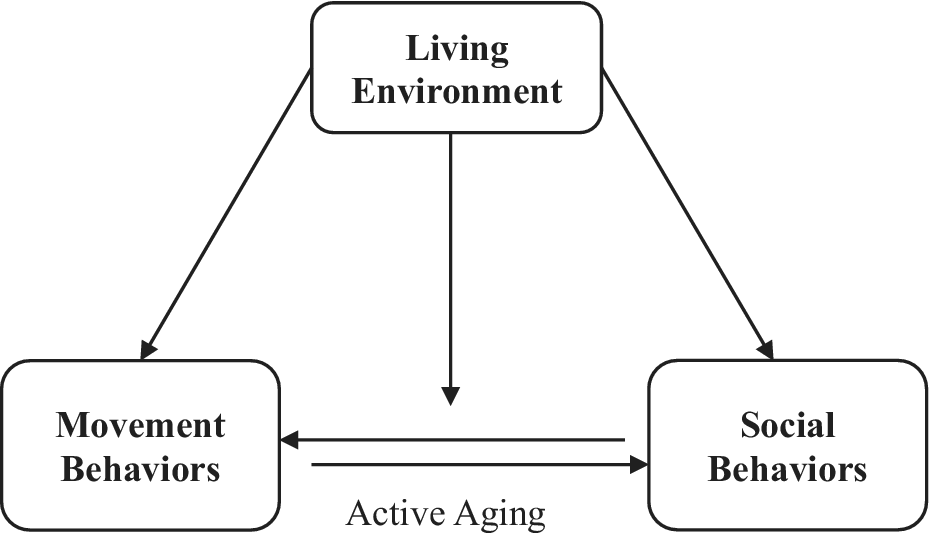
To conceptualize this work, we used a simple framework which shows that social participation is influenced by the living environment, and both of these are impacted by a multitude of factors. Figure 1 illustrates this framework and alludes to the potential mechanistic links between the living environment and social participation. The purpose of this study, therefore, was to explore the relationship between neighbourhood characteristics and social participation outcomes using this framework in a sample of community-dwelling older adults, as their living environment is more variable than those living in congregate or assisted living settings. Specifically, we investigated associations of neighbourhood greenness, and walkability, with social participation outcomes in older adults. Based on the framework and previous research, we hypothesized that regardless of greenness and walkability, older women would report higher social participation (Cohn-Schwartz & Naegele, Reference Cohn-Schwartz and Naegele2023; Levasseur et al., Reference Levasseur, Naud, Bruneau and Généreux2020; Naud et al., Reference Naud, Généreux, Bruneau, Alauzet and Levasseur2019), while older men would report more social participation in neighbourhoods with lower walkability but higher greenness (Klicnik et al., Reference Klicnik, Cullen, Doiron, Barakat, Ardern, Rudoler and Dogra2021). We also hypothesized that physical activity and social participation would be highly correlated, and that this would differ between males and females (Lindsay Smith et al., Reference Lindsay Smith, Banting, Eime, O’Sullivan and van Uffelen2017; Van Uffelen et al., Reference Van Uffelen, Khan and Burton2017; Windt et al., Reference Windt, Sims-Gould, Mackey and McKay2023).
The Living Environment and Active Aging Framework (LEAAF). Characteristics of the living environment are theorized to influence movement and social behaviours separately but also influence the inter-relationship between movement and social behaviours (active ageing).

Methods
Data source and participants
The Canadian Longitudinal Study on Aging (CLSA) is a nationally representative, stratified random sample of Canadian adults (n=51 388 at baseline), aged 45–85 years at baseline (2011-2015). The purpose of the CLSA is to track individuals at three-year intervals to understand the ageing process using a comprehensive battery of questions and measures. The sample is comprised of a Tracking cohort (n=21 000) and a Comprehensive cohort (n=30 000), with the latter participating in in-home interviews and physical assessments in addition to the questionnaires completed by the entire sample. Follow-up data are collected every three years. The present study uses data from baseline (2011-2015) and from the first follow-up (2015-2018, dataset versions 4.1 and 3.0). Participants have been linked by a 3-character forward sortation area with measurements of the Canadian Active Living Environment [Can-ALE] and Normalized Difference Vegetation Index from the Canadian Urban Environmental Health Research Consortium (Brook et al., Reference Brook, Setton, Seed, Shooshtari, Doiron and Consortium2018).
Participants randomly selected by telephone across all 10 provinces comprised the tracking cohort, while the comprehensive cohort included participants from 7 provinces living within 25-50 km of 11 data collection sites. Individuals residing in the territories, on reserves, or those who are in the armed forces were not eligible to participate. Full details on participants, sampling strategy, and study protocol have been published in previous work (Raina et al., Reference Raina, Wolfson, Kirkland, Griffith, Balion, Cossette, Dionne, Hofer, Hogan, van den Heuvel, Liu-Ambrose, Menec, Mugford, Patterson, Payette, Richards, Shannon, Sheets, Taler and Young2019). Only participants aged 65 or older, who had the same postal code during the follow-up period were included.
The protocol of the CLSA has been reviewed and approved by 13 research ethics boards across Canada. Changes to the CLSA protocol are reviewed annually, and written consent is obtained from all participants. The Ontario Tech University Research Ethics Board approved secondary analysis of the CLSA dataset (REB # 16480).
Outcome variables
-
1. Total physical activity (at follow-up) – This variable was derived from a modified version of the Physical Activity Scale for the Elderly (PASE), a retrospective questionnaire used to collect information on movement behaviour. The PASE was developed for a community-dwelling population, with good test-retest reliability (Washburn et al., Reference Washburn, Smith, Jette and Janney1993). Participants were asked how many times in the past 7 days they took part in light, moderate, and strenuous activity, exercise, or walking. Response options included: 1-never, 2-seldom (1-2 days), 3-sometimes (3-4 days), and 4-often (5-7 days). For each of the 5 intensities, they were also asked how many hours per day they spent for each movement (less than 30 mins, 30 minutes but less than 1 hour, 1 hour but less than 2 hours, 2 hours but less than 4 hours, and 4 hours or more). To calculate total physical activity, the number of days was multiplied by the number of minutes (converted from the midpoint of each category) to arrive at total weekly minutes of physical activity, then divided by 60 to yield a count of total hours of physical activity per week.
-
2. Social Participation (at follow-up): Three variables were used to assess social participation. First, variety of weekly social activities was calculated from the question that asked, ‘In the past 12 months, how often did you participate in activities with family and friends out of the household, religious activities, clubs or fraternal organization activities, educational or cultural activities, association activities, other recreational activities, sports or physical activities with others, and volunteer or charity work.’ Response options were on a 5-point ordinal scale (1-at least once a day, 2-at least once a week, 3-at least once a month, 4-at least once a year, and 5-never). Those who responded ‘at least once a day’ or ‘at least once a week’ were given a score of 1; those who responded with other response options were coded as 0. Responses (1 or 0) for each of the 8 questions were summed to create a score of 0-8. Second, loneliness was assessed using the question “How often do you feel lonely?" with a 4-point Likert scale (1-rarely or never, 2-some of the time, 3-occasionally, and 4- every day). Finally, to understand the desire for more social activity, participants were asked ‘In the past 12 months, have you felt like you wanted to participate in more social, recreational, or group activities?’. Response options were yes or no.
Exposure variables: Walkability and greenness (at baseline)
Walkability
The Canadian Active Living environments (Can-ALE, from CANUE) index is a measure of intersection density, dwelling density, and points of interest (Ross et al., Reference Ross, Wasfi, Herrmann and Gleckner2018). The index captures what is colloquially referred to as ‘walkability.’ The index assigns a ranking of favourability of the environment from 1 to 5, corresponding to very low, low, moderate, high, or very high favourability. The Can-ALE measures for 2016 were derived from 1 km circular buffers based on dissemination areas from Statistics Canada. A cluster analysis (k-medians approach) was performed to assign each dissemination area to one of the 5 levels described above (Ross et al., Reference Ross, Wasfi, Herrmann and Gleckner2018). The Can-ALE specifically, and community walkability in general, have been correlated with physical activity levels (Klicnik et al., Reference Klicnik, Cullen, Doiron, Barakat, Ardern, Rudoler and Dogra2021), and social participation (Levasseur et al., Reference Levasseur, Généreux, Bruneau, Vanasse, Chabot, Beaulac and Bédard2015) among older adults. Due to a limited number of CLSA participants living in high or very high-ranked neighbourhoods, these groups were collapsed to create a total of 4 levels of Can-ALE.
Greenness
The mean of annual mean Normalized Difference Vegetation Index (NDVI) within a 500 m buffer for 2011 and 2013 was used to evaluate greenness in participant neighbourhoods (CanMap Postal Code Suite v2015.3. [computer file] DMTI Spatial Inc., 2015; Gorelicket al. Reference Gorelick, Hancher, Dixon, Ilyushchenko, Thau and Moore2017; Landsat 5 TM Annual Greenest-Pixel TOA Reflectance Composite, 1984-2012; Landsat 8 Annual Greenest-Pixel TOA Reflectance Composite, 2013-2015; USGS Landsat 5 TM TOA Reflectance (Orthorectified) & 2011 (n.d.); USGS Landsat 8 TOA Reflectance (Orthorectified) n.d.). The NDVI is the most used metric for green vegetation on the ground (Crouse et al., Reference Crouse, Pinault, Balram, Hystad, Peters, Chen, van Donkelaar, Martin, Menard, Robichaud and Villeneuve2017) and uses a scale of 0 to 1 to identify areas of barrenness or water (values closer to 0) and dense vegetation (values closer to 1). Buffers between 500 and 1000 m are the most commonly used for health research (Browning & Lee, Reference Browning and Lee2017). Greenness values are typically presented as quartiles specific to each data set.
Covariates
Self-reported sex was reported as male or female. Household income was reported in categories of <$20,000, $20,000-$50, 000, $50, 000-$100, 000, $100, 000-$150, 000, and >$150, 000. Highest levels of personal education were reported in 11 categories (<Grade 8, Grade 9 or 10, Grades 11 to 13, High school Graduate, Some Post-Secondary, Trade Certificate/Diploma, College/CEGEP Diploma, University Non-Degree Certificate, Bachelor’s Degree, Graduate Degree, and Other). These responses were combined to classify participants as less than secondary school graduation, secondary school graduation, no post-secondary education, some post-secondary education, or post-secondary degree/diploma.
Statistical analysis
All statistical analysis was computed using R version 4.2.0 (R Core Team, 2022). Prior to imputation, categorical variables were described using counts and percentages, and continuous variables were described using means and standard deviations. Preliminary testing for the presence of associations between physical activity and each of the three social participation variables was assessed visually using plots and by calculation through Kendall’s tau (variety of weekly social activities and loneliness) and Mann-Whitney U (desire for more social participation) tests. These associations were then further assessed through regression modelling, controlling for self-reported sex, household income, and education. Sample and analytic weights provided by the CLSA (Raina et al., Reference Raina, Wolfson, Kirkland, Griffith, Balion, Cossette, Dionne, Hofer, Hogan, van den Heuvel, Liu-Ambrose, Menec, Mugford, Patterson, Payette, Richards, Shannon, Sheets, Taler and Young2019) were used.
Associations between the environmental exposures and each social participation outcome were assessed with regression modelling. Specifically, we employed Poisson regression models to examine the relationships between total physical activity, greenness, or walkability and a participant’s variety of weekly social activities, binary logistic regression models to explore the relationships with an individuals’ desire to participate in more activities, and ordinal logistic regression models to assess relationships with loneliness. Missing data (< 2.1% of analytic sample) were imputed via Multiple Imputation by Chained Equations, and all coefficient values were exponentiated into odds ratios for interpretation.
Results
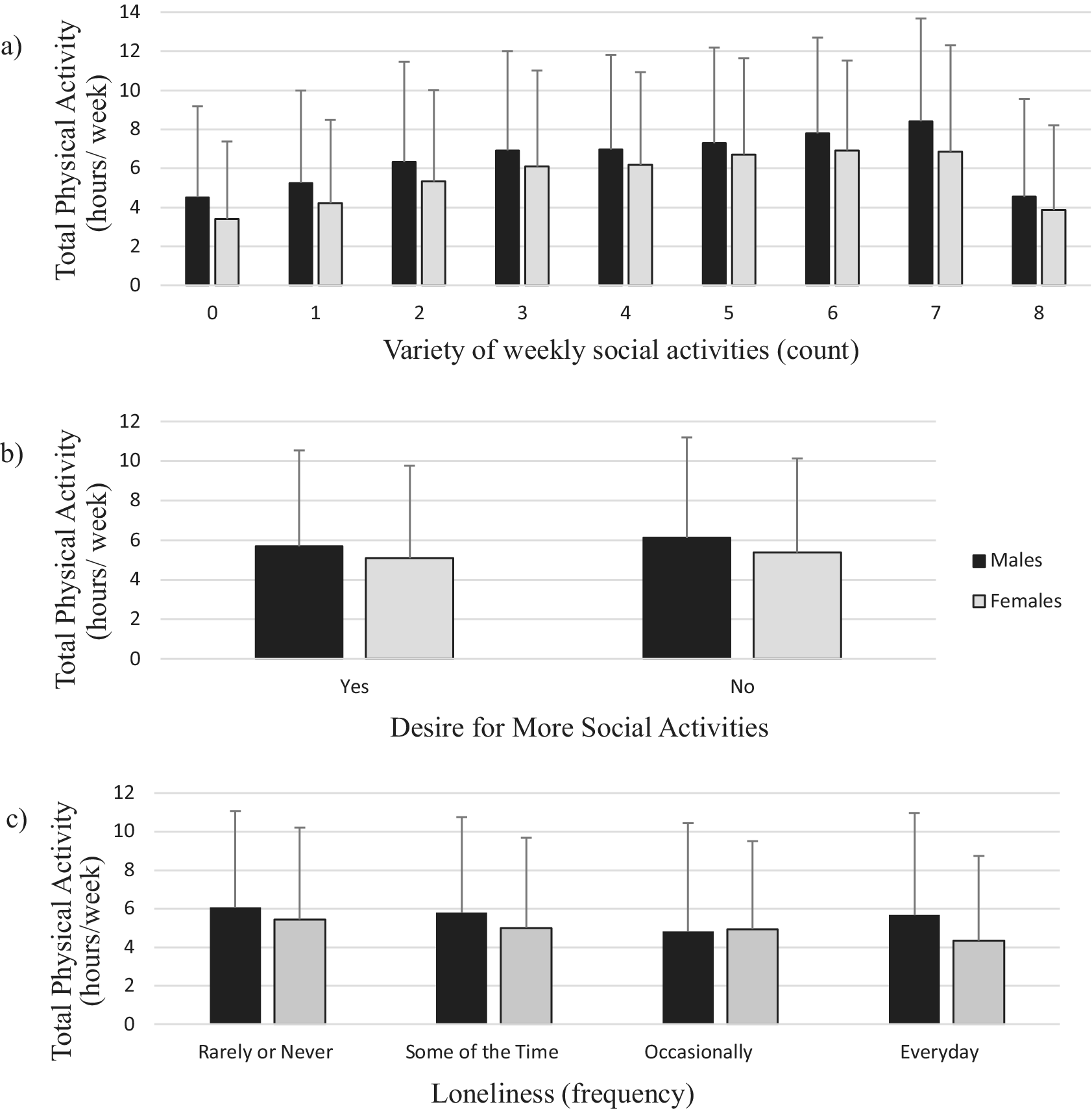
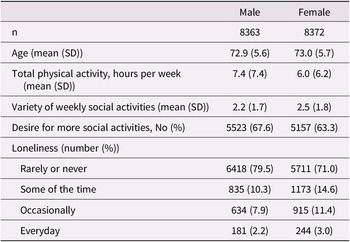
Sample characteristics are presented in Table 1, with additional demographic information in Supplementary Table 1. Further descriptive analyses of physical activity hours per week for each response category are presented in Figure 2. The overall sample included 16 735 older adults. Fifty percent were female, with an average age of 73.0 ± 5.7 for females and 72.9 ± 5.6 for males. On average, total physical activity in females was 6.0 ± 6.2 hours per week compared to males who reported 7.4 ± 7.4 hours per week.

Mean hours of total physical activity by each social participation outcome.

The association between physical activity and social participation variables are presented in Table 2 along with the analysis type. Results for males and females followed similar trends. All associations between physical activity and social participation variables were statistically significant, except for physical activity and loneliness for males. For the combined sample of males and females, each hour of increased physical activity was associated with a 2.4% increase in variety of social activities they participated in, a 1.6% increase in the likelihood of wanting to engage in more social activity, and 1.3% lower likelihood of rarely/never feeling lonely. Due to this association between physical activity and our outcomes, physical activity was not included in the modelling of neighbourhood characteristics and social participation outcomes.
Association between physical activity and social participation variables

* p<0.05
** p<0.01
*** p<0.000
1 Poisson regression
2 logistic regression
3 ordinal logistic regression.
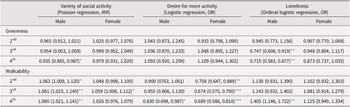
Results for the relationship between greenness, walkability, and the social participation variables are shown in Table 3. Among males, residing in the 4th quartile of greenness was associated with a decrease in variety of social activities (IRR = 0.935 (95%CI: 0.885, 0.987, p<0.05) and lower likelihood of reporting feeling lonely (OR = 0.715 (95%CI: 0.583, 0.877, p<0.01). There were no significant associations between greenness and any of the social participation variables among females. For walkability, being in the highest quartile of walkability was associated with higher variety of social activity (IRR = 1.080 (95%CI: 1.021, 1.141, p<0.01) and higher likelihood of reporting feeling lonely (OR = 1.405 (95%CI: 1.146, 1.722, p<0.01), and a lower likelihood of reporting a desire for more social activity among males (OR = 0.830 (95%CI: 0.698, 0.987, p<0.05). In females, there was a significant relationship across all levels of walkability, such that being in the 2nd, 3rd, or 4th quartile of walkability was associated with a decreased likelihood of desire for more social activity compared to the first quartile. Associations between walkability and loneliness were not significant for females in this sample.
Associations between neighborhood factors and social participation outcomes.
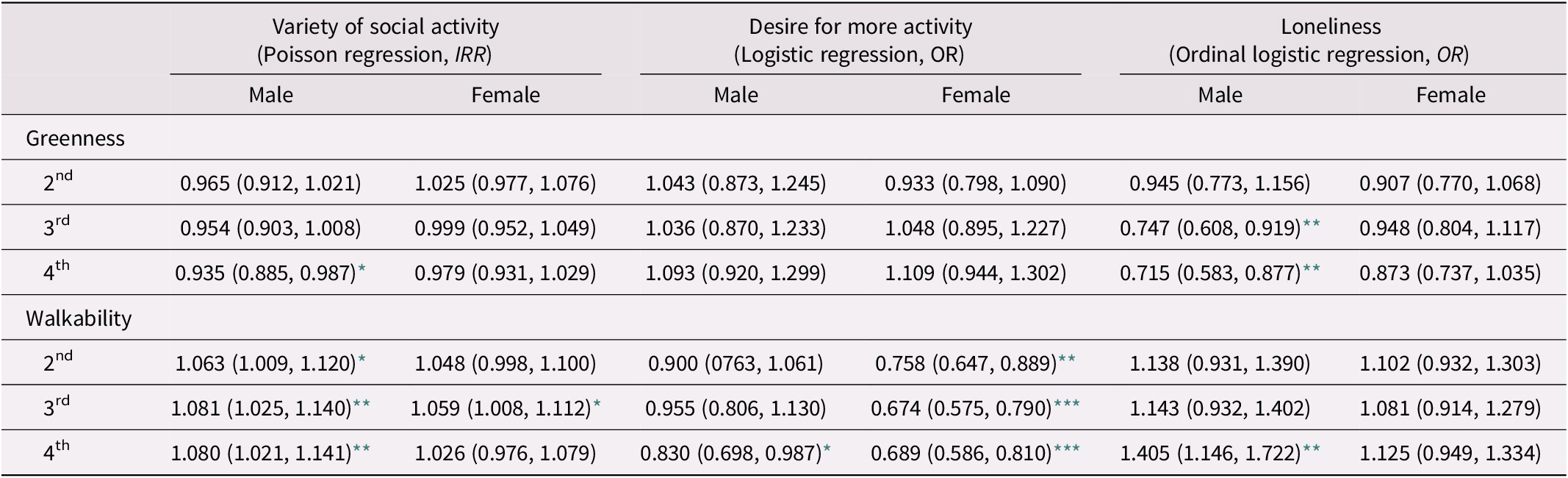
Fully adjusted models (age, household income, education), Poisson and ordinal logistic regression coefficients have been exponentiated to IRRs and ORs above.
* p<0.05
** p<0.01
*** p<0.001.
Discussion
This study sought to examine whether neighbourhood characteristics are associated with social participation in older adults. We hypothesized that social participation would be associated with the neighbourhood environment with differences by sex, and that physical activity and social participation would be highly correlated. Both of our hypotheses were confirmed. First, we found sex differences in the associations between the neighbourhood environment and social participation outcomes. Specifically, it appears that greenness may be important for loneliness among older males, and that higher walkability may be more important for higher variety of social activity among older males. Among older females, walkability appears to be more important than greenness. Second, we found a consistent association between physical activity with desire for more social activity and variety of weekly social activities. These data provide large-scale quantitative evidence to support existing literature that has found associations between physical activity and social participation in smaller samples (Schrempft et al., Reference Schrempft, Jackowska, Hamer and Steptoe2019). These findings have important implications for work aimed at understanding and improving physical activity and social health among older adults, particularly with regard to how we design our neighbourhoods.
Our finding that total physical activity was related to desire for more social activity, variety of weekly social activity, and loneliness (males only) is novel as it is the first study to assess these associations using large-scale Canadian data. It is consistent with previous research linking physical activity to social participation (Decloe et al., Reference Decloe, Kaczynski and Havitz2009; Schrempft et al., Reference Schrempft, Jackowska, Hamer and Steptoe2019). For example, previous research on Flemish older adults (n= 50,000+) found that perceived social environment – defined as frequency of contact with neighbours, neighbourhood support and involvement, and participation – was significantly associated with higher odds of walking for transportation (Van Cauwenberg et al., Reference Van Cauwenberg, De Donder, Clarys, De Bourdeaudhuij, Buffel, De Witte, Dury, Verte and Deforche2014). Recently, in a sample of Japanese older adults (n=1925), it was found that older adults experienced reduced social contact due to COVID-19, with those reporting the largest reductions in social contact also exhibiting lower physical activity and higher sedentary behaviour levels (Otaki et al., Reference Otaki, Yokoro, Yano, Imamura, Akita, Tanino and Fukuo2022). These findings, along with ours, suggest that social participation and physical activity are strongly associated with older adults and that this association likely has a bidirectional component to it. For example, a study of Italian older adults (n=163) who participated in a 16-week dance program found significant improvements in dual-task performance and social engagement (Brustio et al., Reference Brustio, Liubicich, Chiabrero and Rabaglietti2018). Thus, we recommend that future research explore the evaluation of physical activity and social participation jointly as components of a unified ‘active ageing’ construct, rather than treating them as distinct factors in older adults’ well-being. Such an approach could offer a more comprehensive understanding of the interplay between these activities and their collective impact on the well-being of the ageing population.
Data from the analyses including walkability and greenness variables indicated that greenness may be associated with lower levels of loneliness and that walkability may be associated with higher levels of loneliness. This was an interesting finding because previous research has shown that higher walkability is associated with lower levels of deprivation within a neighbourhood or community (Sallis et al., Reference Sallis, Floyd, Rodríguez and Saelens2012), and that a lower level of deprivation is associated with a lower prevalence loneliness (Victor & Pikhartova, Reference Victor and Pikhartova2020). Similarly, though greenness is sometimes higher in rural areas, it is not a proxy for rurality, which means that higher greenness in urban (less deprived) areas is also important for loneliness. However, the mechanistic pathways to this association need further exploration. For example, neighbourhood greenness may be protective against harm from environmental exposures associated with urban living (Browning et al., Reference Browning, Rigolon and McAnirlin2022). Nevertheless, walkability was also associated with lower desire for more social activities, indicating that perhaps a more walkable neighbourhood provides greater opportunity for participation. This is consistent with previous research which has shown that older adults living in more walkable neighbourhoods experience more incidental social interaction due to their time spent mobilizing around their neighbourhoods (Van Holle et al., Reference Van Holle, Van Cauwenberg, De Bourdeaudhuij, Deforche, Van de Weghe and Van Dyck2016). It is important to note however, that we found some interesting sex differences in these associations.
In our sample, older females living in highly walkable neighbourhoods were less likely to report the desire for more social activities, indicating that perhaps there was an alignment between available activities and their preferences, or that older females are resourceful and motivated to find the social activities they enjoy. There was a smaller association for males, and only at the highest levels of walkability. Furthermore, for older males, higher greenness and lower walkability were associated with a lower likelihood of reporting feeling lonely. These data suggest that age-friendly neighbourhood design must take a sex and gender-responsive approach to ensure the health and engagement of all older adults. These findings are also in line with previous research from older males and females that indicates the presence of sex differences in activity preference. For example, while males may be more likely to participate in outdoor activities such as golf and gardening, females may be more likely to participate in indoor activities such as yoga and aerobic dancing (Li et al., Reference Li, Churchill, Procter-Gray, Kane, Cheng, Clarke and Ockene2017). A key limitation of our analysis, therefore, was that information on indoor vs. outdoor activity was not assessed. This may have impacted our findings especially for females, who may prefer to be active indoors (Li et al., Reference Li, Churchill, Procter-Gray, Kane, Cheng, Clarke and Ockene2017) and as such, may not be as impacted by the presence of greenness, especially if they choose to drive to the indoor locations where they carry out social activity.
This study has some notable strengths and limitations. The large national sample with longitudinal data (exposures from baseline; physical activity and social participation outcomes from follow-up (3 years apart)) and the link to objective environmental data was a major strength. To our knowledge, this is also the first study of the relationship between neighbourhood factors, physical activity, and social participation in the Canadian context. One of the primary limitations of this study is the reliance on self-reported measures of physical and social activity. For example, the self-reported PASE scale was used as the primary measure of physical activity in this study, as device-based measures of physical activity were not available at baseline or at first follow-up in the CLSA. While the PASE scale has been validated in older adults (Washburn et al., Reference Washburn, Smith, Jette and Janney1993), there are known limitations to using self-report without the corroboration of objective measures or observation (Welk et al., Reference Welk, Lamoureux, Zeng, Zhu, Berg, Wolff-Hughes and Troiano2023). Additionally, although NDVI was used to measure greenness in this study, it does not distinguish between recreational spaces and dense, unusable vegetation, suggesting a need for a more nuanced analysis of greenspace. Since most people carry out only part of their social and physical activities within their neighbourhood (Browning & Lee, Reference Browning and Lee2017), we cannot assume that objective neighbourhood data is spatially matched to their behaviour patterns with total accuracy. However, the presence of these associations across such a varied geographical area as Canada is indicative of the need for further research into these associations at larger buffer sizes.
Another limitation of this analysis is our reliance on self-reported sex to gauge gender identity and expression, which unfortunately are not captured adequately in the CLSA. Specifically, it is possible that for social outcomes, gender plays a vital role such that gender norms affect behaviour. Gendered roles may have outsized effects on socializing along gender lines beyond what sex differences would indicate. To illustrate, research indicates that older females tend to report having larger social networks (Hosseini et al., Reference Hosseini, Veenstra, Khan and Conklin2020). However, it remains plausible that older males also desire extensive social engagement, but societal expectations of masculine behaviour could potentially hinder them from actively pursuing such social connections (McKenzie et al., Reference McKenzie, Collings, Jenkin and River2018). Thus, future research using gender is needed to better understand how we can encourage active ageing by creating more inclusive communities.
In conclusion, we found that the observed associations between neighbourhood factors and social activity differ by sex. Neighbourhood greenness is associated with loneliness in older males but not in older females, while walkability appears to be more relevant for females in terms of variety of social activity. Our findings highlight the need for sex and gender-based analyses in active ageing research beyond sex stratification. It is crucial for researchers to extend inclusivity by incorporating more nuanced sex and gender-based analysis, better acknowledge the role of culture and countries, and fully understand and support the unique needs of older adults. Overall, these findings can help researchers to better understand the mechanisms by which our environment shapes our health, by considering social participation along with physical activity when developing interventions. Further research of this nature is also needed with equity-seeking populations, and people with varying health status, to address the disparities between neighborhoods in the pursuit of active ageing for all people.
Supplementary material
The supplementary material for this article can be found at http://doi.org/10.1017/S0714980824000369.
Acknowledgements
This research was made possible using the data/biospecimens collected by the Canadian Longitudinal Study on Aging (CLSA). Funding for the Canadian Longitudinal Study on Aging (CLSA) is provided by the Government of Canada through the Canadian Institutes of Health Research (CIHR) under grant reference: LSA 94473 and the Canada Foundation for Innovation, as well as the following provinces, Newfoundland, Nova Scotia, Quebec, Ontario, Manitoba, Alberta, and British Columbia. This research has been conducted using the CLSA Tracking Baseline V3.5, Comprehensive Baseline V4.1, Tracking Follow up 1 V2.1, and Comprehensive Follow up 1 V3.0 under Application Number 20CA011. The CLSA is led by Drs. Parminder Raina, Christina Wolfson and Susan Kirkland.
The Normalized Difference Vegetation Index and the Canadian Active Living Environments z-scores (Can-ALE), indexed to DMTI Spatial Inc. postal codes were provided by CANUE (Canadian Urban Environmental Health Research Consortium, www.canue.ca).
Financial support
This research was supported by the Social Sciences and Humanities Research Council (SSHRC).