




1. Introduction
Nouns are among the very first lexical items that young children comprehend and spontaneously produce by the end of the first year or soon after that (Tardif et al., Reference Tardif, Fletcher, Liang, Zhang, Kaciroti and Marchman2008). Modifying and restricting the nouns with lexical elements (e.g. adjective, noun) or clauses (e.g. relative clause) to form complex nominal structures is a natural next step, which can be a lengthy process for young learners aged 2–6 cross-linguistically (e.g. Diessel & Tomasello, Reference Diessel and Tomasello2000, Reference Diessel and Tomasello2005; Mintz & Gleitman, Reference Mintz and Gleitman2002). In English, the postnominal relative clause (RC) restricts the referent of the modified head noun such that the resulting noun phrase (NP) denotes a smaller set of referents than the otherwise bare head noun. A filler–gap dependency between the head noun and a syntactic gap in the clause is commonly observed (Hawkins, Reference Hawkins1999). In (1), for instance, the head noun is co-indexed with a gapped argument position in the RC.
(1) English relative clause (RC)
the phone
i [which he bought __
i].
However, such a syntactic gap is not necessary in Mandarin RCs. In Mandarin, RC is linked to the nominal head by particle de and appears in the prenominal position, on a par with other noun-modifying structures such as adjectival and nominal modifiers in the language. A distinct feature of such nounmodifying clause constructions in Mandarin (hereafter NMCCs, following Matsumoto et al., Reference Matsumoto, Comrie and Sells2017), as opposed to RCs in English and many European languages, is that they do not necessarily involve a syntactic gap, and they appear to allow a looser and more “relaxed” relation with the head noun than would be possible in English-type RCs. That is, not only “gapped” NMCCs in which arguments are co-indexed with a syntactic gap in the modifying clause (e.g. shouji “mobile phone” in (2a)) can naturally appear; “gapless” NMCCs in which adjuncts (e.g. shangdian “shop” in (2b)) or nouns extended from the events depicted by the NMCC (e.g. fapiao “receipt” in (2c)) are also common (Tsai, Reference Tsai1997; Comrie, Reference Comrie, Boeder, Schroeder, Wagner and Wildgen1998; Cheng & Sybesma, Reference Cheng, Sybesma, Broekhuis, Corver, Huybregts, Kleinhenz and Koster2006; Wu, Reference Wu2022; Pan, Reference Pan2022; cf. Huang, Reference Huang2016).
(2) Mandarin noun-modifying clause construction (NMCC): [modifying clause] de head.
a.
argument NMCC:
[ta
mai
___i]
de
shouji
i
3SG
buy
de
mobile phone
“the mobile phone that he bought”
b.
adjunct NMCC:
[ta
mai
shouji]
de
shangdian
3SG
buy
mobile phone
de
shop
“the shop where he bought a mobile phone”
c.
extended NMCC:
[ta
mai
shouji]
de
fapiao
3SG
buy
cell phone
de
receipt
lit: “the receipt that (is related to) him buying a mobile phone”
or “the receipt for the mobile phone that he bought”
The uniform modifier-noun sequencing in Mandarin noun-modifying structures and the wider range of head–clause relations in Mandarin NMCC provide valuable opportunities to understand how young children develop complex structures to modify the noun. Will children acquire extended NMCC first and then progress to adjunct and argument types, because extended NMCC allows a more “relaxed” relation between the head and the modifying clause? Despite many studies on argument NMCCs (e.g. Chen & Shirai, Reference Chen and Shirai2015; Yang et al., Reference Yang, Chan, Chang and Kidd2020) and general prenominal modification (e.g. Liu & Chan, Reference Liu and Chan2012; Packard, Reference Packard1988) in child Mandarin, the full range of NMCCs in child Mandarin has not been studied systematically and rigorously. To fill this gap, this study comprehensively describes and analyses Mandarin NMCCs produced by young children in naturalistic and elicited settings, following a typological analytic framework which groups together languages with a general NMCC (Matsumoto et al., Reference Matsumoto, Comrie and Sells2017).
2. Mandarin NMCC: a typological analytic framework
As noted in Comrie (Reference Comrie, Boeder, Schroeder, Wagner and Wildgen1998), a number of areal-related Asian languages, such as Japanese, Korean, and Mandarin, share a general NMCC that covers a substantially broader range of uses than RCs as traditionally defined. Mandarin NMCCs are prenominal noun-modifying clauses linked to the nominal head through the particle de. Depending on the thematic relations between the head and the lexical verb in the modifying clause, NMCCs can be analysed as argument, adjunct, and extended types.
In argument NMCCs (or RCs as traditionally defined), the head is coreferential with an argument in the modifying clause. Studies on RCs posit that relativisation leaves a syntactic gap in the clause, for example, subject and object RCs should have a gapi in the subject or object position co-indexed with the head, as in (3a&b). However, as Mandarin allows null arguments, argument NMCCs like (3c), which are typically defined as RCs, can be interpreted as a subject RC containing a subject gapi as the theme, or an object RC with an object gapj as patient. This well-known ambiguity within Mandarin argument NMCCs is not the focus of this study.
(3) Argument NMCC (subject and object RC)
a.
[jiaoshou
fabiao
___i]
de
lunweni (head noun = patient)
professor
publish
de
paper
“the paper that the professor published”
b.
[___i
fabiao
lunwen]
de
jiaoshoui (head noun = agent)
publish
paper
de
professor
“the professor that published papers”
c.
[___i
fabiao
___j]
de
lunweni/j
publish
de
paper
“the papers that were published,” or
“the papers that (someone) published”
In adjunct NMCCs, the head is conceptually coreferential with an adjunct of the modifying clause. Whether this entails a syntactic gap–filler relation between the modifying clause and the head is under debate (Comrie, Reference Comrie, Boeder, Schroeder, Wagner and Wildgen1998; see LaPolla, Reference LaPolla, Matsumoto, Comrie and Sells2017 for Chinese; Yoon, Reference Yoon, Kathol and Pollard1993 for Korean; Kempson & Kurosawa, Reference Kempson, Kurosawa and Hoshi2009 for Japanese). English allows adjunct heads to be relativised into RCs with relative pronouns encoding specific thematic relations between the head noun and the clausal event (e.g. where for location and when for time). Such adjunct RCs have an argument RC equivalent in which the head and the RC are linked by [preposition-which] instead, as in (4a–b). Unlike argument and adjunct RCs in English which are relativised by two distinctive sets of relative pronouns entailing specific thematic relations between the head and the clause, one single linking particle de is shared by all Mandarin NMCCs. Crucially, full adjunct NMCCs can appear in [S-V-O-de-N] sequence, in which the specific thematic role of the head noun (e.g. location, instrument) is not overtly marked and can thus only be inferred, see (5).
(4) Adjunct NMCC in English (from Radford, Reference Radford2016: 394)
a.
There are [places
where
[they sell counterfeit watches]].
a’
… places
at which
[they sell counterfeit watches]
b.
They lived in [times
when
[money was tight]].
b’
… times
at which
[money was tight]
(5) Adjunct NMCC in Mandarin.
a.
[ta
xie
shufa]
de
shufang (head noun = location)
3SG
write
calligraphy
de
study
“the study in which he practices calligraphy”
b.
[ta
daibu
fanren]
de
shoukao (head noun = instrument)
3SG
arrest
prisoner
de
handcuffs
“the handcuff with which he arrests prisoners”
In extended NMCCs, an extended array of semantic relations between the head noun and the modifying clause is possible. Like adjunct NMCCs, full extended NMCCs can appear in [S-V-O-de-N] sequence, in which the specific thematic role of the head noun is not overtly marked. In (6a), the head weidao “smell” is related to the clausal event “fish being burnt,” forming a head–clause association on the basis of the pragmatic encyclopedic knowledge that burnt food produces a distinct smell, a by-product of fish-grilling. Similarly, in (6b), the head noun yinyue “music” is connected with the clausal event wo paobu “I run,” as an accessory of the event, by the pragmatic plausibility of listening to music while running. In (6c), the head diianying “movie” has a causal relation with the clausal event shui-zhao “fall asleep.” Extended NMCCs are not unique to Mandarin or Chinese languages; they are also observed in Korean (Lee & Lee, Reference Lee and Lee2012; Yoon, Reference Yoon, Kathol and Pollard1993) and Japanese (Kempson & Kurosawa, Reference Kempson, Kurosawa and Hoshi2009; Kurosawa, Reference Kurosawa, Jaszczolt and Turner2003).
(6) Extended NMCC in Mandarin.
a.
[ta
kao-hu
yurou]
de
weidao (head noun = by-product)
3SG
grill-burnt
fish
de
smell
Lit. “the smell that (is related to) he burnt the fish”
b.
[wo
paobu]
de
yinyue (head noun = accessory)
1SG
run
de
music
Lit. “ the music that (is related to) I run”
c.
[ni
shui-zhao]
de
na-bu
dianying
(head noun = external cause)
2SG
fall asleep
de
that-CL
movie
Lit. “the movie that (is related to) you fall asleep”
“ the movie that made you fall asleep”
(a–c adapted from Matsumoto, Reference Matsumoto, Matsumoto, Comrie and Sells2017: 36, LaPolla, Reference LaPolla, Matsumoto, Comrie and Sells2017: 97, and Matthews & Yip, Reference Matthews, Yip, Matsumoto, Comrie and Sells2017: 114, respectively)
3. Relative clause and prenominal modifications in child Mandarin
Although acquisition studies adopting the three-way split typological classification of NMCC as in our study are scarce, there has been systematic documentation of argument NMCC (or “RC” in its narrow sense), as well as prenominal modification in children. Studies on the acquisition of NMCC found a robust developmental pattern in English and many European languages: subject RCs, where the head is relativised from a subject position in the clause, are acquired earlier and less problematic than object RCs, which are relativised from an object position (see Lau & Tanaka, Reference Lau and Tanaka2021, for a review). Research on the acquisition of argument NMCC in Mandarin, however, has mixed findings. Since the goal of our study is not to compare subject and object RCs within argument NMCC, below we will review findings on the acquisition of RC in general, rather than delving into the subject advantage debate.
Using naturalistic data, Chen and Shirai (Reference Chen and Shirai2015) analysed NMCCs (termed RCs) in spontaneous production of four children (0;11–3;5) and their caregivers in Beijing. The first use was documented at 1;4 and 1;7 in the two youngest children. Argument NMCCs (subject and object RCs) accounted for most of the RCs in both the children (80.1%) and their caregivers (76.2%). The remaining NMCCs (19.9% and 23.8%) were either “oblique RCs” or “gapless RCs,” which correspond to the categories of adjunct and extended NMCCs in our study. Longitudinal development shows that the relative proportions of oblique and gapless RCs remain low across MLU stages from 2.10 to 3.88. Both the caregiver input and the child output demonstrate a higher frequency for argument NMCCs than adjunct and extended NMCCs. Additionally, early Mandarin RCs (0;11–3;5) are mostly stand-alone NPs (52.7%) with the head noun functioning as a direct object of the modifying clause (61.5%, e.g. baba mai de ban “the board that Daddy bought”), appearing in the [S-V-de-head N] sequence consistent with the canonical SVO word order.
Among experimental approaches to argument NMCCs, Hsu et al. (Reference Hsu, Hermon and Zukowski2009) reported high accuracy (83.5%) in producing simple argument NMCCs in the [V-O-de-head N] sequence to differentiate pictures contrasting actions (e.g. [_ ti/ reng zuqiu] de nanhai “the boy who is kicking/throwing the football”) by 4-year-olds. In a picture selection task, He et al. (Reference He, Xu and Ji2017) found that older children (4;11–6;6) performed significantly more accurately than younger children (3;6–6;6) in matching pictures to auditorily presented argument NMCCs embedded either in the matrix subject [[NMCC]S-V-O] or in the matrix object [S-V-[NMCC]O]. Depending on the type of embedding, accuracy ranged from 50% to 80% in the two groups, capturing rapid development in comprehension of argument NMCC from age 3 onwards. Yang et al. (Reference Yang, Chan, Chang and Kidd2020) tested comprehension of NMCCs through a referent selection task with concurrent eye movements recorded. The 4-year-olds performed well above chance levels (>60%) in selecting the correct animal referent from an array of four candidates on the basis of an auditorily presented argument NMCC (e.g. [laoshu qin _] de gongji “the rooster that the mouse kissed”). Their fixation time at the correct referent corroborated their offline judgements. Overall, although NMCCs emerge very early before age 2 and all types are attested in spontaneous production, Mandarin children display gradual and measurable development in both production and comprehension of argument NMCCs between ages 2 and 6 in controlled experimental settings.
Regarding prenominal modification as a broad category, Packard (Reference Packard1988) analysed 141 tokens of prenominal modification in [modifier-de-head N] sequences produced by 2-year-olds in naturalistic play, showing that adjectival and nominal noun modifiers such as gui-de-shu “expensive-de-book” and yufa-de-shu “grammar-de-book” emerge earlier and are more productive than NMCCs in the toddlers. Liu and Chan (Reference Liu and Chan2012), who analysed 1034 tokens of [modifier-de-head N] sequences produced by preschoolers (3;0–6;0), reported similar findings. Specifically, they found that 22.8% of the clausal modifiers fell outside the scope of RCs as traditionally defined, and these instances were rarely studied for their own sake.
The first and only acquisition study including a full range of NMCCs is Lai et al. (Reference Lai, Chan, Matthews, Han and Brebner2023), who collected 60 tokens of NMCCs produced by Cantonese monolingual children (1;7–5;6) from longitudinal and cross-sectional corpora. Cantonese shares many structural features with Mandarin including canonical SVO word order and prenominal NMCCs without explicit marking of the thematic relation between the head noun and the clausal verb. In the longitudinal data, argument NMCCs were produced earlier and more frequently than the other types. Nevertheless, their cross-sectional data showed that argument NMCCs were the most productive type in the 4-year-olds, but not the 2-, 3-, and 5-year-olds. The seemingly contradictory results in the longitudinal and cross-sectional data were attributed to the small number of attested NMCCs.
4. Developmental hierarchy of Mandarin NMCC: a multi-factorial proposal
What are the factors shaping the development of NMCCs in Mandarin? We draw from two theoretical accounts in the RC literature. First, syntactic gap-based accounts posit that NPs that are higher in the Noun Phrase Accessibility Hierarchy are easier to relativise than those lower in the Hierarchy (e.g. subject > direct object > indirect object, Keenan & Comrie, Reference Keenan and Comrie1977; O’Grady, Reference O’Grady and Kidd2011). Along the same line, RCs with the head nouns farther away from the syntactic gaps are harder to acquire than those with head nouns closer to the relevant gaps (Gibson, Reference Gibson1998; Hawkins, Reference Hawkins1999; O’Grady, Reference O’Grady1997). These approaches explain acquisition differences across NMCC types on the basis of grammatical roles of the head noun and the syntactic distance between the head and its corresponding clausal gap. Although they make testable predictions about argument NMCCs, they do not predict or explain the development of gapless adjunct and extended NMCCs in Mandarin, where syntactic gaps are absent (see (2), (5), (6)).
A second tradition invokes frequency in the input (Brandt et al., Reference Brandt, Kidd, Lieven and Tomasello2009; Kidd et al., Reference Kidd, Brandt, Lieven and Tomasello2007; Ozeki & Shirai, Reference Ozeki, Shirai, Matsumoto, Oshima, Robinson and Sells2007), predicting that the type of NMCC that is most frequent in the input will be acquired earlier. In Mandarin, for example, argument NMCCs dominate NMCCs in naturalistic child-directed speech (75–78%, Chen & Shirai, Reference Chen and Shirai2015) and adult-to-adult speech (71%, Lancaster Corpus of Mandarin Chinese, Ming & Chen, Reference Ming and Chen2010). Since, in those samples, the ratio between adjunct and extended NMCCs is not reported, we conducted our own corpus search in the child-directed speech by parents of two monolingual Mandarin children, Tong (Deng & Yip, Reference Deng and Yip2018) and Xue (Zhang & Zhou, Reference Zhang, Zhou and Zhou2009) in Child Language Data Exchange System (CHILDES; see 5.2 for coding scheme). Our results showed that argument NMCCs accounted for 74.73% of total NMCCs, very similar to that reported in Chen and Shirai (Reference Chen and Shirai2015) and Ming and Chen (Reference Ming and Chen2010). Interestingly, adjunct and extended NMCCs accounted for similar proportions of NMCCs in the input (12.09% and 13.19%, respectively, more details in Supplementary Table S1). Given this evidence, input frequency would predict an advantage of argument NMCCs and similar developmental trajectories between adjunct and extended NMCCs in Mandarin children.
We hypothesise a third factor that shapes the developmental trajectory of NMCC: the conceptual importance or prominence of the head noun’s role in clausal events, ordered on a scale shown in (7). The scale is motivated by independent evidence from event perception and memory research: located furthest to the left, agent and patient (especially the agent) are most prominent in human event cognition. They are identified and configured into mental schemas most rapidly during processing of visual scenes and activated by verbs most consistently during lexical processing (Hafri et al., Reference Hafri, Trueswell and Strickland2018; see Zacks, Reference Zacks2020 for a review). After them, other event elements such as instrument, location, and time are also prominent: lexical processing research shows that when the verb entails specific instruments (e.g. cut, dig), the instrument is part of the generalised situation scheme and automatically activated by the verb, whereas information about the location of the action is less activated (Ferretti et al., Reference Ferretti, McRae and Hatherell2001). Nevertheless, location and time are two powerful labels and organisers of events in memory, affecting memory retrieval and processing speed (Radvansky et al., Reference Radvansky, Zwaan, Federico and Franklin1998, Reference Radvansky, O’Rear and Fisher2017; Swallow et al., Reference Swallow, Zacks and Abrams2009). Finally, accessory, by-product, and external cause of the event are the lowest in prominence. by-products usually emerge at subsequent stages of the event (e.g. smell of burnt fish in (6a)). accessories are optional elements that elaborate upon the core event structure by providing secondary instrumental details (e.g. music in (6b)). external causes are initiating factors originating outside the relevant verbs’ event model (e.g. movie in (6c)). The three clusters of event roles in (7) align with the three NMCC types (i.e. argument, adjunct, extended) identified by Matsumoto et al. (Reference Matsumoto, Comrie and Sells2017) in a non-arbitrary way. The alignment reflects universal tendencies in natural languages to map agents and patients to subject and object positions, and instruments, locations, and times to adjuncts.
(7) Scale of conceptual prominence of event roles (more prominent > less prominent)
Agent patient
instrument location time
accessory
by-product external cause
most
prominent|-*---------------------------*----------------------------------*-|
least
prominent
Given the syntactic, input frequency and conceptual factors above, we propose a developmental hierarchy for the three types of NMCCs in Mandarin, shown in (8), which predicts that NMCCs further to the left should develop earlier than those further to the right. The dominance of argument NMCC over adjunct and extended NMCCs in early Mandarin (and Cantonese) has already received strong empirical support (e.g. Chen & Shirai, Reference Chen and Shirai2015; Lai et al., Reference Lai, Chan, Matthews, Han and Brebner2023; Liu & Chan, Reference Liu and Chan2012), consistent with input frequency and conceptual prominence effects. The proposed superiority of adjunct NMCC over extended NMCC is, on the other hand, an uncharted territory and hence the main focus of our study.
(8) Developmental hierarchy of NMCC in Mandarin (earlier > later)
Argument NMCC
>
Adjunct NMCC
>
Extended NMCC
This study addresses two overarching questions: to what extent does the development of the three NMCC types in Mandarin-speaking children align with the proposed hierarchy, and to what extent can conceptual prominence explain the differences between adjunct and extended NMCCs? To address these overarching questions, we adopted a two-step approach: we first established a foundational profile of NMCC production through systematic analysis of spontaneous child speech, using a rigorous, theoretically informed coding scheme (Study 1). We then tested specific NMCC structures via an elicited production task with 3- and 4-year-olds, controlling for NMCC-level (word order, animacy, length) and child-level factors (age, working memory (WM), grammatical proficiency) (Study 2).
5. Study 1: Corpus-based study
5.1. Research questions
The first study sought to provide developmental evidence on the emergence, frequency, and quality of three types of Mandarin NMCCs in naturalistic child speech. Specifically, we asked three questions: (i) At what age do monolingual Mandarin-speaking children start to produce argument, adjunct, and extended NMCCs, respectively? (ii) Among the three types of NMCCs, which type predominates in naturalistic child speech? (iii) What are the structural and semantic characteristics of early NMCCs in naturalistic child speech?
5.2. Methods
Data. As NMCCs are infrequent in naturalistic speech (Lai et al., Reference Lai, Chan, Matthews, Han and Brebner2023; Matthews & Yip, Reference Matthews, Yip and Ramat2002), we exhausted available data of monolingual Mandarin children in the CHILDES (MacWhinney, Reference MacWhinney2000) in order to maximise the sample size. We also incorporated the newly constructed Beijing Child Mandarin Corpus (BJCMC, Mai et al., Reference Mai, Shang, Liu, Yan, Matthews and Yip2024). Table 1 presents details of the corpora used. All corpora recorded child speech during toy-play activities. According to the documentation of individual corpora, all the children were raised in Mandarin-dominant families and communities and received Mandarin input from native speakers. There are no indications that the children were auditorily or verbally impaired or had developed language atypically.
Corpus data selected for this study

Table 1. Long description
The table is organized into five columns: Corpus, Age, N sub children, and N sub utterances.
Cross-sectional section:
* Li Zhou (Li and Zhou, Reference Li and Zhou2008): Age 3;0 to 6;3, 80 children, 12169 utterances.
* Zhou 1 and 2 (Li and Zhou, Reference Li and Zhou2004; Zhou, Reference Zhou2001): Age 1;2 to 6;0, 185 children, 17149 utterances.
* Chang 1 and 2 (Chang, 1998, 2000): Age 3;4 to 6;5, 40 children, 3860 utterances.
* BJCMC (Mai et al., 2024): Age 3;0 to 6;9, 50 children, 18117 utterances.
* Cross-sectional Total: Age 1;2 to 6;9, 355 children, 51295 utterances.
Longitudinal section:
* Tong (Deng and Yip, Reference Deng and Yip2018): Age 1;7 to 3;4, 1 child, 9250 utterances.
* Zhou 3 (Zhang and Zhou, Reference Zhang, Zhou and Zhou2009): Age 1;8 to 5;5, 1 child, 8350 utterances.
* Erbaugh (Erbaugh, 1992): Age 1;9 to 3;9, 2 children, 19879 utterances.
* TCCM (Cheung et al., 2011): Age 1;5 to 4;3, 10 children, 30990 utterances.
* Longitudinal Total: Age 1;5 to 5;5, 14 children, 68469 utterances.
Coding. We searched for utterances containing de Footnote 1 using the KWAL command in CLAN (MacWhinney, Reference MacWhinney2000); the first author manually checked the results and extracted the target NMCCs appearing in this sequence: [modifying clause]-de-head N. More details about the inclusion criteria are in Supplementary Table S2. In this study, a prenominal modifier is considered a “clause” only when it is predicated by a verb, defined as a word modifiable by the negator bu “not” and aspectual markers like le, excluding adjectives which are modifiable by degree adverbs like hen “very” (following Huang et al., Reference Huang, Li and Li2009). The intended meaning of the NMCCs was determined based on the surrounding context. For corpora with accompanying audio or video files (i.e. Tong and Erbaugh), multimedia files were additionally consulted to ascertain the meaning. The NMCCs were categorised into argument, adjunct, or extended depending on the grammatical relations between the head noun and the modifying clause:
-
i) If the head noun falls into the broad categories of agent or patient (including theme, experiencer, etc.) of the event denoted by the verb phrase in the modifying clause, as in (9a), it is an argument NMCC;
-
ii) Failing (i), if the head noun expresses location, time, or instrument of the event depicted in the modifying clause, as in (9b), then it is an adjunct NMCC. We delineate location and instrument based on their functional significance in the event and preclude blanket inclusion of all entities related to the event. Specifically, for instrument, we refer to entities that are considered necessary, predictable tools in the event. By location, we refer to “containment” (including loosely “encirclement”) and “support” relations, but not other spatial relations such as occlusion, proximity, and attachment. This is because containment and support are two core spatial relations: Conceptually, event entities that contain or support the agent/patient can have direct interactions with them and lead to physical consequences (e.g. moving the box containing the apple will move the apples as well). Empirically, containment and support emerge and mature the earliest in cognitive development (Casasola et al., Reference Casasola, Cohen and Chiarello2003; Rigney & Wang, Reference Rigney and Wang2015); they are also labelled most successfully across languages by young children (Choi & Bowerman, Reference Choi and Bowerman1991; Johnston & Slobin, Reference Johnston and Slobin1979) and are provided most extensively in infant-directed speech (Casasola et al., Reference Casasola, Bhagwat, Doan and Love2017);
-
iii) Failing both (i) and (ii), if the head noun forms a relation with the modifying clause such as accessory, by-product, and external cause, as in (9c), it is an extended NMCC.
(9) Examples of three types of NMCC in child-produced speech in our dataset.
a.
Argument:
[___i
mai
shuzi]
de
lao-taipoi (agent)
sell
comb
de
old woman
“the old woman who sells combs” (XUE 3;9, Zhou3)
b.
Adjunct:
[__
chi
fan]
de
zhuozi (location)
eat
meal
de
table
“the table at which (people) eat meals” (4;10, LiZhou)
c.
Context: in a role-play game, the child had received some change from the “cab driver” and turned to the investigator to offer the money to her.
Extended:
[wo
zuo
jichengche]
de
qian (by-product)
1SG
take
taxi
de
money
Lit. “the change that (is related to) me taking the taxi”
“the change that I received after I took the taxi.” (KANG 3;2, Erbaugh)
The first author coded the data independently. Then 20% of the extracted NMCCs were randomly selected and independently coded by the corresponding author. The agreement rate between the two authors was 91.43% (Cohen’s Κ = .832, p < .001). When the two coders disagreed, they reviewed the coding and settled the disagreement with reference to the conversational contexts and the video recording. We extracted 728 tokens of NMCC, including 481 argument, 148 adjunct, and 99 extended NMCCs. Given the nature of the data, we present the cross-sectional and longitudinal data separately.
5.3. Cross-sectional data
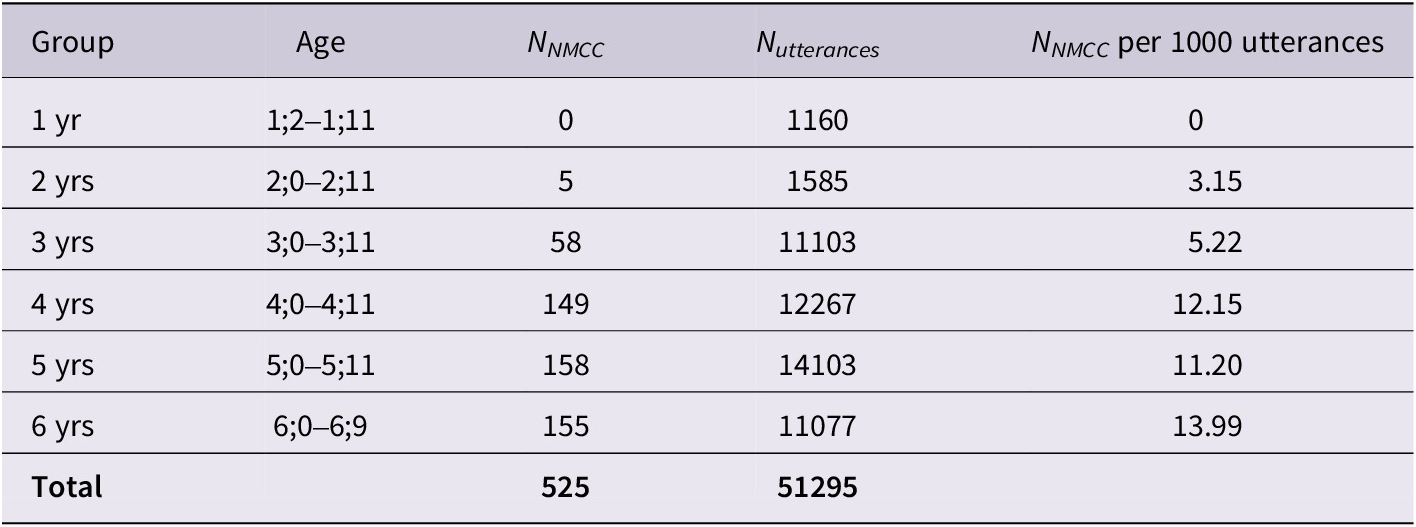
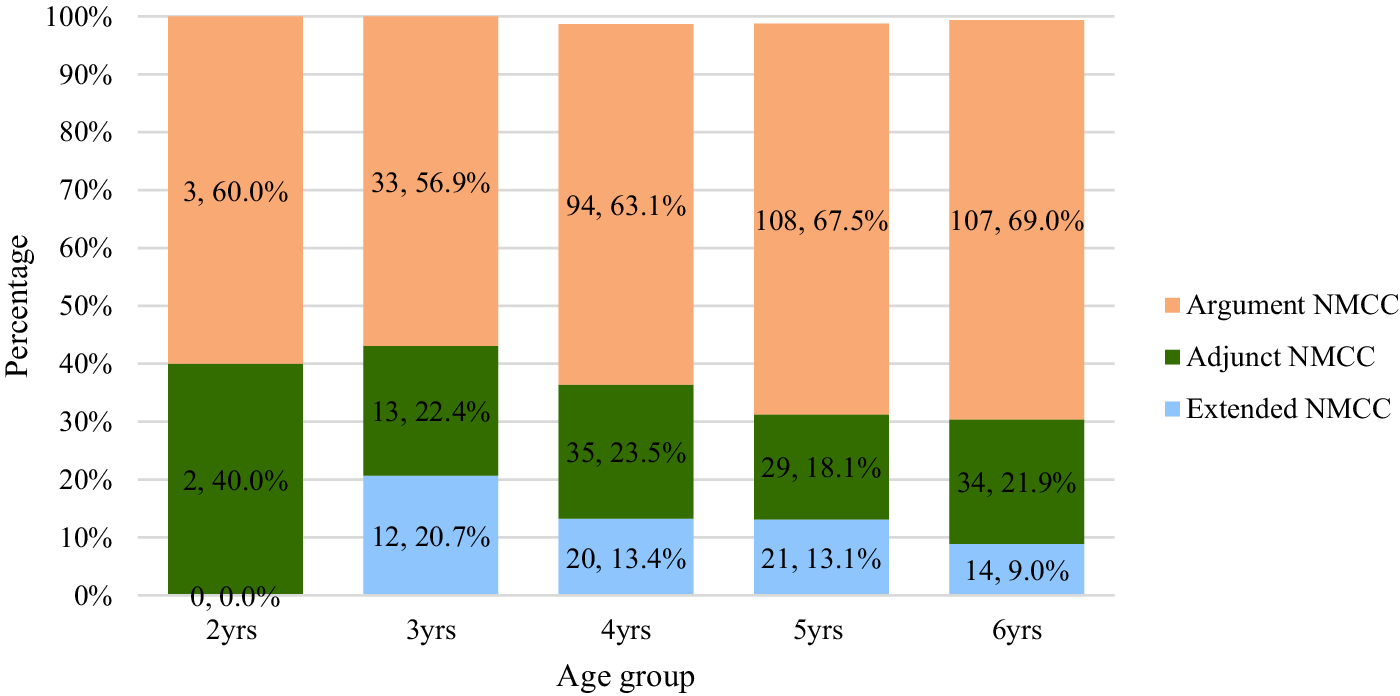
A total of 525 NMCCs were extracted from the cross-sectional corpora and placed into six age groups, as shown in Table 2. The results show that NMCC is produced at a low frequency in child Mandarin, with fewer than 15 tokens per thousand utterances. An increase in productivity is observed between 1;2 and 4;11. Figure 1 illustrates the token number and proportion of each type of NMCC. Argument NMCCs are more frequent than adjunct and extended NMCCs across age groups. Argument and adjunct NMCCs were observed in the production of 2-year-olds, whereas extended NMCCs were only found in children aged 3;0 and above, suggesting later emergence of extended NMCC than the other two types.
NMCC in the cross-sectional corpora

Table 2. Long description
The table consists of five columns: Group, Age, N sub NMCC, N sub utterances, and N sub NMCC per 1000 utterances.
* Group 1 yr, Age 1;2 to 1;11: N sub NMCC is 0, N sub utterances is 1160, N sub NMCC per 1000 utterances is 0.
* Group 2 yrs, Age 2;0 to 2;11: N sub NMCC is 5, N sub utterances is 1585, N sub NMCC per 1000 utterances is 3.15.
* Group 3 yrs, Age 3;0 to 3;11: N sub NMCC is 58, N sub utterances is 11103, N sub NMCC per 1000 utterances is 5.22.
* Group 4 yrs, Age 4;0 to 4;11: N sub NMCC is 149, N sub utterances is 12267, N sub NMCC per 1000 utterances is 12.15.
* Group 5 yrs, Age 5;0 to 5;11: N sub NMCC is 158, N sub utterances is 14103, N sub NMCC per 1000 utterances is 11.20.
* Group 6 yrs, Age 6;0 to 6;9: N sub NMCC is 155, N sub utterances is 11077, N sub NMCC per 1000 utterances is 13.99.
* Total: N sub NMCC is 525, N sub utterances is 51295.
NMCC types in the cross-sectional corpora (“token number, percentage” in bars).

Figure 1. Long description
The y-axis represents Percentage from 0 to 100 percent in increments of 10. The x-axis is labeled Age group with five categories: 2yrs, 3yrs, 4yrs, 5yrs, and 6yrs. A legend to the right identifies three categories: Argument NMCC in peach, Adjunct NMCC in dark green, and Extended NMCC in light blue. Data points are labeled as token number followed by percentage.
* 2yrs: Extended NMCC is 0, 0.0 percent. Adjunct NMCC is 2, 40.0 percent. Argument NMCC is 3, 60.0 percent.
* 3yrs: Extended NMCC is 12, 20.7 percent. Adjunct NMCC is 13, 22.4 percent. Argument NMCC is 33, 56.9 percent.
* 4yrs: Extended NMCC is 20, 13.4 percent. Adjunct NMCC is 35, 23.5 percent. Argument NMCC is 94, 63.1 percent.
* 5yrs: Extended NMCC is 21, 13.1 percent. Adjunct NMCC is 29, 18.1 percent. Argument NMCC is 108, 67.5 percent.
* 6yrs: Extended NMCC is 14, 9.0 percent. Adjunct NMCC is 34, 21.9 percent. Argument NMCC is 107, 69.0 percent.
The trend shows Argument NMCC remains the dominant type across all age groups, range from 56.9 percent to 69.0 percent across age groups.
5.4. Longitudinal data
In the longitudinal corpora with 14 children’s speech data, 203 NMCCs were extracted and coded. Table 3 presents the raw token number, first emergence, and the percentage of each type, as recorded in respective corpora. As expected, there is wide variation across the corpora. Only five children produced more than 15 tokens of NMCC during the recording periods, all of them from the three “larger” corpora with greater numbers of total utterances per child (i.e. Tong, Zhou3, Erbaugh, see Table 1). This is consistent with previous observations and our own cross-sectional finding that NMCC is a low-frequency structure in naturalistic speech. Nevertheless, as a limitation of naturalistic samples, the earliest tokens may or may not be captured. Additionally, given the generally small numbers of analysable NMCC recorded for each child, patterns generalised from this small sample may be highly instable and thus lack generalisability. Hence, whether the order of emergence or frequency count as recorded in the longitudinal data is indicative of a developmental hierarchy is inconclusive. Notwithstanding, our longitudinal data clearly show that all individual children from the larger corpora spontaneously produced all three types of NMCCs at the age of 3, which is consistent with the patterns in the cross-sectional data, motivating us to test children as young as age 3 in Study 2.
NMCC produced in the longitudinal corpora

Table 3. Long description
The table is organized into seven columns: Child, Age, Raw token (token per 1000 utterances), and Age of 1st attested token (proportion) which is subdivided into Argument, Adjunct, and Extended.
* Tong Corpus:
- TONG: Age 1;7 to 3;4. Raw token 44 (4.76). Argument: 1;11 (40.9 percent). Adjunct: 2;2 (29.5 percent). Extended: 2;0 (29.5 percent).
* Zhou 3 Corpus:
- XUE: Age 1;8 to 5;5. Raw token 30 (3.59). Argument: 2;0 (83.3 percent). Adjunct: 1;8 (10.0 percent). Extended: 3;8 (6.7 percent).
* Erbaugh Corpus:
- PANG: Age 1;9 to 2;11. Raw token 19 (2.24). Argument: 2;1 (78.9 percent). Adjunct: 2;6 (5.3 percent). Extended: 2;7 (15.8 percent).
- KANG: Age 2;10 to 3;9. Raw token 40 (3.51). Argument: 2;10 (62.5 percent). Adjunct: 2;10 (30.0 percent). Extended: 3;2 (7.5 percent).
* T C C M Corpus:
- YANG: Age 1;5 to 2;9. Raw token 2 (1.04). Argument: 2;9 (100 percent).
- XU: Age 1;6 to 2;5. Raw token 1 (.38). Adjunct: 2;5 (100 percent).
- WU: Age 1;7 to 2;10. Raw token 3 (1.08). Argument: 1;9 (66.7 percent). Extended: 2;6 (33.3 percent).
- PAN: Age 1;7 to 3;9. Raw token 8 (2.77). Argument: 2;6 (50.0 percent). Adjunct: 2;6 (25.0 percent). Extended: 2;0 (25.0 percent).
- JC: Age 2;2 to 3;5. Raw token 10 (2.04). Argument: 2;6 (60.0 percent). Extended: 2;5 (40.0 percent).
- WANG: Age 2;5 to 3;4. Raw token 13 (4.11). Argument: 2;5 (84.6 percent). Adjunct: 2;9 (15.4 percent).
- CHOU: Age 2;6 to 3;4. Raw token 7 (1.37). Argument: 2;6 (71.4 percent). Extended: 3;2 (28.6 percent).
- WUYS: Age 2;7 to 3;10. Raw token 8 (5.21). Argument: 2;7 (87.5 percent). Adjunct: 2;10 (12.5 percent).
- CHENG: Age 3;1 to 3;11. Raw token 14 (4.11). Argument: 3;1 (92.9 percent). Extended: 3;4 (7.1 percent).
- CHW: Age 3;6 to 4;3. Raw token 4 (1.53). Argument: 3;8 (75.0 percent). Extended: 3;10 (25.0 percent).
5.5. Structural and semantic characteristics of early NMCCs
Some of the earliest argument, adjunct, and extended NMCCs are presented in (10)–(12), with the head nouns serving a variety of roles in the clausal events from agent and instrument to by-product, external cause, and accessory. In the argument NMCC in (10), the head noun is co-indexed with gapped subject position in the modifying clause (i.e. huoche “train”). In the adjunct and extended NMCCs in (11) and (12), the modifying clauses have syntactic gaps with unrealised, covert subject and objects, but the head nouns are not co-indexed with those gaps. The majority of early adjunct (95 out of 148) and extended (72 out of 99) NMCCs have covert clausal subjects, resulting in a simpler [V(-N)-de-head N] sequence than a full NMCC, as in (11) and (12a–b).
(10) Earliest argument NMCC.
[[___i
bian-cheng
zhe
yangzi]
de
huochei].
change-become
this
appearance
de
train
“The train that changes into this appearance.” (WU 1;9, TCCM)
(11) Earliest adjunct NMCC.
[[__
xie
zi]
de
bi]. (instrument)
write
(Chinese) character
de
pen
“The pen that (one) writes (with).” (XUE 1;8)
(12) Earliest extended NMCC.
a.
[[__
chui
__]
de
shengyin]. (by-product)
blow
de
sound
“The sound that (results from one) blowing (candles)” (PAN 2;0, TCCM)
b.
mama
dian
[[__
fangpi]
de
zhe-ge]. (external cause)
mom
click
fart
de
this-CL
“Mom, click this button such that (we make the toy) fart.” (TONG 2;4, Tong)
(Authors’ note: the toy has a button which you can press to hear a farting sound.)
c.
zhe
shi
[[tamen
da-zhen]
de
ka]. (accessory)
this
COP
3PL
get-injection
de
card
Lit. “This is the card that (is related to) them getting vaccines.”
“This is their vaccine record card.” (3;0, LiZhou)
5.6. Interim summary
Study 1 investigated how Mandarin-learning children produce Mandarin NMCCs in naturalistic child speech. We analysed 728 tokens of NMCCs extracted from a total of 119,764 utterances produced by 369 children. The results show that NMCCs emerge quite early, typically at or before 2;0. Although the frequency is low at the early stages (less than 6 tokens per thousand utterances from 1;2 to 3;11), it increases with age (see Table 2), despite considerable individual differences (see Table 3). Different production patterns are found across the three types of NMCCs. Argument NMCCs make up a larger percentage in child speech than adjunct and extended NMCCs across age groups and individuals. In the cross-sectional data, argument and adjunct NMCC emerge at 2;0, earlier than extended NMCCs, which are produced after 3;0. Qualitative analysis showed that early NMCCs instantiate a variety of head–clause relations derived from the modifying event and the conversational context. An empty clausal argument could either be subject to a coreferential relationship with the head noun, or subject to pervasive argument dropping in Mandarin (Comrie, Reference Comrie, Boeder, Schroeder, Wagner and Wildgen1998).
Overall, our results indicate a primacy of argument NMCCs over the other types in language acquisition, consistent with the developmental hierarchy in (8). However, the naturalistic data present limitations: lower frequency and later emergence may be partially due to a lack of production opportunities; individual differences in NMCC production may be associated with uncontrolled child-internal factors as well as potential sampling gaps across the disparate corpora. An experimental study was therefore designed to remedy this weakness and test specific NMCC structures with Mandarin children controlling for NMCC-level and child-level factors.
6. Study 2: experimental study
6.1. Research questions and predictions
In the second study, we sought to test knowledge of Mandarin NMCCs in children aged 3–4 years, focusing on the role of conceptual prominence of the head noun’s thematic role in the clausal event. To achieve this, in our experimental stimuli we controlled for word order, sentence length, and animacy of the head noun across NMCC types, narrowing down the targets to a subset of NMCC structures. Our experimental design was guided by the following research questions: How accurately do 3–4-year-old Mandarin children produce NMCCs in felicitous elicitation contexts? How do accuracy rates vary across NMCC types? How does the effect of NMCC type vary with age?
Since previous studies and our Study 1 show that children begin to spontaneously produce all three types of NMCCs between ages 2 and 3, we predict that some 3–4-year-olds will be able to produce all three types of NMCCs successfully in felicitous elicitation contexts. Nevertheless, age, WM, and general grammatical proficiency may play moderating roles. In cases where children fail to produce the target NMCC, they will likely substitute the complex, embedded construction with a simpler structure. Across NMCC types, we expect the highest accuracy rate in argument NMCCs, given the dominance of argument NMCCs in naturalistic input and the high prominence of agent and patient in events. We also predict that children will perform better in adjunct NMCCs than in extended ones, considering the conceptual prominence scale in (7). However, the disparities in accuracy among NMCC types should diminish as children approach ceiling performance.
6.2. Methods
Participants. The participants were recruited from a public kindergarten in Shandong Province in northern China, where Mandarin is the dominant language. Priority was given to the youngest testable children in elicited production tasks, namely, 3- and 4-year-olds. 127 monolingual Mandarin-speaking children were invited to participate in the study, and 121 (3;1–4;11, 59 girls) completed all the tasks (Mage in months = 49). No substantial exposure to other varieties of Chinese or other languages was reported by the kindergarten or the parents. This study was approved by the Survey and Behavioral Research Ethics Committee of The Chinese University of Hong Kong (No. SBRE-24-0072). Written consent was obtained from individual parents prior to data collection.
Tasks, materials, and procedures. A contextualised sentence repetition (SR) task was used to elicit NMCC. SR is a sensitive measure of children’s grammatical knowledge (Lust et al., Reference Lust, Flynn, Foley, McDaniel, Cairns and McKee1996) and has been used to investigate young children’s knowledge of complex structures like RCs (Diessel & Tomasello, Reference Diessel and Tomasello2005; Kidd et al., Reference Kidd, Brandt, Lieven and Tomasello2007). Our task was presented as a “treasure hunt game” in which the children were required to repeat previously heard instructions (i.e. prompt sentences with NMCCs) to Peppa Pig (a popular cartoon character) so that Peppa could follow their instructions to find the treasures (e.g. diamond, pearl). The children were told that Peppa only took instructions from children, rather than adults, and that they should repeat the instructions that they heard from the experimenter to Peppa most clearly and accurately. An example of the prompt sentence and its preceding lead-in is presented in (14) and (13). A lead-in sentence spells out the target entity in this search (e.g. coin), followed by a test item (one of (14)) which is a prepositional phrase in the “zai-[NMCC]-locative” frame, identifying the location of the target entity. Zai is the only preposition used in the experiment, and the locatives include shangmian “top,” xiamian “bottom,” limian “inside,” and pangbian “side.” Previous studies have shown that 3-year-olds demonstrate productive use of zai and the four locative expressions used in our stimuli, and can interpret them in largely adult-like manners (Deng & Yip, Reference Deng and Yip2016).
Note that the experimental design controlled for word order and head noun animacy across the three NMCC types to align with Study 2’s focus on conceptual prominence, within the constraints of a limited item set. Only object RCs with inanimate patient head nouns (i.e. [S-V-de-O]) were included to represent argument NMCCs. Subject RCs were avoided because their non-agent-first [V-O-de-S] word order and preference for animate heads (see (3) and (9)) would have rendered them considerably different from the adjunct and extended NMCCs and confounded the results (Hao et al., Reference Hao, Chondrogianni and Sturt2025). The adjunct NMCC items included instrument and location heads, and the extended NMCC items accessory and by-product heads.
(13) Lead-in sentence.
Women
lai
kan
zhe
fu
tu
de
jinbi
zai
nali.
1PL
come
see
this
CL
picture
de
gold coin
at
where
“Let us see where the gold coin is in this picture.”
(14) Test items (to be repeated by children)
a. Argument NMCC prompt in [S-V-de-O]:
Zai
[xiongmao
didi
chui
de
lazhu]NMCC
pangbian
at
Panda
brother
blow
de
candle
side
“ Next to the candle that Brother Panda blows out.”
b. Adjunct NMCC prompt in [S-V-O-de-N]:
Zai
[xiongmao
chui
lazhu
de
yizi]NMCC
xiamian
at
Panda
blow
candle
de
chair
bottom
“Under the chair where Panda blows out a candle.”
c. Extended NMCC prompt in [S-V-O-de-N]:
Zai
[xiongmao
chui
lazhu
de
zhaopian]NMCC
shangmian
at
Panda
blow
candle
de
photo
top
Lit.: “Above the photo that (is related to) Panda blowing out a candle.”
“Above the photo such that Panda blows out a candle.”
To engage the young children and control for contextual factors which might affect the interpretation of the NMCCs, we created coloured pictures visualising the events denoted by the test items to serve as secondary prompts, as exemplified in Figure 2. Note that the visual prominence of the depicted objects (e.g. agent, patient, instrument, by-product), which may or may not be an integral part of conceptual prominence, was not deliberately controlled in the pictures – the objects were depicted in realistic proportion to one another. A total of 36 test items (3 NMCC types × 12 items per type) and accompanying pictures were created. We controlled for the number of syllables of the clausal verb (all monosyllabic, e.g. chui “to blow”) and the NMCC prompts (11 syllables per sentence). To avoid priming effects among items depicting similar events (like those in (14)), we created three lists such that test items with the same clausal verb were distributed across the lists, rendering 12 test items per list. NMCC types were evenly distributed across lists. Additionally, each list included three “easy” filler items appearing in the [zai-[N1-he-N2]-locative] sequence, in which N1 and N2 were simple nouns coordinated by he “and.” The filler items helped to ascertain whether the participants were engaged in the task. The SR task began with three additional NMCC warm-up items using verbs different from the critical items. The SR task lasted for 10–15 minutes in total. See Tables S3, S4 in Supplementary for the full experimental stimuli.
Sample pictures for three types of NMCC prompts in (14) (from left to right: argument, adjunct, extended).

Since the acceptability of extended NMCCs is known to be conditioned by felicitous pragmatic contexts, a norming study was conducted to select the most appropriate test items. This norming study focused exclusively on extended NMCCs because, unlike argument and adjunct NMCCs, their well-formedness hinges on a loose semantic-pragmatic link between the head noun and the clausal event, which is not yet sufficiently understood in the literature and thus requires case-by-case norming. Prior to the SR task, 50 adult native Mandarin speakers (Mage = 28.38, SD = 6.96) judged 24 sentences on the “plausibility” of the relevant event depicted by the sentences using a five-point Likert scale from 5 “completely acceptable” to 1 “completely unacceptable.” Twelve extended NMCCs that were rated above 3 were selected for the SR task. Their mean ratings are included in Table S4 in Supplementary.
To assess the prominence of the objects depicted in the pictures during language encoding, we asked 45 adult native Mandarin speakers (Mage = 30.60 yrs) to describe each of the 12 pictures within one single sentence using the intended agent as the sentential subject (e.g. panda in Figure 2). In the 452 valid responses, 95.58% encoded the patient (e.g. candle in Figure 2); 24.78% encoded time, location, and instrument (e.g. chair in Figure 2). Only 10.84% encoded entities that are accessory or by-product of the events (e.g. photo on the wall in Figure 2). This descending order of object encodability aligns with the conceptual prominence scale and validates the effectiveness of our visual materials.
In addition to age, children’s memory span and general linguistic knowledge are central to their ability to reconstruct sentences for repetition (Frizelle et al., Reference Frizelle, O’Neill and Bishop2017). We measured children’s WM using the Mandarin version of the Comprehensive Test of Phonological Processing, Memory for Digits (Wagner et al., Reference Wagner, Torgesen, Rashotte and Pearson1999) and their grammatical knowledge using the Mandarin Receptive Grammar Test (Zhou et al., Reference Zhou, Mai, Lau, Lum, Thian and Yip2025). In the WM task, children repeated strings of numbers varying in length from 2–8 digits/syllables. The task terminated when the child provided three incorrect repetitions consecutively. In the receptive grammar (RG) task, children listened to a sentence and pointed to the matching picture among four given pictures in 51 items testing 19 prominent grammatical structures in Mandarin such as negation, classifier, and passive (see Supplementary Table S4 in Zhou et al., Reference Zhou, Mai, Lau, Lum, Thian and Yip2025 for the list of structures tested).
The children were individually tested in a quiet classroom at the kindergarten. The tasks were administered by the first author and a research assistant, both native Mandarin speakers with postgraduate training in linguistics. Typically, it took 20–30 minutes for a child to complete all the tasks. Children’s responses were audio-recorded for transcription and analysis.
Scoring and data analysis. For the SR, a repetition was considered “correct” only when it was identical to the original prompt, or contained minor changes without altering the meaning and structure of test items (see coding scheme in Supplementary Table S5). Preliminary scoring was conducted by individual experimenters on site, and the first author double-checked the scoring against the recording and discussed the discrepancies until consensus was reached. The WM and RG tasks were scored following the respective manuals. Data analysis was conducted in R (R Core Team, 2024).
6.3. Quantitative results
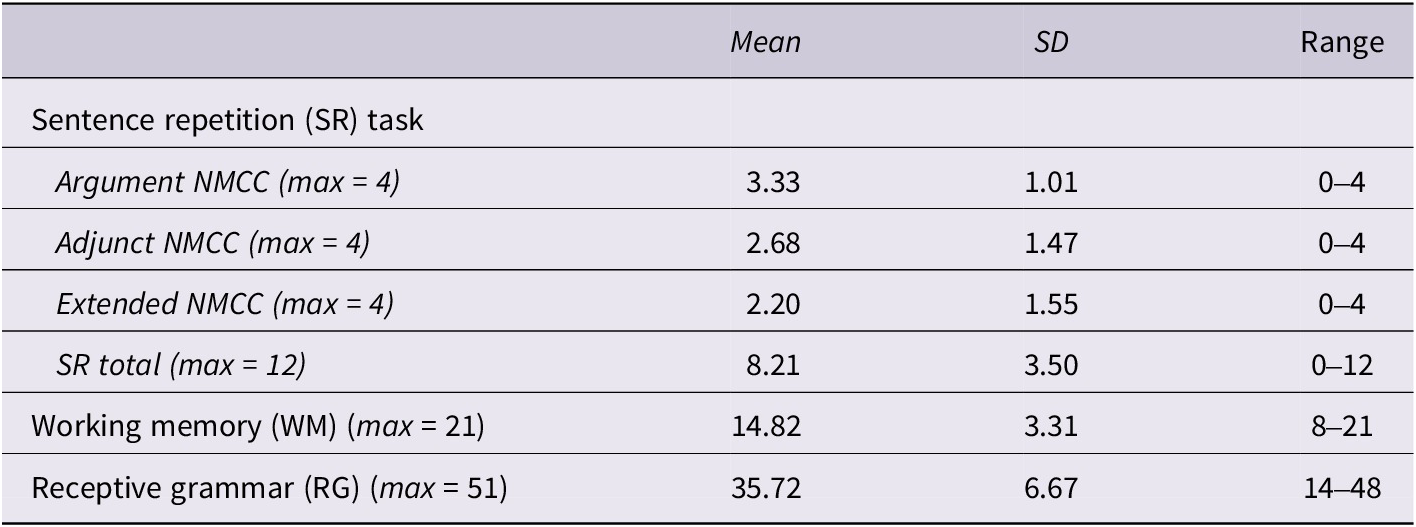
In the SR task, 116 out of the 121 children performed 100% accurately in the three fillers; four of them provided correct responses in two out of three fillers; one of them only responded to one filler item correctly. We removed the last child, reducing the sample size to 120. Table 4 presents the raw scores in the tests. In SR, the children performed most accurately in argument NMCCs (M = 3.33, SD = 1.01), followed by adjunct NMCCs (M = 2.68, SD = 1.47), with extended NMCCs exhibiting the lowest accuracy (M = 2.2, SD = 1.55). Paired-sample tests revealed significant differences between argument and adjunct NMCC (t = 5.45, p < .001) and between adjunct and extended NMCC (t = 5.03, p < .001). Overall, the children displayed an average accuracy rate of 68% (8.21 out of 12) in the SR task. In the WM task, only four children performed at ceiling (8 syllables) and scored 21. For RG, the children obtained an average score of 35.72 out of 51 items (70%) with no ceiling cases.
Descriptive statistics of performance scores in Study 2

Table 4. Long description
The table consists of four columns: Task/Measure, Mean, SD, and Range.
* Sentence repetition SR task sub-categories:
- Argument NMCC (maximum 4): Mean 3.33, SD 1.01, Range 0 to 4.
- Adjunct NMCC (maximum 4): Mean 2.68, SD 1.47, Range 0 to 4.
- Extended NMCC (maximum 4): Mean 2.20, SD 1.55, Range 0 to 4.
- SR total (maximum 12): Mean 8.21, SD 3.50, Range 0 to 12.
* General cognitive measures:
- Working memory WM (maximum 21): Mean 14.82, SD 3.31, Range 8 to 21.
- Receptive grammar RG (maximum 51): Mean 35.72, SD 6.67, Range 14 to 48.
To examine the extent to which experimental conditions (NMCC type) and participant characteristics (age, WM, RG) predict the item-level binary responses (1 = correct; 0 = incorrect) in SR, we fitted generalised linear mixed-effects models (GLMMs) using lme4 in R. An empty means (no predictor) model with participant (N = 120) and item (target NMCC, N = 36) as random intercepts had an intraclass correlation of .69, in which 52.4% of the variance in accuracy was due to participant mean differences and 16.6% due to item mean differences. Children’s age (scaled), WM, and RG scores were entered as control variables, which significantly improved the empty means model, −2ΔLL(3) = 99.70, p < .001. NMCC type (argument, adjunct, extended) and its interaction with age were entered as fixed effects, which further improved the control variable model, −2ΔLL(4) = 38.82, p < .001. The variance inflation factor (VIF) showed low multicollinearity of predictors (VIFs ranging from 1.03–1.76) in the last model. Results from the GLMM indicated a significant main effect of NMCC type: adjunct NMCCs have significantly lower item accuracy than argument NMCCs (γ = 1.49, p = .001) and significantly higher accuracy than extended NMCCs (γ = −.90, p = .03). Table 5 summarises the GLMM analysis.
GLMM analysis of Sentence Repetition (fixed effects: NMCC type, Age, NMCC type~Age, working memory, receptive grammar; response variable: accuracy score in SR)

Table 5. Long description
The table contains five columns: Coefficient, gamma, Std. Error, z value, and p.
* Intercept: gamma minus 9.28, Std. Error 1.29, z value minus 7.17, p less than .001.
* NMCC type adjunct versus argument: gamma 1.49, Std. Error .43, z value 3.48, p .001.
* NMCC type adjunct versus extended: gamma minus .90, Std. Error .41, z value minus 2.17, p .030.
* Age: gamma .52, Std. Error .22, z value 2.39, p .017.
* Working memory: gamma .44, Std. Error .06, z value 7.99, p less than .001.
* Receptive grammar: gamma .12, Std. Error .03, z value 3.96, p less than .001.
* NMCC type adjunct versus argument colon Age: gamma minus .66, Std. Error .22, z value minus 3.01, p .003.
* NMCC type adjunct versus extended colon Age: gamma .10, Std. Error .20, z value .48, p .631.
Figure 3 visualises the predicted probability of children producing the target NMCC correctly across age. Older children (γ = .52, p = .017) are more likely to produce accurate responses than younger children. Although the 3-year-olds showed a below-chance probability of producing the target extended NMCCs and a slightly above-chance probability of producing the target adjunct NMCCs, accuracy rates in both types increased sharply with age. The interaction between NMCC type and age is only significant between argument and adjunct NMCCs (γ = −.66, p = .003), suggesting that the performance difference between these two types narrows with age. Such interaction effect is not significant between adjunct and extended NMCCs (γ = −.1, p = .631), probably because both types grow considerably from 3;0 to 5;0 at similar rates and neither has reached ceiling by 5;0.
Probability of correct responses (= 1) in each NMCC type across ages (scores in working memory and receptive grammar tests centred by means).

Figure 3. Long description
The horizontal x-axis represents Age in Year semicolon Month, ranging from 3 forward slash 0 to 5 forward slash 0. The vertical y-axis represents Probability correct, ranging from 0.00 to 1.00 in increments of 0.05. Individual data points are clustered at the top 1.00 and bottom 0.00 probability lines. Three logistic growth curves represent the NMCC Subtypes.
* The argument subtype, shown as a red line, starts at approximately 0.90 and shows a slight asymptotic increase toward 1.00.
* The adjunct subtype, shown as a green line, starts at approximately 0.65 and shows a steady upward curve reaching nearly 0.90.
* The extended subtype, shown as a blue line, starts at the lowest point of approximately 0.44 and shows the steepest linear increase, reaching 0.75 by age 5 forward slash 0.
6.4. Analysis of errors
Of the 1440 responses, 451 responses were coded as incorrect. Within this subset, 54 were null or incomprehensible (NULL) and were excluded, leaving 397 analysable tokens. From these, 48 instances were grammatical and plausible paraphrases of the target NMCCs (PRPH), including change of NMCC type from a lower type to a higher type (from right to left in the hierarchy), as in (15). Reverse change of NMCC type from a higher type to a lower type was not attested.
(15)
Target NMCC:
zai
[xiaomao
chi
mianbao]
de
guojiang
limian
(extended)
at
Kitten
eat
bread
de
jam
inside
“(it’s) in the jam such that Kitten eats bread”
Response:
zai
[xiaomao
chi
guojiang]
de
beizi
limian
(adjunct NMCC)
at
Kitten
eat
jam
de
mug
inside
“(it’s) in the mug from which Kitten eats jam”
From the 397 analysable tokens, 349 were incomplete, ungrammatical repetitions (IR) where the children dropped one or more lexical items in the target NMCC. Half of them (50.14%) appeared in a non-embedded [N-V-N] sequence; some (22.34%) were verbless sequences with a string of one to three nouns, as in [N(-N)(-N)]; others (9.17%) were structured as [N-de-N], forming a possessive relation with the head noun. For the adjunct and extended NMCC items, which were presented in the [N1S-V-N2O-de-N3] sequence in the prompts, the IR responses routinely dropped either the head noun (N3) or the clausal object (N2, 90.26%), while retaining the clausal subject (N1, 82.7%), which is the semantic agent across the prompts. An example is shown in (16). A chi-square test shows that the proportions of each type of incorrect responses (NULL, PRPH, IR) do not differ across NMCC types, X2 (4, N = 451) = 5.38, p = .25.
(16)
Target NMCC:
zai
[yaziN1
xi
waziN2]
de
feizaoN3
pangbian
(adjunct)
at
Duck
wash
sock
de
soap
side
“(it’s) beside the soap with which Duck washes socks”
Response:
zai
yaziN1
xi
waziN2
de
pangbian
at
Duck
wash
sock
de
side
“(it’s) beside Duck washing socks”
6.5. Interim summary
Study 2 tested 3–4-year-old children’s knowledge of Mandarin NMCCs in a contextualised SR task, with age, WM, and general RG as control variables in GLMM models. The results showed a significant main effect of NMCC type and an advantage for argument over adjunct, and adjunct over extended NMCCs, after age, WM, and general RG were controlled for, conforming to the hierarchy in (8). The adjunct and extended NMCCs were produced slightly above or below chance levels by the youngest children, but the accuracy rates increased sharply with age.
Since the stimuli were controlled for syllable count, lexicon, visualisation, word order, and head noun animacy across NMCC types, the sole systematic variation was the conceptual prominence of the head noun’s role in the event. Moreover, given that the 11-syllable elicitation prompts exceeded the children’s phonological memory capacity (as evidenced by the digit span task where only 4 of 120 preschoolers reached the ceiling of 8 syllables), their repetitions should reflect their grammatical knowledge of NMCC, rather than rote parroting. One could argue that the argument NMCC prompts were cognitively less demanding than the adjunct and extended NMCC ones, because the former require holding only two event entities (agent, patient) in memory and the latter three (e.g. agent, patient, instrument). Nevertheless, the difference is inherent to the issues under investigation – the event structure of adjunct and extended NMCCs is inherently more complex and nuanced. A methodological note is that we did not employ the traditional picture-identification task, in which the child produces an RC in order to identify the intended referents from their competitors. Picture identification would provide felicitous contexts for NMCC production. However, pilot testing revealed that the concurrent demands of producing full RCs and assessing visual competitors overwhelmed our youngest participants.
Our error analysis provides further insights into two dimensions. First, children only produced errors in one direction: they sometimes substituted a higher NMCC type for a lower one (e.g. argument for extended), but never the opposite. Second, when children encountered NMCCs beyond their grammatical capacity, they often dropped a postverbal noun (N2 or N3) in [N1S-V-N2O-de-N3], but consistently retained the clausal subject N1 and produced [N1-V] instead. This is notable because N1, referring to the only animate agent in the picture (e.g. the panda in Figure 2), had little referential value in identifying the agent in the SR task due to the lack of semantic competitors. Its retention is likely attributable to the canonical status of the [N-V] sequence in early sentence parsing (Diessel & Tomasello, Reference Diessel and Tomasello2005; Slobin & Bever, Reference Slobin and Bever1982) and the prominence of agents in incremental processing (Sauppe et al., Reference Sauppe, Naess, Roversi, Meyer, Bornkessel-Schlesewsky and Bickel2023) and visual perception (Cohn & Paczynski, Reference Cohn and Paczynski2013). Both error patterns are consistent with the predictions of the proposed developmental hierarchy.
7. General discussion
7.1. Developmental hierarchy of Mandarin NMCC: a summary of Studies 1 and 2
We have reported the first comprehensive examination of the full range of Mandarin NMCCs in early childhood acquisition, analysing naturalistic production in existing corpora and elicited imitation in a controlled experiment. As summarised in Table 6, both studies showed that in Mandarin, argument, adjunct, and extended NMCCs develop at different rates. Specifically, argument NMCCs show an advantage over the other two: they emerged the earliest and were produced most frequently (Study 1) and accurately (Study 2). Adjunct NMCCs displayed significantly different patterns from the other two types in two measures (frequency in naturalistic production and accuracy in SR), lending support to their status as the “middle” type in the hierarchy. Extended NMCCs were identified as the most challenging type across analyses. The quantitative results largely conform to the developmental hierarchy proposed in (8), and the children’s substitution and omission errors in the repetition task were consistent with the hierarchy.
Summary of findings in both studies

Table 6. Long description
The table is organized into columns for Study, Data, Measure, and Findings.
Study 1 includes two data types. For Cross-sectional data, the Emergence measure shows Argument and Adjunct are greater than Extended, while the Frequency measure shows Argument is greater than Adjunct, which is greater than Extended. For Longitudinal data, the Frequency measure also shows Argument is greater than Adjunct, which is greater than Extended.
Study 2 focuses on Repetition data. The Accuracy measure shows Argument is greater than Adjunct, which is greater than Extended. The Errors measure indicates an N dash V and agent advantage.
At the bottom of the table, a Proposed developmental hierarchy is listed as: Argument is greater than Adjunct, which is greater than Extended.
Our hierarchy is predicated on the role of conceptual prominence in acquiring NMCCs, among others. Conceptually there exist more event roles beyond those listed in (7), and even those already listed in (7) can be further differentiated into finer-grained roles such as theme, experiencer, and recipient. The scale in (7) is only preliminary. Future research in event cognition is essential to elaborate and refine the scale. Although we treat conceptual prominence as independent of grammatical function, the two are interrelated: agent and patient roles typically map onto core, obligatory verbal arguments (subjects/objects), while location and instrument are often encoded as non-core, optional adjuncts (Boland, Reference Boland2005). Our developmental hierarchy for Mandarin NMCCs aligns most closely with Pan’s (Reference Pan2022) Mandarin RC Recoverability Hierarchy (Argument > Adjunct > Gapless), which is based on the recoverability of a syntactic gap or a covert semantic variable in the clause associated with the head noun. A key difference, however, is that our hierarchy is motivated by multiple factors critical to early language development (including but not limited to the status of the linking particle, input frequency, thematic prominence, and word order). Our model thus offers an analytical framework with a set of parameters that can be applied to other languages with differing configurations. Below we will return to this in our discussions of the high and low ends of the hierarchy (early emergence of argument NMCC and late acquisition of extended NMCC).
7.2. Early emergence of NMCC in Mandarin
Our analysis of naturalistic child Mandarin speech (1;2–6;9) reveals that NMCCs emerge by 2;0, notably earlier than RCs in languages like English. This early emergence can be attributed to the structural unity of noun modification in Mandarin. Unlike English, which employs prenominal adjectives and postnominal RCs, Mandarin places adjectives, possessives, and NMCCs consistently prenominally, all linked by the particle de. We posit that children’s early acquisition of simpler prenominal modifiers (e.g. adjectives) facilitates their subsequent grasp of the more complex NMCC structure, consistent with the developmental trajectory from simple to complex constructions (Diessel & Tomasello, Reference Diessel and Tomasello2000). This structural isomorphism provides a scaffold, explaining the earlier onset of Mandarin NMCCs compared to RCs in other languages (Lai et al., Reference Lai, Chan, Matthews, Han and Brebner2023).
Although Cantonese and Mandarin NMCCs are structurally similar, our findings on Mandarin acquisition diverge from prior Cantonese studies. Lai et al. (Reference Lai, Chan, Matthews, Han and Brebner2023) reported Cantonese NMCCs emerging around 2;2–2;5, approximately 6 months later than in our Mandarin data. This discrepancy may stem from methodological or linguistic factors. Methodologically, Lai et al.’s smaller Cantonese sample size, due to data scarcity, may have failed to capture the earliest productions. Linguistically, while Mandarin NMCCs appear in a single form with an overt and obligatory linking particle de, Cantonese NMCCs exhibit greater complexity and diversity, appearing in two different forms (the classifier form and the linking particle form). The classifier form is more common in colloquial Cantonese and arguably more frequent in child-directed speech, yet realised through a range of specific classifiers depending on specific head nouns (details in Yip & Matthews, Reference Yip and Matthews2007:159). This more complex form-to-function mapping likely elevates acquisition difficulty, explaining the later emergence and lower frequency of Cantonese NMCCs.
The presence of a general noun-modifying clause construction and the dependence of NMCC construal on an aggregate of grammatical, semantic, and pragmatic factors are not unique to Mandarin. The facilitative effect of a uniform prenominal modification system may extend to languages like Japanese and Korean, where both lexical and clausal modifiers are prenominal. However, Japanese and Korean lack overt linking particles like de in Mandarin, which may weaken the facilitative effect. Furthermore, whether the same argument > adjunct > extended ordering applies to these languages will critically depend on multiple factors. For example, the canonical SOV word order in Japanese and Korean introduces a word order factor. In these languages, adjunct and extended NMCCs typically maintain the canonical [S-O-V-Head] sequence, whereas argument NMCCs deviate from the canonical SOV order and appear in either [S-V-O] (for object RC) or [O-V-S] order (for subject RC). This configuration creates a unique test case: while conceptual prominence predicts an advantage in acquiring argument NMCCs, there is a mismatch between NMCC and the canonical word order that may attenuate the advantage. Studying these languages can evaluate the interaction of these competing factors.
7.3. Late acquisition of extended NMCC
Extended NMCCs are licensed through semantic-pragmatic inferencing between the head noun and its modifying clause in Mandarin NMCCs (Cheng & Sybesma, Reference Cheng, Sybesma, Broekhuis, Corver, Huybregts, Kleinhenz and Koster2006; LaPolla, Reference LaPolla, Matsumoto, Comrie and Sells2017; Matthews & Yip, Reference Matthews, Yip and Ramat2002). In our naturalistic speech data, we found that children above age 3 can successfully establish such relations in extended NMCCs based on encyclopedic, pragmatic knowledge about events, producing a non-trivial number and variety of extended NMCCs (Study 1). Nevertheless, the experimental results showed that the probability of reproducing an accurate extended NMCC is below .45 at 3;0 and approaches only .70 at 4;0, suggesting that 3–4-year-olds have not mastered this type. Another look at the corpus and experimental data revealed that two differences might have led to the discrepancy: (i) semantically, early extended NMCCs in spontaneous speech are restricted in function to express generic events associated with the head noun, whereas extended NMCC prompts in the SR had a specific clausal event illustrated by pictures; and (ii) syntactically, early extended NMCCs in naturalistic speech had a simpler [V(-N)-de-N] structure, whereas the extended NMCC prompts in the SR were fully fledged NMCCs with overt subjects and objects.
The excerpts in (17) and (18) from our corpus data illustrate the aforementioned semantic and syntactic differences. In (17) the child identifies a toy based on how it is used (one plays by pressing the little bear on the toy). Note that the clausal subject position is empty and receives a generic reading “one” or “people” in context. In (18), the child produced an extended NMCC in response to a wh-question “what happened in the forest?” Both NMCCs are innovative uses, which led to conversational repairs (mother’s clarification question in (17) and experimenter’s recast in (18)). Since the NMCC does not impose strict grammatical relations between the head noun and the modifying clause, it offers children a convenient structural frame to build up their prenominal modifiers, which sometimes leads to non-adult-like usages, showing children’s developing competence in making semantic-pragmatic inferences in extended NMCCs.
(17) Meaning negotiation between child and mother regarding an extended NMCC.
CHI:
haiyou
na-ge
[[__
an
xiao
xiong]
de
na-ge]
.
and
that-CL
press
little
bear
de
that-CL
“And the one (toy) such that (one can) press the little bear.”
MOT:
an xiao xiong de shenme dongxi a?
“What do you mean by pressing the little bear?”
CHI:
jiushi na huang de che shang.
“It is on that yellow car.”
MOT:
o, you ge xiao xiong gei an xiaqu, shiba?
“Oh, there is a little bear to be pressed, right?”
(Tong, 2;4)
(18) Non-adult-like use of an extended NMCC by child.
EXP:
senlin fasheng shenme shiqing?
“What happened in the forest?”
CHI:
fasheng
[[__
zai
dajia]
de
shi]
.
happen
ASP
fight
de
thing
“The thing such that (the animals) fighting is happening.”
EXP:
o, tamen zai da jia.
“Oh, they are fighting.”
(5;7, Chang1)
8. Conclusions
This study presents the first developmental investigation of the full spectrum of NMCCs in Mandarin, testing the proposed acquisition hierarchy of argument > adjunct > extended NMCC. This hierarchy is theorised to be influenced by the conceptual prominence of the head noun’s role in the modifying event, in addition to syntactic and frequency factors. Methodologically, we combined an exhaustive analysis of naturalistic CHILDES data with a controlled SR task. Our findings reveal that Mandarin NMCCs, as a group of syntactic constructions, emerge early. We argue that this early emergence is facilitated by the construction’s uniform morphosyntactic form, which is consistently marked by a prenominal linking particle. Our quantitative and qualitative results confirm the predicted developmental hierarchy: Not only did argument NMCCs demonstrate primacy over both adjunct and extended types in terms of frequency and accuracy, but adjunct NMCCs also showed a significant advantage over extended NMCCs through the same measures, confirming our predictions that NMCCs with conceptually more prominent heads are acquired earlier than those with less prominent heads in Mandarin.
Mandarin-learning 3- and 4-year-olds demonstrate the ability to form fully grammatical argument NMCCs, showing mastery of syntactic dependencies and filler–gap relations. Meanwhile, their gradual acquisition of adjunct and extended NMCCs, which are built on nuanced event semantics and pragmatic knowledge, reveals that their acquisition of NMCC is not confined to syntactic filler–gap relations. This progression underscores a powerful human language learning mechanism in acquiring complex constructions. Our work establishes a foundation for cross-linguistic comparison, calling for parallel investigations in other languages with a general noun-modifying clause construction, such as Japanese and Korean.
Supplementary material
The supplementary material for this article can be found at http://doi.org/10.1017/S0305000926100750.
Data availability statement
The numeric data that support the findings of this study and the analysis codes are available from: https://osf.io/6bu3j/overview?view_only=fb23ef5fd8db42baabe02dba382f6bdb
Acknowledgements
We are grateful for the Child Language Data Exchange System (CHILDES) and the research teams who contributed Mandarin child speech samples to CHILDES, including our own team at Childhood Bilingualism Research Centre at the Chinese University of Hong Kong (CUHK). Without the rich corpus data, our first study would not have been possible. We thank all the children and teachers of Fushan Kindergarten in China for their participation in our experimental study. This article is an extension of Mengyao Shang’s doctoral thesis project. Many colleagues and students shared their experience, suggestions, and constructive feedback over the years, especially Angel Chan, Lawrence Cheung, Haihua Pan, Zhenguang Cai, Jingyao Liu, as well as conference attendees at the 13th and 14th International Symposium on Bilingualism and the 16th International Congress for the Study of Child Language. This study is partially funded by a New Faculty Start-up Grant at CUHK awarded to Ziyin Mai. All remaining errors are our own.
Competing interests
The authors declare none.
Disclosure of use of AI tools
This paper did not use any AI tools to generate, analyse, or present ideas, words, data, or other materials.
Statement of ethical approval
This study was approved by the Survey and Behavioral Research Ethics Committee of The Chinese University of Hong Kong (No. SBRE-24-0072). Written consent was obtained from individual parents prior to data collection.





 Open access

