




Introduction
Evidence for ornamentation worn on the body extends deep into the human past. In Island Southeast Asia, the discovery of personal ornamentation as well as parietal art, has transformed our understanding of the earliest communities of Homo sapiens that moved into this region and made it their home (e.g. Langley & O'Connor Reference Langley and O'Connor2016; Brumm et al. Reference Brumm2017; Aubert et al. Reference Aubert2018, Reference Aubert2019; Langley et al. Reference Langley, Hakim, Oktaviana, Burhan, Sumantri, Sulistyarto, Lebe and Brumm2020). In particular, whereas previous investigations had largely assumed that rock art and shell beads were of relatively recent Holocene age (e.g. Van Heekeren Reference Van Heekeren1972), assemblages discovered over the past 10 years indicate much earlier origins. Consequently, knowledge about how people understood and interacted with this island environment over the past 50 000 years is still in its early stages.
Here, we report the recovery and identification of carefully crafted Nautilus pompilius shell beads directly dated to c.12 000 cal BP at the Indonesian site of Gua Makpan (hereafter Makpan) located on Alor Island. This assemblage includes single-holed disc beads but is dominated by a two-holed type which, we demonstrate, were sewn onto a material or textile as reflective appliqués. Similar two-holed beads have also been found in terminal Pleistocene contexts in the neighbouring islands of Kisar and Timor suggesting a shared decorative practice (O'Connor Reference O'Connor, Bellina, Bacus, Pryce and Christie2010; O'Connor et al. Reference O'Connor, Mahirta, Tanudirjo, Ririmasse, Husni, Kealy, Hawkins and Alifah2018).
Archaeological context
Makpan is a large lava tube cave, between the modern villages of Halmin and Ling Al, on the south-west coast of Alor Island (Figure 1). The cave entrance faces the sea, and lies approximately 386m from the modern shoreline and some 37.5m above current mean sea level (Kealy et al. Reference Kealy2020; Figure 1B). As the offshore topography in this region drops away steeply to a depth of −100m within a distance of less than 1.8km of the current shoreline, even during maximum low sea stands, Makpan would have been within walking distance of the sea (see Kealy et al. Reference Kealy2020 for details of the bathymetric reconstruction).
Location of Makpan on Alor Island, Indonesia (A–B) and site context showing main excavation pit outlined with range poles (C–D) (figure/image by S. Kealy).

In June and July 2016, a joint team from the Australian National University and Universitas Gadjah Mada conducted excavations at Makpan. The main excavation, comprising a 2 × 2m trench designated as Squares A, B, C and D was positioned centrally within the well-lit cave entrance, inside the dripline (Figure 1D). Excavation proceeded in approximately 5mm spits within stratigraphic layers. Excavated deposits were both dry screened and then wet screened through a 1.5mm mesh, before drying and sorting. Following the completion of Spit 23, at a depth of approximately 1.5m, the pit was shored and excavation continued in a single 1 × 1m square: Square B. Excavation of Square B, down to Spit 68, extended an additional 2m, reaching a total depth of 3.5m, only halting once culturally sterile beach sand was found (Kealy et al. Reference Kealy2020; Figure 2). Here, we focus on the material culture recovered from Square B as this unit is the only square to sample the entire depth of the cultural deposits.
Stratigraphic sections for Makpan. The upper 2 × 2m excavation at Makpan (modified from Kealy et al. Reference Kealy2020).

Stratigraphic sections for Makpan. The lower 1 × 1m square B excavation at Makpan (modified from Kealy et al. Reference Kealy2020).

Dates for the Makpan assemblage were obtained on charcoal, or on marine shell where charcoal was unavailable (Kealy et al. Reference Kealy2020). Kealy et al.'s (Reference Kealy2020) Bayesian model divides the Makpan record into five phases and suggests occupation at Makpan began with a median modelled start date of c. 43 076 BP. Phase 1 covers a period of approximately 28 000 years (Spits 68–58). Phase 2 (Spits 57–37) represents the terminal Pleistocene phase starting at c. 13 965 BP, while Phase 3 (Spits 36–21) records the Pleistocene–Holocene transition starting at c. 11 805 BP and consists of a substantial shell midden deposit. Phase 4 (Spits 20–9) begins c. 10 430 BP and moves into the middle Holocene, with Phase 5 (Spits 8–1) recording the Neolithic to historic periods starting c. 3663 BP. In terms of occupation hiatuses, there is a significant gap of some 3500 years between Phase 4 (early-middle Holocene) and Phase 5 (Neolithic-historic), with a much shorter hiatus between Phase 3 (Pleistocene–Holocene transition) and Phase 4 also evident. Sedimentation rates vary considerably across these phases and reflect changing site occupation intensity: Phase 1 has a significantly lower rate of sedimentation than any of the subsequent phases, while Phase 3, the midden, is characterised by the most rapid sedimentation and the densest occupation residues.
Methods
The shell finds from Square B were examined under low magnification using a Zeiss Stemi 508 stereomicroscope fitted with an Axiocam 105 camera. Features of interest were photographed using the Zeiss software for the microscopy, along with a Canon EOS 400D digital camera, the resulting images serving as the bases for drawings of the artefacts onto which any features of interest were then mapped. Identification of raw materials was based on physical characteristics visible on the artefact surfaces and on comparison with known shell samples, while identification of manufacturing and use wear traces was based on published criteria regarding worked marine and freshwater shell (e.g. d’Errico et al. Reference D'Errico, Jardón-Giner, Soler-Mayor and Anderson1993; Szabó Reference Szabó2010; Velazquez-Castro Reference Velazquez-Castro and Ollich-Castanyer2012; Langley et al. Reference Langley, O'Connor and Piotto2016; Shaw & Langley Reference Shaw and Langley2017). Particularly important for this assemblage is the identification of drilling (indicated by semi-concentric striations which run around perforation walls), flaking (small U- or V-shaped scars), grinding (presence of fusiform striations whose breadth, depth and cross-section vary depending on the grinding surface utilised), and use wear from stringing and attachment (presence of notches and polish on perforation walls and edges, as well as bead outer surfaces). Such traces were clearly visible under low magnification owing to the good preservation conditions for shell at Makpan. Mitutoyo (CD-6”CX) digital calipers, with plastic-coated jaws to prevent damage to the artefacts, were used to gather metrical data for comparison to published artefacts of similar find context, material and construction. The length, width and height of each complete bead, and of all bead fragments retaining at least 75 per cent of their original forms, were measured. Metrics for the smaller bead fragments were not collected, but each specimen was examined under the microscope to confirm the presence of anthropogenic alterations before being added to the artefact count.
All dates are AMS radiocarbon dates. With the exception of the two directly dated beads, all dates are reproduced as published in Kealy et al. (Reference Kealy2020). For this study, the Kealy et al. (Reference Kealy2020) dates are calibrated using OxCal v.4.4 (Bronk Ramsey Reference Bronk Ramsey2009) to 95.4% probability, using the IntCal20 (for charcoal, Reimer et al. Reference Reimer2020) and Marine20 (for marine shell, Heaton et al. Reference Heaton2020) calibration curves. Marine shell dates from the Makpan sequence are calibrated without a regional offset (ΔR) as these data are currently unavailable for Alor; however, as the few known local reservoir effects from the wider region cover a range of less than ±100 years these would not appreciably alter the millennial scale patterns reported here. In contrast, the two bead dates are calibrated using OxCal 4.4.4 (Bronk Ramsey Reference Bronk Ramsey2021) with the Marine20 (Heaton et al. Reference Heaton2020) calibration curve and a ΔR correction of −179 ± 75, which is an average for the southern Indonesian region (Fiona Petchey pers. comm.).
Results
In total, 577 artefacts including 36 complete or near-complete (>75% present) beads and 541 bead fragments were recovered from Square B (Figures 3 & 4). Of the complete and near-complete examples, 33 are ovoid in shape and feature two centrally aligned perforations. The remaining three examples, all circular in overall shape, each feature a single central perforation.
‘Intact’ (>75%) beads recovered from Makpan. Bead provenance (Square and Spit) is listed below each artefact, along with their analysis identifier shown in parentheses (figure/image by M. Langley).

Typical fragments of two-holed beads. Scale bar = 1mm (figure/image by M. Langley).

While the majority (approximately 97%) of the beads were recovered from the midden deposit (Phase 3) with a modelled age range of 11 805–11 223 BP, beads were also present in the later Phase 4 (up to 7284 BP), as well as in the earlier Phases 1 (c. 21 500–40 500) and 2 (c. 11 000–13 500). While it has been argued that the stratigraphic interpretation of Makpan generally supports the integrity of Phase 1 relative to the overlying deposit (Kealy et al. Reference Kealy2020), in view of the age range represented by the dated samples in Phase 1, the evident inversions in the dates, and the possibility of vertical movement of small beads (e.g. O'Connor et al. Reference O'Connor, Spriggs and Veth2002), we decided it would be prudent to date the lowest of the beads in this unit directly. Unfortunately, while all beads were accounted for at the time of photographic recording and analysis, the lowest two beads from Spit 63 and 60 could not be relocated for dating.
Dates were therefore obtained on a bead fragment and a complete bead from Spit 58. These beads produced dates of 12 080–11 400 (WK 53582 10 445±27 BP) and 12 440–11 810 (WK 53581 10 667±28 BP) respectively, demonstrating their terminal Pleistocene age and relative concordance with the ages obtained in Phase 2 from Spit 57 on marine shell of 13 276–12 930 (11 783±48; ANU 53613). The new direct dates obtained on the beads indicate that the original modelled extent of Phase 2 to Spit 57 (Kealy et al. Reference Kealy2020) is incorrect, and that it should extend down at least as far as Spit 58. The lack of previous dates from Spits 58 or 59 and minimal changes in stratigraphic features at this depth on which to differentiate phases, make this shift downwards for the end of Phase 1 / start of Phase 2 boundary a reasonable revision in light of the new dates from the beads. We therefore consider Spit 58, and its associated beads, as best associated with Phase 2.
Distribution of Nautilus bead artefacts throughout Square B of Makpan. Associated radiocarbon dates follow Kealy et al. (Reference Kealy2020) with calibrations and modelling in OxCal v.4.4 (Bronk Ramsey 2009a) using the IntCal20 (for charcoal and tooth enamel; Reimer et al. Reference Reimer2020) and Marine20 (for shell; Heaton et al. Reference Heaton2020) calibration curves. ‘Start’ and ‘End’ dates reflect the modelled start and end dates for each Phase identified by Kealy et al. (Reference Kealy2020), while the dates associated with the different spits are shown as unmodelled, calibrated dates. *Indicates the two new dates obtained by this study by directly dating the beads recovered from Spit 58. Note: Phase divisions follow Kealy et al. (Reference Kealy2020), except for our revision to move Spit 58 up into Phase 2.

Raw material
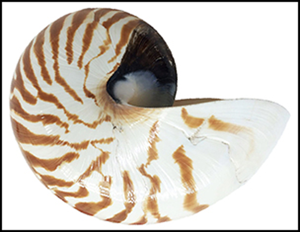
All of the beads described here are made on Nautilus pompilius. N. pompilius shell is aragonite, nacreous and pressure resistant to a depth of approximately 800m (Dustan et al. Reference Dustan, Ward and Marshall2011a; Saunders & Ward Reference Saunders and Ward1987). While Nautilus are occasionally consumed by humans, the main lure for their collection is their large size, white and orange-brown patterned outer shell (Figure 5A), and the inner, iridescent nacreous layer (Figure 5B), which together create a material valued for decorative purposes.
Nautilus pompilius shell reaches to around 200mm in length, providing a large quantity of nacreous shell for material culture production (figure/image by M. Langley).

Nautilus inhabit depths of approximately 200–300m, though after death, they may float for significant periods of time and across long distances (Saunders & Spinosa Reference Saunders and Spinosa1979; Ishii Reference Ishii1981; Saunders & Ward Reference Saunders and Ward1987; Ward Reference Ward1987; Dustan et al. Reference Dustan, Ward and Marshall2011b). In the Philippines, ethnographic observations have documented traps constructed of bamboo and rattan (Dean Reference Dean1901; Arnold Reference Arnold1985; Hayasaka et al. Reference Hayasaka, Ōki, Tanabe, Saisho, Shinomiya, Saunders and Landman1987), with fishermen reporting the successful trapping of Nautilus at depths of approximately 150–200m (Dean Reference Dean1901; Arnold Reference Arnold1985; Hayasaka et al. Reference Hayasaka, Ōki, Tanabe, Saisho, Shinomiya, Saunders and Landman1987). While it is possible that the Nautilus used to make the beads described here were either intentionally or inadvertently caught during fishing activities—extensive evidence for both on- and off-shore fishing has been recovered from the site (Kealy et al. Reference Kealy2020; Langley et al. Reference Langley, O'Connor, Kealy and Mahirta2021)—these shells also commonly wash ashore, where they can be easily collected.
Manufacture and use
Each of the 36 complete or near-complete beads, as well as the 541 fragments, were microscopically examined for traces of manufacture and use. As shell fishhooks were also made on nacreous shell at this site (Langley et al. Reference Langley, O'Connor, Kealy and Mahirta2021), it was important to distinguish fragments of fishhooks from fragments of beads. We differentiated between these objects based on the raw materials used (fishhooks being made on Rochia or Turbo), their size (bead fragments are smaller and thinner) and form (fishhook fragments have a plano-convex shape, while beads are wing, tooth or boat-shaped and largely planar in cross-section). This last feature was assessed by comparing the fragments to the shapes of the complete or near-complete examples, as well as the manufacturing and use wear marks observed on the latter. Typical examples of identified bead fragments are shown in Figure 4.
The Makpan beads are small, with complete and near-complete examples ranging between 4.4mm and 11.6mm in maximum width (mean: 7.3mm). Their ovoid or circular shape was achieved through controlled flaking prior to grinding of the outer circumference (Figure 6A). A significant proportion of the complete beads were not ground, however, and retain the scalloped perimeter produced from flaking (Figure 6B, C & F). Perforations were primarily made using a handheld unifacial drill as indicated by the presence of striations which do not form complete circles and which have a wavy trajectory (examples in Figure 6), though examples of bifacial drilling are also present (N = 5 on the >75% present beads). Unifacial drilling proceeded from the inner, nacreous side resulting in chips of shell detaching on the opposing surface as the drill broke through (Figure 6B & C). The striations present within the walls of the perforations indicate that they were created using a stone tip (Figure 6E & F).
Features of the Makpan Nautilus two-holed beads. (A) Near-complete example for Square B, Spit 18 with red ochrous residue between and in perforations; (B & C) Chipping on the outer shell surface created during unifacial drilling. From Square B, Spits 36 and 23, respectively; (D & E) Striations and red ochrous residue on back of bead from Square B, Spit 23; (E) Hand-held drilling of perforations on bead from Square B, Spit 23; Restriction of red ochrous residue to between the two perforations on bead from Square B, Spit 36; (G) polish on edge of bead from Square B, Spit 32. Scale bar = 1mm (figure/image by M. Langley).

Traces of use wear and associated residues are well-preserved given the recovery of the objects from a tropical context. Polish is evident on the high points of the outer shell side (Figure 6G) and the outer edges of the beads are well-rounded (Figure 6). The perforations display notable rounding and notching from contact with a thread or string, and it is significant that on two-holed beads the section of shell located between the two perforations is frequently marked by shallow notches, etching and a bright red residue consistent with hematite-based pigment (Figure 7A–C). These signs together indicate that the beads were attached outer edge down—so that the nacreous layer faced out—and held in a largely stationary position against a relatively soft surface. That is, they were utilised as shiny appliqués sewn onto some type of material.
Indications of the mode of attachment on the two-holed beads. (Above) Examples of larger fragments from two-holed beads; (Below) mid-region of two-holed beads showing concentrations of residues and notches (indicated by red arrows). (A) Artefact 131; (B) Artefact 117; (C) Artefact 155. White scale bar = 1mm (figure/image by M. Langley).

Prior to the Neolithic, no medium- to large-sized animals from which skins could be obtained were present on Alor Island, and thus the appliqués must have been attached to textiles made from knotted, plaited or woven plant fibres or beaten bark cloth. We have previously reported Nassarius shell appliqué beads dated from the mid Holocene from several sites in Timor-Leste, which preserved evidence that they had been attached to a plant-based material such as bark cloth or a woven plant fibre (Langley & O'Connor Reference Langley and O'Connor2015). This interpretation was supported by the ethnographic literature and items held in the collections of The Australian Museum (Sydney) and Musée du Quai Branly (Paris) which demonstrate that Nassarius in particular was commonly selected for use as appliqués on bags, headbands and other items of personal adornment throughout the region (Indonesia, Timor-Leste and New Guinea; Langley & O'Connor Reference Langley and O'Connor2015: 187–8, fig. 16). One item, a heavily ochred bark-cloth headband from Timor, which neighbours Alor, was covered with glossy white Nassarius shells sewn onto the contrasting red surface of the bark (The Australian Museum–E89272). If the Nautilus beads of Makpan were utilised in the same way as those on Timor, we can explain how the perforations, and the area immediately between them, would become stained with pigment as the ochre transferred from the backing material and/or strings to the shell surfaces. As we only found significant traces of the red pigment between the perforations, and not elsewhere trapped in striations, nicks and grooves across the wider surfaces (either distal or ventral) of the beads, we conclude that the beads were not deliberately painted with the red colourant.
Many very small fragments of these Nautilus two-holed beads were recovered from Square B (N = 541). These pieces typically measure between 2mm and 4mm and exhibit characteristic forms such as a wing or tear shape (see examples in Figure 4). Fragments largely consist of bead shoulders or beads which have split horizontally across the middle (Figure 7). This breakage pattern indicates that weak points were created between the perforations and leading from the perforations across to the shortest edges of the bead. This breakage pattern also supports our argument that these beads were attached as appliqués; a thread passing across the middle and/or over the bead shoulders to attach the bead and hold it flat against a surface would have created pressure at these points. Curiously, the nacreous surface of several beads was deliberately scratched or ground up with a stone tool edge (Figure 6D & E). The purpose of these marks is unknown; it is possible that they increased reflectivity.
Focusing on the size and shape of the more complete specimens, we can define four discrete types among the ovoid two-holed beads, here termed Types A, B, C and D (Figure 8). Type A is characterised by beads with an elongated ellipse form, while Types B, C and D are rounder in circumference and differentiated by their sizes (Type B: mean width 10.7mm; Type C: mean width 7mm; Type D: mean width 5.5mm; Figure 3). Except for Type C, which was recovered from Spits 30–34 only, these types do not appear to be temporally restricted.
Scatterplot of complete two-holed beads suggesting the presence of four main styles: (Yellow) Type A; (Pink) Type B; (Purple) Type C; and (Blue) Type D (figure/image by M. Langley).

Discussion
The distribution of the Nautilus beads throughout the Makpan deposit largely mirrors other evidence for changes in occupation intensity from Phase 1 through to Phase 4 (Figure 9) (Kealy et al. Reference Kealy2020). Direct dating of two beads, a complete bead and a fragment from Spit 58, establishes their appearance between at least 12 800 and 11 400 cal BP, with the same bead form continuing to be deposited over the next 5000 years. As such, these tiny artefacts currently constitute the earliest directly dated evidence for the use of appliqués in Island Southeast Asia. Pigment-stained fragments of worked Nautilus shell have been recovered from Asitau Kuru (previously Jerimalai), on Timor, dating back to c. 42 000 cal. BP (Langley et al. Reference Langley, O'Connor and Piotto2016) but, as fragmentary pieces, the finished form of these objects is uncertain. Further afield, the use of mineral or organic-based red pigments to decorate both the human body and material culture has been widely documented in Pleistocene and early Holocene contexts throughout Southeast Asia (Langley & O'Connor Reference Langley, O'Connor, Langley, Litster, Wright and May2018; Langley et al. Reference Langley, Clarkson and Ulm2019), not to mention its early adoption by Homo sapiens in Africa and the Levant (Marean et al. Reference Marean2007; McBrearty & Brooks Reference Mcbrearty and Brooks2000). The Makpan assemblage provides another example of this persistent pairing of red colourant with light or bright coloured shell ornamentation.
Distribution of Nautilus two-holed and disc bead fragments in Square B, Makpan (figure/image by M. Langley).

Appliqués—the fixing of beads to create a pattern or otherwise cover a base layer—are widely recorded in the Eurasian Palaeolithic record, in the form of whole shells (simply perforated for stringing) and as fully worked ivory beads. This approach to ornamentation is exemplified by the shell ‘cap’ from the Arene Candide 1 burial, c. 28–27 ka cal BP (23 440±190; OxA–10700; Pettitt et al. Reference Pettitt, Richards, Maggi and Formicola2003), and the garment covered in mammoth ivory beads worn by Sunghir 1, 2 and 3, dating to c. 33–30 ka cal. BP (27 210±710; AA-36474) in Russia (Trinkaus et al. Reference Trinkaus, Buzhilova, Mednikova and Dobrovolskaya2014). These Gravettian burials provide the oldest known contexts in which we can confidently recognise the use of beads as appliqués, though it is possible that certain older beads from Aurignacian contexts were also used in such a fashion. The similarly sized, two-holed ivory beads recovered from Hohle Fels (Germany) (Velliky et al. Reference Velliky, Schmidt, Bellot-Gurlet, Wolf and Conard2021), for example, may have been attached to fabrics, while the smaller ivory basket-shaped beads of Solutré (France) are similarly suited to such a use (Vanhaeren & d'Errico Reference Vanhaeren and D'Errico2006).
Although not as early in date as the Eurasian appliqués, the Nautilus two-holed beads from Makpan are significant as they constitute one element of a shared tradition of material culture, style and technology of the terminal Pleistocene across several islands in southern Wallacea. Double-holed beads made on Nautilus shell have also been recovered from sites on Kisar Island (Indonesia) and in Timor-Leste, to the east and south of Alor (O'Connor Reference O'Connor, Bellina, Bacus, Pryce and Christie2010; O'Connor et al. Reference O'Connor, Mahirta, Tanudirjo, Ririmasse, Husni, Kealy, Hawkins and Alifah2018). One Nautlilus two-holed bead from Matja Kuru 2 (previously incorrectly identified as Trochus niloticus), is directly dated to 10 110–9629 cal BP (9260±50; OZG 898; O'Connor Reference O'Connor, Bellina, Bacus, Pryce and Christie2010: 228), while a two-holed Nautilus bead from Here Sorot Entapa in Kisar was recovered from a context dated to 12 019–12 400 cal BP (10 354±45; ANU-47727). The directly dated Alor beads overlap with the age of the Kisar example and indicate that this type of decorative appliqué was a tradition of personal ornamentation shared between at least three island communities in southern Wallacea during the terminal Pleistocene/early Holocene. This tradition of appliqué ornamentation, the production of which involved significant labour, likely reflects an inter-island community of practice with shared values and world views (Lemonnier Reference Lemonnier1993). Indeed, from studies of modern hunter-gatherer communities, such widespread use of a particular bead form may evince the material means by which social information was transmitted across these islands (following Wiessner Reference Wiessner1977, Reference Wiessner1984; Wobst Reference Wobst and Cleland1977).
Notably, at approximately the same date that this regional appliqué tradition appears, a geochemically distinctive obsidian is first identified in the lithic assemblages on all three islands. This Group 1 obsidian is incompatible with the geology of Timor and Kisar and, in view of its restricted chronological distribution within the Alor assemblages and its distinctive geochemical signature, its source is also likely to be exotic to Alor (Reepmeyer et al. Reference Reepmeyer, O'Connor, Kealy and Maloney2019). Further, shortly before the first appearance of this obsidian, fishhooks begin to feature in the southern Wallacean assemblages, signalling an increased technological investment in maritime resources (O'Connor et al. Reference O'Connor, Ono and Clarkson2011, 2018; Kealy et al. Reference Kealy2020; Langley et al. Reference Langley, O'Connor, Kealy and Mahirta2021). Polished shell adzes, which are implicated in a shift in maritime technology facilitating more regular or reliable inter-island communication, are first noted c. 14 000 years ago in Obi Island in the Maluku islands in north-eastern Wallacea, and from the early Holocene in Timor (Shipton et al. Reference Shipton, O'Connor, Reepmeyer, Kealy and Jankowski2020 and Reference Shipton, O'Connor and Kealy2021). Adzes are a rare tool type and their earliest presence is recognised by the presence of ground shell flakes which had detached from the edges of these tools in antiquity; earlier instances may yet be identified.
The roughly contemporaneous appearance of appliquéd apparel and obsidian tools may mark the identity of groups participating in this interaction network—groups that may have shared not only styles and goods, but also genes. Social networks and reciprocity partnerships can provide resilience for populations in precarious environments (Barham Reference Barham, O'Connor and Veth2000: 238) and marriage partners and information sharing may have been as, or more, important than the resources that moved through this network (e.g. O'Connor et al. Reference O'Connor2019). New genetic research provides support for this thesis, indicating a period of extensive demographic movement across Wallacea during the terminal Pleistocene (Purnomo et al. Reference Purnomo2021).
Conclusion
Excavations at the cave site of Makpan, Alor Island, have recovered hundreds of beads made on Nautilus shell. Our analysis demonstrates that these beads were threaded or strung onto a base layer, probably a plant-based textile or bark cloth coloured with ochre, as a form of decorative appliqué. Direct AMS dating of the beads, and of charcoal and shell from associated deposits, indicates these objects first appeared between c. 12 800 and 11 400 cal BP, and continued to be deposited at the site for more than 5000 years. The Makpan two-holed beads are currently the earliest known appliqués from Island Southeast Asia. The contemporaneous appearance of these beads on least three islands (Kisar, Timor and Alor) in southern Wallacea marks the onset of a community of practice with shared technologies and styles. The broadly contemporaneous presence of obsidian, from a currently unlocated source, in archaeological assemblages from all three islands, hints at the emergence of an even more extensive maritime network reflecting shared values and world views at the very end of the Pleistocene.
Acknowledgements
The fieldwork and laboratory dating was funded by an Australian Research Council Laureate Fellowship to O’Connor (FL120100156) and analysis and dating of the two appliqué beads by the ARC Centre of Excellence for Australian Biodiversity and Heritage (CE170100015). Permission for the research in Alor was granted by the Indonesian government: RISTEK Foreign Research Permit (O’Connor 1172/FRP/E5/Dit.KI/V/2016). We thank the landowners and villagers of Halmin and Ling Al, Dr Widya Nayati and students from the Universitas Gadja Mada, and Balai Arkeologi Bali for their assistance in the field.


 Open access

