Refine listing
Actions for selected content:
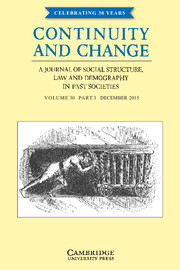
Contents
Research Article
Time constraints on market activity and the balance of power in medieval Liège
-
- Published online by Cambridge University Press:
- 29 December 2015, pp. 315-340
-
- Article
- Export citation
Feudal colonisation and socio-ecological transition in Mayûrqa (Muslim Majorca) in the thirteenth century
-
- Published online by Cambridge University Press:
- 29 December 2015, pp. 341-366
-
- Article
- Export citation
Plague and crime: Bologna, 1348–1351
-
- Published online by Cambridge University Press:
- 29 December 2015, pp. 367-393
-
- Article
- Export citation
Urban environmental degradation and the standard of living: the case of the Spanish mining industry (1870–1930)
-
- Published online by Cambridge University Press:
- 29 December 2015, pp. 395-421
-
- Article
- Export citation
Book Review
R. Houston, Bride Ales and Penny Weddings: Recreations, Reciprocity and Regions in Britain from the Sixteenth to the Nineteenth Century (Oxford: Oxford University Press, 2014). Pages 272. £65.00 hardback.
-
- Published online by Cambridge University Press:
- 29 December 2015, pp. 423-425
-
- Article
- Export citation
Mo Moulton, Ireland and the Irish in Interwar England (Cambridge: Cambridge University Press, 2014). Pages viii + 378. £65.00 hardback.
-
- Published online by Cambridge University Press:
- 29 December 2015, pp. 425-427
-
- Article
- Export citation
A. M. Gill and S. R. Prodan (editors), Friendship and Sociability in Premodern Europe: Contexts, Concepts and Expressions, Essays and Studies 33 (Toronto: Publications of the Centre for Reformation and Renaissance Studies, 2014). Pages 318 + Illustrations. $39.95 paperback.
-
- Published online by Cambridge University Press:
- 29 December 2015, pp. 427-429
-
- Article
- Export citation
Paul Slack, The Invention of Improvement: Information and Material Progress in Seventeenth-Century England (Oxford: Oxford University Press, 2015). Pages xii + 321. £35.00 hardback.
-
- Published online by Cambridge University Press:
- 29 December 2015, pp. 429-431
-
- Article
- Export citation
Roderick Floud, Jane Humphries and Paul Johnson (editors), The Cambridge Economic History of Modern Britain, 2nd edition, volume 1: 1700–1870; and volume 2: 1870 to the Present (Cambridge: Cambridge University Press, 2014). Pages 505 and 599. £29.99 and £29.99 paperback.
-
- Published online by Cambridge University Press:
- 29 December 2015, pp. 431-433
-
- Article
- Export citation
Chris Briggs, P. M. Kitson and S. J. Thompson (editors), Population, Welfare and Economic Change in Britain 1290–1834 (Woodbridge, Suffolk: Boydell, 2014). Pages xvi + 345. £25.00 paperback.
-
- Published online by Cambridge University Press:
- 29 December 2015, pp. 433-435
-
- Article
- Export citation
Front Cover (OFC, IFC) and matter
CON volume 30 issue 3 Cover and Front matter
-
- Published online by Cambridge University Press:
- 29 December 2015, pp. f1-f2
-
- Article
-
- You have access
- Export citation
Back Cover (IBC, OBC) and matter
CON volume 30 issue 3 Cover and Back matter
-
- Published online by Cambridge University Press:
- 29 December 2015, pp. b1-b11
-
- Article
-
- You have access
- Export citation