


Introduction
Himalayan glaciers are classified as clean-ice type (C-type) and debris-covered ice type (D-type) (Reference Moribayashi and HiguchiMoribayashi and Higuchi, 1977; Reference Shroder, Bishop, Copland and SloanShroder and others, 2000). Debris- or moraine-covered glaciers are a significant sediment transport agent in cold mountainous environments (Reference KirkbrideKirkbride, 1995). Debris over the ablation zone generally originates from rockfall from the adjacent valley mountain, erosion from elevated lateral moraines, avalanches, and debris entrainment through englacial channels (Reference Hambrey, Bennett, Dowdeswell, Glasser and HuddartHambrey and others, 1999; Reference HewittHewitt, 2009; Reference BennBenn and others, 2012). An understanding of debris cover is important for mass balance and glacier dynamics as debris thickness determines the ice-melt rate (Reference Mattson, Gardner and YoungMattson and others, 1993; Reference Zhang, Xie, Kang, Yi and AckleyZhang and others, 2011). For example, thick debris-covered glaciers respond more slowly to climatic changes than glaciers with thinner debris covers or clean glaciers (Reference MattsonMattson, 2000; Reference Singh, Kumar, Ramasastri and SinghSingh and others, 2000; Reference Scherler, Bookhagen and StreckerScherler and others, 2011).
Existing studies suggest that 70–80% of Himalayan glaciers are debris-covered and have been receding almost since the end of the Little Ice Age (Reference Mayewski and JeschkeMayewski and Jeschke, 1979; Reference Sakai, Takeuchi, Fujita and NakawoSakai and others, 2000; Reference Dobhal, Gergan and ThayyenDobhal and others, 2004; Reference Casey, Kääb and BennCasey and others, 2012). Most of the research work on debris-covered Himalayan glaciers has concentrated on mapping, mass balance and its temporal variations based on remote sensing (Reference Berthier, Arnaud, Kumar, Ahmad, Wagnon and ChevallierBerthier and others, 2007; Reference Bolch, Buchroithner, Pieczonka and KunertBolch and others, 2008, Reference Bolch, Pieczonka and Benn2011; Reference Racoviteanu, Williams and BarryRacoviteanu and others, 2008; Reference Shukla, Gupta and AroraShukla and others, 2009; Reference Bhambri, Bolch and ChaujarBhambri and others, 2011, Reference Bhambri, Bolch and Chaujar2012; Reference Kulkarni, Rathore, Singh and BahugunaKulkarni and others, 2011; Reference Scherler, Bookhagen and StreckerScherler and others, 2011; Reference Casey, Kääb and BennCasey and others, 2012).
Much less attention has been paid to quantifying debris-cover effects on the mass-balance process and its response to climate change using ground-based glaciological methods (Reference Adhikary, Nakawo, Seko and ShakyaAdhikary and others, 2000; Reference Singh, Kumar, Ramasastri and SinghSingh and others, 2000; Reference RainaRaina 2009; Reference Dobhal, Mehta and SrivastavaDobhal and others, 2013). Additionally, the influence of debris cover on the ablation process in different seasons (e.g. winter, spring and monsoon) is largely unknown. Therefore, understanding the impact of debris-cover thickness on ablation is of paramount interest among glaciologists especially over the Himalayan glaciers.
Experimental and short-period (ablation season) studies suggest that a thick debris cover reduces ablation, whereas a thin debris layer increases ice melt underneath (Reference Mattson, Gardner and YoungMattson and others, 1993; Reference MattsonMattson, 2000; Reference Sakai, Takeuchi, Fujita and NakawoSakai and others, 2000; Reference Singh, Kumar, Ramasastri and SinghSingh and others, 2000; Reference RainaRaina 2009; Reference Reznichenko, Davies, Shulmeister and McSaveneyReznichenko and others, 2010; Reference Zhang, Xie, Kang, Yi and AckleyZhang and others, 2011). The critical thickness that alters the ablation rate varies greatly from glacier to glacier, as well as from one point to another even on the same glacier (Reference Kirkbride and DugmoreKirkbride and Dugmore, 2003). An experimental study by Reference Reznichenko, Davies, Shulmeister and McSaveneyReznichenko and others (2010) reported that >50 mm thick debris reduces the total heat flux to the ice surface underneath. Reference Mattson, Gardner and YoungMattson and others (1993) reported an increase in ablation under 0–10 mm of debris on debris-covered Rakhiot Glacier, Punjab Himalaya. They also found that 30 mm of debris tends to be a critical thickness which suppresses the ablation process as compared to clean ice. These measurements are complemented by Reference Kayastha, Takeuchi, Nakawo and AgetaKayastha and others (2000) who predicted ice melting at different thickness levels beneath variably thick debris cover on Khumbu Glacier, Nepal Himalaya. Reference Kayastha, Takeuchi, Nakawo and AgetaKayastha and others (2000) also showed that maximum ablation occurs when the fine debris layer over the bare ice is ~0.3 cm thick and that ablation decreases when debris becomes thicker than 5 cm.
Some other noteworthy numerical models have also been developed for understanding the insulating effect of debris cover on ice melt. These are generally based on energy balance on the debris layer using meteorological parameters and thermal conductivity of the debris layer as a function of its thickness (Reference Kayastha, Takeuchi, Nakawo and AgetaKayastha and others, 2000; Reference Nicholson and BennNicholson and Benn, 2006, Reference Nicholson and Benn2013). In addition, previous studies have described the role of debris thickness in the lower regions of glaciers which can reduce the retreat rate but can lead to fragmentation of the snout (Reference KulkarniKulkarni and others 2007; Reference Basnett, Kulkarni and BolchBasnett and others, 2013; Reference Dobhal, Mehta and SrivastavaDobhal and others 2013).
Observations of sub-debris ice ablation and debris cover enhancement as a function of ablation are site-specific and are highly dependent on the prevailing atmospheric conditions (Reference Nicholson and BennNicholson and Benn, 2006). In view of this, we investigated the ablation rate under varying debris-cover thickness in relation to the distinct altitude of Dokriani Glacier, central Himalaya, India, for the period 2009/10–2012/13 and analysed glacier behaviour in response to annual atmospheric conditions. Our study also provides an overview of the spatial and temporal distribution of debris cover in the lower ablation zone.
Study Area
Dokriani Glacier is a valley glacier formed by two cirques, one on the northern slopes of Draupadi Ka Danda (5716 m a.s.l.) and the other on the western slopes of Janoli Peak (6632 m a.s.l.) (Fig. 1). It flows north-northwestwards for 2.0 km up to the base of the icefall, from where it turns west-west-northwards and flows for another 3.0 km before terminating at 3965 m a.s.l. The Din Gad tributary of Bhagirathi River originates from the snout of Dokriani Glacier (3965 m a.s.l.). It has a catchment area of 77.8 km2, of which 7 km2 is glacierized. This catchment area is one of the best-studied glacierized basins in the Himalaya in terms of mass balance, recession, hydrological and meteorological research (Reference Thayyen, Gergan and DobhalThayyen and others, 2005; Reference Singh, Haritashya and KumarSingh and others, 2007; Reference Dobhal, Gergan and ThayyenDobhal and others 2008; Reference Thayyen and GerganThayyen and Gergan 2010; Reference Pratap, Dobhal, Bhambri and MehtaPratap and others, 2013). Previous studies have revealed that Dokriani Glacier has experienced continuous negative mass balance and extensive retreat since 1962 (Reference Dobhal, Gergan and ThayyenDobhal and others 2008; Reference Dobhal and MehtaDobhal and Mehta, 2010). The ground-based mass-balance study for Dokriani Glacier was conducted during the 1990s, and average equilibrium-line altitude (ELA) during the study period was at 5070 m a.s.l. (Reference Dobhal, Gergan and ThayyenDobhal and others, 2008). Dokriani Glacier retreated 838 m at an average rate of 16.4 m a–1 during 1962–2007 (Reference Dobhal, Gergan and ThayyenDobhal and others, 2004; Reference Dobhal and MehtaDobhal and Mehta, 2010). About 20% of its ablation area is covered with debris, enclosed by highly elevated right lateral and left lateral moraines (Fig. 1). The centre line of the Dokriani Glacier ablation zone comprises clean ice, while the undistributed debris cover is located along the side margins (Figs 1 and 2). Geologically, the study area is located in the north of the Pindari Thrust and comprises calc silicate rocks, biotite gneisses, and schists with granite, pegmatite and apatite veins belonging to the Pindari Formation (Reference Valdiya, Paul, Chandra, Bhakuni and UpadhyayValdiya and others, 1999). Accordingly, the debris over the Dokriani Glacier consists of gneisses, granite and schist.
Location map of Dokriani Glacier, central Himalaya, India. Background is based on Resourcesat 2 Linear Imaging Self-Scanning sensor (LISS) IV, 20 September 2013 (spatial resolution 5.8 m), band combination 3-3-1. Circles over the glacier surface represent the ablation stakes and associated debris thickness. Star shows location of automatic weather station.

Temporal changes in debris cover, landform and surface morphology of Dokriani Glacier: (a) ablation zone in 1995 and (b) 2013 glacier surface show substantial surface lowering; (c, d) glacier extension in (c) 1992 and (d) 2013 shows recession and debris enhancement over terminus.

Methodology
To determine the effects of a supraglacial debris cover of varying thickness on glacier ice melt, ablation was measured for four consecutive years (2009/10–2012/13). At the end of October every year during the study period, 30 ablation stakes were drilled into the debris-covered and clean-ice portions of Dokriani Glacier to quantify ablation (Fig. 1). International protocols for ablation measurements based on glaciological methods (Reference Østrem and BrugmanØstrem and Brugman, 1991; Reference CogleyCogley and others, 2011) were followed. Ablation at each stake was monitored at 15 day intervals during the ablation season, and winter melting was calculated based on cumulative melting from 1 November to 30 April in order to determine net winter, net summer and monthly ablation. As this glacier had varying debris thickness as well as clean ice in every 100 m, ablation stakes were installed such that each stake could represent the specific glacier area (i.e. debris-covered area or bare-ice area) (Fig. 1). Net ablation was computed based on ice thickness loss multiplied by ice density. Ice density was measured at various points over the Dokriani Glacier ablation zone, and an average density of 850 kg m–3 was calculated for assessing water equivalent ice ablation.
Generally, a reading problem arises for stakes placed near the side-walls of the lateral moraines because debris fall from moraines can affect the measurements. In the study area the lateral moraines reach 40–60 m above the glacier surface, indicating significant glacier downwasting in recent decades (Fig. 2). Moreover, the debris cover consists of large boulders with a greater possibility of shifting in an undulating manner which can hamper the stake reading. To minimize the effect of these factors, stake networks were laid with due caution for making observations.
Results and Discussion
Debris-covered and clean-ice melting
A total of 30 ablation stakes were emplaced, 16 in the debris-covered ice and 14 in the clean ice of Dokriani Glacier for 4 years (2009/10–2012/13). In situ survey for supraglacial debris thickness and coverage measurement indicated that the debris cover was limited to the ablation zone between 3900 and 4400 m a.s.l. (Fig. 1). The observed annual ablation at the stakes in clean ice and in debris-covered ice of varying thickness is presented in Figure 3. We found a strong positive correlation between mean annual ablation of clean ice and elevation (R 2 ≥ 0.92) during the study period. The maximum clean-ice melting (4.9 m w.e. a–1) was observed near the snout between 4000 and 4200 m a.s.l. from 2009/10 to 2012/13. The clean-ice melting decreases with increasing elevation and reaches 0.34 m w.e. a–1 at 4900–5000 m a.s.l. near the ELA. The observed clean-ice melt rate at different elevations revealed the role of temperature lapse rate (which is also linear with elevation). Reference Pratap, Dobhal, Bhambri and MehtaPratap and others (2013) observed an average monthly temperature lapse rate of 6.56°C km–1 between 3800 and 4400 m a.s.l., higher than the basin average lapse rate (6.0°C km–1). This occurs due to the high temperature gradient between two elevations, where the ice surface is exposed earlier at lower elevation than at snow-covered higher elevation. At higher elevations, therefore, the melting of ice (underneath the snow cover) is delayed.
Annual ablation profile for debris-covered and clean ice of Dokriani Glacier during 2009/10–2012/13.
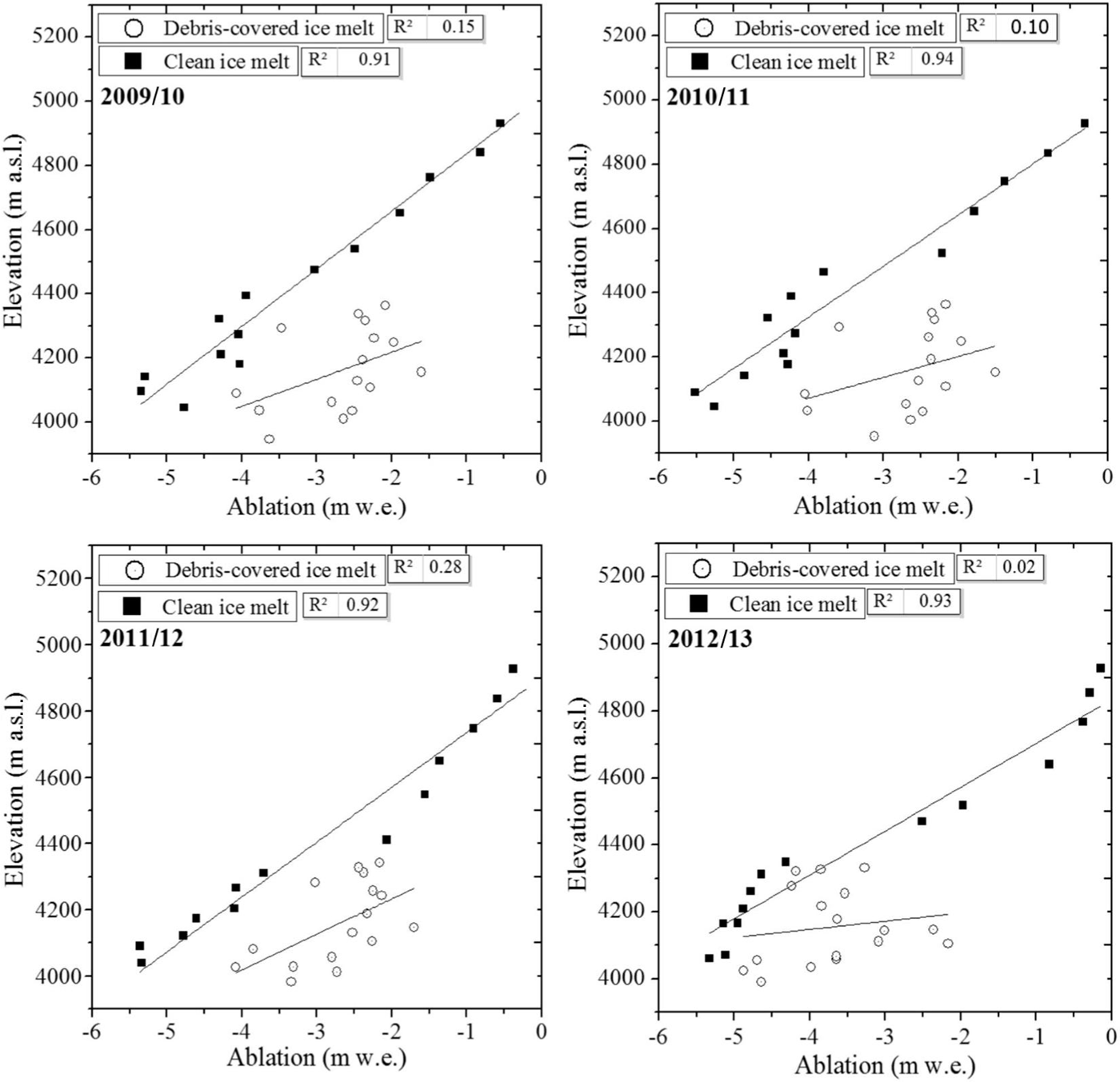
Conversely, inconsistent ablation was observed in debris-covered ice where debris thickness ranged from 1 to 40 cm. We found a low correlation between debris-covered ice and altitude (R 2 = 0.14) (Fig. 3). This is due to the insulation effects of inhomogeneous distribution (variable thickness) of debris irrespective of altitudinal variation. Ablation measurements also show that debris-covered ice had a lower melt rate than clean ice (Fig. 3). Annual ablation measurements in areas between 3900 and 4400 m a.s.l. from the initial visit in October 2009 to the end of the 2013 ablation season show that the difference in ablation rates of debris-covered and clean ice varies between 27% and 44% (average 37%) on Dokriani Glacier (Table 1). Furthermore, we found that even a small debris-cover thickness (1–2 cm) retards melting compared to that of clean ice on an annual basis. Thus, no evidence was found to support increased ablation under a fine debris thickness compared to clean ice.
Observed annual ablation on Dokriani Glacier for adjacent debris-covered ice and clean ice between 3900 and 4400 m a.s.l.
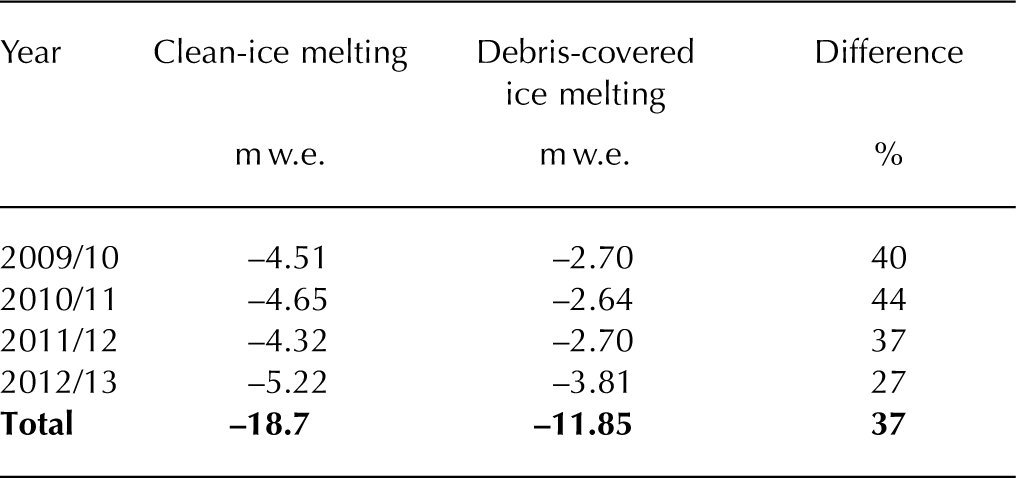
The relative difference between melting of debris-covered and clean ice was lowest in 2012/13. However, the absolute value of melting was higher in that year than in other years during the study period (Table 1). This is owing to the development of a supraglacial meltwater channel along the centre line during 2012/13, which contributed proportionally higher ice melt (Fig. 4).
(a) Recent (2013) formation of supraglacial stream channel along the centre line to nearby snout of Dokriani Glacier. (b) Fragmentation of glacier snout due to higher melting at clean-ice upper surface compared to thick debris-covered lower part.

Substantial ice melting during 2012/13 progressively narrowed down the glacier centre line, rendering the debris along the side margins of the glacier highly unstable and eventually sluicing it into the 10 m deep supraglacial stream channel (Fig. 4; Table 1). A sudden change in ablation pattern of Dokriani Glacier due to epiglacial morphology change has also been reported (Reference Dobhal, Gergan and ThayyenDobhal and others 2008; Reference Dobhal and MehtaDobhal and Mehta, 2010).
Spatial variations in debris thickness and melting
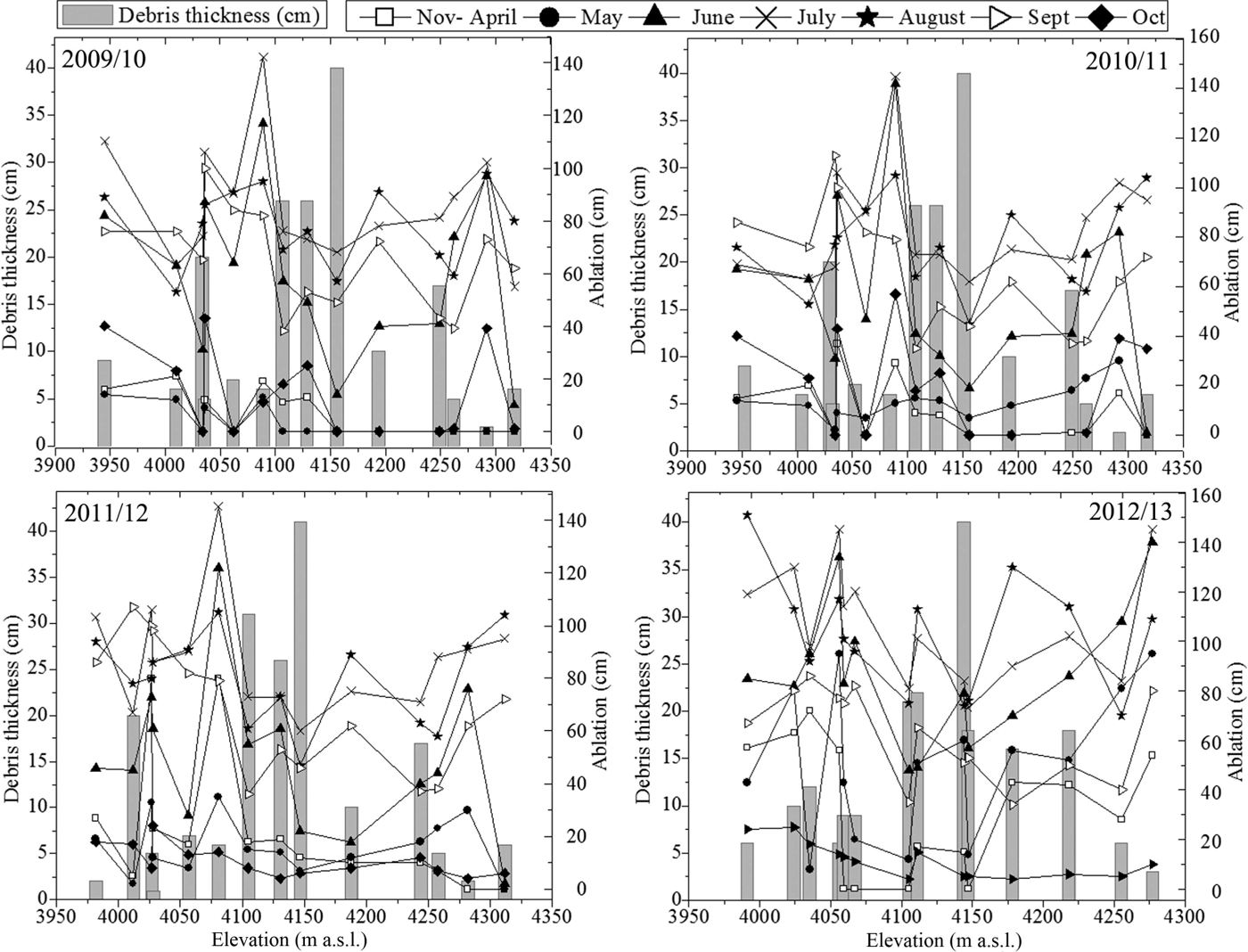
The ablation area of Dokriani Glacier was covered with debris varying in thickness between 1 and 40 cm (Fig. 1). The average value was 9 cm based on in situ survey at the end of each ablation period during 2009/10–2012/13. The pattern of monthly ablation of debris-covered ice was highly variable in each year (Fig. 5). June–September was the period with maximum melting during 2009/10–2012/13. This period is known as the peak summer melting season, with maximum melting occurring in July. Overall, monthly melt rates of ice covered with debris of varying thickness at different elevations show significant variations among the studied balance years (Fig. 5). This is due to differences in seasonal meteorological conditions (e.g. quantity of insulation, snowline depletion, temperature and precipitation).
Spatial distributions of debris-cover thickness and associated monthly melting during 2009/10–2012/13.
Previous work on the sub-debris melt rate (an empirical measurement of the relationship between debris thickness and ice ablation rate, known as the Østrem curve) has determined the gain or loss in ablation rate (Reference ØstremØstrem, 1959; Reference Nicholson and BennNicholson and Benn, 2006). Those results demonstrate increased ice ablation under 1–2 cm, and equal ablation under 2–4 cm, of debris thickness compared to clean ice. Unlike the increase in melting rate up to a certain debris thickness in the Østrem curve, we found asymptotic decline in ablation rate under thin debris cover (1–2 cm) compared to clean ice (Figs 3 and 6). Our study, based on the annual exponential curve relationship of debris thickness and melt rate, reports moderate correlation coefficients (R 2) ranging from 0.45 to 0.73 during 2009/10 to 2012/13 (Fig. 6). The low statistical relationship during 2010–12 is attributed to lower melt rate at higher elevation compared to a lower ablation zone under similar debris thickness. Surprisingly, we found high correlation coefficients (R 2 = 0.73) during 2012/13 when supraglacial streamflows significantly increased ice melt (Fig. 6). For debris-covered ice, melting was maximum (4.0 m w.e. a–1) for 1–6 cm of debris, abruptly decreasing by 11% (to 3.6 m w.e. a–1) for ~9 cm of debris and reaching a minimum (1.6 m w.e. a–1) at 40 cm of debris (Fig. 6). The stakes drilled at 4025–50 and 4325–50 m a.s.l. with similar debris thickness (5–7 cm) show variation in ablation rate (Fig. 6). Ablation decreased by 36% at higher-elevation (4325–50 m a.s.l.) stakes as compared to lower-elevation stakes (4025–50 m a.s.l.). This suggests that altitude influences the impact of debris cover on glacier ice melting, as mentioned by previous studies (e.g. Reference Reznichenko, Davies, Shulmeister and McSaveneyReznichenko and others, 2010; Reference FyffeFyffe and others, 2014).
Exponential curve relationship between debris thickness and annual ablation during 2010–13. Dotted line connected to markers displays ablation stake observation from snout to higher ablation zone.

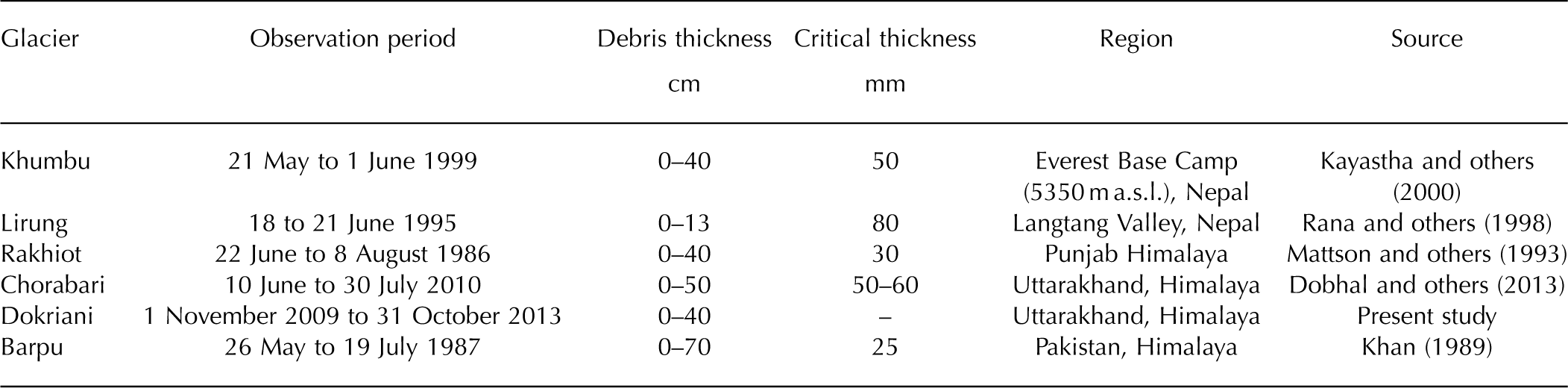
Our analysis shows that an increase in debris thickness reduces the rate of ice ablation and protects the ice underneath from melting. This is in conformity with many field-based short-term studies in the Himalaya (e.g. of Khumbu and Lirung glaciers, Nepal Himalaya (Reference Rana, Nakawo, Ageta, Seko, Kubota and KojimaRana and others, 1998; Reference Kayastha, Takeuchi, Nakawo and AgetaKayastha and others, 2000), Chorabari Glacier, Garhwal Himalaya (Reference Dobhal, Mehta and SrivastavaDobhal and others, 2013), and Barpu Glacier, Pakistan (Reference KhanKhan, 1989)) (Table 2). Reference Mattson, Gardner and YoungMattson and others (1993) reported an ablation increase under 0–10 mm of debris on debris-covered Rakhiot Glacier based on an in situ survey from 22 June to 8 August 1986 (Table 2). Conversely, our study presented long-term (4 years) monthly summer ablation, as well as cumulative winter ablation, which sheds more light on monthly variation between debris thickness and the ablation process.
Summary of field-based observation of supraglacial debris thickness and critical thickness for ablation underneath Himalayan glaciers
Conclusion
We have reported surface melting conditions on Dokriani Glacier from 2009/10 to 2012/13. We found high correlation (R 2 = 0.92) between the mean annual ablation of clean ice and altitude, and very low correlation (R 2 = 0.14) between the mean annual ablation of debris-covered ice and altitude. This difference can be attributed to the insulation effect of inhomogeneous distribution of debris thickness with respect to altitude. Maximum clean-ice melting (4.9 m w.e. a–1) was observed near the snout and found to be linearly decreasing with elevation increase, reaching 0.34 m w.e. a–1 between 4900 and 5000 m a.s.l.
Conversely, debris-covered ice melting was found to be inhomogeneous with altitude, but melting decreased as debris thickness increased. We found that even ice covered with 1–2 cm of debris has less melting as compared to clean-ice melting for every studied year (2009/10–2012/13). Our results suggest that debris-covered ice has significantly lower melting rates than clean ice during the study period. An analysis based on monthly ablation over debris-covered area also shows variability with altitude for every studied balance year. This is due to differences in monthly atmospheric conditions.
In addition, ablation data suggest that the supraglacial debris-covered area is continuously accompanied by debris at higher elevation. The debris that particularly accumulates in the lower ablation zone due to substantial clean-ice melting now reduces the ice melt. These results imply that the lower part of glacier response becomes less sensitive to climate. Therefore, we conclude that the substantial ice-surface loss in the recent warm period is gradually increasing the debris cover in the ablation zone and insulating ice melt underneath.
Acknowledgements
We are grateful to A.K. Gupta, Director, Wadia Institute of Himalayan Geology (WIHG), for providing facilities and ample support to carry out this work. We thank Kishor Kumar of WIHG and the anonymous reviewers for valuable comments and suggestions which improved the manuscript. We are also grateful to the Department of Science and Technology (DST), Government of India, New Delhi, for financial support.



