




1 Introduction
Asian options, also known as the underlying asset average price options, are derivatives of stock options. There are many studies on the pricing of Asian options. The problem of computing the price of an Asian option is reduced to the problem of solving a parabolic partial differential equation in two variables by exploiting a scaling property [Reference Rogers and Shi21]. Costabile et al. [Reference Costabile, Massabó and Russo5] used a binomial tree to describe the underlying asset evolution. At each node of the tree, a set of representative averages is chosen from among all the effective averages realized at that node. Then, backward recursion and linear interpolation are used to compute the Asian option price. Geman and Yor [Reference Geman and Yor7] used simple probabilistic methods on Asian options and obtained the computation of the moments of all orders of an arithmetic average of geometric Brownian motion. By using Bessel processes, several open problems involving the integral of an exponential of Brownian motion are solved (for example, the valuation of perpetuities or annuities under stochastic interest rates within the Cox–Ingersoll–Ross framework). Nielsen and Sandmann [Reference Nielsen and Sandmann19] analysed the effect of stochastic interest rates on the pricing of Asian options in 1996. The price of the underlying asset and the prices of bonds are assumed to follow correlated two-dimensional Itô processes. The averages considered in the Asian options are calculated on a discrete time grid. In emerging financial markets, the trading volume of financial assets is small and the asset price remains constant for a short period of time. This phenomenon may also occur in interest rate markets, money markets and commodity markets. At this point, the common Black–Scholes model and fractional Black–Scholes model are no longer applicable. To characterize the constant periodicity of the underlying asset price, Piryatinska et al. [Reference Piryatinska, Saichev and Woyczynski20] introduced a stochastic process $T_\alpha (t)$
and constructed its density function as follows:
$T_\alpha (t)$
and constructed its density function as follows:
 $$ \begin{align*} f(t, \alpha)=t-\frac{t^\alpha}{\Gamma(\alpha+1)}, \quad t>0, \ \alpha \in[0,1]. \end{align*} $$
Magdziarz [Reference Magdziarz15] introduced the subdiffusion mechanism into the option pricing theory and derived the subdiffusion Black–Scholes model. In addition, Magdziarz proved that the financial market was arbitrage-free and incomplete under this model, and presented the corresponding partial differential equation and pricing formula for European options. Subsequently, Magdziarz et al. [Reference Magdziarz, Orzeł and Weron16] proposed the subdiffusion arithmetic Brownian motion model and the pricing formula of the European options under this condition was also given. Carr and Wu [Reference Carr and Wu3] applied time-changed Lévy processes to select and test a particular option pricing model through the use of characteristic function technology. Huang and Wu [Reference Huang and Wu11] analysed the specifications of option pricing models based on time-changed Lévy processes, and classified option pricing models based on the structure of the jump component in the underlying return process, the source of stochastic volatility and the specification of the volatility process itself. The above time-changed process can well describe the constant cyclical phenomenon that appears in the price changes of the underlying asset.
Huang et al. [Reference Huang, Tao and Li12] concentrated on the pricing problem of European options under the fractional dimensional Vasicek interest rate model in 2012. The general pricing formula for the European options with stochastic interest rate, and explicit expression for the European option price, put option price and the call–put parity are obtained. Zhou and Li [Reference Zhou and Li24] studied the pricing problem of geometric average Asian options under fractional dimensional Vasicek interest rate model in 2014. The partial differential equations for continuous geometric average Asian call option price are established. The general pricing formula for continuous geometric average Asian options, and the explicit expression for continuous geometric average Asia call, put option price and the call–put parity are obtained.
Many scholars used fractional Brownian motion for option pricing [Reference Ahmadian, Ballestra and Shokrollahi1, Reference Ballestra, Pacelli and Radi2, Reference Elliott and Van Der Hoek6, Reference Karipova and Magdziarz14, Reference Wang, Cai and Tao23]. To reflect the feature of long-term correlation of financial data, Liang et al. [Reference Gu, Liang and Zhang8] extended the time-changed geometric Brownian motion model to the time-changed fractional geometric Brownian motion model, that is, it is assumed that the underlying asset price is satisfied,
 $$ \begin{align*} S_\alpha(t)=S(T_\alpha(t))=S_0 e^{\mu T_\alpha(t)+\sigma B_H(T_\alpha(t))}, \end{align*} $$
where $B_H(t)$
is fractional Brownian motion. They also gave a pricing formula for European options in the discrete case without discussing arbitrage.
$B_H(t)$
is fractional Brownian motion. They also gave a pricing formula for European options in the discrete case without discussing arbitrage.
To avoid arbitrage opportunities in the traditional model based on the path-dependent integral of fractional Brownian motion, Cheridito et al. [Reference Cheridito4, Reference Mishura and Valkeila18] proposed the mixed fractional Brownian motion model,
 $$ \begin{align*} M_{\alpha, H}(t)=a B(T_\alpha(t))+b B_H(T_\alpha(t)) \quad \text{for all } t \in \mathbb{R}^{+}, \end{align*} $$
where a, b and H are parameters, $B(t)$
is standard Brownian motion and
$B(t)$
is standard Brownian motion and $B_H(t)$
is fractional Brownian motion. The model is suitable for describing the constant cyclicality of financial asset price in financial markets [Reference Mishura17]. Cheridito [Reference Cheridito4] also pointed out that the mixed fractional Brownian motion model is equivalent to the Black–Scholes model under the condition
$B_H(t)$
is fractional Brownian motion. The model is suitable for describing the constant cyclicality of financial asset price in financial markets [Reference Mishura17]. Cheridito [Reference Cheridito4] also pointed out that the mixed fractional Brownian motion model is equivalent to the Black–Scholes model under the condition $H \in (3/4,1)$
and there is no arbitrage in the market at this time. Subsequently, Mishura and Valkeila [Reference Mishura and Valkeila18] proposed that when
$H \in (3/4,1)$
and there is no arbitrage in the market at this time. Subsequently, Mishura and Valkeila [Reference Mishura and Valkeila18] proposed that when $H \in (1/2,1)$
, there is no arbitrage in this model. Guo [Reference Guo and Yuan9] established a European option pricing model based on time-changed mixed fractional Brownian motion in 2014, which can describe the long-term correlation and constant periodicity of stock price changes.
$H \in (1/2,1)$
, there is no arbitrage in this model. Guo [Reference Guo and Yuan9] established a European option pricing model based on time-changed mixed fractional Brownian motion in 2014, which can describe the long-term correlation and constant periodicity of stock price changes.
Now, we pay attention to the pricing of a geometric average Asian option with fixed and stochastic interest rates based on time-changed mixed fractional Brownian motion. We construct portfolio through $\Delta $
-hedge and the pricing formula is obtained after variable substitution. Since the partial differential equation corresponding to an Asian option is high-dimensional, dimension reduction is required through multiple variable substitutions. The pricing formula of an Asian call and a put option, and the corresponding parity formula as well as the explicit solution are obtained.
$\Delta $
-hedge and the pricing formula is obtained after variable substitution. Since the partial differential equation corresponding to an Asian option is high-dimensional, dimension reduction is required through multiple variable substitutions. The pricing formula of an Asian call and a put option, and the corresponding parity formula as well as the explicit solution are obtained.
The framework of the paper is as follows. Some preliminaries of the model are shown in Section 2. The geometric average Asian option pricing based on time-changed mixed fractional Brownian motion is considered under the Vasicek interest rate model in Section 3, and find the explicit solution of the call option and the parity formula. As a special case, we present the relevant results when the interest rate is constant. In Section 4, conclusion and some future prospects are presented.
2 Preliminaries
We consider the stochastic process $M_{\alpha , H}(t)=a B(T_\alpha (t))+b B_H(T_\alpha (t))$
on the probability space
$M_{\alpha , H}(t)=a B(T_\alpha (t))+b B_H(T_\alpha (t))$
on the probability space $(\Omega , \mathcal {F},(\mathcal {F}_t)_{t \geq 0}, P)$
. When
$(\Omega , \mathcal {F},(\mathcal {F}_t)_{t \geq 0}, P)$
. When $a = 0$
,
$a = 0$
, $M_{\alpha , H}(t)$
is fractional Brownian motion, when
$M_{\alpha , H}(t)$
is fractional Brownian motion, when $b = 0$
,
$b = 0$
, $M_{\alpha , H}(t)$
is time-changed Brownian motion. We refer to the first passage time process
$M_{\alpha , H}(t)$
is time-changed Brownian motion. We refer to the first passage time process $T_\alpha (\tau )$
as the inverse process, where
$T_\alpha (\tau )$
as the inverse process, where $T_\alpha (\tau ) = \text {inf}\{t>0\alpha (t)>\tau \}$
,
$T_\alpha (\tau ) = \text {inf}\{t>0\alpha (t)>\tau \}$
, $U_\alpha (t)$
is the
$U_\alpha (t)$
is the $\alpha $
-stable subordinator. Suppose
$\alpha $
-stable subordinator. Suppose $U_\alpha (t)$
is a Lévy infinitely divisible process,
$U_\alpha (t)$
is a Lévy infinitely divisible process, $f_\alpha (t,\tau )$
is the density function of the process, then the Laplace transform of
$f_\alpha (t,\tau )$
is the density function of the process, then the Laplace transform of $f_\alpha (t,\tau )$
satisfies
$f_\alpha (t,\tau )$
satisfies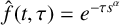 $\hat {f}(t,\tau ) = e^{-\tau s^\alpha }$
[Reference Piryatinska, Saichev and Woyczynski20]. Suppose Brownian motion
$\hat {f}(t,\tau ) = e^{-\tau s^\alpha }$
[Reference Piryatinska, Saichev and Woyczynski20]. Suppose Brownian motion $B(t)$
and Lévy infinitely divisible process
$B(t)$
and Lévy infinitely divisible process $T_\alpha (t)$
are independent of each other, we have that
$T_\alpha (t)$
are independent of each other, we have that
 $$ \begin{align*} E[B^2(T_\alpha(t))]=E(T_\alpha(t))=\frac{t^\alpha}{\Gamma(\alpha+1)}. \end{align*} $$
Thus, $B(T_\alpha (t))$
is a subdiffusion process. Since it is a composite of the two above processes, therefore, subdiffusion geometric Brownian motion is also called time-changed geometric Brownian motion. The result is generalized to fractional Brownian motion. We also assume
$B(T_\alpha (t))$
is a subdiffusion process. Since it is a composite of the two above processes, therefore, subdiffusion geometric Brownian motion is also called time-changed geometric Brownian motion. The result is generalized to fractional Brownian motion. We also assume $B_H(t)$
and
$B_H(t)$
and $T_\alpha (t)$
are independent of each other, then
$T_\alpha (t)$
are independent of each other, then
 $$ \begin{align} E[(B_H(T_\alpha(t)))^2]=E B_H^2(1) E[T_\alpha^{2 H}(1)]=t^{2 \alpha H} E[T_\alpha^{2 H}(1)], \end{align} $$
when $2\alpha H<1$
,
$2\alpha H<1$
, $B_H(T_\alpha (t))$
is a subdiffusion process and when
$B_H(T_\alpha (t))$
is a subdiffusion process and when $2\alpha H>1$
, it is a superdiffusion process. We call this a time-changed fractional Brownian motion.
$2\alpha H>1$
, it is a superdiffusion process. We call this a time-changed fractional Brownian motion.
Proposition 2.1. Suppose $\varepsilon \in (0, \alpha H)$
and
$\varepsilon \in (0, \alpha H)$
and $\Delta T_\alpha (t)=o(\Delta t^{\alpha -\varepsilon })$
,
$\Delta T_\alpha (t)=o(\Delta t^{\alpha -\varepsilon })$
, $\Delta B_H(T_\alpha (t))=o(\Delta t^{\alpha H-\varepsilon })$
. Then, for any
$\Delta B_H(T_\alpha (t))=o(\Delta t^{\alpha H-\varepsilon })$
. Then, for any $n \in \mathbb {N}, 0 \leq s<t<\infty $
,
$n \in \mathbb {N}, 0 \leq s<t<\infty $
,
 $$ \begin{gather*} E(|T_\alpha(t)-T_\alpha(s)|^n) \leq \frac{n !}{\Gamma^n(\alpha+1)}(t-s)^{\alpha n}, \\ E(|B_H(T_\alpha(t))-B_H(T_\alpha(s))|^n) \leq(n-1) ! !\bigg[\frac{n !}{\Gamma^n(\alpha+1)}\bigg]^H(t-s)^{H \alpha n}. \end{gather*} $$
Since $T_\alpha (t)$
is nondecreasing, and
$T_\alpha (t)$
is nondecreasing, and $B_H(\tau )$
is self-similar and with a stationary increment, we can get the proof through Jensen inequality.
$B_H(\tau )$
is self-similar and with a stationary increment, we can get the proof through Jensen inequality.
Proposition 2.2. For any $0 < \varepsilon \leq 1$
, let
$0 < \varepsilon \leq 1$
, let $M_{\alpha , H}(t)=a B(T_\alpha (t))+b B_H(T_\alpha (t))$
. Then, we obtain
$M_{\alpha , H}(t)=a B(T_\alpha (t))+b B_H(T_\alpha (t))$
. Then, we obtain $\Delta M_{\alpha , H}(t)=o(\Delta t^{\alpha / 2-\varepsilon })$
. Furthermore, for
$\Delta M_{\alpha , H}(t)=o(\Delta t^{\alpha / 2-\varepsilon })$
. Furthermore, for $n \in N, 0 \leq s<t<\infty $
,
$n \in N, 0 \leq s<t<\infty $
,
 $$ \begin{align*} E(|M_{\alpha, H}(t)-M_{\alpha, H}(s)|^n) &\leq 2^{n-1}|a|^n(n-1)!!\bigg[\frac{n!}{\Gamma^n(\alpha+1)}\bigg]^{{1}/{2}}(t-s)^{\alpha n/2} \\ & \quad + 2^{n-1}|b|^n(n-1)!!\bigg[\frac{n!}{\Gamma^n(\alpha+1)}\bigg]^H(t-s)^{H\alpha n}, \end{align*} $$
especially, when $n = 1, s = t - \Delta (t)$
,
$n = 1, s = t - \Delta (t)$
,
 $$ \begin{align*} \Delta M_{\alpha, H}(t)=o(\Delta t^{ \alpha /2-\varepsilon}). \end{align*} $$
Wang et al. [Reference Wang, Liang, Lv, Qiu and Ren22] dealt with the asset price exhibiting subdiffusion dynamics and presented the solutions of the following equation.
Proposition 2.3. Suppose $f(x)$
is a continuous function, then the solution of the equation
$f(x)$
is a continuous function, then the solution of the equation
 $$ \begin{align*} d y=f(t)(d t)^\alpha,\quad t \geq 0, y(0)=0 \end{align*} $$
is
 $$ \begin{align*} y=\int_0^t f(t)(d t)^\alpha= \begin{cases}\alpha \int_0^t(t-\tau)^{\alpha-1} f(\tau)\,d \tau, & 0<\alpha \leq 1, \\ \alpha(\alpha-1) \int_0^t(t-\tau)^{\alpha-1} F(\tau)\,d \tau, & 1<\alpha \leq 2,\end{cases} \end{align*} $$
where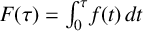 $F(\tau )=\int _0^\tau f(t)\,d t$
. In particular, when
$F(\tau )=\int _0^\tau f(t)\,d t$
. In particular, when $f(t) \equiv 1$
, then
$f(t) \equiv 1$
, then $y=\int _0^t(d t)^\alpha =t^\alpha ,\ 0<\alpha <2$
.
$y=\int _0^t(d t)^\alpha =t^\alpha ,\ 0<\alpha <2$
.
Combined with the above propositions,
 $$ \begin{align*} (d B_H(T_\alpha(t)))^2=\bigg[\frac{t^{\alpha-1}}{\Gamma(\alpha)}\bigg]^{2 H}(d t)^{2 H}=2 H t^{2 H-1}\bigg[\frac{t^{\alpha-1}}{\Gamma(\alpha)}\bigg]^{2 H}\,d t. \end{align*} $$
Based on some results of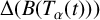 $\Delta (B(T_\alpha (t)))$
,
$\Delta (B(T_\alpha (t)))$
, $\Delta (B_H(T_\alpha (t)))$
, next, we use the no-arbitrage principle to find the partial differential equation satisfied by the Asian option price.
$\Delta (B_H(T_\alpha (t)))$
, next, we use the no-arbitrage principle to find the partial differential equation satisfied by the Asian option price.
3 Asian option pricing based on a time-changed fractional Brownian motion and Vasicek interest rate
In this section, we consider the pricing of a geometric average Asian option based on time-changed mixed fractional Brownian motion under the Vasicek interest rate model. First, we present the assumptions about the market. The interest rate $r(t)$
obeys
$r(t)$
obeys
 $$ \begin{align*} r(t)=X(T_\alpha(t)), \end{align*} $$
and the Vasicek interest rate $X(\tau )$
under forward measure [Reference Han and Zhao10] follows
$X(\tau )$
under forward measure [Reference Han and Zhao10] follows
 $$ \begin{align} d X(\tau)=u(v-r)\, d \tau+\sigma_1 \,d B^r(\tau), \end{align} $$
and the price of stock follows
 $$ \begin{align*} S(t)=\tilde{X}(T_\alpha(t)), \end{align*} $$
where $\tilde {X}(\tau )$
follows
$\tilde {X}(\tau )$
follows
 $$ \begin{align} d \tilde{X}(\tau) &= \mu_S \tilde{X}(\tau)\, d \tau+\sigma_S \tilde{X}(\tau) (a B^S(\tau)+b B_H^S(\tau)) \nonumber \\ &\triangleq \mu_S \tilde{X}(\tau) \,d \tau+ \tilde{X}(\tau)(\sigma_2 B^S(\tau)+\sigma_3 B_H^S(\tau)). \end{align} $$
Here, $u, v, \mu _S, \sigma _S, \sigma _1, \sigma _2, \sigma _3$
are constants,
$u, v, \mu _S, \sigma _S, \sigma _1, \sigma _2, \sigma _3$
are constants, $\tilde {X}(0)> 0$
,
$\tilde {X}(0)> 0$
, $T_\alpha (t)$
is an inverse subordination process,
$T_\alpha (t)$
is an inverse subordination process, $\alpha \in (2/3,1)$
,
$\alpha \in (2/3,1)$
, $B^S(\tau )$
is the Brownian motion;
$B^S(\tau )$
is the Brownian motion; $B^r(\tau )$
and the fractional Brownian motion
$B^r(\tau )$
and the fractional Brownian motion $B^S_H(\tau )$
are independent,
$B^S_H(\tau )$
are independent, $H \in (1/2,1)$
and, thus, there is no arbitrage in this market.
$H \in (1/2,1)$
and, thus, there is no arbitrage in this market.
We denote $P(r, t ,T)$
as the price of a zero coupon bond. If the short-term interest rate satisfies (3.1), we establish a pricing formula for
$P(r, t ,T)$
as the price of a zero coupon bond. If the short-term interest rate satisfies (3.1), we establish a pricing formula for $P(r, t ,T)$
through risk hedging.
$P(r, t ,T)$
through risk hedging.
Specifically, we construct a portfolio $\Pi _1$
in
$\Pi _1$
in $[t, t+\Delta _t]$
,
$[t, t+\Delta _t]$
,
 $$ \begin{align*} \Pi_1=P_1-\Delta P_2. \end{align*} $$
From Taylor expansion and the property of $E(\Delta T_\alpha (t))$
,
$E(\Delta T_\alpha (t))$
, $E(\Delta B_H (T_\alpha (t))^2)$
,
$E(\Delta B_H (T_\alpha (t))^2)$
,
 $$ \begin{align} d \Pi_1 &= \frac{\partial P_1}{\partial t}\, d t+\frac{\partial P_1}{\partial r} \,d r+\dfrac{1}{2} \sigma_1^2 \frac{t^{\alpha-1}}{\Gamma(\alpha)} \frac{\partial^2 P_1}{\partial r^2} \,d t \nonumber \\ & \quad -\,\Delta\bigg[\frac{\partial P_2}{\partial t}\, d t+\frac{\partial P_2}{\partial r} \,d r+\dfrac{1}{2} \sigma_1^2 \frac{t^{\alpha-1}}{\Gamma(\alpha)} \frac{\partial^2 P_2}{\partial r^2}\, d t\bigg]. \end{align} $$
Let
 $$ \begin{align*} \Delta=\frac{\partial P_1}{\partial r} \,\bigg/\, \frac{\partial P_2}{\partial r}. \end{align*} $$
Substituting it in (3.3),
 $$ \begin{align*} d \Pi_1=\frac{\partial P_1}{\partial t} \,d t+\dfrac{1}{2} \sigma_1^2 \frac{t^{\alpha-1}}{\Gamma(\alpha)} \frac{\partial^2 P_1}{\partial r^2}\, d t-\frac{\partial P_1}{\partial r} \,\bigg/\, \frac{\partial P_2}{\partial r}\bigg[\frac{\partial P_2}{\partial t}\, d t+\dfrac{1}{2} \sigma_1^2 \frac{t^{\alpha-1}}{\Gamma(\alpha)} \frac{\partial^2 P_2}{\partial r^2}\, d t\bigg]. \end{align*} $$
According to the principle of no arbitrage, it can be seen that $E(d \Pi _1)=r \Pi _1 \,d t$
and
$E(d \Pi _1)=r \Pi _1 \,d t$
and
 $$ \begin{align*} \bigg[\frac{\partial P_1}{\partial t}+\dfrac{1}{2} \sigma_1^2 \frac{t^{\alpha-1}}{\Gamma(\alpha)} \frac{\partial^2 P_1}{\partial r^2}-r P_1\bigg] \,\bigg/\, \frac{\partial P_1}{\partial r}=\bigg[\frac{\partial P_2}{\partial t}+\dfrac{1}{2} \sigma_1^2 \frac{t^{\alpha-1}}{\Gamma(\alpha)} \frac{\partial^2 P_2}{\partial r^2}-r P_2\bigg] \,\bigg/\, \frac{\partial P_2}{\partial r}. \end{align*} $$
Suppose $\lambda $
is the price of risk of the market, then for all zero coupon bonds,
$\lambda $
is the price of risk of the market, then for all zero coupon bonds,
 $$ \begin{align*} \bigg[\frac{\partial P}{\partial t}+\dfrac{1}{2} \sigma_1^2 \frac{t^{\alpha-1}}{\Gamma(\alpha)} \frac{\partial^2 P}{\partial r^2}-r P\bigg] \,\bigg/\, \frac{\partial P}{\partial r}=-u(\hat{v}-r(t)), \end{align*} $$
where $\hat {v}=v-\lambda \sigma _1 / \mu $
. Therefore,
$\hat {v}=v-\lambda \sigma _1 / \mu $
. Therefore,
 $$ \begin{align*} \frac{\partial P}{\partial t}+u(\hat{v}-r(t)) \frac{\partial P}{\partial r}+\dfrac{1}{2} \sigma_1^2 \frac{t^{\alpha-1}}{\Gamma(\alpha)} \frac{\partial^2 P}{\partial r^2}-r P=0. \end{align*} $$
The price of a zero coupon bond satisfies the following partial differential equation:
 $$ \begin{align} \begin{cases} \dfrac{\partial P}{\partial t}+u(\hat{v}-r(t)) \dfrac{\partial P}{\partial r}+\dfrac{1}{2} \sigma_1^2 \dfrac{t^{\alpha-1}}{\Gamma(\alpha)} \dfrac{\partial^2 P}{\partial r^2}-r P=0, \\ P(r, t; T)=1. \end{cases} \end{align} $$
There is a unique explicit solution for the Cauchy problem (3.4),
 $$ \begin{align*} P(r, t; T)=e^{-A_1(t; T)-r A_2(t; T)}, \end{align*} $$
where
 $$ \begin{align*} A_1(t; T) &= \hat{v}[(T-t)-A_2(t; T)]-\frac{\sigma_1^2}{2 \Gamma(\alpha)} \int_t^T \frac{s^{\alpha-1}}{\Gamma(\alpha)}(A_2(s; T))^2 \,d s, \\ A_2(t; T) &= \dfrac{1}{u}(1-e^{-a(T-t)}). \end{align*} $$
3.1 Pricing model
We first give some assumptions of the market.
-
(i) There are no taxes or transaction fees.
-
(ii) No dividends are paid and volatility is a known function of time [Reference Hull and White13].
-
(iii) The price of stock obeys (3.2) and the interest rate obeys (3.1).
Then, we derive the partial differential equation satisfied by the Asian option price through hedging, and solve the equation as the following results.
Theorem 3.1. Under conditions (i)–(iii), when the strike price is K, the price of a zero coupon bond is P, the maturity date of a zero coupon bond is T, which is also the maturity date of an Asian option, the price of a geometric average Asian option $V(S(t),J(t),r(t),t)$
satisfies the following equation:
$V(S(t),J(t),r(t),t)$
satisfies the following equation:
 $$ \begin{align} & \frac{\partial V}{\partial t}+\sigma^2(t) \frac{\partial^2 V}{\partial r^2}+\tilde{\sigma}^2(t) \frac{\partial^2 V}{\partial S^2} S^2+\frac{\partial V}{\partial J} \frac{J}{t} \ln \frac{S}{J}-r V \nonumber \\ & \qquad+r S \frac{\partial V}{\partial S}+\bigg[u(v-r) \frac{t^{\alpha-1}}{\Gamma(\alpha)}-\lambda_1 \sigma_1\bigg] \frac{\partial V}{\partial r}=0, \end{align} $$
where
 $$ \begin{align*} \sigma^2(t)=\dfrac{1}{2} \sigma_1^2 \dfrac{t^{\alpha-1}}{\Gamma(\alpha)}, \quad\tilde{\sigma}^2(t)=\dfrac{1}{2} \sigma_2^2 \dfrac{t^{\alpha-1}}{\Gamma(\alpha)}+H t^{2 H-1} \sigma_3^2\bigg[\dfrac{t^{\alpha-1}}{\Gamma(\alpha)}\bigg]^{2 H}, \end{align*} $$
the final observation is
 $$ \begin{align*} V(T, S, J)= \begin{cases}(J-K)^{+} & \text {fixed strike price}, \\ (S-J)^{+} & \text {floating strike price},\end{cases} \end{align*} $$
and $0<t<T$
,
$0<t<T$
, $0<S<\infty $
,
$0<S<\infty $
, $0<J<\infty $
.
$0<J<\infty $
.
Proof. The portfolio $\Pi _t$
consists of one unit Asian option,
$\Pi _t$
consists of one unit Asian option, $\Delta _1$
units stock and
$\Delta _1$
units stock and $\Delta _2$
units zero coupon bond at time t,
$\Delta _2$
units zero coupon bond at time t,
 $$ \begin{align*} \Pi_t=V-\Delta_1 S-\Delta_2 P. \end{align*} $$
It is known that
 $$ \begin{align} J_t=\exp \bigg\{\dfrac{1}{t} \int_0^t \ln(S(u))\ d u\bigg\},\quad \frac{d J}{d t}=\dfrac{J}{t} \ln \dfrac{S}{J}. \end{align} $$
We have that
 $$ \begin{align} d \Pi_t&= d V-\Delta_1 \,d S-\Delta_2 \,d P \nonumber \\ &= \frac{\partial V}{\partial t}\, d t+\frac{\partial V}{\partial r} \,d r+\frac{\partial V}{\partial S}\, d S+\dfrac{1}{2} \frac{\partial^2 V}{\partial r^2}(d r)^2+\frac{1}{2} \frac{\partial^2 V}{\partial S^2}(d S)^2+\frac{\partial V}{\partial J}\, d J \nonumber \\ & \quad -\Delta_1 \,d S-\Delta_2\bigg[\frac{\partial P}{\partial t} \,d t+\frac{\partial P}{\partial r} \,d r+\dfrac{1}{2} \frac{\partial^2 P}{\partial r^2}(d r)^2\bigg]. \end{align} $$
Let $\Delta _1=({\partial V}/{\partial S})$
,
$\Delta _1=({\partial V}/{\partial S})$
, $\Delta _2=({\partial V}/{\partial r}) / ({\partial P}/{\partial r})$
and substitute into (3.7). According to the assumption
$\Delta _2=({\partial V}/{\partial r}) / ({\partial P}/{\partial r})$
and substitute into (3.7). According to the assumption $d\Pi = r\Pi \, dt$
and (3.6), it is obtained that the price of the geometric average Asian option based on the time-changed process under the Vasicek interest rate model satisfies the following partial differential equation:
$d\Pi = r\Pi \, dt$
and (3.6), it is obtained that the price of the geometric average Asian option based on the time-changed process under the Vasicek interest rate model satisfies the following partial differential equation:
 $$ \begin{align*} &\frac{\partial V}{\partial t}+\sigma^2(t) \frac{\partial^2 V}{\partial r^2}+\tilde{\sigma}^2(t) \frac{\partial^2 V}{\partial S^2} S^2+\frac{\partial V}{\partial J} \frac{J}{t} \ln \frac{S}{J}-r V \\ &\qquad +\, r S \frac{\partial V}{\partial S}+\bigg[u(v-r) \frac{t^{\alpha-1}}{\Gamma(\alpha)}-\lambda_1 \sigma_1\bigg] \frac{\partial V}{\partial r} =0, \end{align*} $$
where
 $$ \begin{align*} \sigma^2(t)=\dfrac{1}{2} \sigma_1^2 \dfrac{t^{\alpha-1}}{\Gamma(\alpha)}, \quad \tilde{\sigma}^2(t)=\dfrac{1}{2} \sigma_2^2 \dfrac{t^{\alpha-1}}{\Gamma(\alpha)}+H t^{2 H-1} \sigma_3^2\bigg[\dfrac{t^{\alpha-1}}{\Gamma(\alpha)}\bigg]^{2 H}. \end{align*} $$
That completes the proof of Theorem 3.1.
3.2 Solution procedure
Now, we are in a position to solve (3.5).
Theorem 3.2. Under assumptions (i)–(iii), the price of a geometric average Asian option based on time-changed process $V(S(t),J(t),r(t),t)$
satisfies the following equation:
$V(S(t),J(t),r(t),t)$
satisfies the following equation:
 $$ \begin{align*} V(S(t), J(t), r(t), t)=J^{{t}/{T}} P^{{t}/{T}} S^{({T-t})/{T}} e^L N(d_1)-K N(d_2), \end{align*} $$
where
 $$ \begin{align*} d_1 &= \frac{{t}/{T} \ln J+({T-t})/{T} \ln ({S}/{P})+\int_t^T \beta_4(s) \,d s+2 \int_t^T \beta_3(s) \,d s-\ln K}{\sqrt{2 \int_t^T \beta_3(s)\, d s}}, \\ d_2 &= d_1-\sqrt{2 \int_t^T \beta_3(s) \,d s}, \\ \sigma^2(t) &= \dfrac{1}{2} \sigma_1^2 \frac{t^{\alpha-1}}{\Gamma(\alpha)}, \quad\tilde{\sigma}^2(t)=\dfrac{1}{2} \sigma_2^2 \frac{t^{\alpha-1}}{\Gamma(\alpha)}+H t^{2 H-1} \sigma_3^2\bigg[\frac{t^{\alpha-1}}{\Gamma(\alpha)}\bigg]^{2 H}, \\ \beta_1^2(t) &= \sigma^2(t) A_2^2(t; T)+\tilde{\sigma}^2(t), \quad \beta_2(t)=\ln P=A_1(t; T)-r A_2(t; T), \\ \beta_3(t) &= \bigg[\frac{T-t}{T}\bigg]^2 \beta_1^2(t), \quad \beta_4(t)=\frac{1}{T} \beta_2(t)-\frac{T-t}{T} \beta_1^2(t), \\ L &= \int_t^T \beta_4(s)\, d s+\int_t^T \beta_3(s) \,d s, \quad N(x)=\frac{1}{\sqrt{2 \pi}} \int_{-\infty}^x e^{-{t^2}/{2}} \,d t. \end{align*} $$
Proof. In solving (3.5), we divide the problem into the following steps.
Step 1. We substitute the following variable:
 $$ \begin{align} y=\frac{S}{P(r, t; T)}, \quad V_1(y, J, t)=\frac{V(S, J, t, r)}{P(r, t; T)}. \end{align} $$
We have
 $$ \begin{align*} \frac{\partial V}{\partial J} &= P \frac{\partial V_1}{\partial J},\quad \frac{\partial V}{\partial t}=V_1 \frac{\partial P}{\partial t}+P \frac{\partial V_1}{\partial t}-y \frac{\partial V_1}{\partial y} \frac{\partial P}{\partial t}, \\ \frac{\partial V}{\partial r} &= V_1 \frac{\partial P}{\partial r}-y \frac{\partial V_1}{\partial y} \frac{\partial P}{\partial r}, \quad \frac{\partial V}{\partial S}=\frac{\partial V_1}{\partial y}, \\ \frac{\partial^2 V}{\partial r^2} &= V_1 \frac{\partial^2 P}{\partial r^2}-y \frac{\partial V_1}{\partial y} \frac{\partial^2 P}{\partial r^2}+y^2 \frac{\partial^2 V_1}{\partial y^2} \frac{1}{P}\bigg(\frac{\partial P}{\partial r}\bigg)^2, \quad \frac{\partial^2 V}{\partial S^2}=\dfrac{1}{P} \frac{\partial^2 V_1}{\partial y^2}. \end{align*} $$
The results of the above calculations are substituted into (3.5) and it is obvious that
 $$ \begin{align*} \frac{\partial V_1}{\partial t} &+ \bigg[\sigma^2(t)\bigg(\frac{\partial P}{\partial r}\bigg)^2 \frac{y^2}{P^2}+\tilde{\sigma}^2(t) \frac{S^2}{P^2}\bigg] \frac{\partial^2 V_1}{\partial y^2} \\ &+ \frac{1}{P}\bigg\{-\frac{\partial P}{\partial t}-\sigma^2(t) \frac{\partial^2 P}{\partial r^2}-\bigg[u(v-r) \frac{t^{\alpha-1}}{\Gamma(\alpha)}-\lambda \sigma_1\bigg] \frac{\partial P}{\partial r}+r \frac{S}{y}\bigg\} y \frac{\partial V_1}{\partial y} \\ &+ \frac{1}{P}\bigg\{\frac{\partial P}{\partial t}+\sigma^2(t) \frac{\partial^2 P}{\partial r^2}+\bigg[u(v-r) \frac{t^{\alpha-1}}{\Gamma(\alpha)}-\lambda \sigma_1\bigg] \frac{\partial P}{\partial r}-r P\bigg\} V_1 \\ &+ \frac{\partial V_1}{\partial J} \frac{J}{t} \ln \frac{S}{J} = 0. \end{align*} $$
Since the partial differential equation (3.4) is satisfied by the zero-coupon bond price,
 $$ \begin{align} \frac{\partial V_1}{\partial t}+\bigg[\sigma^2(t)\bigg(\frac{\partial P}{\partial r}\bigg)^2 \frac{1}{P^2}+\tilde{\sigma}^2(t)\bigg] \frac{\partial^2 V_1}{\partial y^2} y^2+\frac{\partial V_1}{\partial J} \frac{J}{t} \ln \frac{S}{J}=0. \end{align} $$
Let
 $$ \begin{align*} \beta_1^2(t)=\sigma^2(t) A_2^2(t; T)+\tilde{\sigma}^2(t), \quad \beta_2(t)=\ln P=A_1(t; T)-r A_2(t; T). \end{align*} $$
Note that $S = yP(r,t;T)$
, so
$S = yP(r,t;T)$
, so
 $$ \begin{align} \frac{\partial V_1}{\partial t}+\bigg[\beta_2(t)+\ln \dfrac{y}{J}\bigg] \frac{\partial V_1}{\partial J} \frac{J}{t}+\beta_1^2(t) y^2 \frac{\partial^2 V_1}{\partial y^2}=0. \end{align} $$
Step 2. Making the following transformation:
 $$ \begin{align*} x=\frac{t \ln J+(T-t) \ln y}{T}, \quad V_2(x, t)=V_1(y, J, t) , \end{align*} $$
we have
 $$ \begin{align} \begin{aligned} \frac{\partial V_1}{\partial J} &= \frac{t}{T J} \frac{\partial V_2}{\partial x}, \quad \frac{\partial V_1}{\partial t}=\frac{\partial V_2}{\partial t}+\frac{\ln J-\ln y}{T} \frac{\partial V_2}{\partial x}, \\ \frac{\partial V_1}{\partial y} &= \frac{T-t}{T y} \frac{\partial V_2}{\partial x}, \quad \frac{\partial^2 V_1}{\partial y^2}=\bigg[\frac{T-t}{T y}\bigg]^2 \frac{\partial^2 V_2}{\partial x^2}-\frac{T-t}{T y^2} \frac{\partial V_2}{\partial x}. \end{aligned} \end{align} $$
Substituting this equation into (3.10),
 $$ \begin{align*} \frac{\partial V_2}{\partial t} &+ \beta_1^2(t)\bigg[\frac{T-t}{T}\bigg]^2 \frac{\partial^2 V_2}{\partial x^2} \\ &+ \bigg[\frac{\ln J-\ln y}{T}+\bigg(\beta_2(t)+\ln \frac{y}{J}\bigg) \frac{1}{T}-\beta_1^2(t) \frac{T-t}{T}\bigg] \frac{\partial V_2}{\partial x} = 0. \end{align*} $$
The equivalent form is
 $$ \begin{align*} \frac{\partial V_2}{\partial t}+\beta_3(t) \frac{\partial^2 V_2}{\partial x^2}+\beta_4(t) \frac{\partial V_2}{\partial x}=0, \end{align*} $$
that is, the partial differential equation satisfied by $V_2(x,t)$
is
$V_2(x,t)$
is
 $$ \begin{align} \begin{cases} \dfrac{\partial V_2}{\partial t}+\beta_3(t) \dfrac{\partial^2 V_2}{\partial x^2}+\beta_4(t) \dfrac{\partial V_2}{\partial x}=0, \\ V_2(x, T)=(e^x-K)^{+}, \end{cases} \end{align} $$
where $\beta _3(t)=[({T-t})/{T}]^2 \beta _1^2(t), \quad \beta _4(t)=({1}/{T}) \beta _2(t)-(({T-t})/{T}) \beta _1^2(t)$
.
$\beta _3(t)=[({T-t})/{T}]^2 \beta _1^2(t), \quad \beta _4(t)=({1}/{T}) \beta _2(t)-(({T-t})/{T}) \beta _1^2(t)$
.
Step 3. In addition, we make the following substitutions:
 $$ \begin{align*} V_2(x, t) = \mu(\eta, \theta), \quad \eta = x+\int_t^T \beta_4(s) \,d s, \quad \theta=\int_t^T \beta_3(s) \,d s. \end{align*} $$
Substituting the above equation into (3.12),
 $$ \begin{align*} \begin{cases} \dfrac{\partial^2 u}{\partial \eta^2}-\dfrac{\partial u}{\partial \theta}=0, \\[2mm] \mu(\eta, T)=({e}^\eta-K)^{+}. \end{cases} \end{align*} $$
Analogously, from the Poisson formula,
 $$ \begin{align*} V_2(x, t)=\mu(\eta, \theta)=e^{\eta+\theta} N(d_5)-K N(d_6)=e^{x+L} N(d_5)-K N(d_6), \end{align*} $$
where
 $$ \begin{align*} d_5 &= \frac{\eta-\ln K+2 \theta}{\sqrt{2 \theta}} = \frac{x+\int_t^T \beta_4(s) \,d s+2 \int_t^T \beta_3(s) \,d s-\ln K} {\sqrt{2 \int_t^T \beta_3(s) \,d s}}, \\ d_6 &= d_5-\sqrt{2 \theta} = d_5-\sqrt{2 \int_t^T \beta_3(s)\, d s}, \\ L &= \int_t^T \beta_4(s)\, d s+\int_t^T \beta_3(s)\, d s, \quad e^x = J^{{t}/{T}} y^{{(T-t)}/{T}}. \end{align*} $$
Step 4. We substitute the above results into (3.11) and get
 $$ \begin{align*} V_1(y, J, t)=J^{{t}/{T}} y^{{(T-t)}/{T}} e^L N(d_3)-K N(d_4), \end{align*} $$
where
 $$ \begin{align*} d_3 &= \frac{({t}/{T}) \ln J+(({T-t})/{T} )\ln y+\int_t^T \beta_4(s) \,d s+2 \int_t^T \beta_3(s) \,d s-\ln K}{\sqrt{2 \int_t^T \beta_3(s) \,d s}}, \\ d_4 &= d_3-\sqrt{2 \int_t^T \beta_3(s)\, d s}, \quad L = \int_t^T \beta_4(s)\, d s+\int_t^T \beta_3(s)\, d s. \end{align*} $$
Substituting the above results into (3.8)–(3.10), we have that
 $$ \begin{align*} V(S(t), J(t), r, t)=V_1\bigg(\frac{S}{P}, J, t\bigg) P=J^{{t}/{T}} P^{{L}/{T}} S^{{(T-t)}/{T}} e^L N(d_1)-K N(d_2), \end{align*} $$
where
 $$ \begin{align*} d_1 &= \frac{({t}/{T}) \ln J+(({T-t})/{T}) \ln ({S}/{P})+\int_t^T \beta_4(s)\, d s+2 \int_t^T \beta_3(s)\, d s-\ln K}{\sqrt{2 \int_t^T \beta_3(s) \,d s}}, \\ d_2 &= d_1-\sqrt{2 \int_t^T \beta_3(s) \,d s}. \end{align*} $$
This completes the proof of Theorem 3.2.
It is easy to obtain the pricing formula for the geometric average Asian put option with a fixed strike price. Here, we only present the results.
Theorem 3.3. At a fixed strike price, when the price of stock satisfies (3.2), interest rate satisfies (3.1), the strike price is K, the price of zero coupon bond is P and the maturity date of zero coupon bond is T, the price of the geometric average Asian put option based on time-changed process $V(S(t),J(t),r(t),t)$
satisfies the following equation:
$V(S(t),J(t),r(t),t)$
satisfies the following equation:
 $$ \begin{align*} V(S(t), J(t), r, t)=P K N(-d_2)-P J^{{1}/{T}}\bigg(\frac{S}{P}\bigg)^{{(T-t)}/{T}} e^L N(-d_1), \end{align*} $$
where
 $$ \begin{align*} d_1 &= \frac{({t}/{T}) \ln J+(({T-t})/{T}) \ln ({S}/{P})+\int_t^T \beta_4(s) \,d s+2 \int_t^T \beta_3(s)\, d s-\ln K}{\sqrt{2 \int_t^T \beta_3(s) \,d s}}, \\ d_2 &= d_1-\sqrt{2 \int_t^T \beta_3(s)\, d s},\\\sigma^2(t) &= \dfrac{1}{2} \sigma_1^2 \frac{t^{\alpha-1}}{\Gamma(\alpha)}, \quad \tilde{\sigma}^2(t)=\dfrac{1}{2} \sigma_2^2 \frac{t^{\alpha-1}}{\Gamma(\alpha)}+H t^{2 H-1} \sigma_3^2\bigg[\frac{t^{\alpha-1}}{\Gamma(\alpha)}\bigg]^{2 H}, \\ \beta_1^2(t) &= \sigma^2(t) A_2^2(t; T)+\tilde{\sigma}^2(t), \quad \beta_2(t)=\ln P=A_1(t; T)-r A_2(t; T), \\ \beta_3(t) &= \bigg[\frac{T-t}{T}\bigg]^2 \beta_1^2(t), \quad \beta_4(t)=\frac{1}{T} \beta_2(t)-\frac{T-t}{T} \beta_1^2(t), \\ L &= \int_t^T \beta_4(s) \,d s+\int_t^T \beta_3(s) \,d s, \quad N(x)=\frac{1}{\sqrt{2 \pi}} \int_{-\infty}^x e^{-{t^2}/{2}}\, d t. \end{align*} $$
Now, we give the formula of call–put parity for the geometric average Asian option based on a time-changed process under the Vasicek interest rate model.
Theorem 3.4. Suppose $c(S, J, r, t)$
and
$c(S, J, r, t)$
and $p(S, J, r, t)$
have the same strike price K, maturity date T. The former satisfies the price of the call option in Theorem 3.2, and the latter satisfies the price of the put option in Theorem 3.3, respectively, then the corresponding parity formula is
$p(S, J, r, t)$
have the same strike price K, maturity date T. The former satisfies the price of the call option in Theorem 3.2, and the latter satisfies the price of the put option in Theorem 3.3, respectively, then the corresponding parity formula is
 $$ \begin{align*} c(S, J, r, t)-p(S, J, r, t)=J^{{1}/{T}} P^{{1}/{T}} S^{{(T-t)}/{T}} e^L-P K, \end{align*} $$
where
 $$ \begin{align*} L &= \int_t^T \beta_4(s) \,d s+\int_t^T \beta_3(s)\, d s, \\ \beta_1^2(t) &= \sigma^2(t) A_2^2(t; T)+\tilde{\sigma}^2(t), \quad \beta_2(t)=\ln P=A_1(t; T)-r A_2(t; T), \\ \sigma^2(t) &= \dfrac{1}{2} \sigma_1^2 \frac{t^{\alpha-1}}{\Gamma(\alpha)}, \quad \tilde{\sigma}^2(t)=\dfrac{1}{2} \sigma_1^2 \frac{t^{\alpha-1}}{\Gamma(\alpha)}+H t^{2 H-1} \sigma_3^2\bigg[\frac{t^{\alpha-1}}{\Gamma(\alpha)}\bigg]^{2 H}, \\ \beta_3(t) &= \bigg[\frac{T-t}{T}\bigg]^2 \beta_1^2(t), \quad \beta_4(t)=\dfrac{1}{T} \beta_2(t)-\frac{T-t}{T} \beta_1^2(t). \end{align*} $$
Proof. Assume that $W(S, J, r, t)=c(S, J, r, t)-p(S, J, r, t)$
, then the following partial differential equation is satisfied by
$W(S, J, r, t)=c(S, J, r, t)-p(S, J, r, t)$
, then the following partial differential equation is satisfied by $W(S, J, r, t)$
:
$W(S, J, r, t)$
:
 $$ \begin{align*} \begin{cases} \begin{aligned} &\frac{\partial W}{\partial t}+\sigma^2(t) \frac{\partial^2 W}{\partial r^2}+\tilde{\sigma}^2(t) \frac{\partial^2 W}{\partial S^2} S^2+\frac{\partial W}{\partial J} \dfrac{J}{t} \ln \dfrac{S}{J}-r W \\ &\qquad +r S \frac{\partial W}{\partial S}+\bigg[u(v-r) \frac{t^{\alpha-1}}{\Gamma(\alpha)}-\lambda_1 \sigma_1\bigg] \frac{\partial W}{\partial r}=0, \end{aligned} \\[4mm] W(S, J, t, r)=(J-K)^{+}-(K-J)^{+}=J-K, \end{cases} \end{align*} $$
where
 $$ \begin{align*} \sigma^2(t)=\dfrac{1}{2} \sigma_1^2 \dfrac{t^{\alpha-1}}{\Gamma(\alpha)}, \quad \tilde{\sigma}^2(t)=\dfrac{1}{2} \sigma_1^2 \dfrac{t^{\alpha-1}}{\Gamma(\alpha)}+H t^{2 H-1} \sigma_3^2\bigg[\dfrac{t^{\alpha-1}}{\Gamma(\alpha)}\bigg]^{2 H}. \end{align*} $$
Using the same variable substitution as in Theorem 3.2,
 $$ \begin{align} y=\frac{S}{P(r, t; T)}, \quad W_1(y, J, t)=\frac{W(S, J, t, r)}{P(r, t; T)} , \end{align} $$
and
 $$ \begin{align} \frac{\partial W_1}{\partial t}+\ln \dfrac{S}{P} \frac{\partial V_1}{\partial J} \dfrac{J}{t}+\beta_1^2(t) y^2 \frac{\partial^2 V_1}{\partial y^2}=0, \end{align} $$
where
 $$ \begin{align*} \beta_1^2(t)=\sigma^2(t) A_2^2(t; T)+\tilde{\sigma}^2(t). \end{align*} $$
From (3.13), we determine the solution sequence $W_1\rightarrow W$
. Thus, to acquire
$W_1\rightarrow W$
. Thus, to acquire $W_1$
, we make some variable substitutions:
$W_1$
, we make some variable substitutions:
 $$ \begin{align*} x=\frac{t \ln J+(T-t) \ln y}{T}, \quad W_2(x, t)=W_1(y, J, t). \end{align*} $$
Substituting the above equation into (3.14),
 $$ \begin{align} \begin{cases} \dfrac{\partial W_2}{\partial t}+\beta_3(t) \dfrac{\partial^2 W_2}{\partial x^2}+\beta_4(t) \dfrac{\partial W_2}{\partial x}=0, \\ W_2(x, T)=(e^x-K)^{+}, \end{cases} \end{align} $$
where
 $$ \begin{align*} \beta_3(t) &= \bigg[\frac{T-t}{T}\bigg]^2 \beta_1^2(t), \quad \beta_4(t) = \dfrac{1}{T} \beta_2(t)-\frac{T-t}{T} \beta_1^2(t), \\ \beta_1^2(t) &= \sigma^2(t) A_2^2(t; T)+\tilde{\sigma}^2(t), \\ \beta_2(t) &= \ln P = A_1(t; T)-r A_2(t; T). \end{align*} $$
Let
 $$ \begin{align} W_2(x,t) = a(t)e^\xi - b(t)K. \end{align} $$
Substituting $W_2(x,t)$
into (3.15),
$W_2(x,t)$
into (3.15),
 $$ \begin{align*} [a^{\prime}(t)+a(t) \beta_3(t)+a(t) \beta_4(t)] e^x-b^{\prime}(t) K=0. \end{align*} $$
Select the appropriate $a(t)$
and
$a(t)$
and $b(t)$
such that
$b(t)$
such that
 $$ \begin{align*} \begin{cases} a^{\prime}(t)+a(t) \beta_3(t)+a(t) \beta_4(t)=0, \\[2mm] b^{\prime}(t)=0, \\[2mm] a(T)=1, \\[2mm] b(T)=1, \end{cases} \end{align*} $$
and the solution is
 $$ \begin{align} a(t) = e^L, b(t) = 1, \end{align} $$
where $L=\int _t^T(\beta _3(s)+\beta _4(s))\, d s$
. Substituting the solution (3.17) into (3.16),
$L=\int _t^T(\beta _3(s)+\beta _4(s))\, d s$
. Substituting the solution (3.17) into (3.16),
 $$ \begin{align} W_2(x, t)=e^L e^x-K=J^{{1}/{T}} y^{{(T-1)}/{T}} e^L-K=W_1(y, J, t). \end{align} $$
Finally, substituting (3.18) into (3.13), the parity formula is obtained as
 $$ \begin{align*} c(S, J, r, t)-p(S, J, r, t)=J^{{t}/{T}} P^{{t}/{T}} S^{{(T-t)}/{T}} e^L-P K. \end{align*} $$
This completes the proof of the parity formula.
Remark 3.5. The constant interest rate is a special case of the model. We still construct the model in a simple, arbitrage-free financial market. For an arbitrage-free financial market, we need to give some assumptions. Assumptions (i) and (ii) in Section 3 remain unchanged, and assumption (iii) is replaced as follows. Stock price $S_t$
satisfies
$S_t$
satisfies
 $$ \begin{align} S_t=S_0 \exp \{\mu T_\alpha(t)+\sigma M_{\alpha, H}(t)\}, \quad S_0>0, \end{align} $$
where $S_0, \mu , \sigma $
are constants, and
$S_0, \mu , \sigma $
are constants, and $T_\alpha (t)$
is an inverse
$T_\alpha (t)$
is an inverse $\alpha $
-subordinator,
$\alpha $
-subordinator, $\alpha \in (2/3,1)$
,
$\alpha \in (2/3,1)$
, $M_{\alpha , H}(t)=a B(T_\alpha (t))+b B_H(T_\alpha (t))$
is a subdiffusion process,
$M_{\alpha , H}(t)=a B(T_\alpha (t))+b B_H(T_\alpha (t))$
is a subdiffusion process, $H \in (1/2,1)$
, and
$H \in (1/2,1)$
, and $B(\tau )$
and
$B(\tau )$
and $B_H(\tau )$
are independent with each other. From the above assumptions, we can guarantee that the market is arbitrage-free.
$B_H(\tau )$
are independent with each other. From the above assumptions, we can guarantee that the market is arbitrage-free.
Suppose there is a risk-free bond and a stock, and the price of the bond obeys
 $$ \begin{align*} d Q_t=r Q_t, \quad Q(0)=Q_0. \end{align*} $$
From (2.1), we find that
 $$ \begin{align*} E(\Delta M_{\alpha, H}(t))^2=a^2 \frac{t^{\alpha-1} \Delta t}{\Gamma(\alpha)}+b^2\bigg[\frac{t^{\alpha-1}}{\Gamma(\alpha)}\bigg]^{2 H}(\Delta t)^{2 H}. \end{align*} $$
Denote $V =V(t,S,J)$
as the price of a geometric average Asian call option, where t is the moment, S is the stock price, T is the due date and K is the strike price. Now, we are in a position to show the equation satisfied by the price of a geometric average Asian option based on time-changed. The following corollary is from Theorem 3.1 and the special case (constant interest rate) is considered.
$V =V(t,S,J)$
as the price of a geometric average Asian call option, where t is the moment, S is the stock price, T is the due date and K is the strike price. Now, we are in a position to show the equation satisfied by the price of a geometric average Asian option based on time-changed. The following corollary is from Theorem 3.1 and the special case (constant interest rate) is considered.
Corollary 3.6. Suppose that the stock price obeys (3.19) and the risk-free interest rate is constant, then the price of the geometric average Asian option $V(t,S,J)$
obeys
$V(t,S,J)$
obeys
 $$ \begin{align*} \frac{\partial V}{\partial t} +\bigg\{\frac{a^2}{2} \frac{t^{\alpha-1}}{\Gamma(\alpha)}+H b^2\bigg[\frac{t^{\alpha-1}}{\Gamma(\alpha)}\bigg]^{2 H} t^{2 H-1}\bigg\} \sigma^2 S_t^2 \frac{\partial^2 V}{\partial S_t^2}+J \frac{\ln S-\ln J}{t} \frac{\partial V}{\partial J} +r S_t \frac{\partial V}{\partial S}-r V=0, \end{align*} $$
where final observation is
 $$ \begin{align*} V(T, S, J)= \begin{cases}(J-K)^{+} & \text {fixed strike price}, \\ (S-J)^{+} & \text {floating strike price},\end{cases} \end{align*} $$
and $0<t<T$
,
$0<t<T$
, $0<S<\infty $
,
$0<S<\infty $
, $0<J<\infty $
.
$0<J<\infty $
.
To solve the final observation problem, we present the following corollary.
Corollary 3.7. Suppose that the price of the stock obeys (3.19), and the price of the geometric average Asian call option with fixed knock pricing based on a time-changed process in $t \in [0,T]$
is as follows:
$t \in [0,T]$
is as follows:
 $$ \begin{align*} V(t, S, J)=(J^t S^{T-t})^{1 / T} e^{\delta(t)-(T-t)+\sigma^2(a^*+b^*) / 2} N(d_1)-K e^{-(T-t)} N(d_2), \end{align*} $$
where $N(x)$
is the cumulative distribution function of the standard normal distribution and
$N(x)$
is the cumulative distribution function of the standard normal distribution and
 $$ \begin{align*} d_1 &= \dfrac{\ln (J^{{t}/{T}} S^{{(T-t)}/{T}})+\delta(t)+\sigma^2(a^*+b^*)-\ln K}{\sigma \sqrt{a^*+b^*}}, \\ d_2 &= d_1-\sigma \sqrt{a^*+b^*}, \\ a^* &= \dfrac{a^2(T^\alpha-t^\alpha)}{\Gamma(\alpha+1)}-\frac{2 a^2(T^{\alpha+1}-t^{\alpha+1})}{(\alpha+1) \Gamma(\alpha) T}+\frac{a^2(T^{\alpha+2}-t^{\alpha+2})}{(\alpha+2) \Gamma(\alpha) T^2}, \\ b^* &= \dfrac{b^2(T^{2 H \alpha}-t^{2 H \alpha})}{\alpha(\Gamma(\alpha))^{2 H}}-\frac{4 H b^2(T^{2 H \alpha+1}-t^{2 H \alpha+1})}{(2 H \alpha+1)(\Gamma(\alpha))^{2 H} T} \\ &\quad +\frac{2 H b^2(T^{2 H \alpha+2}-t^{2 H \alpha+2})}{(2 H \alpha+2)(\Gamma(\alpha))^{2 H} T^2}, \\ \delta(t) &= \frac{r(T-t)^2}{2 T}-\frac{a^2 \sigma^2(T^\alpha-t^\alpha)}{2 \Gamma(\alpha+1)}+\frac{a^2 \sigma^2(T^{\alpha+1}-t^{\alpha+1})}{2(\alpha+1) \Gamma(\alpha) T} \\ &\quad -\frac{b^2 \sigma^2(T^{2 H \alpha}-t^{2 H \alpha})}{2(\Gamma(\alpha))^{2 H} T} +\frac{H b^2 \sigma^2(T^{2 H \alpha+1}-t^{2 H \alpha+1})}{(\Gamma(\alpha))^{2 H}(2 H \alpha+1) T}. \end{align*} $$
Analogously, for the put option, we use the same analysis and we hereby omit it. The put–call parity is analysed in the following corollary.
Corollary 3.8. Under assumptions (i)–(iii), also suppose the price of the stock obeys (3.19), then the call–put parity formula for a geometric average Asian option with fixed knock pricing based on a time-changed process is given by
 $$ \begin{align*} V(t, S, J)-P(t, S, J)=c(t) J^{{1}/{T}} S^{{(T-t)}/{T}}-K e^{-(T-t)}, \end{align*} $$
where $P(t, S, J)$
is the price of a geometric average Asian put option with fixed knock pricing and
$P(t, S, J)$
is the price of a geometric average Asian put option with fixed knock pricing and $c(t)=\exp \{\sigma ^2 c\}$
, where
$c(t)=\exp \{\sigma ^2 c\}$
, where
 $$ \begin{align*} c &= \frac{a^2(T^{\alpha+1}-t^{\alpha+1})}{2(\alpha+1) \Gamma(\alpha) T} +\frac{H b^2(T^{2 H \alpha+1}-t^{2 H \alpha+1})}{(2 H \alpha+1)(\Gamma(\alpha))^{2 H} T} \\ &\quad +\frac{a^2(T^{\alpha+2}-t^{\alpha+2})}{2(\alpha+2) \Gamma(\alpha) T^2} +\frac{H b^2(T^{2 H \alpha+2}-t^{2 H \alpha+2})}{(2 H \alpha+2)(\Gamma(\alpha))^{2 H} T^2} +\frac{t^2-T^2}{2 r}. \end{align*} $$
4 Conclusions
We deal with a geometric average Asian option pricing model with a fixed knock pricing, based on time-changed fractional Brownian motion. We consider the pricing of Asian options under the Vasicek interest rate model and the fixed interest rate, construct the portfolio according to the hedging principle, and find the partial differential equation satisfied by the option price by using the arbitrage principle and Taylor expansion. The pricing formula of an Asian call and a put option, and the corresponding party formula as well as the explicit solution, is obtained in Section 3.
Based on the research in this paper, we can continue to explore from the following perspectives: consider the geometric average Asian option pricing with floating strike price and find the explicit solution, and continue to explore the application value of the model. We will also pay attention to the arithmetic average Asian option pricing. According to the current papers, there is no explicit solution for the arithmetic averaging Asian option. We will use a large amount of actual data to conduct empirical analysis and research the rules of the market in the future.
Acknowledgements
This research was supported in part by the National Key R $\&$
D Program of China (No. 2023YFA1009200) and NSFC grant (No. 12471417).
$\&$
D Program of China (No. 2023YFA1009200) and NSFC grant (No. 12471417).


