





1. Introduction
1.1. Incidence geometry
The Szemerédi–Trotter theorem asserts that if  $\mathcal P$ is a set of points and $\mathcal L$ is a set of lines in $\mathbb R^2$ then
 \begin{equation*}
\# \{(\mathfrak p, \mathfrak l) \in \mathcal P \times \mathcal L: \mathfrak p \in \mathfrak l \}
\ll |\mathcal P|^{2/3} |\mathcal L|^{2/3} + |\mathcal P| + |\mathcal L|.
\end{equation*}
\begin{equation*}
\# \{(\mathfrak p, \mathfrak l) \in \mathcal P \times \mathcal L: \mathfrak p \in \mathfrak l \}
\ll |\mathcal P|^{2/3} |\mathcal L|^{2/3} + |\mathcal P| + |\mathcal L|.
\end{equation*}Such estimates have implications for the sum–product problem of Erdős and Szemerédi, see [Reference Elekes6]. Vinh established the following finite-field analogue.
Theorem 1.1 ([Reference Vinh19])
Let  $\mathcal P$ be a set of points and $\mathcal L$ a set of lines in $\mathbb F_q^2$. Then
 \begin{equation*}
\left|
\# \{(\mathfrak p, \mathfrak l) \in \mathcal P \times \mathcal L: \mathfrak p \in \mathfrak l \}
- \frac{|\mathcal P| \cdot |\mathcal L|}{q} \right|
\leqslant
q^{1/2} \sqrt{|\mathcal P| \cdot |\mathcal L|}.
\end{equation*}
\begin{equation*}
\left|
\# \{(\mathfrak p, \mathfrak l) \in \mathcal P \times \mathcal L: \mathfrak p \in \mathfrak l \}
- \frac{|\mathcal P| \cdot |\mathcal L|}{q} \right|
\leqslant
q^{1/2} \sqrt{|\mathcal P| \cdot |\mathcal L|}.
\end{equation*}In our previous paper, we bootstrapped Vinh’s theorem to infer the following generalization to higher degrees.
Theorem 1.2 ([Reference Arala and Chow2])
Let 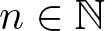 $n \in \mathbb N$, and let $q \gt n$ be a prime power. Let $\mathcal P$ be a set of points in $\mathbb F_q^2$, and $\mathcal Q$ a collection of subsets of $\mathbb F_q^2$ of the shape
 \begin{equation*}
\{(x,y) \in \mathbb F_q^2:
y = a_n x^n + \cdots + a_0 \},
\end{equation*}
\begin{equation*}
\{(x,y) \in \mathbb F_q^2:
y = a_n x^n + \cdots + a_0 \},
\end{equation*}where  $a_0,\ldots,a_n \in \mathbb F_q$. Then
 \begin{equation*}
\left|
\# \{(\mathfrak p, \mathfrak q) \in \mathcal P \times \mathcal Q: \mathfrak p \in \mathfrak q \}
- \frac{|\mathcal P| \cdot |\mathcal Q|}{q} \right|
\leqslant
q^{n/2} \sqrt{|\mathcal P| \cdot |\mathcal Q|}.
\end{equation*}
\begin{equation*}
\left|
\# \{(\mathfrak p, \mathfrak q) \in \mathcal P \times \mathcal Q: \mathfrak p \in \mathfrak q \}
- \frac{|\mathcal P| \cdot |\mathcal Q|}{q} \right|
\leqslant
q^{n/2} \sqrt{|\mathcal P| \cdot |\mathcal Q|}.
\end{equation*}We had initially sought to generalize Vinh’s result to sets
 \begin{equation*}
\{(x,y) \in \mathbb F_q^2:
y = (x + a)^n + b \}.
\end{equation*}
\begin{equation*}
\{(x,y) \in \mathbb F_q^2:
y = (x + a)^n + b \}.
\end{equation*} Although Theorem 1.2 could reasonably be considered to achieve this, its error term  $q^{n/2} \sqrt{|\mathcal P| \cdot |\mathcal Q|}$ exceeds the main term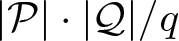 $|\mathcal P| \cdot |\mathcal Q| / q$ in this context, if $n \geqslant 3$. We now present such a generalization in which the error term is smaller than the main term, when $|\mathcal P|, |\mathcal Q| \gg q^2$ and $q$ is sufficiently large. Our results apply to symmetric polynomials, i.e.
 \begin{equation*}
F(a,x) = F(x,a).
\end{equation*}
\begin{equation*}
F(a,x) = F(x,a).
\end{equation*}Theorem 1.3. Let  $F(a,x) \in \mathbb F_q[a,x]$ be a non-diagonal, symmetric polynomial such that $\mathrm{deg}(F) \lt \mathrm{char}(\mathbb F_q)$. Let $\mathcal P$ be a set of points and $\mathcal Q$ a collection of subsets of $\mathbb F_q^2$ of the shape
 \begin{equation}
\mathfrak q_{a,b} =
\{(x,y) \in \mathbb F_q^2:
F(a,x) + b + y = 0 \}
\end{equation}
\begin{equation}
\mathfrak q_{a,b} =
\{(x,y) \in \mathbb F_q^2:
F(a,x) + b + y = 0 \}
\end{equation}in  $\mathbb F_q^2$. Then
 \begin{equation*}
\# \{(\mathfrak p, \mathfrak q) \in \mathcal P \times \mathcal Q:
\mathfrak p \in \mathfrak q \}
= \frac{|\mathcal P| \cdot |\mathcal Q| }q +
O_{\mathrm{deg}(F)}(q^{5/6} \sqrt{|\mathcal P| \cdot |\mathcal Q|}).
\end{equation*}
\begin{equation*}
\# \{(\mathfrak p, \mathfrak q) \in \mathcal P \times \mathcal Q:
\mathfrak p \in \mathfrak q \}
= \frac{|\mathcal P| \cdot |\mathcal Q| }q +
O_{\mathrm{deg}(F)}(q^{5/6} \sqrt{|\mathcal P| \cdot |\mathcal Q|}).
\end{equation*}1.2. Expanding polynomials in finite fields
For a polynomial  $P \in \mathbb F_q[x_1,\ldots,x_k]$ and sets $A_1, \ldots, A_k \subseteq \mathbb F_q$, we would usually expect
 \begin{equation*}
P(A_1, \ldots, A_k)
:= \{P(x_1, \ldots, x_k): x_1 \in A_1, \ldots, x_k \in A_k \}
\end{equation*}
\begin{equation*}
P(A_1, \ldots, A_k)
:= \{P(x_1, \ldots, x_k): x_1 \in A_1, \ldots, x_k \in A_k \}
\end{equation*}to be much larger than 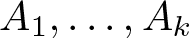 $A_1, \ldots, A_k$, i.e. $P$ should expand. There are some algebraic obstructions, e.g. $F$ could be additively or multiplicatively structured, or some $A_i$ could be dense. The Elekes–Rónyai problem [Reference de Zeeuw5, Reference Elekes and Rónyai7] is to demonstrate expansion away from such obstructions. The problem is also studied over more general fields, and is closely related to the sum–product problem.
In order to quantify the amount of expansion, Tao [Reference Tao18] proposed the following hierarchy.
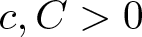
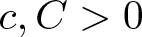
(i) Weak asymmetric expansion: there exist $c, C \gt 0$ such that
whenever
\begin{equation*}|P(A_1,\ldots,A_k)|\geq C^{-1}
\min\{|A_1|,\ldots,|A_k|\}^{1-c}q^c\end{equation*}
$|A_1|,\ldots,|A_k|\geq Cq^{1-c}$.
$c, C \gt 0$ such that
whenever
\begin{equation*}|P(A_1,\ldots,A_k)|\geq C^{-1}
\min\{|A_1|,\ldots,|A_k|\}^{1-c}q^c\end{equation*}
$|A_1|,\ldots,|A_k|\geq Cq^{1-c}$.(ii) Moderate asymmetric expansion: there exist
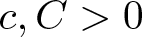
$c, C \gt 0$ such that
whenever
\begin{equation*}|P(A_1,\ldots,A_k)|\geq C^{-1}q\end{equation*}
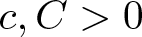
$|A_1|,\ldots,|A_k|\geq Cq^{1-c}$.(iii) Almost strong asymmetric expansion: there exist
$c,C \gt 0$ such that
whenever
\begin{equation*}|P(A_1,\ldots,A_k)|\geq q-Cq^{1-c}\end{equation*}
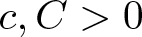
$|A_1|,\ldots,|A_k|\geq Cq^{1-c}$.(iv) Strong asymmetric expansion: there exist
$c,C \gt 0$ such that
whenever
\begin{equation*}|P(A_1,\ldots,A_k)|\geq q-C\end{equation*}
$|A_1|,\ldots,|A_k|\geq Cq^{1-c}$.(v) Very strong asymmetric expansion: there exist
$c,C \gt 0$ such that
whenever
\begin{equation*}P(A_1,\ldots,A_k)=\mathbb F_q\end{equation*}
$|A_1|,\ldots,|A_k|\geq Cq^{1-c}$.










The qualifier ‘asymmetric’ in the above refers to the fact that the sets 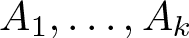 $A_1,\ldots,A_k$ are allowed to differ. Typically, $q$ is allowed to vary, and $P$ is allowed to vary in some family, meaning that $c,C$ do not depend on them.
In our previous paper, we established almost strong expansion for a Zariski-dense set of polynomials of degree  $d$ in $d+1$ variables, strengthening and generalizing the main result of [Reference Pham, Vinh and de Zeeuw13]. We are now able to handle ternary polynomials of more general degree.
Theorem 1.4. Let  $P\in\mathbb F_q[x,y,z]$ be a polynomial of the form
 \begin{equation*}F(x,G(y,z))+H(y,z)+J(x),\end{equation*}
where  $F,G,H\in \mathbb F_q[x,y]$ and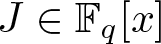 $J\in \mathbb F_q[x]$ are such that:
(i)
$F$ is non-diagonal and symmetric with
$\mathrm{deg}(F) \lt \mathrm{char}(\mathbb F_q)$, and(ii)
$G$ and
$H$ are algebraically independent.




Then there exists a constant 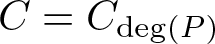 $C = C_{\mathrm{deg}(P)}$ such that if $X,Y,Z\subseteq\mathbb F_q$ and $|X|,|Y|,|Z|\geq Cq^{1/2}$ then
 \begin{equation*}
|P(X,Y,Z)| = q-O_{\mathrm{deg}(P)}\left(\frac{q^{11/3}}{|X|\cdot|Y|\cdot|Z|}\right)\text{.}
\end{equation*}
\begin{equation*}
|P(X,Y,Z)| = q-O_{\mathrm{deg}(P)}\left(\frac{q^{11/3}}{|X|\cdot|Y|\cdot|Z|}\right)\text{.}
\end{equation*}Corollary 1.5. Let  $\varepsilon \gt 0 $, let $P$ be a polynomial of the form given in Theorem 1.4, and let $X,Y,Z\subseteq\mathbb F_q$ be such that $|X|,|Y|,|Z|\gg q^{8/9+\varepsilon}$. Then
 \begin{equation*}|P(X,Y,Z)|=q-O_{\varepsilon,\mathrm{deg}(P)}(q^{1-3\varepsilon})\text{.}\end{equation*}
Corollary 1.6. Let  $\varepsilon \gt 0$, let $P(x,y,z)=(x-y)^k+z$, where $k\geq2$ is an integer, and let $q$ be a power of a prime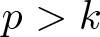 $p \gt k$. Let $X,Y,Z\subseteq\mathbb F_q$ be such that $|X|,|Y|,|Z|\gg q^{8/9+\varepsilon}$. Then
 \begin{equation*}|P(X,Y,Z)|=q-O_{\varepsilon,k}(q^{1-3\varepsilon})\text{.}\end{equation*}
A great deal of work has been done on binary expansion [Reference Bourgain3, Reference Garaev and Shen8, Reference Hart, Li and Shen10–Reference Mohammadi12]. The Elekes–Rónyai problem was essentially solved for weak binary expansion by Bukh and Tsimerman [Reference Bukh and Tsimerman4], and for moderate expansion by Tao [Reference Tao18]. Therein, Tao also obtained a general result for almost strong binary expansion, but with a technical condition that is difficult to check in practice.
These developments led us to consider the Elekes–Rónyai problem for ternary polynomials over finite fields. Aside from the aforementioned results, Shkredov [Reference Shkredov16] established very strong expansion for 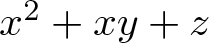 $x^2 + xy + z$. As for higher-degree ternary polynomials, we were previously successful at demonstrating almost strong expansion [Reference Arala and Chow2, Theorem 1.6] only in the special case
 \begin{equation*}
P(x,y,z) = xG(y,z) + H(y,z) + ax^k,
\end{equation*}
\begin{equation*}
P(x,y,z) = xG(y,z) + H(y,z) + ax^k,
\end{equation*}where  $G$ and $H$ are algebraically independent. Theorem 1.4 is more general. For example, it handles
 \begin{equation*}
P(x,y,z) = (x-y)^k + z,
\end{equation*}
\begin{equation*}
P(x,y,z) = (x-y)^k + z,
\end{equation*}whereas our previous approach does not reach such polynomials.
1.3. Methods
We will see that Theorem 1.4 is easy to deduce from Theorem 1.3. To prove Theorem 1.3, we use Vinh’s spectral framework [Reference Vinh19], which begins by realizing incidences as edges of a regular graph. The main task is to bound the second largest eigenvalue, in absolute value. Vinh is able to use the square of an adjacency matrix to swiftly achieve this in the case of point–line incidences. In our higher-degree setting, we need to cube the matrix, giving rise to a family of algebraic curves on which we need to count  $\mathbb F_q$ points. The Weil bound is suitable for this purpose, as we are able to show that almost all curves in the family are absolutely irreducible.
Organization. We will prove Theorem 1.3 in § 2. Then, in § 3, we will deduce Theorem 1.4.
Notation. We use the Vinogradov notations  $\ll$ and $\gg$, as well as the Bachmann–Landau notation $O(\cdot)$. Let $f$ and $g$ be complex-valued functions. We write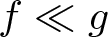 $f \ll g$ or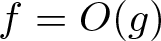 $f=O(g)$ if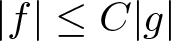 $|f|\leq C|g|$ pointwise, for some constant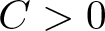 $C \gt 0$. We use a subscript within these notations to indicate possible dependence on the implied constant $C$.
$C$.
2. An incidence bound
In this section, we prove Theorem 1.3. The first subsection will establish the result assuming a lemma about absolute irreducibility. The latter will then be demonstrated in the second subsection.
2.1. Spectral theory
Definition 2.1. Let  $\mathcal G$ be a graph with $n$ vertices. We denote the eigenvalues of the adjacency matrix of $\mathcal G$ by $\lambda_1(\mathcal G),\ldots,\lambda_n(\mathcal G)$, ordered in such a way that
 \begin{equation*}|\lambda_1(\mathcal G)|\geq\cdots\geq|\lambda_n(\mathcal G)|\text{.}\end{equation*}
Definition 2.2. For a symmetric polynomial 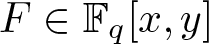 $F\in\mathbb F_q[x,y]$, we define the graph $\mathcal G_F$ as the graph with set of vertices $\mathbb F_q^2$ and an edge between $(a,b)$ and $(x,y)$ if and only if
 \begin{equation*}F(a,x)+b+y=0\text{.}\end{equation*}
 We will prove the following spectral bound for the graphs  $\mathcal G_F$.
Lemma 2.3. Let 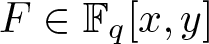 $F\in\mathbb F_q[x,y]$ be a non-diagonal, symmetric polynomial such that $\mathrm{deg}(F) \lt \mathrm{char}(\mathbb F_q)$. Then $\lambda_2(\mathcal G_F)\ll_{\mathrm{deg}(F)}q^{5/6}$.
Proof [Proof of Lemma 2.3 assuming Lemma 2.4]. Let  $A$ be the adjacency matrix of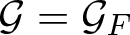 $\mathcal G=\mathcal G_F$, the rows and columns of which are indexed by points in $\mathbb F_q^2$. We consider the matrix $A^3$.
The entry of  $A^3$ in the row corresponding to $(a,b)$ and the column corresponding to $(c,d)$ is the number of paths of length $3$ in $\mathcal G$ connecting $(a,b)$ to $(c,d)$. This is the number of solutions $(x_1,x_2,y_1,y_2)\in\mathbb F_q^4$ to the system of equations
 \begin{equation*}
\begin{cases}
F(a, x_1) + b + y_1 = 0 \\
F(x_1, x_2) + y_1 + y_2 = 0 \\
F(x_2, c) + y_2 + d = 0\text{.}
\end{cases}
\end{equation*}
\begin{equation*}
\begin{cases}
F(a, x_1) + b + y_1 = 0 \\
F(x_1, x_2) + y_1 + y_2 = 0 \\
F(x_2, c) + y_2 + d = 0\text{.}
\end{cases}
\end{equation*} Solutions to this system are in bijection with pairs 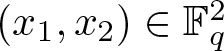 $(x_1,x_2)\in\mathbb F_q^2$ satisfying
 \begin{equation}F(a,x_1)+F(x_2,c)-F(x_1,x_2)+b+d=0\text{,}
\end{equation}
\begin{equation}F(a,x_1)+F(x_2,c)-F(x_1,x_2)+b+d=0\text{,}
\end{equation}with mutually inverse bijections being given by
 \begin{equation*}(x_1,x_2,y_1,y_2)\mapsto(x_1,x_2)\end{equation*}
and
 \begin{equation*}(x_1,x_2)\mapsto(x_1,x_2,-F(a,x_1)-b,-F(x_2,c)-d)\text{.}\end{equation*}
 Let 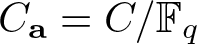 $C_{\mathbf{a}}=C/\mathbb F_q$ be the affine plane curve defined in coordinates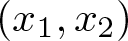 $(x_1,x_2)$ by (2.1), where $\mathbf{a}=(a,b,c,d)$, so that, as argued above,
 \begin{equation*}A^3_{(a,b),(c,d)}=\#C(\mathbb F_q)\text{.}\end{equation*}
 Observe that (2.1) indeed defines a curve; the polynomial on the left-hand side of (2.1) does not vanish, since  $F$ is assumed not to be diagonal.
By the Weil bound,
 \begin{equation*}\#C(\mathbb F_q)=\begin{cases}
q+O(\sqrt{q})&\text{if C is absolutely irreducible}\\
O(q)&\text{otherwise.}
\end{cases}
\end{equation*}
\begin{equation*}\#C(\mathbb F_q)=\begin{cases}
q+O(\sqrt{q})&\text{if C is absolutely irreducible}\\
O(q)&\text{otherwise.}
\end{cases}
\end{equation*} Denote by  $U$ the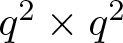 $q^2\times q^2$ matrix all the entries of which equal $1$. The upshot is that
 \begin{equation*}A^3=qU+M \text{,}\end{equation*}
where  $M$ is a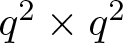 $q^2\times q^2$ real matrix, the entries of which are indexed by points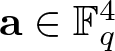 $\mathbf{a}\in\mathbb F_q^4$, such that
 \begin{equation*}
M_{\mathbf{a}} = \begin{cases}
O(\sqrt{q}) &\text{if $C_\mathbf{a}$ is absolutely irreducible} \\
O(q) &\text{otherwise.}
\end{cases}
\end{equation*}
\begin{equation*}
M_{\mathbf{a}} = \begin{cases}
O(\sqrt{q}) &\text{if $C_\mathbf{a}$ is absolutely irreducible} \\
O(q) &\text{otherwise.}
\end{cases}
\end{equation*} Lemma 2.4, which we will prove in § 2.2, asserts that the points  $\mathbf{a}$ such that $C_\mathbf{a}$ is not absolutely irreducible are contained in a proper subvariety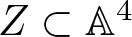 $Z \subset \mathbb A^4$.
We have 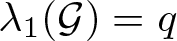 $\lambda_1(\mathcal G)=q$, since $\mathcal G$ is clearly $q$-regular. Note that the eigenspace corresponding to the eigenvalue $1$ is spanned by the vector $\mathbf{u}=(1,\ldots,1)$. Since $A$ is symmetric, the spectral theorem implies that
 \begin{equation*}|\lambda_2(\mathcal G)|^3=\max\{\lambda\in\mathbb R:\|A^3\mathbf{x}\|_2\leq\lambda\|\mathbf{x}\|_2\ \text{for any }\mathbf{x}\ \text{with }\mathbf{x}\cdot\mathbf{u}=0\}\text{.}\end{equation*}
 For  $\mathbf{x}$ with $\mathbf{x}\cdot\mathbf{u}=0$, we have $U\mathbf{x} = \mathbf 0$ and hence
 \begin{equation*}
A^3\mathbf{x}=(qU+M)\mathbf{x}=M\mathbf{x}\text{.}
\end{equation*}
\begin{equation*}
A^3\mathbf{x}=(qU+M)\mathbf{x}=M\mathbf{x}\text{.}
\end{equation*}Now
 \begin{equation*}\|A^3\mathbf{x}\|_2=\|M\mathbf{x}\|_2\leq\|M\|_2\|\mathbf{x}\|_2\text{,}\end{equation*}
by Cauchy-Schwarz, where
 \begin{equation*}
\|M\|_2 = \sqrt{\sum_{\mathbf{a}\in\mathbb F_q^4} M_\mathbf{a}^2}\text{.}
\end{equation*}
\begin{equation*}
\|M\|_2 = \sqrt{\sum_{\mathbf{a}\in\mathbb F_q^4} M_\mathbf{a}^2}\text{.}
\end{equation*}It follows that
 \begin{equation}|\lambda_2(\mathcal G)|\leq\left(\sum_{\mathbf{a}\in\mathbb F_q^4}M_\mathbf{a}^2\right)^{1/6}\text{.}
\end{equation}
\begin{equation}|\lambda_2(\mathcal G)|\leq\left(\sum_{\mathbf{a}\in\mathbb F_q^4}M_\mathbf{a}^2\right)^{1/6}\text{.}
\end{equation} Using that  $\#Z(\mathbb F_q)=O(q^3)$, since $Z$ is a proper subvariety of $\mathbb A^4$,
 \begin{align*}\sum_{\mathbf{a}\in\mathbb F_q^4}M_\mathbf{a}^2&=\sum_{\mathbf{a}\in Z(\mathbb F_q)}M_\mathbf{a}^2+\sum_{\mathbf{a}\notin Z(\mathbb F_q)}M_\mathbf{a}^2\\
&=O(q^3\cdot q^2)+O(q^4\cdot q)=O(q^5)\text{.}
\end{align*}
\begin{align*}\sum_{\mathbf{a}\in\mathbb F_q^4}M_\mathbf{a}^2&=\sum_{\mathbf{a}\in Z(\mathbb F_q)}M_\mathbf{a}^2+\sum_{\mathbf{a}\notin Z(\mathbb F_q)}M_\mathbf{a}^2\\
&=O(q^3\cdot q^2)+O(q^4\cdot q)=O(q^5)\text{.}
\end{align*}Inserting this into (2.2) completes the proof.
Proof of Theorem 1.3 assuming Lemma 2.3
The result follows immediately by applying the expander mixing lemma [Reference Alon and Spencer1, Corollary 9.2.5] to the graph  $\mathcal G_F$, together with Lemma 2.3.
Recall that we proved Lemma 2.3 subject to Lemma 2.4. We now turn to the latter.
2.2. Absolute irreducibility
In this subsection, we establish the following lemma used in the proof of Lemma 2.3.
Lemma 2.4. Let 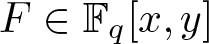 $F\in\mathbb F_q[x,y]$ be a non-diagonal, symmetric polynomial such that $\mathrm{deg}(F) \lt \mathrm{char}(\mathbb F_q)$. Then there exists a proper subvariety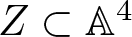 $Z\subset \mathbb A^4$ of degree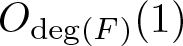 $O_{\mathrm{deg}(F)}(1)$ such that, for $\mathbf{a}=(a,b,c,d)\notin Z(\mathbb F_q)$, the curve $C_\mathbf{a}$ defined by (2.1) is absolutely irreducible.
To this end, we will require the following auxiliary result, the proof of which we defer to Appendix A.
Lemma 2.5. Let  $k$ be a field and let $P,Q,R,S\in k[x]$ be polynomials such that $0 \lt \mathrm{deg}(P)=\mathrm{deg}(R) \lt \mathrm{char}(k)$ and the compositions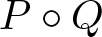 $P\circ Q$ and $R\circ S$ are equal. Then there exists a linear polynomial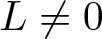 $L \ne 0$ such that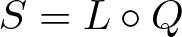 $S=L\circ Q$.
We will also require the following characterization of additive polynomials [Reference Goss9, Chapter 1].
Lemma 2.6. Let  $k$ be an infinite field of finite characteristic $p$, and let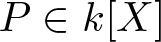 $P\in k[X]$ satisfy
 \begin{equation*}
P(x+y) = P(x) + P(y)
\qquad (x, y \in k).
\end{equation*}
\begin{equation*}
P(x+y) = P(x) + P(y)
\qquad (x, y \in k).
\end{equation*}Then
 \begin{equation*}
P = \sum_{j=0}^K
a_j X^{p^j}
\end{equation*}
\begin{equation*}
P = \sum_{j=0}^K
a_j X^{p^j}
\end{equation*}for some  $a_0, \ldots, a_K \in k$.
Proof [Proof of Lemma 2.4]. We begin by observing that the reducibility of  $C_\mathbf{a}$ can be characterized in terms of polynomial equations in the coefficients of the polynomial defining $C_{\mathbf{a}}$, see [Reference Schmidt15, Chapter V, Theorem 2A]. Thus, there exists a subvariety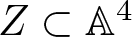 $Z \subset \mathbb A^4$ of degree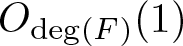 $O_{\mathrm{deg}(F)}(1)$ such that $C_\mathbf{a}$ is absolutely irreducible if and only if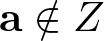 $\mathbf{a}\notin Z$. It remains to prove that $Z$ is proper, in other words, that $C_\mathbf{a}$ is irreducible over $\overline{\mathbb F_q}$ for some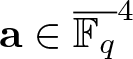 $\mathbf{a} \in \overline{\mathbb F_q}^4$. Henceforth, we assume for a contradiction that $C_\mathbf{a}$ is reducible over $\overline{\mathbb F_q}$ for every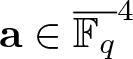 $\mathbf{a} \in \overline{\mathbb F_q}^4$.
Our assumption implies that the polynomial
 \begin{equation*}F(a,x_1)+F(x_2,c)-F(x_1,x_2)+t\end{equation*}
is reducible for any 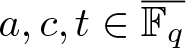 $a,c,t\in\overline{\mathbb F_q}$. By [Reference Schinzel14, §3.3, Corollary 1], this forces the polynomial $F(a,x_1)+F(x_2,c)-F(x_1,x_2)$ to be composite—namely it has the form $P(Q(x_1,x_2))$ with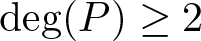 $\mathrm{deg}(P)\geq2$—for any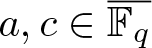 $a,c\in\overline{\mathbb F_q}$. Specializing $a=0$, we deduce that the polynomial
 \begin{equation*}
F(0,x_1)+F(x_2,c)-F(x_1,x_2) \in \mathbb F_q(c)[x_1,x_2]
\end{equation*}
\begin{equation*}
F(0,x_1)+F(x_2,c)-F(x_1,x_2) \in \mathbb F_q(c)[x_1,x_2]
\end{equation*}has the form  $P(Q(x_1,x_2))$, for some polynomials $P$ and $Q$ with coefficients in $\overline{\mathbb F_q(c)}$ and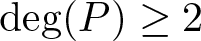 $\mathrm{deg}(P)\geq 2$. Note that the coefficients of $P$ and $Q$ lie in some finite extension of $\mathbb F_q(c)$. Furthermore, any such extension is the function field of a curve $X/ \mathbb F_q$, see [Reference Silverman17, Chapter II, Remark 2.5]. This gives rise to a polynomial identity
 \begin{equation}
F(0,x_1)+F(x_2,\pi(p))-F(x_1,x_2)=P_p(Q_p(x_1,x_2)) \text{,}
\end{equation}
\begin{equation}
F(0,x_1)+F(x_2,\pi(p))-F(x_1,x_2)=P_p(Q_p(x_1,x_2)) \text{,}
\end{equation}where  $\pi:X\to\mathbb A^1$ is a non-constant morphism, and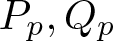 $P_p,Q_p$ are polynomials whose coefficients are algebraically parametrized by a point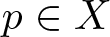 $p\in X$.
For 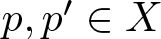 $p,p'\in X$ with
 \begin{equation*}
F(x, \pi(p)) \ne
F(x, \pi(p'))
\in \overline{\mathbb F_q}[x],
\end{equation*}
\begin{equation*}
F(x, \pi(p)) \ne
F(x, \pi(p'))
\in \overline{\mathbb F_q}[x],
\end{equation*}the above yields
 \begin{equation}
F(x_2,\pi(p))-F(x_2,\pi(p'))=P_p(Q_p(x_1,x_2))-P_{p'}(Q_{p'}(x_1,x_2))\text{.}
\end{equation}
\begin{equation}
F(x_2,\pi(p))-F(x_2,\pi(p'))=P_p(Q_p(x_1,x_2))-P_{p'}(Q_{p'}(x_1,x_2))\text{.}
\end{equation} If we fix  $p,p'$ and regard the above as an identity of polynomials in the variable $x_1$ with coefficients in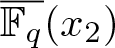 $\overline{\mathbb F_q}(x_2)$, then we have the equality of polynomial compositions
 \begin{equation*}
(P_{p'}+F(x_2,\pi(p))-F(x_2,\pi(p')))\circ Q_{p'}(\cdot,x_2)=P_p\circ Q_p(\cdot,x_2)\text{.}
\end{equation*}
\begin{equation*}
(P_{p'}+F(x_2,\pi(p))-F(x_2,\pi(p')))\circ Q_{p'}(\cdot,x_2)=P_p\circ Q_p(\cdot,x_2)\text{.}
\end{equation*} For generic 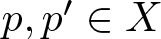 $p,p'\in X$, the degrees in $x_1$ of
 \begin{equation*}
P_p, \qquad
P_{p'}+F(x_2,\pi(p))-F(x_2,\pi(p'))
\end{equation*}
\begin{equation*}
P_p, \qquad
P_{p'}+F(x_2,\pi(p))-F(x_2,\pi(p'))
\end{equation*}are equal. Now Lemma 2.5 implies that for generic—and hence for all—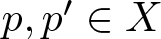 $p,p'\in X$ the polynomials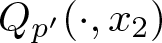 $Q_{p'}(\cdot,x_2)$ and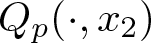 $Q_p(\cdot,x_2)$ are related by left-composition with a linear polynomial with coefficients in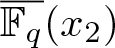 $\overline{\mathbb F_q}(x_2)$. In other words, the family of polynomials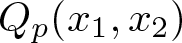 $Q_p(x_1,x_2)$ has the form
 \begin{equation*}
Q_p(x_1,x_2)=f_p(x_2)h(x_1,x_2)+g_p(x_2) \text{,}
\end{equation*}
\begin{equation*}
Q_p(x_1,x_2)=f_p(x_2)h(x_1,x_2)+g_p(x_2) \text{,}
\end{equation*}for some families of polynomials  $f_p,g_p\in \overline{\mathbb F_q}[x_2]$ with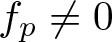 $f_p \ne 0$, and some $h\in\mathbb F_q[x_1,x_2]$. We assume as we may that the polynomials $f_p$ do not have a common factor, for such a factor can be absorbed into $h$.
$h$.
Inserting the above into (2.4) yields
 \begin{align*}
&F(x_2,\pi(p))-F(x_2,\pi(p'))\\
&=P_p(f_p(x_2)h(x_1,x_2)+g_p(x_2))-P_{p'}(f_{p'}(x_2)h(x_1,x_2)+g_{p'}(x_2))\text{.}
\end{align*}
\begin{align*}
&F(x_2,\pi(p))-F(x_2,\pi(p'))\\
&=P_p(f_p(x_2)h(x_1,x_2)+g_p(x_2))-P_{p'}(f_{p'}(x_2)h(x_1,x_2)+g_{p'}(x_2))\text{.}
\end{align*} Since  $h$ is non-constant—as otherwise the left-hand side of (2.3) would not depend on $x_1$, which is clearly a contradiction—we obtain the polynomial identity
 \begin{equation*}
F(x_2,\pi(p))-F(x_2,\pi(p'))=P_p(f_p(x_2)z+g_p(x_2))-P_{p'}(f_{p'}(x_2)z+g_{p'}(x_2))\text{.}
\end{equation*}
\begin{equation*}
F(x_2,\pi(p))-F(x_2,\pi(p'))=P_p(f_p(x_2)z+g_p(x_2))-P_{p'}(f_{p'}(x_2)z+g_{p'}(x_2))\text{.}
\end{equation*} Let 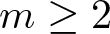 $m\geq2$ be the generic degree of $P_p$, and let $a_p$ be its leading coefficient. Comparing leading coefficients in $z$ yields
 \begin{equation*}
a_pf_p(x_2)^m=a_{p'}f_{p'}(x_2)^m\text{,}
\end{equation*}
\begin{equation*}
a_pf_p(x_2)^m=a_{p'}f_{p'}(x_2)^m\text{,}
\end{equation*}which implies that any two  $f_p$ and $f_{p'}$ are related by multiplication by a root of unity. Since the $f_p$ were assumed not to share a common factor, this implies that $(f_p)_p$ is a family of constant polynomials. We thus obtain
 \begin{equation*}
P_p\left(f_pz+g_p(x_2)\right)-P_{p'}(f_{p'}z+g_{p'}(x_2))=F(x_2,\pi(p))-F(x_2,\pi(p'))\text{.}
\end{equation*}
\begin{equation*}
P_p\left(f_pz+g_p(x_2)\right)-P_{p'}(f_{p'}z+g_{p'}(x_2))=F(x_2,\pi(p))-F(x_2,\pi(p'))\text{.}
\end{equation*} We now make the variable change  $w=f_{p'}z+g_{p'}(x_2)$ and observe that
 \begin{equation*}P_p \left(
\frac{f_p}{f_{p'}}(w-g_{p'}(x_2))
\right) = P_{p'}(w)+F(x_2,\pi(p))-F(x_2,\pi(p'))\text{.}\end{equation*}
\begin{equation*}P_p \left(
\frac{f_p}{f_{p'}}(w-g_{p'}(x_2))
\right) = P_{p'}(w)+F(x_2,\pi(p))-F(x_2,\pi(p'))\text{.}\end{equation*} The right-hand side is a polynomial in  $x_2$ and $w$ where no monomial involving both $x_2$ and $w$ shows up with a non-zero coefficient. On the other hand, the left-hand side is of the form
 \begin{equation*}
P_p(aw + \ell(x_2)) \text{,}
\end{equation*}
\begin{equation*}
P_p(aw + \ell(x_2)) \text{,}
\end{equation*}where  $\ell$ is non-constant. This expands as
 \begin{equation*}
P_p(aw) + P_p(\ell(x_2)) + C + M(w,x_2)
\end{equation*}
\begin{equation*}
P_p(aw) + P_p(\ell(x_2)) + C + M(w,x_2)
\end{equation*}for some constant  $C$, where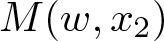 $M(w,x_2)$ is a linear combination of monomials involving both $w$ and $x_2$. We must have $M(w,x_2)=0$, so $P_p$ satisfies the identity
 \begin{equation*}
P_p(x+y)=P_p(x)+P_p(y)+C
\text{.}
\end{equation*}
\begin{equation*}
P_p(x+y)=P_p(x)+P_p(y)+C
\text{.}
\end{equation*} The upshot is that the polynomial 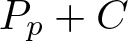 $P_p+C$ satisfies the assumption of Lemma 2.6. Therefore, either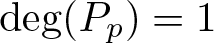 $\mathrm{deg}(P_p) = 1$ or $\mathrm{deg}(P_p) \geqslant \mathrm{char}(\mathbb F_q)$. The latter would contradict our assumption on the degree of $F$, in light of (2.3). Therefore, $P_p$ has degree $1$, which contradicts our assumption that it has degree at least $2$.
$2$.
3. Expanding polynomials
In this section, we prove Theorem 1.4. We begin by showing that
 \begin{equation*}\#\{(G(y,z),H(y,z)):(y,z)\in Y\times Z\}\gg |Y|\cdot|Z|\text{.}\end{equation*}
 To this end, we argue as follows. Identify  $\mathbb F_q^2$ with affine space $\mathbb A_{\mathbb F_q}^2$. The condition that $G$ and $H$ are algebraically independent implies that the map $\varphi$ given by $\varphi(y,z)=(G(y,z),H(y,z))$ is dominant, i.e. its image is not contained in a proper subvariety of $\mathbb A_{\mathbb F_q}^2$. Therefore, if we denote by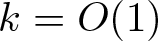 $k=O(1)$ the degree of $\varphi$, there exists a proper subvariety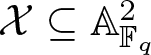 $\mathcal X \subseteq \mathbb A_{\mathbb F_q}^2$, of degree $O(1)$ by [Reference Arala and Chow2, Lemma 3.1], such that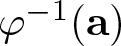 $\varphi^{-1}(\mathbf{a})$ is finite whenever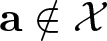 $\mathbf{a} \notin \mathcal X$. Since $\varphi$ is at most $k$-to- $1$ outside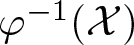 $\varphi^{-1}(\mathcal X)$, it follows that
 \begin{align*}
|\varphi(Y\times Z)|&\geq|
\varphi((\mathbb A_{\mathbb F_q}^2\setminus\varphi^{-1}(\mathcal X))(\mathbb F_q)\cap (Y\times Z))|\\
&\geq\frac{1}{k}|(\mathbb A_{\mathbb F_q}^2\setminus\varphi^{-1}(\mathcal X))(\mathbb F_q)\cap (Y\times Z)|\\
&\geq\frac{1}{k}(|Y|\cdot|Z|-|\varphi^{-1}(\mathcal X)(\mathbb F_q)|)\\
&=\frac{1}{k}(|Y|\cdot|Z| + O(q))\text{.}
\end{align*}
\begin{align*}
|\varphi(Y\times Z)|&\geq|
\varphi((\mathbb A_{\mathbb F_q}^2\setminus\varphi^{-1}(\mathcal X))(\mathbb F_q)\cap (Y\times Z))|\\
&\geq\frac{1}{k}|(\mathbb A_{\mathbb F_q}^2\setminus\varphi^{-1}(\mathcal X))(\mathbb F_q)\cap (Y\times Z)|\\
&\geq\frac{1}{k}(|Y|\cdot|Z|-|\varphi^{-1}(\mathcal X)(\mathbb F_q)|)\\
&=\frac{1}{k}(|Y|\cdot|Z| + O(q))\text{.}
\end{align*} In the final line, we used that 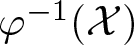 $\varphi^{-1}(\mathcal X)$, being a proper subvariety of $\mathbb A_{\mathbb F_q}^2$, has dimension at most $1$, and its degree is bounded in terms of the degrees of $\mathcal X$ and $\varphi$. It is now clear that, for sufficiently large $C$, if $|Y|,|Z|\geq Cq^{1/2}$, then the above is at least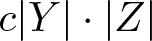 $c|Y|\cdot|Z|$ for a suitably small constant $c \gt 0$.
Recall (1.1), and consider the set
 \begin{equation*}\mathcal Q=\{\mathfrak q_{G(y,z),H(y,z)}:(y,z)\in Y\times Z\}\text{.}\end{equation*}
 We just proved that  $|\mathcal Q|\gg|Y|\cdot|Z|$. Define also $W=\mathbb F_q\setminus P(X,Y,Z)$, and set
 \begin{equation*}\mathcal P = \{(x, J(x)-w): x \in X, w \in W \}
\text{,}\end{equation*}
\begin{equation*}\mathcal P = \{(x, J(x)-w): x \in X, w \in W \}
\text{,}\end{equation*}noting that  $|\mathcal P|=|X|\cdot|W|$. It follows from the definitions of $\mathcal P$, $\mathcal Q$, $P$ and $W$ that if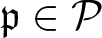 $\mathfrak p\in\mathcal P$ and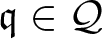 $\mathfrak q\in\mathcal Q$ then $\mathfrak p\notin\mathfrak q$. Therefore, Theorem 1.3 yields
 \begin{equation*}\frac{|\mathcal P|\cdot|\mathcal Q|}{q}=O(q^{5/6}\sqrt{|\mathcal P|\cdot|\mathcal Q|})\text{,}\end{equation*}
whence
 \begin{equation*}|\mathcal P|\cdot|\mathcal Q|\ll q^{11/3}\text{.}\end{equation*}
On using that
 \begin{equation*}
|\mathcal Q|\gg |Y|\cdot|Z|, \quad
|\mathcal P|=|X|\cdot|W|,
\quad
|W|=q-|P(X,Y,Z)|,
\end{equation*}
\begin{equation*}
|\mathcal Q|\gg |Y|\cdot|Z|, \quad
|\mathcal P|=|X|\cdot|W|,
\quad
|W|=q-|P(X,Y,Z)|,
\end{equation*}the result follows.
Acknowledgement
We thank an anonymous referee for a careful reading and for helpful comments.
Funding
NA was funded through the Engineering and Physical Sciences Research Council Doctoral Training Partnership at the University of Warwick.
Rights
For the purpose of open access, the authors have applied a Creative Commons Attribution (CC-BY) licence to any Author Accepted Manuscript version arising from this submission.
Appendix A. On polynomial composition
Here, we prove Lemma 2.5. A variant of this featured as Problem 5 at the 14th edition of the Romanian Masters of Mathematics, and the proof that we present here is adapted from the official solutions to that problem.
Proof of Lemma 2.5
Since  $P\circ Q=R\circ S$, one has
 \begin{equation*}
\mathrm{deg}(P)\mathrm{deg}(Q)=\mathrm{deg}(R)\mathrm{deg}(S)
\end{equation*}
\begin{equation*}
\mathrm{deg}(P)\mathrm{deg}(Q)=\mathrm{deg}(R)\mathrm{deg}(S)
\end{equation*}which, since  $\mathrm{deg}(P)=\mathrm{deg}(R)$, implies that $\mathrm{deg}(Q)=\mathrm{deg}(S)$. Let $d$ be this common degree. If $\alpha$ and $\beta$ denote the leading coefficients of $Q$ and $S$, respectively, and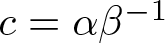 $c=\alpha\beta^{-1}$, then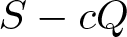 $S-cQ$ is a polynomial of degree smaller than $d$. If this polynomial is constant, we are done. So we assume henceforth that it is non-constant, i.e. that $S=cQ+M$ where $M$ is a polynomial with $0 \lt \mathrm{deg}(M) \lt d$.
We then have
 \begin{equation*}R(cQ(x)+M(x))=P(Q(x))\text{,}\end{equation*}
and the left-hand side expands as a linear combination of products of powers of  $Q(x)$ and $M(x)$. Among the terms that contain positive powers of $M(x)$, the one with the largest degree is $\gamma rc^{r-1}Q(x)^{r-1}M(x)$, where $r$ is the common degree of $R$ and $P$ and $\gamma$ is the leading coefficient of $R$. Recall that $0 \lt r \lt \mathrm{char}(k)$. Therefore, $rc^{r-1}Q^{r-1}M$ differs from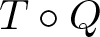 $T\circ Q$ by a polynomial of lower degree, for some polynomial $T$, and in particular
 \begin{equation*}\mathrm{deg}(Q^{r-1}M)=\mathrm{deg}(T\circ Q)\text{.}\end{equation*}
 The degree of the right-hand side is divisible by  $d$, whereas the degree of the left-hand side is $d(r-1)+\mathrm{deg}(M)$, which is not divisible by $d$ because $0 \lt \mathrm{deg}(M) \lt d$. This contradiction completes the proof of the lemma.


 Open access

