


Part of our problem in moving towards circularity is most people neither see the importance of it nor exactly know how to do it. (Sheldon, Reference Sheldon2018)
This quote by John Elkington, executive chairman and cofounder of Volans Ventures, highlights the challenge individuals face in recognizing the vision and actions needed to transform linear business models, which describe systems in which resources are extracted, and then discarded after use, into circular business models. For decades, linear models were taken for granted but with resources becoming increasingly scarce, the limits of this approach become increasingly evident. The circular economy (CE) has emerged as an alternative paradigm. Kirchherr et al., (Reference Kirchherr, Reike and Hekkert2017) defines the CE as “an economic system that replaces the ‘end-of-life’ concept [i.e., a product’s lifecycle with an endpoint, with no consideration for reusing or recycling] with reducing, alternatively reusing, recycling and recovering materials in production/distribution and consumption processes” (p. 229).Footnote 1 The shift toward the CE is not only about reducing waste but also about rethinking value creation in ways that align with global sustainability objectives, such as United Nations’ Sustainable Development Goals (Ferradás-González et al., Reference Ferradás-González, Pérez-Rico and Adá-Lameiras2024; Opferkuch et al., Reference Opferkuch, Caeiro, Salomone and Ramos2022). As Elkington emphasizes in the introductory quote: For this transformation to succeed, individuals must recognize and embrace the opportunities inherent in circularity (Sheldon, Reference Sheldon2018).
The circular value chain, ranging from raw material extraction and product design over production, usage, collection, and recovery to disposal of the product, or the extraction of raw materials for a new circular product loop, concerns a variety of industries and various workplaces within these industries (Ritter et al., Reference Ritter, Schilling, Brüggemann, Fröhlich, Goldmann, Henze, Kuhlmann, Mennenga, Mrotzek-Blöß, Niemeyer, Schmidt, Spengler, Sturm, Vietor, Woisetschläger and Kauffeld2024). These workplaces differ not only in terms of their specific products, but also in their organizational goals, workplace designs, required skill and qualification levels, and workforce characteristics (Rajput & Singh, Reference Rajput and Singh2019). Although top managers often view the CE as an innovative business model with significant potential to conserve and efficiently utilize earth’s limited natural resources, its implementation introduces uncertainty at all organizational levels (Kristoffersen et al., Reference Kristoffersen, Mikalef, Blomsma and Li2021; Lahti et al., Reference Lahti, Wincent and Parida2018). In the management and engineering literatures, these uncertainties are typically described as concerning product design, the development of closed-loop supply chains, and organizational structures that support circularity (Awan & Sroufe, Reference Awan and Sroufe2022; de Lima et al., Reference de Lima, Seuring and Sauer2022). At the same time, uncertainties regarding the psychological microfoundations of the CE, which encompass individual (e.g., employee attitudes and motivation), group (e.g., teamwork and leadership), and job level factors (e.g., work design), have received limited attention in both psychological science and practice. Given the potential of the CE transformation, these factors represent a promising area for future inquiry and application (Awan & Sroufe, Reference Awan and Sroufe2022; Ritter et al., Reference Ritter, Schilling, Brüggemann, Fröhlich, Goldmann, Henze, Kuhlmann, Mennenga, Mrotzek-Blöß, Niemeyer, Schmidt, Spengler, Sturm, Vietor, Woisetschläger and Kauffeld2024).
Nikolaou et al. (Reference Nikolaou, Jones and Stefanakis2021) emphasize that most CE-related discussions take place within the fields of management and engineering and tend to neglect the experiences and behaviors of individuals within transforming organizations. This is an important oversight because changing business models toward the CE across organizations necessitates behavioral change and cooperation. These topics are highly relevant to industrial and organizational (I-O) psychologists, and their contributions in the context of the CE transformation may include understanding and facilitating behavioral change in individual and team contexts or studying and enhancing cooperation within and between organizations. However, I-O psychology remains largely silent on the topic of the CE.
This focal article aims to demonstrate that the science and practice of I-O psychology has important insights to offer for the effective implementation of the CE. Specifically, the article seeks to establish the CE as a novel, important, and timely topic for I-O psychologists and to build the foundation for future research and practice that systematically examines how insights from I-O psychology can shape, enable, and sustain the CE. Therefore, the core question this article aims to answer is: How can I-O psychology contribute to the CE transformation and implementation in science and practice?
We take the following steps to answer this question: First, we provide a knowledge base by briefly summarizing the history of the CE and current practices. Second, we propose an integrated definition of the CE that incorporates aspects relevant from the viewpoint of I-O psychology, especially previously neglected individual level factors. Thereby, we contribute to the ongoing theoretical debate on the conceptualization of the CE by examining the origins and developments of the CE concept through an I-O psychology lens. Third, we link the CE to other relevant topics in I-O psychology, such as corporate social responsibility and employee green behavior, to highlight important intersections that can inform future research and practice. By establishing these connections, we demonstrate how the CE can strengthen organizational environmental sustainability efforts and provide I-O psychologists with a broader action plan for advancing sustainable organizational change. Finally, we discuss how I-O psychologists can address one of the major challenges in CE transformation, namely intra- and interorganizational cooperation, which is central to the successful implementation of sustainable value chains.
Overall, we contribute to science and practice in I-O psychology and CE research not only by providing a new conceptualization of cooperation between and within organizations across the CE value chain but also by outlining a future research agenda for I-O psychologists interested in the CE. This research agenda connects to established research areas in I-O psychology, such as person-organization fit, work meaningfulness, and teamwork, while also outlining areas in which new and innovative lines of study could be pursued.
History and current practices of the circular economy
Drawing from multiple theoretical traditions across different disciplines, the concept of the CE has evolved over several decades. Scholars have long criticized the linear economy for its unsustainable extraction of natural resources and waste generation, prompting the search for alternative models that emphasize resource efficiency, waste minimization, and closed-loop material cycles (Stahel, Reference Stahel2020; Winans et al., Reference Winans, Kendall and Deng2017).
Early discussions of circularity took place in the field of industrial ecology, which emerged in the 1970s and introduced systemic approaches to material and energy flows between industries, promoting symbiotic relationships to optimize resource use (Winans et al., Reference Winans, Kendall and Deng2017). The 1972 Limits to Growth report by the Club of Rome, along with Kenneth Boulding’s (Reference Boulding and Jarrett1966) metaphor of “Spaceship Earth,” reinforced concerns about finite planetary resources and the need for regenerative economic systems (Reike et al., Reference Reike, Vermeulen and Witjes2018).
The evolution of the CE can be understood in three distinct phases (Reike et al., Reference Reike, Vermeulen and Witjes2018): CE 1.0 (1970s–1990s), which focused on waste management strategies and the adoption of the 3Rs (reduce, reuse, recycle); CE 2.0 (1990s–2010s), which incorporated industrial ecology, life-cycle thinking, and eco-efficiency; and CE 3.0 (2010s–present), which emphasizes value retention mechanisms such as remanufacturing, refurbishing, and repurposing to maximize resource efficiency. Additionally, different regional approaches to CE emerged, with Germany implementing early waste management regulations in the 1990s, China institutionalizing the CE in national policies from the early 2000s, and the European Union embedding CE principles into economic and environmental policy frameworks (Nikolaou et al., Reference Nikolaou, Jones and Stefanakis2021; Winans et al., Reference Winans, Kendall and Deng2017).
Despite this structured evolution and regional progress, recent assessments reveal a significant gap between the popularity of the CE in global discourse and the actual implementation of circular practices. Each year, the Circle Economy Foundation, in partnership with the consulting firm Deloitte, publishes the Circular Economy Gap Report, which outlines global efforts in the CE transformation. The latest report demonstrated that although the CE is a megatrend topic, actual circularity declined steadily since the first analysis of the report in 2018 (Circle Economy Foundation, 2025). Ultimately, the Circular Economy Gap Report calls for greater cooperation among all stakeholders involved in the CE to counteract the decline in circularity (Circle Economy Foundation, 2025). Therefore, raising awareness of I-O psychologists’ potential contributions to the grand challenge of the CE implementation is both important and timely.
An industrial and organizational psychology definition of the circular economy
As the CE has evolved over the last decade, so has its definition. As a result, multiple definitions of the CE exist that focus on different aspects of the CE. Kirchherr et al. (Reference Kirchherr, Reike and Hekkert2017) reviewed 114 of these definitions and, on that basis, proposed a comprehensive and one of the most cited definitions of the CE. They describe the CE as “an economic system that is based on business models which replace the “end-of-life” concept with reducing, alternatively reusing, recycling, and recovering materials in production/distribution and consumption processes, thus operating at the micro level (products, companies, consumers), meso level (eco-industrial parks) and macro level (city, region, nation and beyond), with the aim to accomplish sustainable development, which implies creating environmental quality, economic prosperity and social equity, to the benefit of current and future generations” (pp. 224–225). In an updated analysis of CE definitions, Kirchherr et al. (Reference Kirchherr, Yang, Schulze-Spüntrup, Heerink and Hartley2023) note that CE conceptualizations have become even more differentiated, even though some aspects were also solidified in the literature. They identify key trends in CE conceptualization, including a growing emphasis on CE as a “fundamental systemic shift,” particularly within supply chains. Kirchherr et al. (Reference Kirchherr, Yang, Schulze-Spüntrup, Heerink and Hartley2023) also stress the need to involve different stakeholders from the value chain in CE implementation efforts, which shows the importance of successful cooperation within the CE.
Although frequently cited, the definitions of the CE by Kirchherr et al. (Reference Kirchherr, Reike and Hekkert2017, Reference Kirchherr, Yang, Schulze-Spüntrup, Heerink and Hartley2023) might not be suitable as a basis for I-O psychology research and practice. Specifically, the definitions largely frame the CE as an economic concept, with little attention to individual and organizational stakeholders. Other scholars have likewise pointed out this limitation. For example, Mies and Gold (Reference Mies and Gold2021) suggest that human-centered perspectives (e.g., labor practices) have not been adequately addressed in CE conceptualizations, whereas D’Amato and Korhonen (Reference D’Amato and Korhonen2021) highlight how CE frameworks tend to focus on industrial ecology and systems thinking, but fail to explicitly address behavioral and organizational challenges. Given that these aspects are central to CE implementation (Ritter et al., Reference Ritter, Schilling, Brüggemann, Fröhlich, Goldmann, Henze, Kuhlmann, Mennenga, Mrotzek-Blöß, Niemeyer, Schmidt, Spengler, Sturm, Vietor, Woisetschläger and Kauffeld2024), their absence from CE conceptualizations seems problematic. Therefore, a definition of CE from an I-O psychology perspective is needed.
We argue that the micro, meso, and macro levels included in Kirchherr et al.’s (Reference Kirchherr, Reike and Hekkert2017) definition do not fully represent the units of analysis of interest when investigating how CE practices can be implemented in organizations. Specifically, Kirchherr et al.’s (Reference Kirchherr, Reike and Hekkert2017) definition situates the smallest level of analysis at the organizational level. Although the organizational level is also a relevant level of analysis for I-O psychologists (e.g., regarding organizational change processes), we argue that psychological and interpersonal processes are equally important in the transition to the CE and should not be disregarded. Although it could be argued that cooperation as a central lever of CE implementation could well be discussed at the organizational level alone, we disagree. For organizations to cooperate successfully, they inherently depend on the individuals working within them. Those individuals are the agents who “make or break” cooperations, and their role in creating, sustaining, and using cooperative connections to implement the CE needs to be recognized by both research and practice.
Thus, I-O psychology needs a CE definition that extends the one by Kirchherr et al. (Reference Kirchherr, Reike and Hekkert2017) by “scaling it down” to include a field-specific understanding of the micro, meso, and macro levels and embeds the CE within the realities of organizational functioning. This ensures that it is not just an economic and structural concept but one that is deeply intertwined with individual, team, and organizational dynamics. Therefore, although closely aligned with the definition of Kirchherr et al. (Reference Kirchherr, Reike and Hekkert2017), our definition explicitly incorporates the different levels at which the CE operates in workplace settings. Specifically, we define the CE as an economic system that replaces the “end-of-life” concept with reducing, alternatively reusing, recycling, and recovering materials throughout the whole value creation circle. It operates at the micro level (individuals within organizations), meso level (teams), and macro level (organization), and includes broader contextual factors (such as regional and national context as well as industry specific contexts), with the aim to accomplish sustainable development, thus simultaneously creating environmental sustainability, economic prosperity, and social equity, to the benefit of current and future generations. It is enabled by novel business models and responsible consumers, as well as individuals working within the CE at various levels.
By explicitly integrating micro, meso, and macro levels, this definition bridges the gap between CE conceptualization and its practical implementation by individuals in teams and organizations. Furthermore, our definition provides a more actionable framework for I-O psychology researchers and practitioners. It emphasizes that circularity is not merely a structural transformation but also a process necessitating engagement at all levels of organizations, making it particularly relevant for I-O psychologists, organizational leaders, and policymakers seeking to advance circular practices in the workplace.
The impact of the circular economy on organizational environmental sustainability
Organizational environmental sustainability represents the responsible interaction with the natural environment in economic activities, keeping resource use and environmental impact within the regenerative limits of ecosystems to ensure continued quality of life on earth for present and future generations (IUCN et al., 1991; Morelli, Reference Morelli2011; Wackernagel et al., Reference Wackernagel, Schulz, Deumling, Linares, Jenkins, Kapos, Monfreda, Loh, Myers and Norgaard2002; Zacher et al., Reference Zacher, Rudolph and Katz2023). Although enhancing environmental sustainability is one of the most frequently mentioned reasons by scholars, practitioners, and politicians for transferring from a linear economy to the CE, CE systems do not automatically lead to environmental benefits (Haupt & Hellweg, Reference Haupt and Hellweg2019).
Embracing circular business models can improve energy and resource efficiency, thereby reducing resource depletion, waste, and carbon emissions (e.g., Bianchi & Cordella, Reference Bianchi and Cordella2023; Korhonen et al., Reference Korhonen, Honkasalo and Seppälä2018). However, CE practices may have unintended adverse environmental impacts, which can be illustrated with two examples. First and foremost, CE practices may lead to increased consumption levels. Recycling and reusing strategies can lower the costs for input materials and production. In turn, this may lead to increased production rates and overconsumption, because organizations can produce more goods at lower costs, attracting new consumers (“growing the pie”). As a result, the environmental benefits of reusing and recycling may be offset or even negated, a phenomenon referred to as the “rebound effect” (D’Amato & Korhonen, Reference D’Amato and Korhonen2021). For example, Makov and Vivanco (Reference Makov and Vivanco2018) quantified the environmental rebound effect resulting from smartphone reuse via second-hand markets in the US in terms of life cycle greenhouse gas emissions. They found an average rebound effect of 29%, ranging from 27–46% for specific iPhone models. Similarly, based on an analysis of 28 European economies over the past decade, Bianchi and Cordella (Reference Bianchi and Cordella2023) found that, although transitioning to more CE systems can reduce the extraction of primary resources, the annual resource extraction caused by economic growth was approximately four times greater than the resources saved through CE initiatives. Importantly, although rebound effects may arise as potential side effects of the CE, they are unintended. Mitigating such effects requires appropriate policy measures as well as organizational monitoring and governance structures (Schultz et al., Reference Schultz, Valentinov, Reinhardt and Pies2024; Vivanco et al., Reference Vivanco, Kemp and van der Voet2016).
Second, implementing material recycling and recovery as part of the CE may increase emissions through increased transportation needs. Materials are rarely produced, purchased, recycled, and recovered in the same location. Instead, they often require long-distance transport across countries and continents, producing greenhouse gas emissions (Corvellec et al., Reference Corvellec, Stowell and Johansson2022; Skene, Reference Skene2018).
To fully harness its potential for improving organizational environmental performance, CE approaches must adopt a broader, more cooperative, and systems-focused perspective to identify and mitigate potential unintended environmental consequences (Bianchi & Cordella, Reference Bianchi and Cordella2023; Velenturf & Purnell, Reference Velenturf and Purnell2021). This necessitates the joint efforts of employees across organizational levels, highlighting the importance of understanding motivational, behavioral, and systemic factors that influence employee engagement in CE practices. I-O psychology offers valuable insights into how to support such collective efforts.
Integrating circular economy practices into organizational environmental sustainability
The CE concept can be integrated with contemporary theoretical models of organizational environmental sustainability (Norton et al., Reference Norton, Parker, Zacher and Ashkanasy2015; Zacher et al., Reference Zacher, Rudolph and Katz2023). Importantly, these models situate employee pro-environmental or “green” behavior at the core of environmentally sustainable organizations and propose that employee green behavior is influenced by antecedents at different conceptual levels, and that changes in employee green behavior, in turn, will contribute to greener organizations (Kühner et al., Reference Kühner, Hüffmeier and Zacher2025). Employee green behavior has been defined as “scalable actions and behaviors that employees engage in that are linked with and contribute to […] environmental sustainability” (Ones & Dilchert, Reference Ones, Dilchert, Jackson, Ones and Dilchert2012, p. 87). The specific forms of employee green behavior vary widely and can be organized according to the “green five” taxonomy (Ones & Dilchert, Reference Ones, Dilchert, Jackson, Ones and Dilchert2012), comprising conserving resources (e.g., recycling input materials), transforming work products and processes (e.g., integrating circularity into work processes), avoiding negative environmental impact (e.g., preventing waste), enhancing others’ pro-environmental behavior (e.g., educating colleagues on environmental issues), and taking initiative (e.g., initiating CE practices).
Adopting CE initiatives and practices can change the antecedents of employee green behavior across multiple conceptual levels. Given that I-O psychologists are experts for work-related behavior and organizational change, it is essential for future I-O psychology research to explore how CE practices may facilitate employee green behavior and vice versa. For example, at the organizational level, CE principles can be integrated into an organization’s environmental sustainability strategy, which defines the organization’s overall approach to environmental sustainability (Ones et al., Reference Ones, Dilchert, Wiernik, Klein, Ones, Anderson, Viswesvaran and Sinangil2018). This could involve setting goals for recycling rates, issuing mission statements on enhancing circularity, and implementing CE policies. Additionally, CE practices can be embedded into specific organizational programs and interventions aimed at increasing employee green behavior, such as incentivizing energy and waste reduction. I-O psychologists could assist in developing and planning, implementing, and evaluating such organizational change initiatives. At the job level, implementing CE practices might encourage employee green behavior by reshaping how work is designed. For example, production processes can be altered to include recycling processes or the introduction of new technologies may assist employees in monitoring environmental impact, recycling rates, and material input. I-O psychology could assist here by applying principles and practices of work analysis and work design. Furthermore, at the team level, the introduction of CE practices may strengthen social norms regarding recycling, energy efficiency, and reuse (Carrico & Riemer, Reference Carrico and Riemer2011; Güntner et al., Reference Güntner, Endrejat and Kauffeld2021), which could further strengthen employees’ engagement in green behavior. I-O psychologists could train team members and leaders to support these changes at the team level. In this way, individuals’ can become change agents who support bottom-up transformation in organizations (e.g., Kauffeld & Berg, Reference Kauffeld and Berg2022, Reference Kauffeld, Berg, Schmuntzsch, Shajek and Hartmann2025; Ritter & Kauffeld, Reference Ritter, Kauffeld, Harth, Kauffeld, McLeod and van Swol2026).
Employee green behavior may not only be shaped by CE initiatives but also plays a crucial role in their adoption. Individuals at different levels in the hierarchy of organizations can advocate for CE practices, choose CE systems over linear business models, refine CE approaches, and cooperate to implement them within and across organizations. Without these individual actions, the further development and large-scale adoption of CE practices remain unlikely. In terms of the Green Five taxonomy, employees could contribute to the CE by conserving resources, transforming work products and processes toward greater circularity, avoiding material waste, educating others on CE practices, and initiating CE projects. Ultimately, a widespread CE that enhances organizational environmental sustainability (and societal environmental sustainability more broadly) emerges from the collective decisions, actions, and cooperative efforts of employees within and across organizations. Therefore, it is important to understand the factors contributing to successful cooperation toward the CE.
An industrial and organizational psychology perspective on the circular economy
The conceptual complexity of the CE has led to the development of various visual frameworks, such as the “Comet Circle” by the Japanese company Ricoh, which emphasizes hierarchical resource loops, or the “Butterfly Diagram” by the Ellen MacArthur Foundation, which distinguishes between technical and biological nutrient cycles (Stahel, Reference Stahel2020). Although these models provide valuable insights into circular (material) flows, an alternative circular value chain model is necessary for the purposes of this paper (see Ritter et al., Reference Ritter, Schilling, Brüggemann, Fröhlich, Goldmann, Henze, Kuhlmann, Mennenga, Mrotzek-Blöß, Niemeyer, Schmidt, Spengler, Sturm, Vietor, Woisetschläger and Kauffeld2024). Specifically, a more parsimonious visualization of the circular value chain is better suited for many of the research questions of interest to I-O psychologists. Figure 1 shows our model, which illustrates how I-O psychologists can contribute to cooperation and, thereby, to successful CE implementation. Importantly, the model focuses not only on the material or product flow between organizations or life-cycle stages. Rather it highlights the cooperation and knowledge exchange that is necessary to enable circularity and that is enacted by individuals (micro) working in teams (meso) within the organization (macro), and the broader contextual network of different organizations.
Cooperation Within and Between Organizations Across the Circular Economy (CE) Value Chain.
Note. Circles represent organizations across the circular value chain. (A) Overview of the value creation circle adapted from Ritter et al. (Reference Ritter, Schilling, Brüggemann, Fröhlich, Goldmann, Henze, Kuhlmann, Mennenga, Mrotzek-Blöß, Niemeyer, Schmidt, Spengler, Sturm, Vietor, Woisetschläger and Kauffeld2024) with added visualization of the micro, meso, and macro levels and possible cooperation relationships between value creation phases. (B) Visualization of different cooperation relationships within and between organizations. These cooperation relationships are applicable to all relationships depicted in panel A.

The model demonstrates that all organizations along the circular value chain must not only cooperate with each other but also that individuals must cooperate across different levels within their organization to establish a fully integrated CE value chain. Figge et al. (Reference Figge, Thorpe, Manzhynski and Gutberlet2022) support this argument by stating that individual organizations are unable to create a sustainable CE on their own. As such, organizations need to cooperate with both their direct counterparts (e.g., an organization focusing on recovery with one that specializes in collection and raw material extraction) and with organizations at the opposite end of the CE value chain (e.g., an organization focusing on recovery with one focused on production). This holistic cooperation throughout the entire (and possibly multiple) life cycle(s) of a product would address the need for a shared understanding of a product throughout the CE value chain to enable its reuse or efficient and sustainable recycling (Alamerew & Brissaud, Reference Alamerew and Brissaud2020).
As an example, already during the choice of materials early in the life cycle, material specialists and product designers must gain knowledge about how these materials and products might be re-used or recycled at later stages of the life cycle. Additionally, exact information about materials, product design, and production, as well as the usage phase must be fed forward to later life stages. Similarly, new developments in how products can or need to be recycled or re-used need to be fed back from later life stages to earlier ones to ensure that new products conform with those necessities. Additionally, information about how materials or products were treated during usage or end-of-life phases affect how these materials and products can be used in the next life cycle if the loop is to be closed effectively. This knowledge exchange is the basis for an ideal scenario, in which not only knowledge and information is exchanged, but products are developed cooperatively. In this case, individuals and teams from different organizations might jointly take part in the development so that products and materials could, ideally, move seamlessly through the different life phases.
Interorganizational and intraorganizational cooperation
Cooperation between stakeholders involved in the CE is central to a functional and sustainable CE (Ritter et al., Reference Ritter, Schilling, Brüggemann, Fröhlich, Goldmann, Henze, Kuhlmann, Mennenga, Mrotzek-Blöß, Niemeyer, Schmidt, Spengler, Sturm, Vietor, Woisetschläger and Kauffeld2024). This was supported by a longitudinal study with manufacturing firms, which demonstrated that cooperative CE practices (e.g., environmental and social life cycle assessment) positively predicted sustainability-oriented firm performance (Schöggl et al., Reference Schöggl, Stumpf and Baumgartner2024). Although these studies highlight the importance of cooperation for the implementation of CE practices, the literature on how individuals, teams, and even organizations do and should cooperate in CE is still in its infancy.
Besides the lack of studies addressing intraorganizational cooperation in the CE, most research has relied on conceptual and case studies to study interorganizational cooperation in the CE (Bloise, Reference Bloise2020; Hansen & Schmitt, Reference Hansen and Schmitt2021; Köhler et al., Reference Köhler, Sönnichsen and Beske-Jansen2022; Lisi et al., Reference Lisi, Mignacca, Grimaldi and Greco2024; Mishra et al., Reference Mishra, Chiwenga and Ali2019). For example, Hansen and Schmitt (Reference Hansen and Schmitt2021) used a longitudinal case study design to examine the potential of interorganizational cooperation and collaboration mechanisms at the organizational (macro) level, facilitated by external CE promoters, in overcoming company barriers to CE implementation. Another case study found that cooperation and collaboration with multiple organizational stakeholders is a crucial antecedent to CE implementation, again investigating interorganizational cooperation at the organizational (macro) level (Mishra et al., Reference Mishra, Chiwenga and Ali2019). Similarly, Lisi et al. (Reference Lisi, Mignacca, Grimaldi and Greco2024) reported that cooperation along the CE value chain could enable the transition from linear to CE business models. Bloise (Reference Bloise2020) demonstrated in a qualitative interview study that farmers in the UK primarily cooperate to manage food waste and exchange knowledge. Again, the focus here is on interorganizational cooperation at the organizational level, whereas knowledge exchange could also be investigated as an interorganizational cooperation at the individual (micro) level (i.e., the farmers themselves). Finally, Köhler et al. (Reference Köhler, Sönnichsen and Beske-Jansen2022) explored in a qualitative study how open innovation and dynamic capabilities relate to cooperative and collaborative advancements in the CE. In many of these studies, theories from strategic management and organizational studies, such as dynamic capabilities theory and resource dependency theory, are used to explain interorganizational cooperation (Köhler et al., Reference Köhler, Sönnichsen and Beske-Jansen2022; Lisi et al., Reference Lisi, Mignacca, Grimaldi and Greco2024; Schöggl et al., Reference Schöggl, Stumpf and Baumgartner2024).
Dynamic capabilities theory (Teece, Reference Teece2007; Teece et al., Reference Teece, Pisano and Shuen1997) focuses on an organization’s ability to reorganize their own resources and capabilities to gain a competitive advantage during change processes, such as transitioning from linear to circular business models. Teece (Reference Teece2007) describes three dynamic capabilities, including sensing (e.g., identifying threats in the market such as new competitors), seizing (e.g., investing in innovative new products to gain advantage over the competitor), and reconfiguring (e.g., reallocating resources for example through cooperating with new suppliers). Köhler et al. (Reference Köhler, Sönnichsen and Beske-Jansen2022) describes that such capabilities in CE organizations can be useful for fostering innovativeness, enabling holistic system thinking, and promoting cooperation across the CE value chain. Importantly, all three capabilities are linked with an organization’s relation to other organizations, which could be either competitive or cooperative. Additionally, resource dependency theory (Pfeffer & Salancik, Reference Pfeffer, Salancik and Miner2015) emphasizes the importance of organizations acquiring resources through cooperation with other organizations due to environmental uncertainty and limited resource availability.
These theories contrast with psychological theories that are used to explain cooperation between groups, such as realistic group conflict theory (Sherif et al., Reference Sherif, Harvey, White, Hood and Sherif1961). According to this theory, scarce resources and competition are seen as a source of intergroup conflict rather than cooperation, such as seen in the classic “Robbers Cave Experiment” (Sherif et al., Reference Sherif, Harvey, White, Hood and Sherif1961) but also more recent works (e.g., Goldman et al., Reference Goldman, Cooper and Kugler2019; for a meta-analysis, see Riek et al., Reference Riek, Mania and Gaertner2006; for a review on theories of group conflict, see Böhm et al., Reference Böhm, Rusch and Baron2020). However, when scarcity of resources becomes an external threat for both groups, initially competing groups can start to cooperate to reach a shared goal (Barclay & Benard, Reference Barclay and Benard2020; Dovidio, Reference Dovidio2013), even when not all parties profit evenly from the cooperation (Theelen & Böhm, Reference Theelen and Böhm2021). This might be the case within the circular value chain: As resources (e.g., recycled materials) become scarce, many organizations may perceive the environment as more uncertain and threatening. Under these circumstances, organizations might choose to cooperate to acquire more resources (e.g., through a joint collection system for end-of-life products), following resource dependency theory (Pfeffer & Salancik, Reference Pfeffer, Salancik and Miner2015). This can lead to mutual dependencies, particularly when uncertainty regarding the acquisition of new resources remains high (Pfeffer & Salancik, Reference Pfeffer, Salancik and Miner2015).
To reduce dependencies on singular partners, organizations can form multiple cooperative relationships with additional organizations, as seen in the optimal CE value chain (Lisi et al., Reference Lisi, Mignacca, Grimaldi and Greco2024). Lisi et al. (Reference Lisi, Mignacca, Grimaldi and Greco2024) pointed out that organizations need to form strong resource bonds with a multitude of stakeholders (i.e., suppliers and customers) to successfully implement CE practices. Even cooperation with competitors can become a necessity within the CE (Lisi et al., Reference Lisi, Mignacca, Grimaldi and Greco2024). Although this might contradict resource dependency theory (Pfeffer & Salancik, Reference Pfeffer, Salancik and Miner2015) at a first glance, it could be argued that building cooperations with competitors can function as an additional reduction of environmental uncertainty and can ensure distribution of limited resources between competitors, thereby connecting back to resource dependency theory (Pfeffer & Salancik, Reference Pfeffer, Salancik and Miner2015) as well as the predictions of realistic group conflict theory (Sherif et al., Reference Sherif, Harvey, White, Hood and Sherif1961).
Another psychological theory that could be used to explain why different organizations or individuals at different organizational levels are not cooperating with each other is social identity theory (Tajfel et al., Reference Tajfel, Turner, Austin and Worchel1979). Social identity theory explains intergroup conflict as a function of group-based self-definitions (Islam, Reference Islam and Teo2014). Individuals categorize themselves and others into social groups based on characteristics such as race, gender, and nationality. Furthermore, individuals can also be grouped by their organizational affiliation (macro level), belonging to a particular organizational department or team within this company (meso level), or holding a specific occupational role, such as worker or CEO (micro level). This categorization helps individuals make sense of their everyday environment and fosters a sense of self-identity. Individuals adopt group identities by embracing values and behaviors associated with the group (Tajfel et al., Reference Tajfel, Turner, Austin and Worchel1979). In relation to the CE, this could include a specific focus on environmental sustainability or an emphasis on prolonging the lifespan of products (Bianchi & Cordella, Reference Bianchi and Cordella2023; D’Amato & Korhonen, Reference D’Amato and Korhonen2021; Velenturf & Purnell, Reference Velenturf and Purnell2021). Following the categorization and identification stages, individuals engage in comparisons with other groups (Tajfel et al., Reference Tajfel, Turner, Austin and Worchel1979). In this stage, individuals compare their own group (in-group) with others (out-groups), often favoring the values and behaviors of the in-group, even when they are not objectively superior to those of the out-group (i.e., in-group bias; Brewer, Reference Brewer1979). In-group bias, in the context of interorganizational and intraorganizational cooperation in the CE, can manifest as distrust toward the out-group (e.g., other CE stakeholders or organizational groups). This distrust may lead to reluctance in sharing existing organizational resources or knowledge, ultimately hindering the successful implementation of the CE (Palagonia et al., Reference Palagonia, Michelini and Mattelin-Pierrard2025; Södergren & Palm, Reference Södergren and Palm2021).
Finally, integrated threat theory (Stephan et al., Reference Stephan, Ybarra and Rios2015) can aid in combining propositions of realistic group conflict theory and social identity theory, as it considers group conflict as a product of both structural (e.g., scarcity of resources) and psychological (e.g., social categorization) causes. Although structural causes often result in a threat toward material resources (e.g., economic welfare of an organization), psychological causes pose a symbolic threat targeting nonmaterial resources (e.g., values of sustainability). Additionally, integrated threat theory posits that threats can be perceived at an individual (i.e., micro level) or group level (i.e., meso or macro level). Depending on how individuals and their groups (e.g., teams or organizations) appraise the threat, how credible a threat is, and how power is distributed between the affected groups, the affective and behavioral reactions can differ both in amplitude and quality (Stephan et al., Reference Stephan, Ybarra and Rios2015).
Although integrated threat theory can help understand the threats individuals and organizations might face, it fails to inform about how the resulting conflicts can be overcome to foster cooperation. Similarly, assumptions from realistic group conflict theory and social identity theory can be applied to explain the absence of interorganizational and intraorganizational cooperation in the CE; however, these theories were not originally developed to explain cooperation in an organizational setting within the CE. Management research has begun to formalize threats to organizations more specifically (Connelly & Shi, Reference Connelly and Shi2022), however, these classifications focus on the macro level of organizations and do not provide a holistic understanding of how all levels of an organization interact to foster the interorganizational cooperation needed for the CE.
No theory or model in psychology, especially in I-O psychology, is currently well-equipped to explain interorganizational and intraorganizational cooperation in the CE across individual, team, and organizational levels. Therefore, future research on this topic is needed.
Opportunities for industrial and organizational psychology to contribute to research regarding the circular economy
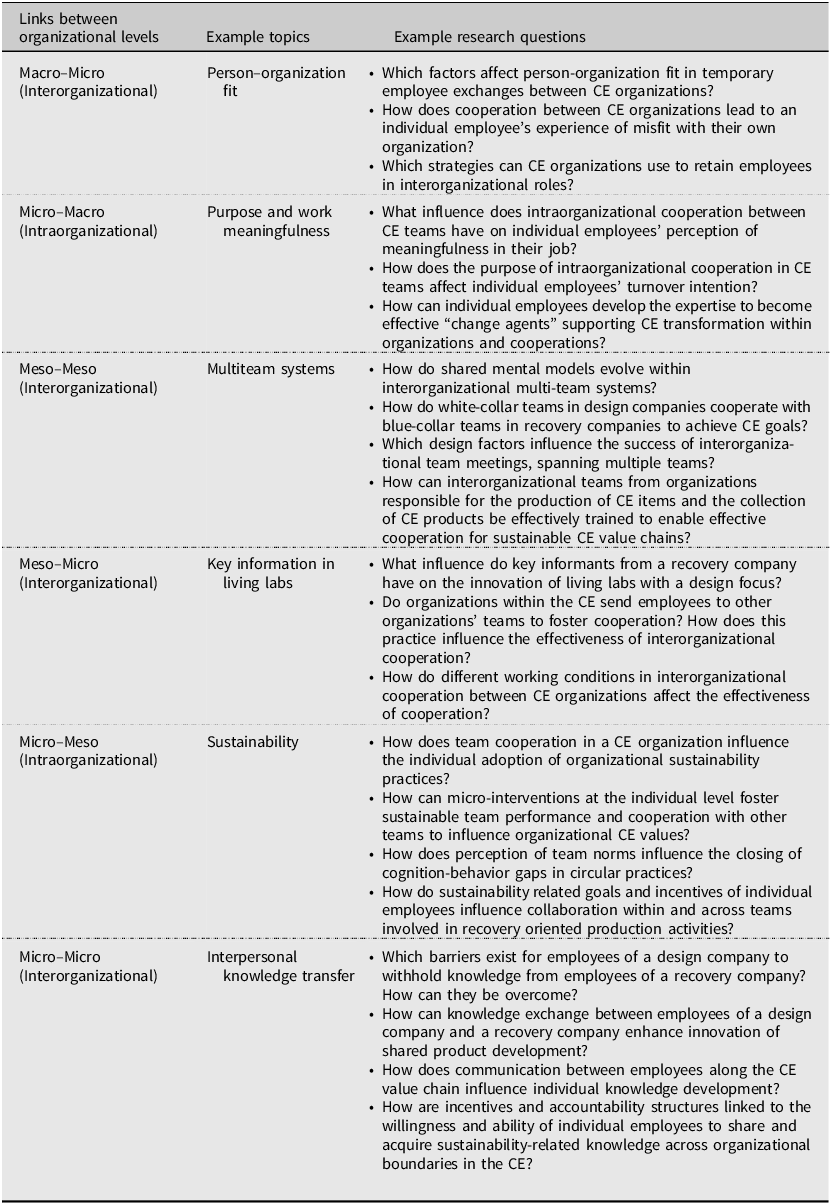
To provide scholars and practitioners in I-O psychology with ideas on how to contribute to CE implementation, we outline future research topics related to the topics of interorganizational and intraorganizational cooperation (Table 1). The table, along with the subsequent discussion of topics, aims at advancing theoretical and empirical understanding (for a more in-depth investigation into how I-O psychologists can practically contribute to CE practices, please see Schilling et al., Reference Schilling, Ritter, Klaka, Kauffeld, Zacher and Unsworth2026). We placed less emphasis on “macro to macro” and “macro to meso” level interactions, but a few recent studies, such as those by Palagonia et al. (Reference Palagonia, Michelini and Mattelin-Pierrard2025) and Mosgaard et al. (Reference Mosgaard, Kristensen and Bocken2025), have addressed how to contribute to these interactions. We recognize that there may be several other ways through which I-O psychology could support a successful and sustainable CE, such as competency development, organizational change management, and occupational health management (Ritter et al., Reference Ritter, Schilling, Brüggemann, Fröhlich, Goldmann, Henze, Kuhlmann, Mennenga, Mrotzek-Blöß, Niemeyer, Schmidt, Spengler, Sturm, Vietor, Woisetschläger and Kauffeld2024). Nevertheless, interorganizational and intraorganizational cooperation, as discussed in this focal article, remain arguably some of the most important and timely domains (Figge et al., Reference Figge, Thorpe, Manzhynski and Gutberlet2022). Table 1 is intended to serve as an illustration and is not meant to be exhaustive.
Opportunities for Industrial and Organizational Psychology to Contribute to Interorganizational and Intraorganizational Cooperation in the Circular Economy (CE)

Macro–micro and micro–macro
Exchanges between an organization and individual workers in the context of the CE can be examined in two broad ways. On the one hand, if an organization decides to transition from a linear to a CE model, research could explore how this affects employee knowledge, skills, attitudes, and behavior. For example, one could expect that the CE transformation will be positively associated with longitudinal increases in employees’ CE-related knowledge and skills, particularly, when accompanied by formal training and job redesign (i.e., macro → micro). Ul-Durar et al.’s (Reference Ul-Durar, Awan, Varma, Memon and Mention2023) study hints at similar propositions by stating the importance of integrating knowledge management within and across organizational boarders for effective CE transformation. Moreover, the implementation of CE practices at the organizational level should result in increases in employees’ pro-environmental attitudes and motivation to engage in CE-related training over time. In terms of behavioral change, CE implementation could lead to increases in employees’ green task performance and proactive CE-related behaviors, mediated by changes in work processes and perceived task significance. Additionally, Bertassini et al. (Reference Bertassini, Ometto, Severengiz and Gerolamo2021) highlight the importance of leadership support and guidance for employees in facilitating the CE transition. Organizational adoption of CE principles could further affect employees’ perceived demands–abilities and needs–supplies person-organization fit. Finally, the effects of CE implementation on employee knowledge, skills, attitudes, and behavior could be mediated by meso-level factors such as intrateam and cross-functional cooperation.
On the other hand, a “bottom-up” perspective could examine how workers’ knowledge, skills, abilities, attitudes, behavior, and other factors, such as personality and interests, as well as the development of these factors over time, may contribute to effective CE implementation at the organizational level, possibly mediated through mesolevel factors (i.e., micro → macro). Such research would have implications for personnel selection and development, as organizations could select and train employees to support the transition. For example, research could test the proposition that employees’ CE-related knowledge, skills, and abilities are positively related to the effectiveness and speed of CE implementation at the organizational level. Moreover, higher average levels of pro-environmental attitudes and CE commitment among employees could predict stronger organizational adoption and institutionalization of CE practices over time. Support for these proposition can be found in research by Bertassini et al. (Reference Bertassini, Ometto, Severengiz and Gerolamo2021), who stated in their review article that individual values, in particular, can act as catalysts for CE change and the implementation of CE practices within and across organizations. The aggregation of employee green behaviors and CE-related initiatives should contribute to organizational-level CE performance, mediated by team-level norms and shared sustainability goals. Finally, the presence and development of employees who act as CE experts or change agents could strengthen organizations’ capacity to implement and sustain CE practices, particularly in complex or uncertain contexts. Although the recent debate on the concept of a circular society is beyond the scope of the current manuscript, as the concept focuses on resource preservation beyond organizational value chains at the socio-economic level (Jaeger-Erben et al., Reference Jaeger-Erben, Jensen, Hofmann and Zwiers2021), individual change agents or CE experts within organizations can act as catalysts, planting the metaphorical seed for broader circular society transformation.
Meso–meso
Cooperation in the CE frequently takes place between teams embedded in different organizations, forming interorganizational multiteam systems. These constellations raise important questions about how shared mental models evolve across boundaries within an organization, particularly when teams differ in expertise, values, or occupational identity. For example, one might expect that a greater frequency and quality of cross-team interaction will be positively associated with the development of shared mental models regarding CE goals, task interdependencies, and coordination strategies over time. Similarly, cross-team and cross-sector interactions can also lead to greater knowledge sharing routines (Köhler et al., Reference Köhler, Sönnichsen and Beske-Jansen2022). Moreover, research could shed light on how white-collar teams in design or planning firms cooperate effectively with blue-collar teams in recovery or waste management companies, especially when deep-seated identity faultlines or status asymmetries may exist. Perceived status asymmetries between interorganizational teams might be negatively related to trust and cooperation, mediated by the salience of subgroup identities. Research could also explore how rhythm mismatches, such as different temporal cycles of planning versus operations, affect coordination and trust building. In this context, social identity dynamics, in line with social identity theory (Islam, Reference Islam and Teo2014), may influence whether team members view themselves as part of a common supraordinate system or primarily as representatives of their respective organizations. Greater misalignment in temporal rhythms (e.g., planning cycles vs. operational cycles) between interorganizational teams might be associated with lower cooperation quality and trust, unless explicit temporal coordination mechanisms are implemented.
Finally, which design factors, such as meeting formats, facilitation strategies, or shared rituals, can buffer against intergroup tensions and enhance synchronization across teams? In a previous study with farmers from the UK, proximity enabling physical and nonphysical exchanges among cooperation partners was identified as an important aspect of CE collaboration (Bloise, Reference Bloise2020). Shared rituals, such as joint kick-off meetings, milestone reviews, or site visits, could further positively affect the emergence of relational integration and psychological safety across interorganizational teams. Investigating these issues would advance theory on interteam cooperation and provide insights into how to structure and support cross-team cooperation in CE initiatives.
Meso–micro and micro–meso
As with exchanges between organizations and individuals, teams influence their members and are shaped by them in return. In the context of the CE, team structure, tasks, and composition can affect individual knowledge, skills, abilities, attitudes, and behavior, in a top-down fashion (i.e., meso → micro). For example, exposure to diverse team perspectives on sustainability and resource use may foster individual learning and creativity, while simultaneously introducing risks of misunderstanding or conflict. A particularly promising context for studying such dynamics are living labs (Hossain et al., Reference Hossain, Leminen and Westerlund2019), which involve real-world experimental environments in which diverse stakeholders co-develop, test, and implement circular solutions. Within these settings, research could explore how different working conditions in interorganizational teams shape individual employee green behavior, motivation, or innovation potential. Moreover, some CE organizations place employees temporarily in the teams of partner organizations to foster cooperation and mutual understanding; the impact of such cross-placement practices on team functioning and interorganizational trust deserves further investigation. Temporary cross-placement of employees into partner organizations’ teams could lead to higher interorganizational trust and improved individual understanding of CE processes.
Conversely, individuals influence their teams through bottom-up mechanisms such as proactive work behavior, role modeling sustainable behavior, knowledge sharing, or spreading positive attitudes toward CE goals (i.e., micro → meso). Leaders may play a pivotal role in translating individual inputs into team-level change regarding CE acceptance by shaping the climate for innovation, sustainability, or psychological safety (Jabbour et al., Reference Jabbour, Sarkis, de Sousa Jabbour, Renwick, Singh, Grebinevych, Kruglianskas and Godinho Filho2019). At the same time, they are themselves influenced by the diverse orientations and expertise within the team. For instance, key informants from recovery companies, who often bring grounded, operational experience, can introduce critical knowledge into design-focused teams, potentially catalyzing more feasible and resource-aware innovations. Employees’ proactive work behavior, such as sustainability role modeling and knowledge sharing, could positively influence the emergence of team-level norms and shared commitment toward CE goals (Jabbour et al., Reference Jabbour, Sarkis, de Sousa Jabbour, Renwick, Singh, Grebinevych, Kruglianskas and Godinho Filho2019). Leadership behaviors that foster psychological safety, sustainability, and innovation climates might strengthen the translation of individual CE-related expertise and proactive behavior into team-level change.
Micro–micro
Finally, interactions among individuals in the context of the CE may concern the transfer of knowledge regarding the CE across organizational borders (e.g., knowledge sharing, knowledge receiving, knowledge hiding), but also interpersonal influence processes that may shape others’ attitudes regarding CE adoption in a different organization (i.e., micro → micro). Research could make use of the partner–actor interdependence model and dyadic or team study designs to examine how knowledge and attitudes related to the CE transfer across individuals and to what extent they are maintained over time. For example, in interorganizational dyads, employees’ CE-related knowledge sharing should be positively related to partners’ knowledge acquisition and retention over time, whereas knowledge hiding should have negative effects. Likewise, employees’ favorable attitudes toward CE adoption could predict changes in their interaction partners’ CE-related attitudes in other organizations over time, with stronger effects when dyads report high trust and frequent interaction.
In this context, future studies also could explicitly address the cognition–behavior gap by examining why employees who have favorable attitudes and intentions toward the implementation of the CE fail to enact those attitudes in their daily work behavior. Research in the context of pro-environmental behavior (e.g., Kollmuss & Agyeman, Reference Kollmuss and Agyeman2002; Norton et al., Reference Norton, Zacher, Parker and Ashkanasy2017) can aid in understanding why this gap exists and help formulate research questions for specific CE applications. For example, favorable individual attitudes toward the CE might be insufficient to predict circular work behaviors when employees perceive low behavioral control, conflicting performance goals, or weak social reinforcement within their immediate work context. Focusing on the interpersonal level, future studies could, for instance, examine the role of peer feedback as well as leader role modeling on the enactment of circular behaviors, even when individual attitudes are already favorable. In particular, high levels of peer feedback and leader role modeling could strengthen the relationship between CE-related attitudes and actual behavior, such that the cognition–behavior gap is reduced when peers and leaders visibly enact and reinforce CE practices.
Concluding remarks
The focal article set out to demonstrate how I-O psychology can advance the scientific understanding and effective practical implementation of the CE by illuminating its psychological micro-foundations. Our central argument is that the CE transformation is not only an economic or technological challenge, as emphasized in other scientific disciplines, but fundamentally a behavioral and cooperative one. By integrating micro, meso, and macro level perspectives, we position CE implementation from an I-O psychology perspective as a multilevel organizational change process driven by individual employees, teams, and their interactions within and across organizations.
To this end, three core research priorities emerge from our perspective. First, organizational-level CE initiatives may alter employees’ knowledge, skills, attitudes, motivation, and behavior over time, but these same factors reversely shape the speed, depth, and durability of CE implementation. Second, cooperation—within organizations and across circular value chains—is a critical yet undertheorized and understudied mechanism through which CE practices may succeed or fail, particularly when psychological barriers, such as identity boundaries, status asymmetries, and temporal misalignments, are present. Third, similar to the domain of pro-environmental behavior, favorable attitudes and intentions toward the CE do not reliably translate into behavior, highlighting the importance of peer social influence, leadership, and work design in closing the cognition–behavior gap.
Methodologically, we argue that progress requires moving beyond organization-level, qualitative case studies toward more quantitative experimental, longitudinal, multilevel, and relational designs, including field experiments, living labs, dyadic and multiteam system studies, and experience sampling studies. Such approaches allow researchers to capture causal mechanisms and dynamic processes, complementing dominant macro-level CE research.
Overall, by embedding the CE within I-O psychology theories on motivation, cooperation, identity, and behavior changes, this article contributes a psychologically grounded agenda for CE research and practice. Ultimately, we contend that sustainable circular transformation depends on understanding and practically shaping how individuals work, cooperate, influence each other, and make meaning of circularity in their workplaces and everyday organizational lives.


 Open access

