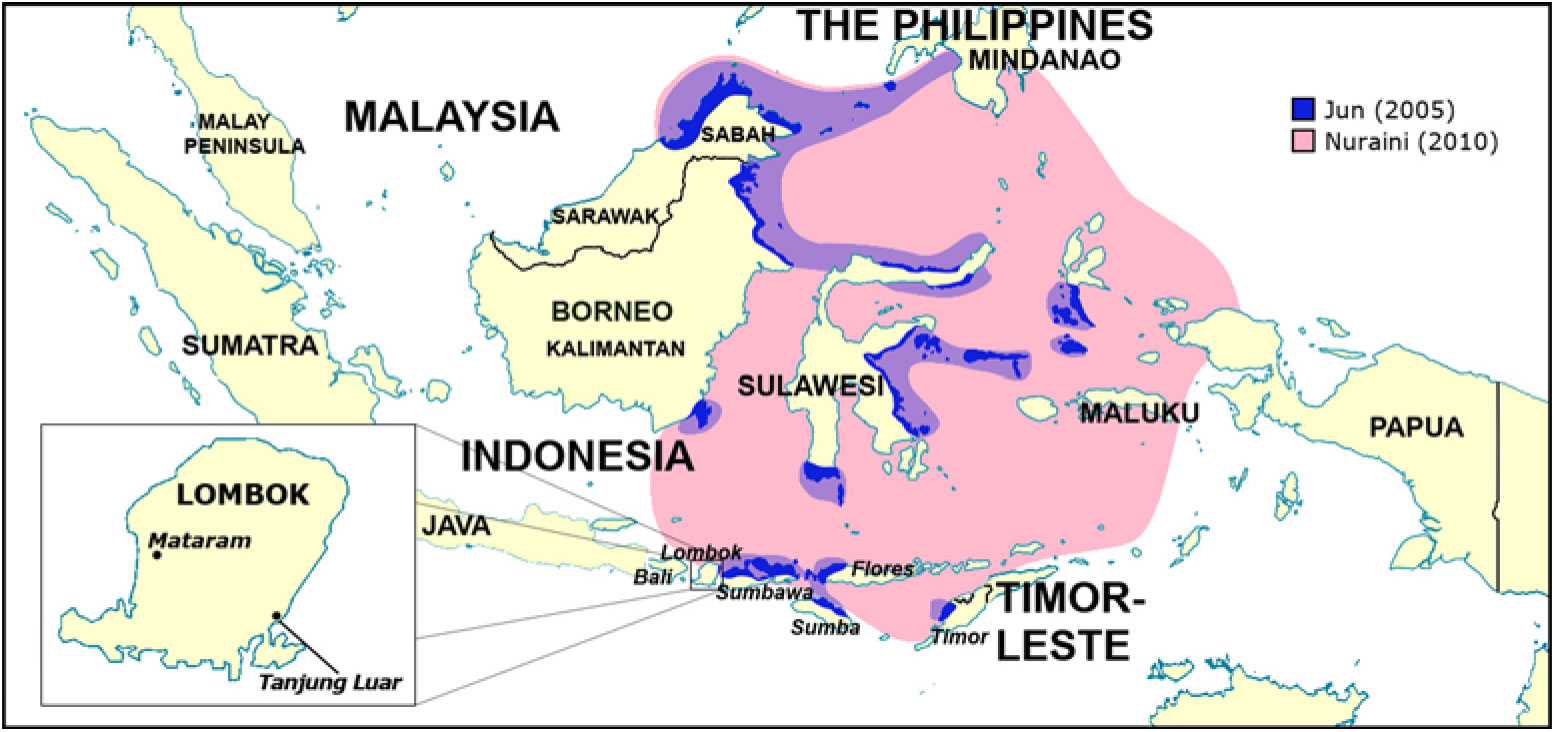


Bajau is spoken as the primary language from the Philippines to Borneo to eastern Indonesia, by both nomadic and settled communities. It is also known as Badjaw, Badjo, Bajao, Bajo, Bayo, Gaj, Indonesian Bajaw, Orang Laut, Sama, and Terijene – see Simons & Fennig Reference Simons and Fennig2017. Glottolog.org lists ‘Indonesian Bajau’ as a language spoken on the south-eastern coast of Sulawesi, glottocode indo1317 and ISO 639-3 bdl. Clifton (Reference Clifton, Unsworth, Clifton and Smith2010) claims the population of Bajau speakers is 700,000–900,000, with around 150,000–230,000 in eastern Indonesia (Sather Reference Sather1997) and 92,000 in Sulawesi (Mead & Lee Reference Mead and Lee2007). There are also Bajau-speaking populations in the Philippines and Borneo (Jun Reference Jun, Adelaar and Himmelmann2005); see Figure 1. Bajau is classified as a threatened Austronesian, Malayo-Polynesian language (Simons & Fennig Reference Simons and Fennig2017). It has been proposed that the language originated in the Zamboanga-Basilan area in southern Philippines (Jun Reference Jun, Adelaar and Himmelmann2005 citing Pallesen Reference Pallesen1985).
Geographic location of Bajau-speaking regions of insular Southeast Asia, according to Jun (Reference Jun, Adelaar and Himmelmann2005; dark blue/dark grey) and Nuraini (Reference Nuraini2010; pink/light grey) (overview map) and the location of Tanjung Luar (our speaker’s hometown) on Lombok (inset map). Purple/medium grey (intersectional) areas indicate geographical regions where assessments by Jun and Nuraini coincide.

Jun (Reference Jun, Adelaar and Himmelmann2005) follows Grimes (Reference Grimes1999) in dividing Bajau speakers into nine general dialects; Aboknon Sama, Balangingi Sama, Central Sama, Pangutaran Sama, Southern Sama, Yakan, Mapun, West Coast Bajau, and Indonesian Bajau. Our paper focuses on Indonesian Bajau.
Method
Audio and ultrasound data were recorded from a native Indonesian Bajau speaker, Hamdiyati (full name). Hamdiyati comes from Tanjung Luar, a small community of Bajau speakers in East Lombok, West Nusa Tenggara, at the western edge of the Bajau diaspora; as such, Hamdiyati is from the ‘Indonesian Bajau’ dialect. (See Hapip Reference Hapip1979, Verheijen Reference Verheijen1986, Donohue Reference Donohue1996, Candrawati Reference Candrawati1997 for discussion of different aspects of Indonesian Bajau; see Jun Reference Jun, Adelaar and Himmelmann2005 for sources on the other dialects; Nuraini Reference Nuraini2010 includes a text description of the sounds of Sabah Bajau, Philippines.) At the time of recording, Hamdiyati was 22 years old, a third-year university student. Both parents are Bajau speakers; she (and they) also speak Sasak and Bahasa Indonesia. (See Soderberg & Olson Reference Soderberg and Olson2008 on Bahasa Indonesia and Archangeli, Tanashur & Yip (published online 28 March 2018) on Sasak.)
Hamdiyati translated ‘The North Wind and the Sun’ into Bajau. She practiced the story, and read it three times. Hamdiyati also provided the individual words illustrating the sounds, practiced them, then read them for both acoustic and ultrasound recording. In our study, we recorded audio and ultrasound video of a total of 76 unique words in a randomized order with three iterations. Each word was presented on a laptop screen to the speaker. All words were elicited one after the other in isolation during a single audio-video recording. Eighteen words were identified for describing the consonant inventory and six words were used to illustrate the vowel inventory of Indonesian Bajau. In addition, the stimuli also included 26 words for comparing the duration of consonantal singletons and geminates, 12 words for comparing the vowel quality in open and closed syllable types, and 14 words for comparing the vowel duration of short and long vowels.
Recordings were made in a classroom at the Mataram Lingua Franca Institute. To reduce the level of echo within the classroom, we erected a makeshift, sound-attenuated cubicle using tall, fabric-covered partition panels and a heavy desk. An omnidirectional, earset condenser microphone was used, attached to a laptop via an analog-to-digital audio interface. The sampling rate for audio was 44,100 Hz in all recordings.
The ultrasound transducer was visually aligned along the centerline of Hamdiyati’s head and was immobilized with respect to her head using a non-metallic ultrasound transducer holder (Derrick, Best & Fiasson Reference Derrick, Best and Fiasson2015), which held the transducer at a fixed position relative to the jaw by two elastic, adjustable straps. The straps were tightened relatively snugly to ensure that the entire brace would not slip during the recording procedure. The elasticity of the brace straps allowed for relatively free downward and upward movements of the jaw during speech. Hamdiyati was free to move her head in any direction, as the brace did not immobilize her head in any way. Before recording, we asked Hamdiyati to produce [t] and [k] sounds during scanning. At this time, the live scan was checked by the authors to ensure that full dorsal and coronal constrictions were being captured in the ultrasonic video recording.
Ultrasound images were collected with a Telemed ClarUs-EXT portable, ultrasonic beam-former and a 2–4 MHz convex ultrasound sensor (Telemed MC4-2R20N), with an ultrasonic beam frequency of 4 MHz and an image sampling frequency of approximately 60 frames per second.
A high-performance gaming laptop located outside of the recording cubicle functioned as the machine dedicated to simultaneous audio- and video-data collection, while a separate laptop within the cubicle presented target materials to our speaker. Ultrasonic image frames were constructed using EchoWave II software (Telemed 2015), and single audio-video files were recorded using screen-capture software (Beepa 2015, SplitmediaLabs 2015). Post-collection, audio recordings were processed and analyzed with Praat (Boersma & Weenink Reference Boersma and Weenink2015); Praat was also used to identify acoustic landmarks in order to achieve video-to-audio synchronization and locate points in the audio stream corresponding to relevant ultrasound frames. Traces were extracted as a set of 100 x- and y-coordinate values in EdgeTrak (Li, Kambhamettu & Stone Reference Li, Kambhamettu and Stone2005): EdgeTrak fit a smoothed graphical spline curve on the boundary edge corresponding to the tongue surface for each tongue image, and converted the curves into Cartesian-coordinate points for analysis. Splines were analyzed and plotted using R statistical software (R Core Team 2016).
Palate images were procured using the sip-of-water method: Throughout the recording procedure, palate images were collected by having Hamdiyati sip water through a straw and swallow the water bolus. In the swallow frames, a contour of the palate was traced along the top boundary of the bolus in the anterior and posterior regions of the palate.
Consonants
The Bajau sound inventory has 18 consonantal phonemes.


Oral plosives and affricates, and nasal stops
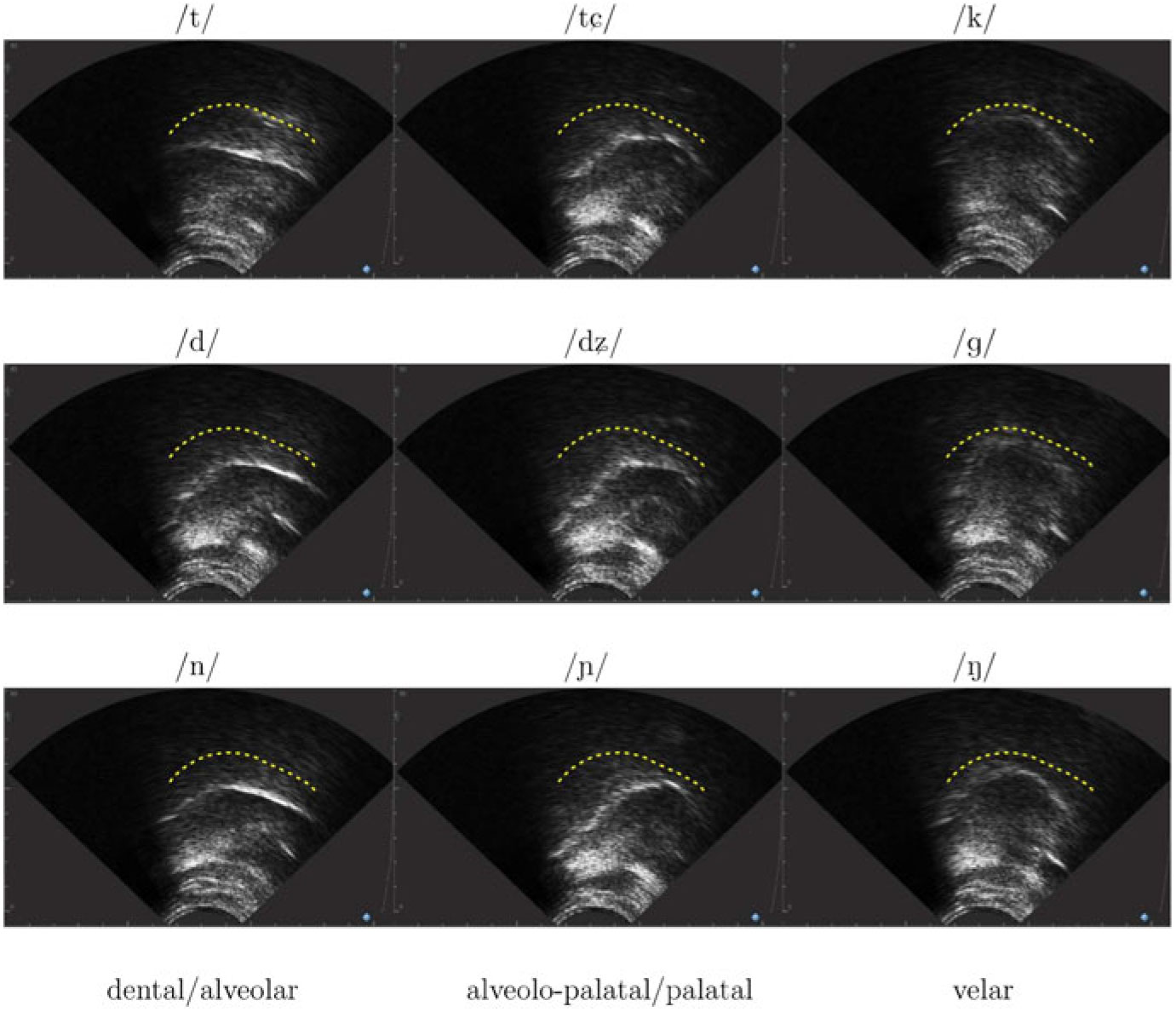
Bajau oral plosives show a three-way place of articulation distinction while nasal stops show a four-way contrast: bilabial /p b m/, dental/alveolar /t d n/, palatal /ɲ/, and velar /k g ŋ/. Additionally, there are voiced and voiceless postalveolar affricates /tɕ dʑ/, which pattern with the plosives in terms of phonation effects. The individual articulatory tongue configurations for lingual sounds (dental/alveolar, postalveolar/palatal, velar) are shown in single ultrasound images in Figure 2. For plosives (oral stops; the top two rows in Figure 2), the selected ultrasound frames were the last frame before the acoustic release of the stop. For nasal stops (the third row in Figure 2), frames were taken at the temporal midpoint of the relevant voiced nasal stop interval identified within the acoustic signal.
Ultrasound images, midsagittal view; tongue tip to right; palate trace at top (dashed line). Lefthand column shows initial dental/alveolar consonants /t d n/ from /tapɔʔ/ tapoq ‘to hide (intrans)’, /dapuʔ/ dapuq ‘to have’, /napɔʔ/ napoq ‘to hide (trans)’; central column shows postalveolar /tɕ dʑ/ and palatal /ɲ/ from /tɕabiːʔ/ cabiiq ‘chili’, /dʑambaŋ/ jambang ‘to poop’, /ɲapah/ nyapah ‘to have breakfast’; righthand column shows velar /k g ŋ/ from /kampoh/ kampoh ‘village’, /gampoh/ gampoh ‘pull- up, chin up’, /ŋampuʔ/ ngampuq ‘to have sex’. Top row shows initial voiceless consonants; second row shows initial voiced consonants; third row shows initial nasal consonants.

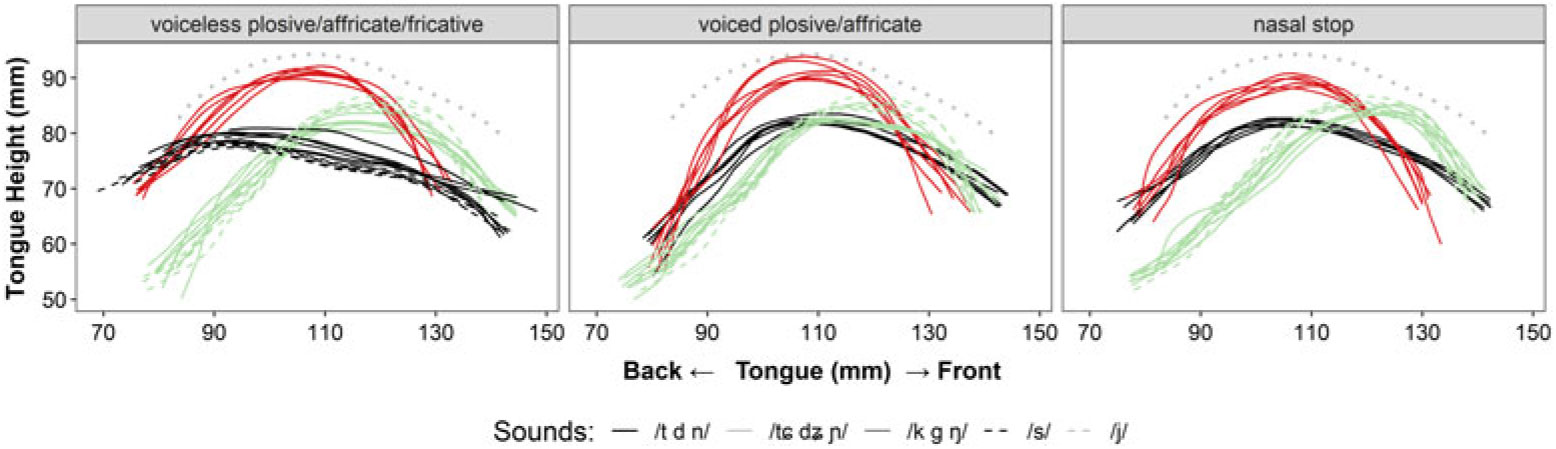
Figures 3 and 4 show compilations of traces from multiple ultrasound images in order to better compare articulations of different sound categories. The traces in Figure 3 show that regardless of phonation type, the velars are high and back, the postalveolars and the palatal are high and front, and dental/alveolars have a lower tongue position.
Tongue contour traces (from ultrasound images) of the midpoint of five productions each of the items in Figure 2, tongue tip to the right; palate trace near top (dotted light grey line); traces for palatal /j/ (dashed pale green/pale grey lines) are shown in each panel for comparison. Panels show phonation (left: voiceless /t s tɕ k/; center: voiced plosives/affricate /d dʑ g/; right: nasals /n ɲ ŋ/). Place is shown in each panel by color: dental/alveolar (black), postalveolar (pale green/pale grey lines) and velar (red/dark grey).

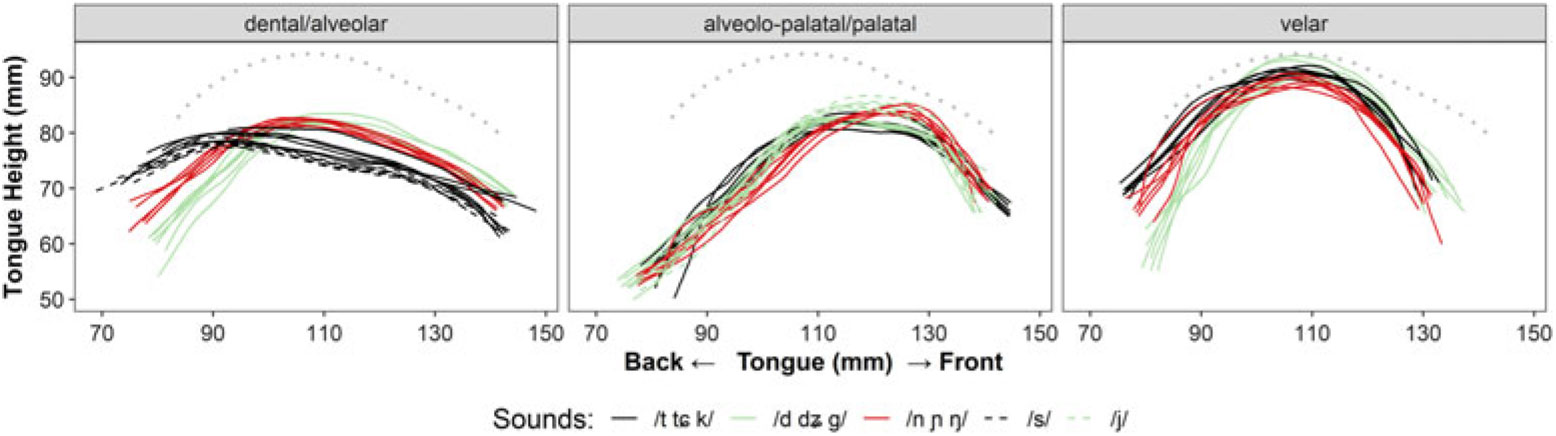
Tongue contour traces (from ultrasound images) of the midpoint of five productions each of the items in Figure 2, tongue tip to the right; palate trace near top (dotted light grey line). Panels show place (left: dental/alveolar /t d n/; center: postalveolars/tɕ dʑ/ and palatal /ɲ j/; right: velar /k g ŋ/). Phonation is shown in each panel by color: Voiceless (black, with /s/ shown by a black dashed line, voiced (pale green/pale grey, with /j/ shown by a pale green/pale grey dashed line), and nasal (red/dark grey).

The traces in Figure 4 show the position of the tongue in three general places of articulation, comparing oral voiceless, oral voiced, and nasal articulations. The leftmost panel shows that dental/alveolar sounds generally have a relatively retracted tongue root and lowered dorsum, with /t/ and /s/ (black solid and dashed lines, respectively) having more retraction and a lower tongue dorsum than /d/ and /n/ (pale green/pale grey and red/dark grey solid lines). The tongue tip is missing in these images, so it is not possible to determine whether these are alveolar or dental sounds. The middle pane shows that the postalveolars have the tongue body raised towards the front of the mouth, with /tɕ/ and /dʑ/ (black and pale green/pale grey solid lines) having a slightly lower dorsum position and slightly higher tongue tip than the palatal /ɲ/ and /j/ (solid red/dark grey and dashed pale green/pale grey lines), hence the two designations, palatal and postalveolar. The rightmost pane shows that velars /k g ŋ/ are high and back, with voiced plosive /g/ (pale green/pale grey) having more advanced tongue root position than /k/ and /ŋ/ (black and red/dark grey).
The glottal stop /ʔ/ occurs contrastively in final position, where it may be realized as creak, as a glottal stop, or deleted. Sporadically, vowel-initial words are pronounced with an initial [ʔ]: /aːhaːʔ/ [ʔaːhaːʔ] aahaaq ‘people, someone’ vs. /aːhaʔ/ [aːhaʔ] aahaq ‘Sunday’.
Voice onset time
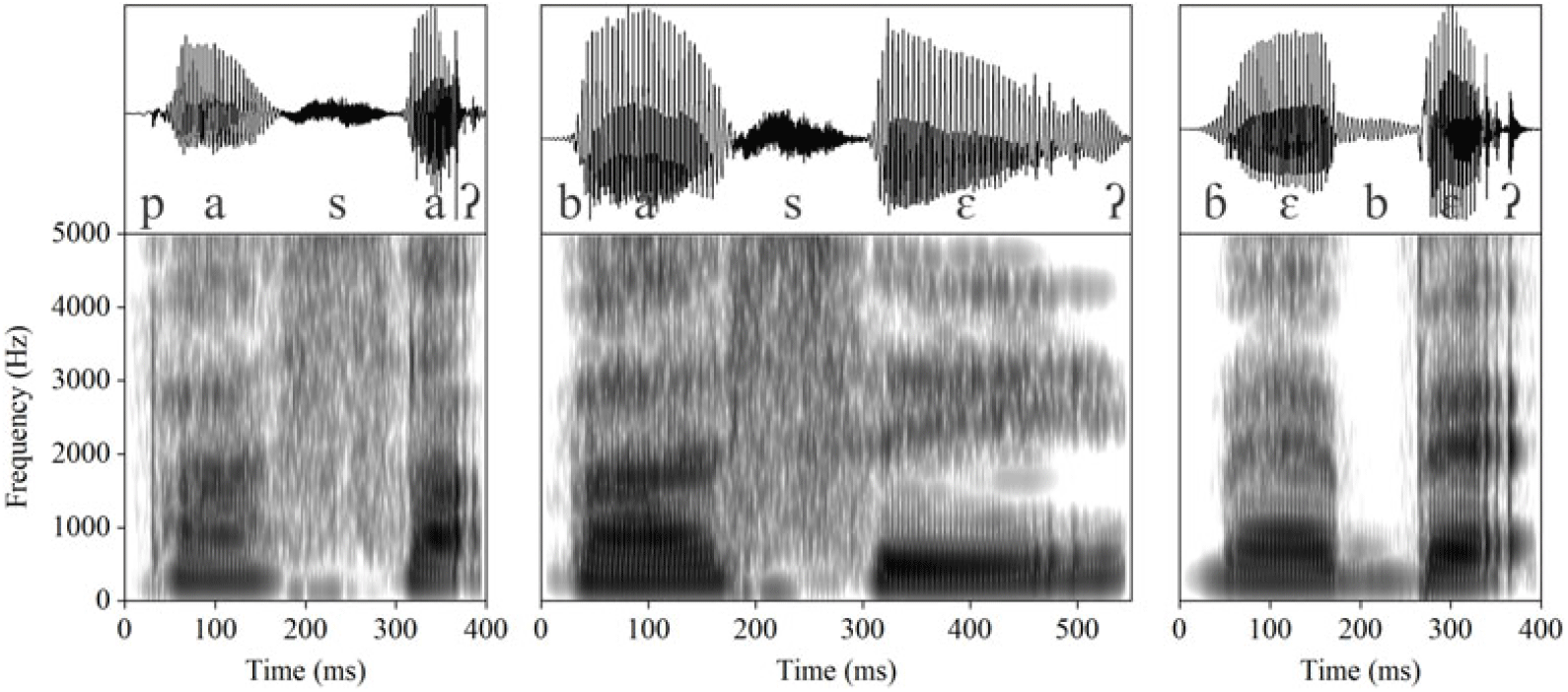
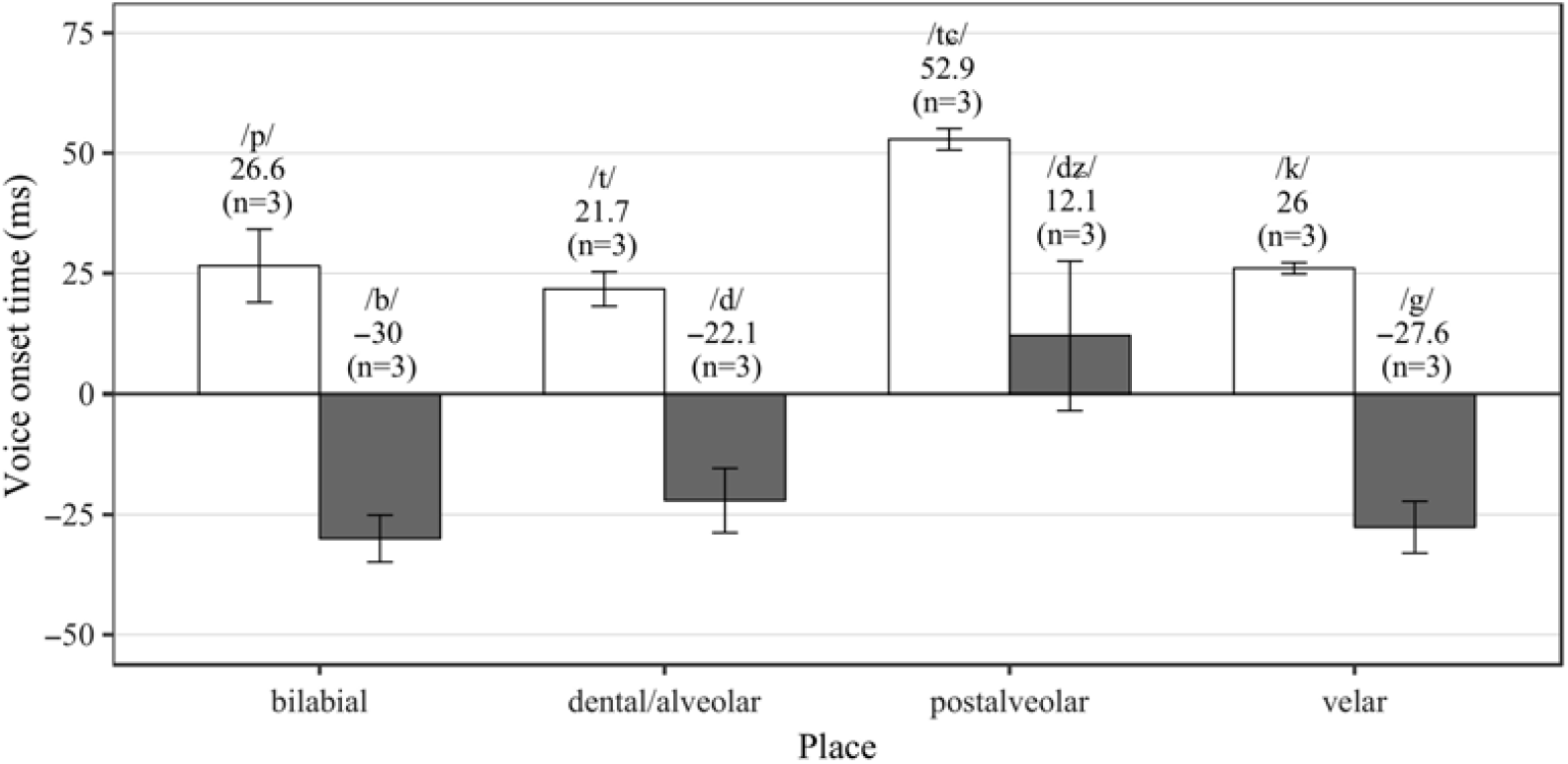
Voice onset time (VOT) was measured as the temporal interval beginning at the release of an oral stop and ending at the onset of voicing associated with that stop. (Recall that words were produced in isolation, so there is no issue of voicing from a preceding segment ‘bleeding’ into the target sound. All stops were immediately preceded by a long interval of silence.) VOT for voiceless plosives /p t k/ are consistently positive, whereas those for voiced plosives /b d g/ are near zero or slightly negative. ‘Voiced’ affricate /dʑ/ is phonetically voiceless (so, [ʥ̥]), with positive VOT, although its VOTs are substantially shorter than those for /tɕ/. Voiced plosives /b d/ tend to be articulated as implosives with very short intervals of pre-voicing. These productions are illustrated with oral labial consonants in Figure 5.
Waveforms and spectrograms for productions of bilabial /p/ and /b/: Positive VOT in /pasaʔ/ pasaq ‘come, enter’ (left), near-zero negative VOT during [b] in /basɛʔ/ baseq ‘wet’ (center), and an implosive [ɓ] followed by a fully voiced, intervocalic [b] in /bɛbɛʔ/ bebeq ‘duck’ (right).

Bajau VOT (around 25 ms, with the exception of affricates) is short for aspirated voiceless stops and long for unaspirated voiceless stops, based on values reported in Lisker & Abramson (Reference Lisker and Abramson1964) for 11 languages. For our speaker of Bajau, as shown in Figure 6, voiced stops have shorter intervals of prevoicing by 20–30 ms when compared to the voiced stops reported in the Lisker & Abramson (Reference Lisker and Abramson1964) study, whether aspirated or not. Thus, a relatively short difference in VOT distinguishes the two series of oral plosives and the affricates, of approximately 50 ms, which is shorter than in any language reported in Lisker & Abramson (Reference Lisker and Abramson1964).
Voice onset time of plosives arranged by place, from the word-initial plosive items listed in the table illustrating consonants. VOT values for voiceless plosives (white bars) are moderately long positive, whereas VOTs for voiced plosives (dark grey bars) are short and generally negative. VOTs for postalveolar affricates /tɕ dʑ/ are longer but exhibit the same voiceless-voiced pattern as in plosives.

Effect of consonant phonation on adjacent vowels
Consonant phonation affects the quality of the following vowel. Following Blankenship (Reference Blankenship2002), Keating & Esposito (Reference Keating and Esposito2007), Garellek & Keating (Reference Garellek and Keating2011), we measure these effects using the first two harmonics of the following vowel. Measured H1 and H2 amplitudes were not corrected for vowel formants or bandwidths, but this was not expected to cause an issue given that the stops were always followed by the vowel /a/ and as such, H1 and H2 were always far below the much higher frequency of F1 during /a/.
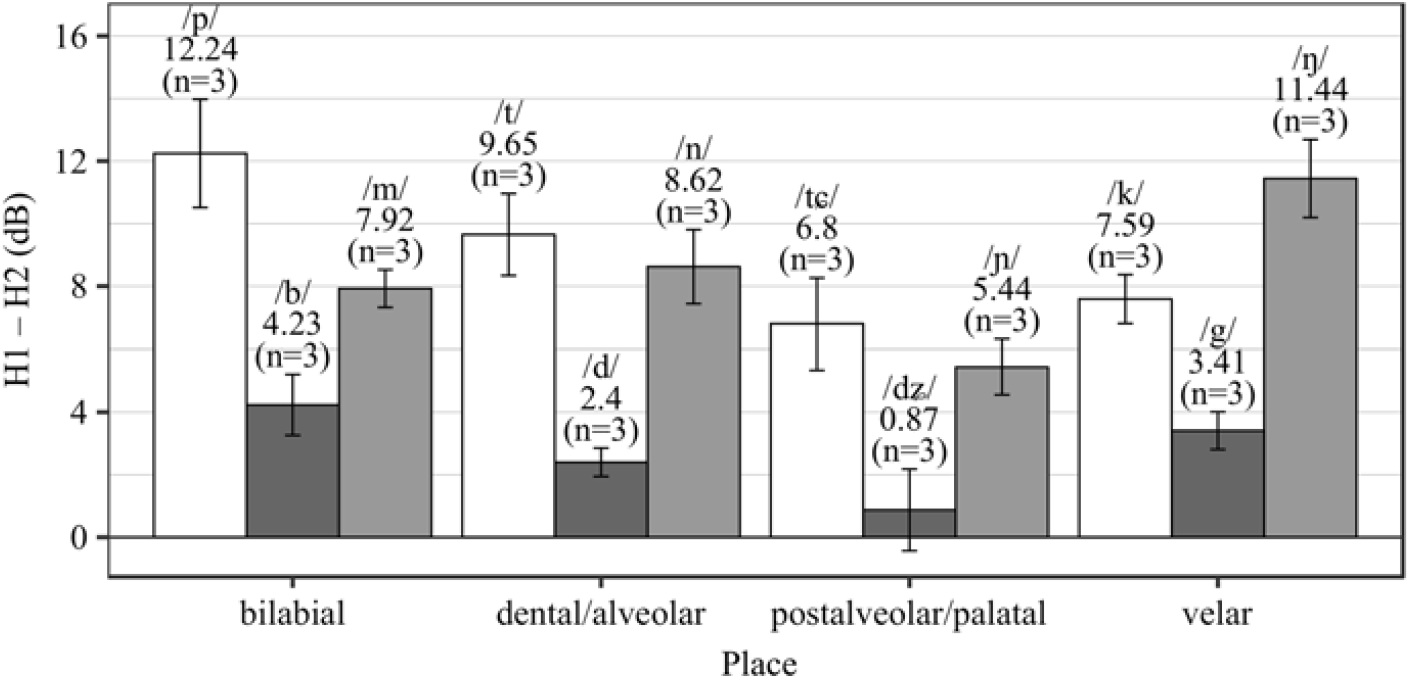
A large difference between the first and second harmonics (H1–H2 values in dB) correlates to breathiness, seen following voiceless plosives in Bajau as shown in Figure 7. A small difference correlates to laryngealized phonation (creak), occurring in Bajau following voiced plosives. This finding provides additional evidence that our speaker sometimes produced voiced plosives as implosives (Ladefoged & Maddieson Reference Ladefoged and Maddieson1996: 82–90). The H1–H2 values after nasal stops are in-between, indicating modal voicing.
Differences between the intensity (dB) of the first and second harmonics (H1–H2) during the vocalic interval for [a] immediately following onsets from items found in the list following the consonant chart, according to place: voiceless plosives /p t tɕ k/ (white), voiced plosives /b d dʑ g/ (dark grey), and nasal stops /m n ɲ ŋ/ (medium grey).

Tap
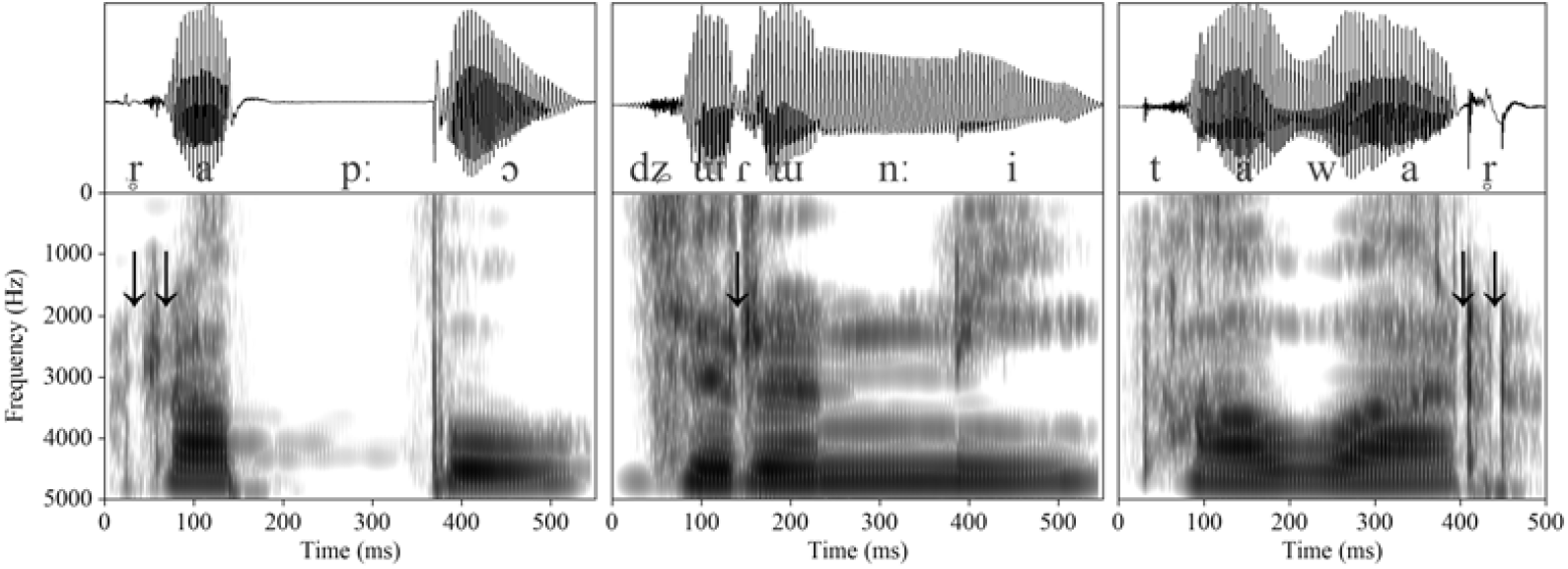
The Bajau rhotic has both tap and trill variants, with tap occurring in intervocalic position and trill occurring both at the beginning and the end of words; it may be devoiced in either position. These are illustrated in Figure 8.
Waveforms and spectrograms for different articulations of /ɾ/: word-initial voiceless trill [r̥] in /ɾapːɔ/ rappo ‘key’ (left), intervocalic tap [ɾ] in /dʑɯɾɯnːi/ jerenni ‘cold’ (center), and word-final voiceless trill [r̥] in /tawaɾ/ tawar ‘bargain’ (right). Moments of constriction during [ɾ] and [r̥] are indicated with downward arrows.

A syllable ending with /ɯɾ/ may be realized as a voiceless syllabic trill [r̥̩]: /pɯrtɯmɯ/ [pr̥̩.tɯ.mɯ] perteme ‘first’.
Fricatives and approximants
The dental/alveolar fricative /s/ has a lingual position similar to that of /t/; see Figures 2 and 4 above, with retracted tongue root, depressed dorsum, and raised tongue tip/blade.
The laryngeal fricative/approximant /h/ is typically found between vowels, as in /tahaʔ/ tahaq ‘long’, and at the end of words, as in /lapːɔh/ lappoh ‘to lie’. It is rare in word-initial position: our example /hadʑi/ haji ‘to make the hajj’ is a borrowing.
There are two approximants, /l j/. The lateral /l/ is light in all contexts. Occasionally, initial /l/ is slightly devoiced. See Figure 3 above for the lingual articulation of /j/, which shows a high articulation towards the front part of the hard palate.
Consonant duration
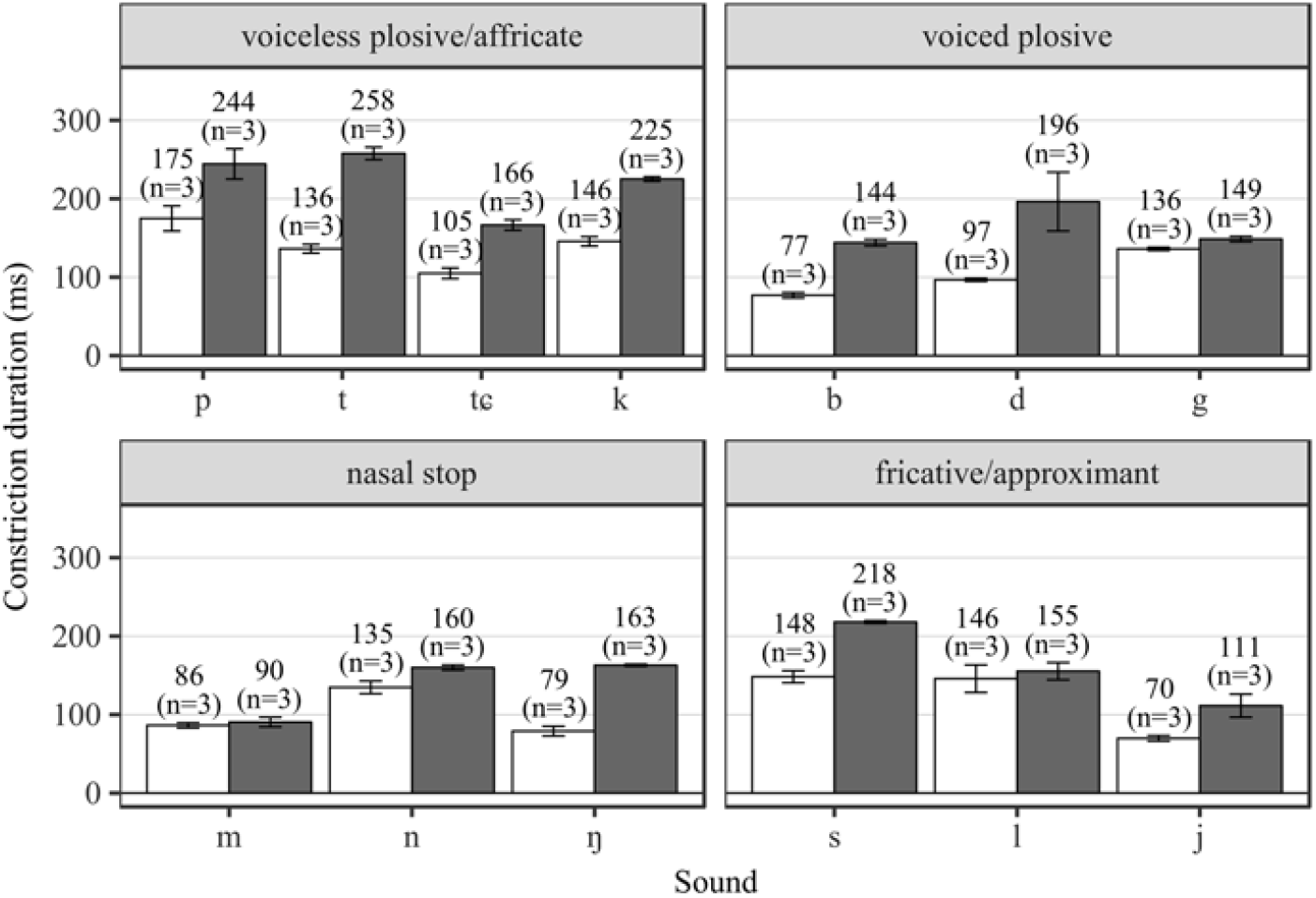
The language contrasts short (singleton) and long (geminate) obstruents, three of the nasals, /l/ and /j/. Mean durations between three productions of each sound are shown in Figure 9.
Duration (in ms) of singleton (white bars) and geminate (dark grey bars) consonants.

Durational differences appear to be largest for plosives. We did not find any acoustic evidence of gemination with /ɾ ɲ w ʔ h/.
(1) Indonesian Bajau short and long consonants illustrated

We are somewhat vague in our discussion of consonant duration contrasts because finding minimal pairs or near-minimal pairs to illustrate the duration differences proved to be difficult. Example words (from the list in (1) above) sometimes have a different number of syllables (/tɯ.bɛ.aʔ/ tebeaq ‘join’ vs. /tɯbːal/ tebbal ‘thick’), different flanking vowels (/bɯnaŋ/ benang ‘pay’ vs. /dʑɯɾɯnːi/ jerenni ‘cold’), or flanking vowels of different lengths (/ijɔʔ/ iyoq ‘yes’ vs. /iːjːaʔ/ iiyyaq ‘shy’). We were unable to determine whether these differences affected consonant length in Bajau.

Vowels


Bajau has six vowel phonemes, two front, two central, and two back. Spatial locations in the vowel diagram above are determined by the F1 and F2 values (in bark) measured in the vowels in the first syllable of the items listed below the diagram. (In our near-minimal set above, [ɔpaʔ] opaq ‘to gossip’ and [upaːʔ] upaaq ‘salary’ contrast both in the initial vowel (our focus here) and in the length of the second vowel. See the sections below on allophonic vowel length and contrastive vowel length; [upaːʔ] is a case of contrastive vowel length). Back vowels are articulated with lip-rounding. The high rounded /u/ shows little variation regardless of context. Other vowels vary depending on duration and syllable type.
In utterance-initial position, word-initial vowels are sometimes devoiced at acoustic onset, sounding similar to a low intensity [h] as in /ɛba/ [ɛ̥ba] eba ‘against’. This appears to be less common with high vowels. Alternatively, vowels in this position may instead begin with a glottal release: [ʔɛba].
The mid central vowel /ɯ/ shows variation in both duration and quality. In word-initial position, /ɯ/ is deleted or extremely short, especially in word-initial position: /ɯma/ [mːa] ema ‘mother’, /ɯluŋ/ [lːuŋ] elung ‘alive’. In initial syllables, /ɯ/ can be very short: /tɯbɛaʔ/ [tɯ̆beaʔ] tebeaq ‘ join’, /tɯbbal/ [tɯ̆bːal] tebbal ‘thick’.
Vowel quality in open and closed syllables
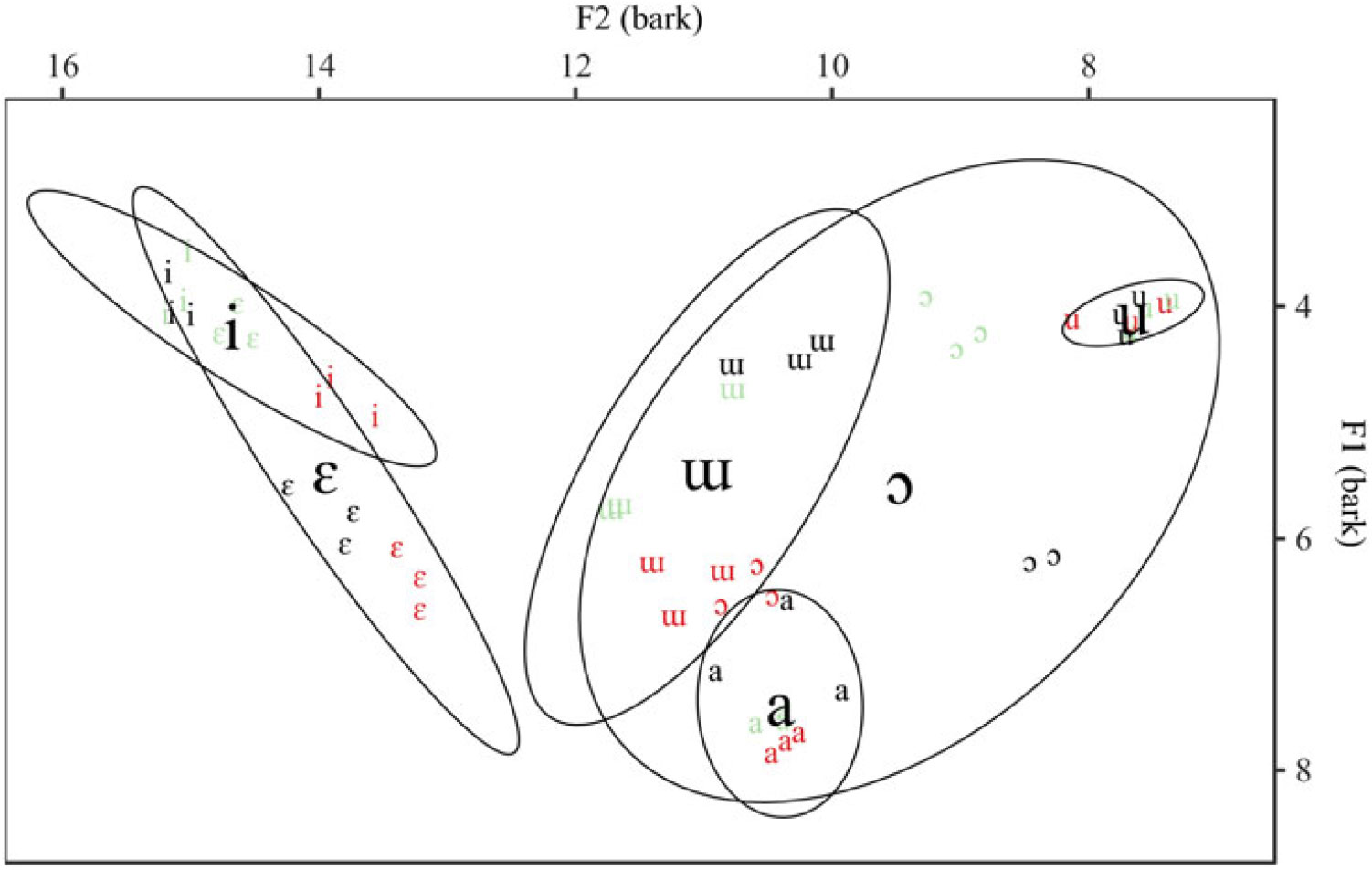
While /u/ and /a/ show little variation, high vowels /i ɯ/ and mid vowels /ɛ ɔ/ tend to have higher F1 in closed syllables, indicating a lower tongue position, and lower F1 in open syllables, indicating a higher tongue position. This effect appears to be strongest in word-final open syllables, where the mid-low vowels /ɛ ɔ/ may raise to the height of /i u/, respectively. Final /ɯ/ is generally quite centralized, as in /lɯgɯ/ [lɯgɯ̈] lege ‘free’. Open and closed vowel quality is illustrated in Figure 10 and the examples in (2).
Vowel formants according to syllable type and position. Measures are taken from word-initial open syllables (smaller black vowel symbols), word-final open syllables (pale green/pale grey symbols), and word-final closed syllables (red/dark grey symbols). Measures from word-initial open syllables are from the list below the Vowel Diagram; those for word-final open and closed syllables were taken from items in example (2).

(2) Indonesian Bajau open and closed syllable allophony illustrated

That syllable type affects vowel quality may be an influence of Sasak, the majority language in Lombok. See Clynes (Reference Clynes and Tryon1995), Chahal (Reference Chahal and Austin1998), Archangeli et al. (published online 28 March 2018) on Sasak vowel length and quality. Vowel quality dependent on syllable type occurs in several Austronesian languages, typically with a lower or more lax vowel in closed syllables; see Blust (Reference Blust2013: 263–265) for a survey and Dudas (Reference Dudas1976) for details on Javanese vowel quality in open and closed syllables.
Allophonic vowel length in open and closed syllables
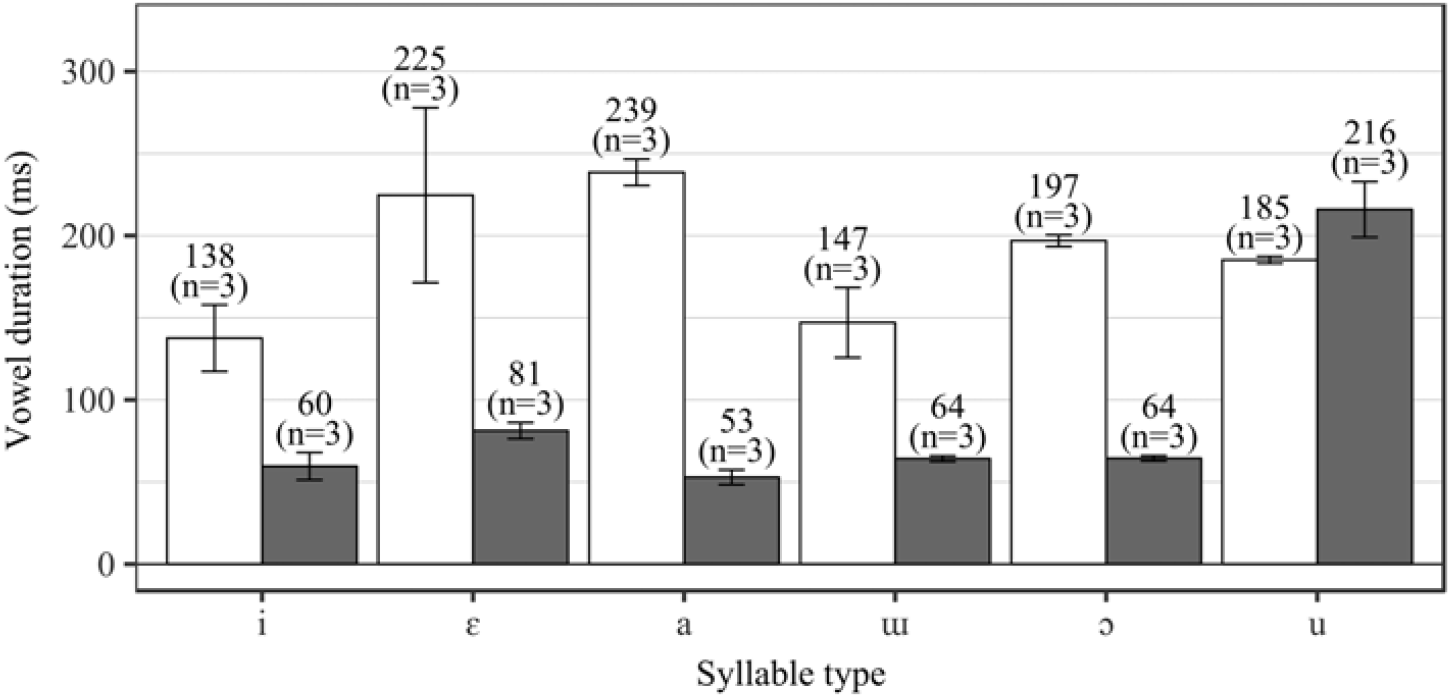
Vowels are around twice as long in open syllables as they are in closed syllables, as seen in Figure 11, although there is a fair amount of variation.
Vowel duration (ms) in word-final open (white bars) and closed (dark grey bars) syllables, by vowel quality. With the exception of /u/ vowels have very short duration in closed syllables relative to those in open syllables. Measures from word-final open and closed syllables were taken from items in example (2).

Contrastive vowel length
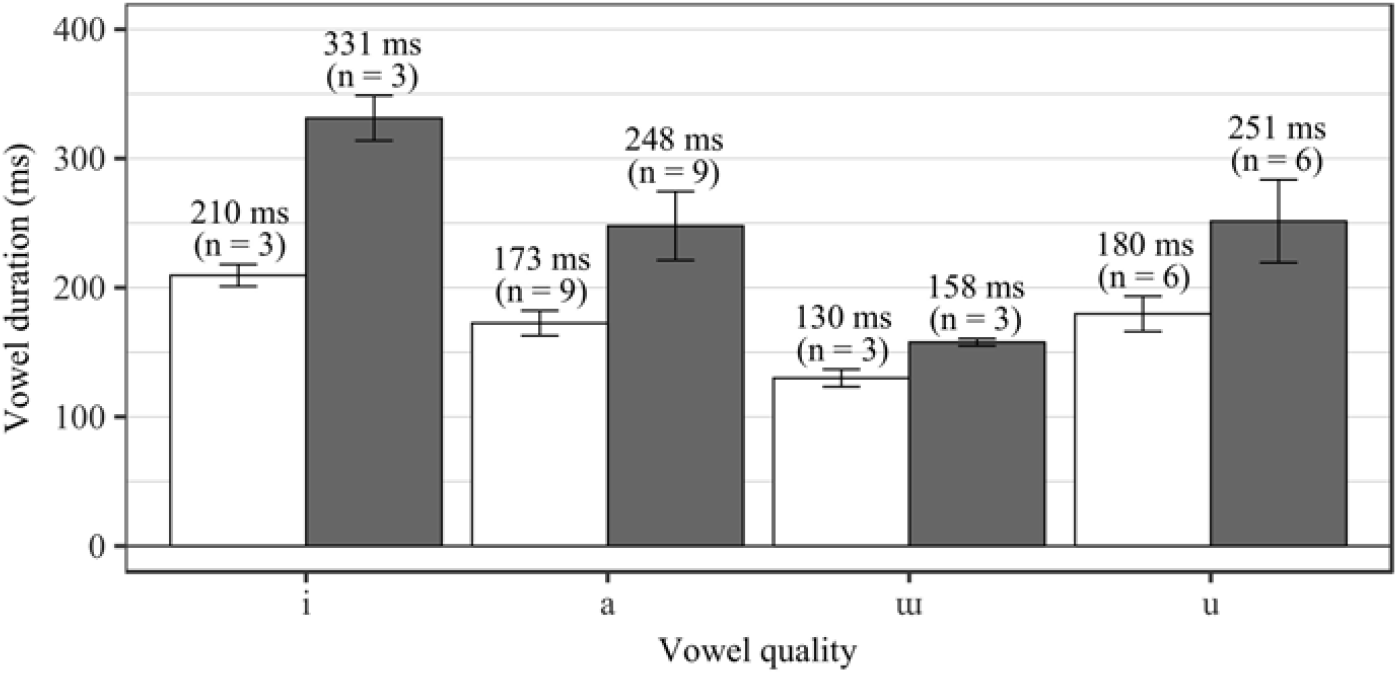
Length contrasts were found with high vowels and central vowels, /i a ɯ u/ (illustrated in the examples in (3) and in Figure 12), despite the report in Nuraini (Reference Nuraini2010), that vowel length was not mentioned in the description of East Lombok Bajau found in Candrawati (Reference Candrawati1997). (Nuraini Reference Nuraini2010 notes that vowel length is observed in Philippine Sabah Bajau but that she did not hear vowel length contrasts in Bajau communities around the Flores Sea or in Central Sulawesi.)
Vowel duration for short (white bars) and long (dark grey bars) vowels, by vowel quality. The duration difference is greatest with /i iː/ and least with /ɯ ɯː/.

(3) Indonesian Bajau long and short vowels illustrated

Syllables
The typical Bajau syllable consists of an optional onset, an obligatory vowel (long or short) and an optional coda. Intervocalic codas are typically part of a geminate or the nasal of a homorganic nasal–oral sequence. Word-final codas include /ʔ h ɾ l n ŋ s k t/.
Whether a syllable is open or closed has an effect on both the length and the quality of the vowel of that syllable. See discussion of the relation between syllable type and vowel quality in the section ‘Vowel quality in open and closed syllables’.
Words with an initial vowel are sometimes pronounced with a /ʔ/ onset, especially after vowel-final words.
Prenasalized plosives or nasal–consonant sequences
Nasal–plosive sequences occur between vowels, but not word-initially (see Table 7). Word-initial nasal–plosive sequences are found in some Bajau dialects and so we assume these sequences are heterosyllabic. When in the field, we noticed nothing striking about the ‘NC’ sequences and did not intentionally record them, so our list of examples is incomplete. While Nuraini (Reference Nuraini2010: 327) proposes these are a single phoneme in Sabah Bajau (Philippines) ‘[s]ince the audible syllable boundary in such words precedes the consonant sequence rather than separates its constituents’, we have no reason to think these are single phonemes; in word-initial position, we found a singleton plosive /gai/ gai ‘not’ vs. nggai (presumeably /ŋgai/) ‘no, not’ in Sabah Bajau, Nuraini (Reference Nuraini2010). (The item tentang is from the story, not the word lists; the initial vowel is [ə], not the expected [ɛ]. This may be due to the running speech situation; a reviewer suggested it may be from Bahasa Indonesia, which has [ə] in this syllable.)
(4) Indonesian Bajau ‘NC’ clusters illustrated

Stress
Our study did not include sufficient data to determine the distribution of stress in Bajau.
Transcription of recorded passage
The orthography used for Bajau is similar to that used for Bahasa Indonesia, with the following orthographic/phonemic correspondences:
(5) Indonesian Bajau sound–orthographic symbol correspondences

Austronesian is known for a nasal prefixation that may result in substitution (see Blust Reference Blust2004 for a survey). The Bajau version of Austronesian nasal substitution adds an argument to the verb; we gloss it as active. Phonologically, /p b t k/ are replaced with a homorganic nasal /m m n ŋ/, respectively; /s tɕ/ are replaced with /ɲ/; /h/ is replaced with /ŋ/ and vowel-initial words begin with /ŋ/; /l ɾ/ are preceded by /ɾa/; and the plosives /d g/ are preceded by /ɾa(n)/ where the ‘(n)’ is optional and is homorganic with the following consonant. (See Nuraini Reference Nuraini2010 for nasal substitution description for Sabah Bajau, Philippines.) In the phonemic transcription, we indicate nasal substitution by placing the corresponding oral segment in parentheses, for example /m-(p)akai/ [makai] makai ‘active-use’.
Some words appear to be borrowed or code-switched from Bahasa Indonesia: sebuah, bergoyang, terlalu. Other words have Bahasa Indonesia cognates, but have Bajau sounds, e.g. perteme (Bajau), pertama (Bahasa Indonesia).
Orthographic transcription
Matahari beke Sangai Utere. Cerite itu dimulai ma sebuah kampoh dikkiq. Niaq ahaq lelle makai jaket tebbal. Ma atas langiq, niaq matahari beke sangai utere. Matahari beke sangai utere itu mugai lombe, lombe sai saq paling bagal kekuatang ne. Lombe ne iru tentang sai-sai saq koleq mugai ahaq lelle iru lebanang ne jaket ne. Sangai utere nyobanang perteme, ai-ai saq koleq mugai ahaq lelle iru lebanang ne jaket ne. Nyobanang ye peluaq ne kekuatang ne. Sangai saq agaq bagal peluaq ne. Pere pohong-pohong iru bergoyang ke utere. Baunglah ye, koleq ku mugai ahaq lelle iru lebanang ne jaket ne. Tapi ahaq lelle iru numalang beke masi ye makai jaket ne. Merese ye jerenni badang ne leq sangai iru. Ye mene tettaq ye makai jaket ne. Nyobanang ye lagi, peluaq ne sangai ne saq paling bagal. Memong pohong beke syal ahaq lelle iru bergoyang. Tapi tettaq ahaq lelle iru makai jaket ne. Akhirne, menyerahlah si sangai utere iru. Terus, matahari nyobanang kekuatang ne. Perteme, peluaq ne panas saq gai terlalu panas. Ahaq lelle iru mulai ngerese panas. Tapi, masi ye makai jaket ne. Nyobanang ye lagi untuk kedue kali ne. Matahari iru peluaq ne panas saq lebih bagal dari saq perteme ne iru. Ahaq lelle iru kepanasang, yemene lebanang ne jaket ne. Dadi, matahari saq dadi pemenang ne.
Phonetic transcription
In each set of four lines, the first line gives the orthographic transcription from above. The second line gives a phonemic transcription with morpheme boundaries shown, while the third line gives a phonetic transcription. The fourth line presents a morpheme-by-morpheme gloss of the narrative.


Abbreviations
We have followed Leipzig Glossing Rules (Lehmann Reference Lehmann1982, Croft Reference Croft2003, xix–xxv), with the following correspondences:

Acknowledgments
We are grateful to Untung Waluyo, Husni Mu’adz and the Mataram Lingua Franca Institute (MaLFI) for providing a venue and contacts necessary for this project, and to Hamdiyati for her patient and careful work to help us understand the Bajau language. We also appreciate the care given by our reviewers and the editors at JIPA Illustrations to help make this article clear and complete.
Supplementary material
To view supplementary material for this article, please visit https://doi.org/10.1017/S0025100319000239.