

Introduction
As of January, 2025, nine women are serving as vice presidents (VPs) in the 15 Latin American countries with popularly elected vice presidencies.Footnote 1 This is not a random landmark because Latin America has had 135 nominations of women to the vice presidency from 1978 to 2022 among the 471 presidential tickets of parties with at least 5% of the vote share, and 34 of the women candidates have become VPs through democratic elections (own calculations with the dataset described below). It is thus intriguing that the inclusion of women to the vice presidency has been understudied in Latin American politics. There is abundant research about women in Latin American legislatures (e.g., Funk, Hinojosa, and Piscopo Reference Funk, Hinojosa and Piscopo2017, Reference Funk, Hinojosa and Piscopo2021; Schwindt-Bayer Reference Schwindt-Bayer2009; Schwindt-Bayer and Alles Reference Schwindt-Bayer, Alles and Schwindt-Bayer2018), presidential cabinets (Escobar-Lemmon and Taylor-Robinson Reference Escobar-Lemmon and Taylor-Robinson2005, Reference Escobar-Lemmon and Taylor-Robinson2016; Taylor-Robinson and Gleitz Reference Taylor-Robinson, Gleitz and Schwindt-Bayer2018), subnational governments (Caminotti and Freidenberg Reference Caminotti and Freidenberg2016; Escobar-Lemmon and Funk Reference Escobar-Lemmon, Funk and Schwindt-Bayer2018), political parties (Morgan and Hinojosa Reference Morgan, Hinojosa and Schwindt-Bayer2018), and the presidency (Reyes-Housholder and Thomas Reference Reyes-Housholder, Thomas and Schwindt-Bayer2018), but the vice presidency has not received comparable attention.
I claim that the vice presidency is important for women in politics for at least three reasons. First, the vice presidency is a traditionally male-dominated position where women have recently gained ground, providing a descriptive and symbolic representation to them. Second, presidential interruptions are frequent in Latin America (Llanos and Marsteintredet Reference Llanos and Marsteintredet2010), positioning women VPs as potential successors to the usually male presidents, thereby placing them closer to power. Third, the fact that VPs may take on meaningful assignments beyond their potential ascension to the presidency is important for substantive representation because women in power can prioritize distinct issues compared to men, such as women’s rights (Franceschet and Piscopo Reference Franceschet and Piscopo2008; Taylor-Robinson and Heath Reference Taylor-Robinson and Heath2003), though not necessarily within a feminist agenda (Morgan and Hinojosa Reference Morgan, Hinojosa and Schwindt-Bayer2018).
This article addresses two questions. First, why do parties nominate women to the vice presidency? In other words, since male elites have traditionally controlled political parties (O’Brien Reference O’Brien2015; Valdini Reference Valdini2019), why do men cede the vice-presidential slot to women? The literature on vice presidencies often neglects gender considerations and addresses this question through a strategy of ticket balancing (e.g., Mieres and Pampín Reference Mieres and Pampín2015; Sigelman and Wahlbeck Reference Sigelman and Wahlbeck1997), suggesting that pairing a male presidential candidate with a female vice-presidential candidate is an effective electoral tactic to attract women voters. However, this explanation is limited because if parties sought to maximize their electoral appeal, they would present gender-balanced tickets far more frequently, leveraging the fact that women constitute half the electorate and tend to vote for female candidates (Morgan Reference Morgan, Carlin, Singer and Zechmeister2015; Sanbonmatsu Reference Sanbonmatsu2002). Then, institutional and political explanations regarding the incentives and conditions for nominating women to the vice presidency are necessary.
Second, what do female vice-presidential candidates add to the ticket? A female VP, different to a male presidential candidate, might complement his expertise with her knowledge and experience in another policy domain, enhancing the ticket’s competence during the election and in a potential government (Hiller and Kriner Reference Hiller and Kriner2008). Maximizing both electoral and governing qualities creates incentives to choose women with different credentials than those of men (Pignataro and Taylor-Robinson Reference Pignataro and Taylor-Robinson2021), so that female vice-presidential candidates are not tokens. This would further explain why election- and policy-driven politicians (and not necessarily gender-conscious politicians) pick women as running mates, shedding light on the first question regarding female inclusion on the tickets.
The article proceeds as follows. The next section summarizes how the literature has traditionally addressed the vice presidency. I then develop novel, testable hypotheses based on theories of women’s representation in arenas other than the vice presidency. Following this, I present the criteria for the case selection, the data, and the measurement of variables. The results section analyzes the predictors of women’s inclusion as vice-presidential candidates, as well as a comparison of their political experience and policy expertise with the male presidential candidates. Finally, I discuss the findings and their implications for women’s representation.
Previous Research on the US and Latin American Vice Presidencies
The United States is, by far, the country where the vice presidency has been studied the most. Initially, scholars approached the institution from descriptive and historical perspectives (e.g., David Reference David1967), and some were openly prescriptive when calling for its reform (Sindler Reference Sindler1976) and abolition (Schlesinger Reference Schlesinger1974). Yet in the 1970s when the nomination rules changed, the US vice presidency evolved into a position of greater weight and significance (Goldstein Reference Goldstein2016).
Traditionally, running mates were chosen with ticket-balance strategies in mind, prioritizing vice-presidential candidates different from their presidential counterparts in characteristics such as age, religious affiliation, career, political orientation, and regional base, to expand the ticket’s electoral appeal (Sigelman and Wahlbeck Reference Sigelman and Wahlbeck1997). However, the 1970s reforms of the primary selection process led to changes of how presidential candidates choose their running mates, creating incentives to pick vice-presidential candidates considering their political qualifications and competence in a foreseeable government (Baumgartner and Park Reference Baumgartner and Park2022; Goldstein Reference Goldstein2016; Hiller and Kriner Reference Hiller and Kriner2008). As a consequence, most VPs since the Carter administration became loyal advisers to their presidents and key players in government. This transformation of the US vice presidency gave way to novel systematic studies on the selection of running mates (Baumgartner and Park Reference Baumgartner and Park2022; Hiller and Kriner Reference Hiller and Kriner2008; Sigelman and Wahlbeck Reference Sigelman and Wahlbeck1997) and the impact of vice-presidential candidates on the electoral outcomes (Dudley and Rapoport Reference Dudley and Rapoport1989; Grofman and Kline Reference Grofman and Kline2010; Heersink and Peterson Reference Heersink and Peterson2016; Knuckey Reference Knuckey2012; Ulbig Reference Ulbig2010).
Comparative studies on the vice presidency have often taken normative stances toward the office. For instance, Linz (Reference Linz1990), in his famous criticism toward presidentialism, questioned the convenience of the vice presidency as a solution to the succession dilemmas in countries other than the United States. By the same token, Shugart and Carey (Reference Shugart and Carey1992) suggested replacing the vice presidency with a special election to select a successor for the remainder of the term. Yet recent analyses have underscored that the vice presidency and its succession role are not necessarily the source of the political instability in Latin America that some scholars (e.g., Sribman Mittelman Reference Sribman Mittelman2019) have warned. Although there are well-known cases of presidential interruptions where the VP plays a suspicious role in the demise of the president (Michel Temer and the impeachment of Dilma Rousseff in Brazil being a renowned example), these usually occur in coalition governments where the VP comes from another party — known as an external vice president (Marsteintredet and Uggla Reference Marsteintredet and Uggla2019). These external VPs are more likely chosen in contexts of political instability and party fragmentation (Uggla Reference Uggla2020), where presidents also face harsh difficulties sustaining a legislative majority against impeachments. Thus, while these external vice presidents may behave less loyal to the president, a contextual variable — that is, party fragmentation — intervenes so that vice presidents are not the sole cause of presidential interruptions (Marsteintredet and Uggla Reference Marsteintredet and Uggla2019).
Beyond the risks that vice-presidential succession might entail, others have examined the functions of VPs in government. Baumgartner and Case (Reference Baumgartner and Case2009) analyzed the constitutional prerogatives of VPs in 29 presidential democracies worldwide, finding that the succession role is often combined with a variety of executive functions, while the legislative role of the VP is less prevalent. Among South American countries, there are cases of VPs with purely executive functions (Brazil, Colombia, Ecuador, and Peru), some with legislative functions — that is, where the VP is president of a legislative chamber (Argentina, Bolivia, and Uruguay) — and others where the VP should act as mediator between branches (Paraguay and Venezuela) (Bidegain Reference Bidegain2017). In the Central American countries, plus Dominican Republic, the VP has no legislative functions at all, but some enjoy prerogatives in the executive branch besides temporary substitution and permanent succession, such as participating in the Cabinet of Ministers (see Supplementary Material, Table A1). Still, there is no systematic research about the unwritten or informal responsibilities that VPs in Latin America have acquired when in government.
The selection strategies of Latin American VPs have been another field of inquiry. Descriptive analyses showed that presidential tickets in Latin America are more often balanced by political and partisan criteria than by race, gender, and political experience. That is, in most tickets both presidential and vice-presidential candidates are men with a political background, in which presidents select external and independent VPs aiming at coalition-building strategies when facing adverse political environments (Mieres and Pampín Reference Mieres and Pampín2015; Uggla Reference Uggla2020). In Brazil, regional balance between Southeast and Northeast is the most common selection factor (Lopes Reference Lopes2022). In Costa Rica, over time, parties have placed less emphasis on partisan and political experience as a requirement for vice-presidential candidates, focusing instead on their policy expertise and connections with other societal groups (Pignataro and Taylor-Robinson Reference Pignataro and Taylor-Robinson2021).
Despite advances in the research on the vice presidency, this position has seldom been studied from a gender perspective. There is evidence of sexism in the media coverage of US vice-presidential candidates Geraldine Ferraro and Sarah Palin (Conroy et al. Reference Conroy, Oliver, Breckenridge-Jackson and Heldman2015) and vice president Kamala Harris (Heckman, Bhargava, and Ndulue Reference Heckman, Bhargava and Ndulue2025). In Latin America, the gender dimension in the vice presidency has been exclusively analyzed with descriptive purposes as part of the ticket-balancing strategies, either in single-cases studies (e.g., Lopes Reference Lopes2022) or focusing on the winning tickets only (Mieres and Pampín Reference Mieres and Pampín2015), without delving into the factors that explain the inclusion of women as running mates. Also, there has been scant attention to the qualifications of female vice-presidential candidates (see Pignataro and Taylor-Robinson Reference Pignataro and Taylor-Robinson2021 for the Costa Rican case) and how they might expand the competence that the ticket projects as a “package deal” (Grofman and Kline Reference Grofman and Kline2010).
Theoretical Expectations
The literature on the vice presidency offers little insight on why parties nominate women to the vice presidency beyond theories of ticket balancing (e.g., Sigelman and Wahlbeck Reference Sigelman and Wahlbeck1997). These theories posit that when the presidential candidate is male, it is strategic for parties to choose a woman as a running mate to mobilize female support. However, compared to the gender distribution of the electorates, women are underrepresented in presidential tickets.
A better way to approach the puzzle is through the accumulated knowledge of women’s representation in the executive and legislative arenas, which underlines institutional and political factors when explaining the appointment of women in cabinets (e.g., Armstrong et al. Reference Armstrong, Barnes, O’Brien and Taylor-Robinson2022; Escobar-Lemmon and Taylor-Robinson Reference Escobar-Lemmon and Taylor-Robinson2005; Taylor-Robinson and Gleitz Reference Taylor-Robinson, Gleitz and Schwindt-Bayer2018), legislative lists (Funk, Hinojosa, and Piscopo Reference Funk, Hinojosa and Piscopo2021; Jones Reference Jones2009; Schwindt-Bayer Reference Schwindt-Bayer2009; Schwindt-Bayer and Alles Reference Schwindt-Bayer, Alles and Schwindt-Bayer2018; Valdini Reference Valdini2019), and executive leadership (Jalalzai Reference Jalalzai2008; Reyes-Housholder and Thomas Reference Reyes-Housholder, Thomas and Schwindt-Bayer2018).
Firstly, literature underlines the impact of institutions, mainly gender quotas, as mechanisms to mandate the nomination of women (Jones Reference Jones2009; Piscopo Reference Piscopo2015; Schwindt-Bayer Reference Schwindt-Bayer2009). While there are only a handful of Latin American countries where gender quotas apply to the executive ticket (Costa Rica since 1998, Peru since 2021, and Ecuador since 2023), legislative quotas might have a diffusion effect by increasing the number of female politicians and expanding the pool of potential female vice-presidential candidates. In addition, beyond their mandatory nature, quotas normalize the presence of women in politics and foster their inclusion in other institutions. Research has found that an increase in the number of women legislators raises the likelihood of appointing women to cabinets (Escobar-Lemmon and Taylor-Robinson Reference Escobar-Lemmon and Taylor-Robinson2005) and of women leading the executive branch as presidents and prime ministers (Jalalzai Reference Jalalzai2008). Likewise, national representation of women spreads to subnational governments (Escobar-Lemmon and Funk Reference Escobar-Lemmon, Funk and Schwindt-Bayer2018). It is therefore expected that:
H1. When the size of the gender quota for the legislative chamber is higher, the probability of a party nominating a female vice-presidential candidate rises.
H2. When more women are elected to parliament, the probability of a party nominating a female vice-presidential candidate rises.
Secondly, politics matters alongside institutions. Parties and politicians make strategic choices within the institutional framework in which they are embedded. And because executive quotas are such a rarity, political choices matter even more. As parties vary in size, incumbency status, and ideology, they may behave distinctly in relation to the nomination of women VPs.
The glass cliff theory postulates that “women are more likely than men to occupy leadership positions that have an increased risk of failure” (Ryan, Haslam, and Kulich Reference Ryan, Haslam and Kulich2010, 57). This can be explained either because male dominance within parties sets high costs to available positions when electoral prospects are good (Valdini Reference Valdini2019), or because gender stereotypes foster female candidacies in times of trouble (Funk, Hinojosa, and Piscopo Reference Funk, Hinojosa and Piscopo2021). According to previous research, women are more likely to win party leadership positions in minor opposition parties, in parties losing seats (O’Brien Reference O’Brien2015), or in circumstances of political crisis within parties (Beckwith Reference Beckwith2015). Under this logic, smaller parties, with less chance of success, would more likely nominate women as vice presidents. Hence, I posit that:
H3. When the vote share of a party is smaller, the probability of nominating a female vice-presidential candidate is higher.
There is also a relation between incumbency and nomination of women. In legislative districts, male incumbents usually seek reelection, so there is a high displacement cost for women that want to enter the lists (Valdini Reference Valdini2019). In presidential elections, a president able to run for reelection rarely replaces the running mate, as it would open criticisms to a prior decision.Footnote 2 But even when a president does not seek reelection, the incumbent party presumably takes a low-risk strategy for staying in power by nominating a male VP. Challenger parties instead will try to take the incumbent party out of government through innovative strategies — one of which is nominating a woman VP. These parties take advantage of feminine stereotypes that sees female politicians as more honest, moral, tolerant, and trustful than men (Armstrong et al. Reference Armstrong, Barnes, O’Brien and Taylor-Robinson2022; Funk, Hinojosa, and Piscopo Reference Funk, Hinojosa and Piscopo2021; Valdini Reference Valdini2019). Furthermore, I propose that when a woman acts as VP in the incumbent government, challenger parties still have incentives to nominate a female vice-presidential candidate. Rather than innovating — which they cannot — they aim to diminish the innovation of the incumbent party. My analysis will test if the hypothesis is correct for Latin American parties:
H4. Challenger parties are more likely to nominate female vice-presidential candidates than incumbent parties.
Lastly, left-wing parties usually nominate more women than right-wing parties (Escobar-Lemmon and Taylor-Robinson Reference Escobar-Lemmon and Taylor-Robinson2005; Jones Reference Jones2009; Krook Reference Krook2010; but see Funk, Hinojosa, and Piscopo Reference Funk, Hinojosa and Piscopo2017) since the former place higher value on gender equity, while the latter mobilize more conservative, religious voters that support the domestic roles of women in society rather than the professional or political ones (Valdini Reference Valdini2019). The “left turn” in Latin America is one explanation for the rise of women presidential candidates in the region (Reyes-Housholder and Thomas Reference Reyes-Housholder, Thomas and Schwindt-Bayer2018). This relationship is nevertheless complex (O’Brien Reference O’Brien2018) and the ideological platforms of parties do not predetermine the gender of their leaders. For instance, in several far-right European parties, female leadership has grown (Mudde Reference Mudde2019). Still, I suggest that:
H5. Left-wing parties are more likely to nominate female vice-presidential candidates than right-wing parties.
Regarding the second research question — what women VPs bring to the ticket — the literature suggests that female candidates often resemble their male counterparts. Schwindt-Bayer (Reference Schwindt-Bayer2011) argues that women politicians need educational and professional qualifications comparable to those of men to compete for the nomination on legislative lists. Likewise, Escobar-Lemmon and Taylor-Robinson (Reference Escobar-Lemmon and Taylor-Robinson2016) find that female ministers in Latin America enter the cabinet with high credentials, as parties avoid the risk of appointing unprepared ministers who would harm the administration. In the presidential tickets, parties also have incentives to nominate qualified women as VPs, since they are possible successors of the chief executive. Although the lesser prestige of the vice presidency may attract people with lower political qualifications in comparison to the presidency, presidential candidates have reasons to pick running mates that complement the ticket, in an effort to project competence during the campaign and to count with diverse policy skills in an eventual government (Hiller and Kriner Reference Hiller and Kriner2008).
My theoretical expectation is that, although the political qualifications of women nominated to the vice presidency may be lower than those of the president (due to the nature of the role and not because of the gender), women may contribute diverse policy expertise to the tickets, driven by the incentives created by elections and potential governance. Evidence indicates that most vice presidents in Latin America possess prior political experience (Mieres and Pampín Reference Mieres and Pampín2015) and the Costa Rican case shows that women vice-presidential candidates are equally qualified as men (Pignataro and Taylor-Robinson Reference Pignataro and Taylor-Robinson2021). But since Costa Rica may just be an outlier in that regard, it is required to test these presumptions with a vast number of Latin American tickets. Thus, the hypotheses are:
H6. Female vice-presidential candidates have less political experience than male presidential candidates.
H7. Female vice-presidential candidates bring different policy expertise than that of male presidential candidates.
Case Selection
The universe of cases is Latin American countries, with a popularly-elected vice presidency in their constitutional designs since 1978 — that is, the start of the so-called third way of democratization in Latin America (Mainwaring and Pérez-Liñán Reference Mainwaring and Pérez-Liñán2014). This excludes Chile and Mexico as there is no vice presidency; Colombia reinstated the vice presidency in 1991, so the country is analyzed since then; and Venezuela, while having a vice presidency in the 1999 constitution, is not covered because VPs are appointed by the president, not chosen in a joint ticket by popular vote. To sum up, 15 countries meet the selection criteria: Argentina, Bolivia, Brazil, Colombia, Costa Rica, Dominican Republic, Ecuador, El Salvador, Guatemala, Honduras, Nicaragua, Panama, Paraguay, Peru, and Uruguay.Footnote 3
Each observation in the database is an executive ticket from a fair, competitive election. In Latin America, the status of democracy is variable across time and countries — even if focusing on the third wave of democratization. Because a stringent minimum would leave out many elections and tickets, my rule requests that elections occur in democratic or semi-democratic years according to Mainwaring and Pérez-Liñán’s (Reference Mainwaring and Pérez-Liñán2014) classification. This means that the candidates on the tickets faced each other in open and fair elections, with protection of political and civil rights, without any significant violations to the principles — but with possible partial violations in the semi-democratic years (see Mainwaring and Pérez-Liñán Reference Mainwaring and Pérez-Liñán2014, 65–6). In addition, due to practical feasibility, I only include parties that reach at least 5% of the vote share. This threshold, not uncommon in empirical research (e.g., Funk, Hinojosa, and Piscopo Reference Funk, Hinojosa and Piscopo2021), allows me to include far more cases than prior studies (Mieres and Pampín Reference Mieres and Pampín2015; Uggla Reference Uggla2020), although at the risk of excluding possible interesting cases.
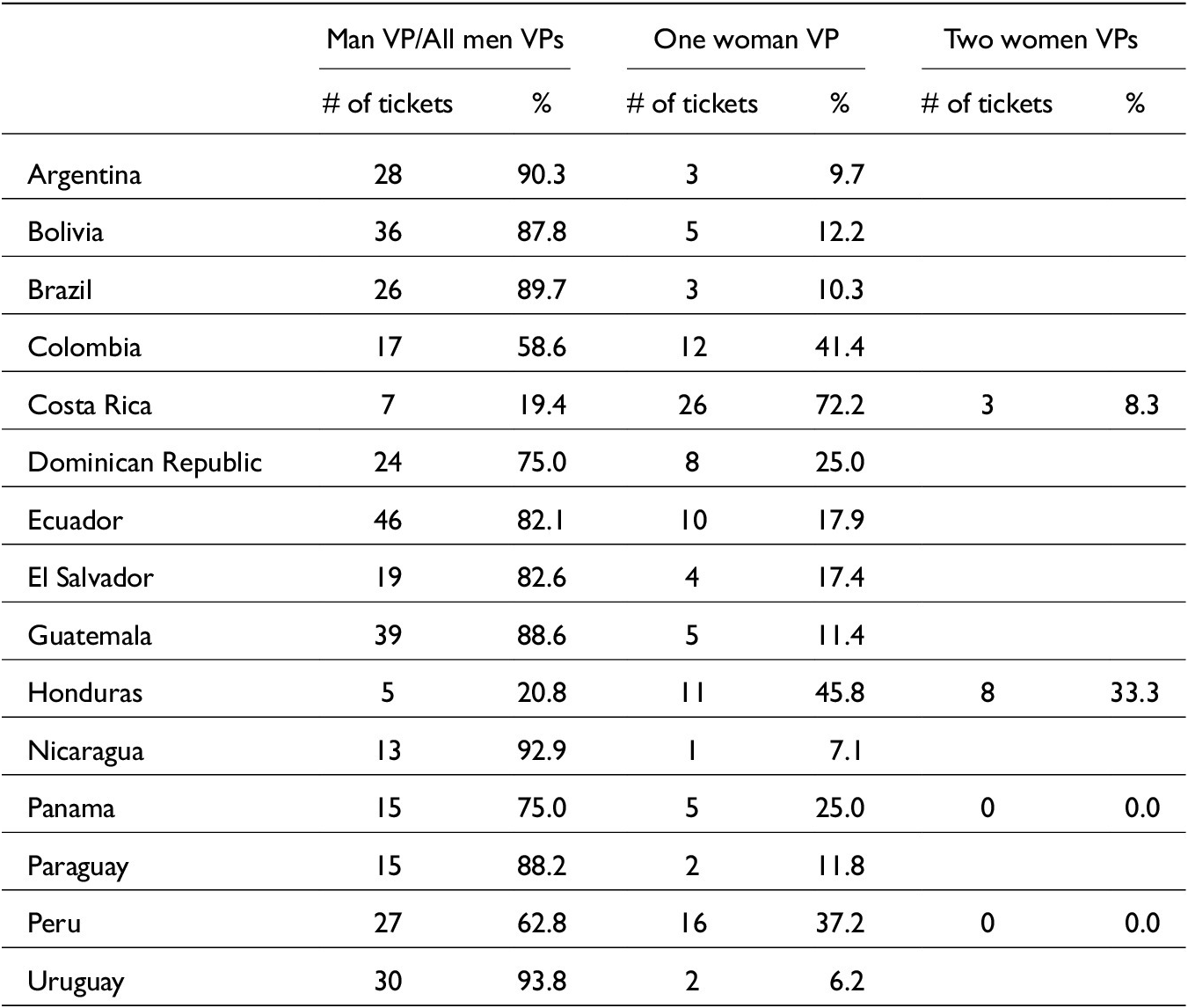
Using these criteria, there are 471 tickets in 134 elections of the 15 countries (Table A2 of the Supplementary Material breaks down this data by country). The tickets are self-gathered data based on primary information from the electoral management bodies and secondary sources such as books, articles, and newspapers. Overall, there have been 135 nominations of women to the vice presidency between 1978 and 2022 (recounting the women candidates who appeared multiple times). While some countries have more nominations than others because of the frequency of their elections, certain countries do because of having multiple vice-presidential slots: Costa Rica and Peru each have two VPs; Panama has one since the 2009 election, but previously had two; and Honduras has three.Footnote 4 For these reasons, Table 1 shows the relative composition of the tickets, alongside the absolute numbers. Around 72% of Costa Rica’s presidential tickets have one woman VP — the highest percentage in the sample. Honduras is the second country with more tickets with a woman as VP, but surpasses Costa Rica by having more tickets with two female vice-presidential candidates (33% versus 8%). The other countries with more than one VP (Panama and Peru) do not have a ticket with two women running mates. Among countries with one vice president, Colombia has the highest count of female vice-presidential candidates, while Argentina, Brazil, Nicaragua, and Uruguay — a very heterogeneous group of countries — the lowest.
Gender composition of tickets with 5% or more of the vote share by country

Table 1. Long description
The table is organized into seven columns: Country, Number of tickets with Man V P or All men V Ps, Percentage of tickets with Man V P or All men V Ps, Number of tickets with One woman V P, Percentage of tickets with One woman V P, Number of tickets with Two women V Ps, and Percentage of tickets with Two women V Ps.
* Argentina: 28 tickets (90.3%) with man V P; 3 tickets (9.7%) with one woman V P.
* Bolivia: 36 tickets (87.8%) with man V P; 5 tickets (12.2%) with one woman V P.
* Brazil: 26 tickets (89.7%) with man V P; 3 tickets (10.3%) with one woman V P.
* Colombia: 17 tickets (58.6%) with man V P; 12 tickets (41.4%) with one woman V P.
* Costa Rica: 7 tickets (19.4%) with man V P; 26 tickets (72.2%) with one woman V P; 3 tickets (8.3%) with two women V Ps.
* Dominican Republic: 24 tickets (75.0%) with man V P; 8 tickets (25.0%) with one woman V P.
* Ecuador: 46 tickets (82.1%) with man V P; 10 tickets (17.9%) with one woman V P.
* El Salvador: 19 tickets (82.6%) with man V P; 4 tickets (17.4%) with one woman V P.
* Guatemala: 39 tickets (88.6%) with man V P; 5 tickets (11.4%) with one woman V P.
* Honduras: 5 tickets (20.8%) with man V P; 11 tickets (45.8%) with one woman V P; 8 tickets (33.3%) with two women V Ps.
* Nicaragua: 13 tickets (92.9%) with man V P; 1 ticket (7.1%) with one woman V P.
* Panama: 15 tickets (75.0%) with man V P; 5 tickets (25.0%) with one woman V P; 0 tickets (0.0%) with two women V Ps.
* Paraguay: 15 tickets (88.2%) with man V P; 2 tickets (11.8%) with one woman V P.
* Peru: 27 tickets (62.8%) with man V P; 16 tickets (37.2%) with one woman V P; 0 tickets (0.0%) with two women V Ps.
* Uruguay: 30 tickets (93.8%) with man V P; 2 tickets (6.2%) with one woman V P.
Additionally, the database registers 40 female presidential candidates. Among them, only six have a woman as a running mate and five out of the six cases occur in a country with a multiple vice-presidential design. There is only one all-female ticket: Colombia’s Polo Democrático Alternativo in 2014.
It must be stressed that in three countries — Costa Rica, Peru, and Ecuador — the gender quotas apply to the presidential tickets, increasing the number of nominated women. From 1998 to 2010, Costa Rica’s Supreme Electoral Court, Tribunal Supremo de Elecciones (TSE), compelled parties to include at least one woman in any of the three slots (president plus two VPs) of the ticket (1996 amendment to article 60 of the 1952 Electoral Code; TSE resolution 1544-E-2001). Thus, unless there was a female presidential candidate (e.g., Laura Chinchilla in 2010), parties were enforced to nominate a woman to the vice presidency. However, when parity rule came into effect in 2014, at least one vice-presidential candidate had to be female, regardless of the gender of the presidential candidate (article 2 of the 2009 Electoral Code; TSE resolutions 3671-E8-2010 and 4757-E8-2021). Hence, because the executive gender quota perfectly predicts the presence of female vice-presidential candidates from 2014 to 2022, and almost perfectly from 1998 to 2010, these Costa Rican elections are excluded from the regression analysis of the tickets. Peru also applies a gender quota, introduced through a reform of article 104 of the Organic Law of Elections (Law 31030), requiring that presidential tickets include at least one woman and one man in alternating positions. The rule was first implemented with the 2021 election, which is likewise excluded from the analysis. Lastly, Ecuador applied a gender quota for the presidential ticket in 2023 based on the 2020 amendment to the Electoral Organic Law, Democratic Code (Ley Orgánica Electoral, Código de la Democracia), but this election is beyond the temporal boundary of the analysis.
Variables and Measurement
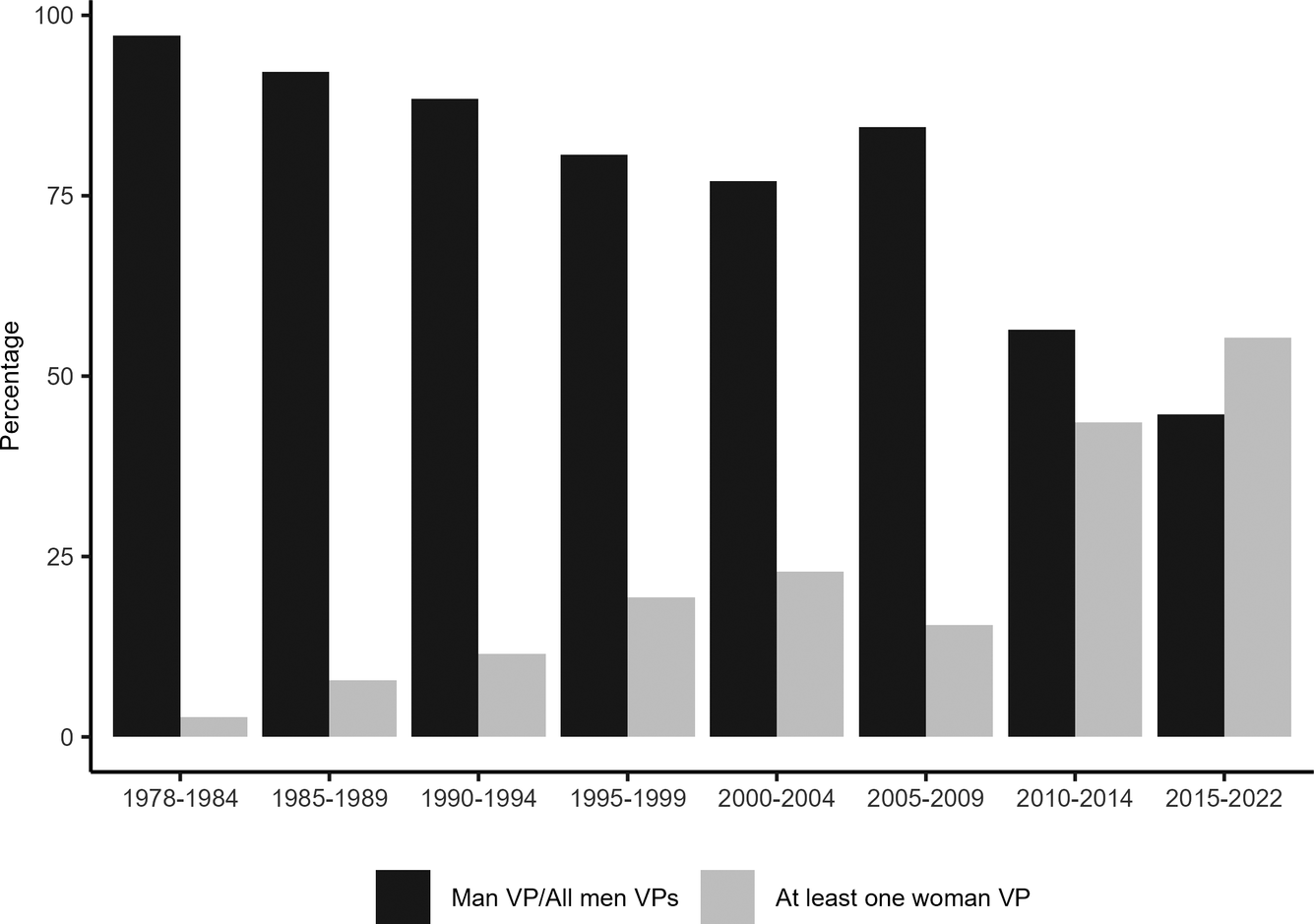
Using my database of presidential tickets in Latin America (1978–2022), I build a dependent variable that measures the presence of women in the vice-presidential slots, coding 1 when there is a female vice-presidential candidate (or more than one, in multiple vice-presidential tickets) and 0 when there is none. This variable reveals how much women candidates for the vice presidency have gained ground in Latin American politics, as seen in other arenas of representations such as legislatures, cabinets, and presidential nominations (Schwindt-Bayer Reference Schwindt-Bayer2018). While from 1978 to 2009 the percentage was less than 25%, female running mates surpass male nominees between 2015 and 2022 (Figure 1).
Gender composition of tickets among parties with 5% or more of the vote share in 15 Latin American countries.

Figure 1. Long description
The Y-axis represents Percentage from 0 to 100. The X-axis lists eight time intervals. Black bars represent Man V P forward slash All men V Ps, and light gray bars represent At least one woman V P.
* 1978-1984: Black bar is near 97 percent, gray bar is near 3 percent.
* 1985-1989: Black bar is near 92 percent, gray bar is near 8 percent.
* 1990-1994: Black bar is near 88 percent, gray bar is near 12 percent.
* 1995-1999: Black bar is near 81 percent, gray bar is near 19 percent.
* 2000-2004: Black bar is near 77 percent, gray bar is near 23 percent.
* 2005-2009: Black bar rises to near 84 percent, gray bar drops to near 16 percent.
* 2010-2014: Black bar drops significantly to near 56 percent, gray bar rises to near 44 percent.
* 2015-2022: Black bar drops to near 45 percent, while the gray bar becomes the majority at near 55 percent.
The overall trend shows a steady decline in all-male tickets and a corresponding increase in tickets with at least one woman vice president over the four-decade span.
For the institutional explanations ( H1 and H2 ), I include the size of the gender quotas at the time of the election, as reported by the Observatorio de Reformas Políticas en América Latina (Observatory of Political Reforms in Latin America 2022), cross-checked with Piscopo (Reference Piscopo2015) and Schwindt-Bayer (Reference Schwindt-Bayer2009), and the percentage of women elected to the lower or single legislative house in the previous election, based on data published by the Inter-Parliamentary Union (2018) and cross-checked with national sources when available (the descriptive statistics are available in Supplementary Material, Table A3).
The vote share of parties ( H3 ) comes either from national electoral bodies or from secondary sources. While the variable can be thought as endogenous to the presence of a woman VP, studies show that the effects of VPs on electoral outcomes are marginal (Dudley and Rapoport Reference Dudley and Rapoport1989; Grofman and Kline Reference Grofman and Kline2010). Moreover, relying on results from the previous election carries risks when measuring electoral support in Latin America, a region with high volatility, where parties grow, decay, and even die easily (Mainwaring and Su Reference Mainwaring and Su2021). Success in one election does not guarantee high support in the next one.
When coding parties ( H4 ), the incumbent parties are those elected in the last election, regardless if the president completed the term; otherwise, the party is a challenger.Footnote 5 If an unelected president finishes the term, as happens with vice presidents that serve as presidents after a resignation, impeachment, or death of the incumbent, and belongs to a different party, the party of the successor is not the incumbent party in my coding. The reasoning behind this choice is that, in my theory, challenger parties innovate facing the party that won the last election, not the party that rose to the presidency by a contingency. For instance, after the impeachment of Dilma Rousseff, her vice president Michel Temer completed the term. In my coding, the incumbent party in the next election is Rousseff’s Partido dos Trabalhadores, not Temer’s Movimento Democrático Brasileiro.
To examine if left-wing parties nominate more women to the vice presidency ( H5 ), I take advantage of Baker and Greene’s (Reference Baker and Greene2016) ideological classification of Latin American parties. This covers most of the parties in my database (and those that do not have a score are excluded from the analysis). The scale ranges from 1 (extreme left) to 20 (extreme right).
In addition, the models include controls drawn from the literature. First, because theories of cultural change (Inglehart and Norris Reference Inglehart and Norris2003) claim that economic development leads to social changes and to more open attitudes about women’s participation in politics, I include the (logged) GDP per capita, lagged one year, as reported by the World Bank (2021). Second, the models also control for years after female vote was granted, as this is related to culture attitudes toward women’s political rights (Jalalzai Reference Jalalzai2008; Norris Reference Norris2004); the years are obtained from national sources. Third, the multiple vice-presidential designs in Costa Rica, Honduras, Panama, and Peru are taken into account using indicator variables. This control is important because, applying the logic of legislative lists (Jones Reference Jones2009; Schwindt-Bayer Reference Schwindt-Bayer2009), when there are multiple vice presidents the value of each slot of the ticket decreases, raising the possibility that parties nominate a woman VP. Fourth, models include the electoral democracy index of V-Dem (Coppedge et al. Reference Coppedge2023) to account for differences in the democratic status of the Latin American countries. Even though the democratic or semi-democratic status was one selection criterion, the Latin American region is diverse regarding the quality of its democracies. It is important to control for this variation, given the possible relation between democracy and female inclusion (see Valdini Reference Valdini2019).
Turning now to the political qualifications of candidates, which relates to the second research question, in my database I identify 129 dyads of a male presidential candidate paired with a female vice-presidential candidate. When there is a ticket with more than one woman vice-president (11 tickets), there is a dyad for each pairing of male-female candidates. If a person is in more than one ticket, the nominee appears multiple times to acknowledge changes in the qualifications. This analysis, however, does not cover tickets with female presidential candidates, as it focuses on the question of what women VPs add to the tickets led by men.
Political experience ( H6 ) is coded according to the previous posts in the legislative and executive branches. The coding is based on the assumption that people in a higher position gather more political experience, knowledge, and recognition in five levels from none to very high (see Supplementary Material). Policy expertise ( H7 ) identifies fields of knowledge that can be applied in public policy, using the educational background and the professional experience for the coding (Escobar-Lemmon and Taylor-Robinson Reference Escobar-Lemmon and Taylor-Robinson2016, 80–1). When two fields are noticeable, both are coded; when there are more than two, I coded the most prominent one or the one related to the highest educational degree. Media framings are also counted, as when a politician is presented as an “expert” on certain topic. Overall, the coding of policy experience is holistic, based on all the sources available: institutional profiles, online newspapers, personal websites, and Wikipedia articles. This methodology assumes that the most prominent features are reported either by the media or by the politician her/himself. For example, if a person is not identified as a former legislator, the most likely explanation is that she or he wasn’t one, since the person has incentives to underline that prior experience in his or her résumé, website, or Wikipedia entry.
Results
Women on the Tickets
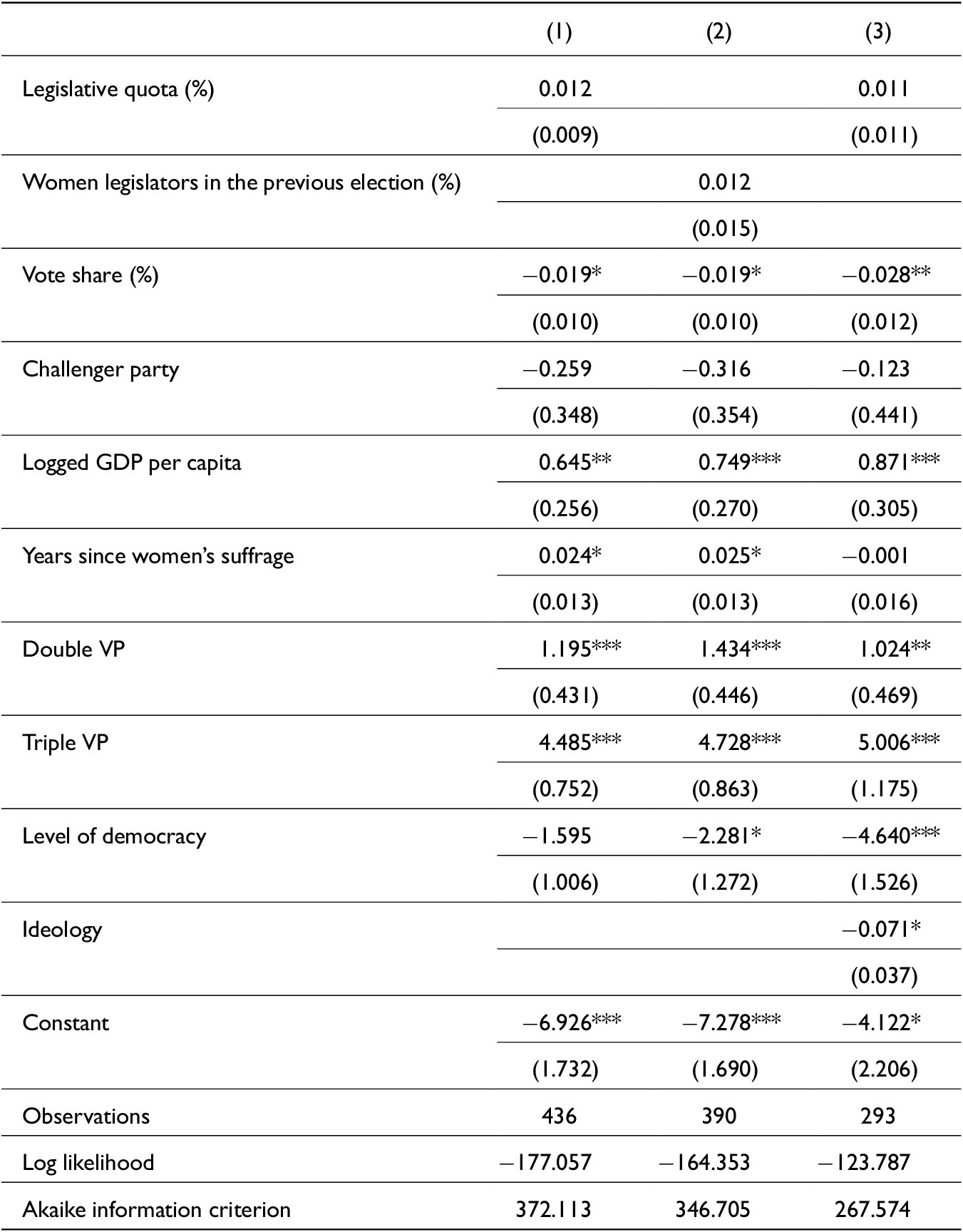
To analyze the inclusion of a woman (or more) as vice-presidential candidate(s) on a ticket, I estimate logistic regression models (Table 2) Model 1 includes the theoretical variables and controls but leaves aside the percentage of women legislators, which is analyzed in another model due to its high correlation with legislative quotas (r = 0.62). In this model, the vote share of the parties carries a negative sign, as expected, so that smaller parties are more likely to nominate women (p < 0.10). For example, the predicted probability for a party with 50% of the votes nominating a woman VP is 44% (95% CI: 29%–59%), while for a party with 10% of the votes is 63% (95% CI: 44%–78%), with all other variables at their means or modes. Contrary to expectations, legislative quotas do not translate into more women vice-presidential candidates, nor do challenger parties significantly nominate more female vice-presidential candidates than incumbents.
Logit models predicting the presence of (at least) one female vice-presidential candidate on the ticket
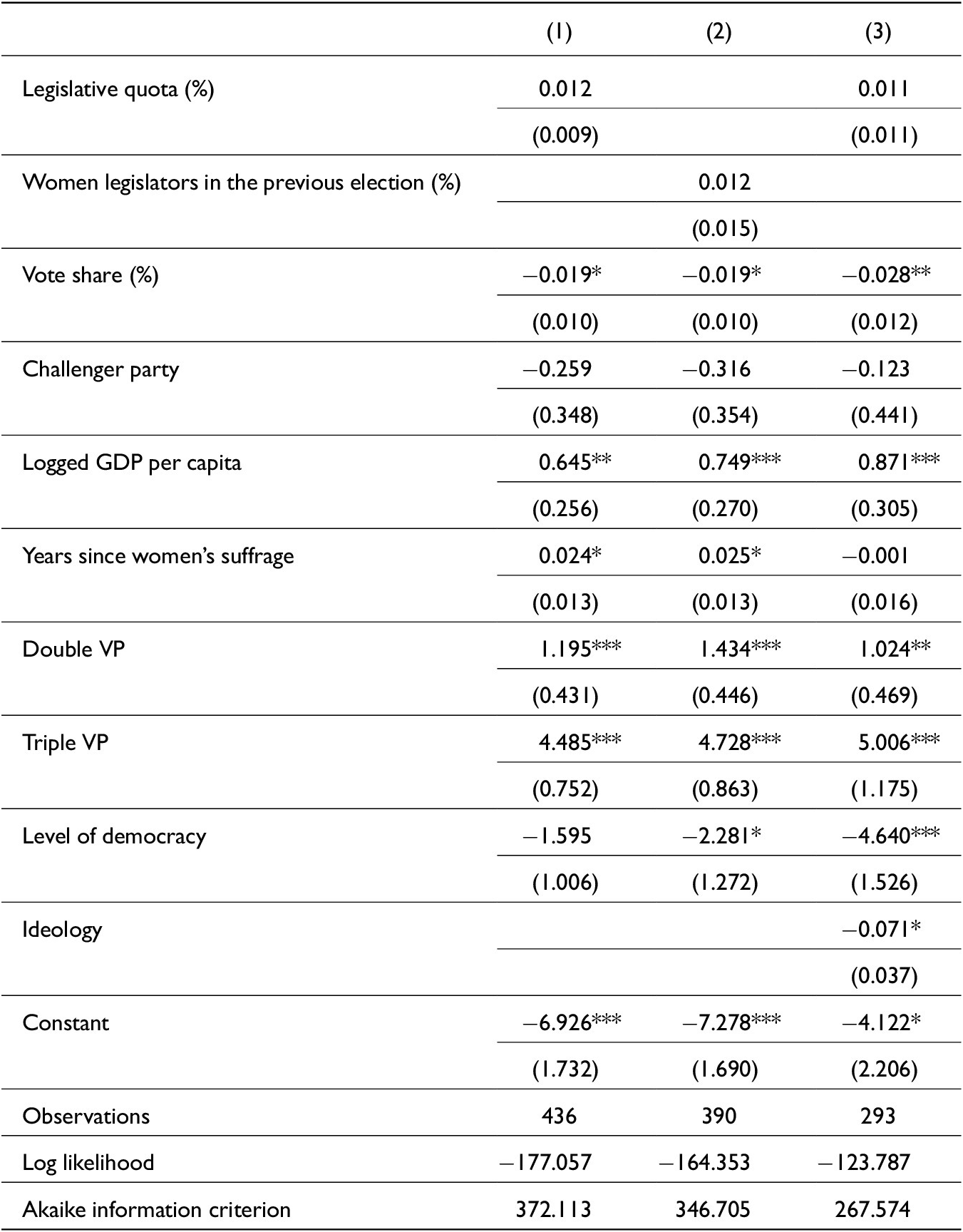
Table 2. Long description
The table consists of three columns labeled 1, 2, and 3, representing different logit model specifications. The rows list independent variables with their coefficients and standard errors in parentheses below.
- Legislative quota percentage: 0.012 in model 1 and 0.011 in model 3.
- Women legislators in the previous election percentage: 0.012 in model 2.
- Vote share percentage: negative 0.019 asterisk in models 1 and 2, and negative 0.028 double asterisk in model 3.
- Challenger party: negative 0.259 in model 1, negative 0.316 in model 2, and negative 0.123 in model 3.
- Logged G D P per capita: 0.645 double asterisk in model 1, 0.749 triple asterisk in model 2, and 0.871 triple asterisk in model 3.
- Years since women’s suffrage: 0.024 asterisk in model 1, 0.025 asterisk in model 2, and negative 0.001 in model 3.
- Double V P: 1.195 triple asterisk in model 1, 1.434 triple asterisk in model 2, and 1.024 double asterisk in model 3.
- Triple V P: 4.485 triple asterisk in model 1, 4.728 triple asterisk in model 2, and 5.006 triple asterisk in model 3.
- Level of democracy: negative 1.595 in model 1, negative 2.281 asterisk in model 2, and negative 4.640 triple asterisk in model 3.
- Ideology: negative 0.071 asterisk in model 3.
- Constant: negative 6.926 triple asterisk in model 1, negative 7.278 triple asterisk in model 2, and negative 4.122 asterisk in model 3.
Summary statistics at the bottom show:
- Observations: 436 for model 1, 390 for model 2, and 293 for model 3.
- Log likelihood: negative 177.057 for model 1, negative 164.353 for model 2, and negative 123.787 for model 3.
- Akaike information criterion: 372.113 for model 1, 346.705 for model 2, and 267.574 for model 3.
Significance levels are indicated as asterisk p less than 0.1, double asterisk p less than 0.05, and triple asterisk p less than 0.01.
Note: Standard errors in parentheses.
* p < 0.1; ** p < 0.05; *** p < 0.01.
In Model 1, the control variables indicate that per capita GDP significantly predicts a female vice-presidential candidate (p < 0.05), meaning that a higher socioeconomic development fosters women’s representation in the vice presidency. When female suffrage is older, parties are more likely to nominate women as VPs (p < 0.10). A double and triple vice-presidential design increases the probability of a female vice-presidential candidate (p < 0.01). Although the level of electoral democracy is negatively related with women VPs, the coefficient does not reach a traditional level of statistical significance.
Model 2 includes the percentage of elected women in the previous lower or single legislative chamber, missing some observations due to the absence of a legislative chamber in authoritarian periods before the first democratic elections. While this variable does not reach any conventional threshold of statistical significance, the coefficients and significance of the other predictors are stable. Model 3 includes the ideological position of parties, bringing back legislative quotas to the model specification. Because some scores in Baker and Greene’s (Reference Baker and Greene2016) classification are unavailable for older parties, the number of tickets is reduced. But even with fewer degrees of freedom, the coefficient has the expected negative sign with statistical significance (p < 0.10). Since a higher score means that the party is right-wing oriented, left-wing parties have higher probabilities of including women as vice-presidential candidates. For a party with a score of 4 there is a predicted probability of 74% (95% CI: 49%–89%) of having a female vice-presidential candidate, while for a party with a score of 16 the probability is 55% (95% CI: 34%–74%).
As robustness checks, I re-ran Model 1 with dummy variables for five-year periods to capture time effects and with dummies for countries (Supplementary Material, Table A4). The first additional model finds that elections held between 2010 and 2022 significantly predict more women candidates to the vice presidency (p < 0.05). In this model, GDP and years of female vote are not significant, presumably because they increase in time, so that the five-year periods capture their trends. Vote share (p < 0.10) and double and triple vice presidency retain their significance (p < 0.05). The second additional model, with indicator variables for each country — which excludes the controls for multiple vice presidency as they are mostly constant within countries — shows that vote share and years of female vote are significant (p < 0.01 and p < 0.05), and that their coefficients display the expected signs. The third additional model includes both ideology and country indicators, finding that both vote share and ideology remain statistically significant (p < 0.01 and p < 0.10). These specifications favor Models 1 and 3 as robust models since, even with the fixed effects that absorb the country variance, a lower vote share and a left ideology increase the likelihood of a female vice-presidential candidate.Footnote 6
Overall, models support hypotheses H3 and H5 in that lower electoral success and nomination by a left-wing party predict a higher probability of including a woman as vice president on the ticket. The evidence is scant regarding the impact of legislative quotas ( H1 ), the diffusion effects of legislative representation ( H2 ), and the innovation strategies of challenger parties picking a female running mate ( H4 ).
Several cases in the dataset illustrate these findings. In Argentina, two of the three female vice-presidential candidates were nominated by left-wing parties: Norma Morandini of Alianza Frente Amplio Progresista, and Cristina Fernández of Frente de Todos. In Ecuador, Teresa Minuche became the first woman candidate to the vice-presidency when nominated on the ticket of Concentración de Fuerzas Populares, a populist party that came in sixth place with 7.8% of the vote in the 1988 election. Out of the next nine female vice-presidential candidates in Ecuador, six were nominated by left-wing parties and all but one ticket got less than 25% of the vote (the exception being the ticket of Abdalá Bucaram and Rosalía Arteaga, which won the 1996 runoff election). In Paraguay, there are only two women vice-presidential candidates from major parties: Cynthia Brizuela, nominated by a left-wing party (Avanza País), which received 6% of the vote, and María Victoria Brusquetti from a right-wing party (Alianza Encuentro Nacional), which garnered 23% of the vote. These examples highlight that the relationship between party size, ideology, and the presence of women vice-presidential candidates is not deterministic but correlational.
What Women Bring to the Tickets
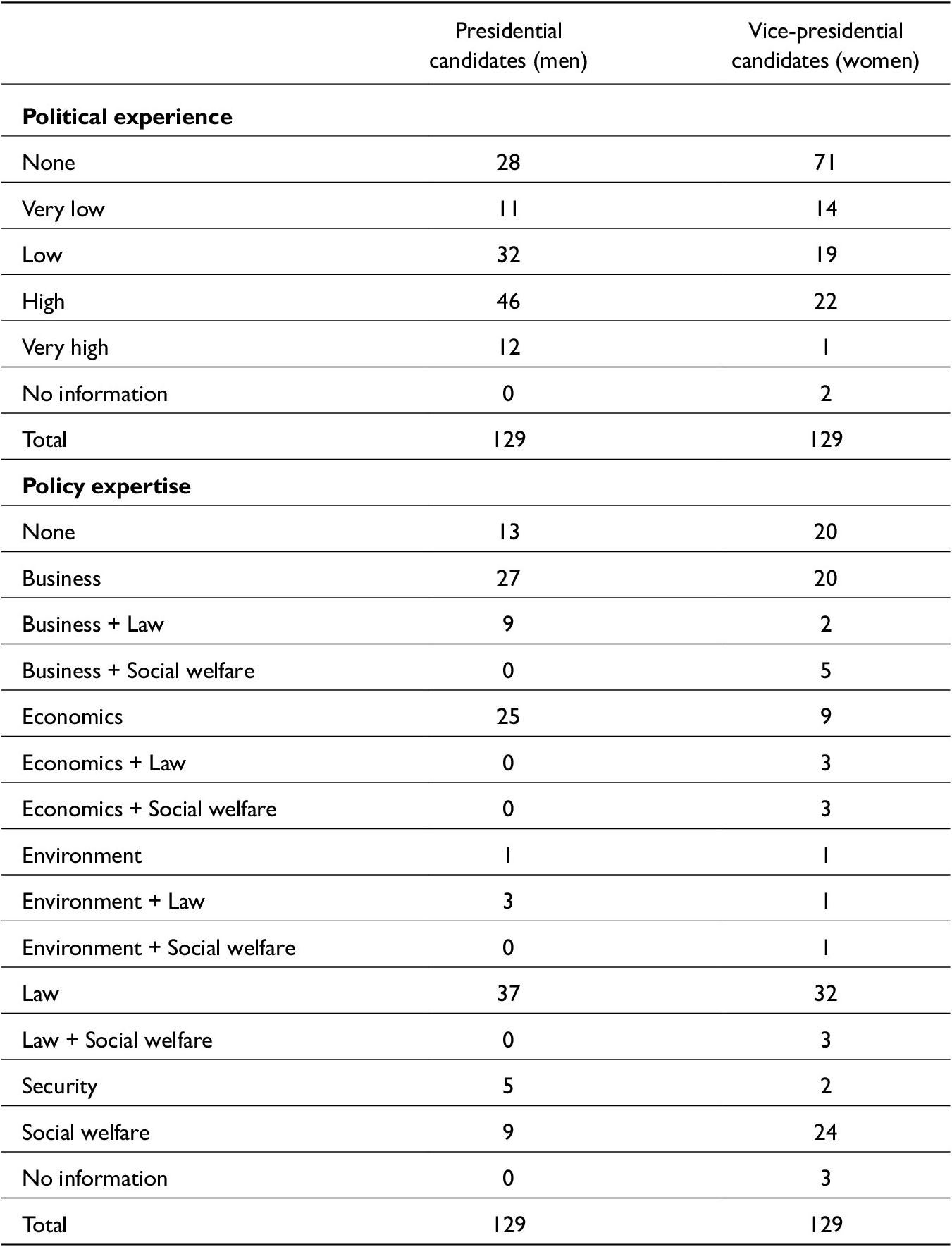
Table 3 compares the political experience of male presidential candidates with that of their female running mates.Footnote 7 Overall, men have more political experience than women candidates in their tickets: out of the 129 male presidential candidates, 46 have high political experience and only 28 have none, while 22 female vice-presidential candidates have high political experience and 71 have none.Footnote 8 Thus, as expected ( H6 ), women vice-presidential candidates have less political experience than the presidential candidates in their tickets. This difference should not be attributed to them being women, but rather to their lower-rank position, namely the vice presidency; however, since there is no comparison with male vice-presidential candidates, this remains an assumption until further analyses confirm it.
Qualifications on tickets composed of a male presidential candidate and a female vice-presidential candidate
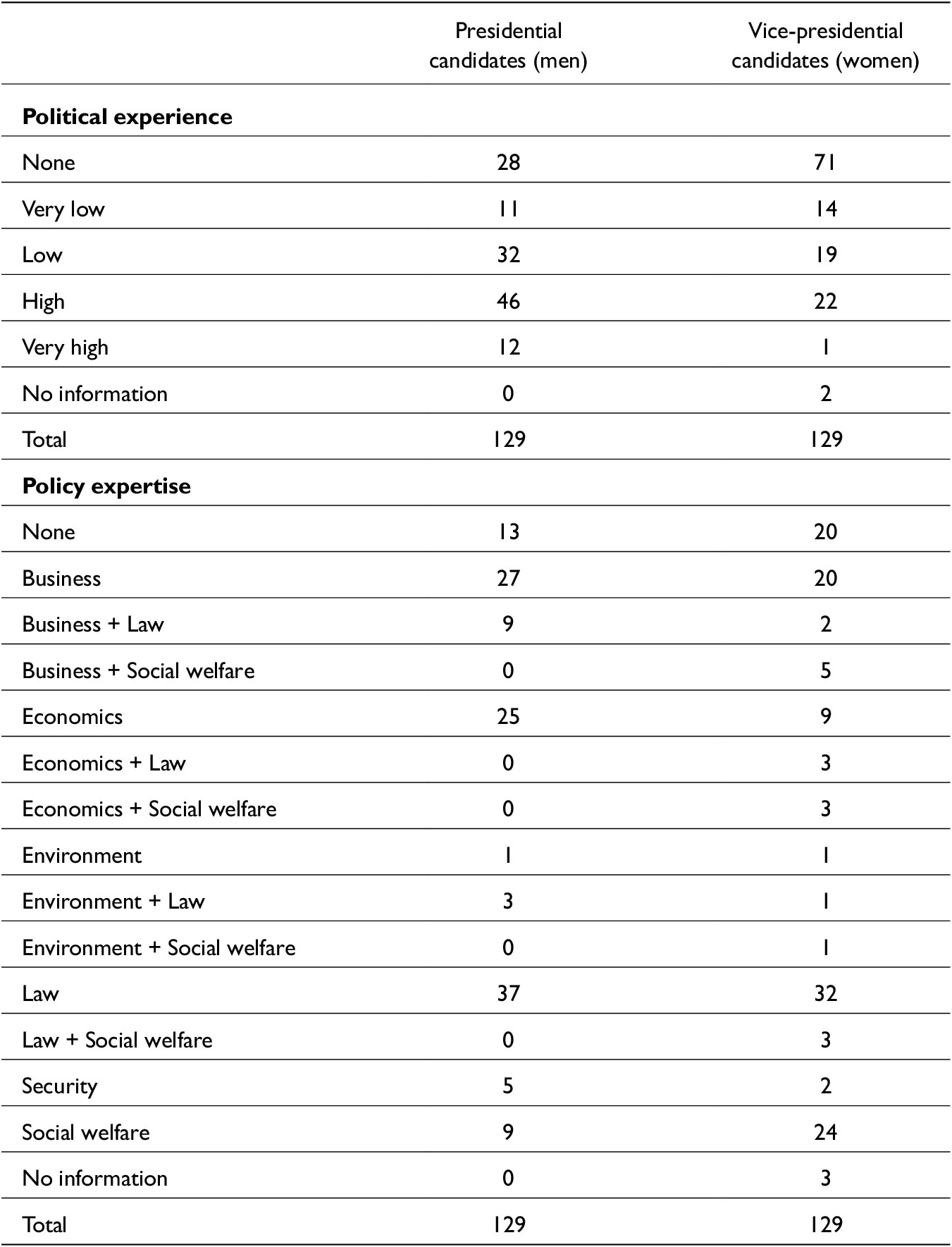
Table 3. Long description
The table is divided into two main sections.
Section 1: Political experience.
- None: 28 men, 71 women.
- Very low: 11 men, 14 women.
- Low: 32 men, 19 women.
- High: 46 men, 22 women.
- Very high: 12 men, 1 woman.
- No information: 0 men, 2 women.
- Total: 129 men, 129 women.
Section 2: Policy expertise.
- None: 13 men, 20 women.
- Business: 27 men, 20 women.
- Business plus Law: 9 men, 2 women.
- Business plus Social welfare: 0 men, 5 women.
- Economics: 25 men, 9 women.
- Economics plus Law: 0 men, 3 women.
- Economics plus Social welfare: 0 men, 3 women.
- Environment: 1 man, 1 woman.
- Environment plus Law: 3 men, 1 woman.
- Environment plus Social welfare: 0 men, 1 woman.
- Law: 37 men, 32 women.
- Law plus Social welfare: 0 men, 3 women.
- Security: 5 men, 2 women.
- Social welfare: 9 men, 24 women.
- No information: 0 men, 3 women.
- Total: 129 men, 129 women.
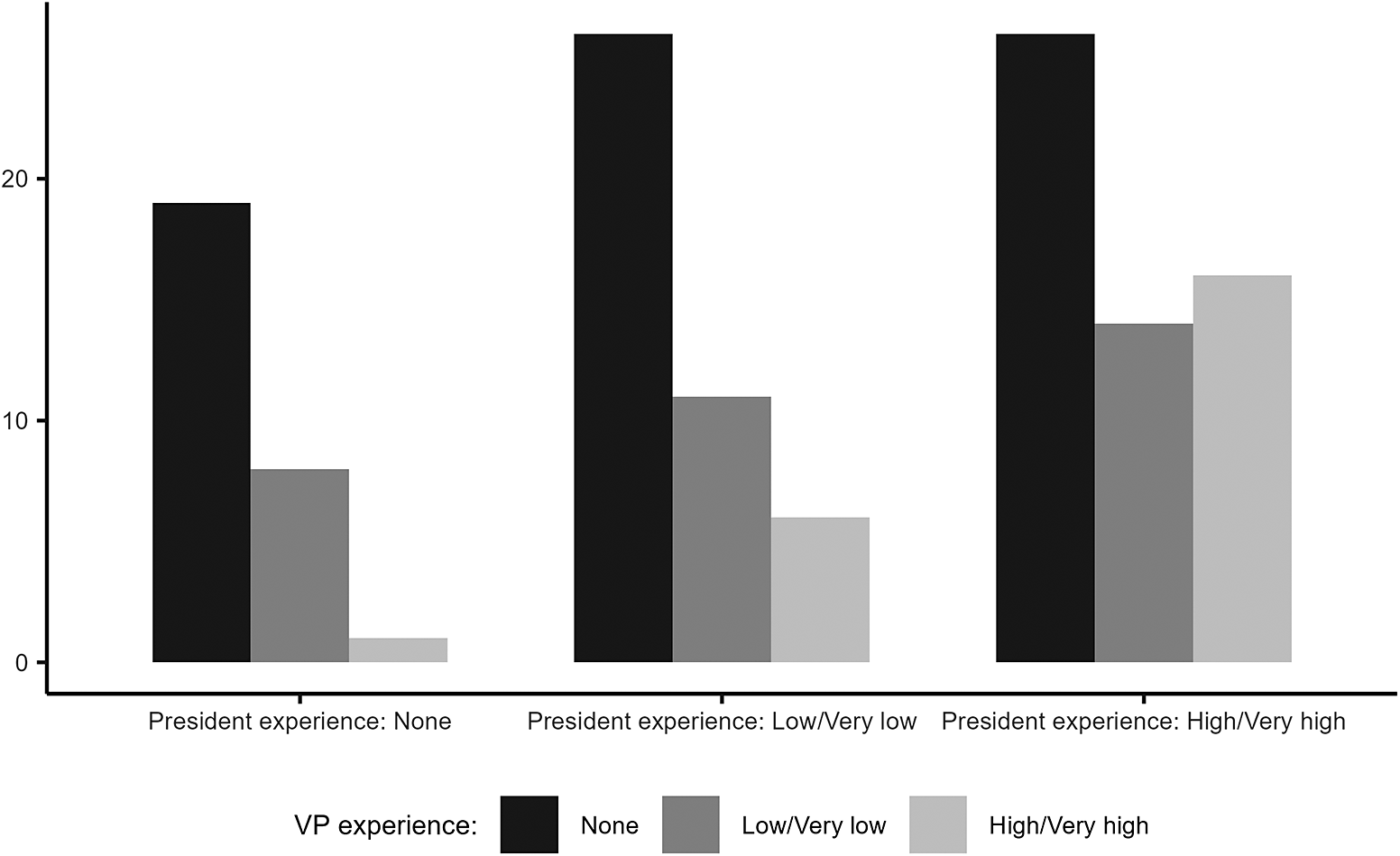
Interestingly, among tickets with male presidential candidates without any political experience — that is, outsiders — most female running mates lack experience as well, as Figure 2 shows. Yet, among men presidential candidates with high or very high experience, the quantity of female vice-presidential candidates with high political experience is greater than on the tickets in which men have low, very low, or null experience (although women without political experience are still the majority). Thus, there is a trend of tickets being homogeneous in terms of political experience.
Political experience of female vice-presidential candidates by political experience of male presidential candidates in the same ticket.
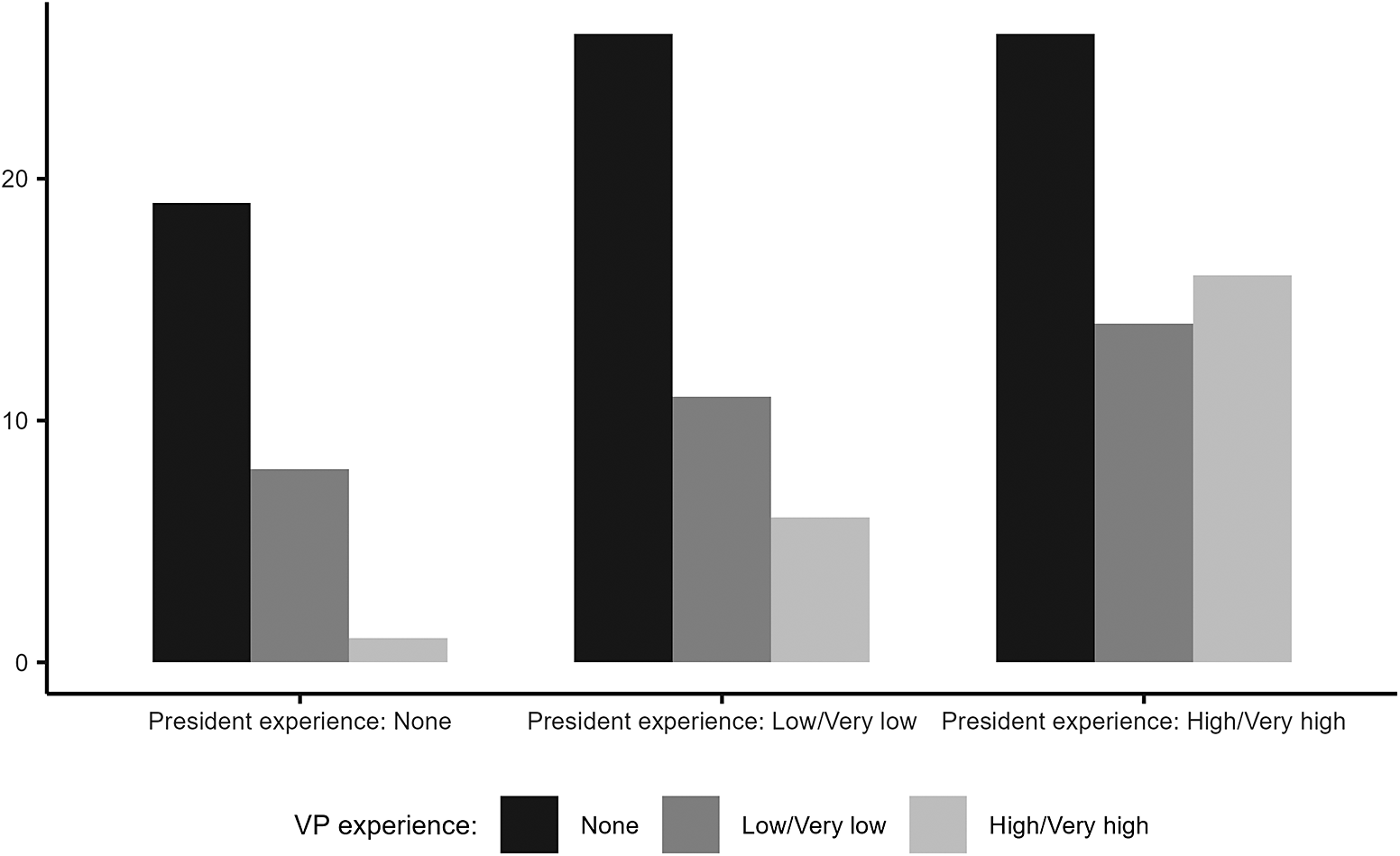
Figure 2. Long description
The y-axis represents a numerical count from 0 to over 20. The x-axis categorizes male presidential experience into three groups: None, Low or Very low, and High or Very high. A legend at the bottom identifies three shades for female V P experience: black for None, dark gray for Low or Very low, and light gray for High or Very high.
* In the President experience: None group, the black bar is highest at approximately 19, followed by dark gray at 8, and light gray at 1.
* In the President experience: Low or Very low group, the black bar peaks at approximately 26, followed by dark gray at 11, and light gray at 6.
* In the President experience: High or Very high group, the black bar is again highest at approximately 26, followed by light gray at 16, and dark gray at 14.
Across all categories, tickets most frequently feature female V P candidates with no prior political experience.
While women have less political experience than men, most female vice-presidential candidates have an identifiable policy field of expertise — only 20 out of 129 lack one, slightly more than the 13 male presidential candidates without such expertise (Table 3).Footnote 9 Some of the policy domains fit the stereotypical gender patterns (Escobar-Lemmon and Taylor-Robinson Reference Escobar-Lemmon and Taylor-Robinson2016): women are more frequently associated with social welfare, while men with economics and security. There are, however, similar numbers of men and women specialized in business and law. Also, there are combinations of fields unique to women: business + social welfare, economics + law, economics + social welfare, environment + social welfare, and law + social welfare. This shows that women’s areas of policy expertise are generally more diverse than those of men.
Furthermore, there are only 18 dyads (or 14%) where the (single or composite) policy expertise of the presidential and vice-presidential candidates is exactly the same. That is, in most cases (88, or 70%) women VPs complement the policy expertise credentials of the male candidates. For instance, Costa Rican presidential candidate Abel Pacheco, a psychiatrist, picked Lineth Saborío as VP, a lawyer with a security expertise; Jorge Quiroga, an MBA with expertise in economics, in his 2014 bid for the Bolivian presidency selected Tomasa Yarhui as VP, a former Minister of Peasant and Indigenous Affairs with expertise in law + social welfare. All in all, the data indicate that most women vice-presidential candidates are not tokens, since they usually add a different field of knowledge to the ticket, supporting H7 .
Because most women have a policy expertise, it could be expected that the elected VPs have actively contributed to the administrations. Even though the Latin American constitutions do not establish a uniform set of functions in the executive branch for the VPs (Supplementary Material, Table A1), there is evidence of women VPs with assigned tasks that go beyond the temporal substitution of the president and the traditional ceremonial and diplomatic roles of the vice presidency (e.g., attending national events, traveling to international summits, meeting with foreign leaders). Many of them have undertaken cabinet portfolios while in the vice presidency: Astrid Fischel (Costa Rica), Culture; Dina Boluarte (Peru), Development and Social Inclusion, before becoming President of the Republic after the exit of Pedro Castillo; Elizabeth Odio (Costa Rica), Environment; Francia Márquez (Colombia), Equality and Equity; Laura Chinchilla (Costa Rica), Justice; Lineth Saborío (Costa Rica), Planning; María Antonia Rivera (Honduras), Economic Development; Marta Lucía Ramírez (Colombia), Epsy Campbell (Costa Rica), and Isabel de Saint Malo (Panama), Foreign Relations; Mary Munive (Costa Rica), Sport and Health; Milagros Ortiz (Dominican Republic), Education; and Rebeca Grynspan (Costa Rica), Housing. In several cases, these posts align with the policy expertise of the VPs. For instance, de Saint Malo, a diplomat, was appointed to Foreign Relations; Márquez, a lawyer, environmentalist, and human rights activist, to Equality and Equity; Munive, a medical doctor, after a first nomination to Sport, was reassigned to Health.
Some women VPs have worked within the presidency, as Ministers of the Presidency (Lineth Saborío in Costa Rica and María Antonieta Guillén in Honduras), as Head of the Presidential Office (Marisol Espinoza in Peru), as coordinators of special presidential councils (Victoria Garrón, Rebeca Grynspan, Lineth Saborío, Ana Helena Chacón, Epsy Campbell, and Mary Munive in Costa Rica; Raquel Peña in Dominican Republic), and as President of the Council of the Ministers — that is, Prime Minister (Mercedes Aráoz in Peru).
Conversely, there are well-known cases of women VPs neglected by the president or in open conflict with him (for example, Cristina Fernández with Alberto Fernández, Verónica Abad with Daniel Noboa, and Victoria Villarruel with Javier Milei), whose policy expertise was wasted. Still, it has also happened to men VPs (Juan Carlos Varela with Ricardo Martinelli, Luis Fishman with Abel Pacheco, and Salvador Nasralla with Xiomara Castro, among others). More systematic research of VPs in office is needed to determine the existence of gendered patterns in the “types of partnerships” (Prémont Reference Prémont2024) between presidents and running mates.
Discussion and Conclusion
The vice presidency remains an understudied arena of gender representation, and the limited interest in female vice-presidential candidates cannot be justified by their historically low recurrence, as their numbers have grown over time. There is still much to learn by studying women VPs, and the prevalence of presidentialism in Latin America turns it into an ideal region for the comparative study of the vice presidency.
The analysis of 471 executive tickets from the main competitive parties in 15 Latin American countries with vice-presidential institutions shows that smaller parties with less chance of winning the election and greater incentives to take risks (Ryan, Haslam, and Kulich Reference Ryan, Haslam and Kulich2010) are more likely to nominate female vice-presidential candidates. In contrast, larger parties tend to stick to safer strategies, such as picking male running mates. As it happens with cabinet appointments (Escobar-Lemmon and Taylor-Robinson, Reference Escobar-Lemmon and Taylor-Robinson2005), left-wing parties are more likely to nominate a woman as a running mate. A multiple vice-presidential design (observed in four Latin American countries) increases the likelihood of nominating a woman VP, as VP slots are not unique and, therefore, less valuable to party elites. Challenger and incumbent parties, however, select women running mates at the same rates. Lastly, following theories of cultural modernization (Inglehart and Norris Reference Inglehart and Norris2003), higher levels of socioeconomic development and a longer history of female voting rights — which are positively associated with gender equality values — lead to more women nominees to the vice presidency. However, in contrast to the expectations derived from previous studies (Escobar-Lemmon and Taylor-Robinson Reference Escobar-Lemmon and Taylor-Robinson2005; Escobar-Lemmon and Funk Reference Escobar-Lemmon, Funk and Schwindt-Bayer2018; Jalalzai Reference Jalalzai2008; Piscopo Reference Piscopo2015), legislative quotas and female legislative representation do not predict more women vice-presidential candidates.
In addition, the article delved into the political qualifications of women vice-presidential candidates. The fact that women VPs have less political experience than the male presidential candidates on the same tickets does not contradict previous results about the equal qualifications of men and women in Latin American legislatures (Schwindt-Bayer Reference Schwindt-Bayer2011) and cabinets (Escobar-Lemmon and Taylor-Robinson Reference Escobar-Lemmon and Taylor-Robinson2016) because this paper compares men and women in two different positions: male presidential candidates and female vice-presidential candidates. Other projects should study the qualifications of women and men vice-presidential candidates to compare their careers, backgrounds, and expertise. The main point here is that, while most female vice-presidential candidates differ from their presidential counterparts of their tickets in their political trajectories, they are not unprepared. Among the 129 dyads of a male presidential candidate paired with a female vice-presidential candidate, the majority of women VPs have one or more areas of policy expertise and often complement the ticket with a policy field different from that of the male presidential candidate. Plus, there are plenty examples of women VPs in Latin America that have actively contributed to their administrations. Future research should analyze in more detail if presidents assign responsibilities to women VPs based on their areas of expertise, if they limit them to stereotypical female policy domains different than their own, or if they are neglected in the administrations at higher, equal, or lower rates than men VPs.
In sum, these results underline the strategic context in which parties nominate women. Powerful positions are harder to reach for women (Jalalzai Reference Jalalzai2008). Yet, while the vice presidency is a relatively more marginal position compared to other posts, men still outnumber women. Men only relinquish the running mate slot when the parties have lower chances of succeeding, or when the position is one of many (i.e., a multiple vice-presidential design), as they hold on to all arenas of representation — not only to the most alluring ones. With the exception of Costa Rica and, more recently, Ecuador and Peru, quotas have not been applied to executive tickets, meaning that the institutional effects are outweighed by partisan considerations.
The vice presidency entails opportunities for women in politics, nevertheless. First, women VPs might expand their political resources — experience, connections, and public recognition — when in government, benefiting their careers and even improving their credentials as potential presidential candidates — although the position could also harm their future in politics if they are associated with an unpopular government. Second, women VPs could inspire other women to engage in politics (Muñoz-Muñoz Reference Muñoz-Muñoz2023; Wolbrecht and Campbell Reference Wolbrecht and Campbell2007), while at the same time they make the all-male tickets look bad. For instance, in Costa Rica’s election of 1998, Miguel Ángel Rodríguez nominated two women to the vice presidency, exceeding the quota of one woman; after that, José Miguel Corrales, his main adversary, nominated two women as well, even though he previously stated that he would nominate a man and a woman (“Ahora juegan las damas” [Now, it’s the women’s turn to play] 1997). Finally, the vice presidency can enhance the descriptive representation of other politically marginalized groups (Pignataro and Taylor-Robinson Reference Pignataro and Taylor-Robinson2021). The cases of vice presidents Epsy Campbell in Costa Rica and Francia Márquez in Colombia — alongside Kamala Harris in the US — as Black women, and of Gabriela Michetti in Argentina as a woman with a physical disability, are exemplary.
Women VPs, however, are placed in a difficult position. Morgan and Hinojosa say that “having female presidential candidates at the helm has only rarely led to the transformation of party priorities toward feminist or even feminine concerns” (Reference Morgan, Hinojosa and Schwindt-Bayer2018, 90). If that’s true for the presidency, even more so for the vice presidency — a position with vastly inferior powers in which the number and the significance of their duties largely depend on the will of the president. Certainly, several women VPs in Latin America perform meaningful and visible tasks in government, particularly as cabinet ministers. Nonetheless, it would be deceptive and unfair to expect transformative agendas driven by women in the vice presidency, for the same is not expected from men in the same office.
Supplementary material
The supplementary material for this article can be found at http://doi.org/10.1017/S1743923X25100123. The databases are available at Harvard Dataverse, https://doi.org/10.7910/DVN/HQ1IDD.
Acknowledgments
I thank the three anonymous reviewers of this journal for their insightful observations, as well as the participants of the panel at the 81st Annual Midwest Political Science Association Conference where I presented a previous version of this paper. Darío Euraque, Juan Manuel Muñoz Portillo, Magdalena Rivarola, and Ricardo Córdova provided information about some hard-to-find presidential tickets, while research assistant Catalina Monge Rubí contributed by compiling the biographical information of the candidates, and I am grateful for their help.
Funding statement
This article is the result of research projects C1005 and C3146, both funded by the Centro de Investigación y Estudios Políticos and the Escuela de Ciencias Políticas at the Universidad de Costa Rica.