





Introduction
Italian ryegrass is a major weed in wheat production worldwide, and is reported to reduce wheat grain yields as much as 92% (Appleby and Brewster Reference Appleby and Brewster1992; Bararpour et al. Reference Bararpour, Norsworthy, Burgos, Korres and Gbur2017; Hashem et al. Reference Hashem, Radosevich and Roush1998; Liebl and Worsham Reference Liebl and Worsham1987). This species exhibits high genetic diversity, leading to wide plasticity in plants as well as seed traits that allow for wide adaptability (Maity et al. Reference Maity, Singh, Martins, Ferreira and Bagavathiannan2021a, Reference Maity, Singh, Jessup and Bagavathiannan2021b; Terrell Reference Terrell1968). In the United States, this species is an important weed in small grain production across several states, including Oregon (Appleby and Brewster Reference Appleby and Brewster1992; Appleby et al. Reference Appleby, Olson and Colbert1976), Washington (Lyon et al. Reference Lyon, Huggins and Spring2016), North Carolina (Liebl and Worsham Reference Liebl and Worsham1987), and Texas (Stone et al. Reference Stone, Cralle, Chandler, Miller and Bovey1999). In Texas, Italian ryegrass is a dominant weed throughout the wheat production areas in the Blacklands Prairie (Singh et al. Reference Singh, Maity, Abugho, Swart and Bagavathiannan2020).
Italian ryegrass has a high capacity for herbicide resistance evolution. At present, resistance has been documented in this species across 18 U.S. states to six herbicide sites of action (SOAs), namely aacetyl coenzyme-A carboxylase (ACCase) inhibitors, acetolactate synthase (ALS) inhibitors, 5-enolpyruvylshikimate-3-phosphate synthase inhibitors, glutamine synthetase inhibitors, very long-chain fatty acid inhibitors, and photosystem-I electron diverters (Heap Reference Heap2022). Furthermore, cases of multiple herbicide resistance, especially to ACCase- and ALS-inhibitors have also been widely reported in this species (Chandi et al. Reference Chandi, York, Jordan and Beam2011; Eleni et al. Reference Eleni, Tal and Rubin2000; Kuk et al. Reference Kuk, Burgos and Scott2008; Liu et al. Reference Liu, Hulting and Mallory-Smith2016; Singh et al. Reference Singh, Maity, Abugho, Swart and Bagavathiannan2020). This situation has coincided with a lack of new herbicide SOAs commercialized in recent years. There is a critical need for developing integrated weed management (IWM) strategies that include both chemical and non-chemical tools for minimizing the selection pressure imposed by any single management tool (Norsworthy et al. Reference Norsworthy, Ward, Shaw, Llewellyn, Nichols, Webster, Bradley, Frisvold, Powles, Burgos, Witt and Barrett2012; Swanton and Weise Reference Swanton and Weise1991; Thill et al. Reference Thill, Lish, Callihan and Bechinski1991). In particular, a strong focus on soil seedbank management is invaluable for resistance management, and in this regard, managing seed rain from weed escapes is an important component (Bagavathiannan and Norsworthy Reference Bagavathiannan and Norsworthy2012).
Weed seedbank enrichment primarily occurs via seed rain from weed escapes, which occurs through seed shattering before crop harvest and seed dispersal at harvest by the harvest equipment (Walsh et al. Reference Walsh, Broster, Schwartz-Lazaro, Norsworthy, Davis, Tidemann, Beckie, Lyon, Soni, Neve and Bagavathiannan2018). Two opportunities exist to control seeds produced in weed escapes and minimize seedbank inputs. First, any retained weed seed can be intercepted with the combine harvester and subsequently destroyed or removed from the field using methods collectively known as harvest weed seed control (HWSC; Walsh et al. Reference Walsh, Newman and Powles2013). Second, the amount of shattered/dispersed seed added to the soil seedbank can be minimized by encouraging seed predation and other seed loss processes (Bagavathiannan and Norsworthy Reference Bagavathiannan and Norsworthy2013; Forcella Reference Forcella2003; Gallandt Reference Gallandt2006; Liebman et al. Reference Liebman, Mohler and Staver2001; Westerman et al. Reference Westerman, Wes, Kropff and Van Der Werf2003, Reference Westerman, Borza, Andjelkovic, Liebman and Danielson2008). When combined with effective herbicide programs, these tactics may greatly reduce long-term weed population sizes and help prolong the utility of available herbicide options.
For Italian ryegrass, HWSC may be an effective strategy for minimizing inputs to seedbank from escapes (Bagavathiannan and Maity Reference Bagavathiannan and Maity2020). This approach has been effective in managing rigid ryegrass (Lolium rigidum Gaud.), a species closely related to Italian ryegrass, in Australian winter grain production (Walsh et al. Reference Walsh, Broster, Schwartz-Lazaro, Norsworthy, Davis, Tidemann, Beckie, Lyon, Soni, Neve and Bagavathiannan2018). Across Australian cropping systems, up to 80% of rigid ryegrass seeds can be collected and destroyed during crop harvest (Walsh and Powles Reference Walsh and Powles2007; Walsh et al. Reference Walsh, Harrington and Powles2012, Reference Walsh, Newman and Powles2013). Walsh et al. (Reference Walsh, Ouzman, Newman, Powles and Llewellyn2017a) reported that some type of HWSC tactic was adopted by 43% of growers across different cropping systems in Australia. Among the HWSC variants such as narrow-windrow burning, chaff lining, chaff tramlining, bale-direct systems, and weed seed impact mills (Shergill et al. Reference Shergill, Bejleri, Davis and Mirsky2020a), narrow-windrow burning is relatively inexpensive compared to other HWSC methods, and has been extensively practiced in Australia (Walsh Reference Walsh, Ouzman, Newman, Powles and Llewellyn2017a). With narrow-windrow burning, weed seeds and crop residues exiting from the combine harvester are concentrated in narrow lines in the field, which are subsequently burned to destroy the weed seeds present within it. In the United States, HWSC tactics such as narrow-windrow burning have enormous potential for adoption in various cropping systems (Shergill et al. Reference Shergill, Schwartz-Lazaro, Leon, Ackroyd, Flessner, Bagavathiannan, Everman, Norsworthy, VanGessel and Mirsky2020b).
The effectiveness of HWSC, however, is highly influenced by the degree to which weed seeds are retained at the time of crop harvest (Walsh and Powles Reference Walsh and Powles2014). In Washington state, Italian ryegrass is reported to have shattered approximately 42% of the total seed by wheat harvest (Walsh et al. Reference Walsh, Broster, Schwartz-Lazaro, Norsworthy, Davis, Tidemann, Beckie, Lyon, Soni, Neve and Bagavathiannan2018). Under controlled greenhouse conditions in College Station, Texas, Italian ryegrass seed shattering at full maturity ranged from 5% to 54% among different biotypes without any crop competition (Maity et al. Reference Maity, Singh, Martins, Ferreira and Bagavathiannan2021a), but the upper range of seed shattering could be much higher under field environments. The degree of weed seed shattering can also vary across different geographical locations (Schwartz-Lazaro et al. Reference Schwartz-Lazaro, Shergill, Evans, Bagavathiannan, Beam, Bish, Bond, Bradley, Curran, Davis, Everman, Flessner, Haring, Jordan, Korres, Lindquist, Norsworthy, Sanders, Steckel, VanGessel, Young and Mirsky2021).
Post-dispersal loss through predation by animals, microbial decay, and natural death is an inevitable fate of weed seeds in arable lands, which can greatly impact weed population dynamics (Gallandt Reference Gallandt2006; Liebman et al. Reference Liebman, Mohler and Staver2001). With the growing threat of herbicide-resistant weeds, there is an urgent need for alternative strategies (Norsworthy et al. Reference Norsworthy, Ward, Shaw, Llewellyn, Nichols, Webster, Bradley, Frisvold, Powles, Burgos, Witt and Barrett2012), including the enhancement of post-dispersal seed loss (Westerman et al. Reference Westerman, Wes, Kropff and Van Der Werf2003, Reference Westerman, Borza, Andjelkovic, Liebman and Danielson2008). After grain harvest, allowing the weed seeds to remain on the soil surface for some duration by delaying the post-harvest tillage operation can encourage weed seed predation by granivores (Bagavathiannan and Norsworthy Reference Bagavathiannan and Norsworthy2013).
There is a vital need to develop multitactic strategies for sustainable management of Italian ryegrass in the south-central United States. The current study assesses the long-term efficacy of narrow-windrow burning (hereafter HWSC) and postharvest tillage timing, in combination with herbicide programs, for managing Italian ryegrass in wheat.
Materials and Methods
Experimental Location and Treatment Details
A 4-yr study (2016 to 2019) was conducted in two south-central U.S. locations: College Station, Texas, and Newport, Arkansas. The Texas study location has mild winters and hot and humid summers, with monthly average temperatures ranging from 5 to 36 C, and average annual precipitation of 1,020 mm. The soil type at the Texas location was a clay loam. The Arkansas site (silty loam soil) is also characterized by hot and humid summers, but with relatively colder winters compared to the Texas site; the monthly average temperature ranges from −1.7 to 32.2 C, with an average annual rainfall of 1,260 mm. Fields were selected with a history of good Italian ryegrass infestation (average 20 to 30 plants m−2) so that the efficacy of the treatments could be adequately evaluated.
The experiments were arranged in a split-plot design with four replications, with three levels of harvest-time and postharvest treatments in Texas and two levels of harvest-time treatments in Arkansas as main plots, and two levels of herbicide programs as subplots. Each subplot measured 12 m × 70 m in both locations. The treatment structure differed slightly between the two locations to reflect local production scenarios. At the Texas site, wheat was grown as a monocrop each year, and the field was left fallow between wheat harvest in late May and subsequent planting in early November. In Arkansas, a wheat-soybean [Glycine max (L.) Merr.] double-cropping system was followed. In this system, a late-maturity soybean (Group IV) cultivar is planted immediately following wheat harvest (early July), and harvested before wheat planting in late fall (late October).
The main plot treatments in Texas were 1) no HWSC + disk tillage immediately after harvest (hereafter Conventional), 2) HWSC (Figure 1) + disk tillage immediately after harvest (hereafter Burn), and 3) HWSC + disk tillage 1 mo after harvest (hereafter Burn+late disk). The two subplot treatments consisted of A) pendimethalin (1,065 g ai ha−1; Prowl H2O®) at delayed preemergence (PRE) approximately 5 d after wheat planting (hereafter DPRE), and B) a premix of flufenacet (305 g ai ha−1) + metribuzin (76 g ai ha−1; Axiom® DF) mixed with pyroxasulfone (89 g ai ha−1; Zidua® WG) as an early postemergence (POST) application at the 1- to 2-leaf stage of Italian ryegrass, followed by pinoxaden (59 g ai ha−1; Axial® XL) postemergence in spring (hereafter EPOST+POST). The DPRE+Conventional plots were used as a check to compare to the IWM treatments. Because soybean is planted immediately after wheat harvest in Arkansas, unlike in Texas where the field is usually left fallow, the main-plot treatment of Burn+late disk was omitted. All other treatments remained the same at the Arkansas site.
A) narrow-windrow formation, and B) narrow-windrow burning as a harvest weed seed control tactic implemented for Italian ryegrass management in the experiment.

In each year, the seedbed was prepared using conventional tillage ahead of wheat planting. Wheat cultivar ‘Cedar’ (56 kg ha−1) was drilled at 15-cm row spacing in late October and early November, respectively in Texas and Arkansas. At the Arkansas site, a late-maturity group glufosinate-resistant (LibertyLink®) soybean cultivar was planted during early July and harvested in late October each year; an herbicide program consisting of S-metolachlor (1,070 g ai ha−1; Dual II Magnum®) PRE followed by glufosinate (594 g ai ha−1; Liberty®) + S-metolachlor (1,216 g ai ha−1) + fomesafen (266 g ai ha−1; Prefix®) POST was implemented in the soybean phase of the rotation. Other agronomic practices followed the wheat production practices recommended for each location (Kelly Reference Kelly2021; Kimura et al. Reference Kimura, Bell, Trostle and Neely2017). At grain maturity, wheat was harvested using a commercial-scale combine harvester (9.14-m header width) fitted with a chute at the rear to make the narrow windrows.
Data Collection
Italian Ryegrass Density. Italian ryegrass plant density in each plot was recorded twice each year, late fall (before frost) and early summer (wheat maturity stage), in seven 1- m2 quadrats representing the Italian ryegrass density for the plot. In DPRE+Conventional plots, it was difficult to identify the base of individual Italian ryegrass plants at wheat maturity; therefore, the total number of reproductive tillers (with spike) within each quadrat were counted for all the treatments as a measure of Italian ryegrass density.
Fecundity. Total mature Italian ryegrass seed produced in seven random quadrats (1 m2) within each plot was nondestructively estimated immediately before wheat harvest each year. To do so, 100 randomly selected Italian ryegrass mature spikes were harvested from the field buffer areas before seed shattering in both locations during 2017 and 2018. The spike length and number of seeds produced were recorded for each spike and a mathematical relationship was established for determining potential seed production for a given spike length. In each of the seven quadrats/plot, the length of 10 random spikes was measured using a ruler. Additionally, seed shattering percentage at this time of observation was visually estimated for each plot. Fecundity was calculated as follows:
Fecundity m−2 = spike count m−2 × average spike length (cm) × seed count cm−1 of spike
Seed Shattering Phenology. Italian ryegrass seed retention before wheat harvest is an important determinant of HWSC efficacy. The seeds retained on the Italian ryegrass plant during wheat harvest reflect the proportion of seeds that can be targeted by HWSC. For this purpose, seven Italian ryegrass plants were randomly selected in the buffer area of the experimental field during the early stages of Italian ryegrass seed maturity. A set of four trays, each of 0.1-m2 area, were placed on the ground, covering the base of each of the seven plants. The plants were tied to wooden stakes to prevent lodging as if they were surrounded and supported by wheat plants within a field. The trays were observed at weekly intervals and any shattered seeds were extracted from the trays and counted. This activity was continued until 8 wk past the first opportunity to harvest wheat. At the termination of the experiment, Italian ryegrass spikes were harvested from each plant, threshed, and the number of seeds still retained on the plant was counted.
Soil Seedbank
Soil samples were collected at the end of the study (October 2019) to determine differences in soil seedbank size across the treatments, 4 yr after initiation of the experiment. In each plot, 16 random soil cores (15 cm depth and 13 cm diameter) across the entire plot were collected, and four cores were pooled into a single composite sample, thus yielding four total composite soil samples per plot. Any already emerged Italian ryegrass seedlings in the soil cores at the time of collection were counted. The soil samples were spread in plastic trays in a greenhouse at 25 ± 2 C and 14-h photoperiod to quantify Italian ryegrass seedling emergence and in turn seedbank density. The soil in the trays was inverted every 15 d for three cycles to stimulate new seedling emergence.
Wheat Grain Yield
Wheat grain yield was determined in each plot from a single pass (15 m long × 9.1 m wide, 139 m2) of the combine harvester at the first practical harvest opportunity in both locations. A grain bag was attached to the transfer auger of the combine harvester to capture all the grain harvested from the swath. After harvesting, grain bags were brought back to the laboratory and wheat seeds were cleaned to remove foreign material before determining wheat grain yield.
Data Analysis
All data were analyzed using JMP PRO 15.0 software (SAS Institute Inc., Cary, NC). Before conducting all statistical tests, data were checked for normality using the Shapiro-Wilk test. No transformations were required. Because the main-plot treatments were different between the two locations, data for the two study locations were analyzed separately. Analysis of variance was conducted by considering the herbicide program and the harvest-time and postharvest-time operations as the fixed factors, to examine the effect of various treatments on Italian ryegrass density, fecundity, soil seedbank size, and other variables. The error term specific to the split-plot design was used in the model. Treatment means were separated based on Tukey’s honestly significant difference test at α = 0.05. Cumulative seed shattering values over the 2 mo were fit to a three-parameter sigmoidal curve using the SigmaPlot software version 14.0 (Systat Software, Inc., San Jose, CA).
Results and Discussion
Italian Ryegrass Density
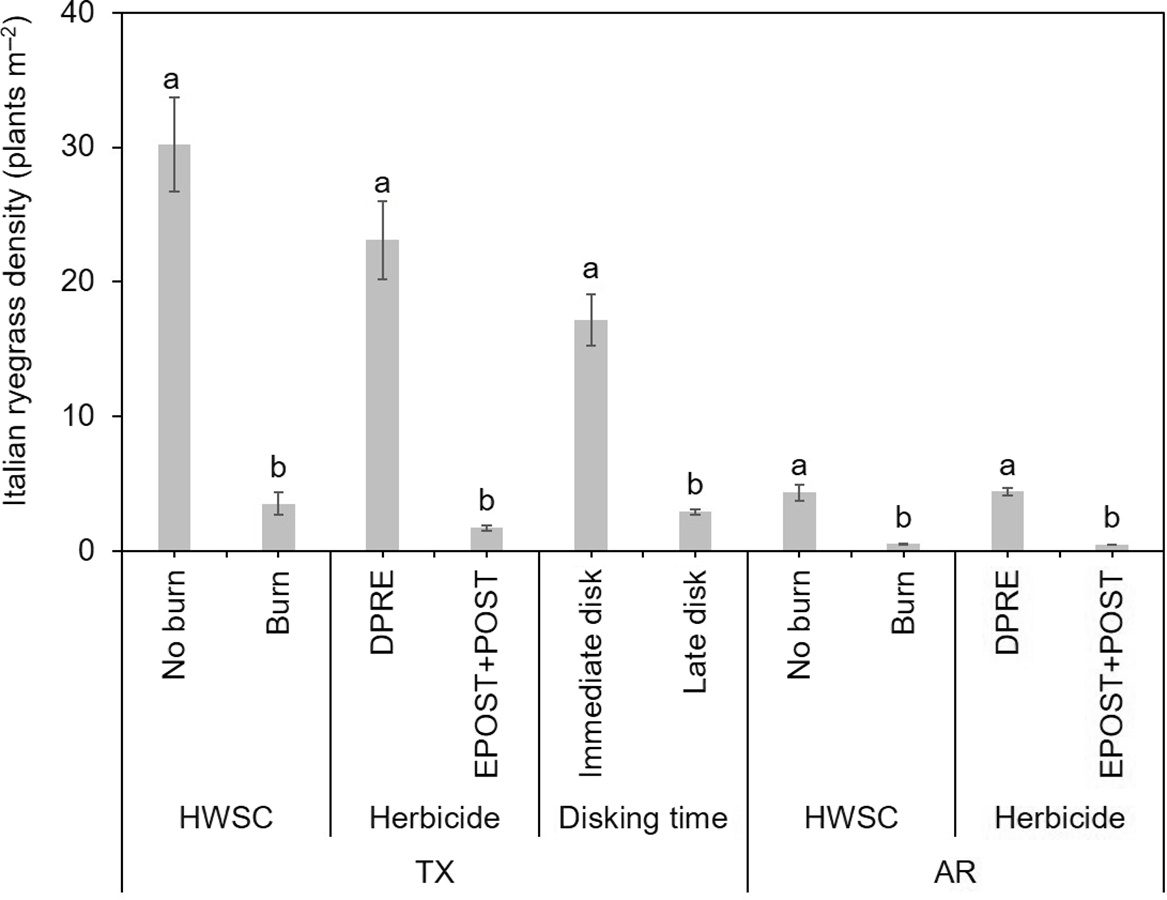
Italian ryegrass densities were dramatically reduced over the years via the combination of effective herbicide programs and the harvest-time and postharvest treatments. At the Texas site, the inclusion of HWSC in weed management programs resulted in lower (P < 0.05) Italian ryegrass densities at the end of the 4 yr irrespective of the disking time; so did the EPOST+POST herbicide program across the experimental locations (Figures 2 and 3). The Italian ryegrass densities were reduced by 88% to 89% in HWSC compared to no HWSC, by 90% to 93% in EPOST+POST compared to DPRE (P < 0.05) across the two locations, and by 83% in late disk compared to immediate disk in Texas (P < 0.05; Figure 3). Two years after initiation of the experiment in Texas, Italian ryegrass densities had declined to 0.5 plants m−2 in [EPOST+POST]+Burn and 0.04 plants m−2 in [EPOST+POST]+[Burn+late disk] treatments, an 87% and 99% reduction, respectively, compared with the reduction in the DPRE+Conventional treatment (Figure 4). Densities in [EPOST+POST]+Burn and [EPOST+POST]+[Burn+late disk] treatments became negligible after 4 yr of treatment implementation (by summer 2019).
Italian ryegrass densities in A) Delayed preemergence (DPRE) +Conventional: pendimethalin (1,065 g ai ha−1; Prowl H2O®) DPRE after wheat spiking, approximately 5 d after planting + no narrow-windrow burning + disk immediately after harvest; and B) DPRE+Burn+late disk: pendimethalin (1,065 g ai ha−1; Prowl H2O®) DPRE after wheat spiking, approximately 5 d after planting + narrow-windrow burning + disk 1 mo after harvest. Italian ryegrass spikes can be seen above the wheat canopy (brown color) in the left image.

The main effects of harvest weed seed control (HWSC, burn or no-burn), herbicide program [pendimethalin (1,065 g ai ha−1; Prowl H2O®) after wheat spiking, approximately 5 d after planting (§ DPRE) or a premix of flufenacet (305 g ai ha−1) + metribuzin (76 g ai ha−1) (Axiom® DF) mixed with pyroxasulfone (89 g ai ha−1; Zidua® WG) as early postemergence at 1- to 2-leaf stage of Italian ryegrass followed by pinoxaden (59 g ai ha−1; Axial® XL) in spring (EPOST+POST)], and disking time (immediate disking or late disking) on Italian ryegrass densities during the field study in College Station, TX, and Newport, AR (the disking treatment was not implemented in Arkansas due to the wheat-soybean double cropping system). Bars topped with different letters indicate significant differences between the main effects of HWSC, herbicide program or disking time within a location, based on Tukey’s honestly significant difference test (P < 0.05). Abbreviations: DPRE, delayed preemergence; EPOST, early postemergence; HWSC, harvest weed seed control; POST, postemergence.
Italian ryegrass densities as affected by various treatments during the field study in A) College Station, TX, and B) Newport, AR. Abbreviations: DPRE, delayed preemergence; EPOST, early postemergence; POST, postemergence. Treatments: DPRE: pendimethalin (1,065 g ai ha−1; Prowl H2O®) after wheat spiking, approximately 5 d after planting. EPOST+POST: a premix of flufenacet (305 g ai ha−1) + metribuzin (76 g ai ha−1; Axiom® DF) mixed with pyroxasulfone (89 g ai ha−1; Zidua® WG) as early postemergence at 1- to 2-leaf stage of Italian ryegrass followed by pinoxaden (59 g ai ha−1; Axial® XL) in spring. Conventional: no narrow-windrow burning + disking immediately after harvest. Burn: narrow-windrow burning + disking immediately after harvest. Burn+late disk: narrow-windrow burning + disking 1 mo after harvest. In Texas, a wheat-fallow system was practiced each year, whereas in Arkansas wheat-soybean double-crop system was implemented. Different letters within an observation time indicate significant differences among the treatments, based on Tukey’s honestly significant difference test (P < 0.05).
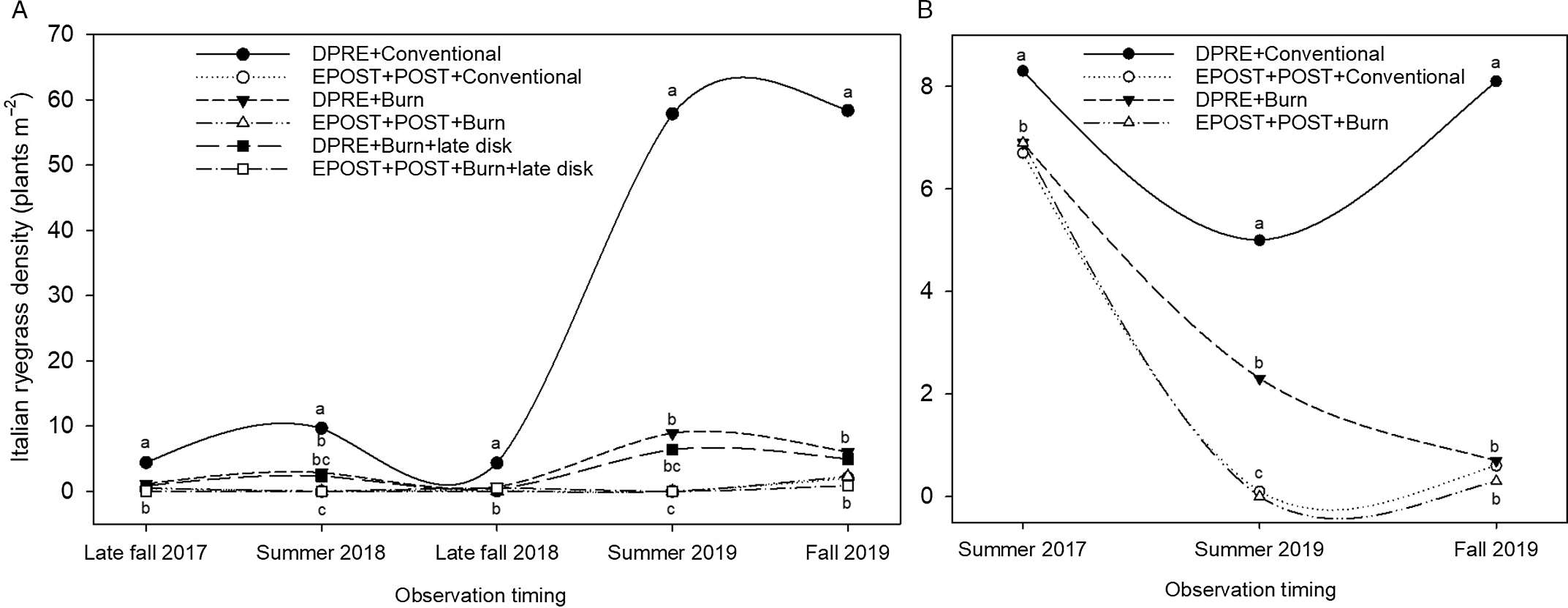
Any effects of late disking were generally masked early on by the use of HWSC regardless of the herbicide program. However, late disk tillage reduced Italian ryegrass densities across the treatments at the end of the study (Figure 3). There was an 85% greater reduction in DPRE and 63% greater in EPOST+POST than the reduction observed in immediate disk tillage treatments (Figure 4A). In DPRE+Burn and DPRE+[Burn+late disk] treatments, Italian ryegrass densities were at 6 and 5 plants per square meter, respectively, at the end of the experiment, which was significantly greater than that of the EPOST+POST programs. This indicates that use of pendimethalin DPRE was not sufficient for controlling Italian ryegrass in this study, regardless of the disking time.
The treatment without HWSC under herbicide program #1 (i.e., DPRE+Conventional) had greater Italian ryegrass densities (58 plants m−2) at the end of the experiment (compared to DPRE+Burn at 6 plants m−2), which confirmed the significant role of HWSC in controlling Italian ryegrass in Texas (Figure 4A). On average, HWSC reduced Italian ryegrass densities by 73%, 83%, and 88% after the second, third, and fourth year of the experiment, respectively, in comparison to the no-HWSC treatments in Texas.
In Arkansas, all treatments showed a decrease in Italian ryegrass densities from 7 to 8 plants per square meter in summer 2017 to 0 to 5 plants per square meter in summer 2019, though there were differences among the treatments (Figure 4B). At the end of the experiment in fall 2019, Burn was 89% more effective than no burn and EPOST+POST was 90% more effective than DPRE treatments (Figure 4B). When combined, the treatments [EPOST+POST]+Conventional and [EPOST+POST]+Burn were equally effective in controlling Italian ryegrass (0.1 and 0 plants m−2, respectively). In Arkansas, HWSC reduced Italian ryegrass densities by 8%, 55%, and 89% after the second, third, and fourth year of treatment implementation, respectively, compared to no HWSC.
In both the locations, herbicide program #2 (EPOST+POST) provided greater Italian ryegrass control than that of herbicide program #1 (DPRE only; Figure 3). Ellis et al. (Reference Ellis, Steckel, Main, De Melo, West and Mueller2010) reported in Tennessee that pendimethalin, when applied as DPRE (herbicide program #1 in our case), did not provide adequate Italian ryegrass control, whereas a pinoxaden-flufenacet-metribuzin-based EPOST program (similar to herbicide program #2 here, which additionally had pyroxasulfone) provided excellent control. There was evidence that disking 1 mo after harvest provided additional control of Italian ryegrass through postdispersal seed loss under southeast Texas conditions, though the effects were generally masked by the herbicide program and/or HWSC during the initial years. These findings corroborate those of Bagavathiannan and Norsworthy (Reference Bagavathiannan and Norsworthy2013), who observed through a field experiment in Arkansas, that delaying tillage operations following crop harvest can minimize the number of weed seeds incorporated into the soil seedbank.
In this study, HWSC combined with herbicide program #2 controlled Italian ryegrass in wheat very effectively across locations. In previous studies, HWSC practices provided effective control of Italian ryegrass in other cropping systems. Lyon et al. (Reference Lyon, Huggins and Spring2016), through studies conducted in Washington state, reported Italian ryegrass emergence from only 1% of the seeds in the HWSC treatment, compared with 63% in the untreated control. Our study corroborates this and that of Walsh and Newman (Reference Walsh and Newman2007), who in Western Australia, documented a 99% reduction in rigid ryegrass seed viability following HWSC. Walsh et al. (Reference Walsh, Aves and Powles2017b) indicated that implementation of HWSC just for 1 yr reduced rigid ryegrass densities by 60% compared to the nontreated control. Borger et al. (Reference Borger, Riethmuller and D’Antuono2016), also in Western Australia, showed complete control of rigid ryegrass after 11 yr of HWSC in wheat when combined with an effective herbicide program. Though multiple HWSC strategies could be considered, narrow-windrow burning has been an effective, cheap, and widely used tactic in managing weed seedbanks (Walsh et al. Reference Walsh, Aves and Powles2017b). Our findings in the south-central United States corroborate those of other published research in illustrating that HWSC in combination with effective herbicide programs can greatly deplete Italian ryegrass seedbanks to very low levels, within a few years of implementation.
Spike Density, Fecundity, and Seed Retention
At the Texas site during the final year, herbicide program #2 (EPOST+POST) reduced Italian ryegrass densities to negligible levels throughout the season regardless of the HWSC treatment. Hence, this treatment was excluded from the analysis of reproductive traits (Table 1). At the termination of the study in Year 4, Italian ryegrass spike densities were reduced (P < 0.05) by 85% (9 spikes m−2) in DPRE+Burn and 90% (6 spikes m−2) in DPRE+Burn+late disk, as compared to DPRE+Conventional for which the highest number of spikes (58 spikes m−2) were recorded. At the Arkansas site, HWSC combined with herbicide program #2 (EPOST+POST+Burn) resulted in negligible Italian ryegrass spike counts after 4 yr of treatment implementation (Table 1). As compared to DPRE+Conventional (106 spikes m−2), Italian ryegrass spike densities in DPRE+Burn and [EPOST+POST]+Conventional were reduced by 80% (21 spikes m−2) and 98% (2 spikes m−2), respectively.
Reproductive attributes and seed production in Italian ryegrass at the termination of the long-term experiment, after implementation of harvest-time and postharvest weed seedbank management tactics over a period. a , b

a Abbreviations: DPRE, delayed preemergence; EPOST, early postemergence; POST, postemergence.
b Data were obtained during the final study year (2019) in each location, immediately prior to wheat harvest on May 22 in College Station, TX, and June 15 in Newport, AR.
c Treatments: DPRE, pendimethalin (1,065 g ai ha-1; Prowl H2O®); DPRE after wheat spiking, approximately 5 d after planting; EPOST+POST, premix of flufenacet (305 g ai ha−1) + metribuzin (76 g ai ha−1) using Axiom® DF + pyroxasulfone (89 g ai ha−1, Zidua® WG) as early postemergence at 1- to 2-leaf stage of Italian ryegrass followed by pinoxaden (59 g ai ha−1; Axial® XL) in spring; Conventional, no narrow-windrow burning + disk immediately after harvest; Burn, narrow-windrow burning + disk immediately after harvest; Burn+late disk, narrow-windrow burning + disk 1 mo after harvest. In Texas, a wheat-fallow system was practiced each year, whereas in Arkansas a wheat-double crop soybean system was implemented. Different letters within a column indicate significant differences among the treatments, based on the Tukey’s honestly significant difference test (P < 0.05).
d There were insufficient plants in the treatments EPOST+POST+Conventional, EPOST+POST+Burn, and EPOST+POST+Burn+late disk to collect these observations due to treatment effects.
The integrated management programs led to a drastic reduction in Italian ryegrass fecundity. In Texas, the highest fecundity of 8,900 seeds m−2 was observed in the DPRE+Conventional treatment followed by 1,300 seeds m−2 in DPRE+Burn and 930 seeds m−2 in DPRE+Burn+late disk treatments, reflecting an 86% and 90% reduction, respectively, compared to the reduction observed in DPRE+Conventional treatment (P < 0.05; Table 1). Pendimethalin DPRE alone did not provide sufficient control of Italian ryegrass and was ineffective in reducing fecundity, as previously shown by Asai and Yogo (Reference Asai and Yogo2010). In Arkansas, HWSC alone provided 78% greater decline in fecundity compared to no burning, whereas EPOST+POST showed 98% greater decline in fecundity compared to DPRE. When herbicide program #2 was combined with HWSC (EPOST+POST+Burn), fecundity was reduced to negligible levels, whereas it was 110 seeds m−2 in the EPOST+POST+Conventional treatment. Herbicide program #1 with (DPRE+Burn) or without HWSC (DPRE+Conventional) resulted in 1,600 seeds m−2 or 7,200 seeds m−2, respectively. These results corroborate several previous studies on the impact of HWSC in reducing reproductive outputs (reviewed in Walsh et al. Reference Walsh, Newman and Powles2013, Reference Walsh, Broster, Schwartz-Lazaro, Norsworthy, Davis, Tidemann, Beckie, Lyon, Soni, Neve and Bagavathiannan2018).
Italian ryegrass seed shattering levels at wheat harvest differed among the treatments. In the final year of the study in Texas, Italian ryegrass plants in the HWSC treatment showed reduced seed shattering (5.1% and 4.3% in DPRE+Burn and DPRE+Burn+late disk treatments, respectively) compared to that of the worst-performing treatment, DPRE+Conventional (15.3%). The differences in shattering could be attributed to the possible existence of density-dependent effects, especially under high densities. The effect of plant competition on seed shattering was evident in Arkansas as well, since the DPRE+Conventional treatment showed significantly (P < 0.05) greater seed shattering (59%) compared to EPOST+POST+Conventional and DPRE+Burn (50%) treatments. Density-dependent effects on seed shattering have also been reported in other species such as Centaurea solstitialis (Swope and Parker Reference Swope and Parker2010) and Lesquerella fendleri (Brahim et al. Reference Brahim, Ray and Dierig1998). More research is vital to quantify density-dependent shattering in Italian ryegrass. Moreover, the potential for additional seed shattering due to disturbance by harvest machinery was not considered in any of these studies. Because the success of HWSC tactics depends largely on the extent of seed retention at the time of crop harvest (Walsh et al. Reference Walsh, Aves and Powles2017b), minimizing seed shattering is imperative to maximize weed seed capture and destruction.
Italian ryegrass seed shattering levels highly varied across the years. For example, at the Texas site, shattering was significantly greater (range 0% to 70%, average 50%; Figure 5) in 2018, compared to that of 2019 (range 0% to 25%, average 15.3%) in the baseline program (DPRE+Conventional). A close examination of the prevailing weather conditions for a 3-wk period before wheat harvest in the two study years revealed that 2018 was relatively warmer and drier (daily average temperature 26 C, relative humidity 73%) with fewer rainfall events (daily average precipitation 0.5 mm), compared to 2019 with 23 C daily average temperature, 83% relative humidity, and 2.5 mm daily average precipitation [weather data was obtained from a nearby weather station located within the Texas A&M research farm (http://afs102.tamu.edu/)]. High seed shattering under warm and dry weather conditions was documented by several studies (e.g., Gan et al. Reference Gan, Mahli, Brandt and McDonald2008; Maity et al. Reference Maity, Lamichaney, Joshi, Bajwa, Subramanian, Walsh and Bagavathiannan2021c; Shirtliffe et al. Reference Shirtliffe, Entz and Van Acker2000; Tiwari and Bhatnagar Reference Tiwari and Bhatnagar1989).
Weekly Italian ryegrass seed rain during wheat maturity and harvest window in College Station, TX. The typical wheat harvest window in the region is from late May to mid-June.

The efficacy of pendimethalin in controlling Italian ryegrass appears to be declining, although this herbicide has been an effective option (Salas et al. Reference Salas, Dayan, Pan, Watson, Dickson, Scott and Burgos2012). Ellis et al. (Reference Ellis, Steckel, Main, De Melo, West and Mueller2010) also reported reduced Italian ryegrass control with pendimethalin in the southeastern United States. In their study, fflufenacet + metribuzin (herbicide program #2 in our experiment had pyroxasulfone in addition to their treatment) as EPOST followed by pinoxaden in spring effectively reduced Italian ryegrass infestation, a result that is consistent with the current study. Pinoxaden is an effective POST herbicide, but Italian ryegrass resistance to this herbicide has been recently reported (Heap Reference Heap2022; Singh et al. Reference Singh, Maity, Abugho, Swart and Bagavathiannan2020). Integration of HWSC can limit the rate of herbicide resistance evolution by restricting the soil seedbank enrichment and subsequent field infestation, as shown in our study. This corroborates the findings reported by Lyon et al. (Reference Lyon, Huggins and Spring2016) in Washington and Borger et al. (Reference Borger, Riethmuller and D’Antuono2016) in Western Australia.
Disking 1 mo after wheat harvest substantially reduced Italian ryegrass infestations compared to immediate disking with herbicide program #1 (only evaluated in Texas), which resulted in more reduction in seedbank input. However, late disking did not show any additional benefits with herbicide program #2, as the strong effect of this herbicide program appeared to mask the effect of late disking in the initial years. In the case of late disking, a greater number of Italian ryegrass seeds exposed on the soil surface for a longer period might have attracted more seed predators (Bagavathiannan and Norsworthy Reference Bagavathiannan and Norsworthy2013; Ichihara et al. Reference Ichihara, Yamashita, Sawada, Kida and Asai2009), whereas immediate disking might have moved the seeds to greater soil depths, protecting them from major seed predators, as indicated in several studies (e.g., Guillemin and Chauvel Reference Guillemin and Chauvel2011; Ichihara et al. Reference Ichihara, Inagaki, Matsuno, Saiki, Yamashita and Sawada2012).
Italian Ryegrass Seed Shattering Phenology
In the seed shattering phenology experiment conducted in the field buffer areas, Italian ryegrass began to mature in mid to late May under Texas conditions, but cumulative seed shattering levels varied substantially among the environments, ranging from 54% (2018) to 70% (2019) when assessed up to mid-July; that is, at the eighth week past the first opportunity to harvest wheat (Figure 5). The rate of seed shattering increased until the third week of June and declined thereafter. Wheat that is not harvested by the end of May under southeast Texas conditions will have a substantial amount of Italian ryegrass seeds shattered before harvest (Figure 6). In these studies, there was only 5% to 10% seed shatter by the third week of May; however, beyond the third week of June shattering increased to 35% to 50%, highlighting the potential for reduced HWSC efficacy if wheat harvest is delayed (Figure 5). Italian ryegrass seed shattering phenology is not available for the Arkansas location due to inclement weather. Although seed shattering phenology was recorded only at College Station (2 yr) and does not represent the entire region, it still offers a glimpse of Italian ryegrass seed shattering potential in the region, which can be >60% if wheat harvest is substantially delayed.
An example of profuse seed shattering of Italian ryegrass observed in the standard management program [pendimethalin (Prowl H2O® at 1,065 g ai ha−1) applied delayed preemergence with no narrow-windrow burning] before wheat harvest in College Station, TX, during early summer 2018.

Walsh et al. (Reference Walsh, Broster, Schwartz-Lazaro, Norsworthy, Davis, Tidemann, Beckie, Lyon, Soni, Neve and Bagavathiannan2018) indicated that Italian ryegrass could retain approximately 58% of the total seed production at wheat harvest in Washington. In a different study, San Martin et al. (Reference San Martín, Thorne, Gourlie, Lyon and Barroso2021) observed 28.2% to 48.0% seed retention in Italian ryegrass in the Pacific Northwest (northeastern Oregon and southeastern Washington); in this region, Italian ryegrass seed shattering begins at around the end of June. These reports corroborate our study and indicate that a large proportion of Italian ryegrass seeds can shatter before wheat harvest, depending on the timing of harvest and weather conditions.
Soil Seedbank Size
In the final year, HWSC reduced the soil seedbank size (P < 0.05) by 78% over no burning, irrespective of the herbicide programs and time of disking in Texas (Figure 7A). Likewise, the EPOST+POST herbicide program reduced the soil seed bank size by 93% over the DPRE program. The plots under DPRE+Conventional had the largest Italian ryegrass seedbank size (807 seeds m−2) among all the treatments (P < 0.05). The treatments of [EPOST+POST]+[Burn+late disk] and [EPOST+POST]+Burn did not significantly affect soil seedbank size (10 and 7.5 viable seeds m−2, respectively), but the soil seedbank was reduced in these plots compared to the standard treatment. The DPRE+Burn (123 seeds m−2) and DPRE+[Burn+late disk] treatments (240 seeds m−2) showed seedbank reductions as well. In Arkansas, HWSC was similarly effective in reducing the soil seedbank, whereas the DPRE+Conventional and EPOST+POST+Conventional treatments had 115 and 54 seeds m−2, respectively, which was negligible in the EPOST+POST+Burn treatment (Figure 7B).
Comparison of soil seedbank size between the treatments at the termination of the field experiments in fall 2019 (3 yr after initiation) at A) College Station, TX, and B) Newport, AR. Abbreviations: DPRE, delayed preemergence; EPOST, early postemergence; POST, postemergence. Treatments: DPRE: pendimethalin (1,065 g ai ha−1; Prowl H2O®) after wheat spiking, approximately 5 d after planting. EPOST+POST: a premix of flufenacet (305 g ai ha−1) + metribuzin (76 g ai ha−1; Axiom® DF) mixed with pyroxasulfone (89 g ai ha−1; Zidua® WG) as early postemergence at 1- to 2-leaf stage of Italian ryegrass followed by pinoxaden (59 g ai ha−1; Axial® XL) in spring. Conventional: no narrow-windrow burning + disking immediately after harvest. Burn: narrow-windrow burning + disking immediately after harvest. Burn+late disk: narrow-windrow burning + disking 1 mo after harvest. In Texas, a wheat-fallow system was practiced each year, whereas in Arkansas wheat-soybean double-crop system was implemented. Different letters within an observation time indicate significant differences among the treatments, based on Tukey’s honestly significant difference test (P < 0.05).

Inclusion of HWSC showed a dramatic potential for reducing the Italian ryegrass soil seedbank in this study, supporting the findings reported by Beam et al. (Reference Beam, Mirsky, Cahoon, Haak and Flessner2019). In the present study, the effects were more prominent in Arkansas than in Texas in terms of seedbank reduction. This may be attributed to the additional effect of soybean production immediately after wheat in Arkansas (i.e., wheat-soybean double cropping). It is, however, unclear which specific factors associated with soybean production could have contributed to this decline. When combined with a robust herbicide program, HWSC provides effective weed management, as reported by Norsworthy et al. (Reference Norsworthy, Korres, Walsh and Powles2016) and Shergill et al. (Reference Shergill, Bejleri, Davis and Mirsky2020a) in controlling Palmer amaranth (Amaranthus palmeri S.Wats.) in soybean across the U.S. states.
In the current study, the rapid decline of the Italian ryegrass seedbank could also be attributed to the short-lived seed dormancy in this species, as reported by Ghersa and Martinez-Ghersa (Reference Ghersa and Martinez-Ghersa2000) and Maia et al. (Reference Maia, Maia and Bekker2009). Late disking also contributed to seedbank reduction. Ichihara et al. (Reference Ichihara, Yamashita, Sawada, Kida and Asai2009) reported that Italian ryegrass seeds on the soil surface did not germinate after 100 d, whereas the seeds that entered the soil via immediate tillage operation remained viable for relatively longer periods, indicating the benefit of delayed tillage operations in minimizing viable seedbank size. Although a high degree of aboveground as well as belowground control of Italian ryegrass was achieved after 4 yr of HWSC implementation in the study, Beam et al. (Reference Beam, Mirsky, Cahoon, Haak and Flessner2019) found that only 2 yr of consecutive HWSC was still effective in greatly depleting Italian ryegrass seedbank in Virginia. However, the production scenarios, initial weed density, and environmental conditions were different between these two study locations.
Wheat Grain Yield
The herbicide programs and HWSC tactics improved wheat grain yield through significant improvements in Italian ryegrass control (Figure 8). The highest grain yields were achieved in EPOST+POST+Burn+late disk in Texas (2,190 kg ha−1) and EPOST+POST+Burn in Arkansas (3,700 kg ha−1). Not surprisingly, the DPRE+Conventional treatment yielded the least in both sites (1,570 and 2,220 kg ha−1, respectively in Texas and Arkansas). Measured wheat grain yields were in the order of [EPOST+POST]+Burn > [EPOST+POST]+Conventional > DPRE+Burn at both locations. However, Beam et al. (Reference Beam, Mirsky, Cahoon, Haak and Flessner2019) did not find any yield advantage with the addition of HWSC within the 2 yr of their study, of which only one pass of HWSC was implemented. The majority of previous HWSC studies have not evaluated yield responses in subsequent crops.
Wheat grain yield in A) College Station, TX, and B) Newport, AR. Abbreviations: DPRE, delayed preemergence; EPOST, early postemergence; POST, postemergence. Treatments: DPRE: pendimethalin (1,065 g ai ha−1; Prowl H2O®) after wheat spiking, approximately 5 d after planting. EPOST+POST: a premix of flufenacet (305 g ai ha−1) + metribuzin (76 g ai ha−1; Axiom® DF) mixed with pyroxasulfone (89 g ai ha−1; Zidua® WG) as early postemergence at 1- to 2-leaf stage of Italian ryegrass followed by pinoxaden (59 g ai ha−1; Axial® XL) in spring. Conventional: no narrow-windrow burning + disking immediately after harvest. Burn: narrow-windrow burning + disking immediately after harvest. Burn+late disk: narrow-windrow burning + disking 1 mo after harvest. In Texas, a wheat-fallow system was practiced each year, whereas in Arkansas wheat-soybean double-crop system was implemented. Different letters within an observation time indicate significant differences among the treatments, based on Tukey’s Honestly significant difference test (P < 0.05).

Practical Implications
The routine use of HWSC in combination with an effective herbicide program can greatly reduce Italian ryegrass infestations in south-central U.S. wheat production. Though high levels of seed shattering were observed in this species, HWSC can still be effectively integrated if implemented in a timely fashion. Potential delays in harvesting combined with adverse weather conditions can greatly enhance seed shattering and in turn reduce the efficacy of HWSC. More research in seed shattering phenology under different environmental conditions is required for south-central U.S. wheat production. Moreover, evidence indicates that continuous application of any management strategy can induce evolutionary changes in weeds such as crop-mimicry, dwarf stature, prostrate growth habit, etc. [reviewed in Barrett (Reference Barrett1983, Reference Barrett, Altieri and Liebman1988); Warwick and Briggs Reference Warwick and Briggs1979]. Thus, HWSC should not be relied on heavily for weed control; rather, it should be integrated with herbicides and other control methods. The HWSC treatment combined with a strong herbicide program is an effective option for long-term control of Italian ryegrass in wheat. An herbicide program that includes PRE and POST options should be preferred over a PRE-only program. These findings will be useful for developing an improved Italian ryegrass management strategy in the south-central United States. In the future, more practical HWSC techniques such as chaff lining and impact mills should be explored for improved Italian ryegrass control in the region.
Acknowledgments
Author A. Maity acknowledges the Netaji Subhash ICAR–International Scholarship by the Indian Council of Agricultural Research and the Tom Slick Fellowship by Texas A&M University. Funding was provided by AFRI Foundational Program (Award No. 2016-67013-24810) through the U.S. Department of Agriculture–National Institute for Food and Agriculture. Field/laboratory assistance provided by Daniel Hathcoat, Matheus Martins, Bruno Gianovelli, and Camila Grassmann is gratefully acknowledged.
The authors declare that no conflict of interest exists.


 Open access

