





Highlights
-
• An N400 crosslinguistic Typicality effect was observed in translation.
-
• The N400 effect may be linked to resting-level translation activation.
-
• An f-PNP crosslinguistic Typicality effect was found in congruent trials.
-
• The f-PNP may reflect the inhibition of typical translations to integrate atypical but congruent ones.
1. Introduction
The early 19th-century German linguist Wilhelm von Humboldt once wrote: “The diversity of languages is not a diversity of signs and sounds but a diversity of views of the world” (Humboldt, Reference Humboldt and von Humboldt1836). In other words, each language has a unique way of cutting reality into understandable and communicable pieces of meaning. Indeed, different languages do not just use different linguistic categories to refer to the exact same fragments of reality; instead, they use linguistic classifications to refer to vastly or marginally different fragments of reality. This difference of Weltanschauung (i.e., “world view” in German) between languages leads people to wonder how transfers of meanings between different languages – interlingual translation (Jakobson, Reference Jakobson and Brower1959) or translatability (i.e., the possibility of interlingual translation equivalence) – can even be possible (Mounin, Reference Mounin1963; Fram-Cohen, Reference Fram-Cohen1985; Snell-Hornby, Reference Snell-Hornby1988; for an exhaustive review, see Pym, Reference Pym2014).
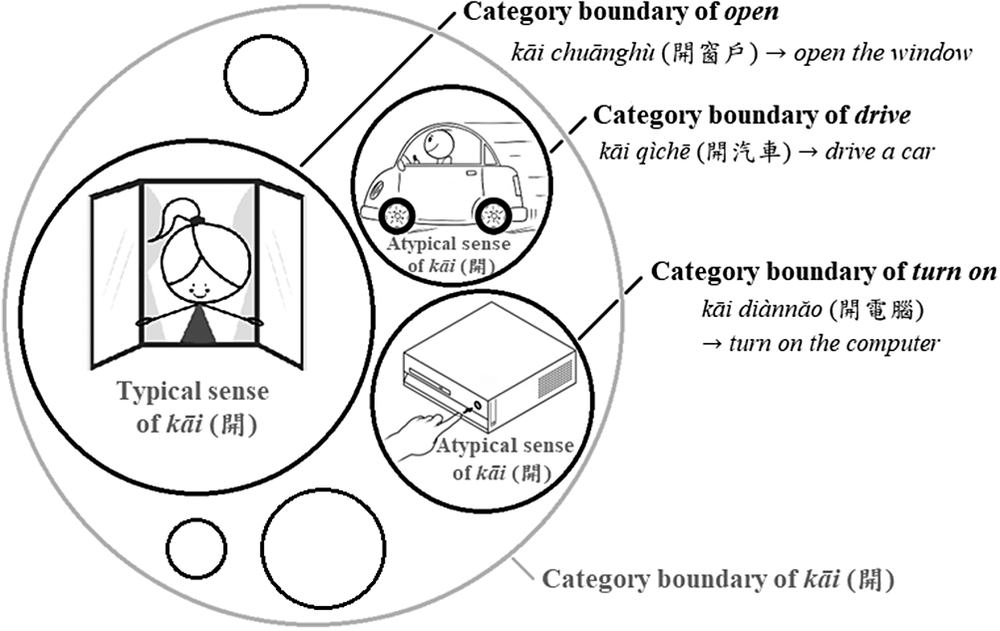
Despite the mismatches between categories in different languages, the bilingual brain seems to translate one category in the source language into another in the target language without difficulty. For example, many one-character/syllable verbs in Mandarin Chinese are polysemous, and their multiple senses can be translated into various English verbs: the Chinese verb kāi (開) can be used in kāi chuānghù (開窗戶), kāi diànnăo (開電腦), and kāi qìchē (開汽車), which can be translated as open the window, turn on the computer, and drive a car, respectively (Figure 1). However, although most Mandarin Chinese–English bilinguals correctly translate kāi (開) as open, turn on, or drive depending on the context, such a translation process may not happen “without a hiccup” inside the brain. In fact, a closer look would reveal that, despite open, turn on, and drive being translation equivalents of kāi, Chinese-English bilinguals typically answer open when asked to provide a translation for kāi in isolation. Such a “crosslinguistic typicality effect” may explain why bilinguals sometimes use the typical translation equivalent erroneously in their second language, such as “close the light” (關燈 guān dēng) instead of “turn off the light,” “eat medicine” (吃藥 chī yào) instead of “take medicine,” and “break a case” (破案 pò àn) instead of “solve a case.” This form of English, filled with incorrect literal translations from Chinese, is known as Chinglish and is often produced by low-proficiency Chinese-English bilinguals (on literal translation, see Vinay & Darbelnet, Reference Vinay and Darbelnet1958; on Chinglish, see Radtke, Reference Radtke, Liu and Tao2012).
Different senses conveyed by the Chinese verb kāi and their respective translations in English.

To understand why translation equivalents are not created equal (e.g., open tends to be chosen rather than turn on or drive in the translation of kāi from Chinese to English), we need to first discuss the typicality effect in semantic categories. The human brain categorizes individual instances of objects, events, ideas, and so forth into different categories, and the inner structures of such categories have been one of the main interests in the literature. Two influential accounts for the nature of linguistic categories are the “classical approach” and the “prototype approach.” The classical approach to categorization (tracing its roots to Plato) and its modern variant, the feature-based theory (Katz & Fodor, Reference Katz and Fodor1963; Katz & Postal, Reference Katz and Postal1964), argue that each linguistic category has a set of necessary semantic features that help to distinguish members from nonmembers in a discrete fashion, laying down boundaries for different categories. For example, the category bird contains necessary features, such as having a beak, feathers, and being able to lay hard-shelled eggs; therefore, penguins and robins are regarded as members of the category bird, while bats are nonmembers. In contrast, the prototype approach states that each category is best represented by a prototype that embodies the most typical features of that category; therefore, members of the category have various degrees of representativeness, with a gradation of typicality increasing toward the category’s core and decreasing toward the periphery (Rosch & Mervis, Reference Rosch and Mervis1975; Lakoff, Reference Lakoff1987; Taylor, Reference Taylor1989). For example, compared with penguins, robins have more features typically found in birds (e.g., the ability to fly) and fewer features typically found in other categories (e.g., the ability to swim); therefore, robins are viewed as core/typical members of the category bird, while penguins as peripheral/atypical members, as manifested by the linguistic hedge that a penguin is “sort of a bird” (Lakoff, Reference Lakoff1973).
Both approaches have advantages and disadvantages, but the prototype approach seems to be favored because it can explain the typicality effect found in empirical studies. Behavioral studies showed that some category members are judged as more typical/representative, learned better, and classified faster than others (Berlin & Kay, Reference Berlin and Kay1969; McCloskey & Glucksberg, Reference McCloskey and Glucksberg1978; Rosch et al., Reference Rosch, Simpson and Miller1976; Rosch, Reference Rosch, Rosch and Lloyd1978; see Geeraerts, Reference Geeraerts2006, and Dieciuc & Folstein, Reference Dieciuc and Folstein2019, for reviews on typicality). Event-related potential (ERP) studies also revealed clear evidence of typicality. Fujihara et al. (Reference Fujihara, Nageishi, Koyama and Nakajima1998) found that, when primed by their target category (e.g., vegetables), members of that category (e.g., carrot, parsley) elicited smaller N400s, shorter reaction times, and lower error rates compared to when they were primed by a non-target category (e.g., sport). In addition to this “target effect,” as the authors called it, a Typicality effect was also found. When primed by their target category (e.g., vegetables), typical members (e.g., carrot) elicited smaller N400s, shorter reaction times, and lower error rates than atypical members (e.g., parsley), but such a processing advantage disappeared when the typical members were primed by a non-target category (e.g., sport), indicating that a typicality effect was induced only in the congruent condition (i.e., items primed by the category they belong to). Heinze et al. (Reference Heinze, Muente and Kutas1998) examined whether the typicality effect could be affected by context (presence of semantically related or unrelated nonmembers within the same block) and found that such modulation was observed in reaction times, but not in ERP data: the reaction time to atypical members was longer in the presence of semantically related nonmembers (e.g., whale with regard to the priming category fish) than unrelated ones (e.g., car with regard to the prime fish), while atypical members elicited a larger N400 than typical ones irrespective of whether the nonmembers presented in the same block were semantically related to the priming category or not.
Taken together, these ERP studies showed that typical members elicited a smaller N400 during category verification tasks, suggesting a facilitated retrieval from the semantic memory. It is important to note that although the majority of prior behavioral and ERP studies on typicality were conducted on nouns, typicality also exists in senses expressed by verbs. Hsiao et al. (Reference Hsiao, Chen and Wu2016) asked Mandarin Chinese speakers from Taiwan to judge the acceptability of Chinese verb phrases expressing basic senses (i.e., typical), closely related senses (i.e., less typical), or distantly related senses (i.e., even less typical) of the one-character verbs chī (吃 “eat”), dǎ (打 “hit”), and xǐ (洗 “wash”) and discovered that the less the sense was related to the basic sense (e.g., 吃敗仗 chī bàizhàng “lose a battle,” literally “eat lost battle”), the longer its reaction time was and the lower its acceptability rate was.
What we have discussed so far are studies of typicality within one language. However, the typicality effect also manifests itself in translation equivalence across two languages, with only a few studies having investigated it (for review, see Jarvis & Pavlenko, Reference Jarvis and Pavlenko2008). Kellerman (Reference Kellerman1978) examined the typicality of senses expressed by the Dutch verb breken (which means “to break”) and found a correlation between the typicality of a sense and its degree of translatability into English. The author found that Dutch sentences expressing a typical sense of breken, such as Het kopje brak (“The cup broke”), were rated by Dutch learners of English as more translatable in English using its English equivalent (to break), while those expressing an atypical sense, such as Zijn val werd door een boom gebroken (“His fall was broken by a tree”), were rated as less translatable by the same group of subjects. This difference in perceived translatability suggests that typical translation equivalents in the target language (to break in English) are learned by transferring typical senses from the translated category in the native language (breken in Dutch). Also, Ijaz (Reference Ijaz1986) found that typical senses in the target language were similar to the typical senses of the typical translation equivalents in the native language. For example, when Urdu speakers of English performed a semantic-relatedness test and a cloze-type/sentence-completion test in English, the English preposition on and its Urdu translation equivalent per can be used to convey the same typical senses (e.g., There is a basket on the floor), but the atypical senses of on can sometimes be conveyed by other translation equivalents in Urdu, such as in the sentence He stooped to avoid hitting his head on the lamp where on is translated as say in Urdu, emphasizing the semantic component of collision. Comparable results were also found for the German speakers of English in the study. Krzeszowski (Reference Krzeszowski and Fisiak1990) conducted a similar experiment, where Polish students of English were asked to translate 20 short English sentences using over into Polish. The results showed that while sentences expressing more typical senses of the English preposition over (e.g., The helicopter is hovering over the town) were invariably translated in Polish as nad or its variant ponad, less typical senses evoked various degrees of disagreement among participants: some were translated into a variety of translation equivalents (e.g., over in The guards were posted all over the hill was translated in Polish as po, na, or others); others were only translated into one atypical translation equivalent (e.g., over in She spread the tablecloth over the table was translated in Polish as na).
In summary, past behavioral studies have shed light on the origin of typicality in translation equivalents: translation equivalents are more typical when they can convey the typical senses in the translated category (e.g., breken in Dutch, per in Urdu, and nad/ponad in Polish are the typical translations of to break, on, and over in English, respectively) but are less typical when they can only convey atypical senses (e.g., say in Urdu is an atypical translation of on in English; po in Polish is an atypical translation of over in English). Based on these findings, we could explore the underlying processes of the crosslinguistic typicality effect during translation.
The main goal of this study was to examine the neurocognitive basis of the crosslinguistic typicality effect using ERP. We designed a Chinese–English translation experiment, where we asked Chinese–English bilinguals to read a visually presented Chinese verb phrase (prime) and judge whether the following English translation (target) was appropriate for the verb in the Chinese verb phrase. The congruity/appropriateness of the target was manipulated by including both typical and atypical English translations of the Chinese verb. We hypothesized that the processing of incongruent targets would elicit a strong N400 Congruity effect – similar to the “target effect” reported by Fujihara et al. (Reference Fujihara, Nageishi, Koyama and Nakajima1998) – demonstrating the existence of a translation process in the brain. More importantly, we predicted that previous behavioral findings on crosslinguistic typicality (Kellerman, Reference Kellerman1978; Ijaz, Reference Ijaz1986; Krzeszowski, Reference Krzeszowski and Fisiak1990) would be replicated by observing an N400 Typicality effect – similar to the typicality effects reported by Fujihara et al. (Reference Fujihara, Nageishi, Koyama and Nakajima1998) and Heinze et al. (Reference Heinze, Muente and Kutas1998) – associated with greater difficulty in processing atypical target translations compared with typical ones.
2. Methods
2.1. Participants
Twenty-six Chinese-English bilinguals who were native speakers of Mandarin Chinese in Taiwan (first language, L1) and fluent in English (second language, L2) were recruited. They had normal or corrected-to-normal vision and were right-handed, as assessed by a simplified version of the Edinburgh Handedness Inventory (Oldfield, Reference Oldfield1971). None of them reported a neurological surgery or a neurological disorder that might interfere with language processing. The ERP data from two participants were excluded due to low accuracy rates and/or excessive electroencephalography (EEG) artifacts (rejection rate above 50%). The data from the remaining 24 participants (17 females, 7 males, mean age: 27 years old, range: 21–39 years old, SD = 5) were kept for further analysis. Twenty-three participants took a standardized English test (e.g., TOEFL, TOEIC, IETLS, etc.) and showed that they had a B2 level or above as defined by the Common European Framework of Reference (CEFR). One participant did not take a standardized test but had a TESOL (Teaching English to Speakers of Other Languages) certificate. To ensure that the participants did not receive any translation or interpreting training that might affect the translation process and did not have or only had a limited experience in translation or interpretation, they were screened by an abridged version of the Translation and Interpreting Competence Questionnaire (TICQ) (Schaeffer et al., Reference Schaeffer, Huepe, Hansen-Schirra, Hofmann, Muñoz, Kogan, Herrera, Ibanez and García2019), which was modified by an ongoing research project about interpreters and translators (Liu et al., Reference Liu, García, Fan and Fongn.d.). Before the experiment, all participants signed a consent form approved by the Research Ethics Office of National Taiwan Normal University in which the procedure of the experiment was described. The authors assert that all procedures contributing to this work comply with the ethical standards of the relevant national and institutional committees on human experimentation and with the Helsinki Declaration of 1975, as revised in 2008. After the experiment, the participants were paid 250 NT dollars per hour as compensation for their time.
2.2. Materials
The materials included 128 Chinese verb phrases (with 64 Chinese verbs) as primes and 128 English verb translations as targets. The Chinese verb phrases only included one-character verbsFootnote 1. Two factors, typicality of the translation equivalent (Typicality) and congruity of the translation (Congruity), were manipulated to create four conditions: (1) Typical & Congruent (TC): the English translation is typical and congruent with the sense of the Chinese verb in the phrasal context (e.g., 開窗戶 kāi chuānghù “open the window” followed by open); (2) Typical & Incongruent (TI): the English translation is typical but incongruent with the sense of the Chinese verb in the phrasal context (e.g., 開電腦 kāi diànnăo “turn on the computer” followed by open); (3) Atypical & Congruent (AC): the English translation is atypical and congruent with the sense of the Chinese verb in the phrasal context (e.g., 開電腦 kāi diànnăo “turn on the computer” followed by turn on); (4) Atypical & Incongruent (AI): the English translation is atypical and incongruent with the sense of the Chinese verb in the phrasal context (e.g., 開窗戶 kāi chuānghù “open the window” followed by turn on) (see Table 1 for the experimental design and example materials).
Experimental design and example materials

To select the final materials, we first chose 103 one-character Chinese verbs and, for different senses of each verb, we generated two English translations (in their bare infinitive forms) with different typicality: its most typical translation (e.g., 開 kāi = open) and an atypical translation (e.g., 開 kāi = turn on). Two Chinese verb phrases were then created for each Chinese verb based on the selected senses and the translations (e.g., 開窗戶 kāi chuānghù “open the window” and 開電腦 kāi diànnăo “turn on the computer”). Next, to ensure that the same verb was used in the Chinese verb phrase pairs (e.g., 開窗戶 kāi chuānghù and 開電腦 kāi diànnăo), not two distinct verbs that happen to share the same Chinese character (i.e., the verb is polysemous, not two homonymous verbs), two Taiwanese Mandarin Chinese school teachers were recruited to verify the materials. They also confirmed that all the Chinese verb phrases were well-formed and made sense.
Two further steps were taken to ensure the accuracy and typicality of the English verb translations. To verify the accuracy of the English verb translations and to confirm that the two English translations were mutually exclusive (i.e., the same English verb cannot be used to translate the verbs from both Chinese verb phrases), a U.S. professional translator with English as L1 and Mandarin Chinese as L2 and working language was recruited to examine the list of the 206 Chinese verb phrases (i.e., two phrases for each of the 103 verbs) and their English translations. The translator had to ensure that the Chinese verb from one Chinese verb phrase can only be translated into the typical but not the atypical English verb translation (e.g., with kāi chuānghù, kāi can only be translated as open, but not as turn on), and vice versa (e.g., with kāi diànnăo, kāi can be translated as turn on, but not as open). Also, to confirm the typicality of the English verb translations, an online questionnaire was administered to 10 professional Taiwanese translators and/or interpreters (none of them were recruited for the ERP experiment), with Mandarin Chinese as their L1 and English as their L2 and working language. They had to type in what they considered to be “the most typical English translation” for each of the 103 Chinese verbs without the help of a dictionary or a translation machine. The rationale behind this survey was that the most mentioned English verb translation of a Chinese verb without context (i.e., in isolation) would be the most typical one, while the least mentioned English verb translation(s) would be atypical. Based on the above two steps, 128 Chinese verb phrases (i.e., two phrases for 64 verbs) were selected, among which the typical English verb translations were mentioned by 77.5% of the respondents (SD = 19.76%) on average, against 0.94% (SD = 2.94%) for atypical ones, t(66) = −30.66, p < .0001 (Welch’s t-test for samples with unequal variances). The number of characters (i.e., one or two) of the object/noun in the Chinese verb phrases was also controlled.
Furthermore, since past behavioral studies (Ijaz, Reference Ijaz1986; Krzeszowski, Reference Krzeszowski and Fisiak1990) showed that the translated senses conveyed by typical translation equivalents are more typical than those conveyed by atypical ones, we also tested this on the materials. To obtain the typicality of senses in Chinese, each sense’s order of appearance was checked via the Taiwan Ministry of Education’s Revised Mandarin Chinese Dictionary (https://dict.revised.moe.edu.tw/). For example, the sense expressed by kāi in kāi chuānghù (“open the window”) was listed as the first entry, while the sense expressed by kāi in kāi diànnăo (“turn on the computer”) was indicated on the third entry. The correlation between the entry number of the sense and the typicality of the English verb translations was significant (r(126) = −0.36, p < .0001), indicating that the higher a Chinese verb’s sense was ordered in the dictionary (the sense of “open” is ranked higher than the sense of “turn on” for kāi), the more often its English translation was mentioned as its typical translation (open). The results agreed with the overall picture presented by past studies (Ijaz, Reference Ijaz1986; Krzeszowski, Reference Krzeszowski and Fisiak1990).
Finally, other factors that might affect word processing were also controlled or examined. First, since frequency has been known to affect the N400 amplitudes (Rugg, Reference Rugg1990; Barber et al., Reference Barber, Vergara and Carreiras2004; Kutas & Federmeier, Reference Kutas and Federmeier2011), this factor was carefully controlled. For primes, the number of occurrences on the World Wide Web (via Google verbatim search) did not differ between Chinese verb phrases with typical and atypical English verb translations (e.g., 開窗戶 kāi chuānghù versus 開電腦 kāi diànnăo), t(101) = 0.87, p = .39 (Welch’s t-test). Also, there was no significant difference in frequency rankings (via Academia Sinica Word List with Accumulated Word Frequency in Sinica Corpus: https://elearning.ling.sinica.edu.tw/CWordfreq.html ) in the objects of the two types of Chinese verb phrases, t(126) = −0.05, p = .96. For targets, there was also no significant difference in frequency counts (via Princeton University WordNet Search: https://wordnet.princeton.edu/) between the typical (e.g., open) and atypical (e.g., turn on) English verb translations, t(126) = −0.09, p = .93. In addition to frequency, concreteness has also been known to affect N400 amplitudes (Kounios & Holcomb, Reference Kounios and Holcomb1994; Holcomb et al., Reference Holcomb, Kounios, Anderson and West1999: Barber et al., Reference Barber, Otten, Kousta and Vigliocco2013); therefore, the concreteness between the two types of Chinese verb phrases was also examined. Twenty-two participants (none of them were later recruited for the ERP experiment) were asked to rate the concreteness of the 206 Chinese verb phrases on a 5-point Likert scale (1 = abstract, 5 = concrete) via Ibex Farm (https://spellout.net/ibexfarm/). The t-test revealed that, with the 128 verb phrases eventually selected for the experiment, the verb phrases with a typical verb sense were more concrete than those with an atypical sense (4.42 (SD = 0.61) versus 3.91 (SD = 0.88), t(112) = −3.82, p < .001 (Welch’s t-test)). The list of materials and related detailed information are in Table S1 in the Supplementary Material.
In sum, the experimental materials included 64 Chinese verbs, which were developed into 128 Chinese verb phrases (i.e., each Chinese verb phrase appeared once, while each Chinese verb appeared twice) and 128 English verb translations, with 32 trials for each of the 4 conditions. The Chinese verb phrases were presented as the primes (e.g., 開電腦 kāi diànnăo) and the English verb translations as the targets (e.g., open or turn on, which is either a typical or an atypical translation of the verb). The prime–target pairs were randomized such that each participant saw a unique experimental list of items. Also, to prevent two trials with the same Chinese verb from being too close to each other, each list was divided into two blocks of 64 trials (16 trials for each condition), with each Chinese verb appearing only once in each block.
2.3. Procedure
The experiment took place at the Neurolinguistics Lab at National Taiwan Normal University in a dimly lit, sound-attenuated room. Participants were comfortably seated about 90 cm in front of a computer screen and were asked to put their hands on the keyboard in front of them. The experiment began with instructions given in English and a practice session to familiarize the participants with the procedure.
The stimuli were displayed in the following order in each trial: a fixation point (a cross sign) was first presented in the middle of the screen for 1000 ms, followed by a 200 ms blank screen. Next, a Chinese verb phrase consisting of a verb and an object (e.g., 開電腦 kāi diànnăo) was presented as the prime for 1000 ms, followed by a 300 ms blank screen. Then, an English verb (e.g., turn on) was presented as the target for 1000 ms, followed by a 200 ms blank screen. Finally, a question mark was presented, prompting the participants to judge with a button press whether the previously presented English verb was an appropriate translation of the Chinese verb in the verb phrase. The design of the translation verification task with a delayed response was to avoid contamination of the ERP data from hand responses. All the participants used their dominant/right hand to respond on the keyboard, with the index finger indicating a translation as “appropriate” and the ring finger as “inappropriate.” After the participants made their self-paced responses, a blank screen was displayed for 200 ms before the next trial began. An example of the procedure for presenting the stimuli is in Figure S1 in the Supplementary Material. To avoid eye-movement contamination of the ERP data, participants were encouraged to blink after they had pushed the button and before the next trial began. Also, the material list for each subject was divided into two blocks, so the subjects were allowed to take a short break between blocks if needed. The experiment lasted for about 15 minutes.
2.4. Data acquisition
The E-Prime 3.0 software (Psychology Software Tools, Inc., 2016) was used to present the stimuli, record the participants’ behavioral responses (reaction times and accuracy), and send event codes to a separate computer for later ERP processing. Thirty-two electrodes (FP1, FP2, F7, F3, Fz, F4, F8, FT7, FC3, FCz, FC4, FT8, T3, C3, Cz, C4, T4, TP7, CP3, CPz, CP4, TP8, T5, P3, Pz, P4, T6, O1, Oz, O2, A1, A2) were placed on the scalp according to the 10–20 system to record the EEG. Four additional electrodes (VEOU, VEOL, HEOL, HEOR) were placed around the eyes (on the left eye’s higher ridge and lower ridge and on each eye’s outer canthus) to monitor blinks and eye movements. The channels were referenced online to the average of the left and right mastoid electrodes. Each electrode had its impedance kept below 5 kΩ. The EEG data were recorded at a sampling rate of 1000 Hz and the amplifier gain was set to 19. The data of each participant were preprocessed using EEGLAB (Delorme & Makeig, Reference Delorme and Makeig2004) and ERPLAB toolbox (Lopez-Calderon & Luck, Reference Lopez-Calderon and Luck2014) in MATLAB (MathWorks, 2005) according to the following pipeline. The raw EEG data file was imported, and the four electrodes around the eyes were transformed into two bipolar channels (VEOG for vertical movements using VEOU and VEOL, and HEOG for horizontal movements using HEOL and HEOR). A high-pass filter was applied to the continuous EEG data (IIR Butterworth, 0.1 Hz). Segments contaminated by artifacts (e.g., large muscle movements, temporary defective channels) were manually rejected through visual inspection. Independent component analysis (ICA) was performed (Jung et al., Reference Jung, Makeig, Westerfield, Townsend, Courchesne and Sejnowski2000), and ICA components signaling eye movements and large muscle activities were rejected. The continuous EEG data were time-locked to the onsets of the prime and the target. They were then epoched from −200 ms before stimulus onset to 1200 ms after stimulus onset and baseline corrected from −200 to 0 ms. Epochs with the following problems were rejected. First, epochs with an inaccurate response were removed from further ERP analysis. Also, epochs contaminated with large artifacts were automatically detected and removed using the “moving window peak-to-peak threshold” function applied on all electrodes (with a 200 ms moving time window from −200 to 1200 ms relative to the stimulus onset in 100 ms increments, and with a voltage threshold set at 100 μV) and the “step-like artifacts” function applied to the HEOG channel (with 400 ms moving time window from −200 to 1200 ms relative to the stimulus onset in 10 ms increments, and with a voltage threshold set at 15 μV). Finally, epochs contaminated with alpha waves or remaining muscle artifacts were manually rejected. The ERPs of the remaining trials were then averaged and low-passed filtered (IIR Butterworth, 30 Hz). The overall rejection rate for the Chinese primes was 8.72% (0–47%, SD: 10.09%) for typical senses and 9.38% (0–34%, SD: 9.59%) for atypical senses. For the English targets, the rejection rate was 13.93% (0–37%, SD: 8.39%) for TC, 24.22% (3–44%, SD: 9.68%) for AC, 25% (9–50%, SD: 10.47%) for TI, and 11.2% (0–37%, SD: 9.53%) for AI. Note that the higher rejection rates for AC and TI targets, relative to TC and AI targets, were partially due to their less accurate responses.
2.5. Data analyses
The behavioral data (accuracy rates and reaction times from trials that received an accurate response) and the ERP data (mean amplitudes for both primes and targets) were analyzed using R (R Core Team, Reference Team2018). Generalized linear mixed-effects models were applied to the behavioral data using the “glmer” function from the “lme4” package (Bates et al., Reference Bates, Mächler, Bolker and Walker2015). Since participants provided a binary response for each trial, the model for accuracy rates specified a binomial distribution with a logit link function. Given the right skewness of reaction times, the model specified a gamma distribution family with an identity link function (as advised by Lo & Andrews, Reference Lo and Andrews2015). Both models for accuracy rates and reaction times included Congruity (Congruent Translation, Incongruent Translation) and Typicality (Typical Translation, Atypical Translation) as fixed effects and random intercepts for participants (i.e., 24 individuals) and items (i.e., the 256 unique combinations of a Chinese verb phrase and an English verb used as experimental stimuli). The model for accuracy rates also specified random slopes for Congruity and Typicality by item. However, due to issues with model convergence, the model for reaction times did not specify random slopes.
Moreover, the ERP data were analyzed using the “aov_ez” function from the “afex” package (Singmann et al., Reference Singmann, Bolker, Westfall, Aust and Ben-Shachar2020) on trials that received a correct response from the participantsFootnote 2. Analyses were conducted on the mean amplitudes of the targets during the 300–500 and 600–900 ms windows to determine whether our hypotheses regarding the Congruity N400 and Typicality N400 effects were supported and whether the effects persisted into the later time window. A four-way repeated measures ANOVA was performed for each time window, with the factors of Congruity (Congruent, Incongruent), Typicality (Typical, Atypical), Anteriority (Fontal, Fronto-Central, Central, Centro-Posterior, Posterior), and Laterality (Left, Midline, Right). Regarding the Anteriority factor, the F3, Fz, and F4 electrodes were selected for the Frontal region, FC3, FCz, and FC4 for the Fronto-Central region, C3, Cz, and C4 for the Central region, CP3, CPz, and CP4 for the Centro-Posterior region, and P3, Pz, and P4 for the Posterior region. As for the Laterality factor, the F3, FC3, C3, CP3, and P3 electrodes were selected for the Left hemisphere, Fz, FCz, Cz, CPz, and Pz for the Midline area, and F4, FC4, C4, CP4, and P4 for the Right hemisphere. Also, to confirm that the two types of Chinese primes (Chinese verb phrases with a typical or atypical sense of the verb) were well-controlled, the ERP response to the prime during 300–500 and 600–900 ms was analyzed with three-way repeated measures ANOVAs, with the factors of Verb Phrase Type (Typical Sense, Atypical Sense), Anteriority, and Laterality. For all the analyses, when Mauchly’s test for sphericity was violated (which was the case when the factor of Anteriority or Laterality was involved), the p-value was corrected by applying the Greenhouse–Geisser correction. When an effect involving the Typicality or Congruity factor reached statistical significance, follow-up pairwise t-tests with Bonferroni correction were conducted using the “emmeans” package (Lenth, Reference Lenth2020).
3. Results
3.1. Behavioral results
3.1.1. Accuracy rates
The participants’ average accuracy rates for the four conditions were TC, 92.58%; AC, 81.51%; TI, 81.12%; and AI, 95.05%. The high accuracy rates demonstrated that the subjects were paying attention and performing the task following the instruction. The generalized linear mixed-effects model did not reveal a significant main effect of Congruity (β = −0.36, SE = 0.21, z = −1.75, p = .08) or Typicality (β = 0.2, SE = 0.21, z = 0.98, p = .33), but found an interaction between Congruity and Typicality (β = −0.83, SE = 0.21, z = −3.97, p < .0001) (see Table S2 in the Supplementary Material). Follow-up pairwise t-tests on the Congruity × Typicality interaction revealed an inverse pattern of Typicality depending on the Congruity of the English translation: compared with atypical translations, typical translations led to higher accuracy rates in congruent trials (AC minus TC: β = −1.24, SE = 0.44, z = −2.85, p < .05) but lower accuracy rates in incongruent trials (AI minus TI: β = 2.06, SE = 0.71, z = 2.9, p < .05), indicating that it was easier to accept typical translations as “appropriate” in congruent trials, but more difficult to reject typical translations as “inappropriate” in incongruent trials.
3.1.2. Reaction times
The participants’ average reaction times for the four conditions were: TC, 969 ms; AC, 1075 ms; TI, 1172 ms; AI, 976 ms. The generalized linear mixed-effects model did not reveal a significant main effect of Congruity (β = −9.8, SE = 7.77, t = −1.26, p = .21) or Typicality (β = −0.67, SE = 8.84, t = −0.08, p = .94), but found an interaction between Congruity and Typicality (β = 57.33, SE = 7.62, t = 7.52, p < .0001) (see Table S3 in the Supplementary Material). Follow-up pairwise t-tests on the Congruity × Typicality interaction revealed an inverse pattern of Typicality depending on the Congruity of the English translation: compared with atypical translations, typical translations induced shorter reaction times in congruent trials (AC minus TC: β = 113.3, SE = 23.3, z = 4.86, p < .0001) but longer reaction times in incongruent trials (AI minus TI: β = −116, SE = 23.4, z = −4.96, p < .0001). Although the participants’ behavioral responses were delayed to avoid data contamination from button press, the reaction time results demonstrated a strikingly similar pattern as accuracy rates with regard to the Typicality effect: it was easier to accept typical translations as “appropriate” in congruent trials, but more difficult to reject them as “inappropriate” in incongruent trials.
3.2. ERP results
3.2.1. Chinese verb phrases (primes)
To verify that the Chinese verb phrases with typical or atypical senses of the verb were carefully controlled (note that the difference in concreteness rating was significant although other factors were controlled), we analyzed the mean amplitudes of the primes during the 300–500 and 600–900 ms time windows with three-way repeated measures ANOVAs, with Verb Phrase Type, Anteriority and Laterality as the factors. The results did not reveal a Verb Phrase Type effect (300–500 ms: F(1, 23) = 0.05, p = .83; 600–900 ms: F(1, 23) = 1.4, p = .25), nor any interactions involving this factor at any time window (see Figure S2 and Table S4 in the Supplementary Material), confirming that our manipulation was valid and that no other factors were differentially affecting the processing of the primes.
3.2.2. English verb translations (targets) during the 300–500 ms time window
The mean amplitudes of the targets during 300–500 ms were analyzed to examine the Congruity and Typicality effects. Subjects’ ERP responses to the English verb translations in the four conditions (TC, AC, TI, AI) are presented in Figure 2. The Typicality (Atypical minus Typical) and Congruity (Incongruent minus Congruent) effects are illustrated in Figure 3. Visual inspection of Figures 2 and 3 revealed that incongruent targets elicited a larger N400 than congruent ones, and atypical targets elicited a larger N400 than typical ones. The amplitudes were analyzed with a four-way repeated measures ANOVA, with the factors of Typicality, Congruity, Anteriority, and Laterality. The results showed significant main effects of Congruity (F(1, 23) = 25.71, p < .0001) and Typicality (F(1, 23) = 4.39, p < .05), two-way interactions of Congruity × Anteriority (F(4, 92) = 12.09, p < .01), Typicality × Anteriority (F(4, 92) = 27.78, p < .0001) and Congruity × Laterality (F(2, 46) = 11.83, p < .0001), and a four-way interaction of Congruity × Typicality × Anteriority × Laterality (F(8, 184) = 2.7, p < .05). See Table 2 for the ANOVA results and Table S5 in the Supplementary Material for the voltage (and SE) of each condition at each location (electrodes and regions). The follow-up pairwise t-tests on the Congruity × Typicality × Anteriority × Laterality interaction revealed that the Congruity effect (Incongruent minus Congruent) was widespread in both types of translations, although it was more pronounced in atypical translations than in typical ones, due to greater frontal (F4) and fronto-central (FC4) activity (Atypical: F4: t(23) = −4.69, p < .01; FC4: t(23) = −4.68, p < .01; Cz: t(23) = −3.99, p < .05; CPz: t(23) = −3.86, p < .05; Pz: t(23) = −4.35, p < .05; C4: t(23) = −5.38, p < .01; CP3: t(23) = −3.87, p < .05; CP4: t(23) = −4.76, p < .01; P3: t(23) = −3.86, p < .05; P4: t(23) = −4.74, p < .01; Typical: CPz: t(23) = −4.66, p < .01; Pz: t(23) = −4.89, p < .01; C3: t(23) = −3.96, p < .05; C4: t(23) = −4.41, p < .05; CP3: t(23) = −3.93, p < .05; CP4: t(23) = −5.67, p < .001; P3: t(23) = −5.09, p < .01; P4: t(23) = −6.16, p < .001) (see Figures 4A and 4B). On the other hand, the Typicality effect (Atypical minus Typical) was weaker, observed only at the posterior region in congruent trials (P3: t(23) = −3.9, p < .05) (see Figure 4C) and was absent in incongruent trials (see Figure 4D). The follow-up pairwise t-tests on the two two-way interactions involving Anteriority (Congruity × Anteriority and Typicality × Anteriority) further revealed the scalp distribution of the Congruity and Typicality effects: while both effects induced an N400 centering around the centro-parietal sites, the Congruity effect was stronger and more widespread than the Typicality effect (Incongruent minus Congruent: Frontal: t(23) = −3.21, p < .05; Fronto-Central: t(23) = −3.88, p < .01; Central: t(23) = −4.99, p = .001; Centro-Posterior: t(23) = −5.84, p < .0001; Posterior: t(23) = −5.73, p < .0001; Atypical minus Typical: Centro-Posterior: t(23) = −3.18, p < .05; Posterior: t(23) = −3.79, p < .01). Additionally, the follow-up pairwise t-tests on the Congruity × Laterality interaction also revealed that the Congruity effect was more pronounced on the right hemisphere (Left: t(23) = −3.89, p < .01; Midline: t(23) = −4.59, p < .001; Right: t(23) = −6.42, p < .0001). See Figure 3 for the scalp distribution of the Typicality and Congruity effects.
ERP response to English verb translations (targets): black line – Typical & Congruent (TC); blue line – Atypical & Congruent (AC); green line – Typical & Incongruent (TI); red line – Atypical & Incongruent (AI).

Brainwaves and topographic maps (300–500 ms) of the Congruity and Typicality effects. Upper panel (A): Congruity effect: ERP response to Congruent (black line: TC + AC) and Incongruent (red line: TI + AI) targets and the differential topographic map (Incongruent – Congruent). Lower panel (B): Typicality effect: ERP response to Typical (black line: TC + TI) and Atypical (red line: AC + AI) targets and the differential topographic map (Atypical – Typical).

Summary of degrees of freedom and F-values of repeated-measures ANOVAs for the 300–500 ms and 600–900 ms time windows of the target (i.e., English verb translation) epoch.

* p < 0.05;
** p < 0.01;
*** p < 0.001
Brainwaves and topographic maps (300–500 and 600–900 ms) of the Congruity × Typicality interaction. Panel (A): Congruity effect in Typical targets: ERP response to Congruent (black line: TC) and Incongruent (red line: TI) Typical targets and differential topographic maps (TI – TC). Panel (B): Congruity effect in Atypical targets: ERP response to Congruent (black line: AC) and Incongruent (red line: AI) Atypical targets and differential topographic maps (AI – AC). Panel (C): Typicality effect in Congruent targets: ERP response to Typical (black line: TC) and Atypical (red lines: AC) Congruent targets and differential topographic maps (AC – TC). Panel (D): Typicality effect in Incongruent targets: ERP response to Typical (black line: TI) and Atypical (red line: AI) Incongruent targets and differential topographic maps (AI – TI).

3.2.3. English verb translations (targets) during the 600–900 ms time window
To find out if the observed Typicality and Congruity effects continued into the later stage of translation, a four-way repeated measures ANOVA was conducted on the main amplitudes of the 600–900 ms time window. The results revealed a Congruity effect (F(1, 23) = 5.36, p < .05), two-way interactions of Congruity × Typicality (F(1, 23) = 8.66, p < .01) and Congruity × Laterality (F(2, 46) = 4.9, p < .05), a three-way interaction of Congruity × Typicality × Laterality (F(2, 46) = 3.46, p < .05), and a four-way interaction of Congruity × Typicality × Anteriority × Laterality (F(8, 184) = 2.61, p < .05). See Table 2 for the ANOVA results and Table S6 in the Supplementary Material for the voltage (and SE) of each condition at each location (electrodes and regions). The follow-up pairwise t-tests on the Congruity × Typicality × Anteriority × Laterality interaction revealed that, while the Congruity effect (Incongruent minus Congruent) was absent in typical translations (see Figure 4A), such an effect manifested itself in atypical translations as a fronto-central and slightly right-lateralized sustained negativity (Cz: t(23) = −5.02, p < .01; F4: t(23) = −4.61, p < .01; FC4: t(23) = −4.71, p < .01; C4: t(23) = −4.42, p < .05) (see Figure 4B). In contrast, the Typicality effect (Atypical – Typical) turned into a positivity at the fronto-central area in congruent translations (Cz: t(23) = 4.95, p < .01; FCz: t(23) = 3.98, p < .05) (see Figure 4C), while no such effect was found in incongruent trials (see Figure 4D).
4. Discussion
The main purpose of the present ERP study was to explore the underlying neural mechanism of crosslinguistic typicality in translation. To address this, high-proficiency bilingual participants were asked to perform a translation verification task by judging the appropriateness of an English translation (presented as the target) of a verb within a Chinese verb phrase (presented as the prime). Two hypotheses were made: (1) a Congruity N400 effect should be observed, triggered by processing incongruent target translations compared with congruent ones, and (2) a Typicality N400 effect should emerge, induced by greater difficulty in processing atypical targets than typical ones.
The results supported our hypotheses: we observed a strong N400 Congruity effect and a less strong N400 Typicality effect. Both N400 effects centered around the centro-parietal sites, with the Congruity effect slightly right-lateralized, in line with commonly observed scalp distributions (Kutas & Federmeier, Reference Kutas and Federmeier2011). Additionally, both effects persisted into the later time window: the Congruity effect manifested itself as a widespread, slightly right-lateralized sustained negativity in atypical translations (Figure 4B), while the Typicality effect emerged as a late positivity at the fronto-central area in congruent translations (Figure 4C). The behavioral results also revealed the Typicality effect in trials of different Congruity: it was easier to accept typical translations as appropriate in congruent trials, but more difficult to reject typical translations as inappropriate in incongruent trials.
4.1. The Congruity and Typicality effects during the N400 time window
The elicitation of the N400 effects demonstrated that translation, which involved the explicit verification of prime-target congruity and the implicit influence of typicality with the current experimental design, requires activations of lexical and conceptual representations. It is widely accepted that translation depends on the understanding of meaning/concepts in both source and target languages; however, translation also involves a lexical process that can be independent of semantic processing, as indicated by bilingual aphasia studies. For example, patients can spontaneously translate sentences uttered by their interlocutor but are unable to act on the commands given to them (Veyrac, Reference Veyrac1931; Paradis et al., Reference Paradis, Goldblum and Abidi1982; De Vreese et al., Reference De Vreese, Motta and Toschi1988), or, on the contrary, are unable to translate between languages even though their comprehension of both languages remains intact (Aglioti & Fabbro, Reference Aglioti and Fabbro1993; Fabbro & Paradis, Reference Fabbro, Paradis and Paradis1995). This double dissociation between comprehension and translation (i.e., “translation without comprehension” or “comprehension without translation”) shows that “form” can be separate from “meaning” during the translation process. Indeed, two bilingual language models, the Revised Hierarchical Model (RHM) (Kroll & Stewart, Reference Kroll and Stewart1994; Kroll et al., Reference Kroll, van Hell, Tokowicz and Green2010) and the Neuroarchitectural Translation Model (NTM) (García, Reference García2019), recognize the independence of the form and meaning components during translation and make a distinction between a “lexical” and a “conceptual” route. Nevertheless, it is often challenging, if not impossible, to differentiate these two routes in regular translation, like what was examined in the present experiment.
We believe that the Congruity N400 effect in our study indicated the recruitment of both the lexical and conceptual routes, thus, the activation of the lexical and conceptual representations during the translation process. To evaluate the appropriateness of a translation, subjects had to compare the activated representations between the Chinese prime and the English target. It is important to note that even though the subjects’ task was to judge the appropriateness of the English translation, during the debriefing session after the ERP experiment, almost all the subjects reported that they immediately translated the Chinese verb into English upon seeing the prime. Therefore, right after recognizing the prime, the conceptual representations (shared by the perceived Chinese verb phrase and the expected English target) and the lexical representations (specific to the perceived Chinese verb phrase and the predicted (although not yet seen) English target) were already activated and ready to be compared with the representations of the actual target. As a result, when the encountered targets were incongruent, a strong Congruity N400 effect was induced, signaling the clashes between the pre-activated and newly-activated conceptual and lexical representations.
While the N400 Congruity effect likely demonstrated the prime-target representation mismatches, the N400 Typicality effect might index the differential “resting-level activation” (i.e., baseline activation level of a particular node in the network when not being stimulated by any external input) of representations shared by L1 and L2, similar to what was proposed in the Bilingual Interactive Activation Plus model (BIA+) (Dijkstra & van Heuven, Reference Dijkstra and Van Heuven2002; van Heuven & Dijkstra, Reference van Heuven and Dijkstra2010). Although the resting-level activation proposed in the BIA+ model refers to the lexical representations, the same idea can also be applied to conceptual representations. We believe the frequent co-activation of the (lexical and conceptual) representations associated with the translated linguistic category in L1 and those associated with the typical translation equivalent of that category in L2 would eventually lead to higher resting-level activation of typical translation equivalents. Therefore, although the representations of both typical and atypical translation equivalents co-exist in the mental lexicon, due to language users’ subjective frequency of words, the resting-level activation of the typical translations becomes higher and more easily activated than atypical ones in the L1–L2 translation direction (Dijkstra & van Heuven, Reference Dijkstra and Van Heuven2002; van Heuven & Dijkstra, Reference van Heuven and Dijkstra2010). That is why an N400 Typicality effect was observed because atypical representations were more difficult to retrieve than typical ones due to their lower frequency of use and, thus, lower resting-level activation, which requires more cognitive effort to activate. This cognitive facilitation of typical translation equivalents can explain why, for instance, Chinese-English bilinguals may occasionally think of open, instead of turn on, when asked to translate kāi dēng (“turn on the light”) into English, since the lexical and conceptual representations of open are easier to retrieve than those of turn on. In fact, such facilitation can also account for our behavioral results that participants judged typical translations as “appropriate” in congruent trials more quickly and accurately: due to the facilitated retrieval of representations for typical translation targets, the pre-activated representations were more activated for typical translations than for atypical ones. Therefore, when the actual, expected typical targets were encountered in congruent trials, the pre-activated representations, which were already highly active, could be easily selected (more detail about the selection mechanism in the following paragraph) and used for congruity evaluation, resulting in TC (e.g., 開窗戶 kāi chuānghù “open the window” followed by open) having higher accuracy rates and shorter reaction times than AC (e.g., 開電腦 kāi diànnăo “turn on the computer” followed by turn on). In contrast, the same facilitation would lead to the opposite behavioral effect in incongruent trials (i.e., lower accuracy rates and longer reaction times in typical translations (TI) than atypical ones (AI)), showcasing the double-edged nature of the N400 Typicality effect, which makes typical translations easier to accept but harder to reject. However, we will have to wait until we discuss the ERP data in the later time window to explain this more fully.
Before entering the later time window, we would like to briefly discuss why the Congruity effect was stronger than the Typicality one. One possibility is that incongruent translations were more anomalous than atypical usage, making them more cognitively taxing. Previous research found that semantic anomalies disrupt meaning processing more than pragmatic inconsistencies, with stronger N400 effects for the former (Van Berkum et al., Reference Van Berkum, van den Brink, Tesink, Kos and Hagoort2008). For example, semantically incorrect sentences (e.g., “You wash your hands with horse and water” versus “You wash your hands with soap and water”) elicited an N400 effect four times larger than pragmatically inconsistent but semantically correct sentences (e.g., “I’m going to quit smoking soon” when uttered by a 5-year-old versus an adult). Therefore, the stronger Congruity effect compared to the Typicality effect in our study might stem from the different degrees of anomaly. An alternative explanation for why the Congruity effect was stronger than the Typicality effect might be because the former was task-relevant. An ERP study at our lab (Chan, Reference Chan2022) showed that experimental tasks (or, in a broader sense, context) could select relevant features for further computation in a convergence stage (during the N400 time window), while non-task-relevant information, although not selected, remained active and could participate in other processes not related to the experimental task. It is thus possible that some key features of the activated representations were selected for the translation verification task in this study, which further enhanced the observed N400 Congruity effect. Although information related to the typicality of translation equivalents was not task-relevant (i.e., subjects were not explicitly told to respond to the typicality of the stimuli), the N400 Typicality effect was still present, demonstrating that the crosslinguistic Typicality effect was robust and could exert a strong influence on translation despite not being demanded by the context.
4.2. The Congruity and Typicality effects in the later time window
During the 600–900 ms time window, the Congruity effect appeared as a widespread, slightly right-lateralized sustained negativity in atypical translations, while the Typicality effect emerged as a late positivity at the fronto-central area in congruent translations.
The Congruity effect started as an N400 and then became a sustained negativity in atypical translations, lasting toward the end of the epoch. Sustained negativity was reported in previous studies where participants had to hold information in their working memory (Kluender & Kutas, Reference Kluender and Kutas1993; Fiebach et al., Reference Fiebach, Schlesewsky and Friederici2001). Since the responses in this translation verification task were delayed to 1,200 ms after target onset, this delay likely added extra load to the subjects’ working memory, particularly for atypical targets, since their representations were more difficult to retrieve and therefore required more effort to maintain. Likewise, the absence of sustained negativity in typical translations was likely due to their higher resting-level activation, making them easier to maintain in the working memory, regardless of congruity. Note that such a working memory load difference did not decrease the accuracy rates or increase the reaction times in the AI condition (e.g., 開窗戶 kāi chuānghù “open the window” followed by turn on) compared with the TC condition (e.g., 開窗戶 kāi chuānghù “open the window” followed by open), suggesting that the decision-making process for congruity evaluation might rely on other cognitive resources than those recruited for information maintenance.
In contrast, the Typicality effect emerged as an N400 but turned into a late positivity at the fronto-central area in congruent translations. Van Petten & Luka (Reference Van Petten and Luka2012), DeLong et al. (Reference DeLong, Quante and Kutas2014), and Ness & Meltzer-Asscher (Reference Ness and Meltzer-Asscher2018) have observed two distinct post-N400 positivities (PNP): a posterior PNP (p-PNP), elicited by anomalous words (e.g., clock versus restaurant in Ilan currently works as a cook and he aspires to open a _____), reflecting reanalysis or repair, and a frontal PNP (f-PNP), elicited by unexpected but congruent words (e.g., bakery versus restaurant), indexing the inhibition of the originally predicted word to integrate the unexpected but congruent one (Ness & Meltzer-Asscher, Reference Ness and Meltzer-Asscher2018). Therefore, it appears that the late fronto-central positivity observed in our study was the f-PNP, which reflects the inhibition of the typical translations to facilitate the integration of the atypical but congruent translations. Since typical translations have a higher resting-level activation, participants needed to exert more effort to inhibit them to avoid crosslinguistic interference (e.g., systematically translating kāi as open). The argument also helps explain why the Typicality f-PNP was absent in incongruent trials: incongruent targets did not need to be integrated into the translation, and therefore there was no need to inhibit the activated typical translation.
Taken together, the N400 and the f-PNP effects (the latter in congruent trials) support the presence of a crosslinguistic typicality effect at the electrophysiological level, consistent with findings from prior behavioral research (Kellerman, Reference Kellerman1978; Ijaz, Reference Ijaz1986; Krzeszowski, Reference Krzeszowski and Fisiak1990). The differential resting-level activation of the typical and atypical senses of a verb could account for why so many bilinguals, even the most proficient ones, can sometimes struggle with crosslinguistic interferences. The typical sense and its typical translation equivalent are more easily retrieved from the semantic memory. Therefore, bilinguals are more prone to produce incorrect translations in L2, especially in situations such as fatigue or fast-paced conversation (e.g., guān dēng translated as close the light instead of turn off the light). Conversely, atypical senses and translation equivalents are more difficult to retrieve and less likely to cause crosslinguistic interference (e.g., guān mén translated as turn off the door instead of close the door). This differential resting-level activation explains why incorrect translations are usually asymmetrical, favoring typical over atypical equivalents.
5. Conclusion
The present ERP study aimed to uncover the underlying mechanism for crosslinguistic typicality, which, to our knowledge, presented the first neurophysiological evidence at a crosslinguistic level for the prototype approach to categorization. Consistent with prior behavioral research on the facilitation of typical translation equivalents, we observed the Typicality effect – characterized by the posterior N400 and the f-PNP (in congruent trials) – in response to atypical translation equivalents compared with typical ones. We argued that such an effect might be due to the higher resting-level activation of the lexical and conceptual representations of typical translations, which can provide an explanation for the ubiquitous erroneous use of literal translations from L1 when speaking L2.
Supplementary material
To view supplementary material for this article, please visit http://doi.org/10.1017/S1366728925000227
Data availability
The data that support the findings of this study are available on Figshare at https://doi.org/10.6084/m9.figshare.28014482
Acknowledgments
This research was supported by the National Science and Technology Council (formerly the Ministry of Science and Technology) of Taiwan under Grants [MOST 111-2410-H-003-070-MY2] and [NSTC 113-2410-H-003-058-MY2].
Competing interest
The authors declare none.


 Open access

