

1. Introduction
According to standard accounts of “inference to the best explanation” (IBE), one may infer a hypothesis just in case it would provide a better explanation of one’s total evidence than any other available explanatory hypothesis (e.g., Harman Reference Harman1965; Thagard Reference Thagard1978; Lipton Reference Lipton2004). Some influential accounts of IBE conceive of it as a basic and autonomous form of non-deductive inference warranting belief in, or acceptance of, its conclusions (Lycan Reference Lycan1985; Harman Reference Harman1989; McCain and Moretti Reference McCain and Moretti2022). However, it is now more common for proponents of IBE to argue that it serves to complement some more sophisticated form of ideal reasoning, such as Bayesian reasoning, by serving as a useful heuristic for mathematically limited beings who cannot be expected to assign precise credences to all relevant propositions, to do so in a probabilistically coherent manner, or to update these credences strictly by conditionalizing on newly obtained evidence (Okasha Reference Okasha2000; Lipton Reference Lipton, Hon and Rakover2001; Dellsén Reference Dellsén2018, Reference Dellsén2024). On this latter view, IBE is still a rule of non-deductive inference, warranting some form of belief or acceptance in its conclusions, but the point of this is ultimately to approximate the ideal form of (typically Bayesian) reasoning.
Although these accounts thus disagree on whether IBE is epistemically fundamental or instrumental, they share a core commitment that may roughly be summarized as follows:
- ${\bf{IB}}{{\bf{E}}_{{\bf{ST}}}}$
: If
$H$
would provide a better explanation of one’s total evidence
$\mathbb{E}$
than any other available hypothesis, then one may defeasibly infer
$H$
.
${\bf{IB}}{{\bf{E}}_{{\bf{ST}}}}$
: If
$H$
would provide a better explanation of one’s total evidence
$\mathbb{E}$
than any other available hypothesis, then one may defeasibly infer
$H$
.


I will refer to views that conform to ${\rm{IB}}{{\rm{E}}_{{\rm{ST}}}}$
as standard accounts of IBE. Not quite everything that has been referred to as “IBE” fits this description, but much of it does.Footnote 1 Of course, much will depend on how proponents of such accounts spell out key notions such as “better explanation,” “available hypothesis,” and “defeasibly infer.” But let us set such details aside. This paper presents a new problem for IBE that applies regardless of how it is fleshed out in these respects.
${\rm{IB}}{{\rm{E}}_{{\rm{ST}}}}$
as standard accounts of IBE. Not quite everything that has been referred to as “IBE” fits this description, but much of it does.Footnote 1 Of course, much will depend on how proponents of such accounts spell out key notions such as “better explanation,” “available hypothesis,” and “defeasibly infer.” But let us set such details aside. This paper presents a new problem for IBE that applies regardless of how it is fleshed out in these respects.
In short, the problem stems from the fact that some or all of one’s total evidence $\mathbb{E}$
may be uncertain to various degrees. Since this problem is analogous to a well-known problem for Bayesianism, I begin by briefly discussing the latter, before turning to presenting the new problem of uncertain evidence that pertains to IBE (section 2). I then outline a possible solution to the problem, in which the standard account of IBE is generalized so as to handle cases of uncertain evidence in a plausible way (section 3). Finally, I briefly illustrate how the account may be applied to scientific inferences by briefly considering how Einstein handled evidential uncertainty about Dayton Miller’s experiments on “ether drift” in the 1920s (section 4).
$\mathbb{E}$
may be uncertain to various degrees. Since this problem is analogous to a well-known problem for Bayesianism, I begin by briefly discussing the latter, before turning to presenting the new problem of uncertain evidence that pertains to IBE (section 2). I then outline a possible solution to the problem, in which the standard account of IBE is generalized so as to handle cases of uncertain evidence in a plausible way (section 3). Finally, I briefly illustrate how the account may be applied to scientific inferences by briefly considering how Einstein handled evidential uncertainty about Dayton Miller’s experiments on “ether drift” in the 1920s (section 4).
2. IBE’s problem of uncertain evidence
Let us start with a familiar problem of uncertain evidence. Bayesian conditionalization (BC) says that when you learn some evidence $E$
, your new subjective probability in any hypothesis
$E$
, your new subjective probability in any hypothesis $H$
,
$H$
, ${P_{\rm{n}}}\left( H \right)$
, should equal your previous conditional probability in
${P_{\rm{n}}}\left( H \right)$
, should equal your previous conditional probability in $H$
given
$H$
given $E$
, i.e.,
$E$
, i.e., ${P_{\rm{o}}}(H|E)$
. Here, “learning”
${P_{\rm{o}}}(H|E)$
. Here, “learning” $E$
means becoming absolutely certain that
$E$
means becoming absolutely certain that $E$
is true, i.e., setting
$E$
is true, i.e., setting ${P_{\rm{n}}}\left( E \right) = 1$
.Footnote 2 This implication of BC is generally considered implausible in and of itself, for surely we should distinguish between many evidential propositions and patently self-evident truths such as
${P_{\rm{n}}}\left( E \right) = 1$
.Footnote 2 This implication of BC is generally considered implausible in and of itself, for surely we should distinguish between many evidential propositions and patently self-evident truths such as $1 + 1 = 2$
. Moreover, requiring certainty of any empirical proposition is highly problematic within the Bayesian framework, where such extreme probabilities cannot ever be revised through later applications of BC.
$1 + 1 = 2$
. Moreover, requiring certainty of any empirical proposition is highly problematic within the Bayesian framework, where such extreme probabilities cannot ever be revised through later applications of BC.
A common response to this Bayesian problem of uncertain evidence, influentially suggested by Jeffrey (Reference Jeffrey1965), is to replace BC with a more general updating rule. Jeffrey conditionalization (JC) says that when your subjective probabilities in some partition of evidential propositions ${E_1}, \ldots, {E_n}$
changes in any way, your new probability for
${E_1}, \ldots, {E_n}$
changes in any way, your new probability for $H$
should be a weighted sum of your previous conditional probabilities of
$H$
should be a weighted sum of your previous conditional probabilities of $H$
given each
$H$
given each ${E_i}$
, where each weight is your new probability in
${E_i}$
, where each weight is your new probability in ${E_i}$
, i.e.,
${E_i}$
, i.e., ${P_{\rm{n}}}\left( H \right) = \mathop \sum \nolimits_{i \le n} {P_{\rm{n}}}\left( {{E_i}} \right){P_{\rm{o}}}(H|{E_i})$
. JC nicely allows for each evidential proposition in the partition to be uncertain, since we can have
${P_{\rm{n}}}\left( H \right) = \mathop \sum \nolimits_{i \le n} {P_{\rm{n}}}\left( {{E_i}} \right){P_{\rm{o}}}(H|{E_i})$
. JC nicely allows for each evidential proposition in the partition to be uncertain, since we can have ${P_{\rm{n}}}\left( {{E_i}} \right) \lt 1$
for all
${P_{\rm{n}}}\left( {{E_i}} \right) \lt 1$
for all $i$
, while still giving us BC as a special limiting case in which some evidential proposition
$i$
, while still giving us BC as a special limiting case in which some evidential proposition ${E_i}$
in the partition is assigned probability 1. Thus, while JC may itself not be entirely unproblematic (see, e.g., Weisberg Reference Weisberg2009a; Trpin Reference Trpin2020), it is safe to say that the possibility of obtaining uncertain evidence has motivated a profound revision of the Bayesian framework.
${E_i}$
in the partition is assigned probability 1. Thus, while JC may itself not be entirely unproblematic (see, e.g., Weisberg Reference Weisberg2009a; Trpin Reference Trpin2020), it is safe to say that the possibility of obtaining uncertain evidence has motivated a profound revision of the Bayesian framework.
By contrast, standard accounts of IBE have not yet accommodated this possibility of obtaining uncertain evidence. The only extant discussion of uncertain evidence with reference to “IBE” appears in Trpin and Pellert’s (Reference Trpin and Pellert2019) account of how JC may be combined with the idea, due originally to van Fraassen (Reference van Fraassen1989) and later developed by Douven (Reference Douven2022), that the hypotheses which provide better explanations of some evidence should be given bonus probability points as one updates on that evidence. Trpin and Pellert show how this can be done in an elegant way by generalizing Douven’s IBE-inspired updating rule, EXPL, which is itself a generalization of BC, and argue that this new probabilistic updating rule is preferable to JC in a number of simulations. What the literature does not contain, however, is any hint at how uncertain evidence may be handled in standard accounts of IBE, i.e., those according to which IBE is a form of defeasible non-deductive inference (rather than a mere variation on a probabilistic updating rule such as BC).
This is an important lacuna in the literature, for—as I’ll now argue—such standard accounts of IBE face a structurally similar problem concerning uncertain evidence, which in turn calls for a correspondingly profound revision of these accounts. As before, the problem stems from the fact that some or all of one’s total evidence $\mathbb{E}$
may be uncertain for various reasons. In many cases, such evidential uncertainty undermines the inferrability of a given hypothesis
$\mathbb{E}$
may be uncertain for various reasons. In many cases, such evidential uncertainty undermines the inferrability of a given hypothesis $H$
that provides the best explanation of
$H$
that provides the best explanation of $\mathbb{E}$
, for
$\mathbb{E}$
, for $H$
may only provide a better explanation than an alternative
$H$
may only provide a better explanation than an alternative $H{\rm{'}}$
on the assumption that this uncertain evidence is indeed accurate. However, as we shall see, standard accounts of IBE as involving an inference to
$H{\rm{'}}$
on the assumption that this uncertain evidence is indeed accurate. However, as we shall see, standard accounts of IBE as involving an inference to $H$
from
$H$
from $\mathbb{E}$
are not even capable of representing such uncertainty about the evidence—let alone its implication for the inferrability of a given hypothesis.
$\mathbb{E}$
are not even capable of representing such uncertainty about the evidence—let alone its implication for the inferrability of a given hypothesis.
For example, consider an everyday case discussed by van Fraassen (Reference van Fraassen1980, 19–20): “I hear scratching in the wall, the patter of little feet at midnight, my cheese disappears—and I infer that a mouse has come to live with me.” Setting aside van Fraassen’s (and others’) concerns about the cogency of IBE, it seems prima facie reasonable to make the inference from ( ${E_{\rm{s}}}$
) scratching in the wall, (
${E_{\rm{s}}}$
) scratching in the wall, ( ${E_{\rm{p}}}$
) pattering of little feet, and (
${E_{\rm{p}}}$
) pattering of little feet, and ( ${E_{\rm{d}}}$
) disappearance of cheese, to the hypothesis (
${E_{\rm{d}}}$
) disappearance of cheese, to the hypothesis ( ${H_{\rm{m}}}$
) that a mouse has come to live with me. After all,
${H_{\rm{m}}}$
) that a mouse has come to live with me. After all, ${H_{\rm{m}}}$
arguably provides the best explanation of
${H_{\rm{m}}}$
arguably provides the best explanation of ${E_{\rm{s}}}$
,
${E_{\rm{s}}}$
, ${E_{\rm{p}}}$
, and
${E_{\rm{p}}}$
, and ${E_{\rm{d}}}$
taken together. So far so good. But what if you are not so sure about
${E_{\rm{d}}}$
taken together. So far so good. But what if you are not so sure about ${E_{\rm{d}}}$
, i.e., that the cheese actually disappeared, e.g., because you don’t quite remember whether you ate the cheese yourself the night before? Surely, such uncertainty about the evidence should be taken into account in considering whether, or the extent to which,
${E_{\rm{d}}}$
, i.e., that the cheese actually disappeared, e.g., because you don’t quite remember whether you ate the cheese yourself the night before? Surely, such uncertainty about the evidence should be taken into account in considering whether, or the extent to which, ${H_{\rm{m}}}$
can be inferred from
${H_{\rm{m}}}$
can be inferred from ${E_{\rm{s}}}$
,
${E_{\rm{s}}}$
, ${E_{\rm{p}}}$
, and
${E_{\rm{p}}}$
, and ${E_{\rm{d}}}$
in the situation in question.
${E_{\rm{d}}}$
in the situation in question.
This is especially apparent if there is another available hypothesis that might provide an equally good, or indeed better, explanation of the remaining evidence, i.e., the evidence of which you are certain. For example, it is not hard to imagine a case in which the scratching and the pattering, i.e., ${E_{\rm{s}}}$
and
${E_{\rm{s}}}$
and ${E_{\rm{p}}}$
, would be best explained by (
${E_{\rm{p}}}$
, would be best explained by ( ${H_{\rm{s}}}$
) the presence of a squirrel outside your house (rather than a mouse inside it). In that case, since you are uncertain about the crucial piece of evidence
${H_{\rm{s}}}$
) the presence of a squirrel outside your house (rather than a mouse inside it). In that case, since you are uncertain about the crucial piece of evidence ${E_{\rm{d}}}$
that discriminates between this alternative hypothesis
${E_{\rm{d}}}$
that discriminates between this alternative hypothesis ${H_{\rm{s}}}$
and the original mouse hypothesis
${H_{\rm{s}}}$
and the original mouse hypothesis ${H_{\rm{m}}}$
, it seems at best dubious to infer
${H_{\rm{m}}}$
, it seems at best dubious to infer ${H_{\rm{m}}}$
—even though there is a clear sense in which it provides the best explanation of the entirety of your evidence (including evidence about which you are uncertain). Indeed, it would seem to be equally dubious to infer the alternative hypothesis
${H_{\rm{m}}}$
—even though there is a clear sense in which it provides the best explanation of the entirety of your evidence (including evidence about which you are uncertain). Indeed, it would seem to be equally dubious to infer the alternative hypothesis ${H_{\rm{s}}}$
in such a situation, even though it provides the best explanation of the evidence of which you are certain. After all, you are not certain that
${H_{\rm{s}}}$
in such a situation, even though it provides the best explanation of the evidence of which you are certain. After all, you are not certain that ${E_{\rm{d}}}$
is false either—rather, you are uncertain whether
${E_{\rm{d}}}$
is false either—rather, you are uncertain whether ${E_{\rm{d}}}$
is true or false—and if
${E_{\rm{d}}}$
is true or false—and if ${E_{\rm{d}}}$
were true then
${E_{\rm{d}}}$
were true then ${H_{\rm{s}}}$
would arguably not be the best explanation of your evidence.Footnote 3
${H_{\rm{s}}}$
would arguably not be the best explanation of your evidence.Footnote 3
In sum, then, standard accounts of IBE, on which one may infer a hypothesis $H$
just in case it would provide the best explanation of one’s total evidence
$H$
just in case it would provide the best explanation of one’s total evidence $\mathbb{E}$
, are simply unsuited to handle cases of uncertain evidence. The underlying reason for this should be clear at this point. On these accounts, a given piece of potential evidence
$\mathbb{E}$
, are simply unsuited to handle cases of uncertain evidence. The underlying reason for this should be clear at this point. On these accounts, a given piece of potential evidence ${E_i}$
is either included in, or excluded from, the set of total evidence
${E_i}$
is either included in, or excluded from, the set of total evidence $\mathbb{E}$
of which a given hypothesis
$\mathbb{E}$
of which a given hypothesis $H$
must provide the best explanation if
$H$
must provide the best explanation if $H$
is to be inferrable by IBE. If
$H$
is to be inferrable by IBE. If ${E_i}$
is uncertain, it occupies a sort of in-between space, neither clearly included nor clearly excluded from
${E_i}$
is uncertain, it occupies a sort of in-between space, neither clearly included nor clearly excluded from $\mathbb{E}$
. It is unclear at present how this in-between space could or should be conceptualized in accounts of IBE; nor is it clear what sort of claims IBE should allow one to infer from evidence that partly occupies such an in-between space.
$\mathbb{E}$
. It is unclear at present how this in-between space could or should be conceptualized in accounts of IBE; nor is it clear what sort of claims IBE should allow one to infer from evidence that partly occupies such an in-between space.
One possible response to this problem of uncertain evidence is to jettison standard accounts of IBE altogether, e.g., by replacing them with a purely probabilistic framework in which hypotheses are never really inferred at all. Before we take such drastic measures, however, let us consider whether it may be possible to modify—or, rather, generalize—standard accounts of IBE so as to handle the problem in a more accommodating manner.
3. Evidentially robust IBE
The key idea behind the solution I wish to explore is that, in cases of evidential uncertainty, it may still be that the same hypothesis provides the best explanation regardless of whether uncertain pieces of evidence are included in the set of evidence to be explained. To put the point differently, it may be that a given hypothesis’s status as the best explanation is robust across all the different possibilities that are left open by one’s uncertainty about the evidence; in that case, the evidential uncertainty should not matter to the inferrability of $H$
.
$H$
.
To flesh out this idea, let us model an agent’s total evidence at a given time as a set of evidential propositions, $\mathbb{E} = \left\{ {{E_1}, {\rm\ldots}, {E_m}} \right\}$
. Given some standard for what makes an evidential proposition certain (or, equivalently, uncertain), there is a subset
$\mathbb{E} = \left\{ {{E_1}, {\rm\ldots}, {E_m}} \right\}$
. Given some standard for what makes an evidential proposition certain (or, equivalently, uncertain), there is a subset ${\mathbb{E}_{\rm{c}}} \subseteq \mathbb{E}$
which contains only evidential propositions of which one is certain. Now, let’s say that
${\mathbb{E}_{\rm{c}}} \subseteq \mathbb{E}$
which contains only evidential propositions of which one is certain. Now, let’s say that $\mathbb{E}_k^{\rm{o}}$
is an open evidential combination if and only if
$\mathbb{E}_k^{\rm{o}}$
is an open evidential combination if and only if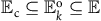 ${\mathbb{E}_{\rm{c}}} \subseteq \mathbb{E}_k^{\rm{o}} \subseteq \mathbb{E}$
. So an open evidential combination has every certain evidential proposition as a member, and none, some, or all of the uncertain evidential propositions. For example, in our variation on van Fraassen’s mouse case, supposing that
${\mathbb{E}_{\rm{c}}} \subseteq \mathbb{E}_k^{\rm{o}} \subseteq \mathbb{E}$
. So an open evidential combination has every certain evidential proposition as a member, and none, some, or all of the uncertain evidential propositions. For example, in our variation on van Fraassen’s mouse case, supposing that ${E_{\rm{s}}}$
and
${E_{\rm{s}}}$
and ${E_{\rm{p}}}$
are certain but
${E_{\rm{p}}}$
are certain but ${E_{\rm{d}}}$
is uncertain, the open evidential combinations are simply
${E_{\rm{d}}}$
is uncertain, the open evidential combinations are simply $\left\{ {{E_{\rm{s}}},{E_{\rm{p}}},{E_{\rm{d}}}} \right\}$
and
$\left\{ {{E_{\rm{s}}},{E_{\rm{p}}},{E_{\rm{d}}}} \right\}$
and $\left\{ {{E_{\rm{s}}},{E_{\rm{p}}}} \right\}$
. (Had
$\left\{ {{E_{\rm{s}}},{E_{\rm{p}}}} \right\}$
. (Had ${E_{\rm{p}}}$
also been uncertain, the open evidential combinations would also have included
${E_{\rm{p}}}$
also been uncertain, the open evidential combinations would also have included $\left\{ {{E_{\rm{s}}},{E_{\rm{d}}}} \right\}$
and
$\left\{ {{E_{\rm{s}}},{E_{\rm{d}}}} \right\}$
and $\left\{ {{E_{\rm{s}}}} \right\}$
.)
$\left\{ {{E_{\rm{s}}}} \right\}$
.)
With this notion of open evidential combinations in hand, my suggestion is—to a first approximation—that IBE should be modified to state that one may infer a hypothesis if it provides the best explanation of any open evidential combination. More precisely:
-
${\bf{IB}}{{\bf{E}}_{{\bf{ER}}}}$
* : If
$H$
would provide a better explanation of any open evidential combination
$\mathbb{E}_k^{\rm{o}}$
than any other available hypothesis, then one may defeasibly infer
$H$


The thought here is that regardless of which of the open evidential combinations turns out to be accurate, the inferred hypothesis would provide the best explanation of it. In the limiting case where there is no uncertainty about any evidence, i.e., $\mathbb{E} = {\mathbb{E}_{\rm{c}}}$
, the only open evidential combination would be the total evidence itself, i.e.,
$\mathbb{E} = {\mathbb{E}_{\rm{c}}}$
, the only open evidential combination would be the total evidence itself, i.e., $\mathbb{E}_k^{\rm{o}} = \mathbb{E}$
. In that special case,
$\mathbb{E}_k^{\rm{o}} = \mathbb{E}$
. In that special case, ${\rm{IB}}{{\rm{E}}_{{\rm{ER}}}}$
* reduces to
${\rm{IB}}{{\rm{E}}_{{\rm{ER}}}}$
* reduces to ${\rm{IB}}{{\rm{E}}_{{\rm{ST}}}}$
. In this sense,
${\rm{IB}}{{\rm{E}}_{{\rm{ST}}}}$
. In this sense, ${\rm{IB}}{{\rm{E}}_{{\rm{ER}}}}$
* is a generalization of standard accounts of IBE.
${\rm{IB}}{{\rm{E}}_{{\rm{ER}}}}$
* is a generalization of standard accounts of IBE.
However, ${\rm{IB}}{{\rm{E}}_{{\rm{ER}}}}$
* is still too restrictive in some cases of evidential uncertainty. Consider cases in which there is no single hypothesis that provides the best explanation of every open evidential combination. Indeed, our variation of van Fraassen’s mouse inference is a case in point:
${\rm{IB}}{{\rm{E}}_{{\rm{ER}}}}$
* is still too restrictive in some cases of evidential uncertainty. Consider cases in which there is no single hypothesis that provides the best explanation of every open evidential combination. Indeed, our variation of van Fraassen’s mouse inference is a case in point: ${H_{\rm{m}}}$
provides the best explanation of
${H_{\rm{m}}}$
provides the best explanation of $\left\{ {{E_{\rm{s}}},{E_{\rm{p}}},{E_{\rm{d}}}} \right\}$
, while
$\left\{ {{E_{\rm{s}}},{E_{\rm{p}}},{E_{\rm{d}}}} \right\}$
, while ${H_{\rm{s}}}$
provides the best explanation of
${H_{\rm{s}}}$
provides the best explanation of $\left\{ {{E_{\rm{s}}},{E_{\rm{p}}}} \right\}$
. So there would be no hypothesis
$\left\{ {{E_{\rm{s}}},{E_{\rm{p}}}} \right\}$
. So there would be no hypothesis $H$
that could be inferred via
$H$
that could be inferred via ${\rm{IB}}{{\rm{E}}_{{\rm{ER}}}}$
*. However, note that in such cases there may nevertheless be some other claim that is robust across these explanatory hypotheses, in that it is implied by each one of them. For example,
${\rm{IB}}{{\rm{E}}_{{\rm{ER}}}}$
*. However, note that in such cases there may nevertheless be some other claim that is robust across these explanatory hypotheses, in that it is implied by each one of them. For example, ${H_{\rm{m}}}$
and
${H_{\rm{m}}}$
and ${H_{\rm{s}}}$
both imply (
${H_{\rm{s}}}$
both imply ( ${H_{\rm{r}}}$
) that there is a rodent in or near your house. This logically weaker claim, implied by each of the best explanations of the two open evidential combinations, should surely be inferrable by our generalization of
${H_{\rm{r}}}$
) that there is a rodent in or near your house. This logically weaker claim, implied by each of the best explanations of the two open evidential combinations, should surely be inferrable by our generalization of ${\rm{IB}}{{\rm{E}}_{{\rm{ST}}}}$
.
${\rm{IB}}{{\rm{E}}_{{\rm{ST}}}}$
.
To accommodate this thought, we may modify ${\rm{IB}}{{\rm{E}}_{{\rm{ER}}}}$
* to say that one may infer a claim
${\rm{IB}}{{\rm{E}}_{{\rm{ER}}}}$
* to say that one may infer a claim $C$
if it is implied by each hypothesis that provides the best explanation of some open evidential combination:
$C$
if it is implied by each hypothesis that provides the best explanation of some open evidential combination:
-
${\bf{IB}}{{\bf{E}}_{{\bf{ER}}}}$
: If
$C$
is implied by each hypothesis
${H_i}$
that provides a better explanation than any other available hypothesis of some open evidential combination
$\mathbb{E}_k^{\rm{o}}$
, then one may defeasibly infer
$C$
.


In the limiting case where there is no uncertainty about any evidence ( $\mathbb{E} = {\mathbb{E}_{\rm{c}}}$
),
$\mathbb{E} = {\mathbb{E}_{\rm{c}}}$
), ${\rm{IB}}{{\rm{E}}_{{\rm{ER}}}}$
reduces to the view that one may infer a claim only if it is implied by the hypothesis that provides the best explanation of one’s total evidence. Since any hypothesis implies itself, this is itself a generalization of
${\rm{IB}}{{\rm{E}}_{{\rm{ER}}}}$
reduces to the view that one may infer a claim only if it is implied by the hypothesis that provides the best explanation of one’s total evidence. Since any hypothesis implies itself, this is itself a generalization of ${\rm{IB}}{{\rm{E}}_{{\rm{ST}}}}$
, albeit a very natural one (see Lipton Reference Lipton2004, 63–4; Dellsén Reference Dellsén2017, 20–21).
${\rm{IB}}{{\rm{E}}_{{\rm{ST}}}}$
, albeit a very natural one (see Lipton Reference Lipton2004, 63–4; Dellsén Reference Dellsén2017, 20–21). ${\rm{IB}}{{\rm{E}}_{{\rm{ER}}}}$
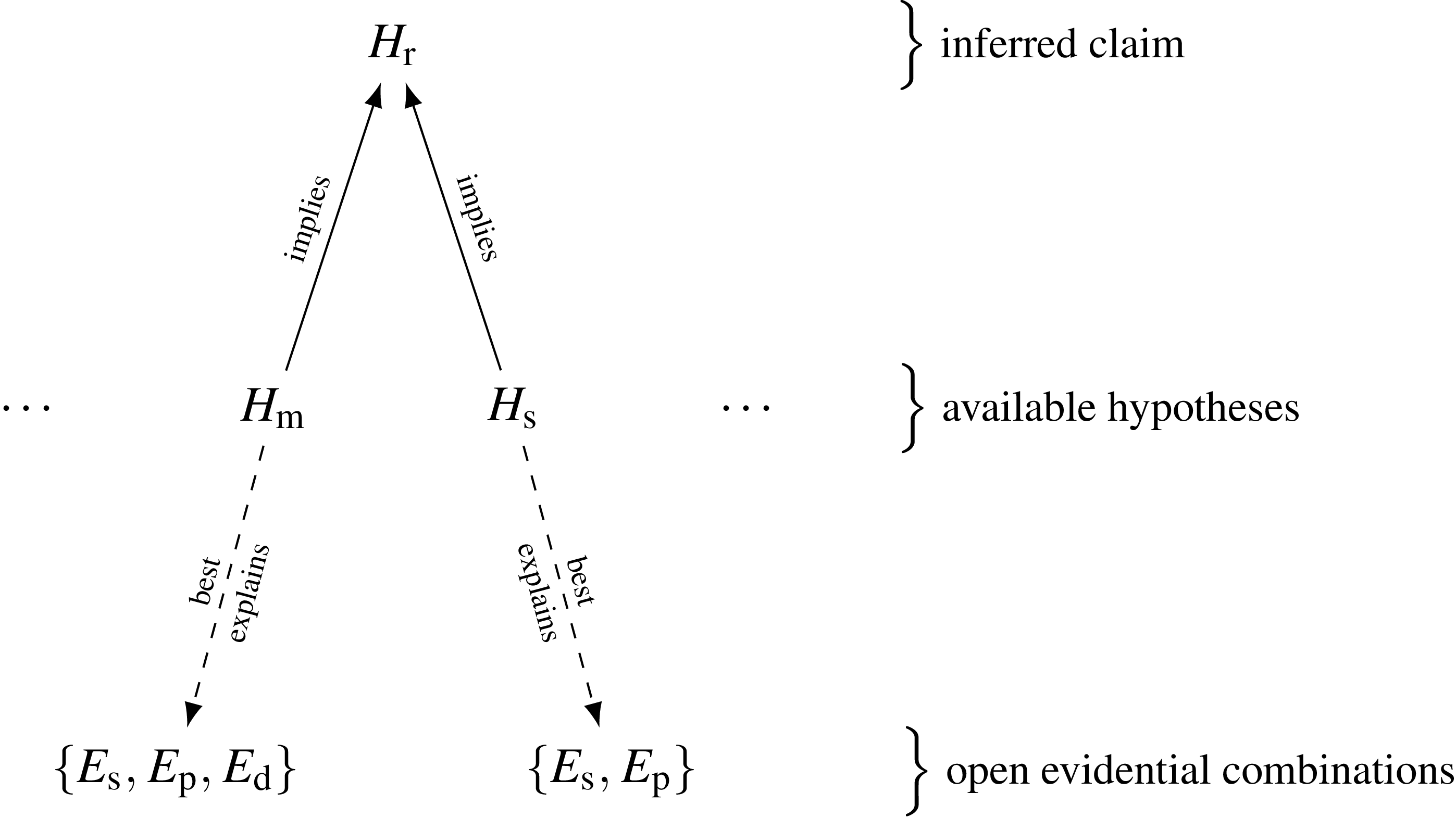
clearly delivers the desired verdict in the variation of van Fraassen’s mouse case in which
${\rm{IB}}{{\rm{E}}_{{\rm{ER}}}}$
clearly delivers the desired verdict in the variation of van Fraassen’s mouse case in which ${E_{\rm{d}}}$
is uncertain, viz. that
${E_{\rm{d}}}$
is uncertain, viz. that ${H_{\rm{r}}}$
may be inferred (see Figure 1).
${H_{\rm{r}}}$
may be inferred (see Figure 1). ${H_{\rm{r}}}$
is implied by both
${H_{\rm{r}}}$
is implied by both ${H_{\rm{m}}}$
and
${H_{\rm{m}}}$
and ${H_{\rm{s}}}$
, each of which provides the best available explanation of an open evidential combination.
${H_{\rm{s}}}$
, each of which provides the best available explanation of an open evidential combination.

Indeed, it also delivers plausible verdicts in further variations on the case in which, say, ${E_{\rm{p}}}$
is also uncertain. In that case, the open evidential combinations would include, in addition to
${E_{\rm{p}}}$
is also uncertain. In that case, the open evidential combinations would include, in addition to $\left\{ {{E_{\rm{s}}},{E_{\rm{p}}},{E_{\rm{d}}}} \right\}$
and
$\left\{ {{E_{\rm{s}}},{E_{\rm{p}}},{E_{\rm{d}}}} \right\}$
and $\left\{ {{E_{\rm{s}}},{E_{\rm{p}}}} \right\}$
, also
$\left\{ {{E_{\rm{s}}},{E_{\rm{p}}}} \right\}$
, also $\left\{ {{E_{\rm{s}}},{E_{\rm{d}}}} \right\}$
and
$\left\{ {{E_{\rm{s}}},{E_{\rm{d}}}} \right\}$
and $\left\{ {{E_{\rm{s}}}} \right\}$
. Now suppose—as seems plausible—that
$\left\{ {{E_{\rm{s}}}} \right\}$
. Now suppose—as seems plausible—that ${H_{\rm{m}}}$
and
${H_{\rm{m}}}$
and ${H_{\rm{s}}}$
still provide the best explanations of these open evidential combinations, e.g., because
${H_{\rm{s}}}$
still provide the best explanations of these open evidential combinations, e.g., because ${H_{\rm{m}}}$
best explains
${H_{\rm{m}}}$
best explains $\left\{ {{E_{\rm{s}}},{E_{\rm{d}}}} \right\}$
and
$\left\{ {{E_{\rm{s}}},{E_{\rm{d}}}} \right\}$
and ${H_{\rm{s}}}$
best explains
${H_{\rm{s}}}$
best explains $\left\{ {{E_{\rm{s}}}} \right\}$
. In that case,
$\left\{ {{E_{\rm{s}}}} \right\}$
. In that case, ${H_{\rm{r}}}$
would still be inferrable via
${H_{\rm{r}}}$
would still be inferrable via ${\rm{IB}}{{\rm{E}}_{{\rm{ER}}}}$
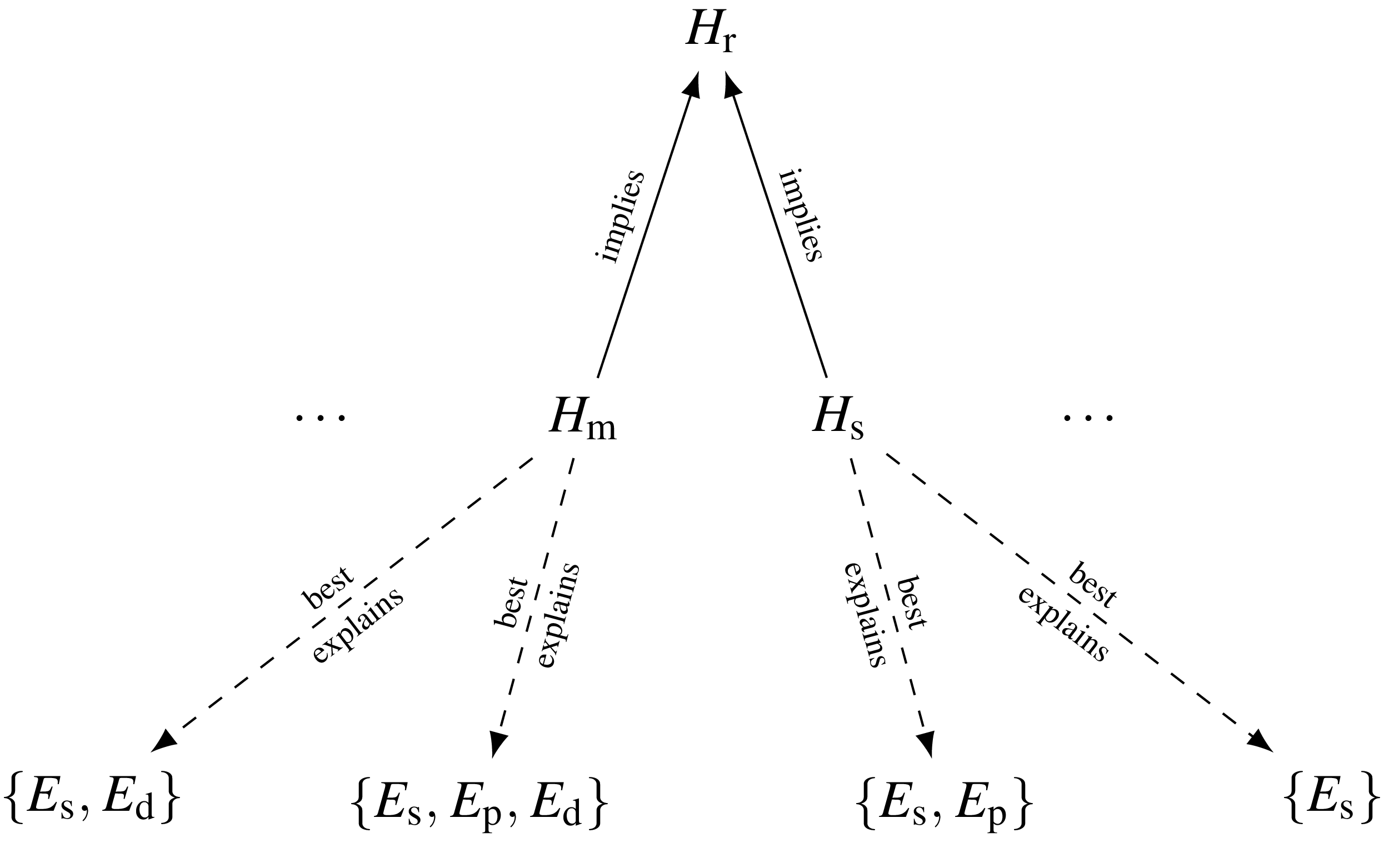
(see Figure 2).
${\rm{IB}}{{\rm{E}}_{{\rm{ER}}}}$
(see Figure 2). ${H_{\rm{r}}}$
is implied by both
${H_{\rm{r}}}$
is implied by both ${H_{\rm{m}}}$
and
${H_{\rm{m}}}$
and ${H_{\rm{s}}}$
, each of which provides the best available explanation of two open evidential combinations.
${H_{\rm{s}}}$
, each of which provides the best available explanation of two open evidential combinations.

With that said, things would be different if some entirely different hypothesis, e.g., the hypothesis ( ${H_{\rm{p}}}$
) that you are being pranked by a member of your family, provided the best explanation of one of these open evidential combinations, e.g.,
${H_{\rm{p}}}$
) that you are being pranked by a member of your family, provided the best explanation of one of these open evidential combinations, e.g., $\left\{ {{E_{\rm{s}}}} \right\}$
. In that case,
$\left\{ {{E_{\rm{s}}}} \right\}$
. In that case, ${\rm{IB}}{{\rm{E}}_{{\rm{ER}}}}$
would not license an inference to either
${\rm{IB}}{{\rm{E}}_{{\rm{ER}}}}$
would not license an inference to either ${H_{\rm{r}}}$
or
${H_{\rm{r}}}$
or ${H_{\rm{p}}}$
, although it would allow you to infer their disjunction
${H_{\rm{p}}}$
, although it would allow you to infer their disjunction ${H_{\rm{r}}} \vee {H_{\rm{p}}}$
, which of course is implied by
${H_{\rm{r}}} \vee {H_{\rm{p}}}$
, which of course is implied by ${H_{\rm{m}}}$
,
${H_{\rm{m}}}$
, ${H_{\rm{s}}}$
, and
${H_{\rm{s}}}$
, and ${H_{\rm{p}}}$
. As this illustrates,
${H_{\rm{p}}}$
. As this illustrates, ${\rm{IB}}{{\rm{E}}_{{\rm{ER}}}}$
will sometimes only license inferences to quite modest conclusions, such as disjunctions of genuinely explanatory hypotheses, especially when one is uncertain about several evidential propositions. Is this a problem for
${\rm{IB}}{{\rm{E}}_{{\rm{ER}}}}$
will sometimes only license inferences to quite modest conclusions, such as disjunctions of genuinely explanatory hypotheses, especially when one is uncertain about several evidential propositions. Is this a problem for ${\rm{IB}}{{\rm{E}}_{{\rm{ER}}}}$
? I don’t think so. On the contrary, when there is more uncertainty about the evidential propositions from which one is inferring, it seems entirely appropriate to hold off on making ambitious inferences unless and until the evidential situation changes, either by one’s becoming more certain about the previously uncertain evidence, or—which is presumably more common—by obtaining other evidence that some of the relevant hypotheses cannot plausibly explain at all. For example, supposing that
${\rm{IB}}{{\rm{E}}_{{\rm{ER}}}}$
? I don’t think so. On the contrary, when there is more uncertainty about the evidential propositions from which one is inferring, it seems entirely appropriate to hold off on making ambitious inferences unless and until the evidential situation changes, either by one’s becoming more certain about the previously uncertain evidence, or—which is presumably more common—by obtaining other evidence that some of the relevant hypotheses cannot plausibly explain at all. For example, supposing that ${H_{\rm{p}}}$
does indeed provide the best explanation of
${H_{\rm{p}}}$
does indeed provide the best explanation of $\left\{ {{E_{\rm{s}}}} \right\}$
, and that this is an open evidential combination, it does seem reasonable not to infer
$\left\{ {{E_{\rm{s}}}} \right\}$
, and that this is an open evidential combination, it does seem reasonable not to infer ${H_{\rm{r}}}$
unless and until you have gathered further evidence to rule out
${H_{\rm{r}}}$
unless and until you have gathered further evidence to rule out ${H_{\rm{p}}}$
, e.g., by interrogating your family members. So while
${H_{\rm{p}}}$
, e.g., by interrogating your family members. So while ${\rm{IB}}{{\rm{E}}_{{\rm{ER}}}}$
is a quite cautious inference rule in situations of evidential uncertainty, it is arguably cautious in just the right way.
${\rm{IB}}{{\rm{E}}_{{\rm{ER}}}}$
is a quite cautious inference rule in situations of evidential uncertainty, it is arguably cautious in just the right way.
4. Einstein on the Mt. Wilson experiments
Thus far, I have motivated ${\rm{IB}}{{\rm{E}}_{{\rm{ER}}}}$
with variations on a case drawn from everyday life. But does
${\rm{IB}}{{\rm{E}}_{{\rm{ER}}}}$
with variations on a case drawn from everyday life. But does ${\rm{IB}}{{\rm{E}}_{{\rm{ER}}}}$
also help us understand how hypotheses are inferred from uncertain evidence in scientific practice? In this section, I briefly discuss one case which suggests that it does—although of course further work is needed to evaluate this in a more systematic fashion.
${\rm{IB}}{{\rm{E}}_{{\rm{ER}}}}$
also help us understand how hypotheses are inferred from uncertain evidence in scientific practice? In this section, I briefly discuss one case which suggests that it does—although of course further work is needed to evaluate this in a more systematic fashion.
Einstein’s special theory of relativity famously discards with the luminiferous ether posited by classical theories of electromagnetism. In so doing, it elegantly explains the famous result, due originally to Michelson and Morley (Reference Michelson and Morley1887), that no effects of an “ether drift”—i.e., movement of the Earth relative to the ether—were observed in increasingly meticulous experiments. Although special relativity also provided rather compelling explanations of other phenomena, such as the speed of light in water flowing in and against the light’s direction of travel (Fizeau experiments), it is safe to say that ether drift experiments were extremely important to establish the plausibility of special relativity in its early years, as Einstein acknowledged (see, e.g., Fölsing Reference Fölsing1998, 219). Moreover, the fact that special relativity elegantly explains the lack of an observed ether drift is often taken to show that Einstein used something like IBE in arguing for his theory (e.g., Douven Reference Douven2002; Janssen Reference Janssen2002).
In the 1920s, however, the significance of earlier ether drift experiments were cast into doubt by several new experiments performed at a much greater altitude than before, viz. at the top of Mt. Wilson near Pasadena (Hentschel Reference Hentschel1992). These experimental efforts were led by the highly regarded experimentalist Dayton Miller, who had not only collaborated with Morley on influential replications of the original ether drift experiment in 1905, but was also the president of the American Physical Society. In a series of papers, Miller reported small but positive interference effects of the sort Michelson, Morley, and himself had failed to observe at lesser altitudes (e.g., Miller Reference Miller1925; Miller Reference Miller1933). These experiments seemed to lend support to versions of classical electrodynamics on which the effects of ether drift could only really be observed at very high altitudes.
Miller’s results caused a major upheaval in the scientific community at the time. Einstein himself remained relatively skeptical, however, expressing doubts both privately and publicly about the reliability of Miller’s results (Hentschel Reference Hentschel1992, 603–608; see also Norton Reference Norton2024, 27–28). But Einstein nevertheless took the apparent results sufficiently seriously to visit Miller specifically to discuss them in person. It seems, then, that Einstein was uncertain about Miller’s results from Mt. Wilson in a way that he was not regarding various other experiments relevant to his theory, e.g., the Michelson and Morley and Fizeau experiments. Accordingly, we could say—imposing the terminology of section 2—that for Einstein there were at least two open evidential combinations relevant to special relativity at the time: one consisting of all the empirical results available to Einstein at the time, and one consisting of all those results except for Miller’s results from Mt. Wilson.
Einstein was convinced that it would not be possible to modify special relativity so as to provide a plausible explanation of ether drift. The reason for this was Einstein’s insistence that ether drift would contradict the constancy of the speed of light, which in turn forms one of the two fundamental principles of his theory. The internal coherence of special relativity would therefore be irredeemably lost by any accommodation of Miller’s results within the theory. Accordingly, while special relativity remains the best explanation of the open evidential combination in which Miller’s results are excluded, Einstein seems to have ruled out an appropriately modified version of special relativity as the best explanation of the more inclusive open evidential combination in which Miller’s results are included. Since there was thus, by Einstein’s lights, no weaker version of special relativity implied by the best explanations of both evidential combinations, no such version of special relativity could be inferred via ${\rm{IB}}{{\rm{E}}_{{\rm{ER}}}}$
while these evidential combinations are both open. This accords with Einstein’s insistence that “[i]f the results of the Miller experiments were to be confirmed, then relativity theory could not be maintained” (Einstein Reference Einstein1926; quoted in, and translated by, Hentschel Reference Hentschel1992, 606).
${\rm{IB}}{{\rm{E}}_{{\rm{ER}}}}$
while these evidential combinations are both open. This accords with Einstein’s insistence that “[i]f the results of the Miller experiments were to be confirmed, then relativity theory could not be maintained” (Einstein Reference Einstein1926; quoted in, and translated by, Hentschel Reference Hentschel1992, 606).
Of course, this situation did not last forever, and ${\rm{IB}}{{\rm{E}}_{{\rm{ER}}}}$
also sheds light on how the situation was resolved. Subsequent analyses of Miller’s results suggested that they were due to temperature changes that caused unequal expansion of certain rods in the experimental setup, leading to an unexpected experimental error. Although Einstein seems to have suspected that something like this might explain Miller’s results, there was no way to know this for certain until several years later (Shankland et al. Reference Shankland, McCluskey, Leone and Kuerti1955). At that point, however,
${\rm{IB}}{{\rm{E}}_{{\rm{ER}}}}$
also sheds light on how the situation was resolved. Subsequent analyses of Miller’s results suggested that they were due to temperature changes that caused unequal expansion of certain rods in the experimental setup, leading to an unexpected experimental error. Although Einstein seems to have suspected that something like this might explain Miller’s results, there was no way to know this for certain until several years later (Shankland et al. Reference Shankland, McCluskey, Leone and Kuerti1955). At that point, however, ${\rm{IB}}{{\rm{E}}_{{\rm{ER}}}}$
suggests that special relativity could once again be defeasibly inferred, since the evidential uncertainty about Miller’s experiments had been resolved in such a way that alternatives to special relativity would no longer provide best explanations of any open evidential combination. Special relativity could, then, reassume its position as the default theory in its domain.
${\rm{IB}}{{\rm{E}}_{{\rm{ER}}}}$
suggests that special relativity could once again be defeasibly inferred, since the evidential uncertainty about Miller’s experiments had been resolved in such a way that alternatives to special relativity would no longer provide best explanations of any open evidential combination. Special relativity could, then, reassume its position as the default theory in its domain.
5. Conclusion
I have argued that standard accounts of IBE face a problem of uncertain evidence that is analogous to a well-known problem for Bayesian conditionalization. If IBE is to survive as a rule of inference, conceived of either as a fundamental rule of inference or as a heuristic for some other form of reasoning, then IBE must be modified so as to accommodate circumstances in which one’s evidence is uncertain. I have sketched a potential solution to this problem in the form of a generalization of IBE— ${\rm{IB}}{{\rm{E}}_{{\rm{ER}}}}$
—which roughly requires an inferred claim to be implied by the best explanations of any combination of one’s evidence that the evidential uncertainty does not rule out.
${\rm{IB}}{{\rm{E}}_{{\rm{ER}}}}$
—which roughly requires an inferred claim to be implied by the best explanations of any combination of one’s evidence that the evidential uncertainty does not rule out.
It is worth noting that ${\rm{IB}}{{\rm{E}}_{{\rm{ER}}}}$
does not require agents to make probabilistic calculations, e.g., by weighing different pieces of evidence by a quantitative estimation of their (un)certainty. Hence, although
${\rm{IB}}{{\rm{E}}_{{\rm{ER}}}}$
does not require agents to make probabilistic calculations, e.g., by weighing different pieces of evidence by a quantitative estimation of their (un)certainty. Hence, although ${\rm{IB}}{{\rm{E}}_{{\rm{ER}}}}$
is in some respects rather crude (at least in comparison to highly idealized updating rules that can handle uncertainty, such as Jeffrey conditionalization), it holds some promise of constituting a workable heuristic inference rule of the sort that many have hoped that IBE might provide us with.
${\rm{IB}}{{\rm{E}}_{{\rm{ER}}}}$
is in some respects rather crude (at least in comparison to highly idealized updating rules that can handle uncertainty, such as Jeffrey conditionalization), it holds some promise of constituting a workable heuristic inference rule of the sort that many have hoped that IBE might provide us with.
Acknowledgements
I am very grateful to Borut Trpin for written comments on an earlier version of this paper, and to audiences at the MCMP at LMU Munich, the PSA 2023 Around the World, and the PSA 2024 in New Orleans.
Funding information
This research was supported by the Icelandic Research Fund (grant 228526-051).
Competing interests
None to declare.






 Open access

