

Thus die I, thus, thus, thus.
Bottom as Pyramus in Shakespeare, A Midsummer Night's Dream, act 5, scene 1
When Shakespeare's Bottom dies as Pyramus, he dies in his own way and like a tragic hero. The combination generates a parody and prompts reflection on the theatricality of death. Pyramus's problem is one of originality: he dies too self-consciously, too much like a lion-hearted lover. But he also faces a challenge common to all would-be artists-of-dying: ignorance. No one knows what it is like to die. When it comes to imagining what it is like to die, the art of analogy can propose a bridge between an object of study and future subjective experience. As a result, ideas about dying are often underpinned and overshadowed by examples; they are shaped by other people's deaths and by models of dying proposed by art. Either way, being an outsider poses challenges.Footnote 1 How far can we extrapolate a generalised idea about dying from examples?Footnote 2 Can we compare one death with another?Footnote 3 In this article, I explore how one category of ancient objects — Roman sarcophagi — mediated reflection on the possibilities and limitations of analogy for meditation on death.Footnote 4 As I discuss in my conclusion, this sort of image-mediated conceptualisation can be emically situated within a specifically Roman cultural regime.
I focus on Roman sarcophagi that have been categorised as featuring the mythological death of Adonis.Footnote 5 These offer a productive case study because, as burial containers, sarcophagi are associated with death. But the life history of scholarship on sarcophagi and death has been turbulent. In the 1940s, those interested in classical archaeology and mythological representations (which is to say, non-Christian images and ideas) moved away from looking for ancient beliefs about the afterlife in sarcophagi.Footnote 6 More recently, approaches have found a middle ground between classicism and eschatology by emphasising the perspectives of the living: images on sarcophagi console the bereaved and praise the dead by offering analogies with exemplary figures from mythology or Roman life.Footnote 7 Sarcophagi have thus been positioned within a Roman phenomenon of exemplarity, a key feature of cultural, especially rhetorical, discourse.Footnote 8 There is also a growing body of literature that pursues a thanatological, or death-focused, approach by exploring how the formal features of a sarcophagus — its shape, ornamentation, framing devices, figures and portraits — prompt meditation on death and the dead.Footnote 9 This work somewhat closes the rift between the study of classical and early Christian material. It also contributes to a field interested in sensory and embodied experience, materiality and object-oriented approaches to the relationship between Graeco-Roman art and ideas about death.Footnote 10 In this paper on analogical viewing and thanatological thinking I build on both current approaches. I dig deeper into how analogies on sarcophagi work, while also considering formal features and the ways in which these features negotiate the challenges of imagining what it is like to die. My point is that analogies on sarcophagi did not just interact with the living as the bereaved and the dead as the deceased, but also invited the living to engage in meditations on death.Footnote 11
My emphasis, throughout this article, on close looking — and on the generative relationship between a visual object and its viewers — raises a practical question of visibility: to what extent, and under what conditions, can we speak of ‘viewers’ of Roman sarcophagi? This is a difficult question, not least because for any given example (including most of the sarcophagi that I discuss here) precise contextual information has often been lost. In general, as regards ‘viewing’, sarcophagi were displayed or concealed in a range of contexts: though some continued to be visible either publicly or privately (at least in principle),Footnote 12 others were unlikely to be seen after interment.Footnote 13 The sort of viewing that I pursue here might, then, best be imagined as taking place during a funeral,Footnote 14 or else before it, perhaps even by its future occupant — an intriguing possibility in the context of this paper.Footnote 15
Sarcophagus studies have often been characterised by a desire to translate and organise, to identify images as specific and to group them as a generalisable and thus recognisable category — ‘an image of’ or ‘images of’ Adonis.Footnote 16 But Roman sarcophagi resist this approach.Footnote 17 The abundance of analogical possibilities presented by sarcophagi invites, even thematises, a more expansive mode of viewing.Footnote 18 Others have emphasised the survival of a diverse cultural heritage in sarcophagi images and deliberate variation of motifs to suit different contexts.Footnote 19 I would add that intimations of multiple stories within one image produce a scene with a plural identity or a fluid, elusive identity.Footnote 20 The ‘identity crises’ part of my title thus refers to problems of specificity and generality in methodologies historically present in the discipline of classical art and archaeology as well as example-based meditation on death.
Indeed, example-based meditation is a running theme in this article in approach as much as content. Though the sarcophagi that I discuss here are comparable with one another (they are similar objects with similar functions and contexts, originating from a relatively brief time-period), the exercise of constructing a general argument from specific examples stages, in a more extreme fashion, the assumptions that necessarily underpin extrapolation of a cultural-historical story from fragmentary evidence.Footnote 21 My examples purport to represent a corpus and a cultural phenomenon. Moreover, the possibilities and limitations of the case studies in this article mirror the promise and deficiency of images of Adonis as exemplars of what it is like to die. Analogies, examples and their shortcomings thus carry and compromise the form and the content of my argument.
Why Adonis? Adonis, beloved of Venus, died after being wounded in the thigh by a boar during a hunting expedition. The myth is a tale of love and loss, death and grief.Footnote 22 In ancient Greek tradition, the story had a cyclical dimension, with Adonis dying and returning annually in rhythm with the seasons.Footnote 23 Adonis also comes with a scholarly tradition, a history of views deriving existential beliefs about mortality, immortality and resurrection or rebirth from the cult of Adonis and his representations in Graeco-Roman culture.Footnote 24 So even when not on a sarcophagus, Adonis's death has a claim to exemplarity. He is a natural subject for example-based meditation on death.
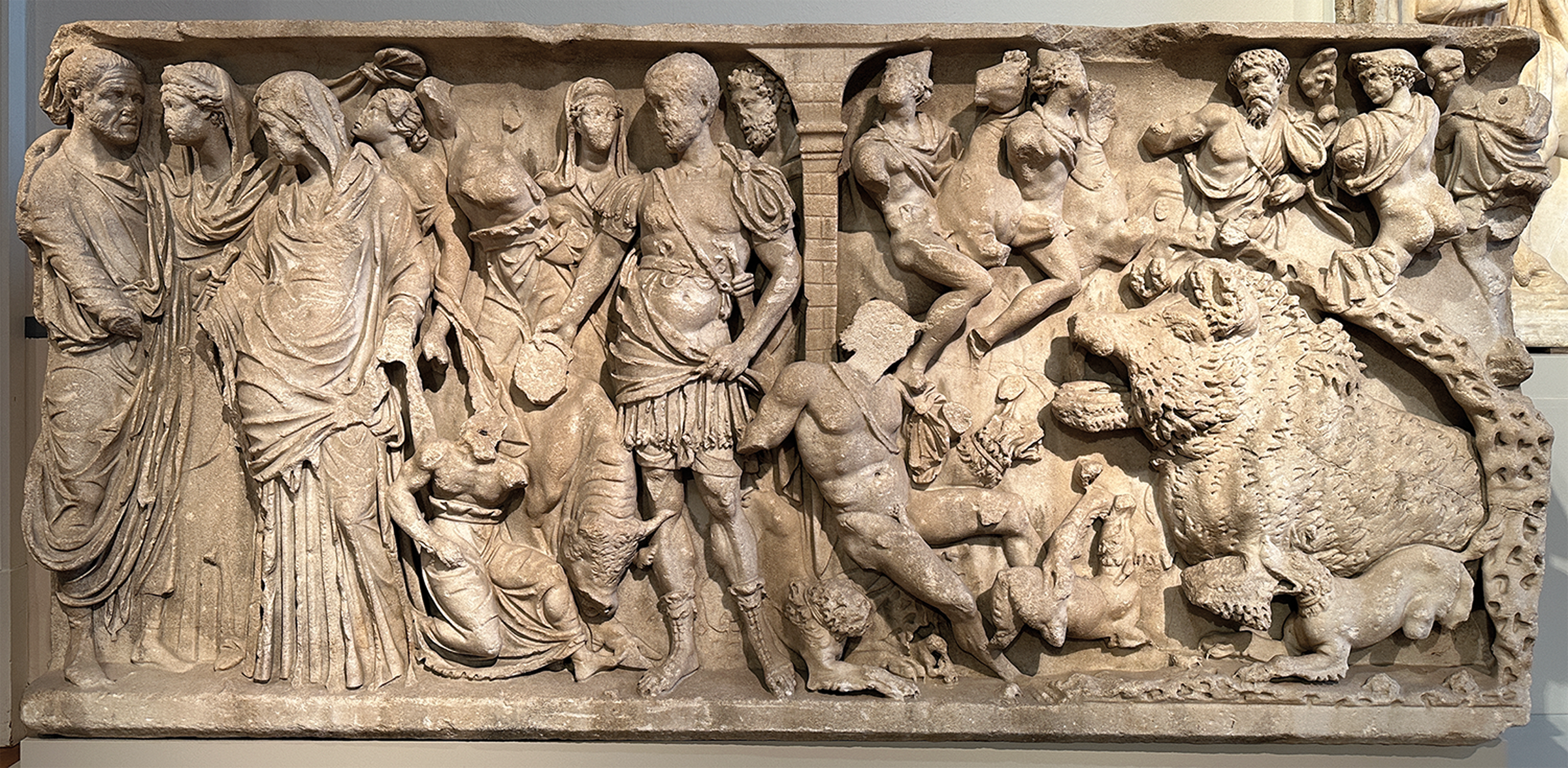
Though I refer to several sarcophagi, I focus on the Rinuccini sarcophagus (Figs 1–6).Footnote 25 I consider first how resemblances within the sarcophagus's rectangular field invite a mode of viewing and thinking based on equivalence. Then, I discuss the numerous identities that might inhere in representations of Adonis himself and what this multiplicity does in the context of death. In my conclusion, I turn to more reflexive ways in which sarcophagi make the process of meditation by analogy an object of discourse. I suggest, finally, that the way of conceptualisation explored in this paper is recognisably Roman.
Rinuccini sarcophagus front panel, c. 200 c.e., marble, length 212–15 cm, height 101 cm. Berlin State Museums, Berlin, 1987.2. (Artwork in the public domain; photograph by the author)
Rinuccini sarcophagus front panel (Fig. 1), detail of the left-hand side. (Artwork in the public domain; photograph by the author)

Rinuccini sarcophagus front panel (Fig. 1), detail of the right-hand side. (Artwork in the public domain; photograph by the author)

Rinuccini sarcophagus front panel (Fig. 1), detail of the centre. (Artwork in the public domain; photograph by the author)

Rinuccini sarcophagus left-end panel, marble, depth 94 cm. Berlin State Museums, Berlin, 1987.2. (Artwork in the public domain; photograph by the author)

Rinuccini sarcophagus right-end panel, marble, depth 99 cm. Berlin State Museums, Berlin, 1987.2. (Artwork in the public domain; photograph by the author)

I Death By Analogy
The front face of the Rinuccini sarcophagus presents two spaces divided by a pier that swoops outwards at the top; the illusion is that the pier supports an open archway that connects and demarcates two areas (Fig. 1).Footnote 26 Viewers of the sarcophagus relief are situated, as it were, in an imaginary vaulted space that is created by the sarcophagus relief, and are provided with views in either direction from beneath the arch, one looking into the left-hand space, one to the right. These spaces are filled with figures carved in high relief that seem to inhabit two different realms, real and mythological.Footnote 27
In the left-hand scene (drawn from Roman life, a vita Romana scene), figures are clothed, women accompany men and most figures stand upright (Fig. 2). This is a domain of layers and folds, with bodies wrapped in fabric and figures in the foreground partially concealing those behind. The bodies of two male figures on the group's fringes form other partitions, their heads turning towards the space between them, an interior space shielded by their bodies and inhabited by a woman, a smaller kneeling figure and a domestic animal, a bull. By contrast, the right-hand scene is a display of macho nudity, with bodies twisting and sprawling (Fig. 3). While, on the left, up-standing bodies and the deep folds of their garments emphasise verticals, figures on the right ride and lunge above the arch of the cave, or loll and crouch below, upon the ground: the arc composed by their bodies reinforces the cave's curvature to encircle the boar, producing a vigorous space of circles, spy-holes and traps. Indeed, the halo of smooth, sculpted flesh around rough pitted textures — bulbous crannies in the rock and craggy waves that ripple about the boar's chest and neck — revels in surface, a riposte to the left-hand insistence on depth. Though the three figures in the top right of the mythological scene are usually interpreted as Adonis's companions (and so human not divine), their position in the upper field alongside two horsemen complicates their ontological status, because the latter are usually read as the Dioscuri, the twins Castor and Pollux, mortal and divine respectively. On the left, then, we have an ordinary realm with people arranged in layers and figures’ feet planted firmly on the ground (even, it seems, the feet of the two figures usually identified as personifications of harmony and duty). On the right we have an alternate one, where human, divinity and hero intermingle in a flatter but sky-high plane.Footnote 28 The sculptor has distinguished two zones.
The demarcation is, however, ruptured by a nude, sprawling male body, usually interpreted as Adonis since he is injured and alongside a boar (Fig. 1). This figure (and the animal beneath him) connects the two spaces by slumping through the arch, which works, effectively, as a gateway between the spaces.Footnote 29 He encourages viewers to link one scene with another, to view two halves as one, to think by analogy. One possibility is that he connects two scenes of harmony and duty with a third scene of courage: he links a marriage symbolised by joined right hands and a sacrifice and libation, probably before battle,Footnote 30 with a wounded hunter's parting shot, spearing the boar that gored him.Footnote 31 Or perhaps he glosses two exemplary scenes from a Roman man's life (marriage and sacrifice) with the universal message that all men must die.Footnote 32 Both these interpretations fit with a principle (widely endorsed in scholarship) that mythological scenes enact consolation rhetoric by introducing, in a loosely analogous way, solace for the bereaved and praise for the dead. But the reflections that are prompted by this scene are also thanatological and epistemological. The slumped male figure puts dying centre-stage and, by establishing a way of viewing predicated upon making connections and comparisons, turns attention upon the process of thinking about death by analogy.
There is nothing simple about drawing analogies with the images on this sarcophagus.Footnote 33 Repetitions and correspondences accumulate to thematise figurative viewing, its problems and its possibilities. The relief is a collection of groups and pairs: moving from the left, a husband and wife join hands; a soldier pours a libation beside a sacrificial victim; the injured figure of Adonis faces the boar; the Dioscuri ride; Adonis's three companions lunge; two dogs frame Adonis; two attack the boar. In some ways these groups are mirror images, in others alternatives. We see a reflection of marital harmony in the partnership between hunters and Dioscuri and its inversion in the struggle between hunters, gods and boar. The Dioscuri are nude with a short cloak and ride rightwards, their motion bringing them towards, even against, Adonis's unmounted companions, who are similarly dressed but unmounted. The groups are matched and distinguished: on horse, on foot; bodies in profile, bodies in front and rear view; two (or four with the horses) moving as one, two converging in a triangle; heads turn apart, faces look in the same direction. Each group is also joint and several, replicating themes of similarity and difference at a micro level. If the two mounted figures are Castor and Pollux, one is mortal, the other divine (but we cannot identify which is which), and arguably each has more in common with his horse than his brother: though their bodies seem to move in the same direction, their heads (and their horses’ heads) turn apart. The repetition distinguishes as much as it aligns.
This has implications for more generalised meditation on dying, mediated by the combination of examples. I will focus on three sets of ideas thrown together by the images: sacrifice, hunting and marriage. Let us begin with an interpretation that traces male bodies to make a general argument about Roman virtues, specifically those of the deceased (who is often presumed to be male, though this is a tenuous assumption: the identity of the deceased is unknown).Footnote 34 The male figures differ in appearance: the left is in a toga; the central figure in military dress; the third nude; the hunters and Dioscuri partially draped.Footnote 35 The combination mixes sobriety, strength and erotic appeal, but a common thread prevails: the male body is repeatedly a model of harmony, duty and courage.Footnote 36 As such, the figures might represent the deceased in admirable guises, as enshrined in his family's memory. This is a fairly standard interpretation.
We can, however, push the analogies further, such that similarities become an exercise in the figurative nature of meditating upon dying. I begin with the central scenes of sacrifice, libation and death (Fig. 4). To the left, a kneeling figure prepares to pierce a bull's throat while a butcher strikes from behind (a similar butcher to the one on the sarcophagus's left-end relief, Fig. 5).Footnote 37 In the centre, a man stands with his armoured torso in frontal view, his head turned to the left and his right arm extended to pour a libation from a bowl over the bull. To the right, Adonis falls from one realm into another, his right arm bent in a mirror reflection of the soldier's left and extended backwards to touch, or almost touch, that figure's left knee. These events are bound closer by visual parallels between Adonis's drooping head and the bowed neck of the bull, intimating, perhaps, two blood sacrifices. Mythological accounts survive in which a god (variously Mars, Diana or Apollo) drove the boar to wound Adonis,Footnote 38 so Adonis's death, and the blood he sheds, picks up on the power and violence latent in the left-hand scene of religious dying; in each scene the gods receive or take a victim.Footnote 39
Enclosed by two scenes in which bodies (bull, Adonis and boar) pour out their life's blood, or will soon do so, the figure of the soldier takes on a thanatological significance.Footnote 40 He too sheds liquid, but from a hollow vessel. In the context of the sarcophagus, his libation might, among other associations, look backwards, honouring a past death, or deaths, with a liquid memorial.Footnote 41 But his military dress also accommodates the possibility of death in battle, perhaps, like Adonis in some accounts, slain by Mars, whether Mars be god, boar, war or all three.Footnote 42 In mythology, Adonis is sometimes injured by a god-as-boar (or a god-sent boar), which is similar to how, in the Iliad, warriors are slain by gods, gods-in-men and men-like-boars.Footnote 43 Adonis's death by boar thus presents an analogy for military death, and vice versa. Indeed, the round libation dish in the soldier's hand echoes the circular perimeter of the cave that holds the gory scene between Adonis and the boar, visually reinforcing the equivalence of the scenes. One implication is that Adonis's death is exemplary insofar as his death is not extraordinary; he, like everyone else (a soldier, or any mortal creature), dies like (in the same sort of simile as) everyone else — like, for example, a boar or a bull.
What does it mean, then, for Adonis to look like a slayer as well as a victim? His body is also twinned with that of the small figure crouching beside the bull: another sacrificial slayer.Footnote 44 This draws attention to the spear (now lost) that this Adonis once directed into the boar's throat.Footnote 45 Imagine that the spear is still in Adonis's grip. Not only do both figures pierce (or will pierce) their victims with a weapon in the neck, but their positions and poses are similar. Each is set to the left of the animal they kill. In addition, though Adonis sits and the other kneels, the lines of their shoulders incline gently to the right, both left legs are bent and the upper portions of their right arms trace the same gradient. Given the possibility of analogies not just between two scenes of dying but between two scenes of killing (with boar and Adonis doubling as aggressor and victim), the circular dish in the soldier's hand offers the mythological scene as a mise en abyme of sacrificial dying and a mirror reflection, a reversal in which the exemplary death is not that of Adonis but the boar, enclosed within the darkness of the cave, opening its mouth in a voiceless scream.Footnote 46 In this respect, the arcs of sculpted masonry at the relief's centre pick up the circle of the cave (also sculpted, but sculpted to look natural) and tighten the correspondences between the soldier and the boar, two masculine figures with heads turned to the left. It is no coincidence that a sacrificial bull and a boar feature on the sarcophagus's left- and right-side friezes respectively (Figs 5 and 6). The bull is led; the boar is chased; both move away from columned archways. Are the bull and the boar central figures here?
Let us return to the interpretation that I introduced above: the repeated male figure and implications for the deceased's good character. So far, my discussion has focused on males and masculinity: dying like a soldier, Adonis, a bull or a boar. But what about the woman in the foreground at the frieze's left-hand end (Figs 1 and 2)? It has been suggested that, as one of three male figures (also including the soldier and Adonis), the man grasping her right hand (though the hands are lost) enacts one virtue for which the deceased is praised, the harmony of marital union.Footnote 47 This is an attractive interpretation, not least because the heads of the two male figures that frame the left-hand scene turn towards one another in an implicit mirror reflection; this might be the same man in two differently commendable contexts (harmony and duty). But an over-specific mapping of identity here does not account for similarities between the woman and the soldier. These two stand in a frontal pose, their weight upon their right leg, the left relaxed. Their right arms are extended, while the left bend and clasp the fabric of their cloaks, pulling it across their hips and upwards to reveal the folds of the clothing beneath. Both stomachs are accentuated, one by stretched fabric, the other by a moulded breastplate. Both heads turn to the left and the figures are similar heights. The soldier is linked visually, and thereby conceptually, with the woman.
Aside from resisting any neat organisation of who's who here, the visual analogy intensifies thanatological meditation: any ideas about dying generated by him are also shaped by her. This matters, because if the male marital figure evokes union, the female imbues that concept with additional narratives of power, consent, abduction, departure, death and loss. Traditionally a Roman woman's marriage staged a mock kidnap from her father's house, a cultural re-enactment of, among other stories, the mythical abduction of Proserpina, goddess of spring (and life), by Pluto, god of the underworld (and death).Footnote 48 This sculpted woman's split pose (body turned towards the viewer, head towards the man grasping her hand) is thus ambivalent. Does she turn towards or from him? If towards, where has she come, or been taken, from?Footnote 49 Admittedly, the female figure in the background between these two has been identified as a personification of harmony (which is the obvious emphasis of the scene).Footnote 50 But what about the figure behind the married woman's left shoulder, who tilts her face towards the sky? Might this hint at distress, desperation, an appeal to the gods?Footnote 51 A woman taken in marriage on a sarcophagus might import themes of abduction, loss and death as well as union; in fact, this was a popular association.Footnote 52 Consider one sarcophagus held in the Uffizi, which deals more explicitly with these themes in the story of Proserpina's abduction by Pluto (Fig. 7).Footnote 53 Proserpina's body is outstretched in his arms as if already deceased. Another sarcophagus shows the kidnap of two sisters, the daughters of Leucippus, by the Dioscuri and mourns in its epigraph the death of a young bride (Fig. 8).Footnote 54 The sculpted girls appear alive, but their torsos are rigid and near horizontal. These are the sorts of images and stories that formed the cultural backdrop to the Rinuccini sarcophagus, and which might well have coloured the impact of the marriage scene when viewed alongside the other more noticeably violent scenes.Footnote 55 Indeed, if anyone did remember the role played by the Dioscuri in the abduction of the daughters of Leucippus, the glance by the left-hand twin on the Rinuccini sarcophagus towards the scenes on the frieze's other end might acquire a troubling edge.Footnote 56
Sarcophagus with the abduction of Proserpina, c. 160–180 c.e., marble, length 210 cm, height 75 cm, depth 63 cm. Uffizi Gallery, Florence, 1914, 86 (Photograph by Gerhard Singer, provided by the Deutsches Archäologisches Institut Rom, D-DAI-ROM-72.120, cropped by the author)

Sarcophagus with the abduction of the daughters of Leucippus by the Dioscuri, c. 160–180 c.e., marble, length 220 cm, height 56 cm, depth 75 cm. Uffizi Gallery, Florence, 1914, 104. (Artwork in the public domain; photograph by Gerhard Singer, provided by the Deutsches Archäologisches Institut Rom, D-DAI-ROM-72.131, cropped by the author)

In addition, the visible presence of one woman might make another's absence more striking. Usually Venus, Adonis's bereaved lover, plays a prominent role.Footnote 57 On the Rospigliosi sarcophagus, for example, she appears four times (Fig. 9).Footnote 58 Each time, her arm connects her with Adonis, bridging the gap between them. A sarcophagus in the Vatican, Vatican 10409, has a similar impact (Fig. 10):Footnote 59 to the left, the figures turn towards each other, connected by Venus's hand; in the centre, the curtained backdrop connects them in a private space; to the right, Venus's drapery arcs above them, grouping them in another pseudo-indoor scene.
Sarcophagus with Adonis, c. 200 c.e., marble, length 237 cm, height 58 cm. Casino Rospigliosi, Rome. (Artwork in the public domain; photograph by Franz Schlechter, provided by the Deutsches Archäologisches Institut Rom, D-DAI-ROM-86.48, cropped by the author)

Sarcophagus with Adonis, c. 220 c.e., marble, length 215 cm, height 72 cm, depth 71 cm. Museo Gregoriano Profano, Vatican, 10409. (Artwork in the public domain; photograph by Gisela Geng, provided by the Forschungsarchiv für Antike Plastik, FA-S-GEN-5710-01a_21252, cropped by the author)

On the Rinuccini sarcophagus (Fig. 1), by contrast, Venus is absent from the hunt and possibly the whole frieze, except by analogy with the wife,Footnote 60 or perhaps the husband. The composition still conveys intimacy with its abundance of groups, but Adonis is remarkably isolated. The vault of the cave fails to bring him within its embrace: the right calves of the Dioscuri trace its curve downwards to meet his shoulder, separating him from the boar. The body that spans mythological and real zones also sits outside both. The nude male on the right and the draped female on the left therefore also work as each other's analogies:Footnote 61 the man or the god that takes a woman in his grip (and so implicitly removes her from her family) accentuates the impotence and loneliness of the bereaved, who has been taken out of the picture.
In focalising death through the eyes of the bereaved Venus, it is clear how sarcophagi such as these might have participated in consolatory rhetoric: grieving viewers may have seen themselves and their sorrow repeated in the decoration and been comforted that gods and heroes suffered the same or worse. They might have found solace in reinforcement of their status by identification with exemplary figures. They might have experienced hope of victory over death, particularly in the context of Adonis's association with cyclical renewal.Footnote 62
But my point here is that the profusion of analogies also becomes something more thanatological.Footnote 63 Indeed, within the group of objects that Dagmar Grassinger categorised as ‘Adonis’ sarcophagi, there often appear scenes in which Venus bids farewell to Adonis as he departs for the hunt (a profectio, or ‘departure’ scene) and scenes in which the lovers embrace while figures such as winged cupids tend his wound (a union that precedes another sort of departure — in death).Footnote 64 On the Rinuccini sarcophagus, the reconfiguration of the more familiar scene of two lovers separating (before the hunt) or embracing (before Adonis's death) in an image of marriage (itself conceivably, though more subtly, associated with separation — separation from the bride's family) gives the latter scene an emotional twist that chimes with the theme of departure in death that overshadows the relief as a whole.Footnote 65 The dominant emphasis of the Rinuccini marriage scene may be union, but the cultural and artistic tapestry against which the image is viewed imbues it with thanatological significance.
In these ways, resemblances across the frieze set up a mode of viewing based on association and transference of impressions. In the context of death, this shapes the processes and results of thanatological thinking.Footnote 66 But in addition, given the discrepancies as well as similarities between details, resemblances might provoke meditation on the essential but flawed role played by examples and the challenges of extrapolating from them generalised ideas about what it is like to die.Footnote 67
II DYING LIKE ADONIS (OR A. N. OTHER)
On this note, let us consider how resemblances might generate a provocative lack of specificity in the context of death. What does it mean for multiple identities to be immanent in one figure? An assumption runs through much scholarship on Roman sarcophagi that figures have an identity. They may allude to other traditions, but there is a core story to be unearthed.Footnote 68 On Michael Koortbojian's analysis, for example, the sprawling nude on the Rinuccini sarcophagus is a variant of Adonis and a vessel for the generalised idea of mortality.Footnote 69 But at what point does variation risk producing someone else entirely? When is resemblance simply reality? Ovid's playful description of Adonis in his Metamorphoses is instructive here (Met. 10.515–18):Footnote 70
Ovid's visualisation of Adonis's body plays with the boundary between resemblance and identification. The image of Adonis that emerges from the text draws on images of ‘Loves’ familiar from the iconographic tradition.Footnote 71 Ovid distinguishes the textual image by the absence of the Loves’ usual attributes, arrows, but undercuts the difference by suggesting that Adonis would be better with arrows, a depiction that might render him visually indistinguishable from a Love and allow him to defend himself successfully against the boar.
This last possibility anticipates the mercurial mythological identification invited by sarcophagi. Give Adonis a weapon, allow him to defeat the boar, and he might become … Meleager.Footnote 72 Consider one sarcophagus in the Palazzo Doria Pamphilj (Fig. 11):Footnote 73 a central nude male figure is shown in a three-quarters stance, striding with his left leg forwards as he thrusts his spear into a boar's forehead. This figure is usually identified as Meleager.Footnote 74 A similar body schema, alike in pose albeit with his head tilted further forwards, appears on the Rospigliosi sarcophagus, beside the seated figure usually identified as the wounded Adonis (Fig. 9).Footnote 75 We also see hints of this man in hunter figures in the background to ‘Adonis’ sarcophagi in the Vatican and Mantua (Figs 10 and 12).Footnote 76
Sarcophagus with Meleager, c. 180–200 c.e., marble, length 247 cm, height 94 cm, depth 110 cm. Palazzo Doria Pamphilj, Rome. (Artwork in the public domain; photograph by Peter Barritt, provided by Alamy, G3DJN3)

Sarcophagus with Adonis, c. 190 c.e., marble, length 218 cm, height 73 cm. Palazzo Ducale, Mantua (Artwork in the public domain; photograph by Gisela Fittschen-Badura, provided by the Forschungsarchiv für Antike Plastik, Fitt77-03-01_12159, cropped by the author)

Usually, identification of these figures is subordinated to that of the male nude in the foreground, whose leg wound sets the tone (as an ‘Adonis’ scene). But what happens when that fallen figure also deals the killing blow, as on the Rinuccini and Vatican sarcophagi (Figs 1, 3 and 10)? By combining more than one body schema (for example Adonis and Meleager), these reliefs challenge attempts to specify the identity of the figure or scene.Footnote 77 On the Vatican sarcophagus, a fallen male figure, nude apart from a cloak, is shown upon his knees, his head turned towards the boar and his left hand raised palm outwards in defence (Fig. 10). His right hand, by contrast, grasps a large spear that he thrusts into the boar's throat. The balance of power is unclear. Leaning ever so slightly backwards and kneeling with his genitals exposed, the fallen nude appears in a position of erotic vulnerability. But the line of his spear, braced upon the ground, is strong and stiff, virile even, projecting from his groin. The figure subjugates and succumbs in one.
This highlights the fragility of extrapolating a story from identification of a specific figure: if a fallen man is Adonis, Meleager-like people around him become generalised hunter companions, background figures as opposed to named characters. But when defeat is mixed with victory, as on the Rinuccini and Vatican sarcophagi, it becomes more difficult to determine the figure's identity and, in turn, the identity of the wider scene. What would it take to accept that a figure alongside a boar is not specifically Adonis, and not a participant in a generic hunt scene or another mythological hunt scene, but all of them at once? We either accept that scenes include images that are variously generic ‘hunter attacks a boar’ figures and specific mythological characters (and that it is possible to distinguish the two),Footnote 78 or we must consider the possibility that figures and scenes can hold more than one identity. If the spear-wielding, nude male shown at disadvantage on the Rinuccini and Vatican sarcophagi were a literary figure, he might be ‘Adonis-Meleager’, neither an Adonis, nor a Meleager (likewise, it is Bottom-as-Pyramus who dies, not one or the other).
In fact, even as a wounded, dying hunter, Adonis still recalls Meleager. This is notable on examples in Blera and the Villa Giustiniani Massimo (Figs 13 and 14).Footnote 79 On these the semi-recumbent nude figure usually identified as Adonis looks remarkably similar to depictions of the prostrate Meleager, such as that on the narrow superior frieze of the sarcophagus in the Palazzo Doria Pamphilj (although this raises a question as to whether the latter could be Adonis) (Fig. 11). Repetition of the boar and male figure prompts viewers to recognise a specific scene (Adonis, say, rather than Hector) and opens the possibilities to include other identities such as Meleager and the deceased. Why see one story in any one scene? Given that there are not only examples such as the Rinuccini sarcophagus that encourage analogy between real and mythological scenes, but also ones that set Mars and Rhea Silvia alongside Endymion and Selene (Fig. 15),Footnote 80 for example, we should consider the possibility that images on sarcophagi work in an altogether more expansive way, becoming multiple stories and identities at once.Footnote 81
Sarcophagus with Adonis, c. 200 c.e., marble, length 198 cm, height 52 cm, depth 55 cm. Chiesa Santa Maria Assunta, Blera. (Artwork in the public domain; photograph by Barry Ferst)

Sarcophagus with Adonis, c. 180 c.e., marble, length 210 cm, height 49 cm. Villa Giustiniani Massimo, Rome. (Artwork in the public domain; photograph by Gerhard Singer, provided by Deutsches Archäologisches Institut Rom, D-DAI-ROM-68.5200, cropped by the author)

Sarcophagus with Mars and Rhea Silvia, Selene and Endymion, c. 200–215 c.e., marble, length 225 cm, height 82 cm. Museo Gregoriano Profano, Vatican, 9558. (Artwork in the public domain; photograph by Gisela Geng, provided by the Forschungsarchiv für Antike Plastik, FA-S-GEN-5713-01_21259)

A more expansive reading is supported by the multiplicity of directional imperatives on sarcophagi friezes.Footnote 82 Carl Robert categorised Adonis sarcophagi according to whether their scenes run from left to right or right to left, but the density of analogies within a sarcophagus frieze offers numerous routes for eyes to follow,Footnote 83 and so frustrates categorisation according to one linear pattern.Footnote 84 For example, while the Rinuccini scene can be read as a left-to-right progression through an adult male Roman's life,Footnote 85 it also invites convergence on a central twin sacrifice (Fig. 1). The variety of options for exercising visual attention leaves narrative possibilities open-ended, both as a matter of sequence and content.
Moreover, latent within the image of the outstretched male nude is a long, diverse visual tradition of dead and dying figures. The sprawling nude on the Blera sarcophagus is charged with possibilities (Fig. 13). His slumped body, lifted by a companion, could be (at least) Adonis, Meleager or even Hector (Fig. 16).Footnote 86 Polymorphous identity is not an accidental result of one schema being especially aesthetically pleasing or, more prosaically, there being limited options for representation of a dying or dead body. Scenes on sarcophagi are not generic: they are specific, but abundantly, multifariously specific, pointing viewers in more than one direction at once (as on the Rinuccini sarcophagus, where the slumped pose of the figure indicates Adonis, but the presence of the Dioscuri and the killing blow indicates Meleager).Footnote 87
Sarcophagus with Hector brought back from Troy, c. 200 c.e., marble, length 175 cm, height 50 cm. Louvre, Paris, Ma 353. (Artwork in the public domain; photograph by Gisela Fittschen-Badura, provided by the Forschungsarchiv für Antike Plastik, file Fitt71-24-08, cropped by the author)

Indeed, the Rinuccini sarcophagus foregrounds movement between the specific and general by combining myth and Roman life in an unexpected and conspicuous way. While analogy is implicit on other sarcophagi, a side-by-side comparison of realms is unusual.Footnote 88 However, even if most sarcophagi do not juxtapose scenes like this, they do experiment with situating the departed or bereaved explicitly within a mythological scene, moving closer towards closing the gap between representation and reality and so between one particular, the analogue, and another, the target.Footnote 89 On the Vatican sarcophagus the two central seated figures (read as Adonis and Venus) have portrait features (Fig. 10). Figures on the Rinuccini sarcophagus also had portraits (Figs 1 and 2).Footnote 90 We cannot know whether Adonis had one because all that survives of his head is a flat surface prepared for an attachment (and it is unclear whether this is an original or a later feature).Footnote 91 Other heads are also missing and the dowels and dowel holes suggest these might have been supplemented, although the existence of sarcophagi with unfinished portraits leaves open the possibility that the absence of faces was a choice.Footnote 92
There are two important points to make here about specificity and identity. First, many sarcophagi, including the Rinuccini sarcophagus, present figures with at least two specific identities simultaneously (Adonis, for example, and a real Roman person).Footnote 93 This fits within a third-century movement away from mythological narrative and towards more overt identification between Romans and characters.Footnote 94 But, secondly, the combination of specifics also highlights their distinction. On the Vatican sarcophagus the portraits and central position of the enthroned couple present them as representative figures, not participants in a fictional narrative: the portrait that belongs to Adonis, gazing out of the scene with apparent lack of concern for his wound,Footnote 95 isolates him from mythological events.Footnote 96 On the Rinuccini sarcophagus, juxtaposition of Adonis's nude wounded body alongside the portrait belonging to the armoured Roman forces viewers to acknowledge the gap between identities. It appears that the point is to notice combinations or disparities, either because portraits are left blank or because they jar in a surprising way.Footnote 97 The idea is to recognise more than one specific identity, not to collapse them into one.
This has implications for how Roman sarcophagi invite viewers to think about what it might be like to die, and what they are doing when they engage in meditation on death in response to an image. On the one hand, multifarious figures are generative: they pull together several sets of ideas and combine them to produce something new. This line of thought has been comprehensively pursued, for example by Michael Koortbojian.Footnote 98 As Koortbojian emphasises, the presence of images and motifs within the cultural tradition lingers in later variations. But what is important about his argument for my purposes is that it emphasises survival (survival of identities via the enduring influence of artistic renditions), and the generation of a new generalised — and generalisable — idea (‘mortality’, for example).Footnote 99 Familiarity with visual and literary mythological traditions enabled artists to vary stories, viewers to recognise them, and both to construct new ideas from the reconfigurations.Footnote 100 Multiplicity is deliberate, sophisticated and generative of stable and cohesive meaning.
However, the proliferation of specifics on sarcophagi also draws attention to the more destructive implications of death for identity and individuality.Footnote 101 What is lost when a dying man looks like himself and also like Adonis and Meleager and others? For Simone Weil, war transformed men into things, ‘inert matter’ or ‘blind force’, and this was reflected in the similes of the Iliad, which liken men to forces of nature and wild animals (like boars).Footnote 102 When the Rinuccini sarcophagus sets Adonis opposite a boar, face-to-face in the approximation of a mirror image, it stages a similar transformation in a similar way. Dying like Adonis is likened to dying like a boar, and this visual analogy, by presenting the possibility of transformation in either direction, echoes the transformation of both identities into something else (a corpse) on death. Thus, the survival of multiple identities from literary and visual traditions (as recalled, deliberately or not, by specific details) and their combination (but not their blending) in a sarcophagus frieze also draws attention to the possibility of a loss, the transformation or dissolution of discrete identity on death.Footnote 103 When Adonis looks like Meleager, or Hippolytus, or a boar (or a Roman, living or dead, looks like Adonis and so on), Adonis ceases to be, well, Adonis — what viewers encounter in these unstable and fragmenting images is a vision of death.
Analogies on sarcophagi might have been consoling for some: even Adonis died; even Venus grieved.Footnote 104 And they might have reinforced the confidence with which viewers extrapolated a generalised concept of what dying is like from observation of other people's experiences, whether mythological or real. But, to the extent that being more than one person means being no one in particular, the fact that we cannot say with conviction that a nude dying figure ‘is’ Adonis, or is ‘just’ Adonis, also points towards a crisis of identity. This has two ramifications, both of which are in tension with the suggestions just offered. The possibility that the end of life involves the end of the self may inspire and express grief, even fear, as opposed to relief. And the survival of multiple similar but not same identities undermines the premise that the living might know from another's example what it is like to die. Analogy on sarcophagi is generative, but any generalised concept of death that emerges is mystifying and not enlightening.
III CONCLUSION: A ROMAN ART OF ANALOGY
Over the course of this article, I have argued two things: that analogies on sarcophagi invited the living to reflect upon death and on the possibilities and limitations of analogy for thanatological reflection, and that sarcophagi should be viewed more expansively, allowing for figures and scenes to have more than one identity, rather than collapsing them into one: this multiplicity reinforced meditation on death.
I conclude by returning to the Vatican sarcophagus (Fig. 10). Consider the Adonis on the left, who stands in a frontal pose with his head in profile. His left leg is slightly bent, the right straight; his right arm is extended by his side, the left raised to clasp a spear. This figure needs no pedestal: though sculpted in relief, he is another Roman copy of Polykleitos's Doryphoros.Footnote 105 The cultural echo calls to mind not just the thanatological implications of making an object or image a substitute for a flesh and blood body,Footnote 106 but the very idea of art and the artistic tradition as a medium for thought.Footnote 107 On objects that draw extensively on that tradition to create a multiplicity of analogies and identities, this presentation of the exemplary figure of Adonis, the analogue himself, in the guise of one of the most famous sculptures of the Graeco-Roman world turns attention upon the entwined forces of art and exemplarity that enable and limit meditation on dying.Footnote 108 Like Ovid's Adonis, who looked like not a Love, but a painted Love,Footnote 109 the analogies presented by the Vatican sarcophagus are themselves works of art, individually and as a whole.
Thinking with Adonis involves an artistic mode of thought (analogy) and extrapolation from or comparison with an example that is known, primarily, through the artistic tradition.Footnote 110 One way of imagining what it is like to die requires movement from another's specific example to a general idea. Art, sculptural or poetic, facilitates that movement, partly by indicating and staging resemblance, partly by presenting and perpetuating an experience or action as exemplary.Footnote 111 When images on sarcophagi spotlight this process, they reveal the possibilities offered by art for vicarious experience, imagining what it is like to die from the position of an outsider. But they also call attention to art's limitations: it offers what is, ultimately, an artistic way of dying.
The self-consciousness here, and the interest that it reveals and stirs in conceptual possibilities, is markedly Roman. Think back to the jarring impact of the portraits on the Vatican and Rinuccini sarcophagi, which serve to align apparently comparable identities (real and mythological) and to demarcate them, thus turning attention upon the process and possibilities of analogy (see above, Section II). Such disjuncture (head/body and specific/general) is a provocative hallmark of Roman portraiture more generally: as Michael Squire argues, Roman artists were interested not just in extracting heads to produce busts or portraits (or combining more individualised heads with generic bodies), but in the conceptual implications of that extraction for an ontology of portraiture — namely, portraiture as a marker of present and absent identity.Footnote 112 This conceptual point sharpens against the backdrop of death, as can be observed not just on sarcophagi, but in the Roman tradition of imagines, funerary portraits that played upon the simultaneous presence and absence of dead ancestors (carried in the memories and arms of their descendants; departed in body).Footnote 113 In funerary contexts, theorisation of art and its representational possibilities becomes thanatologically inflected — it mediates meditations on identity and its loss.
This presents an additional lens through which we might think about the increased prominence of portraits on sarcophagi in the early third century c.e.:Footnote 114 it seems plausible that a desire amongst the living for greater proximity to their dead (as proposed by Mont Allen to explain the ‘death of myth’ on Roman sarcophagi)Footnote 115 went hand-in-hand with more intense theoretical meditation upon the possibility of achieving that proximity through an image and, more generally, on the nature of death; as death drew closer, its conceptual implications grew more provoking.
That said, the image-mediated thanatology explored here was already a feature of sarcophagi in the previous century. Analogous thinking was always a conceivable response, though invitations may have been more implicit, tapping into viewers’ readiness to make links and draw distinctions, underpinned for some by their rhetorical training.Footnote 116 When combinations and comparisons were more overt (for example, in noticeably composite scenes or composite figures), reliefs became a particularly fertile site — with a fitting thanatological slant — for what was a long-standing Roman discourse on representation and identity, but a rhetoric of analogy had long permeated the Roman and imperial Greek world and is likely to have conditioned exactly the sort of responses explored in this paper.
Indeed, such analogical thinking was encouraged not only as part of formal education, but by the cultural and, especially, the visual environment in which viewers were immersed (and viewing of the latter would have been reinforced by the former).Footnote 117 Key here is Arne Reinhardt's study of image reproduction in Roman reliefs, in which he argues that formal and substantive visual analogies within a series (both diachronic and context-specific) assume and generate a ‘comparative seeing’ (vergleichenden Sehens) that is similar to the comparative analysis exhibited in and stimulated by contemporary literature and rhetoric.Footnote 118 In the funerary sphere, we might point to Roman funerary speeches, which, according to Polybius, involved not just praise of the deceased, but praise of his or her ancestors,Footnote 119 all also juxtaposed in a visual congregation of imagines, with the deceased nearby on a bier.Footnote 120 Mythological comparisons, by contrast, were a feature of verse consolations and epitaphs, as well as funerary monuments.Footnote 121 As observed above, the encomiastic and consolatory rhetoric of examples in the funerary sphere has been well established.Footnote 122 But when we look closely at the images discussed in this paper, visual analogies also articulate a more provocative, deliberative rhetoric:Footnote 123 they retain their plurality, fragmenting as much as they blend, and the disjuncture invigorates exploratory thought.Footnote 124 What is more, the idea of image-mediated conceptualisation (including about death) might not have been unfamiliar to thinkers in this period.Footnote 125
The phenomenon that I explore here through one set of objects can thus be emically situated within a specific cultural regime characterised by emphasis on examples, analogies and the visual. Though death — and the conceptual challenge that it poses — might be considered a transcultural phenomenon (as intimated in my opening paragraph), the way in which it was conceptualised by Romans was culturally mediated; what I hope to have sketched out here, then, is both a philosophy-of-sorts of image-mediated thanatology and a specifically Roman way of figuring death by analogy.


 Open access

