





Introduction
In order to understand how host–parasite interactions can evolve, it is also necessary to know the effects of environmental conditions on these interactions (Poulin, Reference Poulin2007). Temperature can influence the physiology, ecology and the evolution of hosts and parasites (Musgrave et al., Reference Musgrave, Bartlow and Fair2019; Aleuy and Kutz, Reference Aleuy and Kutz2020) while host–parasite interactions can also be altered as a consequence of different factors such as host density (Veiga et al., Reference Veiga, Václav and Valera2020), host breeding seasonality (Merino and Potti, Reference Merino and Potti1995), nest microclimate (Martínez-de la Puente et al., Reference Martínez-de la Puente, Merino, Lobato, Rivero de Aguilar, del Cerro, Ruiz de Castañeda and Moreno2010), abiotic factors (Martínez-de la Puente et al., Reference Martínez-de la Puente, Merino, Lobato, Rivero de Aguilar, del Cerro, Ruiz de Castañeda and Moreno2009; Castaño-Vázquez et al., Reference Castaño-Vázquez, Martínez, Merino and Lozano2018) or habitat characteristics (Manzoli et al., Reference Manzoli, Antoniazzi, Saravia, Silvestri, Rorhmann and Beldomenico2013). Changes in temperature (even small) could therefore alter host resistance or pathogen virulence with important implications on host–parasite interactions (Thomas and Blanford, Reference Thomas and Blanford2003; Studer et al., Reference Studer, Thieltges and Poulin2010; Gehman et al., Reference Gehman, Hall and Byers2018). For example, Scharsack et al. (Reference Scharsack, Franke, Noémi, Kuske, Janine Büscher, Stolz, Samonte, Kurtz and Kalbe2016) showed that a temperature increase can intensify the virulence of tape worms (Schistocephalus solidus) by decreasing the resistance to infection of their ectothermic host, the 3-spined stickle back (Gasterosteus aculeatus). Gehman et al. (Reference Gehman, Hall and Byers2018) found that temperature increase affects positively the reproduction of the parasitic crustacean Loxothylacus panopaei reducing infected host survival and producing a net decrease in prevalence on flatback mud crabs (Eurypanopeus depressus). Conversely, those ectoparasites that live in tight contact with endotherm hosts could be less affected by environmental conditions (Merino, Reference Merino, Dunn and Møller2019). With respect to parasites that affect birds, it has been observed that an increase in temperature reduces the relative humidity inside nest boxes, decreasing the population of ectoparasites (Castaño-Vázquez et al., Reference Castaño-Vázquez, Martínez, Merino and Lozano2018, Reference Castaño-Vázquez, Schumm, Bentele, Quillfeldt and Merino2021). For instance, Dube et al. (Reference Dube, Hund, Turbek and Safran2018) found a higher abundance of mites in barn swallow Hirundo rustica nests with higher temperature and lower humidity. Yet, Heeb et al. (Reference Heeb, Kölliker and Richner2000) showed that high humidity levels are necessary for the development of ectoparasites such as fleas inside nests. Therefore, humidity levels could play an important role on the prevalence and abundance of ectoparasites inside nests.
Studies on the effects of climate change on host–parasite interactions have been mostly conducted in temperate climatic areas (Merino and Møller, Reference Merino, Møller, Møller, Fiedler and Berthold2010; Møller, Reference Møller2010) and, consequently, these effects are poorly known in arid or semi-arid areas that are characterized by water scarcity and low rainfall. Arid habitats provide an interesting model to study host–parasite interactions because environmental conditions in these habitats (e.g. lower humidity) could restrict parasite development or their adaptation to these habitats (Veiga and Valera, Reference Veiga and Valera2020b). Warburton (Reference Warburton2020) suggested that arid regions are exemplary places to test new hypotheses on parasite virulence or their transmission and can provide new insights to understand eco-evolutionary relationships between hosts and parasites. On the other hand, drier soils and air in arid habitats could be an impediment for those parasites whose stages require a minimum amount of water for their development or survival. In this respect, other studies have shown that birds in arid habitats have a lower prevalence, abundance and diversity of parasites (Moyer et al., Reference Moyer, Drown and Clayton2002; Valera et al., Reference Valera, Carrillo, Barbosa and Moreno2003). Low precipitation can affect both larval and adult stages of vector populations and therefore the transmission of vector-borne parasitic diseases (Gage et al., Reference Gage, Burkot, Eisen and Hayes2008). In fact, the absence of vectors in different habitats (e.g. marine, saline and arid) is a common explanation for the lack of blood parasite infections there (Bennett, Reference Bennett1992; Figuerola, Reference Figuerola1999; Jovani et al., Reference Jovani, Tella, Forero, Bertelloti, Blanco, Ceballos and Donázar2001; Valera et al., Reference Valera, Carrillo, Barbosa and Moreno2003). The absence of suitable vectors in arid habitats can be explained by the lack of water that could hinder the completion of their larval phase (Hille et al., Reference Hille, Nash and Oliver2007). Alternatively, Martínez-Abraín et al. (Reference Martínez-Abraín, Esparza and Oro2004) suggested that a low host density in arid environments could also explain the absence of blood parasite infections, and Valera et al. (Reference Valera, Carrillo, Barbosa and Moreno2003) proposed that birds inhabiting arid habitats could have a natural resistance to blood parasites. In addition, Tella et al. (Reference Tella, Blanco, Forero, Gajón, Donázar and Hiraldo1999) proposed that bird species with poor immunocompetence may be selected for, or limited to, open habitats in which the prevalence of haematozoa is low (see also Barrientos et al., Reference Barrientos, Valera, Barbosa, Carrillo and Moreno2014). In the same way, Sehgal (Reference Sehgal2015) found the evidence of habitat effects on the prevalence and diversity of blood parasites related to variation on factors affecting insect vectors (e.g. temperature changes). Additionally, other studies have shown that the abundance and diversity of haemo- and ectoparasites can be highly variable in arid habitats (Carrillo et al., Reference Carrillo, Valera, Barbosa and Moreno2007; Belo et al., Reference Belo, Rodríguez-Ferraro, Braga and Ricklefs2012). Probably, low humidity in these habitats could be the limiting factor for ectoparasites (Moyer et al., Reference Moyer, Drown and Clayton2002). Another study showed that Mediterranean habitats had a higher prevalence of blowflies Protocalliphora azurea in avian nests as a result of higher humidity in comparison to drier habitats (Garrido-Bautista et al., Reference Garrido-Bautista, Moreno-Rueda, Baz, Canal, Camacho, Cifrián, Nieves-Aldrey, Carles-Tolrá and Potti2020). However, Dudaniec et al. (Reference Dudaniec, Fessl and Kleindorfer2007) found that changes in the prevalence of parasitic fly Philornis downsi in Darwin's finches were not due to a direct effect of climate on parasitic fly. In addition, Koop et al. (Reference Koop, Le Bohec and Clayton2013) showed that the abundance of parasitic fly P. downsi in the nests of the medium ground finch (Geospiza fortis) was similar in a dry year as compared to another wet year, indicating that the fly was capable to resist extreme climatic fluctuations. In the same way, Vial et al. (Reference Vial, Ducheyne, Filatov, Gerilovych, McVey, Sindryakova, Morgunov, Pérez de León, Kolbasov and De Clercq2018) showed that soft ticks of the genus Ornithodoros can withstand very arid conditions whether the dry seasons were altered with small rains that maintained a minimum of humidity through the year. Therefore, although high temperatures and low humidity in arid habitats are limiting factors for several parasites, some have been able to adapt to these harsh environments and it is thus interesting to study how an increase of temperature or a decrease of humidity will affect the host–parasite interactions in these areas.
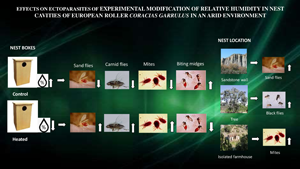
Here, we experimentally increase the temperature inside nest boxes occupied by European rollers Coracias garrulus in order to assess the effects of such manipulation on the abundance of different ectoparasites attacking bird nestlings and on nestling condition. We also study the potential effects of nest-box location (Eucalyptus trees, sandstone walls and isolated farmhouses) on temperature increase, parasites and hosts.
Material and methods
Study area and species
This study was carried out in an area about 50 km2 of the Desert of Tabernas (Almería, S. E. Spain, 37°05′N, 2°21′W, 400 m a.s.l.) from 25 April to 27 July 2018. The landscape is mainly made up of badlands, as well as olive and almond groves interspersed among numerous dry stream rivers. The climate is temperate, semiarid Mediterranean with mild winters and hot summers (Lázaro et al., Reference Lázaro, Rodríguez-Tamayo, Ordiales, Puigdefábregas, Mota, Cabello, Cerrillo and Rodríguez-Tamayo2004). A marked annual variability in temperatures (mean annual temperature around 18°C) and a scarcity of rainfall (mean annual rainfall around 230 mm) are the main characteristics of this study area.
The European roller (C. garrulus; hereafter roller) is a hole-nesting Coraciiform that in northern Europe usually nests in natural holes of different trees such as pines and oaks (Cramp and Simmons, Reference Cramp and Simmons1988). In southern latitudes, rollers nest in cliff cavities and human constructions. However, most of the population in our study area breeds in nest boxes thanks to a nest-box supplementation programme (Václav et al., Reference Václav, Valera and Martínez2011; Valera et al., Reference Valera, Václav, Calero-Torralbo, Martínez and Veiga2019). In our population, incubation takes ~21 days and nestling rollers fledge ~20–25 days (personal observation) after hatching. Egg hatching in rollers is distinctly asynchronous (within-brood nestling ages are in the range 2–10 days; see Václav et al., Reference Václav, Calero-Torralbo and Valera2008).
During the 2018 breeding season, 59 nest boxes were distributed across the study area on trees, sandstone walls and isolated farmhouses (Valera et al., Reference Valera, Václav, Calero-Torralbo, Martínez and Veiga2019), and were used by several bird species including the roller. These species included the Eurasian collared dove (Streptopelia decaocto) and common wood pigeon (Columba palumbus) on trees; common kestrels (Falco tinnunculus), jackdaws (Corvus monedula), rock pigeons (Columba livia) and little owls (Athene noctua) in sandstone walls; and spotless starlings (Sturnus unicolor), house sparrows (Passer domesticus), rock pigeons and common kestrels in farmhouses (see Veiga and Valera, Reference Veiga and Valera2020a). Nest-box dimensions were between 27.5–31 cm height, 25 cm width and 26 cm depth. The entrance hole was of 6 cm in diameter and the thickness of the wall was around 2 cm. Nest boxes on sandstone walls and isolated farmhouses are located in places without vegetation, while nest boxes on trees are covered by dense tree canopy. In addition, it has been shown that nest-box location can contribute to explain the variation in ectoparasite community (e.g. blackflies, biting midges, sand flies and mites) developing inside nest boxes (Veiga and Valera, Reference Veiga and Valera2020a).
Heating treatment
Nest boxes were matched according to hatching date, brood size and nest-site location, and within each pair, one was randomly assigned to heated treatment and the other treated as control. Heated nests were supplied with heat mats (70 × 70 mm, 5 V/1.5 W; thermo Flächenheizungs GmbH, Rohrbach, Bavaria, Germany) during 16 days (from day 6 to 21 post-hatching, day 1 = hatching of the first egg). Previous studies have used these heat mats to manipulate the temperature inside nest boxes occupied by blue tits (Cyanistes caeruleus) during the nestling period (see Castaño-Vázquez et al., Reference Castaño-Vázquez, Schumm, Bentele, Quillfeldt and Merino2021). Heat mats were fixed with thumbtacks to the inner wall of the nest and connected to lithium batteries (169.92 × 86.36 × 29.97 mm, 30 A/111 W; Imuto, X6L, China) through a cord with a USB output (48 h autonomy). Batteries were replaced every 2 days to maintain heat mat functioning during the complete experimental period. Control nests were visited with the same frequency than heated nests during the experiment. For each control nest, a cardboard and a string were placed in the nest simulating the heat mat and the cord of heated nests.
A total of 26 nests (13 heated and 13 controls) were included in the experiment. Fourteen nest boxes were located on trees, 8 on sandstone walls and 4 on isolated farmhouses. First, 110 nestlings from 26 nests (55 nestlings from 13 heated nests and 55 nestlings from 13 control nests) were used to explore the effects of treatment on body mass and wing length at 13 days of the older nestling age. After 13 days of age, several nestlings died by unknown reasons in nests from both treatments. In experimental nests, 5 and 3 nestlings died and in control nest 2 and 1 nestlings died at 17 and 21 days of nestling age, respectively. Thus, we used a total of 103 nestlings (50 nestlings from 13 heated nests and 53 nestlings from 13 control nests) and a total of 99 nestlings (47 nestlings from 13 heated nests and 52 nestlings from 13 control nests) to explore the effects of treatment on body mass and wing length at 17 and 21 days of nestling age, respectively.
Measuring temperature and relative humidity
Temperature and relative humidity inside nest boxes were recorded every hour from day 6 to 21 of nestling age with the aid of data loggers (Hygrochron DS1923; 6 × 17 mm, temperature range: −20 to 85°C; resolution 0.0625°C; humidity range: 0–100% with a resolution of 0.04%; Maxim IC, San Jose, California, USA) that were placed at each nest attached under the nest lid. Once nestlings fledged, sensors were removed and data obtained. One sensor did not register temperature and humidity in one control nest located on a tree. Thus, sample size varied among analyses. Daily average nest temperature and relative humidity from day 6 to 21 of nestling age were calculated and then an average temperature and relative humidity considering average daily values for that period were used for each nest. The same procedure was also used to calculate an average nest temperature and relative humidity for that period at night (from 00:00 to 8:00 h). These hours were selected because it is when temperature decreases to reach minimum values.
Trapping and quantification of ectoparasites
Biting midges (Fam. Ceratopogonidae), blackflies (Fam. Simuliidae) and sandflies (Fam. Psychodidae) were trapped using sticky traps consisting of a piece of 330 cm2 of white vegetal paper smeared with a commercial body oil gel (Johnson's baby oil gel with chamomile; for more details see Tomás et al., Reference Tomás, Merino, Martínez de la Puente, Moreno, Morales and Lobato2008). Haematophagous mites (Fam. Macronyssidae and Fam. Dermanyssidae) were also trapped using sticky traps but this method is not too effective and was only used as an approximate estimation of the number of mites inside nests. That is, we consider that those traps with more mites correspond to nests where more mites were present. Traps were fixed with thumbtacks under the upper lid of nest boxes during 2 periods of 4 days (see Veiga and Valera, Reference Veiga and Valera2020a). The first trap was placed from day 13 to 17 post-hatching and then retrieved and substituted by another trap at day 17 that was removed at day 21 post-hatching. Traps were stored in a freezer (−20 °C) and parasites attached were later extracted from the sticky traps using xylol (isomers mixture C8H10, 99%, density 20/4: 0.862–0.864), identified with the aid of a magnifying glass (NIKON-SMZ645) and counted at the Experimental Station of Arid Zones (Almería, S. E. Spain, 36°50′N, 02°28′W). Once obtained, arthropods were preserved in ethanol absolute (100%) until quantification. Parasite abundance in each nest was estimated as the sum of parasites captured in both sticky traps.
In addition, the number of ectoparasitic flies (Carnus hemapterus) was counted directly on the body surface of each nestling twice and both counts were averaged (see Veiga and Valera, Reference Veiga and Valera2020a; Veiga et al., Reference Veiga, Václav and Valera2020). Carnus hemapterus is a nidicolous ectoparasite that parasitizes nestlings during its imago stage. The imago remains on the nestlings and in the nest debris, so that sticky traps are not suitable to estimate the abundance of carnid flies. This method of visual estimation has been found to be reliable (Roulin, Reference Roulin1998). The number of carnid flies that remained in the nest debris was also counted and added to the sum of the number of carnid flies in all nestlings to get the total number of Carnus flies inside the nest (see Veiga et al., Reference Veiga, Václav and Valera2020). This estimation was done when the older nestling was 13 days old because Carnus infestation is higher at this stage (see Václav et al., Reference Václav, Calero-Torralbo and Valera2008; Václav and Valera, Reference Václav and Valera2018).
Nestling body condition
Nestlings were measured and weighed at 13, 17 and 21 days post-hatching and banded with numbered aluminium rings at 17 or 21 days post-hatching. Body mass of nestling was measured with an electronic balance (±0.1 g) and wing length with a ruler (±0.1 mm). Average body mass and wing length of nestlings for each nest were calculated at 13, 17 and 21 days of nestling age.
Statistical analyses
To test for the effect of temperature manipulation on nest-box microclimate, a 2-way analysis of variance (ANOVA) test was performed with average temperature and relative humidity for the day and night (see above) as dependent variables and nest-site type, treatment (heat and control) and their interaction as independent variables. Temperature and relative humidity were checked to comply with normality assumptions. Relative humidity was transformed as the arcsine of the square root to attain normality.
Generalized linear models with a negative binomial distribution and log link function were used to compare ectoparasite abundances between nests assigned to different treatments or from nest boxes located in different nest-site types. Counts of each ectoparasite group (i.e. blackflies, sandflies, carnid flies, biting midges and mites) were used as dependent variables, and nest-site type and treatment were introduced as independent variables. Then, we used a likelihood-ratio χ 2 test to compare the current model vs the null (intercept) model. The likelihood-ratio χ 2 test assesses the overall significance of the model, indicating whether the explained variance in our data was significantly higher than the unexplained variance. A significant result of this test indicates that the current model fits the data better than the null model (Sokal and Rohlf, Reference Sokal and Rohlf1998) and we explored the significance of the independent variables and their interactions. Conversely, a non-significant result suggests that the model is not sufficient to determine model fit for the predictors and, therefore, the null model is better than the model with the predictors. Contingency tables (3 × 2) and χ 2 or Fisher exact tests were used to analyse differences in the prevalence of each ectoparasite group (i.e. blackflies, sandflies and carnid flies) and nest-site types. The 2 × 2 contingency tables and χ 2 tests were used for analyses of differences between treatment and prevalence of ectoparasites.
To test the relationships between ectoparasites and average nestling growth variables, we used analyses of covariance (ANCOVAs) with the differences in average body mass or wing length between days of measurements as dependent variables and abundance of each ectoparasite group and brood size as covariates while controlling by treatment and nest-site type as independent variables. That is, heat treatment and parasite effects on nestling mass and wing length were evaluated at each date of measurement (13, 17 and 21 days post-hatching) and also for growth differences between nestling ages (13–17; 13–21 and 17–21 days post-hatching). We also tested for differences in nestling mortality between treatments. In all tests, we conducted a backward stepwise procedure to reduce the model to the significant variables. Graphics and statistical analyses were performed with STATISTICA 7 (StatSoft Inc., 2005) and IBM SPSS Statistics for Windows (IBM Corporation, 2019).
Results
Effects of heat treatment on temperature and relative humidity in roller nests
Average nest temperature did not show significant differences with treatment, nest-site type or their interaction (ANOVA, P > 0.1 for all cases). Average nest relative humidity also did not differ between treatments, nest-site type and their interaction (ANOVA, P > 0.1, for all cases; Table 1). Since we did not find any significant differences in temperature and relative humidity between heated and control nest boxes throughout the day (24 h), we assessed the treatment effect only at night (from 00:00 to 8:00 h), when temperature is not so influenced by sunlight and is decreasing and reaching the lowest daily values into the nest boxes. Thus, all data reported hereafter refer to temperature and relative humidity conditions at night, unless otherwise stated.
Differences in average temperature (°C) and relative humidity (%) during the period 6–21 days between heated and control nest boxes of rollers Coracias garrulus during the whole day (24 h) and during the night (from 0:00 to 8:00 h) respectively

Average night nest temperature did not show significant differences between heated and control nests (ANOVA, F 1,24 = 1.57, P = 0.222). However, nest relative humidity was significantly lower in heated nests as compared to control nests (ANOVA, F 1,22 = 5.54, P = 0.027; Table 1) and significantly higher in trees than in sandstone walls or isolated farmhouses (ANOVA, F 2,22 = 4.01, P = 0.032). The interaction term was not significant and was eliminated from the analysis (ANOVA, P > 0.4).
Effects of treatment on ectoparasite abundance
All models were significant (P < 0.02 in all cases) and therefore we explored the significance of explicative variables for each parasite. Sand fly abundance was significantly higher in heated nests as compared to control nests (B = 0.46, F 1,20 = 86.00, P < 0.001, Table 2). In addition, sand fly abundance was significantly higher in nests from sandstone walls than in nests from trees or from isolated farmhouses (B = −32.02, F 1,20 = 111.70, P < 0.001, Table 3). Furthermore, the interaction between nest-site type and treatment was significant, although this effect was only due to a higher abundance of sand flies in heated nests from sandstone walls compared to control nests (B = −0.45, F 1,20 = 89.89, P < 0.001, Fig. 1).
Differences in the abundance of sand flies in roller nests by treatment and nest-site type. Means ± intervals of confidence at 95% are shown. Sample size (number of nests) is shown over the bars.

Prevalence (Prev.) and mean abundance (MA) and standard deviation of ectoparasites in control and heated nest boxes of rollers Coracias garrulus

Prevalence (Prev.) and mean abundance (MA) and standard deviation of ectoparasites in nest boxes of rollers Coracias garrulus located on different nest-site types

Blackfly abundance did not show significant differences between heated and control nests (B = −1.60, F 1,20 = 1.04, P = 0.319, Table 2). However, blackfly abundance was significantly higher in nests from trees than in nests from sandstone walls and isolated farmhouses (B = 1.74, F 2,20 = 6.02, P = 0.009, Table 3). In addition, the interaction between nest-site type and treatment was not significant (B = 0.56, F 2,20 = 0.79, P = 0.466).
Biting midge abundance was significantly lower in heated nests as compared to control nests (B = 0.01, F 1,20 = 14.37, P = 0.001, Table 2), although these differences disappeared when nest-site type was removed from the analysis (B = 0.40, F 1,24 = 0.18, P = 0.673). In addition, the interaction between nest-site type and treatment was not analysed because biting midge abundance in sandstone walls and farmhouses was zero.
Carnid fly abundance in nests was significantly higher in heated nests as compared to control nests (B = −3.07, F 1,10 = 9.67, P = 0.011, Table 2), although these differences disappeared when the non-significant effect of nest-site type (B = −0.59, F 1,14 = 0.74, P = 0.402) was removed from the analysis. The interaction between nest-site type and treatment was significant, although this effect was only due to a higher abundance of carnid flies in heated nests from isolated farmhouses (B = −0.59, F 2,10 = 1.29, P = 0.037).
Mite abundance was significantly higher in heated nests as compared to control nests (B = −3.93, F 1,22 = 10.60, P = 0.004, Table 2). In addition, mite abundance was significantly higher in nests from isolated farmhouses than in nests from trees or from sandstone walls (B = −4.51, F 1,22 = 9.95, P = 0.005, Table 3). The interaction between nest-site type and treatment was not analysed because mite abundance in sandstone walls was zero.
In addition, the prevalence of each ectoparasite group did not show significant differences between heated and control nests (χ 2 test: P > 0.05, in all cases, Table 2). Similarly, the prevalence of blackflies was similar between nest-site types (χ 2 test; P > 0.05 in all cases, Table 3). However, sandstone walls and isolated farmhouses had a higher prevalence of sand flies than trees (χ 2 = 22.41, P < 0.001, Table 3). Although not statistically significant, the prevalence of carnid flies tended to be higher in sandstone walls and trees than in isolated farmhouses (χ 2 = 5.72, P = 0.057, Table 3). The prevalence of biting midges and mites did not show significant differences between nest-site types (Fisher's exact test: P > 0.05 for both cases).
Effects of heat treatment and ectoparasites on body condition of nestlings
Neither average nestling body mass nor wing length was significantly related to heat treatment or nest-site type at 13, 17 and 21 days of nestling age (ANCOVA, P > 0.05 for all cases). Similarly, the differences in average nestling body mass or wing length between different nestling ages (13–17; 13–21 and 17–21 days post-hatching) were not significantly related to heat treatment, nest-site or ectoparasite abundances (ANCOVA, P > 0.05 for all cases). Nestling mortality did not show significant differences between heated and control nests at 17 and 21 days of nestling age (Fisher's exact test: P > 0.05 for both cases).
Discussion
Most works have assessed the effects of climate change on host–parasite interactions in temperate areas (Merino and Møller, Reference Merino, Møller, Møller, Fiedler and Berthold2010; Møller, Reference Møller2010), whereas few studies have assessed such effects in warmer areas (Veiga and Valera, Reference Veiga and Valera2020b). In this study, we experimentally manipulated temperature in roller C. garrulus nests during the nestling period to investigate the effect of an increase of temperature on ectoparasite abundance in nests. We failed to experimentally create significant differences in nest temperatures between nests probably due to high fluctuations due to outer ambient temperatures. However, the treatment reduced significantly the relative humidity inside the nest during night hours. It is surprising that relative humidity was so high (more than 60%) in roller nests but this fact could help nestling rollers to survive in a dry environment while developing inside a cavity. In fact, Maziarz (Reference Maziarz2019) suggested that birds could modify humidity levels inside nest cavities as a strategy to avoid the risk of overheating inside nests. In addition, an elevated nest relative humidity could explain the absence of an effect of heat treatment on temperature.
On the other hand, average nest temperature was similar among different nest-box locations. However, relative humidity was significantly higher in nests from trees than in nests from isolated farmhouses or sandstone walls. Probably, nest relative humidity was higher on trees because their dense canopy covered nest boxes (see Veiga and Valera, Reference Veiga and Valera2020a) and direct solar radiation on nest boxes could have been less effective. In any case, the effects of treatment on ectoparasite abundances or nestling condition in our study were mainly attributed to significant differences in nest relative humidity.
Ectoparasite abundance in roller nests was significantly higher in heated nests compared to control nests except in the case of biting midges, which were significantly less abundant in heated nests compared to control nests, and blackflies, which did not vary significantly between treatments. However, carnid fly and biting midge abundance in roller nests were not affected by heat treatment when the effect of nest-site type was removed from the analysis. In the same way, Veiga and Valera (Reference Veiga and Valera2020a) showed that nest location could explain the variation of ectoparasite community in roller nests. Previous studies have shown that ectoparasite abundance in avian nests varied when nests were subjected to temperature increase and the consequent humidity decrease (Dawson et al., Reference Dawson, Hillen and Whitworth2005; Castaño-Vázquez et al., Reference Castaño-Vázquez, Schumm, Bentele, Quillfeldt and Merino2021). For example, Prudhomme et al. (Reference Prudhomme, Rahola, Toty, Cassan, Roiz, Vergnes, Thierry, Rioux, Alten, Denis and Bañuls2015) found a higher abundance of sandflies Phlebotomus ariasi in the south of France when temperature reached 35°C and relative humidity decreased. In this study, the authors also observed that P. ariasi activity finds its optimal nocturnal temperature ranges between 20 and 25°C, just in the range found in nests in our study at night. In the same way, Branco et al. (Reference Branco, Alves-Pires, Maia, Cortes, Cristovão, Gonçalves, Campino and Afonso2013) found a higher sand fly density in central Portugal associated to higher temperature (25.6°C) and low relative humidity (60% vs the usual 70–80%). Similarly, other studies have suggested that rainfall or high relative humidity can negatively affect the sand fly activity in Mediterranean regions (Gálvez et al., Reference Gálvez, Descalzo, Miró, Jiménez, Martín, Dos Santos-Brandao, Guerrero, Cubero and Molina2010; Dantas-Torres et al., Reference Dantas-Torres, Tarallo, Latrofa, Falchi, Lia and Otranto2014; Prudhomme et al., Reference Prudhomme, Rahola, Toty, Cassan, Roiz, Vergnes, Thierry, Rioux, Alten, Denis and Bañuls2015).
On the other hand, the abundance and prevalence of sand fly in roller nests were significantly higher in sandstone walls and isolated farmhouses than in trees. Furthermore, the interaction between nest-site type and treatment in relation to sand fly abundance clearly indicates that heat treatment had an effect on sandstone walls. More sandflies were collected in heated than in control nests and more in heated nests on sandstone walls than in control nests on trees. Adult sand flies often inhabit rock crevices, caves and animal burrows or human dwellings (Alexander, Reference Alexander2000; Lawyer and Perkins, Reference Lawyer, Perkins, Eldridge and Edman2000). In our study area, sand flies are able to colonize these microhabitats that appear mostly in sandstone walls and isolated farmhouses. In agreement with our results, Veiga and Valera (Reference Veiga and Valera2020a) also found a higher abundance of sandflies in roller nests located on sandstone walls and isolated farmhouses. The preference of sand flies for these nest types could be due to their lower humidity as compared to the ones on trees but also to an effect of the treatment reducing humidity in heated nests on sandstone walls. Similarly, the higher abundance of mites in heated nests compared to control nests could be due to the fact that these arthropods prefer higher temperature and lower humidity for development. Although humid environments could offer optimal conditions for mite growth (Chen and Mullens, Reference Chen and Mullens2008), other studies have shown that a higher temperature and lower humidity could positively affect the mite population in avian nests (Dube et al., Reference Dube, Hund, Turbek and Safran2018). In fact, haematophagous mites find its optimal development and can complete the egg-to egg cycle in just 7 days under conditions of high temperature (28–30°C) and medium humidity. In addition, red mites Dermanyssus gallinae can live up to 8 months away from their hosts and can withstand drier conditions, but do not tolerate high humidity (Chauve, Reference Chauve1998).
In our study area, we found a higher abundance of mites in nests on isolated farmhouses compared to nests on trees or on sandstone walls. In fact, relative humidity was significantly lower in boxes on isolated farmhouses and sandstone walls compared to the ones on trees. Probably, a higher abundance of mites in nest boxes on isolated houses could also be due to their use (previous to the arrival of rollers) by other bird species such as spotless starlings or house sparrows which could have transported these arthropods to nests (Veiga and Valera, Reference Veiga and Valera2020a). In addition, we found a higher abundance of blackflies in nest boxes on trees compared to the ones on sandstone walls or isolated farmhouses. Similarly, Veiga and Valera (Reference Veiga and Valera2020a) found that blackflies had a higher preference for roller nests located on trees. In addition, Černý et al. (Reference Černý, Votýpka and Svobodová2011) showed that blackflies could select tree canopies for resting. Veiga and Valera (Reference Veiga and Valera2020a) reported differences in the prevalence of ectoparasites between nest-site types. However, we only found a higher prevalence of sand flies in nest boxes on sandstone walls and isolated farmhouses compared with the ones on trees using the nests sampled in this study.
Nestling body mass and wing length growth between different nestling ages did not vary between treatments or nest sites. Similarly, Castaño-Vázquez et al. (Reference Castaño-Vázquez, Schumm, Bentele, Quillfeldt and Merino2021) did not find significant differences in blue tit nestling body condition (e.g. mass and wing length) when nests were subjected to temperature increase at 2 different latitudes. However, Vaugoyeau et al. (Reference Vaugoyeau, Meylan and Biard2017) found an increase of body mass in great tit Parus major nestlings subjected to temperature increase in a population from the north of France. In addition, other studies found that an increase in temperature in avian nests negatively affected the nestling body mass (Rodríguez and Barba, Reference Rodríguez and Barba2016; Andreasson et al., Reference Andreasson, Nord and Nilsson2018). Although differences in relative humidity and the number of ectoparasites between heated and control nests were significant (see Tables 1 and 2), it was not enough to detect significant differences in nestling body condition. Heated nests had less humidity and more ectoparasites (e.g. sand flies, mites and carnid flies) compared to control nests. This was a surprising effect because reduction in humidity is detrimental for ectoparasites, at least in less arid environments (see e.g. Castaño-Vázquez et al., Reference Castaño-Vázquez, Martínez, Merino and Lozano2018, Reference Castaño-Vázquez, Schumm, Bentele, Quillfeldt and Merino2021). Alternatively, Moyer et al. (Reference Moyer, Drown and Clayton2002) proposed that low humidity could have little effect on blood-feeding individuals due to the high water content on their diet. However, humidity levels in roller nest are very high and apparently detrimental or unattractive for ectoparasites. An increase in parental effort in the nest affected by more parasites may compensate for the effect of these on nestlings (Bouslama et al., Reference Bouslama, Lambrechts, Ziane, Djenidi and Chabi2002; Merino, Reference Merino2010).
Despite the higher abundance of ectoparasites such as sand flies and mites in heated nests, average nestling body mass and wing length were not affected. Previous studies did not find a relation between brood mass and the abundance of ectoparasites in roller nests (see Veiga and Valera, Reference Veiga and Valera2020a; Veiga et al., Reference Veiga, Václav and Valera2020). It is possible that parasite load in roller nests was not high enough to show changes on average nestling growth. For example, Merino and Potti (Reference Merino and Potti1995) found that nestling body mass was lower in pied flycatcher Ficedula hypoleuca nests with a higher abundance of mites. In the same way, Weddle (Reference Weddle2000) found that haematophagous mites Pellonyssus reedi abundance in house sparrow nests affected negatively the nestling body mass. Alternatively, it is possible that the deleterious effects of ectoparasites would have been compensated by the feeding effort of parents (Møller, Reference Møller1993; Merino et al., Reference Merino, Moreno, Potti, De León and Rodríguez1998). In that case, ectoparasite effects do not appear to significantly affect the body mass of nestlings or their wing length.
On the other hand, given that we did not find a positive relationship between heat treatment and average nestling growth, it is possible that nestlings in worse body condition were not affected by ectoparasites in nests. For example, several studies have found that the ectoparasitic fly C. hemapterus preferred roller nestlings in a better body condition (Václav et al., Reference Václav, Calero-Torralbo and Valera2008; Václav and Valera, Reference Václav and Valera2018). In the same way, different studies have shown that ectoparasite abundance in nests was determined by host body size (e.g. Marshall, Reference Marshall1981; Valera et al., Reference Valera, Hoi, Darolová and Kristofik2004) because larger hosts could provide higher resources to ectoparasites.
Based on these results, we can conclude that a slight increase of temperature reduced relative humidity at night inside nest cavities of rollers and affected positively and significantly some ectoparasites such as sand flies and mites inside nests. Nest-box location could be an essential factor to predict ectoparasite abundance inside nests. In addition, average nestling body mass or wing length was not affected by heat treatment, nest-site or ectoparasite abundances. Thus, our results suggest that climatic conditions in arid environments could serve to understand the adaptations of multitude of parasites to these areas and highlight the importance of high humidity level for some parasites in roller nests.
Data
The datasets generated for this study are available on request to the corresponding author.
Acknowledgements
We thank the Estación Experimental de Zonas Áridas (EEZA; Almería, Spain) for providing the facilities for this research. Junta de Andalucía provided permits to sample birds and their nests.
Author contributions
F.C.-V., F.V., J.V. and S.M. conceived and designed the study. F.C.-V., F.V. and J.V. conducted the fieldwork. F.C.-V., F.V. and J.V. conducted data gathering. F.C.-V. and S.M. performed statistical analyses. F.C.-V., F.V., J.V. and S.M. wrote the article.
Financial support
This study was funded by the project CGL2015-67789-C2-1-P (MINECO/FEDER). Also, this project is part of the project PGC2018-097426-B-C21 and PGC2018-097426-B-C22 funded by MCIU/AEI/10.13039/501100011033/ and by ‘ERDF A way of making Europe’.
Conflict of interest
None.
Ethical standards
Trapping and handling of birds undertaken in this study was approved by the Dirección General de Gestión del Medio Natural, Consejería de Medio Ambiente, Junta de Andalucia.


 Open access

