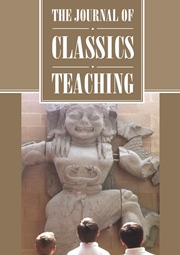


Like the Trojan Horse depicted on the dust jacket, this book is not what it at first appears to be. The title and image might lead us to expect a book for children, or for teachers of Classical Civilisation to younger school students. The key is in the subtitle: ten ancient creatures that make us human. This is a book about the defining characteristics of humanity, as they are revealed in the interactions between the human and animal worlds in classical mythology. It is not exactly a book of stories, although there are plenty of these to delight and entertain, but rather it is a book about the telling of stories, and about how classical myths as portrayed by Greek and Roman authors are a vehicle to inform our understanding of the human existence. By bringing to the fore these two themes of humanity and storytelling, Julia Kindt’s book offers a rich and exciting insight into classical mythology and its continued relevance in the contemporary world.
Each of the ten chapters, through a focus on the story of a classical creature (whether animal, monster, or animal-human hybrid), explores a different aspect of human identity. These ten creatures are as eclectic as the selection of texts from which they are gathered. They include creatures of fantasy, such as the Sphinx with her riddle about the ages of man, the Cyclops with his complex combination of the divine, human, barbaric and animalistic, and the hybrid Minotaur, half-man half-beast. They include insects which are used as political metaphors, such as Aristotle’s honeybees and Socrates’ antagonistic gadfly.
Varied though they are, one feature unites the creatures of this book, which is a capacity for human-like attributes. There are animals which talk and which prophesy, animals which employ reason and justice, pain and emotion; there are animals with the characteristics of a hero in war or which goad citizens to political action. There are animals which become human and humans which become animal. The stories also tell of humans who have animalistic characteristics, and in whose nature, in a post-Darwinian world, the animal has a part.
The scope of this book is extensive. The selected classical examples range from Homer to Late Antiquity. To explore and interpret these ancient stories, Kindt draws on diverse writers from later centuries including Freud, Barthes, Scott Fitzgerald, Kafka and Seeley, and on contemporary classical scholarship. For example, the chapter featuring the Trojan boar of Trimalchio’s Feast delves deeply into the significance of diet and social status in first century Rome. Throughout the book, the modern reception of ancient myths features prominently. A notable and fascinating example is the study of the reception of the Minotaur myth in Picasso’s Minotauromachy.
The heroes of this book are the animals. Kindt challenges the world view of human identity in which man, by virtue of his reason, language, mind and behaviour, is necessarily superior to beast. This is not a new challenge, but, as Kindt acknowledges throughout the work, it resonates with the current appeal of ‘decolonizing’ classics and of overturning some previously established hierarchies of human existence (male above female, white above non-white).
It is undoubtedly a book of scholarship: in addition to the extensive literary references, there are over fifty pages of footnotes, and it deserves a place in many undergraduate reading lists. But it should not be restricted to a scholarly readership. Packed with timeless tales of fantasy and intrigue, and told in an accessible manner, including some colour illustrations, this book can appeal to any reasonably erudite reader who has an interest in the classical world and its resonance today.

 Open access

