





Humans are remarkably flexible. People consistently respond to contingencies in their environment in ways that help them reap the benefits and avoid the perils of their immediate ecology. Guided by principles from life-history theory, theories of adaptive calibration suggest that human psychological and behavioral systems have been designed through evolution to adapt developmentally to key challenges and opportunities afforded by their local ecologies (Belsky, Reference Belsky2012; Boyce & Ellis, Reference Boyce and Ellis2005; Del Giudice, Reference Del Giudice2009; West-Eberhard, Reference West-Eberhard2003). Two crucial ecological affordances that influence a range of cognitive, behavioral, and neuroendocrinological processes involve the extent to which the environment is unpredictable (i.e., characterized by uncertainty or instability due to stochastic changes in the environment) and/or harsh (i.e., characterized by a lack of essential resources, leading to high risk of mortality and morbidity, e.g., Ellis et al., Reference Ellis, Figueredo, Brumach and Schlomer2009). Exposure to unpredictable and/or harsh environments, particularly early in childhood, has been implicated in a range of adult outcomes in domains as far-reaching as parenting, economic decisions, morality, and health (e.g., Maner et al., Reference Maner, Dittmann, Meltzer and McNulty2017; Maranges et al., Reference Maranges, Hasty, Maner and Conway2021; Mittal & Griskevicius, Reference Mittal and Griskevicius2014; Szepsenwol et al., Reference Szepsenwol, Simpson, Griskevicius and Raby2015).
In the current work, we used life-history theory as a guiding conceptual framework to provide insight into the developmental origins of impulsivity and adult externalizing behavior. In doing so, we focused on assessing people’s perceptions of their childhood environment, and carefully disentangled the potential roles of environmental harshness versus unpredictability. The current study tested the primary hypothesis that perceptions of unpredictable environments in childhood, in particular, would be associated with high levels of impulsivity and externalizing traits and behavior in adulthood.
Adaptive calibration: Principles from a life-history theory perspective
Many unhealthy forms of adult behavior have been linked with exposure to adverse experiences in childhood (e.g., Bradley & Corwyn, Reference Bradley and Corwyn2002). Despite the consistency of such findings, we lack an understanding of exactly which features of childhood environments contribute to adverse adult outcomes. It is difficult to determine with precision the specific factors that underlie adult mental health problems because childhood environments are complex, multifaceted, and co-occur with a variety of variables linked with risk for poor mental and physical health (e.g., single parenthood, poverty; Chen & Miller, Reference Chen and Miller2013).
Evolutionary-developmental models (e.g., adaptive calibration; Del Giudice et al., Reference Del Giudice, Ellis and Shirtcliff2011), guided by principles from life-history theory (Belsky et al., Reference Belsky, Steinberg and Draper1991; Kaplan & Gangestad, Reference Kaplan, Gangestad and Buss2005), provide an overarching theoretical framework for understanding effects of childhood ecological variables on behavior throughout the lifespan. Adaptive calibration models view some negative health outcomes as arising from processes designed to help people adapt functionally to the environments in which they live (see Ellis & Del Giudice, Reference Ellis and Del Giudice2014). This perspective suggests that psychological, behavioral, and neuroendocrinological processes become calibrated to ecological affordances encountered early in development (Boyce & Ellis, Reference Boyce and Ellis2005; Del Giudice et al., Reference Del Giudice, Ellis and Shirtcliff2011; Ellis & Del Giudice, Reference Ellis and Del Giudice2014, Reference Ellis and Del Giudice2019). Moreover, the developmental mechanisms that drive early childhood calibration are presumed to be adaptive: people adapt their behavior and physiology in ways that, on average, are likely to maximize reproductive fitness given contingencies in the current environment (Cabeza De Baca et al., Reference Cabeza De Baca, Wahl, Barnett, Figeuredo and Ellis2016; McDade, Reference McDade2003; Pepper & Nettle, Reference Pepper and Nettle2017). Crucially, early childhood may involve a developmental “critical period” in which particular patterns of behavior are initially solidified and later maintained throughout development (Simpson et al., Reference Simpson, Griskevicius, Kuo, Sung and Collins2012). Indeed, once adopted in childhood, those behavioral patterns often persist throughout the lifespan even when such behaviors may prove debilitating in adulthood.
Life-history theory assumes that developmental processes guide the way people manage fundamental tradeoffs associated with human life (Belsky, Reference Belsky2012, Reference Belsky2019). Those include tradeoffs between devoting effort to immediate reproduction versus long-term somatic growth and development, between mating and parenting, and more generally, between focusing on immediate versus long-term rewards (Kaplan & Gangestad, Reference Kaplan, Gangestad and Buss2005). Adaptive calibration models assume that exposure to particular types of environments early in development causes people to navigate those tradeoffs in ways that make the most of limited bioenergetic resources (Belsky et al., Reference Belsky, Steinberg and Draper1991; Ellis et al., Reference Ellis, Figueredo, Brumach and Schlomer2009). The way people strategically navigate those tradeoffs is often characterized as existing on a continuum from fast (accelerated reproduction and a focus on short-term gains) to slow (slower reproductive timing and a focus on long-term growth and development).
A burgeoning body of research suggests that the way people manage those tradeoffs – and more specifically whether they adopt a fast versus slow life-history strategy – is influenced by the level of unpredictability and harshness in their early developmental environments (e.g., Brumbach et al., Reference Brumbach, Figueredo and Ellis2009). Unpredictability refers to the extent to which an environment entails unstable or uncertain fluctuations in the presence of stressors and/or the availability of resources, due to stochastic changes in the environment. Harshness refers to rates of morbidity and mortality in an organism’s environment, based largely on a lack of resources by which to survive; for humans, harshness is often indexed using measures of socioeconomic status (SES) because SES is associated in linear fashion to the scarcity versus abundance of essential resources (Belsky et al., Reference Belsky, Steinberg and Draper1991; Simpson et al., Reference Simpson, Griskevicius, Kuo, Sung and Collins2012).
Previous investigations have tended to find that unpredictability, in particular, underlies a developmental trajectory marked by accelerated reproductive timing, as well as behaviors reflecting prioritization of short-term rewards, impulsivity, and risk-taking (a “fast life history”) (Griskevicius, Tybur et al., Reference Griskevicius, Tybur, Delton and Robertson2011; Griskevicius et al., Reference Griskevicius, Ackerman, Cantú, Delton, Robertson, Simpson and Tybur2013; Simpson et al., Reference Simpson, Griskevicius, Kuo, Sung and Collins2012; Young et al., Reference Young, Griskevicius, Simpson, Waters and Mittal2018). Unpredictability may have a stronger influence than harshness on development because unpredictable stressors may be more difficult to adapt to than harsh but predictable stressors (Ellis et al., Reference Ellis, Figueredo, Brumach and Schlomer2009). Harsh but stable environments may be relatively less threatening because the stability of the environment likely affords opportunities to develop strategies that, when applied on a consistent basis, allow people to avoid threats otherwise associated with resource scarcity. Exposure to unpredictable environments, in contrast, provides cues that the availability of social and material resources is unstable, as is the possibility of encountering social or ecological stressors. Consequently, high levels of unpredictability are likely to evoke in children a fundamental lack of perceived control, and that lack of perceived control may continue to affect behavior into adulthood (Mittal & Griskevicius, Reference Mittal and Griskevicius2014). From a functionalist perspective, exposure to highly unpredictable environments during childhood cues an uncertain future, and so it may be adaptive to invest primarily in short-term (rather than long-term) reproductive pursuits. Adopting an accelerated reproductive strategy, on average, helps organisms reap short-term genetic benefits in an uncertain environment in which long-term investment of resources may offer little reproductive payoff. Exposure to more predictable environments in childhood instead cues a relatively certain future and may lead one to expect a fruitful return on investment in long-term growth and relationships. Thus, models of adaptive calibration imply that exposure to relatively unpredictable versus predictable childhood environments gives rise to prioritization of short-term versus long-term rewards (i.e., a “fast” vs. “slow” life-history strategy).
The crux of reproductive success in sexually reproducing species (including humans) is success in mating, so the logic of life-history theory applies most straightforwardly to mating behavior. Indeed, exposure to unpredictability in childhood is associated with younger age of menarche, sexual debut, first birth, first marriage, as well as the adoption of an overall mating strategy focused on gaining direct genetic benefits from multiple partners (Belsky et al., Reference Belsky, Steinberg, Houts, Friedman, DeHart and Cauffman2007; Chisholm et al., Reference Chisholm, Quinlivan, Petersen and Coall2005; Ellis, Reference Ellis2004; Ellis et al., Reference Ellis, Schlomer, Tilley and Butler2012; Griskevicius, Delton et al., Reference Griskevicius, Delton, Robertson and Tybur2011; Hartman et al., Reference Hartman, Sung, Simpson, Schlomer and Belsky2018; Maranges & Strickhouser, Reference Maranges and Strickhouser2021; Xu et al., Reference Xu, Norton and Rahman2018). Childhood unpredictability is also linked with a more general prioritization of short-term social and material rewards and an overall orientation toward impulsivity and risk-taking (Griskevicius, Tybur et al., Reference Griskevicius, Tybur, Delton and Robertson2011; Griskevicius et al., Reference Griskevicius, Ackerman, Cantú, Delton, Robertson, Simpson and Tybur2013; Simpson et al., Reference Simpson, Griskevicius, Kuo, Sung and Collins2012; White et al., Reference White, Li, Griskevicius, Neuberg and Kenrick2013). Childhood unpredictability has been linked to economic decisions that reflect common forms of risk-taking (Griskevicius et al., Reference Griskevicius, Ackerman, Cantú, Delton, Robertson, Simpson and Tybur2013); a tendency to display dysregulated eating habits and, ultimately, obesity (Maner et al., Reference Maner, Dittmann, Meltzer and McNulty2017); and a lack of investment in developing high quality, long-term relationships (Maranges et al., Reference Maranges, Hasty, Maner and Conway2021).
It is important to note again that although outcomes associated with high levels of childhood unpredictability often, though not always (see Frankenhuis & Nettle, Reference Frankenhuis and Nettle2020; Mittal et al., Reference Mittal, Griskevicius, Simpson, Sung and Young2015; Young et al., Reference Young, Griskevicius, Simpson, Waters and Mittal2018), entail negative outcomes for the individual, such outcomes are assumed to reflect underlying adaptations to environmental contingencies. That is, while the proximate consequences of behaviors stemming from unpredictability may produce destructive or undesirable outcomes, the developmental processes that underlie those behaviors are assumed to be adaptive (i.e., in a reproductive sense). From this perspective, it is not the case that slow life-history strategies are inherently better or more adaptive than fast life-history strategies; both slow and fast strategies are well-calibrated to the environments in which they develop.
Childhood unpredictability, delay discounting, risk-taking, and externalizing symptoms
Given the hypothesized link between childhood unpredictability and impulsivity, one would expect childhood unpredictability to contribute to patterns of decision-making and behavior that reflect prioritization of short-term gains over long-term gains, despite the possibility of negative long-term consequences. An important dimension of decision-making involves temporal preferences and delay discounting (also known as temporal discounting or delay of gratification; Adams & Nettle, Reference Adams and Nettle2009; Griskevicius et al., Reference Griskevicius, Delton, Robertson and Tybur2011; Pepper & Nettle, Reference Pepper and Nettle2013). Delay discounting tasks (DDTs) involve choosing between sooner, albeit smaller rewards or later, larger rewards. Delaying immediate gratification in favor of larger, delayed rewards traditionally is viewed as a rational choice. In real-world decisions, however, if an individual forgoes the immediate reward, the delayed (i.e., future) reward is not always guaranteed. Models of adaptive calibration would thus suggest that individuals exposed to high levels of unpredictability in their childhood environments might opt for immediate rewards despite the possibility of larger rewards in the future. Such individuals might adopt a “take what you can now” approach, given that the future may be uncertain. Conversely, life-history models would predict that individuals exposed to lower levels of unpredictability in their childhood environments might opt for delayed, larger rewards because the certainty associated with time may calibrate individuals to “wait (or delay)” in anticipation of a more certain future (e.g., Griskevicius et al., Reference Griskevicius, Delton, Robertson and Tybur2011).
Previous research also suggests a link between childhood unpredictability (and fast life-history strategies) and risky decision-making (e.g., Griskevicius et al., Reference Griskevicius, Delton, Robertson and Tybur2011, Reference Griskevicius, Ackerman, Cantú, Delton, Robertson, Simpson and Tybur2013), another important component of decision-making. Risky decision-making entails choosing between relatively safer choices versus those that involve the uncertain possibility of negative outcomes (e.g., receiving $10 for sure vs. taking an uncertain chance of receiving $25). Individuals exposed to high levels of unpredictability in their childhood environments might opt to engage in excessive risk-taking because risk-avoidance might result in a lack of sufficient short-term gains to ensure that one will be competitive on the immediate mating market. Conversely, individuals exposed to low levels of childhood unpredictability might avoid excessive risk-taking because the relative certainty of a long-term future implies a high likelihood of accumulating sufficient gains over time to ensure reproductive success.
In addition to assessing delay discounting and risk-taking, we also assessed the tendency to engage in forms of externalizing behavior (e.g., aggression, substance use, lack of inhibitory control), which entail prioritization of short-term gains despite the potential for negative long-term consequences (Patrick et al., Reference Patrick, Kramer, Krueger and Markon2013; see also Krueger et al., Reference Krueger, Hicks, Patrick, Carlson, Iacono and McGue2002). Existing studies provide evidence for a link between childhood unpredictability and externalizing symptomatology. For example, among preschoolers, sources of unpredictability such as unstable attention from caregivers have been linked to forms of externalizing behavior including defiance, hostility, and relational aggression toward teachers and parents (Davies et al., Reference Davies, Thompson, Coe, Sturge-Apple and Martin2019).
Relying on data from the Minnesota Longitudinal Study of Risk and Adaptation, Doom et al. (Reference Doom, Vanzomeren-Dohm and Simpson2016) demonstrated that unpredictability experienced by children prior to age 5 was associated with adolescent and adult externalizing behaviors. Moreover, that association was stronger than the association with those same family disruptions measured at ages 6–16 (see also Richardson et al., Reference Richardson, Chen, Dai, Hardesty and Swoboda2014). Their assessment of unpredictability involved the frequency of changes in mothers’ residence, cohabitation, and employment, in addition to coder ratings of the disruptiveness of those events in the home. In contrast, harshness (operationalized as childhood SES) was unrelated to those same outcomes. Similarly, analysis of the longitudinal NICHD Study of Early Child Care and Youth Development suggests that unpredictability exerts a stronger influence on externalizing behavior (and other risk-related outcomes) than harshness does and, moreover, that changes in family structure (paternal transitions), in particular, may underlie a developmental trajectory reflecting a fast life-history strategy (Hartman et al., Reference Hartman, Sung, Simpson, Schlomer and Belsky2018). Other work has documented links between childhood unpredictability and aggression in adults, such as intimate partner violence (Barbaro & Shackelford, Reference Barbaro and Shackelford2019; Figueredo et al., Reference Figueredo, Gladden and Beck2012; Szepsenwol et al., Reference Szepsenwol, Zamir and Simpson2019). The link between childhood unpredictability, life-history strategies, and externalizing behavior has been observed cross-culturally in adolescents, although that work has also suggested relationships between externalizing behavior and harshness (Chang et al., Reference Chang, Lu, Lansford, Skinner, Bornstein, Steinberg and Tapanya2019; see also Chang & Lu, Reference Chang and Lu2018). Notably, some studies have documented links between adverse child environments and aggression, but have not distinguished unpredictability from harshness (Rucas et al., Reference Rucas, Gurven, Winking and Kaplan2012; Simmons et al., Reference Simmons, Rowan, Knowles, Steinberg, Frick and Cauffman2019; see also Cohen, Reference Cohen1990). In sum, studies have documented links between sources of unpredictability experienced in childhood and externalizing behavior in preschoolers, adolescents, and adults.
The current research
The current work tested hypothesized links between childhood unpredictability, delay discounting, risk-taking, and externalizing behavior in adults. First, we assessed participants’ tendency to discount larger future gains in favor of smaller, short-term gains using a DDT (Studies 1a and 1b). Second, we assessed a tendency to engage in risk-taking using two well-validated decision-making tasks (Studies 1a and 1c). Third, we assessed participants’ tendency to engage in forms of adult externalizing behavior (Study 2).
The current work advances the literature in part by directly assessing people’s perceptions of unpredictability. In assessing childhood unpredictability, previous studies have often relied on assessments of whether people were exposed to particular types of stressors (e.g., changes in family structure, residential changes, maternal depression). This approach is valuable because it provides opportunities to isolate which stressors might exert the largest effects on developmental outcomes. Yet existing measures tend to focus on whether people were exposed to particular stressors during childhood, or the overall level of disruption resulting from those stressors, not the degree to which such stressors influenced perceptions of unpredictably across time and situations. For example, having one’s parents divorce could result in substantial feelings of unpredictability when, for example, the divorce is associated with high levels of conflict over an extended period of time. However, some divorces are relatively amiable and result in regimented family interactions and schedules (Steinbach & Augustijn, Reference Steinbach and Augustijn2021) that could plausibly produce feelings of certainty rather than unpredictability (Thirot & Buckner, Reference Thirot and Buckner1991).
One key question, then, pertains to whether people perceive their environment as unpredictable, uncertain, and uncontrollable. Relative to other species, humans process their experiences through complex layers of cognition and appraisal (Lazarus, Reference Lazarus1991). The stress and coping literature, for example, provides compelling evidence that the way people appraise potentially stressful events plays a crucial role in whether they perceive the event as stressful (e.g., Gross, Reference Gross1998). Moreover, appraisals of stress influence people’s responses and the ways in which they adapt and cope (Taylor & Stanton, Reference Taylor and Stanton2007; Tomaka et al., Reference Tomaka, Blaskovich, Kelsey and Leitten1993). Thus, whether people perceive aspects of their environment as unpredictable, uncertain, or uncontrollable may play a key role in shaping developmental outcomes reflecting fast versus slow life-history strategies. Few previous studies have sought to assess whether, over and above environmental sources of unpredictability, perceptions of unpredictability are linked with developmental outcomes. One previous study, however, showed that measures of subjective unpredictability were more strongly related to aggression than were measures of objective stressors (i.e., potential sources of unpredictability; Barbaro & Shackelford, Reference Barbaro and Shackelford2019).
Our research team extended previous research (Mittal et al., Reference Mittal, Griskevicius, Simpson, Sung and Young2015; Young et al., Reference Young, Griskevicius, Simpson, Waters and Mittal2018) by developing and validating measures of perceived unpredictability and harshness (Maranges et al., Reference Maranges, Hasty, Maner and Conway2021). We used those measures in the current research to predict delay discounting (Studies 1a and 1b), risk-taking (Studies 1a and 1c), and externalizing behavior (Study 2). We also assessed whether such relationships would hold over and above environmental sources of unpredictability (changes in maternal employment, residence, and cohabitation; Study 2). We included the measure of perceived harshness to assess whether associations would be specific to unpredictability versus generalizing to harshness. We also controlled for a range of demographic traits (sex, race, ethnicity, current and childhood income, age) to assess whether any associations with unpredictability would hold over and above potential demographic confounds.
Beyond testing for main effects of childhood unpredictability, we also explored the possibility of interactions between unpredictability and harshness. Unpredictability may have particularly potent effects when experienced under harsh conditions. The high levels of harshness typically experienced by people living in poverty entail stressors such as food insecurity, exposure to crime, poor living conditions, and lack of access to health care, all of which underlie high levels of morbidity and mortality (Chen & Miller, Reference Chen and Miller2013). Experiencing such stressors on an unpredictable basis might be especially likely to potentiate the adoption of a fast life-history strategy marked by accelerated reproduction and a focus on reaping immediate rewards from the environment (Ellis & Del Giudice, Reference Ellis and Del Giudice2019). When harshness is low, in contrast, resources are more abundant and the environment is relatively safer, and thus unpredictable stressors may be relatively less dire. Consequently, when harshness is low, even unpredictable stressors may have less of an impact on development. Consistent with this possibility, some evidence suggests that childhood unpredictability may be more strongly associated with adult externalizing behavior when harshness is high than when harshness is low (Doom et al., Reference Doom, Vanzomeren-Dohm and Simpson2016).
Finally, sex differences in impulsivity, risk-taking, and externalizing spectrum behaviors are sometimes observed, with men displaying higher levels than women (e.g., Martel, Reference Martel2013). Therefore, we explored the possibility that participant sex might moderate any observed effects of unpredictability.
Studies 1a–1c: Perceived unpredictability, delay discounting, and risk-taking
Studies 1a–1c assessed relationships among perceived childhood unpredictability (and/or harshness) and behavioral measures of delay discounting and risk-taking. Study 1a included the 5-trial adjusted DDT (Koffarnus & Bickel, Reference Koffarnus and Bickel2014), the Balloon Analogue Risk Task (BART; Lejuez et al., Reference Lejuez, Read, Kahler, Richards, Ramsey, Stuart and Brown2002), and the Iowa Gambling Task (IGT; Bechara et al., Reference Bechara, Damasio, Damasio and Anderson1994). We saw no significant relationships between childhood unpredictability (or harshness) and scores on the BART or IGT; Study 1b provided an opportunity to replicate findings for the DDT. Study 1c allowed us to replicate the null findings for the BART. Results for the BART and IGT from Study 1a and all results for Study 1c are provided in Supplemental Materials. Thus, the main text focuses on the DDT from Studies 1a and 1b (a preregistered study). The preregistration for Study 1b, as well as data and syntax for all of our studies, can be found here: https://osf.io/g79fm/?view_only=4414bab0662a464488eabbb50917afe7
Participants
Study 1a
Four hundred-eighteen undergraduates participated online in exchange for course credit. Based on a priori exclusion criteria, 69 participants were excluded because they failed at least one of three attention checks. Three-hundred forty-nine participants remained. A number of participants encountered problems moving from task to task in Inquisit (Inquisit 6 2019). Consequently, only 181 participants completed the DDT. Participant demographic characteristics for Studies 1a/1b are reported in Supplemental Materials.
Study 1b
The preregistered sample size for study 1b was determined by performing an a priori power analysis in G*Power using the association between unpredictability and delay discounting in study 1a (f 2 = .0384). Results indicated that, for a multiple regression analysis including 3 predictors, a minimum of 341 participants would be necessary to achieve conservative power of 0.95. We recruited 537 workers from Amazon’s Mechanical Turk Prime (MTurk Prime). Based on preregistered criteria, 51 participants were excluded because they failed at least one of three attention checks. Of the remaining 486 participants, 341 completed the DDT; the 145 who did not experienced software errors when transferring from Qualtrics to Inquisit, similar to participants in Study 1a.
Measures
Perceived childhood unpredictability
Building on measures from previous work (Mittal et al., Reference Mittal, Griskevicius, Simpson, Sung and Young2015; Young et al., Reference Young, Griskevicius, Simpson, Waters and Mittal2018) our team developed and validated a measure of perceived childhood unpredictability with four studies that confirmed the intended factor structure, and demonstrated convergent, discriminant, and predictive validity (Maranges et al., Reference Maranges, Hasty, Maner and Conway2021, Reference Maranges, Hasty, Martinez and Manerunder review). The resulting scale includes 15 items that assess perceptions of unpredictability in family (e.g., I never knew whether my parents would be there to pick me up from school), school (e.g., I often did not know what to expect from other students at school), and neighborhood contexts (e.g., When I left my house I was never quite certain what would happen in my neighborhood). All items assess perceptions of unpredictability, uncertainty, and/or instability. Participants respond regarding their experiences up to age 10 using 7-point scales (1 = strongly disagree, 7 = strongly agree). As reported in Maranges et al. (Reference Maranges, Hasty, Martinez and Manerunder review) the scale demonstrates good reliability, convergent validity (e.g., moderate correlations with ACEs, SES, impulsivity, and lack of perceived certainty and control), and discriminant validity (e.g., low correlations with age, sex, social desirability, personality traits such as extraversion). The measure also predicts biometric indices of life-history strategy including age of sexual debut, age of menarche (in females), age of first child, number of different sex partners, and number of children (Maranges et al., under review). Reliability was high in the current sample (M = 2.32, SD = 1.20, α = .93).
Perceived childhood harshness
In addition to the measure of perceived childhood unpredictability, we also generated and validated a measure of perceived harshness. Eleven items assess harshness, as reflected in poverty and a lack of essential resources (e.g., My family rarely had enough money to go out for a nice dinner; My family was strained financially). Participants respond regarding their experiences up to age 10 using 7-point Likert scales (1=strongly disagree, 7=strongly agree). Like the unpredictability scale, and as reported in Maranges et al. (Reference Maranges, Hasty, Martinez and Manerunder review), the harshness scale demonstrates good reliability, convergent validity (e.g., strong correlation with SES, moderate correlations with ACEs and lack of perceived control), and discriminant validity (e.g., low correlations with age, sex, social desirability; Maranges et al., under review). Reliability was high in the current sample (M = 3.02, SD = 1.59, α = .95).
Delay discounting
Participants completed five trials in which they chose between smaller immediate versus larger delayed rewards (e.g., $1 today vs. $10 next week). The delays were adjusted after each trial such that they varied depending on the previous choice of the participant. The dependent variable of interest is the discount rate, k. Larger k values indicate that participants were less willing to wait for a delayed, higher reward, and instead prioritized more immediate, lesser rewards. The DDT provides a well-validated measure of delay discounting (e.g., Friedel et al., Reference Friedel, DeHart, Frye, Rung and Odum2016; Koffarnus & Bickel, Reference Koffarnus and Bickel2014; Stein et al., Reference Stein, Heckman, Pope, Perry, Fong, Cummings and Bickel2018; Tucker et al., Reference Tucker, Lindstrom, Chandler, Bacon and Cheong2021). In both Studies 1a and 1b, we used a priori exclusion criteria to exclude participants whose k scores were 3SD above the mean (this criterion was preregistered in Study 1b).
Results
Study 1a
Descriptive statistics and correlations are reported in Table 1. Notably, childhood unpredictability (but not harshness) was significantly correlated with delay discounting such that individuals who reported experiencing more unpredictable childhood environments tended to prioritize more immediate, but smaller rewards over delayed, but larger rewards. Unpredictability and harshness were also significantly correlated with one another.
Correlations and descriptive statistics among Studies 1a and 1b variables

Note. Study 1a N = 181. Study 1b N = 332. Study 1a correlations are provided below the diagonal; Study 1b correlations are above the diagonal. *p < .05, **p < .01, ***p < .001.
Hierarchical regression was used to examine the relationships between perceptions of childhood unpredictability and harshness, and delay discounting. In the first step, we simultaneously entered perceptions of childhood unpredictability and harshness. This allowed us to account for their overlap while assessing their associations with delay discounting. Then, in the second step, we entered demographic predictors (sex, race, ethnicity, current income, childhood income, and age) to assess the independent contribution of our predictors over and above those demographic covariates. Race was coded to compare Black/African American participants to non-Black/African American participants; Ethnicity was coded to compare Hispanic participants to non-Hispanic participants. Regression results are reported in Table 2.
Hierarchical linear regression models predicting delay discounting in Studies 1a and 1b

Note. Study 1a N = 181. Study 1b N = 332. Participant sex is coded 1=male, 0=female. Racial minority status compares Black/African American participants (coded 1) to other racial categories (coded 0). Ethnic minority status compares Hispanic (coded 1) to non-Hispanic (coded 0). Bold-faced values indicate significant associations.
In the first step, unpredictability (but not harshness) emerged as the only significant predictor of delay discounting (see Table 2) such that people who reported experiencing more unpredictable childhoods were more likely to discount future rewards and thus less likely to delay gratification in favor of more immediate, albeit lesser rewards. In the second step, unpredictability (but not harshness or any demographic variable) was a significant predictor of delay discounting (see Table 2).
In addition to the main effect of unpredictability, we also tested for the interaction between unpredictability and harshness. After centering both predictors, we added the interaction between those two variables to the model that included unpredictability, harshness, and all of the demographic factors. The interaction term was not significant (B = .05, t = 0.54, p = .59, partial r = .04). Thus, we found no evidence that the relation between unpredictability and delay discounting was moderated by perceived harshness.
In addition to possible moderating effect of harshness, we also explored possible moderating effects of participant sex. We added to the models described above an interaction term including participant sex and unpredictability (both centered prior to calculating the interaction). We found no evidence that the relation between unpredictability and delay discounting was moderated by participant sex (B = .08, t = 1.01, p = .31, partial r = .08).
Study 1b
Descriptive statistics and correlations are reported in Table 1. At the correlational level, unpredictability (but not harshness) was associated with delay discounting. Unpredictability and harshness were also significantly correlated with each other. Therefore, we used regression analyses to assess the independent association of each predictor with delay discounting (see Table 2).
We used the same (preregistered) analytic approach as in Study 1a. In the first step, we entered unpredictability and harshness simultaneously in a model predicting delay discounting. In the second step, we entered demographic predictors (sex, race, ethnicity, current and childhood income as measures of SES, and age). Race was coded to compare Black/African American to non-Black/African American participants. Ethnicity was coded to compare Hispanic to non-Hispanic participants. Regression results are reported in Table 2.
Unpredictability emerged as the strongest predictor of delay discounting. In step 1, unpredictability, but not harshness, was significantly associated with delay discounting. In step 2, unpredictability, but not harshness, again emerged as a strong and significant predictor of delay discounting. Participant age also emerged as a significant predictor of delay discounting such that older participants were more likely to discount future rewards. No other demographic variables were significant.
In addition to the main effect of unpredictability, we also tested for the interaction between unpredictability and harshness. After centering both predictors, we added their interaction to the model that included unpredictability, harshness, and all of the demographic factors. The interaction term was not significant (B = −.08, t = −1.35, p = .18, partial r = −.08) Thus, we found no evidence that the relation between unpredictability and delay discounting was moderated by perceived harshness.
In addition to the possible moderating effect of harshness, we also explored the possible moderating effects of participant sex. We added to the models described above an interaction term including participant sex and unpredictability (both centered prior to calculating the interaction). The interaction term was not significant (B = −.03, t = −0.58, p = .56, partial r = −.03). Thus, we found no evidence that the relation between unpredictability and delay discounting was moderated by participant sex.
Study 2 – Childhood unpredictability and adult externalizing behavior method
Participants
We collected data from 757 participants via the online platform MTurk Prime. Data collection took approximately 30–40 min and participants were compensated $4. Based on a priori exclusion criteria, we excluded participants who failed at least one attention check. This resulted in a sample of 643 participants. Demographic characteristics of the sample are reported in Supplemental Materials.
Measures
Childhood environment
We included the same measures of perceived childhood unpredictability and childhood harshness from Studies 1a–1c. In addition, we included retrospectively reported items from the Life Events Schedule (LES; Egeland et al., Reference Egeland, Breitenbucher and Rosenberg1980) to assess changes in maternal employment, physical residence, and cohabitation (with romantic partners). These factors can reduce the stability of family environments and relationships between caregivers and children and thus serve as valid measures of environmental unpredictability (e.g., Doom et al., Reference Doom, Vanzomeren-Dohm and Simpson2016; Simpson et al., Reference Simpson, Griskevicius, Kuo, Sung and Collins2012). Consistent with previous studies (Doom et al., Reference Doom, Vanzomeren-Dohm and Simpson2016; Simpson et al., Reference Simpson, Griskevicius, Kuo, Sung and Collins2012), we created composite measures that incorporated assessments of both the raw frequency of those events and the level of disruption they caused (the latter used a 0-no disruption to 3-severe disruption scale) during childhood up to age 5. Measures of frequency and disruption for the three maternal variables were standardized and averaged to form a single composite.
Externalizing Spectrum Inventory
The Externalizing Spectrum Inventory (ESI-BF) (Patrick et al., Reference Patrick, Kramer, Krueger and Markon2013) assesses a range of traits and behaviors in the domain of deficient impulse control. Consistent with current clinical models, items cluster along three higher order dimensions reflecting general disinhibition, callous aggression, and substance use (Patrick et al., Reference Patrick, Kramer, Krueger and Markon2013; see also Kotov et al., Reference Kotov, Krueger, Watson, Achenbach, Althoff, Bagby and Zimmerman2017; Krueger et al., Reference Krueger, Hobbs, Conway, Dick, Dretsch and Eaton2021). We used the 160-item brief form version of the ESI. The general disinhibition subscale includes 20 items involving individual facets of problematic impulsivity, irresponsibility, theft, fraud, alienation, boredom proneness, impatient urgency and lack of dependability and planful control. Sample items include: “I get in trouble for not considering the consequences of my actions”; “Others have told me they are concerned about my lack of self-control.” The callous aggression subscale includes 19 items involving a tendency to lack empathy and honesty, show high levels of excitement-seeking, and display relational, physical, and destructive forms of aggression. Sample items include: “I enjoy pushing people around sometimes”; “I don’t see any point in worrying if what I do hurts someone else.” The substance use subscale includes 18 items tapping use and problems associated with alcohol, marijuana, and other drugs. Sample items include: “I’ve had urges to use marijuana that were hard to resist”; “I’ve gone on drinking binges.” Participants responded to each item with a 0–3 scale (false = 0, somewhat false = 1, somewhat true = 2, and true = 3). As recommended by Patrick et al. (Reference Patrick, Kramer, Krueger and Markon2013) we summed items to create composite measures of general disinhibition, callous aggression, and substance use. In addition to calculating scores on the three subscales, we also calculated a total score by averaging across all ESI subfacets. We report findings for the total score here in the main text. Analyses for the three ESI subscales are described briefly here and presented fully in Supplemental Materials.
Current mood and mental health
Some work suggests that retrospective reports of childhood adversity, unpredictability, and/or harshness may be influenced by current mood and mental health (e.g., Reuben et al., Reference Reuben, Moffitt, Caspi, Belsky, Harrington, Schroeder and Danese2016). We therefore included as control variables the General Depression subscale of the IDAS (Watson et al., Reference Watson, O'Hara, Simms, Kotov, Chmielewski, McDade-Montez and Stuart2007) and the Emotional Stability/Neuroticism subscale of the TIPI (Gosling et al., Reference Gosling, Rentfrow and Swann2003). The IDAS General Depression subscale contains 20 items assessing mood symptoms including lassitude, insomnia, change in appetite, irritability, and general well-being (e.g., “I felt depressed”). Ratings are made using a 5-point Likert scale (1 = not at all to 5 =extremely) with total scores ranging from 20 to 100. The TIPI Emotional Stability/Neuroticism subscale is represented by two items rated on a 7-point Likert scale ranging from 1 (strongly disagree) to 7 (strongly agree). One item is stated in a way that represents the positive pole, emotional stability (“calm, emotionally stable”), and the other is stated in a way that represents the negative pole, neuroticism (“anxious, easily upset”). The latter item was reverse-coded and the items were averaged such that higher composite scores reflected greater emotional stability.
Results
Descriptive statistics and correlations among all variables are reported in Table 3. Notably, at the bivariate level, childhood unpredictability and childhood harshness were both associated with all ESI measures, with the exception of a null association between harshness and substance use. Disruptive maternal changes were associated with the ESI total score and with disinhibition, but not with callous aggression and substance use. Measures of general depression and emotional stability were associated with all ESI measures, in opposite directions. Unpredictability, harshness, disruptive maternal changes, general depression, and emotional stability were all correlated with each another. Regression analyses allowed us to account for overlap among the predictor variables.
Descriptive statistics and correlations among primary study variables in Study 2
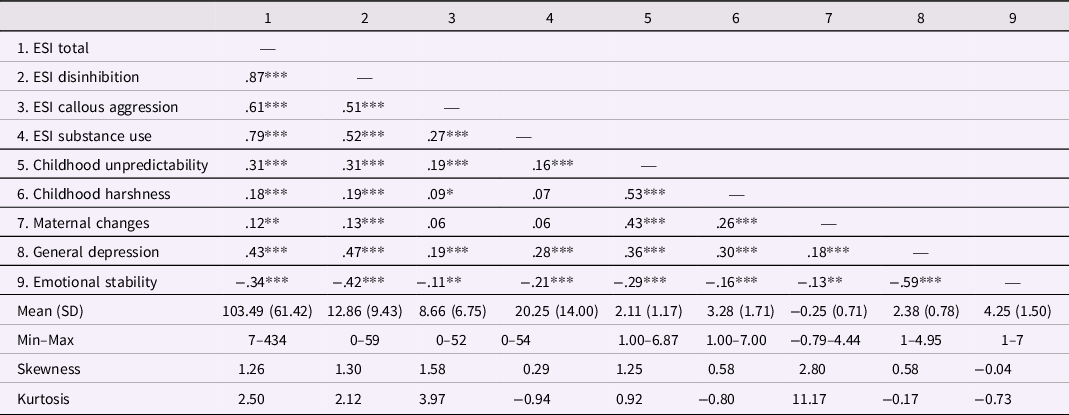
Note. ESI = Externalizing Spectrum Inventory; N = 643. *p < .05, **p < .01, ***p < .001.
Hierarchical regression was used to test hypothesized associations between childhood unpredictability and adult externalizing behavior. Primary analyses focused on the ESI-BF total score. Supplemental analyses focusing on the ESI-BF subscales (general disinhibition, callous aggression, and substance abuse) are reported in Supplemental Materials. Predictors were entered hierarchically to isolate any association between childhood unpredictability and externalizing behavior. In the first step, we entered LES scores to predict externalizing behavior. In the second step, we included perceptions of childhood unpredictability and harshness. In the third step, we included individual differences in emotional stability/neuroticism and general depression. In the fourth and final step, we included demographic predictors (sex, race, ethnicity, current and childhood income as a measure of SES, and age) to assess whether any associations with unpredictability (and/or harshness) would be observed over those covariates. Race was coded to compare Black/African American to non-Black/African American participants. Ethnicity was coded to compare Hispanic to non-Hispanic participants. See Table 4.
Regression analyses: Predictors of externalizing symptoms (ESI total score) in study 2

Note. N = 643. Participant gender is coded 1 = man, 0 = woman. Racial minority status compares Black/African American participants (coded 1) to other racial categories (coded 0). Ethnic minority status compares Hispanic (coded 1) to Non-Hispanic (coded 0).
Disruptive, maternal changes in early childhood, unpredictability, and harshness were all correlated with externalizing behavior. Once their overlap was taken into account in step 2 of the regression model, however, unpredictability was significantly and independently associated with externalizing behavior, but harshness and disruptive maternal changes were not. In step 3, unpredictability, general depression, and emotional stability were all significantly associated with externalizing behavior, but disruptive maternal changes and harshness were not.
Including demographic predictors in step 4 left the association between unpredictability and externalizing behaviors virtually unchanged. Unpredictability continued to predict externalizing behavior over and above disruptive maternal changes, harshness, and all demographic predictors. General depression, and emotional stability also predicted externalizing behavior. We also observed an association between externalizing behavior and participant sex such that men had higher externalizing scores than women did. No other demographic predictors were significant.
In addition to the main effect of unpredictability, we tested for the interaction between unpredictability and harshness. We added the centered interaction of those two variables to the model predicting ESI total scores. The interaction was nonsignificant (B = −.04, t = −1.02, p = .31, partial r = −.04). Thus, we found no evidence that the relation between unpredictability and externalizing behavior was moderated by perceived harshness. We also tested for the interaction between unpredictability and participant sex. We added the centered interaction of these two variables to the models predicting ESI total scores. The interaction was nonsignificant (B = −.02, t = −0.62, p = .54, partial r = −.03). Thus, we found no evidence that the relation between unpredictability and externalizing behavior was moderated by participant sex.
Finally, we ran a model (using the PROCESS macro in SPSS; Hayes, Reference Hayes2017) to explore the possibility that the association between maternal changes in childhood and adult externalizing behavior was statistically mediated by perceptions of unpredictability. The model included perceived harshness as a covariate. The indirect effect was significant, Z = 8.17, CI = 5.09–11.80. The direct effect was not significant, p = .61 (CI = −8.92–5.28), suggesting that the association was fully mediated by perceived unpredictability (see Figure 1).
Childhood unpredictability as a mediator of the relationship between maternal changes in childhood and adult externalizing behavior. LES = Life Events Schedule; CU = perceived childhood unpredictability; ESI = Externalizing Spectrum Inventory. The solid lines represent significant pathways. The dotted line represents the nonsignificant direct effect of LES on ESI, after accounting for the indirect effect via CU.

General discussion
Findings from the current research suggest independent and robust relationships between perceptions of childhood unpredictability and both delay discounting and externalizing traits and behavior in adults. Those associations were observed over and above childhood harshness, consistent with work suggesting the relatively greater influence of childhood unpredictability (vs. harshness) on adult outcomes. Those associations were also observed over a range of demographic variables. Results of Study 2 suggest not only that perceptions of childhood unpredictability might contribute to externalizing behavior, but also that such perceptions might help explain the links between environmental unpredictability and adult outcomes reflecting a fast life-history strategy. Findings are consistent with models of adaptive calibration and contribute to a growing literature suggesting that exposure to particular types of childhood ecologies can have important effects on development and behavior throughout the lifespan.
Implications of the current research
In two studies (1a and 1b), we found evidence for a link between unpredictability and delay discounting such that individuals who perceived more unpredictability in their childhood environments displayed a tendency toward selecting more immediate, lesser rewards rather than delaying immediate gratification in favor of delayed, greater rewards. This association provides evidence for a cornerstone principle of adaptive calibration models guided by life-history theory: individuals who perceive themselves as experiencing stochastic or chaotic changes in their environment (i.e., high levels of unpredictability) tend to engage in behaviors that provide the most immediate benefit (i.e., prioritization of short-term gains), even if such behaviors may come with undesirable longer-term consequences.
In our supplemental analyses, which reflect findings from two different behavioral tasks (IGT and the BART), we report null associations between perceived unpredictability and general forms of risk-taking. Thus, our findings suggest that while childhood unpredictability might contribute to delay discounting, we saw no evidence for an association between unpredictability (or harshness) and performance on general risk-taking tasks. The different patterns of results may reflect the fact that while delay discounting has an inherent temporal component, some other forms of risk-taking, such as choosing a high risk-high reward option over a low risk-low reward option, do not. Childhood unpredictability might orient people toward prioritizing immediate and short-term rewards (over long-term rewards) rather than toward a more general propensity to prioritize larger (vs. smaller) rewards. Still, we only examined two laboratory risk-taking tasks, and thus more research is needed before drawing any conclusions about the association between childhood unpredictability and risk.
The association between perceptions of unpredictable childhood environments and adult externalizing behavior also fits with theories emphasizing the link between unpredictability and prioritization of short-term gains (e.g., Ellis & Del Giudice, Reference Ellis and Del Giudice2019). The presence of an unpredictable environment may reduce the value of long-term future planning. If the future is uncertain, it may be more adaptive to reap maximum value from shorter-term pursuits. Adopting an accelerated reproductive strategy helps organisms reap immediate genetic benefits in an uncertain environment in which long-term investment of resources may offer little reproductive payoff (Belsky, Reference Belsky2012, Reference Belsky2019). Although this strategy is perhaps most straightforwardly manifested in mating-related outcomes (e.g., earlier sexual development and sexual debut), it is also manifested in more general patterns of behavior marked by adoption of a short-term time horizon and deprioritization of long-term outcomes (Griskevicius et al., Reference Griskevicius, Delton, Robertson and Tybur2011). Patterns of externalizing behavior are characterized by disinhibition, impulsivity, immediate gratification, and a lack of prioritization of long-term consequences. Thus, the pattern of externalizing tendencies among those exposed to early childhood unpredictability is consistent with the functional logic guiding fast life-history strategies. Such tendencies could help people reap from uncertain environments resources that aid in short-term pursuits related to survival, social affiliation, or mating.
Findings from Study 2 replicate previous evidence for the role of maternal changes as an important source of unpredictability (Doom et al., Reference Doom, Vanzomeren-Dohm and Simpson2016; Simpson et al., Reference Simpson, Griskevicius, Kuo, Sung and Collins2012). The current work extends prior work by highlighting the potential mediating role played by perceptions of unpredictability. Although strong conclusions cannot be based on statistical tests of mediation alone, findings are consistent with the possibility that perceptions of unpredictability may explain the relationship between maternal changes in childhood and adult externalizing behavior. People process their environments using complex layers of perception and appraisal, and those psychological processes can serve as mechanisms that mediate the relationship between environmental variables and human behavior (e.g., Lazarus, Reference Lazarus1991). Thus, while there is value to focusing on potential sources of unpredictability (e.g., maternal stress, changes in family structure, or parents’ employment status), there is also value to directly assessing people’s perceptions of unpredictability. The current work suggests that those perceptions may set the stage for developmental trajectories that prioritize short-term versus long-term pursuits.
This perspective fits with the broader literature on stress and coping, which emphasizes the important role perceptions of stress play in biological, social, and behavioral processes (Gross, Reference Gross1998; Taylor & Stanton, Reference Taylor and Stanton2007). For example, evidence suggests that perceptions of stress and the objective presence of environmental stressors both exert independent effects on human health and well-being and, moreover, effects of perceived stress versus environmental stressors may be mediated through different physiological pathways (Cohen et al., Reference Cohen, Tyrrell and Smith1993; Tetrick & Larocco, Reference Tetrick and Larocco1987). Thus, research inspired by life-history theory would benefit from focusing on and distinguishing the role of perceived unpredictability from the presence of environmental factors that may serve as potential sources of unpredictability. Future work would also benefit from identifying which environmental stressors are most likely to evoke high perceptions of unpredictability. Some work, for example, suggests that changes in family structure might affect developmental trajectories more strongly than do changes in residence or parents’ occupation (Hartman et al., Reference Hartman, Sung, Simpson, Schlomer and Belsky2018). The extent to which differential effects of particular stressors may be due to differences in perceived unpredictability, however, is unknown.
In addition to reflecting prioritization of short-term planning, the aggressive component of externalizing behavior may be functionally linked with status-striving. Across a range of species (including humans), aggression can serve as a means of asserting one’s social dominance (Archer, Reference Archer2006; Maner & Case, Reference Maner, Case, Olson and Zanna2016). Although more prosocial (and less dangerous) strategies for attaining high social rank exist, those strategies often require a relatively long-term investment of energy and resources (e.g., earning prestige by mastering a skill; Maner, Reference Maner2017). Aggression, in contrast, can serve as an effective short-term strategy for gaining social rank and ultimately increasing reproductive success (Wilson & Daly, Reference Wilson and Daly1997). People with an orientation toward prioritizing short-term, rather than long-term, gains might use tactics such as aggression or coercion that entail more immediate status payoffs. Thus, displaying a penchant for aggression may serve as an adaptive social rank-striving strategy for those calibrated to unpredictable environments who tend to adopt a short-term time horizon for social decision-making.
Although one might attain high social rank by acting aggressively, such behavior can undermine the quality of social-affiliative relationships. Aggression and other forms of externalizing behavior are not typically viewed as socially desirable and they may suggest that one is not a good bet for long-term cooperation or reciprocity. More broadly, focusing on the present and eschewing long-term gains may lead people exposed to unpredictable environments to invest themselves less in developing supportive, long-term relationships. Indeed, previous evidence suggests that exposure to unpredictable childhood environments is associated with lacking close, high-quality relationships with family, friends, and romantic partners (Maranges et al., Reference Maranges, Hasty, Maner and Conway2021). Thus, although the social behavior of people adopting a fast life-history strategy may be adaptive given contingencies of the environment, that behavior nevertheless may undermine the quality of people’s long-term social relationships.
While delay discounting and externalizing symptoms were associated with perceptions of childhood unpredictability, those same outcomes were not robustly associated with harshness. Harsh but stable environments may be relatively easier to contend with than unpredictable environments because the stability of the environment likely affords opportunities to develop strategies that, when applied on a consistent basis, allow people to avoid many of the perils otherwise associated with harshness. A wealth of research, for example, suggests that people living in low SES communities marked by a lack of resources tend to adopt high levels of long-term social interdependence (Fiske & Markus, Reference Fiske, Markus, Fiske and Markus2012; Stephens et al., Reference Stephens, Fryberg, Markus, Johnson and Covarrubias2012). Enduring relationships provide lasting sources of social support that help people navigate times of hardship or crisis (e.g., Sugiyama, Reference Sugiyama2004). From this perspective, one might expect those from harsh but highly predictable environments to display a psychological orientation marked by long-term, rather than short-term, thinking, at least within the social sphere. The current work thus adds to a growing body of work suggesting that childhood unpredictability, more so than harshness, is associated with developmental outcomes characterizing a fast life-history strategy.
Although not the focus of the current investigation, the study afforded opportunities to explore potential interactions between unpredictability and harshness as well as unpredictability and sex. We found no evidence of moderation by participant sex. Nor did we see any consistent or robust evidence for interactions between perceptions of unpredictability and harshness. Nevertheless, given theories suggesting that unpredictability may exert stronger effects in environments that are also high in harshness, additional research is needed before drawing any firm conclusions about interactions between unpredictability and harshness.
Limitations and future directions
Limitations of this research provide valuable opportunities for future work. One limitation is that, although our samples included reasonably large numbers of participants, those samples included more women than men. Previous work suggests that men tend to display relatively higher levels of risk-taking and externalizing behavior than women do (e.g., Martel, Reference Martel2013). The relatively smaller number of men in the current sample could have obscured possible sex differences in the links between those variables and childhood unpredictability; the current findings should be interpreted in light of this aspect of our participant samples.
A second limitation pertains to the retrospective nature of the perceived unpredictability and harshness measures. Despite the ease of assessing retrospective reports of perceived unpredictability and harshness, and although retrospective measures have been used by many other studies in this literature (e.g., Mittal et al., Reference Mittal, Griskevicius, Simpson, Sung and Young2015; Young et al., Reference Young, Griskevicius, Simpson, Waters and Mittal2018), such measures have drawbacks. For example, retrospective measures do not always predict outcomes in the same way that prospective measures do (see Baldwin et al., Reference Baldwin, Reuben, Newbury and Danese2019; Newbury et al., Reference Newbury, Arseneault, Moffitt, Caspi, Danese, Baldwin and Fisher2018), and some work suggests that they may differentially predict psychopathology in adulthood. Moreover, retrospective reports may be influenced by extraneous factors such as current mental health, such that those with low levels of emotional stability or positive mood may overestimate the unpredictability and harshness of their childhood environments (Reuben et al., Reference Reuben, Moffitt, Caspi, Belsky, Harrington, Schroeder and Danese2016). The association between perceived childhood unpredictability and externalizing behavior (Study 2) was observed over and above measures of emotional stability/neuroticism and current depressive symptoms, suggesting that the association cannot be easily explained by those factors. Nevertheless, future research would benefit from leveraging datasets that include non-retrospective measures of perceived unpredictability, as well as measures of objective stressors, to assess prospectively the extent to which perceptions of childhood unpredictability uniquely contribute to adult developmental outcomes.
A third limitation pertains to the timing of the developmental calibration processes implied by adaptive calibration models. Although the precise timing of developmental calibration is still uncertain, some evidence suggests that calibration to environmental unpredictability occurs in the first 5 (Simpson et al., Reference Simpson, Griskevicius, Kuo, Sung and Collins2012) or 10 (Mittal & Griskevicius, Reference Mittal and Griskevicius2014) years of childhood. The measures used in the current studies do not allow for precise estimates of when developmental calibration occurs. The overarching question of developmental timing, and whether there is a critical period in which calibration to levels of unpredictability occurs (see Simpson et al., Reference Simpson, Griskevicius, Kuo, Sung and Collins2012), provides a number of valuable questions for future investigations.
Although the current work focused on associations between childhood unpredictability and patterns of externalizing behavior, we left unexplored the possible implications of those patterns for positive social outcomes such as status-striving (cf. Frankenhuis & Nettle, Reference Frankenhuis and Nettle2020; Frankenhuis et al., Reference Frankenhuis, Panchanathan and Nettle2016). As noted earlier, some forms of externalizing behavior could serve as routes toward attaining high social rank. Future work would benefit from examining more closely the possibility that childhood unpredictability, and the externalizing behaviors that accompany it, are associated with status attainment in peer groups.
Not all people respond to harsh and unpredictable environments in the same way. Future work would benefit from assessing sources of resilience to adverse effects of childhood ecologies in order to identify factors that affect people’s susceptibility to harsh and/or unpredictable environments (see Belsky & Pluess, Reference Belsky and Pluess2009). Future investigations could profitably explore the hypothesis that perceptions of the environment (e.g., perceptions of unpredictability) might play a role in determining developmental responses to childhood stressors.
Finally, some work suggests that effects of childhood environments depend, in part, on the current state of the environment (Griskevicius, Delton, et al., Reference Griskevicius, Delton, Robertson and Tybur2011). Some work suggests, for example, that effects of exposure to unpredictable childhood environments are amplified in environments that entail currently high levels of unpredictability or instability (Young et al., Reference Young, Griskevicius, Simpson, Waters and Mittal2018). Investigating possible interactions between childhood and current environments provides a number of important opportunities for future research.
Conclusion
Evolutionary-developmental models inspired and guided by life-history theory principles provide an overarching conceptual framework for understanding ways in which exposure to particular forms of ecological variables in childhood can influence developmental processes throughout the lifespan. Adaptive calibration models also provide a framework for understanding the ways with which people make decisions (Griskevicius et al., Reference Griskevicius, Delton, Robertson and Tybur2011, Reference Griskevicius, Ackerman, Cantú, Delton, Robertson, Simpson and Tybur2013; Simpson et al., Reference Simpson, Griskevicius, Kuo, Sung and Collins2012), and for understanding the structure and expression of a range of psychological disorders (Del Giudice, Reference Del Giudice2014, Reference Del Giudice2016). In contrast to models of toxic stress or allostatic load, adaptive calibration models conceptualize developmental outcomes as reflecting adaptive processes designed to maximize reproductive success given contingencies cued by one’s early childhood environment. The current study joins others in this literature to suggest that childhood unpredictability may underlie forms of impulsivity reflected in prioritization of short-term rewards, impulsivity, and adult externalizing behaviors. The current work also highlights the importance of directly assessing perceptions of unpredictability. Perceptions of unpredictable childhood environments were robustly and independently associated with delay discounting and adult externalizing traits and behavior over and above measures of harshness, current mental health and mood, and a broad range of demographic covariates such as (childhood and current) income, race, sex, ethnicity, and age. Findings highlight the important role perceptions of instability and uncertainty may play in setting the stage for adult behaviors that satisfy immediate gratification at the expense of greater satisfaction in the long-term.
Supplementary material
The supplementary material for this article can be found at https://doi.org/10.1017/S0954579421001607
Conflicts of interest
None.
Funding statement
This research received no specific grant from any funding agency, commercial or not-for-profit sectors.


 Open access

