




Introduction
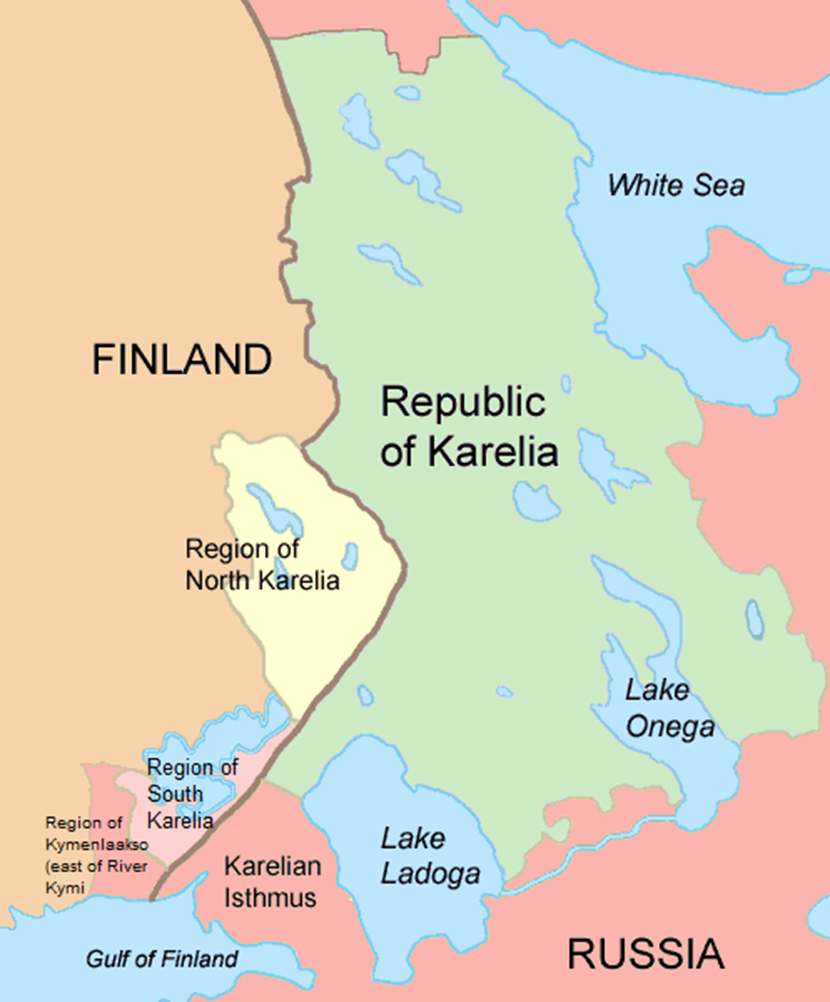
‘If you hide your own roots’ ( Još šie omie juurieš šaluat ) is an often-heard sentiment for minorities with a history of repression. The above line appears in the song ‘Ajatella toisin šanoin’ (‘To think in other words’ 2021a) by Russian Karelian band Zergeyth. The song mourns the loss of connection to previous generations of Karelians in terms of language, culture, and traditions. As a transnational border region, divided between Finland and Russia (Figure 1), Karelia has a tumultuous past. Various countries have vied for it, including Sweden, Finland, and Russia. The border running through the region has changed nine times since 1323, meaning that the region has never been unified (Kangaspuro Reference Kangaspuro2000, 38; Savijärvi and Savijärvi Reference Savijärvi, Savijärvi, Heikkinen, Hämynen and Sihvo1994, 9). Indigenous Karelians in the Republic of Karelia (Russian area) are a minority and make up only 5.5% of the total population.Footnote 1 The Karelian language is endangered and spoken by approximately 14,000 people in Russia and 11,000 in Finland.Footnote 2 The endangered nature of the Karelian language is caused by a variety of factors: assimilation policies, mixed marriages, and stigmatisation under the Soviet Union’s Russification policies (Klementyev et al. Reference Klementyev, Kovaleva and Zamyatin2010, 1; for a more general history of Russian colonisation, see: Slezkine Reference Slezkine2016). Further complicating the Karelian language question are the lack of standardisationFootnote 3 and significant dialectical differences (Klementyev et al. Reference Klementyev, Kovaleva and Zamyatin2010, p. 2).
A map of Karelia and its current borders.

Figure 1. Long description
At the center, a shaded circle is divided vertically: left half labeled Finnish Karelia, right half Russian Karelia. Central Finnish Karelia terms include Karelian-Finnish Folklore, Laments, Loitsu, Ancestors, Field of stones, Hospitality, Saimaa, Cranes, Swans, Vipers, Swamps, and ‘Forest Finland.’ Central Russian Karelia terms include Karelia, Swamp, Latokka, Onega, Suvanto, Finnish invasion, Home, Ritual mountain, Home sickness, Cranes, Native land, Ancestors, Thousand Lakes, and Sandarmoh. The next ring outward contains themes such as Ice Hockey Anthem, Lily of the Valley, Sauna, Land of the Thousand Lakes, and ‘Raudan synty’ Joseph Alanen on the Finnish side; on the Russian side, Oppressors, Carriers of death rule land, Drug addicts, Urbanisation, Anti-capitalism, Climate change, Enemy. The outer ring is divided into four quadrants: The North (top), Finland (left), Russia (right), and the (sub-)Arctic (outermost). The North quadrant includes Northern Lights, North Pole, Arctic Circle, Paganism, Shamanism, Seita, Frost, Snow, Ice, Winter, Summer. The Finland quadrant lists Brotherhood, Lapland, Drinking, Fighting, Boreal forest, Wood, River, Lake, Roots, Sea, Shore, Grass, Great Finnish famine, Birch, Pine, Alder, Spruce, Oak, Society made of lies, Boundaries, Borders, Urbanisation, Climate change, Witchcraft, and Loneliness. The Russia quadrant includes Winter, Summer, Eagle, Bear, Wolf, Raven, Bloodhounds, Darkness (No) sun, Storm, Midnight Sun, Sigtuna, Melaren (lake), Chernobog, Leshy, Võrsa, Ingira, Death, Grave, Goblin. The outermost ring, labeled The (sub-)Arctic, encircles all. Each label is spatially anchored according to its cultural or environmental association, with Finnish and Russian Karelia themes concentrated in the center and broader regional or mythological concepts radiating outward.
Karelia is symbolically incredibly important for Finland (Kirkinen Reference Kirkinen, Mäkinen and Lehmusvaara1982, p. 11). The poetry of Finland’s and Karelia’s national epic, the Kalevala,Footnote 4 was mainly collected in Karelia. After its publication in 1849, the Kalevala evolved into a cornerstone of Finland’s cultural heritage and provided the nation with the legitimacy it craved in its quest towards independence from the Russian empire (Kangaspuro Reference Kangaspuro2000, p. 39). Ever since then, Karelia has become a utopia (Sihvo Reference Sihvo, Mäkinen and Lehmusvaara1982, p. 25; Suutari Reference Suutari, Karjalainen and Kärki2021, p. 73), a place closely connected to mythology, tradition, and nature, often calling to modern Finns through ancestral ties. In the late nineteenth and early twentieth centuries, the Karelian utopia found expression in the Karelianism movement ( karelianismi ). Originally an art movement, with important proponents such as painter Akseli Gallen-Kallela (1865–1931) and composer Jean Sibelius (1865–1957), the movement quickly evolved to also include folklorists, geographers, ethnologists, naturalists, and linguists. Those involved with Karelianism were a part of the Finnish national project, shaping the nation’s identity (Kurs Reference Kurs1994, p. 150; Vento Reference Vento1992, p. 87; Wilson Reference Wilson and Wilson2009, pp. 137–138). Subsequently, the inextricable linking of Karelian culture with Finnish national identity has led to the erasure and invisibility of Karelian culture (Stepanova Reference Stepanova2020, p. 378). Finland ceded most of its Karelian territory to the Soviet Union after the Continuation War (1941–1944) and over 400,000 Finns and KareliansFootnote 5 were evacuated from Karelia into Finland (Pääkkönen Reference Pääkkönen2022). The subsequent generations of these evacuees continue to hold a utopic Karelia in their minds (Fingerroos Reference Fingerroos2006, p. 95; 99; Pääkkönen p. Reference Pääkkönen2022).
The formation and development of a Karelian identity – distinct from the Finnish one – has been hampered at various stages. Sarhimaa (Reference Sarhimaa and Laakso2000, p. 237) wrote that Karelian identity was fragile, with a weak overarching sense. This sentiment was echoed by Klementyev et al. (Reference Klementyev, Kovaleva and Zamyatin2010, p. 3), who added that there is a discrepancy between linguistic and ethnic identities. Karelians are recognised as the titular people of the Republic of Karelia, but not as a national or ethnic minority in Russian legislation, nor are they included in the list of the Numerically Small Indigenous Peoples of Russia (ibid.: 3). The development of a stronger Karelian identity has been partially hindered by the aforementioned conflation of Finnish and Karelian cultures (cf. Hirn Reference Hirn1939, p. 203; Ervasti in: Sihvo Reference Sihvo1973, p. 190; Stepanova Reference Stepanova2020) as well as the slow development of language revival in the Republic after the fall of the Soviet Union (Klementyev et al. Reference Klementyev, Kovaleva and Zamyatin2010, p. 4). Other possible factors could be the dispersion of Karelians into Finland after the Continuation War and the discrimination that some of the evacuees in Finland faced after relocation (Pääkkönen Reference Pääkkönen2022).
Despite the lack of Karelian identity observed in previous research, metal bands from the region – on both Finnish and Russian sides of the border – frequently negotiate Karelian identity. The lyrics presented here often invoke Finland, Russia, the North, and/or the (sub-)Arctic, thereby reflecting Karelia’s hybrid nature as a region divided over two countries, as well as its geographical location in the sub-Arctic. When considering lyrics associated with Karelia, several overarching themes can be identified: folklore, nature, history, and belonging. The recurring themes have a strong connection to the region and can be understood as a way of negotiating and defining an identity that is still very much in flux.
Here, I take the approach that identities are socially constructed, subject to continuous change, and reproduced in everyday life (Billig Reference Billig1995; Edensor Reference Edensor2016). The negotiation of identity by Russian and Finnish Karelian metal artists aids in cultural revitalisation as well as language revitalisation when using the endangered Karelian language. They challenge negative stereotypes of the culture and language as well as introduce both into a new cultural domain. Thus, Karelian culture, history, knowledge, and language are connected to a globalised genre of music: resulting in identity exploration and the export of a little-known Indigenous community’s culture. Language revitalisation can be considered an act of decolonisation, as well as a site of potential resistance, cultural reclamation, and community healing, and contributes to creating a stronger sense of identity (Stebbins et al. Reference Stebbins, Couzens and Eira2018, pp. 3–6).
Karelian metal music
Finnish Karelian metal music thrives within Finland as well as outside of it. Finland’s claim to fame – besides saunas and Nokia – is that it has the most metal bands per capita in the world.Footnote 6 In 2016, Finland had 630 metal bands per million people. Research on Finnish metal music is relatively well-established. Publications have focused on the origins of the scene and its subsequent development (Karjalainen Reference Karjalainen, Karjalainen and Kärki2020b; Karjalainen and Sipilä Reference Karjalainen, Sipilä and Karjalainen2015; Nikula Reference Nikula2002), the adaptation of the Kalevala and other Karelian Finnish folk poetry (Doesburg Reference Doesburg2021; Reference Doesburg2022; Kärki Reference Kärki2015; Tolvanen Reference Tolvanen2006), and themes in the lyrics (Oksanen Reference Oksanen2011; Digioia Reference Digioia2020). Even though Vigier (Reference Vigier, Valijärvi, Doesburg and Digioia2020) has focused on metal music made by the Fenno-Swedish minority community, no other studies have focused on metal music in a particular region of Finland or other minorities. Suutari (Reference Suutari2011; Reference Suutari, Moisala and Seye2013; Reference Suutari and Shikalov2010b; Reference Suutari, Munne, Hovi, Hänninen, Leppälahti and Vasenkari2013; Reference Suutari and Shikalov2010a) has done notable work on modern Karelian folk music, but enquiry into popular music from Karelia has been scarce. Despite this lack of academic investigation, Finnish Karelia is not only home to the international capital of metalFootnote 7 but also to Finland’s most successful metal act: Nightwish (Karjalainen Reference Karjalainen, by and Kärki2020a, p. 223).
Russia’s metal music scene is markedly different; there are only 22 bands per million people. However, given that internationally successful bands, such as Rammstein and Metallica, frequently toured in the country before COVID-19 and the invasion of Ukraine, it is justifiable to speak of a Russian metal scene, even if most of its activity is centred on fans rather than active musicians. Russian metal music has garnered limited scholarly interest with only a few articles and book chapters. These deal with the scene’s origins during the Soviet era and more current developments (Ardrey Reference Ardrey, by, Doesburg and Digioia2020; Hazle Reference Hazle, by, Doesburg and Digioia2020; Rapatskaya Reference Rapatskaya2022; von Faust Reference von Faust2016). Rapatskaya (Reference Rapatskaya2022) considers self-representation of two bands: L’Homme Absurde and Second to Sun. Second to Sun, from the Karelian Republic, is approached from the perspective of Russian national identity and the band’s representations thereof. The band frequently engages with Russian sources, such as Aleksey Konstantinovich Tolstoy’s vampire story ‘The Ghoul’ on their song ‘Pages for a Manuscript’ (2019a). However, Karelian and other Finno-Ugric (urban) legends and folklore are also frequently adapted. The song ‘The Train 1702’ (2018a) adapts an urban legend of a train in the Republic and the appearance of a supernatural light pulling the train. ‘Raida’ (2019b) tells of a KomiFootnote 8 princess and Yag Mort, a cannibalistic sorcerer, who kidnaps the princess.
The division of Karelia between Finland and Russia, and the differences between the scenes on both sides of the border, such as international success, mark the area as a topical subject for a comparative study. Furthermore, after Russia’s invasion of Ukraine in February 2022, Finland’s increasing orientation to the West accelerated. Finland joined NATO in April 2023 and completely closed its border with Russia in November 2023. Russia’s and Finland’s political actions have made the limited collaborations between Finnish and Russian Karelian artists virtually impossible and Russian Karelian artists with dreams of touring in Europe have had to put these on hold indefinitely.
Aim, data, and methods
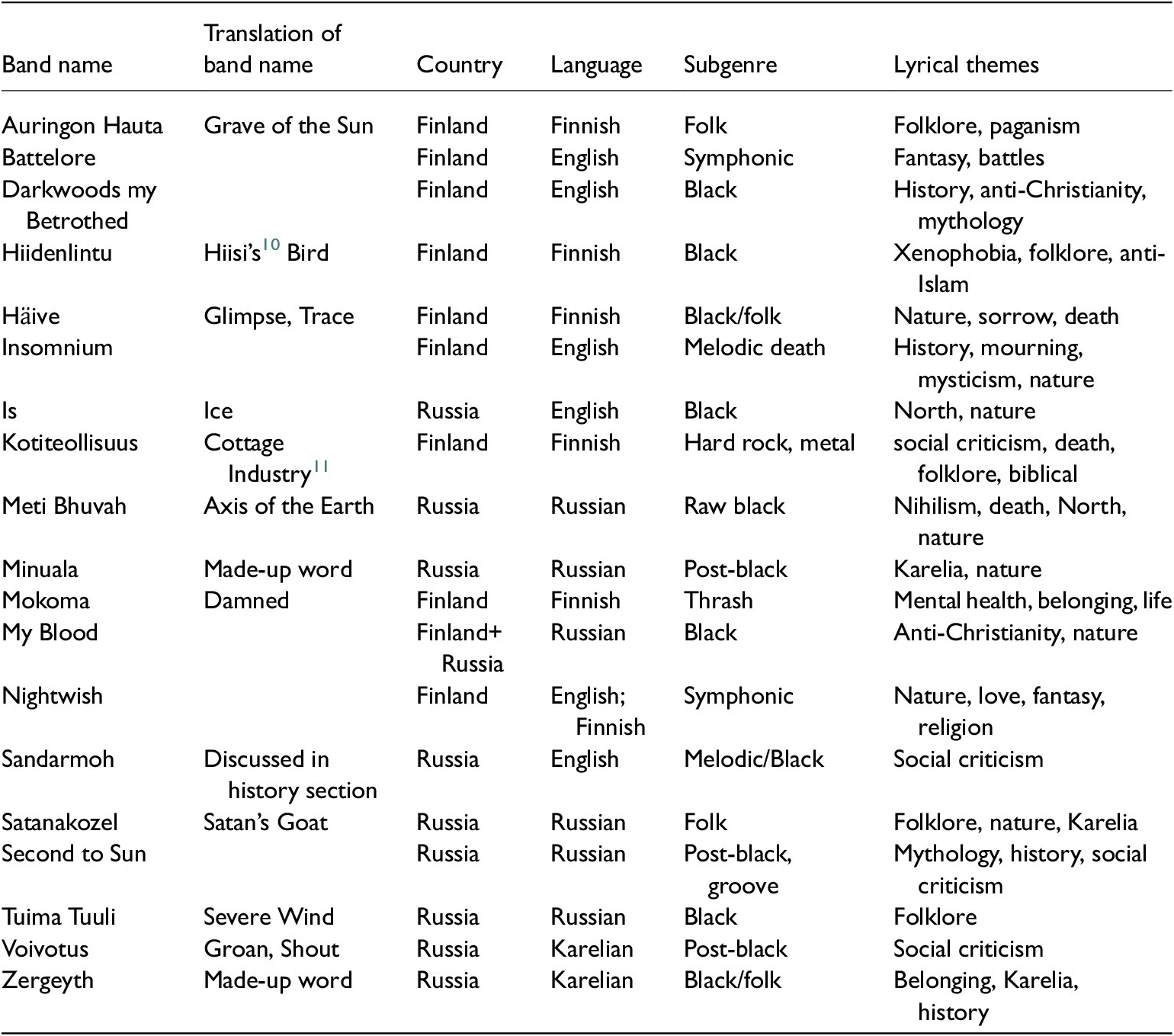
The bands briefly introduced in Table 1 Footnote 9 are central to this article. They are also part of a database I created for a larger project investigating identity negotiations of Finnish and Russian Karelian metal bands. The analysis presented here is the first step towards better understanding how Karelian metal artists approach questions of identity. Here, I compare songs by artists from both sides of the border to better understand how the various themes identified are represented, and I consider convergence and divergence in musical output. Furthermore, the analysis presented here shows that despite the vast socioeconomic and political differences between Finnish and Russian Karelia, metal bands often have a shared thematic base that draws heavily upon Karelia’s nature, history, and folklore. The next part of the project includes in-depth analysis of lyrics, music, and visual representation by a smaller selection of bands. I then investigate how these artists negotiate regional and national identities in their music as well as contextualise these identity negotiations in sociopolitical, historical, and cultural contexts according to references made in the lyrics and music. Another dimension of this project is to include the opinions of the various artists to gain an understanding of how current events have affected artistic output and a sense of identity.
Additional information on the bands central to this article

Table 1. Long description
Beginning at the top row, the table columns are Band name, Translation of band name, Country, Language, Subgenre, and Lyrical themes. The first entry is Auringon Hauta, translated as Grave of the Sun, from Finland, in Finnish, folk subgenre, with folklore and paganism themes. Battelore is from Finland, English language, symphonic subgenre, fantasy and battles themes. Darkwoods my Betrothed is from Finland, English, black subgenre, with history, anti-Christianity, mythology themes. Hiidenlintu is Hiisi’s Bird, Finland, Finnish, black subgenre, xenophobia, folklore, anti-Islam themes. Häive is Glimpse, Trace, Finland, Finnish, black/folk, nature, sorrow, death. Insomnium is from Finland, English, melodic death, history, mourning, mysticism, nature. Is is Ice, Russia, English, black, North and nature themes. Kotiteollisuus is Cottage Industry, Finland, Finnish, hard rock/metal, society critical, death, folklore, biblical. Meti Bhuvah is Axis of the Earth, Russia, Russian, raw black, nihilism, death, North, nature. Minuala is a made-up word, Russia, Russian, post-black, Karelia, nature. Mokoma is Damned, Finland, Finnish, thrash, mental health, belonging, life. My Blood is Finland plus Russia, Russian, black, anti-Christianity, nature. Nightwish is Finland, English and Finnish, symphonic, nature, love, fantasy, religion. Sandarmoh is discussed in history section, Russia, English, melodic/black, society critical. Satanakozel is Satan’s Goat, Russia, Russian, folk, folklore, nature, Karelia. Second to Sun is Russia, Russian, post-black/groove, mythology, history, society critical. Tuima Tuuli is Severe Wind, Russia, Russian, black, folklore. Voivotus is Groan, Shout, Russia, Karelian, post-black, society critical. Zergeyth is a made-up word, Russia, Karelian, black/folk, belonging, Karelia, history. Each row details the band’s origin, language, musical style, and thematic focus.
The complete database for this project consists of close to 300 songs by 22 different bands. I have identified relevant songs – songs with a connection to Karelia, either lyrically or sonically – via a method known as distant reading (Moretti Reference Moretti2007, Reference Moretti2013). Although the method was initially applied to literature studies, I have found it helpful to relatively quickly compile the database. Song titles and lyrics are fast to read, and Moretti’s method allowed me to identify and quickly learn about the themes used by Karelian artists. Another advantage of this method was that I could include songs for which I was unable to find lyrics. This was necessary as the availability of lyrics by Russian Karelian artists varies. Additionally, I identified instrumental songs with a connection to Karelia. Given that it takes more time to listen to music than to read the lyrics, I assessed whether an instrumental song was likely to connect to the region through the song’s title, album title, or other output by the band.
After creating the database, I coded the materials to discover various themes. I also added and translated lyrics to improve my interpretations. Furthermore, the lyrics often form the basis of the analysis presented in this article, therefore it was necessary to include these for at least a portion of the songs. Thematic analysis identifies and interprets repeated patterns in qualitative data (Braun and Clarke Reference Braun and Clarke2016; Fugard and Potts Reference Fugard, Potts, Atkinson, Delamont, Cernat, Sakshaug and Williams2020). It has its roots in psychology (Braun and Clarke Reference Braun and Clarke2006) but has since been applied in a variety of fields, such as the humanities (Lakh, Shamri-Zeevi, and Kalmanowitz Reference Lakh, Shamri-Zeevi and Kalmanowitz2021; Vance and Potash Reference Vance and Potash2022). For this research, I applied a word-based analysis of the appearance of words in the lyrics. Once the lyrics were added and translated, I would assign a possible theme that would fit with the lyrics’ contents. For example, the song ‘Murktide and Midnight Sun’ (2021b) by Finnish Karelian group Darkwoods my Betrothed is set during the Great Northern War (1700–1721) and was therefore tagged with the theme history.
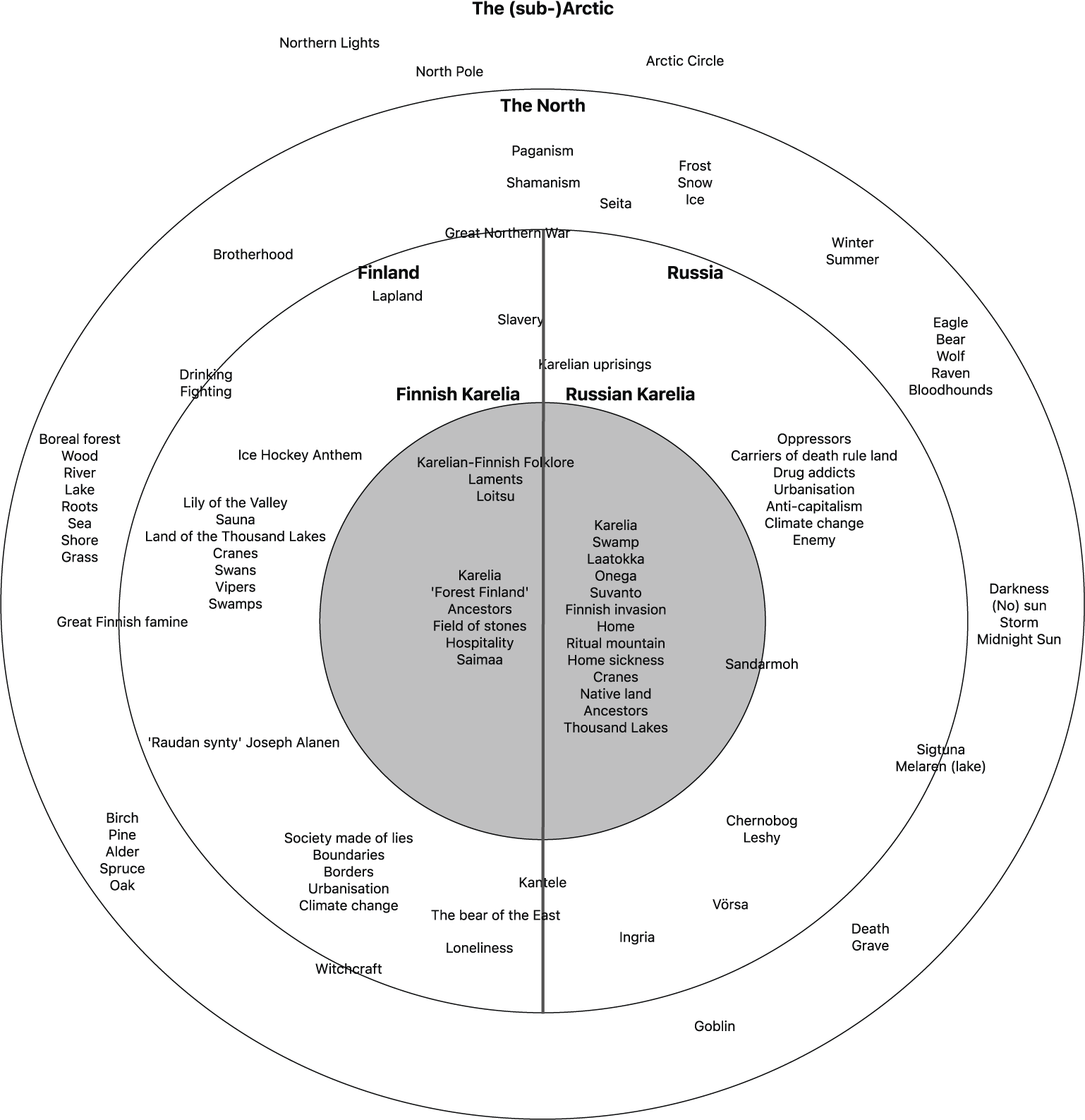
Distant reading is a good tool for mapping (Moretti Reference Moretti2007): visually representing the various identified themes in relation to their geographical location. Visually mapping the identified themes from the analysis on an extremely simplified geographical map of the region, we see that Karelia, Finland, Russia, the North, and the (sub-)Arctic are represented as circles in Figure 2. Finnish and Russian Karelian bands refer to rather similar aspects when they invoke Karelia, such as specific lakes and place names. However, when referring to the country they live in – Finland or Russia – the artists diverge in how these countries are represented in the music. This is especially the case with references to history, whereby Russian Karelians seem to favour narratives in which they are the victors and Finnish Karelians seemingly use the lyrics as a method to process a traumatic past. When it comes to the North and the (sub-)Arctic, bands on both sides of the border converge with more generalised references to, for example, cold, ice, or darkness. The map’s inner circle representing Karelia is subdivided with a line functioning as the border between Finland and Russia. Most often, Finnish Karelian artists refer to places in Finnish Karelia, and Russian Karelian artists to places in Russian Karelia. The second, larger, circle represents Finland on the left and Russia on the right. The third and largest circle denotes ‘the North’, and the (sub-)Arctic is placed outside the circles. Some of the tags are placed upon the circles if they affect several areas. For example, the Great Northern War in Darkwoods My Betrothed’s album Angel of Carnage Unleashed (2021a) affected Finland, Russia, and the wider North. Therefore, the tag is placed in the conjunction of these circles. The slight off-centre placement towards Finland signifies that the album’s narratives mainly take place within Finland. The circle representing the North and the outside of the map (the (sub-)Arctic) do not have a line separating Russian and Finnish Karelian bands as similarities in lyrical themes increase and national boundaries fade away. Below, I will explore the main themes I identified – belonging, history, folklore, and nature – which will also further illustrate Figure 2.
Map of topics found in lyrics.

Figure 2. Long description
At the center is a shaded core labeled Karelian-Finnish Folklore, Laments, Loitsu, surrounded by terms like Karelia, ‘Forest Finland’, Ancestors, Field of stones, Hospitality, Saimaa. The core is bisected vertically: left is Finnish Karelia, right is Russian Karelia. The next layer outward in Finnish Karelia includes Lily of the Valley, Sauna, Land of the Thousand Lakes, Cranes, Swans, Vipers, Swamps, Ice Hockey Anthem, and ‘Raudan synty’ Joseph Alanen. In Russian Karelia, this layer lists Karelia, Swamp, Latokka, Onega, Suvanto, Finnish Invasion, Home, Ritual mountain, Home sickness, Cranes, Native land, Ancestors, Thousand Lakes, Sandarmoh. The following ring for Finnish Karelia contains Boreal forest, Wood, River, Lake, Roots, Sea, Shore, Grass, Great Finnish famine, Birch, Pine, Alder, Spruce, Oak, Society made of lies, Boundaries, Borders, Urbanisation, Climate change, Witchcraft, Kantele, The bear of the East, Loneliness. For Russian Karelia, it includes Oppressors, Carriers of death rule land, Drug addicts, Urbanisation, Anti-capitalism, Climate change, Enemy, Ingria, Chernobog, Leshy, Võrsa, Goblin, Death, Grave. The outermost ring covers broader regional and existential topics: The (sub-)Arctic, The North, Finland, Russia, with themes such as Northern Lights, North Pole, Arctic Circle, Paganism, Shamanism, Seita, Brotherhood, Lapland, Great Northern War, Slavery, Karelian uprisings, Drinking, Fighting, Winter, Summer, Eagle, Bear, Wolf, Raven, Bloodhounds, Darkness (No) sun, Storm, Midnight Sun, Sigtuna, Melaren (lake). Each theme is spatially anchored to its cultural or geographical context, with Finnish and Russian Karelia as the central axis.
‘This is the best place for me’ – belonging in Karelia
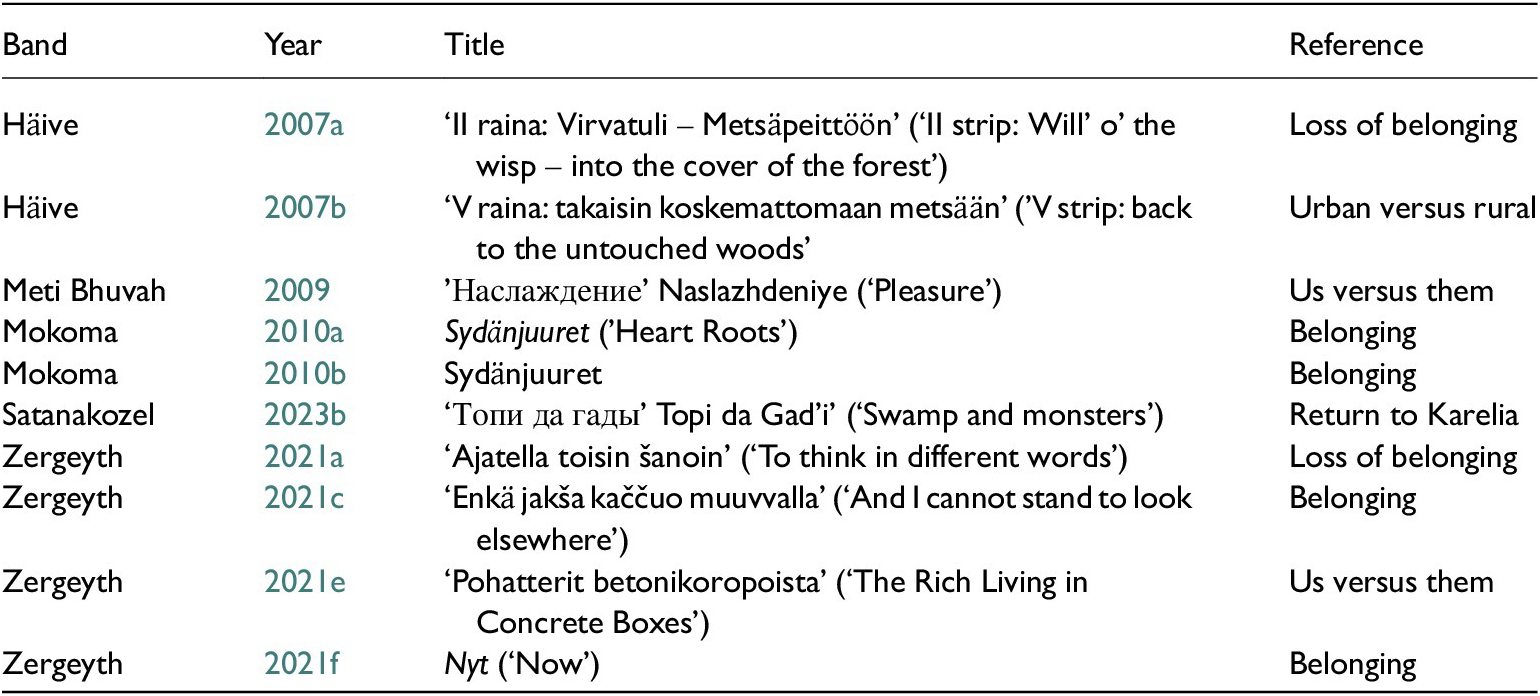
The song ‘Enkä jakša kaččuo muuvalla’ (‘And I Cannot Stand to Look Elsewhere’ 2021c) by Russian Karelian band Zergeyth conveys a strong sense of belonging with the line Tämä on paraš paikka miula ‘This is the best place for me’. The rest of the song praises Karelia’s quietude, greenery, and blue skies, thereby sketching a picture of why Karelia is such a good place for the song’s narrator. However, this strong sense of belonging expressed by Zergeyth is contrasted by songs that detail a loss of belonging or strong oppositions between us and them (Table 2). Sorrow expressed at Karelia changing beyond recognition is central to Häive’s ‘II raina: virvatuli – metsäpeittöön’ (2007a) when the narrator no longer recognises it: En tunnista omia rakkaita mantujani ‘I do not recognise my own beloved soil’. The change that has taken place is never specified within the song, but it leaves the narrator to go ‘into these unknown lands’ näille tuntemattomille tiluksille . The opposite feelings expressed in Zergeyth’s and Häive’s songs exemplify the mixed feelings Karelians can have towards their identity and sense of belonging. The assimilation and erasure of Karelian identity mean that the bands paint a picture both of belonging, a search thereof, or a feeling that it is lost.
Belonging in discussed lyrics and albums

Table 2. Long description
From the top row, columns are Band, Year, Title, and Reference. First row: H ä i v e, 2007a, ‘II raina: Virvatuli – Mets ä peitt ö ö n’ (‘II strip: Will’ o’ the wisp – into the cover of the forest’), Reference: Loss of belonging. Second row: H ä i v e, 2007b, ‘V raina: takaisin koskemattomaan mets ä ä n’ (‘V strip: back to the untouched woods’), Reference: Urban versus rural. Third row: Meti Bhuvah, 2009, ‘Наслаждение’ Naslazhdeniye (‘Pleasure’), Reference: Us versus them. Fourth row: Mokoma, 2010a, Syd änjuuret (‘Heart Roots’), Reference: Belonging. Fifth row: Mokoma, 2010b, Syd änjuuret, Reference: Belonging. Sixth row: Satanakozel, 2023b, ‘Топи да гады’ Topi da Gad’i’ (‘Swamp and monsters’), Reference: Return to Karelia. Seventh row: Zergeyth, 2021a, ‘Ajatella toisin š anoin’ (‘To think in different words’), Reference: Loss of belonging. Eighth row: Zergeyth, 2021c, ‘Enkä jak š a ka č č uo muuvvalla’ (‘And I cannot stand to look elsewhere’), Reference: Belonging. Ninth row: Zergeyth, 2021e, ‘Pohatterit betonikoropoista’ (‘The Rich Living in Concrete Boxes’), Reference: Us versus them. Tenth row: Zergeyth, 2021f, Nyt (‘Now’), Reference: Belonging. The table groups multiple works by the same band and highlights recurring themes such as belonging, loss of belonging, urban versus rural, us versus them, and return to Karelia.
In the Republic of Karelia, lack of belonging often takes the form of an urbanised ‘them’ group, usually also an imprecisely defined oppressor, and a rural ‘us’ group. These aspects are also replicated within other Karelian language sources, such as newspapers (Tanczos Reference Tanczos2015, p. 100). Meti Bhuvah’s song ‘Naslazhdeniye’ (‘Pleasure’ 2009) refers to carriers of death ruling the land.Footnote 12 It is tempting to consider these carriers of death as a symbolic representation of the Russian government, especially given the repressions against ethnic minority identities at different times during the Soviet era and beyond (Kurs Reference Kurs1994, p. 451; Suleymanova Reference Suleymanova2018). The ambiguous nature of ‘carriers of death’ fits with a wider tendency in Karelian language newspapers to not specify the oppressor’s nationality (Tanczos Reference Tanczos2015, p. 100). It also fits with metal music’s general aesthetics. Not clarifying the identity of the oppressor could also be an act of self-censorship (Castells Reference Castells2009, pp. 330–341; Schimpfössl and Yablokov Reference Schimpfössl and Yablokov2020) or inner-censorship (Ader Reference Ader, Zuk and Frolova-Walker2017, p. 417). Officially, Russia has banned censorship. However, control is still exerted via bureaucratic and financial measures (Castells Reference Castells2009, p. 331), such as through the idea of a ‘sovereign internet’ with which the government could control the types of content users can access online (Stadnik Reference Stadnik, Tusikov, Haggart and Scholte2021). Self-censoring has been an observed practice by journalists (Tong Reference Tong2009, p. 594) to convey a potentially explosive message wrapped up in something inconspicuous. When it comes to musicians in Russia, Ader argues that ‘the strict moral norms and laws imposed by the Soviet legal code are in the DNA of the younger generation’ (Reference Ader, Zuk and Frolova-Walker2017, 417). In the context of metal music, ‘carriers of death’ is rather ambiguous and death is an often-encountered topic in the genre, thereby making the song inconspicuous.
The song ‘Pohatterit betonikoropoista’ (2021e) by Zergeyth also identifies two groups living in proximity but separated by their living conditions. The ‘them’ group lives in fenced-in and built-up urban areas without access to nature. On the opposite side, the ‘us’ group prefers to be surrounded by rivers, mountains, and forests. This type of us and them – as well as the imprecisely defined other – is a common discourse technique for national identities (Wodak et al. Reference Wodak, de Cillia, Reisigl and Liebhart2009, p. 119; 141), and it reappears in the wider metal scene and, as shown, within other discourses in the Karelian language. In metal music, Christian versus pagan narratives are popular in the Viking metal subgenre as well as songs inspired by the Kalevala (Doesburg Reference Doesburg2022; Sellheim Reference Sellheim2016). Pagans are depicted as having a closer connection to nature and can use this connection to their advantage, for example, in battle (Doesburg Reference Doesburg2022, pp. 175–182). Karelian language outlets often reinforce the idea that Karelians live a more traditional – rural – lifestyle than others, even though Karelians increasingly live in cities (Tanczos Reference Tanczos2015, p. 99). At the same time, demarcations between Russians and Karelians are not necessarily clear-cut. Russian Karelians often have multiple identities, due to inheriting an ethnic mix of Russian, Karelian, Finnish, Finno-Ugrian, or another minority. Therefore, the ‘others’ and ‘carriers of death’ in these songs might not point to Russians as a whole but rather indicate an animosity towards authorities, as also found in discourses from Russian Karelian newspapers (Tanczos Reference Tanczos2015, p. 102). Furthermore, the demarcation of us and them, whereby them is imprecisely defined, also functions as an attempt towards identity formation. In the case of ‘Pohatterit betonikoropoista’, part of Karelian identity is derived from a close connection to nature.
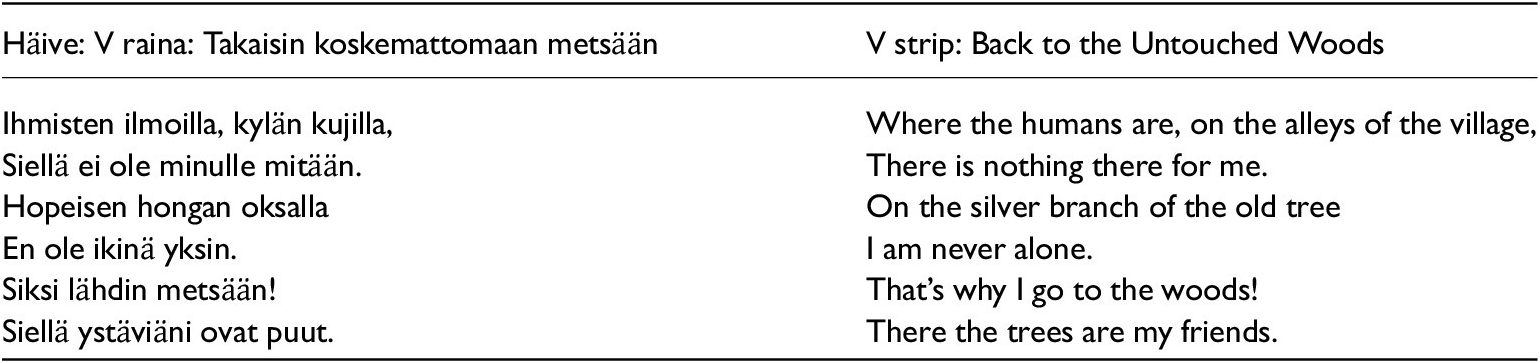
Tensions between urbanisation and nature are also found on the other side of the border. Häive’s song ‘V Raina: Takaisin koskemattomaan metsään’ (‘V strip: back to the untouched woods’ 2007) explores the relationship of the narrator with urban environments and wilderness. The narrator prefers the woods as a place to live, finding only emptiness in human settlements (Table 3). Sellheim (Reference Sellheim2016, p. 511) notes that the North often functions as a place of belonging in Black metal and Viking metal lyrics. For Karelian metal artists, this tendency is present across subgenres. The narrator of ‘Topi da gady’ (‘Swamp and Monsters’ 2023) by Satanakozel prefers to die in their native Karelia.
Häive: V raina: Takaisin koskemattomaan metsään

Table 3. Long description
The table consists of two columns. The left column contains Finnish text, and the right column presents the English translation. The header row reads ‘Häive: V raina: Takaisin koskemattomaan metsään’ and ‘V strip: Back to the Untouched Woods’. The first row pairs ‘Ihmisten ilmoilla, kylän kujilla,’ with ‘Where the humans are, on the alleys of the village,’. The second row pairs ‘Siellä ei ole minulle mitään.’ with ‘There is nothing there for me.’. The third row pairs ‘Hopeisen hongan oksalla’ with ‘On the silver branch of the old tree’. The fourth row pairs ‘En ole ikinä yksin.’ with ‘I am never alone.’. The fifth row pairs ‘Siksi lähdin metsään!’ with ‘That’s why I go to the woods!’. The sixth row pairs ‘Siellä ystäviäni ovat puut.’ with ‘There the trees are my friends.’.
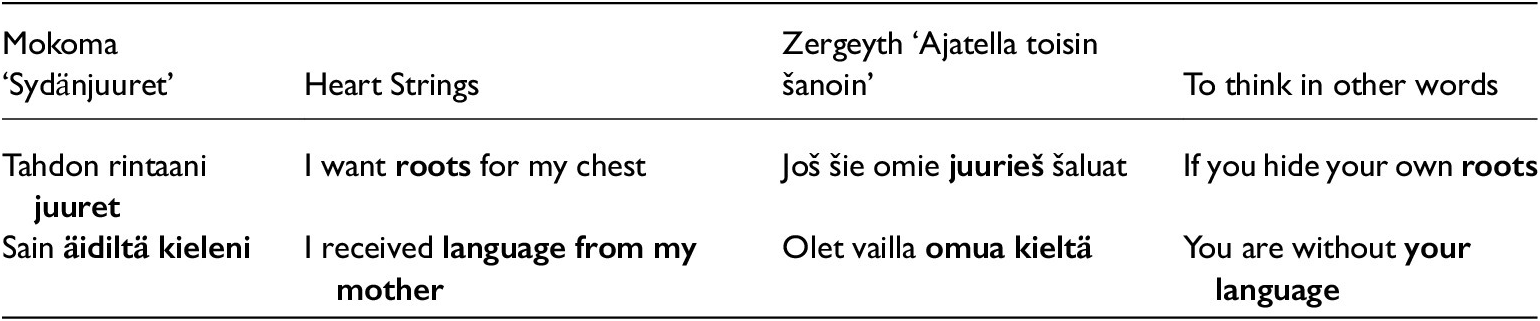
Belonging is a central theme on the albums Sydänjuuret Footnote 13 (‘Heart Roots’ Reference Suutari and Shikalov2010a) by Finnish Karelian band Mokoma (see also: Doesburg Reference Doesburg2021) and Nyt (‘Now’ 2021f) by Russian Karelian Zergeyth. The thematic overlap transcends into lexical and contextual levels (Table 4). In the title song of the album, ‘Sydänjuuret’ (2010b), the narrator is in search of roots, similar to the narrator of ‘Ajatella toisin šanoin’ who accuses the listener of concealing their roots. Roots are strongly connected to identity and belonging. The English ‘finding one’s roots’ uses the same metaphor of roots symbolising a search for belonging and identity. Mokoma’s and Zergeyth’s songs also refer to native languages. In ‘Sydänjuuret’, the Finnish word äidinkieli Footnote 14 ‘mother tongue’ is taken apart in its component words emphasising how language is passed on by the mother. Omua kieltä ‘own language’ in Zergeth’s song refers to the Karelian language, as Karelians often use these words when referring to the Karelian language (Tanczos Reference Tanczos2015, p. 102). The narrator accuses the listener of having lost this language. Thus, mourning a loss of Karelian identity through the endangered status of the language.
Comparison of lyrics by Mokoma and Zergeyth

Table 4. Long description
From left to right, the first column presents Mokoma’s original Finnish lyrics, the second column their English translation, the third column Zergeyth’s original lyrics, and the fourth column their English translation. The first row features Mokoma’s phrase ‘Tahdon rintaani juuret’ and its translation ‘I want roots for my chest’, alongside Zergeyth’s ‘Jo šie omie juurieš šaluat’ and ‘If you hide your own roots’. The second row shows Mokoma’s ‘Sain äidiltä kieleni’ and ‘I received language from my mother’, with Zergeyth’s ‘Olet vailla omua kieltä’ and ‘You are without your language’. Bold formatting is used for the words ‘roots’ and ‘language’ in both languages, emphasizing these motifs across the lyrics.
Even though a sense of belonging is sometimes expressed by Karelian bands, a loss of belonging is more often encountered. This loss can be caused by oppression, urbanisation, or loss of language. In some cases, belonging can still be gained through a connection with nature. For ‘Sydänjuuret’s narrator knowing the native language does not automatically guarantee a sense of belonging, alluding to the confusion that exists over expressing Karelian identity in Finland, especially in the past (Pääkkönen Reference Pääkkönen2022). Even in modern times, Marko Annala – Mokoma’s lyricist, who speaks Finnish in a Karelian dialect infused by regionalisms of the western city of Tampere – has been asked by other Finns where he is from,Footnote 15 possibly indicating that they think he is a foreigner. Overall, artists on both sides of the border show a remarkably similar picture when it comes to belonging. They connect Karelian identity to a close relationship with nature (to which I return in the section ‘Lakes, cranes, and northern lights’), a hostility towards urbanity, and an emphasis on language.
Tales of occupation and oppression – history
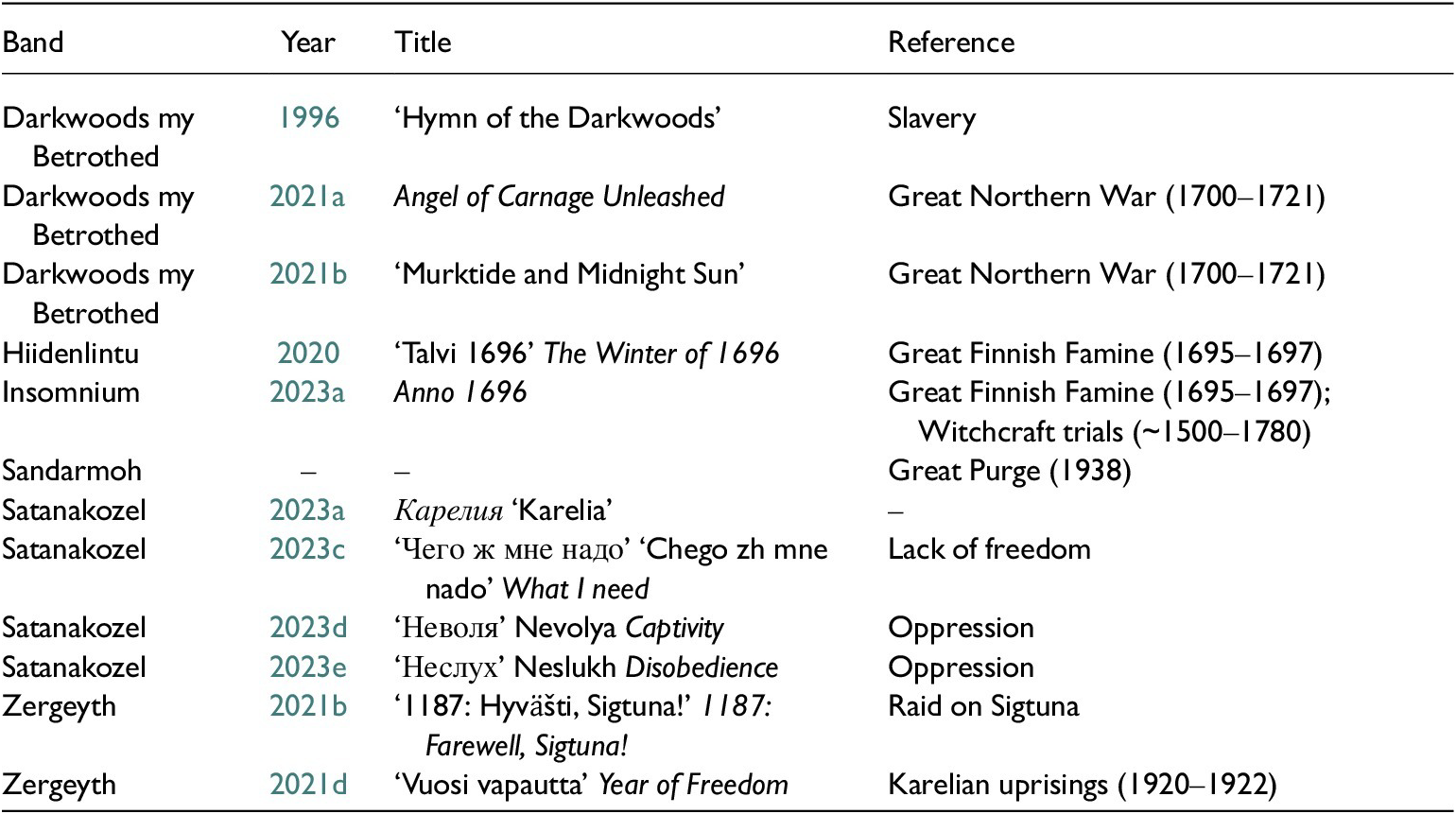
Karelia’s tumultuous past provides a smorgasbord of events. Two different types of narratives can be discerned when considering lyrics from Finnish and Russian Karelian bands (Table 5). Finnish Karelian bands tend to victimise Finns in historical narratives, perhaps to confront a traumatic past. Russian Karelians, on the other hand, refer to historic events related to freedom and victory, thereby changing the prevalent narrative of Indigenous Karelians as victims of oppression. Karelia’s history is present in metal music outside of lyrics, too. The Russian Karelian band SandarmohFootnote 16 is named after the forest massif in the Republic of Karelia where up to 9000 people from 58 nationalities were executed and buried during Stalin’s Great Terror between 1937 and 1938 (Parppei Reference Parppei2020, p. 34; Saramo Reference Saramo2022, p. 149). Many came from the nearby Solovki prison, often referred to as Stalin’s first concentration camp (Saramo Reference Saramo2022, p. 149). The graves were found in 1997, and the area has become contested and politicised (Bäckman Reference Bäckman2020, pp. 248–249; Parppei Reference Parppei2020, pp. 34–39). In 2016, Finns were accused of executing Russian prisoners between 1941 and 1944 at the same location, but this theory has been opposed by various scholars (Parppei Reference Parppei2020, p. 39). For the band Sandarmoh, the name forms a tangible connection to Karelia’s traumatic past as well as its geography.
History in discussed lyrics and band names

Table 5. Long description
From the top row, the columns are Band, Year, Title, and Reference. The first three entries are Darkwoods my Betrothed, with years 1996, 2021a, and 2021b, referencing slavery and the Great Northern War. Hiidenlintu in 2020 features ‘Talvi 1696’ and references the Great Finnish Famine. Insomnium in 2023a lists ‘Anno 1696’ and references both the Great Finnish Famine and witchcraft trials. Sandarmoh has dashes for year and title, referencing the Great Purge of 1938. Satanakozel appears four times: 2023a with ‘Karelia’ and no reference, 2023c with ‘Chego zh mne nado’ referencing lack of freedom, 2023d with ‘Nevolya’ referencing oppression, and 2023e with ‘Neslukh’ also referencing oppression. Zergeyth in 2021b lists ‘1187: Farewell, Sigtuna!’ referencing the Raid on Sigtuna, and in 2021d ‘Year of Freedom’ referencing Karelian uprisings. Each row aligns band, year, title, and historical event, with some titles in Russian or Finnish and English translations provided.
In Zergeyth’s ‘Vuosi vapautta’ (‘Year of Freedom’ 2021d), the Karelian uprisings of 1920-1922 and the brief independence of White Karelia ( Viena Karjala ) are central. In 1918, the Finnish Red Army and Russian White Army fought over the region, with British troops also involved (Baron Reference Baron2008, p. 35). The Karelians fought for the region’s independence. From 1919 until 1920, the Karelian Republic of Uhtua was briefly autonomous, although the state was unrecognised by others. Uhtua’s independence ended in June 1920 when the Russian Red Army gained control (Fingerroos Reference Fingerroos2006, p. 103; Kurs Reference Kurs1994, p. 450). ‘Vuosi vapautta’ engages with a time in history when a Karelian national consciousness first emerged (Baron Reference Baron2008, p. 35), whilst other nations vied for the region. The song references these various forces (Table 6). It is made clear that Karelians are not Finnish, despite the Finnish insistence at that time that the Karelian language was a dialect of Finnish (Baron Reference Baron2002, p. 349). The song makes the desire for independence evident. The final line quoted in Table 6 implies that this desire for a brief spell of freedom is still alive.
Zergeyth ‘Vuosi vapautta’ (2021d)

Table 6. Long description
Starting from the top row, the left column displays ‘Zergeyth Vuosi vapautta’ and the right column shows ‘Year of Freedom’. The first data row states ‘From the left – the Finns, from the right – the British’. The second row reads ‘From the left – the Reds, from the right – the Whites’. The third row contains ‘We did not want to depend on anyone’. The fourth row concludes with ‘But we only got one year of freedom’. Each row aligns the Finnish phrase with its English translation, emphasizing contrasts between groups and reflections on independence.
The focus of ‘Vuosi vapautta’ on independence is replaced with the related themes of captivity and oppression in various songs on Satanakozel’s album Kareliya (‘Karelia’ 2023a). Unlike ‘Vuosi vapautta’ with its referral to a specific historic event, Satanakozel’s songs do not allude to any specific time, yet the lyrics can read as a criticism of the current Russian government. The narrator of ‘Chego zh mne nado’ (‘What I need’ 2023c) asks where freedom can be found. Much like lyrics discussed in the previous section, ‘Nevolya’ (‘Captivity’ 2023d) identifies a ‘them’ group. Here, this group is obsessed with chasing fame and expects submission from the oppressed, whilst a loss of truth is also lamented. In an interview from 2017, the band’s drummer, Nicolai Kuskov, discussed mistrusting Russia’s state-owned media and its dissemination of propaganda,Footnote 17 and it is likely that ‘Nevolya’ alludes to this. The album Kareliya was released roughly a year after Russia’s invasion of Ukraine on 24 February 2022, which brought the themes of independence, captivity, oppression, and freedom into sharp focus. Satanakozel’s discussion of these themes in Russian lyrics seems risky as the aforementioned unofficial censorship policies by the Russian government mean that expressions of dissatisfaction are heavily punished.
The song ‘1187: Hyväšti, Sigtuna!’ (‘1187: Farewell, Sigtuna’ 2021b) by Zergeyth portrays Karelians rather differently. In the song, Sweden’s oldest town, Sigtuna, is attacked and burned. John, the archbishop, is killed by a troop of Karelian warriors (Nyberg Reference Nyberg1998, pp. 64–65). The raid of Sigtuna is reported in some Swedish annals and the Eric Chronicle (Carlquist et al. Reference Carlquist, Hogg and Österberg2011, p. 52). The Chronicle identifies the attackers as Karelian, although some argue that they were joined by Novgorodians (Korpela Reference Korpela1997, 170) or that they were Estonians rather than Karelians (Enn Reference Enn, Julku, Koivunen, Mäkivuoti and Vahtola1992, Reference Enn2007). Academic debates notwithstanding, in Zergeyth’s song, the attackers are Karelian: Ei vielä päivä koittan Sigtunašša, kun nousi karjalaini šotajoukko ‘The day had not dawned yet on Sigtuna, when the Karelian war party rose’. The Karelians had arrived at the shore of Lake Mälaren during the night and burned the city before dawn. The song reverses traditional roles of Swedes and Karelians. Swedes and other Scandinavians usually depict themselves – and are depicted by others – as plundering and conquering Vikings. In ‘1187: Hyväšti, Sigtuna!’ the Swedes are Christians, and the Karelians are šiälimättömät pakanat ‘ruthless pagans’. They bring ‘pain and suffering’ ( kor’ua ta tuškua ) which is contrasted by the ‘happiness and fun’ ( ilo ta lyšti ) experienced by the Swedes after the Karelians leave. The idealisation of pagan Vikings is a recurring theme in metal music, especially in Viking metal, a subgenre characterised by Christian versus pagan Viking narratives. The portrayal of Christianised Swedes changes metal music’s prevalent narrative. Here, the Karelians are pagan. The usual narrative of Karelians as an oppressed minority group is challenged. ‘1187: Hyväšti, Sigtuna’ is an attempt to legitimise Karelians within the metal scene. They were pagan for longer than the romanticised Vikings and plundered a Swedish town after the Swedes became obedient Christians, and Vikings were confined to the past.
In Finnish Karelia, lyrics referring to specific historic events focus on the suffering of Finns, without explicit referrals to Karelia. Insomnium’s concept album Anno 1696 (2023a) is based on the Great Finnish Famine (1695–1697) and the Witchcraft trials that preceded it (for more information on this album see: Doesburg Reference Doesburg2024). Hiidenlintu’s ‘Talvi 1697’ (‘The Winter of 1697’, 2020) details some of the famine’s most horrific aspects, such as disease, harmful famine foods, the consumption of household pets, and cannibalism. The most heinous acts included in ‘Talvi 1697’ did happen during the famine, but they were not commonplace and strongly condemned (Lappalainen Reference Lappalainen2012, p. 175). In a previous article (2024), I call the inclusion or exaggeration of especially shocking and gory details in metal lyrics about history ‘metallisation of the past’.
The Famine was closely followed by the Great Northern War (1700–1721). The Swedish and Russian empires fought over large parts of Central, Eastern, and Northern Europe, including Finland. The album Angel of Carnage Unleashed (2021a) by Darkwoods my Betrothed details how Finnish soldiers and the wider population experienced the war. After initially briefly recovering from the famine (Kujala Reference Kujala2000, p. 71), peasants refused to supply the army with food and pay their taxes in 1713 because they did not feel protected by the military (ibid., p. 83). The army – already running on little motivation due to various defeats and inadequate support from the Crown – completely collapsed after this. The Russian army captured large parts of Finland, including the strategic town of Viipuri (now in the Karelian Republic). The narrator of ‘Murktide and Midnight Sun’ (2021b) laments these losses: ‘over lands torn from us the shredded unfree’ giving voice to the position of Finns and Karelians as pawns with limited agency. Finland and Karelia are described with various nouns and adjectives – swamps, thirsty fen, lake, and sharpest tree – picturing the desolate and hostile landscapes of Eastern Finland and Karelia.
‘Hymn of the Darkwoods’ (1996), by Darkwoods my Betrothed, seems to only connect to Finland on a superficial level through the invocation of Finland’s well-known tourist slogan ‘the land of the thousand lakes’.Footnote 18 The lyrics take a dark turn with references to slavery: ‘break the chains of enslavement’, potentially functioning as a dog whistle indicating the Neo-Nazi extremism characteristic of the National Social Black Metal (NSBM) scene (Buesnel Reference Buesnel2020; Fischer Reference Fischer2022, pp. 131–132; Ndoja Reference Ndoja2019). However, Finns and Karelians were forcibly removed from their homesteads and transported to Novgorod and the Volga region from the Viking Age up until the eighteenth century (Korpela Reference Korpela2019, p. 5; 243). The light skin and fair hair of Finns and Karelians were valued and the captured slaves could end up as officials and spouses, miners, soldiers, builders, or servants (Korpela Reference Korpela2019, pp. 241–243). ‘Hymn of the Darkwoods’ is an invitation for enslaved Finns and Karelians to free themselves: ‘our star is now dim / but getting brighter / it will replace the enslaver sun’. The invocation of ‘star’ to indicate the enslaved coincides with the portrayal of the North in metal music as long winter nights are frequently referred to (Sellheim Reference Sellheim2016). The southern origins of the slave owners (Korpela Reference Korpela2019, p. 243) are referenced in the song with ‘enslaver sun’. This strengthens the idea that ‘Hymn of the Darkwoods’ narrates events of the Finnish Karelian slave trade. The song’s call to rebellion can be considered another act of metallisation as it is difficult to know the number of slaves captured. Korpela states that there could not have been more than a ‘couple of dozen Finnic prisoners yearly’ (ibid., p. 244).
When it comes to portrayals of history, Russian and Finnish Karelians depict different events with opposing results. The tendency of Russian Karelians to portray themselves as victorious when referring to specific events is contrasted by the depiction of suffering and oppression by Finnish Karelians. The likely explanation of this phenomenon is nuanced and requires further exploration. However, the differences between Finland and Russia can partially explain this phenomenon by considering such aspects as the socioeconomic status of Finland and Russia, Finland’s established status as a metal nation versus Russia’s relatively obscure metal music scene, prevailing narratives about Finns and Karelians, as well as the Republic of Karelia’s status as an autonomous part of the Russian Federation, with limited independence. For Russian Karelians, the past is a place where a different reality was possible: they were feared by others, and they were free. Furthermore, from a relatively obscure metal music country, Russian Karelians might feel the need to establish themselves within the scene as victors. For Finnish Karelians, metal music might offer a space to make sense of a traumatic past. Finns do not need to consolidate their status within the scene, but their lyrics still adhere to the genre’s prevailing narratives of victors versus losers, often expressed in terms of Vikings/pagans versus Christians. For the Republic of Karelia, the trauma of oppression is ongoing, complicating sensemaking of the past, especially in combination with Russia’s attitude to expressions of minority identity and its censorship ‘rules’.
A mix and match of mythologies – folklore
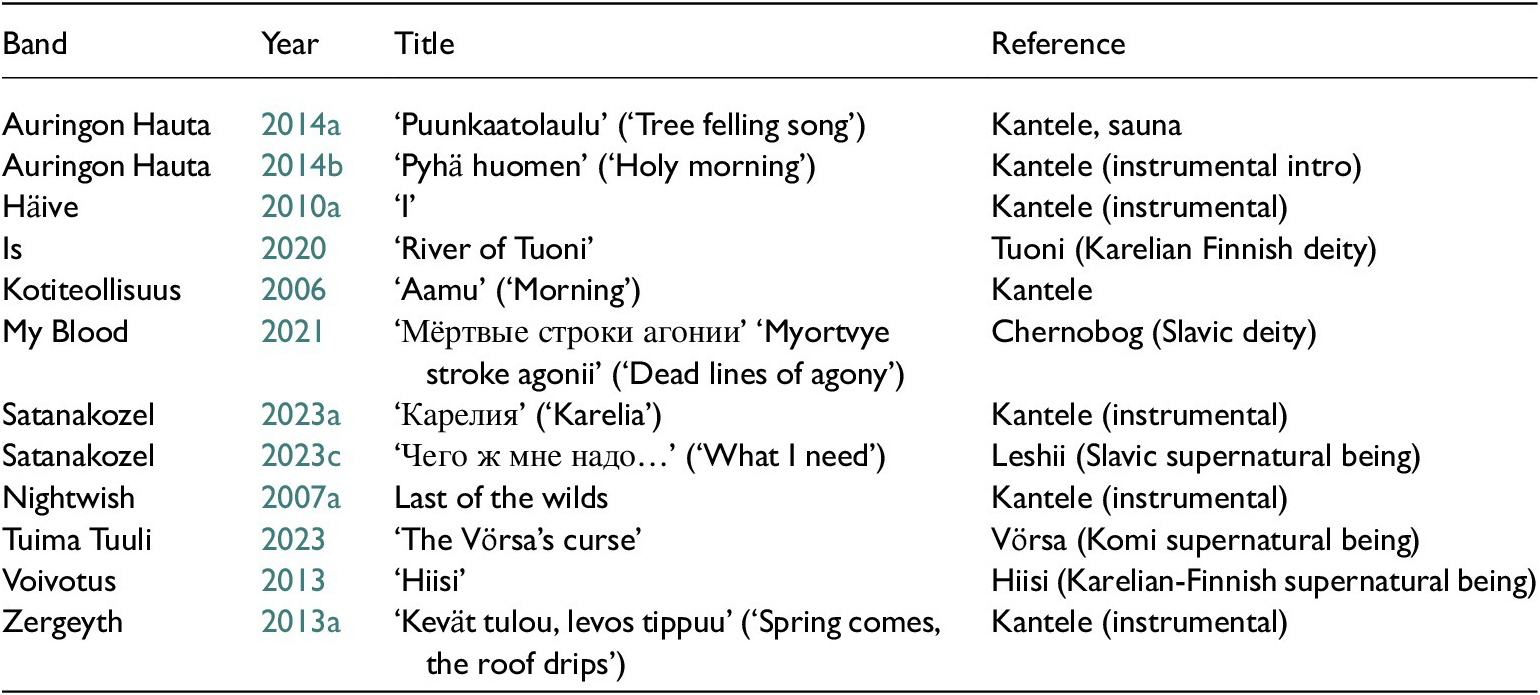
When adapting mythology, Finnish Karelian bands are partial to the Kalevala and other Finnish Karelian folk poetry. Russian Karelian bands sometimes refer to Finnish Karelian folk poetry, such as ‘River of Tuoni’ (2020) or ‘Hiisi’ (2013) (Table 7), but more often adapt from other Finno-Ugric and Slavic mythologies. Unfortunately, the unavailability of published lyrics of the above songs makes it impossible to make a meaningful statement on how these artists approach folk poetry compared to their Finnish Karelian counterparts. The adaptation of Karelian Finnish folk poetry by Finnish metal bands was central to my doctoral research (Doesburg Reference Doesburg2022). Finnish Karelian metal bands are discussed throughout, but I focused on three in particular: Stam1na (pp. 194–219), Mokoma (pp. 255–263), and Kotiteollisuus (pp. 264–276). New material found in the data collecting process of this research did not yield any significant new insights into the adaptation of Karelian Finnish folklore.
Folklore in discussed lyrics and song titles

Table 7. Long description
From top to bottom, the table columns are Band, Year, Title, and Reference. First row: Auringon Hauta, 2014a, ‘Puunkaatolaulu’ (‘Tree felling song’), Kantele, sauna. Second: Auringon Hauta, 2014b, ‘Pyhä huomen’ (‘Holy morning’), Kantele (instrumental intro). Third: Häive, 2010a, ‘I’, Kantele (instrumental). Fourth: Is, 2020, ‘River of Tuoni’, Tuoni (Karelian Finnish deity). Fifth: Kotiteollisuus, 2006, ‘Aamu’ (‘Morning’), Kantele. Sixth: My Blood, 2021, ‘Мёртвые строки агонии’ ‘Myortvye stroke agonii’ (‘Dead lines of agony’), Chernobog (Slavic deity). Seventh: Satanakozel, 2023a, ‘Карелия’ (‘Karelia’), Kantele (instrumental). Eighth: Satanakozel, 2023c, ‘Чего ж мне надо…’ (‘What I need’), Leshii (Slavic supernatural being). Ninth: Nightwish, 2007a, Last of the wilds, Kantele (instrumental). Tenth: Tuima Tuuli, 2023, ‘The Vörsa’s curse’, Vörsa (Komi supernatural being). Eleventh: Voivotus, 2013, ‘Hiisi’, Hiisi (Karelian-Finnish supernatural being). Twelfth: Zergeyth, 2013a, ‘Kevät tulou, levos tippuu’ (‘Spring comes, the roof drips’), Kantele (instrumental).
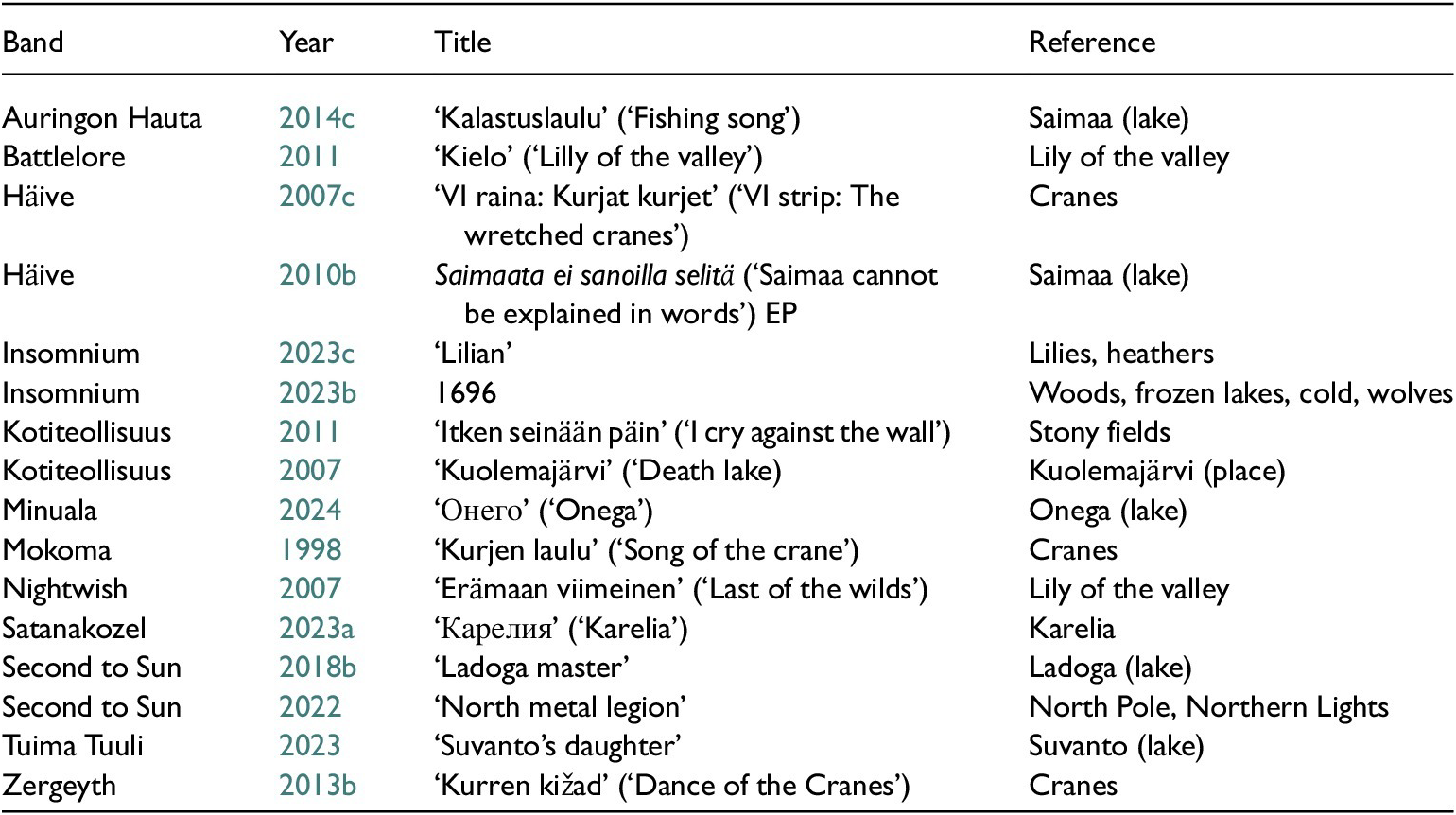
Nature in discussed lyrics, songs, and album titles

Table 8. Long description
From the top row downward, the table contains four columns: Band, Year, Title, and Reference. The first row lists Auringon Hauta, 2014c, ‘Kalastuslaulu’ (‘Fishing song’), and Saimaa (lake). The second row is Battlelore, 2011, ‘Kielo’ (‘Lilly of the valley’), and Lily of the valley. The third row is Häive, 2007c, ‘VI raina: Kurjat kurjet’ (‘VI strip: The wretched cranes’), and Cranes. The fourth row is Häive, 2010b, Saimaata ei sanoilla selitä (‘Saimaa cannot be explained in words’) EP, and Saimaa (lake). The fifth row is Insomnium, 2023c, ‘Lilian’, and Lilies, heathers. The sixth row is Insomnium, 2023b, 1696, and Woods, frozen lakes, cold, wolves. The seventh row is Kotiteollisuus, 2011, ‘Itken seinään päin’ (‘I cry against the wall’), and Stony fields. The eighth row is Kotiteollisuus, 2007, ‘Kuolemajärvi’ (‘Death lake’), and Kuolemajärvi (place). The ninth row is Minuala, 2024, ‘Onego’ (‘Onega’), and Onega (lake). The tenth row is Mokoma, 1998, ‘Kurjen laulu’ (‘Song of the crane’), and Cranes. The eleventh row is Nightwish, 2007, ‘Erämaan viimeinen’ (‘Last of the wilds’), and Lily of the valley. The twelfth row is Satanakozel, 2023a, ‘Kareliya’ (‘Karelia’), and Karelia. The thirteenth row is Second to Sun, 2018b, ‘Ladoga master’, and Ladoga (lake). The fourteenth row is Second to Sun, 2022, ‘North metal legion’, and North Pole, Northern Lights. The fifteenth row is Tuima Tuuli, 2023, ‘Suvanto’s daughter’, and Suvanto (lake). The sixteenth row is Zergeyth, 2013b, ‘Kurren kižad’ (‘Dance of the Cranes’), and Cranes. Nature references include lakes (Saimaa, Onega, Ladoga, Suvanto, Kuolemajärvi), cranes, lilies, heathers, woods, stony fields, Karelia, North Pole, and Northern Lights. Each entry links a band and year to a specific nature motif in the lyrics or album title.
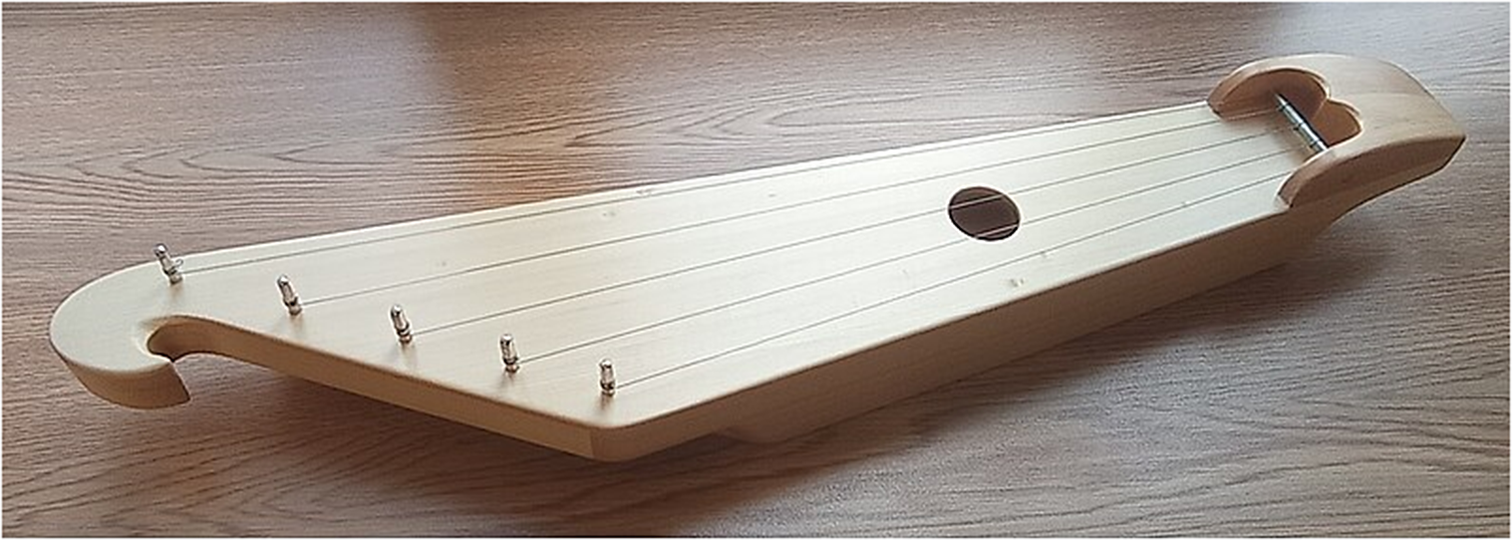
Musically, the traditional kantele (Figure 3), a type of psaltery instrument (Libin Reference Libin2014), appears in music by Finnish and Russian Karelian bands. It is strongly associated with the folk poetry as traditional runo-singersFootnote 19 often used a kantele during their performances. According to folklore, the first kantele was made by Väinämöinen from the jaw of a pike (Kalevala: 40). In metal music, the kantele is featured lyrically, such as in ‘Aamu’ (‘Morning’ 2006) by Kotiteollisuus or ‘Puunkaatolaulu’ (‘Tree felling song’ 2014a) by Auringon Hauta. Musically, kanteles often appear in instrumental intro and outro songs by bands from the region: Auringon Hauta, Nightwish, Satanakozel, Häive, and Zergeyth. The kanteles heard in songs by Auringon Hauta are sometimes made by band members.Footnote 20 As the national instrument of Finland and Karelia, the sound of the kantele in metal music invokes the nation and the region on a musical level.
A traditional 5-stringed kantele from Petrozavodsk, Republic of Karelia.

The Slavic deity Chernobog is referred to in the song ‘Myortvye stroke agonii’ (‘Dead lines of agony’ 2021) by My Blood – a band that originated as a collaboration between Finnish and Russian Karelian artists, including members from Satanakozel, Sandarmoh, Häive, and Auringon Hauta. Currently, the band members are all Russian Karelian; the reason for this is unclear. Chernobog is a relatively well-known deity from the Slavic pantheon as he appears in Neil Gaiman’s American Gods (Reference Gaiman2001) – a popular fantasy novel that creates a new story featuring gods from a variety of different pagan belief systems, such as Norse, Slavic, and African – which was subsequently adapted into a TV series by Amazon Prime (2017–2021). When Chernobog was documented, the belief system he appeared in was nearly eradicated (Gorbachov Reference Gorbachov2017, p. 210), and it is debatable how important he was in the wider Slavic pantheon. Chernobog is described as a black or evil god in Chronica Slavorum , a source whose authenticity has repeatedly been questioned (ibid., p. 214). Academic debates notwithstanding, in popular culture, as well as in ‘Myortvye stroke agonii’, Chernobog is akin to Satan, a comparison taken from the Chronica Slavorum . Another invocation of Slavic mythology appears in Satanakozel’s ‘Chego zh mne nado…’ (‘What I need…’ 2023c) whereby a leshii, a treacherous forest spirit (Warner Reference Warner2002, pp. 38–40), leads the narrator to a swamp. In Slavic mythology, the leshii are known for playing tricks and deceiving people in the forest (2006; Warner Reference Warner2002, pp. 38–40). A similar forest spirit is encountered in ‘The Vörsa’s Curse’ (2023a) by Tuima Tuuli.Footnote 21 The vörsa is a woodland spirit originating in Komi mythology (Aronov Reference Aronov2006, p. 41). The Komi are a Permian Finno-Ugric people living in Russia’s sub-Arctic Komi Republic. The vörsa can help or harm humans, depending on whether they like a person or not.Footnote 22
The adaptation of Finnish Karelian, Slavic, and other Finno-Ugric mythologies by Russian Karelian bands reflects their multiple identities. Many artists are of mixed heritage; Vladimir Lehtinen of the Russian Karelian band Second to Sun has Finnish, Karelian, Moksha, Mari, and Udmurtian roots.Footnote 23 In contrast, Finnish Karelian artists do not usually adapt mythologies beyond the Kalevala and other Finnish Karelian folklore. Remarkably, the use of kanteles is similar on both sides of the border.
Lakes, cranes, and northern lights – nature
Nature is a recurring phenomenon in metal music globally, especially for Nordic metal bands. In this respect, metal music lyrics from Karelia are no different. Depictions of nature range from the specific – referrals to Karelian lakes, places, or aspects specific to Karelia – to a more generalised image of the North or (sub-)Arctic.
The song ‘Itken seinään päin’ (‘I Cry Against the Wall’ 2011) by Kotiteollisuus refers to Finnish Karelia specifically in the second line: pellot, jotka on kiviä täynnä ‘fields, that are full of stones’. Karelian evacuees who moved to Finland after the Winter and Continuation warsFootnote 24 often complained that the ground of their new Finnish fields contained many stones, whereas Karelian fields had been easier to work due to the lack of stones (Pääkkönen Reference Pääkkönen2022). In ‘Itken seinään päin’, the fields of stones are paralleled with empty fishing nets dragged from the lakes, the men who work so hard they sweat, and the only social interactions happening when one is drunk. This first verse sets the tone for the rest of the song, which further details the peculiarity of life in Finnish Karelia/Finland.
The critical stance of Kotiteollisuus is somewhat of an oddity, as most bands refer to Karelia in positive terms. Besides the invocation in ‘Hymn of the Darkwoods’ (1996) to the land of the thousand lakes, lake names often appear in song and EP titles as well as lyrics by Karelian artists. The song ‘Ladoga master’ invokes Lake Ladoga in its title and in the lyrics. Lake Ladoga is Europe’s largest lake. During the Viking and Middle Ages, the village of Ladoga formed an important stop on a trading route, and Ladoga also appears in Old Norse sagas (Jackson Reference Jackson, Nauman, Jezierski, Reimann and Runefelt2022, p. 65). The song ‘Onego’ (‘Onega’ 2024) refers to Lake Onega, Europe’s second-largest lake, and ‘Suvanto’s daughter’ (2023) to Lake Suvanto, also in the Republic of Karelia. Finland’s largest lake, Saimaa, is part of the title of the EP Saimaata ei sanoilla selitä (‘Saimaa cannot be explained into words’ 2010b) by Häive, and it also appears in ‘Kalastuslaulu’ (‘Fishing song’ 2014c) by Auringon Hauta. The song is a modern version of the tradition whereby everyday tasks were accompanied by specific songs, such as herding songs (Kanteletar 1:173; 174; 186) or bear hunting songs (Kanteletar 2: 329; 332; 333; 350). In ‘Kalastuslaulu’ the hungry narrator goes to Saimaa to fish and catches a pike. On Häive’s instrumental EP, mouth harps and kanteles accompany electric guitars, bass, and drums to evoke a Finnish/Karelian atmosphere. The song ‘Kareliya (‘Karelia’ 2023a) by Satanakozel also features a kantele to further strengthen the connection made in the song’s title to Karelia. Finally, the song ‘Kuolemajärvi’ (2007) by Kotiteollisuus refers to the village in the Karelian Republic of the same name. Kuolemajärvi’s literal translation is ‘lake of death’, and the song plays with this literal meaning as it discusses the sensitive topic of suicidal ideation. Besides ‘Kalastuslaulu’, the other songs prominently feature aspects of Karelia in their titles, thus emphasising their Karelian roots. Thereby, Karelian identity is easily conveyed to the listener without having to read or listen to the lyrics. Although it should be noted that lyrics for these songs are never in English, therefore the conveyance of Karelian identity negotiations is limited to a local audience.
Cranes play an important symbolic role in Finland and Karelia and feature in various songs. Cranes appear in traditional folk poems, as a helpful bird conveying messages (Kalevala 42: 293–333; Kanteletar 1:201) and a judge on other birds (Kanteletar 1:91). During the Golden Age of Finnish Art (1880–1910), a period characterised by its interest in Karelian Finnish folk poetry and Karelia, cranes featured prominently. Jean Sibelius’ tone poem ‘Scene with Cranes’ ( Kurkikohtaus op.44 no.2) features clarinets mimicking the call of cranes. The poem ‘Kurjet’ (‘The Cranes’ 1949) by one of Finland’s most celebrated poets, Eino Leino, intrinsically links the birds with Finland. In ‘Kurjet’, the cranes tell the narrator: enslempemme manner on Suomenmaa ‘The continent of our first love is Finland’. Therefore, the invocation of cranes in metal music from Karelia is not without cultural precedent. Unlike some animals which frequently appear in metal music, such as wolves (Digioia Reference Digioia2016; Valijärvi Reference Valijärvi2022), cranes are uncommon. This strengthens their tie to Finland/Karelia, rather than as a stalwart of metal music culture.
Cranes appear in Häive’s ‘VI raina: Kurjat kurjet (‘VI strip: the wretched cranes’ 2007c), Mokoma’s ‘Kurjen laulu’ (‘Song of the crane’ 1998), and Zergeyth’s ‘Kurren kižad’ (‘The dance of the cranes’ 2013b). In all these songs, cranes symbolise melancholy and sorrow, two states of mind closely associated with Karelian Finnish folk poetry, especially the lamenting tradition (Sky Hiltunen Reference Sky Hiltunen2007), but also with metal music in general (Coggins Reference Coggins2019; Oksanen Reference Oksanen2011, pp. 357–358). Häive’s and Zergeyth’s songs allude to the folk beliefs where young cranes learning to fly and departing for the south announced the end of summer. The narrator in ‘Kurren kižad’ observes how the cranes learn to fly and subsequently leave with their parents. The narrator watches this departure: Minä seižoi, tusku vacaz (‘I stood, pain in my belly’). Similarly, the narrator of Häive’s song describes the cranes’ departure as follows: Yksin seison ja käännän teille selkäni (‘I stand alone and turn my back against you’). These melancholic expressions over the end of the summer connect to the harsh winters of the sub-Arctic when the sun hardly rises above the horizon for months, and food would have been hard to come by in premodern times. However, ‘Kurren kižad’ and ‘Kurjat kurjet’ both end on a positive note relating to the cyclical nature of life, whereby seasons change, and better weather will arrive eventually. The narrator of ‘Kurjat kurjet’ ends the song by addressing the cranes directly: Tulettehan taas kuitenkin keväällä takaisin! (‘You will come again in spring after all, will you!’). In ‘Kurren kižad’, the cranes leave with a message of hope for the listener: Keviäv meidy vuattakkua. Tuome siiviy suvituuled, lämmän tänne päiväzen (‘Wait for us in the spring. We bring the summer’s breeze on our wings, bring the warm days here’).
Invocations of flowers are also somewhat of an oddity in metal music. However, there are some Finnish Karelian songs that refer to Finland’s national flower, the lily of the valley. Battlelore’s instrumental song ‘Kielo’ (‘Lily of the Valley’ 2011) refers to the flower in its title. Properties traditionally associated with flowers – delicacy, femininity, joy, and pleasure – are musically conveyed in the song. ‘Kielo’ features many non-traditional metal instruments, such as flute, strings, and trumpets. In this respect, it is a typical intro or outro song for an album in the genre, where metal music’s traditional sonic qualities are sometimes substituted for a gentler sound. The song ‘Erämaan viimeinen’ (‘Last of the Wilds’ 2007b) by Nightwish refers to the lily of the valley in its lyrics: kielon istutin ikihankeen ‘the lily of the valley is planted into the eternal snow drift’. Nightwish is a symphonic metal band with a woman singer. Symphonic metal – with its keyboard sounds, soft vocals, and catchier melodies – embodies the softer side of the genre and can therefore be easily connected to the traditional feminine qualities also inherent to flowers.
A more generalised picture of Northern nature forms the backdrop of many narratives. The song ‘Lillian’ (2023b) by Insomnium mentions lilies, heathers, and pine trees. The song ‘1696’ (2023b) from the same album paints an even more Nordic picture with references to ‘endless woods’, ‘frozen lakes’, the cold, and wolves. The song ‘North Metal Legion’ (2022) by Russian Karelian band Second to Sun refers to Karelia’s geographic location as close to the Arctic: ‘The North Pole is nearby’.Footnote 25 In such songs, invocations of Northern nature and the (sub-)Arctic function as a geographical marker. These areas are idealised in metal music, especially in Black metal and Viking metal (Sellheim Reference Sellheim2016). Besides this idealisation, this is also a familiar environment for the artists. Invoking one’s own natural surroundings – even in a generalised Northern sense – is therefore an act of identity formation. As discussed in connection to Zergeyth’s ‘Pohatterit betonikoropoista’ (2021e) and Häive’s ‘V raina: takaisin koskemattomaan metsään’ (2007b), nature is often the preferred place for metal music artists. The climate of the sub-Arctic is often depicted as harsh and difficult to endure. Nevertheless, for these artists it is home, and they communicate this in their music. Finnish and Russian Karelian artists make remarkably similar references to nature, either to specific places in the region, such as lakes or places, or in a more generalised manner by invoking the ‘North’ and the (sub-)Arctic.
Conclusions
Largely, Russian and Finnish Karelian artists portray Karelia in a similar manner. Differences mainly exist in the adaptation of folklore, with Finnish artists predominantly focusing on Finnish Karelian folklore and Russian Karelian artists also incorporating Slavic and wider Finno-Ugric influences into their lyrics. Similarly, Russian Karelians tend to adapt events from history with a connection to the East, such as the band name Sandarmoh, referring to the burial place used during Stalin’s Great Terror. Finnish Karelians, on the other hand, adapt events with a connection to the West. Both Insomnium and Hiidenlintu created songs about the Great Finnish Famine (1695–1697), a famine that was made worse through the inadequate intervention of the Swedish Crown (Jutikkala and Pirinen Reference Jutikkala and Pirinen1979, p. 108; Lappalainen Reference Lappalainen2014, p. 426). This East-West orientation can be explained by taking historical, political, and geographical factors into account. The geographical location of Finland and Karelia on the border between East and West leads to a politically fraught situation. During the time of Finlandisation, Finland tried to maintain a cordial relationship with the Soviet Union/Russia whilst attempting to improve its relationship with Europe’s Western nations (Arter Reference Arter2023). More recently, Finland finally joined NATO after years of indecision because of Russia’s invasion of Ukraine. This decision signals a complete end to Finlandisation and a further distancing of Finland from Russia. A position that is impossible to take for inhabitants of the Republic of Karelia, whether they want to or not.
Although not wholly unsurprising, Finnish Karelians are more positive of Finland than Russian Karelians are of Russia. Finnish Karelians have made music about Finland’s national symbols (official and unofficial), such as cranes, lily of the valley, swans, the sauna, and the tourist slogan ‘Land of the Thousand Lakes’. Russian Karelian bands have created lyrics about a lack of belonging that is connected to an ‘us-and-them’ dichotomy as well as a yearning for freedom. Finnish Karelians lament urbanisation and a removal from nature, a topic that also appears in Russian Karelian metal music. However, more frequently, Russian Karelians refer to a ‘they’ who oppress the ‘us’. It is never made explicitly clear that the ‘they’ group refers to Russia, and lyricists might practice self-censorship (Castells Reference Castells2009, pp. 330–341; Schimpfössl and Yablokov Reference Schimpfössl and Yablokov2020) or inner-censorship (Ader Reference Ader, Zuk and Frolova-Walker2017, 417). In relation to this type of censorship, official and unofficial actions by the Russian government could also partially explain the limited availability of information on Russian Karelian metal bands, as well as the use of nicknames for artists, such as Nøkken, or a complete lack of information of band members, such as for Tuima Tuuli. Russian Karelian artists repeatedly invoke a lack of freedom or belonging with repeated references to a ‘them’-group – whereas this type of discourse is mostly absent in lyrics by Finnish Karelian artists – pointing towards a feeling of discontent amongst Russian Karelian artists.
Overlap increases between Russian and Finnish Karelian bands when lyrical themes and song names invoke the North. Increased commonality between Russian and Finnish Karelians is mainly expressed through invocations of nature. Referrals to the weather (snow, storm, etc.), seasons (winter, summer), nature (forest, lake, river, etc.), types of trees (birch, spruce, etc.), and animals (wolf, bear, etc.) are made in more or less equal measure on both sides of the border. These depictions of nature coincide with those made in metal music by other bands from the Nordics (Sellheim Reference Sellheim2016; Helden Reference Helden2017). When it comes to the (sub-)Arctic, there is no difference in how bands choose to depict this, with referrals made to the Northern Lights, the Arctic Circle, and the North Pole. All in all, Karelian artists on both sides of the border share the most similarities when the smallest geographical location – Karelia – and the largest geographical location – the (sub-)Arctic – are invoked. The East-West divide becomes clearest when artists sing about Finland or Russia.
Finally, given the weak sense of Karelian identity and the endangered status of the language, the continued allusions by metal artists to aspects that can be connected to Karelia are acts of identity exploration. From this research, several features of Karelian identity can be glimpsed: a close connection to nature, a desire to be considered not only as victims, a strong wish to belong, and identification with other Finno-Ugric cultures. These identity investigations can be better understood from a decolonial framework (Mignolo and Walsh Reference Mignolo and Walsh2018; Tlostanova and Mignolo Reference Tlostanova and Mignolo2012), whereby alternate ways of life and identifying are offered as an alternative to capitalism and the colonial past (and sometimes present). The Russian government’s current unification policies are geared towards a ‘unified all-Russian cultural identity’ and suspicion of any expression of minority identity (Suleymanova Reference Suleymanova2018, p. 827). Therefore, these identity negotiations by Russian Karelian artists are acts of resistance against an authoritarian dictatorship. On the Finnish side of the border, these acts of identity expression are less politically loaded and come with less risk on the part of the artist. However, Finland’s past attempts to assimilate Finnish and Karelian cultures (Stepanova Reference Stepanova2020) mean that even for Finnish Karelian artists, expressions of Karelian identity are subversive and help pave the way towards a better sense of identity.
Acknowledgements
The research for this article was made possible by the generous funding of the Leverhulme Trust and John Fell Fund. I would like to thank Professor Sarah Hill and Professor Philip Ross Bullock for their helpful feedback on an earlier draft of this article, as well as Philip’s corrections of Russian translations. My gratitude is also expressed to the two anonymous peer reviewers for their helpful comments. I would also like to thank Dr Heidi Allene Henrickson for proofreading this article’s final draft, Dr Kristian Wahlström for correcting my Finnish translations, and Dr Niko Tynnyrinen, Dr Olga Karlova, and Dr Natalia Giloeva from the University of Eastern Finland for providing feedback and corrections on my Karelian translations. Any mistakes remaining are entirely my own.


 Open access

