


Statement of Research Significance
Research Question(s) or Topic(s): The present study aimed to develop and preliminarily evaluate a novel Brief Mathematics Achievement Test (BMAT) as a proxy measure of quality of education in culturally and linguistically diverse populations. Main Findings: Mathematics Achievement Test performance was significantly predicted by country-level quality of education (QoE) indicators after controlling for demographic variables. Mathematics Achievement Test performance was unrelated to immigrant status. In regression analyses, BMAT performance significantly predicted performance on a brief cognitive composite, whereas level of education and country-level QoE indicators did not. Study Contributions: Study results provide preliminary evidence for the construct validity of the Brief Mathematics Achievement Test as a cross-cultural proxy measure for quality of education. The BMAT may be particularly valuable in assessing QoE among non-English-speaking individuals educated in varied educational systems.
Introduction
Cognitive function is widely recognized as being influenced by cultural variables, with educational attainment consistently identified as one of the strongest predictors of performance on cognitive tests (Lezak et al., Reference Lezak, Howieson and Loring2004). However, the number of years of education does not necessarily reflect the quality of that education. Educational quality may be shaped by multiple factors, including access to learning resources, student–teacher ratios, teacher qualifications, the length of the academic year, and opportunities to attend and engage in education (Ardila, Reference Ardila2005).
An accumulating body of evidence suggests that quality of education (QoE) may account for ethnic differences in cognitive test performance (Dotson et al., Reference Dotson, Kitner-Triolo, Evans and Zonderman2009; Manly et al., Reference Manly, Jacobs, Touradji, Small and Stern2002; Rohit et al., Reference Rohit, Levine, Hinkin, Abramyan, Saxton, Valdes-Sueiras and Singer2007). Sole reliance on years of education to estimate cognitive performance can result in misclassification of individuals from minoritized ethnic groups (Fillenbaum et al., Reference Fillenbaum, Heyman, Huber, Ganguli and Unverzagt2001; Heaton et al., Reference Heaton, Ryan and Grant2009; Schneider & Lichtenberg, Reference Schneider and Lichtenberg2011). Although QoE has been measured by performance-based reading tests and by retrospectively gathering inferential data as indicators of school quality from state-level historical reports or directly from participants’ self-reports (Metcalfe et al., Reference Metcalfe, Nielsen, O’Donald, Franzen and Calia2026), most studies have used current reading ability as a proxy for QoE (e.g., the Wide Range Achievement Test Reading Recognition subtest (Wilkinson & Robertson, Reference Wilkinson and Robertson2006)). However, this approach has primarily been applied to older adult English-speaking populations in the United States educated within the same system, limiting its generalizability. Reading ability tests typically depend on the correct pronunciation of irregular words in opaque languages such as English. This reliance poses challenges for individuals from linguistic backgrounds with transparent orthographies (e.g., Spanish), where such irregularities are uncommon (Ardila et al., Reference Ardila, Bertolucci, Braga, Castro-Caldas, Judd, Kosmidis, Matute, Nitrini, Ostrosky-Solis and Rosselli2010). Consequently, reading tests may not be suitable for cross-cultural comparisons involving different languages or educational systems.
While reading ability has traditionally been used as a proxy for QoE in neuropsychological research, mathematics achievement may offer a more culturally and linguistically inclusive alternative. To date, only one study has examined whether mathematics achievement can serve as a proxy for QoE in cross-cultural contexts. In that study, mathematics achievement attenuated or eliminated differences in cognitive test performance between Spanish-speaking Colombian and Spanish participants matched on demographic variables (Fasfous et al., Reference Fasfous, Hidalgo-Ruzzante, Vilar-López, Gálvez-Lara and Pérez-García2017). It cannot be assumed that mathematics achievement is culturally neutral. Cross-national differences in mathematical performance may reflect variation in curricular priorities, pedagogy, symbolic conventions, and opportunity to learn, in addition to broader educational quality. Accordingly, the rationale for using mathematics achievement as a proxy for QoE is not that mathematics is culture-free, but that it may provide a less language-bound proxy than reading measures that rely on irregular orthography. More broadly, educational experiences are often discussed in relation to cognitive reserve, whereby sustained cognitive engagement may support more efficient or flexible recruitment of neural and cognitive resources across the lifespan (Nogueira et al., Reference Nogueira, Gerardo, Santana, Simoes and Freitas2022). Within this framework, mathematics achievement may capture not only acquired scholastic knowledge but also repeated engagement of working memory, executive control, abstraction, and problem-solving processes (Cragg & Gilmore, Reference Cragg and Gilmore2014). However, the present study was not designed to test reserve mechanisms directly; rather, it evaluates whether mathematics achievement may function as a practical performance-based proxy indicator of educational quality in culturally and linguistically diverse populations.
Therefore, the present study aimed to develop and preliminarily evaluate a novel Brief Mathematics Achievement Test (BMAT) as a proxy measure of QoE in culturally and linguistically diverse populations. We hypothesized that (1) country-level QoE would significantly predict BMAT performance after controlling for demographic variables, (2) BMAT performance would be unrelated to immigrant status, and (3) BMAT would be a stronger predictor of cognitive test performance than country-level QoE.
Methods
Participants
Community-dwelling adult participants with European native-born and immigrant backgrounds (age range: 18–89 years) were included and assessed at sites across Denmark, Greece, the Netherlands, Spain, and the United Kingdom between March 2023 and July 2025. European native-born participants were defined as participants who were born, and typically belonged to a majority ethnic group, in the country of data collection (e.g., ethnic Danish in Denmark or ethnic Greek in Greece), while participants with immigrant backgrounds were defined as first generation immigrants or refugees in the country of data collection. However, participants represented 30 different countries and 19 different primary languages. Participants were recruited from a university register of potential participants for research studies, local general practice clinics, senior centers, community centers, and through the social networks of multicultural and multilingual researchers. Exclusion criteria included severe psychiatric or neurological disorder, and substance abuse. Additionally, participants older than 60 years were excluded if they scored <24/30 points on the Mini-Mental State Examination (Folstein et al., Reference Folstein, Folstein and McHugh1975) or <23/30 points on the Rowland Universal Dementia Assessment Scale (Storey et al., Reference Storey, Rowland, Basic, Conforti and Dickson2004).
Procedures
All participants underwent an approximately one-hour assessment, in which demographic data were collected and BMAT and cognitive tests were administered. All participants were asked about any vision or hearing impairment and were assessed using their hearing aids or prescribed glasses when relevant. All native-born participants were assessed in their first language by an assessor speaking the same language. Participants with immigrant backgrounds (n = 48) were assessed in their first language by multilingual researchers or through interpreter-mediated assessment (n = 31), or in a second language when this was their preferred testing language (n = 17).
The study adhered to the Declaration of Helsinki for research involving human subjects and was assessed and approved by the Scientific Ethics Committees (reference no. 22007675) and Data Protection Agency (reference no. P-2022-444) for the Capital Region of Denmark, as well as relevant local ethics and data protection authorities at other sites. All participants provided written consent.
Measures
Demographic information
All participants completed a demographic questionnaire. Information collected included age, sex, country of origin, level of education, current or main lifetime (if retired) occupation, and year of immigration for participants with immigrant background.
Socioeconomic status
Socioeconomic status (SES) was included as a covariate in hierarchical regression analyses as math achievement has been shown to correlate with SES in adulthood (e.g., Ritchie & Bates, Reference Ritchie and Bates2013). As occupation reflects income, education, and social status, SES was measured using an inverted International Standard Classification of Occupations (ISCO-8) scale (International Labour Office, 2012) based on participants’ current or main lifetime (if retired) occupation. Scores range from 0 (low) to 9 (high).
Quality of education (QoE)
QoE was estimated using two indicators derived from World Bank data: (1) country-level student–teacher ratios for primary education (www.databank.worldbank.org/databases/education), and (2) country income classifications (World Bank, 1990). Student–teacher ratio is a widely used proxy for QoE and has been shown to predict academic achievement, including mathematics performance (Ajani & Akinyele, Reference Ajani and Akinyele2014; Koc & Celik, Reference Koc and Celik2015; Samnufida & Kismiantini, Reference Samnufida2022), and cognitive function in older adulthood (Crowe et al., Reference Crowe, Clay, Martin, Howard, Wadley, Sawyer and Allman2013). Lower ratios generally indicate more individual attention per student and potentially higher teaching quality, whereas higher ratios may reflect teacher shortages or large class sizes. Country of origin income classification was included as an additional indicator of QoE, given that national wealth influences investment in schools, teachers, and resources. Classifications are based on Gross National Income per capita and categorize countries as Low-Income, Lower-Middle-Income, Upper-Middle-Income, or High-Income countries. For each participant, country of origin student–teacher ratio and country of origin income classification were based on available data from the year closest to when the participant was 10 years old (4th or 5th grade), as this represents the available data that best reflects the educational and economic context across participants’ schooling experiences.
Brief Mathematics Achievements Test
BMAT is a newly developed measure of mathematics achievement, which was used as the dependent variable for our first hypothesis. BMAT consists of 16 items of graded difficulty to be solved using paper-and-pencil methods in an eight-minutes session. The items include simple whole number arithmetic, problems with fractions, long multiplication and division, percentages, and algebra with one unknown. One point is given for each correctly solved item, yielding a total score of 0–16 points (see Supplementary material).
Cognitive performance
All participants completed three brief cognitive tests assessing aspects of processing speed, language, visuospatial abilities, and executive functioning, namely Animal Fluency (Strauss et al., Reference Strauss, Sherman and Spreen2006), Clock Reading Test (Schmidtke & Olbrich, Reference Schmidtke and Olbrich2007), and Copying of a Necker Cube (Storey et al., Reference Storey, Rowland, Basic, Conforti and Dickson2004). Raw scores for each test were converted into z-scores and then averaged to calculate a brief cognitive composite score.
Data analysis
A composite QoE index was created by first coding country of origin income classification as Low-Income = 1, Lower-Middle-Income = 2, Upper-Middle-Income = 3, and High-Income = 4. Then, student–teacher ratios and country income classifications were normalized to z-scores and a weighted arithmetic mean was calculated, using the formula: QoE Index = (.6 × inverted normalized student–teacher ratio) + (.4 × normalized country income classification). Weights were chosen to reflect the stronger predictive value of student–teacher ratio for academic achievement, while still accounting for economic context.
Due to non-normally distributed data, differences between European native-born and immigrant groups in country-level QoE, BMAT, and performance on a brief cognitive composite were tested with the Mann–Whitney U test, and the linear relationship between demographic variables, SES, country-level QoE, BMAT, and performance on a brief cognitive composite was assessed using Spearman’s rank-order correlation coefficient. Correlation coefficients of .10–.29 were interpreted as weak, .30–.49 as moderate, and .50–1.00 as strong correlations (Cohen, Reference Cohen1988). A two-step hierarchical linear regression analysis with preliminary analysis of multicollinearity and plots of residuals as model control was used to test if the QoE Index (added in Model 2) significantly contributed to the explained variance in BMAT scores above and beyond age, immigrant status, SES, and level of education (Model 1) based on the p-value of the ΔR 2 score. Also, the overall significance level for both models and the predictors’ regression coefficients and associated p-values were examined. In a separate hierarchical linear regression analysis, it was tested if the QoE Index and BMAT scores (added Model 2) significantly predicted performance on the brief cognitive composite, controlling for age, immigrant background, SES, and level of education (Model 1). In all regression models, Tolerance values < .10 and Variance inflation factor (VIF) values >5 were considered unacceptable levels of multicollinearity (Daoud, Reference Daoud2017). All analyses were performed with IBM SPSS statistical software (Version 30.0.0.0). A p-value < .05 two-tailed was considered significant.
Results
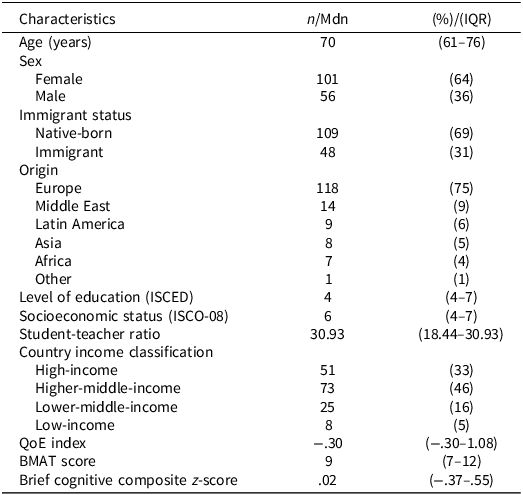
Participant characteristics and descriptive statistics for key variables are presented in Table 1. Participants had a median (Mdn) age of 70 years and a Mdn level of education corresponding to upper secondary education, 36% were male, 75% had European origin, and 31% had immigrant background. Participants with immigrant background had a Mdn age of 28 years (interquartile range (IQR) = 18–36) at the time of immigration. There were no significant differences between females and males or between participants with native-born and immigrant backgrounds in BMAT scores. Spearman’s rank-order correlations are presented in Table 2. BMAT was strongly correlated with SES (ρ = .63, p < .001), level of education (ρ = .74, p < .001), and performance on the brief cognitive composite (ρ = .49, p < .001), moderately with student–teacher ratio (ρ = −.32, p < .001), country income classification (ρ = .24, p = .002), and the QoE Index (ρ = .32, p < .001), and weakly with age (ρ = −.23, p = .003). Females had significantly lower student–teacher ratio compared to males (Mdn = 30.93, IQR = 18.44–30.93 vs Mdn = 30.93, IQR = 18.04–37.80; U = 2156, p < .011), and a higher QoE Index (Mdn = −.30, IQR = −.30–1.07 vs Mdn = −.30, IQR = −1.21–1.09; U = 2189, p < .019). Participants with immigrant background were significantly younger (Mdn = 61 years, IQR = 56–70) than native-born participants (Mdn = 72 years, IQR = 67–78; U = 1385, p < .001) and had higher student–teacher ratio (Mdn = 34.03, IQR = 22.53–37.80 vs Mdn = 30.93, IQR = 18.38–30.93; U = 1628, p < .001), lower country income classification (Mdn = 2, IQR = 2–3 vs Mdn = 3, IQR = 3–4; U = 807, p < .001), and lower QoE Index (Mdn = −1.02, IQR = −1.28–−.21 vs Mdn = −.30, IQR = −.30–1.08; U = 1038, p < .001). In participants with immigrant background, BMAT performance was not associated with age at the time of immigration (ρ = .13, p = .371).
Participant characteristics (n = 157)

Note: Mdn = median; IQR = interquartile range; ISCED = International Standard Classification of Education (Less than primary education = 1; Primary education = 2; Lower secondary education = 3; Upper secondary education = 4; Post-secondary education = 5; Short-cycle tertiary education = 6; Bachelor’s or equivalent = 7; Master’s or equivalent = 8); ISCO-8= International Standard Classification of Occupations (Unemployed and homemakers = 0; Elementary occupations = 1; Plant and machine operators, and assemblers = 2; Craft related trades workers = 3; Skilled agricultural, forestry and fishery workers = 4; Services and sales Workers = 5; Clerical support workers = 6; Technicians and associate professionals = 7; Professionals = 8; Managers = 9); QoE = quality of education; BMAT = Brief Mathematics Achievement Test.
Spearman’s rank-order correlations

Note: QoE = quality of education; BMAT = Brief Mathematics Achievement Test.
* p < .05; **p < .01; ***p < .001.
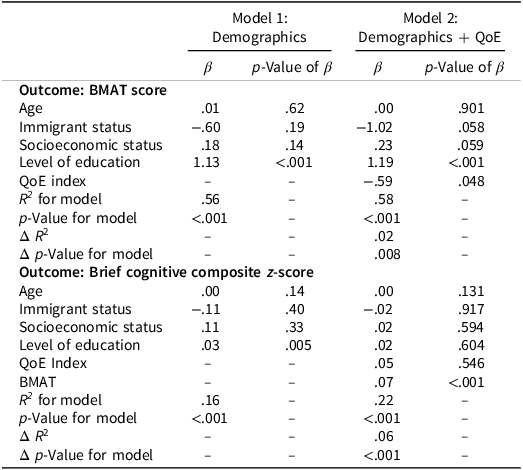
Table 3 presents the results from the hierarchical linear regression analyses. Preliminary analysis indicated acceptable multicollinearity. For the model predicting BMAT scores, Tolerance values ranged from.40–.88 and a VIF values from 1.14–2.68. For the model predicting performance on the brief cognitive composite, Tolerance values ranged from.26 to.88 and a VIF values from 1.14 to 3.82. In the first step (Model 1), BMAT scores were regressed on age, immigrant status, SES, and level of education. The overall model was statistically significant (F(4, 152) = 48.87, p < .001), with an R 2 value of.56. Level of education (β = 1.13, p < .001) significantly predicted BMAT scores. In the second step (Model 2), with the QoE Index added, the overall model remained significant (F(5, 150) = 41.67, p < .001). The R 2 value increased to.58, which was a significant increase (p = .008). Level of education remained significant (β = 1.19, p < .001) and the QoE Index emerged as a significant predictor (β = −.59, p = .048).
Hierarchical linear regression models

Note: QoE = quality of education; BMAT = Brief Mathematics Achievement Test.
Regarding cognitive performance, there were significant correlations between BMAT and performance on the brief cognitive composite (ρ = .49, p < .001) and the individual cognitive tests (Animal Fluency: ρ = .41, p < .001; Clock Reading Test: ρ = .32, p < .001; Copying of a Necker Cube: ρ = .36, p < .001). Also, performance on the brief cognitive composite was strongly correlated with level of education (ρ = .44, p < .001), SES (ρ = .42, p < .001), moderately with the QoE Index (ρ = .30, p < .001), and weakly with age (ρ = −.18, p = .03), student–teacher ratio (ρ = −.28, p < .001), and country income classification (ρ = .22, p = .005) (see Table 2). In participants with immigrant background, performance on the brief cognitive composite was not associated with age at the time of immigration (ρ = .19, p = .196).
Participants with immigrant background had significantly higher scores than native-born participants on Clock Reading Test (Mdn = 11.5, IQR = 10.5–12 vs Mdn = 10.5, IRQ = 9–12; U = 1950, p = .009) and lower scores on Copying of a Necker Cube (Mdn = 2, IQR = 2–3 vs Mdn = 3, IQR = 3–3; U = 1526, p < .001), while there were no significant differences on Animal Fluency (Mdn = 15, IQR = 13–18 vs Mdn = 16, IQR = 12–18; U = 1513, p = .90). Also, there was a trend toward lower performance on the brief cognitive composite in participants with immigrant background compared to native-born participants (Mdn = −.09, IQR = −.59–.33 vs Mdn = .02, IQR = −.33–.61; U = 2069, p = .06). There were no significant differences between females and males on any of the cognitive measures.
As shown in Table 3, the model predicting performance on the brief cognitive composite from the QoE Index and BMAT scores, while controlling for demographic variables (Model 2), was significant (F(6, 149) = 7.11, p < .001), with an Δ R 2 value of.06, which was significant (p < .001). In this model, only BMAT significantly predicted performance on the brief cognitive composite (β = .07, p = .001).
Discussion
The present study investigated the utility of the newly developed BMAT as a performance-based proxy measure of QoE in culturally and linguistically diverse populations. The findings supported the first hypothesis that country-level QoE significantly predicts BMAT performance, even when controlling for age, immigrant status, SES, and educational attainment. In support of the second hypothesis, BMAT scores demonstrated strong associations with SES and level of education, and a moderate association with country-level QoE, while showing no significant relationship with immigrant status or age at the time of immigration in participants with immigrant background. These results provide preliminary evidence for the construct validity of BMAT as a cross-cultural proxy measure for QoE.
Importantly, the findings underscore the potential value of BMAT in cognitive assessments, particularly in multicultural and multilingual contexts where traditional indicators such as years of education may not accurately reflect the quality or nature of educational experiences. Incorporating QoE-related information may enable clinicians to better interpret cognitive test results by offering a more nuanced understanding of individuals’ educational backgrounds. At this stage, BMAT should currently be regarded as a research tool rather than a clinically validated instrument, and its use in diagnostic workflows cannot be recommended without further psychometric and clinical validation. Furthermore, any use of contextual educational indicators must avoid reifying national or migration-based stereotypes. These indicators are intended to support more nuanced interpretation, not to lower expectations or make deterministic assumptions about an individual’s cognitive ability.
Although mathematics is often assumed to be culturally neutral, instructional approaches, curricular emphasis, and symbolic conventions vary across educational systems, which may influence performance independently of educational quality. Consistent with the third hypothesis and prior research on reading ability (Metcalfe et al., Reference Metcalfe, Nielsen, O’Donald, Franzen and Calia2026), BMAT performance significantly predicted performance on the brief cognitive composite, whereas level of education and country-level QoE did not. This suggests that BMAT may serve as a more direct and reliable predictor of cognitive performance than inferential indicators derived from country-level QoE data. However, the observed association between BMAT and the cognitive composite may be partially influenced by shared method variance, as both the BMAT and the cognitive composite rely on structured, time-limited, rule-based test performance and familiarity with formal testing demands. As such, correlations may reflect overlapping cognitive and procedural skills, such as processing speed, executive control, and test-taking familiarity, rather than QoE alone. In other words, it is possible that BMAT predicts cognitive composite scores because mathematical achievement requires the same cognitive functions tapped by the brief cognitive screening measures.
Nevertheless, BMAT’s ease of administration and predictive utility may enhance the accuracy of cognitive assessments in diverse populations, beyond what can be achieved using educational level alone. However, BMAT should not be used as a proxy for QoE in individuals with known or suspected dyscalculia, acquired acalculia, or other neurological conditions affecting calculation ability, as low scores in such cases may reflect mathematical impairment rather than reduced educational opportunity (Fasfous et al., Reference Fasfous, Hidalgo-Ruzzante, Vilar-López, Gálvez-Lara and Pérez-García2017).
Some limitations of the present study should be acknowledged. In particular, correlating individual educational experiences to country-level indicators raises the possibility of ecological fallacy, as within-country variation in school quality may be substantial and correlated with broader socioeconomic conditions. In this study, an individual’s specific educational experience or ability, can similarly not be inferred. Additionally, the sample consisted exclusively of cognitively healthy individuals from a wide range of cultural and linguistic backgrounds. While this diversity enhances the generalizability of the findings in healthy populations, it limits conclusions regarding clinical populations. Future research should examine whether the observed associations generalize to individuals with cognitive impairment. Similarly, measurement invariance of the BMAT across languages and immigrant status was not examined. Without tests of factorial invariance and item-level differential item functioning, we cannot rule out the possibility that some items behave differently across linguistic or migration groups, which would bias group comparisons. Furthermore, cognitive performance was assessed using three brief cognitive tests, which may not fully capture the breadth of neuropsychological functioning. Replication in larger samples using comprehensive neuropsychological test batteries is warranted to determine whether BMAT can account for cultural differences in cognitive performance more robustly. Moreover, the operationalization of QoE relied on historical data on country-level student–teacher ratios and income classifications, which is a novel approach in neuropsychological research. Although widely used, these metrics may imperfectly capture individual educational experiences; its alignment to schooling stage and potential migration during schooling could introduce misclassification for participants who received education across multiple systems. Nevertheless, these metrics correlated with other indicators of educational attainment and the derived QoE Index significantly predicted BMAT scores. These findings are consistent with prior research indicating that school quality indicators are predictive of academic achievement (Ajani & Akinyele, Reference Ajani and Akinyele2014; Koc & Celik, Reference Koc and Celik2015; Samnufida & Kismiantini, Reference Samnufida2022). Similarly, although age was included as a covariate, the wide age range may introduce cohort effects that cannot be fully disentangled from age-related cognitive changes. Likewise, the absence of a main effect of immigrant status should be interpreted cautiously, given age differences between groups and variability in educational experiences prior to migration.
Despite these limitations, these findings provide preliminary support for the BMAT as a research tool for exploring QoE in culturally and linguistically diverse populations. BMAT may be particularly valuable in assessing QoE among non-English-speaking individuals educated in varied educational systems. BMAT should be understood as a proxy indicator that may reflect educational quality in part, but also captures individual aptitude, opportunity, and ongoing numerical engagement beyond schooling. Future psychometric work and validation in clinical samples are needed before its use in clinical assessment can be recommended.
Supplementary material
The supplementary material for this article can be found at https://doi.org/10.1017/S1355617726102100.
Acknowledgments
None.
Funding statement
This research was supported by THE VELUX FOUNDATION (grant number 00042578), which had no role in the formulation of research questions, choice of study design, data collection, data analysis or decision to publish. The Danish Dementia Research Centre is supported by the Danish Ministry of Health. Sanne Franzen is supported by grants from the Netherlands Organisation for Health Research and Development (#10510032120004). She also received consulting fees from Biogen in 2022 (unrelated to this work) and receives royalties on the Dutch version of the Five Digit Test and the modified Visual Association Test (published by Hogrefe). Tamlyn Watermeyer is funded by the National Institute for Health and Care Research (NIHR) Applied Research Collaboration (ARC) Northeast and North Cumbria (NENC) (NIHR200173).
Competing interests
The author reports no conflicts of interest.



 Open access

