





1. Introduction
1.1 Origins of the subject and motivation
The idea for considering premonoidal categories comes from Computer Science. In 1991, Eugenio Moggi proposed the use of monads for modeling notions of computations in the Kleisli category of the monad. In particular, he showed that the notion of a strong monad (T,t) on a Cartesian (but also any monoidal) category $\mathcal{C}$
captures the essence of the structure of effectful programs (Moggi Reference Moggi1989, Reference Moggi1991). Concretely, an effectful program can be modeled by a Kleisli arrow
$\mathcal{C}$
captures the essence of the structure of effectful programs (Moggi Reference Moggi1989, Reference Moggi1991). Concretely, an effectful program can be modeled by a Kleisli arrow $f: A\to T(A')$
in
$f: A\to T(A')$
in $\mathcal{C}$
, and substitution into another program
$\mathcal{C}$
, and substitution into another program $g:B\otimes A'\to A''$
can be modeled by the strength t and the Kleisli extension operation:
$g:B\otimes A'\to A''$
can be modeled by the strength t and the Kleisli extension operation: $B\otimes A\stackrel{1\otimes f}{\to }B\otimes T(A')\stackrel{t}{\to } T(B\otimes A') \stackrel{T(g)}{\to } T(A'')$
. By the framework proposed by Moggi a substantial class of semantic models for various effectful languages can be covered Moggi (Reference Moggi1991). Though the fact that in denoting a program, a monad is involved has as a consequence that the program is not interpreted in the category
$B\otimes A\stackrel{1\otimes f}{\to }B\otimes T(A')\stackrel{t}{\to } T(B\otimes A') \stackrel{T(g)}{\to } T(A'')$
. By the framework proposed by Moggi a substantial class of semantic models for various effectful languages can be covered Moggi (Reference Moggi1991). Though the fact that in denoting a program, a monad is involved has as a consequence that the program is not interpreted in the category $\mathcal{C}$
itself, but in the Kleisli category
$\mathcal{C}$
itself, but in the Kleisli category $\mathcal{C}_T$
.
$\mathcal{C}_T$
.
In 1996, John Power and Edmund Robinson reformulated the theory by introducing the concept of a premonoidal category in Power and Robinson (Reference Power and Robinson1997). It encodes Moggi’s model, namely the structure of $\mathcal{C}_T$
that is necessary for the semantic interpretation. In this way, the structure of effectful languages is directly reflected without any mention of the monad and effectful programs are interpreted simply as morphisms in a premonoidal category. That premonoidal categories generalize Moggi’s approach with monads is illustrated by the fact that in a symmetric monoidal category
$\mathcal{C}_T$
that is necessary for the semantic interpretation. In this way, the structure of effectful languages is directly reflected without any mention of the monad and effectful programs are interpreted simply as morphisms in a premonoidal category. That premonoidal categories generalize Moggi’s approach with monads is illustrated by the fact that in a symmetric monoidal category $\mathcal{C}$
any strength for a monad T induces a premonoidal category structure on the Kleisli category
$\mathcal{C}$
any strength for a monad T induces a premonoidal category structure on the Kleisli category $\mathcal{C}_T$
. However, there are premonoidal categories that do not arise from monads, Power (Reference Power2002); Staton (Reference Staton2017); Thielecke (Reference Thielecke1997). This justifies the interest of studying the notion for itself.
$\mathcal{C}_T$
. However, there are premonoidal categories that do not arise from monads, Power (Reference Power2002); Staton (Reference Staton2017); Thielecke (Reference Thielecke1997). This justifies the interest of studying the notion for itself.
Premonoidal categories enable to model sequential composition of programs. Concretely, one example of where they emerge in the analysis of side effects is that a program from A to B can be modeled by a function $[A]\otimes S \to [B]\otimes S$
, where S is a set of states and [A],[B] are types of the variables. If another program is modeled by a function
$[A]\otimes S \to [B]\otimes S$
, where S is a set of states and [A],[B] are types of the variables. If another program is modeled by a function $[A']\otimes S \to [B']\otimes S$
, one obtains two functions
$[A']\otimes S \to [B']\otimes S$
, one obtains two functions $[A]\otimes [A']\otimes S \to [B]\otimes [B']\otimes S$
, so that both can model the composite program, depending on the order of execution of the programs. This means that the two ways of going along the diagram
$[A]\otimes [A']\otimes S \to [B]\otimes [B']\otimes S$
, so that both can model the composite program, depending on the order of execution of the programs. This means that the two ways of going along the diagram

in the Kleisli category $\mathcal{C}_S$
of the state monad S are fully unrelated. To encode this fact, one is bound to work with a product
$\mathcal{C}_S$
of the state monad S are fully unrelated. To encode this fact, one is bound to work with a product $\otimes$
that is not bifunctorial, thus one is led to go beyond a framework of a monoidal category (of denotations of types and programs). This is how the notion of a premonoidal category arose. Summing up the above example, expressions in effectful programs cannot generally be re-ordered even though the data flow allows for it. In this sense, the composition of morphisms in a premonoidal category should be understood as encoding control flow, as argued in Paquet and Saville (Reference Paquet and Saville2023a).
$\otimes$
that is not bifunctorial, thus one is led to go beyond a framework of a monoidal category (of denotations of types and programs). This is how the notion of a premonoidal category arose. Summing up the above example, expressions in effectful programs cannot generally be re-ordered even though the data flow allows for it. In this sense, the composition of morphisms in a premonoidal category should be understood as encoding control flow, as argued in Paquet and Saville (Reference Paquet and Saville2023a).
The framework of premonoidal categories proved very useful for studying existing models with effects and constructing new ones, which all can be described by categories. In Paquet and Saville (Reference Paquet and Saville2023a,Reference Paquet and Savilleb), a bicategorical setting for premonoidal structures has been proposed under the notion of premonoidal bicategories. In the cited articles, various well-known categorical results concerning Kleisli categories, graded monads, premonoidality, Freyd categories, just to mention some, have been proved to extend to the bicategorical setting. This bicategorical framework proves appropriate for models having more structure, which normally supply more detailed or purposeful information than the usual categorical models. Plenty of such models appeared in recent years, and they are all bicategorical in nature. The examples elaborated in Paquet and Saville (Reference Paquet and Saville2023a,Reference Paquet and Savilleb) cover a certain series of models of programming languages, linear logic based on profunctors, different kinds of game semantics, and models describing the $\beta\eta$
-rewrites of the simply-typed
$\beta\eta$
-rewrites of the simply-typed $\lambda$
-calculus. For more details and references on such examples, see Paquet and Saville (Reference Paquet and Saville2023a). Thus, Paquet–Saville’s model extends the one of Moggi–Power–Robinson both theoretically and in practice, in the latter case providing a practical tool toward new semantic models for programming languages.
$\lambda$
-calculus. For more details and references on such examples, see Paquet and Saville (Reference Paquet and Saville2023a). Thus, Paquet–Saville’s model extends the one of Moggi–Power–Robinson both theoretically and in practice, in the latter case providing a practical tool toward new semantic models for programming languages.
The starting idea for the present research was to study premonoidality for double categories, build double categorical analogues of some of the results on premonoidal bicategories from Paquet and Saville (Reference Paquet and Saville2023a,Reference Paquet and Savilleb, Reference Power2024), and study the relationship between quasi-functors of two variables (introduced in Gray (Reference Gray1974) in the context of 2-categories) and premonoidality. Namely, in the definition of a quasi-functor, there is a 2-cell relating the two compositions of 1-cells in (1). We found that double categorical quasi-functors determine a particular subclass of binoidal structures, which are a part of the data in a premonoidal double category. Both such binoidal structures and premonoidal double categories equipped with them we call purely central. Double categorical quasi-functors have been studied recently in Femić (Reference Femić2023, 2024). In general, quasi-functors present multimaps of multicategories in the style of Gray that we studied in Femić (Reference Femić2024). We introduce also other kinds of multimaps, namely (purely and mixed) funny functors and the multicategories that they induce. These different types of multimaps and their respective multicategories give rise to different types of monoidal products, for this reason, we give them proper names. We will motivate funny functors and funny products in Subsection 1.2. More on the interest in working with double categories we say in the coming subsection.
1.1.1 Bicategorical results that we prove for double categories
Closely related to the notion of a premonoidal bicategory $\mathcal{B}$
is the notion of central cells in
$\mathcal{B}$
is the notion of central cells in $\mathcal{B}$
, giving rise to a further notion of the center bicategory
$\mathcal{B}$
, giving rise to a further notion of the center bicategory $\mathcal{Z}(\mathcal{B})$
. A natural question, extending an existing result in ordinary categories, of whether the center bicategory is monoidal, resulted in a negative answer in Paquet and Saville (Reference Paquet and Saville2023b) and the necessity to introduce the so-called bicategory of pure maps
$\mathcal{Z}(\mathcal{B})$
. A natural question, extending an existing result in ordinary categories, of whether the center bicategory is monoidal, resulted in a negative answer in Paquet and Saville (Reference Paquet and Saville2023b) and the necessity to introduce the so-called bicategory of pure maps $\mathcal{C}_p(\mathcal{B})$
, which is then proved to be monoidal. (The findings of the preprint Paquet and Saville (Reference Paquet and Saville2023b) were in the meantime split into published papers Paquet and Saville (Reference Paquet and Saville2023a) and Paquet and Saville (Reference Paquet and Saville2024), except from the study of the bicategory of pure maps that remained only in Paquet and Saville (Reference Paquet and Saville2023b).) On the other hand, the authors introduced strengths for pseudomonads on monoidal bicategories and proved in particular three important results, generalizing known analogous results from categories. First, the fact that strengths on pseudomonads T on monoidal bicategories
$\mathcal{C}_p(\mathcal{B})$
, which is then proved to be monoidal. (The findings of the preprint Paquet and Saville (Reference Paquet and Saville2023b) were in the meantime split into published papers Paquet and Saville (Reference Paquet and Saville2023a) and Paquet and Saville (Reference Paquet and Saville2024), except from the study of the bicategory of pure maps that remained only in Paquet and Saville (Reference Paquet and Saville2023b).) On the other hand, the authors introduced strengths for pseudomonads on monoidal bicategories and proved in particular three important results, generalizing known analogous results from categories. First, the fact that strengths on pseudomonads T on monoidal bicategories $\mathcal{B}$
induce actions of
$\mathcal{B}$
induce actions of $\mathcal{B}$
on the Kleisli bicategory
$\mathcal{B}$
on the Kleisli bicategory $\mathcal{B}_T$
, second, that there is a 1-1 correspondence between strengths and extensions of the canonical action of
$\mathcal{B}_T$
, second, that there is a 1-1 correspondence between strengths and extensions of the canonical action of $\mathcal{B}$
on itself, and thirdly, that for a bistrong monad T the Kleisli bicategory
$\mathcal{B}$
on itself, and thirdly, that for a bistrong monad T the Kleisli bicategory $\mathcal{B}_T$
is premonoidal. In the presented notions and henceforth results merely the formulation of definitions and then much more the carrying out of the proofs involves a substantial set of data, axioms and technicalities of computations, which make the creating process and then also the follow-up reading a demanding mission. This is so due to the nature of the subject of monoidal bicategories. This is where a double categorical approach proves helpful.
$\mathcal{B}_T$
is premonoidal. In the presented notions and henceforth results merely the formulation of definitions and then much more the carrying out of the proofs involves a substantial set of data, axioms and technicalities of computations, which make the creating process and then also the follow-up reading a demanding mission. This is so due to the nature of the subject of monoidal bicategories. This is where a double categorical approach proves helpful.
Namely, in Shulman’s Shulman (Reference Shulman2010) it is shown that, under mild conditions, it is enough to check much less conditions on a double category in order to draw desired conclusions that would hold in the underlying horizontal bicategory of the double category in play. Although Shulman’s Shulman (Reference Shulman2010, Theorem 5.1) is formulated in terms of monoidality of the double category and its underlying bicategory, in that paper, the bases are set for drawing much more results following the same philosophy. We extract the essence of Shulman’s machinery behind the proof of his Theorem 5.1, in our Proposition 2.22 and the following-up Proposition 2.23. Let us spell out what happens.
For a less instructed reader let us first say that double categories have both horizontal and vertical 1-cells, and henceforth, the 2-cells (often called squares) have both horizontal and vertical composition. For this reason many (bi)categorical notions have both their horizontal and vertical double categorical mates. The baseline is that one can consider horizontal and vertical natural transformations, horizontal and vertical modifications between the latter two, respectively, but also, so to say, “mixed” modifications acting between two horizontal and two vertical transformations.
In short, the “hidden treasure” behind Shulman (Reference Shulman2010, Theorem 5.1) that we make explicit in this paper is the following. If one works with “vertical structures” in a double category $\mathbb{D}$
, that is, with (invertible) vertical strict transformations such that their vertical 1-cell components have companions, and with identity vertical modifications acting between them, then (equivalence) horizontal transformations and horizontal modifications between them are induced, so that the latter satisfy any sensible axiom that can be written down using their compositions. Taking the underlying bicategorical structure from the latter, one obtains, in particular, bicategorical (equivalence) transformations and modifications between them that obey any desired axiom.
$\mathbb{D}$
, that is, with (invertible) vertical strict transformations such that their vertical 1-cell components have companions, and with identity vertical modifications acting between them, then (equivalence) horizontal transformations and horizontal modifications between them are induced, so that the latter satisfy any sensible axiom that can be written down using their compositions. Taking the underlying bicategorical structure from the latter, one obtains, in particular, bicategorical (equivalence) transformations and modifications between them that obey any desired axiom.
Armed with this tool, we engaged in lifting to the setting of double categories the above-spelled bicategorical notions and results. By doing so, not only do we provide simpler proofs for (some of) the corresponding bicategorical results. Rather, by proving double categorical versions of results from Paquet and Saville (Reference Paquet and Saville2024)-Paquet and Saville (Reference Paquet and Saville2023b), we open the way to allow for new applications, and we broaden the mathematical framework so to encompass an even larger class of semantic models for effectful languages than those that have been recognized so far. The particular in double categories with respect to bicategories is their internal category nature - they are categories internal in (the category of) categories - which provides a whole new dimension for additional arrows (the vertical, i.e. strict direction). This has proved at numerous occasions in the literature to enable a more complete, even self-sufficient environment for expressing mathematical concepts.
1.2 Premonoidality and its characterization: the funny tensor product
We first explain what a premonoidal category really is (the first three paragraphs below).
A premonoidal category is weaker than a monoidal category in that its structural functors and transformations are all one variable. Namely, instead of the monoidal product functor $-\otimes-$
of two variables, a premonoidal category
$-\otimes-$
of two variables, a premonoidal category $\mathcal{C}$
is equipped with two one-variable functors
$\mathcal{C}$
is equipped with two one-variable functors $A\ltimes-, -\rtimes B:\mathcal{C}\to \mathcal{C}$
for all
$A\ltimes-, -\rtimes B:\mathcal{C}\to \mathcal{C}$
for all $A,B\in\mathcal{C}$
, agreeing on objects (that is,
$A,B\in\mathcal{C}$
, agreeing on objects (that is, $A\ltimes B=A\rtimes B$
). This part of the data is called a binoidal structure. Moreover, the natural three-variable transformation
$A\ltimes B=A\rtimes B$
). This part of the data is called a binoidal structure. Moreover, the natural three-variable transformation $\alpha$
(for the associativity of the product) is substituted by three one-variable transformations
$\alpha$
(for the associativity of the product) is substituted by three one-variable transformations $\alpha_{-,B,C}, \alpha_{A,-,C}, \alpha_{A,B,-}$
agreeing on objects (meaning that when evaluated at A,B,C, respectively, they all coincide with a morphism
$\alpha_{-,B,C}, \alpha_{A,-,C}, \alpha_{A,B,-}$
agreeing on objects (meaning that when evaluated at A,B,C, respectively, they all coincide with a morphism $\alpha_{A,B,C}$
). This change has for a consequence that the pentagonal axiom from a monoidal category, addressing coherence of the associativity constraint with respect to four variables, is substituted by four pentagonal axioms - one for each of the four variables. Similarly, the triangular axiom holding in a monoidal category involving natural transformations
$\alpha_{A,B,C}$
). This change has for a consequence that the pentagonal axiom from a monoidal category, addressing coherence of the associativity constraint with respect to four variables, is substituted by four pentagonal axioms - one for each of the four variables. Similarly, the triangular axiom holding in a monoidal category involving natural transformations $\lambda, \rho$
is substituted by six triangles. We explain this in more detail.
$\lambda, \rho$
is substituted by six triangles. We explain this in more detail.
In a monoidal category, there are three triangular axioms involving one-variable natural transformations $\lambda, \rho$
and addressing coherence with respect to two variables. The definition of a monoidal category only mentions one triangular axiom, as two of the three are redundant: the ones involving
$\lambda, \rho$
and addressing coherence with respect to two variables. The definition of a monoidal category only mentions one triangular axiom, as two of the three are redundant: the ones involving $\alpha_{I,A,B}$
and
$\alpha_{I,A,B}$
and $\alpha_{A,B,I}$
can be deduced from the third one involving
$\alpha_{A,B,I}$
can be deduced from the third one involving $\alpha_{A,I,B}$
and the pentagonal axiom. In a premonoidal category each of those three triangles regarding two variables is substituted by two triangles regarding the two variables separately, giving rise to six triangles in total.
$\alpha_{A,I,B}$
and the pentagonal axiom. In a premonoidal category each of those three triangles regarding two variables is substituted by two triangles regarding the two variables separately, giving rise to six triangles in total.
The four pentagons and six triangles are expressing equalities of the composed natural transformations, and in them there appear operations of the form $\alpha_{A,B,C}\ltimes-, -\rtimes\alpha_{A,B,C}$
and similarly for
$\alpha_{A,B,C}\ltimes-, -\rtimes\alpha_{A,B,C}$
and similarly for $\lambda_A$
and
$\lambda_A$
and $\rho_A$
. Though, in a premonoidal category, the expressions
$\rho_A$
. Though, in a premonoidal category, the expressions $f\ltimes-$
and
$f\ltimes-$
and $-\rtimes f$
for morphisms f are not defined, hence neither are
$-\rtimes f$
for morphisms f are not defined, hence neither are $f\ltimes B$
and
$f\ltimes B$
and $A\rtimes f$
. (Note the difference between the latter and the images of the binoidal structure
$A\rtimes f$
. (Note the difference between the latter and the images of the binoidal structure $f\rtimes B$
and
$f\rtimes B$
and $A\ltimes f$
, whereas in a monoidal category they all have for analogues only
$A\ltimes f$
, whereas in a monoidal category they all have for analogues only $f\otimes B$
and
$f\otimes B$
and $A\otimes f$
, which are the images of the two-variable functor
$A\otimes f$
, which are the images of the two-variable functor $-\otimes-$
.) For this reason the last condition appearing in the definition of a premonoidal category is that the six gadgets
$-\otimes-$
.) For this reason the last condition appearing in the definition of a premonoidal category is that the six gadgets $f\ltimes-$
and
$f\ltimes-$
and $-\rtimes f$
with f being
$-\rtimes f$
with f being $\alpha_{A,B,C}, \lambda_A$
and
$\alpha_{A,B,C}, \lambda_A$
and $\rho_A$
be transformations. By definition, this is to say that the arrow components
$\rho_A$
be transformations. By definition, this is to say that the arrow components $\alpha_{A,B,C}, \lambda_A$
and
$\alpha_{A,B,C}, \lambda_A$
and $\rho_A$
of the transformations
$\rho_A$
of the transformations $\alpha_{-,B,C}, \alpha_{A,-,C}, \alpha_{A,B,-}$
and
$\alpha_{-,B,C}, \alpha_{A,-,C}, \alpha_{A,B,-}$
and $\lambda, \rho$
are required to be central morphisms.
$\lambda, \rho$
are required to be central morphisms.
A strict premonoidal category was defined in Power and Robinson (Reference Power and Robinson1997) as a monoid in the category of categories with the funny product. The funny product of two categories $\mathcal{C}$
and
$\mathcal{C}$
and $\mathcal{D}$
is usually denoted by
$\mathcal{D}$
is usually denoted by $\mathcal{C}\Box\mathcal{D}$
and is characterized by the fact that the only morphisms in it are of the form
$\mathcal{C}\Box\mathcal{D}$
and is characterized by the fact that the only morphisms in it are of the form $X\Box g$
and
$X\Box g$
and $f\Box Y$
, for objects
$f\Box Y$
, for objects $X\in\mathcal{C}, Y\in\mathcal{D}$
. The only difference between a strict and a general premonoidal category is that the monoidality constraints
$X\in\mathcal{C}, Y\in\mathcal{D}$
. The only difference between a strict and a general premonoidal category is that the monoidality constraints $\alpha$
’s,
$\alpha$
’s, $\lambda,\rho$
in a strict premonoidal category are trivial. Contrarily to the strict ones, general premonoidal categories have not found an interpretation as pseudomonoids in some suitable monoidal bicategory for a while, until the appearance of Román (Reference Román2022), where they were described as pseudomonoids in the monoidal 2-category of promonads. On the other hand, much earlier an alternative approach was resolved in Levy and Staton (Reference Levy and Staton2013) where premonoidal categories are presented as representable premulticategories. This approach is fully analogous to Hermida’s equivalence correspondence between monoidal categories and representable multicategories from Hermida (Reference Hermida2000).
$\lambda,\rho$
in a strict premonoidal category are trivial. Contrarily to the strict ones, general premonoidal categories have not found an interpretation as pseudomonoids in some suitable monoidal bicategory for a while, until the appearance of Román (Reference Román2022), where they were described as pseudomonoids in the monoidal 2-category of promonads. On the other hand, much earlier an alternative approach was resolved in Levy and Staton (Reference Levy and Staton2013) where premonoidal categories are presented as representable premulticategories. This approach is fully analogous to Hermida’s equivalence correspondence between monoidal categories and representable multicategories from Hermida (Reference Hermida2000).
At the time the version of this manuscript including Section 5 that was added later was written, the author was unaware of the references Levy and Staton (Reference Levy and Staton2013); Román (Reference Román2022) and any discussion on the issue of characterization of non-strict premonoidal categories. Our motivating references were bicategorical Paquet and Saville (2023a,b, 2024), where the characterization was not handled. (Further below we will discuss the relation of our construction with Levy and Staton (Reference Levy and Staton2013).) In analogy to Power and Robinson (Reference Power and Robinson1997), we define a strict premonoidal double category as a monoid in $(Dbl, \Box_f)$
, the category of double categories and double functors with the purely funny product. It is for the purpose of characterization of premonoidal double categories that we introduced two types of funny products for double categories, which we call purely funny and mixed funny product. They represent what we call “multicategories of funny type” determined by the “funny functors,” which we announced earlier, and thus yield funny monoidal products, due to Hermida (Reference Hermida2000) (see Table 1). Indeed, we obtain double-representable Dbl-enriched multicategories of double categories.
$(Dbl, \Box_f)$
, the category of double categories and double functors with the purely funny product. It is for the purpose of characterization of premonoidal double categories that we introduced two types of funny products for double categories, which we call purely funny and mixed funny product. They represent what we call “multicategories of funny type” determined by the “funny functors,” which we announced earlier, and thus yield funny monoidal products, due to Hermida (Reference Hermida2000) (see Table 1). Indeed, we obtain double-representable Dbl-enriched multicategories of double categories.
Classification of monoidal products/multicategories/binoidal structures according to the version of multimaps (what defines the version of multimaps (1st column) is the choice of horizontal and vertical 1-cells in the unary multi-hom, i.e. inner-hom double category (2nd and 3rd column))

The purely funny product $\mathbb{A}\Box_f\mathbb{B}$
of double categories is such that there is a monoidal embedding
$\mathbb{A}\Box_f\mathbb{B}$
of double categories is such that there is a monoidal embedding $(2\mbox{-}\operatorname {Cat}, \star)\hookrightarrow(Dbl, \Box_f)$
of the category of 2-categories and 2-functors with the funny monoidal product from Bourke and Gurski (Reference Bourke and Gurski2017). The mixed funny product will play a role in the characterization of non-strict premonoidal categories.
$(2\mbox{-}\operatorname {Cat}, \star)\hookrightarrow(Dbl, \Box_f)$
of the category of 2-categories and 2-functors with the funny monoidal product from Bourke and Gurski (Reference Bourke and Gurski2017). The mixed funny product will play a role in the characterization of non-strict premonoidal categories.
To study the non-strict version of premonoidal categories of dimensions higher than 1, one must previously note that the notion of strictness in higher dimensions is more complex. Namely, in dimension 1 the structural functors $A\ltimes-, -\rtimes B$
can only preserve composition and identity of morphisms in a strict way. However, in higher dimensions (including internal categories of higher dimensions), not only that the compositions and identities do not have to be strictly preserved, they even do not have to be preserved at all. Consequently, the notion of strictness for a 2-dimensional premonoidal category should address the strictness at two places: of the structural higher dimensional functors
$A\ltimes-, -\rtimes B$
can only preserve composition and identity of morphisms in a strict way. However, in higher dimensions (including internal categories of higher dimensions), not only that the compositions and identities do not have to be strictly preserved, they even do not have to be preserved at all. Consequently, the notion of strictness for a 2-dimensional premonoidal category should address the strictness at two places: of the structural higher dimensional functors $A\ltimes-, -\rtimes B$
, and of the structural transformations three
$A\ltimes-, -\rtimes B$
, and of the structural transformations three $\alpha$
’s,
$\alpha$
’s, $\lambda$
and
$\lambda$
and $\beta$
. (For higher dimensions, there are even more places where non-strict coherences may appear.)
$\beta$
. (For higher dimensions, there are even more places where non-strict coherences may appear.)
On the other hand, for characterizing a non-strict premonoidal category of higher dimension, the following has to be noted. When applying Hermida’s correspondence from Hermida (Reference Hermida2000) to prove that a category of higher dimensional categories (labeled $\mathcal{A}, \mathcal{B}$
) is monoidal, one encounters the particularity that the only type of higher dimensional functors out of a non-Cartesian product
$\mathcal{A}, \mathcal{B}$
) is monoidal, one encounters the particularity that the only type of higher dimensional functors out of a non-Cartesian product $\mathcal{A}\otimes\mathcal{B}$
(representing the underlying multicategory) are the strict ones. The examples for this can be found in Gray (Reference Gray1974) for 2-categories, double categories in Femić (Reference Femić2024), Gray-categories in Femić (Reference Femić2024, Corollary 6.8). (For Cartesian products, the situation is different: for 2-categories see Faul, Manuell and Siqueira (Reference Faul, Manuell and Siqueira2021, Theorem 5.3), for double categories Femić (Reference Femić2023, Theorem 5.7) and Campbell (Reference Campbell2019, Theorem A.15), but they do not serve to characterize premonoidality, as we will see further below.)
$\mathcal{A}\otimes\mathcal{B}$
(representing the underlying multicategory) are the strict ones. The examples for this can be found in Gray (Reference Gray1974) for 2-categories, double categories in Femić (Reference Femić2024), Gray-categories in Femić (Reference Femić2024, Corollary 6.8). (For Cartesian products, the situation is different: for 2-categories see Faul, Manuell and Siqueira (Reference Faul, Manuell and Siqueira2021, Theorem 5.3), for double categories Femić (Reference Femić2023, Theorem 5.7) and Campbell (Reference Campbell2019, Theorem A.15), but they do not serve to characterize premonoidality, as we will see further below.)
In this article, we present a class of non-strict premonoidal double categories as pseudomonoids in the monoidal 2-category $Dbl_2$
(which is Dbl together with vertical strict transformations as 2-cells) with the mixed funny product
$Dbl_2$
(which is Dbl together with vertical strict transformations as 2-cells) with the mixed funny product $\Box_2$
. The above being said, the notion of a non-strict premonoidal double category that we obtain in this way is the one in whic: 1) the double functors
$\Box_2$
. The above being said, the notion of a non-strict premonoidal double category that we obtain in this way is the one in whic: 1) the double functors $A\ltimes-,-\rtimes B$
are strict – they origin from the strict double functor out of the mixed funny product
$A\ltimes-,-\rtimes B$
are strict – they origin from the strict double functor out of the mixed funny product $\mathbb{A}\Box\mathbb{B}$
representing the multicategory (induced by mixed funny double functors) of double categories - and 2) the structural transformations three
$\mathbb{A}\Box\mathbb{B}$
representing the multicategory (induced by mixed funny double functors) of double categories - and 2) the structural transformations three $\alpha$
’s,
$\alpha$
’s, $\lambda$
and
$\lambda$
and $\rho$
are non-strict. Namely, we take our mixed funny product
$\rho$
are non-strict. Namely, we take our mixed funny product $-\Box-$
on the category Dbl of double categories and extend it to a 2-functor
$-\Box-$
on the category Dbl of double categories and extend it to a 2-functor $-\Box_2-$
on the 2-category
$-\Box_2-$
on the 2-category $Dbl_2$
. (The above-explained fact that the only double functors from the mixed funny product
$Dbl_2$
. (The above-explained fact that the only double functors from the mixed funny product $\mathbb{A}\Box\mathbb{B}$
of double categories (image of a 1-functor) are strict automatically implies that the only double functors from
$\mathbb{A}\Box\mathbb{B}$
of double categories (image of a 1-functor) are strict automatically implies that the only double functors from $\mathbb{A}\Box_2\mathbb{B}:=\mathbb{A}\Box\mathbb{B}$
(image of a 2-functor) are strict, too.)
$\mathbb{A}\Box_2\mathbb{B}:=\mathbb{A}\Box\mathbb{B}$
(image of a 2-functor) are strict, too.)
The difficulty in dimension 1 that made that it took so long to present premonoidal categories as pseudomonoids in some monoidal 2-category was the following. In order to obtain three $\alpha$
’s, it was clear that the monoidal product in the ambient 2-category should be of funny type: it is on such products that the transformations are natural only in each variable separately. Then, on one hand, one needs to include natural transformations in the ambient 2-category in order for
$\alpha$
’s, it was clear that the monoidal product in the ambient 2-category should be of funny type: it is on such products that the transformations are natural only in each variable separately. Then, on one hand, one needs to include natural transformations in the ambient 2-category in order for $\alpha$
’s,
$\alpha$
’s, $\lambda$
and
$\lambda$
and $\rho$
to be natural in their single variables, but on the other hand, even so it does not necessarily equip the morphism components of
$\rho$
to be natural in their single variables, but on the other hand, even so it does not necessarily equip the morphism components of $\alpha$
’s,
$\alpha$
’s, $\lambda$
and
$\lambda$
and $\rho$
with a centrality structure.
$\rho$
with a centrality structure.
Our approach with double categories resolves this difficulty by using: 1) vertical transformations as 2-cells in the ambient 2-category and 2) the mixed funny product for double categories that we construct. The 1) guarantees naturality of the transformations. Using the funny product assures that we get three separate transformations $\alpha$
, and using precisely the mixed funny product in 2) assures that actually all vertical 1-cells are central, then so are in particular the morphism components of
$\alpha$
, and using precisely the mixed funny product in 2) assures that actually all vertical 1-cells are central, then so are in particular the morphism components of $\alpha$
’s,
$\alpha$
’s, $\lambda$
, and
$\lambda$
, and $\rho$
, in view of 1). Here, we rely on our characterization of the mixed funny product in Proposition 5.8, leading to Corollary 5.10.
$\rho$
, in view of 1). Here, we rely on our characterization of the mixed funny product in Proposition 5.8, leading to Corollary 5.10.
On the other hand, the approach in Levy and Staton (Reference Levy and Staton2013) is to: 1) exclude the “commutativity” condition from the definition of a multicategory (this defines a premulticategory), 2) construct a product $-\otimes-$
representing the premulticategory (of categories), 3)
$-\otimes-$
representing the premulticategory (of categories), 3) $-\otimes-$
is such that the morphisms living in
$-\otimes-$
is such that the morphisms living in $\mathcal{A}\otimes\mathcal{B}$
, for categories
$\mathcal{A}\otimes\mathcal{B}$
, for categories $\mathcal{A},\mathcal{B}$
, are central. The commutativity condition in 1) allows for cells of the form
$\mathcal{A},\mathcal{B}$
, are central. The commutativity condition in 1) allows for cells of the form $G(..,f,...,g,...)$
where f,g are morphisms, at the place of the dots are objects, and G is a functor on the introduced product. However, in a non-Cartesian product the cell
$G(..,f,...,g,...)$
where f,g are morphisms, at the place of the dots are objects, and G is a functor on the introduced product. However, in a non-Cartesian product the cell $G(..,f,...,g,...)$
does not make sense in dimension 1. It is a 2-cell, present in the Gray monoidal product of 2-categories in Gray (Reference Gray1974), and of double categories in Böhm (Reference Böhm2020); Femić (Reference Femić2023, Reference Femić2024). Thus, to construct a non-Cartesian product in dimension 1, the commutativity condition present in a multicategory has to be removed anyway. The product in 2) is the funny product for categories, where all morphisms are of the form
$G(..,f,...,g,...)$
does not make sense in dimension 1. It is a 2-cell, present in the Gray monoidal product of 2-categories in Gray (Reference Gray1974), and of double categories in Böhm (Reference Böhm2020); Femić (Reference Femić2023, Reference Femić2024). Thus, to construct a non-Cartesian product in dimension 1, the commutativity condition present in a multicategory has to be removed anyway. The product in 2) is the funny product for categories, where all morphisms are of the form $A\otimes g$
or
$A\otimes g$
or $f\otimes B$
, and by 3) they are required to be central. This in particular covers the centrality condition for the morphism components of
$f\otimes B$
, and by 3) they are required to be central. This in particular covers the centrality condition for the morphism components of $\alpha$
’s,
$\alpha$
’s, $\lambda$
and
$\lambda$
and $\rho$
. In conclusion, in dimension 1, there is no place for the commutativity condition and centrality of morphisms is imposed in the construction of the funny product, whereas in our double categorical construction the commutativity condition naturally holds allowing the existence of 2-cells, and the centrality of vertical 1-cells is inherent to the characteristics of the mixed funny product (which in turn is derived from the notion of mixed funny functors). Moreover, it is precisely the mixed funny product that enables to extend a 1-dimensional functor
$\rho$
. In conclusion, in dimension 1, there is no place for the commutativity condition and centrality of morphisms is imposed in the construction of the funny product, whereas in our double categorical construction the commutativity condition naturally holds allowing the existence of 2-cells, and the centrality of vertical 1-cells is inherent to the characteristics of the mixed funny product (which in turn is derived from the notion of mixed funny functors). Moreover, it is precisely the mixed funny product that enables to extend a 1-dimensional functor $-\Box-$
(obtained from the double-representable Dbl-enriched multicategory of double categories) to a 2-functor
$-\Box-$
(obtained from the double-representable Dbl-enriched multicategory of double categories) to a 2-functor $-\Box_2-$
on
$-\Box_2-$
on $Dbl_2\times Dbl_2$
, as highlighted in Remark 5.38.
$Dbl_2\times Dbl_2$
, as highlighted in Remark 5.38.
1.3 The structure of the article
Globally, the contents of the present article can be divided in four parts. The first part is in Section 3, which introduces the notion of a premonoidal double category. The second part is Section 5 where the funny monoidal products are introduced and where we treat characterization of premonoidal double categories. Sections 6 to 9 study a subclass of premonoidal double categories that we call purely central and are characterized by an existence of a functorial assignment of centrality structures on their higher cells. They exhibit the following three features: there exists a monoidal double category structure on them, they give rise to center double categories, and the associated pure center double category is monoidal. Section 4 is a sort of a satellite section used in the last subsections of Section 5 and in Subsection 7.5. The fourth part is covered by Section 10, where we study Kleisli double categories and prove that they are premonidal if the double monad is bistrong. This is our major example of a premonoidal double category, another one is Example 5.34. In Femić (Reference Femić2025), we presented two further examples: the coPara double category, provided the underlying action is bistrong, and another one in Proposition 5.9 of loc.cit., involving a braiding in a double category.
We proceed to expose all sections in more details.
Section 2 recollects the definitions of the ingredients of the double category of double functors, definitions and some properties of bicategorical adjoints and mates, as well as some basics on companions and conjoints in double categories, including the lifting of invertible vertical transformations to horizontal natural transformations, and the lifting of vertical identity modifications and of mixed i.e. non-globular modifications to the horizontal ones (see Proposition 2.22 and Proposition 2.23).
After the preliminary section, we start the first part by defining binoidal structures and central cells. We study the relationship between centrality of 1- and 2-cells and companions. We define a premonoidal double category so that the structural transformations are taken to be vertical, in order to be able to apply Shulman’s recipe to draw analogues of the bicategorical results from Paquet and Saville (Reference Paquet and Saville2023a). In Section 4, we study 24 axioms which permit to describe the interplay between the three associativity constraints of a premonoidal structure under certain centrality assumptions.
In Section 5, we introduce two types of double funny functors, which will give rise to two distinct versions of multicategories. They will be closed and representable, so that we obtain two kinds of funny monoidal structures on the category Dbl of double categories: a purely funny and a mixed funny monoidal structure. They generalize the closed monoidal category of 2-categories from Bourke and Gurski (Reference Bourke and Gurski2017, Section 2). In Subsection 5.4 we show that general binoidal structures correspond to pseudodouble purely funny functors, whereas binoidal structures given by pseudodouble mixed funny functors fulfill certain “ $0+6+6+6$
” axioms from Section 4. A monoid in the purely funny monoidal category structure on Dbl is a strict premonoidal double category. One example of it is presented in Example 5.34. On the other hand, we extend the mixed funny monoidal structure on Dbl to a funny monoidal 2-category structure on the 2-category
$0+6+6+6$
” axioms from Section 4. A monoid in the purely funny monoidal category structure on Dbl is a strict premonoidal double category. One example of it is presented in Example 5.34. On the other hand, we extend the mixed funny monoidal structure on Dbl to a funny monoidal 2-category structure on the 2-category $Dbl_2$
of double categories, we construct a pseudomonoid in it and show that it is a premonoidal double category
$Dbl_2$
of double categories, we construct a pseudomonoid in it and show that it is a premonoidal double category $\mathbb{D}$
in which the binoidal structure is strict (meaning that it is given by two strict double functors
$\mathbb{D}$
in which the binoidal structure is strict (meaning that it is given by two strict double functors $A\ltimes-, -\rtimes B: \mathbb{D}\to \mathbb{D}$
).
$A\ltimes-, -\rtimes B: \mathbb{D}\to \mathbb{D}$
).
In Section 6, we study binoidal structures in relation to quasi-functors. Here, we rely on our Proposition 3.3 and Corollary 3.5 from Femić (Reference Femić2023) and conclude in the present Theorem 6.2 that a double category $\mathbb{D}$
has a pseudodouble quasi-functor
$\mathbb{D}$
has a pseudodouble quasi-functor $H:\mathbb{D}\times\mathbb{D}\to \mathbb{D}$
if and only if
$H:\mathbb{D}\times\mathbb{D}\to \mathbb{D}$
if and only if $\mathbb{D}$
is binoidal and purely central. For such a double category, we introduce pure center pseudodouble categories
$\mathbb{D}$
is binoidal and purely central. For such a double category, we introduce pure center pseudodouble categories $\mathbb{Z}_p(\mathbb{D},H)$
, which are then determined by such quasi-functors H and entail a functorial choice of centrality structures. We also explore one-sided centers in relation to pseudodouble quasi-functors and a (general) center double category
$\mathbb{Z}_p(\mathbb{D},H)$
, which are then determined by such quasi-functors H and entail a functorial choice of centrality structures. We also explore one-sided centers in relation to pseudodouble quasi-functors and a (general) center double category $\mathbb{Z}(\mathbb{D},L_0,R_0)$
induced by two partially related pseudodouble quasi-functors
$\mathbb{Z}(\mathbb{D},L_0,R_0)$
induced by two partially related pseudodouble quasi-functors $H_{L_0}, H_{R_0}$
, see Subsection 6.3. At this point, we indeed study the mentioned center double categories for binoidal double categories and defer their study for premonoidal double categories to Section 8.
$H_{L_0}, H_{R_0}$
, see Subsection 6.3. At this point, we indeed study the mentioned center double categories for binoidal double categories and defer their study for premonoidal double categories to Section 8.
We dedicate Section 7 to prove that premonoidal double categories whose binoidal structure stems from a pseudodouble quasi-functor allow for a monoidal structure. From our Femić (Reference Femić2023, Proposition 5.6) applied to the present setting, we know that there is a double category equivalence $\mathcal{F}\colon q\mbox{-}\operatorname{\mathbb{P} s}_{hop}^{st}(\mathbb{D}\times\mathbb{D},\mathbb{D}) \to \operatorname{\mathbb{P} s}_{hop}(\mathbb{D}\times\mathbb{D},\mathbb{D})$
between the double categories of pseudodouble quasi-functors (for which certain 2-cells (u, U) are trivial) and the double category of pseudodouble functors. We then introduce pseudodouble quasi-functors with three variables and vertical strict transformations between them, generalizing to double categories the corresponding 2-categorical gadget from Gordon, Power and Street (Reference Gordon, Power and Street1995, Section 7). We make use of these notions to obtain a three (and four) variable analogue of our mentioned double equivalence result. Indeed, we use a category equivalence of the underlying vertical categories, Theorem 7.5. The latter, more importantly, helps us prove Theorem 7.10, stating the following. A double category
$\mathcal{F}\colon q\mbox{-}\operatorname{\mathbb{P} s}_{hop}^{st}(\mathbb{D}\times\mathbb{D},\mathbb{D}) \to \operatorname{\mathbb{P} s}_{hop}(\mathbb{D}\times\mathbb{D},\mathbb{D})$
between the double categories of pseudodouble quasi-functors (for which certain 2-cells (u, U) are trivial) and the double category of pseudodouble functors. We then introduce pseudodouble quasi-functors with three variables and vertical strict transformations between them, generalizing to double categories the corresponding 2-categorical gadget from Gordon, Power and Street (Reference Gordon, Power and Street1995, Section 7). We make use of these notions to obtain a three (and four) variable analogue of our mentioned double equivalence result. Indeed, we use a category equivalence of the underlying vertical categories, Theorem 7.5. The latter, more importantly, helps us prove Theorem 7.10, stating the following. A double category $\mathbb{D}$
equipped with a quasi-functor H is purely central premonoidal with a binoidal structure given via H if and only if there is a monoidal double category structure
$\mathbb{D}$
equipped with a quasi-functor H is purely central premonoidal with a binoidal structure given via H if and only if there is a monoidal double category structure $(\mathbb{D}, \otimes)$
(in the sense of Shulman (Reference Shulman2010, Definition 2.9)), where H and
$(\mathbb{D}, \otimes)$
(in the sense of Shulman (Reference Shulman2010, Definition 2.9)), where H and $\otimes$
are in 1-1 correspondence via the above double equivalence functor
$\otimes$
are in 1-1 correspondence via the above double equivalence functor $\mathcal{F}$
. We draw a conclusion about an analogous result for 2-categories, on one hand, and a consequence on the underlying horizontal bicategory
$\mathcal{F}$
. We draw a conclusion about an analogous result for 2-categories, on one hand, and a consequence on the underlying horizontal bicategory $\mathcal{H}(\mathbb{D})$
, on the other hand. We also prove that in a premonoidal double category whose binoidal structure comes from a pseudodouble quasi-functor the 24 axioms studied in Section 4 are satisfied. In Remark 7.11, we emphasize the difference in the impact of pseudodouble funny and quasi functors: while premonoidal double categories whose binoidal structure stems from quasi-functors admit a monoidal structure, those whose binoidal structure stems from funny functors do not allow for such a structure. Along the way, in analogy to pseudodouble quasi-functors of n-variables we also introduce n-noidal purely and one-sided central structures as n-variable extensions of the respective central binoidal structures, and their corresponding categories. In Theorem 7.14, we extend Theorem 7.10 by proving that there is a premonoidal and purely central structure on
$\mathcal{H}(\mathbb{D})$
, on the other hand. We also prove that in a premonoidal double category whose binoidal structure comes from a pseudodouble quasi-functor the 24 axioms studied in Section 4 are satisfied. In Remark 7.11, we emphasize the difference in the impact of pseudodouble funny and quasi functors: while premonoidal double categories whose binoidal structure stems from quasi-functors admit a monoidal structure, those whose binoidal structure stems from funny functors do not allow for such a structure. Along the way, in analogy to pseudodouble quasi-functors of n-variables we also introduce n-noidal purely and one-sided central structures as n-variable extensions of the respective central binoidal structures, and their corresponding categories. In Theorem 7.14, we extend Theorem 7.10 by proving that there is a premonoidal and purely central structure on $\mathbb{D}$
(with different sources of left and right centrality structures) if and only if there is a monoidal structure on
$\mathbb{D}$
(with different sources of left and right centrality structures) if and only if there is a monoidal structure on $\mathbb{D}$
.
$\mathbb{D}$
.
In Section 8, we study centers of premonoidal double categories: a new requirement with respect to centers of binoidal double categories is that 1v-cell components of premonoidal constraints should live in the centers. Accordingly, we can only consider pure center $\mathbb{Z}_p(\mathbb{D}, H)$
and (general) center double category
$\mathbb{Z}_p(\mathbb{D}, H)$
and (general) center double category $\mathbb{Z}(\mathbb{D},L_0,R_0)$
. Moreover, we also require interrelatedness of the three associativity constraints via the 24 axioms. It turns out that they are automatically fulfilled in purely central double categories, i.e., in
$\mathbb{Z}(\mathbb{D},L_0,R_0)$
. Moreover, we also require interrelatedness of the three associativity constraints via the 24 axioms. It turns out that they are automatically fulfilled in purely central double categories, i.e., in $\mathbb{Z}_p(\mathbb{D}, H)$
. We prove that there are pseudodouble functors
$\mathbb{Z}_p(\mathbb{D}, H)$
. We prove that there are pseudodouble functors $A\ltimes-, -\rtimes B:\mathbb{Z}_\bullet(\mathbb{D})\to \mathbb{Z}_\bullet(\mathbb{D})$
for
$A\ltimes-, -\rtimes B:\mathbb{Z}_\bullet(\mathbb{D})\to \mathbb{Z}_\bullet(\mathbb{D})$
for $\mathbb{Z}_\bullet(\mathbb{D})$
being
$\mathbb{Z}_\bullet(\mathbb{D})$
being $\mathbb{Z}_p(\mathbb{D}, H)$
or
$\mathbb{Z}_p(\mathbb{D}, H)$
or $\mathbb{Z}(\mathbb{D},L_0,R_0)$
. In Section 9, we prove that monoidal structure on a purely central premonoidal double category
$\mathbb{Z}(\mathbb{D},L_0,R_0)$
. In Section 9, we prove that monoidal structure on a purely central premonoidal double category $\mathbb{D}$
extends to a monoidal structure on its pure center
$\mathbb{D}$
extends to a monoidal structure on its pure center $\mathbb{Z}_p^{st}(\mathbb{D},H)$
(a pure center in which the structure 2-cells (u, U) of the underlying pseudodouble quasi-functor are trivial). Under the additional assumption that the associativity and unity constraints of
$\mathbb{Z}_p^{st}(\mathbb{D},H)$
(a pure center in which the structure 2-cells (u, U) of the underlying pseudodouble quasi-functor are trivial). Under the additional assumption that the associativity and unity constraints of $\mathbb{D}$
are companion-liftable (meaning that their 1v-cell components have companions), the underlying horizontal bicategory
$\mathbb{D}$
are companion-liftable (meaning that their 1v-cell components have companions), the underlying horizontal bicategory $\mathcal{H}(\mathbb{D})$
is premonoidal and admits a monoidal structure. Also, there is a monoidal bicategory
$\mathcal{H}(\mathbb{D})$
is premonoidal and admits a monoidal structure. Also, there is a monoidal bicategory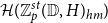 $\mathcal{H}(\mathbb{Z}_p^{st}(\mathbb{D},H)_{hm})$
granting the bicategory of pure maps
$\mathcal{H}(\mathbb{Z}_p^{st}(\mathbb{D},H)_{hm})$
granting the bicategory of pure maps $C_p(\mathcal{H}(\mathbb{D}))$
of
$C_p(\mathcal{H}(\mathbb{D}))$
of $\mathcal{H}(\mathbb{D})$
a monoidal bicategory structure via a pseudofunctor
$\mathcal{H}(\mathbb{D})$
a monoidal bicategory structure via a pseudofunctor $\mathcal{H}(\mathbb{Z}_p^{st}(\mathbb{D},H)_{hm})\to C_p(\mathcal{H}(\mathbb{D}))$
, Theorem 9.4, and it has a natural structure of a Freyd bicategory, Corollary 9.5. For a premonoidal 2-category
$\mathcal{H}(\mathbb{Z}_p^{st}(\mathbb{D},H)_{hm})\to C_p(\mathcal{H}(\mathbb{D}))$
, Theorem 9.4, and it has a natural structure of a Freyd bicategory, Corollary 9.5. For a premonoidal 2-category $\mathcal{B}$
that comes from a premonoidal double category
$\mathcal{B}$
that comes from a premonoidal double category $\mathbb{D}$
satisfying the above conditions, the fact proved in Paquet and Saville (Reference Paquet and Saville2023b, Theorem 3) that the 2-category of pure maps
$\mathbb{D}$
satisfying the above conditions, the fact proved in Paquet and Saville (Reference Paquet and Saville2023b, Theorem 3) that the 2-category of pure maps $\mathcal{C}_p(\mathcal{B})$
is monoidal can be thus seen as a consequence of our theorem.
$\mathcal{C}_p(\mathcal{B})$
is monoidal can be thus seen as a consequence of our theorem.
What follows is the last part concentrated in Section 10 in which we study Kleisli double categories. We start by recalling the notions of horizontal and vertical double monads on a double category $\mathbb{D}$
, and of a horizontal Kleisli double category of a horizontal double monad from Gambino, Garner and Vasilakopoulou (Reference Gambino, Garner and Vasilakopoulou2024). An important condition on vertical transformations used in Gambino, Garner and Vasilakopoulou (Reference Gambino, Garner and Vasilakopoulou2024) is that they be “special”, a condition that is fulfilled if they are companion-liftable and invertible as vertical transformations (in the sense of Definition 2.5). We also recall the result from Gambino, Garner and Vasilakopoulou (Reference Gambino, Garner and Vasilakopoulou2024) saying that a vertical double monad T whose structure vertical transformations are companion-liftable and invertible induces a horizontal double monad
$\mathbb{D}$
, and of a horizontal Kleisli double category of a horizontal double monad from Gambino, Garner and Vasilakopoulou (Reference Gambino, Garner and Vasilakopoulou2024). An important condition on vertical transformations used in Gambino, Garner and Vasilakopoulou (Reference Gambino, Garner and Vasilakopoulou2024) is that they be “special”, a condition that is fulfilled if they are companion-liftable and invertible as vertical transformations (in the sense of Definition 2.5). We also recall the result from Gambino, Garner and Vasilakopoulou (Reference Gambino, Garner and Vasilakopoulou2024) saying that a vertical double monad T whose structure vertical transformations are companion-liftable and invertible induces a horizontal double monad $\hat{T}$
. (This is another example of the lifting of a vertical to a horizontal structure in the style of Shulman (Reference Shulman2010).) We then introduce in Subsection 10.2 the notion of a horizontally monoidal double category, so that a (vertically, i.e. in the sense of Shulman (Reference Shulman2010, Definition 2.9)) monoidal double category
$\hat{T}$
. (This is another example of the lifting of a vertical to a horizontal structure in the style of Shulman (Reference Shulman2010).) We then introduce in Subsection 10.2 the notion of a horizontally monoidal double category, so that a (vertically, i.e. in the sense of Shulman (Reference Shulman2010, Definition 2.9)) monoidal double category $(\mathbb{D}, \otimes, I, \alpha, \lambda, \rho)$
for which
$(\mathbb{D}, \otimes, I, \alpha, \lambda, \rho)$
for which $\alpha, \lambda, \rho$
are companion-liftable, induces a horizontally monoidal double category
$\alpha, \lambda, \rho$
are companion-liftable, induces a horizontally monoidal double category $(\mathbb{D}, \otimes, I, \hat{\alpha}, \hat{\lambda}, \hat{\rho})$
. Furthermore, we introduce, on one hand, the notion of a vertical strength on a vertical double monad on a monoidal double category, and, on the other, a horizontal strength on a horizontal double monad on a horizontally monoidal double category. We prove, assuming that the vertical monad structures and monoidal structures of
$(\mathbb{D}, \otimes, I, \hat{\alpha}, \hat{\lambda}, \hat{\rho})$
. Furthermore, we introduce, on one hand, the notion of a vertical strength on a vertical double monad on a monoidal double category, and, on the other, a horizontal strength on a horizontal double monad on a horizontally monoidal double category. We prove, assuming that the vertical monad structures and monoidal structures of $\mathbb{D}$
are companion-liftable (and invertible), that a vertical strength t on a vertical monad T on
$\mathbb{D}$
are companion-liftable (and invertible), that a vertical strength t on a vertical monad T on $(\mathbb{D}, \otimes, I, \alpha, \lambda, \rho)$
induces a horizontal strength
$(\mathbb{D}, \otimes, I, \alpha, \lambda, \rho)$
induces a horizontal strength $\hat{t}$
on a horizontal monad
$\hat{t}$
on a horizontal monad $\hat{T}$
on
$\hat{T}$
on $(\mathbb{D}, \otimes, I, \hat{\alpha}, \hat{\lambda}, \hat{\rho})$
, so that
$(\mathbb{D}, \otimes, I, \hat{\alpha}, \hat{\lambda}, \hat{\rho})$
, so that $\mathcal{H}(\hat{t})$
is a strength on the pseudomonad
$\mathcal{H}(\hat{t})$
is a strength on the pseudomonad $\mathcal{H}(\hat{T})$
on the monoidal bicategory
$\mathcal{H}(\hat{T})$
on the monoidal bicategory $\mathcal{H}(\mathbb{D})$
. This is our Theorem 10.14.
$\mathcal{H}(\mathbb{D})$
. This is our Theorem 10.14.
Subsection 10.3 discusses how double categorical strengths on monads induce actions on the horizontal Kleisli double category. Again, we differentiate vertical and horizontal action of a monoidal, respectively, horizontally monoidal, double category on another double category. In Theorem 10.18 we show that a vertical strength t on a vertical double monad T on a monoidal double category $(\mathbb{D}, \otimes, I, \alpha, \lambda, \rho)$
, under assumptions that the involved structural vertical transformations are companion-liftable (and invertible), induces a vertical and a horizontal action of
$(\mathbb{D}, \otimes, I, \alpha, \lambda, \rho)$
, under assumptions that the involved structural vertical transformations are companion-liftable (and invertible), induces a vertical and a horizontal action of $\mathbb{D}$
on
$\mathbb{D}$
on $\mathbb{K} l(\hat{T})$
(passing through a horizontal strength
$\mathbb{K} l(\hat{T})$
(passing through a horizontal strength $\hat{t}$
on the horizontal monad
$\hat{t}$
on the horizontal monad $\hat{T}$
on
$\hat{T}$
on $(\mathbb{D}, \otimes, I, \hat{\alpha}, \hat{\lambda}, \hat{\rho})$
). The corresponding claim regarding
$(\mathbb{D}, \otimes, I, \hat{\alpha}, \hat{\lambda}, \hat{\rho})$
). The corresponding claim regarding $\hat{t}$
for the underlying horizontal bicategory holds, too, so that we obtain a double categorical analogue of the bicategorical claim from Paquet and Saville (Reference Paquet and Saville2024, Proposition 7.1).
$\hat{t}$
for the underlying horizontal bicategory holds, too, so that we obtain a double categorical analogue of the bicategorical claim from Paquet and Saville (Reference Paquet and Saville2024, Proposition 7.1).
In Subsection 10.4, we study (horizontal) extensions of the canonical action of $\mathbb{D}$
on itself, which are given by an action of a (horizontally) monoidal
$\mathbb{D}$
on itself, which are given by an action of a (horizontally) monoidal $\mathbb{D}$
on the Kleisli double category of a horizontal double monad and a horizontal icon so that a couple of axioms hold. The above result, that a vertical strength t on T induces a horizontal action of
$\mathbb{D}$
on the Kleisli double category of a horizontal double monad and a horizontal icon so that a couple of axioms hold. The above result, that a vertical strength t on T induces a horizontal action of $\mathbb{D}$
on
$\mathbb{D}$
on $\mathbb{K} l(\hat{T})$
, we extend in Theorem 10.27 to obtaining an extension determined by that action. For a horizontal double monad S we prove that there is a 1-1 correspondence between horizontal strengths s on S and extensions of canonical actions, Theorem 10.32. This is a double categorical version of Paquet and Saville (Reference Paquet and Saville2023b, Theorem 1), Paquet and Saville (Reference Paquet and Saville2024, Theorem 7.2).
$\mathbb{K} l(\hat{T})$
, we extend in Theorem 10.27 to obtaining an extension determined by that action. For a horizontal double monad S we prove that there is a 1-1 correspondence between horizontal strengths s on S and extensions of canonical actions, Theorem 10.32. This is a double categorical version of Paquet and Saville (Reference Paquet and Saville2023b, Theorem 1), Paquet and Saville (Reference Paquet and Saville2024, Theorem 7.2).
Lastly, we introduce bistrengths, both on a vertical and on a horizontal double monad on a corresponding monoidal double category. In Theorem 10.33, we prove, under assumptions that suitable vertical transformations are companion-liftable and invertible, that for a bistrong vertical double monad T on a monoidal double category the horizontal Kleisli double category $\mathbb{K} l(\hat{T})$
is premonoidal. We draw the natural consequences for the underlying horizontal bicategory in Corollary 10.35, obtaining a relation to the analogous result from Paquet and Saville (Reference Paquet and Saville2023b, Theorem 2), Paquet and Saville (Reference Paquet and Saville2024, Proposition 5.10). What is remarkable in this double categorical proof, is the advantage of being able to work with identity vertical modifications and by the properties of companion-lifting obtain non-trivial mixed and horizontal modifications for free, which almost automatically satisfy the four pentagons and six triangles that one otherwise would be obliged to check in the context of a premonoidal bicategory. Instead, provided the existence of suitable companions, one only needs to verify that the 2-cells appearing in the computation are of certain type.
$\mathbb{K} l(\hat{T})$
is premonoidal. We draw the natural consequences for the underlying horizontal bicategory in Corollary 10.35, obtaining a relation to the analogous result from Paquet and Saville (Reference Paquet and Saville2023b, Theorem 2), Paquet and Saville (Reference Paquet and Saville2024, Proposition 5.10). What is remarkable in this double categorical proof, is the advantage of being able to work with identity vertical modifications and by the properties of companion-lifting obtain non-trivial mixed and horizontal modifications for free, which almost automatically satisfy the four pentagons and six triangles that one otherwise would be obliged to check in the context of a premonoidal bicategory. Instead, provided the existence of suitable companions, one only needs to verify that the 2-cells appearing in the computation are of certain type.
The Appendix Contains: the definition of horizontal composition of modifications, the 24 axioms of Section 4, the definition of a lax double quasi-functor (of two variables) from Femić (Reference Femić2023), a table interpreting its axioms, as well as the definition of a vertical lax transformation between two such quasi-functors.
2 Prerequisites on double categories
A double category is a category internal to the category of categories. A weaker notion is a pseudodouble category, which is a pseudocategory internal to the 2-category of categories. In Grandis and Paré (Reference Grandis and Paré1999, Section 7.5), it is proved that any pseudodouble category is double equivalent to a double category. To simplify the writing and computation, we will deal with double categories. For a double category $\mathbb{D}$
, we denote by
$\mathbb{D}$
, we denote by $\mathbb{D}_0$
the category of objects, and by
$\mathbb{D}_0$
the category of objects, and by $\mathbb{D}_1$
the category of morphisms. For horizontal 1-cells, we will say shortly 1h-cells, for vertical 1-cells we will say 1v-cells, and squares we will just call 2-cells. In our convention, the horizontal direction is weak and the vertical direction is strict. The underlying horizontal 2-category of
$\mathbb{D}_1$
the category of morphisms. For horizontal 1-cells, we will say shortly 1h-cells, for vertical 1-cells we will say 1v-cells, and squares we will just call 2-cells. In our convention, the horizontal direction is weak and the vertical direction is strict. The underlying horizontal 2-category of $\mathbb{D}$
will be denoted by
$\mathbb{D}$
will be denoted by $\mathcal{H}(\mathbb{D})$
. It consist of objects, 1h-cells and those 2-cells whose 1v-cells are identities. Composition of 1h-cells
$\mathcal{H}(\mathbb{D})$
. It consist of objects, 1h-cells and those 2-cells whose 1v-cells are identities. Composition of 1h-cells $A\stackrel{f}{\to }A'\stackrel{f'}{\to }A''$
we will write as f’f or
$A\stackrel{f}{\to }A'\stackrel{f'}{\to }A''$
we will write as f’f or $[f\,\, \vert\,\, f']$
and vertical composition of 1v-cells
$[f\,\, \vert\,\, f']$
and vertical composition of 1v-cells $A\stackrel{u}{\to }\tilde A\stackrel{v}{\to }\tilde{\tilde A}$
as a fraction
$A\stackrel{u}{\to }\tilde A\stackrel{v}{\to }\tilde{\tilde A}$
as a fraction $\frac{u}{v}$
. Similarly, to simplify the writing or avoid the use of too many pasting diagrams, we will denote horizontal composition of 2-cells
$\frac{u}{v}$
. Similarly, to simplify the writing or avoid the use of too many pasting diagrams, we will denote horizontal composition of 2-cells $\alpha$
and
$\alpha$
and $\beta$
, where
$\beta$
, where $\alpha$
acts first, by
$\alpha$
acts first, by $[\alpha\vert\beta]$
, and vertical composition of 2-cells
$[\alpha\vert\beta]$
, and vertical composition of 2-cells $\alpha$
and
$\alpha$
and $\gamma$
, where
$\gamma$
, where $\alpha$
acts first, by
$\alpha$
acts first, by $\frac{\alpha}{\gamma}$
. In the images below, we illustrate the mnemotechnical value of such notation
$\frac{\alpha}{\gamma}$
. In the images below, we illustrate the mnemotechnical value of such notation

For more on double categories, we recommend Grandis (Reference Grandis2019); Grandis and Paré (Reference Grandis and Paré1999).
2.1 Some computational tools for globular 2-cells
For 2-cells of the form of a as below we will say that they are horizontally globular, while for those of the form of b we will say that they are vertically globular.

For computations that involve only horizontally or only vertically globular 2-cells, one may use the string diagrams for 2-categories, which are simpler to write and easier to handle in the proofs. This way the string diagrams are to be understood as living in the underlying horizontal (or vertical) 2-category of the double category. In this article our string diagrams are read from top to bottom and from left to right. We present briefly the notation that will be used in this work.
Let $\mathcal{F}$
be a lax functor and
$\mathcal{F}$
be a lax functor and $\mathcal{G}$
an oplax functor between 2-categories. We depict their lax, respectively, oplax structures by string diagrams in the following way:
$\mathcal{G}$
an oplax functor between 2-categories. We depict their lax, respectively, oplax structures by string diagrams in the following way:

where f,g are composable 1-cells and A a 0-cell in the domain 2-category.
Recall that for a 1-cell $f \colon A\to B$
in a 2-category its left adjoint is a 1-cell
$f \colon A\to B$
in a 2-category its left adjoint is a 1-cell $u \colon B \to A$
together with two 2-cells
$u \colon B \to A$
together with two 2-cells $\eta: \operatorname {id}_A\to u f$
and
$\eta: \operatorname {id}_A\to u f$
and $\varepsilon: f u \to \operatorname {id}_B$
such that
$\varepsilon: f u \to \operatorname {id}_B$
such that
 \begin{equation*} \frac{[\eta\vert\operatorname {Id}_f]}{[\operatorname {Id}_f\vert\varepsilon]} = \operatorname {id}_f \qquad \qquad \text{and} \qquad \qquad \frac{[\operatorname {Id}_u\vert\eta]}{[\varepsilon\vert\operatorname {Id}_u]} = \operatorname {id}_u.\end{equation*}
In string diagrams, we will write
 and they satisfy the laws:

It is a folklore that any equivalence between 1-cells in a 2-category can be made into an adjoint equivalence.
We record now two identities regarding mates that will be used in Proposition 8.5. Suppose there are equivalence 1-cells f,f’ in a 2-category with their respective adjoint quasi-inverses $f^\bullet$
and
$f^\bullet$
and $(f')^\bullet$
. Let further 1-cells g,g’ be given so that the compositions g’f and f’g are possible and suppose that there is an invertible 2-cell
$(f')^\bullet$
. Let further 1-cells g,g’ be given so that the compositions g’f and f’g are possible and suppose that there is an invertible 2-cell $\alpha: f'g\Rightarrow g'f$
(with inverse
$\alpha: f'g\Rightarrow g'f$
(with inverse $\alpha^{-1}: g'f\Rightarrow f'g$
). The mates
$\alpha^{-1}: g'f\Rightarrow f'g$
). The mates $\alpha^\bullet$
and
$\alpha^\bullet$
and $(\alpha^{-1})^\bullet$
of
$(\alpha^{-1})^\bullet$
of $\alpha$
and its inverse are given by
$\alpha$
and its inverse are given by

where left-most
 stands for $\eta$
for f’ and the other one stands for
$\eta$
for f’ and the other one stands for $\varepsilon^{-1}$
for f, and the first appearing
$\varepsilon^{-1}$
for f, and the first appearing
 stands for $\varepsilon$
for f and the other one for
$\varepsilon$
for f and the other one for $\eta^{-1}$
for f’. Then given
$\eta^{-1}$
for f’. Then given $\alpha_1=\alpha:f'g\Rightarrow g'f$
and
$\alpha_1=\alpha:f'g\Rightarrow g'f$
and $\alpha_2:fh\Rightarrow h'f'$
(with
$\alpha_2:fh\Rightarrow h'f'$
(with $\alpha_2^\bullet: h(f')^\bullet\Rightarrow f^\bullet h'$
) one has identities
$\alpha_2^\bullet: h(f')^\bullet\Rightarrow f^\bullet h'$
) one has identities

and one also has

where in the left-hand side identity
denotes $\eta$
for f and
denotes
$\eta$
for f and
denotes $\eta^{-1}$
for f’, and in the right-hand side identity
denotes
$\eta^{-1}$
for f’, and in the right-hand side identity
denotes $\varepsilon^{-1}$
for f and
denotes
$\varepsilon^{-1}$
for f and
denotes $\varepsilon$
for f’. (The 2-cell
$\varepsilon$
for f’. (The 2-cell $\alpha$
here will be used in Proposition 8.5 as a 2-cell component of a horizontal pseudonatural transformation
$\alpha$
here will be used in Proposition 8.5 as a 2-cell component of a horizontal pseudonatural transformation $\alpha_{A,X,-}^3$
, the 1-cells f,f’ as 1h-cells
$\alpha_{A,X,-}^3$
, the 1-cells f,f’ as 1h-cells $\alpha_{A,X,B}^3$
and
$\alpha_{A,X,B}^3$
and $\alpha_{A,X,B'}^3$
, and the 1-cells g,g’ as 1h-cells
$\alpha_{A,X,B'}^3$
, and the 1-cells g,g’ as 1h-cells $AB\ltimes h$
and
$AB\ltimes h$
and $A(X\ltimes h)$
, respectively, and similarly.)
$A(X\ltimes h)$
, respectively, and similarly.)
2.2 The double category of double functors
We recall here the definitions of lax/pseudo double functors, horizontal and vertical (op)lax/pseudo transformations and modifications.
Definition 2.1. A (horizontally) lax double functor $F\colon\mathbb{C}\to \mathbb{D}$
between double categories is given by: 1) the data: images on objects, 1h-, 1v- and 2-cells of
$F\colon\mathbb{C}\to \mathbb{D}$
between double categories is given by: 1) the data: images on objects, 1h-, 1v- and 2-cells of $\mathbb{C}$
, globular 2-cells: compositor
$\mathbb{C}$
, globular 2-cells: compositor $F_{gf}\colon F(g)F(f)\Rightarrow F(gf)$
and unitor
$F_{gf}\colon F(g)F(f)\Rightarrow F(gf)$
and unitor $F_A\colon 1_{F(A)}\Rightarrow F(1_A)$
in
$F_A\colon 1_{F(A)}\Rightarrow F(1_A)$
in $\mathbb{D}$
, and 2) rules (in
$\mathbb{D}$
, and 2) rules (in $\mathbb{D}$
):
$\mathbb{D}$
):
-
• (functoriality in vertical morphisms)
 $$ \boldsymbol{(lx.f.v1)} \quad \qquad \frac{F(u)}{F(u')}=F(\frac{u}{u'}), \qquad \qquad \boldsymbol{(lx.f.v2)} \quad \qquad F(1^A)=1^{F(A)};$$
-
• (functoriality in squares)
$$ \boldsymbol{(lx.f.s1)} \quad \qquad F(\frac{\omega}{\zeta})=\frac{F(\omega)}{F(\zeta)}, \qquad \qquad \boldsymbol{(lx.f.s2)} \quad \qquad F(Id_f)=Id_{F(f)};$$
-
• (coherence with compositors and unitors)
$$ \boldsymbol{(lx.f.cmp)} \hspace{2cm}\qquad \frac{[F_{gf}\vert Id_{F(h)}]}{F_{h,gf}}=\frac{[Id_{F(f)}\vert F_{hg}]}{F_{hg,f}} $$
$$ \boldsymbol{(lx.f.u)} \hspace{2cm}\qquad \frac{[F_A\vert Id_{F(f)}]}{F_{f1_A}}=\operatorname {Id}_{F(f)}=\frac{[Id_{F(f)}\vert F_B]}{F_{1_Bf}};$$
-
• (naturality of the compositor)


• (naturality of the unitor)

where u,u’ are composable 1v-cells, $\omega, \zeta$
vertically composable 2-cells,
$\omega, \zeta$
vertically composable 2-cells, $\alpha, \beta$
horizontally composable 2-cells, and f,g,h composable 1h-cells.
$\alpha, \beta$
horizontally composable 2-cells, and f,g,h composable 1h-cells.
A pseudodouble functor is a lax double functor whose compositor and unitor 2-cells are invertible.
We now define horizontal oplax and vertical lax transformations between lax double functors and their modifications. The reason why we introduce these kinds of transformations is explained at the beginning of Subsection 6.1.
Definition 2.2. A horizontal oplax transformation $\alpha$
between lax double functors
$\alpha$
between lax double functors $F,G\colon \mathbb{A}\to \mathbb{B}$
consists of the following:
$F,G\colon \mathbb{A}\to \mathbb{B}$
consists of the following:
-
(1) for every 0-cell A in
$\mathbb{A}$
a 1h-cell
$\alpha(A)\colon F(A)\to G(A)$
in
$\mathbb{B}$
, -
(2) for every 1v-cell
$u\colon A\to A'$
in
$\mathbb{A}$
a 2-cell in
$\mathbb{B}$
:
-
(3) for every 1h-cell
$f\colon A\to B$
in
$\mathbb{A}$
a 2-cell in
$\mathbb{B}$
:
so that the following are satisfied: -
• (coherence with compositors for
$\delta_{\alpha,-}$
): for any composable 1h-cells f and g in
$\mathbb{A}$
the 2-cell
$\delta_{\alpha,gf}$
satisfies:




(coherence with unitors for $\delta_{\alpha,-}$
): for any object
$\delta_{\alpha,-}$
): for any object $A\in\mathbb{A}$
:
$A\in\mathbb{A}$
:

-
• (coherence with vertical composition and identity for
$\alpha^\bullet$
): for any composable 1v-cells u and v in
$\mathbb{A}$
:
$$ \boldsymbol{(h.o.t.-3)} \qquad \alpha^{\frac{u}{v}}=\frac{\alpha^u}{\alpha^v}\quad \qquad \text{ and}\quad \qquad \boldsymbol{(h.o.t.-4)} \qquad \alpha^{1^A}=\operatorname {Id}_{\alpha(A)};$$
-
• (oplax naturality of 2-cells): for every 2-cell in
$\mathbb{A}$
the following identity in
$\mathbb{B}$
must hold:


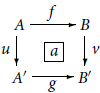
 $\boldsymbol{(h.o.t.-5)}$

A horizontal lax transformation is defined by using the opposite direction of the 2-cells $\delta_{\alpha,f}$
in item 3 and accommodating the axioms correspondingly.
$\delta_{\alpha,f}$
in item 3 and accommodating the axioms correspondingly.
A horizontal pseudonatural transformation is a horizontal oplax transformation for which the 2-cells $\delta_{\alpha,f}$
are isomorphisms. A horizontal strict transformation is a horizontal oplax transformation for which the 2-cells
$\delta_{\alpha,f}$
are isomorphisms. A horizontal strict transformation is a horizontal oplax transformation for which the 2-cells $\delta_{\alpha,f}$
are identities.
$\delta_{\alpha,f}$
are identities.
The axioms of a horizontal lax transformation we denote by (h.l.t.-1)-(h.l.t.-5). Indeed, note that from the five axioms only the three axioms (h.o.t.-1), (h.o.t.-2) and (h.o.t.-5) are changed into (h.l.t.-1), (h.l.t.-2) and (h.l.t.-5).
Remark 2.3. Given a horizontal pseudonatural transformation $\alpha$
between lax double functors
$\alpha$
between lax double functors $F,G\colon \mathbb{A}\to \mathbb{B}$
, we denote by
$F,G\colon \mathbb{A}\to \mathbb{B}$
, we denote by $\mathcal{H}(\alpha):\mathcal{H}(F)\Rightarrow\mathcal{H}(G)$
the underlying pseudonatural transformation between the underlying lax functors between the underlying 2-categories
$\mathcal{H}(\alpha):\mathcal{H}(F)\Rightarrow\mathcal{H}(G)$
the underlying pseudonatural transformation between the underlying lax functors between the underlying 2-categories $\mathcal{H}(\mathbb{A})$
and
$\mathcal{H}(\mathbb{A})$
and $\mathcal{H}(\mathbb{B})$
. Recall that a bicategorical pseudonatural transformation, in this case
$\mathcal{H}(\mathbb{B})$
. Recall that a bicategorical pseudonatural transformation, in this case $\mathcal{H}(\alpha)$
, is called a pseudonatural equivalence if the 1h-cell components
$\mathcal{H}(\alpha)$
, is called a pseudonatural equivalence if the 1h-cell components $\alpha(A)$
are equivalence 1-cells in
$\alpha(A)$
are equivalence 1-cells in $\mathcal{H}(\mathbb{B})$
.
$\mathcal{H}(\mathbb{B})$
.
Lemma 2.4. Femić (Reference Femić2023, Lemma 2.3). Vertical composition of two horizontal oplax transformations $F\stackrel{\alpha}{\Rightarrow} G \stackrel{\beta}{\Rightarrow}H$
between lax functors
$F\stackrel{\alpha}{\Rightarrow} G \stackrel{\beta}{\Rightarrow}H$
between lax functors $F, G, H\colon\mathbb{A}\to \mathbb{B}$
, denoted by
$F, G, H\colon\mathbb{A}\to \mathbb{B}$
, denoted by $\frac{\alpha}{\beta}$
, is given by:
$\frac{\alpha}{\beta}$
, is given by:
-
(1) for every 0-cell A in
$\mathbb{A}$
a 1h-cell in
$\mathbb{B}$
:
$$\bigg(\frac{\alpha}{\beta}\bigg)(A)=\big( F(A)\stackrel{\alpha(A)}{\longrightarrow}G(A) \stackrel{\beta(A)}{\longrightarrow} H(A) \big),$$
-
(2) for every 1v-cell
$u\colon A\to A'$
in
$\mathbb{A}$
a 2-cell in
$\mathbb{B}$
:
-
(3) for every 1h-cell
$f\colon A\to B$
in
$\mathbb{A}$
a 2-cell in
$\mathbb{B}$
:


Definition 2.5. A vertical lax transformation $\alpha_0$
between lax double functors
$\alpha_0$
between lax double functors $F,G\colon \mathbb{A}\to \mathbb{B}$
consists of:
$F,G\colon \mathbb{A}\to \mathbb{B}$
consists of:
-
(1) a 1v-cell
$\alpha_0(A)\colon F(A)\to G(A)$
in
$\mathbb{B}$
for every 0-cell A in
$\mathbb{A}$
; -
(2) for every 1h-cell
$f\colon A\to B$
in
$\mathbb{A}$
a 2-cell in
$\mathbb{B}$
:
-
(3) for every 1v-cell
$u\colon A\to A'$
in
$\mathbb{A}$
a 2-cell in
$\mathbb{B}$
:



which need to satisfy:
-
• (coherence with compositors for
$(\alpha_0)_\bullet$
): for any composable 1h-cells f and g in
$\mathbb{A}$
:


(coherence with unitors for $(\alpha_0)_\bullet$
): for any object A in
$(\alpha_0)_\bullet$
): for any object A in $\mathbb{A}$
:
$\mathbb{A}$
:

-
• (coherence with vertical composition for
$\alpha_0^\bullet$
): for any composable 1v-cells u and v in
$\mathbb{A}$
:


(coherence with vertical identity for $\alpha^\bullet$
): for any object A in
$\alpha^\bullet$
): for any object A in $\mathbb{A}$
:
$\mathbb{A}$
:
 $$ \boldsymbol{(v.l.t.\mbox{-} 4)} \qquad \qquad \alpha_0^{1^A}=\operatorname {Id}^{\alpha_0(A)} \hspace{4cm}$$
-
• (lax naturality of 2-cells): for every 2-cell in
$\mathbb{A}$
the following identity in
$\mathbb{B}$
must hold:

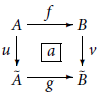


A vertical oplax transformation is defined by using the opposite direction of the 2-cells $\alpha_0^u$
in item 3 and accommodating the axioms correspondingly.
$\alpha_0^u$
in item 3 and accommodating the axioms correspondingly.
A vertical lax transformation is called a vertical pseudonatural transformation if the globular 2-cells $\alpha_0^u$
are horizontally invertible for all 1v-cells u in
$\alpha_0^u$
are horizontally invertible for all 1v-cells u in $\mathbb{A}$
.
$\mathbb{A}$
.
It is called a vertical strict transformation if all the globular 2-cells $\alpha_0^u$
are identities. A vertical strict transformation is said to be invertible if the 2-cells
$\alpha_0^u$
are identities. A vertical strict transformation is said to be invertible if the 2-cells $(\alpha_0)_f$
for all 1h-cells f in
$(\alpha_0)_f$
for all 1h-cells f in $\mathbb{A}$
are vertically invertible (this includes the condition that the 1v-cells
$\mathbb{A}$
are vertically invertible (this includes the condition that the 1v-cells $\alpha_0(A)$
are invertible for all
$\alpha_0(A)$
are invertible for all $A\in\mathbb{A}$
).
$A\in\mathbb{A}$
).
The axioms for a vertical oplax transformation we denote by (v.o.t.- 1) - (v.o.t.- 5). They are made explicit in Femi´c (2023, Definition 2.5). As in the horizontal case, only the axioms (v.l.t.- 1), (v.l.t.- 3) and (v.l.t.- 5) are changed into (v.o.t.- 1), (v.o.t.- 3) and (v.o.t.- 5).
Similarly as in Femić (Reference Femić2023, Lemma 2.6) and Femić (Reference Femić2024, Lemma 3.8) one has:
Lemma 2.6. Vertical composition of two vertical strict transformations $\alpha_0\colon F\Rightarrow G\colon \mathbb{A}\to \mathbb{B}$
and
$\alpha_0\colon F\Rightarrow G\colon \mathbb{A}\to \mathbb{B}$
and $\beta_0\colon G\Rightarrow H\colon\mathbb{A}\to \mathbb{B}$
between lax double functors, denoted by
$\beta_0\colon G\Rightarrow H\colon\mathbb{A}\to \mathbb{B}$
between lax double functors, denoted by $\frac{\alpha_0}{\beta_0}$
, is given by:
$\frac{\alpha_0}{\beta_0}$
, is given by:
for every 0-cell A in $\mathbb{A}$
a 1v-cell on the left below, and for every 1h-cell
$\mathbb{A}$
a 1v-cell on the left below, and for every 1h-cell $f\colon A\to B$
in
$f\colon A\to B$
in $\mathbb{A}$
a 2-cell on the right below, both in
$\mathbb{A}$
a 2-cell on the right below, both in $\mathbb{B}$
:
$\mathbb{B}$
:

We will need modifications between horizontal and vertical pseudonatural transformations. Their definition is formally the same as of modifications of more general transformations that we cite next from Femić (Reference Femić2023, Definition 2.7).
Definition 2.7. A modification $\Theta$
between two horizontal oplax transformations
$\Theta$
between two horizontal oplax transformations $\alpha$
and
$\alpha$
and $\beta$
and two vertical lax transformations
$\beta$
and two vertical lax transformations $\alpha_0$
and
$\alpha_0$
and $\beta_0$
depicted below on the left, where the lax double functors
$\beta_0$
depicted below on the left, where the lax double functors $F, G, F\hspace{0,06cm}', G'$
act between
$F, G, F\hspace{0,06cm}', G'$
act between $\mathbb{A}\to \mathbb{B}$
, is given by a collection of 2-cells in
$\mathbb{A}\to \mathbb{B}$
, is given by a collection of 2-cells in $\mathbb{B}$
depicted below on the right:
$\mathbb{B}$
depicted below on the right:

which satisfy the following rules:
(m.ho-vl.-1) for every 1h-cell f, we have

and
(m.ho-vl.-2) for every 1v-cell u, we have

Similarly, one defines a modification between two horizontal lax transformations and two vertical oplax transformations, whose axioms we denote by (m.hl-vo.-1) and (m.hl-vo.-2). We will use the axioms (h.l.t.-1) - (h.l.t.5), (v.o.t.- 1) - (v.o.t.- 5) and (m.hl-vo.-1) - (m.hl-vo.-2) in the proof of Theorem 6.6 and in Table 7.
Taking, so to say, a horizontal and a vertical restriction of modifications in Definition 2.7, we obtain the definitions of:
-
• horizontal modifications or modifications between horizontal (oplax) transformations given by families of (horizontally globular) 2-cells

and axioms (m.ho.-1) and (m.ho.-2) obtained from (m.ho-vl.-1) and (m.ho-vl.-2) by ignoring the 2-cells $(\alpha_0)_f, (\beta_0)_f, \alpha_0^u$
and
$(\alpha_0)_f, (\beta_0)_f, \alpha_0^u$
and $\beta_0^u$
, and
$\beta_0^u$
, and
-
• vertical modifications or modifications between vertical (lax) transformations given by families of (vertically globular) 2-cells

and axioms (m.vl.-1) and (m.vl.-2) obtained from (m.ho-vl.-1) and (m.ho-vl.-2) by ignoring the 2-cells $\delta_{\alpha,f}, \delta_{\beta,f}, \alpha^u$
and
$\delta_{\alpha,f}, \delta_{\beta,f}, \alpha^u$
and $\beta^u$
.
$\beta^u$
.
Remark 2.8. Given a horizontal modification $\Theta:\alpha\Rrightarrow\beta$
between horizontal pseudonatural transformations between pseudodouble functors we denote by
$\Theta:\alpha\Rrightarrow\beta$
between horizontal pseudonatural transformations between pseudodouble functors we denote by $\mathcal{H}(\Theta):\mathcal{H}(\alpha)\Rrightarrow\mathcal{H}(\beta)$
the underlying modification between the underlying pseudonatural transformations between the underlying pseudofunctors between the underlying 2-categories (it satisfies only the axiom (m.ho.-1)).
$\mathcal{H}(\Theta):\mathcal{H}(\alpha)\Rrightarrow\mathcal{H}(\beta)$
the underlying modification between the underlying pseudonatural transformations between the underlying pseudofunctors between the underlying 2-categories (it satisfies only the axiom (m.ho.-1)).
We will use the following fact that is straightforwardly proved (see also Femić (Reference Femić2024, Lemma 3.4)).
Lemma 2.9. Given pseudodouble functors H,L and a horizontal pseudonatural transformation $\omega:F\Rightarrow G$
between lax/pseudo double functors so that the compositions HF, HG, FL, GL make sense, and let f be a 1h-cell and u a 1v-cell.
$\omega:F\Rightarrow G$
between lax/pseudo double functors so that the compositions HF, HG, FL, GL make sense, and let f be a 1h-cell and u a 1v-cell.
-
a) The 2-cells
$\delta_{H(\omega),f}=\begin{array}{@{\,}c@{\,}}H_{lx}\\ \hline H(\delta_{\omega,f})\\ \hline H_{oplx} \end{array}$
and
$H(\omega)^u=H(\omega^u)$
, where
$H_{lx}$
and
$H_{oplx}$
represent the lax and oplax functor structure of H applied to the corresponding 1h-cells, respectively, define a horizontal pseudonatural transformation
$H(\omega):HF\Rightarrow HG$
of lax/pseudo double functors. -
b) The 2-cells
$\delta_{(\omega L),f}=\delta_{\omega,L(f)}$
and
$(\omega L)^u=\omega^{L(u)}$
define a horizontal pseudonatural transformation
$\omega L:FL\Rightarrow GL$
of lax/pseudo double functors.
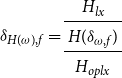







An analogous result holds for vertical pseudonatural transformations. Its proof is even simpler, as in our convention the vertical direction (for lax/pseudo double functors) is strict.
Lemma 2.10. Given pseudodouble functors H,L and a vertical pseudonatural transformation $\alpha:F\Rightarrow G$
between lax/pseudo double functors so that the compositions HF, HG, FL, GL make sense, and let f be a 1h-cell and u a 1v-cell.
$\alpha:F\Rightarrow G$
between lax/pseudo double functors so that the compositions HF, HG, FL, GL make sense, and let f be a 1h-cell and u a 1v-cell.
-
a) The 2-cells
$H(\alpha)_f=H(\alpha_f)$
and
$H(\omega)^u=H(\omega^u)$
define a vertical pseudonatural transformation
$H(\alpha):HF\Rightarrow HG$
of lax/pseudo double functors.
-
b) The 2-cells
$\delta_{\alpha L,f}=\delta_{\alpha, L(f)}$
and
$(\alpha L)^u=\alpha^{L(u)}$
define a vertical pseudonatural transformation
$\alpha L:FL\Rightarrow GL$
of lax/pseudo double functors.





2.3 Companions and conjoints
Recall that a companion for a 1v-cell $u:A\to B$
is a 1h-cell
$u:A\to B$
is a 1h-cell $\hat{u}:A\to B$
together with two 2-cells
$\hat{u}:A\to B$
together with two 2-cells $\varepsilon$
and
$\varepsilon$
and $\eta$
as below satisfying
$\eta$
as below satisfying $[\eta\vert\varepsilon]=\operatorname {Id}_{\hat{u}}$
and
$[\eta\vert\varepsilon]=\operatorname {Id}_{\hat{u}}$
and $\frac{\eta}{\varepsilon}=\operatorname {Id}_{u}$
. On the other hand, a conjoint for a 1v-cell
$\frac{\eta}{\varepsilon}=\operatorname {Id}_{u}$
. On the other hand, a conjoint for a 1v-cell $u: A\to B$
is a 1h-cell
$u: A\to B$
is a 1h-cell $\check{u}:B\to A$
together with two 2-cells
$\check{u}:B\to A$
together with two 2-cells $\varepsilon^*$
and
$\varepsilon^*$
and $\eta^*$
as below satisfying
$\eta^*$
as below satisfying $[\varepsilon^*\vert\eta^*]=\operatorname {Id}_{\check{u}}$
and
$[\varepsilon^*\vert\eta^*]=\operatorname {Id}_{\check{u}}$
and $\frac{\eta^*}{\varepsilon^*}=\operatorname {Id}^{u}$
.
$\frac{\eta^*}{\varepsilon^*}=\operatorname {Id}^{u}$
.

Companions are unique up to a unique globular isomorphism. This and more properties of companions and conjoints we will recall in Subsection 2.4, see also Grandis and Paré (Reference Grandis and Paré2004, Section 1.2), Shulman (Reference Shulman2010, Section 3). For the moment, we focus on the following few facts about them.
Lemma 2.11. Shulman (Reference Shulman2010, Lemma 3.20). If u is an invertible 1v-cell with a companion $\hat{u}$
, then
$\hat{u}$
, then $\hat{u}$
is a conjoint of the inverse
$\hat{u}$
is a conjoint of the inverse $u^{-1}$
, with
$u^{-1}$
, with $\varepsilon^*_{u^{-1}}=\frac{\varepsilon_u}{\operatorname {Id}^{u^{-1}}}$
and
$\varepsilon^*_{u^{-1}}=\frac{\varepsilon_u}{\operatorname {Id}^{u^{-1}}}$
and $\eta^*_{u^{-1}}=\frac{\operatorname {Id}^{u^{-1}}}{\eta_u}$
.
$\eta^*_{u^{-1}}=\frac{\operatorname {Id}^{u^{-1}}}{\eta_u}$
.
Corollary 2.12. Let u be an invertible 1v-cell. If $u^{-1}$
has a companion
$u^{-1}$
has a companion $\widehat{(u^{-1})}$
, then u has a conjoint given by
$\widehat{(u^{-1})}$
, then u has a conjoint given by $\check u=\widehat{(u^{-1})}$
with
$\check u=\widehat{(u^{-1})}$
with $\varepsilon^*_u=\frac{\varepsilon_{u^{-1}}}{\operatorname {Id}^u}$
and
$\varepsilon^*_u=\frac{\varepsilon_{u^{-1}}}{\operatorname {Id}^u}$
and $\eta^*_u=\frac{\operatorname {Id}^u}{\eta_{u^{-1}}}$
.
$\eta^*_u=\frac{\operatorname {Id}^u}{\eta_{u^{-1}}}$
.
Lemma 2.13. Shulman (Reference Shulman2010, Lemma 3.21). If a 1v-cell u has both a companion $\hat{u}$
and a conjoint
$\hat{u}$
and a conjoint $\check u$
, then
$\check u$
, then $\check u$
is a left adjoint 1-cell to
$\check u$
is a left adjoint 1-cell to $\hat{u}$
in the underlying horizontal bicategory of the double category. If moreover u is invertible, then this is an adjoint equivalence.
$\hat{u}$
in the underlying horizontal bicategory of the double category. If moreover u is invertible, then this is an adjoint equivalence.
The unit $\tilde\eta$
and counit
$\tilde\eta$
and counit $\tilde\varepsilon$
of the adjunction are given via
$\tilde\varepsilon$
of the adjunction are given via $\tilde\eta=[\eta\vert\eta^*]$
and
$\tilde\eta=[\eta\vert\eta^*]$
and $\tilde\varepsilon=[\varepsilon^*\vert\varepsilon]$
and their inverses by
$\tilde\varepsilon=[\varepsilon^*\vert\varepsilon]$
and their inverses by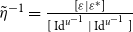 $\tilde\eta^{-1}=\frac{[\varepsilon\vert\varepsilon^*]}{[\operatorname {Id}^{u^{-1}}\vert\operatorname {Id}^{u^{-1}}]}$
and
$\tilde\eta^{-1}=\frac{[\varepsilon\vert\varepsilon^*]}{[\operatorname {Id}^{u^{-1}}\vert\operatorname {Id}^{u^{-1}}]}$
and $\tilde\varepsilon^{-1}=[\eta^*\vert\eta]$
.
$\tilde\varepsilon^{-1}=[\eta^*\vert\eta]$
.
We record that also the following identities hold true
 \begin{equation} \frac{\eta_u}{\varepsilon^*_{u^{-1}}}=1, \quad \frac{\varepsilon_u}{\eta^*_{u^{-1}}}=\operatorname {Id}_{\hat{u}},\quad \frac{\varepsilon^*_{u^{-1}}}{\eta}=\operatorname {Id}_{\hat{u}}, \quad \frac{\eta^*_{u^{-1}}}{\varepsilon_u}=1.\end{equation}
We will need existence of companions and conjoints only for 1v-components of invertible vertical strict transformations. In this case by Corollary 2.12, it is sufficient to require the existence of companions. The following result will be very important for us.
Proposition 2.14. Let $\alpha_0:F\Rightarrow G$
be a vertical pseudonatural transformation between pseudodouble functors acting between double categories
$\alpha_0:F\Rightarrow G$
be a vertical pseudonatural transformation between pseudodouble functors acting between double categories $\mathbb{D}\to \mathbb{E}$
. Suppose that the 2-cell components
$\mathbb{D}\to \mathbb{E}$
. Suppose that the 2-cell components $(\alpha_0)_f$
of
$(\alpha_0)_f$
of $\alpha_0$
are vertically invertible for every 1h-cell
$\alpha_0$
are vertically invertible for every 1h-cell $f:A\to B$
.
$f:A\to B$
.
-
(1) The following data define a horizontal pseudonatural transformation
$\alpha_1:F\Rightarrow G$
:-
a) for all 1v-cell components
$\alpha_0(A)$
of
$\alpha_0$
a fixed choice of companions (and conjoints) in
$\mathbb{E}$
, (we denote their companions by
$\alpha_1(A)$
for every 0-cell A of
$\mathbb{D}$
, the corresponding 2-cells by
$\varepsilon^\alpha_A$
and
$\eta^\alpha_A$
, and also by
$\varepsilon^*_A$
and
$\eta^*_A$
the 2-cells related to conjoints of the inverse of
$\alpha_0(A)$
); -
b) the 2-cells
in
$\mathbb{E}$
for every 1h-cell
$f:A\to B$
in
$\mathbb{D}$
; -
c) the 2-cells
in
$\mathbb{E}$
for every 1v-cell
$u:A\to \tilde A$
in
$\mathbb{D}$
; -
d) the inverses of the 2-cells
$\delta_{\alpha_1,f}$
are given by
-
-
(2) The 1h-cells
$\alpha_1(A)$
are adjoint equivalence 1-cells in
$\mathcal{H}(\mathbb{E})$
. -
(3) The data from 1. define a horizontal equivalence
$\alpha_1:F\Rightarrow G:\mathbb{D}\to \mathbb{E}$
and a pseudonatural equivalence
$\mathcal{H}(\alpha_1):\mathcal{H}(F)\Rightarrow \mathcal{H}(G):\mathcal{H}(\mathbb{D})\to \mathcal{H}(\mathbb{E})$
.




Proof. The first part, up to invertibility, is proved in Femić (Reference Femić2024, Proposition 4.1), the invertibility of $\delta_{\alpha_1,f}$
is proved in Shulman (Reference Shulman2010, Theorem 4.6). Observe that a conjoint of
$\delta_{\alpha_1,f}$
is proved in Shulman (Reference Shulman2010, Theorem 4.6). Observe that a conjoint of $\alpha_0(A)^{-1}$
is
$\alpha_0(A)^{-1}$
is $\alpha_1(A)$
by Lemma 2.11. The proof of invertibility uses the identities (4). Adjoint equivalences follow from Lemma 2.13. Now the third claim is obvious.
$\alpha_1(A)$
by Lemma 2.11. The proof of invertibility uses the identities (4). Adjoint equivalences follow from Lemma 2.13. Now the third claim is obvious.
The above proposition in particular holds for invertible vertical strict transformations (recall Definition 2.5) whose 1v-cell components have companions. As such transformations will be crucial in this work, we introduce some terminology.
Definition 2.15. Those 1v-cells that have companions we will call companion-liftable (or shortly liftable) 1v-cells.
Those vertical transformations all of whose 1v-cell components are liftable we will call companion-liftable (or shortly liftable) vertical transformations.
A horizontal pseudonatural equivalence $\alpha_1$
obtained in Proposition 2.14 from an invertible liftable vertical strict transformation
$\alpha_1$
obtained in Proposition 2.14 from an invertible liftable vertical strict transformation $\alpha_0$
we will call a companion-lift of
$\alpha_0$
we will call a companion-lift of $\alpha_0$
.
$\alpha_0$
.
In Shulman (Reference Shulman2010, Theorem 4.6), it is shown that the above-described assignment of bicategorical pseudonatural equivalences to invertible liftable vertical strict transformations, i.e., a companion-lifting of such vertical transformations, is functorial. Lemma 2.13 and the above proposition, together with a reasoning that we will highlight in Proposition 2.22 further below, were crucial pieces on which relies the proof of Shulman’s Shulman (Reference Shulman2010, Theorem 5.1). Let us recall what it means for a double category to be monoidal due to Shulman, in our terminology.
Definition 2.16 Shulman (2010, Definition 2.9). A monoidal double category is a double category $\mathbb{D}$
equipped with pseudodouble functors
$\mathbb{D}$
equipped with pseudodouble functors $\otimes:\mathbb{D}\times\mathbb{D}\to \mathbb{D}$
and
$\otimes:\mathbb{D}\times\mathbb{D}\to \mathbb{D}$
and $I:*\to \mathbb{D}$
and invertible vertical strict transformations
$I:*\to \mathbb{D}$
and invertible vertical strict transformations
 \begin{align*}\begin{array}{c}\alpha: \otimes\circ(\!\operatorname {Id}\times\otimes) \stackrel{\cong}{\to } \otimes\circ(\!\otimes\times\operatorname {Id}\!) \\\lambda: \otimes\circ(I\times\operatorname {Id}\!) \stackrel{\cong}{\to } \operatorname {Id} \\\rho: \otimes\circ(\!\operatorname {Id}\times I) \stackrel{\cong}{\to } \operatorname {Id}\end{array} \end{align*}
satisfying the pentagonal and three triangular axioms (via identity vertical modifications).
In any 2-category with finite products, there is a notion of a pseudomonoid. Thus, a monoidal double category in other words is a pseudomonoid in the 2-category of double categories, pseudofunctors, and vertical strict transformations.
We recall now Shulman (Reference Shulman2010, Theorem 5.1). “Isofibrancy” there supposes existence of companions for all 1v-cells in $\mathbb{D}$
, whereas one indeed needs only existence of 1v-cell components of the monoidal structure
$\mathbb{D}$
, whereas one indeed needs only existence of 1v-cell components of the monoidal structure $(\alpha,\lambda,\rho)$
of
$(\alpha,\lambda,\rho)$
of $\mathbb{D}$
. We give an accordingly adapted formulation.
$\mathbb{D}$
. We give an accordingly adapted formulation.
Theorem 2.17 Shulman (2010, Theorem 5.1). If the monoidal constraints $(\alpha,\lambda,\rho)$
of a monoidal pseudodouble category
$(\alpha,\lambda,\rho)$
of a monoidal pseudodouble category $\mathbb{D}$
are liftable, then its underlying horizontal bicategory
$\mathbb{D}$
are liftable, then its underlying horizontal bicategory $\mathcal{H}(\mathbb{D})$
is monoidal.
$\mathcal{H}(\mathbb{D})$
is monoidal.
The proof of this theorem used a remarkable tool that we show in details in the next subsection. It will also show very important for our work, in particular in Section 10.
2.4 Lifting of modifications
In Proposition 2.14, we saw how, assuming the existence of companions, a (invertible) vertical strict transformation induces a (pseudonatural) horizontal transformation. For this, we can say that vertical (strict) transformations lift to horizontal ones. In this subsection, we will prove that a similar occurrence happens for modifications and axioms that they obey.
We start by recalling some more properties of companions.
Lemma 2.18 Shulman (2010, Lemma 3.8). Between two companions $\hat{u}:A\to B$
and
$\hat{u}:A\to B$
and $\hat{u}':A\to B$
of a 1v-cell
$\hat{u}':A\to B$
of a 1v-cell $u:A\to B$
in
$u:A\to B$
in $\mathbb{D}$
there is a unique globular isomorphism
$\mathbb{D}$
there is a unique globular isomorphism $\theta$
such that
$\theta$
such that

It is given by

Lemma 2.19. Let $\alpha$
be a vertical strict transformation with two different choices of companions for its 1v-cell components, giving rise to two different horizontal transformations
$\alpha$
be a vertical strict transformation with two different choices of companions for its 1v-cell components, giving rise to two different horizontal transformations $\hat{\alpha}$
and
$\hat{\alpha}$
and $\hat{\alpha}'$
, as in Proposition 2.14. The isomorphisms
$\hat{\alpha}'$
, as in Proposition 2.14. The isomorphisms $\theta$
from (6) make an invertible modification
$\theta$
from (6) make an invertible modification $\hat{\alpha}\Rrightarrow\hat{\alpha}'$
.
$\hat{\alpha}\Rrightarrow\hat{\alpha}'$
.
Proof. This is proved in the proof of Shulman (Reference Shulman2010, Lemma 4.8).
Lemma 2.20. Shulman (2010, Lemma 4.10). Let $\alpha:F\Rightarrow G$
be a vertical strict transformation between pseudodouble functors acting between double categories
$\alpha:F\Rightarrow G$
be a vertical strict transformation between pseudodouble functors acting between double categories $\mathbb{D}\to \mathbb{E}$
and suppose that
$\mathbb{D}\to \mathbb{E}$
and suppose that $u:A\to B$
has a companion
$u:A\to B$
has a companion $\hat{u}$
. Then the 2-cell component
$\hat{u}$
. Then the 2-cell component

of the induced horizontal transformation $\hat{\alpha}$
is equal to
$\hat{\alpha}$
is equal to $\theta_{[F(\hat{u})\vert\hat{\alpha}(B)], [\hat{\alpha}(A)\vert G(\hat{u})]}$
, and in particular, it is an isomorphism.
$\theta_{[F(\hat{u})\vert\hat{\alpha}(B)], [\hat{\alpha}(A)\vert G(\hat{u})]}$
, and in particular, it is an isomorphism.
Let us recall the basic algebra of companions from Shulman (Reference Shulman2010, Section 3).
Proposition 2.21. Let $\mathbb{D}$
be a double category.
$\mathbb{D}$
be a double category.
-
(1) An identity 1v-cell has the identity 1h-cell as a companion.
-
(2) If 1v-cells
$u:A\to B$
and
$v:B\to C$
have companions
$\hat{u}$
and
$\hat{v}$
, then
$\frac{u}{v}$
has a companion
$[\hat{u}\vert\hat{v}]$
. -
(3) If u has three companions
$\hat{u}, \hat{u}', \hat{u}''$
, then
$\theta_{\hat{u},\hat{u}''}=\frac{\theta_{\hat{u},\hat{u}'}}{\theta_{\hat{u}',\hat{u}''}}$
. -
(4) If 1v-cells
$u:A\to B$
and
$v:B\to C$
have companions
$\hat{u}, \hat{u}'$
and
$\hat{v},\hat{v}'$
, then
$[\theta_{\hat{u},\hat{u}'} \vert\theta_{\hat{v},\hat{v}'}]=\theta_{[\hat{u},\hat{v}],[\hat{u}',\hat{v}']}$
. -
(5) If u has a companion
$\hat{u}$
, then
$\theta_{\hat{u}, [\operatorname {id}\vert\hat{u}]}$
and
$\theta_{\hat{u}, [\hat{u}\vert\operatorname {id}]}$
are equal to the unit constraints
$\hat{u}\cong [\operatorname {id}\vert\hat{u}]$
and
$\hat{u}\cong [\hat{u}\vert\operatorname {id}]$
. -
(6) Let
$F:\mathbb{D}\to \mathbb{E}$
be a pseudodouble functor between double categories and assume that u has companions
$\hat{u}, \hat{u}'$
in
$\mathbb{D}$
. Then:-
a) F(u) has companions
$F(\hat{u})$
and
$F(\hat{u}')$
, and -
b)
$\theta_{F(\hat{u}),F(\hat{u}')}=F(\theta_{\hat{u},\hat{u}'})$
in
$\mathbb{E}$
.
-
-
(7) Assume that
$\mathbb{D}$
is a monoidal double category and that
$u:A\to \tilde A$
and
$v:B\to \tilde B$
have companions
$\hat{u},\hat{u}'$
and
$\hat{v},\hat{v}'$
. Then:-
a)
$u\otimes v$
has companions
$\hat{u}\otimes\hat{v}$
and
$\hat{u}'\otimes\hat{v}'$
, and -
b)
$\theta_{\hat{u},\hat{u}'} \otimes \theta_{\hat{v},\hat{v}'} = \theta_{\hat{u}\otimes\hat{v},\hat{u}'\otimes\hat{v}'}$
.
-









We extract the essence of the mechanism used by Shulman, which underlies the proof of his remarkable Shulman (Reference Shulman2010, Theorem 5.1) in the following proposition. Its proof is a reformulation of Shulman’s one.
Proposition 2.22. Let $\omega$
be the identity vertical modification between two vertical composites of vertical strict transformations
$\omega$
be the identity vertical modification between two vertical composites of vertical strict transformations
 $$\omega: \,\, \begin{array}{@{\,}c@{\,}}\alpha_1\\ \hline ...\\ \hline \alpha_k \end{array} \,\,\, \Rrightarrow \,\,\, \begin{array}{@{\,}c@{\,}}\beta_1\\ \hline ...\\ \hline \beta_l \end{array} \,\,$$
which act between lax double functors $F\Rightarrow G:\mathbb{B}\to \mathbb{D}$
between double categories, so that all 1v-cell components
$F\Rightarrow G:\mathbb{B}\to \mathbb{D}$
between double categories, so that all 1v-cell components $\alpha_1(A),...\alpha_k(A)$
and
$\alpha_1(A),...\alpha_k(A)$
and $\beta_1(A), ..., \beta_l(A)$
for 0-cells A in
$\beta_1(A), ..., \beta_l(A)$
for 0-cells A in $\mathbb{B}$
, have companions in
$\mathbb{B}$
, have companions in $\mathbb{D}$
. Then:
$\mathbb{D}$
. Then:
-
(1)
$\omega$
induces an invertible horizontal modification
$\hat{\omega}$
between the two (vertical compositions of the) induced horizontal natural transformations; -
(2) the assignment between 2-cell components of
$\omega$
and
$\hat{\omega}$
is invertible; -
(3) if
$\omega_1,...,\omega_m$
are vertical modifications with the above characteristics, then any sensible equation formed by their 2-cell components
$\hat{\omega}_1(A),...,\hat{\omega}_m(A)$
, for any 0-cell A in
$\mathbb{B}$
, holds true.




Proof. We did not specify it in the statement, but it is also possible that $\mathbb{D}$
be a monoidal double category, and that component 1v-cells of the
$\mathbb{D}$
be a monoidal double category, and that component 1v-cells of the $\omega(A)$
’s are tensor products of other 1v-cells. This possibility will be included in the proof.
$\omega(A)$
’s are tensor products of other 1v-cells. This possibility will be included in the proof.
Let A be fixed. Observe that $\omega(A)$
presents the identity between its domain and codomain composite 1v-cells for every A. We will abuse notation by writing
$\omega(A)$
presents the identity between its domain and codomain composite 1v-cells for every A. We will abuse notation by writing $\omega$
both for the modification and its component 2-cells
$\omega$
both for the modification and its component 2-cells $\omega(A)$
.
$\omega(A)$
.
Let $\omega:u\Rightarrow v$
denote
$\omega:u\Rightarrow v$
denote $\omega$
as a vertically globular 2-cell between its composite 1v-cell components u and v. Then, u and v are 1v-cell components of the composite vertical strict transformations. The (clearly invertible) assignment
$\omega$
as a vertically globular 2-cell between its composite 1v-cell components u and v. Then, u and v are 1v-cell components of the composite vertical strict transformations. The (clearly invertible) assignment $\omega\mapsto\hat{\omega}$
is given by
$\omega\mapsto\hat{\omega}$
is given by

where $\eta_u$
is given by diagonally composing
$\eta_u$
is given by diagonally composing $\eta$
’s for every component 1v-cell making the composite u, and the same for
$\eta$
’s for every component 1v-cell making the composite u, and the same for $\varepsilon_v$
. We used here part 2. of Proposition 2.21. (If some component 1v-cell in u or v is of the form
$\varepsilon_v$
. We used here part 2. of Proposition 2.21. (If some component 1v-cell in u or v is of the form $x\otimes y$
for some 1v-cells x,y, then by part 7a) of Proposition 2.21 we have
$x\otimes y$
for some 1v-cells x,y, then by part 7a) of Proposition 2.21 we have $\widehat{x\otimes y}=\hat{x}\otimes\hat{y}$
.)
$\widehat{x\otimes y}=\hat{x}\otimes\hat{y}$
.)
Since $u=v$
via
$u=v$
via $\omega$
by assumption, then
$\omega$
by assumption, then $\hat{\omega}: \hat{u}\Rightarrow\hat{v}$
satisfies (5), it is a
$\hat{\omega}: \hat{u}\Rightarrow\hat{v}$
satisfies (5), it is a $\theta$
2-cell and an isomorphism by Lemma 2.18 with inverse given by
$\theta$
2-cell and an isomorphism by Lemma 2.18 with inverse given by

On the other hand, by Lemma 2.19, it induces an invertible horizontal modification between the composite horizontal natural transformations.
If we are given any equation relating horizontally globular 2-cells $\hat{\omega}_1,...,\hat{\omega}_m$
induced from vertically globular 2-cells
$\hat{\omega}_1,...,\hat{\omega}_m$
induced from vertically globular 2-cells $\omega_1,...,\omega_m$
with the above characteristics, we have as above that every
$\omega_1,...,\omega_m$
with the above characteristics, we have as above that every $\hat{\omega}_i, i=1,2..,m$
is given by a
$\hat{\omega}_i, i=1,2..,m$
is given by a $\theta$
2-cell. By properties 3. and 4. of Proposition 2.21 we have that (combinations of horizontal and vertical) composites of 2-cells
$\theta$
2-cell. By properties 3. and 4. of Proposition 2.21 we have that (combinations of horizontal and vertical) composites of 2-cells $\hat{\omega}_1,...,\hat{\omega}_m$
making the two sides of the equation are both isomorphism 2-cells of the sort of
$\hat{\omega}_1,...,\hat{\omega}_m$
making the two sides of the equation are both isomorphism 2-cells of the sort of $\theta$
between their common domain and codomain. The uniqueness of
$\theta$
between their common domain and codomain. The uniqueness of $\theta$
implies that the equation in question holds.
$\theta$
implies that the equation in question holds.
We will also need the following variation of the above claim. In it we treat $\omega$
as component 2-cells of the modification in question.
$\omega$
as component 2-cells of the modification in question.
Proposition 2.23. Let $\omega$
be as in Proposition 2.22 and assume moreover that at least two of 1v-cells in one of its vertical edges are nontrivial. Then,
$\omega$
be as in Proposition 2.22 and assume moreover that at least two of 1v-cells in one of its vertical edges are nontrivial. Then,
-
(1)
$\omega$
induces a 2-cell
$\omega^*$
defining a modification in the sense of Definition 2.7; -
(2) there is a one-to-one correspondence between 2-cells
$\omega^*$
and
$\hat{\omega}$
from Proposition 2.22, so that
$\omega^*$
induces a modification if and only if so does
$\hat{\omega}$
; -
(3) if
$\omega^*_1,...,\omega^*_m$
are 2-cells induced by vertically globular 2-cells
$\omega_1,...,\omega_m$
with the characteristics as
$\omega$
of this proposition, then any sensible equation formed by the 2-cells
$\omega^*_1,...,\omega^*_m$
holds true.


Proof. We illustrate the assignment from point 1) by an example:

(the assumption that at least two 1v-cells in a same edge of $\omega$
are nontrivial is there only to assure that we get a nonglobular 2-cell
$\omega$
are nontrivial is there only to assure that we get a nonglobular 2-cell $\omega^*$
). The proofs of all the three claims are similar and straightforward. We will comment on the proof of the third claim. The invertible assignment in part 2. is given by:
$\omega^*$
). The proofs of all the three claims are similar and straightforward. We will comment on the proof of the third claim. The invertible assignment in part 2. is given by:
 $$\omega^*\mapsto [\eta\vert\omega^*\vert\varepsilon]\qquad \text{and}\qquad \hat{\omega}\mapsto \begin{array}{@{\,}c@{\,}}[\operatorname {Id}\vert\eta]\\ \hline \hat{\omega}\\ \hline [\varepsilon\vert\operatorname {Id}] \end{array}.$$
For the third part, write any sensible equation $E^*$
formed by
$E^*$
formed by $\omega^*_1,...,\omega^*_m$
in terms of
$\omega^*_1,...,\omega^*_m$
in terms of $\hat{\omega}_1,...,\hat{\omega}_m$
using part 2. to obtain an equation
$\hat{\omega}_1,...,\hat{\omega}_m$
using part 2. to obtain an equation $\tilde E$
. Then
$\tilde E$
. Then $E^*$
holds true if and only if
$E^*$
holds true if and only if $\tilde E$
does. Observe that both vertical and horizontal composition of some
$\tilde E$
does. Observe that both vertical and horizontal composition of some $\omega^*_i$
and
$\omega^*_i$
and $\omega^*_j$
obtains the form
$\omega^*_j$
obtains the form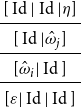 $\begin{array}{@{\,}c@{\,}c@{\,}} [\operatorname {Id}\vert\operatorname {Id}\vert\eta]\\ \hline [\operatorname {Id}\vert\hat{\omega}_j]\\ \hline [\hat{\omega}_i\vert\operatorname {Id}]\\ \hline [\varepsilon\vert\operatorname {Id}\vert\operatorname {Id}]\end{array}$
in
$\begin{array}{@{\,}c@{\,}c@{\,}} [\operatorname {Id}\vert\operatorname {Id}\vert\eta]\\ \hline [\operatorname {Id}\vert\hat{\omega}_j]\\ \hline [\hat{\omega}_i\vert\operatorname {Id}]\\ \hline [\varepsilon\vert\operatorname {Id}\vert\operatorname {Id}]\end{array}$
in $\tilde E$
(or its symmetric diagonal version). Consequently, in the equation
$\tilde E$
(or its symmetric diagonal version). Consequently, in the equation $\tilde E$
“middle
$\tilde E$
“middle $\eta$
’s and
$\eta$
’s and $\varepsilon$
’s” will cancel out and
$\varepsilon$
’s” will cancel out and $\tilde E$
gets the form
$\tilde E$
gets the form $\begin{array}{@{\,}c@{\,}}[\operatorname {Id}\vert\eta]\\ \hline \hat{E}\\ \hline [\varepsilon\vert\operatorname {Id}] \end{array}$
, i.e.,
$\begin{array}{@{\,}c@{\,}}[\operatorname {Id}\vert\eta]\\ \hline \hat{E}\\ \hline [\varepsilon\vert\operatorname {Id}] \end{array}$
, i.e., $[\operatorname {Id}\vert\eta]$
and
$[\operatorname {Id}\vert\eta]$
and $[\varepsilon\vert\operatorname {Id}]$
are composed to both sides of
$[\varepsilon\vert\operatorname {Id}]$
are composed to both sides of $\hat{E}$
, where
$\hat{E}$
, where $\hat{E}$
is an equation as in the third claim of Proposition 2.22. We know that
$\hat{E}$
is an equation as in the third claim of Proposition 2.22. We know that $\hat{E}$
holds true, hence we have the proof.
$\hat{E}$
holds true, hence we have the proof.
For liftable u,u’ we label the invertible assignment

for future reference.
Under assumption on existence of companions, invertibility of vertically globular 2-cells does not imply in general invertibility of squares obtained by the above described assignment $\omega\mapsto\omega^*$
. However, we have
$\omega\mapsto\omega^*$
. However, we have
Lemma 2.24. If the 1v-cells u and u’ in $\omega$
in (8) and the 2-cell
$\omega$
in (8) and the 2-cell $\omega$
itself are invertible, an inverse of
$\omega$
itself are invertible, an inverse of $\omega^*$
is given by
$\omega^*$
is given by

We state for the record that although invertibility of squares implies invertibility of horizontally globular 2-cells (similar to the assignment $\omega^*\mapsto\hat{\omega}$
from Proposition 2.23), the converse holds under assumptions similar as in the above lemma.
$\omega^*\mapsto\hat{\omega}$
from Proposition 2.23), the converse holds under assumptions similar as in the above lemma.
3. Premonoidal Double Categories and Central Cells
In this section, we are going to introduce a double categorical version of the notion of premonoidal bicategories introduced in Paquet and Saville (Reference Paquet and Saville2023a). We start the section by introducing the previously necessary notions of “binoidality” and “centrality” of cells (we will use them in Subsection 6.1), and we also study the relation of companions and centrality.
3.1 Binoidal double categories and central cells
We generalize the definitions of a binoidal bicategory and central 1- and 2-cells in it from Paquet and Saville (Reference Paquet and Saville2023a) to double categories. We will differentiate left and right central 1-cells.
Definition 3.1. A binoidal double category is a double category $\mathbb{B}$
equipped with pseudodouble functors
$\mathbb{B}$
equipped with pseudodouble functors $A\ltimes -$
and
$A\ltimes -$
and $-\rtimes B$
acting
$-\rtimes B$
acting $\mathbb{B}\to \mathbb{B}$
for all 0-cells
$\mathbb{B}\to \mathbb{B}$
for all 0-cells $A,B\in\mathbb{B}$
, such that
$A,B\in\mathbb{B}$
, such that $A\ltimes B=A\rtimes B=:A\bowtie B$
.
$A\ltimes B=A\rtimes B=:A\bowtie B$
.
Definition 3.2. Assume $\mathbb{B}$
is a binoidal double category.
$\mathbb{B}$
is a binoidal double category.
• A left central 1h-cell in $\mathbb{B}$
is a 1h-cell
$\mathbb{B}$
is a 1h-cell $f:A\to A'$
in
$f:A\to A'$
in $\mathbb{B}$
equipped with a horizontal pseudonatural transformation
$\mathbb{B}$
equipped with a horizontal pseudonatural transformation $f\ltimes-:A\ltimes -\to A'\ltimes-$
such that
$f\ltimes-:A\ltimes -\to A'\ltimes-$
such that $f\ltimes B=f\rtimes B$
for all
$f\ltimes B=f\rtimes B$
for all $B\in\mathbb{B}$
. Likewise, a right central 1h-cell in
$B\in\mathbb{B}$
. Likewise, a right central 1h-cell in $\mathbb{B}$
is a 1h-cell
$\mathbb{B}$
is a 1h-cell $f:A\to A'$
in
$f:A\to A'$
in $\mathbb{B}$
equipped with a horizontal pseudonatural transformation
$\mathbb{B}$
equipped with a horizontal pseudonatural transformation $-\rtimes f:-\ltimes A\to -\rtimes A'$
such that
$-\rtimes f:-\ltimes A\to -\rtimes A'$
such that $B\rtimes f=B\ltimes f$
for all
$B\rtimes f=B\ltimes f$
for all $B\in\mathbb{B}$
.
$B\in\mathbb{B}$
.
A 1h-cell is said to be central if it is both left and right central.
• A left central 1v-cell in $\mathbb{B}$
is a 1v-cell
$\mathbb{B}$
is a 1v-cell $v:A\to \tilde A$
in
$v:A\to \tilde A$
in $\mathbb{B}$
equipped with a vertical pseudonatural transformation
$\mathbb{B}$
equipped with a vertical pseudonatural transformation $v\ltimes-:A\ltimes -\to \tilde A\ltimes-$
such that
$v\ltimes-:A\ltimes -\to \tilde A\ltimes-$
such that $v\ltimes B=v\rtimes B$
for all
$v\ltimes B=v\rtimes B$
for all $B\in\mathbb{B}$
. Likewise, a right central 1v-cell in
$B\in\mathbb{B}$
. Likewise, a right central 1v-cell in $\mathbb{B}$
is a 1v-cell
$\mathbb{B}$
is a 1v-cell $v:A\to \tilde A$
in
$v:A\to \tilde A$
in $\mathbb{B}$
equipped with a vertical pseudonatural transformation
$\mathbb{B}$
equipped with a vertical pseudonatural transformation $-\rtimes v:-\rtimes A\to -\rtimes\tilde A$
such that
$-\rtimes v:-\rtimes A\to -\rtimes\tilde A$
such that $B\ltimes v=B\rtimes v$
for all
$B\ltimes v=B\rtimes v$
for all $B\in\mathbb{B}$
.
$B\in\mathbb{B}$
.
A 1v-cell is said to be central if it is both left and right central.
For reader’s convenience, we write down the 2-cell components of the pseudonatural transformations in play. For a horizontal pseudonatural transformation $f\ltimes-:A\ltimes -\to A'\ltimes-$
, a 1h-cell
$f\ltimes-:A\ltimes -\to A'\ltimes-$
, a 1h-cell $g:B\to B'$
and a 1v-cell
$g:B\to B'$
and a 1v-cell $v:A\to \tilde A$
the 2-cell components
$v:A\to \tilde A$
the 2-cell components $f\ltimes-\vert_g$
and
$f\ltimes-\vert_g$
and $f\ltimes-\vert_v$
of the oplax transformation structure of
$f\ltimes-\vert_v$
of the oplax transformation structure of $f\ltimes-$
have the form of the left diagrams below (for the lax transformation structure of
$f\ltimes-$
have the form of the left diagrams below (for the lax transformation structure of $f\ltimes-$
the first 2-cell component is different: it is a 2-cell obtained by reading the same upper left diagram from bottom to top). Likewise, the 2-cell components
$f\ltimes-$
the first 2-cell component is different: it is a 2-cell obtained by reading the same upper left diagram from bottom to top). Likewise, the 2-cell components $-\rtimes f\vert_g$
and
$-\rtimes f\vert_g$
and $-\rtimes f\vert_v$
of the oplax transformation structure of
$-\rtimes f\vert_v$
of the oplax transformation structure of $-\rtimes f:-\rtimes A\to -\rtimes A'$
has the form of the right diagrams below (and the differing 2-cell component for the lax structure is obtained by reading the upper right diagram from bottom to top).
$-\rtimes f:-\rtimes A\to -\rtimes A'$
has the form of the right diagrams below (and the differing 2-cell component for the lax structure is obtained by reading the upper right diagram from bottom to top).

Similarly, for a 1v-cell $u:B\to \tilde B$
the 2-cell components of oplax transformation structures of
$u:B\to \tilde B$
the 2-cell components of oplax transformation structures of $v\ltimes-:A\ltimes -\to \tilde A\ltimes-$
and
$v\ltimes-:A\ltimes -\to \tilde A\ltimes-$
and $-\rtimes v:-\rtimes A\to -\rtimes\tilde A$
have the form as below (and for the lax structures read the respective diagrams from right to left).
$-\rtimes v:-\rtimes A\to -\rtimes\tilde A$
have the form as below (and for the lax structures read the respective diagrams from right to left).

Observe that for a left central 1h-cell f the requirement $f\ltimes B=f\rtimes B$
makes that the image of the pseudodouble functor
$f\ltimes B=f\rtimes B$
makes that the image of the pseudodouble functor $-\rtimes B$
at f is related to the images of the pseudodouble functor
$-\rtimes B$
at f is related to the images of the pseudodouble functor $A\ltimes-$
at g and v via the corresponding 2-cell components of
$A\ltimes-$
at g and v via the corresponding 2-cell components of $f\ltimes-$
, and similarly for other central 1-cells.
$f\ltimes-$
, and similarly for other central 1-cells.
Definition 3.3. In a binoidal double category $\mathbb{B}$
a 2-cell
$\mathbb{B}$
a 2-cell
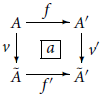 in
in $\mathbb{B}$
, where f and f’ are left central 1h-cells and v and v’ are left central 1v-cells (with respect to horizontal and vertical transformations
$\mathbb{B}$
, where f and f’ are left central 1h-cells and v and v’ are left central 1v-cells (with respect to horizontal and vertical transformations $f\ltimes-, f'\ltimes$
and
$f\ltimes-, f'\ltimes$
and $v\ltimes-, v'\ltimes$
, respectively), is said to be left central if for all
$v\ltimes-, v'\ltimes$
, respectively), is said to be left central if for all $B\in\mathbb{B}$
the 2-cells
$B\in\mathbb{B}$
the 2-cells $a\rtimes B$
obey the axioms determining a modification
$a\rtimes B$
obey the axioms determining a modification $a\ltimes-$
with 2-cell components
$a\ltimes-$
with 2-cell components $a\ltimes B:=a\rtimes B$
:
$a\ltimes B:=a\rtimes B$
:

and

for any 1h-cell g and any 1v-cell u in $\mathbb{B}$
.
$\mathbb{B}$
.
A right central 2-cell is defined similarly. A 2-cell is said to be central if it is both left and right central.
3.2 Centrality and companions
For concluding premonoidality of the underlying bicategory of a premonoidal double category, we will need the following results. They both hold in a binoidal double category. The first one is proved directly.
Lemma 3.4. If a 1v-cell u has $\hat{u}$
for a companion, then
$\hat{u}$
for a companion, then $u\rtimes B$
has
$u\rtimes B$
has $\hat{u}\rtimes B$
for a companion. Similarly,
$\hat{u}\rtimes B$
for a companion. Similarly, $B\ltimes u$
has
$B\ltimes u$
has $B\ltimes\hat{u}$
for a companion.
$B\ltimes\hat{u}$
for a companion.
Lemma 3.5. Let u be an invertible 1v-cell so that both u and its inverse are left central with mutually inverse 2-cell components $u\ltimes-\vert_f$
and
$u\ltimes-\vert_f$
and $u^{-1}\ltimes-\vert_f$
at 1h-cells f. Suppose also that u has a companion and a conjoint. Then, its companion
$u^{-1}\ltimes-\vert_f$
at 1h-cells f. Suppose also that u has a companion and a conjoint. Then, its companion $\hat{u}$
is left central.
$\hat{u}$
is left central.
The right-hand sided version of the claim holds, too.
Proof. By left centrality of u we have a vertical pseudonatural transformation $u\ltimes-$
. By the assumption, the 2-cell components
$u\ltimes-$
. By the assumption, the 2-cell components $u\ltimes-\vert_f$
are invertible, so by Proposition 2.14 there is a horizontal pseudonatural transformation
$u\ltimes-\vert_f$
are invertible, so by Proposition 2.14 there is a horizontal pseudonatural transformation $\hat{u}\ltimes-$
, hence the claim.
$\hat{u}\ltimes-$
, hence the claim.
Definition 3.6. For an invertible 1v-cell u such that both u and its inverse $u^{-1}$
are left central, and so that their 2-cell components
$u^{-1}$
are left central, and so that their 2-cell components $u\ltimes-\vert_f$
and
$u\ltimes-\vert_f$
and $u^{-1}\ltimes-\vert_f$
at 1h-cells f are mutually inverse, we will say that it is left inversely central. Similarly, we define right inversely central 1v-cells. Those 1v-cells that are both left and right inversely central we call inversely central 1v-cells.
$u^{-1}\ltimes-\vert_f$
at 1h-cells f are mutually inverse, we will say that it is left inversely central. Similarly, we define right inversely central 1v-cells. Those 1v-cells that are both left and right inversely central we call inversely central 1v-cells.
Lemma 3.7. If a 2-cell $\sigma$
is central in
$\sigma$
is central in $\mathbb{B}$
, then the 2-cell
$\mathbb{B}$
, then the 2-cell $\hat{\sigma}$
given as below is central in
$\hat{\sigma}$
given as below is central in $\mathcal{H}(\mathbb{B})$
.
$\mathcal{H}(\mathbb{B})$
.

Proof. To the modification condition (m.ho-vl.-1) with $\Theta=\sigma$
and for a 1h-cell
$\Theta=\sigma$
and for a 1h-cell $k:D\to D'$
paste
$k:D\to D'$
paste $\varepsilon_{\alpha_{A',B,C}\ltimes D'}$
from the right and
$\varepsilon_{\alpha_{A',B,C}\ltimes D'}$
from the right and $\eta_{\alpha_{A,B,C}\ltimes D}$
from the left. We explain the procedure on one side of the equation, analogous actions are done on the other side. Between the 2-cells
$\eta_{\alpha_{A,B,C}\ltimes D}$
from the left. We explain the procedure on one side of the equation, analogous actions are done on the other side. Between the 2-cells $\alpha_{f,B,C}\ltimes D$
and
$\alpha_{f,B,C}\ltimes D$
and $\alpha_{A',B,C}\ltimes -\vert_k$
insert the identity 2-cell
$\alpha_{A',B,C}\ltimes -\vert_k$
insert the identity 2-cell $\frac{\eta_{\alpha_{A,B,C}\ltimes D}}{\varepsilon_{\alpha_{A,B,C}\ltimes D}}$
. One obtains 2-cells
$\frac{\eta_{\alpha_{A,B,C}\ltimes D}}{\varepsilon_{\alpha_{A,B,C}\ltimes D}}$
. One obtains 2-cells $\widehat{\alpha_{A',B,C}\ltimes -\vert_k}=\widehat{\alpha_{A',B,C}}\ltimes -\vert_k$
and
$\widehat{\alpha_{A',B,C}\ltimes -\vert_k}=\widehat{\alpha_{A',B,C}}\ltimes -\vert_k$
and $\widehat{\alpha_{f,B,C}\ltimes D}$
, which is
$\widehat{\alpha_{f,B,C}\ltimes D}$
, which is $\widehat{\alpha_{f,B,C}}\ltimes D$
conjugated by the lax and colax structure of
$\widehat{\alpha_{f,B,C}}\ltimes D$
conjugated by the lax and colax structure of $-\rtimes D$
. Finally, relate the composition of components
$-\rtimes D$
. Finally, relate the composition of components $(fB)C\ltimes-\vert_k$
and
$(fB)C\ltimes-\vert_k$
and $\widehat{\alpha_{A',B,C}}\ltimes -\vert_k$
via Lemma 2.4 to
$\widehat{\alpha_{A',B,C}}\ltimes -\vert_k$
via Lemma 2.4 to $\widehat{\alpha_{A',B,C}}((fB)C)\ltimes-\vert_k$
. to get (one side of) the modification condition of
$\widehat{\alpha_{A',B,C}}((fB)C)\ltimes-\vert_k$
. to get (one side of) the modification condition of $\hat{\sigma}\ltimes$
in
$\hat{\sigma}\ltimes$
in $\mathcal{H}(\mathbb{B})$
. Right centrality is proved in a similar way.
$\mathcal{H}(\mathbb{B})$
. Right centrality is proved in a similar way.
3.3 Premonoidal double categories
We start by recalling the definition of a premonoidal bicategory from Paquet and Saville (Reference Paquet and Saville2023a) for reader’s convenience.
Definition 3.8. Paquet and Saville (Reference Paquet and Saville2023a, Definition 6). A premonoidal bicategory is a binoidal bicategory $(\mathcal{B}, \ltimes,\rtimes)$
with a unit object
$(\mathcal{B}, \ltimes,\rtimes)$
with a unit object $I\in\mathcal{B}$
and the following data:
$I\in\mathcal{B}$
and the following data:
-
(1) pseudonatural equivalences
$\lambda: I\ltimes -\Rightarrow\operatorname {Id}, \rho: -\rtimes I\Rightarrow\operatorname {Id}$
and for every
\begin{align*}\begin{array}{c} \alpha_{-,B,C}: (-\rtimes B)\rtimes C\Rightarrow -\rtimes(B\bowtie C)\\\alpha_{A,-,C}: (A\ltimes -)\rtimes C\Rightarrow A\ltimes(-\rtimes C)\\\alpha_{A,B,-}: (A\bowtie B)\ltimes -\Rightarrow A\ltimes(B\ltimes -)\end{array}\end{align*}
$A,B,C\in\mathbb{B}$
, such that all the 1-cell components of these five equivalences are central 1-cells, and
$\alpha_{-,B,C}\vert_A=\alpha_{A,-,C}\vert_B=\alpha_{A,B,-}\vert_C$
;
-
(2) invertible 2-cells
$p_{A,B,C,D}, m_{A,B}, l_{A,B}, r_{A,B}$
such that these form modifications in each argument in the form of the modifications
$\pi, \mu, \lambda, \rho$
from Reference Gordon, Power and Street
Gordon, Power and Street (1995)
.






The above data is subject to the same equations between 2-cells as in a monoidal bicategory.
Taking for the starting point the definition of a premonoidal bicategory from Paquet and Saville (Reference Paquet and Saville2023a), one can follow two approaches to introduce a premonoidal double category. One is to add rules to the definition of a premonoidal bicategory for the 1v-cells and to accommodate the rules for 2-cells, so that forgetting the vertical direction one recovers the notion of a premonoidal bicategory.
Another one is to follow Shulman’s recipe from Shulman (Reference Shulman2010). Namely, to consider a premonoidal analogue of a monoidal double category $\mathbb{D}$
from his Shulman (Reference Shulman2010, Definition 2.9), which is a pseudomonoid in a certain 2-category of double categories, and then assuming the existence of companions and conjoints in
$\mathbb{D}$
from his Shulman (Reference Shulman2010, Definition 2.9), which is a pseudomonoid in a certain 2-category of double categories, and then assuming the existence of companions and conjoints in $\mathbb{D}$
lift isomorphism 1v-cells to equivalence 1h-cells, obtaining that the underlying horizontal bicategory
$\mathbb{D}$
lift isomorphism 1v-cells to equivalence 1h-cells, obtaining that the underlying horizontal bicategory $\mathcal{H}(\mathbb{D})$
is a proper monoidal bicategory.
$\mathcal{H}(\mathbb{D})$
is a proper monoidal bicategory.
The latter is a much easier work to do, given that the first way would suppose to work with non-trivial modifications in double categories, while in the Shulman’s way the (vertical) double modifications are trivial, but one still obtains non-trivial (horizontal) modifications $\pi, \mu, \lambda, \rho$
from the definition of a tricategory from Gordon, Power and Street (Reference Gordon, Power and Street1995). (The latter are necessary to have a monoidal bicategory, which is a one object tricategory.) The cost one pays, though, is that this mechanism works only for those double categories whose 1v-cells have companions and conjoints. A synonym for such double categories is framed bicategories, Shulman (Reference Shulman2008, Theorem A.2), and some examples are listed in Shulman (Reference Shulman2008, Section 4.4).
$\pi, \mu, \lambda, \rho$
from the definition of a tricategory from Gordon, Power and Street (Reference Gordon, Power and Street1995). (The latter are necessary to have a monoidal bicategory, which is a one object tricategory.) The cost one pays, though, is that this mechanism works only for those double categories whose 1v-cells have companions and conjoints. A synonym for such double categories is framed bicategories, Shulman (Reference Shulman2008, Theorem A.2), and some examples are listed in Shulman (Reference Shulman2008, Section 4.4).
We take the second, Shulman’s approach.
Definition 3.9. Let $\mathbb{B}$
be a binoidal double category. We say that the binoidal structure of
$\mathbb{B}$
be a binoidal double category. We say that the binoidal structure of $\mathbb{B}$
is unital if there exists a unit object I and invertible vertical strict transformations
$\mathbb{B}$
is unital if there exists a unit object I and invertible vertical strict transformations $\lambda: I\ltimes -\Rightarrow\operatorname {Id}$
and
$\lambda: I\ltimes -\Rightarrow\operatorname {Id}$
and $\rho: -\rtimes I\Rightarrow\operatorname {Id}$
each of whose 1v-cell components are inversely central 1v-cells.
$\rho: -\rtimes I\Rightarrow\operatorname {Id}$
each of whose 1v-cell components are inversely central 1v-cells.
Definition 3.10. Let $\mathbb{B}$
be a binoidal double category. We say that the binoidal structure of
$\mathbb{B}$
be a binoidal double category. We say that the binoidal structure of $\mathbb{B}$
is associative if there exist invertible vertical strict transformations
$\mathbb{B}$
is associative if there exist invertible vertical strict transformations
 \begin{align*}\begin{array}{c}\alpha_{-,B,C}: (-\rtimes B)\rtimes C\Rightarrow -\rtimes(B\bowtie C)\\\alpha_{A,-,C}: (A\ltimes -)\rtimes C\Rightarrow A\ltimes(-\rtimes C)\\\alpha_{A,B,-}: (A\bowtie B)\ltimes -\Rightarrow A\ltimes(B\ltimes -)\end{array} \end{align*}
for every $A,B,C\in\mathbb{B}$
, such that the following is fulfilled
$A,B,C\in\mathbb{B}$
, such that the following is fulfilled
-
(1) 1v-cell components
$\alpha_{A,B,C}$
of the above three vertical transformations coincide and are inversely central, -
(2) and the following four pentagons, expressing equalities of vertical transformations, commute


Definition 3.11.
Let $\mathbb{B}$
be a binoidal double category. We say that
$\mathbb{B}$
be a binoidal double category. We say that $\mathbb{B}$
is a premonoidal double category if its binoidal structure is unital and associative and the following six triangles, expressing equalities of vertical transformations, commute
$\mathbb{B}$
is a premonoidal double category if its binoidal structure is unital and associative and the following six triangles, expressing equalities of vertical transformations, commute

Remark 3.12 In the definition of a premonoidal double category, centrality of the component 1v-cells $\alpha_{A,B,C}, \lambda_A$
and
$\alpha_{A,B,C}, \lambda_A$
and $\rho_A$
is used in order to have well-defined invertible vertical pseudonatural transformations
$\rho_A$
is used in order to have well-defined invertible vertical pseudonatural transformations $-\rtimes\alpha_{B,C,D},\alpha_{A,B,C}\ltimes-$
in the first and fourth pentagon in Definition 3.10, and
$-\rtimes\alpha_{B,C,D},\alpha_{A,B,C}\ltimes-$
in the first and fourth pentagon in Definition 3.10, and $-\rtimes\lambda_B, \rho_A\ltimes-,\lambda_A\ltimes-, -\rtimes\rho_B$
in the first three and the fifth triangle in Definition 3.11. Inverse centrality is included in these definitions for a reason explained in Remark 3.13.
$-\rtimes\lambda_B, \rho_A\ltimes-,\lambda_A\ltimes-, -\rtimes\rho_B$
in the first three and the fifth triangle in Definition 3.11. Inverse centrality is included in these definitions for a reason explained in Remark 3.13.
In the pentagons and triangles of a premonoidal double category, the compositions of vertical transformations are the vertical ones, from Lemma 2.6. The 2-cell $(\frac{\alpha_0}{\beta_0})_f$
for two such transformations and a 1h-cell f is given by the vertical composition of the 2-cells
$(\frac{\alpha_0}{\beta_0})_f$
for two such transformations and a 1h-cell f is given by the vertical composition of the 2-cells $(\alpha_0)_f$
and
$(\alpha_0)_f$
and $(\beta_0)_f$
.
$(\beta_0)_f$
.
Remark 3.13. Observe that in a premonoidal double category in the above definition 1v-cell components of the five vertical strict transformations are invertible and inversely central. If these transformations are also liftable, then by Proposition 2.14 and Lemma 3.5 they determine bicategorical pseudonatural transformations in which the 1-cell components are equivalence 1-cells and central. This is what we want to obtain in the underlying horizontal 2-category $\mathcal{H}(\mathbb{B})$
(Proposition 3.15).
$\mathcal{H}(\mathbb{B})$
(Proposition 3.15).
3.4 Other implications in a premonoidal double category
In a premonoidal double category $\mathbb{D}$
, we have
$\mathbb{D}$
, we have
-
(1) pseudodouble functors
$A\ltimes -$
and
$-\rtimes B$
such that
$A\ltimes B=A\rtimes B=:A\bowtie B$
; -
(2) a unit object I with invertible vertical strict transformations
$\lambda: I\ltimes -\Rightarrow\operatorname {Id}$
and
$\rho: -\rtimes I\Rightarrow\operatorname {Id}$
each of whose 1v-cell components are central 1v-cells; -
(3) invertible vertical strict transformations
$\alpha_{-,B,C}, \alpha_{A,-,C},\alpha_{A,B,-}$
for every
$A,B,C\in\mathbb{D}$
, such that each 1v-cell component
$\alpha_{A,B,C}$
is central and the four pentagons commute; -
(4) the six triangles commute.








The pseudodouble functors $A\ltimes -$
and
$A\ltimes -$
and $-\rtimes B$
yield functors on the categories
$-\rtimes B$
yield functors on the categories $\mathbb{D}_0$
of objects and
$\mathbb{D}_0$
of objects and $\mathbb{D}_1$
of morphisms, and also pseudofunctors
$\mathbb{D}_1$
of morphisms, and also pseudofunctors $A\ltimes -,-\rtimes B: \mathcal{H}(\mathbb{D})\to \mathcal{H}(\mathbb{D})$
on the underlying horizontal 2-category of
$A\ltimes -,-\rtimes B: \mathcal{H}(\mathbb{D})\to \mathcal{H}(\mathbb{D})$
on the underlying horizontal 2-category of $\mathbb{D}$
.
$\mathbb{D}$
.
The existence of a distinguished (unit) object $I\in\mathbb{D}$
means that there is a pseudodouble functor
$I\in\mathbb{D}$
means that there is a pseudodouble functor $1\to \mathbb{D}$
from the trivial double category so that the image of the single object
$1\to \mathbb{D}$
from the trivial double category so that the image of the single object $*$
is I (and the images of the remaining identity 1h- and 1v-cells and the identity 2-cell on
$*$
is I (and the images of the remaining identity 1h- and 1v-cells and the identity 2-cell on $*$
are horizontal and vertical identities
$*$
are horizontal and vertical identities $1_I$
and
$1_I$
and $1^I$
on I and the identity 2-cell on I, respectively). Then, there are also functors
$1^I$
on I and the identity 2-cell on I, respectively). Then, there are also functors $*\to \mathbb{D}_0$
and
$*\to \mathbb{D}_0$
and $*\to \mathbb{D}_1$
from the trivial category, and a pseudofunctor
$*\to \mathbb{D}_1$
from the trivial category, and a pseudofunctor $*\to \mathcal{H}(\mathbb{D})$
from the trivial 2-category.
$*\to \mathcal{H}(\mathbb{D})$
from the trivial 2-category.
Invertible vertical strict transformations are those that have vertically invertible 2-cells $(\alpha_0)_f$
for every 1h-cell f, and they satisfy the axioms (v.l.t.- 1), (v.l.t.- 2) and (v.l.t.- 5) so that the latter axiom is simplified (the 2-cells
$(\alpha_0)_f$
for every 1h-cell f, and they satisfy the axioms (v.l.t.- 1), (v.l.t.- 2) and (v.l.t.- 5) so that the latter axiom is simplified (the 2-cells $\alpha_0^u$
are identities), whereas the compositors in the first axiom and the unitors in the second one are invertible. Equivalently, invertible vertical strict transformations
$\alpha_0^u$
are identities), whereas the compositors in the first axiom and the unitors in the second one are invertible. Equivalently, invertible vertical strict transformations $\omega:F\to G$
between pseudodouble functors consist of two natural transformations
$\omega:F\to G$
between pseudodouble functors consist of two natural transformations $\omega_0:F_0\to G_0$
and
$\omega_0:F_0\to G_0$
and $\omega_1:F_1\to G_1$
between the induced functors on the categories of objects and morphisms, such that the axioms (v.l.t.- 1) and (v.l.t.- 2) hold, and the 2-cells
$\omega_1:F_1\to G_1$
between the induced functors on the categories of objects and morphisms, such that the axioms (v.l.t.- 1) and (v.l.t.- 2) hold, and the 2-cells $(\alpha_0)_f$
are vertically invertible.
$(\alpha_0)_f$
are vertically invertible.
The fact that we work with vertical transformations together with the functor $*\to \mathbb{D}_0$
produces that associative and unital binoidal structure of
$*\to \mathbb{D}_0$
produces that associative and unital binoidal structure of $\mathbb{D}$
is passed on to an associative and unital binoidal structure of the vertical category
$\mathbb{D}$
is passed on to an associative and unital binoidal structure of the vertical category $\mathbb{D}_0$
. For the horizontal category
$\mathbb{D}_0$
. For the horizontal category $\mathbb{D}_1$
, we consider
$\mathbb{D}_1$
, we consider $1_I$
as the unit object with the rest of a monoidal structure given by the internal category structure of
$1_I$
as the unit object with the rest of a monoidal structure given by the internal category structure of $\mathbb{D}$
.
$\mathbb{D}$
.
We may conclude:
Lemma 3.14. In a premonoidal double category $\mathbb{D}$
, the category of objects
$\mathbb{D}$
, the category of objects $\mathbb{D}_0$
is premonoidal and the category of morphisms
$\mathbb{D}_0$
is premonoidal and the category of morphisms $\mathbb{D}_1$
is monoidal.
$\mathbb{D}_1$
is monoidal.
We may also prove:
Proposition 3.15. The horizontal bicategory of a premonoidal double category whose associativity and unitality constraints are liftable vertical transformations is a premonoidal bicategory from Definition 3.8.
Proof. We saw in Remark 3.13 that invertible liftable vertical strict transformations whose 1v-cell components are inversely central determine bicategorical pseudonatural equivalences whose 1-cell components are (equivalence 1-cells and) central. That the four pentagons and six triangles of a premonoidal double category commute means that they are given by globular vertical identity modifications between vertical compositions of invertible vertical strict transformations. Then according to Proposition 2.22 they induce horizontal i.e. bicategorical modifications between the corresponding horizontal i.e. bicategorical pseudonatural equivalences, and they satisfy in particular the equations between 2-cells in a monoidal bicategory. Thus, we have the proof.
Notational convention. For a premonoidal double category $\mathbb{B}$
whose associativity and unitality constraints are liftable vertical transformations, we will denote by
$\mathbb{B}$
whose associativity and unitality constraints are liftable vertical transformations, we will denote by $\underline{\mathcal{H}(\mathbb{B})}$
the underlying bicategory
$\underline{\mathcal{H}(\mathbb{B})}$
the underlying bicategory $\mathcal{H}(\mathbb{B})$
equipped with bicategorical pseudonatural equivalences
$\mathcal{H}(\mathbb{B})$
equipped with bicategorical pseudonatural equivalences $\hat{\alpha},\hat{\lambda},\hat{\rho}$
induced from
$\hat{\alpha},\hat{\lambda},\hat{\rho}$
induced from $\mathbb{B}$
according to Proposition 2.14. We now know that it is premonoidal.
$\mathbb{B}$
according to Proposition 2.14. We now know that it is premonoidal.
4. 24 Axioms for An Associative Binoidal Structure
In a premonoidal double category, a natural question arises about the coherence of any two of the three associativity constraints. This coherence can be expressed in the form of 24 axioms that we are going to study in this section. Though, not any pair of the component 2-cells of these structural transformations can be compared: one of the two in them appearing 1-cells should be central. Thus, a coherent choice of centrality structures of 1h- and 1v-cells is necessary in order to express these axioms. The definition of a premonoidal double category does not entail such a choice, for this reason these 24 axioms do not appear in it. Center double categories of premonoidal double categories and funny functors and quasi-functors, which we will introduce in sections 5 and 6, will provide a coherent choice of centrality structures for a premonoidal double category. The 24 axioms are relevant for those cases. We will make an explicit reference to these axioms in Subsection 5.4, Subsection 5.5, Subsection 7.4 and Subsection 7.5, so the reader may choose to skip this section now and come back to it at a later moment.
For the interrelation between $\alpha_{-,B,C}$
and
$\alpha_{-,B,C}$
and $\alpha_{A,-,C}$
, we should give four axioms corresponding to compatibilities of their 2-cell components, and similarly for the interrelations between
$\alpha_{A,-,C}$
, we should give four axioms corresponding to compatibilities of their 2-cell components, and similarly for the interrelations between $\alpha_{-,B,C}$
and
$\alpha_{-,B,C}$
and $\alpha_{A,B,-}$
, and between
$\alpha_{A,B,-}$
, and between $\alpha_{A,-,C}$
and
$\alpha_{A,-,C}$
and $\alpha_{A,B,-}$
. This gives 12 axioms. Though, in each of these 12 axioms, there appears (something that should be) a transformation of either of the following forms:
$\alpha_{A,B,-}$
. This gives 12 axioms. Though, in each of these 12 axioms, there appears (something that should be) a transformation of either of the following forms: $f\ltimes-, -\rtimes f'$
and
$f\ltimes-, -\rtimes f'$
and $u\ltimes-, -\rtimes u'$
, whereby we should differentiate 2-cell components
$u\ltimes-, -\rtimes u'$
, whereby we should differentiate 2-cell components $f\ltimes-\vert_{f'}$
for left central 1h-cells f, and
$f\ltimes-\vert_{f'}$
for left central 1h-cells f, and $-\rtimes f'\vert_f$
for right central 1h-cells f’, and so on for the other combinations of 1-cells. This results in having in total 24 axioms that should hold for pairs consisting of any left (or right) central 1h-cell (or 1v-cell) and any other 1h-cell (or 1v-cell). Moreover, the said candidates for transformations should be transformations indeed. That the latter is fulfilled will actually be the consequence of the 24 axioms themselves.
$-\rtimes f'\vert_f$
for right central 1h-cells f’, and so on for the other combinations of 1-cells. This results in having in total 24 axioms that should hold for pairs consisting of any left (or right) central 1h-cell (or 1v-cell) and any other 1h-cell (or 1v-cell). Moreover, the said candidates for transformations should be transformations indeed. That the latter is fulfilled will actually be the consequence of the 24 axioms themselves.
On the other hand, one would also hope to have a coherence of structural transformations of central 1v-cell components of the three $\alpha$
’s with respect to the binoidal structure. If u stands for any of them, we need to know the relations between
$\alpha$
’s with respect to the binoidal structure. If u stands for any of them, we need to know the relations between $u\ltimes(-,\bullet)$
and
$u\ltimes(-,\bullet)$
and $(u\ltimes-)\ltimes\bullet$
, where the places
$(u\ltimes-)\ltimes\bullet$
, where the places $(-,\bullet)$
can be occupied by any of the following four combinations of cells: (g,C), (B,h), (v,C), (B, z) for 1h-cells g,h and 1v-cells v,z. This and similar coherences for 1h-cells in place of u will turn out to be covered by the 24 axioms.
$(-,\bullet)$
can be occupied by any of the following four combinations of cells: (g,C), (B,h), (v,C), (B, z) for 1h-cells g,h and 1v-cells v,z. This and similar coherences for 1h-cells in place of u will turn out to be covered by the 24 axioms.
To illustrate the above, let us have a look at the first of the 24 axioms ( $(f\ltimes,g,C)$
):
$(f\ltimes,g,C)$
):

It should hold for every left central 1h-cell $f\colon A\to A'$
and any 1h-cell
$f\colon A\to A'$
and any 1h-cell $g\colon B\to B'$
. (We write here
$g\colon B\to B'$
. (We write here $(-,-)$
for both
$(-,-)$
for both $-\ltimes-$
and
$-\ltimes-$
and $-\rtimes-$
, which one is meant is clear from the context. In the rectangular diagram for the 2-cell
$-\rtimes-$
, which one is meant is clear from the context. In the rectangular diagram for the 2-cell $(f\ltimes-\vert_g,C)$
, we omitted the compositor 2-cells
$(f\ltimes-\vert_g,C)$
, we omitted the compositor 2-cells $((f,B')\rtimes C)((A,g)\rtimes C) \Rightarrow (f,B')(A,g)\rtimes C$
at the top and
$((f,B')\rtimes C)((A,g)\rtimes C) \Rightarrow (f,B')(A,g)\rtimes C$
at the top and $(f,B)(A',g)\rtimes C\Rightarrow ((f,B)\rtimes C)((A',g)\rtimes C)$
at the bottom, of the pseudodouble functor
$(f,B)(A',g)\rtimes C\Rightarrow ((f,B)\rtimes C)((A',g)\rtimes C)$
at the bottom, of the pseudodouble functor $-\rtimes C$
). This axiom correlates the structural transformations
$-\rtimes C$
). This axiom correlates the structural transformations $(f\ltimes-\vert_g)\rtimes C$
and
$(f\ltimes-\vert_g)\rtimes C$
and $f\ltimes-\vert_{(g,C)}$
of the left central 1h-cell f, and also the 2-cell components of the vertical transformations
$f\ltimes-\vert_{(g,C)}$
of the left central 1h-cell f, and also the 2-cell components of the vertical transformations $\alpha_{-,B,C}$
and
$\alpha_{-,B,C}$
and $\alpha_{A,-,C}$
evaluated at 1h-cells. Moreover, observe that this axiom corresponds to the axiom (m.ho-vl.-1), whereas the axiom (
$\alpha_{A,-,C}$
evaluated at 1h-cells. Moreover, observe that this axiom corresponds to the axiom (m.ho-vl.-1), whereas the axiom ( $(f\ltimes,v,C)$
) (see Appendix A) corresponds to the axiom (m.ho-vl.-2) for
$(f\ltimes,v,C)$
) (see Appendix A) corresponds to the axiom (m.ho-vl.-2) for $\alpha_{f,-,C}$
to be a modification (between horizontal transformations
$\alpha_{f,-,C}$
to be a modification (between horizontal transformations $(f\ltimes-)\rtimes C$
and
$(f\ltimes-)\rtimes C$
and $f\ltimes(-\rtimes C)$
and vertical transformations
$f\ltimes(-\rtimes C)$
and vertical transformations $\alpha_{A,-,C}$
and
$\alpha_{A,-,C}$
and $\alpha_{A',-,C}$
). Though, we should also make sure under which conditions the former two in the parenthesis are horizontal transformations.
$\alpha_{A',-,C}$
). Though, we should also make sure under which conditions the former two in the parenthesis are horizontal transformations.
We stress the fact that the 2-cell components $\alpha_{f,B,C}$
and
$\alpha_{f,B,C}$
and $\alpha_{A,g,C}$
in the above axiom (and similarly in all the remaining 23 axioms) cannot be compared for any 1h-cells f and g: f should be left central in order for the 2-cells
$\alpha_{A,g,C}$
in the above axiom (and similarly in all the remaining 23 axioms) cannot be compared for any 1h-cells f and g: f should be left central in order for the 2-cells $(f\ltimes-\vert_g,C)$
and
$(f\ltimes-\vert_g,C)$
and $f\ltimes-\vert_{(g,C)}$
to exist (and in general one of two determining 1-cells in any axiom must be central at an appropriate side).
$f\ltimes-\vert_{(g,C)}$
to exist (and in general one of two determining 1-cells in any axiom must be central at an appropriate side).
Summarizing, the $12+12$
axioms happen to correspond to the axioms (m.ho-vl.-1) and (m.ho-vl.-2) of certain 6+0 modifications between certain 12 horizontal and three vertical strict transformations
$12+12$
axioms happen to correspond to the axioms (m.ho-vl.-1) and (m.ho-vl.-2) of certain 6+0 modifications between certain 12 horizontal and three vertical strict transformations $\alpha$
. It will turn out that the same
$\alpha$
. It will turn out that the same $12+12$
axioms assure that we indeed have those 12 horizontal and further 12 vertical pseudonatural transformations. The latter fact we show in the sequel.
$12+12$
axioms assure that we indeed have those 12 horizontal and further 12 vertical pseudonatural transformations. The latter fact we show in the sequel.
The complete list of the 24 axioms can be found in Appendix A. In Table 2, we list 12 of those axioms, the 6 modifications that they determine, and 12 (top and bottom) horizontal transformations between which the modifications act. In Table 3 further below, we will list the remaining 12 axioms and 12 vertical transformations, which they interrelate.
Interrelations of horizontal transformations and generation of modifications
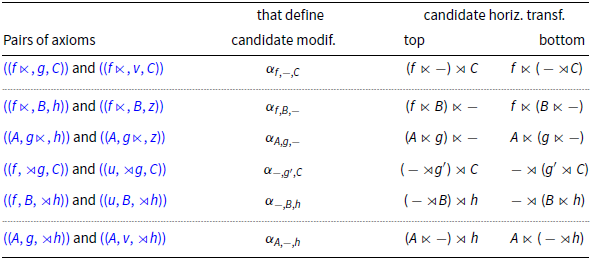
Definitions and interrelations of vertical transformations
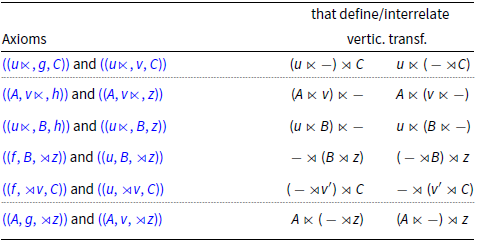
We start by noticing that 8 out of 12 candidate horizontal transformations from the last two columns of Table 2 are automatically horizontal transformations by Lemma 2.9. Similarly, 8 out of 12 candidate vertical transformations in Table 3 are automatically vertical pseudonatural transformations by Lemma 2.10. Namely, we have
Lemma 4.1. Let $\mathbb{B}$
be a double category with a binoidal structure.
$\mathbb{B}$
be a double category with a binoidal structure.
-
(1) For f,g left central and g’,h right central 1h-cells the following are horizontal pseudonatural transformations
$$(f\ltimes -)\rtimes C, \,\,\, \hspace{9cm} A\ltimes(-\rtimes h),$$
$$f\ltimes (-\rtimes C), \,\, f\ltimes (B\ltimes-), \,\, A\ltimes (g\ltimes -) \!\quad \text{and}\quad \!(-\rtimes g')\rtimes C, \,\, (-\rtimes B)\rtimes h, \,\, (A\ltimes-)\rtimes h.$$
-
(2) For u,v left central and v’,z right central 1v-cells the following are vertical pseudonatural transformations
$$(u\ltimes -)\rtimes C, \,\,\, \qquad \qquad \,\,\, A\ltimes (v\ltimes -) \qquad \qquad \quad (-\rtimes v')\rtimes C, \,\,\, \qquad \qquad \,\,\, A\ltimes(-\rtimes z),$$
$$u\ltimes (-\rtimes C), \,\,\, u\ltimes (B\ltimes-), \,\,\, \qquad \qquad \quad \text{and}\quad \qquad \qquad \,\,\, (-\rtimes B)\rtimes z, \,\,\, (A\ltimes-)\rtimes z.$$


For the remaining 4 candidates of horizontal transformations in Table 2, we have the following. Define the 2-cell components of
 \begin{equation} (A\ltimes g)\ltimes -, \,\,\, (f\rtimes B)\ltimes - \quad \text{and}\quad -\rtimes(g'\rtimes C), \,\,\, -\rtimes(B\ltimes h)\end{equation}
by expressing them out of the two axioms written in the same line in Table 2 as the candidate transformation itself (this covers the 8 axioms in the middle four rows of the first column of Table 2). This way these component 2-cells are given in terms of the component 2-cells of the transformations
 $$A\ltimes (g\ltimes -), \,\,\, f\ltimes (B\ltimes-)\quad \text{and}\quad (-\rtimes g')\rtimes C, \,\,\, (-\rtimes B)\rtimes h$$
from Lemma 4.1, respectively. The following is verified straightforwardly:
Lemma 4.2. Assume that the middle 8 axioms of Table 2 hold.
-
(1) Then (12) are horizontal pseudonatural transformations.
-
(2) The pseudofunctors
$A\ltimes-$
and
$-\rtimes B$
preserve left centrality (by first four of the 8 axioms) and right centrality (by the other four axioms) of 1h-cells. -
(3) The 8 axioms mean that
$\alpha_{f,B,-}, \,\, \alpha_{A,g,-}, \,\, \alpha_{-,g',C}, \,\, \alpha_{-,B,h}$
are modifications.



The axioms from the first and the sixth row in Table 2 express how the component 2-cells of $(f\ltimes-)\rtimes C$
and
$(f\ltimes-)\rtimes C$
and $f\ltimes(-\rtimes C)$
, and of
$f\ltimes(-\rtimes C)$
, and of $(A\ltimes-)\rtimes h$
and
$(A\ltimes-)\rtimes h$
and $A\ltimes(-\rtimes h)$
, respectively, are interrelated. We have
$A\ltimes(-\rtimes h)$
, respectively, are interrelated. We have
Proposition 4.3. Let $\mathbb{B}$
be a double category with a binoidal structure and three invertible vertical pseudonatural transformations
$\mathbb{B}$
be a double category with a binoidal structure and three invertible vertical pseudonatural transformations
 \begin{align*}\alpha_{-,B,C}: (-\rtimes B)\rtimes C\Rightarrow -\rtimes(B\bowtie C)\\\alpha_{A,-,C}: (A\ltimes -)\rtimes C\Rightarrow A\ltimes(-\rtimes C)\\\alpha_{A,B,-}: (A\bowtie B)\ltimes -\Rightarrow A\ltimes(B\ltimes -)\end{align*}
for every $A,B,C\in\mathbb{B}$
. Assume that the 12 axioms from Table 2 hold. Then:
$A,B,C\in\mathbb{B}$
. Assume that the 12 axioms from Table 2 hold. Then:
-
(1) for f,g left central and g’,h right central 1h-cells the following are horizontal pseudonatural transformations
$$(f\ltimes -)\rtimes C, \,\, (f\ltimes B)\ltimes-, \,\, (A\ltimes g)\ltimes -, \!\quad \quad \quad \!-\rtimes(g'\rtimes C), \,\, -\rtimes(B\rtimes h), \,\, A\ltimes(-\rtimes h),$$
whose component 2-cells are related via the 12 axioms;
$$f\ltimes (-\rtimes C), \,\, f\ltimes (B\ltimes-), \,\, A\ltimes (g\ltimes -) \quad \text{and}\quad (-\rtimes g')\rtimes C, \,\, (-\rtimes B)\rtimes h, \,\, (A\ltimes-)\rtimes h$$
-
(2) the following are modifications between vertical pseudonatural transformations
$\alpha_{-,B,C}, \alpha_{A,-,C}, \alpha_{A,B,-}$
(with suitable indexes) and horizontal pseudonatural transformations from point 1. (also indicated in Table 2)
$$\alpha_{f,-,C}, \,\,\, \alpha_{f,B,-}, \,\,\, \alpha_{A,g,-}, \,\,\, \quad \alpha_{-,g',C}, \,\,\, \alpha_{-,B,h}, \,\,\, \alpha_{A,-,h}.$$




Proof. It only remains to discuss the last statement: it is immediately seen by inspection. We illustrate this claim by an example: the axioms ( $(f\ltimes,g,C)$
) and (
$(f\ltimes,g,C)$
) and ( $(f\ltimes,v,C)$
) formally mean that
$(f\ltimes,v,C)$
) formally mean that

is a modification.
We do not get, however, that the vertical analogue of (12) make vertical pseudonatural transformations, unless the three vertical transformations $\alpha$
in Proposition 4.3 are strict. Only under that condition, the half of the axioms in the Appendix A that holds for one-sided central 1v-cells determines interrelated vertical pseudonatural transformations. Moreover, we do not get any modification from this half of the axioms.
$\alpha$
in Proposition 4.3 are strict. Only under that condition, the half of the axioms in the Appendix A that holds for one-sided central 1v-cells determines interrelated vertical pseudonatural transformations. Moreover, we do not get any modification from this half of the axioms.
As we announced, in Table 3 are the complementing 12 axioms to those from Table 2. Let u,v be left central and v’,z right central 1v-cells.
Concretely, under the above strictness assumption, by middle 8 axioms from Table 3 four vertical pseudonatural transformations
 $$A\ltimes (v\ltimes -), \,\,\,\quad u\ltimes (B\ltimes-), \,\,\,\quad (-\rtimes B)\rtimes z, \,\,\,\quad (-\rtimes v')\rtimes C$$
from point 2. of Lemma 4.1 define vertical pseudonatural transformations
 \begin{equation} (A\ltimes v)\ltimes-, \,\,\,\quad (u\ltimes B)\ltimes -, \,\,\,\quad -\rtimes(B\rtimes z), \qquad -\rtimes (v'\rtimes C),\end{equation}
while the first two and the last two axioms in this Table force the relations between vertical pseudonatural transformations $(u\ltimes-)\rtimes C$
and
$(u\ltimes-)\rtimes C$
and $u\ltimes(-\rtimes C)$
, and between
$u\ltimes(-\rtimes C)$
, and between $(A\ltimes-)\rtimes z$
and
$(A\ltimes-)\rtimes z$
and $A\ltimes(-\rtimes z)$
, respectively.
$A\ltimes(-\rtimes z)$
, respectively.
Summing up: in this subsection, we proved that if the 12 axioms from Table 2 hold for the indicated one-sided central 1h-cells, then the data in its last two columns present 12 horizontal pseudonatural transformations and the data from its middle column present 6 modifications. If additionally the 12 axioms from Table 3 hold for the indicated one-sided central 1v-cells, then the data in its last two columns present 12 vertical pseudonatural transformations. Moreover, the $12+12$
axioms exhibit the interrelations between the three vertical strict transformations
$12+12$
axioms exhibit the interrelations between the three vertical strict transformations $\alpha$
. (Although the globular 2-cell components of the three
$\alpha$
. (Although the globular 2-cell components of the three $\alpha$
are trivial, their presence in the diagrams in the Appendix A is clarifying.)
$\alpha$
are trivial, their presence in the diagrams in the Appendix A is clarifying.)
5. Funny tensor product and premonoidal double categories
In this section, we introduce two funny types of product on double categories and relate them to premonoidal double categories. We will call them a pure and a mixed funny product. Each of them will give rise to a representable multicategory. (Indeed a double representable Dbl-enriched multicategory.) These in turn will yield monoidal categories of double categories with funny types of monoidal product, via the equivalence proved in Hermida (Reference Hermida2000, Theorem 9.8) between representable multicategories and monoidal categories. A monoid in the first one will be a strict premonoidal double category, a notion that we will make precise later on. Then we are going to construct a monoidal 2-category of double categories $(Dbl_2, -\Box_2-)$
with the mixed funny monoidal product, and a pseudomonoid in it will be a particular case of a premonoidal double category.
$(Dbl_2, -\Box_2-)$
with the mixed funny monoidal product, and a pseudomonoid in it will be a particular case of a premonoidal double category.
5.1. Funny functors and funny product for double categories
We denote by Dbl the category of double categories and double functors. The funny product is tied to an inner-hom in which the transformations are not required to obey the naturality condition. Such transformations are called unnatural transformations.
For double categories, we encounter two ways of defining horizontal unnatural transformations (the vertical unnatural transformations are defined then in an analogous way). On one hand, following the logic of unnatural transformations for categories Power and Robinson (Reference Power and Robinson1997) and 2-categories Bourke and Gurski (Reference Bourke and Gurski2017), one can define horizontal unnatural transformations as given merely by their 1h-cell components obeying no axioms. Thus, defined unnatural transformations we will refer to as purely unnatural transformations. Accordingly, modifications between horizontal and analogously defined vertical purely unnatural transformations are given by 2-cell components that are not required to fulfill any axioms. We call them purely funny modifications. Taking for an inner-hom the double category $[\mathbb{A},\mathbb{B}]_f$
of double functors
$[\mathbb{A},\mathbb{B}]_f$
of double functors $\mathbb{A}\to \mathbb{B}$
, 1h- and 1v-cells horizontal and vertical purely unnatural transformations, respectively, and purely funny modifications, one obtains the funny product
$\mathbb{A}\to \mathbb{B}$
, 1h- and 1v-cells horizontal and vertical purely unnatural transformations, respectively, and purely funny modifications, one obtains the funny product $\mathbb{A}\Box_f\mathbb{B}$
. However, we are interested to build a funny type of a monoidal 2-category of double categories so that pseudomonoids in it would be premonoidal double categories. It will though turn out that in this way we may obtain only premonoidal double categories whose binoidal structure is given by a pair of strict double functors. (The obstacle to obtaining the most general case we will explain in Subsection 5.5.) For that purpose, we will define horizontal unnatural transformations so that they posses square-formed 2-cells that satisfy two axioms. When 1v-cells in these 2-cells are identities, the 2-cells are trivial, so they do retrieve the 2-categorical notion of unnatural transformations. Moreover, instead of taking thus defined unnatural transformations in both directions, for 1v-cells in the inner-hom
$\mathbb{A}\Box_f\mathbb{B}$
. However, we are interested to build a funny type of a monoidal 2-category of double categories so that pseudomonoids in it would be premonoidal double categories. It will though turn out that in this way we may obtain only premonoidal double categories whose binoidal structure is given by a pair of strict double functors. (The obstacle to obtaining the most general case we will explain in Subsection 5.5.) For that purpose, we will define horizontal unnatural transformations so that they posses square-formed 2-cells that satisfy two axioms. When 1v-cells in these 2-cells are identities, the 2-cells are trivial, so they do retrieve the 2-categorical notion of unnatural transformations. Moreover, instead of taking thus defined unnatural transformations in both directions, for 1v-cells in the inner-hom $[\mathbb{A},\mathbb{B}]$
that we will consider we will take vertical strict transformations.
$[\mathbb{A},\mathbb{B}]$
that we will consider we will take vertical strict transformations.
We define now this second kind of unnatural horizontal transformations of lax double functors between double categories, as well as modifications between them and vertical strict transformations. Such modifications we will call mixed funny modifications. We will then construct a funny product $\mathbb{A}\Box\mathbb{B}$
out of
$\mathbb{A}\Box\mathbb{B}$
out of $[\mathbb{A},\mathbb{B}]$
.
$[\mathbb{A},\mathbb{B}]$
.
Definition 5.1. A horizontal unnatural transformation $\alpha$
between lax double functors
$\alpha$
between lax double functors $F,G\colon \mathbb{A}\to \mathbb{B}$
consists of the following:
$F,G\colon \mathbb{A}\to \mathbb{B}$
consists of the following:
-
(1) for every 0-cell A in
$\mathbb{A}$
a 1h-cell
$\alpha(A)\colon F(A)\to G(A)$
in
$\mathbb{B}$
, -
(2) for every 1v-cell
$u\colon A\to A'$
in
$\mathbb{A}$
a 2-cell in
$\mathbb{B}$
:




so that the following are satisfied (coherence with vertical composition and identity for $\alpha^\bullet$
): for any composable 1v-cells u and v in
$\alpha^\bullet$
): for any composable 1v-cells u and v in $\mathbb{A}$
:
$\mathbb{A}$
:
 $$ \boldsymbol{(h.u.t.\mbox{-} 1)} \qquad \alpha^{\frac{u}{v}}=\frac{\alpha^u}{\alpha^v}\quad \qquad \text{ and}\quad \qquad \boldsymbol{(h.u.t.\mbox{-} 2)} \qquad \alpha^{1^A}=\operatorname {Id}_{\alpha(A)}.$$
Definition 5.2. A mixed funny modification $\Theta$
between two horizontal unnatural transformations
$\Theta$
between two horizontal unnatural transformations $\alpha$
and
$\alpha$
and $\beta$
and two vertical strict transformations
$\beta$
and two vertical strict transformations $\alpha_0$
and
$\alpha_0$
and $\beta_0$
depicted below on the left, where the lax double functors
$\beta_0$
depicted below on the left, where the lax double functors $F, G, F\hspace{0,06cm}', G'$
act between
$F, G, F\hspace{0,06cm}', G'$
act between $\mathbb{A}\to \mathbb{B}$
, is given by a collection of 2-cells in
$\mathbb{A}\to \mathbb{B}$
, is given by a collection of 2-cells in $\mathbb{B}$
depicted below on the right:
$\mathbb{B}$
depicted below on the right:

satisfying for every 1v-cell u the axiom (m.hu-vs)

The above definition of unnatural horizontal transformations is coherent with its 2-categorical version indeed. For identity 1v-cells u the 2-cell components $\alpha^u$
of horizontal unnatural transformations are trivial by (h.u.t.- 2) and one recovers unnatural transformations for 2-categories.
$\alpha^u$
of horizontal unnatural transformations are trivial by (h.u.t.- 2) and one recovers unnatural transformations for 2-categories.
Let $[\mathbb{A},\mathbb{B}]$
denote the double category of strict double functors, horizontal unnatural transformations in the sense of Definition 5.1, vertical strict transformations and mixed funny modifications. By
$[\mathbb{A},\mathbb{B}]$
denote the double category of strict double functors, horizontal unnatural transformations in the sense of Definition 5.1, vertical strict transformations and mixed funny modifications. By $[\mathbb{A},\mathbb{B}]^{lx}$
(resp.
$[\mathbb{A},\mathbb{B}]^{lx}$
(resp. $[\mathbb{A},\mathbb{B}]^{ps}$
), we denote the double category differing from the latter in that its objects are lax (resp. pseudo) double functors
$[\mathbb{A},\mathbb{B}]^{ps}$
), we denote the double category differing from the latter in that its objects are lax (resp. pseudo) double functors $\mathbb{A}\to \mathbb{B}$
. The following result is straightforwardly obtained, it is a mixed funny version of Femić (Reference Femić2023, Proposition 3.3). The reader may consult Table 7 to keep track of the relevant axioms (minding the fact that the horizontal transformations are now unnatural and that the vertical transformations are now strict).
$\mathbb{A}\to \mathbb{B}$
. The following result is straightforwardly obtained, it is a mixed funny version of Femić (Reference Femić2023, Proposition 3.3). The reader may consult Table 7 to keep track of the relevant axioms (minding the fact that the horizontal transformations are now unnatural and that the vertical transformations are now strict).
Proposition 5.3. A lax double functor $\mathcal{F}\colon\mathbb{A}\to [\mathbb{B}, \mathbb{C}]^{lx}$
of double categories consists of the following:
$\mathcal{F}\colon\mathbb{A}\to [\mathbb{B}, \mathbb{C}]^{lx}$
of double categories consists of the following:
-
(1) two families of lax double functors
$(-,A)\colon\mathbb{B}\to \mathbb{C}\quad \text{ and}\quad (B,-)\colon\mathbb{A}\to \mathbb{C}$
for objects
$A\in\mathbb{A}, B\in\mathbb{B}$
, such that
$H(A,-)=(-, A), H(-, B)=(B,-)$
and
$(-,A)\vert_B=(B,-)\vert_A=(B,A)$
, and -
(2) two families of 2-cells





and a family of (identity) 2-cells

in $\mathbb{C}$
determined by all 1h-cells
$\mathbb{C}$
determined by all 1h-cells $K\colon A\to A'$
and 1v-cells
$K\colon A\to A'$
and 1v-cells $U\colon A\to \tilde A$
in
$U\colon A\to \tilde A$
in $\mathbb{A}$
, and 1h-cells
$\mathbb{A}$
, and 1h-cells $k\colon B\to B'$
and 1v-cells
$k\colon B\to B'$
and 1v-cells $u\colon B\to \tilde B$
in
$u\colon B\to \tilde B$
in $\mathbb{B}$
, which satisfy the following 11 axioms from Proposition 1:
$\mathbb{B}$
, which satisfy the following 11 axioms from Proposition 1:
(( $u,1_A$
)), ((
$u,1_A$
)), (( $1_B,U$
)), ((
$1_B,U$
)), (( $1^B,K$
)), ((
$1^B,K$
)), (( $k,1^A$
)),
$k,1^A$
)),
((u, K’K)), ((k’k, U)), (( $\frac{u}{u'}, K$
)), ((
$\frac{u}{u'}, K$
)), (( $k,\frac{U}{U'}$
)),
$k,\frac{U}{U'}$
)), $(u,U)=\operatorname {Id}$
, (u,U)-l-nat((u,U)-l-nat), (u,U)-r-nat((u,U)-r-nat).
$(u,U)=\operatorname {Id}$
, (u,U)-l-nat((u,U)-l-nat), (u,U)-r-nat((u,U)-r-nat).
Proposition 5.4. A double functor $\mathcal{F}\colon\mathbb{A}\to [\mathbb{B}, \mathbb{C}]$
is a lax double functor
$\mathcal{F}\colon\mathbb{A}\to [\mathbb{B}, \mathbb{C}]$
is a lax double functor $\mathcal{F}\colon\mathbb{A}\to [\mathbb{B}, \mathbb{C}]^{lx}$
in whose data the double functors
$\mathcal{F}\colon\mathbb{A}\to [\mathbb{B}, \mathbb{C}]^{lx}$
in whose data the double functors $(-,A)\colon\mathbb{B}\to \mathbb{C}$
and
$(-,A)\colon\mathbb{B}\to \mathbb{C}$
and $(B,-)\colon\mathbb{A}\to \mathbb{C}$
are strict. In this case, the axioms ((
$(B,-)\colon\mathbb{A}\to \mathbb{C}$
are strict. In this case, the axioms (( $u,1_A$
)), ((
$u,1_A$
)), (( $1_B,U$
)), ((u, K’K)), ((k’k, U)) simplify into the expressions:
$1_B,U$
)), ((u, K’K)), ((k’k, U)) simplify into the expressions:
 $$(u,1_A)=\operatorname {Id}^{(u,A)}, \,\, (1_B,U)=\operatorname {Id}^{(B,U)}, \,\, (u,K'K)=[(u,K)\vert(u,K')], \,\, (k'k,U)=[(k,U)\vert(k',U)].$$
Analogously to Proposition 5.3 one characterizes a pseudodouble functor $\mathcal{F}\colon\mathbb{A}\to [\mathbb{B}, \mathbb{C}]^{ps}$
. It satisfies formally same 11 axioms: with the only change that the structure 2-cells of the pseudodouble functors
$\mathcal{F}\colon\mathbb{A}\to [\mathbb{B}, \mathbb{C}]^{ps}$
. It satisfies formally same 11 axioms: with the only change that the structure 2-cells of the pseudodouble functors $(-,A)\colon\mathbb{B}\to \mathbb{C}$
and
$(-,A)\colon\mathbb{B}\to \mathbb{C}$
and $(B,-)\colon\mathbb{A}\to \mathbb{C}$
are invertible.
$(B,-)\colon\mathbb{A}\to \mathbb{C}$
are invertible.
Definition 5.5. A lax funny functor $\mathbb{A}\times\mathbb{B}\to \mathbb{C}$
between double categories (or a lax double funny functor) is a pair of lax double functors
$\mathbb{A}\times\mathbb{B}\to \mathbb{C}$
between double categories (or a lax double funny functor) is a pair of lax double functors $(-,A):\mathbb{B}\to \mathbb{C}$
and
$(-,A):\mathbb{B}\to \mathbb{C}$
and $(B,-):\mathbb{A}\to \mathbb{C}$
satisfying the conditions of Proposition 5.3.
$(B,-):\mathbb{A}\to \mathbb{C}$
satisfying the conditions of Proposition 5.3.
A pseudodouble funny functor $\mathbb{A}\times\mathbb{B}\to \mathbb{C}$
is analogously defined.
$\mathbb{A}\times\mathbb{B}\to \mathbb{C}$
is analogously defined.
A funny functor $\mathbb{A}\times\mathbb{B}\to \mathbb{C}$
between double categories (or a double funny functor) is a pair of double functors
$\mathbb{A}\times\mathbb{B}\to \mathbb{C}$
between double categories (or a double funny functor) is a pair of double functors $(-,A):\mathbb{B}\to \mathbb{C}$
and
$(-,A):\mathbb{B}\to \mathbb{C}$
and $(B,-):\mathbb{A}\to \mathbb{C}$
satisfying the conditions of Proposition 5.4.
$(B,-):\mathbb{A}\to \mathbb{C}$
satisfying the conditions of Proposition 5.4.
Strictly speaking the above funny functors we should call mixed funny functors, as in the vertical direction they are not determined by unnatural transformations. We will use the abbreviated version of the name. We proceed to construct a funny product of double categories $\mathbb{A}$
and
$\mathbb{A}$
and $\mathbb{B}$
. One obtains a strict funny product
$\mathbb{B}$
. One obtains a strict funny product $\mathbb{A}\Box\mathbb{B}$
by considering the inner-hom
$\mathbb{A}\Box\mathbb{B}$
by considering the inner-hom $[\mathbb{B},\mathbb{C}]$
, while a lax version
$[\mathbb{B},\mathbb{C}]$
, while a lax version $\mathbb{A}\Box^{lx}\mathbb{B}$
is obtained by considering the inner-hom
$\mathbb{A}\Box^{lx}\mathbb{B}$
is obtained by considering the inner-hom $[\mathbb{B},\mathbb{C}]^{lx}$
(and similarly for
$[\mathbb{B},\mathbb{C}]^{lx}$
(and similarly for $\mathbb{A}\Box^{ps}\mathbb{B}$
). We will show now the construction for the first one (the strict one), as it is this one that is going to give a monoidal category structure (of funny type) to the category of double categories.
$\mathbb{A}\Box^{ps}\mathbb{B}$
). We will show now the construction for the first one (the strict one), as it is this one that is going to give a monoidal category structure (of funny type) to the category of double categories.
To obtain a funny product $\mathbb{A}\Box\mathbb{B}$
, we suppose there is a left adjoint
$\mathbb{A}\Box\mathbb{B}$
, we suppose there is a left adjoint $-\Box \mathbb{B}$
to
$-\Box \mathbb{B}$
to $[\mathbb{B},-]$
. For this set
$[\mathbb{B},-]$
. For this set $\mathbb{C}=\mathbb{A}\times\mathbb{B}$
, consider the unit of the adjunction
$\mathbb{C}=\mathbb{A}\times\mathbb{B}$
, consider the unit of the adjunction $E: \mathbb{A}\to [\mathbb{B},\mathbb{A}\times\mathbb{B}]$
and read off the structure of the image double category
$E: \mathbb{A}\to [\mathbb{B},\mathbb{A}\times\mathbb{B}]$
and read off the structure of the image double category $E(\mathbb{A})(\mathbb{B})$
in
$E(\mathbb{A})(\mathbb{B})$
in $\mathbb{A}\times\mathbb{B}$
. It is a double category
$\mathbb{A}\times\mathbb{B}$
. It is a double category $\mathbb{A}\Box\mathbb{B}$
generated by certain pairs
$\mathbb{A}\Box\mathbb{B}$
generated by certain pairs $(x,y)=:x\Box y$
, where
$(x,y)=:x\Box y$
, where $x\in\mathbb{A}$
and
$x\in\mathbb{A}$
and $y\in\mathbb{B}$
are 0-, 1h-, 1v- or 2-cells, that we also get as images of the above two double functors
$y\in\mathbb{B}$
are 0-, 1h-, 1v- or 2-cells, that we also get as images of the above two double functors $(-,A)$
and
$(-,A)$
and $(B,-)$
(from the end of Definition 5.5). Although we do not know the above pair of functors nor E, knowing that
$(B,-)$
(from the end of Definition 5.5). Although we do not know the above pair of functors nor E, knowing that $\mathbb{A}\Box\mathbb{B}$
is generated as the image by double functors
$\mathbb{A}\Box\mathbb{B}$
is generated as the image by double functors $(-,A)$
and
$(-,A)$
and $(B,-)$
, gives us the hint on how to define it.
$(B,-)$
, gives us the hint on how to define it.
Namely, we define a funny product $\mathbb{A}\Box\mathbb{B}$
by the following generators and relations:
$\mathbb{A}\Box\mathbb{B}$
by the following generators and relations:
objects: $A\Box B$
for objects
$A\Box B$
for objects $A\in\mathbb{A}, B\in\mathbb{B}$
;
$A\in\mathbb{A}, B\in\mathbb{B}$
;
1h-cells: $A\Box k, K\Box B$
, where k is a 1h-cell in
$A\Box k, K\Box B$
, where k is a 1h-cell in $\mathbb{B}$
and K a 1h-cell in
$\mathbb{B}$
and K a 1h-cell in $\mathbb{A}$
;
$\mathbb{A}$
;
1v-cells: $A\Box u, U\Box B$
and vertical compositions of such obeying the following rules:
$A\Box u, U\Box B$
and vertical compositions of such obeying the following rules:
 \begin{equation} \frac{A\Box u}{A\Box u'}=A\Box \frac{u}{u'}, \quad \frac{U\Box B}{U'\Box B}=\frac{U}{U'}\Box B, \quad A\Box 1^B=1^{A\Box B}=1^A\Box B\end{equation}
where u,u’ are 1v-cells of $\mathbb{B}$
and U,U’ 1v-cells of
$\mathbb{B}$
and U,U’ 1v-cells of $\mathbb{A}$
;
$\mathbb{A}$
;
2-cells: $A\Box\omega, \zeta\Box B$
, where
$A\Box\omega, \zeta\Box B$
, where $\omega$
is a 2-cell in
$\omega$
is a 2-cell in $\mathbb{B}$
and
$\mathbb{B}$
and $\zeta$
is a 2-cell in
$\zeta$
is a 2-cell in $\mathbb{A}$
, further 2-cells
$\mathbb{A}$
, further 2-cells

subject to the eleven relations:
 \begin{equation} K\Box 1^B=Id_{K\Box B}, \,\, 1^A\Box k=Id_{A\Box k}, \,\, K\Box \frac{u}{u'}=\frac{K\Box u}{K\Box u'}, \,\,\frac{U}{U'}\Box k=\frac{U\Box k}{U'\Box k},\end{equation}
 \begin{equation} 1_A\Box u=\operatorname {Id}^{A\Box u}, \,\, U\Box 1_B=\operatorname {Id}^{U\Box B}, \,\, K'K\Box u=[K\Box u\vert K'\Box u], \,\, U\Box k'k=[U\Box k\vert U\Box k'];\end{equation}
 \begin{equation} U\Box u=\operatorname {Id}, \,\,\,\, \frac{A\Box\omega}{U\Box l}=\frac{U\Box k}{\tilde A\Box\omega}, \,\,\,\, \frac{K\Box u}{\zeta\Box\tilde B}=\frac{\zeta\Box B}{L\Box u};\end{equation}
four equations holding from the strictness of double functors $(-,A)$
and
$(-,A)$
and $(B,-)$
:
$(B,-)$
:
 \begin{equation} (A\Box k')(A\Box k)= A\Box (k' k), \quad (K'\Box B)(K\Box B)=(K' K)\Box B\end{equation}
 $$1_{A\Box B}= A\Box 1_B,\quad 1_{A\Box B}= 1_A\Box B$$
and the following ones:
 \begin{equation} A\Box \omega'\omega=[A\Box\omega \vert A \Box \omega'], \quad \zeta'\zeta\Box B=[\zeta\Box B \vert\zeta' \Box B]\end{equation}
 \begin{equation} A\Box\frac{\omega}{\omega'}=\frac{A\Box\omega}{A\Box\omega'}, \quad \frac{\zeta}{\zeta'}\Box B=\frac{\zeta\Box B}{\zeta'\Box B},\end{equation}
 \begin{equation} A\Box\operatorname {Id}_k=\operatorname {Id}_{A\Box k}, \quad \operatorname {Id}_K\Box B=\operatorname {Id}_{K\Box B}, \quad A\Box\operatorname {Id}^u=\operatorname {Id}^{A\Box u}, \quad \operatorname {Id}^U\Box B=\operatorname {Id}^{U\Box B} .\end{equation}
The source and target functors s,t on $\mathbb{A}\Box\mathbb{B}$
are defined as in the double category
$\mathbb{A}\Box\mathbb{B}$
are defined as in the double category $\mathbb{A}\times\mathbb{B}$
, the composition functor c is defined by horizontal juxtaposition of the corresponding 2-cells, and the unit functor i is defined on generators as follows:
$\mathbb{A}\times\mathbb{B}$
, the composition functor c is defined by horizontal juxtaposition of the corresponding 2-cells, and the unit functor i is defined on generators as follows:
 $$i(A\Box B)=1_{A\Box B}, \, i(A\Box v)=1^A\Box v (=Id^{A\Box v}) \quad \text{and} \quad i(U\Box B)=U\Box 1^B (=Id^{U\Box B}).$$
Now it is straightforward to see that $-\Box\mathbb{B}: Dbl\to Dbl$
(resp.
$-\Box\mathbb{B}: Dbl\to Dbl$
(resp. $\mathbb{B}\Box-: Dbl\to Dbl$
) and
$\mathbb{B}\Box-: Dbl\to Dbl$
) and $[\mathbb{B}, -]$
are double functors. Then by construction, we have bijections
$[\mathbb{B}, -]$
are double functors. Then by construction, we have bijections
 $$Dbl(\mathbb{A}\Box\mathbb{B},\mathbb{C})\cong f\mbox{-} Dbl(\mathbb{A}\times\mathbb{B},\mathbb{C})\cong Dbl(\mathbb{A}, [\mathbb{B}, \mathbb{C}]),$$
where $Dbl(\mathbb{A}, \mathbb{B})$
denotes a set of double functors
$Dbl(\mathbb{A}, \mathbb{B})$
denotes a set of double functors $\mathbb{A}\to \mathbb{B}$
and
$\mathbb{A}\to \mathbb{B}$
and $f\mbox{-} Dbl(\mathbb{A}\times\mathbb{B},\mathbb{C})$
is the set of double funny functors.
$f\mbox{-} Dbl(\mathbb{A}\times\mathbb{B},\mathbb{C})$
is the set of double funny functors.
Remark 5.6. We defined $-\Box-:Dbl\times Dbl\to Dbl$
on objects. By the above bijection, a double functor
$-\Box-:Dbl\times Dbl\to Dbl$
on objects. By the above bijection, a double functor $F\Box G:\mathbb{A}\Box\mathbb{B}\to \mathbb{A}'\Box\mathbb{B}'$
is given via two families of double functors and three families of 2-cells satisfying eleven equations, see Proposition 5.4. We define
$F\Box G:\mathbb{A}\Box\mathbb{B}\to \mathbb{A}'\Box\mathbb{B}'$
is given via two families of double functors and three families of 2-cells satisfying eleven equations, see Proposition 5.4. We define $(-,A):\mathbb{B}\to \mathbb{A}'\Box\mathbb{B}'$
and
$(-,A):\mathbb{B}\to \mathbb{A}'\Box\mathbb{B}'$
and $(B,-):\mathbb{A}\to \mathbb{A}'\Box\mathbb{B}'$
for all objects
$(B,-):\mathbb{A}\to \mathbb{A}'\Box\mathbb{B}'$
for all objects $A\in\mathbb{A}, B\in\mathbb{B}$
by setting
$A\in\mathbb{A}, B\in\mathbb{B}$
by setting $(b,A)=F(A)\Box G(b)$
and
$(b,A)=F(A)\Box G(b)$
and $(B,a)=F(a)\Box G(B)$
for any cell
$(B,a)=F(a)\Box G(B)$
for any cell $a\in\mathbb{A}$
and
$a\in\mathbb{A}$
and $b\in\mathbb{B}$
. That these are two double functors it is proved using axioms (14), (19)–(22) in the funny product. These two double functors we can write in a resumed form as
$b\in\mathbb{B}$
. That these are two double functors it is proved using axioms (14), (19)–(22) in the funny product. These two double functors we can write in a resumed form as $F(A)\Box G(-)$
and
$F(A)\Box G(-)$
and $F(-)\Box G(B)$
. We introduce the following three types of 2-cells:
$F(-)\Box G(B)$
. We introduce the following three types of 2-cells: $(u,K):=F(K)\Box G(u), \, \, (k,U):=F(k)\Box G(U), \,\, (u,U):=F(U)\Box G(u)$
. Then, the eleven axioms hold by the eleven rules (16)–(18). For so defined double functor
$(u,K):=F(K)\Box G(u), \, \, (k,U):=F(k)\Box G(U), \,\, (u,U):=F(U)\Box G(u)$
. Then, the eleven axioms hold by the eleven rules (16)–(18). For so defined double functor $F\Box G$
, we may shortly write that
$F\Box G$
, we may shortly write that $(F\Box G)(a\Box b)=F(a)\Box G(b)$
for sensible cells
$(F\Box G)(a\Box b)=F(a)\Box G(b)$
for sensible cells $a\Box b\in\mathbb{A}\Box\mathbb{B}$
. This clearly makes
$a\Box b\in\mathbb{A}\Box\mathbb{B}$
. This clearly makes $-\Box-:Dbl\times Dbl\to Dbl$
a functor. (Observe that from the functor property of
$-\Box-:Dbl\times Dbl\to Dbl$
a functor. (Observe that from the functor property of $-\Box -$
for double functors
$-\Box -$
for double functors $F:\mathbb{A}\to \mathbb{A}'$
and
$F:\mathbb{A}\to \mathbb{A}'$
and $G:\mathbb{B}\to \mathbb{B}'$
we have in particular
$G:\mathbb{B}\to \mathbb{B}'$
we have in particular $(\!\operatorname {Id}_{\mathbb{A}'}\Box G)(F\Box \operatorname {Id}_{\mathbb{B}})=(F\Box \operatorname {Id}_{\mathbb{B}'})(\!\operatorname {Id}_{\mathbb{A}}\Box G)=F\Box G$
, even though for 1h- and 1v-cells
$(\!\operatorname {Id}_{\mathbb{A}'}\Box G)(F\Box \operatorname {Id}_{\mathbb{B}})=(F\Box \operatorname {Id}_{\mathbb{B}'})(\!\operatorname {Id}_{\mathbb{A}}\Box G)=F\Box G$
, even though for 1h- and 1v-cells $f:A\to A'$
in
$f:A\to A'$
in $\mathbb{A}$
and
$\mathbb{A}$
and $g:B\to B'$
in
$g:B\to B'$
in $\mathbb{B}$
the two compositions
$\mathbb{B}$
the two compositions $(A'\Box g)(f\Box B)$
and
$(A'\Box g)(f\Box B)$
and $(f\Box B')(A\Box g)$
mapping
$(f\Box B')(A\Box g)$
mapping $A\Box B\to A'\Box B'$
differ.)
$A\Box B\to A'\Box B'$
differ.)
It is readily seen that the above bijections are natural in all variables and that the product $-\Box-$
is symmetric. We defer the proof that
$-\Box-$
is symmetric. We defer the proof that $(Dbl, \Box)$
is a (symmetric) monoidal category for Subsection 5.3, Theorem 5.30, then it will be a biclosed symmetric monoidal category.
$(Dbl, \Box)$
is a (symmetric) monoidal category for Subsection 5.3, Theorem 5.30, then it will be a biclosed symmetric monoidal category.
Remark 5.7. It is immediate to see that there is a double functor $M:\mathbb{A}\Box\mathbb{B}\to \mathbb{A}\times\mathbb{B}$
and that
$M:\mathbb{A}\Box\mathbb{B}\to \mathbb{A}\times\mathbb{B}$
and that $(\!\operatorname {Id}, M): (Dbl,\Box)\to (Dbl,\times)$
gives a symmetric oplax structure on the identity functor on Dbl. Moreover, it can be shown that M factors as the composition
$(\!\operatorname {Id}, M): (Dbl,\Box)\to (Dbl,\times)$
gives a symmetric oplax structure on the identity functor on Dbl. Moreover, it can be shown that M factors as the composition $\mathbb{A}\Box\mathbb{B}\stackrel{P}{\to }\mathbb{A}\otimes_{st}^{ps}\mathbb{B} \stackrel{Q}{\to }\mathbb{A}\times\mathbb{B}$
, where
$\mathbb{A}\Box\mathbb{B}\stackrel{P}{\to }\mathbb{A}\otimes_{st}^{ps}\mathbb{B} \stackrel{Q}{\to }\mathbb{A}\times\mathbb{B}$
, where $\otimes_{st}^{ps}$
is the Gray tensor product originating from the inner-hom made of strict double functors, (horizontal and vertical) pseudonatural transformations and their modifications, and
$\otimes_{st}^{ps}$
is the Gray tensor product originating from the inner-hom made of strict double functors, (horizontal and vertical) pseudonatural transformations and their modifications, and $\mathbb{A}\times\mathbb{B}$
, the Cartesian monoidal product, corresponds to the inner-hom made of strict double functors, (horizontal and vertical) strict transformations and their modifications. The Gray tensor product
$\mathbb{A}\times\mathbb{B}$
, the Cartesian monoidal product, corresponds to the inner-hom made of strict double functors, (horizontal and vertical) strict transformations and their modifications. The Gray tensor product $\otimes_{st}^{ps}$
is a pseudonatural transformation version of the Gray product
$\otimes_{st}^{ps}$
is a pseudonatural transformation version of the Gray product $\otimes=\otimes_{st}^{o\mbox{-} l}$
that we studied in Femić (Reference Femić2024). The above symmetric oplax structure and the factorization are analogous to the 2-categorical results of Bourke and Gurski (Reference Bourke and Gurski2017, Section 2).
$\otimes=\otimes_{st}^{o\mbox{-} l}$
that we studied in Femić (Reference Femić2024). The above symmetric oplax structure and the factorization are analogous to the 2-categorical results of Bourke and Gurski (Reference Bourke and Gurski2017, Section 2).
In the general case, where $*$
stands for any kind of funny functors (be it strict, lax, colax, or pseudo), funny functors of type
$*$
stands for any kind of funny functors (be it strict, lax, colax, or pseudo), funny functors of type $*$
are by construction such that there is a bijection
$*$
are by construction such that there is a bijection
 \begin{equation}f\mbox{-}\operatorname {Fun}^*(\mathbb{A}\times\mathbb{B},\mathbb{C})\cong \operatorname {Fun}^*(\mathbb{A}, [\mathbb{B},\mathbb{C}]^*).\end{equation}
Here, $f\mbox{-}\operatorname {Fun}^*(\mathbb{A}, \mathbb{B})$
and
$f\mbox{-}\operatorname {Fun}^*(\mathbb{A}, \mathbb{B})$
and $\operatorname {Fun}^*(\mathbb{A}, \mathbb{B})$
stand for the sets of double funny functors and double functors of type
$\operatorname {Fun}^*(\mathbb{A}, \mathbb{B})$
stand for the sets of double funny functors and double functors of type $*$
, respectively, and
$*$
, respectively, and $[\mathbb{B}, \mathbb{C}]^*$
is the
$[\mathbb{B}, \mathbb{C}]^*$
is the $*$
-typed double functor version of
$*$
-typed double functor version of $[\mathbb{B}, \mathbb{C}]$
. Also, the induced funny product fits the bijection
$[\mathbb{B}, \mathbb{C}]$
. Also, the induced funny product fits the bijection
 $$Dbl(\mathbb{A}\Box^*\mathbb{B},\mathbb{C})\cong\operatorname {Fun}^*(\mathbb{A},[\mathbb{B},\mathbb{C}]^*)$$
so that one gets
 \begin{equation} Dbl(\mathbb{A}\Box^*\mathbb{B},\mathbb{C})\cong f\mbox{-}\operatorname {Fun}^*(\mathbb{A}\times\mathbb{B},\mathbb{C}).\end{equation}
We state for the record that $[-,-]^*$
and
$[-,-]^*$
and $-\Box^*-$
are functors only on Dbl and
$-\Box^*-$
are functors only on Dbl and $Dbl_{ps}$
, the categories of double categories with strict or pseudodouble functors, but they are not functors on
$Dbl_{ps}$
, the categories of double categories with strict or pseudodouble functors, but they are not functors on $Dbl_{lx}$
nor
$Dbl_{lx}$
nor $Dbl_{clx}$
(where morphisms are lax or colax double functors). (For the reason of this failure, see Femić (Reference Femić2023, Section 3.1).)
$Dbl_{clx}$
(where morphisms are lax or colax double functors). (For the reason of this failure, see Femić (Reference Femić2023, Section 3.1).)
Given that $\mathbb{A}\Box^*\mathbb{B}$
is defined by generators and relations on
$\mathbb{A}\Box^*\mathbb{B}$
is defined by generators and relations on $\mathbb{A}\times\mathbb{B}$
, there is a double funny functor
$\mathbb{A}\times\mathbb{B}$
, there is a double funny functor
 \begin{equation} J^*\colon\mathbb{A}\times\mathbb{B}\to \mathbb{A}\Box^*\mathbb{B}\end{equation}
of type $*$
given by
$*$
given by $J^*(-, B)(a)=a\Box B, J^*(A,-)(b)=A\Box b$
for cells a in
$J^*(-, B)(a)=a\Box B, J^*(A,-)(b)=A\Box b$
for cells a in $\mathbb{A}$
and b in
$\mathbb{A}$
and b in $\mathbb{B}$
and with unique 2-cells
$\mathbb{B}$
and with unique 2-cells $U\Box k, K\Box u$
satisfying the eleven axioms.
$U\Box k, K\Box u$
satisfying the eleven axioms.
We end this subsection by giving another characterization of lax double funny functors analogous to that of lax double quasi-functors from Femić (Reference Femić2023, Proposition 3.3) (see Proposition 1).
Proposition 5.8. Let $\mathbb{A},\mathbb{B},\mathbb{C}$
be double categories. The following are equivalent:
$\mathbb{A},\mathbb{B},\mathbb{C}$
be double categories. The following are equivalent:
-
(1)
$H\colon \mathbb{A}\times\mathbb{B}\to \mathbb{C}$
is a lax double funny functor, -
(2) there are two families of lax double functors
$(-,A)\colon\mathbb{B}\to \mathbb{C}\quad \text{ and}\quad (B,-)\colon\mathbb{A}\to \mathbb{C}$
for objects
$A\in\mathbb{A}, B\in\mathbb{B}$
, such that
$(-,A)\vert_B=(B,-)\vert_A=(B,A)$
, and the following hold:-
(i)
$(-,K)\colon (-,A)\to (-,A')$
is a horizontal unnatural transformation for each 1h-cell
$K\colon A\to A'$
,
$(-,U)\colon (-,A)\to (-,\tilde A)$
is a vertical strict transformation for each 1v-cell
$U\colon A\to \tilde A$
in
$\mathbb{A}$
,
$(-,\zeta)$
is a mixed funny modification with respect to horizontally unnatural and vertically strict transformations for each 2-cell
$\zeta$
in
$\mathbb{A}$
, and the following coincide:
$$(B,-)\vert_K=(-,K)\vert_B, \,\,\,\, (B,-)\vert_U=(-,U)\vert_B, \,\,\,\, (B,-)\vert_\zeta=(-,\zeta)\vert_B;$$
-
(ii)
$(k,-)\colon (B,-)\to (B', -)$
is a horizontal unnatural transformation for each 1h-cell
$k\colon B\to B'$
,
$(u,-)\colon (B,-)\to (\tilde B,-)$
is a vertical strict transformation for each 1v-cell
$u\colon B\to \tilde B$
in
$\mathbb{B}$
,
$(\omega,-)$
is a mixed funny modification with respect to horizontally unnatural and vertically strict transformations for each 2-cell
$\omega$
in
$\mathbb{B}$
, and the following coincide:
$$(-,A)\vert_k=(k,-)\vert_A, \,\,\,\, (-,A)\vert_u=(u,-)\vert_A, \,\,\,\, (-,A)\vert_\omega=(\omega,-)\vert_A;$$
-
(iii) for 1h-cells K,k and 1v-cells U,u the following 2-cell components of the respective transformations coincide:
$(-,K)\vert_u=(u,-)\vert_K$
and
$(-,U)\vert_k=(k,-)\vert_U$
.
-
















Corollary 5.9. A lax double funny functor $H\colon \mathbb{B}\times\mathbb{B}\to \mathbb{B}$
equips all 1v-cells of
$H\colon \mathbb{B}\times\mathbb{B}\to \mathbb{B}$
equips all 1v-cells of $\mathbb{B}$
with a structure of central cells so that the square-formed 2-cell components of the vertical strict transformations
$\mathbb{B}$
with a structure of central cells so that the square-formed 2-cell components of the vertical strict transformations $(-,U)$
and
$(-,U)$
and $(u,-)$
obey
$(u,-)$
obey $(-,K)\vert_u=(u,-)\vert_K=H(K,u)$
, and
$(-,K)\vert_u=(u,-)\vert_K=H(K,u)$
, and $(-,U)\vert_k=(k,-)\vert_U=H(U,k)$
, where
$(-,U)\vert_k=(k,-)\vert_U=H(U,k)$
, where $(-,K), (k,-)$
are horizontal unnatural transformations.
$(-,K), (k,-)$
are horizontal unnatural transformations.
The pseudo (double funny functor) version of the above proposition for $\mathbb{A}=\mathbb{B}=\mathbb{C}$
provides a characterization of a binoidal structure coming from a pseudodouble funny functor:
$\mathbb{A}=\mathbb{B}=\mathbb{C}$
provides a characterization of a binoidal structure coming from a pseudodouble funny functor:
Corollary 5.10. There is a pseudodouble funny functor $H:\mathbb{B}\times\mathbb{B}\to \mathbb{B}$
if and only if
$H:\mathbb{B}\times\mathbb{B}\to \mathbb{B}$
if and only if
-
•
$\mathbb{B}$
is binoidal; -
• there are 1-cells
$$-\rtimes k\vert_A:=A\ltimes-\vert_k, \,\,\, -\rtimes u\vert_A:=A\ltimes-\vert_u \qquad K\ltimes-\vert_B:=-\rtimes B\vert_K, \,\,\, U\ltimes-\vert_B:=-\rtimes B\vert_U; $$
-
• there are 2-cells
$K\ltimes-\vert_u=-\rtimes u\vert_K$
functorial both in k and in u, and
$U\ltimes-\vert_k=-\rtimes k\vert_U$
functorial both in U and in k; -
• all 1v-cells u are central in
$\mathbb{B}$
via vertical strict transformations
$u\ltimes-$
and
$-\rtimes u$
; -
• there are 2-cells
$-\rtimes \omega\vert_A:=A\ltimes-\vert_\omega$
and
$\zeta\ltimes-\vert_B:=-\rtimes B\vert_\zeta$
natural with respect to 1v-cells (in the sense of (m.hu-vs)),








for all objects A,B, 1h-cells K,k, 1v-cells U,u and 2-cells $\zeta, \omega$
in
$\zeta, \omega$
in $\mathbb{B}$
.
$\mathbb{B}$
.
5.1.1. Purely funny product
All the results of the above part of Subsection 5.1 have their counterparts for the funny product obtained from the inner-hom $[\mathbb{A},\mathbb{B}]_f$
whose 1h- and 1v-cells are horizontal and vertical purely unnatural transformations. In this subsection, we record these results. The obtained funny product we denote by
$[\mathbb{A},\mathbb{B}]_f$
whose 1h- and 1v-cells are horizontal and vertical purely unnatural transformations. In this subsection, we record these results. The obtained funny product we denote by $\mathbb{A}\Box_f\mathbb{B}$
and refer to it as a purely funny product.
$\mathbb{A}\Box_f\mathbb{B}$
and refer to it as a purely funny product.
The “pure” version of Proposition 5.3 states that a lax double functor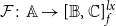 $\mathcal{F}\colon\mathbb{A}\to [\mathbb{B}, \mathbb{C}]_f^{lx}$
of double categories consists merely of two families of lax double functors
$\mathcal{F}\colon\mathbb{A}\to [\mathbb{B}, \mathbb{C}]_f^{lx}$
of double categories consists merely of two families of lax double functors $(-,A)\colon\mathbb{B}\to \mathbb{C}$
and
$(-,A)\colon\mathbb{B}\to \mathbb{C}$
and $(B,-)\colon\mathbb{A}\to \mathbb{C}$
for objects
$(B,-)\colon\mathbb{A}\to \mathbb{C}$
for objects $A\in\mathbb{A}, B\in\mathbb{B}$
, such that
$A\in\mathbb{A}, B\in\mathbb{B}$
, such that $H(A,-)=(-, A), H(-, B)=(B,-)$
and
$H(A,-)=(-, A), H(-, B)=(B,-)$
and $(-,A)\vert_B=(B,-)\vert_A=(B,A)$
. This short data we may call purely (lax) funny functor
$(-,A)\vert_B=(B,-)\vert_A=(B,A)$
. This short data we may call purely (lax) funny functor $\mathbb{A}\times\mathbb{B}\to \mathbb{C}$
of double categories.
$\mathbb{A}\times\mathbb{B}\to \mathbb{C}$
of double categories.
Namely, by substituting strict vertical transformations by unnatural ones, the axioms $(u,u)=\operatorname {Id}$
, ((u,U)-l-nat) and ((u,U)-r-nat) are eliminated. Furthermore, by using purely unnatural transformations, one eliminates square-formed 2-cells and
$(u,u)=\operatorname {Id}$
, ((u,U)-l-nat) and ((u,U)-r-nat) are eliminated. Furthermore, by using purely unnatural transformations, one eliminates square-formed 2-cells and $2+2$
axioms in both directions (h.u.t.- 1), (h.u.t.- 2) and their vertical counterparts) stemming from both variables in a (mixed) funny functor. In total, 11 axioms from the definition of a mixed funny functor are omitted. Consequently, 11 axioms from the definition of the funny product
$2+2$
axioms in both directions (h.u.t.- 1), (h.u.t.- 2) and their vertical counterparts) stemming from both variables in a (mixed) funny functor. In total, 11 axioms from the definition of a mixed funny functor are omitted. Consequently, 11 axioms from the definition of the funny product $\mathbb{A}\Box\mathbb{B}$
are omitted to obtain the purely funny product
$\mathbb{A}\Box\mathbb{B}$
are omitted to obtain the purely funny product $\mathbb{A}\Box_f\mathbb{B}$
. It will have the same generators on objects and 1-cells, but its only generating 2-cells will be
$\mathbb{A}\Box_f\mathbb{B}$
. It will have the same generators on objects and 1-cells, but its only generating 2-cells will be $A\Box_f\omega$
and
$A\Box_f\omega$
and $\zeta\Box_f B$
.
$\zeta\Box_f B$
.
The “pure” versions of bijections (23) and (24) read:
 $$pf\mbox{-}\operatorname {Fun}^*(\mathbb{A}\times\mathbb{B},\mathbb{C})\cong \operatorname {Fun}^*(\mathbb{A}, [\mathbb{B},\mathbb{C}]_f^*) \qquad \text{and}\qquad Dbl(\mathbb{A}\Box_f^*\mathbb{B},\mathbb{C})\cong pf\mbox{-}\operatorname {Fun}^*(\mathbb{A}\times\mathbb{B},\mathbb{C}).$$
Finally, Proposition 5.8 in its “pure” version states:
Proposition 5.11 Let $\mathbb{A},\mathbb{B},\mathbb{C}$
be double categories. The following are equivalent:
$\mathbb{A},\mathbb{B},\mathbb{C}$
be double categories. The following are equivalent:
-
(1)
$H\colon \mathbb{A}\times\mathbb{B}\to \mathbb{C}$
is a lax double purely funny functor, -
(2) there are two families of lax double functors
$(-,A)\colon\mathbb{B}\to \mathbb{C}\quad \text{ and}\quad (B,-)\colon\mathbb{A}\to \mathbb{C}$
for objects
$A\in\mathbb{A}, B\in\mathbb{B}$
, such that
$(-,A)\vert_B=(B,-)\vert_A=(B,A)$
, and the following hold:-
(i)
$(-,K)\colon (-,A)\to (-,A')$
is a horizontal purely unnatural transformation for each 1h-cell
$K\colon A\to A'$
,
$(-,U)\colon (-,A)\to (-,\tilde A)$
is a vertical purely unnatural transformation for each 1v-cell
$U\colon A\to \tilde A$
in
$\mathbb{A}$
,
$(-,\zeta)$
is a purely funny modification for each 2-cell
$\zeta$
in
$\mathbb{A}$
, and the following coincide:
$$(B,-)\vert_K=(-,K)\vert_B, \,\,\,\, (B,-)\vert_U=(-,U)\vert_B, \,\,\,\, (B,-)\vert_\zeta=(-,\zeta)\vert_B;$$
-
(ii)
$(k,-)\colon (B,-)\to (B', -)$
is a horizontal purely unnatural transformation for each 1h-cell
$k\colon B\to B'$
,
$(u,-)\colon (B,-)\to (\tilde B,-)$
is a vertical purely unnatural transformation for each 1v-cell
$u\colon B\to \tilde B$
in
$\mathbb{B}$
,
$(\omega,-)$
is a purely funny modification for each 2-cell
$\omega$
in
$\mathbb{B}$
, and the following coincide:
$$(-,A)\vert_k=(k,-)\vert_A, \,\,\,\, (-,A)\vert_u=(u,-)\vert_A, \,\,\,\, (-,A)\vert_\omega=(\omega,-)\vert_A.$$
-














The meaning of points (i) and (ii) in the above proposition is that the component 1-cells of horizontal and vertical purely unnatural transformations and the component 2-cells of purely funny modifications coincide with the corresponding images of the lax double functors $(-,A)\colon\mathbb{B}\to \mathbb{C}$
and
$(-,A)\colon\mathbb{B}\to \mathbb{C}$
and $(B,-)\colon\mathbb{A}\to \mathbb{C}$
. In particular, the pseudo (double purely funny) version of the proposition with
$(B,-)\colon\mathbb{A}\to \mathbb{C}$
. In particular, the pseudo (double purely funny) version of the proposition with $\mathbb{A}=\mathbb{B}=\mathbb{C}$
implies that in a premonoidal double category in which the binoidal structure comes from a pseudodouble purely funny functor, we have that there exist 1- cells
$\mathbb{A}=\mathbb{B}=\mathbb{C}$
implies that in a premonoidal double category in which the binoidal structure comes from a pseudodouble purely funny functor, we have that there exist 1- cells $-\rtimes k\vert_A:=A\ltimes-\vert_k, \,\,\,\, -\rtimes u\vert_A:=A\ltimes-\vert_u, \quad K\ltimes-\vert_B:=-\rtimes B\vert_K, \,\,\,\, U\ltimes-\vert_B:=-\rtimes B\vert_U$
and 2-cells
$-\rtimes k\vert_A:=A\ltimes-\vert_k, \,\,\,\, -\rtimes u\vert_A:=A\ltimes-\vert_u, \quad K\ltimes-\vert_B:=-\rtimes B\vert_K, \,\,\,\, U\ltimes-\vert_B:=-\rtimes B\vert_U$
and 2-cells $-\rtimes \omega\vert_A:=A\ltimes-\vert_\omega$
and
$-\rtimes \omega\vert_A:=A\ltimes-\vert_\omega$
and $\zeta\ltimes-\vert_B:=-\rtimes B\vert_\zeta$
for which no further laws are required. Then we may conclude:
$\zeta\ltimes-\vert_B:=-\rtimes B\vert_\zeta$
for which no further laws are required. Then we may conclude:
Corollary 5.12. Any binoidal structure in a double category $\mathbb{B}$
is given by a pseudodouble purely funny functor
$\mathbb{B}$
is given by a pseudodouble purely funny functor $H:\mathbb{B}\times\mathbb{B}\to \mathbb{B}$
.
$H:\mathbb{B}\times\mathbb{B}\to \mathbb{B}$
.
5.2 Relation to the funny product for 2-categories
Funny product for 2-categories was studied in Bourke and Gurski (Reference Bourke and Gurski2017, Section 2). Its construction follows an analogous process as our construction of the funny product for double categories, starting from an inner-hom that there was denoted by $[\mathcal{A},\mathcal{B}]_f$
for 2-categories
$[\mathcal{A},\mathcal{B}]_f$
for 2-categories $\mathcal{A},\mathcal{B}$
. The inner-hom
$\mathcal{A},\mathcal{B}$
. The inner-hom $[\mathcal{A},\mathcal{B}]_f$
has for objects 2-functors, for 1-cells transformations (consisting only of 1-cell components subject to no axioms), and for 2-cells modifications (consisting only of 2-cell components subject to no axioms). The obtained funny tensor product there was denoted by
$[\mathcal{A},\mathcal{B}]_f$
has for objects 2-functors, for 1-cells transformations (consisting only of 1-cell components subject to no axioms), and for 2-cells modifications (consisting only of 2-cell components subject to no axioms). The obtained funny tensor product there was denoted by $\mathcal{A}\star\mathcal{B}$
, it satisfies the universal property
$\mathcal{A}\star\mathcal{B}$
, it satisfies the universal property
 $$2\mbox{-}\operatorname {Cat}(\mathcal{A}\star\mathcal{B},\mathcal{C})\cong 2\mbox{-}\operatorname {Cat}(\mathcal{A},[\mathcal{B},\mathcal{C}]_f)$$
and gives a symmetric closed monoidal structure on the category $2\mbox{-}\operatorname {Cat}$
of 2-categories. Analogously as in Subsection 5.1.1, a funny functor
$2\mbox{-}\operatorname {Cat}$
of 2-categories. Analogously as in Subsection 5.1.1, a funny functor $\mathcal{A}\star\mathcal{B}\to \mathcal{C}$
between 2-categories is given merely by a pair of families of 2-functors
$\mathcal{A}\star\mathcal{B}\to \mathcal{C}$
between 2-categories is given merely by a pair of families of 2-functors $(-,A):\mathcal{B}\to \mathcal{C}$
and
$(-,A):\mathcal{B}\to \mathcal{C}$
and $(B,-):\mathcal{A}\to \mathcal{C}$
for
$(B,-):\mathcal{A}\to \mathcal{C}$
for $A\in\mathcal{A},B\in\mathcal{B}$
satisfying
$A\in\mathcal{A},B\in\mathcal{B}$
satisfying $(-,A)_B=(B,-)_A=(B,A)$
. An explicit description of
$(-,A)_B=(B,-)_A=(B,A)$
. An explicit description of $\mathcal{A}\star\mathcal{B}$
can be deduced from our description of
$\mathcal{A}\star\mathcal{B}$
can be deduced from our description of $\mathcal{A}\Box_f\mathcal{B}$
for double categories by considering all vertical 1-cells to be identities. Thus, it is given by the following generators and relations:
$\mathcal{A}\Box_f\mathcal{B}$
for double categories by considering all vertical 1-cells to be identities. Thus, it is given by the following generators and relations:
objects: $A\star B$
for objects
$A\star B$
for objects $A\in\mathcal{A}, B\in\mathcal{B}$
;
$A\in\mathcal{A}, B\in\mathcal{B}$
;
1-cells: $A\star k, K\star B$
, where k is a 1-cell in
$A\star k, K\star B$
, where k is a 1-cell in $\mathcal{B}$
and K a 1-cell in
$\mathcal{B}$
and K a 1-cell in $\mathcal{A}$
;
$\mathcal{A}$
;
2-cells: $A\star\omega, \zeta\star B$
, where
$A\star\omega, \zeta\star B$
, where $\omega$
is a 2-cell in
$\omega$
is a 2-cell in $\mathbb{B}$
and
$\mathbb{B}$
and $\zeta$
a 2-cell in
$\zeta$
a 2-cell in $\mathcal{A}$
;
$\mathcal{A}$
;
four equations from the strictness of double functors $(-,A)$
and
$(-,A)$
and $(B,-)$
:
$(B,-)$
:
 $$(A\star k')(A\star k)= A\star (k' k), \quad (K'\star B)(K\star B)=(K' K)\star B$$
 $$1_{A\star B}= A\star 1_B,\quad 1_{A\star B}= 1_A\star B$$
and the following ones:
 $$A\star \omega'\omega=[A\star\omega \vert A \star \omega'], \quad \zeta'\zeta\star B=[\zeta\star B \vert\zeta' \star B]$$
 $$A\star\frac{\omega}{\omega'}=\frac{A\star\omega}{A\star\omega'}, \quad \frac{\zeta}{\zeta'}\star B=\frac{\zeta\star B}{\zeta'\star B},$$
 $$A\star\operatorname {Id}_k=\operatorname {Id}_{A\star k}, \quad \operatorname {Id}_K\star B=\operatorname {Id}_{K\star B}.$$
Likewise, the funny product on morphisms, i.e., on 2-functors, is defined by $(F\star G)(a\star b)=F(a)\star G(b)$
for sensible cells
$(F\star G)(a\star b)=F(a)\star G(b)$
for sensible cells $a\star b\in\mathcal{A}\star\mathcal{B}$
. This way we have a functor
$a\star b\in\mathcal{A}\star\mathcal{B}$
. This way we have a functor $-\star-:2\mbox{-}\operatorname {Cat}\times 2\mbox{-}\operatorname {Cat}\to 2\mbox{-}\operatorname {Cat}$
. Inspecting the above generators of
$-\star-:2\mbox{-}\operatorname {Cat}\times 2\mbox{-}\operatorname {Cat}\to 2\mbox{-}\operatorname {Cat}$
. Inspecting the above generators of $\mathcal{A}\star\mathcal{B}$
we see that
$\mathcal{A}\star\mathcal{B}$
we see that $F\star G$
is indeed given by a pair of families of 2-functors
$F\star G$
is indeed given by a pair of families of 2-functors $F\star G(B), F(A)\star G$
for objects
$F\star G(B), F(A)\star G$
for objects $A\in\mathcal{A}, B\in\mathcal{B}$
.
$A\in\mathcal{A}, B\in\mathcal{B}$
.
Our purely funny product of double categories $\mathbb{A}\Box_f\mathbb{B}$
is such that there is a monoidal embedding
$\mathbb{A}\Box_f\mathbb{B}$
is such that there is a monoidal embedding $(2\mbox{-}\operatorname {Cat}, \star)\hookrightarrow(Dbl, \Box_f)$
.
$(2\mbox{-}\operatorname {Cat}, \star)\hookrightarrow(Dbl, \Box_f)$
.
Remark 5.13. The double functors $F\Box G$
from Remark 5.6 and
$F\Box G$
from Remark 5.6 and $F\star G$
from above live in the categories Dbl and
$F\star G$
from above live in the categories Dbl and $2\mbox{-}\operatorname {Cat}$
, respectively, and are given by families of double (resp. 2-) functors
$2\mbox{-}\operatorname {Cat}$
, respectively, and are given by families of double (resp. 2-) functors $F\star G(B), F(A)\star G$
for the respective objects A, B. This should not be confused with the following.
$F\star G(B), F(A)\star G$
for the respective objects A, B. This should not be confused with the following.
Consider the 2-category of 2-categories $(2\mbox{-}\operatorname {Cat})_2$
and the 2-category
$(2\mbox{-}\operatorname {Cat})_2$
and the 2-category $Dbl_\bullet$
of double categories, double functors and some
$Dbl_\bullet$
of double categories, double functors and some $\bullet$
-type of vertical transformations.
$\bullet$
-type of vertical transformations.
By the generators of the funny product 2-category $(2\mbox{-}\operatorname {Cat})_2\star(2\mbox{-}\operatorname {Cat})_2$
, for 2-functors F,G, i.e. 1-cells in
$(2\mbox{-}\operatorname {Cat})_2\star(2\mbox{-}\operatorname {Cat})_2$
, for 2-functors F,G, i.e. 1-cells in $(2\mbox{-}\operatorname {Cat})_2$
, there is no valid 1-cell
$(2\mbox{-}\operatorname {Cat})_2$
, there is no valid 1-cell $F\star G$
living in
$F\star G$
living in $(2\mbox{-}\operatorname {Cat})_2\star(2\mbox{-}\operatorname {Cat})_2$
. Rather, there are only 1-cells of the form
$(2\mbox{-}\operatorname {Cat})_2\star(2\mbox{-}\operatorname {Cat})_2$
. Rather, there are only 1-cells of the form $F\star\mathcal{B}$
and
$F\star\mathcal{B}$
and $\mathcal{A}\star G$
for 2-categories
$\mathcal{A}\star G$
for 2-categories $\mathcal{A}$
and
$\mathcal{A}$
and $\mathcal{B}$
.
$\mathcal{B}$
.
Similarly, in the funny product 2-category $Dbl_\bullet\star Dbl_\bullet$
if we set
$Dbl_\bullet\star Dbl_\bullet$
if we set $\mathbb{A}\star\mathbb{B}:=\mathbb{A}\Box_f\mathbb{B}$
on the objects, the purely funny product of double categories, the only valid 1-cells are of the form
$\mathbb{A}\star\mathbb{B}:=\mathbb{A}\Box_f\mathbb{B}$
on the objects, the purely funny product of double categories, the only valid 1-cells are of the form $F\star\mathbb{B}:=F\Box_f \operatorname {Id}_\mathbb{B}: \mathbb{A}\Box_f\mathbb{B}\to \mathbb{A}'\Box_f\mathbb{B}$
and
$F\star\mathbb{B}:=F\Box_f \operatorname {Id}_\mathbb{B}: \mathbb{A}\Box_f\mathbb{B}\to \mathbb{A}'\Box_f\mathbb{B}$
and $\mathbb{A}\star G:=\operatorname {Id}_\mathbb{A}\Box_f G:\mathbb{A}\Box_f\mathbb{B}\to \mathbb{A}\Box_f\mathbb{B}'$
, where the latter are defined similarly as in Remark 5.6. Namely, the former is given by the pairs of double functors
$\mathbb{A}\star G:=\operatorname {Id}_\mathbb{A}\Box_f G:\mathbb{A}\Box_f\mathbb{B}\to \mathbb{A}\Box_f\mathbb{B}'$
, where the latter are defined similarly as in Remark 5.6. Namely, the former is given by the pairs of double functors $F(A)\Box_f-, F(-)\Box_f B$
, and the latter by the pairs
$F(A)\Box_f-, F(-)\Box_f B$
, and the latter by the pairs $A\Box_f G(-), -\Box_f G(B)$
.
$A\Box_f G(-), -\Box_f G(B)$
.
However, had we set $\mathbb{A}\star\mathbb{B}:=\mathbb{A}\Box\mathbb{B}$
(the mixed funny product of double categories) on the objects in the funny product 2-category
$\mathbb{A}\star\mathbb{B}:=\mathbb{A}\Box\mathbb{B}$
(the mixed funny product of double categories) on the objects in the funny product 2-category $Dbl_\bullet\star Dbl_\bullet$
, the 1-cells would be of the form
$Dbl_\bullet\star Dbl_\bullet$
, the 1-cells would be of the form $F\star\mathbb{B}:=F\Box\operatorname {Id}_\mathbb{B}$
and
$F\star\mathbb{B}:=F\Box\operatorname {Id}_\mathbb{B}$
and $\mathbb{A}\star G:=\operatorname {Id}_\mathbb{A}\Box G$
, defined in Remark 5.6. That is, the former is given by the pairs of double functors
$\mathbb{A}\star G:=\operatorname {Id}_\mathbb{A}\Box G$
, defined in Remark 5.6. That is, the former is given by the pairs of double functors $F(A)\Box-, F(-)\Box B$
and three families of 2-cells
$F(A)\Box-, F(-)\Box B$
and three families of 2-cells $(u,K):=F(K)\Box u, \, \, (k,U):=F(k)\Box U, \,\, (u,U):=F(U)\Box u$
obeying the eleven axioms (16) – (18), and the latter is given by the pairs
$(u,K):=F(K)\Box u, \, \, (k,U):=F(k)\Box U, \,\, (u,U):=F(U)\Box u$
obeying the eleven axioms (16) – (18), and the latter is given by the pairs $A\Box G(-), -\Box G(B)$
and three families of 2-cells
$A\Box G(-), -\Box G(B)$
and three families of 2-cells $(u,K):=K\Box G(u), \, \, (k,U):=k\Box G(U), \,\, (u,U):=U\Box G(u)$
satisfying the eleven axioms.
$(u,K):=K\Box G(u), \, \, (k,U):=k\Box G(U), \,\, (u,U):=U\Box G(u)$
satisfying the eleven axioms.
5.3. Multicategories induced by funny functors
It was shown in Hermida (Reference Hermida2000, Theorem 9.8) that monoidal categories are in 1-1 correspondence with representable multicategories. We remind the reader of the notion of a representable multicategory.
Definition 5.14. A multicategory consists of:
-
• a collection of objects,
-
• for each list of objects
$a_1,...,a_n$
for
$n\geq 0$
and an object b, a set
$\mathcal{M}_n(a_1,...,a_n;b)$
, -
• for each object a an element
$1_a\in\mathcal{M}_1(a;a)$
, -
• for all lists
$\overline{a_i}, i=1,...,n$
, and objects
$b_1,...,b_n$
and c a function, called substitution:
$$\mathcal{M}_n(b_1,...,b_n,c)\times\Pi_{j=1}^{n}\mathcal{M}_{k_i}(\overline{a_i};b_i)\to \mathcal{M}_{\sum_{i=1}^n k_i}(\overline{a_1},...,\overline{a_n};\;c)$$
satisfying a natural associativity and two identity axioms. Here
$$(g, f_1,...,f_n)\mapsto g\circ(f_1,...,f_n)$$
$\overline{a_i}$
is a short annotation for a list of objects, and the elements of
$\mathcal{M}_n(a_1,...,a_n;b)$
are called multimaps.






Definition 5.15. A multicategory $\mathcal{M}$
is said to be representable if for any list of objects
$\mathcal{M}$
is said to be representable if for any list of objects $\overline a=a_1,..,a_n$
there exists an object
$\overline a=a_1,..,a_n$
there exists an object $m(a_1,..,a_n)$
and a multimap
$m(a_1,..,a_n)$
and a multimap $j_{\overline a}:a_1,..,a_n\to m(a_1,..,a_n)$
that for every object c and lists
$j_{\overline a}:a_1,..,a_n\to m(a_1,..,a_n)$
that for every object c and lists $\overline x, \overline b$
(of lengths k and l, respectively) induces bijections
$\overline x, \overline b$
(of lengths k and l, respectively) induces bijections
 $$\mathcal{M}_1(m(a_1,..,a_n);\;c)\to \mathcal{M}_n(a_1,..,a_n;\;c)$$
and
 $$\mathcal{M}_{k+1+l}(\overline x,m(a_1,..,a_n),\overline b;\;c)\to \mathcal{M}_{k+n+l}(\overline x,a_1,..,a_n,\overline b;\;c).$$
We also recall when a multicategory is closed.
Definition 5.16. A multicategory $\mathcal{M}$
is said to be left closed if for all objects b,c there is an object [b,c] and a binary map
$\mathcal{M}$
is said to be left closed if for all objects b,c there is an object [b,c] and a binary map $e_{b,c}:[b,c], b\to c$
so that the induced functions
$e_{b,c}:[b,c], b\to c$
so that the induced functions $\mathcal{M}_n(\overline a;[b,c])\to \mathcal{M}_{n+1}(\overline a,b;\;c)$
are bijections for all
$\mathcal{M}_n(\overline a;[b,c])\to \mathcal{M}_{n+1}(\overline a,b;\;c)$
are bijections for all $n\geq 0$
. If there exists an object
$n\geq 0$
. If there exists an object $\{b,c\}$
and a binary map
$\{b,c\}$
and a binary map $\overline{e_{b,c}}:b,\{b,c\}\to c$
for which the induced functions
$\overline{e_{b,c}}:b,\{b,c\}\to c$
for which the induced functions $\mathcal{M}_n(\overline a;\{b,c\})\to \mathcal{M}_{n+1}(b,\overline a;\;c)$
are bijections for all
$\mathcal{M}_n(\overline a;\{b,c\})\to \mathcal{M}_{n+1}(b,\overline a;\;c)$
are bijections for all $n\geq 0$
, then
$n\geq 0$
, then $\mathcal{M}$
is said to be right closed.
$\mathcal{M}$
is said to be right closed. $\mathcal{M}$
is called biclosed if it is both left and right closed.
$\mathcal{M}$
is called biclosed if it is both left and right closed.
We are going to show that (both purely and mixed) funny functors make multimaps for a multicategory. Moreover, these multicategories will be represented by their respective funny types of product. In the first six subsections of Subsection 5.3, we will study the mixed funny case leading to the (mixed) funny monoidal product $\Box$
, omitting the adjective mixed for simplicity. In Subsection 5.3.8, we will briefly record the corresponding results for the purely funny case of
$\Box$
, omitting the adjective mixed for simplicity. In Subsection 5.3.8, we will briefly record the corresponding results for the purely funny case of $\Box_f$
. The constructions that follow are a funny version of the construction that we carried out in Femić (Reference Femić2024) with quasi-functors for double categories.
$\Box_f$
. The constructions that follow are a funny version of the construction that we carried out in Femić (Reference Femić2024) with quasi-functors for double categories.
5.3.1. Ternary and n-ary (lax) double funny functors: constructing a multicategory
Analogously as we do in the next definition for double categories, one can define funny functors of more than two variables for categories and 2-categories.
Definition 5.17. A lax double funny functor of n-variables $H:\mathbb{A}_1\times...\times\mathbb{A}_n\to \mathbb{C}$
for
$H:\mathbb{A}_1\times...\times\mathbb{A}_n\to \mathbb{C}$
for $n\geq 2$
consists of binary lax double funny functors
$n\geq 2$
consists of binary lax double funny functors
 $$H(A_1,...,A_{i-1},\, -,\, A_{i+1},...,A_{j-1}, \, -,\, A_{j+1},..., A_n): \mathbb{A}_i\times\mathbb{A}_j\to \mathbb{C}$$
for all $i<j$
and all choices of objects
$i<j$
and all choices of objects $A_l\in\mathbb{A}_l, l=1,...,n$
, which agree on objects as lax double functors of 1-variable (that is, they give unambiguous lax double functors
$A_l\in\mathbb{A}_l, l=1,...,n$
, which agree on objects as lax double functors of 1-variable (that is, they give unambiguous lax double functors
 $$H(A_1,...,A_{i-1},\, -,\,A_{i+1},..., A_n): \mathbb{A}_i\to \mathbb{C}$$
for all $i=1,...,n$
), and satisfy the axioms:
$i=1,...,n$
), and satisfy the axioms:
(u,v,h)

for $(u,v,h):(A,B,C)\to (\tilde A,\tilde B,C')$
in
$(u,v,h):(A,B,C)\to (\tilde A,\tilde B,C')$
in $\mathbb{A}_i\times\mathbb{A}_j\times\mathbb{A}_k$
, whereby we omit writing the rest of the
$\mathbb{A}_i\times\mathbb{A}_j\times\mathbb{A}_k$
, whereby we omit writing the rest of the $n\mbox{-} 3$
variables, and 2 similar axioms: (u,g,z) for
$n\mbox{-} 3$
variables, and 2 similar axioms: (u,g,z) for $(u,g,z):(A,B,C)\to (\tilde A,B',\tilde C)$
and (f,v,z) for
$(u,g,z):(A,B,C)\to (\tilde A,B',\tilde C)$
and (f,v,z) for $(f,v,z):(A,B,C)\to (A',\tilde B,C')$
, where f,g,h are 1h-cells and u,v,z are 1v-cells, as usual.
$(f,v,z):(A,B,C)\to (A',\tilde B,C')$
, where f,g,h are 1h-cells and u,v,z are 1v-cells, as usual.
We illustrate the condition that the underlying funny functors of 2-variables give unambiguous lax double functors of 1-variables in the example of ternary funny functors $H:\mathbb{A}\times\mathbb{B}\times\mathbb{C}\to \mathbb{D}$
. This means:
$H:\mathbb{A}\times\mathbb{B}\times\mathbb{C}\to \mathbb{D}$
. This means:
 \begin{equation} H(A,-,-)\vert_B=H(-,B,-)\vert_A, H(A,-,-)\vert_C=H(-,-,C)\vert_A, H(-,B,-)\vert_C=H(-,-,C)\vert_B\end{equation}
for $A\in\mathbb{A},B\in\mathbb{B},C\in\mathbb{C}$
. The above definition can be restated so that an n-ary lax double funny functor consists of lax double funny functors of
$A\in\mathbb{A},B\in\mathbb{B},C\in\mathbb{C}$
. The above definition can be restated so that an n-ary lax double funny functor consists of lax double funny functors of $(n\mbox{-} 1)$
-variables (and hence also of k-variables for all
$(n\mbox{-} 1)$
-variables (and hence also of k-variables for all $2\leq k<n$
) that for any choice of three variables satisfy the condition (26). We will sometimes refer to the latter condition as the ternary funny property (with functorialities in the third, second and first variable, respectively.
$2\leq k<n$
) that for any choice of three variables satisfy the condition (26). We will sometimes refer to the latter condition as the ternary funny property (with functorialities in the third, second and first variable, respectively.
It is clear from the definition that any kind of double funny functors $H:\mathbb{A}_1\times...\times\mathbb{A}_n\to \mathbb{C}$
for
$H:\mathbb{A}_1\times...\times\mathbb{A}_n\to \mathbb{C}$
for $n\geq 2$
of double categories are not double functors defined on
$n\geq 2$
of double categories are not double functors defined on $\mathbb{A}_1\times...\times\mathbb{A}_n$
. Loosely speaking, they are only defined on cells
$\mathbb{A}_1\times...\times\mathbb{A}_n$
. Loosely speaking, they are only defined on cells $(a_1,...,a_n)\in\mathbb{A}_1\times...\times\mathbb{A}_n$
whereby either all
$(a_1,...,a_n)\in\mathbb{A}_1\times...\times\mathbb{A}_n$
whereby either all $a_i$
are objects, or at most two of them are simultaneously 1-cells (in which case one is a 1h-cell and another a 1v-cell) or a single
$a_i$
are objects, or at most two of them are simultaneously 1-cells (in which case one is a 1h-cell and another a 1v-cell) or a single $a_i$
is a 2-cell, whereas the rest are objects.
$a_i$
is a 2-cell, whereas the rest are objects.
Let us now introduce the sets of multimaps for our multicategory of funny type for double categories. For the class of nullary maps $\mathcal{M}_0^*(-;\mathbb{A})$
, we set the set of objects of
$\mathcal{M}_0^*(-;\mathbb{A})$
, we set the set of objects of $\mathbb{A}$
, and for unary maps we set
$\mathbb{A}$
, and for unary maps we set $\mathcal{M}_1^*(\mathbb{A};\;\mathbb{B})=\operatorname {Fun}^*(\mathbb{A},\mathbb{B})$
. For the class of n-ary multimaps, we set
$\mathcal{M}_1^*(\mathbb{A};\;\mathbb{B})=\operatorname {Fun}^*(\mathbb{A},\mathbb{B})$
. For the class of n-ary multimaps, we set $\mathcal{M}_n^*(\mathbb{A}_1,...,\mathbb{A}_n;\mathbb{C})=f_n\mbox{-}\operatorname {Fun}^*(\mathbb{A}_1\times...\times\mathbb{A}_n,\mathbb{C})$
, the set of double funny functors of type
$\mathcal{M}_n^*(\mathbb{A}_1,...,\mathbb{A}_n;\mathbb{C})=f_n\mbox{-}\operatorname {Fun}^*(\mathbb{A}_1\times...\times\mathbb{A}_n,\mathbb{C})$
, the set of double funny functors of type $*$
of n-variables.
$*$
of n-variables.
5.3.2 Substitution
We now define substitutions. Let $F^n:\mathbb{A}_1\times...\times\mathbb{A}_n\to \mathbb{B}$
denote a funny functor for
$F^n:\mathbb{A}_1\times...\times\mathbb{A}_n\to \mathbb{B}$
denote a funny functor for $n\geq 2$
, nullary for
$n\geq 2$
, nullary for $n=0$
, or unary for
$n=0$
, or unary for $n=1$
. We separate the two extreme cases:
$n=1$
. We separate the two extreme cases:
-
• for a unary map
$G^1:\mathbb{B}\to \mathbb{C}$
and
$n\geq 0$
, we clearly have that
$G^1\circ F^n$
is of the same kind as
$F^n$
; -
• for
$n\geq 2, k\leq n$
, we set
$F^n\circ_k A_k = F^n(...,A_k,...)$
, which is the k-th
$(n\mbox{-} 1)$
-ary multimap constituting
$F^n$
, where
$A_k$
denotes the nullary multimap
$(-)\to \mathbb{A}_k$
picking up the object
$A_k$
.





In general, for $n\geq 1, m\geq 0$
,
$n\geq 1, m\geq 0$
, $F^n$
as above and
$F^n$
as above and $F^m:\mathbb{B}_1\times...\times\mathbb{B}_m\to \mathbb{A}_k$
, we set
$F^m:\mathbb{B}_1\times...\times\mathbb{B}_m\to \mathbb{A}_k$
, we set
 $$F^n\circ_k F^m(a_1,...a_{k-1}, b_1,...,b_m, a_{k+1},...,a_n)=F^n(a_1,...a_{k-1}, F^m(b_1,...,b_m),a_{k+1},...,a_n)$$
for any sensible combination of cells $(a_1,...,a_n, b_1,..,b_m)\in\mathbb{A}_1\times...\times\mathbb{A}_n\times\mathbb{B}_1\times...\times\mathbb{B}_m$
. When
$(a_1,...,a_n, b_1,..,b_m)\in\mathbb{A}_1\times...\times\mathbb{A}_n\times\mathbb{B}_1\times...\times\mathbb{B}_m$
. When $m=1$
and
$m=1$
and $n\geq 2$
,
$n\geq 2$
, $F^n\circ_k F^1$
is a funny functor because so is
$F^n\circ_k F^1$
is a funny functor because so is $F^n$
. For the rest of the cases, that is for
$F^n$
. For the rest of the cases, that is for $n,m\geq 2$
, it remains to prove that
$n,m\geq 2$
, it remains to prove that $F^n\circ_k F^m$
gives an
$F^n\circ_k F^m$
gives an $(n+m-1)$
-ary multimap. More generally, we prove Proposition 5.19. For that we will need:
$(n+m-1)$
-ary multimap. More generally, we prove Proposition 5.19. For that we will need:
Lemma 5.18. Let $F_1,F_2,F_3$
be unary double functors.
$F_1,F_2,F_3$
be unary double functors.
-
(1) For a binary funny functor G the composite
$G(F_1(\!-\!),F_2(\!-\!))$
is a binary funny functor. -
(2) For a ternary funny functor G the composite
$G(F_1(\!-\!),F_2(\!-\!),F_3(\!-\!))$
is a ternary funny functor.


All $F_i$
’s and G’s are considered to be of the same type
$F_i$
’s and G’s are considered to be of the same type $*$
.
$*$
.
Proof. The agreement-on-objects binary property of $G(F_1(-),F_2(-))$
holds by that property of G, as
$G(F_1(-),F_2(-))$
holds by that property of G, as $G(F_1(A),F_2(-))\vert_B=G(\overline A, -)\vert_{\overline B}=G(-,\overline B)\vert_{\overline A}=G(F_1(-),F_2(B))\vert_A$
, where
$G(F_1(A),F_2(-))\vert_B=G(\overline A, -)\vert_{\overline B}=G(-,\overline B)\vert_{\overline A}=G(F_1(-),F_2(B))\vert_A$
, where $\overline A=F_1(A)$
and
$\overline A=F_1(A)$
and $\overline B=F_2(B)$
. If
$\overline B=F_2(B)$
. If $F_1$
and
$F_1$
and $F_2$
are strict double functors, we can say that the binary axioms for the composite hold because they hold for G. For non-strict
$F_2$
are strict double functors, we can say that the binary axioms for the composite hold because they hold for G. For non-strict $F_i$
’s first observe that
$F_i$
’s first observe that $G(F_1(V),F_2(v))=G(U,u)=\operatorname {Id}$
. The remaining 10 axioms of the funny functor property of
$G(F_1(V),F_2(v))=G(U,u)=\operatorname {Id}$
. The remaining 10 axioms of the funny functor property of $G(F_1(-),F_2(-))$
correspond to the
$G(F_1(-),F_2(-))$
correspond to the $2+2$
axioms of the horizontal unnatural transformations
$2+2$
axioms of the horizontal unnatural transformations $G(K,-)=G(F_1(L),-)$
and
$G(K,-)=G(F_1(L),-)$
and $G(-,k)=G(-,F_2(l))$
and
$G(-,k)=G(-,F_2(l))$
and $3+3$
axioms of the vertical strict transformations
$3+3$
axioms of the vertical strict transformations $G(-,u)=G(-,F_2(v))$
and
$G(-,u)=G(-,F_2(v))$
and $G(U,-)=G(F_1(V),-)$
, recall (i) and (ii) of Proposition 5.8. We used notations k,K,l,L and u,U,v,V for the corresponding 1h- and 1v-cells, respectively.
$G(U,-)=G(F_1(V),-)$
, recall (i) and (ii) of Proposition 5.8. We used notations k,K,l,L and u,U,v,V for the corresponding 1h- and 1v-cells, respectively.
That $G(F_1(-),F_2(-),F_3(-))$
is given by three binary funny functors follows from part 1. For (26) it is sufficient to prove functoriality at any, say first, variable. The question
$G(F_1(-),F_2(-),F_3(-))$
is given by three binary funny functors follows from part 1. For (26) it is sufficient to prove functoriality at any, say first, variable. The question $G(F_1(-), F_2(B),F_3(-))_C=G(F_1(-),F_2(-),F_3(C))_B$
we can rewrite as
$G(F_1(-), F_2(B),F_3(-))_C=G(F_1(-),F_2(-),F_3(C))_B$
we can rewrite as $G(F_1(-),\overline B,-)_{\overline C}=G(F_1(-), -,\overline C)_{\overline B}$
, which is the same property for the ternary functor
$G(F_1(-),\overline B,-)_{\overline C}=G(F_1(-), -,\overline C)_{\overline B}$
, which is the same property for the ternary functor $G(F_1(-),-,-)$
. The latter is indeed a ternary funny functor as it is given by binary funny functors in the first and any other variable by part 1. (and it was already binary funny in the last two variables).
$G(F_1(-),-,-)$
. The latter is indeed a ternary funny functor as it is given by binary funny functors in the first and any other variable by part 1. (and it was already binary funny in the last two variables).
Ternary axioms for $G(F_1(-),F_2(-),F_3(-))$
hold because they hold for G.
$G(F_1(-),F_2(-),F_3(-))$
hold because they hold for G.
Proposition 5.19. Given lax double unary or funny functors $F_i:\mathbb{A}_{i1}\times...\times\mathbb{A}_{im_i}\to \mathbb{B}_i$
of
$F_i:\mathbb{A}_{i1}\times...\times\mathbb{A}_{im_i}\to \mathbb{B}_i$
of $m_i$
-variables with
$m_i$
-variables with $i=1,...,n, m_i\geq 1,n\geq 2$
and a lax double funny functor
$i=1,...,n, m_i\geq 1,n\geq 2$
and a lax double funny functor $G:\mathbb{B}_1\times...\times\mathbb{B}_n\to \mathbb{C}$
of n-variables. Then the composition
$G:\mathbb{B}_1\times...\times\mathbb{B}_n\to \mathbb{C}$
of n-variables. Then the composition
 $$\Pi_{j=1}^{m_1}\mathbb{A}_{1j}\times...\times\Pi_{j=1}^{m_n}\mathbb{A}_{nj}\stackrel{F_1\times...\times F_n}{\longrightarrow}\mathbb{B}_1\times...\times\mathbb{B}_n\stackrel{G}{\to }\mathbb{C}$$
is a lax double funny functor of $m_1+..+m_n$
-variables.
$m_1+..+m_n$
-variables.
Proof. We should check that $G(F_1\times...\times F_n)$
gives binary funny functors for any choice of two variables, and ternary funny functors for any choice of three variables. We can examine the binary funny property, without loss of generality, for the composite of the form
$G(F_1\times...\times F_n)$
gives binary funny functors for any choice of two variables, and ternary funny functors for any choice of three variables. We can examine the binary funny property, without loss of generality, for the composite of the form $G(U_1(-), U_2(-),F_1(-,-), F_2(-,-))$
for unary lax double functors
$G(U_1(-), U_2(-),F_1(-,-), F_2(-,-))$
for unary lax double functors $U_1,U_2$
. It is binary in the first two variables by Lemma 5.18, and in the two variables of each
$U_1,U_2$
. It is binary in the first two variables by Lemma 5.18, and in the two variables of each $F_i, i=1,2$
since so is
$F_i, i=1,2$
since so is $F_i$
. It suffices thus to consider
$F_i$
. It suffices thus to consider $G(U_1(-),F_1(A,-))$
and
$G(U_1(-),F_1(A,-))$
and $G(F_1(A,-),F_2(C,-))$
, without loss of generality. But these are binary funny functors again by Lemma 5.18.
$G(F_1(A,-),F_2(C,-))$
, without loss of generality. But these are binary funny functors again by Lemma 5.18.
For the ternary funny property and axioms, we can assume that neither of the $F_i$
’s has more than two variables (the contrary would only be interesting to study if all the three variables of the composite in which we wish to check the ternary funny property live in a ternary
$F_i$
’s has more than two variables (the contrary would only be interesting to study if all the three variables of the composite in which we wish to check the ternary funny property live in a ternary $F_i$
, but in that case we are done, by the property of that
$F_i$
, but in that case we are done, by the property of that $F_i$
). Also, we can assume that there are at most two unary
$F_i$
). Also, we can assume that there are at most two unary $U_i$
’s, since the ternary funny property of the composite in the variables of three unary
$U_i$
’s, since the ternary funny property of the composite in the variables of three unary $U_i$
’s would hold by the part 2. of Lemma 5.18 in those variables. Then we are left with the cases: 1)
$U_i$
’s would hold by the part 2. of Lemma 5.18 in those variables. Then we are left with the cases: 1) $G(U_1(-),U_2(-),F(-,D))$
, 2)
$G(U_1(-),U_2(-),F(-,D))$
, 2) $G(U(-), F_1(-,X), F_2(-,Y))$
, 3)
$G(U(-), F_1(-,X), F_2(-,Y))$
, 3) $G(U(-), F(-,-))$
, 4)
$G(U(-), F(-,-))$
, 4) $G(F_1(-,X), F_2(-,Y),F_3(-,Z))$
and 5)
$G(F_1(-,X), F_2(-,Y),F_3(-,Z))$
and 5) $G(F_1(-,-), F_2(-,X))$
. The cases 1), 2) and 4) hold by the part 2. of Lemma 5.18. The cases 3) and 5) are actually of the same type: they both consist of a unary and a binary funny functor. Let us discuss 3). Functoriality in the first variable in the ternary funny condition holds by the binary funny property of
$G(F_1(-,-), F_2(-,X))$
. The cases 1), 2) and 4) hold by the part 2. of Lemma 5.18. The cases 3) and 5) are actually of the same type: they both consist of a unary and a binary funny functor. Let us discuss 3). Functoriality in the first variable in the ternary funny condition holds by the binary funny property of $F(-,-)$
. Functoriality in the second or third variable is the only one where there’s more work to be done. We check one of them: to see if
$F(-,-)$
. Functoriality in the second or third variable is the only one where there’s more work to be done. We check one of them: to see if $G(U(A), F(-,-))\vert_B=G(U(-), F(B,-))\vert_A$
as unary functors, we evaluate them at cells
$G(U(A), F(-,-))\vert_B=G(U(-), F(B,-))\vert_A$
as unary functors, we evaluate them at cells $c\in\mathbb{C}$
of different order. So we need to check the equality:
$c\in\mathbb{C}$
of different order. So we need to check the equality:
 $$(G(U(A), F(-,-))\vert_B)_{\displaystyle{\vert_c}}=(G(U(-), F(B,-))\vert_A)_{\displaystyle{\vert_c}}.$$
We have $(G(U(A), F(-,-))\vert_B)_{\displaystyle{\vert_c}}=G(U(A), F(-,-)\vert_{(B,c)})\stackrel{*}{=}G(U(-), F(B,c))\vert_A$
and
$(G(U(A), F(-,-))\vert_B)_{\displaystyle{\vert_c}}=G(U(A), F(-,-)\vert_{(B,c)})\stackrel{*}{=}G(U(-), F(B,c))\vert_A$
and $(G(U(-), F(B,-))\vert_A)_{\displaystyle{\vert_c}}\stackrel{*}{=}G(U(-), F(B,-)\vert_c)\vert_A$
. Observe that
$(G(U(-), F(B,-))\vert_A)_{\displaystyle{\vert_c}}\stackrel{*}{=}G(U(-), F(B,-)\vert_c)\vert_A$
. Observe that $F(B,-)\vert_c=F(B,c)$
and both equalities marked by
$F(B,-)\vert_c=F(B,c)$
and both equalities marked by $*$
hold true by the coincidences in (ii) of Proposition 5.8 for the binary funny functors F,
$*$
hold true by the coincidences in (ii) of Proposition 5.8 for the binary funny functors F, $G(U(-),-)$
(with
$G(U(-),-)$
(with $\overline b=F(B,c)$
) and
$\overline b=F(B,c)$
) and $G(U(-),F(B,-))$
, respectively, if c is any 1-cell or a 2-cell, whereas if c is an object they are true by the agreement-on-objects of the named binary funny functors.
$G(U(-),F(B,-))$
, respectively, if c is any 1-cell or a 2-cell, whereas if c is an object they are true by the agreement-on-objects of the named binary funny functors.
It remains to verify the ternary axioms. Observe that the three axioms correspond to saying that the following are mixed funny modifications: $(-,v,h)$
(or
$(-,v,h)$
(or $(u,-,h)$
) - the first axiom,
$(u,-,h)$
) - the first axiom, $(-,g,z)$
(or
$(-,g,z)$
(or $(u,g,-)$
) - the second, and
$(u,g,-)$
) - the second, and $(f,-,z)$
(or
$(f,-,z)$
(or $(f,v,-)$
) - the third, with usual notations. The first and second are true for
$(f,v,-)$
) - the third, with usual notations. The first and second are true for $G(U(-), F(-,-))$
by Proposition 5.8, as F(v,h) and F(g,z) are 2-cells. (Similarly, the second and third are true for
$G(U(-), F(-,-))$
by Proposition 5.8, as F(v,h) and F(g,z) are 2-cells. (Similarly, the second and third are true for $G(F_1(-,-), F_2(-,X))$
of case 5), since
$G(F_1(-,-), F_2(-,X))$
of case 5), since $F_1(u,g)$
and
$F_1(u,g)$
and $F_1(f,v)$
are 2-cells.) Instead of realizing
$F_1(f,v)$
are 2-cells.) Instead of realizing $(f,-,z)$
as a mixed funny modification in the case of
$(f,-,z)$
as a mixed funny modification in the case of $G(U(-), F(-,-))$
, the third axiom we may write as the identity
$G(U(-), F(-,-))$
, the third axiom we may write as the identity $\frac{(f,B,z)}{(f,v,\tilde C)}=\frac{(f,v,C)}{(f,\tilde B, z)}$
and check if
$\frac{(f,B,z)}{(f,v,\tilde C)}=\frac{(f,v,C)}{(f,\tilde B, z)}$
and check if $\frac{G(U(f),F(B,z))}{G(U(f),F(v,\tilde C))}=\frac{G(U(f),F(v,C))}{G(U(f),F(\tilde B, z))}$
holds. By the axiom ((
$\frac{G(U(f),F(B,z))}{G(U(f),F(v,\tilde C))}=\frac{G(U(f),F(v,C))}{G(U(f),F(\tilde B, z))}$
holds. By the axiom (( $k,\frac{U}{U'}$
)) for G it can be restated as
$k,\frac{U}{U'}$
)) for G it can be restated as $G(U(f),\frac{F(B,z)}{F(v,\tilde C)})=G(U(f),\frac{F(v,C)}{F(\tilde B, z)})$
, but we know this is true, because the two fractions involving the double funny functor F are equal by the identity
$G(U(f),\frac{F(B,z)}{F(v,\tilde C)})=G(U(f),\frac{F(v,C)}{F(\tilde B, z)})$
, but we know this is true, because the two fractions involving the double funny functor F are equal by the identity $(u,U)=\operatorname {Id}$
for the double funny functor F.
$(u,U)=\operatorname {Id}$
for the double funny functor F.
For the associativity of the substitution we find the following. Let us first discuss the cases involving nullary maps.
-
• When only nullary maps are composed into an n-ary multimap
$F^n$
with
$n\geq 2$
at any two variables, the associativity holds by the binary property of
$F^2$
and the ternary property (26) of
$F^n$
for higher n that includes those two variables. -
• When a nullary and an m-ary multimap with
$m\geq 1$
are composed into
$F^n$
, the reasoning for the associativity is similar, whereby one also applies the coincidences (i)-(iii) of Proposition 5.8. -
• Another associativity that involves nullary maps is when a nullary map
$A_k$
is substituted into an m-ary and their composite is substituted into an n-ary multimap, with
$m,n\geq 1$
. This associativity is proved in the same way as the latter one: (27)
\begin{equation} F^n(...,F^m(...,A_k,...)...)=F^n(...,F^m(...,-,...)...)\vert_{(...,(...,A_k,...),...}.\end{equation}


To analyze the other multimaps, take double funny functors $F^n, F^m, F^r$
of arities n,m,r, respectively, then we wonder if
$F^n, F^m, F^r$
of arities n,m,r, respectively, then we wonder if $(F^n\circ_i F^m)\circ_{l+i-1} F^r=F^n\circ_i (F^m\circ_l F^r)$
as double funny functors with
$(F^n\circ_i F^m)\circ_{l+i-1} F^r=F^n\circ_i (F^m\circ_l F^r)$
as double funny functors with $l\leq m$
. Another case of associativity that can occur is that one substitutes
$l\leq m$
. Another case of associativity that can occur is that one substitutes $F_i^{m_i}$
and
$F_i^{m_i}$
and $F_j^{m_j}$
into
$F_j^{m_j}$
into $F^n$
with
$F^n$
with $i<j$
one at a time. The associativity then reads
$i<j$
one at a time. The associativity then reads $(F^n\circ_i F_i^{m_i})\circ_{j+m_i-1} F_j^{m_j}=(F^n\circ_j F_j^{m_j})\circ_i F_i^{m_i}$
. These two kinds of questions can be rewritten as
$(F^n\circ_i F_i^{m_i})\circ_{j+m_i-1} F_j^{m_j}=(F^n\circ_j F_j^{m_j})\circ_i F_i^{m_i}$
. These two kinds of questions can be rewritten as
 $$F^n(...,F^m(...,-,...)...)\vert_{F^r(...)}=F^n(...,-,...)\vert_{F^m(...,F^r(...),...)}$$
and
 $$G(...,F_i(...),...,-,...)\vert_{F_j(...)}=G(...,-,...,F_j(...),...)\vert_{F_i(...)}.$$
To check equalities of these funny functors, we should check if the corresponding composites are equal for any choice of two variables as binary funny functors. After skipping the easy cases, similarly as in the proof of the above proposition, the non-trivial cases are when: 1) one variable is in $F^r$
and the other one in
$F^r$
and the other one in $F^m$
(outside of
$F^m$
(outside of $F^r$
), 2) one is in
$F^r$
), 2) one is in $F^r$
and the other one in
$F^r$
and the other one in $F^n$
(outside of
$F^n$
(outside of $F^m$
), 3) one is in
$F^m$
), 3) one is in $F^m$
(outside of
$F^m$
(outside of $F^r$
) and the other one in
$F^r$
) and the other one in $F^n$
(outside of
$F^n$
(outside of $F^m$
), and similarly in the case of
$F^m$
), and similarly in the case of $G, F_i, F_j$
. The equalities are proved by applying the coincidences in the items (i)-(iii) of Proposition 5.8 for 1- and 2-cells, and by applying the agreement-on-objects binary property.
$G, F_i, F_j$
. The equalities are proved by applying the coincidences in the items (i)-(iii) of Proposition 5.8 for 1- and 2-cells, and by applying the agreement-on-objects binary property.
We can finally claim that double funny functors make a multicategory in the way we described in this subsection.
5.3.3 Binary multimap sets as double categories
The bijection (23) can be upgraded into an isomorphism of double categories
 \begin{equation}f\mbox{-}[\mathbb{A}\times\mathbb{B},\mathbb{C}]^*\cong [\mathbb{A}, [\mathbb{B},\mathbb{C}]^*]^*.\end{equation}
Let us first introduce the double category on the left-hand side. For simplicity we do it for $*=lx$
.
$*=lx$
.
Objects of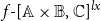 $f\mbox{-}[\mathbb{A}\times\mathbb{B},\mathbb{C}]^{lx}$
are lax double funny functors. Its 1h-cells are horizontal unnatural transformations
$f\mbox{-}[\mathbb{A}\times\mathbb{B},\mathbb{C}]^{lx}$
are lax double funny functors. Its 1h-cells are horizontal unnatural transformations $\theta\colon (-,-)_1\Rightarrow (-,-)_2$
between lax double funny functors
$\theta\colon (-,-)_1\Rightarrow (-,-)_2$
between lax double funny functors $(-,-)_1,(-,-)_2\colon\mathbb{A}\times\mathbb{B}\to \mathbb{C}$
. They are given by: for each
$(-,-)_1,(-,-)_2\colon\mathbb{A}\times\mathbb{B}\to \mathbb{C}$
. They are given by: for each $A\in\mathbb{A}$
a horizontal unnatural transformation
$A\in\mathbb{A}$
a horizontal unnatural transformation $\theta^A\colon (-,A)_1\Rightarrow(-,A)_2$
and for each
$\theta^A\colon (-,A)_1\Rightarrow(-,A)_2$
and for each $B\in\mathbb{B}$
a horizontal unnatural transformation
$B\in\mathbb{B}$
a horizontal unnatural transformation $\theta^B\colon (B,-)_1\Rightarrow(B,-)_2$
, both of lax double functors, such that
$\theta^B\colon (B,-)_1\Rightarrow(B,-)_2$
, both of lax double functors, such that $\theta^A_B=\theta^B_A$
and the following axiom holds
$\theta^A_B=\theta^B_A$
and the following axiom holds
( $HUT^f$
)
$HUT^f$
)

for every 1v-cells $U\colon A\to \tilde A$
and
$U\colon A\to \tilde A$
and $u\colon B\to \tilde B$
.
$u\colon B\to \tilde B$
.
1v-cells of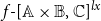 $f\mbox{-}[\mathbb{A}\times\mathbb{B},\mathbb{C}]^{lx}$
are vertical strict transformations
$f\mbox{-}[\mathbb{A}\times\mathbb{B},\mathbb{C}]^{lx}$
are vertical strict transformations $\theta_0\colon (-,-)_1\Rightarrow (-,-)_2$
between lax double funny functors
$\theta_0\colon (-,-)_1\Rightarrow (-,-)_2$
between lax double funny functors $(-,-)_1,(-,-)_2\colon\mathbb{A}\times\mathbb{B}\to \mathbb{C}$
. They are given by: for each
$(-,-)_1,(-,-)_2\colon\mathbb{A}\times\mathbb{B}\to \mathbb{C}$
. They are given by: for each $A\in\mathbb{A}$
a vertical strict transformation
$A\in\mathbb{A}$
a vertical strict transformation $\theta_0^A\colon (-,A)_1\Rightarrow(-,A)_2$
and for each
$\theta_0^A\colon (-,A)_1\Rightarrow(-,A)_2$
and for each $B\in\mathbb{B}$
a vertical strict transformation
$B\in\mathbb{B}$
a vertical strict transformation $\theta_0^B\colon (B,-)_1\Rightarrow(B,-)_2$
, both of lax double functors, such that
$\theta_0^B\colon (B,-)_1\Rightarrow(B,-)_2$
, both of lax double functors, such that $(\theta_0^A)_B=(\theta_0^B)_A$
and the following axioms hold:
$(\theta_0^A)_B=(\theta_0^B)_A$
and the following axioms hold:
( $VST^f_1$
)
$VST^f_1$
)

for every 1h-cell $K\colon A\to A'$
and 1v-cell
$K\colon A\to A'$
and 1v-cell $u\colon B\to \tilde B$
,
$u\colon B\to \tilde B$
,
( $VST^f_2$
)
$VST^f_2$
)

for every 1v-cell $U\colon A\to \tilde A$
and 1h-cell
$U\colon A\to \tilde A$
and 1h-cell $k\colon B\to B'$
.
$k\colon B\to B'$
.
Finally, 2-cells of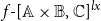 $f\mbox{-}[\mathbb{A}\times\mathbb{B},\mathbb{C}]^{lx}$
are mixed funny modifications. Given horizontal unnatural transformations
$f\mbox{-}[\mathbb{A}\times\mathbb{B},\mathbb{C}]^{lx}$
are mixed funny modifications. Given horizontal unnatural transformations $\theta, \theta'$
and vertical strict transformations
$\theta, \theta'$
and vertical strict transformations $\theta_0, \theta'_0$
acting between lax double funny functors
$\theta_0, \theta'_0$
acting between lax double funny functors $H_1, H_2, H_3, H_4\colon \mathbb{A}\times\mathbb{B}\to \mathbb{C}$
as in the left diagram below. Denote by
$H_1, H_2, H_3, H_4\colon \mathbb{A}\times\mathbb{B}\to \mathbb{C}$
as in the left diagram below. Denote by $(-,A)_i\colon\mathbb{B}\to \mathbb{C}, (B,-)_i\colon\mathbb{A}\to \mathbb{C}, i=1,2,3,4$
the pairs of lax double functors corresponding to
$(-,A)_i\colon\mathbb{B}\to \mathbb{C}, (B,-)_i\colon\mathbb{A}\to \mathbb{C}, i=1,2,3,4$
the pairs of lax double functors corresponding to $H_1, H_2, H_3, H_4$
, respectively. A mixed funny modification
$H_1, H_2, H_3, H_4$
, respectively. A mixed funny modification $\tau$
(on the left below) is given by a pair of mixed funny modifications
$\tau$
(on the left below) is given by a pair of mixed funny modifications $\tau^A, \tau^B$
acting between horizontal unnatural and vertical strict transformations among lax double functors:
$\tau^A, \tau^B$
acting between horizontal unnatural and vertical strict transformations among lax double functors:

such that $\tau^A_B=\tau^B_A$
for every
$\tau^A_B=\tau^B_A$
for every $A\in\mathbb{A}, B\in\mathbb{B}$
.
$A\in\mathbb{A}, B\in\mathbb{B}$
.
The double isomorphism (28) is proved analogously as the quasi-functor version of the claim from Femić (Reference Femić2023, Section 4). Since double quasi-functors obey some additional axioms that do not appear for double funny functors, the proofs for double funny functors are analogous to those for double quasi-functors, but are to some extent simpler. The 1-1 correspondence on 1- and 2-cells in (28) is proved mutatis mutandi as in Sections 4.5 and 4.8 of loc.cit. The funny counterparts of Propositions 4.6 and 4.7 thereof read as follows:
Proposition 5.20. Let $F,G\colon \mathbb{A}\to [\mathbb{B},\mathbb{C}]^{lx}$
be two lax double functors with the corresponding lax double funny functors
$F,G\colon \mathbb{A}\to [\mathbb{B},\mathbb{C}]^{lx}$
be two lax double functors with the corresponding lax double funny functors $(-,-)_1, (-,-)_2\colon\mathbb{A}\times\mathbb{B}\to \mathbb{C}$
. For every
$(-,-)_1, (-,-)_2\colon\mathbb{A}\times\mathbb{B}\to \mathbb{C}$
. For every $A\in\mathbb{A}$
and
$A\in\mathbb{A}$
and $B\in\mathbb{B}$
let
$B\in\mathbb{B}$
let $\alpha(A): F(A)\to G(A)$
and
$\alpha(A): F(A)\to G(A)$
and $\alpha(-)_B: F(-)(B)\to G(-)(B)$
be horizontal unnatural transformations between lax double functors. The following are equivalent:
$\alpha(-)_B: F(-)(B)\to G(-)(B)$
be horizontal unnatural transformations between lax double functors. The following are equivalent:
-
(1)
$\alpha_U$
of the form(30)is a mixed funny modification for every 1v-cell
$U\colon A\to \tilde A$
in
$\mathbb{A}$
; -
(2)the pairs
$(\theta^A, \theta^B)\colon\hspace{-0,2cm}=(\alpha(A),\alpha(-)_B)$
for
$A\in\mathbb{A}, B\in\mathbb{B}$
form a horizontal unnatural transformation
$\theta\colon (-,-)_1\Rightarrow(-,-)_2$
between lax double funny functors.





In the above claim, the 2-cell components of the mixed funny modification $\alpha_U$
(at B) are given by and correspond bijectively to the 2-cell components of the horizontal unnatural transformation
$\alpha_U$
(at B) are given by and correspond bijectively to the 2-cell components of the horizontal unnatural transformation $\alpha(-)_B$
(at U).
$\alpha(-)_B$
(at U).
Proposition 5.21. A horizontal unnatural transformation $\alpha\colon F\Rightarrow G$
between lax double functors
$\alpha\colon F\Rightarrow G$
between lax double functors $F,G\colon \mathbb{A}\to [\mathbb{B},\mathbb{C}]^{lx}$
consists of the following data:
$F,G\colon \mathbb{A}\to [\mathbb{B},\mathbb{C}]^{lx}$
consists of the following data:
-
• a horizontal unnatural transformation
$\alpha(A)\colon F(A)\to G(A)$
between lax double functors for every
$A\in\mathbb{A}$
; -
• a mixed funny modification
$\alpha_U$
(of the form (30)) for every 1v-cell
$U\colon A\to \tilde A$
,



so that $\alpha_U$
obeys two axioms, which (after evaluation at
$\alpha_U$
obeys two axioms, which (after evaluation at $B\in\mathbb{B}$
) yield that
$B\in\mathbb{B}$
) yield that $\alpha(-)_B\colon F(-)(B)\to G(-)(B)$
is a horizontal unnatural transformation between lax double functors for every
$\alpha(-)_B\colon F(-)(B)\to G(-)(B)$
is a horizontal unnatural transformation between lax double functors for every $B\in\mathbb{B}$
(by setting
$B\in\mathbb{B}$
(by setting $\alpha(U)_B\colon\hspace{-0,2cm}=\alpha_U(B)$
).
$\alpha(U)_B\colon\hspace{-0,2cm}=\alpha_U(B)$
).
Analogously as in the quasi-functor case of Femić (Reference Femić2023, Proposition 6.3) for double funny functors one proves an isomorphism of double categories
 \begin{equation} [\mathbb{A}\Box^*\mathbb{B},\mathbb{C}]\cong f\mbox{-}[\mathbb{A}\times\mathbb{B},\mathbb{C}]^*.\end{equation}
In view of (28) we obtain a double category isomorphism
 \begin{equation} [\mathbb{A}\Box^*\mathbb{B},\mathbb{C}]\cong[\mathbb{A},[\mathbb{B},\mathbb{C}]^*]^*.\end{equation}
5.3.4 A characterization of ternary lax double funny functors
In the proof of Proposition 5.19, we observed that the three double funny ternary axioms are equivalent to certain mixed funny modification axioms. We include this finding in the following result. By mere inspection, we see that there is more data equivalent to it.
Proposition 5.22. Let $F:\mathbb{A}\times\mathbb{B}\times\mathbb{C}\to \mathbb{D}$
be an assignment (possibly functorial in every variable). The following equivalences for F to satisfy the three ternary double funny functor axioms hold true:
$F:\mathbb{A}\times\mathbb{B}\times\mathbb{C}\to \mathbb{D}$
be an assignment (possibly functorial in every variable). The following equivalences for F to satisfy the three ternary double funny functor axioms hold true: ${u,v,h}{(u,v,h)}$ $\Leftrightarrow$
(
$\Leftrightarrow$
( $HUT^f$
) for
$HUT^f$
) for $F(-,-,h)$ $\Leftrightarrow$
(
$\Leftrightarrow$
( $VST^f_2$
) for
$VST^f_2$
) for $F(u,-,-)$ $\Leftrightarrow$
(
$\Leftrightarrow$
( $VST^f_2$
) for
$VST^f_2$
) for $F(-,v,-)$ $\Leftrightarrow$ $F(-,v,h)$
obeys the mixed funny modification axiom
$F(-,v,h)$
obeys the mixed funny modification axiom $\Leftrightarrow$ $F(u,-,h)$
obeys the mixed funny modification axiom
$F(u,-,h)$
obeys the mixed funny modification axiom
u,g,z(u,g,z) $\Leftrightarrow$
(
$\Leftrightarrow$
( $HUT^f$
) for
$HUT^f$
) for $F(-,g,-)$ $\Leftrightarrow$
(
$\Leftrightarrow$
( $VST^f_1$
) for
$VST^f_1$
) for $F(u,-,-)$ $\Leftrightarrow$
(
$\Leftrightarrow$
( $VST^f_2$
) for
$VST^f_2$
) for $F(-,-,z)$ $\Leftrightarrow$ $F(-,g,z)$
obeys the mixed funny modification axiom
$F(-,g,z)$
obeys the mixed funny modification axiom $\Leftrightarrow$ $F(u,g,-)$
obeys the mixed funny modification axiom
$F(u,g,-)$
obeys the mixed funny modification axiom
f,v,z(f,v,z) $\Leftrightarrow$
(
$\Leftrightarrow$
( $HUT^f$
) for
$HUT^f$
) for $F(f,-,-)$ $\Leftrightarrow$
(
$\Leftrightarrow$
( $VST^f_1$
) for
$VST^f_1$
) for $F(-,-,z)$ $\Leftrightarrow$
(
$\Leftrightarrow$
( $VST^f_1$
) for
$VST^f_1$
) for $F(-,v,-)$ $\Leftrightarrow$ $F(f,-,z)$
obeys the mixed funny modification axiom
$F(f,-,z)$
obeys the mixed funny modification axiom $\Leftrightarrow$ $F(f,v,-)$
obeys the mixed funny modification axiom
$F(f,v,-)$
obeys the mixed funny modification axiom
for 1h-cells f,g,h and 1v-cells u,v,z.
In the style of Proposition 5.8, we may then conclude:
Proposition 5.23. Let $\mathbb{A},\mathbb{B},\mathbb{C}$
be double categories. The following are equivalent:
$\mathbb{A},\mathbb{B},\mathbb{C}$
be double categories. The following are equivalent:
-
(1)
$H\colon \mathbb{A}\times\mathbb{B}\times\mathbb{C}\to \mathbb{D}$
is a ternary lax double funny functor, -
(2) there are three families of binary lax double funny functors
such that
$$(A,-,-):\mathbb{B}\times\mathbb{C}\to \mathbb{D}, (-,B,-):\mathbb{A}\times\mathbb{C}\to \mathbb{D}, (-,-,C):\mathbb{A}\times\mathbb{B}\to \mathbb{D}$$
for objects
$$(A,-,-)\vert_B=(-,B,-)\vert_A, \,\,(A,-,-)\vert_C=(-,-,C)\vert_A, \,\, (-,B,-)\vert_C=(-,-,C)\vert_B$$
$A\in\mathbb{A}, B\in\mathbb{B}, C\in\mathbb{C}$
, determining unambiguous lax double functors
$(A,B,-):\mathbb{C}\to \mathbb{D}, (-,B,C):\mathbb{A}\to \mathbb{D}, (A,-,C):\mathbb{B}\to \mathbb{D}$
such that
$(A,B,-)\vert_C=(-,B,C)\vert_A=(A,-, C)_B$
, and the following hold for 1h-cells f,g,h and 1v-cells u,v,z:-
(i)
are horizontal unnatural transformations,
\begin{align*}(f,-,-)\colon (A,-,-)\to (A',-,-),\\(-,g,-)\colon (-,B,-)\to (-,B', -),\\(-,-,h)\colon (-,-,C)\to (-,-,C')\end{align*}
are vertical strict transformations, and
\begin{align*}(u,-,-)\colon (A,-,-)\to (\tilde A,-,-),\\(-,v,-)\colon (-,B,-)\to (-,\tilde B,-),\\(-,-,z)\colon (-,-,C)\to (-,-,\tilde C)\end{align*}
are binary mixed funny modifications with respect to horizontally unnatural and vertically strict transformations for all 2-cells a in
$$(a,-,-), (-,b,-), (-,-,c)$$
$\mathbb{A}$
, b in
$\mathbb{B}$
and c in
$\mathbb{C}$
,
-
(ii) the following coincide:
\begin{align*}(f,B,-)\vert_C=(f,-,C)_B=(-,B,C)\vert_f,\\(u,B,-)\vert_C=(u,-,C)_B=(-,B,C)\vert_u, \\(a,B,-)\vert_C=(a,-,C)_B=(-,B,C)\vert_a,\\[4pt](A,g,-)\vert_C=(-,g,C)\vert_A=(A,-,C)\vert_g, \\(A,v,-)\vert_C=(-,v,C)\vert_A=(A,-,C)\vert_v, \\(A,b,-)\vert_C=(-,b,C)\vert_A=(A,-,C)\vert_b,\\[4pt](A,-,h)\vert_B=(-,B,h)_A=(A,B,)\vert_h, \\(A,-,z)\vert_A=(-,B,z)_B=(A,B,-)\vert_z,\\(A,-,c)\vert_B=(-,B,C)_A=(A,B,-)\vert_c,\end{align*}
-
(iii) the following are mixed funny modifications
and the following 2-cell components of the respective transformations and modifications coincide:
$$(f,-,z), \,\, (u,-,h), \,\, (-,g,z), \,\, (-,v,h), \,\, (u,g,-), \,\, (f,v,-)$$
\begin{align*}(f,B,-)\vert_z=(-,B,z)\vert_f=(f,B,z), \,\,\,\, (u,B,-)\vert_h=(-,B,h)\vert_u=(u,B,h), \\(f,-,C)\vert_v=(-,v,C)\vert_f=(f,v,C), \,\,\,\, (u,-,C)\vert_g=(-,g,C)\vert_u=(u,g,C), \\(A,g,-)\vert_z=(A,-,z)\vert_g=(A,g,z), \,\,\,\, (A,v,-)\vert_h=(A,-,h)\vert_v=(A,v,h). \end{align*}
-








In view of Proposition 5.22 one sees that the part 2 in the above characterization contains redundant data. The axioms for $(a,-,-), (-,b,-), (-,-,c)$
to be binary mixed funny modifications correspond to the axioms ((u,U)-l-nat) and ((u,U)-r-nat) of the corresponding underlying component binary double funny functors they act upon.
$(a,-,-), (-,b,-), (-,-,c)$
to be binary mixed funny modifications correspond to the axioms ((u,U)-l-nat) and ((u,U)-r-nat) of the corresponding underlying component binary double funny functors they act upon.
5.3.5 Transformations of ternary lax double funny functors
We will also need horizontal unnatural transformations and vertial strict transformations of (lax) double funny functors of more than two variables. For more than three variables, apply the definition to any triple of variables.
Definition 5.24. A horizontal unnatural transformation $\theta: H_1\Rightarrow H_2$
between lax double funny functors
$\theta: H_1\Rightarrow H_2$
between lax double funny functors $H_1,H_2:\mathbb{A}\times\mathbb{B}\times\mathbb{C}\to \mathbb{E}$
consists of horizontal unnatural transformations
$H_1,H_2:\mathbb{A}\times\mathbb{B}\times\mathbb{C}\to \mathbb{E}$
consists of horizontal unnatural transformations
 $$\theta^{A;\;B}: (A,B,-)_3^1\to (A,B,-)_3^2$$
 $$\theta^{B;\;C}: (-,B,C)_1^1\to (-,B,C)_1^2$$
 $$\theta^{A;\;C}: (A,-,C)_2^1\to (A,-,C)_2^2$$
of lax double functors such that $\theta^{A;B}(C)=\theta^{B;\;C}(A)=\theta^{A;\;C}(B)$
for all
$\theta^{A;B}(C)=\theta^{B;\;C}(A)=\theta^{A;\;C}(B)$
for all $(A,B,C)\in\mathbb{A}\times\mathbb{B}\times\mathbb{C}$
.
$(A,B,C)\in\mathbb{A}\times\mathbb{B}\times\mathbb{C}$
.
Definition 5.25. A vertical strict transformation $\theta: H_1\Rightarrow H_2$
between lax double funny functors
$\theta: H_1\Rightarrow H_2$
between lax double funny functors $H_1,H_2:\mathbb{A}\times\mathbb{B}\times\mathbb{C}\to \mathbb{E}$
consists of vertical strict transformations
$H_1,H_2:\mathbb{A}\times\mathbb{B}\times\mathbb{C}\to \mathbb{E}$
consists of vertical strict transformations
 $$\theta^A: H_1(A,-,-) \Rightarrow H_2(A,-,-),$$
 $$\theta^B: H_1(-,B,-) \Rightarrow H_2(-,B,-),$$
 $$\theta^C: H_1(-,-,C) \Rightarrow H_2(-,-,C)$$
of lax double funny functors, which give unambiguous vertical strict transformations
 $$\theta^{A;\;B}: (A,B,-)_3^1\to (A,B,-)_3^2$$
 $$\theta^{B;\;C}: (-,B,C)_1^1\to (-,B,C)_1^2$$
 $$\theta^{A;\;C}: (A,-,C)_2^1\to (A,-,C)_2^2$$
of lax double functors so that $\theta^{A;B}(C)=\theta^{B;\;C}(A)=\theta^{A;\;C}(B)$
for all
$\theta^{A;B}(C)=\theta^{B;\;C}(A)=\theta^{A;\;C}(B)$
for all $(A,B,C)\in\mathbb{A}\times\mathbb{B}\times\mathbb{C}$
, and so that six equalities between their structure 2-cells, on one hand, and the six structure 2-cells of both
$(A,B,C)\in\mathbb{A}\times\mathbb{B}\times\mathbb{C}$
, and so that six equalities between their structure 2-cells, on one hand, and the six structure 2-cells of both $H_1$
and
$H_1$
and $H_2$
from Definition 7.1, on the other hand, hold. We present these six equalities as vertical compositions of 2-cells together with their labels:
$H_2$
from Definition 7.1, on the other hand, hold. We present these six equalities as vertical compositions of 2-cells together with their labels:
 $$\big((\theta^{A;\;C})^v, (\theta^{B;\;C})_f, (f,v,C)^i_{12}\big), \qquad \qquad \big((\theta^{A;B})^z, (\theta^{B;\;C})_f, (f,B,z)^i_{13}\big) $$
 $$\frac{(\theta^{B;\;C})_f}{(f,v,C)^2}=\frac{(f,v,C)^1}{(\theta^{\tilde B;\;C})_f}, \qquad \qquad \frac{(\theta^{B;\;C})_f}{(f,B,z)^2}=\frac{(f,B,z)^1}{(\theta^{B;\;\tilde C})_f}$$
 $$\big((\theta^{A;B})^z, (\theta^{A;\;C})_g, (A,g,z)^i_{23}\big), \qquad \qquad \big((\theta^{A;\;C})_g, (\theta^{B;\;C})^u, (u,g,C)^i_{12}\big), $$
 $$\frac{(\theta^{A;\;C})_g}{(A,g,z)^2}=\frac{(A,g,z)^1}{(\theta^{A;\tilde C})_g}, \qquad \qquad \frac{(\theta^{A;\;C})_g}{(u,g,C)^2}=\frac{(u,g,C)^1}{(\theta^{\tilde A; C})_g}$$
 $$\big((\theta^{A;B})_h, (\theta^{B;\;C})^u, (u,B,h)^i_{13}\big), \qquad \big((\theta^{A;B})_h, (\theta^{A;\;C})^v, (A,v,h)^i_{23}\big)$$
 \begin{align*}\frac{(\theta^{A;B})_h}{(u,B,h)^2}=\frac{(u,B,h)^1}{(\theta^{\tilde A; B})_h}, \qquad \qquad \frac{(\theta^{A;B})_h}{(A,v,h)^2}=\frac{(A,v,h)^1}{(\theta^{A;\tilde B})_h}\end{align*}
where $(f,v,C)^i$
for
$(f,v,C)^i$
for $i=1,2$
presents a structure 2-cell
$i=1,2$
presents a structure 2-cell $(f,v,C)_{12}$
from Definition 7.1 for
$(f,v,C)_{12}$
from Definition 7.1 for $H_1$
and
$H_1$
and $H_2$
, respectively, and similarly for the remaining five 2-cells of that type.
$H_2$
, respectively, and similarly for the remaining five 2-cells of that type.
5.3.6 Closedness
Knowing from Subsection 5.3.3 that $[\mathbb{B}, \mathbb{C}]^{lx}$
is a double category, we now introduce the evaluation lax double funny functors.
$[\mathbb{B}, \mathbb{C}]^{lx}$
is a double category, we now introduce the evaluation lax double funny functors.
Proposition 5.26. There is a lax double funny functor $ev:[\mathbb{B}, \mathbb{C}]^{lx}\times\mathbb{B}\to \mathbb{C}$
such that given any lax double funny functor
$ev:[\mathbb{B}, \mathbb{C}]^{lx}\times\mathbb{B}\to \mathbb{C}$
such that given any lax double funny functor $H:\mathbb{A}\times\mathbb{B}\to \mathbb{C}$
it is
$H:\mathbb{A}\times\mathbb{B}\to \mathbb{C}$
it is
 $$ev(H^t\times \operatorname {Id}_\mathbb{B})=H$$
where $H^t:\mathbb{A}\to [\mathbb{B}, \mathbb{C}]^{lx}$
is the lax double functor corresponding to H by (23).
$H^t:\mathbb{A}\to [\mathbb{B}, \mathbb{C}]^{lx}$
is the lax double functor corresponding to H by (23).
Proof. For a 0-cell $F\in [\mathbb{B}, \mathbb{C}]^{lx}$
and any cell x in
$F\in [\mathbb{B}, \mathbb{C}]^{lx}$
and any cell x in $\mathbb{B}$
set
$\mathbb{B}$
set $ev(F,x)=F(x)$
; for a 0-cell
$ev(F,x)=F(x)$
; for a 0-cell $B\in\mathbb{B}$
and 1h- or 1v-cell
$B\in\mathbb{B}$
and 1h- or 1v-cell $\alpha$
in
$\alpha$
in $[\mathbb{B}, \mathbb{C}]^{lx}$
set
$[\mathbb{B}, \mathbb{C}]^{lx}$
set $ev(\alpha,B)=\alpha(B)$
, the 1h, respectively, 1v-cell component of the transformation
$ev(\alpha,B)=\alpha(B)$
, the 1h, respectively, 1v-cell component of the transformation $\alpha$
in question; for a 2-cell b in
$\alpha$
in question; for a 2-cell b in $[\mathbb{B}, \mathbb{C}]^{lx}$
set
$[\mathbb{B}, \mathbb{C}]^{lx}$
set $ev(b,B)=b(B)$
, the 2-cell component of the funny modification b; and finally, for a 1v-cell u and 1h-cell g in
$ev(b,B)=b(B)$
, the 2-cell component of the funny modification b; and finally, for a 1v-cell u and 1h-cell g in $\mathbb{B}$
set
$\mathbb{B}$
set $ev(\alpha,u)=\alpha^u$
, respectively,
$ev(\alpha,u)=\alpha^u$
, respectively, $ev(\alpha,g)=\alpha_g$
, the 2-cell components of the horizontal unnatural, respectively, vertical strict transformation
$ev(\alpha,g)=\alpha_g$
, the 2-cell components of the horizontal unnatural, respectively, vertical strict transformation $\alpha$
.
$\alpha$
.
First condition for ev to be a lax double funny functor is that $ev(F,-):\mathbb{B}\to \mathbb{C}$
and
$ev(F,-):\mathbb{B}\to \mathbb{C}$
and $ev(-,B):[\mathbb{B}, \mathbb{C}]^{lx}\to \mathbb{C}$
be lax double functors. It is clear that
$ev(-,B):[\mathbb{B}, \mathbb{C}]^{lx}\to \mathbb{C}$
be lax double functors. It is clear that $ev(F,-)$
is such a functor, as so is F. Since both compositions of 1-cells in
$ev(F,-)$
is such a functor, as so is F. Since both compositions of 1-cells in $[\mathbb{B}, \mathbb{C}]^{lx}$
are vertical compositions of (horizontal unnatural, resp. vertical strict) transformations, we obtain that
$[\mathbb{B}, \mathbb{C}]^{lx}$
are vertical compositions of (horizontal unnatural, resp. vertical strict) transformations, we obtain that $ev(-,B)$
is a strict functor (see Lemma 2.4 and Lemma 2.6 for the vertical compositions of horizontal and vertical transformations).
$ev(-,B)$
is a strict functor (see Lemma 2.4 and Lemma 2.6 for the vertical compositions of horizontal and vertical transformations).
The coincidences of these two lax double functors on objects, and the coincidences of 1- and 2-cells in (i)-(iii) of Proposition 5.8 are now trivially fulfilled. For a (horizontal unnatural or vertical strict) transformation $\alpha$
and a mixed funny modification b, it is clear that
$\alpha$
and a mixed funny modification b, it is clear that $ev(\alpha,-)$
is a (horizontal unnatural, resp. vertical strict) transformation, and that
$ev(\alpha,-)$
is a (horizontal unnatural, resp. vertical strict) transformation, and that $ev(b,-)$
is a corresponding modification. In Table 4, we argument why
$ev(b,-)$
is a corresponding modification. In Table 4, we argument why $ev(-,g)$
and
$ev(-,g)$
and $ev(-,v)$
are a horizontal unnatural and a vertical strict transformation, respectively.
$ev(-,v)$
are a horizontal unnatural and a vertical strict transformation, respectively.
Why $ev(-,g)$
is a horizontal unnatural and
$ev(-,g)$
is a horizontal unnatural and $ev(-,v)$
a vertical strict transformation
$ev(-,v)$
a vertical strict transformation
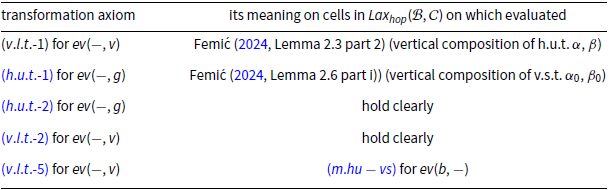
For a 2-cell $\beta$
in
$\beta$
in $\mathbb{B}$
and an object
$\mathbb{B}$
and an object $F\in [\mathbb{B}, \mathbb{C}]^{lx}$
by definition, we have
$F\in [\mathbb{B}, \mathbb{C}]^{lx}$
by definition, we have $F(\beta)=ev(-,\beta)$
. The modification axiom (m.hu-vs) for
$F(\beta)=ev(-,\beta)$
. The modification axiom (m.hu-vs) for $ev(-,\beta)$
at a 1v-cell
$ev(-,\beta)$
at a 1v-cell $\alpha_0$
in
$\alpha_0$
in $Lax_{hop}(\mathbb{B}, \mathbb{C})$
coincides with the transformation axiom
$Lax_{hop}(\mathbb{B}, \mathbb{C})$
coincides with the transformation axiom $(v.l.t.\mbox{-} 5)$
for
$(v.l.t.\mbox{-} 5)$
for $\alpha_0$
. Thus,
$\alpha_0$
. Thus, $ev(-,\beta)$
is a mixed funny modification. This finishes the proof that ev is a lax double funny functor by Proposition 5.8, and the last statement is clear.
$ev(-,\beta)$
is a mixed funny modification. This finishes the proof that ev is a lax double funny functor by Proposition 5.8, and the last statement is clear.
In particular, given an m-ary double funny functor $F^m:\mathbb{A}_1\times...\times\mathbb{A}_m\to [\mathbb{C}, \mathbb{D}]^{lx}$
with
$F^m:\mathbb{A}_1\times...\times\mathbb{A}_m\to [\mathbb{C}, \mathbb{D}]^{lx}$
with $m\geq 1$
and the unary map
$m\geq 1$
and the unary map $F^1=ev_C=ev(-,C)$
for an object
$F^1=ev_C=ev(-,C)$
for an object $C\in\mathbb{C}$
, by (27), we have
$C\in\mathbb{C}$
, by (27), we have
 \begin{equation}(ev_C\circ F^m)(...,A_k,...)=ev_C\circ F^m(...,A_k,...)\end{equation}
as $(m\mbox{-} 1)$
-ary funny functors.
$(m\mbox{-} 1)$
-ary funny functors.
The following will show useful.
Lemma 5.27. Let $F\in f\mbox{-}[\mathbb{A}\times\mathbb{B},[\mathbb{C},\mathbb{D}]^*]^*$
. Then,
$F\in f\mbox{-}[\mathbb{A}\times\mathbb{B},[\mathbb{C},\mathbb{D}]^*]^*$
. Then,
-
•
$F(-,-)(h):\mathbb{A}\times\mathbb{B}\to \mathbb{D}$
is a horizontal binary unnatural transformation; -
•
$F(-,g)(-):\mathbb{A}\times\mathbb{C}\to \mathbb{D}$
is a horizontal binary unnatural transformation; -
•
$F(f,-)(-):\mathbb{B}\times\mathbb{C}\to \mathbb{D}$
is a horizontal binary unnatural transformation; -
•
$F(-,-)(z):\mathbb{A}\times\mathbb{B}\to \mathbb{D}$
is a vertical binary strict transformation; -
•
$F(-,v)(-):\mathbb{A}\times\mathbb{C}\to \mathbb{D}$
is a vertical binary strict transformation; -
•
$F(u,-)(-):\mathbb{B}\times\mathbb{C}\to \mathbb{D}$
is a vertical binary strict transformation.






Proof. For the first part, to prove that one has two unary horizontal unnatural transformations $F(A,-)(h)$
and
$F(A,-)(h)$
and $F(-,B)(h)$
, observe that the first one is
$F(-,B)(h)$
, observe that the first one is $\mathcal{F}_1(-)(k)=(k,-)_1$
and the second one is
$\mathcal{F}_1(-)(k)=(k,-)_1$
and the second one is $\mathcal{F}_2(-)(k)=(k,-)_2$
in the notation of Proposition 5.3, so that by Proposition 5.8 they are h.u.t. The agreement on objects of these h.u.t. follows by the agreement on objects of the unary components of F. The axiom (
$\mathcal{F}_2(-)(k)=(k,-)_2$
in the notation of Proposition 5.3, so that by Proposition 5.8 they are h.u.t. The agreement on objects of these h.u.t. follows by the agreement on objects of the unary components of F. The axiom ( $HUT^f$
) holds by the property
$HUT^f$
) holds by the property $(u,U)=\operatorname {Id}$
for the double funny functor F.
$(u,U)=\operatorname {Id}$
for the double funny functor F.
The axiom ( $HUT^f$
) for
$HUT^f$
) for $F(-,g)(-)$
is the axiom (m.ho-vl.-2) for the modification
$F(-,g)(-)$
is the axiom (m.ho-vl.-2) for the modification $\Theta=F(u,g)$
between horizontal unnatural transformations
$\Theta=F(u,g)$
between horizontal unnatural transformations $\alpha=F(A,g)$
and
$\alpha=F(A,g)$
and $\beta=F(\tilde A,g)$
(as 1h-cells in
$\beta=F(\tilde A,g)$
(as 1h-cells in $[\mathbb{C},\mathbb{D}]^*$
) and vertical strict transformations
$[\mathbb{C},\mathbb{D}]^*$
) and vertical strict transformations $\alpha_0=F(u,B)$
and
$\alpha_0=F(u,B)$
and $\beta=F(u,\tilde B)$
(as 1v-cells in
$\beta=F(u,\tilde B)$
(as 1v-cells in $[\mathbb{C},\mathbb{D}]^*$
). Clearly,
$[\mathbb{C},\mathbb{D}]^*$
). Clearly, $F(A,g)(-):\mathbb{C}\to \mathbb{D}$
is a h.u.t as F(A,g) is a 1h-cell in
$F(A,g)(-):\mathbb{C}\to \mathbb{D}$
is a h.u.t as F(A,g) is a 1h-cell in $[\mathbb{C},\mathbb{D}]^*$
. Functoriality of F in the first variable yields that
$[\mathbb{C},\mathbb{D}]^*$
. Functoriality of F in the first variable yields that $F(-,g)(C):\mathbb{A}\to \mathbb{D}$
is a h.u.t. The agreement of these two unary h.u.t. on objects follows by (33) with
$F(-,g)(C):\mathbb{A}\to \mathbb{D}$
is a h.u.t. The agreement of these two unary h.u.t. on objects follows by (33) with $F^m=F(-,g)$
and
$F^m=F(-,g)$
and $A_k=C$
.
$A_k=C$
.
The third claim is proved analogously as the second one.
One obtains two unary vertical strict transformations for $F(-,-)(z)$
and their agreement on objects similarly as for
$F(-,-)(z)$
and their agreement on objects similarly as for $F(-,-)(h)$
in the first part. As in Proposition 5.22, one has that (
$F(-,-)(h)$
in the first part. As in Proposition 5.22, one has that ( $HUT^f$
) for
$HUT^f$
) for $F(-,g)(-)$
(from the second part) is (
$F(-,g)(-)$
(from the second part) is ( $VST^f_2$
) for
$VST^f_2$
) for $F(-,-)(z)$
. Similarly, (
$F(-,-)(z)$
. Similarly, ( $HUT^f$
) for
$HUT^f$
) for $F(f,-)(-)$
(from the third part) is (
$F(f,-)(-)$
(from the third part) is ( $VST^f_1$
) for
$VST^f_1$
) for $F(-,-)(z)$
.
$F(-,-)(z)$
.
The above proofs are sufficient to deduce the proofs for the remaining two claims.
By iterating (28), we obtain double category isomorphisms
 \begin{equation}f\mbox{-}[\mathbb{A}\times\mathbb{B},[\mathbb{C},\mathbb{D}]^*]^*\cong [\mathbb{A}, [\mathbb{B},[\mathbb{C},\mathbb{D}]^*]^*]^*\cong [\mathbb{A}, f\mbox{-}[\mathbb{B}\times\mathbb{C},\mathbb{D}]^*]^*.\end{equation}
A double funny functor from the left $F\in f\mbox{-}[\mathbb{A}\times\mathbb{B},[\mathbb{C},\mathbb{D}]^*]^*$
consists of unary functors
$F\in f\mbox{-}[\mathbb{A}\times\mathbb{B},[\mathbb{C},\mathbb{D}]^*]^*$
consists of unary functors $F(A,-):\mathbb{B}\to [\mathbb{C},\mathbb{D}]^*$
and
$F(A,-):\mathbb{B}\to [\mathbb{C},\mathbb{D}]^*$
and $F(-,B):\mathbb{A}\to [\mathbb{C},\mathbb{D}]^*$
for any
$F(-,B):\mathbb{A}\to [\mathbb{C},\mathbb{D}]^*$
for any $A\in\mathbb{A}, B\in\mathbb{B}$
. These in turn determine unary
$A\in\mathbb{A}, B\in\mathbb{B}$
. These in turn determine unary $*$
-typed double functors
$*$
-typed double functors $F(A,-)(C):\mathbb{B}\to \mathbb{D}$
,
$F(A,-)(C):\mathbb{B}\to \mathbb{D}$
, $F(A,-)_B:\mathbb{C}\to \mathbb{D}$
, and
$F(A,-)_B:\mathbb{C}\to \mathbb{D}$
, and $F(-,B)(C):\mathbb{A}\to \mathbb{D}, F(-,B)_A:\mathbb{C}\to \mathbb{D}$
, respectively, whereas because of the binary funny property for F the two functors
$F(-,B)(C):\mathbb{A}\to \mathbb{D}, F(-,B)_A:\mathbb{C}\to \mathbb{D}$
, respectively, whereas because of the binary funny property for F the two functors $F(A,-)_B,F(-,B)_A:\mathbb{C}\to \mathbb{D}$
coincide. To prove that F defines a ternary funny functor
$F(A,-)_B,F(-,B)_A:\mathbb{C}\to \mathbb{D}$
coincide. To prove that F defines a ternary funny functor $F(-,-,-)\in[\mathbb{A}\times\mathbb{B}\times\mathbb{C},\mathbb{D}]^{lx}$
by
$F(-,-,-)\in[\mathbb{A}\times\mathbb{B}\times\mathbb{C},\mathbb{D}]^{lx}$
by $F(a,b,c):=F(a,b)(c)$
for sensible cells
$F(a,b,c):=F(a,b)(c)$
for sensible cells $a\in\mathbb{A},b\in\mathbb{B},c\in\mathbb{C}$
(with abuse of notation), we should show that the above three unary functors satisfy two by two the binary funny functor property, and then that the induced three binary funny functors - that simultaneously are induced by F(a,b,c) - satisfy the ternary funny property and axioms. We already have the binary funny functor
$a\in\mathbb{A},b\in\mathbb{B},c\in\mathbb{C}$
(with abuse of notation), we should show that the above three unary functors satisfy two by two the binary funny functor property, and then that the induced three binary funny functors - that simultaneously are induced by F(a,b,c) - satisfy the ternary funny property and axioms. We already have the binary funny functor $F(-,-,C):\mathbb{A}\times\mathbb{B}\to \mathbb{D}$
and the ternary property
$F(-,-,C):\mathbb{A}\times\mathbb{B}\to \mathbb{D}$
and the ternary property $F(A,-,-)_B=F(-,B,-)_A:\mathbb{C}\to \mathbb{D}$
by the properties of the original
$F(A,-,-)_B=F(-,B,-)_A:\mathbb{C}\to \mathbb{D}$
by the properties of the original $F\in f\mbox{-}[\mathbb{A}\times\mathbb{B},[\mathbb{C},\mathbb{D}]^*]^*$
.
$F\in f\mbox{-}[\mathbb{A}\times\mathbb{B},[\mathbb{C},\mathbb{D}]^*]^*$
.
Let $\overline F:\mathbb{A}\to f\mbox{-}[\mathbb{B}\times\mathbb{C},\mathbb{D}]^*$
denote the induced lax
$\overline F:\mathbb{A}\to f\mbox{-}[\mathbb{B}\times\mathbb{C},\mathbb{D}]^*$
denote the induced lax $*$
-typed double functor on the right of (34). It is
$*$
-typed double functor on the right of (34). It is $\overline F(a)(b,c):=F(a,b)(c)$
for sensible cells
$\overline F(a)(b,c):=F(a,b)(c)$
for sensible cells $a\in\mathbb{A},b\in\mathbb{B},c\in\mathbb{C}$
. Then
$a\in\mathbb{A},b\in\mathbb{B},c\in\mathbb{C}$
. Then $\overline F(A)=F(A,-,-):\mathbb{B}\times\mathbb{C}\to \mathbb{D}$
is a binary funny map for all
$\overline F(A)=F(A,-,-):\mathbb{B}\times\mathbb{C}\to \mathbb{D}$
is a binary funny map for all $A\in\mathbb{A}$
, so we have
$A\in\mathbb{A}$
, so we have $F(A,B,-)_C=F(A,-,C)_B$
. Moreover,
$F(A,B,-)_C=F(A,-,C)_B$
. Moreover, $F(a,B,-)_C=F(a,-,C)_B$
for any higher cell
$F(a,B,-)_C=F(a,-,C)_B$
for any higher cell $a\in\mathbb{A}$
would mean that
$a\in\mathbb{A}$
would mean that $\overline F(a)(B,-)_C=\overline F(a)(-,C)_B$
. But this is true, since
$\overline F(a)(B,-)_C=\overline F(a)(-,C)_B$
. But this is true, since $\overline F$
induces a
$\overline F$
induces a $*$
-typed double functor
$*$
-typed double functor $\overline F(-)(B,C):\mathbb{A}\to \mathbb{D}$
. Thus, we have the second ternary property for
$\overline F(-)(B,C):\mathbb{A}\to \mathbb{D}$
. Thus, we have the second ternary property for $F(-,-,-)$
.
$F(-,-,-)$
.
The third binary property $F(A,B,-)_C=F(-,B,C)_A$
on objects now follows by (33) with
$F(A,B,-)_C=F(-,B,C)_A$
on objects now follows by (33) with $F^1=F(-,B):\mathbb{A}\to [\mathbb{C},\mathbb{D}]^*$
for a fixed
$F^1=F(-,B):\mathbb{A}\to [\mathbb{C},\mathbb{D}]^*$
for a fixed $B\in\mathbb{B}$
and
$B\in\mathbb{B}$
and $k=1$
. The same equality implies
$k=1$
. The same equality implies $F(A,-,-)_C=F(-,-,C)_A$
as unary functors, by applying
$F(A,-,-)_C=F(-,-,C)_A$
as unary functors, by applying $F^2=F(-,-)$
and
$F^2=F(-,-)$
and $k=1$
. The proof that the 11 axioms for the remaining binary funny functor
$k=1$
. The proof that the 11 axioms for the remaining binary funny functor $F(-,B)(-):\mathbb{A}\times\mathbb{C}\to \mathbb{D}$
hold is analogous as in the proof of Lemma 5.18, where we apply (i) and (ii) of Proposition 5.8. Namely, ((k’k,U)), ((
$F(-,B)(-):\mathbb{A}\times\mathbb{C}\to \mathbb{D}$
hold is analogous as in the proof of Lemma 5.18, where we apply (i) and (ii) of Proposition 5.8. Namely, ((k’k,U)), (( $1_B,U$
)) and ((u,U)-r-nat) hold by (v.l.t.- 1), (v.l.t.- 2) and (v.l.t.- 5) of the vertical strict transformation F(U,B) evaluated at
$1_B,U$
)) and ((u,U)-r-nat) hold by (v.l.t.- 1), (v.l.t.- 2) and (v.l.t.- 5) of the vertical strict transformation F(U,B) evaluated at $k'k, 1_C$
and u, respectively; ((
$k'k, 1_C$
and u, respectively; (( $\frac{u}{u'}, K$
)) and ((
$\frac{u}{u'}, K$
)) and (( $1^B,K$
)) hold by (h.u.t.- 1) and (h.u.t.- 2) of the horizontal unnatural transformation F(k,B) evaluated at
$1^B,K$
)) hold by (h.u.t.- 1) and (h.u.t.- 2) of the horizontal unnatural transformation F(k,B) evaluated at $\frac{u}{u'}$
and
$\frac{u}{u'}$
and $1_C$
, respectively. On the other hand, ((
$1_C$
, respectively. On the other hand, (( $u,1_A$
)) holds since
$u,1_A$
)) holds since $F(1_A,B)$
as identity horizontal unnatural transformation evaluated at a 1v-cell u is the identity 2-cell on F(A,B)(u), and similarly for ((
$F(1_A,B)$
as identity horizontal unnatural transformation evaluated at a 1v-cell u is the identity 2-cell on F(A,B)(u), and similarly for (( $k,1^A$
)) use
$k,1^A$
)) use $F(1^A,B)(k)$
; for ((u, K’K)) apply the composition of horizontal transformations from Lemma 2.4 to F(k’k,B)(v), and for ((
$F(1^A,B)(k)$
; for ((u, K’K)) apply the composition of horizontal transformations from Lemma 2.4 to F(k’k,B)(v), and for (( $k,\frac{U}{U'}$
)) apply the composition of vertical transformations from Lemma 2.6 to
$k,\frac{U}{U'}$
)) apply the composition of vertical transformations from Lemma 2.6 to $F(\frac{U}{U'},B)(k)$
; the axiom ((u,U)-l-nat) holds by the modification axiom (m.hu-vs) of
$F(\frac{U}{U'},B)(k)$
; the axiom ((u,U)-l-nat) holds by the modification axiom (m.hu-vs) of $F(\zeta,B)$
evaluated at u. Finally, F(U,B)(u) is an identity 2-cell, as F(U,B) is a vertical strict transformation.
$F(\zeta,B)$
evaluated at u. Finally, F(U,B)(u) is an identity 2-cell, as F(U,B) is a vertical strict transformation.
It remains to verify the ternary axioms. Knowing that $F\in f\mbox{-}[\mathbb{A}\times\mathbb{B},[\mathbb{C},\mathbb{D}]^*]^*$
, by Lemma 5.27 we have that
$F\in f\mbox{-}[\mathbb{A}\times\mathbb{B},[\mathbb{C},\mathbb{D}]^*]^*$
, by Lemma 5.27 we have that $F(-,-)(h), F(-,g)(-), F(f,-)(-)$
are binary h.u.t. The three ternary axioms follow now by Proposition 5.22 with
$F(-,-)(h), F(-,g)(-), F(f,-)(-)$
are binary h.u.t. The three ternary axioms follow now by Proposition 5.22 with $F(f,-,-):=F(f,-)(-), F(-,g,-):=F(-,g)(-)$
and
$F(f,-,-):=F(f,-)(-), F(-,g,-):=F(-,g)(-)$
and $F(-,-,h):=F(-,-)(h)$
.
$F(-,-,h):=F(-,-)(h)$
.
Using the identifications as above: $F(-,*,\bullet)=F(-,*)(\bullet)=\overline F(-)(*,\bullet)=\tilde F(-)(*)(\bullet)$
, we obtain the isomorphism of double categories
$F(-,*,\bullet)=F(-,*)(\bullet)=\overline F(-)(*,\bullet)=\tilde F(-)(*)(\bullet)$
, we obtain the isomorphism of double categories
 \begin{equation} f_3\mbox{-}[\mathbb{A}\hspace{-0,06cm}\times\mathbb{B}\times\mathbb{C},\mathbb{D}]^*\cong f\mbox{-}[\mathbb{A}\hspace{-0,06cm}\times\mathbb{B},[\mathbb{C},\mathbb{D}]^*]^*.\end{equation}
We now may prove:
Theorem 5.28. (1) Given a lax double funny functor of n-variables $H:\Pi_{i=1}^{n-1} \mathbb{A}_i\times\mathbb{B}\to \mathbb{C}$
of type
$H:\Pi_{i=1}^{n-1} \mathbb{A}_i\times\mathbb{B}\to \mathbb{C}$
of type $*$
, there is a unique lax double funny functor of
$*$
, there is a unique lax double funny functor of $n\mbox{-} 1$
-variables
$n\mbox{-} 1$
-variables $H^t:\Pi_{i=1}^{n-1} \mathbb{A}_i\to [\mathbb{B},\mathbb{C}]^*$
of type
$H^t:\Pi_{i=1}^{n-1} \mathbb{A}_i\to [\mathbb{B},\mathbb{C}]^*$
of type $*$
such that
$*$
such that $ev(H^t\times \operatorname {Id}_\mathbb{B})=H$
.
$ev(H^t\times \operatorname {Id}_\mathbb{B})=H$
.
(2) The above correspondence extends to a natural isomorphism of double categories:
 $$f_{n}\mbox{-} \big[\Pi_{i=1}^{n-1} \mathbb{A}_i\times\mathbb{B},\mathbb{C}\big]^*\cong f_{n-1}\mbox{-} \big[\Pi_{i=1}^{n-1} \mathbb{A}_i, [\mathbb{B},\mathbb{C}]^*\big]^*.$$
Proof. We only prove the second part on the level of objects. Set $\mathbb{B}=\mathbb{A}_n$
. Given an n-ary
$\mathbb{B}=\mathbb{A}_n$
. Given an n-ary $*$
-typed double funny functor
$*$
-typed double funny functor $G:\Pi_{i=1}^{n-1} \mathbb{A}_i\times\mathbb{B}\to \mathbb{C}$
, define
$G:\Pi_{i=1}^{n-1} \mathbb{A}_i\times\mathbb{B}\to \mathbb{C}$
, define $\overline G(a_1,...,a_{n-1})(a_n):=G(a_1,...,a_n)$
for sensible cells
$\overline G(a_1,...,a_{n-1})(a_n):=G(a_1,...,a_n)$
for sensible cells $a_i\in\mathbb{A}_i, i=1,..,n$
. Then
$a_i\in\mathbb{A}_i, i=1,..,n$
. Then $\overline G$
clearly consists of binary funny functors satisfying the ternary funny property and axioms, as so does G.
$\overline G$
clearly consists of binary funny functors satisfying the ternary funny property and axioms, as so does G.
Let $\mathcal{F}:\Pi_{i=1}^{n-1}\mathbb{A}_i\to [\mathbb{B},\mathbb{C}]^*$
be from the right, and define
$\mathcal{F}:\Pi_{i=1}^{n-1}\mathbb{A}_i\to [\mathbb{B},\mathbb{C}]^*$
be from the right, and define $\overline{\mathcal{F}}:\Pi_{i=1}^n\mathbb{A}_i\to \mathbb{C}$
by
$\overline{\mathcal{F}}:\Pi_{i=1}^n\mathbb{A}_i\to \mathbb{C}$
by $\overline{\mathcal{F}}(a_1,...,a_n)=\mathcal{F}(a_1,...,a_{n-1})(a_n)$
for sensible cells
$\overline{\mathcal{F}}(a_1,...,a_n)=\mathcal{F}(a_1,...,a_{n-1})(a_n)$
for sensible cells $a_i\in\mathbb{A}_i, i=1,..,n$
. Let us consider the binary funny functor property of
$a_i\in\mathbb{A}_i, i=1,..,n$
. Let us consider the binary funny functor property of $\mathcal{F}$
at arbitrarily chosen two variables i,j of
$\mathcal{F}$
at arbitrarily chosen two variables i,j of $\Pi_{l=1}^{n-1}\mathbb{A}_l$
, and let
$\Pi_{l=1}^{n-1}\mathbb{A}_l$
, and let $A_i\in\mathbb{A}_i, A_j\in\mathbb{A}_j, B\in\mathbb{B}$
. Then
$A_i\in\mathbb{A}_i, A_j\in\mathbb{A}_j, B\in\mathbb{B}$
. Then $\overline{\mathcal{F}}(-,-,B)=\mathcal{F}(-,-)(B):\mathbb{A}_i\times\mathbb{A}_j\to \mathbb{C}$
is a funny functor, which is a binary component of both
$\overline{\mathcal{F}}(-,-,B)=\mathcal{F}(-,-)(B):\mathbb{A}_i\times\mathbb{A}_j\to \mathbb{C}$
is a funny functor, which is a binary component of both $\overline{\mathcal{F}}$
and
$\overline{\mathcal{F}}$
and $\mathcal{F}$
. On the other hand,
$\mathcal{F}$
. On the other hand, $\mathcal{F}(A_i,-)(-)\hspace{-0,06cm}:\mathbb{A}_j\to [\mathbb{B},\mathbb{C}]^*$
by (28) determines a double funny functor
$\mathcal{F}(A_i,-)(-)\hspace{-0,06cm}:\mathbb{A}_j\to [\mathbb{B},\mathbb{C}]^*$
by (28) determines a double funny functor $\overline{\mathcal{F}}(A_i,-,-)\hspace{-0,06cm}:\mathbb{A}_j\times\mathbb{B}\to \mathbb{C}$
, which is a binary component of
$\overline{\mathcal{F}}(A_i,-,-)\hspace{-0,06cm}:\mathbb{A}_j\times\mathbb{B}\to \mathbb{C}$
, which is a binary component of $\overline{\mathcal{F}}$
. Instead of i we could have done the same reasoning with j. This way we obtain three component binary funny functors for
$\overline{\mathcal{F}}$
. Instead of i we could have done the same reasoning with j. This way we obtain three component binary funny functors for $\overline{\mathcal{F}}$
for the variables i,j,n. The ternary funny functor property (26) and axioms hold as in the proof of (35), this finishes the proof.
$\overline{\mathcal{F}}$
for the variables i,j,n. The ternary funny functor property (26) and axioms hold as in the proof of (35), this finishes the proof.
We have thus proved that the multicategory induced by funny functors for double categories $\mathbb{D} bl^*$
with
$\mathbb{D} bl^*$
with $*$
-type of double functors and inner-hom
$*$
-type of double functors and inner-hom $[-,-]^*$
is left closed. It is indeed a Dbl-enriched multicategory.
$[-,-]^*$
is left closed. It is indeed a Dbl-enriched multicategory.
Symmetrically to the double funny functor $ev:[\mathbb{B}, \mathbb{C}]^{lx}\times\mathbb{B}\to \mathbb{C}$
from Proposition 5.26 there is a double funny functor
$ev:[\mathbb{B}, \mathbb{C}]^{lx}\times\mathbb{B}\to \mathbb{C}$
from Proposition 5.26 there is a double funny functor $\overline ev:\mathbb{B}\times [\mathbb{B}, \mathbb{C}]^{lx}\to \mathbb{C}$
that induces the double category isomorphism
$\overline ev:\mathbb{B}\times [\mathbb{B}, \mathbb{C}]^{lx}\to \mathbb{C}$
that induces the double category isomorphism
 \begin{equation} f_{n}\mbox{-} \big[\mathbb{B}\times\Pi_{i=1}^{n-1} \mathbb{A}_i,\mathbb{C}\big]^*\cong f_{n-1}\mbox{-} \big[\Pi_{i=1}^{n-1} \mathbb{A}_i, [\mathbb{B},\mathbb{C}]^*\big]^*\end{equation}
implying that $\mathbb{D} bl^*$
with the same inner-hom
$\mathbb{D} bl^*$
with the same inner-hom $[-,-]^*$
is right closed.
$[-,-]^*$
is right closed.
5.3.7 Representability
In this subsection, we finally prove that the multicategory induced by funny functors for double categories $\mathbb{D} bl$
with strict double functors, i.e. with
$\mathbb{D} bl$
with strict double functors, i.e. with $*=st$
, is representable. Before that, let us discuss why
$*=st$
, is representable. Before that, let us discuss why $\Box^*$
is not representable for
$\Box^*$
is not representable for $*$
other than st. By Hermida’s equivalence correspondence between monoidal categories and representable multicategories Hermida (Reference Hermida2000) we will thus have that the only category of double categories that is monoidal is the one with (strict) double functors.
$*$
other than st. By Hermida’s equivalence correspondence between monoidal categories and representable multicategories Hermida (Reference Hermida2000) we will thus have that the only category of double categories that is monoidal is the one with (strict) double functors.
In (24) we established the bijection
 $$Dbl(\mathbb{A}\Box^*\mathbb{B},\mathbb{C})\cong f\mbox{-}\operatorname {Fun}^*(\mathbb{A}\times\mathbb{B},\mathbb{C})$$
and in (31) even the corresponding isomorphism of double categories
 $$[\mathbb{A}\Box^*\mathbb{B},\mathbb{C}]\cong f\mbox{-}[\mathbb{A}\times\mathbb{B},\mathbb{C}]^*.$$
In particular, the only double functors from $\mathbb{A}\Box^*\mathbb{B}$
(on the left) that are directly correlated to the multimaps of type
$\mathbb{A}\Box^*\mathbb{B}$
(on the left) that are directly correlated to the multimaps of type $*$
(on the right) are the strict ones. Now, representability requires that the type of the double functors from
$*$
(on the right) are the strict ones. Now, representability requires that the type of the double functors from $\mathbb{A}\Box^*\mathbb{B}$
coincides with the type
$\mathbb{A}\Box^*\mathbb{B}$
coincides with the type $*$
of the multimaps from
$*$
of the multimaps from $\mathbb{A}\times\mathbb{B}$
, forcing
$\mathbb{A}\times\mathbb{B}$
, forcing $*=st$
. Indeed, left and right representability for a general type
$*=st$
. Indeed, left and right representability for a general type $*$
of multimaps and the funny product
$*$
of multimaps and the funny product $\Box^*$
mean that there are double category isomorphisms
$\Box^*$
mean that there are double category isomorphisms
 $$f_n\mbox{-} \big[\big(\mathbb{A}\Box^*\mathbb{B}\big)\hspace{-0,06cm}\times\hspace{-0,06cm}\big(\Pi_{i=1}^{n-1}\mathbb{C}_i\big),\mathbb{D}\big]^*\cong f_{n+1}\mbox{-} \big[\mathbb{A}\hspace{-0,06cm}\times\hspace{-0,06cm} \mathbb{B}\hspace{-0,06cm}\times\hspace{-0,06cm}\big(\Pi_{i=1}^{n-1}\mathbb{C}_i\big),\mathbb{D}\big]^* \quad \text{left representability}$$
 $$f_n\mbox{-} \big[\big(\Pi_{i=1}^{n-1}\mathbb{A}_i\big)\times \big(\mathbb{B}\Box^*\mathbb{C}\big),\mathbb{D}\big]^*\cong f_{n+1}\mbox{-} \big[\big(\Pi_{i=1}^{n-1}\mathbb{A}_i\big)\hspace{-0,06cm}\times \hspace{-0,06cm}\mathbb{B}\hspace{-0,06cm}\times\hspace{-0,06cm}\mathbb{C},\mathbb{D}\big]^* \quad \text{right representability} $$
for $n\geq 2$
. In the case of left representability, by multicategory-closedness Theorem 5.28 we can pass the
$n\geq 2$
. In the case of left representability, by multicategory-closedness Theorem 5.28 we can pass the $\Pi_{i=1}^{n-1}\mathbb{C}_i$
’s to the codomain to get an equivalent question. After applying (28) on the left-hand side, it becomes enough to prove:
$\Pi_{i=1}^{n-1}\mathbb{C}_i$
’s to the codomain to get an equivalent question. After applying (28) on the left-hand side, it becomes enough to prove: $[\mathbb{A}\Box^*\mathbb{B},\mathbb{C}]^*\cong f\mbox{-} [\mathbb{A}\times \mathbb{B}, \mathbb{C}]^*$
for any double category
$[\mathbb{A}\Box^*\mathbb{B},\mathbb{C}]^*\cong f\mbox{-} [\mathbb{A}\times \mathbb{B}, \mathbb{C}]^*$
for any double category $\mathbb{C}$
. This is possible only if the outer
$\mathbb{C}$
. This is possible only if the outer $*$
on the left is st, by (31). For the other isomorphism use (36) (to drop out the
$*$
on the left is st, by (31). For the other isomorphism use (36) (to drop out the $\Pi_{i=1}^{n-1}\mathbb{A}_i$
’s). In conclusion, by left and right closedness of
$\Pi_{i=1}^{n-1}\mathbb{A}_i$
’s). In conclusion, by left and right closedness of $\mathbb{D} bl$
one can prove separately left and right representability of
$\mathbb{D} bl$
one can prove separately left and right representability of $\Box$
(the funny product with
$\Box$
(the funny product with $*=st$
).
$*=st$
).
Now set
 \begin{equation} \overline\Box^n\mathbb{A}_i=(..(\mathbb{A}_1\Box\mathbb{A}_2)\Box...\Box\mathbb{A}_{n-1})\Box\mathbb{A}_n.\end{equation}
Corollary 5.29 [representability.] There are double category isomorphisms:
-
(1)
natural in
$$f_n\mbox{-}\big[\big(\Pi_{i=1}^{r}\mathbb{A}_i\big)\hspace{-0,06cm}\times\hspace{-0,06cm}(\mathbb{B}\Box\mathbb{C})\hspace{-0,06cm}\times\hspace{-0,06cm}\big(\Pi_{1}^{s}\mathbb{D}_i\big),\mathbb{E}\big] \cong_{f_{n+1}}\mbox{-} \big[\big(\Pi_{i=1}^{r}\mathbb{A}_i\big)\hspace{-0,06cm}\times\hspace{-0,06cm}(\mathbb{B}\times\mathbb{C})\hspace{-0,06cm}\times\hspace{-0,06cm}\big(\Pi_{i=1}^{s}\mathbb{D}_i\big),\mathbb{E}\big] $$
$\mathbb{A}_i$
’s,
$\mathbb{D}_i$
’s and
$\mathbb{E}$
, with
$n=r+1+s$
;
-
(2)
natural in
$$f_n\mbox{-} \big[\big(\Pi_{i=1}^{r}\mathbb{A}_i\big)\hspace{-0,06cm}\times\hspace{-0,06cm}(\overline\Box\mathbb{B}_i)\hspace{-0,06cm}\times\hspace{-0,06cm}\big(\Pi_{1}^{s}\mathbb{D}_i\big),\mathbb{E}\big] \cong_{f_{p}} \mbox{-} \big[\big(\Pi_{i=1}^{r}\mathbb{A}_i\big)\hspace{-0,06cm}\times\hspace{-0,06cm}(\Pi_{i=1}^k\mathbb{B}_i)\hspace{-0,06cm}\times\hspace{-0,06cm}\big(\Pi_{i=1}^{s}\mathbb{D}_i\big),\mathbb{E}\big] $$
$\mathbb{A}_i$
’s,
$\mathbb{D}_i$
’s and
$\mathbb{E}$
, with
$n=r+1+s$
and
$p=r+k+s$
;
-
(3)
$[\overline\Box\mathbb{A}_i,\mathbb{B}]\cong f_n\mbox{-} [\Pi_{i=1}^n\mathbb{A}_i,\mathbb{B}]$
natural in
$\mathbb{B}$
.




Proof. For the first part, by left and right representability of $\Box$
it remains only to verify the ternary property (26) and axioms of funny functors in both sides of
$\Box$
it remains only to verify the ternary property (26) and axioms of funny functors in both sides of
 $$f_3\mbox{-}[\mathbb{A}\hspace{-0,06cm}\times\hspace{-0,06cm}(\mathbb{B}\Box\mathbb{C})\hspace{-0,06cm}\times\hspace{-0,06cm}\mathbb{D},\mathbb{E}] \cong f_4\mbox{-} [\mathbb{A}\hspace{-0,06cm}\times\hspace{-0,06cm}\mathbb{B}\times\mathbb{C}\hspace{-0,06cm}\times\mathbb{D},\mathbb{E}] $$
for the variables living in $\mathbb{A}\times\mathbb{B}\times\mathbb{D}$
, without loss of generality. The double funny functors on both sides are defined in the obvious way. The
$\mathbb{A}\times\mathbb{B}\times\mathbb{D}$
, without loss of generality. The double funny functors on both sides are defined in the obvious way. The $3+3$
equalities that are to be checked are verified by including in both sides an arbitrarily fixed object
$3+3$
equalities that are to be checked are verified by including in both sides an arbitrarily fixed object $C\in\mathbb{C}$
. The functorialities in
$C\in\mathbb{C}$
. The functorialities in $\mathbb{A}$
and
$\mathbb{A}$
and $\mathbb{D}$
at any side of the isomorphism in question follow easily by the known functorialities in
$\mathbb{D}$
at any side of the isomorphism in question follow easily by the known functorialities in $\mathbb{A}$
and
$\mathbb{A}$
and $\mathbb{D}$
of the ternary property holding on the other side. Let us examine functoriality in
$\mathbb{D}$
of the ternary property holding on the other side. Let us examine functoriality in $\mathbb{B}$
and let G be from the left and F from the right above. On the left-hand side it means that the equality
$\mathbb{B}$
and let G be from the left and F from the right above. On the left-hand side it means that the equality $G(A, -\Box C, -)\vert_D=G(-, -\Box C, D)\vert_A$
holds. This equality holds if and only if the equality
$G(A, -\Box C, -)\vert_D=G(-, -\Box C, D)\vert_A$
holds. This equality holds if and only if the equality $F(A, -, C, -)\vert_D=F(-, -, C, D)\vert_A$
is true. Since F is a 4-ary double funny functor, we know that
$F(A, -, C, -)\vert_D=F(-, -, C, D)\vert_A$
is true. Since F is a 4-ary double funny functor, we know that $F(-,-,C,-)$
is its component ternary double funny functor. The desired equality then holds by the agreement on objects (26).
$F(-,-,C,-)$
is its component ternary double funny functor. The desired equality then holds by the agreement on objects (26).
The ternary axioms easily follow by the ternary axioms holding on the other side of the isomorphism in question, having in mind that $F(-,-,C,-)$
behaves as a ternary double funny functor.
$F(-,-,C,-)$
behaves as a ternary double funny functor.
The second part follows from the first part by iteration, and the third one follows from the second part with $r=s=0$
.
$r=s=0$
.
The points 2. and 3. above mean that the multicategory $\mathbb{D} bl$
is representable. It is indeed a double-representable Dbl-enriched multicategory, in the sense that both objects and hom-sets
$\mathbb{D} bl$
is representable. It is indeed a double-representable Dbl-enriched multicategory, in the sense that both objects and hom-sets $\mathcal{M}_n(\mathcal{A}_1,...,\mathcal{A}_n;\mathcal{B})$
are double categories, and that substitution functions and closedness bijections are double functors. Taking into account the symmetry of the funny product and Hermida’s equivalence result Hermida (Reference Hermida2000, Theorem 9.8) we can finally claim:
$\mathcal{M}_n(\mathcal{A}_1,...,\mathcal{A}_n;\mathcal{B})$
are double categories, and that substitution functions and closedness bijections are double functors. Taking into account the symmetry of the funny product and Hermida’s equivalence result Hermida (Reference Hermida2000, Theorem 9.8) we can finally claim:
Theorem 5.30. The category $(Dbl, \Box)$
is biclosed symmetric monoidal.
$(Dbl, \Box)$
is biclosed symmetric monoidal.
We make precise how the associativity constraint for the funny monoidal product is obtained. Consider the following chain of bijections holding in each step by the double category isomorphism (31) (in the second and third bijection apply also left, respectively right representability):
 \begin{align}[(\mathbb{A}\Box\mathbb{B})\Box\mathbb{C},\mathbb{D}] & \cong f\mbox{-} [(\mathbb{A}\Box\mathbb{B})\times\mathbb{C},\mathbb{D}] \nonumber\\& \cong f_3\mbox{-} [\mathbb{A}\times \mathbb{B}\times\mathbb{C},\mathbb{D}] \\ & \cong f\mbox{-} [\mathbb{A}\times (\mathbb{B}\Box\mathbb{C}),\mathbb{D}] \nonumber\\& \cong [\mathbb{A}\Box(\mathbb{B}\Box\mathbb{C}),\mathbb{D}]. \nonumber\end{align}
(Recall that for (left and right) representability it is necessary that the funny product is constructed via strict double functors, this is where we need it.) By the Yoneda lemma there is an isomorphism double functor
 \begin{equation} \alpha_{\mathbb{A},\mathbb{B},\mathbb{C}}:(\mathbb{A}\Box\mathbb{B})\Box\mathbb{C}\to \mathbb{A}\Box(\mathbb{B}\Box\mathbb{C}).\end{equation}
In particular, setting $\mathbb{D}=\mathbb{A}\Box(\mathbb{B}\Box\mathbb{C})$
, we obtain
$\mathbb{D}=\mathbb{A}\Box(\mathbb{B}\Box\mathbb{C})$
, we obtain $\alpha_{\mathbb{A},\mathbb{B},\mathbb{C}}$
as the image of the double funny functor
$\alpha_{\mathbb{A},\mathbb{B},\mathbb{C}}$
as the image of the double funny functor $J_{\mathbb{A},\mathbb{B}\Box\mathbb{C}}(\!\operatorname {Id}_\mathbb{A}\times J_{\mathbb{B},\mathbb{C}})$
in (38), with
$J_{\mathbb{A},\mathbb{B}\Box\mathbb{C}}(\!\operatorname {Id}_\mathbb{A}\times J_{\mathbb{B},\mathbb{C}})$
in (38), with $J=J^{st}$
from (25). Similarly, a double functor
$J=J^{st}$
from (25). Similarly, a double functor $\mathbb{A}\Box(\mathbb{B}\Box\mathbb{C})\to (\mathbb{A}\Box\mathbb{B})\Box\mathbb{C}$
is obtained by setting
$\mathbb{A}\Box(\mathbb{B}\Box\mathbb{C})\to (\mathbb{A}\Box\mathbb{B})\Box\mathbb{C}$
is obtained by setting $\mathbb{D}=(\mathbb{A}\Box\mathbb{B})\Box\mathbb{C}$
as the correspondent to
$\mathbb{D}=(\mathbb{A}\Box\mathbb{B})\Box\mathbb{C}$
as the correspondent to $J_{\mathbb{A}\Box\mathbb{B},\mathbb{C}}(J_{\mathbb{A},\mathbb{B}}\times\operatorname {Id}_\mathbb{C})$
.
$J_{\mathbb{A}\Box\mathbb{B},\mathbb{C}}(J_{\mathbb{A},\mathbb{B}}\times\operatorname {Id}_\mathbb{C})$
.
Moreover, for double functors F,G,H and $\mathbb{D}=\mathbb{A}'\Box(\mathbb{B}'\Box\mathbb{C}')$
, the two composites of double functors
$\mathbb{D}=\mathbb{A}'\Box(\mathbb{B}'\Box\mathbb{C}')$
, the two composites of double functors $(F\Box(G\Box H))\alpha_{\mathbb{A},\mathbb{B},\mathbb{C}}$
and
$(F\Box(G\Box H))\alpha_{\mathbb{A},\mathbb{B},\mathbb{C}}$
and $\alpha_{\mathbb{A}',\mathbb{B}',\mathbb{C}'}((F\Box G)\Box H)$
living in the left-hand side of (38) can be shown to be equal by considering their corresponding ternary funny functors
$\alpha_{\mathbb{A}',\mathbb{B}',\mathbb{C}'}((F\Box G)\Box H)$
living in the left-hand side of (38) can be shown to be equal by considering their corresponding ternary funny functors $\mathbb{A}\times\mathbb{B}\times\mathbb{C}\to \mathbb{A}'\Box(\mathbb{B}'\Box\mathbb{C}')$
. Here the double functors
$\mathbb{A}\times\mathbb{B}\times\mathbb{C}\to \mathbb{A}'\Box(\mathbb{B}'\Box\mathbb{C}')$
. Here the double functors $F\Box(G\Box H), (F\Box G)\Box H$
are as in Remark 5.6. Observe that both they and
$F\Box(G\Box H), (F\Box G)\Box H$
are as in Remark 5.6. Observe that both they and $\alpha_{\mathbb{A},\mathbb{B},\mathbb{C}}$
are given by three one-variable double functors. That
$\alpha_{\mathbb{A},\mathbb{B},\mathbb{C}}$
are given by three one-variable double functors. That $\alpha_{\mathbb{A},\mathbb{B},\mathbb{C}}$
obeys the pentagon it means that four pentagons commute determined by the constituent one-variable double functors, analogously as in Definition 3.10.
$\alpha_{\mathbb{A},\mathbb{B},\mathbb{C}}$
obeys the pentagon it means that four pentagons commute determined by the constituent one-variable double functors, analogously as in Definition 3.10.
5.3.8 The multicategory induced by purely funny functors
We finally record that all the results obtained above in this section hold in their analogous form for purely funny functors and the purely funny product $\mathbb{A}\Box_f\mathbb{B}$
of double categories.
$\mathbb{A}\Box_f\mathbb{B}$
of double categories.
As for the notions, ternary purely funny functors for double categories are not required to satisfy any axioms, in particular the three axioms appearing in Definition 5.17. Horizontal and vertical purely unnatural transformations of binary purely funny functors do not satisfy any axioms either (no axiom ( $HUT^f$
), nor its vertical analogues). One obtains a biclosed monoidal category
$HUT^f$
), nor its vertical analogues). One obtains a biclosed monoidal category $(Dbl,\Box_f)$
.
$(Dbl,\Box_f)$
.
5.4 From a double funny functor to a premonoidal double category
According to Corollary 5.12 and in light of Subsection 5.3.8, we may say:
Proposition 5.31. In any premonoidal double category $\mathbb{B}$
, the binoidal structure is given by a pseudodouble purely funny functor
$\mathbb{B}$
, the binoidal structure is given by a pseudodouble purely funny functor $H:\mathbb{B}\times\mathbb{B}\to \mathbb{B}$
.
$H:\mathbb{B}\times\mathbb{B}\to \mathbb{B}$
.
On the other hand, pseudodouble (mixed) funny functors have more structure and hence induce richer binoidal structures. In Corollary 5.10, we saw that such a funny functor $H:\mathbb{B}\times\mathbb{B}\to \mathbb{B}$
induces a binoidal structure on
$H:\mathbb{B}\times\mathbb{B}\to \mathbb{B}$
induces a binoidal structure on $\mathbb{B}$
so that all 1v-cells are central, and there are 2-cells
$\mathbb{B}$
so that all 1v-cells are central, and there are 2-cells $K\ltimes-\vert_u=-\rtimes u\vert_K$
and
$K\ltimes-\vert_u=-\rtimes u\vert_K$
and $U\ltimes-\vert_k=-\rtimes k\vert_U$
, for all 1h-cells K,k and 1v-cells U,u in
$U\ltimes-\vert_k=-\rtimes k\vert_U$
, for all 1h-cells K,k and 1v-cells U,u in $\mathbb{B}$
.
$\mathbb{B}$
.
To discuss associativity, let us set some terminology first. In Tables 2 and 3, the 24 axioms for the associativity constraint in a premonoidal double category are listed. Each of the first columns of these Tables contains two subcolumns. The first of these four columns depends on two 1h-cells, the middle two columns depend on one 1h- and one 1v-cell, while the fourth column depends on two 1v-cells. Let us refer to the axioms from the last three columns as “ $0+6+6+6$
axioms” for short, whereby the order of columns is respected.
$0+6+6+6$
axioms” for short, whereby the order of columns is respected.
An associative binoidal structure on a pseudodouble funny functor H supposes the existence of invertible vertical strict transformations three $\alpha$
’s. Hereby the
$\alpha$
’s. Hereby the $\alpha$
’s play the role of an associativity that acts on
$\alpha$
’s play the role of an associativity that acts on $H(H\times 1)\Rightarrow H(1\times H)$
, which by Proposition 5.19 are ternary double funny functors. So the thee
$H(H\times 1)\Rightarrow H(1\times H)$
, which by Proposition 5.19 are ternary double funny functors. So the thee $\alpha$
’s are the three one-variable vertical transformations appearing in Definition 5.25 and they obey six identities. Because of the properties
$\alpha$
’s are the three one-variable vertical transformations appearing in Definition 5.25 and they obey six identities. Because of the properties $K\ltimes-\vert_u=-\rtimes u\vert_K$
and
$K\ltimes-\vert_u=-\rtimes u\vert_K$
and $U\ltimes-\vert_k=-\rtimes k\vert_U$
holding for H the latter six identities correspond simultaneously to the
$U\ltimes-\vert_k=-\rtimes k\vert_U$
holding for H the latter six identities correspond simultaneously to the $0+6+0+0$
axioms: (
$0+6+0+0$
axioms: ( $(u\ltimes,g,C)$
), (
$(u\ltimes,g,C)$
), ( $(A, v\ltimes,h)$
), (
$(A, v\ltimes,h)$
), ( $(u\ltimes, B,h)$
), (
$(u\ltimes, B,h)$
), ( $(f,B,\rtimes z)$
), (
$(f,B,\rtimes z)$
), ( $(f,\rtimes v,C)$
), (
$(f,\rtimes v,C)$
), ( $(A,g,\rtimes z)$
), and to the
$(A,g,\rtimes z)$
), and to the $0+0+6+0$
axioms: (
$0+0+6+0$
axioms: ( $(f\ltimes,v,C)$
), (
$(f\ltimes,v,C)$
), ( $(f\ltimes,B,z)$
), (
$(f\ltimes,B,z)$
), ( $(A,g\ltimes,z)$
), (
$(A,g\ltimes,z)$
), ( $(u,\rtimes g,C)$
), (
$(u,\rtimes g,C)$
), ( $(u,B,\rtimes h)$
), (
$(u,B,\rtimes h)$
), ( $(A,v,\rtimes h)$
). Moreover, since the structure 2-cells (u,U) of the binary funny functors are trivial, the
$(A,v,\rtimes h)$
). Moreover, since the structure 2-cells (u,U) of the binary funny functors are trivial, the $0+0+0+6$
axioms are automatically fulfilled: (
$0+0+0+6$
axioms are automatically fulfilled: ( $(u\ltimes,v,C)$
), (
$(u\ltimes,v,C)$
), ( $(A, v\ltimes,z)$
), (
$(A, v\ltimes,z)$
), ( $(u\ltimes, B,z)$
), (
$(u\ltimes, B,z)$
), ( $(u,B,\rtimes z)$
), (
$(u,B,\rtimes z)$
), ( $(u,\rtimes v,C)$
), (
$(u,\rtimes v,C)$
), ( $(A,v,\rtimes z)$
). A similar analysis of an associativity on ternary funny functors we will carry out in more details in the proof of Theorem 5.40. From the above said we have:
$(A,v,\rtimes z)$
). A similar analysis of an associativity on ternary funny functors we will carry out in more details in the proof of Theorem 5.40. From the above said we have:
Proposition 5.32.
Let $\mathbb{B}$
be a premonoidal double category. If its binoidal structure comes from a double funny functor, then it satisfies the
$\mathbb{B}$
be a premonoidal double category. If its binoidal structure comes from a double funny functor, then it satisfies the $0+6+6+6$
axioms.
$0+6+6+6$
axioms.
5.5 Funny product and premonoidal double categories
The purely funny product is related to strict premonoidal double categories, while the mixed funny product is related to general premonoidal double categories. In this subsection, we show these interrelations.
5.5.1 Strict premonoidal double categories
Binoidal structures in 1-categories were introduced in Power and Robinson (Reference Power and Robinson1997) for general premonoidal categories, and a strict premonoidal category was defined as a monoid in the category of categories with the funny product. A strict premonoidal category is then a general premonoidal category in which the monoidality constraints $\alpha,\lambda,\rho$
are trivial. We define a strict premonoidal double category in an analogous way.
$\alpha,\lambda,\rho$
are trivial. We define a strict premonoidal double category in an analogous way.
Definition 5.33. A strict premonoidal double category is a monoid in $(Dbl, \Box_f)$
.
$(Dbl, \Box_f)$
.
Observe that this is the setting of Subsection 5.3.8. In a monoid structure $(\mathbb{D},M,U)$
the double functor
$(\mathbb{D},M,U)$
the double functor $M:\mathbb{D}\Box_f\mathbb{D}\to \mathbb{D}$
is given by a binary double purely funny functor
$M:\mathbb{D}\Box_f\mathbb{D}\to \mathbb{D}$
is given by a binary double purely funny functor $\mathbb{D}\times\mathbb{D}\to \mathbb{D}$
. According to Subsection 5.1.1 (with
$\mathbb{D}\times\mathbb{D}\to \mathbb{D}$
. According to Subsection 5.1.1 (with $*=st$
) the latter is given by a pair of families of double functors:
$*=st$
) the latter is given by a pair of families of double functors: $(-,A):\mathbb{D}\to \mathbb{D}$
and
$(-,A):\mathbb{D}\to \mathbb{D}$
and $(B,-):\mathbb{D}\to \mathbb{D}$
for
$(B,-):\mathbb{D}\to \mathbb{D}$
for $A,B\in\mathbb{D}$
. Then a strict premonoidal double category
$A,B\in\mathbb{D}$
. Then a strict premonoidal double category $\mathbb{B}$
is a premonoidal double category in which the two pseudodouble functors underlying the binoidal structure of
$\mathbb{B}$
is a premonoidal double category in which the two pseudodouble functors underlying the binoidal structure of $\mathbb{B}$
are strict and the three
$\mathbb{B}$
are strict and the three $\alpha$
’s,
$\alpha$
’s, $\lambda$
and
$\lambda$
and $\rho$
are identities.
$\rho$
are identities.
Example 5.34. Let $[\mathbb{D}, \mathbb{D}]_f$
denote the double category of double functors, horizontal and vertical unnatural transformations and modifications. The composition of double endofunctors induces a purely funny functor
$[\mathbb{D}, \mathbb{D}]_f$
denote the double category of double functors, horizontal and vertical unnatural transformations and modifications. The composition of double endofunctors induces a purely funny functor $comp:[\mathbb{D}, \mathbb{D}]_f\Box_f[\mathbb{D}, \mathbb{D}]_f\to [\mathbb{D}, \mathbb{D}]_f$
given by the pair of double functors
$comp:[\mathbb{D}, \mathbb{D}]_f\Box_f[\mathbb{D}, \mathbb{D}]_f\to [\mathbb{D}, \mathbb{D}]_f$
given by the pair of double functors $(-,F)=-\circ F, (G,-)=G\circ-: [\mathbb{D}, \mathbb{D}]_f\to [\mathbb{D}, \mathbb{D}]_f$
. On horizontal unnatural transformations they are given by
$(-,F)=-\circ F, (G,-)=G\circ-: [\mathbb{D}, \mathbb{D}]_f\to [\mathbb{D}, \mathbb{D}]_f$
. On horizontal unnatural transformations they are given by $[\operatorname {Id}_F\vert\beta]$
and
$[\operatorname {Id}_F\vert\beta]$
and $[\operatorname {Id}_G\vert\alpha]$
- horizontal composition of transformations (Femić (Reference Femić2024, Lemma 3.5)), and on vertical unnatural transformations they are given by
$[\operatorname {Id}_G\vert\alpha]$
- horizontal composition of transformations (Femić (Reference Femić2024, Lemma 3.5)), and on vertical unnatural transformations they are given by $\frac{\operatorname {Id}_F}{\gamma}$
and
$\frac{\operatorname {Id}_F}{\gamma}$
and $\frac{\delta}{\operatorname {Id}_F}$
- vertical composition of transformations, which end up being identities on those respective transformations, and similarly for modifications. Clearly,
$\frac{\delta}{\operatorname {Id}_F}$
- vertical composition of transformations, which end up being identities on those respective transformations, and similarly for modifications. Clearly, $([\mathbb{D}, \mathbb{D}]_f, comp)$
is a monoid in
$([\mathbb{D}, \mathbb{D}]_f, comp)$
is a monoid in $(Dbl, \Box_f)$
, and thus a strict premonoidal double category. This is a double categorical version of Power and Robinson (Reference Power and Robinson1997, Example 3.2).
$(Dbl, \Box_f)$
, and thus a strict premonoidal double category. This is a double categorical version of Power and Robinson (Reference Power and Robinson1997, Example 3.2).
Proposition 5.35. A strict premonoidal double category, i.e. a monoid in $(Dbl, \Box_f)$
, is a monoid in the Cartesian monoidal category
$(Dbl, \Box_f)$
, is a monoid in the Cartesian monoidal category $(Dbl_{dp},\times)$
of double categories and double pseudo functors of Shulman (Reference Shulman2011, Definition 6.1).
$(Dbl_{dp},\times)$
of double categories and double pseudo functors of Shulman (Reference Shulman2011, Definition 6.1).
Proof. This is a funny product version of the analogous result for the Gray product (see Femić (Reference Femić2024, Section 2.3) and the end of Böhm (Reference Böhm2020, Section 4.3)). Namely, we will show for a monoid $(\mathbb{A}, m)$
in
$(\mathbb{A}, m)$
in $(Dbl, \Box_f)$
that its product
$(Dbl, \Box_f)$
that its product $m:\mathbb{A}\Box_f\mathbb{A}\to \mathbb{A}$
determines a morphism
$m:\mathbb{A}\Box_f\mathbb{A}\to \mathbb{A}$
determines a morphism $\circledast\:\mathbb{A}\times\mathbb{A}\to \mathbb{A}$
in
$\circledast\:\mathbb{A}\times\mathbb{A}\to \mathbb{A}$
in $(Dbl_{dp},\times)$
. Morphisms in
$(Dbl_{dp},\times)$
. Morphisms in $Dbl_{dp}$
are double functors that are weak (pseudo) in both directions (not only in the horizontal direction, as the usual pseudodouble functors).
$Dbl_{dp}$
are double functors that are weak (pseudo) in both directions (not only in the horizontal direction, as the usual pseudodouble functors).
Since in the monoidal product $\mathbb{A}\Box_f\mathbb{A}$
horizontal and vertical 1-cells of the type
$\mathbb{A}\Box_f\mathbb{A}$
horizontal and vertical 1-cells of the type $(f\Box_f 1)(1\Box_f g)$
and
$(f\Box_f 1)(1\Box_f g)$
and $(1\Box_f g)(f\Box_f 1)$
are unrelated (here juxtaposition denotes the corresponding composition of the 1-cells), one can fix a choice for how to define an image 1-cell
$(1\Box_f g)(f\Box_f 1)$
are unrelated (here juxtaposition denotes the corresponding composition of the 1-cells), one can fix a choice for how to define an image 1-cell $f\circledast g$
by m (either
$f\circledast g$
by m (either $m\big((f\Box_f 1)(1\Box_f g)\big)$
or
$m\big((f\Box_f 1)(1\Box_f g)\big)$
or $m\big((1\Box_f g)(f\Box_f 1)\big)$
). Any of the two choices yields a double pseudo functor
$m\big((1\Box_f g)(f\Box_f 1)\big)$
). Any of the two choices yields a double pseudo functor $\circledast:\mathbb{A}\times\mathbb{A}\to \mathbb{A}$
(from the Cartesian product double category) as we now show.
$\circledast:\mathbb{A}\times\mathbb{A}\to \mathbb{A}$
(from the Cartesian product double category) as we now show.
If we take two pairs of horizontal 1-cells (h,k),(h’,k’) in $A\times A$
, for the images under
$A\times A$
, for the images under $\circledast$
, fixing the second choice above, we get
$\circledast$
, fixing the second choice above, we get $(h'h)\circledast(k'k)=m\big((1\Box_f k'k)(h'h\Box_f 1)\big)=m(1\Box_f k')m(1\Box_f k)m(h'\Box_f 1)m(h\Box_f 1)$
, whereas
$(h'h)\circledast(k'k)=m\big((1\Box_f k'k)(h'h\Box_f 1)\big)=m(1\Box_f k')m(1\Box_f k)m(h'\Box_f 1)m(h\Box_f 1)$
, whereas $(h'\circledast k')(h\circledast k)=m\big((1\Box_f k')(h'\Box_f 1)\big)m\big((1\Box_f k)\\(h\Box_f 1)\big)=m(1\Box_f k')m(h'\Box_f 1)m(1\Box_f k)m(h\Box_f 1)$
. So, the two images differ in the flip on the middle factors. The analogous situation happens on the vertical level, thus the functor
$(h'\circledast k')(h\circledast k)=m\big((1\Box_f k')(h'\Box_f 1)\big)m\big((1\Box_f k)\\(h\Box_f 1)\big)=m(1\Box_f k')m(h'\Box_f 1)m(1\Box_f k)m(h\Box_f 1)$
. So, the two images differ in the flip on the middle factors. The analogous situation happens on the vertical level, thus the functor $\circledast$
preserves both vertical and horizontal 1-cells only up to an isomorphism 2-cell. This makes it a double pseudo functor due to Shulman (Reference Shulman2011, Definition 6.1).
$\circledast$
preserves both vertical and horizontal 1-cells only up to an isomorphism 2-cell. This makes it a double pseudo functor due to Shulman (Reference Shulman2011, Definition 6.1).
There is an obvious double functor $Q:\mathbb{A}\Box_f\mathbb{A}\to \mathbb{A}\times\mathbb{A}$
(similar to Q from Remark 5.7) and
$Q:\mathbb{A}\Box_f\mathbb{A}\to \mathbb{A}\times\mathbb{A}$
(similar to Q from Remark 5.7) and $\circledast$
is then such that that the diagram
$\circledast$
is then such that that the diagram

commutes. A similar occurrence happens on ternary and 4-ary funny products and one gets that monoids in (the non-Cartesian monoidal category) $(Dbl,\Box_f)$
are monoids with the product
$(Dbl,\Box_f)$
are monoids with the product $\circledast$
in the Cartesian monoidal category
$\circledast$
in the Cartesian monoidal category $(Dbl_{dp},\times)$
.
$(Dbl_{dp},\times)$
.
5.5.2 Semi-strict premonoidal double categories
As we announced at the beginning of this section, we are now going to construct a monoidal 2-category of double categories with a funny type of monoidal product, so that a pseudomonoid in it is a particular kind of a premonoidal double category. Namely, observe that to recover a binoidal structure consisting of two pseudo double functors, one should consider the pseudo version $-\Box^{ps}-$
of the funny product, according to (31). One would then hope that by extending the functor
$-\Box^{ps}-$
of the funny product, according to (31). One would then hope that by extending the functor $-\Box^{ps}-:Dbl\times Dbl\to Dbl$
(and the natural transformations of its monoidality constraints) to a 2-functor on a suitable 2-category of double categories (and the corresponding pseudonatural transformations), one would get a monoidal 2-category so that a pseudomonoid in it would give rise to a premonoidal double category with a non-strict binoidal structure that is non-strictly associative and unital. However, monoidality of a 1-category, and then also of the mentioned 2-category, is possible to achieve only for the strict version of the funny product: recall the beginning of Subsection 5.3.7. In this way we will cover premonoidal double categories with strict binoidal structure and non-trivial monoidality constraints.
$-\Box^{ps}-:Dbl\times Dbl\to Dbl$
(and the natural transformations of its monoidality constraints) to a 2-functor on a suitable 2-category of double categories (and the corresponding pseudonatural transformations), one would get a monoidal 2-category so that a pseudomonoid in it would give rise to a premonoidal double category with a non-strict binoidal structure that is non-strictly associative and unital. However, monoidality of a 1-category, and then also of the mentioned 2-category, is possible to achieve only for the strict version of the funny product: recall the beginning of Subsection 5.3.7. In this way we will cover premonoidal double categories with strict binoidal structure and non-trivial monoidality constraints.
We denote by $Dbl_2$
the 2-category of double categories, double functors and vertical strict transformations. Horizontal composition of vertical pseudonatural transformations is given due to Femić (Reference Femić2024, Lemma 3.6) by
$Dbl_2$
the 2-category of double categories, double functors and vertical strict transformations. Horizontal composition of vertical pseudonatural transformations is given due to Femić (Reference Femić2024, Lemma 3.6) by

The strategy that we will apply in our construction is the following:
-
• extend the functor
$-\Box-:Dbl\times Dbl\to Dbl$
to a 2-functor
$-\Box_2-: Dbl_2\star Dbl_2\to Dbl_2$
(here
$\star$
is the funny product of 2-categories, Subsection 5.2), -
• show that
$(Dbl_2, -\Box_2-\!)$
is a pseudomonoid in the monoidal 2-category
$(2\mbox{-}\operatorname {Cat}, \star)_2$
(this makes
$(Dbl_2, -\Box_2-\!)$
a monoidal 2-category), -
• recognize a pseudomonoid in
$(Dbl_2, -\Box_2-\!)$
as a premonoidal double category of the announced type.




We will now extend the functor $-\Box-:Dbl\times Dbl\to Dbl$
to a 2-functor. We can do it in two ways: one defined on the Cartesian product
$-\Box-:Dbl\times Dbl\to Dbl$
to a 2-functor. We can do it in two ways: one defined on the Cartesian product $Dbl_2\times Dbl_2\to Dbl_2$
and the other
$Dbl_2\times Dbl_2\to Dbl_2$
and the other $Dbl_2\star Dbl_2\to Dbl_2$
on the funny product
$Dbl_2\star Dbl_2\to Dbl_2$
on the funny product $\star$
of 2-categories from Subsection 5.2. The former 2-functor induces the latter. We will define both product 2-functors for completeness, any of them serves for our final construction. We will denote both of them by
$\star$
of 2-categories from Subsection 5.2. The former 2-functor induces the latter. We will define both product 2-functors for completeness, any of them serves for our final construction. We will denote both of them by $-\Box_2-$
abusing notation. Then we will make
$-\Box_2-$
abusing notation. Then we will make $(Dbl_2,-\Box_2-:Dbl_2\star Dbl_2\to Dbl_2)$
into a pseudomonoid in a funny monoidal 2-category of 2-categories
$(Dbl_2,-\Box_2-:Dbl_2\star Dbl_2\to Dbl_2)$
into a pseudomonoid in a funny monoidal 2-category of 2-categories $(2\mbox{-}\operatorname {Cat},\star)_2$
, which we will explain below. Similarly,
$(2\mbox{-}\operatorname {Cat},\star)_2$
, which we will explain below. Similarly, $(Dbl_2,-\Box_2-:Dbl_2\times Dbl_2\to Dbl_2)$
will be a pseudomonoid in the Cartesian monoidal 2-category of 2-categories
$(Dbl_2,-\Box_2-:Dbl_2\times Dbl_2\to Dbl_2)$
will be a pseudomonoid in the Cartesian monoidal 2-category of 2-categories $(2\mbox{-}\operatorname {Cat},\times)_2$
. This way
$(2\mbox{-}\operatorname {Cat},\times)_2$
. This way $(Dbl_2,-\Box_2-\!)$
becomes a monoidal 2-category in two ways, so that a pseudomonoid in both of them coincides and will be the desired premonoidal double category.
$(Dbl_2,-\Box_2-\!)$
becomes a monoidal 2-category in two ways, so that a pseudomonoid in both of them coincides and will be the desired premonoidal double category.
Proposition 5.36. The functor $-\Box-:Dbl\times Dbl\to Dbl$
extends to a 2-functor
$-\Box-:Dbl\times Dbl\to Dbl$
extends to a 2-functor $-\Box_2-:Dbl_2\times Dbl_2\to Dbl_2$
.
$-\Box_2-:Dbl_2\times Dbl_2\to Dbl_2$
.
Proof. Let $\alpha: F\Rightarrow F':\mathbb{A}\to \mathbb{A}'$
and
$\alpha: F\Rightarrow F':\mathbb{A}\to \mathbb{A}'$
and $\beta:G\Rightarrow G':\mathbb{B}\to \mathbb{B}'$
be vertical strict transformations of double functors. To define
$\beta:G\Rightarrow G':\mathbb{B}\to \mathbb{B}'$
be vertical strict transformations of double functors. To define $\alpha\Box_2\beta:F\Box G\Rightarrow F'\Box G':\mathbb{A}\Box\mathbb{B}\to \mathbb{A}'\Box\mathbb{B}'$
, we set
$\alpha\Box_2\beta:F\Box G\Rightarrow F'\Box G':\mathbb{A}\Box\mathbb{B}\to \mathbb{A}'\Box\mathbb{B}'$
, we set $(\alpha\Box_2\beta)(A\Box B)=\frac{\alpha(A)\Box G(B)}{F'(A)\Box\beta(B)}$
for a 1v-cell component, for 1h-cells K in
$(\alpha\Box_2\beta)(A\Box B)=\frac{\alpha(A)\Box G(B)}{F'(A)\Box\beta(B)}$
for a 1v-cell component, for 1h-cells K in $\mathbb{A}$
and k in
$\mathbb{A}$
and k in $\mathbb{B}$
we set
$\mathbb{B}$
we set $(\alpha\Box_2\beta)(K\Box B)$
and
$(\alpha\Box_2\beta)(K\Box B)$
and $(\alpha\Box_2\beta)(A\Box k)$
as below
$(\alpha\Box_2\beta)(A\Box k)$
as below

respectively, for 2-cell components of $\alpha\Box_2\beta$
in
$\alpha\Box_2\beta$
in $\mathbb{A}'\Box_2\mathbb{B}'$
, and for 1v-cells U in
$\mathbb{A}'\Box_2\mathbb{B}'$
, and for 1v-cells U in $\mathbb{A}$
and u in
$\mathbb{A}$
and u in $\mathbb{B}$
we set
$\mathbb{B}$
we set $(\alpha\Box_2\beta)(U\Box B)=\alpha^U\Box G(B)$
and
$(\alpha\Box_2\beta)(U\Box B)=\alpha^U\Box G(B)$
and $(\alpha\Box_2\beta)(A\Box u)=F(A)\Box\beta^u$
, which are both identity 2-cells by (22). The axioms (v.l.t.- 1), (v.l.t.- 2) and (v.l.t.- 5) for
$(\alpha\Box_2\beta)(A\Box u)=F(A)\Box\beta^u$
, which are both identity 2-cells by (22). The axioms (v.l.t.- 1), (v.l.t.- 2) and (v.l.t.- 5) for $\alpha\Box_2\beta$
to be a vertical strict transformation are fulfilled because of the relations (17), (22) and (18) holding in the funny product of double categories.
$\alpha\Box_2\beta$
to be a vertical strict transformation are fulfilled because of the relations (17), (22) and (18) holding in the funny product of double categories.
The 2-functor property of $-\Box_2-$
on 2-cells of
$-\Box_2-$
on 2-cells of $Dbl_2\times Dbl_2$
means that the equalities
$Dbl_2\times Dbl_2$
means that the equalities
 $$\frac{\alpha\Box_2\beta}{\alpha'\Box_2\beta'}=\frac{\alpha}{\alpha'}\Box_2\frac{\beta}{\beta'}$$
 $$[\alpha\vert\gamma]\Box_2[\beta\vert\delta]=[\alpha\Box_2\beta\vert\gamma\Box_2\delta]$$
 $$\operatorname {Id}_F\Box_2\operatorname {Id}_G=\operatorname {Id}_{F\Box_2 G}$$
should hold for double functors F,G and suitably composable vertical unnatural transformations $\alpha,\beta,\alpha', \beta',\gamma,\delta$
. The first two equations are given in terms of vertical compositions of transformation components. The first one holds by (18), the second uses (21), (16) and (18), and the third equation holds by the first two identities in (16).
$\alpha,\beta,\alpha', \beta',\gamma,\delta$
. The first two equations are given in terms of vertical compositions of transformation components. The first one holds by (18), the second uses (21), (16) and (18), and the third equation holds by the first two identities in (16).
We now introduce the announced 2-functor on the funny monoidal product $Dbl_2\star Dbl_2$
, and then we will consider a “funny-pseudomonoid”, that is, a pseudomonoid in the funny monoidal 2-category of 2-categories
$Dbl_2\star Dbl_2$
, and then we will consider a “funny-pseudomonoid”, that is, a pseudomonoid in the funny monoidal 2-category of 2-categories $(2\mbox{-}\operatorname {Cat},\star)_2$
. Its underlying monoidal category is
$(2\mbox{-}\operatorname {Cat},\star)_2$
. Its underlying monoidal category is $(2\mbox{-}\operatorname {Cat},\star)$
from Subsection 5.2, and 2-cells the unnatural transformations (consisting only of 1-cell components). For unnatural transformations
$(2\mbox{-}\operatorname {Cat},\star)$
from Subsection 5.2, and 2-cells the unnatural transformations (consisting only of 1-cell components). For unnatural transformations $\alpha,\beta$
from 2-categories
$\alpha,\beta$
from 2-categories $\mathcal{A},\mathcal{B}$
we define
$\mathcal{A},\mathcal{B}$
we define $(\alpha\star B)_A=\alpha(A)\star B$
and
$(\alpha\star B)_A=\alpha(A)\star B$
and $(A\star\beta)_B=A\star\beta(B)$
with
$(A\star\beta)_B=A\star\beta(B)$
with $A\in\mathcal{A}, B\in\mathcal{B}$
. Given that the associativity constraint
$A\in\mathcal{A}, B\in\mathcal{B}$
. Given that the associativity constraint $\tilde\alpha$
for the category
$\tilde\alpha$
for the category $(2\mbox{-}\operatorname {Cat},\star)$
is strictly natural and satisfies the pentagon strictly, for the 2-cell components of its extension to
$(2\mbox{-}\operatorname {Cat},\star)$
is strictly natural and satisfies the pentagon strictly, for the 2-cell components of its extension to $(2\mbox{-}\operatorname {Cat},\star)_2$
we take the identities.
$(2\mbox{-}\operatorname {Cat},\star)_2$
we take the identities.
We proceed to construct a pseudomonoid in $(2\mbox{-}\operatorname {Cat},\star)_2$
. We define a 2-functor
$(2\mbox{-}\operatorname {Cat},\star)_2$
. We define a 2-functor
 $$-\Box_2-:Dbl_2\star Dbl_2\to Dbl_2$$
by giving two 2-functors $(-,\mathbb{A}), (\mathbb{B},-\!):Dbl_2\to Dbl_2$
for any double categories
$(-,\mathbb{A}), (\mathbb{B},-\!):Dbl_2\to Dbl_2$
for any double categories $\mathbb{A},\mathbb{B}$
such that
$\mathbb{A},\mathbb{B}$
such that $(-,\mathbb{A})_\mathbb{B}=(\mathbb{B},-\!)_\mathbb{A}=(\mathbb{B},\mathbb{A})$
. We define
$(-,\mathbb{A})_\mathbb{B}=(\mathbb{B},-\!)_\mathbb{A}=(\mathbb{B},\mathbb{A})$
. We define $(-,\mathbb{A})$
on objects
$(-,\mathbb{A})$
on objects $\mathbb{B}$
and 1-cells
$\mathbb{B}$
and 1-cells $G:\mathbb{B}\to \mathbb{B}'$
by
$G:\mathbb{B}\to \mathbb{B}'$
by $(-,\mathbb{A})_\mathbb{B}=\mathbb{A}\Box\mathbb{B}$
and
$(-,\mathbb{A})_\mathbb{B}=\mathbb{A}\Box\mathbb{B}$
and $(-,\mathbb{A})_G=\operatorname {Id}_\mathbb{A}\Box G:\mathbb{A}\Box\mathbb{B}\to \mathbb{A}\Box\mathbb{B}'$
, the funny product of double categories and double functors from Subsection 5.1, and on 2-cells
$(-,\mathbb{A})_G=\operatorname {Id}_\mathbb{A}\Box G:\mathbb{A}\Box\mathbb{B}\to \mathbb{A}\Box\mathbb{B}'$
, the funny product of double categories and double functors from Subsection 5.1, and on 2-cells $\beta$
by
$\beta$
by $(-,\mathbb{A})_\beta=\mathbb{A}\Box\beta$
. The transformation
$(-,\mathbb{A})_\beta=\mathbb{A}\Box\beta$
. The transformation $\mathbb{A}\Box\beta$
is given on objects
$\mathbb{A}\Box\beta$
is given on objects $A\Box B$
by
$A\Box B$
by $(\mathbb{A}\Box\beta)\vert_{A\Box B}=A\Box\beta(B)$
, on 1h-cells
$(\mathbb{A}\Box\beta)\vert_{A\Box B}=A\Box\beta(B)$
, on 1h-cells $A\Box k$
and
$A\Box k$
and $K\Box B$
by
$K\Box B$
by $(\mathbb{A}\Box\beta)\vert_{A\Box k}=A\Box\beta_k$
and
$(\mathbb{A}\Box\beta)\vert_{A\Box k}=A\Box\beta_k$
and $(\mathbb{A}\Box\beta)\vert_{K\Box B}=K\Box\beta(B)$
, and on 1v-cells by
$(\mathbb{A}\Box\beta)\vert_{K\Box B}=K\Box\beta(B)$
, and on 1v-cells by $(\mathbb{A}\Box\beta)\vert_{A\Box u}=A\Box\beta^u$
and
$(\mathbb{A}\Box\beta)\vert_{A\Box u}=A\Box\beta^u$
and $(\mathbb{A}\Box\beta)\vert_{U\Box B}=U\Box\beta(B)$
, where both are identity 2-cells. The 2-functor
$(\mathbb{A}\Box\beta)\vert_{U\Box B}=U\Box\beta(B)$
, where both are identity 2-cells. The 2-functor $(\mathbb{B},-\!)$
is similarly defined. To prove that
$(\mathbb{B},-\!)$
is similarly defined. To prove that $\mathbb{A}\Box\beta$
is a vertical strict transformation: the axioms concerning
$\mathbb{A}\Box\beta$
is a vertical strict transformation: the axioms concerning $(\mathbb{A}\Box\beta)\vert_{A\Box k}$
are easily proved because of the axioms for
$(\mathbb{A}\Box\beta)\vert_{A\Box k}$
are easily proved because of the axioms for $\beta_k$
. However, the first two axioms for
$\beta_k$
. However, the first two axioms for $(\mathbb{A}\Box\beta)\vert_{K\Box B}$
hold by the first and third axiom from (17), and the third one holds by (18). Vertical strictness of
$(\mathbb{A}\Box\beta)\vert_{K\Box B}$
hold by the first and third axiom from (17), and the third one holds by (18). Vertical strictness of $\mathbb{A}\Box\beta$
follows by the strictness of
$\mathbb{A}\Box\beta$
follows by the strictness of $\beta$
and by the first identity in (18). That
$\beta$
and by the first identity in (18). That $(-,\mathbb{A})$
is a 2-functor is easily verified. Thus, we obtain a 2-functor
$(-,\mathbb{A})$
is a 2-functor is easily verified. Thus, we obtain a 2-functor $-\Box_2-:Dbl_2\star Dbl_2\to Dbl_2$
on the funny product that we denote the same way as in Proposition 5.36 abusing notation.
$-\Box_2-:Dbl_2\star Dbl_2\to Dbl_2$
on the funny product that we denote the same way as in Proposition 5.36 abusing notation.
Its associativity should be an invertible unnatural transformation
 $$\alpha_2:(\!-\Box_2-\!)((-\Box_2-\!)\star 1)\Rightarrow(-\Box_2-\!)(1\star(-\Box_2-\!))\tilde\alpha: (Dbl_2\star Dbl_2)\star Dbl_2\to Dbl_2$$
on 2-categories. Consider the underlying 2-categorical structures in the part 3. of Corollary 5.29 and in Definition 5.24. An unnatural transformation on a ternary funny product is given via a ternary unnatural transformation of funny functors. As such it is given by a triple of unnatural (2-categorical) transformations, each of which consists merely of 1-cell components in $Dbl_2$
. The 2-functor
$Dbl_2$
. The 2-functor $-\Box_2-$
is given on objects the same way as
$-\Box_2-$
is given on objects the same way as $-\Box-$
, then we may set
$-\Box-$
, then we may set $\alpha_2^{\mathbb{A};\mathbb{B}}(\mathbb{C})=\alpha_2^{\mathbb{B};\mathbb{C}}(\mathbb{A})=\alpha_2^{\mathbb{A};\mathbb{C}}(\mathbb{B}):=\alpha_{\mathbb{A},\mathbb{B},\mathbb{C}}$
, the double functor from (39). Since
$\alpha_2^{\mathbb{A};\mathbb{B}}(\mathbb{C})=\alpha_2^{\mathbb{B};\mathbb{C}}(\mathbb{A})=\alpha_2^{\mathbb{A};\mathbb{C}}(\mathbb{B}):=\alpha_{\mathbb{A},\mathbb{B},\mathbb{C}}$
, the double functor from (39). Since $\alpha_{\mathbb{A},\mathbb{B},\mathbb{C}}$
satisfies the pentagon strictly, so does
$\alpha_{\mathbb{A},\mathbb{B},\mathbb{C}}$
satisfies the pentagon strictly, so does $\alpha_2$
.
$\alpha_2$
.
Let $\mathcal{I}$
denote the trivial double category, the terminal object in Dbl. Left unity constraint for
$\mathcal{I}$
denote the trivial double category, the terminal object in Dbl. Left unity constraint for $-\Box_2-$
is an invertible unnatural transformation
$-\Box_2-$
is an invertible unnatural transformation $\lambda:(\!-\Box_2-\!)(\mathcal{I}\star\operatorname {Id}\!)\Rightarrow\operatorname {Id}$
given on an object
$\lambda:(\!-\Box_2-\!)(\mathcal{I}\star\operatorname {Id}\!)\Rightarrow\operatorname {Id}$
given on an object $\mathbb{A}\in Dbl_2$
by a double functor
$\mathbb{A}\in Dbl_2$
by a double functor $\lambda_\mathbb{A}:\mathcal{I}\Box\mathbb{A}\to \mathbb{A}$
. One defines it by the two double functors:
$\lambda_\mathbb{A}:\mathcal{I}\Box\mathbb{A}\to \mathbb{A}$
. One defines it by the two double functors: $(-,I):\mathbb{A}\to \mathbb{A}$
given as
$(-,I):\mathbb{A}\to \mathbb{A}$
given as $\operatorname {Id}_\mathbb{A}$
, where I is the unique object of
$\operatorname {Id}_\mathbb{A}$
, where I is the unique object of $\mathcal{I}$
, and
$\mathcal{I}$
, and $(A,-\!):\mathcal{I}\to \mathbb{A}$
sending I to A and picking identity higher cells on A; and the 2-cells
$(A,-\!):\mathcal{I}\to \mathbb{A}$
sending I to A and picking identity higher cells on A; and the 2-cells $(1^I,K):=\operatorname {Id}_K, (1_I,U):=\operatorname {Id}^U$
in
$(1^I,K):=\operatorname {Id}_K, (1_I,U):=\operatorname {Id}^U$
in $\mathbb{A}$
(the third one
$\mathbb{A}$
(the third one $(1^I,U)$
expressing identity on (I,U) is trivial) clearly satisfy the desired eleven laws. It is clearly an invertible double functor and the right unity
$(1^I,U)$
expressing identity on (I,U) is trivial) clearly satisfy the desired eleven laws. It is clearly an invertible double functor and the right unity $\rho$
is defined analogously. The 2-functor
$\rho$
is defined analogously. The 2-functor $-\Box_2-$
is clearly unital on both sides with these
$-\Box_2-$
is clearly unital on both sides with these $\lambda$
and
$\lambda$
and $\rho$
. The triangular axiom for
$\rho$
. The triangular axiom for $\alpha_2, \lambda, \rho$
holds strictly as in the category
$\alpha_2, \lambda, \rho$
holds strictly as in the category $(Dbl, \Box)$
. We have obtained:
$(Dbl, \Box)$
. We have obtained:
Proposition 5.37. The 2-functor $-\Box_2-:Dbl_2\star Dbl_2\to Dbl_2$
makes
$-\Box_2-:Dbl_2\star Dbl_2\to Dbl_2$
makes $Dbl_2$
a pseudomonoid in
$Dbl_2$
a pseudomonoid in $(2\mbox{-}\operatorname {Cat},\star)_2$
, and thus a monoidal 2-category.
$(2\mbox{-}\operatorname {Cat},\star)_2$
, and thus a monoidal 2-category.
Remark 5.38. Observe that in the above proof that $\mathbb{A}\Box\beta, \alpha\Box\beta$
are vertical strict transformations, and similarly in the proof of Proposition 5.36 that so is
$\mathbb{A}\Box\beta, \alpha\Box\beta$
are vertical strict transformations, and similarly in the proof of Proposition 5.36 that so is $\alpha\Box_2\beta$
, we used the 2-cells
$\alpha\Box_2\beta$
, we used the 2-cells $U\Box k, K\Box u$
and their axioms (17) and (18) from our mixed funny product
$U\Box k, K\Box u$
and their axioms (17) and (18) from our mixed funny product $\mathbb{A}\Box\mathbb{B}$
. This testifies that it is correct to use horizontal non-purely unnatural transformations for double categories, that is, those having square-formed 2-cells and satisfying 2 axioms of Definition 5.1: these are responsible for having the axioms (17) in
$\mathbb{A}\Box\mathbb{B}$
. This testifies that it is correct to use horizontal non-purely unnatural transformations for double categories, that is, those having square-formed 2-cells and satisfying 2 axioms of Definition 5.1: these are responsible for having the axioms (17) in $\mathbb{A}\Box\mathbb{B}$
. And also, that it is correct to use mixed funny product, that is, the one originating from inner-hom that has unnatural transformations in the horizontal direction, and vertical strict transformations in the vertical direction: these are responsible for the axioms (18) in
$\mathbb{A}\Box\mathbb{B}$
. And also, that it is correct to use mixed funny product, that is, the one originating from inner-hom that has unnatural transformations in the horizontal direction, and vertical strict transformations in the vertical direction: these are responsible for the axioms (18) in $\mathbb{A}\Box\mathbb{B}$
.
$\mathbb{A}\Box\mathbb{B}$
.
Remark 5.39. A similar construction can be carried out using the Cartesian monoidal 2-category $(2\mbox{-}\operatorname {Cat},\times)_2$
, whose 2-cells are 2-transformations. Similarly to the above construction, an associativity for the product 2-functor
$(2\mbox{-}\operatorname {Cat},\times)_2$
, whose 2-cells are 2-transformations. Similarly to the above construction, an associativity for the product 2-functor $-\Box_2-:Dbl_2\times Dbl_2\to Dbl_2$
should be a 2-transformation
$-\Box_2-:Dbl_2\times Dbl_2\to Dbl_2$
should be a 2-transformation
 $$\alpha_2:(-\Box_2-\!)((-\Box_2-\!)\times 1)\Rightarrow(-\Box_2-\!)(1\times(-\Box_2-\!))\tilde\alpha: (Dbl_2\times Dbl_2)\times Dbl_2\to Dbl_2,$$
where now $\tilde\alpha$
is the associativity constraint on the Cartesian product of 2-categories. The only data for
$\tilde\alpha$
is the associativity constraint on the Cartesian product of 2-categories. The only data for $\alpha_2$
is the same double functor
$\alpha_2$
is the same double functor $\alpha_{\mathbb{A},\mathbb{B},\mathbb{C}}$
from (39). The rest works the same way as above, and we have a pseudomonoid
$\alpha_{\mathbb{A},\mathbb{B},\mathbb{C}}$
from (39). The rest works the same way as above, and we have a pseudomonoid $(Dbl_2,-\Box_2-:Dbl_2\times Dbl_2\to Dbl_2)$
in the Cartesian monoidal 2-category
$(Dbl_2,-\Box_2-:Dbl_2\times Dbl_2\to Dbl_2)$
in the Cartesian monoidal 2-category $(2\mbox{-}\operatorname {Cat},\times)_2$
.
$(2\mbox{-}\operatorname {Cat},\times)_2$
.
Observe that the images of the 2-functors from Proposition 5.36 and Proposition 5.37 on objects $\mathbb{A},\mathbb{B}$
coincide: they are both the (mixed) funny product
$\mathbb{A},\mathbb{B}$
coincide: they are both the (mixed) funny product $\mathbb{A}\Box\mathbb{B}$
of double categories. A pseudomonoid in the monoidal 2-category
$\mathbb{A}\Box\mathbb{B}$
of double categories. A pseudomonoid in the monoidal 2-category $(Dbl_2, -\Box_2-:Dbl_2\times Dbl_2\to Dbl_2)$
from the above remark turns out to be the same as a pseudomonoid in the monoidal 2-category
$(Dbl_2, -\Box_2-:Dbl_2\times Dbl_2\to Dbl_2)$
from the above remark turns out to be the same as a pseudomonoid in the monoidal 2-category $(Dbl_2, -\Box_2-:Dbl_2\star Dbl_2\to Dbl_2)$
from Proposition 5.37.
$(Dbl_2, -\Box_2-:Dbl_2\star Dbl_2\to Dbl_2)$
from Proposition 5.37.
Recall our notion of “ $0+6+6+6$
axioms” from Proposition 5.32.
$0+6+6+6$
axioms” from Proposition 5.32.
Theorem 5.40. A pseudomonoid in the monoidal 2-category $(Dbl_2, -\Box_2-\!)$
is a premonoidal double category with a strict binoidal structure given by a binary double funny functor and satisfying the
$(Dbl_2, -\Box_2-\!)$
is a premonoidal double category with a strict binoidal structure given by a binary double funny functor and satisfying the $0+6+6+6$
axioms.
$0+6+6+6$
axioms.
Proof. A pseudomonoid in $(Dbl_2, -\Box_2-\!)$
consists of a double category
$(Dbl_2, -\Box_2-\!)$
consists of a double category $\mathbb{D}$
, double functors
$\mathbb{D}$
, double functors $M:\mathbb{D}\Box_2\mathbb{D}\to \mathbb{D}$
and
$M:\mathbb{D}\Box_2\mathbb{D}\to \mathbb{D}$
and $U:*\to \mathbb{D}$
and invertible vertical strict transformations
$U:*\to \mathbb{D}$
and invertible vertical strict transformations
 $$\alpha^M:M(M\Box_2 1)\Rightarrow M(1\Box_2 M)\alpha_{\mathbb{D},\mathbb{D},\mathbb{D}}: (\mathbb{D}\Box_2\mathbb{D})\Box_2 \mathbb{D}\to \mathbb{D}\Box_2(\mathbb{D}\Box_2\mathbb{D}),$$ $\lambda: I\Box_2\operatorname {Id}_\mathbb{D}\Rightarrow\operatorname {Id}_\mathbb{D}, \rho:\operatorname {Id}_\mathbb{D}\Box_2 I\Rightarrow\operatorname {Id}_\mathbb{D}$
. The double functor M is given by a binary double funny functor
$\lambda: I\Box_2\operatorname {Id}_\mathbb{D}\Rightarrow\operatorname {Id}_\mathbb{D}, \rho:\operatorname {Id}_\mathbb{D}\Box_2 I\Rightarrow\operatorname {Id}_\mathbb{D}$
. The double functor M is given by a binary double funny functor $H_M:\mathbb{D}\times\mathbb{D}\to \mathbb{D}$
. That is, by double functors:
$H_M:\mathbb{D}\times\mathbb{D}\to \mathbb{D}$
. That is, by double functors: $(-,A):\mathbb{D}\to \mathbb{D}$
and
$(-,A):\mathbb{D}\to \mathbb{D}$
and $(B,-\!):\mathbb{D}\to \mathbb{D}$
for
$(B,-\!):\mathbb{D}\to \mathbb{D}$
for $A,B\in\mathbb{D}$
and two families of 2-cells (u,K) and (k,U) for 1h-cells K,k and 1v-cells U,u satisfying the eleven axioms of the second part of Definition 5.5. According to Corollary 5.9,
$A,B\in\mathbb{D}$
and two families of 2-cells (u,K) and (k,U) for 1h-cells K,k and 1v-cells U,u satisfying the eleven axioms of the second part of Definition 5.5. According to Corollary 5.9, $H_M$
grants 1v-cells u of
$H_M$
grants 1v-cells u of $\mathbb{D}$
with structures of central cells with centrality structures
$\mathbb{D}$
with structures of central cells with centrality structures $(u,-\!)$
and
$(u,-\!)$
and $(-,u)$
.
$(-,u)$
.
By the third part of Corollary 5.29 the above transformation $\alpha^M$
corresponds to an invertible vertical strict transformation on the ternary funny functors
$\alpha^M$
corresponds to an invertible vertical strict transformation on the ternary funny functors $\mathbb{D}\times\mathbb{D}\times\mathbb{D}\to \mathbb{D}\Box(\mathbb{D}\Box\mathbb{D})$
. This in turn consists by Definition 5.25 of three invertible vertical strict transformations
$\mathbb{D}\times\mathbb{D}\times\mathbb{D}\to \mathbb{D}\Box(\mathbb{D}\Box\mathbb{D})$
. This in turn consists by Definition 5.25 of three invertible vertical strict transformations
 $$\alpha_{-,B,C}^M: ((-, B), C\Rightarrow (-,(B, C))$$
 $$\alpha_{A,-,C}^M: ((A, -),C)\Rightarrow (A,(-, C))$$
 $$\alpha_{A,B,-}^M: ((A, B), -)\Rightarrow (A,(B,-))$$
of double functors $\mathbb{D}\to \mathbb{D}$
for every
$\mathbb{D}\to \mathbb{D}$
for every $A,B,C\in\mathbb{D}$
satisfying six identities. From what we saw above, 1v-cell components of
$A,B,C\in\mathbb{D}$
satisfying six identities. From what we saw above, 1v-cell components of $\alpha^M_{A,B,C}, \lambda_A, \rho_A$
are central via
$\alpha^M_{A,B,C}, \lambda_A, \rho_A$
are central via $H_M$
(observe that these centrality structures coincide with those that the constituent binary double funny functors of
$H_M$
(observe that these centrality structures coincide with those that the constituent binary double funny functors of $M(M\Box_2 1)$
and
$M(M\Box_2 1)$
and $M(1\Box_2 M)\alpha_{\mathbb{D},\mathbb{D},\mathbb{D}}$
deliver to
$M(1\Box_2 M)\alpha_{\mathbb{D},\mathbb{D},\mathbb{D}}$
deliver to $\alpha^M_{A,B,C}, \lambda_A, \rho_A$
). Since they are also invertible, due to Lemma 2.6 they are inversely central. With these centrality structures, the mentioned 6 identities correspond to the
$\alpha^M_{A,B,C}, \lambda_A, \rho_A$
). Since they are also invertible, due to Lemma 2.6 they are inversely central. With these centrality structures, the mentioned 6 identities correspond to the $0+0+6+0$
axioms: (
$0+0+6+0$
axioms: ( $(u\ltimes,g,C)$
), (
$(u\ltimes,g,C)$
), ( $(A, v\ltimes,h)$
), (
$(A, v\ltimes,h)$
), ( $(u\ltimes, B,h)$
), (
$(u\ltimes, B,h)$
), ( $(f,B,\rtimes z)$
), (
$(f,B,\rtimes z)$
), ( $(f,\rtimes v,C)$
), (
$(f,\rtimes v,C)$
), ( $(A,g,\rtimes z)$
), as argued in the proof of Proposition 5.32. We illustrate this by an example. The first of the 6 identities is
$(A,g,\rtimes z)$
), as argued in the proof of Proposition 5.32. We illustrate this by an example. The first of the 6 identities is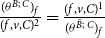 $\frac{(\theta^{B;\;C})_f}{(f,v,C)^2}=\frac{(f,v,C)^1}{(\theta^{\tilde B;\;C})_f}$
, where
$\frac{(\theta^{B;\;C})_f}{(f,v,C)^2}=\frac{(f,v,C)^1}{(\theta^{\tilde B;\;C})_f}$
, where $(f,v,C)^1$
is the structure 2-cell of the binary funny functor
$(f,v,C)^1$
is the structure 2-cell of the binary funny functor $M(M\Box_2 1)$
and
$M(M\Box_2 1)$
and $(f,v,C)^2$
of
$(f,v,C)^2$
of $M(1\Box_2 M)\alpha_{\mathbb{D},\mathbb{D},\mathbb{D}}$
. This corresponds to the axiom (
$M(1\Box_2 M)\alpha_{\mathbb{D},\mathbb{D},\mathbb{D}}$
. This corresponds to the axiom ( $(f,\rtimes v,C)$
) (in the Appendix A) whereby the 2-cell
$(f,\rtimes v,C)$
) (in the Appendix A) whereby the 2-cell $(f,v,C)^1$
becomes
$(f,v,C)^1$
becomes $(f\hspace{-0,06cm}\ltimes\hspace{-0,06cm}-\vert_v,C)$
, and
$(f\hspace{-0,06cm}\ltimes\hspace{-0,06cm}-\vert_v,C)$
, and $(f,v,C)^2$
becomes
$(f,v,C)^2$
becomes $f\hspace{-0,06cm}\ltimes\hspace{-0,06cm}-\vert_{v\ltimes C}$
of the axiom (
$f\hspace{-0,06cm}\ltimes\hspace{-0,06cm}-\vert_{v\ltimes C}$
of the axiom ( $(f,\rtimes v,C)$
).
$(f,\rtimes v,C)$
).
On the other hand, the centrality structures obtained from $H_M$
are given via square-formed 2-cell components satisfying
$H_M$
are given via square-formed 2-cell components satisfying $(-,K)\vert_u=(u,-)\vert_K$
and
$(-,K)\vert_u=(u,-)\vert_K$
and $(-,U)\vert_k=(k,-)\vert_U$
, so that the latter
$(-,U)\vert_k=(k,-)\vert_U$
, so that the latter $0+0+6+0$
axioms simultaneously cover the
$0+0+6+0$
axioms simultaneously cover the $0+6+0+0$
axioms: (
$0+6+0+0$
axioms: ( $(f\ltimes,v,C)$
), (
$(f\ltimes,v,C)$
), ( $(f\ltimes,B,z)$
), (
$(f\ltimes,B,z)$
), ( $(A,g\ltimes,z)$
), (
$(A,g\ltimes,z)$
), ( $(u,\rtimes g,C)$
), (
$(u,\rtimes g,C)$
), ( $(u,B,\rtimes h)$
), (
$(u,B,\rtimes h)$
), ( $(A,v,\rtimes h)$
). (Observe that in the named axioms the 1h-cells f,g,h should be left/right central: in the present case K,k are not central at any side, but the square-formed 2-cells relevant for the axioms exist.) Moreover, since the structure 2-cells (u,U) of the binary funny functors are trivial, the
$(A,v,\rtimes h)$
). (Observe that in the named axioms the 1h-cells f,g,h should be left/right central: in the present case K,k are not central at any side, but the square-formed 2-cells relevant for the axioms exist.) Moreover, since the structure 2-cells (u,U) of the binary funny functors are trivial, the $0+0+0+6$
axioms (
$0+0+0+6$
axioms ( $(u\ltimes,v,C)$
), (
$(u\ltimes,v,C)$
), ( $(A, v\ltimes,z)$
), (
$(A, v\ltimes,z)$
), ( $(u\ltimes, B,z)$
), (
$(u\ltimes, B,z)$
), ( $(u,B,\rtimes z)$
), (
$(u,B,\rtimes z)$
), ( $(u,\rtimes v,C)$
), (
$(u,\rtimes v,C)$
), ( $(A,v,\rtimes z)$
) are automatically fulfilled.s
$(A,v,\rtimes z)$
) are automatically fulfilled.s
That the transformation $\alpha^M$
obeys the pentagon it means that its above three components satisfy the four pentagons of Definition 3.10, whereby the binoidal structure is induced by the underlying binary funny functor
$\alpha^M$
obeys the pentagon it means that its above three components satisfy the four pentagons of Definition 3.10, whereby the binoidal structure is induced by the underlying binary funny functor $H_M$
of the double functor
$H_M$
of the double functor $M:\mathbb{D}\Box\mathbb{D}\to \mathbb{D}$
. Similarly, one has that
$M:\mathbb{D}\Box\mathbb{D}\to \mathbb{D}$
. Similarly, one has that $\lambda, \rho, \alpha^M$
satisfy the six triangles from Definition 3.11.
$\lambda, \rho, \alpha^M$
satisfy the six triangles from Definition 3.11.
6. Double quasi-functors yield purely central binoidal double categories
In Femić (Reference Femić2024) and Femić (Reference Femić2023) we generalized Gray’s 2-categorical “quasi-functors of two variables” from Gray (Reference Gray1974) to the double-categorical setting. In the former reference they emerged from the inner-hom studied in Böhm (Reference Böhm2020) whose 0-cells were double functors, while in the latter they came from a candidate for inner-hom whose 0-cells are lax double functors. In this article we are interested in the “pseudo” version of double quasi-functors. In Gordon, Power and Street (Reference Gordon, Power and Street1995), pseudodouble quasi-functors of two and more variables are called cubical functors.
In this section we investigate the relation between a binoidal structure $-\bowtie-$
and centrality of 1- and 2-cells in a double category
$-\bowtie-$
and centrality of 1- and 2-cells in a double category $\mathbb{B}$
from Subsection 3.1, on one hand, and a pseudodouble quasi-functor structure H in
$\mathbb{B}$
from Subsection 3.1, on one hand, and a pseudodouble quasi-functor structure H in $\mathbb{B}$
, on the other hand.
$\mathbb{B}$
, on the other hand.
6.1 Pseudodouble quasi-functors and pure centrality
In Femić (Reference Femić2023, Section 2) we introduced the double category $\operatorname{\mathbb{L} ax}_{hop}(\mathbb{A}, \mathbb{B})$
of lax double functors of double categories
$\operatorname{\mathbb{L} ax}_{hop}(\mathbb{A}, \mathbb{B})$
of lax double functors of double categories $\mathbb{A}\to \mathbb{B}$
, horizontal oplax transformations as 1h-cells, vertical lax transformations as 1v-cells, and modifications. (Such a choice of transformations is a priori arbitrary and most general. We also explored the impact of having the transformations in the two directions of different kind. In particular, by this choice in the horizontal direction we generalized the 2-categorical constructions from Faul, Manuell and Siqueira (Reference Faul, Manuell and Siqueira2021).) In Femić (Reference Femić2023, Proposition 3.3) we characterized a lax double functor
$\mathbb{A}\to \mathbb{B}$
, horizontal oplax transformations as 1h-cells, vertical lax transformations as 1v-cells, and modifications. (Such a choice of transformations is a priori arbitrary and most general. We also explored the impact of having the transformations in the two directions of different kind. In particular, by this choice in the horizontal direction we generalized the 2-categorical constructions from Faul, Manuell and Siqueira (Reference Faul, Manuell and Siqueira2021).) In Femić (Reference Femić2023, Proposition 3.3) we characterized a lax double functor $\mathcal{F}\colon\mathbb{A}\to \operatorname{\mathbb{L} ax}_{hop}(\mathbb{B}, \mathbb{C})$
as a pair of two families of lax double functors into
$\mathcal{F}\colon\mathbb{A}\to \operatorname{\mathbb{L} ax}_{hop}(\mathbb{B}, \mathbb{C})$
as a pair of two families of lax double functors into $\mathbb{C}$
together with four families of 2-cells in
$\mathbb{C}$
together with four families of 2-cells in $\mathbb{C}$
that satisfy 20 axioms. The latter collection of data and axioms we call a lax double quasi-functor, in analogy to Gray (Reference Gray1974). For reader’s convenience we include this result as Proposition B.1 in the Appendix B. In Table 1 of Femić (Reference Femić2023, Proposition 3.3) we listed the origin of the four types of 2-cells and 20 axioms and we labeled the axioms. Various of those axioms can be interpreted in more than one way. We include that Table enriched with the corresponding additional interpretations as Table 7 in the Appendix C.
$\mathbb{C}$
that satisfy 20 axioms. The latter collection of data and axioms we call a lax double quasi-functor, in analogy to Gray (Reference Gray1974). For reader’s convenience we include this result as Proposition B.1 in the Appendix B. In Table 1 of Femić (Reference Femić2023, Proposition 3.3) we listed the origin of the four types of 2-cells and 20 axioms and we labeled the axioms. Various of those axioms can be interpreted in more than one way. We include that Table enriched with the corresponding additional interpretations as Table 7 in the Appendix C.
Inspecting that Table and realizing that the axioms ((k,K’K)), (( $k,1_A$
)), ((
$k,1_A$
)), (( $k,\frac{U}{U'}$
)), ((
$k,\frac{U}{U'}$
)), (( $k,1^A$
)), (((k,K)-r-nat)) therein mean that
$k,1^A$
)), (((k,K)-r-nat)) therein mean that $(k,-)$
is a horizontal lax transformation, while the axioms ((u,K’K)), ((
$(k,-)$
is a horizontal lax transformation, while the axioms ((u,K’K)), (( $u,1_A$
)), ((
$u,1_A$
)), (( $u,\frac{U}{U'}$
)), ((
$u,\frac{U}{U'}$
)), (( $u,1^A$
)), (((u,U)-r-nat)) mean that
$u,1^A$
)), (((u,U)-r-nat)) mean that $(u,-)$
is a vertical oplax transformation, and finally that the axioms (((k,K)-r-nat)) and (((u,U)-r-nat)) mean that
$(u,-)$
is a vertical oplax transformation, and finally that the axioms (((k,K)-r-nat)) and (((u,U)-r-nat)) mean that $(\omega,-)$
is a modification (with respect to horizontally lax and vertically oplax transformations), one sees that the content of Corollary 3.5 of Femić (Reference Femić2023) can be upgraded into an if and only if statement. Namely, we have
$(\omega,-)$
is a modification (with respect to horizontally lax and vertically oplax transformations), one sees that the content of Corollary 3.5 of Femić (Reference Femić2023) can be upgraded into an if and only if statement. Namely, we have
Proposition 6.1. Let $\mathbb{A},\mathbb{B},\mathbb{C}$
be double categories. The following are equivalent:
$\mathbb{A},\mathbb{B},\mathbb{C}$
be double categories. The following are equivalent:
-
(1)
$H\colon \mathbb{A}\times\mathbb{B}\to \mathbb{C}$
is a lax double quasi-functor, meaning that there are two families of lax double functors
$(-,A)\colon\mathbb{B}\to \mathbb{C}\quad \text{ and}\quad (B,-)\colon\mathbb{A}\to \mathbb{C}$
for objects
$A\in\mathbb{A}, B\in\mathbb{B}$
, such that
$H(A, -) = (-, A), H(-, B)=(B,-)$
and
$(-,A)\vert_B=(B,-)\vert_A=(B,A)$
, and there are four families of 2-cells(40)in
$\mathbb{C}$
determined by all 1h-cells
$K\colon A\to A'$
and 1v-cells
$U\colon A\to \tilde A$
in
$\mathbb{A}$
, and 1h-cells
$k\colon B\to B'$
and 1v-cells
$u\colon B\to \tilde B$
in
$\mathbb{B}$
, which satisfy 20 axioms from Proposition B.1, and -
(2) there are two families of lax double functors
$(-,A)\colon\mathbb{B}\to \mathbb{C}\quad \text{ and}\quad (B,-)\colon\mathbb{A}\to \mathbb{C}$
for objects
$A\in\mathbb{A}, B\in\mathbb{B}$
, such that
$(-,A)\vert_B=(B,-)\vert_A=(B,A)$
, and the following hold:-
(i)
$(-,K)\colon (-,A)\to (-,A')$
is a horizontal oplax transformation for each 1h-cell
$K\colon A\to A'$
,
$(-,U)\colon (-,A)\to (-,\tilde A)$
is a vertical lax transformation for each 1v-cell
$U\colon A\to \tilde A$
in
$\mathbb{A}$
,
$(-,\zeta)$
is a modification with respect to horizontally oplax and vertically lax transformations for each 2-cell
$\zeta$
in
$\mathbb{A}$
, and the following coincide:
$$(B,-)\vert_K=(-,K)\vert_B, \,\, (B,-)\vert_U=(-,U)\vert_B, \,\, (B,-)\vert_\zeta=(-,\zeta)\vert_B;$$
-
(ii)
$(k,-)\colon (B,-)\to (B', -)$
is a horizontal lax transformation for each 1h-cell
$k\colon B\to B'$
,
$(u,-)\colon (B,-)\to (\tilde B,-)$
is a vertical oplax transformation for each 1v-cell
$u\colon B\to \tilde B$
in
$\mathbb{B}$
,
$(\omega,-)$
is a modification with respect to horizontally lax and vertically oplax transformations for each 2-cell
$\omega$
in
$\mathbb{B}$
, and the following coincide:
$$(-,A)\vert_k=(k,-)\vert_A, \,\, (-,A)\vert_u=(u,-)\vert_A, \,\, (-,A)\vert_\omega=(\omega,-)\vert_A;$$
-
(iii) for 1h-cells K,k the 2-cell component
$(-,K)\vert_k$
of the oplax (resp. lax) structure of the horizontal transformation
$(-,K)$
coincides with the 2-cell component
$(k,-)\vert_K$
of the lax (resp. oplax) structure of the transformation
$(k,-)$
; -
(iv) for 1v-cells U,u the 2-cell component
$(-,U)\vert_u$
of the lax (resp. oplax) structure of the vertical transformation
$(-,U)$
coincides with the 2-cell component
$(u,-)\vert_U$
of the oplax (resp. lax) structure of the transformation
$(u,-)$
; -
(v) for 1h-cells K,k and 1v-cells U,u the following 2-cell components of the respective transformations coincide:
$(-,K)\vert_u=(u,-)\vert_K$
and
$(-,U)\vert_k=(k,-)\vert_U$
.
-






















The modifications in item 2. (ii) above are from Definition 2.7.
Similarly to Femić (Reference Femić2024, Proposition 2.9) and Femić (Reference Femić2023, Proposition 3.3), one has that a pseudodouble quasi-functor $H:\mathbb{A}\times\mathbb{B}\to \mathbb{C}$
consists of two families of pseudodouble functors
$H:\mathbb{A}\times\mathbb{B}\to \mathbb{C}$
consists of two families of pseudodouble functors $(-,A)\colon\mathbb{B}\to \mathbb{C}$
and
$(-,A)\colon\mathbb{B}\to \mathbb{C}$
and $(B,-)\colon\mathbb{A}\to \mathbb{C}$
with similar 20 axioms as in the cited two propositions.
$(B,-)\colon\mathbb{A}\to \mathbb{C}$
with similar 20 axioms as in the cited two propositions.
We go back for a moment to the lax case. Assume now that $\mathbb{A}=\mathbb{B}=\mathbb{C}$
. Then to have a lax double quasi-functor
$\mathbb{A}=\mathbb{B}=\mathbb{C}$
. Then to have a lax double quasi-functor $H:\mathbb{B}\times\mathbb{B}\to \mathbb{B}$
it means, among other, to have 2-cells (k,K) and (u,U) in
$H:\mathbb{B}\times\mathbb{B}\to \mathbb{B}$
it means, among other, to have 2-cells (k,K) and (u,U) in $\mathbb{B}$
from (40), so that
$\mathbb{B}$
from (40), so that $(-,K)\colon (-,A)\to (-,A')$
is a horizontal oplax transformation,
$(-,K)\colon (-,A)\to (-,A')$
is a horizontal oplax transformation, $(k,-)\colon (B,-)\to (B', -)$
is a horizontal lax transformation,
$(k,-)\colon (B,-)\to (B', -)$
is a horizontal lax transformation, $(u,-)\colon (B,-)\to (\tilde B,-)$
is a vertical oplax transformation, and
$(u,-)\colon (B,-)\to (\tilde B,-)$
is a vertical oplax transformation, and $(-,U)\colon (-,A)\to (-,\tilde A)$
is a vertical lax transformation, over lax double functors acting
$(-,U)\colon (-,A)\to (-,\tilde A)$
is a vertical lax transformation, over lax double functors acting $\mathbb{B}\to \mathbb{B}$
. Then clearly, if
$\mathbb{B}\to \mathbb{B}$
. Then clearly, if $(-,K)$
is a horizontal pseudonatural transformation for every 1h-cell K, necessarily so is
$(-,K)$
is a horizontal pseudonatural transformation for every 1h-cell K, necessarily so is $(k,-)$
for every 1h-cell k, and if
$(k,-)$
for every 1h-cell k, and if $(-,U)$
is a vertical pseudonatural transformation for every 1v-cell U, necessarily so is
$(-,U)$
is a vertical pseudonatural transformation for every 1v-cell U, necessarily so is $(u,-)$
for every 1v-cell u, as their respective component 2-cells coincide.
$(u,-)$
for every 1v-cell u, as their respective component 2-cells coincide.
Let $\operatorname{\mathbb{P} seudo}_{ps}(\mathbb{B},\mathbb{B})$
be the double category of pseudodouble endofunctors on
$\operatorname{\mathbb{P} seudo}_{ps}(\mathbb{B},\mathbb{B})$
be the double category of pseudodouble endofunctors on $\mathbb{B}$
, horizontal pseudonatural transformations, vertical pseudonatural transformations and modifications. (This is the fully pseudo version of the double category
$\mathbb{B}$
, horizontal pseudonatural transformations, vertical pseudonatural transformations and modifications. (This is the fully pseudo version of the double category $\operatorname{\mathbb{L} ax}_{hop}(\mathbb{B},\mathbb{B})$
from Femić (Reference Femić2023, Section 2).) In view of the above said, and joining the version of Proposition B.1 for pseudodouble functors
$\operatorname{\mathbb{L} ax}_{hop}(\mathbb{B},\mathbb{B})$
from Femić (Reference Femić2023, Section 2).) In view of the above said, and joining the version of Proposition B.1 for pseudodouble functors $\mathbb{B}\to \operatorname{\mathbb{P} seudo}_{ps}(\mathbb{B}, \mathbb{B})$
, we obtain:
$\mathbb{B}\to \operatorname{\mathbb{P} seudo}_{ps}(\mathbb{B}, \mathbb{B})$
, we obtain:
Theorem 6.2. Let $\mathbb{B}$
be a double category. The following are equivalent:
$\mathbb{B}$
be a double category. The following are equivalent:
-
(1) there is a pseudodouble functor
$\mathcal{F}\colon\mathbb{B}\to \operatorname{\mathbb{P} seudo}_{ps}(\mathbb{B}, \mathbb{B})$
; -
(2) there is a pseudodouble quasi-functor
$H:\mathbb{B}\times\mathbb{B}\to \mathbb{B}$
(with families of pseudodouble functors
$(-,A),(B,-)\colon\mathbb{B}\to \mathbb{B}$
for
$A,B\in\mathbb{B}$
, four families of 2-cells satisfying 20 axioms); -
(3) the following hold:
-
-
$\mathbb{B}$
is binoidal with pseudodouble functors
$A\ltimes -,-\rtimes B:\mathbb{B}\to \mathbb{B}$
for
$A,B\in\mathbb{B}$
; -
- every 1h-cell K in
$\mathbb{B}$
is left central via a horizontal pseudonatural transformation
$K\ltimes-$
and every 1h-cell k is right central in
$\mathbb{B}$
via a horizontal pseudonatural transformation
$-\rtimes k$
, and it is
\begin{align*}A\ltimes-\vert_k=-\rtimes k\vert_A \quad \text{and}\quad -\rtimes B\vert_K=K\ltimes-\vert_B;\end{align*}
-
- every 1v-cell U is left central in
$\mathbb{B}$
via a vertical pseudonatural transformation
$U\ltimes-$
and every 1v-cell u is right central in
$\mathbb{B}$
via a vertical pseudonatural transformation
$-\rtimes u$
, and it is
\begin{align*}A\ltimes-\vert_u=-\rtimes u\vert_A \quad \text{and}\quad -\rtimes B\vert_U=U\ltimes-\vert_B;\end{align*}
-
- every 2-cell
$\zeta$
is left central via a modification
$\zeta\ltimes-$
and every 2-cell
$\omega$
is right central via a modification
$-\rtimes\omega$
, and it is
\begin{align*}A\ltimes-\vert_\omega=-\rtimes\omega\vert_A \quad \text{and}\quad -\rtimes B\vert_\zeta=\zeta\ltimes-\vert_B;\end{align*}
-
- it is
for all 1h-cells K,k and 1v-cells U,u in
\begin{align*}K\ltimes-\vert_k=(-\rtimes k\vert_K)^{-1}, \qquad U\ltimes-\vert_u=(-\rtimes u\vert_U)^{-1},\\K\ltimes-\vert_u=-\rtimes u\vert_K \quad \text{and}\quad U\ltimes-\vert_k=-\rtimes k\vert_U\end{align*}
$\mathbb{B}$
.
-








In particular, with notations as above, one has:
-
- the 2-cell component
$K\ltimes-\vert_k$
of the oplax (resp. lax) structure of the horizontal transformation
$K\ltimes-$
coincides with the 2-cell component at K of the lax (resp. oplax) structure of the transformation
$-\rtimes k$
(which is
$(-\rtimes k\vert_K)^{-1}$
in (10)); -
- the 2-cell component
$U\ltimes-\vert_u$
of the lax (resp. oplax) structure of the vertical transformation
$U\ltimes-$
coincides with the 2-cell component at U of the oplax (resp. lax) structure of the transformation
$-\rtimes u$
(which is
$(-\rtimes u\vert_U)^{-1}$
in (11)).


We outline the correspondence holding in the above situation. For all $A,B\in\mathbb{B}$
it is
$A,B\in\mathbb{B}$
it is $A\ltimes -=(-,A)$
and
$A\ltimes -=(-,A)$
and $-\rtimes B=(B,-)$
, and moreover
$-\rtimes B=(B,-)$
, and moreover $K\ltimes-=(-,K)$
and
$K\ltimes-=(-,K)$
and $-\rtimes k=(k,-)$
,
$-\rtimes k=(k,-)$
, $U\ltimes-=(-,U)$
and
$U\ltimes-=(-,U)$
and $-\rtimes u=(u,-)$
,
$-\rtimes u=(u,-)$
, $\zeta\ltimes-=(-,\zeta)$
and
$\zeta\ltimes-=(-,\zeta)$
and $-\rtimes \omega=(\omega,-)$
for 1h-cells K,k, 1v-cells U,u and 2-cells
$-\rtimes \omega=(\omega,-)$
for 1h-cells K,k, 1v-cells U,u and 2-cells $\zeta, \omega$
in
$\zeta, \omega$
in $\mathbb{B}$
. Similarly, the four families of 2-cells in a quasi-functor correspond to the following four identities holding between centrality structural 2-cells in the point 3. of the above theorem:
$\mathbb{B}$
. Similarly, the four families of 2-cells in a quasi-functor correspond to the following four identities holding between centrality structural 2-cells in the point 3. of the above theorem:
 \begin{equation} K\ltimes-\vert_k=(-\rtimes k\vert_K)^{-1}, \qquad \qquad U\ltimes-\vert_u=(-\rtimes u\vert_U)^{-1},\end{equation}
 $$K\ltimes-\vert_u=-\rtimes u\vert_K, \qquad \qquad U\ltimes-\vert_k=-\rtimes k\vert_U$$
for all 1h-cells K,k and all 1v-cells U,u in $\mathbb{B}$
. Observe that in point 3. we have that every 1h-cell, every 1v-cell and every 2-cell in
$\mathbb{B}$
. Observe that in point 3. we have that every 1h-cell, every 1v-cell and every 2-cell in $\mathbb{B}$
are both left and right central, hence central, in their respective senses, with a specific structural transform. From point 1. we know that the assignment of those centrality structure transforms is functorial.
$\mathbb{B}$
are both left and right central, hence central, in their respective senses, with a specific structural transform. From point 1. we know that the assignment of those centrality structure transforms is functorial.
Definition 6.3. A binoidal double category $\mathbb{B}$
satisfying the point 3. in the above theorem we call purely central.
$\mathbb{B}$
satisfying the point 3. in the above theorem we call purely central.
Observe that the choice of the centrality structures in the above definition is fixed by the choice of the binoidal structure $(\ltimes, \rtimes)$
(equivalently, pseudodouble functor
$(\ltimes, \rtimes)$
(equivalently, pseudodouble functor $\mathcal{F}$
and a pseudodouble quasi-functor H). To stress this fact, in view of Theorem 6.2 we may say a purely central binoidal structure with an underlying quasi-functor H.
$\mathcal{F}$
and a pseudodouble quasi-functor H). To stress this fact, in view of Theorem 6.2 we may say a purely central binoidal structure with an underlying quasi-functor H.
Definition 6.4. For a purely central binoidal double category $(\mathbb{B}, H)$
the pure center double category is a pseudodouble category
$(\mathbb{B}, H)$
the pure center double category is a pseudodouble category $\mathbb{Z}_p(\mathbb{B},H)$
that has the same objects as
$\mathbb{Z}_p(\mathbb{B},H)$
that has the same objects as $\mathbb{B}$
, its 1h-cells are triples
$\mathbb{B}$
, its 1h-cells are triples $(f, f\ltimes-, -\rtimes f)$
consisting of all (central) 1h-cells of
$(f, f\ltimes-, -\rtimes f)$
consisting of all (central) 1h-cells of $\mathbb{B}$
and their two structural horizontal transformations, its 1v-cells are triples
$\mathbb{B}$
and their two structural horizontal transformations, its 1v-cells are triples $(v, v\ltimes-, -\rtimes v)$
consisting of all (central) 1v-cells of
$(v, v\ltimes-, -\rtimes v)$
consisting of all (central) 1v-cells of $\mathbb{B}$
and their two structural vertical transformations, its 2-cells are triples
$\mathbb{B}$
and their two structural vertical transformations, its 2-cells are triples $(a, a\ltimes-, -\rtimes a)$
consisting of all (central) 2-cells of
$(a, a\ltimes-, -\rtimes a)$
consisting of all (central) 2-cells of $\mathbb{B}$
and their two structural modifications.
$\mathbb{B}$
and their two structural modifications.
From the definition is clear that there is an isomorphism of binoidal double categories between any purely central binoidal double category $(\mathbb{B}, H)$
and its pure center double category
$(\mathbb{B}, H)$
and its pure center double category $\mathbb{Z}_p(\mathbb{B},H)$
. In Theorem 7.10 we will equip
$\mathbb{Z}_p(\mathbb{B},H)$
. In Theorem 7.10 we will equip $(\mathbb{B}, H)$
with a structure of a monoidal double category, and in Theorem 9.3 we will extend the mentioned binoidal double category isomorphism to a one of monoidal double categories.
$(\mathbb{B}, H)$
with a structure of a monoidal double category, and in Theorem 9.3 we will extend the mentioned binoidal double category isomorphism to a one of monoidal double categories.
It is easily seen that $\mathbb{Z}_p(\mathbb{B},H)$
is indeed a pseudodouble category. The composition of 1h-cells say
$\mathbb{Z}_p(\mathbb{B},H)$
is indeed a pseudodouble category. The composition of 1h-cells say $(f, f\ltimes-, -\rtimes f):A\to A'$
and
$(f, f\ltimes-, -\rtimes f):A\to A'$
and $(f', f'\ltimes-, -\rtimes f'):A'\to A''$
is defined as follows: to the expression
$(f', f'\ltimes-, -\rtimes f'):A'\to A''$
is defined as follows: to the expression $\delta_{\frac{\alpha}{\beta},f}$
in Lemma 2.4 add the 2-cell components of the pseudodouble functor structure of
$\delta_{\frac{\alpha}{\beta},f}$
in Lemma 2.4 add the 2-cell components of the pseudodouble functor structure of $A\ltimes -$
resp.
$A\ltimes -$
resp. $-\rtimes A$
(conjugate by the lax and the oplax part). Then for the associativity one applies the “hexagon axiom” (lx.f.cmp), which leads to the fact that the center double categories are indeed pseudodouble categories. Compositions of 2-cells are induced by the compositions of modifications, see Appendix A.0.
$-\rtimes A$
(conjugate by the lax and the oplax part). Then for the associativity one applies the “hexagon axiom” (lx.f.cmp), which leads to the fact that the center double categories are indeed pseudodouble categories. Compositions of 2-cells are induced by the compositions of modifications, see Appendix A.0.
We also outline that the functorial assignment of the centrality structures in a pure center double category is provided via the pseudodouble functors $A\ltimes -,-\rtimes B:\mathbb{B}\to \mathbb{B}$
. From the perspective of point 1. in the above theorem these two functors are stemming from
$A\ltimes -,-\rtimes B:\mathbb{B}\to \mathbb{B}$
. From the perspective of point 1. in the above theorem these two functors are stemming from $\mathcal{F}(A)=A\ltimes -:\mathbb{B}\to \mathbb{B}$
and
$\mathcal{F}(A)=A\ltimes -:\mathbb{B}\to \mathbb{B}$
and $\mathcal{F}(-)(B)=-\rtimes B:\mathbb{B}\to \mathbb{B}$
.
$\mathcal{F}(-)(B)=-\rtimes B:\mathbb{B}\to \mathbb{B}$
.
Consequently, for $(\mathbb{B}, H)$
purely central there is a double functor
$(\mathbb{B}, H)$
purely central there is a double functor $Z_p:\mathbb{B}\to \mathbb{Z}_p(\mathbb{B},H)$
, which is identity on objects and given by
$Z_p:\mathbb{B}\to \mathbb{Z}_p(\mathbb{B},H)$
, which is identity on objects and given by $b\mapsto (b,b\ltimes-, -\rtimes b)$
for any 1h-, 1v- or 2-cell b in
$b\mapsto (b,b\ltimes-, -\rtimes b)$
for any 1h-, 1v- or 2-cell b in $\mathbb{B}$
. That it is a double functor is easily seen.
$\mathbb{B}$
. That it is a double functor is easily seen.
6.2 One-sided centers of a binoidal double category
Apart from pure centrality and pure center for a binoidal double category one can give two more equivalent interpretations to a pseudodouble quasi-functor and consider two other center double categories. Namely, left and right centrality structures on $\mathbb{B}$
related between each other as in a pure center can be seen as one-sided centrality structures on
$\mathbb{B}$
related between each other as in a pure center can be seen as one-sided centrality structures on $\mathbb{B}$
, by disregarding the structures on the other side. Accordingly, one-sided center double categories can be introduced. This is done in the following way.
$\mathbb{B}$
, by disregarding the structures on the other side. Accordingly, one-sided center double categories can be introduced. This is done in the following way.
For all $A,B\in\mathbb{B}$
we keep a binoidal structure determined by
$A,B\in\mathbb{B}$
we keep a binoidal structure determined by $A\ltimes -=(-,A)$
and
$A\ltimes -=(-,A)$
and $-\rtimes B=(B,-)$
. Then, for left centrality and left center we use:
$-\rtimes B=(B,-)$
. Then, for left centrality and left center we use: $K\ltimes-=(-,K)$
,
$K\ltimes-=(-,K)$
, $U\ltimes-=(-,U)$
and
$U\ltimes-=(-,U)$
and $\zeta\ltimes-=(-,\zeta)$
for 1h-cells K, 1v-cells U and 2-cells
$\zeta\ltimes-=(-,\zeta)$
for 1h-cells K, 1v-cells U and 2-cells $\zeta$
. However, whereas the four families of 2-cells of a quasi-functor were recognized in a purely central binoidal double category as the 2-cells (41), we instead consider:
$\zeta$
. However, whereas the four families of 2-cells of a quasi-functor were recognized in a purely central binoidal double category as the 2-cells (41), we instead consider:
 $$(k,K)=K\ltimes-\vert_k,\qquad (u,K)=K\ltimes-\vert_u, \qquad (k,U)=U\ltimes-\vert_k, \qquad (u,U)=U\ltimes -\vert_u$$
and recognize that the 20 axioms mean (compare to Table 7 of Appendix C):
-
• every 1h-cell K in
$\mathbb{B}$
is left central via a horizontal pseudonatural transformation
$K\ltimes-$
and it is
$K\ltimes-\vert_B=-\rtimes B\vert_K$
; -
• every 1v-cell U is left central in
$\mathbb{B}$
via a vertical pseudonatural transformation
$U\ltimes-$
and it is
$U\ltimes-\vert_B=-\rtimes B\vert_U;$
-
• every 2-cell
$\zeta$
is left central via a modification
$\zeta\ltimes-$
and it is
$\zeta\ltimes-\vert_B=-\rtimes B\vert_\zeta;$
-
• the axioms ((k,K’K)) and ((u,K’K)) for the invertible modification compositor
$(K'\ltimes -)(K\ltimes -)\Rrightarrow K'K\ltimes-$
are saying how a horizontal pseudonatural transformation
$K'K\ltimes-$
, i.e. its structural 2-cells, for left centrality of the composition 1h-cell K’K is given; -
• the axioms ((
$k,1_A$
)) and ((
$u,1_A$
)) for the invertible modification unitor
$\operatorname {Id}_{A\ltimes-}\Rrightarrow 1_A\ltimes-$
are saying how a horizontal pseudonatural transformation
$1_A\ltimes-$
, i.e. its structural 2-cells, for left centrality of the identity 1h-cell
$1_A$
is given; -
• the axioms ((
$k,1^A$
)) and ((
$u,1^A$
)), stemming from the axiom (lx.f.v2) of
$\mathcal{F}$
when evaluated at k and u, say that the structural 2-cells
$1^A\ltimes-\vert_k$
and
$1^A\ltimes-\vert_u$
for 1h-cells k and 1v-cells u for the vertical pseudonatural transformation
$1^A\ltimes-$
are identities:
$\operatorname {Id}_{A\ltimes k}$
and
$\operatorname {Id}_{A\ltimes u}$
, and -
• the axioms ((
$k,\frac{U}{U'}$
)) and ((
$u,\frac{U}{U'}$
)), stemming from the axiom lx.f.v1) of
$\mathcal{F}$
when evaluated at k and u, say that the structural 2-cells
$\frac{U}{U'}\ltimes-\vert_k$
and
$\frac{U}{U'}\ltimes-\vert_u$
for 1h-cells k and 1v-cells u for the vertical pseudonatural transformation
$\frac{U}{U'}\ltimes-$
are given by
$\frac{U}{U'}\ltimes-\vert_k=\frac{U\ltimes-\vert_k}{U'\ltimes-\vert_k}$
and
$\frac{U}{U'}\ltimes-\vert_u=\frac{U\ltimes-\vert_u}{U'\ltimes-\vert_u}$
.















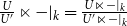

The above consideration means that there is a functorial way of assigning left centrality structural transforms to 1h- and 1v-cells of $\mathbb{B}$
: the last four items express compositionality and unitality in the variable
$\mathbb{B}$
: the last four items express compositionality and unitality in the variable $(\!-\!)$
of the pseudodouble functor
$(\!-\!)$
of the pseudodouble functor $\mathcal{F}(\!-\!)(\bullet)$
with image in
$\mathcal{F}(\!-\!)(\bullet)$
with image in $\mathbb{B}$
, whereby
$\mathbb{B}$
, whereby $\mathcal{F}\colon\mathbb{B}\to \operatorname{\mathbb{P} seudo}_{ps}(\mathbb{B}, \mathbb{B})$
. The above consideration has its right-hand sided version.
$\mathcal{F}\colon\mathbb{B}\to \operatorname{\mathbb{P} seudo}_{ps}(\mathbb{B}, \mathbb{B})$
. The above consideration has its right-hand sided version.
Definition 6.5. A binoidal double category $\mathbb{B}$
equipped with left centrality structures as above we call left central. Since these structures stem from a pseudodouble quasi-functor H, we will write
$\mathbb{B}$
equipped with left centrality structures as above we call left central. Since these structures stem from a pseudodouble quasi-functor H, we will write $(\mathbb{B}, H)$
for a left central binoidal
$(\mathbb{B}, H)$
for a left central binoidal $\mathbb{B}$
with an underlying quasi-functor H.
$\mathbb{B}$
with an underlying quasi-functor H.
Similarly, we define right central binoidal double category.
We can now extend Theorem 6.2 into:
Theorem 6.6. For a double category $\mathbb{B}$
the following are equivalent:
$\mathbb{B}$
the following are equivalent:
-
(1) there is a pseudodouble functor
$\mathcal{F}\colon\mathbb{B}\to \operatorname{\mathbb{P} seudo}_{ps}(\mathbb{B}, \mathbb{B})$
; -
(2) there is a pseudodouble quasi-functor
$H:\mathbb{B}\times\mathbb{B}\to \mathbb{B}$
; -
(3)
$\mathbb{B}$
is binoidal and purely central;
-
(4)
$\mathbb{B}$
is binoidal and left central;
-
(5)
$\mathbb{B}$
is binoidal and right central.




Proof. It only remains to prove the equivalence of 3. with 4. and 5. The part $(3.\Rightarrow 4.)$
is proved before Definition 6.5. Because of the symmetry of 4. and 5. we only prove
$(3.\Rightarrow 4.)$
is proved before Definition 6.5. Because of the symmetry of 4. and 5. we only prove $(4.\Rightarrow 3.)$
. Although maybe surprising at a first glance, 4. implies 3. as they both are defined by the exactly same set of 20 axioms. For curious readers let us walk through the axioms to see how left centrality can be interpreted as pure centrality.
$(4.\Rightarrow 3.)$
. Although maybe surprising at a first glance, 4. implies 3. as they both are defined by the exactly same set of 20 axioms. For curious readers let us walk through the axioms to see how left centrality can be interpreted as pure centrality.
The first three bullet-items of a left central binoidal structure state that all 1h-cells, all 1v-cells and all 2-cells are left central. This covers $5+5+2=12$
of the 20 axioms and this meaning of this part of the data is also present in a purely central binoidal double category. Four of these 12 axioms, together with the remaining 8 axioms, have equivalent meanings in terms of right centrality structures (these are the 12 axioms in the third column of Table 7), that yields the claim. Namely, set
$5+5+2=12$
of the 20 axioms and this meaning of this part of the data is also present in a purely central binoidal double category. Four of these 12 axioms, together with the remaining 8 axioms, have equivalent meanings in terms of right centrality structures (these are the 12 axioms in the third column of Table 7), that yields the claim. Namely, set
 $$-\rtimes k\vert_A:=A\ltimes-\vert_k, \quad \quad -\rtimes u\vert_A:=A\ltimes-\vert_u,\quad \quad -\rtimes\omega\vert_A:=A\ltimes-\vert_\omega,$$
 $${\kern-8.5pt}-\rtimes k\vert_K:=(K\ltimes-\vert_k)^{-1}, {\kern5.5pt}\qquad -\rtimes u\vert_K:=K\ltimes-\vert_u,{\kern8.5pt}$$
 $$ -\rtimes k\vert_U:=U\ltimes-\vert_k, \qquad \qquad -\rtimes u\vert_U:=(U\ltimes-\vert_u)^{-1}$$
and observe that the eight axioms from the last four bullet-items of a left central binoidal structure correspond to the first eight axioms in the third column of Table 7. These in turn correspond to the axioms (h.l.t.-1) - (h.l.t.-4) for $(k,-)=-\rtimes k$
to be a horizontal pseudonatural transformation and (v.o.t.- 1) - (v.o.t.- 4) for
$(k,-)=-\rtimes k$
to be a horizontal pseudonatural transformation and (v.o.t.- 1) - (v.o.t.- 4) for $(u,-)=-\rtimes u$
to be a vertical pseudonatural transformation. As made concise in Table 7, the remaining axioms (h.l.t.-5) for
$(u,-)=-\rtimes u$
to be a vertical pseudonatural transformation. As made concise in Table 7, the remaining axioms (h.l.t.-5) for $(k,-)=-\rtimes k$
and (v.o.t.- 5) for
$(k,-)=-\rtimes k$
and (v.o.t.- 5) for $(u,-)=-\rtimes u$
coincide with the modification axioms (m.hl-vo.-1) and (m.hl-vo.-2) for
$(u,-)=-\rtimes u$
coincide with the modification axioms (m.hl-vo.-1) and (m.hl-vo.-2) for $(-,\zeta)=\zeta\ltimes-$
, respectively, holding since 2-cells
$(-,\zeta)=\zeta\ltimes-$
, respectively, holding since 2-cells $\zeta$
are left central. On the other hand, the axioms (h.o.t.-5) for
$\zeta$
are left central. On the other hand, the axioms (h.o.t.-5) for $(-,K)=K\ltimes-$
and (v.l.t.- 5) for
$(-,K)=K\ltimes-$
and (v.l.t.- 5) for $(-,U)=U\ltimes-$
, holding because all 1h-cells K and all 1v-cells U are left central, coincide with the modification axioms (m.hl-vo.-1) and (m.hl-vo.-2) for
$(-,U)=U\ltimes-$
, holding because all 1h-cells K and all 1v-cells U are left central, coincide with the modification axioms (m.hl-vo.-1) and (m.hl-vo.-2) for $(\omega,-)=-\rtimes\omega$
, respectively, yielding that all 2-cells
$(\omega,-)=-\rtimes\omega$
, respectively, yielding that all 2-cells $\omega$
are right central. We obtained in particular that all 1h-cells k, all 1v-cells u and all 2-cells
$\omega$
are right central. We obtained in particular that all 1h-cells k, all 1v-cells u and all 2-cells $\omega$
are right central. We have proved that the totality of 20 axioms of a left central binoidal structure mean that the cells at all levels are both left and right central in the exactly same way as in part 3. of Theorem 6.2, leading to pure centrality.
$\omega$
are right central. We have proved that the totality of 20 axioms of a left central binoidal structure mean that the cells at all levels are both left and right central in the exactly same way as in part 3. of Theorem 6.2, leading to pure centrality.
We may finally define left and right center double categories.
Definition 6.7. For a left central binoidal double category $(\mathbb{B},H)$
a left center double category is a pseudodouble category
$(\mathbb{B},H)$
a left center double category is a pseudodouble category $\mathbb{Z}_l(\mathbb{B},H)$
that has the same objects as
$\mathbb{Z}_l(\mathbb{B},H)$
that has the same objects as $\mathbb{B}$
, its 1h-cells are pairs
$\mathbb{B}$
, its 1h-cells are pairs $(f, f\ltimes-)$
consisting of all (left central) 1h-cells of
$(f, f\ltimes-)$
consisting of all (left central) 1h-cells of $\mathbb{B}$
and their structural horizontal transformations, its 1v-cells are pairs
$\mathbb{B}$
and their structural horizontal transformations, its 1v-cells are pairs $(v, v\ltimes-)$
consisting of all (left central) 1v-cells of
$(v, v\ltimes-)$
consisting of all (left central) 1v-cells of $\mathbb{B}$
and their structural vertical transformations, its 2-cells are pairs
$\mathbb{B}$
and their structural vertical transformations, its 2-cells are pairs $(a, a\ltimes-)$
consisting of all (left central) 2-cells of
$(a, a\ltimes-)$
consisting of all (left central) 2-cells of $\mathbb{B}$
and their structural modifications.
$\mathbb{B}$
and their structural modifications.
For a right central binoidal double category $(\mathbb{B},H)$
we define similarly a right center double category
$(\mathbb{B},H)$
we define similarly a right center double category $\mathbb{Z}_r(\mathbb{B},H)$
.
$\mathbb{Z}_r(\mathbb{B},H)$
.
If not all higher cells of $\mathbb{B}$
have their centrality structures, i.e. if one does not count with a pseudodouble functor
$\mathbb{B}$
have their centrality structures, i.e. if one does not count with a pseudodouble functor $\mathbb{B}\to \operatorname{\mathbb{P} seudo}_{ps}(\mathbb{B}, \mathbb{B})$
, one can speak of a pure/left/right center double category
$\mathbb{B}\to \operatorname{\mathbb{P} seudo}_{ps}(\mathbb{B}, \mathbb{B})$
, one can speak of a pure/left/right center double category $\mathbb{Z}_\bullet(\mathbb{B}',H)$
for a double subcategory
$\mathbb{Z}_\bullet(\mathbb{B}',H)$
for a double subcategory $\mathbb{B}'\subseteq\mathbb{B}$
, but still one needs a pseudodouble functor
$\mathbb{B}'\subseteq\mathbb{B}$
, but still one needs a pseudodouble functor $\mathbb{B}'\to \operatorname{\mathbb{P} seudo}_{ps}(\mathbb{B}', \mathbb{B}')$
(determining a quasi-functor H).
$\mathbb{B}'\to \operatorname{\mathbb{P} seudo}_{ps}(\mathbb{B}', \mathbb{B}')$
(determining a quasi-functor H).
Given a pseudodouble functor $\mathcal{F}\colon\mathbb{B}\to \operatorname{\mathbb{P} seudo}_{ps}(\mathbb{B}, \mathbb{B})$
, it determines center double categories
$\mathcal{F}\colon\mathbb{B}\to \operatorname{\mathbb{P} seudo}_{ps}(\mathbb{B}, \mathbb{B})$
, it determines center double categories $\mathbb{Z}_l(\mathbb{B},H), \mathbb{Z}_r(\mathbb{B},H), \mathbb{Z}_p(\mathbb{B},H)$
. Then there are pseudodouble functors
$\mathbb{Z}_l(\mathbb{B},H), \mathbb{Z}_r(\mathbb{B},H), \mathbb{Z}_p(\mathbb{B},H)$
. Then there are pseudodouble functors
 \begin{equation} L: \mathbb{Z}_l(\mathbb{B},H)\to \operatorname{\mathbb{P} seudo}_{ps}(\mathbb{B}, \mathbb{B})\quad \text{and}\quad R: \mathbb{Z}_r(\mathbb{B},H)\to \operatorname{\mathbb{P} seudo}_{ps}(\mathbb{B}, \mathbb{B})\end{equation}
(also $L_p, R_p: \mathbb{Z}_p(\mathbb{B},H)\to \operatorname{\mathbb{P} seudo}_{ps}(\mathbb{B}, \mathbb{B})$
) defined in the obvious way. (Observe that
$L_p, R_p: \mathbb{Z}_p(\mathbb{B},H)\to \operatorname{\mathbb{P} seudo}_{ps}(\mathbb{B}, \mathbb{B})$
) defined in the obvious way. (Observe that $\mathbb{Z}_l(\mathbb{B},H)\cong\mathbb{Z}_r(\mathbb{B},H)$
, and that L and R are related so that
$\mathbb{Z}_l(\mathbb{B},H)\cong\mathbb{Z}_r(\mathbb{B},H)$
, and that L and R are related so that $(\mathbb{B},H)$
is purely central.) These pseudodouble functors resemble the known interpretation of the Drinfel‘d center category of a monoidal category, or the center category of a 2-category from Meir and Szymik (Reference Meir and Szymik2015) (see also Theorems 3.6 and 3.7 of Femić and Halbig (Reference Femić and Halbig2025), and Femić (Reference Femić2014, Section 7) for left and right centers). Namely, the latter can be seen as
$(\mathbb{B},H)$
is purely central.) These pseudodouble functors resemble the known interpretation of the Drinfel‘d center category of a monoidal category, or the center category of a 2-category from Meir and Szymik (Reference Meir and Szymik2015) (see also Theorems 3.6 and 3.7 of Femić and Halbig (Reference Femić and Halbig2025), and Femić (Reference Femić2014, Section 7) for left and right centers). Namely, the latter can be seen as $\mathcal{Z}_{Dr}(\mathcal{B})\cong\operatorname{PsNat}(\!\operatorname {Id}_\mathcal{B}, \operatorname {Id}_\mathcal{B})$
, having for objects pseudonatural transformations and for morphisms modifications of the identity 2-functor. We obtain this in a double categorical setting by considering the endo-hom category
$\mathcal{Z}_{Dr}(\mathcal{B})\cong\operatorname{PsNat}(\!\operatorname {Id}_\mathcal{B}, \operatorname {Id}_\mathcal{B})$
, having for objects pseudonatural transformations and for morphisms modifications of the identity 2-functor. We obtain this in a double categorical setting by considering the endo-hom category $\mathcal{H}(\mathbb{Z}_p(\mathbb{B},H))(I,I)$
of
$\mathcal{H}(\mathbb{Z}_p(\mathbb{B},H))(I,I)$
of $\mathcal{H}(\mathbb{Z}_p(\mathbb{B},H))$
.
$\mathcal{H}(\mathbb{Z}_p(\mathbb{B},H))$
.
6.3 Another approach to center double categories
In Paquet and Saville (Reference Paquet and Saville2023b, Definition 21) a bicategory of pure maps $\mathcal{C}_p(\mathcal{B})$
was defined for a premonoidal bicategory
$\mathcal{C}_p(\mathcal{B})$
was defined for a premonoidal bicategory $\mathcal{B}$
. One can consider to take a similar approach to define what we call a pure center double category for a premonoidal double category
$\mathcal{B}$
. One can consider to take a similar approach to define what we call a pure center double category for a premonoidal double category $\mathbb{B}$
. One can even do it if
$\mathbb{B}$
. One can even do it if $\mathbb{B}$
is only binoidal. Let us analyze this approach.
$\mathbb{B}$
is only binoidal. Let us analyze this approach.
Definition 6.8. Let $(\mathbb{B}, \ltimes,\rtimes)$
be a binoidal double category and
$(\mathbb{B}, \ltimes,\rtimes)$
be a binoidal double category and $\mathbb{B}'\subseteq\mathbb{B}$
a double subcategory. Consider pseudodouble functors
$\mathbb{B}'\subseteq\mathbb{B}$
a double subcategory. Consider pseudodouble functors
 \begin{equation} L_0,R_0:\mathbb{B}'\to \operatorname{\mathbb{P} seudo}(\mathbb{B}',\mathbb{B}')\end{equation}
given on 0-, 1h-, 1v- and 2-cells by
 $$L_0(A)=A\ltimes-, \, L_0(f)=f\ltimes -, \, L_0(u)=u\ltimes-\quad \text{and}\quad L_0(a)=a\ltimes-,$$
respectively, and similarly for $R_0$
, whereby
$R_0$
, whereby
 $$L_0(a)_B=-\rtimes B\vert_a, \qquad R_0(a)_B=B\ltimes -\vert_a $$
for objects $A,B\in\mathbb{B}'$
and all cells
$A,B\in\mathbb{B}'$
and all cells $a,b\in\mathbb{B}'$
.
$a,b\in\mathbb{B}'$
.
When such pseudodouble functors $L_0, R_0$
exist with no further compatibilities, we say that
$L_0, R_0$
exist with no further compatibilities, we say that $(\mathbb{B}',\ltimes,\rtimes, L_0, R_0)$
is a central binoidal double category.
$(\mathbb{B}',\ltimes,\rtimes, L_0, R_0)$
is a central binoidal double category.
When $L_0, R_0$
exist so that the four identities (41) hold, we say that
$L_0, R_0$
exist so that the four identities (41) hold, we say that $(\mathbb{B}',\ltimes,\rtimes, L_0, R_0)$
is a purely central binoidal double category.
$(\mathbb{B}',\ltimes,\rtimes, L_0, R_0)$
is a purely central binoidal double category.
Remark 6.9. In Theorem 6.6 it is $\mathcal{F}(a)(b)=H(a,b)=a\ltimes-\vert_b=-\rtimes b\vert_a$
for all cells
$\mathcal{F}(a)(b)=H(a,b)=a\ltimes-\vert_b=-\rtimes b\vert_a$
for all cells $a,b\in\mathbb{B}$
. Accordingly, both
$a,b\in\mathbb{B}$
. Accordingly, both $L_0$
and
$L_0$
and $R_0$
determine a quasi-functor
$R_0$
determine a quasi-functor $(H_{L_0}$
and
$(H_{L_0}$
and $H_{R_0}$
, respectively) and make
$H_{R_0}$
, respectively) and make $\mathbb{B}'$
purely central, left or right central, according to a perspective one takes. However, the agreement with the given binoidal structure
$\mathbb{B}'$
purely central, left or right central, according to a perspective one takes. However, the agreement with the given binoidal structure $A\ltimes -=L_0(A)$
and
$A\ltimes -=L_0(A)$
and $-\rtimes A=R_0(A)$
in Definition 6.8 means that a choice is fixed
$-\rtimes A=R_0(A)$
in Definition 6.8 means that a choice is fixed $A\ltimes -=H_{L_0}(A,-)$
and
$A\ltimes -=H_{L_0}(A,-)$
and $-\rtimes A=H_{R_0}(A,-)$
. Thus, the latter identity equips
$-\rtimes A=H_{R_0}(A,-)$
. Thus, the latter identity equips $(\mathbb{B}',\ltimes,\rtimes, L_0, R_0)$
with a right central binoidal structure in a way opposed to the general Theorem 6.6: whereas here the relation of
$(\mathbb{B}',\ltimes,\rtimes, L_0, R_0)$
with a right central binoidal structure in a way opposed to the general Theorem 6.6: whereas here the relation of $R_0$
(and
$R_0$
(and $H_{R_0}$
) with the binoidal structure is
$H_{R_0}$
) with the binoidal structure is $-\rtimes b=R_0(b)=H_{R_0}(b,-)$
, in Definition 6.5 it is
$-\rtimes b=R_0(b)=H_{R_0}(b,-)$
, in Definition 6.5 it is $-\rtimes b=H(-,b)=\mathcal{F}(-)(b)$
. We will keep this in mind in regard to the pseudodouble functor
$-\rtimes b=H(-,b)=\mathcal{F}(-)(b)$
. We will keep this in mind in regard to the pseudodouble functor $R_0$
.
$R_0$
.
Regarding relations between $L_0$
and
$L_0$
and $R_0$
, by Definition 6.8 one has
$R_0$
, by Definition 6.8 one has $H_{L_0}(a,-)_B=H_{R_0}(B,-)_a$
, whereas by the quasi-functor property for
$H_{L_0}(a,-)_B=H_{R_0}(B,-)_a$
, whereas by the quasi-functor property for $H_{L_0}$
it is
$H_{L_0}$
it is $H_{L_0}(a,-)_B=H_{L_0}(-,B)_a$
, hence one obtains
$H_{L_0}(a,-)_B=H_{L_0}(-,B)_a$
, hence one obtains $H_{L_0}(-,B)_a=H_{R_0}(B,-)_a$
. Similarly, it is
$H_{L_0}(-,B)_a=H_{R_0}(B,-)_a$
. Similarly, it is $H_{L_0}(-,a)_B=H_{R_0}(a,-)_B$
. If
$H_{L_0}(-,a)_B=H_{R_0}(a,-)_B$
. If $L_0$
is known, the only value of
$L_0$
is known, the only value of $R_0$
that is not known is
$R_0$
that is not known is $H_{R_0}(f,g)$
, for 1-cells f,g, unless
$H_{R_0}(f,g)$
, for 1-cells f,g, unless $L_0, R_0$
make
$L_0, R_0$
make $\mathbb{B}'$
purely central. In that case one has the four identities (41):
$\mathbb{B}'$
purely central. In that case one has the four identities (41): $H_{L_0}(f,g)=H_{R_0}(g,f)^{-1}, \,\, H_{L_0}(U,u)=H_{R_0}(u,U)^{-1}, \,\, H_{L_0}(K,u)=H_{R_0}(u,K), \,\, H_{L_0}(U,k)=H_{R_0}(k,U)$
with the usual notations of cells.
$H_{L_0}(f,g)=H_{R_0}(g,f)^{-1}, \,\, H_{L_0}(U,u)=H_{R_0}(u,U)^{-1}, \,\, H_{L_0}(K,u)=H_{R_0}(u,K), \,\, H_{L_0}(U,k)=H_{R_0}(k,U)$
with the usual notations of cells.
One can now define the pseudodouble category pure center $\mathbb{Z}_p(\mathbb{B}, L_0, R_0)$
, which is formally as in Definition 6.4, whereby the notion of a pure binoidal double category is as in Definition 6.8. Observe that in view of Theorem 6.6 the latter notion of left binoidal structure is equivalent to the notion of left binoidal structure from Definition 6.5, whereas the notion of right and pure binoidal structure is “anti-equivalent” to that of Definition 6.5, in the sense discussed in the above remark. Thus, the corresponding definitions of a pure center double category differ up to this subtlety.
$\mathbb{Z}_p(\mathbb{B}, L_0, R_0)$
, which is formally as in Definition 6.4, whereby the notion of a pure binoidal double category is as in Definition 6.8. Observe that in view of Theorem 6.6 the latter notion of left binoidal structure is equivalent to the notion of left binoidal structure from Definition 6.5, whereas the notion of right and pure binoidal structure is “anti-equivalent” to that of Definition 6.5, in the sense discussed in the above remark. Thus, the corresponding definitions of a pure center double category differ up to this subtlety.
In Paquet and Saville (Reference Paquet and Saville2023a, Definition 7) the authors study also the center bicategory $\mathcal{Z}_0(\mathcal{B})$
of a premonoidal bicategory
$\mathcal{Z}_0(\mathcal{B})$
of a premonoidal bicategory $\mathcal{B}$
. Its 1- and 2-cells are central 1- and 2-cells of
$\mathcal{B}$
. Its 1- and 2-cells are central 1- and 2-cells of $\mathcal{B}$
without specifying their centrality structure. For a central binoidal double category
$\mathcal{B}$
without specifying their centrality structure. For a central binoidal double category $(\mathbb{B},\ltimes,\rtimes, L_0, R_0)$
we will consider a center double category
$(\mathbb{B},\ltimes,\rtimes, L_0, R_0)$
we will consider a center double category $\mathbb{Z}(\mathbb{B},L_0, R_0)$
with specified centrality structures, whose cells coincide in form with the cells of
$\mathbb{Z}(\mathbb{B},L_0, R_0)$
with specified centrality structures, whose cells coincide in form with the cells of $\mathbb{Z}_p(\mathbb{B}, L_0, R_0)$
. We will denote by
$\mathbb{Z}_p(\mathbb{B}, L_0, R_0)$
. We will denote by $\mathcal{Z}(\mathcal{B}, L_0, R_0)$
the bicategorical version of
$\mathcal{Z}(\mathcal{B}, L_0, R_0)$
the bicategorical version of $\mathbb{Z}(\mathbb{B},L_0, R_0)$
: it is given via pseudofunctors determining centrality structures on cells in
$\mathbb{Z}(\mathbb{B},L_0, R_0)$
: it is given via pseudofunctors determining centrality structures on cells in $\mathcal{B}$
, while
$\mathcal{B}$
, while $\mathcal{Z}_0(\mathcal{B})$
does not have any functorial choice of centrality structures. We will further study the center double category
$\mathcal{Z}_0(\mathcal{B})$
does not have any functorial choice of centrality structures. We will further study the center double category $\mathbb{Z}(\mathbb{B}, L_0, R_0)$
in Section 8.
$\mathbb{Z}(\mathbb{B}, L_0, R_0)$
in Section 8.
7 Monoidality of purely central premonoidal double categories
The presence of the associativity for a binoidal structure and of a functorial choice for centrality structures in a purely central premonoidal double category $\mathbb{D}$
turn out to be the just pieces of data necessary for constructing a monoidal double category structure on
$\mathbb{D}$
turn out to be the just pieces of data necessary for constructing a monoidal double category structure on $\mathbb{D}$
. We explore this fact in this section. We do it in two forms: for binoidal structures coming from pseudodouble quasi-functors, and in the form of purely central n-noidal structures that we introduce. Our findings are summarized in Theorem 7.14.
$\mathbb{D}$
. We explore this fact in this section. We do it in two forms: for binoidal structures coming from pseudodouble quasi-functors, and in the form of purely central n-noidal structures that we introduce. Our findings are summarized in Theorem 7.14.
7.1 Towards monoidality of the pure center
In Femić (Reference Femić2023) we proved a Bifunctor Theorem for lax double functors, which becomes of interest to us in this work. Namely, applying Femić (Reference Femić2023, Proposition 5.6) to the present setting, we have that when all the 2-cells (u,U) of a pseudodouble quasi-functor $H:\mathbb{B}\times\mathbb{B}\to \mathbb{B}$
for all 1v-cells U,u in
$H:\mathbb{B}\times\mathbb{B}\to \mathbb{B}$
for all 1v-cells U,u in $\mathbb{B}$
are identities, then H induces a pseudodouble functor
$\mathbb{B}$
are identities, then H induces a pseudodouble functor $P:\mathbb{B}\times\mathbb{B}\to \mathbb{B}$
. In this case we have a candidate for a monoidal product on the double category
$P:\mathbb{B}\times\mathbb{B}\to \mathbb{B}$
. In this case we have a candidate for a monoidal product on the double category $\mathbb{B}$
. In fact, there is a double category equivalence
$\mathbb{B}$
. In fact, there is a double category equivalence
 \begin{equation} \mathcal{F}\colon q\mbox{-}\operatorname{\mathbb{P} s}_{hop}^{st}(\mathbb{B}\times\mathbb{B},\mathbb{B}) \to \operatorname{\mathbb{P} s}_{hop}(\mathbb{B}\times\mathbb{B},\mathbb{B})\end{equation}
where in the left-hand side is the double category consisting of pseudodouble quasi-functors in which the 2-cells (u,U) are trivial, horizontal oplax transformations as 1h-cells, vertical lax transformations as 1v-cells, and modifications between the latter two. On the right-hand side is the double category of pseudodouble functors, their horizontal oplax transformations, vertical lax transformations, and modifications. (A reader interested in more details is referred to the beginning and the end of Section 5 in Femić (Reference Femić2023).)
In the subsections that follow further below we will investigate conditions under which a pair $(\mathbb{B}, P)$
as above becomes a monoidal double category (recall Definition 2.16).
$(\mathbb{B}, P)$
as above becomes a monoidal double category (recall Definition 2.16).
7.2 The categories of central binoidal structures
We are going to consider three categories of central binoidal structures. First of all, we define the category $\operatorname{Binoidal}_{pc}^{st}(\mathbb{B})$
of purely central binoidal structures. Its objects are purely central binoidal structures from Definition 6.3. Its morphisms consist of pairs of vertical strict transformations
$\operatorname{Binoidal}_{pc}^{st}(\mathbb{B})$
of purely central binoidal structures. Its objects are purely central binoidal structures from Definition 6.3. Its morphisms consist of pairs of vertical strict transformations $\theta_l^A: A\ltimes_1-\Rightarrow A\ltimes_2-, \, \,\theta_r^B: -\rtimes_1 B\Rightarrow-\rtimes_2 B$
for
$\theta_l^A: A\ltimes_1-\Rightarrow A\ltimes_2-, \, \,\theta_r^B: -\rtimes_1 B\Rightarrow-\rtimes_2 B$
for $A,B\in\mathbb{B}$
such that
$A,B\in\mathbb{B}$
such that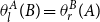 $\theta_l^A(B)=\theta_r^B(A)$
and which satisfy the analogous axioms to (
$\theta_l^A(B)=\theta_r^B(A)$
and which satisfy the analogous axioms to ( $VLT^q_1$
)-texmath>inline2398</texmath>) from Definition D.1 of Appendix D, whereby the 2-cells
$VLT^q_1$
)-texmath>inline2398</texmath>) from Definition D.1 of Appendix D, whereby the 2-cells $(u,U)_i, i=1,2$
are identities. Let
$(u,U)_i, i=1,2$
are identities. Let $q\mbox{-}\operatorname{Ps}_{vst}^{st}(\mathbb{B}\times\mathbb{B},\mathbb{B})$
be the (strict version of the) vertical category of the double category
$q\mbox{-}\operatorname{Ps}_{vst}^{st}(\mathbb{B}\times\mathbb{B},\mathbb{B})$
be the (strict version of the) vertical category of the double category $q\mbox{-}\operatorname{\mathbb{P} s}_{hop}^{st}(\mathbb{B}\times\mathbb{B},\mathbb{B})$
from (44). We thus obtain
$q\mbox{-}\operatorname{\mathbb{P} s}_{hop}^{st}(\mathbb{B}\times\mathbb{B},\mathbb{B})$
from (44). We thus obtain
 \begin{equation} q\mbox{-}\operatorname{Ps}_{hop}^{st}(\mathbb{B}\times\mathbb{B},\mathbb{B})\cong\operatorname{Binoidal}_{pc}^{st}(\mathbb{B}) \simeq \operatorname{Ps}_{hop}(\mathbb{B}\times\mathbb{B},\mathbb{B})\end{equation}
where $\operatorname{Ps}_{hop}(\mathbb{B}\times\mathbb{B},\mathbb{B})$
is the (strict version of the) vertical category of the double category
$\operatorname{Ps}_{hop}(\mathbb{B}\times\mathbb{B},\mathbb{B})$
is the (strict version of the) vertical category of the double category $\operatorname{\mathbb{P} s}_{hop}(\mathbb{B}\times\mathbb{B},\mathbb{B})$
from (44). Let
$\operatorname{\mathbb{P} s}_{hop}(\mathbb{B}\times\mathbb{B},\mathbb{B})$
from (44). Let $\mathcal{G}:\operatorname{Binoidal}_{pc}^{st}(\mathbb{B}) \to \operatorname{Ps}_{vst}(\mathbb{B}\times\mathbb{B},\mathbb{B})$
denote the obvious equivalence functor.
$\mathcal{G}:\operatorname{Binoidal}_{pc}^{st}(\mathbb{B}) \to \operatorname{Ps}_{vst}(\mathbb{B}\times\mathbb{B},\mathbb{B})$
denote the obvious equivalence functor.
For the other two categories of central binoidal structures we use analogous axioms to ( $VLT^q_1$
)- (
$VLT^q_1$
)- ( $VLT^q_4$
) with the following change. Whereas in the cited axioms the 2-cells of the form
$VLT^q_4$
) with the following change. Whereas in the cited axioms the 2-cells of the form $(b,a)_1, (b,a)_2$
appear where
$(b,a)_1, (b,a)_2$
appear where $a\in\mathbb{A}, b\in\mathbb{B}$
are different types of 1-cells, we will differentiate “left binoidal” version of those axioms where instead of the latter 2-cells the 2-cells of the form
$a\in\mathbb{A}, b\in\mathbb{B}$
are different types of 1-cells, we will differentiate “left binoidal” version of those axioms where instead of the latter 2-cells the 2-cells of the form $a\ltimes_1-\vert_b, a\ltimes_2-\vert_b$
appear (here both
$a\ltimes_1-\vert_b, a\ltimes_2-\vert_b$
appear (here both $a,b\in\mathbb{B}$
), and “right binoidal” version of those axioms with 2-cells of the form
$a,b\in\mathbb{B}$
), and “right binoidal” version of those axioms with 2-cells of the form $-\ltimes_1 b\vert_a, -\ltimes_2 b\vert_a$
.
$-\ltimes_1 b\vert_a, -\ltimes_2 b\vert_a$
.
Now we define the category $\operatorname{Binoidal}_{lc}^{st}(\mathbb{B})$
of left central binoidal structures. Its objects are left central binoidal structures from Definition 6.5. Its morphisms are pairs of vertical strict transformations
$\operatorname{Binoidal}_{lc}^{st}(\mathbb{B})$
of left central binoidal structures. Its objects are left central binoidal structures from Definition 6.5. Its morphisms are pairs of vertical strict transformations $\theta_l^A: A\ltimes_1-\Rightarrow A\ltimes_2-, \, \,\theta_r^B: -\rtimes_1 B\Rightarrow-\rtimes_2 B$
for
$\theta_l^A: A\ltimes_1-\Rightarrow A\ltimes_2-, \, \,\theta_r^B: -\rtimes_1 B\Rightarrow-\rtimes_2 B$
for $A,B\in\mathbb{B}$
such that
$A,B\in\mathbb{B}$
such that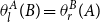 $\theta_l^A(B)=\theta_r^B(A)$
and which satisfy the left binoidal version of the axioms (
$\theta_l^A(B)=\theta_r^B(A)$
and which satisfy the left binoidal version of the axioms ( $VLT^q_1$
)-
$VLT^q_1$
)- $VLT^q_4$
) for left central 1h-cells K, left central 1v-cells U and any 1h-cells k and 1v-cells U, whereby the 2-cells
$VLT^q_4$
) for left central 1h-cells K, left central 1v-cells U and any 1h-cells k and 1v-cells U, whereby the 2-cells $(u,U)_i, i=1,2$
are identities.
$(u,U)_i, i=1,2$
are identities.
Similarly, the category $\operatorname{Binoidal}_{rc}^{st}(\mathbb{B})$
of right central binoidal structures is defined. Its morphisms
$\operatorname{Binoidal}_{rc}^{st}(\mathbb{B})$
of right central binoidal structures is defined. Its morphisms $(\theta_l^A, \theta_r^B)_{A,B\in\mathbb{B}}$
with
$(\theta_l^A, \theta_r^B)_{A,B\in\mathbb{B}}$
with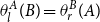 $\theta_l^A(B)=\theta_r^B(A)$
satisfy the right binoidal version of the axioms (
$\theta_l^A(B)=\theta_r^B(A)$
satisfy the right binoidal version of the axioms ( $VLT^q_1$
)- (
$VLT^q_1$
)- ( $VLT^q_4$
) for right central 1h-cells k, right central 1v-cells u and any 1h-cells K and 1v-cells U.
$VLT^q_4$
) for right central 1h-cells k, right central 1v-cells u and any 1h-cells K and 1v-cells U.
The relations from Theorem 6.6 can be extended functorially and added to the equivalences (45) so to obtain
 $$q\mbox{-}\operatorname{Ps}_{hop}^{st}(\mathbb{B}\times\mathbb{B},\mathbb{B})\cong\operatorname{Binoidal}_{pc}^{st}(\mathbb{B})\cong\operatorname{Binoidal}_{lc}^{st}(\mathbb{B})\cong\operatorname{Binoidal}_{rc}^{st}(\mathbb{B}) \simeq \operatorname{Ps}_{hop}(\mathbb{B}\times\mathbb{B},\mathbb{B}).$$
7.3 Double quasi-functors with three and more variables
We generalize 2-categorical quasi-functors in three and more variables and their quasi-natural transformations from Gray (Reference Gray1974, Definition I.4.6) to double categories.
Definition 7.1. A pseudodouble quasi-functor $H:\mathbb{A}\times\mathbb{B}\times\mathbb{C}\to \mathbb{E}$
(or a binary pseudodouble quasi-functor) consists of pseudodouble quasi-functors
$H:\mathbb{A}\times\mathbb{B}\times\mathbb{C}\to \mathbb{E}$
(or a binary pseudodouble quasi-functor) consists of pseudodouble quasi-functors
 $$H(A,-,-):\mathbb{B}\times\mathbb{C}\to \mathbb{E}, \quad H(-,B,-):\mathbb{A}\times\mathbb{C}\to \mathbb{E}, \quad H(-,-,C): \mathbb{A}\times\mathbb{B}\to \mathbb{E}$$
for $(A,B,C)\in\mathbb{A}\times\mathbb{B}\times\mathbb{C}$
, such that
$(A,B,C)\in\mathbb{A}\times\mathbb{B}\times\mathbb{C}$
, such that
 $$H(A,-,-)\vert_B=H(-,B,-)\vert_A, \,\, H(A,-,-)\vert_C=H(-,-,C)\vert_A, \,\, H(-,B,-)\vert_C=H(-,-,C)\vert_B,$$
and which give unambiguous pseudofunctors
 $$(A,B,-)_3:\mathbb{C}\to \mathbb{E}, \quad (A,-,C)_2:\mathbb{B}\to \mathbb{E}, \quad (-,B,C)_1: \mathbb{A}\to \mathbb{E},$$
such that the structure 2-cells (40) of the former relate in the following way:
-
i) for all 1h-cells
$(f,g,h):(A,B,C)\to (A',B', C')$
in
$\mathbb{A}\times\mathbb{B}\times\mathbb{C}$
it is -
ii) for all 1v-cells
$(u,v,z):(A,B,C)\to (\tilde A, \tilde B, \tilde C)$
in
$\mathbb{A}\times\mathbb{B}\times\mathbb{C}$
it is(where we simplified the notation by writing
$(v,z)_{23}$
for the 2-cell
$(A,v,z)_{23}$
and so on…), -
iii) for
$(f,v,h):(A,B,C)\to (A',\tilde B,C')$
and 2 similar conditions, one for
$(f,g,z):(A,B,C)\to (A',B',\tilde C)$
and the other for
$(u,g,h):(A,B,C)\to (\tilde A,B',C')$
, -
iv) for
$(u,v,h):(A,B,C)\to (\tilde A,\tilde B,C')$
and 2 similar conditions, one for
$(u,g,z):(A,B,C)\to (\tilde A,B',\tilde C)$
and the other for
$(f,v,z):(A,B,C)\to (A',\tilde B,C')$
, where f,g,h are 1h-cells and u,v,z are 1v-cells, as usual.














Observe that in the above definition there are $2\cdot 2\cdot 3=12$
structure 2-cells combining in
$2\cdot 2\cdot 3=12$
structure 2-cells combining in $2^3=8$
ways.
$2^3=8$
ways.
Definition 7.2. A vertical strict transformation $\theta: H_1\Rightarrow H_2$
between pseuodouble quasi-functors
$\theta: H_1\Rightarrow H_2$
between pseuodouble quasi-functors $H_1,H_2:\mathbb{A}\times\mathbb{B}\times\mathbb{C}\to \mathbb{E}$
consists of vertical strict transformations
$H_1,H_2:\mathbb{A}\times\mathbb{B}\times\mathbb{C}\to \mathbb{E}$
consists of vertical strict transformations
 $$\theta^A: H_1(A,-,-) \Rightarrow H_2(A,-,-),$$
 $$\theta^B: H_1(-,B,-) \Rightarrow H_2(-,B,-),$$
 $$\theta^C: H_1(-,-,C) \Rightarrow H_2(-,-,C)$$
of binary pseudodouble quasi-functors, which give unambiguous vertical strict transformations
 $$\theta^{A;B}: (A,B,-)_3^1\to (A,B,-)_3^2$$
 $$\theta^{B;\;C}: (-,B,C)_1^1\to (-,B,C)_1^2$$
 $$\theta^{A;\;C}: (A,-,C)_2^1\to (A,-,C)_2^2$$
of pseudodouble functors for each $(A,B,C)\in\mathbb{A}\times\mathbb{B}\times\mathbb{C}$
, so that twelve equalities between their structure 2-cells, on one hand, and the twelve structure 2-cells of both
$(A,B,C)\in\mathbb{A}\times\mathbb{B}\times\mathbb{C}$
, so that twelve equalities between their structure 2-cells, on one hand, and the twelve structure 2-cells of both $H_1$
and
$H_1$
and $H_2$
from Definition 7.1, on the other hand, hold. We present these twelve equalities schematically as lists consisting of those structure 2-cells which are related in the only possible way by one equation:
$H_2$
from Definition 7.1, on the other hand, hold. We present these twelve equalities schematically as lists consisting of those structure 2-cells which are related in the only possible way by one equation:
 $$(\theta^{A;\;C})_g, (\theta^{B;\;C})_f, (f,g,C)^i_{12}, \quad (\theta^{A;B})_h, (\theta^{B;\;C})_f, (f,B,h)^i_{13}, \quad (\theta^{A;B})_h, (\theta^{A;\;C})_g, (A,g,h)^i_{23}$$
 $$(\theta^{A;\;C})^v, (\theta^{B;\;C})_f, (f,v,C)^i_{12}, \quad (\theta^{A;B})^z, (\theta^{B;\;C})_f, (f,B,z)^i_{13}, \quad (\theta^{A;B})^z, (\theta^{A;\;C})_g, (A,g,z)^i_{23}$$
 $$(\theta^{A;\;C})_g, (\theta^{B;\;C})^u, (u,g,C)^i_{12}, \quad (\theta^{A;B})_h, (\theta^{B;\;C})^u, (u,B,h)^i_{13}, \quad (\theta^{A;B})_h, (\theta^{A;\;C})^v, (A,v,h)^i_{23}$$
 $$(\theta^{A;\;C})^v, (\theta^{B;\;C})^u, (u,v,C)^i_{12}, \quad (\theta^{A;B})^z, (\theta^{B;\;C})^u, (u,B,z)^i_{13}, \quad (\theta^{A;B})^z, (\theta^{A;\;C})^v, (A,v,z)^i_{23}$$
where $(f,g,C)_{12}^i$
for
$(f,g,C)_{12}^i$
for $i=1,2$
presents a structure 2-cell
$i=1,2$
presents a structure 2-cell $(f,g,C)_{12}$
from Definition 7.1 for
$(f,g,C)_{12}$
from Definition 7.1 for $H_1$
and
$H_1$
and $H_2$
, respectively, and similarly for the remaining eleven 2-cells of that type.
$H_2$
, respectively, and similarly for the remaining eleven 2-cells of that type.
Observe that it holds $\theta^{A;B}(C)=\theta^{B;\;C}(A)=\theta^{A;\;C}(B)$
for all
$\theta^{A;B}(C)=\theta^{B;\;C}(A)=\theta^{A;\;C}(B)$
for all $(A,B,C)\in\mathbb{A}\times\mathbb{B}\times\mathbb{C}$
in the above definition. Also, the first row of the axioms corresponds to the axiom (
$(A,B,C)\in\mathbb{A}\times\mathbb{B}\times\mathbb{C}$
in the above definition. Also, the first row of the axioms corresponds to the axiom ( $VLT^q_4$
) applied to the three coordinates, and similarly the second, third and fourth row correspond to the axioms (
$VLT^q_4$
) applied to the three coordinates, and similarly the second, third and fourth row correspond to the axioms ( $VLT^q_2$
), (
$VLT^q_2$
), ( $VLT^q_3$
) and (
$VLT^q_3$
) and ( $VLT^q_1$
), respectively. Moreover, observe that the 2-cell components
$VLT^q_1$
), respectively. Moreover, observe that the 2-cell components $(\theta^{A;B})^z, (\theta^{A;\;C})^v, (\theta^{B;\;C})^u$
are trivial, and the last three axioms show the way in which
$(\theta^{A;B})^z, (\theta^{A;\;C})^v, (\theta^{B;\;C})^u$
are trivial, and the last three axioms show the way in which $(u,v,C)^1_{12}=(u,v,C)^2_{12}, \,\, (u,B,z)^1_{13}=(u,B,z)^2_{13}$
and
$(u,v,C)^1_{12}=(u,v,C)^2_{12}, \,\, (u,B,z)^1_{13}=(u,B,z)^2_{13}$
and $(A,v,z)^1_{23}=(A,v,z)^2_{23}$
.
$(A,v,z)^1_{23}=(A,v,z)^2_{23}$
.
Remark 7.3. Visually, the pasting diagrams for the 12 equations from the above definition have the same form as the diagrams of Definition 7.1. Indeed, in Subsection 5.6 of Femić (Reference Femić2024) we showed that there is a 1-1 correspondence between vertical transformations of quasi-functors of two variables and quasi-functors of three variables. We had an analogous situation in the double funny case, recall Proposition 5.22.
Pseudodouble quasi-functors of more than three variables and their vertical strict transformations are defined as follows.
Definition 7.4. A pseudodouble quasi-functor $H:\mathbb{A}_1\times...\times\mathbb{A}_n\to \mathbb{E}$
for
$H:\mathbb{A}_1\times...\times\mathbb{A}_n\to \mathbb{E}$
for $n>3$
consists of pseudodouble quasi-functors of three variables
$n>3$
consists of pseudodouble quasi-functors of three variables
 $$H(A_1,...,A_{i-1},\, -,\, A_{i+1},...,A_{j-1}, \, -,\, A_{j+1},...,A_{k-1}, \, -,\, A_{k+1},..., A_n):\mathbb{A}_i\times\mathbb{A}_j\times\mathbb{A}_k\to \mathbb{E}$$
for all $i<j<k$
and all choices of objects
$i<j<k$
and all choices of objects $A_l\in\mathbb{A}_l, l=1,...,n$
.
$A_l\in\mathbb{A}_l, l=1,...,n$
.
A vertical strict transformation $\theta: H_1\Rightarrow H_2$
between pseudodouble quasi-functors
$\theta: H_1\Rightarrow H_2$
between pseudodouble quasi-functors $H_1,H_2:\mathbb{A}_1\times...\times\mathbb{A}_n\to \mathbb{E}$
for
$H_1,H_2:\mathbb{A}_1\times...\times\mathbb{A}_n\to \mathbb{E}$
for $n>3$
consists of vertical strict transformations
$n>3$
consists of vertical strict transformations
 \begin{align*}\theta^i: H_1(A_j,-,-) \Rightarrow H_2(A_i,-,-),\\\theta^j: H_1(-,A_j,-) \Rightarrow H_2(-,A_j,-),\\\theta^k: H_1(-,-,A_k) \Rightarrow H_2(-,-,A_k)\end{align*}
of binary pseudodouble quasi-functors for all $i<j<k\leq n$
and all choices of objects
$i<j<k\leq n$
and all choices of objects $A_l\in\mathbb{A}_l, l=1,...,n$
, where we omit the irrelevant variables.
$A_l\in\mathbb{A}_l, l=1,...,n$
, where we omit the irrelevant variables.
7.4 Associativity constraints
We now come back to the question from the end of Subsection 7.1. We saw that a pseudodouble quasi-functor $H:\mathbb{B}\times\mathbb{B}\to \mathbb{B}$
whose 2-cells (u,U) are trivial induces a pseudodouble functor
$H:\mathbb{B}\times\mathbb{B}\to \mathbb{B}$
whose 2-cells (u,U) are trivial induces a pseudodouble functor $P:\mathbb{B}\times\mathbb{B}\to \mathbb{B}$
, and that there is even a double category equivalence
$P:\mathbb{B}\times\mathbb{B}\to \mathbb{B}$
, and that there is even a double category equivalence
 \begin{equation} \mathcal{F}\colon q\mbox{-}\operatorname{\mathbb{P} s}_{hop}^{st}(\mathbb{B}\times\mathbb{B},\mathbb{B}) \to \operatorname{\mathbb{P} s}_{hop}(\mathbb{B}\times\mathbb{B},\mathbb{B})\end{equation}
 $$\hspace{1,5cm}H \mapsto P=\otimes$$
(we marked the assignment on 0-cells). The pseudodouble functor P is defined on a 2-cell $(\alpha,\beta)\in\mathbb{B}\times\mathbb{B}$
by
$(\alpha,\beta)\in\mathbb{B}\times\mathbb{B}$
by

(mind that, as in Subsection 6.1, we denote the two pseudodouble functors determining a pseudodouble quasi-functor H by $(-,A)$
and
$(-,A)$
and $(B,-)$
.)
$(B,-)$
.)
For the pseudodouble functor structure $\gamma_{(K',k')(K,k)}\colon P(K',k')P(K,k)\Rightarrow P(K'K,k'k)$
and
$\gamma_{(K',k')(K,k)}\colon P(K',k')P(K,k)\Rightarrow P(K'K,k'k)$
and $\iota^P\colon 1_{P(A,B)}\Rightarrow P(1_{(A,B)})$
of P we set
$\iota^P\colon 1_{P(A,B)}\Rightarrow P(1_{(A,B)})$
of P we set

and

where $\iota^B_A=(B,-)_A$
and
$\iota^B_A=(B,-)_A$
and $\iota^A_B=(-,A)_B$
of H.
$\iota^A_B=(-,A)_B$
of H.
Let us explore how associativity of H is related to associativity of P. From now on we will write $\otimes$
for P.
$\otimes$
for P.
Analogously to the proof in Femić (Reference Femić2023, Section 5), plugging-in a third fixed variable in three different positions on the side of quasi-functors, one could first obtain an analogous double category $q_3\mbox{-}\operatorname{\mathbb{P} s}_{hop}^{st}(\mathbb{B}\times\mathbb{B}\times\mathbb{B},\mathbb{B})$
, and then an analogous equivalence of double categories to
$q_3\mbox{-}\operatorname{\mathbb{P} s}_{hop}^{st}(\mathbb{B}\times\mathbb{B}\times\mathbb{B},\mathbb{B})$
, and then an analogous equivalence of double categories to $\mathcal{F}$
in (46). Since here we are not interested in horizontal quasi-natural transformations nor in the modifications, we satisfy ourselves with a category equivalence. For this purpose, let
$\mathcal{F}$
in (46). Since here we are not interested in horizontal quasi-natural transformations nor in the modifications, we satisfy ourselves with a category equivalence. For this purpose, let $q_3\mbox{-}\operatorname{Ps}_{vst}^{st}(\mathbb{B}\times\mathbb{B}\times\mathbb{B},\mathbb{B})$
denote the category of psuedodouble quasi-functors and their vertical strict transformations, and
$q_3\mbox{-}\operatorname{Ps}_{vst}^{st}(\mathbb{B}\times\mathbb{B}\times\mathbb{B},\mathbb{B})$
denote the category of psuedodouble quasi-functors and their vertical strict transformations, and $\operatorname{Ps}_{vst}(\mathbb{B}\times\mathbb{B}\times\mathbb{B},\mathbb{B})$
its usual version on the Cartesian product.
$\operatorname{Ps}_{vst}(\mathbb{B}\times\mathbb{B}\times\mathbb{B},\mathbb{B})$
its usual version on the Cartesian product.
Theorem 7.5. For a double category $\mathbb{B}$
there is an equivalence of categories
$\mathbb{B}$
there is an equivalence of categories
 \begin{equation} \mathcal{F}_3\colon q_3\mbox{-}\operatorname{Ps}_{vst}^{st}(\mathbb{B}\times\mathbb{B}\times\mathbb{B},\mathbb{B}) \to \operatorname{Ps}_{vst}(\mathbb{B}\times\mathbb{B}\times\mathbb{B},\mathbb{B}).\end{equation}
Similarly, there is an equivalence of categories
 $$\mathcal{F}_4\colon q_4\mbox{-}\operatorname{Ps}_{vst}^{st}(\mathbb{B}\times\mathbb{B}\times\mathbb{B}\times\mathbb{B},\mathbb{B}) \to \operatorname{Ps}_{vst}(\mathbb{B}\times\mathbb{B}\times\mathbb{B}\times\mathbb{B},\mathbb{B}).$$
Proof. The proof is analogous to that of Femić (Reference Femić2023, Theorem 5.7). We only comment two points. The functor $\mathcal{F}_3(H)$
is defined for
$\mathcal{F}_3(H)$
is defined for $H\in q_3\mbox{-}\operatorname{Ps}_{vst}^{st}(\mathbb{B}\times\mathbb{B}\times\mathbb{B},\mathbb{B})$
by:
$H\in q_3\mbox{-}\operatorname{Ps}_{vst}^{st}(\mathbb{B}\times\mathbb{B}\times\mathbb{B},\mathbb{B})$
by:

with usual notations for 1-cells, and where the 2-cells are those from Definition 7.1, parts (iii) and (iv).
Regarding the correspondence of morphisms, we use the keypoint from the proof of the binary case. Namely, from the proof of the correspondence of (horizontal and) vertical transformations on both sides of the equivalence in Femić (Reference Femić2023, Section 5.4) it is clear that the five axioms of transformations between pseudodouble functors (right-hand side of the equivalence) hold by: 1) the corresponding five axioms of the component transformations on the quasi-functors (left-hand side), 2) the axioms ( $VLT^q_1$
)- (
$VLT^q_1$
)- ( $VLT^q_4$
), and 3) axioms of the quasi-functors. Then exactly the analogous happens in the current ternary case, whereby the four axioms (
$VLT^q_4$
), and 3) axioms of the quasi-functors. Then exactly the analogous happens in the current ternary case, whereby the four axioms ( $VLT^q_1$
)- (
$VLT^q_1$
)- ( $VLT^q_4$
) are replaced by their analogues in the three variables, which are precisely the twelve axioms of Definition 7.2.
$VLT^q_4$
) are replaced by their analogues in the three variables, which are precisely the twelve axioms of Definition 7.2.
From the definition of $\mathcal{F}_3$
it is clear that we have
$\mathcal{F}_3$
it is clear that we have
Lemma 7.6. The functor $\mathcal{F}_3$
preserves invertible vertical strict transformations whose 1v-cell components are inversely central 1v-cells.
$\mathcal{F}_3$
preserves invertible vertical strict transformations whose 1v-cell components are inversely central 1v-cells.
As a matter of fact, due to Theorem 6.2 a double category admitting a pseudodouble quasi-functor is purely central, so all its 1v-cells are central.
In Femić (Reference Femić2024, Proposition 5.17) we generalized Gray’s substitution result for quasi-functors Gray (Reference Gray1974, Theorem I.4.7) from 2-categories to double categories and Gray-categories. We cite here the version of the result for pseudodouble quasi-functors for double categories.
Proposition 7.7. Femić (Reference Femić2024, Proposition 5.17). Given pseudodouble quasi-functors $F_i:\mathbb{A}_{i1}\times...\times\mathbb{A}_{im_i}\to \mathbb{B}_i$
of
$F_i:\mathbb{A}_{i1}\times...\times\mathbb{A}_{im_i}\to \mathbb{B}_i$
of $m_i$
-variables with
$m_i$
-variables with $i=1,...,n, m_i\geq 2, n\geq 2$
and a quasi-functor
$i=1,...,n, m_i\geq 2, n\geq 2$
and a quasi-functor $G:\mathbb{B}_1\times...\times\mathbb{B}_n\to \mathbb{C}$
of n-variables, the composition
$G:\mathbb{B}_1\times...\times\mathbb{B}_n\to \mathbb{C}$
of n-variables, the composition
 $$\Pi_{j=1}^{m_1}\mathbb{A}_{1j}\times...\times\Pi_{j=1}^{m_n}\mathbb{A}_{nj}\stackrel{F_1\times...\times F_n}{\longrightarrow}\mathbb{B}_1\times...\times\mathbb{B}_n\stackrel{G}{\to }\mathcal{C}$$
is a pseudodouble quasi-functor of $m_1+..+m_n$
-variables.
$m_1+..+m_n$
-variables.
Now consider the following two diagrams

According to Proposition 7.7, the compositions $H_1:=H(1\times H)$
and
$H_1:=H(1\times H)$
and $H_2:=H(H\times 1)$
are pseudodouble quasi-functors
$H_2:=H(H\times 1)$
are pseudodouble quasi-functors $H_1,H_2: \mathbb{B}\times\mathbb{B}\times\mathbb{B}\to \mathbb{B}$
. Then the compositions of the arrows in the two diagrams above present 0-cells assigned to each other via
$H_1,H_2: \mathbb{B}\times\mathbb{B}\times\mathbb{B}\to \mathbb{B}$
. Then the compositions of the arrows in the two diagrams above present 0-cells assigned to each other via $\mathcal{F}_3$
in (49) in the obvious way. The associativity
$\mathcal{F}_3$
in (49) in the obvious way. The associativity $\theta: H_1\Rightarrow H_2$
is a 1-cell corresponding to
$\theta: H_1\Rightarrow H_2$
is a 1-cell corresponding to $\Sigma$
in (49).
$\Sigma$
in (49).
We have that $\theta: H_1\Rightarrow H_2$
is comprised of three unambiguous vertical strict transformations
$\theta: H_1\Rightarrow H_2$
is comprised of three unambiguous vertical strict transformations $\theta^{A;B}, \theta^{B;\;C}$
and
$\theta^{A;B}, \theta^{B;\;C}$
and $\theta^{A;\;C}$
of pseudodouble functors for each
$\theta^{A;\;C}$
of pseudodouble functors for each $(A,B,C)\in\mathbb{A}\times\mathbb{B}\times\mathbb{C}$
, which obey the 12 axioms from Definition 7.2. Observe that the pentagon for the associativity
$(A,B,C)\in\mathbb{A}\times\mathbb{B}\times\mathbb{C}$
, which obey the 12 axioms from Definition 7.2. Observe that the pentagon for the associativity $\theta: H_1\Rightarrow H_2$
is an equality of two vertical strict transformations of pseudodouble quasi-functors of four variables, one, say
$\theta: H_1\Rightarrow H_2$
is an equality of two vertical strict transformations of pseudodouble quasi-functors of four variables, one, say $\Theta^1$
, is a composite of three (left and bottom arrows in the diagram below), and the other, say
$\Theta^1$
, is a composite of three (left and bottom arrows in the diagram below), and the other, say $\Theta^2$
, is a composite of two (top and right arrow below):
$\Theta^2$
, is a composite of two (top and right arrow below):

As transformations of pseudodouble quasi-functors of four variables they are given by four unambiguous vertical strict transformations of pseudodouble functors. Thus, there are four pentagons that describe the associativity $\theta: H_1\Rightarrow H_2$
.
$\theta: H_1\Rightarrow H_2$
.
Since H gives a binoidal structure on $\mathbb{B}$
(recall Subsection 6.1), the above three unambiguous vertical strict transformations
$\mathbb{B}$
(recall Subsection 6.1), the above three unambiguous vertical strict transformations $\theta^{A;B}, \theta^{B;\;C}$
and
$\theta^{A;B}, \theta^{B;\;C}$
and $\theta^{A;\;C}$
correspond to the vertical strict transformations
$\theta^{A;\;C}$
correspond to the vertical strict transformations $\alpha_{-,B,C}, \alpha_{A,-,C},\alpha_{A,B,-}$
from Definition 3.10, and the four pentagons for the
$\alpha_{-,B,C}, \alpha_{A,-,C},\alpha_{A,B,-}$
from Definition 3.10, and the four pentagons for the $\theta$
’s correspond to those of that same definition. Moreover, the 12 identities from Definition 7.2 correspond to the 24 axioms from Section 4 and Appendix A, which because of pure centrality, Theorem 6.2, come down to 12 axioms. By the comment from the end of the proof of Theorem 7.5 we know that those 12 axioms of
$\theta$
’s correspond to those of that same definition. Moreover, the 12 identities from Definition 7.2 correspond to the 24 axioms from Section 4 and Appendix A, which because of pure centrality, Theorem 6.2, come down to 12 axioms. By the comment from the end of the proof of Theorem 7.5 we know that those 12 axioms of $\theta$
’s correspond to the axioms of
$\theta$
’s correspond to the axioms of $\Sigma$
being a vertical strict transformation.
$\Sigma$
being a vertical strict transformation.
As a consequence of Theorem 7.5 we have
Corollary 7.8. Let $H:\mathbb{B}\times\mathbb{B}\to \mathbb{B}$
be a pseudodouble quasi-functor whose 2-cells (u,U) are trivial,
$H:\mathbb{B}\times\mathbb{B}\to \mathbb{B}$
be a pseudodouble quasi-functor whose 2-cells (u,U) are trivial, $\otimes=\mathcal{F}(H)$
and let
$\otimes=\mathcal{F}(H)$
and let $\theta$
and
$\theta$
and $\Sigma$
be as in (50). Then
$\Sigma$
be as in (50). Then $(H,\theta:H_1\Rightarrow H_2)$
is an associative binoidal structure making
$(H,\theta:H_1\Rightarrow H_2)$
is an associative binoidal structure making $\mathbb{B}$
purely central if and only if
$\mathbb{B}$
purely central if and only if $(\otimes, \Sigma: \otimes(\otimes\times 1)\Rightarrow \otimes(1\times\otimes)$
is an associative product on
$(\otimes, \Sigma: \otimes(\otimes\times 1)\Rightarrow \otimes(1\times\otimes)$
is an associative product on $\mathbb{B}\times\mathbb{B}$
.
$\mathbb{B}\times\mathbb{B}$
.
We record that in the proof of the above corollary the following is entailed:
Proposition 7.9. An associative binoidal structure that comes from a double quasi-functor H (and makes a double category $\mathbb{B}$
premonoidal) satisfies the 24 axioms, where the centrality structures are induced by H.
$\mathbb{B}$
premonoidal) satisfies the 24 axioms, where the centrality structures are induced by H.
7.5 Premonoidal double categories coming from quasi-functors are purely central, monoidal and satisfy the 24 axioms
For a premonoidal double category that is purely (resp. left or right) central binoidal we will say that it is purely (resp. left or right) central premonoidal. We are ready to prove:
Theorem 7.10. Let $\mathbb{B}$
be a double category and bear in mind the double category equivalence (46). Then:
$\mathbb{B}$
be a double category and bear in mind the double category equivalence (46). Then:
-
(1)
$\theta:H_1\Rightarrow H_2$
obeys the 24 axioms, which are indeed 12 axioms; -
(2)
$(\mathbb{B},H,\theta,I)$
is a purely central premonoidal double category whereby the structure 2-cells (u,U) are trivial if and only if
$(\mathbb{B}, \otimes, \Sigma, I)$
is a monoidal double category.


Proof. First recall that a pseudodouble quasi-functor H equips $\mathbb{B}$
with a binoidal structure. Because of the double category equivalence
$\mathbb{B}$
with a binoidal structure. Because of the double category equivalence $\mathcal{F}$
we have that
$\mathcal{F}$
we have that $(\mathbb{B},H)$
is unital with unit I and invertible vertical strict transformations
$(\mathbb{B},H)$
is unital with unit I and invertible vertical strict transformations $\lambda: H(I,-)\Rightarrow\operatorname {Id}$
and
$\lambda: H(I,-)\Rightarrow\operatorname {Id}$
and $\rho: H(-,I)\Rightarrow\operatorname {Id}$
if and only if
$\rho: H(-,I)\Rightarrow\operatorname {Id}$
if and only if $(\mathbb{B},\otimes)$
is unital with unit I and invertible vertical strict transformations
$(\mathbb{B},\otimes)$
is unital with unit I and invertible vertical strict transformations $\tilde\lambda: I\otimes-\Rightarrow\operatorname {Id}$
and
$\tilde\lambda: I\otimes-\Rightarrow\operatorname {Id}$
and $\tilde\rho: -\otimes I\Rightarrow\operatorname {Id}$
. Moreover, the first two triangles in Definition 3.11 for
$\tilde\rho: -\otimes I\Rightarrow\operatorname {Id}$
. Moreover, the first two triangles in Definition 3.11 for $(\mathbb{B},H, \theta=(\alpha_{\bullet, -,-}, \alpha_{-,\bullet,-}, \alpha_{-,-,\bullet}), \lambda, \rho)$
correspond to the analogous triangle connecting
$(\mathbb{B},H, \theta=(\alpha_{\bullet, -,-}, \alpha_{-,\bullet,-}, \alpha_{-,-,\bullet}), \lambda, \rho)$
correspond to the analogous triangle connecting $\Sigma, \tilde\lambda$
and
$\Sigma, \tilde\lambda$
and $\tilde\rho$
for
$\tilde\rho$
for $(\mathbb{B},\otimes, \Sigma, \tilde\lambda, \tilde\rho)$
, the second two triangles in loc.cit. for
$(\mathbb{B},\otimes, \Sigma, \tilde\lambda, \tilde\rho)$
, the second two triangles in loc.cit. for $(\mathbb{B},H)$
correspond to the analogous triangle connecting
$(\mathbb{B},H)$
correspond to the analogous triangle connecting $\Sigma,\tilde\lambda_A\otimes-$
and
$\Sigma,\tilde\lambda_A\otimes-$
and $\tilde\lambda_{A\otimes-}$
, while the last two triangles therein correspond to the analogous triangle connecting
$\tilde\lambda_{A\otimes-}$
, while the last two triangles therein correspond to the analogous triangle connecting $\Sigma,-\otimes\tilde\rho_B$
and
$\Sigma,-\otimes\tilde\rho_B$
and $\tilde\rho_{-\otimes B}$
. We finally obtain that
$\tilde\rho_{-\otimes B}$
. We finally obtain that $(\mathbb{B},H)$
is premonoidal if and only if
$(\mathbb{B},H)$
is premonoidal if and only if $(\mathbb{B},\otimes)$
is monoidal (Definition 2.16).
$(\mathbb{B},\otimes)$
is monoidal (Definition 2.16).
Remark 7.11. Recall from Corollary 5.10 that pseudodouble funny functors induce a binoidal structure on double categories $\mathbb{B}$
and equip all 1v-cells of
$\mathbb{B}$
and equip all 1v-cells of $\mathbb{B}$
with a central structure. Though, the fact that funny functors stem from an inner-hom in which there is no naturality for horizontal transformations, makes it impossible to upgrade a possible premonoidal structure on
$\mathbb{B}$
with a central structure. Though, the fact that funny functors stem from an inner-hom in which there is no naturality for horizontal transformations, makes it impossible to upgrade a possible premonoidal structure on $\mathbb{B}$
into a monoidal one (at least in the way studied in this section). Namely, the induction of a pseudodouble functor
$\mathbb{B}$
into a monoidal one (at least in the way studied in this section). Namely, the induction of a pseudodouble functor $\otimes:\mathbb{B}\times\mathbb{B}\to \mathbb{B}$
in (46) relies on the existence of 2-cells (k,K) in the structure of a pseudodouble quasi-functor as it is shown in (48). However, precisely these 2-cells do not exist in a structure of funny functors.
$\otimes:\mathbb{B}\times\mathbb{B}\to \mathbb{B}$
in (46) relies on the existence of 2-cells (k,K) in the structure of a pseudodouble quasi-functor as it is shown in (48). However, precisely these 2-cells do not exist in a structure of funny functors.
7.5.1 2-categorical case
Similarly to the above proof, which relies on the double category equivalence (46), one proves its 2-categorical analogue, which relies on the 2-categorical version of (46). (The latter result is the pseudofunctor version of the result Faul, Manuell and Siqueira (Reference Faul, Manuell and Siqueira2021, Theorem 5.3) for lax functors with $\mathcal{A}=\mathcal{B}=\mathcal{C}$
; in the introduction of Femić (Reference Femić2023, Section 4) we explained that the 2-categories
$\mathcal{A}=\mathcal{B}=\mathcal{C}$
; in the introduction of Femić (Reference Femić2023, Section 4) we explained that the 2-categories $\operatorname{Dist}(\mathcal{B},\mathcal{B},\mathcal{B})$
of Faul, Manuell and Siqueira (Reference Faul, Manuell and Siqueira2021) and
$\operatorname{Dist}(\mathcal{B},\mathcal{B},\mathcal{B})$
of Faul, Manuell and Siqueira (Reference Faul, Manuell and Siqueira2021) and $q\mbox{-}\operatorname{\mathbb{L} ax}_{hop}(\mathbb{B}\times\mathbb{B},\mathbb{B})$
of Femić (Reference Femić2023) are equal.) With analogous notations as above one has:
$q\mbox{-}\operatorname{\mathbb{L} ax}_{hop}(\mathbb{B}\times\mathbb{B},\mathbb{B})$
of Femić (Reference Femić2023) are equal.) With analogous notations as above one has:
Theorem 7.12. Let $H:\mathcal{B}\times\mathcal{B}\to \mathcal{B}$
be a quasi-functor of two variables (from Gray (Reference Gray1974)) on a 2-category
$H:\mathcal{B}\times\mathcal{B}\to \mathcal{B}$
be a quasi-functor of two variables (from Gray (Reference Gray1974)) on a 2-category $\mathcal{B}$
. Then
$\mathcal{B}$
. Then $(\mathcal{B}, H)$
is a purely central premonoidal bicategory if and only if
$(\mathcal{B}, H)$
is a purely central premonoidal bicategory if and only if $(\mathcal{B},\otimes)$
is a monoidal bicategory.
$(\mathcal{B},\otimes)$
is a monoidal bicategory.
Another way to see that the above result holds is to think of the double category equivalence (46) and the double category equivalence functors analogous to $\mathcal{F}_3$
and
$\mathcal{F}_3$
and $\mathcal{F}_4$
from Theorem 7.5, and consider the underlying horizontal 2-categories therein.
$\mathcal{F}_4$
from Theorem 7.5, and consider the underlying horizontal 2-categories therein.
In Paquet and Saville (Reference Paquet and Saville2023b, Proposition 6) it is stated that all the structure 2-cells $f\ltimes-\vert_g, -\rtimes g\vert_f, \alpha_{f,B,C}, \alpha_{A,g,C}, \alpha_{A,B,h}, \lambda_f, \rho_f$
and the modification components
$f\ltimes-\vert_g, -\rtimes g\vert_f, \alpha_{f,B,C}, \alpha_{A,g,C}, \alpha_{A,B,h}, \lambda_f, \rho_f$
and the modification components $p_{A,B,C,D}, m_{A,B}, l_{A,B}, r_{A,B}$
of a premonoidal structure of
$p_{A,B,C,D}, m_{A,B}, l_{A,B}, r_{A,B}$
of a premonoidal structure of $\mathcal{B}$
live in
$\mathcal{B}$
live in $\mathcal{C}_p(\mathcal{B})$
. It is readily seen that an analogue of Theorem 6.2 holds for bicategories. We have that the binoidal structure of a premonoidal bicategory
$\mathcal{C}_p(\mathcal{B})$
. It is readily seen that an analogue of Theorem 6.2 holds for bicategories. We have that the binoidal structure of a premonoidal bicategory $\mathcal{B}$
comes from a quasi-functor if and only if
$\mathcal{B}$
comes from a quasi-functor if and only if $\mathcal{B}$
is purely central. In this case in particular all 2-cells in
$\mathcal{B}$
is purely central. In this case in particular all 2-cells in $\mathcal{B}$
are central. This confirms the above claim from Paquet and Saville (Reference Paquet and Saville2023b).
$\mathcal{B}$
are central. This confirms the above claim from Paquet and Saville (Reference Paquet and Saville2023b).
On the other hand, from the point of view of premonoidal double categories we have
Proposition 7.13. Let $\mathbb{B}$
be a premonoidal double category so that its binoidal structure comes from a pseudodouble quasi-functor
$\mathbb{B}$
be a premonoidal double category so that its binoidal structure comes from a pseudodouble quasi-functor $H:\mathbb{B}\times\mathbb{B}\to \mathbb{B}$
and assume that its associativity and unity constraints are liftable vertical transformations. Then:
$H:\mathbb{B}\times\mathbb{B}\to \mathbb{B}$
and assume that its associativity and unity constraints are liftable vertical transformations. Then:
-
(1)
$\underline{\mathcal{H}(\mathbb{B})}$
is a monoidal bicategory with monoidal structure
$\mathcal{H}(\otimes)=\mathcal{H}\mathcal{F}(H)$
, -
(2) the structure 2-cells
$f\ltimes-\vert_g, -\rtimes g\vert_f, \alpha_{f,B,C}, \alpha_{A,g,C}, \alpha_{A,B,h}, \lambda_f, \rho_f$
are central in
$\mathbb{B}$
, -
(3) the above 2-cells
$\omega$
induce central 2-cells
$\hat{\omega}$
in
$\underline{\mathcal{H}(\mathbb{B})}$
, and moreover the induced modification components
$p_{A,B,C,D}, m_{A,B}, l_{A,B}, r_{A,B}$
in
$\underline{\mathcal{H}(\mathbb{B})}$
are central.







Proof. From Theorem 7.10 we know that $(\mathbb{B}, \otimes, \Sigma, I)$
is a monoidal double category, where
$(\mathbb{B}, \otimes, \Sigma, I)$
is a monoidal double category, where $\otimes=\mathcal{F}(H)$
and
$\otimes=\mathcal{F}(H)$
and $\mathcal{F}$
is the double category equivalence (46). Then by Theorem 2.17 we have that
$\mathcal{F}$
is the double category equivalence (46). Then by Theorem 2.17 we have that $(\underline{\mathcal{H}(\mathbb{B})},\mathcal{H}(\otimes))$
is a monoidal bicategory. The second part follows by Theorem 6.2. (In partiular,
$(\underline{\mathcal{H}(\mathbb{B})},\mathcal{H}(\otimes))$
is a monoidal bicategory. The second part follows by Theorem 6.2. (In partiular, $(f\ltimes-\vert_g)\ltimes-$
is a modification according to Theorem 6.2 coming from the structure of the ternary quasi-functor
$(f\ltimes-\vert_g)\ltimes-$
is a modification according to Theorem 6.2 coming from the structure of the ternary quasi-functor $H(H\times 1)$
.) The first claim of 3. holds by Lemma 3.7, and the second one holds by Proposition 2.22.
$H(H\times 1)$
.) The first claim of 3. holds by Lemma 3.7, and the second one holds by Proposition 2.22.
7.6 Central n-noidal structures
In the spirit of Subsection 7.2, where we established a 1-1 correspondence between pseudodouble quasi-functors and purely/left/right central binoidal structures on a double category $\mathbb{B}$
, we may extend this correspondence to more than two variables. Namely, observe that pseudodouble quasi-functors of three and more variables, and their transformations, from Definition 7.4 come down to collections of pseudodouble quasi-functors of two variables and their transformations satisfying certain compatibilities. We can take a mutatis mutandi versions of Definition 7.1 – Definition 7.4 to introduce purely central, respectively left or right central n-noidal structures and their vertical transformations, determining relations between structural centrality transforms on central cells from
$\mathbb{B}$
, we may extend this correspondence to more than two variables. Namely, observe that pseudodouble quasi-functors of three and more variables, and their transformations, from Definition 7.4 come down to collections of pseudodouble quasi-functors of two variables and their transformations satisfying certain compatibilities. We can take a mutatis mutandi versions of Definition 7.1 – Definition 7.4 to introduce purely central, respectively left or right central n-noidal structures and their vertical transformations, determining relations between structural centrality transforms on central cells from $\mathbb{B}$
in different variables.
$\mathbb{B}$
in different variables.
Let $3\mbox{-}\operatorname{noidal}_{pc}^{st}(\mathbb{B})$
and
$3\mbox{-}\operatorname{noidal}_{pc}^{st}(\mathbb{B})$
and $4\mbox{-}\operatorname{noidal}_{pc}^{st}(\mathbb{B})$
denote the ternary and 4-ary analogue of the category
$4\mbox{-}\operatorname{noidal}_{pc}^{st}(\mathbb{B})$
denote the ternary and 4-ary analogue of the category $\operatorname{Binoidal}_{pc}^{st}(\mathbb{B})$
from (45). In particular, objects of
$\operatorname{Binoidal}_{pc}^{st}(\mathbb{B})$
from (45). In particular, objects of $3\mbox{-}\operatorname{noidal}_{pc}^{st}(\mathbb{B})$
are 3-noidal structures given by three pairs of purely central binoidal structures (Definition 6.3)
$3\mbox{-}\operatorname{noidal}_{pc}^{st}(\mathbb{B})$
are 3-noidal structures given by three pairs of purely central binoidal structures (Definition 6.3) $(\{A,B\ltimes,-\}, \{A,-,\rtimes C\}), \,\, (\{-,B,\rtimes C\}, \{A\ltimes,B,-\}), \,\, (\{A\ltimes,-,C\}, \{-,\rtimes B,C\})$
for objects
$(\{A,B\ltimes,-\}, \{A,-,\rtimes C\}), \,\, (\{-,B,\rtimes C\}, \{A\ltimes,B,-\}), \,\, (\{A\ltimes,-,C\}, \{-,\rtimes B,C\})$
for objects $A,B,C\in\mathbb{B}$
that agree on objects and such that the centrality structural 2-cells of these three binoidal structures obey 7 axioms in the style of Definition 7.1 (the axiom in point ii) corresponding to the triple (u,v,z) is now trivial). Morphisms in
$A,B,C\in\mathbb{B}$
that agree on objects and such that the centrality structural 2-cells of these three binoidal structures obey 7 axioms in the style of Definition 7.1 (the axiom in point ii) corresponding to the triple (u,v,z) is now trivial). Morphisms in $3\mbox{-}\operatorname{noidal}_{pc}^{st}(\mathbb{B})$
are vertical strict transformations of purely central 3-noidal structures, they consist of three one-variable vertical strict transformations that obey 9 axioms (analogous to the first 9 of the 12 axioms of Definition 7.2 - the last 3 axioms trivially hold because the 2-cells (u,U) are now trivial). We then obtain isomorphisms and equivalences of categories
$3\mbox{-}\operatorname{noidal}_{pc}^{st}(\mathbb{B})$
are vertical strict transformations of purely central 3-noidal structures, they consist of three one-variable vertical strict transformations that obey 9 axioms (analogous to the first 9 of the 12 axioms of Definition 7.2 - the last 3 axioms trivially hold because the 2-cells (u,U) are now trivial). We then obtain isomorphisms and equivalences of categories
 $$q_3\mbox{-}\operatorname{Ps}_{hop}^{st}(\mathbb{B}\times\mathbb{B}\times\mathbb{B},\mathbb{B}) \cong 3\mbox{-}\operatorname{noidal}_{pc}^{st}(\mathbb{B})\simeq\operatorname{Ps}_{hop}(\mathbb{B}\times\mathbb{B}\times\mathbb{B},\mathbb{B})$$
and
 $$q_4\mbox{-}\operatorname{Ps}_{hop}^{st}(\mathbb{B}\times\mathbb{B}\times\mathbb{B}\times\mathbb{B},\mathbb{B}) \cong 4\mbox{-}\operatorname{noidal}_{pc}^{st}(\mathbb{B})\simeq \operatorname{Ps}_{hop}(\mathbb{B}\times\mathbb{B}\times\mathbb{B}\times\mathbb{B},\mathbb{B}),$$
extending Theorem 7.5.
One may also consider the n-noidal versions of $\operatorname{Binoidal}_{lc}^{st}(\mathbb{B})$
and
$\operatorname{Binoidal}_{lc}^{st}(\mathbb{B})$
and $\operatorname{Binoidal}_{rc}^{st}(\mathbb{B})$
from Subsection 7.2. They are isomorphic to the category of purely central n-noidal structures.
$\operatorname{Binoidal}_{rc}^{st}(\mathbb{B})$
from Subsection 7.2. They are isomorphic to the category of purely central n-noidal structures.
For later use let us list the axioms defining left and right central 3-noidal structures. Observe that the 8 axioms in Definition 7.1 we labeled by the triples
 $$(f,g,h), \, (u,v,z), \, (f,v,h), \, (f,g,z), \, (u,g,h), \, (u,v,h), \, (u,g,z), \, (f,v,z).$$
The axioms that the objects of $3\mbox{-}\operatorname{noidal}_{lc}^{st}(\mathbb{B})$
obey are analogous to them, whereby the axiom corresponding to (u,v,z) is now trivial. The remaining 7 axioms we may write in an allusive way as
$3\mbox{-}\operatorname{noidal}_{lc}^{st}(\mathbb{B})$
obey are analogous to them, whereby the axiom corresponding to (u,v,z) is now trivial. The remaining 7 axioms we may write in an allusive way as
 \begin{align*}& (f\ltimes,g\ltimes,h\ltimes\!), \, (f\ltimes,v\ltimes,h\ltimes\!), \, (f\ltimes,g\ltimes,z\ltimes\!), \, (u\ltimes,g\ltimes,h\ltimes\!),\, (u\ltimes,v\ltimes,h\ltimes\!), \, (u\ltimes,g\ltimes,z\ltimes\!), \\ &\quad (f\ltimes,v\ltimes,z\ltimes\!).\end{align*}
Similarly, the 7 axioms that the objects of $3\mbox{-}\operatorname{noidal}_{rc}^{st}(\mathbb{B})$
fulfill we may write as
$3\mbox{-}\operatorname{noidal}_{rc}^{st}(\mathbb{B})$
fulfill we may write as
( $\rtimes f,\rtimes g,\rtimes h$
),
$\rtimes f,\rtimes g,\rtimes h$
), $(\!\rtimes f,\rtimes v,\rtimes h), \, (\!\rtimes f,\rtimes g,\rtimes z)$
, (
$(\!\rtimes f,\rtimes v,\rtimes h), \, (\!\rtimes f,\rtimes g,\rtimes z)$
, ( $\rtimes u,\rtimes g,\rtimes h$
),
$\rtimes u,\rtimes g,\rtimes h$
), $(\!\rtimes u,\rtimes v,\rtimes h), \, (\!\rtimes u,\rtimes g,\rtimes z), \phantom{00}(\!\rtimes f,\rtimes v,\rtimes z)$
.
$(\!\rtimes u,\rtimes v,\rtimes h), \, (\!\rtimes u,\rtimes g,\rtimes z), \phantom{00}(\!\rtimes f,\rtimes v,\rtimes z)$
.
In Theorem 7.10 we proved a 1-1 correspondence between a premonoidal double category structure on $(\mathbb{B},H)$
coming from a pseudodouble quasi-functor H and a monoidal double category structure
$(\mathbb{B},H)$
coming from a pseudodouble quasi-functor H and a monoidal double category structure $(\mathbb{B},\otimes)$
. The proof relied on the double category equivalence (46) and equivalences of categories from Theorem 7.5. Joining to these the above equivalences to n-noidal structures and Theorem 6.6, analogously to the proofs of Corollary 7.8 and Theorem 7.10 we get:
$(\mathbb{B},\otimes)$
. The proof relied on the double category equivalence (46) and equivalences of categories from Theorem 7.5. Joining to these the above equivalences to n-noidal structures and Theorem 6.6, analogously to the proofs of Corollary 7.8 and Theorem 7.10 we get:
Theorem 7.14. The following are equivalent:
-
(1) there is a pseudodouble quasi-functor H with trivial 2-cells (u,U) so that
$(\mathbb{B}, H)$
is a purely central premonoidal double category; -
(2) there is a purely central (resp. left or right central) premonoidal structure
$(\mathbb{B}, \ltimes,\rtimes)$
(in the sense of Definition 6.3 and Definition 6.5) with trivial 2-cells
$u\ltimes-\vert_v$
(resp.
$-\rtimes v\vert_u$
); -
(3) there is a purely central premonoidal structure
$(\mathbb{B}, \ltimes,\rtimes, L_0, R_0)$
with trivial 2-cells
$u\ltimes-\vert_v$
; -
(4) there is a monoidal double category structure
$(\mathbb{B}, \otimes_r)$
.





The pair $L_0, R_0$
, i.e. their quasi-functors, in point 3. are related to the first point by setting
$L_0, R_0$
, i.e. their quasi-functors, in point 3. are related to the first point by setting $H=H_{L_0}$
and determining
$H=H_{L_0}$
and determining $H_{R_0}$
according to Remark 6.9. The index r in
$H_{R_0}$
according to Remark 6.9. The index r in $\otimes_r$
in point 4. is allusive to right. Namely, in (47) we defined
$\otimes_r$
in point 4. is allusive to right. Namely, in (47) we defined $P=\otimes$
in one of two possible ways. We will comment more on this in (56). Similarly, analogously to Theorem 7.12 one has:
$P=\otimes$
in one of two possible ways. We will comment more on this in (56). Similarly, analogously to Theorem 7.12 one has:
Theorem 7.15. Let $\mathcal{B}$
be a 2-category. There is a purely central (resp. left or right central) binoidal bicategory structure
$\mathcal{B}$
be a 2-category. There is a purely central (resp. left or right central) binoidal bicategory structure $(\mathcal{B}, \ltimes, \rtimes; H)$
making
$(\mathcal{B}, \ltimes, \rtimes; H)$
making $\mathcal{B}$
a premonoidal bicategory if and only if there is a monoidal bicategory structure
$\mathcal{B}$
a premonoidal bicategory if and only if there is a monoidal bicategory structure $(\mathcal{B},\otimes)$
.
$(\mathcal{B},\otimes)$
.
A purely (resp. left or right) central bicategory here has an analogous meaning as a purely (resp. left or right) central double category.
8. Centers of a premonoidal double category
In Section 6 we introduced pure, left and right center double categories and a center double category for a binoidal double category $\mathbb{B}$
. In this section we introduce pure center and center for a premonoidal double category and study their relation to their bicategorical counterparts. The reason why we study separately binoidal and premonoidal case is that for centers of a premonoidal double category two additional requirements are made. One is that the associativity constraint
$\mathbb{B}$
. In this section we introduce pure center and center for a premonoidal double category and study their relation to their bicategorical counterparts. The reason why we study separately binoidal and premonoidal case is that for centers of a premonoidal double category two additional requirements are made. One is that the associativity constraint $\alpha$
(and
$\alpha$
(and $\lambda, \rho$
) should live in the center, and the other one is that with a functorial choice of centrality structures present in a center the appropriate axioms of the 24 axioms for
$\lambda, \rho$
) should live in the center, and the other one is that with a functorial choice of centrality structures present in a center the appropriate axioms of the 24 axioms for $\alpha$
should hold.
$\alpha$
should hold.
8.1 Pure center and center of a premonoidal double category
When $\mathbb{B}$
is premonoidal and there is a pseudodouble functor
$\mathbb{B}$
is premonoidal and there is a pseudodouble functor $\mathcal{F}\colon\mathbb{B}'\to \operatorname{\mathbb{P} seudo}_{ps}(\mathbb{B}', \mathbb{B}')$
(equivalently, a pseudodouble quasi-functor
$\mathcal{F}\colon\mathbb{B}'\to \operatorname{\mathbb{P} seudo}_{ps}(\mathbb{B}', \mathbb{B}')$
(equivalently, a pseudodouble quasi-functor $H:\mathbb{B}'\times\mathbb{B}'\to \mathbb{B}'$
) for a double subcategory
$H:\mathbb{B}'\times\mathbb{B}'\to \mathbb{B}'$
) for a double subcategory $\mathbb{B}'\subseteq\mathbb{B}$
, one has due to Proposition 7.9 that the 24 axioms for
$\mathbb{B}'\subseteq\mathbb{B}$
, one has due to Proposition 7.9 that the 24 axioms for $\alpha$
hold true in
$\alpha$
hold true in $\mathbb{B}'$
, where the centrality structures are induced by H. On the other hand,
$\mathbb{B}'$
, where the centrality structures are induced by H. On the other hand, $\mathcal{F}$
(i.e. H) determines a pure/left/right center double category
$\mathcal{F}$
(i.e. H) determines a pure/left/right center double category $\mathbb{Z}_\bullet(\mathbb{B}',H)$
, and we have that 12 axioms corresponding to the center
$\mathbb{Z}_\bullet(\mathbb{B}',H)$
, and we have that 12 axioms corresponding to the center $\mathbb{Z}_\bullet(\mathbb{B}',H)$
hold. Namely, for the left center
$\mathbb{Z}_\bullet(\mathbb{B}',H)$
hold. Namely, for the left center $\mathbb{Z}_l(\mathbb{B}',H)$
the upper half, for the right center
$\mathbb{Z}_l(\mathbb{B}',H)$
the upper half, for the right center $\mathbb{Z}_r(\mathbb{B}',H)$
the lower half of the 24 axioms applies, whereas for the pure center
$\mathbb{Z}_r(\mathbb{B}',H)$
the lower half of the 24 axioms applies, whereas for the pure center $\mathbb{Z}_p(\mathbb{B}',H)$
all 24 axioms hold, but they collapse into 12 axioms. The totality of the 24 axioms says that the horizontal transformations
$\mathbb{Z}_p(\mathbb{B}',H)$
all 24 axioms hold, but they collapse into 12 axioms. The totality of the 24 axioms says that the horizontal transformations
 $$(f\ltimes -)\rtimes C, \,\,\, (f\ltimes B)\ltimes-, \,\,\, (A\ltimes g)\ltimes -, \quad \quad \quad -\rtimes(g'\rtimes C), \,\,\, -\rtimes(B\rtimes h), \,\,\, A\ltimes(-\rtimes h),$$
for f,g left central and g’,h right central, are related via the $\alpha$
’s to the horizontal transformations
$\alpha$
’s to the horizontal transformations
 $$f\ltimes (-\rtimes C), \,\,\, f\ltimes (B\ltimes-), \,\,\, A\ltimes (g\ltimes -) \quad \text{and}\quad (-\rtimes g')\rtimes C, \,\,\, (-\rtimes B)\rtimes h, \,\,\, (A\ltimes-)\rtimes h$$
(recall Proposition 4.3), and similarly for vertical transformations (Table 3). In particular, the left and right centrality structures for the 1h-cells $f\rtimes B, \,\, A\ltimes g, \,\, g'\rtimes C, \,\, B\rtimes h$
, are given via the middle 8 axioms of Table 2 (recall Lemma 4.2). In terms of the quasi-functor H, e.g. the left centrality structure for
$f\rtimes B, \,\, A\ltimes g, \,\, g'\rtimes C, \,\, B\rtimes h$
, are given via the middle 8 axioms of Table 2 (recall Lemma 4.2). In terms of the quasi-functor H, e.g. the left centrality structure for $A\ltimes g=(g,A)$
is given by
$A\ltimes g=(g,A)$
is given by $(-,(g,A))=H(A\ltimes g,-)=H(H(A,g),-)$
, which is related via
$(-,(g,A))=H(A\ltimes g,-)=H(H(A,g),-)$
, which is related via $\alpha$
to
$\alpha$
to $H(A,H(g,-))=((-,g),A)$
, and similarly for the other pairs of transformations.
$H(A,H(g,-))=((-,g),A)$
, and similarly for the other pairs of transformations.
Now that we have settled this, there is one more thing we should make sure regarding center double categories of a premonoidal double category $\mathbb{B}$
. Namely, the structural 1v-cells
$\mathbb{B}$
. Namely, the structural 1v-cells $\alpha_{A,B,C}, \lambda_A, \rho_A$
for all
$\alpha_{A,B,C}, \lambda_A, \rho_A$
for all $A,B,C\in\mathbb{B}$
are central, so they should live both in the left and the right center. In
$A,B,C\in\mathbb{B}$
are central, so they should live both in the left and the right center. In $\mathbb{Z}_l(\mathbb{B}',H)$
we have that all 1- and 2-cells are left central and we also have pseudodouble functors
$\mathbb{Z}_l(\mathbb{B}',H)$
we have that all 1- and 2-cells are left central and we also have pseudodouble functors $A\ltimes-$
and
$A\ltimes-$
and $-\rtimes B$
. (Observe that
$-\rtimes B$
. (Observe that $-\rtimes B\vert_A=A\ltimes-\vert_B$
, while
$-\rtimes B\vert_A=A\ltimes-\vert_B$
, while $-\rtimes B$
when evaluated at a 1- or a 2-cell
$-\rtimes B$
when evaluated at a 1- or a 2-cell $a\in\mathbb{B}'$
because of left centrality of a is equal to
$a\in\mathbb{B}'$
because of left centrality of a is equal to $a\ltimes-\vert_B$
.) Now, for a 1-cell
$a\ltimes-\vert_B$
.) Now, for a 1-cell $b\in\mathbb{B}'$
to say that it is right central we should give a corresponding transformation
$b\in\mathbb{B}'$
to say that it is right central we should give a corresponding transformation $-\rtimes b$
. It is given by evaluation at a 0-cell A and a suitable 1-cell a. However, we do not have such cells in
$-\rtimes b$
. It is given by evaluation at a 0-cell A and a suitable 1-cell a. However, we do not have such cells in $\mathbb{Z}_l(\mathbb{B}',H)$
. Thus, for premonoidal
$\mathbb{Z}_l(\mathbb{B}',H)$
. Thus, for premonoidal $(\mathbb{B}, H)$
the only center double category that we can consider is a pure one.
$(\mathbb{B}, H)$
the only center double category that we can consider is a pure one.
On the other hand, given pseudodouble functors $L_0,R_0\colon\mathbb{B}'\to \operatorname{\mathbb{P} seudo}_{ps}(\mathbb{B}', \mathbb{B}')$
as in (43) inducing a central binoidal structure
$L_0,R_0\colon\mathbb{B}'\to \operatorname{\mathbb{P} seudo}_{ps}(\mathbb{B}', \mathbb{B}')$
as in (43) inducing a central binoidal structure $(\mathbb{B}', \ltimes,\rtimes, L_0, R_0)$
, similarly as in Proposition 7.9 associativity for
$(\mathbb{B}', \ltimes,\rtimes, L_0, R_0)$
, similarly as in Proposition 7.9 associativity for $A\ltimes=H_{L_0}(A,-)$
satisfies the upper half and associativity for
$A\ltimes=H_{L_0}(A,-)$
satisfies the upper half and associativity for $-\rtimes A=H_{R_0}(A,-)$
satisfies the lower half of the 24 axioms for
$-\rtimes A=H_{R_0}(A,-)$
satisfies the lower half of the 24 axioms for $\alpha$
. In the former case left centrality structures are induced from
$\alpha$
. In the former case left centrality structures are induced from $L_0$
, and in the latter right centrality structures are induced from
$L_0$
, and in the latter right centrality structures are induced from $R_0$
. For premonoidal
$R_0$
. For premonoidal $(\mathbb{B}, L_0, R_0)$
that is (purely) central binoidal we can consider a (pure) center double category
$(\mathbb{B}, L_0, R_0)$
that is (purely) central binoidal we can consider a (pure) center double category $\mathbb{Z}(\mathbb{B}', L_0, R_0)$
(resp.
$\mathbb{Z}(\mathbb{B}', L_0, R_0)$
(resp. $\mathbb{Z}_p(\mathbb{B}', L_0, R_0)$
).
$\mathbb{Z}_p(\mathbb{B}', L_0, R_0)$
).
Proposition 8.1. An associative binoidal structure $(\mathbb{B}, \ltimes,\rtimes, L_0, R_0)$
making
$(\mathbb{B}, \ltimes,\rtimes, L_0, R_0)$
making $\mathbb{B}$
premonoidal satisfies the 24 axioms, where the left and right centrality structures are induced by
$\mathbb{B}$
premonoidal satisfies the 24 axioms, where the left and right centrality structures are induced by $L_0$
and
$L_0$
and $R_0$
, respectively.
$R_0$
, respectively.
Definition 8.2. Let $(\mathbb{B}, \ltimes,\rtimes)$
be a premonoidal double category.
$(\mathbb{B}, \ltimes,\rtimes)$
be a premonoidal double category.
-
• Suppose that
$(\mathbb{B}, \ltimes,\rtimes)$
is purely central binoidal on a double subcategory
$\mathbb{B}'\subseteq\mathbb{B}$
and that the structural 1v-cells
$\alpha_{A,B,C}, \lambda_A, \rho_A$
for all
$A,B,C\in\mathbb{B}$
live in
$\mathbb{B}'$
. In this case we say that
$\mathbb{Z}_p(\mathbb{B}',H)$
from Definition 6.4 is a pure center double category for
$\mathbb{B}$
. -
• Suppose that
$(\mathbb{B}, \ltimes,\rtimes, L_0, R_0)$
is (purely) central binoidal on a double subcategory
$\mathbb{B}'\subseteq\mathbb{B}$
and that the structural 1v-cells
$\alpha_{A,B,C}, \lambda_A, \rho_A$
for all
$A,B,C\in\mathbb{B}$
live in
$\mathbb{B}'$
. In this case we say that
$\mathbb{Z}(\mathbb{B}', L_0, R_0)$
(resp.
$\mathbb{Z}_p(\mathbb{B}', L_0, R_0)$
) from Subsection 6.3 is a (pure) center double category for
$\mathbb{B}$
.





Under certain conditions there is a pseudoretraction to the pseudodouble functors (42). Assume that $\mathbb{B}$
is premonoidal and purely central (so that its binoidal structure comes from a pseudodouble quasi-functor H), that the structure vertical transformations
$\mathbb{B}$
is premonoidal and purely central (so that its binoidal structure comes from a pseudodouble quasi-functor H), that the structure vertical transformations $\alpha$
’s,
$\alpha$
’s, $\lambda$
and
$\lambda$
and $\rho$
are liftable, and that the 1v-cells
$\rho$
are liftable, and that the 1v-cells $\lambda_A, \rho_A$
are identities. Define
$\lambda_A, \rho_A$
are identities. Define $E:\operatorname{\mathbb{P} seudo}_{ps}(\mathbb{B},\mathbb{B})\to \mathbb{Z}_p(\mathbb{B},H)$
by
$E:\operatorname{\mathbb{P} seudo}_{ps}(\mathbb{B},\mathbb{B})\to \mathbb{Z}_p(\mathbb{B},H)$
by $E(F)=F(I), \, E(\theta_h)=(\theta_h(I), \theta_h(I)\ltimes-, -\rtimes \theta_h(I))$
,
$E(F)=F(I), \, E(\theta_h)=(\theta_h(I), \theta_h(I)\ltimes-, -\rtimes \theta_h(I))$
, $E(\theta_v)=(\theta_v(I), \theta_v(I)\ltimes-, -\rtimes \theta_v(I))$
and
$E(\theta_v)=(\theta_v(I), \theta_v(I)\ltimes-, -\rtimes \theta_v(I))$
and $E(\Theta)=(\Theta(I), \Theta(I)\ltimes-, -\rtimes \Theta(I))$
, for 0-, 1h-, 1v- and 2-cells
$E(\Theta)=(\Theta(I), \Theta(I)\ltimes-, -\rtimes \Theta(I))$
, for 0-, 1h-, 1v- and 2-cells $F, \theta_h, \theta_v$
and
$F, \theta_h, \theta_v$
and $\Theta$
from
$\Theta$
from $\operatorname{\mathbb{P} seudo}_{ps}(\mathbb{B},\mathbb{B})$
, respectively. To see that E is a pseudoretraction of L (and similarly R) observe that
$\operatorname{\mathbb{P} seudo}_{ps}(\mathbb{B},\mathbb{B})$
, respectively. To see that E is a pseudoretraction of L (and similarly R) observe that $\tilde\rho_f\ltimes-: (\tilde\rho_{A'}(f\ltimes I))\ltimes-\Rrightarrow (f\tilde\rho_A)\ltimes-$
is an invertible modification, where
$\tilde\rho_f\ltimes-: (\tilde\rho_{A'}(f\ltimes I))\ltimes-\Rrightarrow (f\tilde\rho_A)\ltimes-$
is an invertible modification, where $\tilde\rho$
presents the horizontal pseudonatural equivalence obtained via Proposition 2.14 from
$\tilde\rho$
presents the horizontal pseudonatural equivalence obtained via Proposition 2.14 from $\rho$
. This explains the level of 1h-cells, for 1v-cells the idea is similar (use directly
$\rho$
. This explains the level of 1h-cells, for 1v-cells the idea is similar (use directly $\rho$
). For the level of 2-cells use the axiom (h.o.t.-5).
$\rho$
). For the level of 2-cells use the axiom (h.o.t.-5).
Whereas in the monoidal setting and even in the bicategorical setting the Drinfel’d center of a bicategory $\mathcal{B}$
is the category
$\mathcal{B}$
is the category $\mathcal{Z}_{Dr}(\mathcal{B})\cong\operatorname{PsNat}(\!\operatorname {Id}_\mathcal{B}, \operatorname {Id}_\mathcal{B})$
as we commented before, in the premonoidal setting the center of a bicategory and a double category is two-dimensional. From the point of view of a double category
$\mathcal{Z}_{Dr}(\mathcal{B})\cong\operatorname{PsNat}(\!\operatorname {Id}_\mathcal{B}, \operatorname {Id}_\mathcal{B})$
as we commented before, in the premonoidal setting the center of a bicategory and a double category is two-dimensional. From the point of view of a double category $\mathbb{B}$
on the endo-hom category
$\mathbb{B}$
on the endo-hom category $\mathcal{H}(\mathbb{Z}_p(\mathbb{B},H))(I,I)$
one has an (induced) functor with an (induced) pseudoretraction under the above conditions. Still, it does not get to be an isomorphism. This illustrates the difference between premonoidal and monoidal centers.
$\mathcal{H}(\mathbb{Z}_p(\mathbb{B},H))(I,I)$
one has an (induced) functor with an (induced) pseudoretraction under the above conditions. Still, it does not get to be an isomorphism. This illustrates the difference between premonoidal and monoidal centers.
8.1.1 Pure center on the underlying 2-category
As we mentioned, in Paquet and Saville (Reference Paquet and Saville2023b, Definition 21) a bicategory of pure maps $\mathcal{C}_p(\mathcal{B})$
was defined for a premonoidal bicategory
$\mathcal{C}_p(\mathcal{B})$
was defined for a premonoidal bicategory $\mathcal{B}$
. We now want to study the relation between a pure center double category
$\mathcal{B}$
. We now want to study the relation between a pure center double category $\mathbb{Z}_p(\mathbb{B},H)$
of a premonoidal double category
$\mathbb{Z}_p(\mathbb{B},H)$
of a premonoidal double category $\mathbb{B}$
and
$\mathbb{B}$
and $\mathcal{C}_p(\underline{\mathcal{H}(\mathbb{B})})$
, the bicategory of pure maps of the underlying premonoidal 2-category
$\mathcal{C}_p(\underline{\mathcal{H}(\mathbb{B})})$
, the bicategory of pure maps of the underlying premonoidal 2-category $\underline{\mathcal{H}(\mathbb{B})}$
of
$\underline{\mathcal{H}(\mathbb{B})}$
of $\mathbb{B}$
(recall Proposition 3.15).
$\mathbb{B}$
(recall Proposition 3.15).
Let us spell out the definition of $\mathcal{C}_p(\mathcal{B})$
with a small adaptation. According to Proposition 7.9 and Proposition 8.1 six bicategorical axioms analogous to
$\mathcal{C}_p(\mathcal{B})$
with a small adaptation. According to Proposition 7.9 and Proposition 8.1 six bicategorical axioms analogous to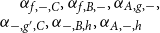 $\alpha_{f,-,C}, \alpha_{f,B,-}, \alpha_{A,g,-}, \alpha_{-,g',C},\alpha_{-,B,h}, \alpha_{A,-,h}$
hold automatically in
$\alpha_{f,-,C}, \alpha_{f,B,-}, \alpha_{A,g,-}, \alpha_{-,g',C},\alpha_{-,B,h}, \alpha_{A,-,h}$
hold automatically in $\mathcal{C}_p(\mathcal{B})$
, whereas in Paquet and Saville (Reference Paquet and Saville2023b, Definition 21) it is required that
$\mathcal{C}_p(\mathcal{B})$
, whereas in Paquet and Saville (Reference Paquet and Saville2023b, Definition 21) it is required that $\alpha_{f,-,C}$
and
$\alpha_{f,-,C}$
and $\alpha_{A,-,h}$
be modifications.
$\alpha_{A,-,h}$
be modifications.
Definition 8.3. Let $\mathcal{B}$
be a premonoidal bicategory and let
$\mathcal{B}$
be a premonoidal bicategory and let $\mathcal{B}'\subseteq\mathcal{B}$
be a sub-bicategory such that
$\mathcal{B}'\subseteq\mathcal{B}$
be a sub-bicategory such that
-
(1) there are pseudofunctors
$L_0, R_0:\mathcal{B}'\to \operatorname{Pseudo}_{ps}(\mathcal{B}',\mathcal{B}')$
, -
(2) structural 1-cells
$\alpha_{A,B,C}, \lambda_A, \rho_A$
live in
$\mathcal{B}'$
for all
$A,B,C\in\mathcal{B}$
, -
(3) bicategorical axioms analogous to the left-most 6 axioms of Table 2 hold, i.e.
$\alpha_{f,-,C}, \alpha_{f,B,-},\alpha_{A,g,-}, \alpha_{-,g',C}, \alpha_{-,B,h}, \alpha_{A,-,h}$
are modifications, and -
(4)
$f\ltimes-\vert_g=(-\rtimes g\vert_f)^{-1}$
hold for all 1-cells f,g.





Here $\operatorname{Pseudo}_{ps}(\mathcal{B}',\mathcal{B}')$
is the 2-categorical analogue of
$\operatorname{Pseudo}_{ps}(\mathcal{B}',\mathcal{B}')$
is the 2-categorical analogue of $\operatorname{\mathbb{P} seudo}_{ps}(\mathbb{B}',\mathbb{B}')$
. (It is smaller than the underlying 2-category of
$\operatorname{\mathbb{P} seudo}_{ps}(\mathbb{B}',\mathbb{B}')$
. (It is smaller than the underlying 2-category of $\operatorname{\mathbb{P} seudo}_{ps}(\mathbb{B}',\mathbb{B}')$
.) Also, the modifications in 3. are meant in the bicategorical sense: the associativity constraints involved are given by globular 2-cells.
$\operatorname{\mathbb{P} seudo}_{ps}(\mathbb{B}',\mathbb{B}')$
.) Also, the modifications in 3. are meant in the bicategorical sense: the associativity constraints involved are given by globular 2-cells.
Observe that structural cells of the underlying horizontal bicategory $\mathcal{H}(\mathbb{Z}_p(\mathbb{B},H))$
of the pure center pseudodouble category
$\mathcal{H}(\mathbb{Z}_p(\mathbb{B},H))$
of the pure center pseudodouble category $\mathbb{Z}_p(\mathbb{B},H)$
of a double category
$\mathbb{Z}_p(\mathbb{B},H)$
of a double category $\mathbb{B}$
possess non-trivial 1v-cells of
$\mathbb{B}$
possess non-trivial 1v-cells of $\mathbb{B}$
and henceforth
$\mathbb{B}$
and henceforth $\mathcal{H}(\mathbb{Z}_p(\mathbb{B},H))$
is properly larger than the bicategory of pure maps
$\mathcal{H}(\mathbb{Z}_p(\mathbb{B},H))$
is properly larger than the bicategory of pure maps $\mathcal{C}_p(\underline{\mathcal{H}(\mathbb{B})})$
of the underlying horizontal 2-category of
$\mathcal{C}_p(\underline{\mathcal{H}(\mathbb{B})})$
of the underlying horizontal 2-category of $\mathbb{B}$
. Namely, 1h-cells of
$\mathbb{B}$
. Namely, 1h-cells of $\mathbb{Z}_p(\mathbb{B},H)$
are triples
$\mathbb{Z}_p(\mathbb{B},H)$
are triples $(f,f\ltimes-,-\rtimes f)$
where the horizontal structure transformations possess non-globular 2-cells
$(f,f\ltimes-,-\rtimes f)$
where the horizontal structure transformations possess non-globular 2-cells $f\ltimes-\vert_u$
and
$f\ltimes-\vert_u$
and $-\rtimes f\vert_u$
.
$-\rtimes f\vert_u$
.
Let $\mathbb{B}$
be a premonoidal double category such that a premonoidal 2-category
$\mathbb{B}$
be a premonoidal double category such that a premonoidal 2-category $\mathcal{B}$
is its underlying horizontal premonoidal 2-category,
$\mathcal{B}$
is its underlying horizontal premonoidal 2-category, $\underline{\mathcal{H}(\mathbb{B})}=\mathcal{B}$
. It is immediate to see that the points 1. and 4. for
$\underline{\mathcal{H}(\mathbb{B})}=\mathcal{B}$
. It is immediate to see that the points 1. and 4. for $\mathcal{C}_p(\mathcal{B})$
follow from the definition of the pure center double category
$\mathcal{C}_p(\mathcal{B})$
follow from the definition of the pure center double category $\mathbb{Z}_p(\mathbb{B},H)$
from our Definition 8.2. Under the assumptions of Proposition 3.15 the point 2. above also holds. It remains to show that under the same conditions the bicategorical axioms for
$\mathbb{Z}_p(\mathbb{B},H)$
from our Definition 8.2. Under the assumptions of Proposition 3.15 the point 2. above also holds. It remains to show that under the same conditions the bicategorical axioms for $\alpha_{f,-,C}$
and
$\alpha_{f,-,C}$
and $\alpha_{A,-,h}$
in 3. (and for the remaining four modifications) follow from their double categorical analogues. (Rrecall that the axioms for
$\alpha_{A,-,h}$
in 3. (and for the remaining four modifications) follow from their double categorical analogues. (Rrecall that the axioms for $\alpha$
hold by premonoidality and existence of functorial assignment of centrality structures
$\alpha$
hold by premonoidality and existence of functorial assignment of centrality structures $L_0, R_0$
, Proposition 8.1; for
$L_0, R_0$
, Proposition 8.1; for $\underline{\mathcal{H}(\mathbb{B})}=\mathcal{B}$
we consider only the listed six axioms.)
$\underline{\mathcal{H}(\mathbb{B})}=\mathcal{B}$
we consider only the listed six axioms.)
In the pure center double category $\mathbb{Z}_p(\mathbb{B},H)$
we have that the axiom (
$\mathbb{Z}_p(\mathbb{B},H)$
we have that the axiom ( $(f\ltimes,g,C)$
) (out of the 24 from Appendix A) holds, and in Proposition 2.14 we have a way how vertical strict transformations
$(f\ltimes,g,C)$
) (out of the 24 from Appendix A) holds, and in Proposition 2.14 we have a way how vertical strict transformations $\alpha_{-,B,C}$
and
$\alpha_{-,B,C}$
and $\alpha_{A,-,C}$
determine horizontal pseudonatural transformations that we will denote here by
$\alpha_{A,-,C}$
determine horizontal pseudonatural transformations that we will denote here by $\alpha_{-,B,C}^1$
and
$\alpha_{-,B,C}^1$
and $\alpha_{A,-,C}^2$
. Then to see that the first axiom in item 3. holds we need to check the equality
$\alpha_{A,-,C}^2$
. Then to see that the first axiom in item 3. holds we need to check the equality

But this is true precisely because of the axiom ( $(f\ltimes,g,C)$
) and since
$(f\ltimes,g,C)$
) and since $\frac{\eta}{\varepsilon}=\operatorname {Id}$
(the vertical composition of 2-cells). The bicategorical axiom for
$\frac{\eta}{\varepsilon}=\operatorname {Id}$
(the vertical composition of 2-cells). The bicategorical axiom for $\alpha_{A,-,h}$
follows similarly from the axiom (
$\alpha_{A,-,h}$
follows similarly from the axiom ( $(A,g,\rtimes h)$
).
$(A,g,\rtimes h)$
).
The relation between the double categorical and bicategorical pure center we can formalize as follows. Let $\mathbb{Z}_p(\mathbb{B})_{hm}$
denote the pure center double category (stemming either from H or from
$\mathbb{Z}_p(\mathbb{B})_{hm}$
denote the pure center double category (stemming either from H or from $(L_0,R_0)$
) in whose 2-cells
$(L_0,R_0)$
) in whose 2-cells $(a, a\ltimes-, -\rtimes a)$
the modifications
$(a, a\ltimes-, -\rtimes a)$
the modifications $a\ltimes-$
and
$a\ltimes-$
and $-\rtimes a$
are horizontal (recall axioms (m.ho.-1) and (m.ho.-2)). We define the center double category
$-\rtimes a$
are horizontal (recall axioms (m.ho.-1) and (m.ho.-2)). We define the center double category $\mathbb{Z}(\mathbb{B})_{hm}$
similarly, with centrality structures stemming from
$\mathbb{Z}(\mathbb{B})_{hm}$
similarly, with centrality structures stemming from $(L_0,R_0)$
. For
$(L_0,R_0)$
. For $\mathbb{B}$
such that its associativity and unity constraints
$\mathbb{B}$
such that its associativity and unity constraints $\alpha,\lambda,\rho$
are liftable vertical transformations we know from Proposition 3.15 that
$\alpha,\lambda,\rho$
are liftable vertical transformations we know from Proposition 3.15 that $\underline{\mathcal{H}(\mathbb{B})}$
is the underlying premonoidal 2-category with the induced pseudonatural equivalences
$\underline{\mathcal{H}(\mathbb{B})}$
is the underlying premonoidal 2-category with the induced pseudonatural equivalences $\hat{\alpha},\hat{\lambda},\hat{\rho}$
induced from
$\hat{\alpha},\hat{\lambda},\hat{\rho}$
induced from $\mathbb{B}$
according to Proposition 2.14. Similarly, consider
$\mathbb{B}$
according to Proposition 2.14. Similarly, consider $\underline{\mathcal{H}(\mathbb{Z}_p(\mathbb{B})_{hm})}$
equipped with the same
$\underline{\mathcal{H}(\mathbb{Z}_p(\mathbb{B})_{hm})}$
equipped with the same $\hat{\alpha},\hat{\lambda},\hat{\rho}$
. There are pseudofunctors
$\hat{\alpha},\hat{\lambda},\hat{\rho}$
. There are pseudofunctors
 \begin{equation} hor_p:\underline{\mathcal{H}(\mathbb{Z}_p(\mathbb{B})_{hm})}\to C_p(\underline{\mathcal{H}(\mathbb{B})})\end{equation}
and
 \begin{equation} hor:\underline{\mathcal{H}(\mathbb{Z}(\mathbb{B})_{hm})}\to \mathcal{Z}(\underline{\mathcal{H}(\mathbb{B})})\end{equation}
that are identity on objects and send 1- and 2-cells $(b,b\ltimes-,-\rtimes b)$
to
$(b,b\ltimes-,-\rtimes b)$
to $(b,\mathcal{H}(b\ltimes-),\mathcal{H}(-\rtimes b))$
(for the meaning of
$(b,\mathcal{H}(b\ltimes-),\mathcal{H}(-\rtimes b))$
(for the meaning of $\mathcal{H}$
on transformations and modifications recall Remark 2.8 and Remark 2.3).
$\mathcal{H}$
on transformations and modifications recall Remark 2.8 and Remark 2.3).
8.2 Pseudodouble functors on the center
We have introduced two pure center double categories, which differ only in the way how centrality structures are given in them: either via a pseudodouble quasi-functor H, or a pair of pseudodouble functors $(L_0,R_0)$
. We also introduced the center double category
$(L_0,R_0)$
. We also introduced the center double category $\mathbb{Z}(\mathbb{B},L_0, R_0)$
, supposing existence of
$\mathbb{Z}(\mathbb{B},L_0, R_0)$
, supposing existence of $(L_0, R_0)$
. The following result, based on what we proved in Section 4, holds independently on which centrality structure one works with. Because of this and to alleviate the notation, until the remainder of this section we will denote both pure center double categories by
$(L_0, R_0)$
. The following result, based on what we proved in Section 4, holds independently on which centrality structure one works with. Because of this and to alleviate the notation, until the remainder of this section we will denote both pure center double categories by $\mathbb{Z}_p(\mathbb{B})$
and the center double category
$\mathbb{Z}_p(\mathbb{B})$
and the center double category $\mathbb{Z}(\mathbb{B},L_0, R_0)$
by
$\mathbb{Z}(\mathbb{B},L_0, R_0)$
by $\mathbb{Z}(\mathbb{B})$
.
$\mathbb{Z}(\mathbb{B})$
.
Proposition 8.4. In a premonoidal double category $\mathbb{B}$
for every
$\mathbb{B}$
for every $A,B\in\mathbb{B}$
there are pseudodouble functors
$A,B\in\mathbb{B}$
there are pseudodouble functors
 $$A\ltimes-, \,\, -\rtimes B: \mathbb{Z}_p(\mathbb{B})\to \mathbb{Z}_p(\mathbb{B}),$$
 $$A\ltimes-, \,\, -\rtimes B: \mathbb{Z}(\mathbb{B})\to \mathbb{Z}(\mathbb{B}).$$
Proof. The two pseudodouble functors in both cases are clearly defined on 0-cells. In Proposition 4.3 we showed that if f is a left central 1h-cell, then $A\ltimes f, f\rtimes B$
are left central, and if f is right central, then
$A\ltimes f, f\rtimes B$
are left central, and if f is right central, then $A\ltimes f, f\rtimes B$
are right central. Then centrality of f implies centrality of
$A\ltimes f, f\rtimes B$
are right central. Then centrality of f implies centrality of $A\ltimes f$
and
$A\ltimes f$
and $f\rtimes B$
. Similar claims for 1v-cells we have by Lemma 4.1 and as explained around (13), because of the assumption that the three
$f\rtimes B$
. Similar claims for 1v-cells we have by Lemma 4.1 and as explained around (13), because of the assumption that the three $\alpha$
’s are strict. Given a left central 2-cell
$\alpha$
’s are strict. Given a left central 2-cell $\sigma$
it is straightforward to check that
$\sigma$
it is straightforward to check that $A\ltimes\sigma$
and
$A\ltimes\sigma$
and $\sigma\rtimes B$
are left central, and if
$\sigma\rtimes B$
are left central, and if $\sigma$
is right central, that so are
$\sigma$
is right central, that so are $A\ltimes\sigma$
and
$A\ltimes\sigma$
and $\sigma\rtimes B$
(one uses the axiom (v.l.t.- 5)). In particular, for
$\sigma\rtimes B$
(one uses the axiom (v.l.t.- 5)). In particular, for $\sigma$
central, both
$\sigma$
central, both $A\ltimes\sigma$
and
$A\ltimes\sigma$
and $\sigma\rtimes B$
are central. The pseudodouble functor property follows from centrality of the domain 1-cells.
$\sigma\rtimes B$
are central. The pseudodouble functor property follows from centrality of the domain 1-cells.
Up to the difference that the bicategorical center from Paquet and Saville (Reference Paquet and Saville2023b, Definition 20), Paquet and Saville (Reference Paquet and Saville2023a, Definition 7) does not fix centrality structures, whereas our double categorical center fixes them, the above result is an extension of Paquet and Saville (Reference Paquet and Saville2023b, Proposition 5), Paquet and Saville (Reference Paquet and Saville2023a, Proposition 8) to double categories in the following sense. We defined pseudonatural transformations (12) appearing in the image of the above pseudodouble functors $A\ltimes-, \,\, -\rtimes B$
on
$A\ltimes-, \,\, -\rtimes B$
on $\mathbb{Z}(\mathbb{B})$
and
$\mathbb{Z}(\mathbb{B})$
and $\mathbb{Z}_p(\mathbb{B})$
for each
$\mathbb{Z}_p(\mathbb{B})$
for each $A,B\in\mathbb{B}$
via the middle 8 axioms in Table 2. Their horizontally globular 2-cell components can be expressed from the left 4 axioms of those 8 axioms, and they have the following form
$A,B\in\mathbb{B}$
via the middle 8 axioms in Table 2. Their horizontally globular 2-cell components can be expressed from the left 4 axioms of those 8 axioms, and they have the following form

and similarly for the remaining three transformations. When we pass the square-formed component 2-cells of the three vertical liftable transformations $\alpha$
(and their inverses) appearing in these expressions to horizontal pseudonatural equivalences by Proposition 2.14 part b), we obtain exactly the same component 2-cells for the pseudonatural transformations induced by the images by
$\alpha$
(and their inverses) appearing in these expressions to horizontal pseudonatural equivalences by Proposition 2.14 part b), we obtain exactly the same component 2-cells for the pseudonatural transformations induced by the images by $L_A$
and
$L_A$
and $R_B$
of central 1-cells f in
$R_B$
of central 1-cells f in $\underline{\mathcal{H}(\mathbb{B})}$
, as defined in Paquet and Saville (Reference Paquet and Saville2023a). To see this, we will use string diagrams for 2-categories, recall Subsection 2.1. We will write
$\underline{\mathcal{H}(\mathbb{B})}$
, as defined in Paquet and Saville (Reference Paquet and Saville2023a). To see this, we will use string diagrams for 2-categories, recall Subsection 2.1. We will write $\beta_{A,B,C}$
for horizontal companions of the 1v-cell components
$\beta_{A,B,C}$
for horizontal companions of the 1v-cell components $\alpha_{A,B,C}$
of the associativity constraint
$\alpha_{A,B,C}$
of the associativity constraint $\alpha$
, and similarly we will denote by
$\alpha$
, and similarly we will denote by $\beta_{f,B,C}, \beta_{A,g,C},\beta_{A,B,h}$
the horizontally globular 2-cell components of horizontal pseudodouble transformations obtained from the 2-cell components
$\beta_{f,B,C}, \beta_{A,g,C},\beta_{A,B,h}$
the horizontally globular 2-cell components of horizontal pseudodouble transformations obtained from the 2-cell components $\alpha_{f,B,C}, \alpha_{A,g,C},\alpha_{A,B,h}$
of the corresponding vertical liftable transformations. We consider the 1h-cells
$\alpha_{f,B,C}, \alpha_{A,g,C},\alpha_{A,B,h}$
of the corresponding vertical liftable transformations. We consider the 1h-cells $\beta_{A,B,C}$
as adjoint equivalences and denote by
$\beta_{A,B,C}$
as adjoint equivalences and denote by $\gamma_{A,B,C}$
their quasi-inverses. Suppressing the symbols
$\gamma_{A,B,C}$
their quasi-inverses. Suppressing the symbols $\ltimes, \rtimes$
, we get
$\ltimes, \rtimes$
, we get

Where
and
present $\eta$
and its inverse for
$\eta$
and its inverse for $\alpha_{A',B,C'}$
and
$\alpha_{A',B,C'}$
and $\alpha_{A,B',C'}$
, respectively, and
$\alpha_{A,B',C'}$
, respectively, and

where
and
in the left-hand side present $\varepsilon^{-1}$
for
$\varepsilon^{-1}$
for $\beta_{A',B,C}$
and
$\beta_{A',B,C}$
and $\varepsilon$
for
$\varepsilon$
for $\beta_{A,B',C}$
, respectively, and in the right-hand side
$\beta_{A,B',C}$
, respectively, and in the right-hand side $\varepsilon^{-1}$
for
$\varepsilon^{-1}$
for $\beta_{A',B,C}$
and
$\beta_{A',B,C}$
and $\varepsilon$
for
$\varepsilon$
for $\beta_{A,B,C'}$
, respectively.
$\beta_{A,B,C'}$
, respectively.
These four transformations are precisely pseudonatural transformations in a bicategory used in Paquet and Saville (Reference Paquet and Saville2023a, Proposition 8) (two of them were not explicitly given).
As we argued before, the first two of the above four definitions in $\underline{\mathcal{H}(\mathbb{B})}$
originate from the fact that
$\underline{\mathcal{H}(\mathbb{B})}$
originate from the fact that $\alpha_{f,B,-}$
and
$\alpha_{f,B,-}$
and $\alpha_{A,g,-}$
are modifications between vertical pseudonatural transformations and horizontal pseudonatural transformations. On the other hand, the adjoint equivalence of the companion 1h-cells makes these two definitions in
$\alpha_{A,g,-}$
are modifications between vertical pseudonatural transformations and horizontal pseudonatural transformations. On the other hand, the adjoint equivalence of the companion 1h-cells makes these two definitions in $\underline{\mathcal{H}(\mathbb{B})}$
equivalent to the facts that
$\underline{\mathcal{H}(\mathbb{B})}$
equivalent to the facts that
 $$\alpha_{f,X,-}:\frac{(f\ltimes X)\ltimes-}{\alpha_{A',X,-}}\Rrightarrow\frac{\alpha_{A,X,-}}{f\ltimes(X\ltimes-)}$$
and
 $$\alpha_{X,f,-}:\frac{(X\rtimes f)\ltimes-}{\alpha_{X,A',-}}\Rrightarrow\frac{\alpha_{X,A,-}}{X\rtimes (f\ltimes-)}$$
are modifications of (2-categorical) pseudonatural transformations, respectively, as recorded in Paquet and Saville (Reference Paquet and Saville2023b, Proposition 5).
We may summarize the above findings in the proposition below, in which we omit the proof for 2-cells. Let $\mathbb{L}_A,\mathbb{R}_B$
denote the restrictions of the above pseudodouble functors
$\mathbb{L}_A,\mathbb{R}_B$
denote the restrictions of the above pseudodouble functors $A\ltimes-, \,\, -\rtimes B$
on
$A\ltimes-, \,\, -\rtimes B$
on $\mathbb{Z}(\mathbb{B})$
to
$\mathbb{Z}(\mathbb{B})$
to $\underline{\mathcal{H}(\mathbb{Z}(\mathbb{B})_{hm})}$
, and let
$\underline{\mathcal{H}(\mathbb{Z}(\mathbb{B})_{hm})}$
, and let $L_A,R_A:\mathcal{Z}(\underline{\mathcal{H}(\mathbb{B})})\to \mathcal{Z}(\underline{\mathcal{H}(\mathbb{B})})$
denote the bicategorical counterparts of
$L_A,R_A:\mathcal{Z}(\underline{\mathcal{H}(\mathbb{B})})\to \mathcal{Z}(\underline{\mathcal{H}(\mathbb{B})})$
denote the bicategorical counterparts of $A\ltimes-$
and
$A\ltimes-$
and $-\rtimes B$
analogous to those from Paquet and Saville (Reference Paquet and Saville2024, Proposition 8). Let
$-\rtimes B$
analogous to those from Paquet and Saville (Reference Paquet and Saville2024, Proposition 8). Let $hor:\underline{\mathcal{H}(\mathbb{Z}(\mathbb{B})_{hm})}\to \mathcal{Z}(\underline{\mathcal{H}(\mathbb{B})})$
be as in (52) and let
$hor:\underline{\mathcal{H}(\mathbb{Z}(\mathbb{B})_{hm})}\to \mathcal{Z}(\underline{\mathcal{H}(\mathbb{B})})$
be as in (52) and let $hor^*:\mathcal{I}(\underline{\mathcal{H}(\mathbb{Z}(\mathbb{B})_{hm})})\to \mathcal{Z}(\underline{\mathcal{H}(\mathbb{B})})$
be the pseudofunctor that sends the double categorical structural data to the corresponding underlying bicategorical data in the following way. Here,
$hor^*:\mathcal{I}(\underline{\mathcal{H}(\mathbb{Z}(\mathbb{B})_{hm})})\to \mathcal{Z}(\underline{\mathcal{H}(\mathbb{B})})$
be the pseudofunctor that sends the double categorical structural data to the corresponding underlying bicategorical data in the following way. Here, $\mathcal{I}(\underline{\mathcal{H}(\mathbb{Z}(\mathbb{B})_{hm})})$
is the image of
$\mathcal{I}(\underline{\mathcal{H}(\mathbb{Z}(\mathbb{B})_{hm})})$
is the image of $\mathbb{L}_A$
or
$\mathbb{L}_A$
or $\mathbb{R}_B$
, with small abuse of notation. Both hor and
$\mathbb{R}_B$
, with small abuse of notation. Both hor and $hor^*$
are identities on 0-cells and send a 2-cell
$hor^*$
are identities on 0-cells and send a 2-cell $(a,a\ltimes-,-\rtimes a)$
to the 2-cell
$(a,a\ltimes-,-\rtimes a)$
to the 2-cell $(a,\mathcal{H}(a\ltimes-),\mathcal{H}(-\rtimes a))$
. Now, whereas hor sends a 1-cell
$(a,\mathcal{H}(a\ltimes-),\mathcal{H}(-\rtimes a))$
. Now, whereas hor sends a 1-cell $(f,f\ltimes-,-\rtimes f)$
to the 1-cell
$(f,f\ltimes-,-\rtimes f)$
to the 1-cell $(f,\mathcal{H}(f\ltimes-),\mathcal{H}(-\rtimes f))$
, for
$(f,\mathcal{H}(f\ltimes-),\mathcal{H}(-\rtimes f))$
, for $hor^*((f\rtimes B,(f\rtimes B)\ltimes-,-\rtimes (f\rtimes B)))$
instead of taking
$hor^*((f\rtimes B,(f\rtimes B)\ltimes-,-\rtimes (f\rtimes B)))$
instead of taking $\mathcal{H}((f\rtimes B)\ltimes-)$
that is given by (53) in which 1v-cells appear, one takes
$\mathcal{H}((f\rtimes B)\ltimes-)$
that is given by (53) in which 1v-cells appear, one takes $\widehat{\mathcal{H}}((f\rtimes B)\ltimes-)$
given by (54). One proceeds similarly for
$\widehat{\mathcal{H}}((f\rtimes B)\ltimes-)$
given by (54). One proceeds similarly for $-\rtimes (f\rtimes B)$
and the images by
$-\rtimes (f\rtimes B)$
and the images by $\mathbb{L}_A$
.
$\mathbb{L}_A$
.
Proposition 8.5. Let $\mathbb{B}$
be a premonoidal double category whose structure vertical strict transformations are liftable. For every
$\mathbb{B}$
be a premonoidal double category whose structure vertical strict transformations are liftable. For every $A,B\in\mathbb{B}$
, the following diagram of pseudofunctors between bicategories commutes
$A,B\in\mathbb{B}$
, the following diagram of pseudofunctors between bicategories commutes

The analogous holds when $\mathcal{Z}(\underline{\mathcal{H}(\mathbb{B})})$
is replaced by
$\mathcal{Z}(\underline{\mathcal{H}(\mathbb{B})})$
is replaced by $\mathcal{Z}_0(\underline{\mathcal{H}(\mathbb{B})})$
, and also for pure (double categorical and bicategorical) centers.
$\mathcal{Z}_0(\underline{\mathcal{H}(\mathbb{B})})$
, and also for pure (double categorical and bicategorical) centers.
9. Monoidality of a pure center double category
While in a premonoidal category the center subcategory is monoidal, in Paquet and Saville (Reference Paquet and Saville2023b), Section 6.5 it is explained that for a premonoidal bicategory $\mathcal{B}$
its center bicategory
$\mathcal{B}$
its center bicategory $\mathcal{Z}(\mathcal{B})$
is not monoidal. Though, in Theorem 3 the authors prove that the corresponding bicategory of pure maps
$\mathcal{Z}(\mathcal{B})$
is not monoidal. Though, in Theorem 3 the authors prove that the corresponding bicategory of pure maps $\mathcal{C}_p(\mathcal{B})$
is a monoidal bicategory.
$\mathcal{C}_p(\mathcal{B})$
is a monoidal bicategory.
The analogous occurrences we find in the double categorical setting (the fact that our center $(\mathbb{Z}(\mathbb{B}), L_0,R_0)$
fixes centrality structures contrarily to
$(\mathbb{Z}(\mathbb{B}), L_0,R_0)$
fixes centrality structures contrarily to $\mathcal{Z}(\mathcal{B})$
does not play a role in this issue). In Theorem 7.10, we proved that if the binoidal, hence premonoidal, structure of
$\mathcal{Z}(\mathcal{B})$
does not play a role in this issue). In Theorem 7.10, we proved that if the binoidal, hence premonoidal, structure of $\mathbb{B}$
comes from a quasi-functor, then
$\mathbb{B}$
comes from a quasi-functor, then $\mathbb{B}$
is purely central and monoidal. This will help us prove in Subsection 9.2 that the pure center double category
$\mathbb{B}$
is purely central and monoidal. This will help us prove in Subsection 9.2 that the pure center double category $\mathbb{Z}_p^{st}(\mathbb{B},H)$
is monoidal. Regarding a center double category
$\mathbb{Z}_p^{st}(\mathbb{B},H)$
is monoidal. Regarding a center double category $(\mathbb{Z}(\mathbb{B}),L_0,R_0)$
, the two pseudodouble functors
$(\mathbb{Z}(\mathbb{B}),L_0,R_0)$
, the two pseudodouble functors $L_0,R_0$
give rise to two pseudodouble quasi-functors so that the binoidal structure is given by
$L_0,R_0$
give rise to two pseudodouble quasi-functors so that the binoidal structure is given by $A\ltimes-=A\ltimes_{L_0}-$
and
$A\ltimes-=A\ltimes_{L_0}-$
and $-\rtimes B=-\rtimes_{R_0} B$
, whereby the 2-cells
$-\rtimes B=-\rtimes_{R_0} B$
, whereby the 2-cells $f\ltimes_{L_0}-\vert_g$
and
$f\ltimes_{L_0}-\vert_g$
and $-\rtimes_{R_0} g\vert_f$
are unrelated. In the construction of a monoidal product
$-\rtimes_{R_0} g\vert_f$
are unrelated. In the construction of a monoidal product $\otimes$
in (46) we set its lax pseudodouble functor structure using
$\otimes$
in (46) we set its lax pseudodouble functor structure using $K\ltimes-\vert_k$
in (48), and its colax structure then uses
$K\ltimes-\vert_k$
in (48), and its colax structure then uses $(K\ltimes-\vert_k)^{-1}$
, which equals
$(K\ltimes-\vert_k)^{-1}$
, which equals $-\rtimes k\vert_K$
because of pure centrality. Though, if we want to equip
$-\rtimes k\vert_K$
because of pure centrality. Though, if we want to equip $\mathbb{Z}(\mathbb{B})$
with a monoidal structure, we need to give a monoidal product also on central 1h-cells f and g, so we should be able to relate the 2-cell components
$\mathbb{Z}(\mathbb{B})$
with a monoidal structure, we need to give a monoidal product also on central 1h-cells f and g, so we should be able to relate the 2-cell components $f\ltimes_{L_0}-\vert_g$
and
$f\ltimes_{L_0}-\vert_g$
and $-\rtimes_{R_0} g\vert_f$
, and also the latter with the lax and colax structure of
$-\rtimes_{R_0} g\vert_f$
, and also the latter with the lax and colax structure of $\otimes$
. Thus not having pure centrality hinders center double categories from being monoidal.
$\otimes$
. Thus not having pure centrality hinders center double categories from being monoidal.
In the first subsection, we study necessary conditions to have a pseudodouble functor $\otimes:\mathbb{Z}_p^{st}(\mathbb{B})\times\mathbb{Z}_p^{st}(\mathbb{B})\to \mathbb{Z}_p^{st}(\mathbb{B})$
, where
$\otimes:\mathbb{Z}_p^{st}(\mathbb{B})\times\mathbb{Z}_p^{st}(\mathbb{B})\to \mathbb{Z}_p^{st}(\mathbb{B})$
, where $\mathbb{Z}_p^{st}(\mathbb{B}):=\mathbb{Z}_p^{st}(\mathbb{B},H)$
denotes a pure center stemming from a pseudodouble quasi-functor H whose 2-cells
$\mathbb{Z}_p^{st}(\mathbb{B}):=\mathbb{Z}_p^{st}(\mathbb{B},H)$
denotes a pure center stemming from a pseudodouble quasi-functor H whose 2-cells $(u,U)=H(U,u)$
are trivial.
$(u,U)=H(U,u)$
are trivial.
9.1 Candidate for a monoidal product on a pure center
Let $\mathbb{B}$
be a premonoidal double category. From Theorem 7.14, we have that in order to obtain a candidate for a monoidal product
$\mathbb{B}$
be a premonoidal double category. From Theorem 7.14, we have that in order to obtain a candidate for a monoidal product $\otimes$
on
$\otimes$
on $\mathbb{Z}_p(\mathbb{B},H)$
, we should define a pseudodouble quasi-functor for
$\mathbb{Z}_p(\mathbb{B},H)$
, we should define a pseudodouble quasi-functor for $\mathbb{Z}_p(\mathbb{B},H)$
whose 2-cells (u,U) are trivial. Let
$\mathbb{Z}_p(\mathbb{B},H)$
whose 2-cells (u,U) are trivial. Let $\mathbb{Z}_p^{st}(\mathbb{B}):=\mathbb{Z}_p^{st}(\mathbb{B},H)$
denote a pure center double category stemming from a pseudodouble quasi-functor
$\mathbb{Z}_p^{st}(\mathbb{B}):=\mathbb{Z}_p^{st}(\mathbb{B},H)$
denote a pure center double category stemming from a pseudodouble quasi-functor $H:\mathbb{B}\times\mathbb{B}\to \mathbb{B}$
whose 2-cells H(U,u) are trivial. We are going to show that H extends to a pseudodouble quasi-functor
$H:\mathbb{B}\times\mathbb{B}\to \mathbb{B}$
whose 2-cells H(U,u) are trivial. We are going to show that H extends to a pseudodouble quasi-functor $\overline H:\mathbb{Z}_p^{st}(\mathbb{B})\times \mathbb{Z}_p^{st}(\mathbb{B})\to \mathbb{Z}_p^{st}(\mathbb{B})$
so that the 2-cells
$\overline H:\mathbb{Z}_p^{st}(\mathbb{B})\times \mathbb{Z}_p^{st}(\mathbb{B})\to \mathbb{Z}_p^{st}(\mathbb{B})$
so that the 2-cells $\overline H(\overline U,\overline u)$
are trivial, for 1v-cells
$\overline H(\overline U,\overline u)$
are trivial, for 1v-cells $\overline U, \overline u\in\mathbb{Z}_p^{st}(\mathbb{B})$
. Otherwise stated, we will use the fact that H induces two pseudodouble functors as in Proposition 8.4 and equipping
$\overline U, \overline u\in\mathbb{Z}_p^{st}(\mathbb{B})$
. Otherwise stated, we will use the fact that H induces two pseudodouble functors as in Proposition 8.4 and equipping $\mathbb{Z}_p^{st}(\mathbb{B})$
with thus obtained binoidal structure, we will prove that all 1- and 2-cells in
$\mathbb{Z}_p^{st}(\mathbb{B})$
with thus obtained binoidal structure, we will prove that all 1- and 2-cells in $\mathbb{Z}_p^{st}(\mathbb{B})$
are left and right central in
$\mathbb{Z}_p^{st}(\mathbb{B})$
are left and right central in $\mathbb{Z}_p^{st}(\mathbb{B})$
. The necessary four identities on 2-cells for
$\mathbb{Z}_p^{st}(\mathbb{B})$
. The necessary four identities on 2-cells for $\overline H$
will then hold because they hold for H, including triviality of the 2-cells
$\overline H$
will then hold because they hold for H, including triviality of the 2-cells $\overline H(\overline U,\overline u)$
.
$\overline H(\overline U,\overline u)$
.
Remark 9.1. Before we pursue, let us see what it means for 1- and 2-cells in $\mathbb{Z}_p^{st}(\mathbb{B})$
to be left/right central in
$\mathbb{Z}_p^{st}(\mathbb{B})$
to be left/right central in $\mathbb{Z}_p^{st}(\mathbb{B})$
. We divide this study in cases: when cells in
$\mathbb{Z}_p^{st}(\mathbb{B})$
. We divide this study in cases: when cells in $\mathbb{Z}_l^{st}(\mathbb{B})$
are left and right central in
$\mathbb{Z}_l^{st}(\mathbb{B})$
are left and right central in $\mathbb{Z}_l^{st}(\mathbb{B})$
, and when cells in
$\mathbb{Z}_l^{st}(\mathbb{B})$
, and when cells in $\mathbb{Z}_r^{st}(\mathbb{B})$
are left and right central in
$\mathbb{Z}_r^{st}(\mathbb{B})$
are left and right central in $\mathbb{Z}_r^{st}(\mathbb{B})$
. For example for
$\mathbb{Z}_r^{st}(\mathbb{B})$
. For example for $\mathbb{Z}_r^{st}(\mathbb{B})$
: take a 1h-cell
$\mathbb{Z}_r^{st}(\mathbb{B})$
: take a 1h-cell $(k, -\rtimes k)$
in
$(k, -\rtimes k)$
in $\mathbb{Z}_r^{st}(\mathbb{B})$
, in order for
$\mathbb{Z}_r^{st}(\mathbb{B})$
, in order for $(k, -\rtimes k)$
to be right central in
$(k, -\rtimes k)$
to be right central in $\mathbb{Z}_r(\mathbb{B})$
, we need a pseudonatural transformation
$\mathbb{Z}_r(\mathbb{B})$
, we need a pseudonatural transformation $-\rtimes k: -\rtimes A\Rightarrow -\rtimes A': \mathbb{Z}_r^{st}(\mathbb{B})\to \mathbb{Z}_r^{st}(\mathbb{B})$
. In particular, for a right central 1h-cell K and a right central 1v-cell U we want structure 2-cells
$-\rtimes k: -\rtimes A\Rightarrow -\rtimes A': \mathbb{Z}_r^{st}(\mathbb{B})\to \mathbb{Z}_r^{st}(\mathbb{B})$
. In particular, for a right central 1h-cell K and a right central 1v-cell U we want structure 2-cells $-\rtimes k\vert_K$
and
$-\rtimes k\vert_K$
and $-\rtimes k\vert_U$
to live in
$-\rtimes k\vert_U$
to live in $\mathbb{Z}_r^{st}(\mathbb{B})$
. What we do have, by right centrality of k in
$\mathbb{Z}_r^{st}(\mathbb{B})$
. What we do have, by right centrality of k in $\mathbb{B}$
, is that
$\mathbb{B}$
, is that $-\rtimes k: -\rtimes A\Rightarrow-\rtimes A': \mathbb{B}\to \mathbb{B}$
is a pseudonatural transformation, meaning that for K and U living (only) in
$-\rtimes k: -\rtimes A\Rightarrow-\rtimes A': \mathbb{B}\to \mathbb{B}$
is a pseudonatural transformation, meaning that for K and U living (only) in $\mathbb{B}$
the 2-cells
$\mathbb{B}$
the 2-cells $-\rtimes k\vert_K$
and
$-\rtimes k\vert_K$
and $-\rtimes k\vert_U$
live (only) in
$-\rtimes k\vert_U$
live (only) in $\mathbb{B}$
. The transformation axioms for
$\mathbb{B}$
. The transformation axioms for $-\rtimes k$
in
$-\rtimes k$
in $\mathbb{Z}_r(\mathbb{B})$
will follow by the transformation axioms for
$\mathbb{Z}_r(\mathbb{B})$
will follow by the transformation axioms for $-\rtimes k$
in
$-\rtimes k$
in $\mathbb{B}$
.
$\mathbb{B}$
.
For 1v-cells the situation is similar. For a 2-cell $(\sigma, -\rtimes\sigma)$
in
$(\sigma, -\rtimes\sigma)$
in $\mathbb{Z}_r^{st}(\mathbb{B})$
, between 1h- and 1v-cells which are right central in
$\mathbb{Z}_r^{st}(\mathbb{B})$
, between 1h- and 1v-cells which are right central in $\mathbb{Z}_r^{st}(\mathbb{B})$
, to be right central in
$\mathbb{Z}_r^{st}(\mathbb{B})$
, to be right central in $\mathbb{Z}_r^{st}(\mathbb{B})$
it means that
$\mathbb{Z}_r^{st}(\mathbb{B})$
it means that $A\rtimes\sigma$
are right central 2-cells in
$A\rtimes\sigma$
are right central 2-cells in $\mathbb{B}$
and the two modification axioms from Definition 3.3 for
$\mathbb{B}$
and the two modification axioms from Definition 3.3 for $\sigma$
hold for any 1h-cell K and 1v-cell U in
$\sigma$
hold for any 1h-cell K and 1v-cell U in $\mathbb{Z}_r^{st}(\mathbb{B})$
. By right centrality of
$\mathbb{Z}_r^{st}(\mathbb{B})$
. By right centrality of $\sigma$
in
$\sigma$
in $\mathbb{B}$
we only have that
$\mathbb{B}$
we only have that $A\rtimes\sigma$
are 2-cells in
$A\rtimes\sigma$
are 2-cells in $\mathbb{B}$
and K and U should be from
$\mathbb{B}$
and K and U should be from $\mathbb{B}$
. Though, by right center version of Proposition 8.4 we already have that
$\mathbb{B}$
. Though, by right center version of Proposition 8.4 we already have that $A\rtimes\sigma$
are right central 2-cells, and the desired modification axioms hold in particular for K and U from
$A\rtimes\sigma$
are right central 2-cells, and the desired modification axioms hold in particular for K and U from $\mathbb{Z}_r^{st}(\mathbb{B})$
. The rest of the cases for 2-cells similarly follows because of Proposition 8.4, so it suffices to prove only centralities of 1-cells.
$\mathbb{Z}_r^{st}(\mathbb{B})$
. The rest of the cases for 2-cells similarly follows because of Proposition 8.4, so it suffices to prove only centralities of 1-cells.
Let us consider the case that 1-cells in $\mathbb{Z}_r^{st}(\mathbb{B})$
should be right central in
$\mathbb{Z}_r^{st}(\mathbb{B})$
should be right central in $\mathbb{Z}_r^{st}(\mathbb{B})$
. For 1h-cells
$\mathbb{Z}_r^{st}(\mathbb{B})$
. For 1h-cells $(K, -\rtimes K), (k, -\rtimes k)$
and 1v-cells
$(K, -\rtimes K), (k, -\rtimes k)$
and 1v-cells $(U, -\rtimes U), (u, -\rtimes u)$
in
$(U, -\rtimes U), (u, -\rtimes u)$
in $\mathbb{Z}_r^{st}(\mathbb{B})$
, we have 2-cells
$\mathbb{Z}_r^{st}(\mathbb{B})$
, we have 2-cells $-\rtimes k\vert_K, \,\,\, -\rtimes k\vert_U, \,\,\, -\rtimes u\vert_K, \,\,\, -\rtimes u\vert_U$
in
$-\rtimes k\vert_K, \,\,\, -\rtimes k\vert_U, \,\,\, -\rtimes u\vert_K, \,\,\, -\rtimes u\vert_U$
in $\mathbb{B}$
. To simplify notation, let us denote them by
$\mathbb{B}$
. To simplify notation, let us denote them by $K\rtimes k, \,\,\, U\rtimes k, \,\,\, K\rtimes u, \,\,\, U\rtimes u$
, respectively. Observe that the 2-cells
$K\rtimes k, \,\,\, U\rtimes k, \,\,\, K\rtimes u, \,\,\, U\rtimes u$
, respectively. Observe that the 2-cells $U\rtimes u$
are identities. By Remark 9.1, we should prove that
$U\rtimes u$
are identities. By Remark 9.1, we should prove that $K\rtimes k, \,\,\, U\rtimes k, \,\,\, K\rtimes u, \,\,\, U\rtimes u$
are right central 2-cells in
$K\rtimes k, \,\,\, U\rtimes k, \,\,\, K\rtimes u, \,\,\, U\rtimes u$
are right central 2-cells in $\mathbb{B}$
(observe that here we evaluated right centrality transformations at right central 1-cells, as the Remark requires). To prove right centrality of
$\mathbb{B}$
(observe that here we evaluated right centrality transformations at right central 1-cells, as the Remark requires). To prove right centrality of $K\rtimes k$
, one should prove that
$K\rtimes k$
, one should prove that $-\rtimes(K\rtimes k)$
is a modification in
$-\rtimes(K\rtimes k)$
is a modification in $\mathbb{B}$
. At this point, we switch to the notation
$\mathbb{B}$
. At this point, we switch to the notation $(f,g,h):(A,B,C)\to (A',B', C')$
for 1h-cells and
$(f,g,h):(A,B,C)\to (A',B', C')$
for 1h-cells and $(u,v,z):(A,B,C)\to (\tilde A, \tilde B,\tilde C)$
for 1v-cells, as in Section 4. To prove right centrality of
$(u,v,z):(A,B,C)\to (\tilde A, \tilde B,\tilde C)$
for 1v-cells, as in Section 4. To prove right centrality of $g\rtimes h$
, one should prove that
$g\rtimes h$
, one should prove that $-\rtimes(g\rtimes h)$
is a modification, between horizontal transformations
$-\rtimes(g\rtimes h)$
is a modification, between horizontal transformations $\frac{[-\rtimes gC\vert\operatorname {Id}]}{[\operatorname {Id}\vert-\rtimes B'h]}$
and
$\frac{[-\rtimes gC\vert\operatorname {Id}]}{[\operatorname {Id}\vert-\rtimes B'h]}$
and $\frac{[-\rtimes Bh\vert\operatorname {Id}]}{[\operatorname {Id}\vert-\rtimes gC']}$
(and similarly for right centrality of
$\frac{[-\rtimes Bh\vert\operatorname {Id}]}{[\operatorname {Id}\vert-\rtimes gC']}$
(and similarly for right centrality of $v\rtimes h$
and
$v\rtimes h$
and $g\rtimes z$
). To write out the two modification conditions for
$g\rtimes z$
). To write out the two modification conditions for $-\rtimes(g\rtimes h), \,\,\, -\rtimes(v\rtimes h), \,\,\, -\rtimes(g\rtimes z)$
one applies Lemma 2.4 for vertical composition of horizontal transformations. In the case of
$-\rtimes(g\rtimes h), \,\,\, -\rtimes(v\rtimes h), \,\,\, -\rtimes(g\rtimes z)$
one applies Lemma 2.4 for vertical composition of horizontal transformations. In the case of $-\rtimes(g\rtimes h)$
, the two modification conditions read
$-\rtimes(g\rtimes h)$
, the two modification conditions read

and

for any 1h-cell f and 1v-cell u in $\mathbb{B}$
, whereby the 2-cell
$\mathbb{B}$
, whereby the 2-cell $-\rtimes (-\rtimes h\vert_g)\vert_A$
is defined via the axiom (
$-\rtimes (-\rtimes h\vert_g)\vert_A$
is defined via the axiom ( $(A,g,\rtimes h)$
) that relates it to the 2-cell
$(A,g,\rtimes h)$
) that relates it to the 2-cell $-\rtimes h\vert_{A\ltimes g}$
. Similarly one uses the other corresponding axioms out of the 12 ones holding in
$-\rtimes h\vert_{A\ltimes g}$
. Similarly one uses the other corresponding axioms out of the 12 ones holding in $\mathbb{Z}_r^{st}(\mathbb{B})$
for the other three modification candidates. Observe that the above two conditions are formally precisely the axioms (
$\mathbb{Z}_r^{st}(\mathbb{B})$
for the other three modification candidates. Observe that the above two conditions are formally precisely the axioms ( $\rtimes f,\rtimes g,\rtimes h$
) and (
$\rtimes f,\rtimes g,\rtimes h$
) and ( $\rtimes u,\rtimes g,\rtimes h$
) of a 3-noidal right central structure, the only difference is that here f and u are not required to be central. To highlight this difference we write the above two axioms as
$\rtimes u,\rtimes g,\rtimes h$
) of a 3-noidal right central structure, the only difference is that here f and u are not required to be central. To highlight this difference we write the above two axioms as $(f,\underline{\rtimes g,\rtimes h})$
and
$(f,\underline{\rtimes g,\rtimes h})$
and $(u,\underline{\rtimes g,\rtimes h})$
. (As a matter of fact, for simplicity, we assumed that H is defined on the whole
$(u,\underline{\rtimes g,\rtimes h})$
. (As a matter of fact, for simplicity, we assumed that H is defined on the whole $\mathbb{B}$
, so any f and u are central. Nevertheless, we proceed this meticulous style of the study for the record.) We conclude that the eight axioms for
$\mathbb{B}$
, so any f and u are central. Nevertheless, we proceed this meticulous style of the study for the record.) We conclude that the eight axioms for $-\rtimes(g\rtimes h), -\rtimes(v\rtimes h), -\rtimes(g\rtimes z)$
, and
$-\rtimes(g\rtimes h), -\rtimes(v\rtimes h), -\rtimes(g\rtimes z)$
, and $-\rtimes(v\rtimes z)$
to be modifications are the (seven) axioms from the first four lines of Table 5 and they correspond (up to the just explained difference) to the axioms of a 3-noidal right central structure - the eighth modification axiom regarding
$-\rtimes(v\rtimes z)$
to be modifications are the (seven) axioms from the first four lines of Table 5 and they correspond (up to the just explained difference) to the axioms of a 3-noidal right central structure - the eighth modification axiom regarding $-\rtimes(v\rtimes z)\vert_u$
trivially holds, as it consists only of identity 2-cells.
$-\rtimes(v\rtimes z)\vert_u$
trivially holds, as it consists only of identity 2-cells.
Modification i.e. centrality conditions (needed to have a ps.d. functor $\mathbb{Z}^{st}_p(\mathbb{B})\times\mathbb{Z}^{st}_p(\mathbb{B})\rightarrow\mathbb{Z}^{st}_p(\mathbb{B})$
)
$\mathbb{Z}^{st}_p(\mathbb{B})\times\mathbb{Z}^{st}_p(\mathbb{B})\rightarrow\mathbb{Z}^{st}_p(\mathbb{B})$
)
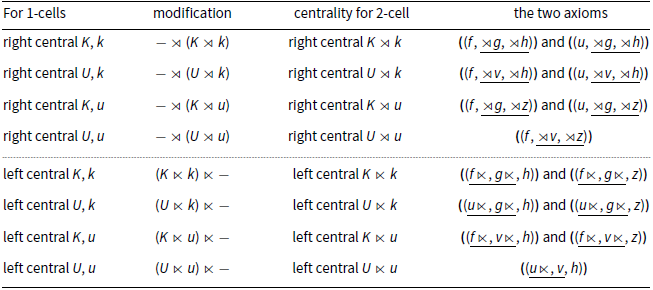
In the case where 1-cells in $\mathbb{Z}_l^{st}(\mathbb{B})$
should be left central in
$\mathbb{Z}_l^{st}(\mathbb{B})$
should be left central in $\mathbb{Z}_l^{st}(\mathbb{B})$
we start from left central 1-cells K,k,U,u, i.e. 1-cells in
$\mathbb{Z}_l^{st}(\mathbb{B})$
we start from left central 1-cells K,k,U,u, i.e. 1-cells in $\mathbb{Z}_l^{st}(\mathbb{B})$
. We obtain 2-cell components
$\mathbb{Z}_l^{st}(\mathbb{B})$
. We obtain 2-cell components $K\ltimes -\vert_k=K\ltimes k, \,\,\, K\ltimes -\vert_u=K\ltimes u, \,\,\, U\ltimes -\vert_k=U\ltimes k, \,\,\,U\ltimes -\vert_u=U\ltimes u$
in
$K\ltimes -\vert_k=K\ltimes k, \,\,\, K\ltimes -\vert_u=K\ltimes u, \,\,\, U\ltimes -\vert_k=U\ltimes k, \,\,\,U\ltimes -\vert_u=U\ltimes u$
in $\mathbb{B}$
, of the horizontal and vertical pseudonatural transformations provided by the left centrality of K and U. In order for these 2-cells to live in
$\mathbb{B}$
, of the horizontal and vertical pseudonatural transformations provided by the left centrality of K and U. In order for these 2-cells to live in $\mathbb{Z}_l(\mathbb{B})$
we obtain similar seven conditions to the above ones to have the corresponding modification conditions. These are the seven axioms from the last four lines of Table 5, and correspond to the axioms of a 3-noidal left central structure.
$\mathbb{Z}_l(\mathbb{B})$
we obtain similar seven conditions to the above ones to have the corresponding modification conditions. These are the seven axioms from the last four lines of Table 5, and correspond to the axioms of a 3-noidal left central structure.
It remains to study when 1-cells in $\mathbb{Z}_l^{st}(\mathbb{B})$
are right central in
$\mathbb{Z}_l^{st}(\mathbb{B})$
are right central in $\mathbb{Z}_l^{st}(\mathbb{B})$
, and analogously when 1-cells in
$\mathbb{Z}_l^{st}(\mathbb{B})$
, and analogously when 1-cells in $\mathbb{Z}_r^{st}(\mathbb{B})$
are left central in
$\mathbb{Z}_r^{st}(\mathbb{B})$
are left central in $\mathbb{Z}_r(\mathbb{B})$
. Take
$\mathbb{Z}_r(\mathbb{B})$
. Take $(k, k\ltimes-)\in\mathbb{Z}_l^{st}(\mathbb{B})$
, for it to be right central in
$(k, k\ltimes-)\in\mathbb{Z}_l^{st}(\mathbb{B})$
, for it to be right central in $\mathbb{Z}_l^{st}(\mathbb{B})$
we need a horizontal pseudonatural transformation
$\mathbb{Z}_l^{st}(\mathbb{B})$
we need a horizontal pseudonatural transformation $-\rtimes k:-\rtimes A\Rightarrow -\rtimes A'$
in
$-\rtimes k:-\rtimes A\Rightarrow -\rtimes A'$
in $\mathbb{Z}_l^{st}(\mathbb{B})$
. This means that for a 1h-cell
$\mathbb{Z}_l^{st}(\mathbb{B})$
. This means that for a 1h-cell $(K, K\ltimes-)\in\mathbb{Z}_l^{st}(\mathbb{B})$
we want a 2-cell
$(K, K\ltimes-)\in\mathbb{Z}_l^{st}(\mathbb{B})$
we want a 2-cell $-\rtimes k\vert_K$
in
$-\rtimes k\vert_K$
in $\mathbb{Z}_l^{st}(\mathbb{B})$
, i.e., a modification
$\mathbb{Z}_l^{st}(\mathbb{B})$
, i.e., a modification $(-\rtimes k\vert_K)\ltimes-$
in
$(-\rtimes k\vert_K)\ltimes-$
in $\mathbb{B}$
, and a similar discussion goes for the rest of combinations of 1h- and 1v-cells. By the quasi-functor property for H, we have
$\mathbb{B}$
, and a similar discussion goes for the rest of combinations of 1h- and 1v-cells. By the quasi-functor property for H, we have $-\rtimes k\vert_K=(K\ltimes-\vert_k)^{-1}$
. So, we want
$-\rtimes k\vert_K=(K\ltimes-\vert_k)^{-1}$
. So, we want $(K\ltimes-\vert_k)^{-1}\ltimes-$
to be a modification in
$(K\ltimes-\vert_k)^{-1}\ltimes-$
to be a modification in $\mathbb{B}$
. It is a modifications, if so is
$\mathbb{B}$
. It is a modifications, if so is $(K\ltimes-\vert_k)\ltimes-$
, so for right centrality in
$(K\ltimes-\vert_k)\ltimes-$
, so for right centrality in $\mathbb{Z}_l^{st}(\mathbb{B})$
we need the last seven axioms in Table 5 to hold. Similarly, for cells in
$\mathbb{Z}_l^{st}(\mathbb{B})$
we need the last seven axioms in Table 5 to hold. Similarly, for cells in $\mathbb{Z}_r^{st}(\mathbb{B})$
to be left central in
$\mathbb{Z}_r^{st}(\mathbb{B})$
to be left central in $\mathbb{Z}_r^{st}(\mathbb{B})$
, we want e.g.
$\mathbb{Z}_r^{st}(\mathbb{B})$
, we want e.g. $-\rtimes(K\ltimes-\vert_k)=-\rtimes(-\rtimes k\vert_K)^{-1}$
to be a modification in
$-\rtimes(K\ltimes-\vert_k)=-\rtimes(-\rtimes k\vert_K)^{-1}$
to be a modification in $\mathbb{B}$
for K,k right central. It is a modifications if so is
$\mathbb{B}$
for K,k right central. It is a modifications if so is $-\rtimes(-\rtimes k\vert_K)$
. Thus, for left centrality in
$-\rtimes(-\rtimes k\vert_K)$
. Thus, for left centrality in $\mathbb{Z}_r^{st}(\mathbb{B})$
, we want the first seven axioms in Table 5 to hold.
$\mathbb{Z}_r^{st}(\mathbb{B})$
, we want the first seven axioms in Table 5 to hold.
This finishes the analysis of what it takes to have a desired pseudodouble quasi-functor $\overline H:\mathbb{Z}_p^{st}(\mathbb{B})\times\mathbb{Z}_p^{st}(\mathbb{B})\to \mathbb{Z}_p^{st}(\mathbb{B})$
. Hence, in order to have a pseudodouble functor
$\overline H:\mathbb{Z}_p^{st}(\mathbb{B})\times\mathbb{Z}_p^{st}(\mathbb{B})\to \mathbb{Z}_p^{st}(\mathbb{B})$
. Hence, in order to have a pseudodouble functor $\otimes:\mathbb{Z}_p^{st}(\mathbb{B})\times\mathbb{Z}_p^{st}(\mathbb{B})\to \mathbb{Z}_p^{st}(\mathbb{B})$
, given 1h-cells
$\otimes:\mathbb{Z}_p^{st}(\mathbb{B})\times\mathbb{Z}_p^{st}(\mathbb{B})\to \mathbb{Z}_p^{st}(\mathbb{B})$
, given 1h-cells $(k,k\ltimes-,-\rtimes k),(K,K\ltimes-,-\rtimes K)$
and 1v-cells
$(k,k\ltimes-,-\rtimes k),(K,K\ltimes-,-\rtimes K)$
and 1v-cells $(u,u\ltimes-,-\rtimes u), (U,U\ltimes-,-\rtimes U)$
in
$(u,u\ltimes-,-\rtimes u), (U,U\ltimes-,-\rtimes U)$
in $\mathbb{Z}^{st}_p(\mathbb{B})$
we want the pairs (k,K), (k,U), (u,K), (u,U) to satisfy the above two groups of seven axioms, whereby either their left or right centralities are employed. As we said above, since H exists on the whole
$\mathbb{Z}^{st}_p(\mathbb{B})$
we want the pairs (k,K), (k,U), (u,K), (u,U) to satisfy the above two groups of seven axioms, whereby either their left or right centralities are employed. As we said above, since H exists on the whole $\mathbb{B}$
, any three 1-cells that should obey those
$\mathbb{B}$
, any three 1-cells that should obey those $7\cdot 2$
axioms are both left and right central. Then the above axioms coincide with the seven right, respectively left 3-noidality axioms. However, depending on the axiom different structure 2-cells are to be employed. So for example, the axiom (
$7\cdot 2$
axioms are both left and right central. Then the above axioms coincide with the seven right, respectively left 3-noidality axioms. However, depending on the axiom different structure 2-cells are to be employed. So for example, the axiom ( $(f,\underline{\rtimes g,\rtimes h})$
) is about the structure 2-cell
$(f,\underline{\rtimes g,\rtimes h})$
) is about the structure 2-cell $-\rtimes(-\rtimes h\vert_g)\vert_f$
, while the axiom
$-\rtimes(-\rtimes h\vert_g)\vert_f$
, while the axiom $(\underline{f\ltimes ,g\ltimes },h)$
) is about the structure 2-cell
$(\underline{f\ltimes ,g\ltimes },h)$
) is about the structure 2-cell $(f\ltimes-\vert_g)\ltimes-\vert_h$
. As a matter of fact, all these axioms hold automatically by pure centrality of
$(f\ltimes-\vert_g)\ltimes-\vert_h$
. As a matter of fact, all these axioms hold automatically by pure centrality of $\mathbb{B}$
, as we discuss next.
$\mathbb{B}$
, as we discuss next.
When we proved right centrality of $K\rtimes k$
(i.e., of
$K\rtimes k$
(i.e., of $g\rtimes h$
), in the first modification axiom for
$g\rtimes h$
), in the first modification axiom for $-\rtimes(g\rtimes h)$
we evaluated the horizontal transformations
$-\rtimes(g\rtimes h)$
we evaluated the horizontal transformations $\frac{[-\rtimes gC\vert\operatorname {Id}]}{[\operatorname {Id}\vert-\rtimes B'h]}$
and
$\frac{[-\rtimes gC\vert\operatorname {Id}]}{[\operatorname {Id}\vert-\rtimes B'h]}$
and $\frac{[-\rtimes Bh\vert\operatorname {Id}]}{[\operatorname {Id}\vert-\rtimes gC']}$
at a 1h-cell f. Applying pure centrality of
$\frac{[-\rtimes Bh\vert\operatorname {Id}]}{[\operatorname {Id}\vert-\rtimes gC']}$
at a 1h-cell f. Applying pure centrality of $\mathbb{B}$
, we have
$\mathbb{B}$
, we have $-\rtimes Bh\vert_f=(f\ltimes-\vert_{Bh})^{-1}$
and
$-\rtimes Bh\vert_f=(f\ltimes-\vert_{Bh})^{-1}$
and $-\rtimes gC'\vert_f=(f\ltimes-\vert_{gC'})^{-1}$
. Then, by Lemma 2.4,
$-\rtimes gC'\vert_f=(f\ltimes-\vert_{gC'})^{-1}$
. Then, by Lemma 2.4, $\frac{[-\rtimes gC\vert\operatorname {Id}]}{[\operatorname {Id}\vert-\rtimes B'h]}\vert_f=(f\ltimes-\vert_{(B'\rtimes h)(g\rtimes C)})^{-1}$
and
$\frac{[-\rtimes gC\vert\operatorname {Id}]}{[\operatorname {Id}\vert-\rtimes B'h]}\vert_f=(f\ltimes-\vert_{(B'\rtimes h)(g\rtimes C)})^{-1}$
and $\frac{[-\rtimes Bh\vert\operatorname {Id}]}{[\operatorname {Id}\vert-\rtimes gC']}\vert_f=(f\ltimes-\vert_{(g\rtimes C')(B\rtimes h)})^{-1}$
. On the other hand, the 2-cell
$\frac{[-\rtimes Bh\vert\operatorname {Id}]}{[\operatorname {Id}\vert-\rtimes gC']}\vert_f=(f\ltimes-\vert_{(g\rtimes C')(B\rtimes h)})^{-1}$
. On the other hand, the 2-cell $A\rtimes(g\rtimes h)$
can be seen as F(a) with
$A\rtimes(g\rtimes h)$
can be seen as F(a) with $F=A\ltimes-$
and
$F=A\ltimes-$
and $a=g\rtimes h$
, so that the first modification condition for
$a=g\rtimes h$
, so that the first modification condition for $-\rtimes(g\rtimes h)$
actually holds by (h.o.t.-5) of
$-\rtimes(g\rtimes h)$
actually holds by (h.o.t.-5) of $f\ltimes-$
. Similarly, in the second modification axiom because of pure centrality consider
$f\ltimes-$
. Similarly, in the second modification axiom because of pure centrality consider $[u\rtimes(gC)\vert u\rtimes(B'h)]$
as
$[u\rtimes(gC)\vert u\rtimes(B'h)]$
as $(u\ltimes (B'h)(gC))^{-1}$
, apply (v.l.t.- 5) for
$(u\ltimes (B'h)(gC))^{-1}$
, apply (v.l.t.- 5) for $u\ltimes-$
and the condition holds again by (h.o.t.-5) but now of
$u\ltimes-$
and the condition holds again by (h.o.t.-5) but now of $-\rtimes h$
. By similar reasoning, the rest of the centrality, i.e., modification proofs work.
$-\rtimes h$
. By similar reasoning, the rest of the centrality, i.e., modification proofs work.
Now we have, similarly as in Femić (Reference Femić2023, Proposition 5.6) and (47), a pseudodouble functor
 \begin{equation} \boxtimes_r: \mathbb{Z}^{st}_p(\mathbb{B})\times\mathbb{Z}^{st}_p(\mathbb{B})\to \mathbb{Z}^{st}_p(\mathbb{B})\end{equation}
given as follows. For any 2-cells $(\sigma, \sigma\ltimes-, -\rtimes\sigma), (\delta, \delta\ltimes-, -\rtimes\delta)$
in
$(\sigma, \sigma\ltimes-, -\rtimes\sigma), (\delta, \delta\ltimes-, -\rtimes\delta)$
in $\mathbb{Z}^{st}_p(\mathbb{B})$
, being
$\mathbb{Z}^{st}_p(\mathbb{B})$
, being

2-cells in $\mathbb{B}$
, we define
$\mathbb{B}$
, we define

which includes the definitions
 $$K\boxtimes_r k:=(A'\ltimes k)(K\rtimes B)\quad \text{and}\quad U\boxtimes_r u:=\frac{U\rtimes B}{\tilde A\ltimes u},$$
for 1h-cells $K:A\to A'$
and
$K:A\to A'$
and $k:B\to B'$
and 1v-cells
$k:B\to B'$
and 1v-cells $U:A\to \tilde A$
and
$U:A\to \tilde A$
and $u:B\to \tilde B$
in
$u:B\to \tilde B$
in $\mathbb{Z}^{st}_p(\mathbb{B})$
(we suppress the structures). Observe that
$\mathbb{Z}^{st}_p(\mathbb{B})$
(we suppress the structures). Observe that $K\boxtimes_r k$
and
$K\boxtimes_r k$
and $U\boxtimes_r u$
correspond to the domain 1-cells of the right-hand sided diagrams in (10) and (11). (A pseudodouble functor
$U\boxtimes_r u$
correspond to the domain 1-cells of the right-hand sided diagrams in (10) and (11). (A pseudodouble functor $\boxtimes_l:\mathbb{Z}^{st}_p(\mathbb{B})\times\mathbb{Z}^{st}_p(\mathbb{B})\to \mathbb{Z}^{st}_p(\mathbb{B})$
can be defined similarly using the domain 1-cells of the left-hand sided diagrams therein.)
$\boxtimes_l:\mathbb{Z}^{st}_p(\mathbb{B})\times\mathbb{Z}^{st}_p(\mathbb{B})\to \mathbb{Z}^{st}_p(\mathbb{B})$
can be defined similarly using the domain 1-cells of the left-hand sided diagrams therein.)
In the above considerations, instead of starting with a pseudodouble quasi-functor H, we could have equivalently started from a purely central binoidal structure from Definition 6.3 on $\mathbb{B}$
to obtain a pseudodouble functor analogous to
$\mathbb{B}$
to obtain a pseudodouble functor analogous to $\boxtimes_l$
, because of (45). Then we can state:
$\boxtimes_l$
, because of (45). Then we can state:
Proposition 9.2. Let $(\mathbb{B},H)$
be purely central premonoidal whose purely central binoidal structure is such that the 2-cells
$(\mathbb{B},H)$
be purely central premonoidal whose purely central binoidal structure is such that the 2-cells $-\rtimes u\vert_U=H(U,u)$
are trivial. Let
$-\rtimes u\vert_U=H(U,u)$
are trivial. Let $\mathbb{Z}_p^{st}(\mathbb{B})=\mathbb{Z}_p^{st}(\mathbb{B},H)$
be the corresponding pure center double category. The binoidal structure of
$\mathbb{Z}_p^{st}(\mathbb{B})=\mathbb{Z}_p^{st}(\mathbb{B},H)$
be the corresponding pure center double category. The binoidal structure of $\mathbb{B}$
induces a pseudodouble functor
$\mathbb{B}$
induces a pseudodouble functor $\mathbb{Z}_p^{st}(\mathbb{B})\times\mathbb{Z}_p^{st}(\mathbb{B})\to \mathbb{Z}_p^{st}(\mathbb{B})$
.
$\mathbb{Z}_p^{st}(\mathbb{B})\times\mathbb{Z}_p^{st}(\mathbb{B})\to \mathbb{Z}_p^{st}(\mathbb{B})$
.
In the analysis of associativity of the pseudodouble functors $\boxtimes_l$
and
$\boxtimes_l$
and $\boxtimes_r$
additional conditions in the style of those in Table 5 appear (they can be expressed in terms of a 4-noidal and a 5-noidal structure, recall Subsection 7.6). For
$\boxtimes_r$
additional conditions in the style of those in Table 5 appear (they can be expressed in terms of a 4-noidal and a 5-noidal structure, recall Subsection 7.6). For $(\mathbb{B},H)$
purely central those axioms are trivially fulfilled.
$(\mathbb{B},H)$
purely central those axioms are trivially fulfilled.
9.2 Monoidality of a pure center
For $(\mathbb{B},\ltimes,\rtimes; H)$
purely central and
$(\mathbb{B},\ltimes,\rtimes; H)$
purely central and $\mathcal{G}:\operatorname{Binoidal}_{pc}^{st}(\mathbb{B}) \to \operatorname{Ps}_{vst}(\mathbb{B}\times\mathbb{B},\mathbb{B})$
from (45), observe that
$\mathcal{G}:\operatorname{Binoidal}_{pc}^{st}(\mathbb{B}) \to \operatorname{Ps}_{vst}(\mathbb{B}\times\mathbb{B},\mathbb{B})$
from (45), observe that $\boxtimes_r: \mathbb{Z}^{st}_p(\mathbb{B})\times\mathbb{Z}^{st}_p(\mathbb{B})\to \mathbb{Z}^{st}_p(\mathbb{B})$
is precisely the extension of
$\boxtimes_r: \mathbb{Z}^{st}_p(\mathbb{B})\times\mathbb{Z}^{st}_p(\mathbb{B})\to \mathbb{Z}^{st}_p(\mathbb{B})$
is precisely the extension of $\mathcal{G}(\ltimes,\rtimes)=\otimes_r:\mathbb{B}\times\mathbb{B}\to \mathbb{B}$
(compare (56) and (57) to (46) and (47)).
$\mathcal{G}(\ltimes,\rtimes)=\otimes_r:\mathbb{B}\times\mathbb{B}\to \mathbb{B}$
(compare (56) and (57) to (46) and (47)).
Theorem 9.3. For a premonoidal and purely central double category $(\mathbb{B}, \ltimes,\rtimes; H)$
as in Proposition 9.2 its pure center pseudodouble category
$(\mathbb{B}, \ltimes,\rtimes; H)$
as in Proposition 9.2 its pure center pseudodouble category $\mathbb{Z}_p^{st}(\mathbb{B})=\mathbb{Z}_p^{st}(\mathbb{B},H)$
is monoidal with the monoidal product
$\mathbb{Z}_p^{st}(\mathbb{B})=\mathbb{Z}_p^{st}(\mathbb{B},H)$
is monoidal with the monoidal product $\boxtimes_r$
.
$\boxtimes_r$
.
Proof. In Theorem 7.14, we proved that $(\mathbb{B}, \otimes_r)$
is a monoidal double category and by Proposition 9.2 we know that
$(\mathbb{B}, \otimes_r)$
is a monoidal double category and by Proposition 9.2 we know that $\boxtimes_r$
is a pseudofunctor. The monoidal structure of
$\boxtimes_r$
is a pseudofunctor. The monoidal structure of $\mathbb{B}$
passes then to
$\mathbb{B}$
passes then to $\mathbb{Z}_p^{st}(\mathbb{B})$
via the double functor
$\mathbb{Z}_p^{st}(\mathbb{B})$
via the double functor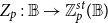 $Z_p:\mathbb{B}\to \mathbb{Z}_p^{st}(\mathbb{B})$
.
$Z_p:\mathbb{B}\to \mathbb{Z}_p^{st}(\mathbb{B})$
.
For the underlying horizontal bicategory we have
Theorem 9.4. Let $(\mathbb{B}, \ltimes,\rtimes; H)$
be a left/right/purely central premonoidal double category so that its associativity and unity constraints are liftable vertical transformations and so that the 2-cells
$(\mathbb{B}, \ltimes,\rtimes; H)$
be a left/right/purely central premonoidal double category so that its associativity and unity constraints are liftable vertical transformations and so that the 2-cells $-\rtimes u\vert_U$
are trivial. Then for its underlying horizontal bicategory
$-\rtimes u\vert_U$
are trivial. Then for its underlying horizontal bicategory $\mathcal{H}(\mathbb{B})$
we have
$\mathcal{H}(\mathbb{B})$
we have
-
(1)
$\underline{\mathcal{H}(\mathbb{B})}$
is a left/right/purely central premonoidal bicategory with structure
$(\mathcal{H}(\ltimes,\rtimes))$
; -
(2)
$\underline{\mathcal{H}(\mathbb{B})}$
is a monoidal bicategory with structure
$\mathcal{H}(\otimes_r)$
; -
(3)
$\underline{\mathcal{H}(\mathbb{Z}_p^{st}(\mathbb{B})_{hm})}$
is a monoidal bicategory and
$C_p(\mathcal{H}(\mathbb{B}))$
inherits monoidal structure from it.


Proof. By Theorem 7.14, we have that $(\mathbb{B}, \otimes_r)$
is a monoidal double category. By Theorem 2.17, then
$(\mathbb{B}, \otimes_r)$
is a monoidal double category. By Theorem 2.17, then $(\underline{\mathcal{H}(\mathbb{B})},\mathcal{H}(\otimes_r))$
is a monoidal bicategory, and by Theorem 7.15, we obtain that
$(\underline{\mathcal{H}(\mathbb{B})},\mathcal{H}(\otimes_r))$
is a monoidal bicategory, and by Theorem 7.15, we obtain that $(\underline{\mathcal{H}(\mathbb{B})}, \mathcal{H}(\ltimes,\rtimes), \mathcal{H}(H))$
is a left/right/purely central premonoidal bicategory. For the last statement, by Theorem 9.3 we know that
$(\underline{\mathcal{H}(\mathbb{B})}, \mathcal{H}(\ltimes,\rtimes), \mathcal{H}(H))$
is a left/right/purely central premonoidal bicategory. For the last statement, by Theorem 9.3 we know that $\mathbb{Z}_p^{st}(\mathbb{B})$
is a monoidal double category, then so is
$\mathbb{Z}_p^{st}(\mathbb{B})$
is a monoidal double category, then so is $\mathbb{Z}_p^{st}(\mathbb{B})_{hm}$
. By Theorem 2.17,
$\mathbb{Z}_p^{st}(\mathbb{B})_{hm}$
. By Theorem 2.17, $\underline{\mathcal{H}(\mathbb{Z}_p^{st}(\mathbb{B})_{hm})}$
becomes a monoidal bicategory and
$\underline{\mathcal{H}(\mathbb{Z}_p^{st}(\mathbb{B})_{hm})}$
becomes a monoidal bicategory and $C_p(\underline{\mathcal{H}(\mathbb{B})})$
inherits its monoidal structure via (51).
$C_p(\underline{\mathcal{H}(\mathbb{B})})$
inherits its monoidal structure via (51).
The following diagram illustrates the claims of Theorem 9.4 and Proposition 7.13, whereby the arrow on the right is due to Shulman (Reference Shulman2010):

We cannot say that every premonoidal 2-category $\mathcal{B}$
comes from a premonoidal double category
$\mathcal{B}$
comes from a premonoidal double category $\mathbb{B}$
with non-trivial 1v-cells, in the sense that
$\mathbb{B}$
with non-trivial 1v-cells, in the sense that $\underline{\mathcal{H}(\mathbb{B})}=\mathcal{B}$
and that the 2-categorical part of the premonoidal structure of
$\underline{\mathcal{H}(\mathbb{B})}=\mathcal{B}$
and that the 2-categorical part of the premonoidal structure of $\mathbb{B}$
is precisely the premonoidal structure of
$\mathbb{B}$
is precisely the premonoidal structure of $\mathcal{B}$
. For purely central premonoidal 2-categories
$\mathcal{B}$
. For purely central premonoidal 2-categories $\mathcal{B}$
coming from purely central premonoidal double categories that also satisfy the conditions of our Theorem 9.4, the fact proved in Paquet and Saville (Reference Paquet and Saville2023b, Theorem 3) that the 2-category of pure maps
$\mathcal{B}$
coming from purely central premonoidal double categories that also satisfy the conditions of our Theorem 9.4, the fact proved in Paquet and Saville (Reference Paquet and Saville2023b, Theorem 3) that the 2-category of pure maps $\mathcal{C}_p(\mathcal{B})$
is monoidal, can be seen as a consequence of our theorem.
$\mathcal{C}_p(\mathcal{B})$
is monoidal, can be seen as a consequence of our theorem.
We finish this first part of the paper by commenting the notion of a Freyd bicategory introduced in Paquet and Saville (Reference Paquet and Saville2023a, Definition 16). A Freyd bicategory is given by the following data: a monoidal bicategory $(\mathcal{V}, \otimes,I)$
, a premonoidal bicategory
$(\mathcal{V}, \otimes,I)$
, a premonoidal bicategory $(\mathcal{B}, \ltimes, \rtimes,I)$
, so that
$(\mathcal{B}, \ltimes, \rtimes,I)$
, so that $\mathcal{V}$
and
$\mathcal{V}$
and $\mathcal{B}$
have the same objects and unit I, and an identity-on-objects 0-strict premonoidal pseudofunctor
$\mathcal{B}$
have the same objects and unit I, and an identity-on-objects 0-strict premonoidal pseudofunctor $J:\mathcal{V}\to \mathcal{B}$
, which factors strictly through the center bicategory
$J:\mathcal{V}\to \mathcal{B}$
, which factors strictly through the center bicategory $\mathcal{Z}_0(\mathcal{B})$
of
$\mathcal{Z}_0(\mathcal{B})$
of $\mathcal{B}$
via a binoidal pseudofunctor
$\mathcal{B}$
via a binoidal pseudofunctor $J_\mathcal{Z}$
satisfying some axioms. (Mind the difference between the center
$J_\mathcal{Z}$
satisfying some axioms. (Mind the difference between the center $\mathcal{Z}_0(\mathcal{B})$
from Paquet and Saville (Reference Paquet and Saville2023a) without specified centrality structures and centers
$\mathcal{Z}_0(\mathcal{B})$
from Paquet and Saville (Reference Paquet and Saville2023a) without specified centrality structures and centers $\mathcal{Z}(\mathcal{B})$
with functorial choice of such structures.)
$\mathcal{Z}(\mathcal{B})$
with functorial choice of such structures.)
Let $\mathbb{B}$
be a premonoidal double category so that its binoidal structure comes from a pseudodouble quasi-functor
$\mathbb{B}$
be a premonoidal double category so that its binoidal structure comes from a pseudodouble quasi-functor $H:\mathbb{B}\times\mathbb{B}\to \mathbb{B}$
. Let
$H:\mathbb{B}\times\mathbb{B}\to \mathbb{B}$
. Let $J:\mathbb{Z}_p^{st}(\mathbb{B})_{hm}\to \mathbb{B}$
be the identity-on-objects double functor sending 1- and 2-cells
$J:\mathbb{Z}_p^{st}(\mathbb{B})_{hm}\to \mathbb{B}$
be the identity-on-objects double functor sending 1- and 2-cells $(b, b\ltimes-, -\rtimes b)\mapsto b$
, and let
$(b, b\ltimes-, -\rtimes b)\mapsto b$
, and let $J_\mathcal{Z}: \underline{\mathcal{H}(\mathbb{Z}^{st}_p(\mathbb{B})_{hm})}\to \mathcal{Z}_0(\underline{\mathcal{H}(\mathbb{B})})$
be induced from
$J_\mathcal{Z}: \underline{\mathcal{H}(\mathbb{Z}^{st}_p(\mathbb{B})_{hm})}\to \mathcal{Z}_0(\underline{\mathcal{H}(\mathbb{B})})$
be induced from $hor: \underline{\mathcal{H}(\mathbb{Z}(\mathbb{B})_{hm})}\to \mathcal{Z}(\underline{\mathcal{H}(\mathbb{B})})$
from Proposition 8.5 (by forgetting the purity condition first and the choice of centrality structures at the end). Then J preserves strictly the structural 1- and 2-cells (from the associativity and unity constraints). The pseudodouble category
$hor: \underline{\mathcal{H}(\mathbb{Z}(\mathbb{B})_{hm})}\to \mathcal{Z}(\underline{\mathcal{H}(\mathbb{B})})$
from Proposition 8.5 (by forgetting the purity condition first and the choice of centrality structures at the end). Then J preserves strictly the structural 1- and 2-cells (from the associativity and unity constraints). The pseudodouble category $\mathbb{Z}_p^{st}(\mathbb{B})_{hm}$
inherits its monoidal structure
$\mathbb{Z}_p^{st}(\mathbb{B})_{hm}$
inherits its monoidal structure $\otimes$
from
$\otimes$
from $\mathbb{Z}_p^{st}(\mathbb{B})$
known from Theorem 9.3.
$\mathbb{Z}_p^{st}(\mathbb{B})$
known from Theorem 9.3.
Corollary 9.5. Let $\mathbb{B}$
be a premonoidal double category so that its associativity and unity constraints are liftable vertical transformations and whose binoidal structure comes from a pseudodouble quasi-functor
$\mathbb{B}$
be a premonoidal double category so that its associativity and unity constraints are liftable vertical transformations and whose binoidal structure comes from a pseudodouble quasi-functor $H:\mathbb{B}\times\mathbb{B}\to \mathbb{B}$
. Then, the underlying horizontal pseudofunctor
$H:\mathbb{B}\times\mathbb{B}\to \mathbb{B}$
. Then, the underlying horizontal pseudofunctor $\mathcal{H}(J): \underline{\mathcal{H}(\mathbb{Z}^{st}_p(\mathbb{B})_{hm})}\to \underline{\mathcal{H}(\mathbb{B})}$
determines a Freyd bicategory, with
$\mathcal{H}(J): \underline{\mathcal{H}(\mathbb{Z}^{st}_p(\mathbb{B})_{hm})}\to \underline{\mathcal{H}(\mathbb{B})}$
determines a Freyd bicategory, with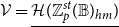 $\mathcal{V}=\underline{\mathcal{H}(\mathbb{Z}^{st}_p(\mathbb{B})_{hm})}$
, the binoidal structure on
$\mathcal{V}=\underline{\mathcal{H}(\mathbb{Z}^{st}_p(\mathbb{B})_{hm})}$
, the binoidal structure on $\mathcal{B}=\underline{\mathcal{H}(\mathbb{B})}$
induced from
$\mathcal{B}=\underline{\mathcal{H}(\mathbb{B})}$
induced from $\mathcal{H}(H)$
, monoidal structure on
$\mathcal{H}(H)$
, monoidal structure on $\mathcal{V}$
induced by
$\mathcal{V}$
induced by $\mathcal{H}(\otimes)$
, and
$\mathcal{H}(\otimes)$
, and $J_\mathcal{Z}$
induced by hor:
$J_\mathcal{Z}$
induced by hor:

10 Kleisli double categories and premonoidality
The last section of the paper is dedicated to the study of two aspects of Kleisli double categories in regard to strengths on their double monads. We recall them first in lower dimensions.
It is well known in the categorical setting that strengths on a monad correspond to certain actions on the Kleisli category of the monad, see e.g. McDermott and Uustalu (Reference McDermott and Uustalu2022, Proposition 4.3). As it can be seen in Mø gelberg and Staton (2014), the latter actions are sometimes used directly to axiomatize models for effectful languages. The other feature is that for a bistrong monad on a monoidal category its Kleisli category is premonoidal. The Cartesian case for this can be found in Power and Thielecke (Reference Power and Thielecke1999, Section 2), and a recent general symmetric instance in Uustalu and Vene (Reference Uustalu and Vene2008, Section 2.2).
In one dimension, higher one has pseudomonads on bicategories (see e.g. Marmolejo (Reference Marmolejo1997)) and Paquet and Saville have introduced in Paquet and Saville (Reference Paquet and Saville2024) strengths for pseudomonads on monoidal bicategories. They showed in Theorem 1 of Section 4 that strengths for a pseudomonad correspond to certain actions on its Kleisli bicategory and to extensions of the canonical actions of the bicategory on itself. Moreover, in Section 6, Theorem 2 of loc.cit. they showed that the Kleisli bicategory of a bistrong pseudomonad is premonoidal.
In this section, we elaborate a double categorical treatment of the subject. We start by briefly recalling several notions and results from Gambino, Garner and Vasilakopoulou (Reference Gambino, Garner and Vasilakopoulou2024). These are the notion of a horizontal and a vertical monad on a double category $\mathbb{D}$
, the fact that assuming existence of companions for certain 1v-cells, a vertical monad T lifts to a horizontal monad
$\mathbb{D}$
, the fact that assuming existence of companions for certain 1v-cells, a vertical monad T lifts to a horizontal monad $\hat{T}$
, and the definition of a horizontal Kleisli pseudodouble category
$\hat{T}$
, and the definition of a horizontal Kleisli pseudodouble category $\mathbb{K} l(S)$
for a horizontal monad S on a double category
$\mathbb{K} l(S)$
for a horizontal monad S on a double category $\mathbb{D}$
. We then introduce strengths, both on a vertical monad T and on a horizontal monad S, and prove the following results. In all of them
$\mathbb{D}$
. We then introduce strengths, both on a vertical monad T and on a horizontal monad S, and prove the following results. In all of them $\mathbb{D}$
is a monoidal double category and suitable transformations are assumed to be liftable. First, that a (bi)strong vertical monad T induces a (bi)strong horizontal monad
$\mathbb{D}$
is a monoidal double category and suitable transformations are assumed to be liftable. First, that a (bi)strong vertical monad T induces a (bi)strong horizontal monad $\hat{T}$
. Second, that a strength on a vertical monad T induces a strength on a horizontal monad
$\hat{T}$
. Second, that a strength on a vertical monad T induces a strength on a horizontal monad $\hat{T}$
. Third, that there is a 1-1 correspondence between strengths on a horizontal monad S and extensions of the canonical actions of
$\hat{T}$
. Third, that there is a 1-1 correspondence between strengths on a horizontal monad S and extensions of the canonical actions of $\mathbb{D}$
on itself (an extension is comprised of an action of
$\mathbb{D}$
on itself (an extension is comprised of an action of $\mathbb{D}$
on the horizontal Kleisli pseudodouble category
$\mathbb{D}$
on the horizontal Kleisli pseudodouble category $\mathbb{K} l(S)$
and a double icon). Finally, that given a bistrong vertical monad T, the horizontal Kleisli pseudodouble category
$\mathbb{K} l(S)$
and a double icon). Finally, that given a bistrong vertical monad T, the horizontal Kleisli pseudodouble category $\mathbb{K} l(\hat{T})$
is premonoidal.
$\mathbb{K} l(\hat{T})$
is premonoidal.
In this section we will heavily use the technical tools that we developed in Subsection 2.4.
10.1 Double monads and Kleisli double categories
In this subsection, we recall the necessary notions and results from Gambino, Garner and Vasilakopoulou (Reference Gambino, Garner and Vasilakopoulou2024) in an abbreviated form. The notions in Gambino, Garner and Vasilakopoulou (Reference Gambino, Garner and Vasilakopoulou2024) of: double functors, horizontal transformations and vertical transformations correspond to our notions of: pseudodouble functors, horizontal pseudonatural transformations and vertical strict transformations, respectively. Our formulations below are expressed accordingly in our terminology.
Definition 10.1. A horizontal double monad on a double category $\mathbb{D}$
consists of:
$\mathbb{D}$
consists of:
-
• pseudodouble functor
$T:\mathbb{D}\to \mathbb{D}$
; -
• horizontal pseudonatural transformations
$\mu:TT\Rightarrow T$
and
$\eta:\operatorname {Id}_{\mathbb{D}}\to T$
; -
• invertible modifications
$a^T,l^T,r^T$
with respective components given by horizontally globular 2-cells:which satisfy two axioms as in Gambino, Garner and Vasilakopoulou (Reference Gambino, Garner and Vasilakopoulou2024, Definition 6.1).


Definition 10.2. A vertical double monad on a double category $\mathbb{D}$
consists of:
$\mathbb{D}$
consists of:
-
• pseudodouble functor
$T:\mathbb{D}\to \mathbb{D}$
, and -
• vertical strict transformations
$\mu:TT\Rightarrow T$
and
$\eta:\operatorname {Id}_{\mathbb{D}}\to T$
, which satisfy the usual associativity and unity laws (via identity vertical modifications).


For the next result, which is Gambino, Garner and Vasilakopoulou (Reference Gambino, Garner and Vasilakopoulou2024, Theorem 7.4), we need to clarify the following. In Gambino, Garner and Vasilakopoulou (Reference Gambino, Garner and Vasilakopoulou2024, Definition 3.6), a vertical (strict) transformation $\alpha$
is said to be special if: 1) its 1v-cell components have companions, and 2) the companion transposes
$\alpha$
is said to be special if: 1) its 1v-cell components have companions, and 2) the companion transposes $\hat{\alpha}_f$
of the 2-cell components
$\hat{\alpha}_f$
of the 2-cell components $\alpha_f$
of
$\alpha_f$
of $\alpha$
for any 1h-cell f (recall Proposition 2.14) are invertible. Since we proved in our cited proposition that
$\alpha$
for any 1h-cell f (recall Proposition 2.14) are invertible. Since we proved in our cited proposition that $\hat{\alpha}_f$
’s are invertible if
$\hat{\alpha}_f$
’s are invertible if $\alpha$
is an invertible vertical strict transformation, our “invertible liftable vertical strict transformations” are special in the sense of Gambino, Garner and Vasilakopoulou (Reference Gambino, Garner and Vasilakopoulou2024). Thus, we get to the following formulation of Gambino, Garner and Vasilakopoulou (Reference Gambino, Garner and Vasilakopoulou2024, Theorem 7.4) in our terminology.
$\alpha$
is an invertible vertical strict transformation, our “invertible liftable vertical strict transformations” are special in the sense of Gambino, Garner and Vasilakopoulou (Reference Gambino, Garner and Vasilakopoulou2024). Thus, we get to the following formulation of Gambino, Garner and Vasilakopoulou (Reference Gambino, Garner and Vasilakopoulou2024, Theorem 7.4) in our terminology.
Theorem 10.3. Let $T:\mathbb{D}\to \mathbb{D}$
be a vertical double monad in a double category
$T:\mathbb{D}\to \mathbb{D}$
be a vertical double monad in a double category $\mathbb{D}$
. Assume that its multiplication
$\mathbb{D}$
. Assume that its multiplication $\mu:TT\Rightarrow T$
and unit
$\mu:TT\Rightarrow T$
and unit $\eta:\operatorname {Id}_{\mathbb{D}}\to T$
are invertible liftable vertical transformations. Then,
$\eta:\operatorname {Id}_{\mathbb{D}}\to T$
are invertible liftable vertical transformations. Then, $(T,\mu,\eta)$
induces a horizontal double monad
$(T,\mu,\eta)$
induces a horizontal double monad $(\hat{T}, \hat{\mu},\hat{\eta})$
on
$(\hat{T}, \hat{\mu},\hat{\eta})$
on $\mathbb{D}$
.
$\mathbb{D}$
.
Although one may define a vertical Kleisli pseudodouble category of a vertical double monad T, there is no natural way to lift it to a horizontal Kleisli pseudodouble category of the horizontal double monad $\hat{T}$
, which is where we want to obtain our results. For this reason we will only work with the latter version of a Kleisli pseudodouble category, that was introduced in Gambino, Garner and Vasilakopoulou (Reference Gambino, Garner and Vasilakopoulou2024, Theorem 9.1). We recall it next.
$\hat{T}$
, which is where we want to obtain our results. For this reason we will only work with the latter version of a Kleisli pseudodouble category, that was introduced in Gambino, Garner and Vasilakopoulou (Reference Gambino, Garner and Vasilakopoulou2024, Theorem 9.1). We recall it next.
Theorem 10.4. Gambino, Garner and Vasilakopoulou (Reference Gambino, Garner and Vasilakopoulou2024, Theorem 9.1). Let $\mathbb{D}$
be a double category and
$\mathbb{D}$
be a double category and $(T,\mu,\eta)$
a horizontal double monad on it. There is a pseudodouble category
$(T,\mu,\eta)$
a horizontal double monad on it. There is a pseudodouble category $\mathbb{K} l(T)$
, called the horizontal Kleisli pseudodouble category of
$\mathbb{K} l(T)$
, called the horizontal Kleisli pseudodouble category of $\mathbb{D}$
whose objects and 1v-cells are the same as in
$\mathbb{D}$
whose objects and 1v-cells are the same as in $\mathbb{D}$
, 1h-cells
$\mathbb{D}$
, 1h-cells $A\to B$
are 1h-cells
$A\to B$
are 1h-cells $A\to T(B)$
in
$A\to T(B)$
in $\mathbb{D}$
, and 2-cells as on the left below are the 2-cells of
$\mathbb{D}$
, and 2-cells as on the left below are the 2-cells of $\mathbb{D}$
as to the right:
$\mathbb{D}$
as to the right:

Vertical composition in $\mathbb{K} l(T)$
is the same as in
$\mathbb{K} l(T)$
is the same as in $\mathbb{D}$
, horizontal composition of Kleisli 1h-cells
$\mathbb{D}$
, horizontal composition of Kleisli 1h-cells $f: A\to B$
and
$f: A\to B$
and $g:B\to C$
is given by
$g:B\to C$
is given by
 $$A\stackrel{f}{\to }T(B) \stackrel{T(g)}{\to }T^2(C)\stackrel{\mu(C)}{\to }T(C),$$
horizontal composition of Kleisli 2-cells $\phi$
and
$\phi$
and $\psi$
is given by
$\psi$
is given by

The identity 1h-cell on A is given by $\eta(A)$
in
$\eta(A)$
in $\mathbb{D}$
, and the horizontal identity 2-cell on
$\mathbb{D}$
, and the horizontal identity 2-cell on $u:A\to \tilde A$
is
$u:A\to \tilde A$
is

Observe that the underlying horizontal bicategory $\mathcal{H}(\mathbb{K} l(T))$
of the Kleisli pseudodouble category coincides with the Kleisli bicategory
$\mathcal{H}(\mathbb{K} l(T))$
of the Kleisli pseudodouble category coincides with the Kleisli bicategory $\operatorname {Kl}(\mathcal{H}(T))$
of the underlying pseudomonad on the bicategory
$\operatorname {Kl}(\mathcal{H}(T))$
of the underlying pseudomonad on the bicategory $\mathcal{H}(\mathbb{D})$
of the horizontal double monad T. We will also need:
$\mathcal{H}(\mathbb{D})$
of the horizontal double monad T. We will also need:
Definition 10.5. Gambino, Garner and Vasilakopoulou (2024, Definition 9.2). Let $\mathbb{D}$
be a double category and T a horizontal double monad on it. The canonical embedding
$\mathbb{D}$
be a double category and T a horizontal double monad on it. The canonical embedding $K:\mathbb{D}\to \operatorname {Kl}(T)$
is the pseudodouble functor that is the identity on objects and vertical 1-cells, it sends a horizontal 1-cell
$K:\mathbb{D}\to \operatorname {Kl}(T)$
is the pseudodouble functor that is the identity on objects and vertical 1-cells, it sends a horizontal 1-cell $f: A\to B$
into a 1h-cell
$f: A\to B$
into a 1h-cell $K(f): A\to B$
in
$K(f): A\to B$
in $\operatorname {Kl}(T)$
determined by
$\operatorname {Kl}(T)$
determined by $\eta_B\circ f: A\to T(B)$
in
$\eta_B\circ f: A\to T(B)$
in $\mathbb{D}$
, and correspondingly a 2-cell
$\mathbb{D}$
, and correspondingly a 2-cell $\phi$
to the horizontal composition of 2-cells
$\phi$
to the horizontal composition of 2-cells

Proposition 10.6. Gambino, Garner and Vasilakopoulou (Reference Gambino, Garner and Vasilakopoulou2024, Proposition 9.3), Cruttwell and Shulman (Reference Cruttwell and Shulman2010, Proposition 7.5).
If a 1v-cell u in $\mathbb{D}$
has a companion
$\mathbb{D}$
has a companion $\hat{u}$
in
$\hat{u}$
in $\mathbb{D}$
, then it has a companion in
$\mathbb{D}$
, then it has a companion in $\operatorname {Kl}(T)$
, for a horizontal double monad
$\operatorname {Kl}(T)$
, for a horizontal double monad $(T,\mu,\eta)$
on
$(T,\mu,\eta)$
on $\mathbb{D}$
with structure 2-cells
$\mathbb{D}$
with structure 2-cells

10.2 Strengths on double monads
Pseudomonads on bicategories were introduced in Marmolejo (Reference Marmolejo1997). Based on Proposition 2.14, we obtain:
Proposition 10.7. A vertical double monad T on a double category $\mathbb{D}$
such that its multiplication and unit are invertible liftable vertical transformations induces a pseudomonad
$\mathbb{D}$
such that its multiplication and unit are invertible liftable vertical transformations induces a pseudomonad $\mathcal{H}(\hat{T})$
on the underlying bicategory
$\mathcal{H}(\hat{T})$
on the underlying bicategory $\mathcal{H}(\mathbb{D})$
.
$\mathcal{H}(\mathbb{D})$
.
In Paquet and Saville (Reference Paquet and Saville2023b, Definition 9), Paquet and Saville (Reference Paquet and Saville2024, Definition 4.3) Paquet and Saville introduced a (left) strength on a pseudomonad T on a monoidal bicategory $\mathcal{B}$
. We next give a definition of a strength in a double categorical setting. For this we set that a horizontal and a vertical double monad on a monoidal double category
$\mathcal{B}$
. We next give a definition of a strength in a double categorical setting. For this we set that a horizontal and a vertical double monad on a monoidal double category $\mathbb{D}$
are simply a horizontal and a vertical double monad on the underlying double category
$\mathbb{D}$
are simply a horizontal and a vertical double monad on the underlying double category $\mathbb{D}$
, respectively.
$\mathbb{D}$
, respectively.
Definition 10.8. A left (vertical) strength on a vertical double monad T on a monoidal double category $\mathbb{D}$
consists of:
$\mathbb{D}$
consists of:
-
• a vertical strict transformation with 1v-components
$t_{A,B}:A\otimes T(B)\to T(A\otimes B)$
for
$A,B\in\mathbb{D}$
; -
• identity vertical modifications with the following identity vertically globular 2-cell components, expressing compatibility of the strength t with:
-
(a) monoidal structure of
$\mathbb{D}$
$$x_A: \lambda_{T(A)}\Rightarrow\frac{t_{I,A}}{ T\lambda_A} \qquad \qquad y_{A,B,C}:\begin{array}{@{\,}c@{\,}}\alpha_{A,B,T(C)}\\ \hline At_{B,C}\\ \hline t_{A,BC} \end{array} \Rightarrow\frac{t_{AB,C}}{T(\alpha_{A,B,C})}; $$
-
(b) monad structure of T
$$w_{A,B}: \frac{A\mu_B}{t_{A,B}}\Rightarrow\begin{array}{@{\,}c@{\,}}t_{A,T(B)}\\ \hline T(t_{A,B})\\ \hline \mu_{A,B} \end{array} \qquad \qquad z_{A,B}:\eta_{AB}\Rightarrow\frac{A\eta_B}{t_{A,B}}. $$
-



One defines a right (vertical) strength on a vertical double monad T analogously, based on a vertical strict transformation with 1v-components $s_{A,B}:T(A)\otimes B\to T(A\otimes B)$
.
$s_{A,B}:T(A)\otimes B\to T(A\otimes B)$
.
We can carry out the following reasoning.
Let $(T, \mu, \lambda)$
be a vertical double monad on a monoidal double category
$(T, \mu, \lambda)$
be a vertical double monad on a monoidal double category $\mathbb{D}$
. Let t be a left strength on T and assume that the following transformations are invertible and liftable: strength t,
$\mathbb{D}$
. Let t be a left strength on T and assume that the following transformations are invertible and liftable: strength t, $\alpha, \lambda, \rho$
of
$\alpha, \lambda, \rho$
of $\mathbb{D}$
and
$\mathbb{D}$
and $\mu, \eta$
of T. Then by Theorem 10.3, we have a horizontal double monad
$\mu, \eta$
of T. Then by Theorem 10.3, we have a horizontal double monad $(\hat{T},\hat{\mu},\hat{\eta})$
, by Proposition 2.14 we have a horizontal natural equivalence
$(\hat{T},\hat{\mu},\hat{\eta})$
, by Proposition 2.14 we have a horizontal natural equivalence $\hat{t}:-\otimes \hat{T}(-)\to \hat{T}(-\otimes -)$
in
$\hat{t}:-\otimes \hat{T}(-)\to \hat{T}(-\otimes -)$
in $\mathbb{D}$
, by Proposition 2.22, we have invertible horizontal modifications
$\mathbb{D}$
, by Proposition 2.22, we have invertible horizontal modifications
 $$\hat{x}_A: [\hat{t}_{I,A}\vert T\hat{\lambda}_A]\Rightarrow\hat{\lambda}_{T(A)} \qquad \hat{y}_{A,B,C}:[\hat{t}_{AB,C}\vert T(\hat{\alpha}_{A,B,C})]\Rightarrow[\hat{\alpha}_{A,B,T(C)}\vert A\hat{t}_{B,C}\vert \hat{t}_{A,BC}] $$
 $$\hat{w}_{A,B}: [\hat{t}_{A,T(B)}\vert T(\hat{t}_{A,B})\vert \hat{\mu}_{A,B}]\Rightarrow[A\hat{\mu}_B\vert \hat{t}_{A,B}] \qquad \hat{z}_{A,B}:[A\hat{\eta}_B\vert \hat{t}_{A,B}]\Rightarrow\hat{\eta}_{A,B} $$
in $\mathbb{D}$
satisfying any sensible equation that can be formed by them.
$\mathbb{D}$
satisfying any sensible equation that can be formed by them.
This motivates the following definition.
Definition 10.9. For a double category $\mathbb{D}$
, we say that it is horizontally monoidal if there are pseudodouble functors
$\mathbb{D}$
, we say that it is horizontally monoidal if there are pseudodouble functors $\otimes:\mathbb{D}\times\mathbb{D}\to \mathbb{D}$
and
$\otimes:\mathbb{D}\times\mathbb{D}\to \mathbb{D}$
and $I:*\to \mathbb{D}$
, horizontal equivalence transformations
$I:*\to \mathbb{D}$
, horizontal equivalence transformations
 $$\alpha: \otimes\circ(\!\operatorname {Id}\times\otimes) \stackrel{\cong}{\to } \otimes\circ(\otimes\times\operatorname {Id}\!) $$
 $$\lambda: \otimes\circ(I\times\operatorname {Id}\!) \stackrel{\cong}{\to } \operatorname {Id} $$
 $$\rho: \otimes\circ(\!\operatorname {Id}\times I) \stackrel{\cong}{\to } \operatorname {Id},$$
and horizontal modifications p,m,l,r whose 2-cell components satisfy axioms (TA1)-(TA3) as in Gordon, Power and Street (1995) (write the latter as equations of pasted horizontally globular 2-cells).
Remark 10.10. We require only three axioms (for the modifications) in a horizontally monoidal double category in analogy to the three axioms for a monoidal bicategory seen as a one-object tricategory of Gordon, Power and Street (Reference Gordon, Power and Street1995). On the other hand, in Stay (Reference Stay2016, Definition 4.4), a definition of a monoidal bicategory is provided where four modifications, analogous to p,m,l,r in our definition above, obey five axioms. The same kind of definition appears in Schommer-Pries (Reference Schommer-Pries2009, Definition C.1) in whose point (4) it is argued that the two axioms relating the modifications $p\mbox{-} l$
and
$p\mbox{-} l$
and $p\mbox{-} r$
out of those five are reduntant and follow from the remaining three axioms, analogous to (TA1)-(TA3) from Gordon, Power and Street (Reference Gordon, Power and Street1995). This is analogous to the redundancy of two of the three triangular axioms commuting in a monoidal category, as we observed in the Introduction.
$p\mbox{-} r$
out of those five are reduntant and follow from the remaining three axioms, analogous to (TA1)-(TA3) from Gordon, Power and Street (Reference Gordon, Power and Street1995). This is analogous to the redundancy of two of the three triangular axioms commuting in a monoidal category, as we observed in the Introduction.
The above definition is such that for a horizontally monoidal double category $(\mathbb{D},\otimes,\alpha,\lambda,\rho)$
the underlying horizontal bicategory
$(\mathbb{D},\otimes,\alpha,\lambda,\rho)$
the underlying horizontal bicategory $\mathcal{H}(\mathbb{D})$
is a monoidal bicategory.
$\mathcal{H}(\mathbb{D})$
is a monoidal bicategory.
A horizontal double monad on a horizontally monoidal double category $\mathbb{D}$
is a horizontal double monad on the underlying double category
$\mathbb{D}$
is a horizontal double monad on the underlying double category $\mathbb{D}$
.
$\mathbb{D}$
.
Due to Proposition 2.14 and Proposition 2.22, we have
Theorem 10.11. A monoidal double category $(\mathbb{D}, \otimes, I, \alpha,\lambda,\rho)$
in which
$(\mathbb{D}, \otimes, I, \alpha,\lambda,\rho)$
in which $\alpha,\lambda,\rho$
are liftable vertical transformations yields a horizontally monoidal double category
$\alpha,\lambda,\rho$
are liftable vertical transformations yields a horizontally monoidal double category $(\mathbb{D}, \otimes, I, \hat{\alpha}, \hat{\lambda},\hat{\rho})$
.
$(\mathbb{D}, \otimes, I, \hat{\alpha}, \hat{\lambda},\hat{\rho})$
.
From now on we will omit to write I explicitly when referring to this result. Joining Theorem 10.3 with the latter theorem we clearly have
Proposition 10.12. Given a vertical double monad $(T, \mu,\eta)$
on a monoidal double category
$(T, \mu,\eta)$
on a monoidal double category $(\mathbb{D}, \otimes, \alpha,\lambda,\rho)$
, and assume that
$(\mathbb{D}, \otimes, \alpha,\lambda,\rho)$
, and assume that $\mu,\eta, \, \alpha,\lambda,\rho$
are invertible liftable transformations. Then,
$\mu,\eta, \, \alpha,\lambda,\rho$
are invertible liftable transformations. Then, $(\hat{T}, \hat{\mu},\hat{\eta})$
is a horizontal double monad on a horizontally monoidal double category
$(\hat{T}, \hat{\mu},\hat{\eta})$
is a horizontal double monad on a horizontally monoidal double category $(\mathbb{D}, \otimes, \hat{\alpha},\hat{\lambda},\hat{\rho})$
.
$(\mathbb{D}, \otimes, \hat{\alpha},\hat{\lambda},\hat{\rho})$
.
We finally define:
Definition 10.13. A left (horizontal) strength on a horizontal double monad T on a horizontally monoidal double category $\mathbb{D}$
consists of:
$\mathbb{D}$
consists of:
-
a) a horizontal pseudonatural transformation with 1h-components
$t_{A,B}:A\otimes T(B)\to T(A\otimes B)$
for
$A,B\in\mathbb{D}$
; -
b) invertible horizontal modifications with horizontally globular 2-cell components
which fulfill three axioms as in Paquet and Saville (Reference Paquet and Saville2024, Figure 3) (connecting them to the horizontal modifications p,m,l of the horizontally monoidal double category
$$x_A: [t_{I,A}\vert T\lambda_A]\Rightarrow\lambda_{T(A)} \qquad y_{A,B,C}:[t_{AB,C}\vert T(\alpha_{A,B,C})] \Rightarrow[\alpha_{A,B,T(C)}\vert At_{B,C}\vert t_{A,BC}]$$
$\mathbb{D}$
);
-
c) invertible horizontal modifications with horizontally globular 2-cell components
which fulfill seven axioms as in Paquet and Saville (Reference Paquet and Saville2023b, Figure 4), p. 12 (i.e. in Figures 4 and 5 of Paquet and Saville (Reference Paquet and Saville2024)) (three axioms for connecting w and z to the horizontal modifications
$$w_{A,B}: [t_{A,T(B)}\vert T(t_{A,B})\vert \mu_{A,B}]\Rightarrow[A\mu_B\vert t_{A,B}] \qquad z_{A,B}:[A\eta_B\vert t_{A,B}]\Rightarrow\eta_{A,B}$$
$l^T,r^T,a^T$
of the horizontal double monad structure of T; two for connecting both z and w with x, and two for connecting both z and w with y).



For vertically globular 2-cells $\omega$
we will call the operation
$\omega$
we will call the operation $\omega\mapsto\hat{\omega}$
as in (7) a companion-lift of 2-cells.
$\omega\mapsto\hat{\omega}$
as in (7) a companion-lift of 2-cells.
Coming back to our above reasoning we get to:
Theorem 10.14. Let $(T, \mu, \eta)$
be a vertical double monad on a monoidal double category
$(T, \mu, \eta)$
be a vertical double monad on a monoidal double category $(\mathbb{D}, \otimes, \alpha,\lambda,\rho)$
. Let t be a left (respectively right) (vertical) strength on T, and assume that the following transformations are invertible and liftable: strength t,
$(\mathbb{D}, \otimes, \alpha,\lambda,\rho)$
. Let t be a left (respectively right) (vertical) strength on T, and assume that the following transformations are invertible and liftable: strength t, $\alpha, \lambda, \rho$
of
$\alpha, \lambda, \rho$
of $\mathbb{D}$
, and
$\mathbb{D}$
, and $\mu, \eta$
of T.
$\mu, \eta$
of T.
Then $\hat{t}$
is a left (respectively right) (horizontal) strength on the horizontal double monad
$\hat{t}$
is a left (respectively right) (horizontal) strength on the horizontal double monad $\hat{T}$
on the horizontally monoidal double category
$\hat{T}$
on the horizontally monoidal double category $(\mathbb{D}, \otimes, \hat{\alpha}, \hat{\lambda},\hat{\rho})$
.
$(\mathbb{D}, \otimes, \hat{\alpha}, \hat{\lambda},\hat{\rho})$
.
Moreover, $\mathcal{H}(\hat{t})$
is a left (respectively right) strength on the pseudomonad
$\mathcal{H}(\hat{t})$
is a left (respectively right) strength on the pseudomonad $\mathcal{H}(\hat{T})$
on the monoidal bicategory
$\mathcal{H}(\hat{T})$
on the monoidal bicategory $\mathcal{H}(\mathbb{D})$
.
$\mathcal{H}(\mathbb{D})$
.
Proof. For the last statement, use Proposition 10.7. It only remains to prove that $\hat{x}$
and
$\hat{x}$
and $\hat{y}$
obey the three axioms from the item (b) of Definition 10.13, and
$\hat{y}$
obey the three axioms from the item (b) of Definition 10.13, and $\hat{w}$
and
$\hat{w}$
and $\hat{y}$
the seven axioms from the item (c) of that Definition, since apart from modification components these axioms contain also the 2-cell components of the horizontal pseudonatural transformations
$\hat{y}$
the seven axioms from the item (c) of that Definition, since apart from modification components these axioms contain also the 2-cell components of the horizontal pseudonatural transformations $\hat{t}, \hat{\alpha},\hat{\lambda}, \hat{\mu}$
and
$\hat{t}, \hat{\alpha},\hat{\lambda}, \hat{\mu}$
and $\hat{\eta}$
. Namely, the first axiom involves the 2-cell components of the modifications
$\hat{\eta}$
. Namely, the first axiom involves the 2-cell components of the modifications $\hat{m}, \hat{x}, \hat{y}$
and the 2-cell components
$\hat{m}, \hat{x}, \hat{y}$
and the 2-cell components $\hat{t}_{1_A,\hat{\lambda}_B}$
and
$\hat{t}_{1_A,\hat{\lambda}_B}$
and $\hat{t}_{\hat{\rho}_A,1_B}$
of
$\hat{t}_{\hat{\rho}_A,1_B}$
of $\hat{t}$
. The 1h-cells of their domains and codomains are all companions, so
$\hat{t}$
. The 1h-cells of their domains and codomains are all companions, so $\hat{t}_{1_A,\hat{\lambda}_B}$
and
$\hat{t}_{1_A,\hat{\lambda}_B}$
and $\hat{t}_{\hat{\rho}_A,1_B}$
are the canonical isomorphism 2-cells of
$\hat{t}_{\hat{\rho}_A,1_B}$
are the canonical isomorphism 2-cells of $\theta$
type (recall Lemma 2.20), and the first axiom is proved to hold the same way as in the proof of Proposition 2.22, part 3. The same holds for the remaining nine axioms. We only list the 2-cells appearing in the other two axioms for
$\theta$
type (recall Lemma 2.20), and the first axiom is proved to hold the same way as in the proof of Proposition 2.22, part 3. The same holds for the remaining nine axioms. We only list the 2-cells appearing in the other two axioms for $\hat{x}$
and
$\hat{x}$
and $\hat{y}$
, for reader’s convenience. In the second axiom, there appear the modifications
$\hat{y}$
, for reader’s convenience. In the second axiom, there appear the modifications $\hat{l},\hat{x}, \hat{y}$
and the 2-cell components
$\hat{l},\hat{x}, \hat{y}$
and the 2-cell components $\hat{\lambda}_{t_{A,B}}$
of
$\hat{\lambda}_{t_{A,B}}$
of $\hat{\lambda}$
and
$\hat{\lambda}$
and $\hat{t}_{\hat{\lambda}_A,1_B}$
of
$\hat{t}_{\hat{\lambda}_A,1_B}$
of $\hat{t}$
. Finally, in the third axiom, there appear the modifications
$\hat{t}$
. Finally, in the third axiom, there appear the modifications $\hat{p}, \hat{y}$
and the 2-cell components
$\hat{p}, \hat{y}$
and the 2-cell components $\hat{\alpha}_{1_A,1_B,t_{C,D}}$
of
$\hat{\alpha}_{1_A,1_B,t_{C,D}}$
of $\hat{\alpha}$
and
$\hat{\alpha}$
and $\hat{t}_{\alpha_{A,B,C},1_D}, \hat{t}_{1_A,\alpha_{B,C,D}}$
of
$\hat{t}_{\alpha_{A,B,C},1_D}, \hat{t}_{1_A,\alpha_{B,C,D}}$
of $\hat{t}$
.
$\hat{t}$
.
10.3 Vertical strengths induce actions on the Kleisli double category
In this subsection, we prove our double categorical version of the result known for categories and bicategories that a strength of a double monad induces an action of a monoidal double category to the corresponding Kleisli double category of the double monad. Here, we first focus on vertical strengths, the case of horizontal strengths we leave for Subsection 10.4.2.
10.3.1 Actions on double categories
As before, we may consider two kinds of actions.
Definition 10.15. We say that a monoidal double category $\mathbb{D}$
acts (from the left) on a double category
$\mathbb{D}$
acts (from the left) on a double category $\mathbb{E}$
if there is a pseudodouble functor
$\mathbb{E}$
if there is a pseudodouble functor $F:\mathbb{D}\times\mathbb{E}\to \mathbb{E}$
, invertible vertical strict transformations with components
$F:\mathbb{D}\times\mathbb{E}\to \mathbb{E}$
, invertible vertical strict transformations with components
 $$\tilde\lambda_E: I\times E\to E\quad \text{and}\quad \tilde\alpha_{A,B,E}:(A\otimes B)\times E\to A\times(B\times E)$$
with $A,B\in\mathbb{D}$
and
$A,B\in\mathbb{D}$
and $E\in\mathbb{E}$
, and identity vertical modifications
$E\in\mathbb{E}$
, and identity vertical modifications $\tilde p, \tilde l, \tilde m$
, analogous to p,l,m from Definition 10.9.
$\tilde p, \tilde l, \tilde m$
, analogous to p,l,m from Definition 10.9.
This kind of action we might call a vertical action. To the contrast to it, we will differ what might be called a horizontal action. The difference is actually already anticipated by the fact that in the vertical action Shulman’s kind of monoidality of the acting double category is meant, whereas in the horizontal action horizontal monoidality of the acting double category is assumed. This “horizontal” action we define as follows.
Definition 10.16. By an action of a horizontally monoidal double category $\mathbb{D}$
on a double category
$\mathbb{D}$
on a double category $\mathbb{E}$
, we mean the data comprised of: a pseudodouble functor
$\mathbb{E}$
, we mean the data comprised of: a pseudodouble functor $F:\mathbb{D}\times\mathbb{E}\to \mathbb{E}$
, horizontal equivalences with components
$F:\mathbb{D}\times\mathbb{E}\to \mathbb{E}$
, horizontal equivalences with components
 $$\tilde\lambda_E: I\times E\to E\quad \text{and}\quad \tilde\alpha_{A,B,E}:(A\otimes B)\times E\to A\times(B\times E)$$
with $A,B\in\mathbb{D}$
and
$A,B\in\mathbb{D}$
and $E\in\mathbb{E}$
, and horizontal modifications
$E\in\mathbb{E}$
, and horizontal modifications $\tilde p, \tilde l, \tilde m$
whose 2-cell components satisfy axioms analogous to (TA1)-(TA2) of Gordon, Power and Street (1995).
$\tilde p, \tilde l, \tilde m$
whose 2-cell components satisfy axioms analogous to (TA1)-(TA2) of Gordon, Power and Street (1995).
By Theorem 10.11 and Proposition 2.22 we get:
Proposition 10.17. A vertical action $(F, \tilde\alpha, \tilde\lambda)$
of a monoidal double category
$(F, \tilde\alpha, \tilde\lambda)$
of a monoidal double category $(\mathbb{D}, \otimes, \alpha,\lambda,\rho)$
on a double category
$(\mathbb{D}, \otimes, \alpha,\lambda,\rho)$
on a double category $\mathbb{E}$
, so that
$\mathbb{E}$
, so that $\alpha,\lambda,\rho$
and
$\alpha,\lambda,\rho$
and $\tilde\alpha, \tilde\lambda$
are liftable, induces a horizontal action
$\tilde\alpha, \tilde\lambda$
are liftable, induces a horizontal action $(F, \widehat{\tilde\alpha}, \widehat{\tilde\lambda})$
of the horizontally monoidal double category
$(F, \widehat{\tilde\alpha}, \widehat{\tilde\lambda})$
of the horizontally monoidal double category $(\mathbb{D}, \otimes, \hat{\alpha}, \hat{\lambda},\hat{\rho})$
on
$(\mathbb{D}, \otimes, \hat{\alpha}, \hat{\lambda},\hat{\rho})$
on $\mathbb{E}$
.
$\mathbb{E}$
.
10.3.2 Vertical strengths induce actions on the Kleisli double category
Recall from Theorem 10.4 that 1h- and 2-cells in $\mathbb{K} l(T)$
we denote by
$\mathbb{K} l(T)$
we denote by $f^K$
and
$f^K$
and $\phi^K$
and that they are given by 1h- and 2-cells f and
$\phi^K$
and that they are given by 1h- and 2-cells f and $\phi$
in
$\phi$
in $\mathbb{D}$
, respectively. We now prove:
$\mathbb{D}$
, respectively. We now prove:
Theorem 10.18. Let t be a (vertical) left strength on a vertical double monad T on a monoidal double category $\mathbb{D}$
. Assume that the vertical transformations
$\mathbb{D}$
. Assume that the vertical transformations $\alpha,\lambda,\rho$
of
$\alpha,\lambda,\rho$
of $\mathbb{D}$
, t and
$\mathbb{D}$
, t and $\mu,\eta$
of T are invertible and liftable. The following then hold.
$\mu,\eta$
of T are invertible and liftable. The following then hold.
-
(1) There is a pseudodouble functor
$\triangleright:\mathbb{D}\times\mathbb{K} l(\hat{T})\to \mathbb{K} l(\hat{T})$
defined on objects and 1v-cells by the action of the monoidal product of
$\mathbb{D}$
, for 1h-cells
$f:A\to A'\in\mathbb{D}$
and
$g^K:B\to B'\in\mathbb{K} l(\hat{T})$
we define and for 2-cells
$$f\triangleright g^K:=(A\otimes B\stackrel{f\otimes g}{\to }A'\otimes T(B') \stackrel{\hat{t}_{A',B'}}{\to }T(A'\otimes B'))$$
$\sigma\in\mathbb{D}, \delta^K\in\mathbb{K} l(\hat{T})$
we set where v,v’ are the right hand-side 1v-cells of
$$\sigma\triangleright\delta^K:=[\sigma\otimes\delta \,\, \vert \,\, \hat{t}^{v,v'}]$$
$\sigma$
and
$\delta$
, respectively.
-
(2) There are invertible vertical strict (action) transformations
$\tilde\lambda$
and
$\tilde\alpha=\tilde\alpha^L$
with 2-cell components for 1h-cells
$f,g\in\mathbb{D}$
and
$h^K\in\mathbb{K} l(\hat{T})$
. Here
$y^*, x^*$
are the 2-cells induced from the identity vertical modification 2-cell components of y,x of the strength t as described by the assignment (8).
-
(3) The above data define a left vertical action of
$\mathbb{D}$
on
$\mathbb{K} l(\hat{T})$
, with
$\tilde p, \tilde l, \tilde m$
being K(p),K(l),K(m), where p,l,m are the identity vertical modifications from Definition 2.16, respectively. -
(4) There are horizontal equivalences
$\widehat{\tilde\alpha}$
and
$\widehat{\tilde\lambda}$
, and horizontal modifications
$\widehat{\tilde p}, \widehat{\tilde l}, \widehat{\tilde m}$
obeying the axioms of Definition 10.16, so that
$\triangleright$
induces a left horizontal action of
$\mathbb{D}$
on
$\mathbb{K} l(\hat{T})$
.








Proof. The compositor 2-cell for $\triangleright$
is given by the globular 2-cell
$\triangleright$
is given by the globular 2-cell

The hexagonal law for the compositor is proved as in the bicategorical case of Paquet and Saville (Reference Paquet and Saville2024, Proposition 7.1). We comment that one uses the axioms (h.o.t.-1) for $\hat{t}$
, (m.ho-vl.-1) for
$\hat{t}$
, (m.ho-vl.-1) for $\hat{w}$
, and the
$\hat{w}$
, and the $w-a^T$
axiom from c) of Definition 10.13. The unitor is defined via
$w-a^T$
axiom from c) of Definition 10.13. The unitor is defined via $\hat{z}$
and the unitor law is proved as in the bicategorical case, too. The axiom (lx.f.u-nat) reads
$\hat{z}$
and the unitor law is proved as in the bicategorical case, too. The axiom (lx.f.u-nat) reads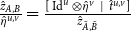 $\frac{\hat{z}_{A,B}}{\hat{\eta}^{u,v}}=\frac{[\operatorname {Id}^u\otimes\hat{\eta}^v \,\, \vert \,\,\hat{t}^{u,v}]}{\hat{z}_{\tilde A, \tilde B}}$
. It holds true because the corresponding equality comprised of original vertical modifications and strict vertical transformations
$\frac{\hat{z}_{A,B}}{\hat{\eta}^{u,v}}=\frac{[\operatorname {Id}^u\otimes\hat{\eta}^v \,\, \vert \,\,\hat{t}^{u,v}]}{\hat{z}_{\tilde A, \tilde B}}$
. It holds true because the corresponding equality comprised of original vertical modifications and strict vertical transformations $z_{A,B}, \eta^{u,v}, z_{\tilde A, \tilde B}, \operatorname {Id}^u\times\eta^v, t^{u,v}$
(trivially) holds true. It is important to notice that the strictness of t was necessary at this point. The rest of the pseudodouble functor axioms are proved as follows: (lx.f.s1) and (lx.f.s2) hold by (h.o.t.-3) and (h.o.t.-4) of
$z_{A,B}, \eta^{u,v}, z_{\tilde A, \tilde B}, \operatorname {Id}^u\times\eta^v, t^{u,v}$
(trivially) holds true. It is important to notice that the strictness of t was necessary at this point. The rest of the pseudodouble functor axioms are proved as follows: (lx.f.s1) and (lx.f.s2) hold by (h.o.t.-3) and (h.o.t.-4) of $\hat{t}$
, respectively; (lx.f.c-nat) holds by: (m.ho-vl.-1) of the modification
$\hat{t}$
, respectively; (lx.f.c-nat) holds by: (m.ho-vl.-1) of the modification $\hat{w}$
, (lx.f.c-nat) of the pseudodouble functor
$\hat{w}$
, (lx.f.c-nat) of the pseudodouble functor $\otimes$
and (h.o.t.-5) of
$\otimes$
and (h.o.t.-5) of $(\hat{t})^{-1}$
; and (lx.f.u-nat), which we commented above, holds also by (m.ho-vl.-2) of the modification
$(\hat{t})^{-1}$
; and (lx.f.u-nat), which we commented above, holds also by (m.ho-vl.-2) of the modification $\hat{z}$
.
$\hat{z}$
.
Observe that the 2-cells $\tilde\alpha_{f,g,h}^L$
and
$\tilde\alpha_{f,g,h}^L$
and $\tilde\lambda_h$
are vertically invertible by Lemma 2.24 and since so are
$\tilde\lambda_h$
are vertically invertible by Lemma 2.24 and since so are $\alpha_{f,g,h}$
and
$\alpha_{f,g,h}$
and $\lambda_h$
. To check the axiom (v.l.t.- 1) for
$\lambda_h$
. To check the axiom (v.l.t.- 1) for $\tilde\alpha$
, apply (m.ho-vl.-1) for
$\tilde\alpha$
, apply (m.ho-vl.-1) for $y^*$
and the axiom w-y from Definition 10.13 c). For (v.l.t.- 2), apply (m.ho-vl.-2) for
$y^*$
and the axiom w-y from Definition 10.13 c). For (v.l.t.- 2), apply (m.ho-vl.-2) for $\hat{z}$
, and for (v.l.t.- 5) for
$\hat{z}$
, and for (v.l.t.- 5) for $\tilde\alpha$
, apply (v.l.t.- 5) for
$\tilde\alpha$
, apply (v.l.t.- 5) for $\alpha$
and (m.ho-vl.-2) for
$\alpha$
and (m.ho-vl.-2) for $y^*$
. Similar proof goes for
$y^*$
. Similar proof goes for $\tilde\lambda$
: for (v.l.t.- 1) apply (m.ho-vl.-1) for
$\tilde\lambda$
: for (v.l.t.- 1) apply (m.ho-vl.-1) for $x^*$
and the axiom w-x from Definition 10.13 c), and so on.
$x^*$
and the axiom w-x from Definition 10.13 c), and so on.
The third part is clear. The first part of point 4. holds by Proposition 2.14. Take the companion-lifts $\widehat{\tilde p}, \widehat{\tilde l}, \widehat{\tilde m}$
of
$\widehat{\tilde p}, \widehat{\tilde l}, \widehat{\tilde m}$
of $\tilde p, \tilde l, \tilde m$
, so that by Proposition 2.22 we obtain the second claim in point 4. and hence also the whole theorem.
$\tilde p, \tilde l, \tilde m$
, so that by Proposition 2.22 we obtain the second claim in point 4. and hence also the whole theorem.
A right vertical strength s on a vertical double monad T induces in a similar way a right horizontal action of $\mathbb{D}$
on
$\mathbb{D}$
on $\mathbb{K} l(\hat{T})$
with
$\mathbb{K} l(\hat{T})$
with

where $(y')^*$
and
$(y')^*$
and $(x')^*$
are induced by the assignment (8) from identity vertical modification 2-cell components y’,x’ of s given by
$(x')^*$
are induced by the assignment (8) from identity vertical modification 2-cell components y’,x’ of s given by
 $$x'_A: \rho_{T(A)}\Rightarrow\frac{s_{A,I}}{ T\rho_A} \qquad \qquad y'_{A,B,C}:\frac{\alpha_{T(A),B,C}}{s_{A,BC}}\Rightarrow\begin{array}{@{\,}c@{\,}}s_{A,B}\otimes C\\ \hline s_{AB,C}\\ \hline T(\alpha_{A,B,C}) \end{array} .$$
Corollary 10.19. Let t be a (vertical) left strength on a vertical double monad T on a monoidal double category $\mathbb{D}$
. Assume that the vertical transformations t,
$\mathbb{D}$
. Assume that the vertical transformations t, $\mu,\eta,$
of T and
$\mu,\eta,$
of T and $\alpha,\lambda,\rho$
of
$\alpha,\lambda,\rho$
of $\mathbb{D}$
are invertible and liftable. Then,
$\mathbb{D}$
are invertible and liftable. Then, $\mathcal{H}(\hat{t})$
is a left strength on the pseudomonad
$\mathcal{H}(\hat{t})$
is a left strength on the pseudomonad $\mathcal{H}(\hat{T})$
on the monoidal bicategory
$\mathcal{H}(\hat{T})$
on the monoidal bicategory $\mathcal{H}(\mathbb{D})$
and the induced pseudofunctor
$\mathcal{H}(\mathbb{D})$
and the induced pseudofunctor $\triangleright:\mathcal{H}(\mathbb{D})\times\mathcal{H}(\mathbb{K} l(\hat{T}))\to \mathcal{H}(\mathbb{K} l(\hat{T}))$
defines a left action of
$\triangleright:\mathcal{H}(\mathbb{D})\times\mathcal{H}(\mathbb{K} l(\hat{T}))\to \mathcal{H}(\mathbb{K} l(\hat{T}))$
defines a left action of $\mathcal{H}(\mathbb{D})$
on the Kleisli bicategory
$\mathcal{H}(\mathbb{D})$
on the Kleisli bicategory $\mathcal{H}(\mathbb{K} l(\hat{T}))=\operatorname {Kl}(\mathcal{H}(\hat{T}))$
.
$\mathcal{H}(\mathbb{K} l(\hat{T}))=\operatorname {Kl}(\mathcal{H}(\hat{T}))$
.
In the next subsection, we are going to prove a partial converse to Theorem 10.18. It is a double categorical version of Paquet and Saville (Reference Paquet and Saville2024, Theorem 7.2), where a 1-1 correspondence between left strengths on a pseudomonad T on a monoidal bicategory $\mathcal{B}$
, on one side, and of “extensions of canonical actions of
$\mathcal{B}$
, on one side, and of “extensions of canonical actions of $\mathcal{B}$
on itself”, on the other, are proved. The latter notion comprises a left action
$\mathcal{B}$
on itself”, on the other, are proved. The latter notion comprises a left action $\mathcal{B}\times\mathcal{B}_T\to \mathcal{B}_T$
, where
$\mathcal{B}\times\mathcal{B}_T\to \mathcal{B}_T$
, where $\mathcal{B}_T$
is the corresponding Kleisli bicategory, and an icon.
$\mathcal{B}_T$
is the corresponding Kleisli bicategory, and an icon.
10.4 Extensions of the canonical action
In this subsection, we introduce the notion of a horizontal extension of the canonical (horizontal) action of $\mathbb{D}$
on itself. We will first prove that vertical strengths on vertical double monads T on
$\mathbb{D}$
on itself. We will first prove that vertical strengths on vertical double monads T on $\mathbb{D}$
induce (horizontal strengths and then) horizontal extensions, and second, that horizontal strengths on the induced horizontal double monads
$\mathbb{D}$
induce (horizontal strengths and then) horizontal extensions, and second, that horizontal strengths on the induced horizontal double monads $\hat{T}$
(actually, on any horizontal double monad S) are in one-to-one correspondence with horizontal extensions of the canonical action of (horizontally monoidal)
$\hat{T}$
(actually, on any horizontal double monad S) are in one-to-one correspondence with horizontal extensions of the canonical action of (horizontally monoidal) $\mathbb{D}$
on itself. We will also explain where the difficulty lies in preventing a horizontal strength s on
$\mathbb{D}$
on itself. We will also explain where the difficulty lies in preventing a horizontal strength s on $\hat{T}$
to induce a vertical strength t on T, even though one supposes that the 1h-cells
$\hat{T}$
to induce a vertical strength t on T, even though one supposes that the 1h-cells $s_{A,B}$
are companions of some 1v-cells
$s_{A,B}$
are companions of some 1v-cells $t_{A,B}$
.
$t_{A,B}$
.
10.4.1 Vertical strengths induce horizontal extensions
We first prove that the results spelled out in Theorem 10.18 can be extended to having a horizontal extension of the canonical action. We will define the latter notion at the end of this first subsection.
Lemma 10.20. In the setting of Theorem 10.18, if 1v-cells u,v have companions $\hat{u}, \hat{v}$
, then a companion
$\hat{u}, \hat{v}$
, then a companion $\widehat{u\hspace{-0,06cm}\triangleright\hspace{-0,06cm} K(v)}$
for
$\widehat{u\hspace{-0,06cm}\triangleright\hspace{-0,06cm} K(v)}$
for $u\triangleright K(v)$
is given by the 1h-cell
$u\triangleright K(v)$
is given by the 1h-cell $\stackrel{\hat{u}\otimes \hat{v}}{\longrightarrow}\stackrel{\tilde A\otimes\eta_{\tilde B}}{\longrightarrow}\stackrel{\hat{t}_{\tilde A, \tilde B}}{\longrightarrow}$
with structure 2-cells
$\stackrel{\hat{u}\otimes \hat{v}}{\longrightarrow}\stackrel{\tilde A\otimes\eta_{\tilde B}}{\longrightarrow}\stackrel{\hat{t}_{\tilde A, \tilde B}}{\longrightarrow}$
with structure 2-cells $e_{u\triangleright K(v)}$
and
$e_{u\triangleright K(v)}$
and $\iota_{u\triangleright K(v)}$
given respectively by the following diagrams in
$\iota_{u\triangleright K(v)}$
given respectively by the following diagrams in $\mathbb{D}$

Proof. The identity $\frac{\iota}{e}=\operatorname {Id}$
is easily proved, to prove
$\frac{\iota}{e}=\operatorname {Id}$
is easily proved, to prove $[\iota\vert e]=\operatorname {Id}$
apply the axiom (h.o.t.- 5) to
$[\iota\vert e]=\operatorname {Id}$
apply the axiom (h.o.t.- 5) to $\hat{\eta}^{u\otimes v}$
and then to
$\hat{\eta}^{u\otimes v}$
and then to $\hat{\eta}^{id}$
, use that the structure 2-cell
$\hat{\eta}^{id}$
, use that the structure 2-cell $\hat{\eta}_{\hat{\eta}_{\tilde A\tilde B}}$
is an identity to cancel out the
$\hat{\eta}_{\hat{\eta}_{\tilde A\tilde B}}$
is an identity to cancel out the $\hat{z}$
and its inverse. The resulting 2-cell is the identity 2-cell
$\hat{z}$
and its inverse. The resulting 2-cell is the identity 2-cell

in $\mathbb{K} l(\hat{T})$
as desired.
$\mathbb{K} l(\hat{T})$
as desired.
Lemma 10.21. The 2-cell

is a canonical isomorphism between two companions of the 1v-cell $u\triangleright K(v)=K(u\otimes v)$
.
$u\triangleright K(v)=K(u\otimes v)$
.
Proof. One easily verifies that $Z_{\hat{u},\hat{v}}$
obeys the condition (5) using
$Z_{\hat{u},\hat{v}}$
obeys the condition (5) using $\iota_{u\triangleright K(v)}$
from Lemma 10.20 and
$\iota_{u\triangleright K(v)}$
from Lemma 10.20 and $e_{K(u\otimes v)}$
from Proposition 10.6, so the claim follows by Lemma 2.18.
$e_{K(u\otimes v)}$
from Proposition 10.6, so the claim follows by Lemma 2.18.
Definition 10.22. A vertical icon is a vertical transformation such that its 1v-cell components are all identities.
A vertical icon that is simultaneously a strict vertical transformation we will call a strict vertical icon.
Similarly, a horizontal icon is a horizontal transformation such that the 1-cell components are all identities.
Lemma 10.23. Let $\alpha: F\Rightarrow G$
be a vertical icon in a double category
$\alpha: F\Rightarrow G$
be a vertical icon in a double category $\mathbb{B}$
and let
$\mathbb{B}$
and let $\hat{\alpha}$
denote the induced horizontal transformation (via Proposition 2.14). Then,
$\hat{\alpha}$
denote the induced horizontal transformation (via Proposition 2.14). Then,
-
(1)
$\alpha$
is a strict vertical icon if and only if
$\hat{\alpha}$
is a horizontal icon so that
$\hat{\alpha}^u=\operatorname {Id}$
for 1v-cells u if and only if
$\hat{\alpha}$
is an icon in the underlying bicategory
$\mathcal{H}(\mathbb{B})$
; -
(2) for
$\alpha$
as in 1. and a 1v-cell u with a companion
$\hat{u}$
, the 2-cell components
$\alpha_{\hat{u}}=\hat{\alpha}_{\hat{u}}$
coincide with the canonical isomorphism 2-cell from (6), which is the companion-lift of the 2-cell component
$\alpha^u=\operatorname {Id}$
.


Proof. For a strict vertical icon one has $F(u)=G(u)$
for 1v-cells u. Then,
$F(u)=G(u)$
for 1v-cells u. Then, $\operatorname {Id}^{F(u)}=\alpha^u=\hat{\alpha}^u$
, and
$\operatorname {Id}^{F(u)}=\alpha^u=\hat{\alpha}^u$
, and $\alpha_f=\hat{\alpha}_f$
for 1h-cells f. As a strict vertical transformation
$\alpha_f=\hat{\alpha}_f$
for 1h-cells f. As a strict vertical transformation $\alpha$
satisfies then only the three axioms (v.l.t.- 1), (v.l.t.- 2) and (v.l.t.- 5). Simplified by the fact that
$\alpha$
satisfies then only the three axioms (v.l.t.- 1), (v.l.t.- 2) and (v.l.t.- 5). Simplified by the fact that $\alpha(A)$
, and hence
$\alpha(A)$
, and hence $\hat{\alpha}(A)$
, is identity they coincide with the axioms (h.o.t.- 1), (h.o.t.- 2) and (h.o.t.- 5) for
$\hat{\alpha}(A)$
, is identity they coincide with the axioms (h.o.t.- 1), (h.o.t.- 2) and (h.o.t.- 5) for $\hat{\alpha}$
, and with the three axioms for
$\hat{\alpha}$
, and with the three axioms for $\hat{\alpha}$
to be a pseudonatural transformation in
$\hat{\alpha}$
to be a pseudonatural transformation in $\mathcal{H}(\mathbb{B})$
. The second part follows by Lemma 2.20 and Lemma 2.18. This is an isomorphism 2-cell between two companions of
$\mathcal{H}(\mathbb{B})$
. The second part follows by Lemma 2.20 and Lemma 2.18. This is an isomorphism 2-cell between two companions of $F(u)=G(u)$
.
$F(u)=G(u)$
.
Proposition 10.24. Let t be a vertical left strength on a vertical double monad T on a monoidal double category $\mathbb{D}$
and let
$\mathbb{D}$
and let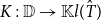 $K:\mathbb{D}\to \mathbb{K} l(\hat{T})$
be the canonical pseudodouble functor from Definition 10.5. In the conditions of Theorem 10.18 one has:
$K:\mathbb{D}\to \mathbb{K} l(\hat{T})$
be the canonical pseudodouble functor from Definition 10.5. In the conditions of Theorem 10.18 one has:
-
(1) t induces a strict vertical icon
$\theta:-\triangleright K(-)\Rightarrow K(-\otimes-):\mathbb{D}\times\mathbb{D}\to \mathbb{K} l(\hat{T})$
whose invertible 2-cell components
$\theta_{f,g}$
for 1h-cells
$f:A\to A', g:B\to B'$
are given by -
(2) for 1v-cells u,v with companions
$\hat{u}, \hat{v}$
the 2-cells
$Z_{\hat{u},\hat{v}}$
in
$\mathbb{D}$
from Lemma 10.21 present companion-lifts of
$\theta^{u,v}=\operatorname {Id}$
in
$\mathbb{K} l(\hat{T})$
.





Proof. Recall that K is identity on objects and 1v-cells, while $K(f)=\eta_{A'}\circ f$
, and that the action
$K(f)=\eta_{A'}\circ f$
, and that the action $\triangleright$
is given on objects and 1v-cells by the horizontally monoidal product of
$\triangleright$
is given on objects and 1v-cells by the horizontally monoidal product of $\mathbb{D}$
. Then for
$\mathbb{D}$
. Then for $\theta$
on objects (A,B), we set the identity 1v-cells on
$\theta$
on objects (A,B), we set the identity 1v-cells on $A\otimes B$
, on 1v-cells (u,v), we set
$A\otimes B$
, on 1v-cells (u,v), we set $\theta^{u,v}: u\triangleright K(v) \Rightarrow u\otimes v$
to be the identity 2-cell in
$\theta^{u,v}: u\triangleright K(v) \Rightarrow u\otimes v$
to be the identity 2-cell in $\mathbb{K} l(\hat{T})$
, whereas the domain and codomain of
$\mathbb{K} l(\hat{T})$
, whereas the domain and codomain of $\theta$
at 1h-cells (f,g) should be given by a horizontally globular 2-cell
$\theta$
at 1h-cells (f,g) should be given by a horizontally globular 2-cell $\theta_{f,g}:f\triangleright(\eta_{B'}\circ g)\Rightarrow \eta_{A'\otimes B'}\circ (f\otimes g)$
in
$\theta_{f,g}:f\triangleright(\eta_{B'}\circ g)\Rightarrow \eta_{A'\otimes B'}\circ (f\otimes g)$
in $\mathbb{D}$
. In Theorem 10.18, the 1h-cell
$\mathbb{D}$
. In Theorem 10.18, the 1h-cell $f\triangleright(\eta_{B'}\circ g)$
is defined as
$f\triangleright(\eta_{B'}\circ g)$
is defined as $\hat{t}_{A',B'}\circ(f\otimes(\eta_{B'}\circ g))$
, so the above defined globular 2-cell makes sense as a desired 2-cell component of
$\hat{t}_{A',B'}\circ(f\otimes(\eta_{B'}\circ g))$
, so the above defined globular 2-cell makes sense as a desired 2-cell component of $\theta$
, and we define
$\theta$
, and we define $\theta$
at (f,g) this way. By the first part of Lemma 10.23 it suffices to prove that the three axioms of a pseudonatural transformation in the bicategory
$\theta$
at (f,g) this way. By the first part of Lemma 10.23 it suffices to prove that the three axioms of a pseudonatural transformation in the bicategory $\mathcal{H}(\mathbb{B})$
hold for
$\mathcal{H}(\mathbb{B})$
hold for $\theta$
. That they hold it was observed in the bicategorical case in Paquet and Saville (Reference Paquet and Saville2023b, Theorem 1), Paquet and Saville (Reference Paquet and Saville2024, Theorem 7.2). More precisely, they follow by the three strength axioms involving z from Definition 10.13, c) and the modification axiom for
$\theta$
. That they hold it was observed in the bicategorical case in Paquet and Saville (Reference Paquet and Saville2023b, Theorem 1), Paquet and Saville (Reference Paquet and Saville2024, Theorem 7.2). More precisely, they follow by the three strength axioms involving z from Definition 10.13, c) and the modification axiom for $\hat{z}$
. Observe that by the second part of Lemma 10.23 it is
$\hat{z}$
. Observe that by the second part of Lemma 10.23 it is

where the diagram on the left-hand side is in $\mathbb{K} l(\hat{T})$
. This should not be a surprise because of Lemma 10.21. Thus, the 2-cell
$\mathbb{K} l(\hat{T})$
. This should not be a surprise because of Lemma 10.21. Thus, the 2-cell $Z_{\hat{u},\hat{v}}$
in
$Z_{\hat{u},\hat{v}}$
in $\mathbb{D}$
presents a 2-cell in
$\mathbb{D}$
presents a 2-cell in $\mathbb{K} l(\hat{T})$
that is a companion-lift of
$\mathbb{K} l(\hat{T})$
that is a companion-lift of $\theta^{u,v}=\operatorname {Id}$
in
$\theta^{u,v}=\operatorname {Id}$
in $\mathbb{K} l(\hat{T})$
.
$\mathbb{K} l(\hat{T})$
.
By construction of the action in Theorem 10.18, we defined the vertical modifications $\tilde p=K(p), \tilde l=K(l), \tilde m=K(m)$
in
$\tilde p=K(p), \tilde l=K(l), \tilde m=K(m)$
in $\mathbb{K} l(\hat{T})$
in terms of the vertical modifications p,l,m from the monoidal structure of
$\mathbb{K} l(\hat{T})$
in terms of the vertical modifications p,l,m from the monoidal structure of $\mathbb{D}$
. We will now draw the 2-cell components of these diagrams, composing to them the identity 2-cells
$\mathbb{D}$
. We will now draw the 2-cell components of these diagrams, composing to them the identity 2-cells $\theta^{u,v}: u\triangleright K(v) \Rightarrow K(u\otimes v)$
in
$\theta^{u,v}: u\triangleright K(v) \Rightarrow K(u\otimes v)$
in $\mathbb{K} l(\hat{T})$
for the corresponding varying 1v-cells u,v at suitable places. (Observe that all these 1v-cells are either identities, or 1v-cell components of
$\mathbb{K} l(\hat{T})$
for the corresponding varying 1v-cells u,v at suitable places. (Observe that all these 1v-cells are either identities, or 1v-cell components of $\alpha, \lambda, \rho$
, which are liftable by assumption.) To suit the space in the diagrams, instead of writing K(u) for 1v-cells on the arrows of these diagrams, we will write
$\alpha, \lambda, \rho$
, which are liftable by assumption.) To suit the space in the diagrams, instead of writing K(u) for 1v-cells on the arrows of these diagrams, we will write $\overline u$
. We get that
$\overline u$
. We get that

equal, respectively,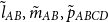 $\tilde l_{AB}, \tilde m_{AB}, \tilde p_{ABCD}$
.
$\tilde l_{AB}, \tilde m_{AB}, \tilde p_{ABCD}$
.
By definition, these are then, respectively, equal to the 2-cell components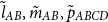 $\tilde l_{AB}, \tilde m_{AB}, \tilde p_{ABCD}$
in
$\tilde l_{AB}, \tilde m_{AB}, \tilde p_{ABCD}$
in $\mathbb{K} l(\hat{T})$
. Applying companion lifting to these three equalities of 2-cells, we obtain the following equalities of the vertical compositions:
$\mathbb{K} l(\hat{T})$
. Applying companion lifting to these three equalities of 2-cells, we obtain the following equalities of the vertical compositions:
 \begin{equation} \frac{\theta_{\hat{\lambda}_A, B}}{K(\hat{l}_{AB})}=\widehat{\tilde l_{AB}}, \qquad \begin{array}{@{\,}c@{\,}}[\operatorname {Id}_{K(\hat{\alpha}_{A,I,B})} \vert\theta_{A,\hat{\lambda}_B}]\\ \hline K(\hat{m}_{AB})\\ \hline (\theta_{\hat{\rho}_A, B})^{-1} \end{array}=\widehat{\tilde m_{AB}}, \qquad \frac{[\theta_{K(\hat{\alpha}_{A,B,C}),D} \vert K(\hat{\alpha}_{A,BC,D})\vert\theta_{A,K(\hat{\alpha}_{B,C,D})}]}{K(\hat{p}_{ABCD})}=\widehat{\tilde p_{ABCD}}\end{equation}
whereby note that $\widehat{K(u)}=K(\hat{u})$
for 1v-cells u by Proposition 10.6, and that the companion-lift of
$\widehat{K(u)}=K(\hat{u})$
for 1v-cells u by Proposition 10.6, and that the companion-lift of $\theta^{u,v}$
in
$\theta^{u,v}$
in $\mathbb{K} l(\hat{T})$
is
$\mathbb{K} l(\hat{T})$
is $\theta_{\hat{u}, \hat{v}}$
by the second part of Proposition 10.24.
$\theta_{\hat{u}, \hat{v}}$
by the second part of Proposition 10.24.
In the setting of Theorem 10.18, we have two more identities that hold true. One connects $\hat{\alpha}, \widehat{\tilde\alpha}, \theta$
, and another
$\hat{\alpha}, \widehat{\tilde\alpha}, \theta$
, and another $\hat{\lambda}, \widehat{\tilde\lambda}, \theta$
. We discuss them next.
$\hat{\lambda}, \widehat{\tilde\lambda}, \theta$
. We discuss them next.
We comment first in more detail why the equality of 2-cells
 \begin{equation} \frac{[\theta_{1_I,f}\vert\operatorname {Id}_{K(\hat{\lambda}_{A'})}]}{K(\hat{\lambda}_f)}=\widehat{\tilde\lambda_{K(f)}}: \quad \widehat{\tilde\lambda_{A'}}(I\triangleright K(f))\Rightarrow K(f)\widehat{\tilde\lambda_A}\end{equation}
holds, for any 1h-cell f in $\mathbb{D}$
, whereby
$\mathbb{D}$
, whereby $K(\hat{\lambda}_A)=\widehat{\tilde\lambda_A}$
(by Proposition 10.6 and by construction
$K(\hat{\lambda}_A)=\widehat{\tilde\lambda_A}$
(by Proposition 10.6 and by construction $K(\lambda_A)=\tilde\lambda_A$
.) The 2-cell
$K(\lambda_A)=\tilde\lambda_A$
.) The 2-cell $\theta_{1_I,f}$
is comprised basically of the 2-cell
$\theta_{1_I,f}$
is comprised basically of the 2-cell $\hat{z}_{I,A}$
. Next,
$\hat{z}_{I,A}$
. Next, $K(\hat{\lambda}_f)$
is a companion-lift in
$K(\hat{\lambda}_f)$
is a companion-lift in $\mathbb{K} l(\hat{T})$
of the 2-cell
$\mathbb{K} l(\hat{T})$
of the 2-cell $K(\lambda_f)$
, which is the horizontal composition
$K(\lambda_f)$
, which is the horizontal composition $[\lambda_f\vert\hat{\eta}^{\lambda_A}]$
. Finally,
$[\lambda_f\vert\hat{\eta}^{\lambda_A}]$
. Finally, $\widehat{\tilde\lambda_{K(f)}}$
is a companion-lift in
$\widehat{\tilde\lambda_{K(f)}}$
is a companion-lift in $\mathbb{K} l(\hat{T})$
of the 2-cell
$\mathbb{K} l(\hat{T})$
of the 2-cell $\tilde\lambda_{K(f)}$
in
$\tilde\lambda_{K(f)}$
in $\mathbb{K} l(\hat{T})$
, which by Theorem 10.18 is given by the horizontal composition
$\mathbb{K} l(\hat{T})$
, which by Theorem 10.18 is given by the horizontal composition $[\lambda_{K(f)}\vert x^*_A]$
, whereby
$[\lambda_{K(f)}\vert x^*_A]$
, whereby $\lambda_{K(f)}$
consists of the composition
$\lambda_{K(f)}$
consists of the composition $[\lambda_f\vert\lambda_{\hat{\eta}_A}]$
. (All the 2-cells in these horizontal compositions are square-formed.) After canceling out the equal parts stemming from companion-lifting (the structure 2-cells
$[\lambda_f\vert\lambda_{\hat{\eta}_A}]$
. (All the 2-cells in these horizontal compositions are square-formed.) After canceling out the equal parts stemming from companion-lifting (the structure 2-cells $\iota$
and e) and the 2-cell
$\iota$
and e) and the 2-cell $\lambda_f$
, for the desired equality to hold it remains to prove
$\lambda_f$
, for the desired equality to hold it remains to prove

Remark 10.25. Note that both $K(\hat{\lambda}_f)$
and
$K(\hat{\lambda}_f)$
and $\widehat{\tilde\lambda_{K(f)}}$
contain
$\widehat{\tilde\lambda_{K(f)}}$
contain $\lambda_f$
as a component in the composition constituting them, and that it is being cancelled out. Thus, the question of liftability does not affect the 1h-cell f. On the other hand,
$\lambda_f$
as a component in the composition constituting them, and that it is being cancelled out. Thus, the question of liftability does not affect the 1h-cell f. On the other hand, $\theta_{1_I,f}=[\operatorname {Id}_{1_I\otimes f}\vert\hat{z}_{I,A'}]$
, so that the only non-trivial 2-cell depending on f in (60) is
$\theta_{1_I,f}=[\operatorname {Id}_{1_I\otimes f}\vert\hat{z}_{I,A'}]$
, so that the only non-trivial 2-cell depending on f in (60) is $\lambda_f$
that we already discussed.
$\lambda_f$
that we already discussed.
To obtain (61) start from the trivially holding identity between vertical modifications z and x that gives rise to the $z\mbox{-} x$
axiom holding in Definition 10.13 for
$z\mbox{-} x$
axiom holding in Definition 10.13 for $\hat{T}$
. Namely, we have
$\hat{T}$
. Namely, we have

Then compose on the left the companion structure 2-cell $\iota_{\eta_A}$
and on the right
$\iota_{\eta_A}$
and on the right $e_{I\eta_A}$
and
$e_{I\eta_A}$
and $e_{t_{I,A}}$
, and also insert the identity 2-cell
$e_{t_{I,A}}$
, and also insert the identity 2-cell $\frac{\iota_{\eta_A}}{e_{\eta_A}}=\operatorname {Id}$
between z and
$\frac{\iota_{\eta_A}}{e_{\eta_A}}=\operatorname {Id}$
between z and $\eta^{\lambda_A}$
on the left-hand side to obtain (61).
$\eta^{\lambda_A}$
on the left-hand side to obtain (61).
By similar arguments, using trivial identity holding between vertical modifications z and y that gives rise to the $z\mbox{-} y$
axiom in Definition 10.13, one proves the equality of 2-cells
$z\mbox{-} y$
axiom in Definition 10.13, one proves the equality of 2-cells
 \begin{equation} \frac{[\theta_{fg,h}\vert\operatorname {Id}_{K(\hat{\alpha}_{A',B',C'})}]}{K(\hat{\alpha}_{f,g,h})}=\begin{array}{@{\,}c@{\,}}\widehat{\tilde\alpha_{f,g,K(h)}}\\ \hline [\operatorname {Id}_{\hat{\alpha}_{A,B,C}}\vert f\triangleright\theta_{g,h}]\\ \hline [\operatorname {Id}_{\hat{\alpha}_{A,B,C}}\vert\theta_{f,gh}] \end{array}: \quad \hat{\alpha}_{A',B',C'}\big( (fg)K(h)\big) \Rightarrow K(f(gh))\hat{\alpha}_{A,B,C},\end{equation}
whereby $K(\hat{\alpha}_{A,B,C})=\widehat{\tilde\alpha_{A,B,C}}$
.
$K(\hat{\alpha}_{A,B,C})=\widehat{\tilde\alpha_{A,B,C}}$
.
Given that all the 2-cells appearing in equations (59), (60), (63) are horizontally globular, the diagrammatic representation of the equations corresponding to them in $\mathcal{H}(\mathbb{K} l(\hat{T}))$
is precisely the one appearing in Paquet and Saville (Reference Paquet and Saville2023b, Definition 11) where “an extension of the canonical action of a bicategory on itself” is defined (in Paquet and Saville (Reference Paquet and Saville2023a, Definition 20) it is called “0-strict morphism of actions”). This brings us to the following.
$\mathcal{H}(\mathbb{K} l(\hat{T}))$
is precisely the one appearing in Paquet and Saville (Reference Paquet and Saville2023b, Definition 11) where “an extension of the canonical action of a bicategory on itself” is defined (in Paquet and Saville (Reference Paquet and Saville2023a, Definition 20) it is called “0-strict morphism of actions”). This brings us to the following.
Definition 10.26. Let T be a horizontal double monad on a horizontally monoidal double category $(\mathbb{D}, \otimes, \alpha, \lambda, \rho; p,l,m)$
. A horizontal extension of the canonical action of
$(\mathbb{D}, \otimes, \alpha, \lambda, \rho; p,l,m)$
. A horizontal extension of the canonical action of $\mathbb{D}$
on itself is a pair
$\mathbb{D}$
on itself is a pair $(\triangleright, \theta)$
, where
$(\triangleright, \theta)$
, where
-
(1)
$\triangleright:\mathbb{D}\times\mathbb{K} l(T)\to \mathbb{K} l(T)$
is a horizontal action with structure pseudonatural transformations
$\tilde\alpha, \tilde\lambda$
and structure horizontal modifications
$\tilde p, \tilde m, \tilde l$
, and -
(2)
$\theta:-\triangleright K(-)\Rightarrow K(-\otimes-)$
is a horizontal icon,




so that $\theta_{1_A,1_B}=\triangleright^0_{A,B}$
(the unitor of the action on
$\theta_{1_A,1_B}=\triangleright^0_{A,B}$
(the unitor of the action on $A\triangleright B$
) and the identities
$A\triangleright B$
) and the identities
 \begin{equation} \frac{\theta_{\lambda_A, B}}{K(l_{AB})}=\tilde l_{AB}, \qquad \begin{array}{@{\,}c@{\,}}[\!\operatorname {Id}_{K(\alpha_{A,I,B})} \vert\theta_{A,\lambda_B}]\\ \hline K(m_{AB})\\ \hline (\theta_{\rho_A, B})^{-1} \end{array}=\tilde m_{AB}, \qquad \frac{[\theta_{K(\alpha_{A,B,C}),D} \vert K(\alpha_{A,BC,D})\vert\theta_{A,K(\alpha_{B,C,D})}]}{K(p_{ABCD})}=\tilde p_{ABCD}\end{equation}
 \begin{equation} \frac{[\theta_{1_I,f}\vert\operatorname {Id}_{K(\lambda_{A'})}]}{K(\lambda_f)}=\tilde\lambda_{K(f)}: \quad \tilde\lambda_{A'}(I\triangleright K(f))\Rightarrow K(f)\tilde\lambda_A\end{equation}
 \begin{equation} \frac{[\theta_{fg,h}\vert\operatorname {Id}_{K(\alpha_{A',B',C'})}\!]}{K(\alpha_{f,g,h})}=\begin{array}{@{\,}c@{\,}}\tilde\alpha_{f,g,K(h)}\\ \hline [\!\operatorname {Id}_{\alpha_{A,B,C}}\vert f\triangleright\theta_{g,h}]\\ \hline [\!\operatorname {Id}_{\alpha_{A,B,C}}\vert\theta_{f,gh}] \end{array}: \quad \tilde\alpha_{A',B',C'}\big( (fg)K(h)\big) \Rightarrow K(f(gh))\tilde\alpha_{A,B,C}\end{equation}
hold, whereby $K(\lambda_A)=\tilde\lambda_A$
and
$K(\lambda_A)=\tilde\lambda_A$
and $K(\alpha_{A,B,C})=\tilde\alpha_{A,B,C}$
.
$K(\alpha_{A,B,C})=\tilde\alpha_{A,B,C}$
.
Recall from Lemma 10.23 that $\theta$
is a strict vertical icon if and only if
$\theta$
is a strict vertical icon if and only if $\hat{\theta}$
is a horizontal icon with trivial (square-formed) 2-cell components
$\hat{\theta}$
is a horizontal icon with trivial (square-formed) 2-cell components $\hat{\theta}^u$
. Our above findings we can then formulate into the following claim.
$\hat{\theta}^u$
. Our above findings we can then formulate into the following claim.
Theorem 10.27. Let T be a vertical double monad on a monoidal double category $\mathbb{D}$
and assume that the vertical transformations
$\mathbb{D}$
and assume that the vertical transformations $\alpha,\lambda,\rho$
of
$\alpha,\lambda,\rho$
of $\mathbb{D}$
, and
$\mathbb{D}$
, and $\mu,\eta$
of T are liftable. A vertical liftable (left) strength t on T that is invertible as a vertical transformation induces a horizontal extension of the canonical action of
$\mu,\eta$
of T are liftable. A vertical liftable (left) strength t on T that is invertible as a vertical transformation induces a horizontal extension of the canonical action of $\mathbb{D}$
on itself, where the action and the icon are given as in Theorem 10.18 and Proposition 10.24.
$\mathbb{D}$
on itself, where the action and the icon are given as in Theorem 10.18 and Proposition 10.24.
Remark 10.28. One can also define a vertical extension for a vertical double monad on a monoidal double category as a pair consisting of a vertical action and a strict vertical icon, so that the three identities (58) hold and $\theta_{1_A,1_B}=\triangleright^0_{A,B}$
. Nevertheless, for a general action not necessarily induced by a strength, it is not clear if one can lift a vertical extension into a horizontal one. Namely, if for liftable
$\theta_{1_A,1_B}=\triangleright^0_{A,B}$
. Nevertheless, for a general action not necessarily induced by a strength, it is not clear if one can lift a vertical extension into a horizontal one. Namely, if for liftable $\alpha, \lambda, \rho$
of
$\alpha, \lambda, \rho$
of $\mathbb{D}$
and
$\mathbb{D}$
and $\mu,\eta$
of T, we had a vertical action (and hence extension
$\mu,\eta$
of T, we had a vertical action (and hence extension $(\triangleright,\theta)$
), we would get an induced horizontal icon
$(\triangleright,\theta)$
), we would get an induced horizontal icon $\hat{\theta}$
, but we would not be able to recover (60) and (63) as lifts of vertically globular 2-cells. This is so because we cannot factor
$\hat{\theta}$
, but we would not be able to recover (60) and (63) as lifts of vertically globular 2-cells. This is so because we cannot factor $\tilde\alpha_{f,g,h}, \tilde\lambda_f$
and
$\tilde\alpha_{f,g,h}, \tilde\lambda_f$
and $\theta_{f,g}$
to be able to compare them with
$\theta_{f,g}$
to be able to compare them with $\alpha_{f,g,h}, \lambda_f$
and
$\alpha_{f,g,h}, \lambda_f$
and $\theta_{A,B}$
and eventually cancel out
$\theta_{A,B}$
and eventually cancel out $\alpha_{f,g,h}$
and
$\alpha_{f,g,h}$
and $\lambda_f$
in those expressions to get to a companion-lift of some trivially holding identity among vertical structures, as we did in Theorem 10.18.
$\lambda_f$
in those expressions to get to a companion-lift of some trivially holding identity among vertical structures, as we did in Theorem 10.18.
In a bicategorical case, in Table 1 on p.20 of Paquet and Saville (Reference Paquet and Saville2024), the correspondence is listed between the underlying axioms of left strengths, on one hand, and of extensions of the canonical actions, on the other hand. We present that Table here: observe that the axioms in the left column are both bicategorical and double categorical, as they are expressed in terms of globular 2-cells.
As far as the right-hand side column applied to the double categorical situation concerns, the axioms in the first row are globular, whereas pseudodouble functor axioms and axioms of horizontal pseudonatural transformations additionally involve vertical 1-cells. This added complexity in the axioms with respect to the bicategorical situation corresponds to the same sort of change in the axioms for the underlying given data on the side of a strength: horizontal transformations ((h.o.t.-3) – (h.o.t.-5) for $\hat{t}$
) and horizontal modifications ((m.ho-vl.-1) and (m.ho-vl.-2) for
$\hat{t}$
) and horizontal modifications ((m.ho-vl.-1) and (m.ho-vl.-2) for $\hat{w}, \hat{z}$
and for
$\hat{w}, \hat{z}$
and for $x^*, y^*$
i.e.
$x^*, y^*$
i.e. $\hat{x}, \hat{y}$
). Consequently, the correspondence listed in the above table applies equally to the double categorical case.
$\hat{x}, \hat{y}$
). Consequently, the correspondence listed in the above table applies equally to the double categorical case.
Let us summarize the structure of our above proof that a vertical strength yields a (horizontal) extension, in order to conclude what the gain is of working with a vertical structure in a double categorical setting and by assuming the existence of certain companions. Namely, starting from a vertical strength we obtained: 1) a horizontal strength (due to Theorem 10.14) – this is a double categorical version of a bicategorical strength, 2) the vertical action - as in Theorem 10.18, 3) the horizontal action (in Theorem 10.18, obtained by lifting the vertical action), 4) an icon – as in Proposition 10.24 and 5) the five extension axioms - we obtained them for free by companion-lifting of trivially holding identities between vertical structures (so they follow essentially by Proposition 2.22).
10.4.2 Horizontal strengths induce horizontal actions on the Kleisli double category
Let s be a horizontal strength on a horizontal double monad S on a horizontally monoidal double category $(\mathbb{D}, \otimes, \alpha,\lambda, \rho)$
. By Lemma 10.23 and the first part of Proposition 10.24, we indeed have
$(\mathbb{D}, \otimes, \alpha,\lambda, \rho)$
. By Lemma 10.23 and the first part of Proposition 10.24, we indeed have
Proposition 10.29. A horizontal left strength s on a horizontal double monad S on a horizontally monoidal double category $\mathbb{D}$
induces a horizontal icon
$\mathbb{D}$
induces a horizontal icon $\theta:-\triangleright K(-)\Rightarrow K(-\otimes-):\mathbb{D}\times\mathbb{D}\to \mathbb{K} l(S)$
whose invertible 2-cell components
$\theta:-\triangleright K(-)\Rightarrow K(-\otimes-):\mathbb{D}\times\mathbb{D}\to \mathbb{K} l(S)$
whose invertible 2-cell components $\theta_{f,g}$
for 1h-cells
$\theta_{f,g}$
for 1h-cells $f:A\to A', g:B\to B'$
are given by
$f:A\to A', g:B\to B'$
are given by

and the square-formed 2-cell components $\theta^{u,v}=\operatorname {Id}^{u\otimes v}$
for 1v-cells u,v.
$\theta^{u,v}=\operatorname {Id}^{u\otimes v}$
for 1v-cells u,v.
By substituting in the proof of Theorem 10.18 the companion-lifts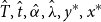 $\hat{T}, \hat{t}, \hat{\alpha}, \hat{\lambda},y^*, x^*$
by their horizontal analogues
$\hat{T}, \hat{t}, \hat{\alpha}, \hat{\lambda},y^*, x^*$
by their horizontal analogues $S,s,\alpha, \lambda, y, x$
, that proof is easily adapted to the proof of the following fact:
$S,s,\alpha, \lambda, y, x$
, that proof is easily adapted to the proof of the following fact:
Theorem 10.30. A horizontal strength s on a horizontal double monad S on a horizontally monoidal double category $(\mathbb{D}, \otimes, \alpha, \lambda, \rho)$
induces an action
$(\mathbb{D}, \otimes, \alpha, \lambda, \rho)$
induces an action $\triangleright:\mathbb{D}\times\mathbb{K} l(S)\to \mathbb{K} l(S)$
.
$\triangleright:\mathbb{D}\times\mathbb{K} l(S)\to \mathbb{K} l(S)$
.
Proof. The action functor $\triangleright$
in the horizontal context is defined similarly as in Theorem 10.18. The action constraints
$\triangleright$
in the horizontal context is defined similarly as in Theorem 10.18. The action constraints $\tilde\alpha, \tilde\lambda$
are defined on objects and 1v-cells as
$\tilde\alpha, \tilde\lambda$
are defined on objects and 1v-cells as $\alpha$
and
$\alpha$
and $\lambda$
, and on 1h-cells as
$\lambda$
, and on 1h-cells as
 $$\tilde\alpha_{f,g,h}=\frac{[\operatorname {Id}_{(fg)h}\,\vert\,y_{A',B',C'}]}{[\alpha_{f,g,h}\,\vert\,\operatorname {Id}_{[A's_{B',C'}\vert s_{A',B'C'}]}]}\quad \text{ and }\quad \tilde\lambda_h=\frac{[\operatorname {Id}_{Ih}\vert x_{A'}]}{\lambda_h},$$
whereby now $\alpha_{f,g,h}$
and
$\alpha_{f,g,h}$
and $\lambda_h$
are globular 2-cells. To prove that
$\lambda_h$
are globular 2-cells. To prove that $\tilde\alpha$
is a horizontal transformation, observe that the axioms (h.o.t.-1) and (h.o.t.-2) hold as in the bicategorical case of Femić and Halbig (Reference Femić and Halbig2025), and that (h.o.t.-3) and (h.o.t.-4) hold because they hold for
$\tilde\alpha$
is a horizontal transformation, observe that the axioms (h.o.t.-1) and (h.o.t.-2) hold as in the bicategorical case of Femić and Halbig (Reference Femić and Halbig2025), and that (h.o.t.-3) and (h.o.t.-4) hold because they hold for $\alpha$
. One only needs to work out the axiom (h.o.t.-5). It is proved to hold applying the modification axiom (m.ho-vl.-2) for y and (h.o.t.-5) for
$\alpha$
. One only needs to work out the axiom (h.o.t.-5). It is proved to hold applying the modification axiom (m.ho-vl.-2) for y and (h.o.t.-5) for $\alpha$
. The proof that
$\alpha$
. The proof that $\tilde\lambda$
is a horizontal transformation is similar.
$\tilde\lambda$
is a horizontal transformation is similar.
The horizontal modifications $\tilde l, \tilde m, \tilde p$
are defined as in (64) with
$\tilde l, \tilde m, \tilde p$
are defined as in (64) with $\theta$
from Proposition 10.29, whereby now l,m,p are horizontal modifications of the horizontally monoidal structure on
$\theta$
from Proposition 10.29, whereby now l,m,p are horizontal modifications of the horizontally monoidal structure on $\mathbb{D}$
. The modification axiom (m.ho-vl.-1) holds as in the bicategorical case. For the other modification axiom (m.ho-vl.-2), for
$\mathbb{D}$
. The modification axiom (m.ho-vl.-1) holds as in the bicategorical case. For the other modification axiom (m.ho-vl.-2), for $\tilde l$
use (h.o.t.-5) for
$\tilde l$
use (h.o.t.-5) for $\theta$
and (m.ho-vl.-2) of the horizontal modification l. The proofs for
$\theta$
and (m.ho-vl.-2) of the horizontal modification l. The proofs for $\tilde m$
and
$\tilde m$
and $\tilde p$
work by similar arguments.
$\tilde p$
work by similar arguments.
The remaining work required to prove Theorem 10.30 is the verification of the action axioms for the horizontal modifications $\tilde l,\tilde m, \tilde p$
. This verification coincides with the one carried out in the bicategorical case in Paquet and Saville (Reference Paquet and Saville2023b, Proposition 2), Paquet and Saville (Reference Paquet and Saville2024, Proposition 7.1), given that those axioms are comprised of globular 2-cells, which are the 2-cell components of horizontal modifications.
$\tilde l,\tilde m, \tilde p$
. This verification coincides with the one carried out in the bicategorical case in Paquet and Saville (Reference Paquet and Saville2023b, Proposition 2), Paquet and Saville (Reference Paquet and Saville2024, Proposition 7.1), given that those axioms are comprised of globular 2-cells, which are the 2-cell components of horizontal modifications.
Note that for vertical T, t in the setting of Theorem 10.18 and such that $S=\hat{T}, s=\hat{t}$
the horizontal action structures defined in the above theorem are companion-lifts of the type (9) of the corresponding action structures from Theorem 10.18. In other words, the horizontal action that
$S=\hat{T}, s=\hat{t}$
the horizontal action structures defined in the above theorem are companion-lifts of the type (9) of the corresponding action structures from Theorem 10.18. In other words, the horizontal action that $\hat{t}$
induces as in Theorem 10.30 is the companion-lift
$\hat{t}$
induces as in Theorem 10.30 is the companion-lift $(\triangleright; \widehat{\tilde\alpha}, \widehat{\tilde\lambda})$
of the vertical action
$(\triangleright; \widehat{\tilde\alpha}, \widehat{\tilde\lambda})$
of the vertical action $(\triangleright; \tilde\alpha, \tilde\lambda)$
obtained in Theorem 10.18.
$(\triangleright; \tilde\alpha, \tilde\lambda)$
obtained in Theorem 10.18.
10.4.3. Particularities of actions on the Kleisli double category
Given that cells in a Kleisli double category are represented via cells in the underlying double category, it is necessary to settle down some technical details regarding actions $\triangleright$
of
$\triangleright$
of $\mathbb{D}$
on
$\mathbb{D}$
on $\mathbb{K} l(T)$
for a horizontal double monad T. Let us first fix some notation. The lax pseudodouble functor structure of the action
$\mathbb{K} l(T)$
for a horizontal double monad T. Let us first fix some notation. The lax pseudodouble functor structure of the action $\triangleright$
we will denote by
$\triangleright$
we will denote by $\triangleright^2, \triangleright^0$
. Recall that for 1h-cells in
$\triangleright^2, \triangleright^0$
. Recall that for 1h-cells in $\mathbb{K} l(T)$
we write
$\mathbb{K} l(T)$
we write $f^K:A\to A'$
and that they are given by 1h-cells
$f^K:A\to A'$
and that they are given by 1h-cells $f:A\to T(A')$
in
$f:A\to T(A')$
in $\mathbb{D}$
. For the 1h-cell unit on an object A in
$\mathbb{D}$
. For the 1h-cell unit on an object A in $\mathbb{K} l(T)$
we will write
$\mathbb{K} l(T)$
we will write $1^K_A: A\to A$
and we know that it is given by
$1^K_A: A\to A$
and we know that it is given by $\eta_A:A\to T(A)$
in
$\eta_A:A\to T(A)$
in $\mathbb{D}$
. In contrast, we will denote by
$\mathbb{D}$
. In contrast, we will denote by $1_{T(A)}^\bullet:T(A)\to A$
a 1h-cell in
$1_{T(A)}^\bullet:T(A)\to A$
a 1h-cell in $\mathbb{K} l(T)$
given by
$\mathbb{K} l(T)$
given by $1_{T(A)}$
in
$1_{T(A)}$
in $\mathbb{D}$
. Then for 1h-cells
$\mathbb{D}$
. Then for 1h-cells $f:A\to A'$
in
$f:A\to A'$
in $\mathbb{D}$
and
$\mathbb{D}$
and $g^K:B\to B'$
in
$g^K:B\to B'$
in $\mathbb{K} l(T)$
we have that
$\mathbb{K} l(T)$
we have that $(f\triangleright g^K)^K: A\triangleright B\to A'\triangleright B'$
in
$(f\triangleright g^K)^K: A\triangleright B\to A'\triangleright B'$
in $\mathbb{K} l(T)$
is given by a 1h-cell
$\mathbb{K} l(T)$
is given by a 1h-cell $A\triangleright B\to T(A'\triangleright B')$
in
$A\triangleright B\to T(A'\triangleright B')$
in $\mathbb{D}$
that can be understood as the composition
$\mathbb{D}$
that can be understood as the composition
 \begin{equation} f\triangleright g^K=\big(A\triangleright B \stackrel{f\triangleright g}{\longrightarrow} A'\triangleright T(B') \stackrel{1_{A'}\triangleright 1^\bullet_{T(B')}}{\xrightarrow{\hspace{1cm}}}T(A'\triangleright B')\big).\end{equation}
Observe that in the component $f\triangleright g$
the 1h-cells f and g in
$f\triangleright g$
the 1h-cells f and g in $\mathbb{D}$
act componentwise, whereas
$\mathbb{D}$
act componentwise, whereas $1_{A'}\triangleright 1^\bullet_{T(B')}$
is a 1h-cell in
$1_{A'}\triangleright 1^\bullet_{T(B')}$
is a 1h-cell in $\mathbb{D}$
determining a 1h-cell
$\mathbb{D}$
determining a 1h-cell $(1_{A'}\triangleright 1^\bullet_{T(B')})^K: A'\triangleright T(B')\to A'\triangleright B'$
in
$(1_{A'}\triangleright 1^\bullet_{T(B')})^K: A'\triangleright T(B')\to A'\triangleright B'$
in $\mathbb{K} l(T)$
acting componentwise. (By the notation
$\mathbb{K} l(T)$
acting componentwise. (By the notation $1_{A'}\triangleright 1^\bullet_{T(B')}$
we keep an analogy with the notation in Uustalu and Vene (Reference Uustalu and Vene2008, Proposition 4.3) and Femić and Halbig (Reference Femić and Halbig2025, Theorem 1).)
$1_{A'}\triangleright 1^\bullet_{T(B')}$
we keep an analogy with the notation in Uustalu and Vene (Reference Uustalu and Vene2008, Proposition 4.3) and Femić and Halbig (Reference Femić and Halbig2025, Theorem 1).)
Remark 10.31. Furthermore, observe that the component $f\triangleright g$
in (67) behaves in a strict way, in the sense that
$f\triangleright g$
in (67) behaves in a strict way, in the sense that $f'f\triangleright g'g=(f'\triangleright g')(f\triangleright g):A\triangleright B \stackrel{f\triangleright g}{\longrightarrow} A'\triangleright T(B') \stackrel{f'\triangleright T(g')}{\longrightarrow} A''\triangleright T^2(B'')\stackrel{A''\mu_{B''}}{\longrightarrow} A''\triangleright T(B'')$
, and we have that
$f'f\triangleright g'g=(f'\triangleright g')(f\triangleright g):A\triangleright B \stackrel{f\triangleright g}{\longrightarrow} A'\triangleright T(B') \stackrel{f'\triangleright T(g')}{\longrightarrow} A''\triangleright T^2(B'')\stackrel{A''\mu_{B''}}{\longrightarrow} A''\triangleright T(B'')$
, and we have that $1_A\triangleright 1_{T(B)}:A\triangleright T(B)\to A\triangleright T(B)$
is precisely
$1_A\triangleright 1_{T(B)}:A\triangleright T(B)\to A\triangleright T(B)$
is precisely $1_{A\triangleright T(B)}$
(set
$1_{A\triangleright T(B)}$
(set $g^K=1^\bullet_{T(B)}$
in (67)).
$g^K=1^\bullet_{T(B)}$
in (67)).
Similarly, for 2-cells
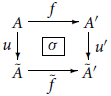 in
in $\mathbb{D}$
and
$\mathbb{D}$
and
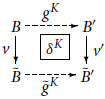 in
in $\mathbb{K} l(T)$
we have that the 2-cell
$\mathbb{K} l(T)$
we have that the 2-cell $(\sigma\triangleright\delta^K)^K$
is given as the composition
$(\sigma\triangleright\delta^K)^K$
is given as the composition

in $\mathbb{D}$
, where
$\mathbb{D}$
, where $\operatorname {Id}^{T(v)\bullet}: T(v)\Rightarrow v$
in
$\operatorname {Id}^{T(v)\bullet}: T(v)\Rightarrow v$
in $\mathbb{K} l(T)$
is a 2-cell given by the identity 2-cell
$\mathbb{K} l(T)$
is a 2-cell given by the identity 2-cell $\operatorname {Id}^{T(v)}$
in
$\operatorname {Id}^{T(v)}$
in $\mathbb{D}$
.
$\mathbb{D}$
.
For the compositor and unitor, we have

and

The reader may have noticed that the action constructed in Theorem 10.18 fits the above presented framework.
10.4.4. From an extension to a horizontal strength
In this final part of the current subsection, we are going to prove that a (horizontal) extension induces a horizontal strength. We will also explain why we cannot construct a vertical strength even though if we start from a monoidal double category with liftable monoidality constraints $\alpha, \lambda, \rho$
, and a vertical double monad with liftable monad structures
$\alpha, \lambda, \rho$
, and a vertical double monad with liftable monad structures $\mu, \eta$
.
$\mu, \eta$
.
For this reason, we start from a horizontally monoidal double category $(\mathbb{D}, \otimes, \alpha, \lambda, \rho; p,l,m)$
and a horizontal double monad
$(\mathbb{D}, \otimes, \alpha, \lambda, \rho; p,l,m)$
and a horizontal double monad $(T, \mu, \eta)$
. We assume that there is a horizontal extension of the canonical action of
$(T, \mu, \eta)$
. We assume that there is a horizontal extension of the canonical action of $\mathbb{D}$
on itself given by:
$\mathbb{D}$
on itself given by:
-
• a horizontal action, that is a pseudodouble functor
$\triangleright:\mathbb{D}\times\mathbb{K} l(T)\to \mathbb{K} l(T)$
with horizontal equivalences
$\tilde\lambda,\tilde\alpha$
, and horizontal modifications
$\tilde p, \tilde l, \tilde m$
satisfying the appropriate axioms, and -
• a horizontal icon
$\theta:-\triangleright K(-)\Rightarrow K(-\otimes-)$




so that $\theta_{1_A,1_B}=\triangleright^0_{A,B}$
, the identities (64), (65) and (66) hold, and it is
$\theta_{1_A,1_B}=\triangleright^0_{A,B}$
, the identities (64), (65) and (66) hold, and it is $K(\alpha_{A,B,C})=\tilde\alpha_{A,B,C}$
and
$K(\alpha_{A,B,C})=\tilde\alpha_{A,B,C}$
and $K(\lambda_A)=\tilde\lambda_A$
.
$K(\lambda_A)=\tilde\lambda_A$
.
The construction of a horizontal transformation s out of the above pair $(\triangleright, \theta)$
is technically involved. In the categorical case in Uustalu and Vene (Reference Uustalu and Vene2008), it is only stated how morphisms
$(\triangleright, \theta)$
is technically involved. In the categorical case in Uustalu and Vene (Reference Uustalu and Vene2008), it is only stated how morphisms $s_{A,B}$
are defined, and in the bicategorical case in Femić and Halbig (Reference Femić and Halbig2025, Theorem 1) apart from the definition of 1-cells
$s_{A,B}$
are defined, and in the bicategorical case in Femić and Halbig (Reference Femić and Halbig2025, Theorem 1) apart from the definition of 1-cells $s_{A,B}$
, bijective interrelation between the axioms of an extension and a strength is recorded (see Table 6). Given the complexity of the construction, we explain for the record how the structure 2-cells for a horizontal strength s in a double categorical case are given.
$s_{A,B}$
, bijective interrelation between the axioms of an extension and a strength is recorded (see Table 6). Given the complexity of the construction, we explain for the record how the structure 2-cells for a horizontal strength s in a double categorical case are given.
Correspondence between axioms of (h.) strengths and (h.) extensions
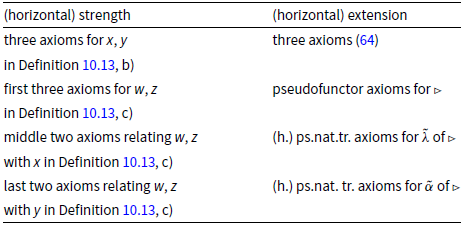
We define a horizontal transformation s with 1h-cell components $s_{A,B}:A\otimes T(B)\to T(A\otimes B)$
given by
$s_{A,B}:A\otimes T(B)\to T(A\otimes B)$
given by $s_{A,B}=1_A\triangleright 1_{ T(B)}^\bullet$
. For 1h-cells
$s_{A,B}=1_A\triangleright 1_{ T(B)}^\bullet$
. For 1h-cells $f:A\to A', g:B\to B'$
in
$f:A\to A', g:B\to B'$
in $\mathbb{D}$
, set
$\mathbb{D}$
, set $g^K:=g$
for a cell in
$g^K:=g$
for a cell in $\mathbb{K} l( T)$
determined by
$\mathbb{K} l( T)$
determined by $\eta_{B'}g$
in
$\eta_{B'}g$
in $\mathbb{D}$
. Then, compose
$\mathbb{D}$
. Then, compose $\triangleright^2_{f1_A,g^K1_{T(B)}^\bullet}$
in (69) with
$\triangleright^2_{f1_A,g^K1_{T(B)}^\bullet}$
in (69) with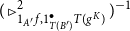 $(\triangleright^2_{1_{A'}f,1_{T(B')}^\bullet T(g^K)})^{-1}$
– let us call this a braiding of the action - to get a 2-cell
$(\triangleright^2_{1_{A'}f,1_{T(B')}^\bullet T(g^K)})^{-1}$
– let us call this a braiding of the action - to get a 2-cell
 \begin{align*}&\mu_{A'B'}\big( T(1_{A'}\hspace{-0,06cm}\triangleright\hspace{-0,06cm} 1^\bullet_{T(B')}) T(A'\triangleright\eta_{T(B')}) T(f\triangleright g)\big)(1_A\hspace{-0,06cm}\triangleright\hspace{-0,06cm} 1^\bullet_{T(B)})\Rightarrow \\&\quad \mu_{A'B'} T(1_{A'}\hspace{-0,06cm}\triangleright\hspace{-0,06cm} 1_{T(B')}^\bullet) \big((1_{A'}\hspace{-0,06cm}\triangleright\hspace{-0,06cm} 1^\bullet_{T^2(B')})(A'\triangleright\eta_{T(B')})(f\triangleright T(g))\big) \end{align*}
whereby we applied (67) at two places. We apply it once again in the codomain to get $(1_{A'}\triangleright 1^\bullet_{T^2(B')})(A'\triangleright\eta_{T(B')})=1_{A'}\triangleright 1_{T(B')}^K$
, and compose the domain from above with (the inverse of) (70) in the form of a composite 2-cell
$(1_{A'}\triangleright 1^\bullet_{T^2(B')})(A'\triangleright\eta_{T(B')})=1_{A'}\triangleright 1_{T(B')}^K$
, and compose the domain from above with (the inverse of) (70) in the form of a composite 2-cell $ T(\eta_{A'B'})\Rightarrow T(1_{A'}\triangleright 1^\bullet_{T(B')}) T(A'\triangleright\eta_{T(B')})$
. We find ourselves in a diagram chasing, where we apply then a braiding of the action in the codomain to use an isomorphism
$ T(\eta_{A'B'})\Rightarrow T(1_{A'}\triangleright 1^\bullet_{T(B')}) T(A'\triangleright\eta_{T(B')})$
. We find ourselves in a diagram chasing, where we apply then a braiding of the action in the codomain to use an isomorphism $ T(1_{A'}\triangleright 1_{T(B')}^\bullet)(1_{A'}\triangleright 1_{T(B')}^K)\cong T(1_{A'}\triangleright 1_{B'}^K)(1_{A'}\triangleright 1_{T(B')}^\bullet)$
(this is obtained by composing
$ T(1_{A'}\triangleright 1_{T(B')}^\bullet)(1_{A'}\triangleright 1_{T(B')}^K)\cong T(1_{A'}\triangleright 1_{B'}^K)(1_{A'}\triangleright 1_{T(B')}^\bullet)$
(this is obtained by composing $\triangleright^2_{1_A1_A,1_{T(B)}^\bullet 1_{T(B)}^K}$
with
$\triangleright^2_{1_A1_A,1_{T(B)}^\bullet 1_{T(B)}^K}$
with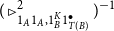 $(\triangleright^2_{1_A1_A,1_B^K 1_{T(B)}^\bullet})^{-1}$
). We then compose with the 2-cell
$(\triangleright^2_{1_A1_A,1_B^K 1_{T(B)}^\bullet})^{-1}$
). We then compose with the 2-cell $ T(\triangleright^0_{A',B'})$
to “substitute” the border 1h-cell
$ T(\triangleright^0_{A',B'})$
to “substitute” the border 1h-cell $ T(1_{A'}\triangleright 1_{B'}^K)$
by
$ T(1_{A'}\triangleright 1_{B'}^K)$
by $ T(\eta_{A'B'})$
. Now we may compose with the double monad structure 2-cell
$ T(\eta_{A'B'})$
. Now we may compose with the double monad structure 2-cell $l^{ T}$
in the codomain and with its inverse in the domain to “substitute” the border 1h-cell
$l^{ T}$
in the codomain and with its inverse in the domain to “substitute” the border 1h-cell $\mu_{A'B'} T(\eta_{A'B'})$
by the identity on
$\mu_{A'B'} T(\eta_{A'B'})$
by the identity on $A'\triangleright B'$
, so that we end up with an invertible composite 2-cell that we take to be
$A'\triangleright B'$
, so that we end up with an invertible composite 2-cell that we take to be
 $$s_{f,g}: T(f\triangleright g)(1_A\triangleright 1^\bullet_{T(B)})\Rightarrow(1_{A'}\triangleright 1_{T(B')}^\bullet)(f\triangleright T(g)).$$
For the 2-cell component $s^{u,v}$
for 1v-cells u,v we take the square 2-cell
$s^{u,v}$
for 1v-cells u,v we take the square 2-cell $\operatorname {Id}^u\triangleright\operatorname {Id}^{T(v)\bullet}$
as in the right-hand side of (68). The axioms (h.o.t.-3) and (h.o.t.-4) concerning
$\operatorname {Id}^u\triangleright\operatorname {Id}^{T(v)\bullet}$
as in the right-hand side of (68). The axioms (h.o.t.-3) and (h.o.t.-4) concerning $s^{u,v}$
then clearly hold. For the axiom (h.o.t.-5): since
$s^{u,v}$
then clearly hold. For the axiom (h.o.t.-5): since $s_{f,g}$
is basically constructed as a braiding of the action, this axiom follows by the naturality of the action functor (lx.f.c-nat) – one applies it twice in an appropriate way, being that the braiding is comprised of the composition of the lax and the colax structure of the action functor. The axioms (h.o.t.-1) and (h.o.t.-2) are proved as in the bicategorical case. In conclusion, s makes a horizontal pseudonatural transformation.
$s_{f,g}$
is basically constructed as a braiding of the action, this axiom follows by the naturality of the action functor (lx.f.c-nat) – one applies it twice in an appropriate way, being that the braiding is comprised of the composition of the lax and the colax structure of the action functor. The axioms (h.o.t.-1) and (h.o.t.-2) are proved as in the bicategorical case. In conclusion, s makes a horizontal pseudonatural transformation.
For the 2-cell $z_{A,B}: s_{A,B}\circ(A\triangleright\eta_B)\Rightarrow\eta_{AB}$
we set the globular isomorphism
$z_{A,B}: s_{A,B}\circ(A\triangleright\eta_B)\Rightarrow\eta_{AB}$
we set the globular isomorphism $\theta_{1_A,1_B}=\triangleright^0_{A,B}$
, see also (70).
$\theta_{1_A,1_B}=\triangleright^0_{A,B}$
, see also (70).
To construct $x_A$
, substitute K(f) in (60) by
$x_A$
, substitute K(f) in (60) by $1^\bullet_{T(A)}$
and observe that
$1^\bullet_{T(A)}$
and observe that ${\tilde\lambda}_A(1_I\triangleright 1^\bullet_{T(A)})^K\cong T(\lambda_A)(1_I\triangleright 1^\bullet_{T(A)})$
as 1h-cells in
${\tilde\lambda}_A(1_I\triangleright 1^\bullet_{T(A)})^K\cong T(\lambda_A)(1_I\triangleright 1^\bullet_{T(A)})$
as 1h-cells in $\mathbb{D}$
via the isomorphism 2-cell
$\mathbb{D}$
via the isomorphism 2-cell $l^{ T}$
, and similarly,
$l^{ T}$
, and similarly,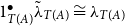 $1^\bullet_{T(A)}\tilde\lambda_{T(A)}\cong\lambda_{T(A)}$
. Then, given that a 2-cell component of the horizontal modification x is of the form
$1^\bullet_{T(A)}\tilde\lambda_{T(A)}\cong\lambda_{T(A)}$
. Then, given that a 2-cell component of the horizontal modification x is of the form $ T(\lambda_{A})\circ s_{I,A}\Rightarrow\lambda_{T(A)}$
, we set
$ T(\lambda_{A})\circ s_{I,A}\Rightarrow\lambda_{T(A)}$
, we set $x_A$
to be
$x_A$
to be $\tilde\lambda_{1^\bullet_{T(A)}}$
up to the conjugation by
$\tilde\lambda_{1^\bullet_{T(A)}}$
up to the conjugation by $l^{ T}$
(i.e. its inverse), similarly as in the construction of
$l^{ T}$
(i.e. its inverse), similarly as in the construction of $s_{f,g}$
above.
$s_{f,g}$
above.
To define the horizontal modification y with 2-cell components mapping $y_{A,B,C}:[s_{AB,C}\vert T(\alpha_{A,B,C})] \Rightarrow[\alpha_{A,B,T(C)}\vert As_{B,C}\vert s_{A,BC}]$
we define
$y_{A,B,C}:[s_{AB,C}\vert T(\alpha_{A,B,C})] \Rightarrow[\alpha_{A,B,T(C)}\vert As_{B,C}\vert s_{A,BC}]$
we define

Finally, we define the 2-cell components for a modification w by

The above horizontal action, that is, the pseudodouble functor $\triangleright:\mathbb{D}\times\mathbb{K} l( T)\to \mathbb{K} l( T)$
with horizontal equivalences
$\triangleright:\mathbb{D}\times\mathbb{K} l( T)\to \mathbb{K} l( T)$
with horizontal equivalences $\tilde\lambda,\tilde\alpha$
, and horizontal modifications
$\tilde\lambda,\tilde\alpha$
, and horizontal modifications $\tilde p, \tilde l, \tilde m$
, determines an action
$\tilde p, \tilde l, \tilde m$
, determines an action $\mathcal{H}(\triangleright):\mathcal{H}(\mathbb{D}) \times\mathcal{H}(\mathbb{K} l( T))\to \mathcal{H}(\mathbb{K} l( T))$
of the underlying bicategory
$\mathcal{H}(\triangleright):\mathcal{H}(\mathbb{D}) \times\mathcal{H}(\mathbb{K} l( T))\to \mathcal{H}(\mathbb{K} l( T))$
of the underlying bicategory $\mathcal{H}(\mathbb{D})$
on
$\mathcal{H}(\mathbb{D})$
on $\mathcal{H}(\mathbb{K} l( T))=\operatorname {Kl}(\mathcal{H}( T))$
. Also, the above horizontal icon
$\mathcal{H}(\mathbb{K} l( T))=\operatorname {Kl}(\mathcal{H}( T))$
. Also, the above horizontal icon $\theta:-\triangleright K(-)\Rightarrow K(-\otimes-)$
induces a bicategorical icon, that abusing notation we will denote the same way,
$\theta:-\triangleright K(-)\Rightarrow K(-\otimes-)$
induces a bicategorical icon, that abusing notation we will denote the same way, $\theta:-\triangleright K(-)\Rightarrow K(-\otimes-)$
. Finally, the identities (64), (65) and (66) already have a bicategorical form so that we have an extension of the canonical action of
$\theta:-\triangleright K(-)\Rightarrow K(-\otimes-)$
. Finally, the identities (64), (65) and (66) already have a bicategorical form so that we have an extension of the canonical action of $\mathcal{H}(\mathbb{D})$
on itself. By Paquet and Saville (Reference Paquet and Saville2023b, Theorem 1), Paquet and Saville (Reference Paquet and Saville2024, Theorem 7.2), this extension determines a left strength s on
$\mathcal{H}(\mathbb{D})$
on itself. By Paquet and Saville (Reference Paquet and Saville2023b, Theorem 1), Paquet and Saville (Reference Paquet and Saville2024, Theorem 7.2), this extension determines a left strength s on $\mathcal{H}(T)$
, whereby we spelled out the data
$\mathcal{H}(T)$
, whereby we spelled out the data $s_{f,g}, z,x,y,w$
for s explicitly (observe that they are all globular 2-cells). Since a bicategorical strength satisfies the same axioms as a horizontal double categorical strength (in the form of 2-cell components of horizontal modifications, see Definition 10.13, b), c)), and we proved above that s is a horizontal pseudonatural transformation, we have that s is a left horizontal strength on T.
$s_{f,g}, z,x,y,w$
for s explicitly (observe that they are all globular 2-cells). Since a bicategorical strength satisfies the same axioms as a horizontal double categorical strength (in the form of 2-cell components of horizontal modifications, see Definition 10.13, b), c)), and we proved above that s is a horizontal pseudonatural transformation, we have that s is a left horizontal strength on T.
In this subsection, we have thus proved that given a horizontal monad T on a double category $\mathbb{D}$
, a horizontal extension
$\mathbb{D}$
, a horizontal extension $\triangleright:\mathbb{D}\times\mathbb{K} l( T)\to \mathbb{K} l( T)$
(with a horizontal icon
$\triangleright:\mathbb{D}\times\mathbb{K} l( T)\to \mathbb{K} l( T)$
(with a horizontal icon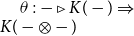 $\theta:-\triangleright K(-)\Rightarrow K(-\otimes-)$
) of the canonical action of
$\theta:-\triangleright K(-)\Rightarrow K(-\otimes-)$
) of the canonical action of $\mathbb{D}$
on itself induces a left horizontal strength on T. In view of Theorem 10.30 we may claim:
$\mathbb{D}$
on itself induces a left horizontal strength on T. In view of Theorem 10.30 we may claim:
Theorem 10.32. Let $(\mathbb{D}, \otimes, \alpha, \lambda, \rho)$
be a horizontally monoidal double category and let S be a horizontal double monad on
$(\mathbb{D}, \otimes, \alpha, \lambda, \rho)$
be a horizontally monoidal double category and let S be a horizontal double monad on $\mathbb{D}$
. There is a one-to-one correspondence between horizontal strengths on S and extensions of the canonical action of
$\mathbb{D}$
. There is a one-to-one correspondence between horizontal strengths on S and extensions of the canonical action of $\mathbb{D}$
on itself (given by horizontal actions
$\mathbb{D}$
on itself (given by horizontal actions $\triangleright:\mathbb{D}\times\mathbb{K} l(S)\to \mathbb{K} l(S)$
and horizontal icons
$\triangleright:\mathbb{D}\times\mathbb{K} l(S)\to \mathbb{K} l(S)$
and horizontal icons $\theta:-\triangleright K(-)\Rightarrow K(-\otimes-)$
).
$\theta:-\triangleright K(-)\Rightarrow K(-\otimes-)$
).
The above result obviously applies to a monoidal double category with liftable $\alpha, \lambda, \rho$
and a vertical double monad T with invertible liftable transformations
$\alpha, \lambda, \rho$
and a vertical double monad T with invertible liftable transformations $\mu, \eta$
considering
$\mu, \eta$
considering $S=\hat{T}$
. However, although in Theorem 10.18, we constructed a horizontal extension out of a vertical strength on such T, the converse is not possible to construct, as we cannot obtain a liftable strict invertible vertical transformation t such that
$S=\hat{T}$
. However, although in Theorem 10.18, we constructed a horizontal extension out of a vertical strength on such T, the converse is not possible to construct, as we cannot obtain a liftable strict invertible vertical transformation t such that $\hat{t}=s$
, where s is a horizontal pseudonatural transformation obtained in this subsection. Assuming that the 1h-cells
$\hat{t}=s$
, where s is a horizontal pseudonatural transformation obtained in this subsection. Assuming that the 1h-cells $s_{A,B}$
are companions of some 1v-cells
$s_{A,B}$
are companions of some 1v-cells $t_{A,B}$
, similarly as in part 1. of Proposition 2.14 one can construct an invertible vertical transformation t so that
$t_{A,B}$
, similarly as in part 1. of Proposition 2.14 one can construct an invertible vertical transformation t so that $\hat{t}=s$
(see Femić (Reference Femić2024, Proposition 4.2)). Though, there is no way to obtain the strictness for t, necessary for t to be a vertical strength.
$\hat{t}=s$
(see Femić (Reference Femić2024, Proposition 4.2)). Though, there is no way to obtain the strictness for t, necessary for t to be a vertical strength.
Likewise, horizontal pseudonatural transformations $\tilde\alpha, \tilde\lambda$
in a horizontal action do not yield the corresponding invertible vertical strict transformations, so we cannot obtain a vertical action out of a horizontal one. An easy but insignificant part that works is that by assuming that the horizontal icon
$\tilde\alpha, \tilde\lambda$
in a horizontal action do not yield the corresponding invertible vertical strict transformations, so we cannot obtain a vertical action out of a horizontal one. An easy but insignificant part that works is that by assuming that the horizontal icon $\theta$
in a horizontal extension has trivial square-formed 2-cell components
$\theta$
in a horizontal extension has trivial square-formed 2-cell components $\theta^{u,v}$
, by Lemma 10.23 it determines a vertical icon
$\theta^{u,v}$
, by Lemma 10.23 it determines a vertical icon $-\triangleright K(-)\Rightarrow K(-\otimes-)$
.
$-\triangleright K(-)\Rightarrow K(-\otimes-)$
.
10.5 Bistrong monads yield premonoidal Kleisli double categories
As several times so far, we can define three versions of the notion of a bistrength: a vertical one, a so-to-say “square” or “mixed” one, and a horizontal one, where the vertical one induces the other two, assuming that both left and right strength are given by invertible liftable vertical transformations.
Given a monoidal double category $(\mathbb{D},\otimes,\alpha,\lambda,\rho)$
and a vertical double monad T on
$(\mathbb{D},\otimes,\alpha,\lambda,\rho)$
and a vertical double monad T on $\mathbb{D}$
. Assume that t and s are a left and a right vertical strength on T and that they are invertible liftable vertical transformations. We say that (T,t,s) is vertically bistrong if there is an identity vertical modification q, and similarly that
$\mathbb{D}$
. Assume that t and s are a left and a right vertical strength on T and that they are invertible liftable vertical transformations. We say that (T,t,s) is vertically bistrong if there is an identity vertical modification q, and similarly that $(T,\hat{t},\hat{s})$
is (mixed) bistrong if there is a modification in the sense of Definition 2.7 with components
$(T,\hat{t},\hat{s})$
is (mixed) bistrong if there is a modification in the sense of Definition 2.7 with components

(we denote it by $q^*$
alluding to Proposition 2.23), which satisfies the two axioms analogous to those of Paquet and Saville (Reference Paquet and Saville2024, Figure 6) (they stand for compatibility of
$q^*$
alluding to Proposition 2.23), which satisfies the two axioms analogous to those of Paquet and Saville (Reference Paquet and Saville2024, Figure 6) (they stand for compatibility of $q^*$
with
$q^*$
with $z^*$
and
$z^*$
and $w^*$
).
$w^*$
).
It is immediate that a (vertically or mixed) bistrong vertical monad T induces a bistrong horizontal monad $\hat{T}$
with the defining horizontal modification
$\hat{T}$
with the defining horizontal modification $\hat{q}$
satisfying the same axioms as in Paquet and Saville (Reference Paquet and Saville2024, Figure 6).
$\hat{q}$
satisfying the same axioms as in Paquet and Saville (Reference Paquet and Saville2024, Figure 6).
Let a bistrong vertical double monad (T,t,s) on a monoidal double category $(\mathbb{D},\otimes,\alpha,\lambda,\rho)$
be given, and assume that
$(\mathbb{D},\otimes,\alpha,\lambda,\rho)$
be given, and assume that $\alpha,\lambda,\rho, \,\, t,s,\,\, \mu,\eta$
are invertible liftable vertical transformations. By Theorem 10.18, we have that t and similarly s induce a left and a right horizontal actions
$\alpha,\lambda,\rho, \,\, t,s,\,\, \mu,\eta$
are invertible liftable vertical transformations. By Theorem 10.18, we have that t and similarly s induce a left and a right horizontal actions $\triangleright:\mathbb{D}\times\mathbb{K} l(\hat{T})\to \mathbb{K} l(\hat{T})$
and
$\triangleright:\mathbb{D}\times\mathbb{K} l(\hat{T})\to \mathbb{K} l(\hat{T})$
and $\triangleleft:\mathbb{K} l(\hat{T})\times\mathbb{D}\to \mathbb{K} l(\hat{T})$
, respectively. The accompanying horizontal equivalences are induced by invertible vertical strict transformations that we denote as
$\triangleleft:\mathbb{K} l(\hat{T})\times\mathbb{D}\to \mathbb{K} l(\hat{T})$
, respectively. The accompanying horizontal equivalences are induced by invertible vertical strict transformations that we denote as
 $$\tilde\alpha_{A,B,E}^L:(A\otimes B)\triangleright E\to A\triangleright(B\triangleright E), \qquad \tilde\alpha_{W,X,Y}^R:(W\triangleleft X)\triangleleft Y\to W\triangleleft(X\otimes Y)$$
 $$\tilde\lambda_E: I\triangleright E\to E\qquad \text{and}\qquad \tilde\rho_W: W\triangleleft I\to W$$
where $A,B,X,Y\in\mathbb{D}$
and
$A,B,X,Y\in\mathbb{D}$
and $E,W\in\mathbb{K} l(\hat{T})$
, with their respective horizontal modifications
$E,W\in\mathbb{K} l(\hat{T})$
, with their respective horizontal modifications $\tilde p^L, \tilde m^L, \tilde l$
and
$\tilde p^L, \tilde m^L, \tilde l$
and $\tilde p^R, \tilde m^R, \tilde r$
.
$\tilde p^R, \tilde m^R, \tilde r$
.
We will say that these two (underlying vertical) actions are compatible if
-
•
$\tilde\alpha_{A,B,C}^L=\tilde\alpha_{A,B,C}^R$
for
$A,B,C\in\mathbb{D}$
, and -
•
$\tilde p_{A,B,C,D}^L=\tilde p_{A,B,C,D}^R$
and
$\tilde m_{A,B}^L=\tilde m_{A,B}^R$
.
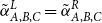



We now may prove:
Theorem 10.33. Let (T,t,s) be a bistrong vertical double monad on a monoidal double category $\mathbb{D}$
so that the vertical transformations
$\mathbb{D}$
so that the vertical transformations $\alpha, \lambda, \rho,t,s,\mu,\eta$
are invertible and liftable. Then, the Kleisli pseudodouble category
$\alpha, \lambda, \rho,t,s,\mu,\eta$
are invertible and liftable. Then, the Kleisli pseudodouble category $\mathbb{K} l(\hat{T})$
is premonoidal.,
$\mathbb{K} l(\hat{T})$
is premonoidal.,
Proof. We define a binoidal structure on $\mathbb{K} l(\hat{T})$
by setting
$\mathbb{K} l(\hat{T})$
by setting
 $$A\ltimes g^K:=(A\otimes B\stackrel{A\otimes g}{\to }A\otimes T(B') \stackrel{\hat{t}_{A,B'}}{\to }T(A\otimes B'))$$
 $$f^K\rtimes B:=(A\otimes B\stackrel{f\otimes B}{\to }T(A')\otimes B \stackrel{\hat{s}_{A',B}}{\to }T(A'\otimes B))$$
for 1h-cells $f^K:A\to A'$
and
$f^K:A\to A'$
and $g^K:B\to B'$
in
$g^K:B\to B'$
in $\mathbb{K} l(\hat{T})$
. That thus defined assignments
$\mathbb{K} l(\hat{T})$
. That thus defined assignments $A\ltimes-, -\rtimes B:\mathbb{K} l(\hat{T})\to \mathbb{K} l(\hat{T})$
determine pseudodouble functors is proved analogously as for
$A\ltimes-, -\rtimes B:\mathbb{K} l(\hat{T})\to \mathbb{K} l(\hat{T})$
determine pseudodouble functors is proved analogously as for $\triangleright$
of Theorem 10.18. (We also have invertible vertical strict transformations
$\triangleright$
of Theorem 10.18. (We also have invertible vertical strict transformations $\tilde\alpha^L, \tilde\alpha^R$
and
$\tilde\alpha^L, \tilde\alpha^R$
and $\tilde\lambda, \tilde\rho$
, as we commented above.) We now define three
$\tilde\lambda, \tilde\rho$
, as we commented above.) We now define three $\overline\alpha$
’s as in Definition 3.10 which should live in
$\overline\alpha$
’s as in Definition 3.10 which should live in $\mathbb{K} l(\hat{T})$
. We set:
$\mathbb{K} l(\hat{T})$
. We set:
 $$\overline\alpha_{-,B,C}:=\tilde\alpha^R_{-,B,C}: (-\rtimes B)\rtimes C\Rightarrow -\rtimes(B\bowtie C)$$
 $$\overline\alpha_{A,B,-}:=\tilde\alpha^L_{A,B,-}: (A\bowtie B)\ltimes -\Rightarrow A\ltimes(B\ltimes -)$$
 $$\hspace{-1cm}\overline\alpha_{A,-,C}:(A\ltimes -)\rtimes C\Rightarrow A\ltimes(-\rtimes C)$$
where the latter we define by $\overline\alpha_{A,g,C}:=[\alpha_{A,g,C}\,\vert\, q^*_{A,B',C}]$
and
$\overline\alpha_{A,g,C}:=[\alpha_{A,g,C}\,\vert\, q^*_{A,B',C}]$
and $\overline\alpha_{A,v,C}:=\alpha_{A,v,C}$
at a 1h-cell g and a 1v-cell v. We already know that
$\overline\alpha_{A,v,C}:=\alpha_{A,v,C}$
at a 1h-cell g and a 1v-cell v. We already know that $\tilde\alpha^R_{-,B,C}$
and
$\tilde\alpha^R_{-,B,C}$
and $\tilde\alpha^L_{A,B,-}$
are invertible vertical strict transformations, and similarly so is
$\tilde\alpha^L_{A,B,-}$
are invertible vertical strict transformations, and similarly so is $[\alpha_{A,-,C}\,\vert\, q^*_{A,-,C}]$
. For
$[\alpha_{A,-,C}\,\vert\, q^*_{A,-,C}]$
. For $\overline\lambda: I\ltimes -\Rightarrow\operatorname {Id}$
and
$\overline\lambda: I\ltimes -\Rightarrow\operatorname {Id}$
and $\overline\rho: -\rtimes I\to \operatorname {Id}$
we set to be
$\overline\rho: -\rtimes I\to \operatorname {Id}$
we set to be $\tilde\lambda: I\triangleright -\Rightarrow\operatorname {Id}$
and
$\tilde\lambda: I\triangleright -\Rightarrow\operatorname {Id}$
and $\tilde\rho: -\triangleleft I\Rightarrow \operatorname {Id}$
.
$\tilde\rho: -\triangleleft I\Rightarrow \operatorname {Id}$
.
Observe that 1v-cell components of the three $\overline\alpha$
’s are all equal to
$\overline\alpha$
’s are all equal to $\alpha_{A,B,C}$
(of
$\alpha_{A,B,C}$
(of $\mathbb{D}$
), thus the first condition for the left and the right actions of
$\mathbb{D}$
), thus the first condition for the left and the right actions of $\mathbb{D}$
on
$\mathbb{D}$
on $\mathbb{K} l(\hat{T})$
to be compatible is fulfilled. We also have that the 1v-cell components of
$\mathbb{K} l(\hat{T})$
to be compatible is fulfilled. We also have that the 1v-cell components of $\overline\lambda$
and
$\overline\lambda$
and $\overline\rho$
are equal to the 1v-cells
$\overline\rho$
are equal to the 1v-cells $\lambda_A$
and
$\lambda_A$
and $\rho_A$
. We have that they and
$\rho_A$
. We have that they and $\alpha_{A,B,C}$
are invertible, we are now going to make them inversely central. We define
$\alpha_{A,B,C}$
are invertible, we are now going to make them inversely central. We define

(the right-most 2-cells of the form $\hat{t}^u$
and
$\hat{t}^u$
and $\hat{s}^u$
are obtained from Proposition 2.14, part 1. c)). It is directly proved that these make
$\hat{s}^u$
are obtained from Proposition 2.14, part 1. c)). It is directly proved that these make $\alpha_{A,B,C}\ltimes-$
and
$\alpha_{A,B,C}\ltimes-$
and $-\rtimes\alpha_{B,C,D}$
invertible vertical strict transformations, so that the 1-cell
$-\rtimes\alpha_{B,C,D}$
invertible vertical strict transformations, so that the 1-cell $\alpha_{A,B,C}$
is central (one uses (h.o.t.-5) for
$\alpha_{A,B,C}$
is central (one uses (h.o.t.-5) for $\hat{t}$
and
$\hat{t}$
and $\hat{s}$
and modification axioms for
$\hat{s}$
and modification axioms for $\hat{w}$
and
$\hat{w}$
and $\hat{z}$
). They are obviously inversely central. The construction and proof of inverse centrality for
$\hat{z}$
). They are obviously inversely central. The construction and proof of inverse centrality for $\tilde\lambda_A$
and
$\tilde\lambda_A$
and $\tilde\rho_A$
are similar.
$\tilde\rho_A$
are similar.
It remains to check the four pentagons and six triangles for a premonoidal structure. We first observe that 2-cell components of the three $\overline\alpha$
’s comprising the pentagons are given by:
$\overline\alpha$
’s comprising the pentagons are given by:

for 1h-cells f,g,h as usual. Given that the 1v-cells $\alpha_{A,B,C}$
are invertible, by Lemma 2.24 the above appearing 2-cell components of
$\alpha_{A,B,C}$
are invertible, by Lemma 2.24 the above appearing 2-cell components of $y^*, q^*, (y')^*$
are invertible, hence so are
$y^*, q^*, (y')^*$
are invertible, hence so are $\overline\alpha_{A,B,h}, \overline\alpha_{A,g,C},\overline\alpha_{f,B,C}$
. Before going on, at this point, we note the following. Recall from the end of the proof of Theorem 10.18 that both
$\overline\alpha_{A,B,h}, \overline\alpha_{A,g,C},\overline\alpha_{f,B,C}$
. Before going on, at this point, we note the following. Recall from the end of the proof of Theorem 10.18 that both $\tilde p^L$
and
$\tilde p^L$
and $\tilde p^R$
, we took to be the identity vertical modification p from
$\tilde p^R$
, we took to be the identity vertical modification p from $\mathbb{D}$
, and similarly, for
$\mathbb{D}$
, and similarly, for $\tilde m^L$
and
$\tilde m^L$
and $\tilde m^R$
we took to be m from
$\tilde m^R$
we took to be m from $\mathbb{D}$
. Thus also the second condition for the left and the right actions of
$\mathbb{D}$
. Thus also the second condition for the left and the right actions of $\mathbb{D}$
on
$\mathbb{D}$
on $\mathbb{K} l(\hat{T})$
to be compatible is fulfilled.
$\mathbb{K} l(\hat{T})$
to be compatible is fulfilled.
Now, each of the four pentagons becomes an equation of vertical compositions of horizontal compositions of 2-cell components, where these horizontal compositions have some of the following four forms:
 $$[\alpha_{f,B,C}\otimes D\,\,\vert\,\, (y')^*_{A',B,C}\otimes D\,\,\vert\,\,\hat{s}^{\alpha_{A',B,C},1_D}]$$
 $$[\alpha_{f,BC,D}\,\,\vert\,\, (y')^*_{A',BC,D}]$$
 $$[\operatorname {Id}_f\otimes\alpha_{1_B,1_C,1_D}\,\,\vert\,\, \hat{s}^{1_{A'},\alpha_{B,C,D}}]$$
 $$[\alpha_{fB,C,D}\,\,\vert\,\, \alpha_{\hat{s}_{A',B},C,D}\,\,\vert\,\, (y')^*_{A'B,C,D}]$$
with the following variations:
-
• instead of
$-\otimes D$
there appears
$A\otimes-$
, -
• instead of
$(y')^*$
there appears
$y^*$
or
$q^*$
, -
• instead of
$\hat{s}$
there appears
$\hat{t}$
, -
• instead of
$\alpha_{f,BC,D}$
there can be any of:
$\alpha_{f,B,CD}, \alpha_{A,g,CD},\alpha_{AB,h,D}, \alpha_{A,BC,k}, \alpha_{AB,C,k}$
, and -
• instead of
$\alpha_{fB,C,D}$
there can be any of:
$\alpha_{A,gC,D}, \alpha_{Ag,C,D}, \alpha_{A,Bh,D}, \alpha_{A,B,hD}, \alpha_{A,B,Ck}$





(with 1h-cells $f:A\to A', g:B\to B', h:C\to C', k:D\to D'$
in
$f:A\to A', g:B\to B', h:C\to C', k:D\to D'$
in $\mathbb{D}$
). In the above described vertical compositions at some places, there also appear 2-cells (compositors) for the lax and the colax pseudodouble functor structure of
$\mathbb{D}$
). In the above described vertical compositions at some places, there also appear 2-cells (compositors) for the lax and the colax pseudodouble functor structure of $\otimes$
. Although it would be very tedious to check that such pentagon-equations hold, the argument that we have at hand is simple. At the first place, in each of the four pentagon-equations, to the most left, on both sides of the equations, in all the rows of the pasted diagrams, there is a 2-cell component of
$\otimes$
. Although it would be very tedious to check that such pentagon-equations hold, the argument that we have at hand is simple. At the first place, in each of the four pentagon-equations, to the most left, on both sides of the equations, in all the rows of the pasted diagrams, there is a 2-cell component of $\alpha$
. When we first compose vertically these 2-cell components of
$\alpha$
. When we first compose vertically these 2-cell components of $\alpha$
(and then we compose this vertical composition horizontally with the rest of the pasting diagrams, i.e. 2-cells, in both sides of the four pentagon-equations, which is allowed by the strict interchange law holding in double categories), we find the single pentagon-equation for
$\alpha$
(and then we compose this vertical composition horizontally with the rest of the pasting diagrams, i.e. 2-cells, in both sides of the four pentagon-equations, which is allowed by the strict interchange law holding in double categories), we find the single pentagon-equation for $\alpha$
of
$\alpha$
of $\mathbb{D}$
that we know that holds. Then we cancel out the first columns in both sides of every of the four pentagon-equations.
$\mathbb{D}$
that we know that holds. Then we cancel out the first columns in both sides of every of the four pentagon-equations.
In the remaining part, there appear (vertical and horizontal) compositions of 2-cells of the form $(y')^*_{A',B,C}\otimes D, \,\, \hat{s}^{\alpha_{A',B,C},1_D}, \,\, (y')^*_{A',BC,D}, \,\, \alpha_{\hat{s}_{A',B},C,D}$
(and their announced variations). We make several observations.
$(y')^*_{A',B,C}\otimes D, \,\, \hat{s}^{\alpha_{A',B,C},1_D}, \,\, (y')^*_{A',BC,D}, \,\, \alpha_{\hat{s}_{A',B},C,D}$
(and their announced variations). We make several observations.
-
(1) The 2-cell components of the modifications
$y^*, (y')^*, q^*$
originate from 2-cell components of the identity vertical modifications y,y’,q and are in 1-1 correspondence with the 2-cell components of the corresponding horizontal modifications
$\hat{y}, \hat{y}', \hat{q}$
(see Proposition 2.23). -
(2) The 2-cells of the form
$\hat{s}^u, \hat{t}^u$
are in 1-1 correspondence with the vertically globular 2-cells
$s^u, t^u$
(this is similar to Proposition 2.23), and these in turn are in 1-1 correspondence with the horizontally globular 2-cells
$\hat{s}_{\hat{u}}, \hat{t}_{\hat{u}}$
(as in Proposition 2.22). -
(3) The 2-cells of the form
$\alpha_{\hat{u}}$
are in 1-1 correspondence with the horizontally globular 2-cells
$\hat{\alpha}_{\hat{u}}$
.


Now, by Lemma 2.20, the 2-cells $\hat{s}_{\hat{u}}, \hat{t}_{\hat{u}}$
and
$\hat{s}_{\hat{u}}, \hat{t}_{\hat{u}}$
and $\hat{\alpha}_{\hat{u}}$
(as in 2. and 3.) are of
$\hat{\alpha}_{\hat{u}}$
(as in 2. and 3.) are of $\theta$
type, and by Lemma 2.19, so are the 2-cell components of
$\theta$
type, and by Lemma 2.19, so are the 2-cell components of $\hat{y}, \hat{y}', \hat{q}$
(from 1.).
$\hat{y}, \hat{y}', \hat{q}$
(from 1.).
At last, the 2-cells $(y')^*\otimes D, y^*\otimes D, A\otimes q^*$
, (i.e., the corresponding 2-cell components of them) actually appear vertically composed to the compositors of the lax, colax and both lax and colax pseudodouble functor structures of
$(y')^*\otimes D, y^*\otimes D, A\otimes q^*$
, (i.e., the corresponding 2-cell components of them) actually appear vertically composed to the compositors of the lax, colax and both lax and colax pseudodouble functor structures of $-\otimes D$
i.e.
$-\otimes D$
i.e. $A\otimes-$
, respectively. As a matter of fact, all of the appearances of the compositors that we mentioned earlier above can be attached to some of these 2-cells (or their variations), and for these vertical composite 2-cells we have
$A\otimes-$
, respectively. As a matter of fact, all of the appearances of the compositors that we mentioned earlier above can be attached to some of these 2-cells (or their variations), and for these vertical composite 2-cells we have
Lemma 10.34. Let $\omega_1^*, \omega_2^*, \omega_3^*$
be three 2-cells as below induced as in Proposition 2.23 with liftable 1v-cells l,r and so that all the indicated 1-cells are nontrivial.
$\omega_1^*, \omega_2^*, \omega_3^*$
be three 2-cells as below induced as in Proposition 2.23 with liftable 1v-cells l,r and so that all the indicated 1-cells are nontrivial.

Let $F:\mathbb{D}\to \mathbb{D}$
be a pseudodouble functor and consider the composite 2-cells
$F:\mathbb{D}\to \mathbb{D}$
be a pseudodouble functor and consider the composite 2-cells
 $$\xi_1^*=\frac{F_{\hat{u},\hat{v}}}{F(\omega_1^*)}, \qquad \xi_2^*=\frac{F(\omega_2^*)}{F_{\hat{u}',\hat{v}'}^{-1}}, \qquad \xi_3^*=\begin{array}{@{\,}c@{\,}}F_{\hat{u},\hat{v}}\\ \hline F(\omega_3^*)\\ \hline F_{\hat{u}',\hat{v}'}^{-1} \end{array}$$
where $F_{\hat{u},\hat{v}}$
and
$F_{\hat{u},\hat{v}}$
and $F_{\hat{u},\hat{v}}^{-1}$
present the laxity and the colaxity compositor, respectively. Then, the horizontally globular 2-cells
$F_{\hat{u},\hat{v}}^{-1}$
present the laxity and the colaxity compositor, respectively. Then, the horizontally globular 2-cells $\hat{\xi}_1, \hat{\xi}_2, \hat{\xi}_3$
(as in Proposition 2.22) are
$\hat{\xi}_1, \hat{\xi}_2, \hat{\xi}_3$
(as in Proposition 2.22) are $\theta$
2-cell isomorphisms.
$\theta$
2-cell isomorphisms.
Proof. First of all, observe that the 1-cells on the edges of $\xi_1^*,\xi_2^*,\xi_3^*$
are compositions of the same type as in
$\xi_1^*,\xi_2^*,\xi_3^*$
are compositions of the same type as in $\omega_1^*,\omega_2^*,\omega_3^*$
. The domain and codomain 1h-cells of
$\omega_1^*,\omega_2^*,\omega_3^*$
. The domain and codomain 1h-cells of $\hat{\xi}_1$
are as indicated:
$\hat{\xi}_1$
are as indicated: $[F(\hat{u})\,\,\vert\,\, F(\hat{v})\,\,\vert\,\, \widehat{F(r)}]\Rightarrow [\widehat{F(l)}\,\,\vert\,\,F(\hat{w})]$
. By Proposition 2.21, 6a) and 2) the domain and codomain of
$[F(\hat{u})\,\,\vert\,\, F(\hat{v})\,\,\vert\,\, \widehat{F(r)}]\Rightarrow [\widehat{F(l)}\,\,\vert\,\,F(\hat{w})]$
. By Proposition 2.21, 6a) and 2) the domain and codomain of $\hat{\xi}_1$
are companions of
$\hat{\xi}_1$
are companions of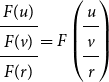 $\begin{array}{@{\,}c@{\,}}F(u)\\ \hline F(v)\\ \hline F(r) \end{array}=F\left(\begin{array}{@{\,}c@{\,}}u\\ \hline v\\ \hline r \end{array}\right)$
and
$\begin{array}{@{\,}c@{\,}}F(u)\\ \hline F(v)\\ \hline F(r) \end{array}=F\left(\begin{array}{@{\,}c@{\,}}u\\ \hline v\\ \hline r \end{array}\right)$
and $F(\frac{l}{w})$
, respectively, and these are equal because of the identity vertically globular 2-cell
$F(\frac{l}{w})$
, respectively, and these are equal because of the identity vertically globular 2-cell $\omega_1$
. Thus, there is a
$\omega_1$
. Thus, there is a $\theta$
2-cell between the domain and codomain of
$\theta$
2-cell between the domain and codomain of $\hat{\xi}_1$
. Now as in the proof of Lemma 2.20, substituting
$\hat{\xi}_1$
. Now as in the proof of Lemma 2.20, substituting $\theta$
in (5) by
$\theta$
in (5) by $\hat{\xi}_1$
, applying (lx.f.c-nat) and the assignment
$\hat{\xi}_1$
, applying (lx.f.c-nat) and the assignment $\hat{\omega}\mapsto\omega$
from Proposition 2.22, one sees that (5) holds, hence
$\hat{\omega}\mapsto\omega$
from Proposition 2.22, one sees that (5) holds, hence $\hat{\xi}_1$
is a
$\hat{\xi}_1$
is a $\theta$
isomorphism. The proof for
$\theta$
isomorphism. The proof for $\hat{\xi}_2, \hat{\xi}_3$
is similar.
$\hat{\xi}_2, \hat{\xi}_3$
is similar.
Coming back to the proof of Theorem 10.33: the composites of (the 2-cell components of) $(y')^*\otimes D, y^*\otimes D, A\otimes q^*$
with the corresponding compositors are of the form of
$(y')^*\otimes D, y^*\otimes D, A\otimes q^*$
with the corresponding compositors are of the form of $\xi^*_1, \xi^*_2, \xi^*_3$
from the lemma, and so they are in 1-1 correspondence with
$\xi^*_1, \xi^*_2, \xi^*_3$
from the lemma, and so they are in 1-1 correspondence with $\theta$
isomorphisms (and the same holds for their variations).
$\theta$
isomorphisms (and the same holds for their variations).
Now the same reasoning as in the proof of part 3. of Proposition 2.23 applies here to finalize the proof. Those four types of 2-cells $(y')^*_{A',B,C}\otimes D, \,\, \hat{s}^{\alpha_{A',B,C},1_D}, \,\, (y')^*_{A',BC,D}, \,\, \alpha_{\hat{s}_{A',B},C,D}$
we express - using the respective 1-1 correspondences – in terms of their corresponding
$(y')^*_{A',B,C}\otimes D, \,\, \hat{s}^{\alpha_{A',B,C},1_D}, \,\, (y')^*_{A',BC,D}, \,\, \alpha_{\hat{s}_{A',B},C,D}$
we express - using the respective 1-1 correspondences – in terms of their corresponding $\theta$
isomorphisms. Any of the four pentagon equations
$\theta$
isomorphisms. Any of the four pentagon equations $E_i^*, i=1,2,3,4$
gets the form
$E_i^*, i=1,2,3,4$
gets the form $\begin{array}{@{\,}c@{\,}}[\operatorname {Id}\vert\iota]\\ \hline \hat{E}_i\\ \hline [\varepsilon\vert\operatorname {Id}] \end{array}$
, i.e.
$\begin{array}{@{\,}c@{\,}}[\operatorname {Id}\vert\iota]\\ \hline \hat{E}_i\\ \hline [\varepsilon\vert\operatorname {Id}] \end{array}$
, i.e. $[\operatorname {Id}\vert\iota]$
and
$[\operatorname {Id}\vert\iota]$
and $[\varepsilon\vert\operatorname {Id}]$
are composed to both sides of
$[\varepsilon\vert\operatorname {Id}]$
are composed to both sides of $\hat{E}_i$
, where
$\hat{E}_i$
, where $\hat{E}_i$
is an equation as in Proposition 2.22, part 3. Since by Proposition 2.22 the equations
$\hat{E}_i$
is an equation as in Proposition 2.22, part 3. Since by Proposition 2.22 the equations $\hat{E}_i,i=1,2,3,4$
hold true, the four pentagon-equations are also fulfilled.
$\hat{E}_i,i=1,2,3,4$
hold true, the four pentagon-equations are also fulfilled.
The proof for the six triangles is similar.
The above proof offers a great evidence of the advantage of working in a double categorical setting in the cases that the assumption on the existence of the appropriate companions is fulfilled. We were spared of the tedious checking that the four pentagons and six triangles commute. Instead, we had to take an account on the type of the 2-cells involved in the pasted diagrams constituting the equation/axiom in question, and make sure that they all come as companion-lifts of vertically globular 2-cells that are identities. The rest flows by Lemma 2.18, Proposition 2.22, and Proposition 2.23. Having carried out this easier and shorter task, we are then also able to draw the desired consequences for (underlying) bicategories (recall Theorem 10.14 and Proposition 3.15):
Corollary 10.35. Under the assumptions of Theorem 10.33, $\mathcal{H}(\hat{T})$
is a bistrong pseudomonad on
$\mathcal{H}(\hat{T})$
is a bistrong pseudomonad on $\mathcal{H}(\mathbb{D})$
, and the Kleisli bicategory
$\mathcal{H}(\mathbb{D})$
, and the Kleisli bicategory $\mathcal{H}(\mathbb{K} l(\hat{T}))=\operatorname {Kl}(\mathcal{H}(\hat{T}))$
is premonoidal.
$\mathcal{H}(\mathbb{K} l(\hat{T}))=\operatorname {Kl}(\mathcal{H}(\hat{T}))$
is premonoidal.
This is a double categorical version of Paquet and Saville (Reference Paquet and Saville2023b, Theorem 2 on page 21), Paquet and Saville (Reference Paquet and Saville2024, Proposition 5.10) and simplifies its proof. The relation between the two is as follows. If we are given a bistrong pseudomonad S on a monoidal bicategory $\mathcal{B}$
that comes from a vertically bistrong vertical double monad T on a monoidal double category
$\mathcal{B}$
that comes from a vertically bistrong vertical double monad T on a monoidal double category $\mathbb{B}$
, then by Corollary 10.35 the Kleisli bicategory
$\mathbb{B}$
, then by Corollary 10.35 the Kleisli bicategory $\operatorname {Kl}(S)$
is premonoidal. We explain in more details what it means for S and
$\operatorname {Kl}(S)$
is premonoidal. We explain in more details what it means for S and $\mathcal{B}$
to come from T and
$\mathcal{B}$
to come from T and $\mathbb{B}$
. Namely, that given a bistrong pseudomonad
$\mathbb{B}$
. Namely, that given a bistrong pseudomonad $(S, \mu_1, \eta_1)$
with a left and a right strength
$(S, \mu_1, \eta_1)$
with a left and a right strength $s_l, s_r$
on a monoidal bicategory
$s_l, s_r$
on a monoidal bicategory $(\mathcal{B}, \otimes_1, \alpha_1, \lambda_1, \rho_1)$
, we can find a monoidal double category
$(\mathcal{B}, \otimes_1, \alpha_1, \lambda_1, \rho_1)$
, we can find a monoidal double category $(\mathbb{B}, \otimes, \alpha, \lambda, \rho)$
and a vertically bistrong vertical double monad
$(\mathbb{B}, \otimes, \alpha, \lambda, \rho)$
and a vertically bistrong vertical double monad $(T, \mu, \eta)$
on
$(T, \mu, \eta)$
on $\mathbb{B}$
, with a left vertical strength
$\mathbb{B}$
, with a left vertical strength $t_l$
and a right vertical strength
$t_l$
and a right vertical strength $t_r$
, so that
$t_r$
, so that $\alpha, \lambda, \rho$
and
$\alpha, \lambda, \rho$
and $\mu, \eta, t_l, t_r$
are invertible liftable vertical transformations, and so that
$\mu, \eta, t_l, t_r$
are invertible liftable vertical transformations, and so that $\mathcal{H}((\mathbb{B}, \otimes, \hat{\alpha}, \hat{\lambda}, \hat{\rho}))=(\mathcal{B}, \otimes_1, \alpha_1, \lambda_1, \rho_1)$
and
$\mathcal{H}((\mathbb{B}, \otimes, \hat{\alpha}, \hat{\lambda}, \hat{\rho}))=(\mathcal{B}, \otimes_1, \alpha_1, \lambda_1, \rho_1)$
and $\mathcal{H}((\hat{T}, \hat{\mu}, \hat{\eta}, \hat{t}_l, \hat{t}_r))=(S, \mu_1, \eta_1, s_l, s_r)$
.
$\mathcal{H}((\hat{T}, \hat{\mu}, \hat{\eta}, \hat{t}_l, \hat{t}_r))=(S, \mu_1, \eta_1, s_l, s_r)$
.
A fully horizontal version of Theorem 10.33 is possible. Namely, that for a bistrong horizontal double monad S on a horizontally monoidal double category $\mathbb{D}$
the Kleisli pseudodouble category
$\mathbb{D}$
the Kleisli pseudodouble category $\mathbb{K} l(S)$
is premonoidal in a sense not studied in this paper: where the premonoidality constraints are horizontal pseudonatural transformations. Though, this perspective is out of the interest here.
$\mathbb{K} l(S)$
is premonoidal in a sense not studied in this paper: where the premonoidality constraints are horizontal pseudonatural transformations. Though, this perspective is out of the interest here.
In conclusion, by working in a setting of double categories, by means of lifting the vertical structures, which are simpler and possess less data, to the horizontal ones, one may obtain results concerning horizontal or mixed structures (expressed by nonglobular 2-cells), analogous to those known in bicategories, with the benefit of passing through significantly less laborous proofs. This is possible under the assumption that the suitable vertical transformations are invertible and liftable, meaning that their vertical 1-cell components are have companions.
Acknowledgements
The author thanks to Hugo Paquet and Philip Saville for nice conversations and comments regarding
their construction, to Silvia Ghilezan for helping me understand logical expressions in Levy and Staton (Reference Levy and Staton2013), and above all,
my sincere and deep thanks to the referee for his great devotion to my article and inspiring and constructive critiques to the
previous versions of the manuscript.
Funding statement
The research was conducted at theMathematical Institite of Serbian Academy of Sciences and Arts. The
author was supported by the Science Fund of the Republic of Serbia, Grant No. 7749891, Graphical Languages – GWORDS.
Competing interests
The author declares none.
Appendices
The horizontal composition of modifications is induced on components by the horizontal composition of the corresponding 2-cells:

The vertical composition of modifications is induced on components by the vertical composition of the corresponding 2-cells:

It is clear that the associativity and unitality of modifictaions in both horizontal and vertical direction hold strictly.
Appendix A.
The 24 axioms determining interrelations of 12 horizontal, 12 vertical pseudodouble transformations, and 6 modifications from Section 4 (to simplify the annotation in the diagrams, we will write $(-,-)$
both for
$(-,-)$
both for $-\ltimes-$
and
$-\ltimes-$
and $-\rtimes-$
, which one is meant will be clear from the context):
$-\rtimes-$
, which one is meant will be clear from the context):
( $(f\ltimes,g,C)$
)
$(f\ltimes,g,C)$
)

for every left central 1h-cell $f\colon A\to A'$
and any 1h-cell
$f\colon A\to A'$
and any 1h-cell $g\colon B\to B'$
(observe that in the rectangular diagram for the 2-cell
$g\colon B\to B'$
(observe that in the rectangular diagram for the 2-cell $(f\ltimes-\vert_g,C)$
we omitted the compositor 2-cells of the pseudodouble functor
$(f\ltimes-\vert_g,C)$
we omitted the compositor 2-cells of the pseudodouble functor $-\rtimes C$
on top and bottom);
$-\rtimes C$
on top and bottom);
( $(f\ltimes,v,C)$
)
$(f\ltimes,v,C)$
)

for every left central 1h-cell $f\colon A\to A'$
and any 1v-cell
$f\colon A\to A'$
and any 1v-cell $v\colon B\to \tilde B$
;
$v\colon B\to \tilde B$
;
( $(u\ltimes,g,C)$
)
$(u\ltimes,g,C)$
)

for every left central 1v-cell $u\colon A\to \tilde A$
and any 1h-cell
$u\colon A\to \tilde A$
and any 1h-cell $g\colon B\to B'$
;
$g\colon B\to B'$
;
( $(u\ltimes,v,C)$
)
$(u\ltimes,v,C)$
)

for every left central 1v-cell $u\colon A\to \tilde A$
and any 1v-cell
$u\colon A\to \tilde A$
and any 1v-cell $v\colon B\to \tilde B$
;
$v\colon B\to \tilde B$
;
to the above four axioms the analogous four axioms
 $$ ((f,\rtimes g,C)), \,\, ((f,\rtimes v,C)), \,\, ((u,\rtimes g,C)), \,\, ((u,\rtimes v,C))$$
hold for right central 1h-cell g, right central 1v-cell v and any 1h-cell f and 1v-cell u, and additionally to the above eight axioms the analogous $8\cdot 2=16$
axioms, which we denote symbolically like this
$8\cdot 2=16$
axioms, which we denote symbolically like this
 $$ ((f\ltimes,B,h)), \,\, ((f\ltimes,B,z)), \,\, ((u\ltimes, B,h)), \,\, ((u\ltimes, B,z))$$
 $$ ((f,B,\rtimes h)), \,\,((f,B,\rtimes z)), \,\,((u,B,\rtimes h)), \,\,((u,B,\rtimes z))$$
 $$ ((A,g\ltimes,h)), \,\,((A,g\ltimes,z)), \,\,((A, v\ltimes,h)), \,\,((A, v\ltimes,z))$$
 $$((A,g,\rtimes h)), \,\,((A,g,\rtimes z)), \,\,((A,v,\rtimes h)), \,\,((A,v,\rtimes z)),$$
where in $p\ltimes-$
the corresponding 1-cell p is left central and in
$p\ltimes-$
the corresponding 1-cell p is left central and in $-\rtimes p$
the corresponding 1-cell p is right central.
$-\rtimes p$
the corresponding 1-cell p is right central.
Appendix B.
Proposition B.1 Femić (Reference Femić2023, Proposition 3.3). A lax double functor $\mathcal{F}\colon\mathbb{A}\to \operatorname{\mathbb{L} ax}_{hop}(\mathbb{B}, \mathbb{C})$
of double categories consists of the following:
$\mathcal{F}\colon\mathbb{A}\to \operatorname{\mathbb{L} ax}_{hop}(\mathbb{B}, \mathbb{C})$
of double categories consists of the following:
1. lax double functors
 $$(-,A)\colon\mathbb{B}\to \mathbb{C}\quad \text{ and}\quad (B,-)\colon\mathbb{A}\to \mathbb{C}$$
such that $(-,A)\vert_B=(B,-)\vert_A=(B,A)$
, for objects
$(-,A)\vert_B=(B,-)\vert_A=(B,A)$
, for objects $A\in\mathbb{A}, B\in\mathbb{B}$
,
$A\in\mathbb{A}, B\in\mathbb{B}$
,
2. 2-cells

in $\mathbb{C}$
for every 1h-cells
$\mathbb{C}$
for every 1h-cells $A\stackrel{K}{\to } A'$
and
$A\stackrel{K}{\to } A'$
and $B\stackrel{k}{\to } B'$
and 1v-cells
$B\stackrel{k}{\to } B'$
and 1v-cells $A\stackrel{U}{\to } \tilde A$
and
$A\stackrel{U}{\to } \tilde A$
and $B\stackrel{u}{\to } \tilde B$
which satisfy:
$B\stackrel{u}{\to } \tilde B$
which satisfy: $\bullet$
((
$\bullet$
(( $1_B,K$
))
$1_B,K$
))
 $\bullet$
((
$\bullet$
(( $k,1_A$
))
$k,1_A$
))

where the 2-cells $(-,A)_{B}$
and
$(-,A)_{B}$
and $(B,-)_A$
come from laxity of the lax double functors
$(B,-)_A$
come from laxity of the lax double functors $(-,A)$
and
$(-,A)$
and $(B,-)$ $\bullet$
((
$\bullet$
(( $u,1_A$
))
$u,1_A$
))
 $\bullet$
((
$\bullet$
(( $1_B,U$
))
$1_B,U$
))
 $\bullet$
((
$\bullet$
(( $1^B,K$
))
$1^B,K$
)) $(1^B,K)=Id_{(B,K)}$
and
$(1^B,K)=Id_{(B,K)}$
and $\bullet$
((
$\bullet$
(( $k,1^A$
))
$k,1^A$
))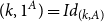 $(k,1^A)=Id_{(k,A)}$ $\bullet$
((
$\bullet$
(( $1^B,U$
))
$1^B,U$
)) $(1^B,U)=Id^{(B,U)}$
and
$(1^B,U)=Id^{(B,U)}$
and $\bullet$
((
$\bullet$
(( $u,1^A$
))
$u,1^A$
)) $(u,1^A)=Id^{(u,A)}$ $\bullet$
((
k
’
k
,
K
))
$\bullet$
((
k
’
k
,
K
))

where $(-,A)_{k'k}$
is the 2-cell from the laxity of
$(-,A)_{k'k}$
is the 2-cell from the laxity of $(-,A)$ $\bullet$
((
k
,
K
’
K
))
$\bullet$
((
k
,
K
’
K
))

where $(B,-)_{K'K}$
is the 2-cell from the laxity of
$(B,-)_{K'K}$
is the 2-cell from the laxity of $(B,-)$ $\bullet$
((
u
,
K
’
K
))
$\bullet$
((
u
,
K
’
K
))
 $\bullet$
((
k
’
k
,
U
))
$\bullet$
((
k
’
k
,
U
))
 $\bullet$
((
$\bullet$
(( $\frac{u}{u'},K$
))
$\frac{u}{u'},K$
)) $(\frac{u}{u'}, K)=\frac{(u,K)}{(u', K)}$
and
$(\frac{u}{u'}, K)=\frac{(u,K)}{(u', K)}$
and $\bullet$
((
$\bullet$
(( $k,\frac{U}{U'}$
))
$k,\frac{U}{U'}$
)) $(k,\frac{U}{U'})=\frac{(k,U)}{(k,U')}$ $\bullet$
((
$\bullet$
(( $u,\frac{U}{U'}$
))
$u,\frac{U}{U'}$
))
 $\bullet$
((
$\bullet$
(( $\frac{u}{u'},U$
))
$\frac{u}{u'},U$
))
 $\bullet$
((
k
,
K
)-l-nat)
$\bullet$
((
k
,
K
)-l-nat)
 $\bullet$
((
k
,
K
)-r-nat)
$\bullet$
((
k
,
K
)-r-nat)
 $\bullet$
(((
u
,
U
)-l-nat)
$\bullet$
(((
u
,
U
)-l-nat)
 $\bullet$
((
u
,
U
)-r-nat)
$\bullet$
((
u
,
U
)-r-nat)

for any 2-cells

in $\mathbb{B}$
, respectively
$\mathbb{B}$
, respectively $\mathbb{A}$
.
$\mathbb{A}$
.
The data of the points 1. and 2. of this proposition comprise the definition of a lax double quasi-functor $H:\mathbb{A}\times\mathbb{B}\to \mathbb{C}$
.
$H:\mathbb{A}\times\mathbb{B}\to \mathbb{C}$
.
Appendix C.
Table 1 of Reference Femić Femić (2023) , Proposition 3.3 enriched by additional interpretations:
Generation of a lax double quasi-functor $\mathbb{A}\times\mathbb{B}\to \mathbb{C}$
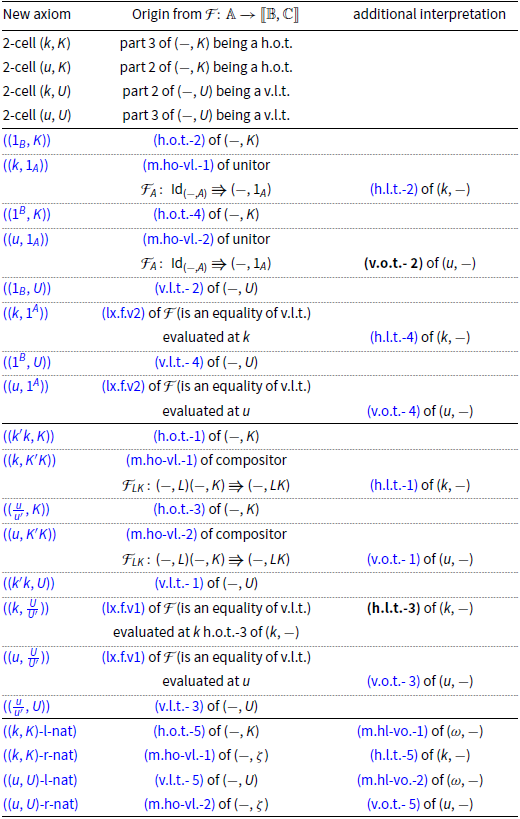
Appendix D.
Definition D.1 Femić (2023, Definition 4.3)). A vertical lax transformation $\theta_0\colon (-,-)_1\Rightarrow (-,-)_2$
between lax double quasi-functors
$\theta_0\colon (-,-)_1\Rightarrow (-,-)_2$
between lax double quasi-functors $(-,-)_1,(-,-)_2\colon\mathbb{A}\times\mathbb{B}\to \mathbb{C}$
is given by: for each
$(-,-)_1,(-,-)_2\colon\mathbb{A}\times\mathbb{B}\to \mathbb{C}$
is given by: for each $A\in\mathbb{A}$
a vertical lax transformation
$A\in\mathbb{A}$
a vertical lax transformation $\theta_0^A\colon (-,A)_1\Rightarrow(-,A)_2$
and for each
$\theta_0^A\colon (-,A)_1\Rightarrow(-,A)_2$
and for each $B\in\mathbb{B}$
a vertical lax transformation
$B\in\mathbb{B}$
a vertical lax transformation $\theta_0^B\colon (B,-)_1\Rightarrow(B,-)_2$
, both of lax double functors, such that
$\theta_0^B\colon (B,-)_1\Rightarrow(B,-)_2$
, both of lax double functors, such that $(\theta_0^A)_B=(\theta_0^B)_A$
and such that
$(\theta_0^A)_B=(\theta_0^B)_A$
and such that
( $VLT^q_1$
)
$VLT^q_1$
)

for every 1v-cells $U\colon A\to \tilde A$
and
$U\colon A\to \tilde A$
and $u\colon B\to \tilde B$
;
$u\colon B\to \tilde B$
;
( $VLT^q_2$
)
$VLT^q_2$
)

for every 1h-cell $K\colon A\to A'$
and 1v-cell
$K\colon A\to A'$
and 1v-cell $u\colon B\to \tilde B$
,
$u\colon B\to \tilde B$
,
( $VLT^q_3$
)
$VLT^q_3$
)

for every 1v-cell $U\colon A\to \tilde A$
and 1h-cell
$U\colon A\to \tilde A$
and 1h-cell $k\colon B\to B'$
, and
$k\colon B\to B'$
, and
( $VLT^q_4$
)
$VLT^q_4$
)

for every 1h-cells $K\colon A\to A'$
and
$K\colon A\to A'$
and $k\colon B\to B'$
.
$k\colon B\to B'$
.
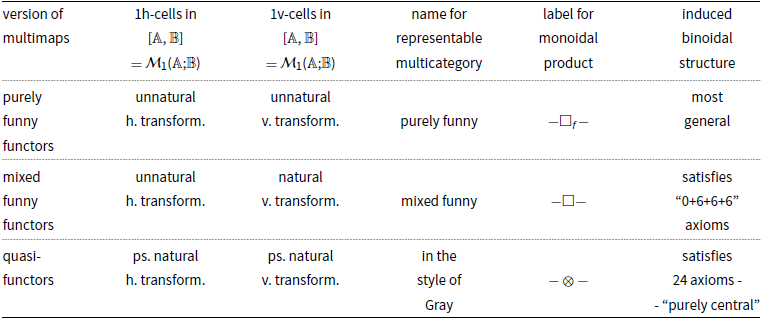
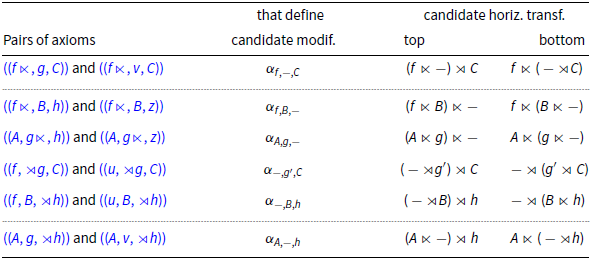
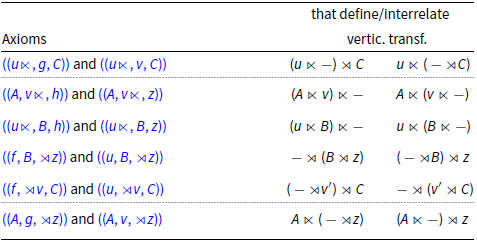
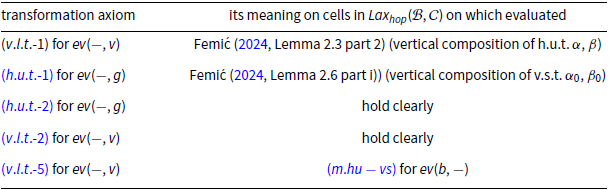


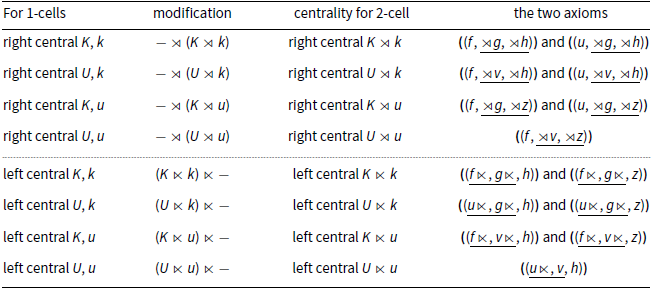

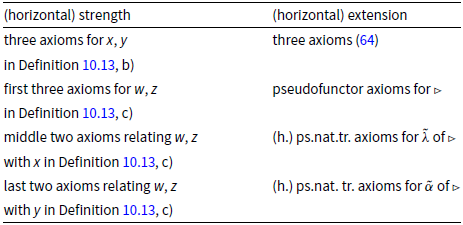
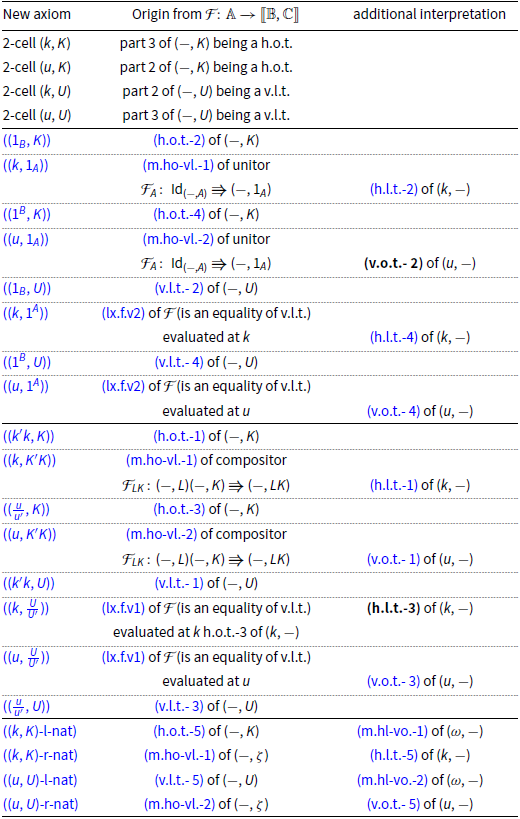


 Open access

