




Background
Population aging in urban centres has increased attention to the concept of age-friendly cities (Menec & Brown, Reference Menec and Brown2022; Sánchez-González et al., Reference Sánchez-González, Rojo-Pérez, Rodríguez-Rodríguez and Fernández-Mayoralas2020; Torku et al., Reference Torku, Chan and Yung2021). Age-friendly cities and initiatives (AFCIs) encompass a wide array of municipal and community-level actions designed to support older adults’ well-being (Greenfield et al., Reference Greenfield, Oberlink, Scharlach, Neal and Stafford2015), and these have been widely adopted across Canadian urban settings (Forsyth & Lyu, Reference Forsyth and Lyu2024; Guglielmin et al., Reference Guglielmin, Shankardass, Bayoumi, O’Campo, Kokkinen and Muntaner2022). Successes continue to be reported as cities adopt AFCIs in creative ways via cross-sectoral collaborations and co-produced initiatives that centre the lived experiences of older adults (Buffel & Phillipson, Reference Buffel, Phillipson, Buffel and Phillipson2023). Simultaneously, older adults who experience disadvantage and marginalization are rendered invisible within age-friendly systems that fail to account for variability in local implementation, uneven resource distribution, and barriers to meaningful participation (Tenquist et al., Reference Tenquist, Hartland, Salles, Buffel, Doran and Yarker2024). The extent to which older adults are able to age well in their urban communities depends on their social and economic capital with persistent and increasing inequities noted among certain sub-groups (Bolster-Foucault et al., Reference Bolster-Foucault, Vedel, Busa, Hacker, Sourial and Quesnel-Vallée2024). Thus, the aspirations of age-friendly policies continue to be challenged by ongoing systemic failures to meet the needs of older adults facing precarity in the context of dwindling social welfare supports and increasing government austerity measures (Buffel & Phillipson, Reference Buffel, Phillipson, Buffel and Phillipson2023).
Within this landscape, the well-being of immigrant and racialized older adults (IROAs) has emerged as a pressing issue in Canadian urban environments, reflecting the intersection of population aging with broader goals for immigrant integration (Khan et al., Reference Khan, Ferrer, Lee, Deloria, Kusari, Migrino, Danan and Yen2023; Orpana et al., Reference Orpana, Chawla, Gallagher and Escaravage2016). ‘Racialized Canadians’ refers to individuals grouped according to ethnic or racial characteristics and subjected to systemic discrimination. For IROAs, the combined effects of ageism and racism produce near invisibility of their needs and concerns across policy domains (Bhatia et al., Reference Bhatia, McLaren and Huang2024; Salma & Salami, Reference Salma and Salami2020). This lack of policy recognition has been described as a form of passive ageism that neglects the later phases of immigrants’ lives (Dolberg et al., Reference Dolberg, Sigurðardóttir, Trummer, Ayalon and Tesch-Römer2018). Immigrant older adults represent a growing demographic: those over 65 now comprise 30 per cent of their age cohort, the highest proportion among all age groups in Canada (Statistics Canada, 2022a). Compared to non-immigrant older adults, IROAs experience higher poverty rates, poorer health outcomes, and greater unmet long-term care needs (Employment and Social Development Canada, 2018; Ho et al., Reference Ho, Pullenayegum, Burnes and Fuller-Thomson2022; Lin, Reference Lin2024; Salma & Salami, Reference Salma and Salami2020). Their challenges vary depending on the life stage at which they migrated and the socioeconomic capital they accumulate (Bhatia et al., Reference Bhatia, McLaren and Huang2024; Kwak, Reference Kwak2018). Those immigrating after retirement often face heightened economic dependency on family members and limited access to government-funded supports (Brotman et al., Reference Brotman, Ferrer and Koehn2020; Li et al., Reference Li, Guruge and Lee2023). Current services designed for IROAs tend to emphasize multilingual support and cultural inclusion yet frequently overlook structural issues such as poverty and systemic racism (Ferrer et al., Reference Ferrer, Grenier, Brotman and Koehn2017; Johnson et al., Reference Johnson, Bacsu, Abeykoon, McIntosh, Jeffery and Novik2018; Laher, Reference Laher2017).
Edmonton, a mid-sized Canadian urban centre with approximately 1.2 million residents, is among the fastest-growing cities in Canada, fueled by both international and interprovincial migration; Alberta led all provinces with 17,444 net migrants in 2025 (Government of Alberta, 2025a, 2025b). This rapid demographic diversification has contributed to a growing population of IROAs, highlighting the importance of examining how municipal policies address health equity. Edmonton is situated within a province often characterized as politically conservative, yet the city itself reflects a more politically mixed and comparatively progressive urban context. Municipal leadership and civic initiatives have tended to emphasize inclusion, social equity, and newcomer integration. Responsibility for immigrant settlement and integration in Canada primarily rests with the federal government, with varying provincial involvement depending on jurisdiction (Blower, Reference Blower2020; Gunn, Reference Gunn2012). Municipalities, however, provide frontline services for newcomers and have historically acted as ‘policy innovators’ in settlement and integration, developing programmes and initiatives that respond to local needs (Blower, Reference Blower2020; Gunn, Reference Gunn2012; Holley & Jedwab, Reference Holley and Jedwab2019). Municipal governments increasingly recognize their responsibility in advancing inclusion and equity, adopting anti-racism frameworks and policies that foster immigrant belonging (Blower, Reference Blower2020). Edmonton’s Migrant Inclusion Policy (C529) and associated Migrant Action Plan articulate a municipal commitment to supporting migrants’ full participation in civic, social, and economic life (City of Edmonton Council, 2024). Complementing these efforts, the State of Immigration and Settlement Reports provide ongoing analyses of newcomer demographics, experiences, and service needs, informing local policy and practice in Edmonton (City of Edmonton, n.d.). Edmonton also benefits from the presence of the Edmonton Local Immigration Partnership, a multi-sectoral collaboration that coordinates strategies across government, community agencies, and service providers to enhance settlement and inclusion outcomes. Immigration, Refugees and Citizenship Canada (IRCC) funds Local Immigration Partnerships (LIPs) in 87 communities across Canada, which facilitate partnerships, coordination, and information sharing across service providers and jurisdictions (National LIP Secretariat, n.d.).
At the same time, age-friendly priorities have evolved in Edmonton. In 2010, the City of Edmonton spearheaded the Seniors’ Declaration, and this was followed, most notably, by the Age-Friendly Edmonton Initiative which was the City’s most targeted effort to address older adults’ needs (Government of Alberta, 2014). The initiative’s nine strategic areas were comprehensive and included: (a) community support services, (b) healthy aging, (c) communication and information, (d) social and recreational participation, (e) transportation, (f) respect and social inclusion, (g) civic participation, volunteerism, employment, (h) housing, and (i) outdoor spaces and buildings. The Edmonton Seniors Coordinating Council (ESCC), created in 2004, continues to be a key municipal partner. The ESCC evolved from a small network formed to address gaps in seniors’ services into a city-wide leader in collaboration, uniting organizations and partners to shape age-friendly policy, programmes, and systems. Its growth has been marked by expanding partnerships, launching initiatives like Age-Friendly Edmonton, and increasingly acting as a catalyst for integrated, community-driven supports that help older adults age well in place (Cyuzuzo, Reference Cyuzuzo2025). Despite these important efforts, there remains limited clarity regarding how municipal policies and practices address the needs of individuals whose experiences are shaped by the intersecting processes of aging and migration. The aim of this study was to engage municipal policy partners, including elected officials, municipal staff, and community members that work closely with the municipality, on their perceptions of equity for IROAs and how their needs are addressed within Edmonton’s age-friendly initiatives.
Methods
Study design, setting, and sampling
This study is part of a larger community-based participatory research project – the Edmonton Neighborhood Study – that engages immigrant older women from Arab and South Asian communities in designing and implementing a community-based well-being intervention. These communities were selected because they are among the largest and fastest-growing immigrant groups in Canada (Statistics Canada, 2022b) and are well represented in Edmonton.
A qualitative descriptive sub-project in 2023–2024 involved engaging municipal policy partners in discussions about age-friendly policies and practices that address the needs of IROAs. An equity lens is used to explore the ways policies and related practices impact historically underserved communities and identify structural barriers to healthy aging for IROAs (Douglas et al., Reference Douglas, Willock, Respress, Rollins, Tabor, Heiman, Hopkins, Dawes and Holden2019). We use the term ‘older adults’ and ‘seniors’ interchangeably in this study as the second term is more commonly used in the community and policy realms. We define policy partners as knowledge users who have worked directly or indirectly with municipal policy through one of the following capacities: municipal officials/elected representatives, city administrators, programming staff, advisory committee volunteers, and senior-serving providers/organization staff members. All participants were recruited by a research assistant and graduate student (NL) using snowball and purposive sampling. Potential participants were initially contacted via email, with addresses obtained from publicly available organizational websites or through professional network connections, to inform them about the study and request their participation. Given the research teams’ expertise in the area of aging and migration, we were able to identify key policy partners in Edmonton. To ensure a broad range of opinions and experiences, participants were encouraged to refer and suggest additional potential participants. Key to this research was to seek diverse opinions and experiences, and thus sampling and data analysis were conducted concurrently to facilitate an iterative process. An information letter was sent via email to all potential participants explaining the purpose of the study and the background of the larger CBPR project.
Data collection
All participants provided written informed consent. Ethics approval was obtained from the research team’s academic institution before commencement of research activities (ethics ID: Pro00123689). Semi-structured interviews were participant led and an iterative interview guide that included specific questions to reference policies relevant to aging in place and the age-friendly frameworks was used to facilitate conversation (Table 1). The interview guide was refined and adapted to ongoing concurrent data analysis. One interview occurred with a dyad and another scheduled interview spontaneously evolved into a focus group discussion due to organization staff asking if others on their team could join the conversation and add insights to the questions. Sample size was determined using information power which emphasizes the adequacy and richness of the data in relation to the study’s aim (Malterud et al., Reference Malterud, Siersma and Guassora2016). Recruitment ended when the research team determined that the data set had a variety of perspectives that provided contextually rich insights, adding to existing understandings of the needs of IROAs in Edmonton.
Sample questions from interview guide

With each new interview, the interview guide was modified to build on emerging ideas and adapted to participants’ roles and responsibilities regarding the policies discussed. All interviews lasted 45–60 minutes and were conducted online using Google Meets. Audio-recorded interviews were transcribed verbatim. Throughout the data collection process, field notes were taken and team meetings were held to support iterative sampling and analysis. Careful attention to exploring diversity in perspectives was essential to understanding and interpreting what was important to participants and their understanding of how IROAs are depicted and attended to at the level of the municipality. The interviewer (NL) on the research team was a graduate student with a strong interest in municipal politics and understanding of the Edmonton context.
Data analysis
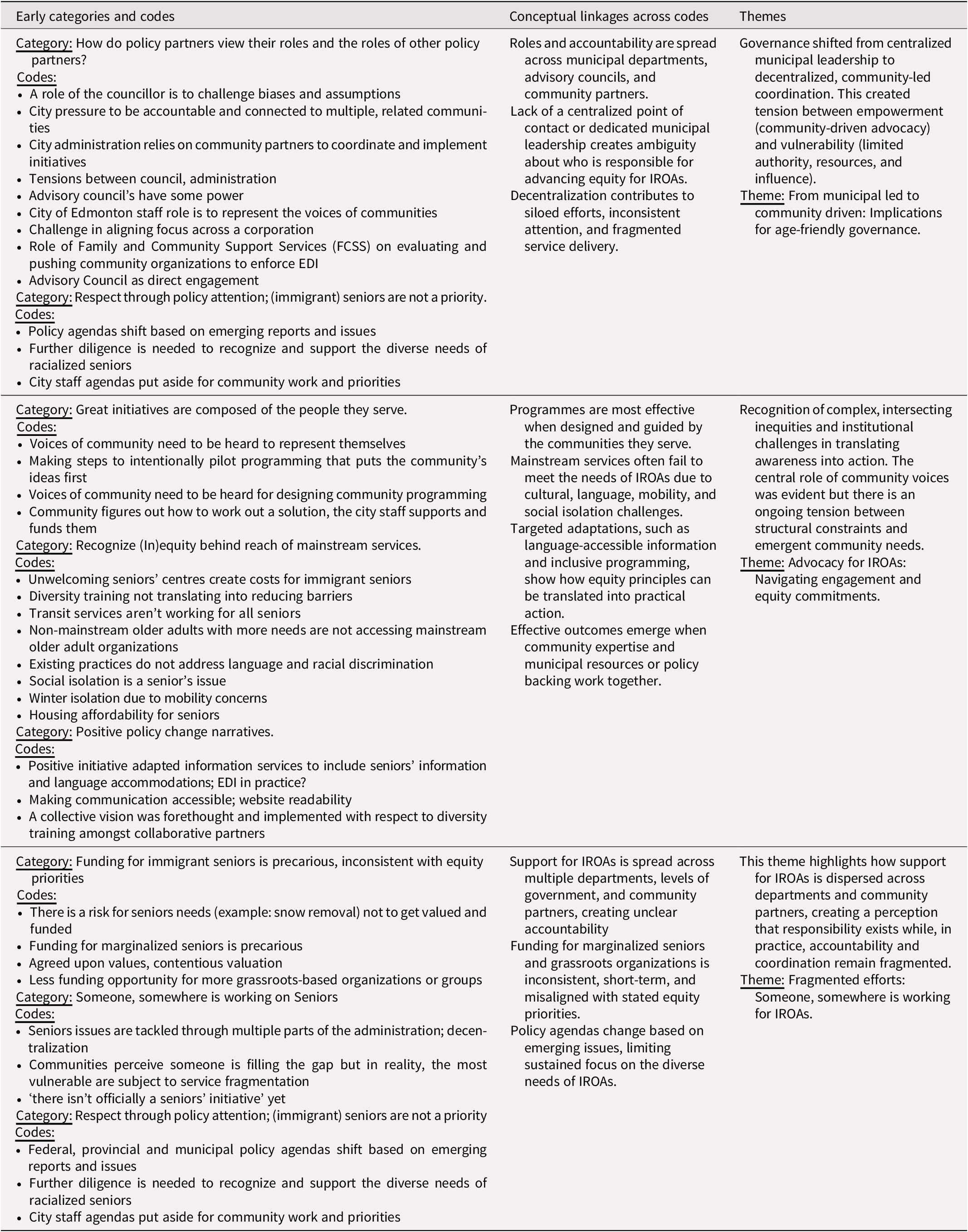
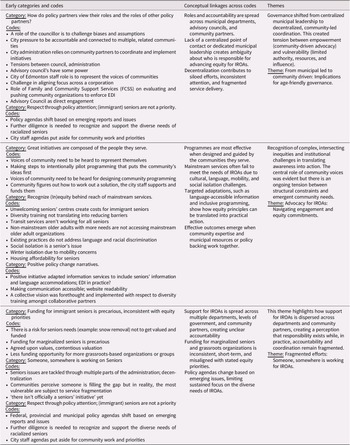
Reflexive thematic data analysis is a method for identifying, analyzing, and reporting patterns observed in the data through both inductive and deductive coding (Clarke & Braun, Reference Clarke and Braun2017). NVivo 12 qualitative data analysis software was used to facilitate the coding process in a collaborative team approach. The researchers (NL, AA, LH, JS) held weekly team meetings to resolve disagreements and collectively agree on key patterns and coding interpretations. The coding process was facilitated via an online concept mapping software and involved inductive coding of the data transcripts. These initial codes were further refined over time as analysis progressed and organized into categories that reflected similar concepts or ideas related to the needs of IROAs, structural challenges, and policy partner experiences supporting older adults in the City. Higher level coding, that reflected the theoretical evolution of our understanding of the data, followed where we drew on our equity-centred lens to look for ways IROAs were included or excluded within policy realms. Relationships among codes were assessed to identify patterns that explained the ways policy partners were navigating advocating for and supporting IROAs and the contextual influences. These explanatory patterns were formulated through multiple group discussions within the research team and data patterns were organized into the final themes (Table 2).
Coding process for theme development
Reflexivity and positionality
Key to this research was the researchers’ collaborative reflexivity (i.e., asking difficult questions about our assumptions during team meetings) during the analysis. OS, HF, and JS have conducted research in collaboration with immigrant communities and have extensive expertise in equity health research and qualitative methods. NL and SC have policy expertise, including at the municipal and community levels. LH, NL, AA, and VM were graduate students at the time of this study and supported recruitment, data collection, and analysis. Some team members self-identify as belonging to racialized and/or migrant communities, while others do not, which facilitated the in-depth analysis of equity from insider and outsider perspectives.
Results
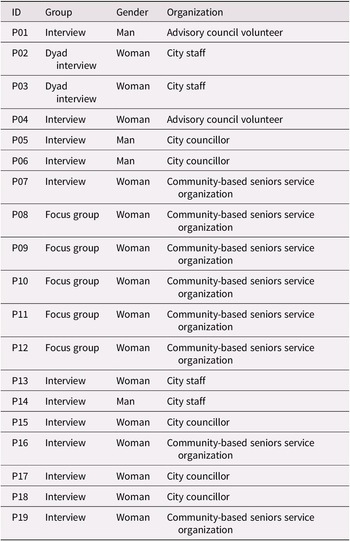
A total of 19 policy partners participated in this study (Table 3). Edmonton has 22 citizen-appointed committees, eight of which are advisory committees, and participants from two of these volunteered to join the study. At the time of data collection, there was no Seniors or Newcomer Advisory Committee. Participants also included representatives from three community-based seniors service organizations, such as executive directors, programme leads, project managers, and staff members. City councillors are elected to be a voice for their communities and work on city council to shape municipal policies, while city staff hold administrative roles and are responsible for implementing council directives and delivering public services. Our analysis is presented as three inter-related themes that showcase the success, struggles, and systemic barriers to meeting the needs of IROAs within this municipality: (1) from municipal led to community driven: implications for age-friendly governance, (2) advocacy for IROAs: navigating engagement and equity commitments, and (3) fragmented efforts: someone, somewhere is working for IROAs.
Participants’ gender and roles

From municipal led to community driven: Implications for age-friendly governance
At the time of the interviews, the Age-Friendly Edmonton initiative was undergoing re-structuring to renew its focus and better engage older adults from diverse backgrounds, including IROAs. Seven participants (P05, P06, P11, P13, P16, P17, P19) observed the absence of a dedicated municipal seniors’ initiative. Perspectives ranged from critical, ‘they don’t even have a seniors’ area or seniors’ department anymore’ (P19, Community-Based Seniors Service Provider (CBSSP)) to neutral ‘at the moment there isn’t officially a seniors’ initiative, but that doesn’t mean it won’t come back’ (P06, Elected Representative). Many linked this shift to the municipality’s decision to delegate leadership to a partner community organization responsible for advocacy and collaboration with the City. As one municipal administrator explained:
Those pillars for Age-Friendly Edmonton really advanced some of our policy, and our thinking, and quite a bit of that foundational work. Now… the City of Edmonton’s moved out of being the lead… and it now sits with the community. (P03)
All 19 participants referenced the initiative’s strategic areas using examples of successful initiatives. One City staff member described the outcomes:
Age-Friendly Edmonton had… 58 goals or outcomes… In the first five years, we ended up achieving 54… We would now focus on transportation, physical spaces, social programs, diversity, and equity… to develop tools, programs, or identify services to best address the aging population. (P02)
Over time, the City shifted from age-specific programming to broader social issue frameworks, integrating older adults’ needs into general services. Many participants noted valuable progress being made by the City in enhancing transportation, recreation, and other areas that the municipality was responsible for and these participants emphasized the positive impact of listening to citizens to enhance services and urban spaces. While Age-Friendly Edmonton was credited with building a strong policy foundation, participants noted seniors’ issues had become less centralized and less visible within municipal priorities. One community-based seniors service organization now acts as the coordinating body for seniors’ issues. While this role allows for community-led advocacy, several participants described it as ‘offloading’, creating capacity challenges due to limited funding and staffing. Success depended on strong municipal relationships to ensure early engagement in policy processes. As one participant noted:
Almost every issue the City touches on affects seniors… But we don’t have the relationships in every department… half the time… they don’t keep you in the loop until the decision is made. (P03)
A key concern was the absence of dedicated municipal staff for seniors’ issues, with responsibilities spread across departments and a reliance on community organizations for timely community feedback:
we don’t do direct service delivery… We’re small… nine people… We get calls… ‘Tell us what seniors think about… alcohol use in the park,’… how do we mobilize to find out what’s needed… to advocate at realistic levels? (P04)
These accounts highlight the tension between the value of community-level engagement and the resource limitations of community organizations tasked with system-level advocacy. Several participants perceived a decline in municipal commitment following the dismantling of a dedicated municipal seniors team, viewing this as a loss of credibility, visibility, and integration across policies and departments. Without dedicated municipal leadership to champion and coordinate initiatives, participants feared the momentum of age-friendly efforts could diminish, where attention to the needs of marginalized older adults would become fragmented and less effective. In the two themes next, we describe some of the ways that the municipality and its’ partners understand and respond to the needs of IROAs.
Advocacy for IROAs: Navigating engagement and equity commitments
Across the sample, there was a high degree of awareness about health (in)equities and the unique needs of IROAs, including the necessity for tailored services and supports. Many participants were familiar with concepts such as equity, diversity, and inclusion (EDI), and intersectionality. City staff noted that ‘the city has embedded EDI into everything we do’ (P02/P03), and an elected representative observed that ‘every report [has] an intersectional lens’ (P06). Despite these commitments, participants emphasized that greater progress was needed in terms of representation, engagement, and practical application. Elected officials spoke of the need to ‘proactively’ reach underrepresented IROAs (P06) and highlighted the importance of ‘the rich tapestry of the expertise across multiple voices’ to challenge entrenched assumptions in decision making (P18).
Advocacy for IROAs was framed as part of broader efforts to address multiple, intersecting forms of disadvantage. Participants often reported feeling pressured to respond to emerging funding calls and organizational priorities, even when these did not align with the immediate needs of the communities they aimed to serve. In this study, ‘advocacy’ refers not to sweeping, high-profile policy reforms but to smaller, incremental actions taken by organizational champions. Participants not only acknowledged that IROAs require additional resources but also reported competing demands to address the needs of other marginalized populations, including Black, Indigenous, and People of Color (P02), marginalized youth (P07), and people with disabilities or on low income (P14). Some elected officials advocated for moving away from narrowly targeted interventions toward broader, cross-cutting initiatives. For example, one participant noted that ‘if you remove barriers to one, you remove barriers for many’ (P18). Examples included low-cost food provision, recreation programmes in multiple languages, and inclusive festivals (P18).
A City administrator emphasized the need for a comprehensive policy review: ‘We want the ethnocultural communities and the Indigenous perspective there, which is very different’ (P05). Increasing representation across groups and organizations was seen as a shared ideal by elected representatives, city administrators, CBSSPs, and advisory committee members. For advisory council volunteers, however, their direct engagement was described as meaningful and rewarding: ‘it’s very gratifying, as a volunteer, to have some influence, and responsibility as well…one of the most rewarding committees I’ve ever served on’ (P01). In contrast, CBSSPs often felt their advocacy efforts went unheard or undervalued, while city administrators emphasized shared values and streamlined resources.
Reaching socially isolated older adults was recognized as a persistent challenge. IROAs are frequently categorized as ‘socially isolated’. City administrators, elected officials, and CBSSPs emphasized the importance of ‘meeting people where they are’ (P08), rather than requiring them to travel to unfamiliar or inaccessible service locations. These constraints placed the burden of service provision on under-resourced ethnocultural and faith-based communities. These communities are often ‘completely overwhelmed’ with addressing immediate concerns like food, housing, and crisis supports, leaving little capacity for advocacy and timely engagement in municipal policymaking. Current City engagement practices, such as centralized town halls, can fail to meet communities where they are or address issues that are meaningful to them, resulting in limited and inequitable participation in decision making.
I think engagement is always a challenging process, right? I think from a municipal perspective, the City needs to go where the people are and meet them where they’re at, and engage them on issues that are meaningful to them. I don’t think our City’s engagement policy does a good job of any of that. It’s, ‘Here’s a town hall. Come downtown. This is what we’ll talk about, checkbox, and that’s our engagement’. (P16)
Additionally, civic engagement was sometimes questioned for those marginalized within the system, such as temporary migrants. One elected representative recalled pushback to a community request for park benches:
‘Why are you only listening to people who are not even citizens, who are not voting, they don’t pay taxes?’ But I’m like, ‘These are the people who came to take care of your grandkids’. Shouldn’t they get a say… and be able to put some of their ideas into action? (P16)
Overall, participants demonstrated a strong understanding of IROAs’ experiences and needs but felt constrained by limited resources and competing priorities. IROAs were often seen as one of many equity-denied groups whose needs overlapped with others, and therefore potentially addressed through broader initiatives. Policy partners stressed the importance of including IROAs in forthcoming age-friendly policy discussions, which would require intentional outreach to socially isolated older adults and those historically excluded from service provision.
Fragmented efforts: Someone, somewhere is working for IROAs
Participants described an implicit expectation that ‘someone, somewhere’ within the system was addressing the health equity needs of IROAs. While issues of concern to older adults in the City were recognized as being addressed across multiple areas of the administration, there were no clear accountability mechanisms specific to health (in)equity for IROAs. Advocacy for IROAs was often embedded within short-term initiatives added to already full portfolios. As one participant explained, people were ‘stretched… [with] too many competing priorities’, resulting in IROAs being ‘pushed to the side’ (P19). Participants called for sustainable initiatives that integrate IROA engagement into core responsibilities, rather than being treated as peripheral tasks ‘off the side of people’s desks’ (P16). Staff from a community-based seniors service organization also described a top-down approach to priority setting that left little room for input: ‘This is a bureaucracy that tends not to be open to listening’ (P08–P12). Jurisdictional fragmentation compounded these challenges where federal, provincial, and municipal governments are responsible for different areas of social and health policy in Canada. While the federal government oversees immigration and provinces manage health care, municipal responsibilities for IROAs remain ill defined:
Immigrant seniors need a separate policy… after 2005, many immigrants were in the position to sponsor their families, particularly parents and grandparents… settlement is not under the jurisdiction of the municipality and therefore they would not provide any English as a second language program. Senior housing, this is an issue…This is not the City’s responsibility. Then comes the health issues, which is again not in the jurisdiction of the City…there need[s] to be some healthy debate on what is and what is not under the City policy, and what should be done to respond to those issues? Because these people live in our communities, whether they are the problem of the province or problem of the federal government, they are living in our communities, which means the City. (P05)
The need for a policy or policies focused on IROAs was emphasized to enhance accountability, coordination, and delegation of resources to this population. Responsibility often fell to ‘other parties’ outside participants’ direct jurisdiction, with little clarity about who was advancing the work. As one participant noted, ‘I don’t know whether I’m the best person to speak to it… I’m just someone who happens to have seniors as a portfolio’ (P13). Shifting organizational roles contributed to this fragmentation, prompting calls for a centralized point of contact or a database of those working on IROA issues. While some participants sought to align and connect initiatives between community and government sectors (P02/03; P13), limited municipal resources created persistent fragmentation. Challenges included navigating power differentials (P05, P13), accessing funding (P07), managing local data collection (P08), and setting priorities (P15, P18). Also some discussed the lack of data to track where the needs were and whether diverse communities were being served:
Equality means we treat everybody the same but that’s not effective for those who have increased cultural needs, who don’t feel welcome in certain spaces because they don’t see themselves represented… that’s the cultural landscape in which we’re operating… who are the cultural communities we’re reaching based on the population data? Who are we missing? Of those cultural communities that we’re missing, what are the access points that we need to think about? What kind of services do we need to build? (P08)
Another main barrier to implementing age-friendly infrastructure was seen as inadequate resource allocation, not a lack of awareness. Using snow removal as an example, one participant explained that winter conditions ‘continue to be challenging to navigate… if you have any type of mobility challenge’, but budget constraints prevent adequate investment (P06). This tension between fiscal restraint and accessibility goals was seen as indication of broader underinvestment in age-friendly initiatives. Although Edmonton has been committed to age-friendly policies since 2010, policy and programme implementation for IROAs remains limited. Participants highlighted the absence of culturally relevant gathering spaces, recreation programmes, and housing options tailored to IROAs. These gaps intersect with barriers such as language discrimination, racism, and cultural exclusion from mainstream programming.
Ultimately, responsibilities for IROAs were siloed across organizations and levels of government, leaving their everyday needs insufficiently addressed. The dissolution of the City’s seniors section further reduced municipal leadership and coordination. Limited funding and decision-making power of some community groups restricts access to municipal resources and opportunities of influencing policy.
Discussion
Our research contributes to the expanding literature on inequities in aging (Bolster-Foucault et al., Reference Bolster-Foucault, Vedel, Busa, Hacker, Sourial and Quesnel-Vallée2024) and builds on existing scholarship on health equity initiatives in municipalities (Collins & Hayes, Reference Collins and Hayes2010; Nurdin et al., Reference Nurdin, Djaelani, Ansar and Sholihatin Amri2024). Neighbourhoods remain critical microsystems for healthy aging (Karner et al., Reference Karner, London, Rowangould and Manaugh2020), yet disadvantaged older adults, particularly those who are racialized, immigrants, or on low income, continue to be underserved (Phillipson & Grenier, Reference Phillipson and Grenier2021). Participants described the persistent tension of meeting the needs of IROAs while simultaneously addressing the priorities of other groups experiencing systemic disadvantages (e.g., Black, Indigenous, low-income, or youth populations). A challenge for the age-friendly paradigm is the degree to which the needs of older adults can be accommodated within broader policies and initiatives, for example, related to housing and food security, social inclusion, and transportation equity. While policy partners in this study pointed to ongoing efforts to be age-friendly, some described difficulties due to competing demands and priorities that limited timely input of older adults in policy decisions that impact their well-being. This mirrors experiences of other AFCIs where low visibility of older adults’ concerns, lack of interest in aging issues, lack of resources, and barriers to cross-sectoral collaboration hinder progress (Phillipson & Buffel, Reference Phillipson and Buffel2020; Rémillard-Boilard et al., Reference Rémillard-Boilard, Buffel and Phillipson2021). Overall, migration and aging are often treated as separate policy spheres. Ageism and racism intersect in policies that privilege younger economic migrants or Canadian-born older adults, leaving IROAs overlooked and under-supported. Recent calls for emancipatory approaches (Yeh et al., Reference Yeh, And, Plasencia, Buffel, Doran and Yarker2024) and spatial justice frameworks (Buffel et al., Reference Buffel, Yarker, Doran, Buffel, Doran and Yarker2024) provide valuable directions for building age-friendly, anti-racist cities that explicitly address inequities affecting older migrants. These frameworks compel policymakers to interrogate how systemic structures perpetuate inequities, including those disproportionately affecting older migrants (Phillipson & Grenier, Reference Phillipson and Grenier2021). Further research is required to explore the pathways of privilege and disadvantage that influence healthy aging in migrant populations and the related policy options that can enhance quality of life in older age.
Advocacy, community relationships, and representation
This study underscores the importance of policy partners advocating with and for IROAs. While equity-minded individuals worked creatively within the municipality and in partnership to support IROAs, their efforts were often undermined by the absence of targeted, system-level policies that were responsive to emerging needs of this population. Organizational champions played a vital role, but sustainable impact requires structural change that embeds IROAs into long-term policy strategies for healthy urban aging. Recent calls for attending to diversity within AFCIs have drawn attention to social inequalities in older age that stem from the intersections of racism, material deprivation, and ableism embedded in social and built environments (Nazroo, Reference Nazroo, Buffel, Doran and Yarker2024; Phillipson & Buffel, Reference Phillipson and Buffel2020; Rémillard-Boilard et al., Reference Rémillard-Boilard, Buffel and Phillipson2021). Policy partners in this study emphasized the critical need for processes that engage IROAs, via advisory councils and sustainable partnerships with seniors service organizations that have access to local community knowledge. This mirrors findings of other studies on the role of community-based seniors service organizations in bolstering the success of AFCIs via leading social initiatives that target social inclusion, support access to essential services for aging in place, and advocate for the needs of all older adults (Joy et al., Reference Joy, Fournier, Marr-Laing and Hebblethwaite2025). Structural barriers continue to limit IROAs’ civic engagement and, by extension, their ability to shape municipal decision making. Addressing these barriers requires culturally sensitive engagement strategies and meeting people in venues that are both accessible and familiar as per policy partners in this study. Central to these strategies are relationships among community members and municipal governments to foster trust and harness tacit community knowledge (Gupta et al., Reference Gupta, Pisolkar, Alhassan, Judge, Engler-Stringer, Gauvin and Muhajarine2022; Schultz et al., Reference Schultz, Zorbas, Peeters, Yoong and Backholer2023). Sustained and authentic engagement ensures that policy solutions are responsive to IROAs and grounded in lived realities of urban centres.
Transcending short-term and fragmented efforts
The shift in Edmonton from a municipal-led to a community-driven age-friendly model was described by some policy partners as reflecting the institutionalization of the Age-Friendly Edmonton vision, in which considerations for aging are integrated across departments and committees. Shortly after data collection for this study was completed, it was announced that Age-Friendly Edmonton transitioned from a city-led initiative co-led with the Edmonton Seniors Coordinating Council into the Edmonton Age Friendly Alliance, a broader network model that brings together diverse partners under the leadership of the Council to advance more collaborative, inclusive, and community-driven support for older adults. Integrating IROA needs into this broader alliance requires equitable funding models that strengthen grassroots ethnocultural organizations and support robust community–government partnerships. Local Immigration Partnerships (LIPs), funded through Canada’s Settlement Program, illustrate the potential of collaborative platforms to convene municipalities, service providers, and community stakeholders. By reducing duplication and fostering inclusive local policies, LIPs could be leveraged as sites of intervention to improve collaboration among senior service organizations, settlement agencies, and municipal governments, thereby enhancing the quality and coordination of supports for IROAs. Municipalities are increasingly involved in settlement and play a pivotal role in the successful integration of migrants, often being recognized as policy innovators (Blower, Reference Blower2020; Gunn, Reference Gunn2012). While efforts frequently focus on working-age migrants and their families as a strategy for urban economic growth, these individuals will eventually age, retire, and likely remain in urban centres. Moreover, as migration continues to rise, family reunification will increasingly enable older parents and grandparents to join multi-generational households. Further research and policy innovation in the AFCI domain are needed to better understand and address the needs of this demographic. Effective age-friendly policy implementation requires coordinated cross-sector action, leadership, capacity, and investment to overcome fragmentation and enable equitable, system-wide change (Keyes et al., Reference Keyes, Collins, Tao and Tiwari2022; Lustosa et al., Reference Lustosa, Meens Miller, Klicnik and Dogra2026; Pope et al., Reference Pope, Greenfield, Keyes and Russell2025). Policy partners in this study struggled to identify systemic approaches to recognizing and responding to the needs of IROAs. Recommendations included creating policies that centred the needs of this population, increasing coordination with community-based organizations that work with IROAs, and exploring ways to enhance coordination across sectors and levels of government. Overall, while the City of Edmonton was making notable progress in age-friendly initiatives and migrant inclusion polices, there remained a gap for IROAs whose needs often intersected across these two policy domains.
Strengths and limitations
Our research team brings strong contextual knowledge and established relationships with IROAs in the study setting. We highlight the perspectives of municipal policy partners who continue to advocate for healthy aging despite significant financial, organizational, and policy barriers. Interviewing policy partners about sensitive equity-focused topics such as ageism and racism can be challenging due to conceptual ambiguity about equity-related terms, reputational concerns, and the emotional discomfort these discussions may evoke. Participants’ positionality impacted the degree to which these issues emerged in the interview encounter, while the interviewer (NL) worked to create a relational space of acceptance, curiosity, and mutual learning. Finally, this was a convenience sample of policy partners which might have limited the diversity of perspectives shared in this study. While our findings reflect the experience of a single western Canadian municipality, they provide valuable insights into the local dynamics of policy and practice, with lessons that may inform other jurisdictions grappling with the intersecting needs of aging and migrant populations.
Conclusion
We identified the main barriers and facilitators faced by municipal policy partners when addressing health equity for IROAs based on an in-depth qualitative descriptive study in the City of Edmonton. Policy partners’ perceptions emphasized many successes but some challenges remain. Insufficient funding, lack of IROA representation, competing priorities, and limited capacity for sustainable policy action all result in fragmented and insufficient efforts to support this population. Incorporating IROA needs into broader age-friendly strategies requires equitable funding models and a strategic plan that fosters strong community-municipal partnerships of which Edmonton has a strong track record.
Data availability statement
The data sets generated and/or analyzed during the current are not publicly available to protect participant confidentiality and privacy, but are available from the corresponding author on reasonable request.
Author contribution
NL performed data collection. NL, LH, and AA were mentored by JS for data analysis and interpreting the data. NL, LH, AA, and JS prepared the first draft of the manuscript. VM, BS, HFS, and SC provided feedback and input for data interpretation and the manuscript write-up. VM, AA, and JS prepared the final draft.
Financial support
This work was financially supported by the Canadian Institutes of Health Research (CIHR) Project Grant (FRN: 183916).
Competing interests
The authors declare that they have no competing interests.
Ethics approval and consent to participate
Ethics approval for this work was obtained at the University of Alberta’s Research Ethics Board (Pro00123689). Informed consent to participate was obtained from all interview participants.


 Open access

